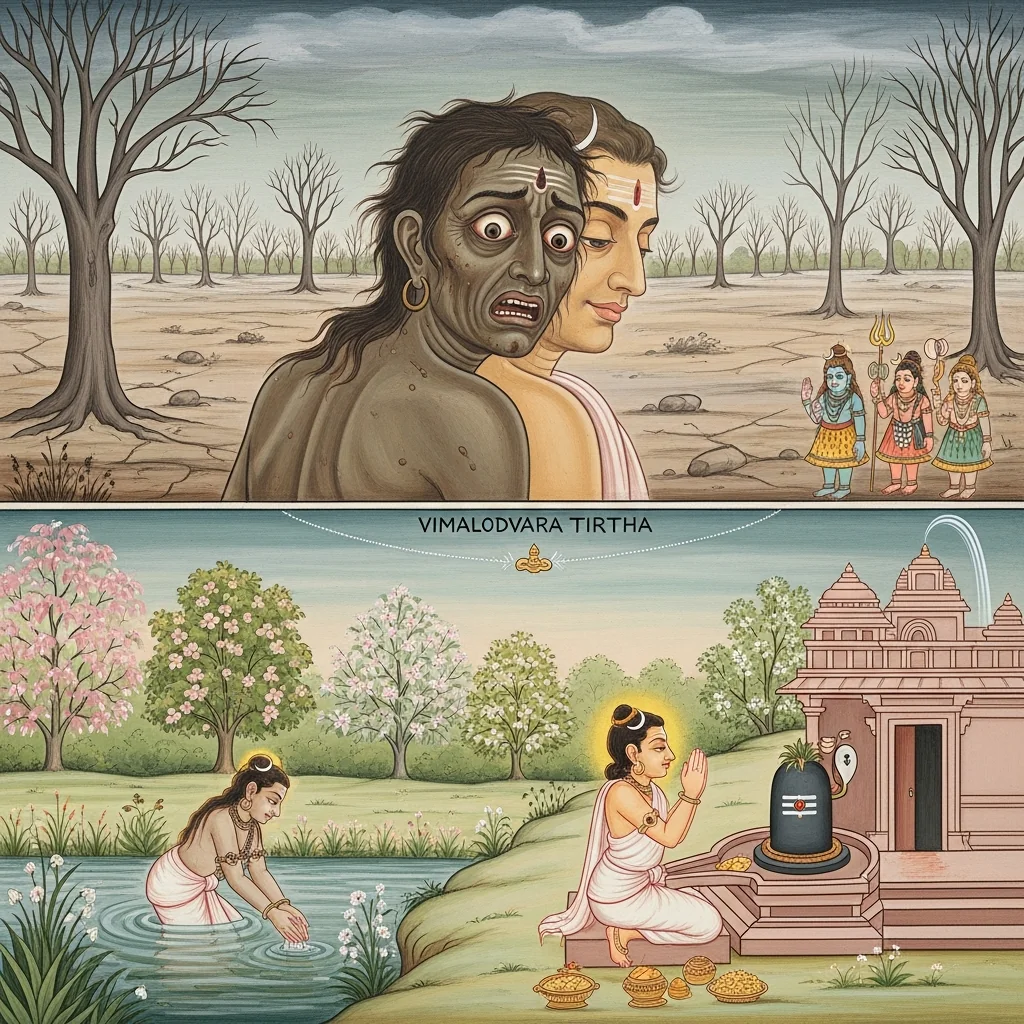
Adhyaya 4
Skanda speaks to Kumbhasambhava (Agastya) and proclaims the unsurpassed greatness of Kapardīśvara’s liṅga, situated north of Pitṛīśa. There a tank called Vimalodaka is excavated; contact with its water is said to make one “vimala” (purified). A Tretā-yuga episode follows: the Pāśupata ascetic Vālmīki performs strict midday observances—bhasma-snāna (smearing with sacred ash), pañcākṣarī-japa, meditative remembrance of Śiva, and circumambulation with devotional cries, song, rhythm, and gesture. He beholds a terrifying preta/rākṣasa-like being, whose ghastly form serves as a lesson contrasting impurity with ascetic order. The being explains karmic causality: once a brāhmaṇa at Pratiṣṭhāna on the Godāvarī, he accepted pilgrimage-linked gifts (tīrtha-pratigraha) and fell into a painful preta state in a harsh wasteland. By Śiva’s injunction, pretas and great sinners cannot enter Vārāṇasī and linger at its boundary in fear of Śiva’s attendants; yet hearing Śiva’s Name from a passerby reduced his demerit and allowed limited access. Moved by compassion, Vālmīki prescribes the remedy: mark the forehead with vibhūti as protective “armor,” bathe in Vimalodaka, and worship Kapardīśvara. With the ash-mark, the water-deities do not obstruct him; after bathing and drinking, the preta condition dissolves and a divine body is attained. The liberated one names the tīrtha Piśāca-mocana and declares its continuing power, including annual observance on the bright fourteenth of Mārgaśīrṣa with bathing, ancestral offerings (piṇḍa, tarpaṇa), worship, and food-gifts. The phalaśruti concludes that hearing or reciting this account protects from bhūtas, pretas, piśācas, thieves, and wild beasts, and is recommended to pacify children afflicted by graha disturbances.
Shlokas
Verse 1
स्कंद उवाच । कुंभसंभव वक्ष्यामि शृणोत्ववहितो भवान् । कपर्दीशस्य लिंगस्य महामाहात्म्यमुत्तमम्
Skanda said: O Kumbhasambhava (Agastya), I shall speak—listen with full attention—of the supreme, great glory of the Liṅga of Kapardīśa.
Verse 2
कपर्दी नाम गणपः शंभोरत्यंतवल्लभः । पित्रीशादुत्तरे भागे लिंगं संस्थाप्य शांभवम्
A gaṇa named Kapardī, exceedingly dear to Śambhu (Śiva), established a Śaiva Liṅga to the north of the shrine of Pitrīśa.
Verse 3
कुंडं चखान तस्याग्रे विमलोदक संज्ञकम् । यस्य तोयस्य संस्पर्शाद्विमलो जायते नरः
In front of it he dug a pond called Vimalodaka; by the touch of its water, a man becomes purified and spotless.
Verse 4
इतिहासं प्रवक्ष्यामि तत्र त्रेतायुगे पुरा । यथावृत्तं कुंभयोने श्रवणात्पातकापहम्
I shall now narrate an ancient sacred account from the Tretā-yuga—exactly as it occurred, O Kumbhayoni (Agastya). Merely hearing it destroys sins.
Verse 5
एकः पाशुपत श्रेष्ठो वाल्मीकिरिति संज्ञितः । तपश्चचार स मुनिः कपर्दीशं समर्चयन्
There was a foremost devotee of Paśupati, renowned as Vālmīki. That sage practiced austerity, worshipping Kapardīśa (Śiva) with reverence.
Verse 6
एकदा स हि हेमंते मार्गे मासि तपोधनः । स्नात्वा तत्र महातीर्थे मध्याह्ने विमलोदके
Once, in the winter season, in the month of Mārga (Mārgaśīrṣa), that ascetic—rich in austerity—bathed there at the great tīrtha at midday, in the pure waters of Vimalodaka.
Verse 7
चकार भस्मना स्नानमापादतलमस्तकम् । लिंगस्य दक्षिणेभागे कृतमाध्याह्निकक्रियः
He performed an ash-bath from the soles of his feet up to his head; and on the southern side of the liṅga he completed the midday observances.
Verse 8
न्यस्तमस्तकपांसुश्च संध्यामाध्यात्मिकीं स्मरन् । जपन्पंचाक्षरीं विद्यां ध्यायन्देवं कपर्दिनम्
With head bowed low, remembering the inner (spiritual) sandhyā, he recited the Pañcākṣarī mantra-vidyā and meditated upon the divine Lord Kapardin (Śiva).
Verse 9
कृत्वा संहारमार्गेण सप्रमाणं प्रदक्षिणाम् । हुडुंकृत्य हुडुंकृत्य हुडुंकृत्य त्रिरुच्चकैः
Having performed a full, proper pradakṣiṇā by the saṃhāra-mārga (the ritual path of dissolution), he cried out “huḍuṃ” again and again—thrice, in a loud voice.
Verse 10
प्रणवं पुरतः कृत्वा षड्जादिस्वरभेदतः । गीतं विधाय सानंदं सनृत्यं हस्तकान्वितम्
Placing the Praṇava (Oṃ) at the forefront, and varying the notes beginning with Ṣaḍja, he sang in joy—dancing as well, with expressive hand-gestures.
Verse 11
अंगहारैर्मनोहारि चारी मंडलसंयुतम् । क्षणं तत्र सरस्तीरे उपविष्टो महातपाः
With captivating aṅgahāras (dance combinations), joined with steps and circular movements, the great ascetic sat there for a moment on the bank of the lake.
Verse 12
अद्राक्षीद्राक्षसं घोरमतीव विकृताकृतिम् । शुष्कशंखकपोलास्यं निमग्ना पिंगलोचनम्
He beheld a dreadful rākṣasa, exceedingly misshapen—its cheeks and face like dried conch-shells, its tawny eyes sunken deep.
Verse 13
रूक्षस्फुटितकेशाग्रं महालंब शिरोधरम् । अतीव चिपिट घ्राणं शुष्कौष्ठमतिदंतुरम्
Its hair-tips were rough and split; its head and neck hung massively. Its nose was extremely flattened, its lips dry, and its teeth grotesquely protruding.
Verse 14
महाविशालमौलिं च प्रोर्ध्वीभूतशिरोरुहम् । प्रलंबकर्णपालीकं पिंगलश्मश्रुभीषणम्
He had an enormously large head, with hair standing upright; his ear-lobes hung down long, and he looked dreadful with tawny, bristling whiskers.
Verse 15
प्रलंबित ललज्जिह्वमत्युत्कट कृकाटिकम् । स्थूलास्थि जत्रु संस्थानं दीर्घस्कंधद्वयोत्कटम्
His tongue lolled out, his neck was grotesquely prominent; his collar-bone and upper-chest frame were made of thick bones, and his two shoulders were long and unnervingly massive.
Verse 16
निमग्नकक्षाकुहरं शुष्कह्रस्व भुजद्वयम् । विरलांगुलिहस्ताग्रं नतपीन नखावलिम्
His armpit-hollows were deeply sunken; both his arms were dried and short. His fingertips bore sparse, thin fingers, and his nails were bent and thickened.
Verse 17
विशुष्क पांसुलोत्क्रोडं पृष्ठलग्नोदरत्वचम् । कटीतटेन विकटं निर्मांसत्रिकबंधनम्
His loins were utterly dried and dusty; the skin of his belly clung to his back. His waist was misshapen and dreadful, and his back-joints were bound by fleshless, bony knots.
Verse 18
प्रलंब स्फिग्युगयुतं शुष्कमुष्काल्पमेहनम् । दीर्घनिर्मांसलोरूकं स्थूलजान्वस्थिपंजरम्
His buttocks hung low; his testicles were shriveled and his organ small. His thighs were long and fleshless, and his knees were heavy with a frightening cage of bone.
Verse 19
अस्थिचर्मावशेषं च शिराजालितविग्रहम् । शिरालं दीर्घजंघं च स्थूलगुल्फास्थिभीषणम्
He was little more than bone and skin; his body was netted over with protruding veins. Vein-ridged, with long shanks, he looked terrifying with thick ankle-bones.
Verse 20
अतिविस्तृत पादं च दीर्घवक्रकृशांगुलिम् । अस्थिचर्मावशेषेण शिराताडितविग्रहम्
His feet were excessively wide, with toes that were long, crooked, and thin. Being only bone and skin, his whole frame looked battered and striped by bulging veins.
Verse 21
विकटं भीषणाकारं क्षुत्क्षाममतिलोमशम् । दावदग्धद्रुमाकारमति चंचललोचनम्
Grotesque and fearsome in form, he was wasted by hunger and covered with excessive hair. He looked like a tree scorched by a forest-fire, and his eyes darted restlessly.
Verse 22
मूर्तं भयानकमिव सर्वप्राणिभयप्रदम् । हृदयाकंपनं दृष्ट्वा तं प्रेतं वृद्धतापसः । अतिदीनाननं कस्त्वमिति धैर्येण पृष्टवान्
Seeing that preta—like fear made manifest, a giver of terror to all beings, making the heart tremble—the aged ascetic, with steady courage, asked: “O you of most pitiable face, who are you?”
Verse 23
कुतस्त्वमिह संप्राप्तः कस्मात्ते गतिरीदृशी । अनुक्रोशधियारक्षः पृच्छामि वद निर्भयम्
From where have you come here? Why is your condition like this? O spirit, I ask you with a mind of compassion—speak without fear.
Verse 24
अस्माकं तापसानां च न भयं त्वद्विधान्मनाक् । शिवनामसहस्राणां विभूतिकृतवर्मणाम्
For us ascetics there is not the slightest fear of beings like you, for we are armoured with sacred ash and protected by the recitation of the thousand names of Śiva.
Verse 25
तापसोदीरितमिति तद्रक्षः प्रीतिपूवर्कम् । निशम्य प्रांजलिः प्राह तं कृपालुं तपोधनम्
Hearing what the ascetic had spoken, that rākṣasa—pleased—bowed with folded hands and addressed the compassionate sage, rich in austerity.
Verse 26
राक्षस उवाच । अनुक्रोशोस्ति यदि ते भगवंस्तापसोत्तम । स्ववृत्तांतं तदा वच्मि शृणुष्वावहितः क्षणम्
The rākṣasa said: “O venerable best of ascetics, if you have compassion, then I shall tell my own story—listen attentively for a moment.”
Verse 27
प्रतिष्ठानाभिधानोस्ति देशो गोदावरी तटे । तीर्थप्रतिग्रहरुचिस्तत्रासं ब्राह्मणस्त्वहम्
There is a place called Pratiṣṭhāna on the bank of the Godāvarī. There I lived as a brāhmaṇa, taking delight in accepting offerings connected with pilgrimage-rites.
Verse 28
तेन कर्मविपाकेन प्राप्तोस्मि गतिमीदृशीम् । मरुस्थले महाघोरे तरुतोयविवर्जिते
By the ripening of that karma, I have met with such a fate—cast into a dreadful desert land, bereft of trees and water.
Verse 29
गतो बहुतरः कालस्तत्र मे वसतो मुने । क्षुधितस्य तृषार्तस्य शीततापसहस्य च
O sage, a very long time has passed while I have dwelt there—hungry, tormented by thirst, and enduring cold and heat.
Verse 30
वर्षत्यपि महामेघे धारासारैर्दिवानिशम् । प्रावृट्कालेऽनिले वाति किंचित्प्रावरणं न मे
Even when great clouds pour torrents day and night, and when the monsoon winds blow, I have not even the slightest covering.
Verse 31
पर्वण्यदत्तदाना ये कृततीर्थप्रतिग्रहाः । त इमां योनिमृच्छंति महादुःख निबंधनीम्
Those who accept pilgrimage-offerings while failing to give charity on sacred festival days fall into this very womb-state, a bondage that brings great suffering.
Verse 32
गते बहुतिथे काले मरुभूमौ मुने मया । दृष्टो ब्राह्मणदायाद एकदा कश्चिदागतः
After a very long time had passed, O sage, in that desert I once saw a certain brāhmaṇa’s descendant who had arrived there.
Verse 33
सूर्योदयमनुप्राप्य संध्याविधिविवर्जितः । कृत्वा मूत्रपुरीषे तु शौचाचमनवर्जितः
Having reached the time of sunrise, he neglected the prescribed sandhyā-rites; and after urinating and defecating, he omitted purification and sipping of water (ācamanam).
Verse 34
मुक्तकच्छमशौचं च संध्याकर्मविवर्जितम् । तं दृष्ट्वा तच्छरीरेहं संक्रांतो भोगलिप्सया
Seeing that brāhmaṇa—careless in dress, impure, and one who had abandoned the twilight rites—I, out of craving for enjoyments, entered his very body here.
Verse 35
स द्विजो मंदभाग्यान्मे केनचिद्वणिजा सह । अर्थलोभेन संप्राप्तः पुरीं पुण्यामिमां मुने
That brāhmaṇa—unfortunate for me—arrived at this holy city, O sage, together with a certain merchant, driven by greed for wealth.
Verse 36
अंतःपुरि प्रविष्टोभूत्स द्विजो मुनिसत्तम । तच्छरीराद्बहिर्भूतस्त्वहं पापैः समं क्षणात्
When that brāhmaṇa entered the inner precincts (of the city), O best of sages, I was instantly expelled from his body—together with the sins.
Verse 37
प्रवेशो नास्ति चास्माकं प्रेतानां तपसां निधे । महतां पातकानां च वाराणस्यां शिवाज्ञया
For us pretas there is no entry—nor for great sins—into Vārāṇasī, O treasure of austerity, by Śiva’s command.
Verse 38
अद्यापि तानि पापानि तद्बहिर्निर्गमेच्छया । बहिरेव हि तिष्ठंति सीम्नि प्रमथसाध्वसात्
Even now, those sins, yearning to draw him outside, remain only at the boundary—indeed, outside—out of fear of Śiva’s Pramathas.
Verse 39
अद्य श्वो वा परश्वो वा स बहिर्निर्गमिष्यति । इत्याशया स्थिताः स्मो वै यावदद्य तपोधन
“Today, or tomorrow, or the day after, he will go outside”—with this hope we have been waiting until now, O rich one in austerity.
Verse 40
नाद्यापि स बहिर्गच्छेन्नाद्याप्याशा प्रयाति नः । इत्यास्महे निराधारा आशापाश नियंत्रिताः
Even now he does not go outside, and even now our hope does not depart. Thus we remain supportless, held fast by the noose of hope.
Verse 41
चित्रमद्यतनं वच्मि तपस्विंस्तन्निशामय । अतीव भावि कल्याणमिति मन्येऽधुनैव हि
I shall tell a marvel of today—listen to it, O ascetic. I think that an exceedingly great auspiciousness is about to occur, even now.
Verse 42
आप्रयागं प्रतिदिनं प्रयामः क्षुधिता वयम् । आहारकाम्यया क्वापि परं नो किंचिदाप्नुमः
Hungry as we are, we wander each day as far as Prayāga, seeking food; yet we obtain nothing at all.
Verse 43
संति सर्वत्र फलिनः पादपाः प्रतिकाननम् । जलाशयाश्च स्वच्छापाः संति भूम्यां पदेपदे
Everywhere, in each grove, there are fruit-bearing trees; and upon the earth, at every step, reservoirs of clear, pure water are found.
Verse 44
अन्यान्यपि च भक्ष्याणि सर्वेषां सुलभान्यहो । पानान्यपि विचित्राणि संति भूयांसि सर्वतः
Other kinds of foods too—indeed, easily obtainable for all—are found here; and all around, many varied kinds of drinks abound.
Verse 45
परं नो दृग्गतान्येव दूरे दूरे व्रजंत्यहो । दैवादद्यैकमायांतं दृष्ट्वा कार्पटिकं मुने
Yet whatever comes within our sight slips farther and farther away—alas! But today, by fate’s decree, seeing a single rag-clad mendicant approaching, O sage…
Verse 46
तस्यांतिकमहं प्राप्तः क्षुधया परिपीडितः । प्रसह्य भक्षयाम्येनमिति मत्वा त्वरान्वितः
Tormented by hunger, I rushed close to him; and seized by the thought, “I will overpower and devour him,” I hurried forward.
Verse 47
यावत्तं तु जिघृक्षामि तावत्तद्वदनांबुजात् । शिवनामपवित्रा वाङ्निरगाद्विघ्नहारिणी
But just as I was about to seize him, from the lotus of his mouth issued speech—purified by Śiva’s Name—removing every obstruction.
Verse 48
शिवनामस्मरणतो मदीयमपि पातकम् । मंदीभूतं ततस्तेन प्रवेशं लब्धवानहम्
Through remembrance of Śiva’s holy Name, even my own sin grew feeble; and by that, I gained entry (along with him).
Verse 49
सीमस्थैः प्रमथैर्नाहं सद्यो दृग्गोचरीकृतः । शिवनामश्रुतौ येषां तान्न पश्येद्यमोपि यत्
I was not at once made visible to the Pramathas stationed at the boundary; for those who have heard Śiva’s Name—even Yama does not behold them.
Verse 50
अंतर्गेहस्य सीमानं प्राप्तस्तेन सहाधुना । स तु कार्पटिको मध्यं प्रविष्टोहमिहस्थितः
Now, together with him, I have reached the boundary of the inner precinct; that rag-clad mendicant has entered into the middle, while I remain standing here.
Verse 51
आत्मानं बहुमन्येहं त्वां विलोक्याधुना मुने । मामुद्धर कृपालो त्वं योनेरस्मात्सदारुणात्
Seeing you now, O sage, I deem myself greatly blessed. Compassionate one—lift me out from this womb-state, ever dreadful!
Verse 52
इति प्रेतवचः श्रुत्वा स कृपालुस्तपोधनः । मनसा चिंतयामास धिङ्निजार्थोद्यमान्नरान्
Hearing these words of the preta, that compassionate ascetic—treasure of austerity—reflected within: “Fie upon men who strive only for their own self-interest!”
Verse 53
स्वोदरं भर यः सर्वे पशुपक्षिमृगादयः । स एव धन्यः संसारे यः परार्थोद्यतः सदा
All beings—cattle, birds, beasts, and the rest—fill only their own belly. But in this world, truly blessed is the one who is ever devoted to the welfare of others.
Verse 54
तपसाद्य निजेनाहं प्रेतमेतमघातुरम् । मामेव शरणं प्राप्तमुद्धरिष्याम्यसंशयम्
By my own austerity, I shall surely deliver this afflicted preta who has come to Me alone for refuge—without any doubt.
Verse 55
विमृश्येति स वै चित्ते पिशाचं प्राह सत्तमः । विमलोदे सरस्यस्मिन्स्नाहि रे पापनुत्तये
Having reflected within his mind, that excellent one said to the piśāca: “Bathe in this Vimaloda lake, to drive away sin.”
Verse 56
पिशाच ते पिशाचत्वं तीर्थस्यास्य प्रभावतः । कपर्दीशेक्षणादद्य क्षणात्क्षीणं विनंक्ष्यति
“O piśāca, by the power of this tīrtha—and by the very glance of Kapardīśa—your piśāca-nature will today be worn away and vanish in an instant.”
Verse 57
श्रुत्वेति स मुनेर्वाक्यं प्रेतः प्राह प्रणम्य तम् । प्रीतात्मा प्रीतमनसं प्रबद्धकरसंपुटः
Hearing the sage’s words, the preta spoke after bowing to him—his heart gladdened, his mind pleased, with hands joined in reverence.
Verse 58
पानीयं पातुमपि नो लभेयं मुनिसत्तम । स्नानस्य का कथा नाथ रक्षेयुर्जलदेवताः
“O best of sages, I cannot obtain even water to drink. Then what to speak of bathing, O Lord? The deities of the waters would restrain me.”
Verse 59
पानस्याप्यत्र का वार्ता जलस्पर्शोपि दुर्लभः । इति प्रेतोक्तमाकर्ण्य स भृशं प्रीतिमानभूत्
“Here, what hope is there even of drinking? Even touching water is hard to obtain.” Hearing these words spoken by the preta, he became greatly pleased.
Verse 60
उवाच च तपस्वी तं जगदुद्धरणक्षमः । गृहाणेमां विभूतिं त्वं ललाटफलके कुरु
Then the ascetic, capable of uplifting the world, said to him: “Take this sacred ash (vibhūti) and apply it upon the forehead.”
Verse 61
अस्माद्विभूतिमाहात्म्यात्प्रेत कोपि न कुत्रचित् । बाधा करोति कस्यापि महापातकिनोप्यहो
“By the greatness of this vibhūti, no preta anywhere can cause trouble to anyone—astonishingly, not even to a great sinner.”
Verse 62
भालं विभूतिधवलं विलोक्य यमकिंकराः । पापिनोपि पलायंते भीताः पाशुपतास्त्रतः
Seeing the forehead whitened with vibhūti, Yama’s attendants flee—even sinners—terrified as though struck by the Pāśupata weapon.
Verse 63
अस्थिध्वजांकितं दृष्ट्वा यथा पांथा जलाशयम् । दूरं यंति तथा भस्म भालांकं यमकिंकराः
Just as travelers, seeing a sign that points to a water-reservoir, go far toward it, so do Yama’s attendants go far away when they behold a forehead marked with sacred ash.
Verse 64
कृतभूति तनुत्राणं शिवमंत्रैर्नरोत्तमम् । नोपसर्पंति नियतमपि हिंस्राः समंततः
For the best of men, sacred ash (vibhūti), empowered by Śiva-mantras, becomes a protection for the body; even violent beings on every side do not approach him at all.
Verse 66
सर्वेभ्यो दुष्टसत्त्वेभ्यो यतो रक्षेदहर्निशम् । रक्षत्येषा ततः प्रोक्ता विभूतिर्भूतिकृद्यतः
Because it guards day and night from every wicked being—and itself protects—therefore it is called vibhūti, for it bestows welfare and auspicious attainment.
Verse 67
भासनाद्भर्त्सनाद्भस्म पांसुः पांसुत्वदायतः । पापानां क्षारणात्क्षारो बुधेरेवं निरुच्यते
It is called bhasma because it illumines and rebukes evil; it is called dust (pāṃsu) because it reduces to dust; it is called alkali (kṣāra) because it ‘scrapes away’ sins—so the wise explain its meanings.
Verse 68
गृहीत्वा धारमध्यात्स भस्म प्रेतकरेऽर्पयत् । सोप्यादरात्समादाय भालदेशे न्यवेशयत्
Taking ash from the middle of the stream, he placed it into the hand of the spirit; and that one too, receiving it with reverence, applied it upon his forehead.
Verse 69
विभूतिधारिणं वीक्ष्य पिशाचं जलदेवताः । जलावगाहनपरं वारयांचक्रिरे न तम्
Seeing the piśāca adorned with sacred vibhūti, the water-deities did not restrain him, though he was intent on entering the waters for bathing.
Verse 70
स्नात्वा पीत्वा स निर्गच्छेद्यावत्तस्माज्जलाशयात् । तावत्पैशाच्यमगमद्दिव्यदेहमवाप च
After bathing and drinking, the moment he emerged from that water-reservoir, his piśāca-state fell away—and he attained a divine body.
Verse 71
दिव्यमालांबरधरो दिव्यगंधानुलेपनः । दिव्ययानं समारुह्य वर्त्म प्राप्तोथ पावनम्
Wearing divine garlands and garments, anointed with celestial fragrance, he mounted a heavenly conveyance and then reached the purifying path.
Verse 72
गच्छता तेन गगने स तपस्वी नमस्कृतः । प्रोच्चैः प्रोवाच भगवन्मोचितोस्मि त्वयानघ
As he journeyed through the sky, he bowed to a sage-ascetic and cried aloud, “O Lord, O sinless One—by you I have been freed!”
Verse 73
तस्मात्कदर्ययोनित्वादतीव परिनिंदितात् । अस्य तीर्थस्य माहात्म्याद्दिव्यदेहमवाप्तवान्
Thus, from that vile and utterly despised state of birth, through the greatness (māhātmya) of this very tīrtha, he obtained a divine body.
Verse 74
पिशाचमोचनं तीर्थमद्यारभ्य समाख्यया । अन्येषामपि पैशाच्यमिदं स्नानाद्धरिष्यति
From this day onward, it shall be known by name as the ‘Piśācamocana Tīrtha’; and for others too, bathing here will remove the piśāca-condition.
Verse 75
अस्मिंस्तीर्थे महापुण्ये ये स्नास्यंतीह मानवाः । पिंडांश्च निर्वपिष्यंति संध्यातर्पणपूर्वकम्
In this supremely meritorious tīrtha, those who bathe here—and then, after performing the sandhyā rites and the libations (tarpaṇa), offer piṇḍas—gain great merit through these ancestral offerings.
Verse 76
दैवात्पैशाच्यमापन्नास्तेषां पितृपितामहाः । तेपि पैशाच्यमुत्सृज्य यास्यंति परमां गतिम्
Even if, by fate, their fathers and grandfathers have fallen into a piśāca-like state, they too—casting off that condition—will go to the highest destination.
Verse 77
अद्यशुक्लचतुर्दश्यां मार्गेमासि तपोनिधे । अत्र स्नानादिकं कार्यं पैशाच्यपरिमोचनम
O treasure of austerity, today—on the bright fourteenth day of the month of Mārgaśīrṣa—one should perform bathing and the related rites here; this brings release from piśāca-affliction.
Verse 78
इमां सांवत्सरीं यात्रां ये करिष्यंति मानवाः । तीर्थप्रतिग्रहात्पापान्निःसरिष्यंति ते नराः
Those who undertake this annual pilgrimage will, by receiving the tīrtha’s grace, come out from sins and leave them behind.
Verse 79
पिशाचमोचने स्नात्वा कपर्दीशं समर्च्य च । कृत्वा तत्रान्नदानं च नरोन्यत्रापि निर्भयाः
After bathing at Piśācamocana, worshipping Lord Kapardīśa, and offering the gift of food there, a person becomes fearless—even elsewhere.
Verse 80
मार्गशुक्लचतुर्दश्यां कपर्दीश्वर संनिधौ । स्नात्वान्यत्रापि मरणान्न पैशाच्यमवाप्नुयुः
Having bathed on the bright fourteenth of Mārgaśīrṣa in the presence of Kapardīśvara, even if they die elsewhere, they do not fall into piśāca-affliction.
Verse 81
इत्युक्त्वा दिव्यपुरुषो भूयोभूयो नमस्य तम् । तपोधनं महाभागो दिव्यां गतिमवाप्तवान्
Having spoken thus, the divine being repeatedly bowed to that great ascetic; and that blessed one attained a divine state.
Verse 82
तपोधनोपि तं दृष्ट्वा महाश्चर्यं घटोद्भव । कपर्दीश्वरमाराध्य कालान्निर्वाणमाप्तवान्
O Agastya, born of the pot, even that ascetic, seeing that great wonder, worshipped Kapardīśvara; and in due course he attained nirvāṇa, final release.
Verse 83
पिशाचमोचनं तीर्थं तदारभ्य महामुने । वाराणस्यां परां ख्यातिमगमत्सर्वपापहृत्
From that time onward, O great sage, the Piśācamocana Tīrtha attained supreme renown in Vārāṇasī, for it removes all sins.
Verse 84
पैशाचमोचने तीर्थे संभोज्य शिवयोगिनम् । कोटिभोज्यफलं सम्यगेकैक परिसंख्यया
At the Paiśācamocana Tīrtha, by feeding a Śiva-yogin one rightly gains the fruit of feeding crores of guests; thus is the merit reckoned for each such act.
Verse 85
श्रुत्वाध्यायमिमं पुण्यं नरो नियतमानसः । भूतैः प्रेतैः पिशाचैश्च कदाचिन्नाभिभूयते
A man of disciplined mind, having heard this holy chapter, is never at any time overcome by bhūtas, pretas, or piśācas.
Verse 86
बालग्रहाभिभूतानां बालानां शांतिकारकम् । पठनीयं प्रयत्नेन महाख्यानमिदं परम्
This supreme great narrative should be recited with effort; it brings pacification and protection for children afflicted by bāla-grahas.
Verse 87
इदमाख्यानमाकर्ण्य गच्छन्देशांतरं नरः । चोरव्याघ्रपिशाचाद्यैर्नाभिभूयेत कुत्रचित्
A man who has listened to this sacred account, even while traveling to other regions, is never anywhere overpowered by thieves, tigers, piśācas, and the like.