Adhyaya 49
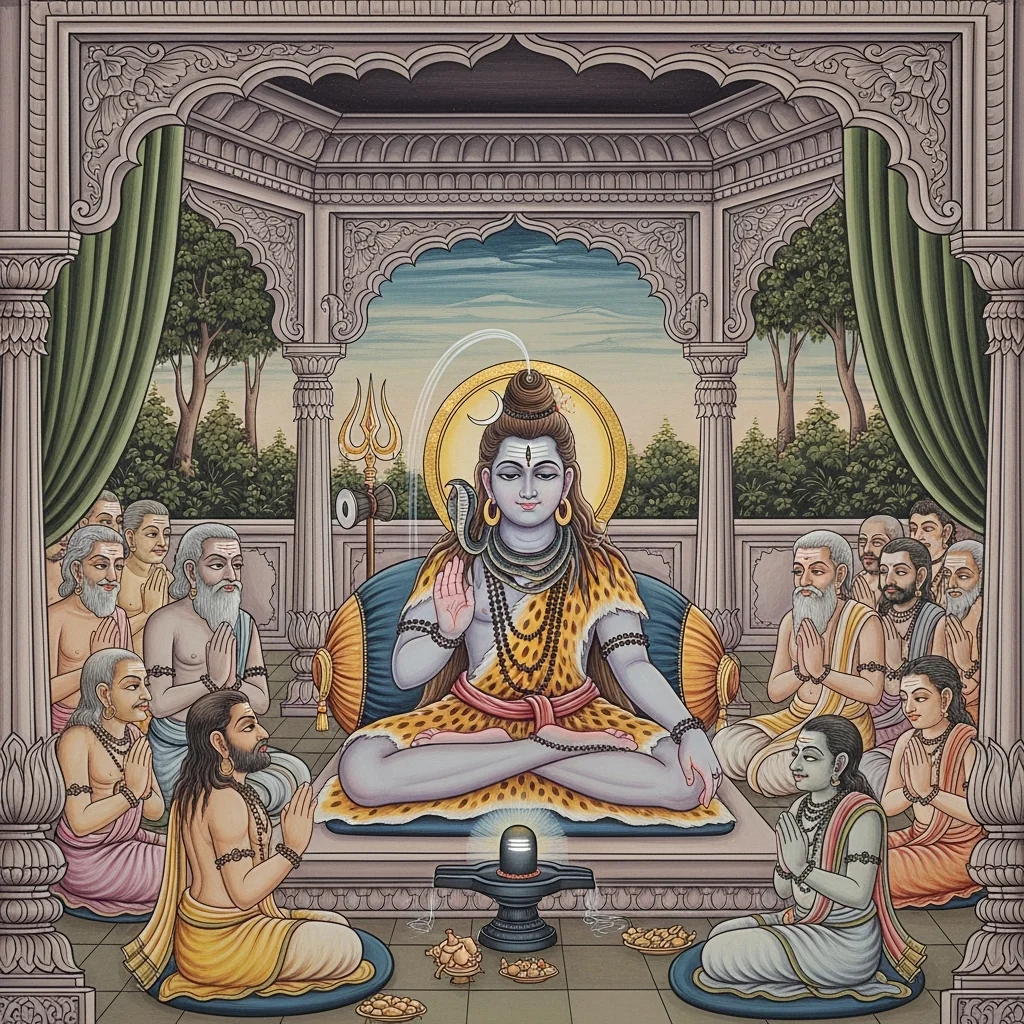
This adhyāya unfolds as a nested dialogue: Vyāsa relates to Sūta an account tied to Agastya’s inquiry, and Skanda answers by narrating Śiva’s movement from a mukti/nirvāṇa-associated space into the Śṛṅgāra-maṇḍapa. Śiva is portrayed seated facing east with Umā, while Brahmā and Viṣṇu stand on either side, attended by Indra, ṛṣis, and gaṇas. Śiva proclaims the Viśveśvara liṅga supreme as “parama-jyotis,” the highest Light, and as his stable, abiding form (sthāvara). He also defines exemplary Pāśupata practitioners as disciplined, pure, non-possessive, devoted to liṅga-arcana, and committed to strict ethical and ascetic observances. The chapter then details an ascending economy of merit: hearing of, remembering, setting out toward, seeing, touching, and offering even the smallest gift to the liṅga each yields increasing purification and auspiciousness, with comparisons to the fruits of aśvamedha and rājasūya, culminating in assurances of protection and nirvāṇa-oriented grace. Maṇikarṇikā and Kāśī are exalted as uniquely potent in the three worlds, Śiva’s continual presence in liṅga-form for devotees is affirmed, and Skanda closes by noting that only a portion of the kṣetra’s power has been spoken, framed by Vyāsa through Agastya’s contemplative response.
Shlokas
Verse 1
व्यास उवाच । शृणु सूत यथा प्रोक्तं कुंभजे शरजन्मना । देवदेवस्य चरितं विश्वेशस्य परात्मनः
Vyāsa said: “Listen, O Sūta, to what was declared by the pot-born sage and the reed-born one: the divine deeds of the God of gods, Viśveśa, the Supreme Self.”
Verse 2
अगस्त्य उवाच । सेनानीः कथय त्वं मे ततो निर्वाणमंडपात् । निर्गत्य देवो देवेंद्रैः सहितः किं चकार ह
Agastya said: “O Commander (Skanda), tell me: after the God departed from the Nirvāṇamaṇḍapa, what did he do, accompanied by the lords of the gods?”
Verse 3
स्कंद उवाच । मुक्तिमंडपतः शंभुर्ब्रह्मविष्णुपुरोगमः । शृंगारमंडपं प्राप्य यच्चकार वदामि तत्
Skanda said: From the Pavilion of Liberation, Śaṃbhu—preceded by Brahmā and Viṣṇu—came to the Śṛṅgāra Pavilion. What he then did there, I shall now declare.
Verse 4
प्राङ्मुखस्तूपविश्येशः सहास्माभिः सहेशया । ब्रह्मणाधिष्ठितः सव्ये वामपार्श्वेथ शार्ङ्गिणा
Facing east, the Lord sat upon the raised seat, together with us and with the Goddess. On his right side sat Brahmā, and then on his left side was Viṣṇu, bearer of the Śārṅga bow.
Verse 5
वीज्यमानो महेंद्रेण ऋषिभिः परितो वृतः । गणैः पृष्ठप्रदेशस्थैर्जोषं तिष्ठद्भिरादरात्
He was fanned by Mahendra (Indra), surrounded on all sides by sages, while the Gaṇas stood respectfully behind him, attending in silent readiness.
Verse 6
उदायुधैः सेव्यमानश्चावसन्मानभूरिभिः । ब्रह्मणे विष्णवे शंभुः पाणिमुत्क्षिप्य दक्षिणम्
Served by armed attendants and honored in many ways, Śaṃbhu raised his right hand toward Brahmā and Viṣṇu.
Verse 7
दर्शयामास देवेशो लिंगं पश्यत पश्यत । इदमेव परं ज्योतिरिदमेव परात्परम्
The Lord of gods revealed the Liṅga, saying, “Behold—behold! This alone is the supreme Light; this alone is the Highest beyond the high.”
Verse 8
इदमेव हि मे रूपं स्थावरं चाति सिद्धिदम् । एते पाशुपता सिद्धा आबाल ब्रह्मचारिणः
“This indeed is my very form—fixed and unmoving—yet bestowing extraordinary attainment. These are the perfected Pāśupatas, celibate from childhood.”
Verse 9
जितेंद्रियास्तपोनिष्ठाः पंचार्थज्ञाननिर्मलाः । भस्मकूटशया दाताः सुशीला ऊर्ध्वरेतसः
They are conquerors of the senses, steadfast in austerity, purified by knowledge of the fivefold principles; they sleep upon heaps of ash, are generous givers, well-conducted, and preserve their vital energy upward (perfect celibates).
Verse 10
लिंगार्चनरता नित्यमनन्येंद्रियमानसाः । सदैव वारुणाग्नेय स्नानद्वय सुनिर्मलाः
Ever devoted to worship of the Liṅga, with senses and mind unwaveringly fixed (on Śiva), they remain always purified by the twofold bath—of water and of fire.
Verse 11
कंदमूलफलाहाराः परतत्त्वार्पितेक्षणाः । सत्यवंतो जितक्रोधा निर्मोहा निष्परिग्रहाः
Living on bulbs, roots, and fruits, with their gaze offered to the Supreme Reality, they are truthful, have conquered anger, are free from delusion, and possess no hoarding grasp.
Verse 12
निरीहा निष्प्रपंचाश्च निरातंका निरामयाः । निर्भगा निरुपायाश्च निःसंगा निर्मलाशयाः
Desireless and beyond worldly entanglement, free from fear and illness; without claims to fortune, without worldly strategizing, unattached, and pure in intention—such are they.
Verse 13
निस्तीर्णोदग्रसंसारा निर्विकल्पा निरेनसः । निर्द्वंद्वा निश्चितार्थाश्च निरहंकारवृत्तयः
They have crossed over the surging ocean of saṃsāra; they are free from wavering doubt and free from sin. Beyond the pairs of opposites, firm in their spiritual aim, their conduct is devoid of egoism.
Verse 14
सदैव मे महाप्रीता मत्पुत्रा मत्स्वरूपिणः । एते पूज्या नमस्याश्च मद्बुद्ध्यामत्परायणैः
They are ever exceedingly dear to me—my own sons, bearing my very nature. Those who are devoted to me, holding their mind fixed on me, should worship and bow to them.
Verse 15
अर्चितेष्वेष्वहं प्रीतो भविष्यामि न संशयः । अस्मिन्वैश्वेश्वरे क्षेत्रे संभोज्याः शिवयोगिनः
When these are honored, I shall be pleased—of this there is no doubt. In this holy ground of Vaiśveśvara (Viśveśvara), the yogins of Śiva are to be fed and hospitably received.
Verse 16
कोटिभोज्यफलं सम्यगेकैक परिसंख्यया । अयं विश्वेश्वरः साक्षात्स्थावरात्मा जगत्प्रभुः
By a true reckoning, each single act here yields the fruit of feeding crores. This Viśveśvara is manifestly the Lord of the world—whose very essence abides in the immovable form of the liṅga.
Verse 17
सर्वेषां सर्वसिद्धीनां कर्ता भक्तिजुषामिह । अहं कदाचिद्दृश्यः स्यामदृश्यः स्यां कदाचन
Here, for those who abide in devotion, I am the bestower of every attainment and every perfection. At times I may be seen; at times I may remain unseen.
Verse 18
आनंदकानने चात्र स्वैरं तिष्ठामि देवताः । अनुग्रहाय सर्वेषां भक्तानामिह सर्वदा
And here, in the Ānandakānana, I dwell in freedom, O gods—ever in this place, for the grace and uplift of all devotees.
Verse 19
स्थास्यामि लिंगरूपेण चिंतितार्थफलप्रदः । स्वयंभून्यस्वयंभूनि यानि लिंगानि सर्वतः । तानि सर्वाणि चायांति द्रष्टुं लिंगमिदं सदा
I shall abide in the form of the liṅga, granting the fruits of the desires held in the mind. All liṅgas everywhere—whether self-manifest or consecrated—come, as it were, to behold this liṅga always.
Verse 20
अहं सर्वेषु लिंगेषु तिष्ठा्म्येव न संशयः । परं त्वियं परामूर्तिर्मम लिंगस्वरूपिणी
I indeed dwell in all liṅgas—of this there is no doubt. Yet this one is my supreme manifestation, embodying my very liṅga-nature.
Verse 21
येन लिंगमिदं दृष्टं श्रद्धया शुद्धचक्षुषा । साक्षात्कारेण तेनाहं दृष्ट एव दिवौकसः
Whoever beholds this liṅga with faith and purified vision—by that very direct realization, he truly beholds Me, O dwellers of heaven.
Verse 22
श्रवणादस्य लिंगस्य पातकं जन्मसंचितम् । क्षणात्क्षयति शृण्वंतु देवा ऋषिगणैः सह
By merely hearing of this Liṅga, the sins accumulated through births are destroyed in an instant. Let the gods hear this, together with the hosts of sages.
Verse 23
स्मरणादस्य लिंगस्य पापं जन्मद्वयार्जितम् । अवश्यं नश्यति क्षिप्रं मम वाक्यान्न संशयः
By merely remembering this Liṅga, the sins accumulated over two births surely perish at once—this is My word; there is no doubt.
Verse 24
एतल्लिंगं समुद्दिश्य गृहान्निष्क्रमणक्षणात् । विलीयते महापापमपि जन्मत्रयार्जितम्
If one sets one’s intention toward this Liṅga, then from the very moment of stepping out of the house, even great sins accumulated over three births dissolve away.
Verse 25
दर्शनादस्य लिंगस्य हयमेधशतोद्भवम् । पुण्यं लभेत नियतं ममानुग्रहतोमराः
By the mere sight of this Liṅga, one surely gains the merit born of a hundred Aśvamedha sacrifices—O immortals—through My grace.
Verse 26
स्वयंभुवोस्य लिंगस्य मम विश्वेशितुः सुराः । राजसूयसहस्रस्य फलं स्यात्स्पर्शमात्रतः
O gods, this self-manifest Liṅga of Mine—of Me, the Lord of the Universe—bestows, by mere touch alone, the fruit of a thousand Rājasūya sacrifices.
Verse 27
पुष्पमात्र प्रदानाच्च चुलुकोदकपूवर्कम् । शतसौवर्णिकं पुण्यं लभते भक्तियोगतः
By offering even a single flower—preceded by a handful of water—one attains, through the yoga of devotion, merit equal to a hundred gifts of gold.
Verse 28
पूजामात्रं विधायास्य लिंगराजस्य भक्तितः । सहस्रहेमकमलपूजाफलमवाप्यते
By performing even simple worship of this ‘King of Liṅgas’ with devotion, one attains the reward of worshipping with a thousand golden lotuses.
Verse 29
विधाय महती पूजां पंचामृतपुरःसराम् । अस्य लिंगस्य लभते पुरुषार्थचतुष्टयम्
Having performed a grand worship of this Liṅga, with pañcāmṛta as the foremost offering, one attains the four aims of human life.
Verse 30
वस्त्रपूतजलैर्लिंगं स्नापयित्वा ममामराः । लक्षाश्वमेधजनितं पुण्यमाप्नोति सत्तमः
O My immortals, the best of men—having bathed the Liṅga with water filtered through cloth—attains merit born of a hundred thousand Aśvamedha sacrifices.
Verse 31
सुगंधचंदनरसैर्लिंगमालिप्य भक्तितः । आलिप्यते सुरस्त्रीभिः सुगंधैर्यक्षकर्दमैः
Anointing the Liṅga with fragrant sandal paste in devotion—one performs the very act for which even celestial women anoint it with perfumed, yakṣa-like unguents.
Verse 32
सामोद धूपदानैश्च दिव्यगंधाश्रयो भवेत् । घृतदीपप्रबोधैश्च ज्योतीरूप विमानगः
By offering sweet-smelling incense, one becomes a bearer of divine fragrance; and by kindling ghee lamps, one attains a luminous form and moves in a radiant celestial car.
Verse 33
कर्पूरवर्तिदीपेन सकृद्दत्तेन भक्तितः । कर्पूरदेहगौरश्रीर्भवेद्भालविलोचनः
By offering, even once and with devotion, a lamp with a camphor wick (to Viśveśvara in Kāśī), one attains a radiant, camphor-like fair splendor of body, and becomes endowed with an auspicious, shining presence, as though with a divine eye upon the brow.
Verse 34
दत्त्वा नैवेद्यमात्रं तु सिक्थेसिक्थे युगंयुगम् । कैलासाद्रौ वसेद्धीमान्महाभोगसमन्वितः
By offering even a simple naivedya (food offering), in every age again and again, the wise one comes to dwell on Mount Kailāsa, endowed with great enjoyments and prosperity.
Verse 35
विश्वेशे परमान्नं यो दद्यात्साज्य सशर्करम् । त्रैलोक्यं तर्पितं तेन सदेवपितृमानवम्
Whoever offers to Viśveśvara the finest cooked food, together with ghee and sugar, by that act he satisfies the three worlds—gods, ancestors, and human beings alike.
Verse 36
मुखवासं तु यो दद्याद्दर्पणं चारुचामरम् । उल्लोचं सुखपर्यंकं तस्य पुण्यफलं महत्
Whoever donates mouth-fragrance (tāmbūla and the like), a mirror, a beautiful fan, a footstool, and a comfortable couch—his meritorious reward is great indeed.
Verse 37
संख्या सागररत्नानां कथंचित्कर्तुमिष्यते । मुखवासादिदानस्य कः संख्यामत्र कारयेत्
One might, somehow, attempt to count the jewels in the ocean; but who here could ever compute the measure of merit arising from gifts such as mouth-fragrance and the like, offered in devotion?
Verse 38
पूजोपकरणद्रव्यं यो घंटा गडुकादिकम् । भक्त्या मे भवने दद्यात्स वसेदत्र मेंतिके
Whoever, with devotion, donates articles and materials for worship—such as a bell, a water-pot, and similar items—into My temple, he shall dwell here, close to Me.
Verse 39
यो गीतवाद्यनृत्यानामेकं मत्प्रीतये व्यधात् । तस्याग्रतो दिवारात्रं भवेत्तौर्यत्रिकं महत्
Whoever performs, for My pleasure, even one among singing, instrumental music, or dance—before him, day and night, there shall be a great threefold festive music and celebration.
Verse 40
चित्रलेखनकर्मादि प्रासादे मेऽत्र कारयेत् । यः सचित्रान्महाभोगान्भुंक्ते मत्पुरतः स्थितः
Whoever commissions painting, decorative writing, and such works in My temple here—standing in My presence, he enjoys great prosperities adorned with splendor and beauty.
Verse 41
सकृद्विश्वेश्वरं नत्वा मध्ये जन्मसुधीर्नरः । त्रैलोक्यवंदितपदो जायते वसुधापतिः
A discerning man who, in the midst of his life, bows even once to Viśveśvara is born thereafter as a lord of the earth, with feet honored throughout the three worlds.
Verse 42
यस्तु विश्वेवरं दृष्ट्वा ह्यन्यत्रापि विपद्यते । तस्य जन्मांतरे मोक्षो भवत्येव न संशयः
But if someone, having received the darśana of Viśveśvara, should meet misfortune elsewhere, for him liberation (mokṣa) surely arises in another birth—of this there is no doubt.
Verse 43
विश्वेशाख्या तु जिह्वाग्रे विश्वनाथकथाश्रुतौ । विश्वेशशीलनं चित्ते यस्य तस्य जनिः कुतः
For the one on whose tongue rests the very name “Viśveśa,” whose ears drink in the sacred accounts of Viśvanātha, and whose heart continually contemplates Viśveśa—how could such a person ever be subject to rebirth?
Verse 44
लिंगं मे विश्वनाथस्य दृष्ट्वा यश्चानुमोदते । स मे गणेषु गण्येत महापुण्यबलाश्रितः
Whoever beholds my Liṅga of Viśvanātha and rejoices in it with approving delight—he is to be counted among my gaṇas, upheld by the power of immense merit.
Verse 46
ममापीदं महालिंगं सदा पूज्यतमं सुराः । तस्मात्सर्वप्रयत्नेन पूज्यं देवर्षि मानवैः
This great Liṅga of mine is ever the most worshipful, even for the gods; therefore, with every effort it should be worshipped by gods, seers (ṛṣis), and human beings.
Verse 47
यैर्न विश्वेश्वरो दृष्टो यैर्न विश्वेश्वरः स्मृतः । कृतांतदूतैस्ते दृष्टास्तैः स्मृता गर्भवेदना
Those by whom Viśveśvara is not seen, and by whom Viśveśvara is not remembered—such people are seen by Yama’s messengers, and for them the pains of the womb are remembered again.
Verse 48
यैरिदं प्रणतं लिंगं प्रणतास्ते सुरासुरैः । यस्यै केन प्रणामेन दिक्पालपदमल्पकम् । दिक्पालपदतः पातः पातः शिवनतेर्नहि
Those who bow to this Liṅga are bowed to by gods and asuras alike. By other acts of reverence one gains only a minor post, such as guardian of the directions; from that post there may be a fall—but from bowing to Śiva there is no fall.
Verse 49
शृण्वंतु देवर्षिगणाः समस्तास्तथ्यं ब्रुवे तच्च परोपकृत्यै । न भूर्भुवः स्वर्गमहर्जनांतर्विश्वेशतुल्यं क्वचिदस्ति लिंगम्
Let all the hosts of divine seers listen: I speak a truth for the benefit of others. Within Bhūḥ, Bhuvaḥ, Svarga, Maharloka, or Janaloka, nowhere exists any Liṅga equal to Viśveśa.
Verse 50
न सत्यलोके न तपस्यहो सुरा वैकुंठकैलासरसातलेषु । तीर्थं क्वचिद्वै मणिकर्णिकासमं लिंगं च विश्वेश्वरतुल्यमन्यतः
O gods, neither in Satyaloka nor in Tapoloka, nor in Vaikuṇṭha, Kailāsa, or Rasātala is there anywhere a tīrtha equal to Maṇikarṇikā, nor elsewhere any Liṅga equal to Viśveśvara.
Verse 51
न विश्वनाथस्य समं हि लिंगं न तीर्थमन्यन्मणिकर्णिकातः । तपोवनं कुत्रचिदस्ति नान्यच्छुभं ममानंदवनेन तुल्यम्
There is no Liṅga equal to Viśvanātha, and no tīrtha other than Maṇikarṇikā that can match it. Nowhere exists another forest of austerity (tapo-vana); nothing auspicious is equal to my Ānandavana, Kāśī.
Verse 52
वाराणसी तीर्थमयी समस्ता यस्यास्तुनामापि हि तीर्थतीर्थम् । तत्रापि काचिन्मम सौख्यभूमिर्महापवित्रा मणिकर्णिकासौ
Vārāṇasī is wholly made of tīrthas; even its very name is a “tīrtha among tīrthas.” And within it there is one special ground of my delight—Maṇikarṇikā, supremely purifying.
Verse 53
स्थानादमुष्मान्ममराजसौधात्प्राच्यां मनागीशसमाश्रितायाम् । सव्येपसव्ये च कराः क्रमेण शतत्रयी यापि शतद्वयी च
From that place—My royal mansion—toward the east, slightly inclined and resting near the Lord: on the left and on the right, in due order, are the “hands” (extensions/terraces/steps), one set numbering three hundred and another numbering two hundred.
Verse 54
हस्ताः शतं पंच सुरापगायामुदीच्यवाच्योर्मणिकर्णिकेयम् । सारस्त्रिलोक्याः परकोशभूमिर्यैः सेविता ते मम हृच्छया हि
This Maṇikarṇikā—situated on the heavenly river, between the northern and the northeastern quarters—extends for a hundred and five hastas. She is the very essence of the three worlds, a supreme treasury-ground; those who have served her are truly cherished in My heart.
Verse 55
अस्मिन्ममानंदवने यदेतल्लिंगं सुधाधाम सुधामधाम । आसप्त पातालतलात्स्वयंभु समुत्थितं भक्तकृपावशेन
In this My Ānandavana, this very Liṅga—abode of nectar, the very home of immortality—arose of itself from as deep as the seven netherworld levels, moved by compassion for devotees.
Verse 56
येस्मिञ्जनाः कृत्रिमभावबुद्ध्या लिंगं भजिष्यंति च हेतुवादैः । तेषां हि दंडः पर एष एव नगर्भवासाद्विरमंति ते ध्रुवम्
Those people who approach the Liṅga with contrived feelings and with argumentative rationalizations—this alone is their supreme punishment: they do not cease from dwelling in the womb (cycle of rebirth), certainly.
Verse 57
यद्यद्धितं स्वस्य सदैव तत्तल्लिंगेत्र देयं मम भक्तिमद्भिः । इहाप्यमुत्रापि न तस्य संक्षयो यथेह पापस्य कृतस्य पापिभिः
Whatever one regards as truly beneficial for oneself—let My devoted ones always offer that at this Liṅga. Its merit does not diminish, either here or hereafter—just as the sin committed by sinners does not simply vanish in this world.
Verse 58
दूरस्थितैरप्यधिबुद्धिभिर्यैर्लिंगं समाराधि ममेदमत्र । मयैव दत्तैः शुभवस्तुजातैर्निःश्रेयसः श्रीर्वसं येत्सतस्तान्
Even those who are far away, if with elevated understanding they worship this My Liṅga here, then upon those virtuous ones—through auspicious offerings granted by Me—the prosperity of ultimate liberation abides continually.
Verse 59
शृणुष्व विष्णो शृणु सृष्टिकर्तः शृण्वंतु देवर्षिगणाः समस्ताः । इदं हि लिंगं परसिद्धिदं सतां भेदो मनागत्र न मत्सकाशतः
Listen, O Viṣṇu; listen, O Creator—let all hosts of divine seers hear. For this Liṅga bestows the supreme perfection upon the virtuous; here there is not even the slightest difference from My own presence.
Verse 60
अस्मिन्हि लिंगेऽखिलसिद्धिसाधने समर्पितं यैः सुकृतार्जितं वसु । तेभ्योतिमात्राखिलसौख्यसाधनं ददामि निर्वाणपदं सुनिर्भयम्
Whoever offers at this Liṅga—means for accomplishing all siddhis—wealth earned through righteous deeds, to them I grant in overflowing measure the source of all bliss: the fearless state of nirvāṇa.
Verse 61
उत्क्षिप्य बाहुं त्वसकृद्ब्रवीमि त्रयीमयेऽस्मिंस्त्रयमेव सारम् । विश्वेश लिंगं मणिकर्णिकांबु काशीपुरी सत्यमिदं त्रिसत्यम्
Raising My arm, I declare again and again: in this realm formed of the three Vedas, these three alone are the essence—Viśveśvara’s Liṅga, the waters of Maṇikarṇikā, and the city of Kāśī. This is truth—triple truth.
Verse 62
उत्थाय देवोथ स शक्तिरीशस्तस्मिन्हि लिंगे कृतचारुपूजः । ययौ लयं ते च सुरा जयेति जयेति चोक्त्वा नुनुवुस्तमीशम्
Then the Lord—together with His Śakti—rose and performed beautiful worship at that Liṅga. Thereafter they entered into stillness; and the gods, crying “Victory! Victory!”, praised that Lord.
Verse 63
स्कंद उवाच । क्षेत्रस्य मैत्रावरुणे विमुक्तस्य महामते । प्रभावस्यैकदेशोयं कथितः कल्मषापहः
Skanda said: O great-minded one, this is but a single portion of the glory of the liberated sacred field of Maîtrāvaruṇa; it is declared to be a remover of defilements.
Verse 64
तवाग्रे तु यथाबुद्धि काशीविश्लेषतापि नः । अचिरेणैव कालेन काशीं प्राप्स्यस्यनुत्तमाम्
Even if, as you deem, we must endure for a while separation from Kāśī, very soon indeed you will attain that unsurpassed Kāśī again.
Verse 65
अस्ताचलस्य शिखरं प्राप्तवानेष भानुमान् । तवापि हि ममाप्येष मौनस्य समयोऽभवत्
The Sun has reached the peak of the western mountain; for you—and for me as well—this has become the time for mauna, sacred silence.
Verse 66
व्यास उवाच । श्रुत्वेति स मुनिः सूत संध्योपास्त्यै विनिर्गतः । प्रणम्यौ मेयमसकृल्लोपामुद्रा समन्वितः
Vyāsa said: Hearing this, that sage, O Sūta, went out to perform the twilight worship (sandhyā-upāsanā). Again and again he bowed, accompanied by Lopāmudrā.
Verse 67
रहस्यं परिविज्ञाय क्षेत्रस्य शशिमौलिनः । अगस्त्यो निश्चितमनाः शिवध्यानपरोभवत्
Having fully understood the secret of the sacred field of the Moon-crested Lord, Agastya—firm in resolve—became wholly devoted to meditation on Śiva.
Verse 68
आनंदकाननस्येह महिमानं महत्तरम् । कोत्र वर्णयितुं शक्तः सूत वर्षशतैरपि
Here, the greatness of Ānandakānana is supremely vast. Who, O Sūta, could possibly describe it—even across hundreds of years?
Verse 69
यथा देव्यै समाख्यायि शिवेन परमात्मना । तथा स्कंदेन कथितं माहात्म्यं कुंभसंभवे
Just as the Supreme Self, Śiva, explained it to the Goddess, so too Skanda related this māhātmya to Agastya, the one born from the pot.
Verse 70
तवाग्रे च समाख्यातं शुकादीनां च सत्तम । इदानीं प्रष्टुकामोसि किं तत्पृच्छ वदामि ते
In your presence it has been narrated—and also in the presence of the noble ones such as Śuka. Now you wish to ask; ask whatever it is, and I shall tell you.
Verse 71
श्रुत्वाध्यायमिमं पुण्यं सर्वकल्मषनाशनम् । समस्तचिंतितफलप्रदं मर्त्यो भवेत्कृती
Having heard this holy chapter, which destroys all taints, a mortal becomes successful—since it grants every desired fruit.
Verse 99
इति श्रीस्कांदे महापुराण एकाशीति साहस्र्यां संहितायां चतुर्थे काशीखंड उत्तरार्धे विश्वेश्वरलिंगमहिमाख्यो नाम नवनवतितमोऽध्यायः
Thus, in the holy Skanda Mahāpurāṇa, in the Fourth Saṃhitā of eighty-one thousand verses, within the Kāśīkhaṇḍa (Uttarārdha), concludes the ninety-ninth chapter, called “The Greatness of the Viśveśvara Liṅga.”