Adhyaya 8
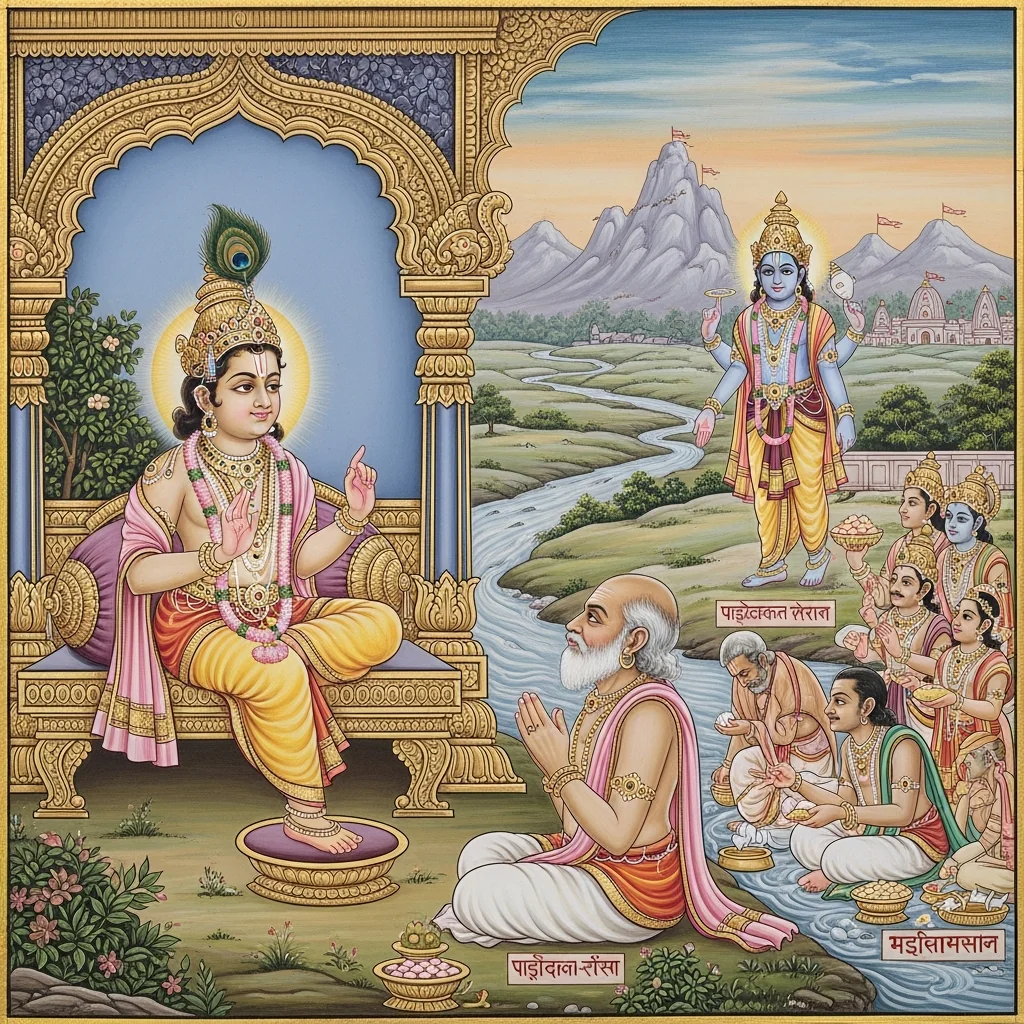
Chapter 8 unfolds as a dialogue: Agastya asks Skanda about Śiva’s conduct while abiding at Mandara, and Skanda replies with a Kāśī-centered account praised as impurity-destroying. Within it, a discourse attributed to Viṣṇu teaches that ritual efficacy depends on devotion and remembrance: human effort is required, yet the final fruit rests with the Divine as witness and enabler; acts done in remembrance of Śiva succeed, while acts done without such remembrance fail even if performed correctly. The narrative then turns to Viṣṇu’s departure from Mandara to Vārāṇasī, his bathing at the Gaṅgā boundary/confluence, and the establishment or recognition of Pādodaka-tīrtha. A dense itinerary follows, listing many tīrthas and Keśava-linked shrines—beginning with Ādikeśava and including Śaṅkha, Cakra, Gadā, Padma, Mahālakṣmī, Tārkṣya, Nārada, Prahlāda, Ambārīṣa, and others—each paired with practices such as snāna, drinking pādodaka, śrāddha, tarpaṇa, and dāna, and with stated merits: purification, ancestral uplift, prosperity, health, and liberation-oriented results. A later segment introduces a “saugata” (ascetic/teacher) discourse stressing ethical universals, especially ahiṃsā (non-violence) as the highest dharma and compassion as the supreme norm. The chapter closes with a phalaśruti assurance that reading or hearing this account fulfills one’s aims, likened to Viṣṇu’s wish-fulfillment and Śiva as the “accomplisher of thought.”
Shlokas
Verse 1
अगस्त्य उवाच । किं चकार हरः स्कंद मंदराद्रिगतस्तदा । विलंबमालंबयति तस्मिन्नपि गजानने
Agastya said: “O Skanda, what did Hara (Śiva) do then, when he had gone to Mount Mandara, while that Elephant-faced one (Gaṇeśa) was still delaying?”
Verse 2
स्कंद उवाच । शृण्वगस्त्य कथां पुण्यां कथ्यमानां मयाधुना । वाराणस्येकविषयामशेषाघौघनाशिनीम्
Skanda said: “Listen, O Agastya, to this holy account I now proclaim—concerned with Vārāṇasī alone—one that destroys the entire flood of sins.”
Verse 3
करींद्रवदने तत्र क्षेत्रवर्येऽविमुक्तके । विलंबभाजित्र्यक्षेण प्रैक्षिक्षिप्रमधोक्षजः
There, in that foremost sacred field—Avimukta—when the Elephant-faced one lingered, Adhokṣaja (Viṣṇu) swiftly turned his gaze toward the Three-eyed Lord (Śiva).
Verse 4
प्रोक्तोथ बहुशश्चेति बहुमानपुरःसरम् । तथा त्वमपि माकार्षीर्यथा प्राक्प्रस्थितैः कृतम्
“This indeed has been spoken many times,” he said, with due honor preceding his words. “So you too should not act otherwise; do as those who set out earlier have done.”
Verse 5
श्रीविष्णुरुवाच । उद्यमः प्राणिभिः कार्यो यथाबुद्धि बलाबलम् । परं फलंति कर्माणि त्वदधीनानि शंकर
Śrī Viṣṇu said: “Beings must strive according to their understanding of strength and limitation. Yet the final fruit of actions depends upon you, O Śaṅkara.”
Verse 6
अचेतनानि कर्माणि स्वतंत्राः प्राणिनोपि न । त्वं च तत्कर्मणां साक्षी त्वं च प्राणिप्रवर्तकः
“Actions are without consciousness, and living beings too are not truly independent. You are the witness of those actions, and you are the one who impels all beings.”
Verse 7
किंतु त्वत्पादभक्तानां तादृशी जायते मतिः । यया त्वमेव कथयेः साध्वनेनत्वनुष्ठितम्
But in those devoted to Your sacred feet, such understanding arises—by which You Yourself declare: “He has rightly accomplished it.”
Verse 8
यत्किंचिदिह वै कर्मस्तोकं वाऽस्तोकमेव वा । तत्सिद्ध्यत्येव गिरिश त्वत्पादस्मृत्यनुष्ठितम्
Whatever act is done here—whether small or great—O Lord of the Mountain, it surely attains success when performed in remembrance of Your sacred feet.
Verse 9
सुसिद्धमपि वै कार्यं सुबुद्ध्यापि स्वनुष्ठितम् । अत्वत्पदस्मृतिकृतं विनश्यत्येव तत्क्षणात्
Even a task well-established and properly carried out with sound understanding perishes at once if it is done without remembrance of Your feet.
Verse 10
शंभुना प्रेषितेनाद्य सूद्यमः क्रियते मया । त्वद्भक्तिसंपत्तिमतां संपन्नप्राय एव नः
Today, at Śambhu’s command, I undertake an earnest effort; for those endowed with the wealth of devotion to You, success is almost assured.
Verse 11
अतीव यदसाध्यं स्यात्स्वबुद्धिबलपौरुषैः । तत्कार्यं हि सुसिद्धं स्यात्त्वदनुध्यानतः शिव
Even what is utterly impossible by one’s own intellect, strength, and human effort becomes perfectly accomplished through meditation upon You, O Śiva.
Verse 12
यांति प्रदक्षिणीकृत्य ये भवंतं भवं विभो । भवंति तेषां कार्याणि पुरोभूतानि ते भयात्
Those who, having circumambulated You—Bhava, O Almighty Lord—go on their way, find their undertakings already accomplished beforehand, as though the deeds themselves hasten ahead out of fear of Your power.
Verse 13
जातं विद्धि महादेव कार्यमेतत्सुनिश्चितम् । काशीप्रावेशिकश्चिंत्य शुभलग्नोदयः परम्
Know, O Mahādeva, that this undertaking is already accomplished—firmly and certainly resolved. The supremely auspicious moment for entering Kāśī has arisen; embrace it without doubt.
Verse 14
अथवा काशिसंप्राप्तौ न चिंत्यं हि शुभाशुभम् । तदैव हि शुभः कालो यदैवाप्येत काशिका
Or else, upon reaching Kāśī, one need not deliberate over auspicious or inauspicious signs; for that very time is auspicious—precisely when Kāśikā is attained.
Verse 15
शंभुं प्रदक्षिणीकृत्य प्रणम्य च पुनःपुनः । प्रतस्थेऽथ सलक्ष्मीको मंदराद्गरुडध्वजः
Having circumambulated Śambhu and bowed again and again, Viṣṇu—Garuḍa-bannered and accompanied by Lakṣmī—then set out from Mandara.
Verse 16
दृशोरतिथितां नीत्वा विष्णुर्वाराणसीं ततः । पुंडरीकाक्ष इत्याख्यां सफलीकृतवान्मुदा
Then Viṣṇu, making Vārāṇasī a “guest” to his eyes by beholding her, joyfully rendered the epithet “Puṇḍarīkākṣa” truly fulfilled and meaningful.
Verse 17
गंगावरणयोर्विष्णुः संभेदे स्वच्छमानसः । प्रक्षाल्य पाणिचरणं सचैलः स्नातवानथ
At the confluence of Gaṅgā and Varaṇā, Viṣṇu—his mind serene and clear—washed his hands and feet, and then bathed there, still wearing his garments.
Verse 18
तदाप्रभृति तत्तीर्थं पादोदकमितीरितम् । पादौ यदादौ शुभदौ क्षालितौ पीतवाससा
From that time onward, that sacred ford came to be known as “Pādodaka,” for there, at the very beginning, the auspicious feet were washed by Pītavāsā (Viṣṇu, the One clad in yellow).
Verse 19
तत्र पादोदके तीर्थे ये स्नास्यंतीह मानवाः । तेषां विनश्यति क्षिप्रं पापं सप्तभवार्जितम्
Those people who bathe there, at the Pādodaka sacred ford, quickly destroy the sins they have accumulated across seven births.
Verse 20
तत्र श्राद्धं नरः कृत्वा दत्त्वा चैव तिलोदकम् । सप्तसप्त तथा सप्त स्ववंश्यांस्तारयिष्यति
A man who performs śrāddha there and offers water with sesame will deliver his own lineage—seven times seven, and another seven (generations).
Verse 21
गयायां यादृशी तृप्तिर्लभ्यते प्रपितामहैः । तीर्थे पादोदके काश्यां तादृशी लभ्यते ध्रुवम्
The same satisfaction that the forefathers obtain at Gayā is surely obtained at the Pādodaka sacred ford in Kāśī.
Verse 22
कृतपादोदक स्नानं पीतपादोदकोदकम् । दत्तपादोदपानीयं नरं न निरयः स्पृशेत्
One who has bathed in the sacred Pādodaka, drunk that pādodaka-water, and offered it as a holy drink—hell does not touch such a man.
Verse 23
विष्णुपादोदके तीर्थे प्राश्य पादोदकं सकृत् । जातुचिज्जननीस्तन्यं न पिबेदिति निश्चितम्
At the Viṣṇu‑Pādodaka sacred ford, once one has sipped the pādodaka even a single time, it is firmly concluded that one should never again drink mother’s milk.
Verse 24
सचक्र शालग्रामस्य शंखेन स्नापितस्य च । अद्भिः पादोदकस्यांबु पिबन्नमृततां व्रजेत्
If one drinks the pādodaka-water—the water used to bathe the Śālagrāma marked with the discus, bathed with a conch—one attains immortality (amṛtatva).
Verse 25
विष्णुपादोदके तीर्थे विष्णुपादोदकं पिबेत् । यदि तत्सुधया किं नु बहुकालीनयातया
At the Viṣṇu‑Pādodaka sacred ford one should drink Viṣṇu’s pādodaka; for if that is itself nectar, what need is there of any stale, long-kept ‘amṛta’?
Verse 26
काश्यां पादोदके तीर्थे यैः कृता नोदकक्रियाः । जन्मैव विफलं तेषां जलबुद्बुद सश्रियाम्
Those who do not perform the water-rites at the Pādodaka sacred ford in Kāśī—though endowed with the fleeting splendor of life like bubbles on water—their very birth becomes fruitless.
Verse 27
कृतनित्यक्रियो विष्णुः सलक्ष्मीकः सकाश्यपिः । उपसंहृत्य तां मूर्तिं त्रैलोक्यव्यापिनीं तथा
Viṣṇu—having completed His daily rites—together with Lakṣmī and also with Kāśyapa, then withdrew that form which pervaded the three worlds.
Verse 28
विधाय दार्षदीं मूर्तिं स्वहस्तेनादिकेशवः । स्वयं संपूजयामास सर्वसिद्धिसमृद्धिदाम्
Having fashioned with His own hands a stone image, Ādikeśava Himself worshipped it—an icon that bestows the fullness of every attainment and auspicious prosperity.
Verse 29
आदिकेशवनाम्नीं तां श्रीमूर्तिं पारमेश्वरीम् । संपूज्य मर्त्यो वैकुंठं मन्यते स्वगृहांगणम्
After duly worshipping that glorious, supremely divine icon named Ādikeśava, a mortal comes to regard even the courtyard of his own home as Vaikuṇṭha itself.
Verse 30
श्वेतद्वीप इति ख्यातं तत्स्थानं काशिसीमनि । श्वेतद्वीपे वसंत्येव नरास्तन्मूर्तिसेवकाः
That place, within the borders of Kāśī, is renowned as ‘Śvetadvīpa’. Indeed, those who serve that sacred icon dwell in Śvetadvīpa.
Verse 31
क्षीराब्धिसंज्ञं तत्रान्यत्तीर्थं केशवतोग्रतः । कृतोदकक्रियस्तत्र वसेत्क्षीराब्धिरोधसि
There is another tīrtha there, known as ‘Kṣīrābdhi’, situated in front of Keśava. Having performed the water-rites there, one should reside, in observance, upon the bank of Kṣīrābdhi.
Verse 32
तत्र श्राद्धं नरः कृत्वा गां दत्त्वा च पयस्विनीम् । यथोक्तसर्वाभरणां क्षीरोदे वासयेत्पितॄन्
There, having performed śrāddha and gifted a milk-giving cow adorned as prescribed, a man causes his forefathers to dwell contentedly in Kṣīroda, the realm of the Milk-Ocean.
Verse 33
एकोत्तरशतं वंश्यान्नवेत्पायस कर्दमम् । क्षीरोदरोधः पुण्यात्मा भक्त्या तत्रैकधेनुदः
A single cow-gift offered there with devotion by a virtuous person on the bank of Kṣīroda brings satisfaction—like rich payasa and sweet oblations—to one hundred and one descendants of the lineage.
Verse 34
बह्वीश्च नैचिकीर्दत्त्वा श्रद्धयात्र सदक्षिणाः । शय्योत्तरांश्च प्रत्येकं पितॄंस्तत्र सुवासयेत्
By giving many naicikī offerings there, with faith and proper dakṣiṇā, and by offering beds and additional gifts, one settles each ancestor comfortably in that sacred realm.
Verse 35
क्षीरोदाद्दक्षिणे तत्र शंखतीर्थमनुत्तमम् । तत्रापि संतर्प्यपितॄन्विष्णुलोकेमहीयते
To the south of Kṣīroda lies the unsurpassed Śaṅkha-tīrtha. Even there, by satisfying the ancestors, one is honored in Viṣṇu’s world.
Verse 36
तद्याम्यां चक्रतीर्थं च पितॄणामपि दुर्लभम् । तत्रापि विहितश्राद्धो मुच्यते पैतृकादृणात्
To its south lies Cakra-tīrtha, rare even for the ancestors. Even there, one who performs śrāddha as enjoined is freed from the ancestral debt.
Verse 37
तत्संन्निधौ गदातीर्थं विष्वगाधिनिबर्हणम् । तारणं च पितॄणां वै कारणं चैनसां क्षये
Near that (Cakra-tīrtha) is Gadā-tīrtha, which destroys deep-rooted afflictions. Truly it is a cause for the deliverance of the Pitṛs (ancestors) and for the waning of sins.
Verse 38
पद्मतीर्थं तदग्रे तु तत्र स्नात्वा नरोत्तमः । पितॄन्संतर्प्य विधिना पद्मयानेव हीयते
In front of that lies Padma-tīrtha. The best of men, having bathed there and duly satisfied the Pitṛs with the prescribed rites, departs as if borne in a lotus-aerial car.
Verse 39
तत्रैव च महालक्ष्म्यास्तीर्थं त्रैलोक्यविश्रुतम् । स्वयं यत्र महालक्ष्मीः स्नाता त्रैलोक्यहर्षदा
There itself is the tīrtha of Mahālakṣmī, renowned throughout the three worlds—where Mahālakṣmī herself once bathed, bestowing joy upon the three worlds.
Verse 40
तत्र तीर्थे कृतस्नानो दत्त्वा रत्नानि कांचनम् । पट्टांबराणि विप्रेभ्यो न लक्ष्म्या परिहीयते
Having bathed at that tīrtha, and giving jewels, gold, and fine silk garments to the Brāhmaṇas, one is never diminished in Lakṣmī—prosperity and grace.
Verse 41
यत्रयत्र हि जायेत तत्रतत्र समृद्धिमान् । पितरोपि हि सुश्रीकास्तस्य स्युस्तीर्थगौरवात्
Wherever he may be born, there and then he will be prosperous; and even his ancestors become richly endowed, by the majesty of that tīrtha.
Verse 42
तत्रास्ति हि महालक्ष्म्या मूर्तिस्त्रैलोक्यवंदिता । तां प्रणम्य नरो भक्त्या न रोगी जायते क्वचित्
There indeed stands an image of Mahālakṣmī, revered throughout the three worlds. A man who bows to Her with devotion is never born afflicted by disease.
Verse 43
नभस्य बहुलाष्टम्यां कृत्वा जागरणं निशि । समभ्यर्च्य महालक्ष्मीं व्रती व्रतफलं लभेत्
On bahulāṣṭamī, the dark eighth day of the month of Nabhas (Bhādrapada), keeping vigil through the night and duly worshipping Mahālakṣmī, the vow-observing devotee attains the full fruit of the vrata.
Verse 44
तार्क्ष्य तीर्थं हि तत्रास्ति तार्क्ष्यकेशवसन्निधौ । तत्र स्नात्वा नरो भक्त्या संसाराहिं न पश्यति
There too is Tārkṣya-tīrtha, near Tārkṣya-Keśava. Bathing there with devotion, a man no longer beholds the serpent of saṃsāra.
Verse 45
तदग्रे नारदं तीर्थं महापातकनाशनम् । ब्रह्मविद्योपदेशं च प्राप्तवान्यत्र नारदः
Beyond that lies Nārada-tīrtha, the destroyer of great sins—where Nārada received instruction in brahma-vidyā, the knowledge of Brahman.
Verse 46
तत्र स्नातो नरः सम्यग्ब्रह्मविद्यामवाप्नुयात् । केशवात्तेन तत्रोक्तः काश्यां नारदकेशवः
Bathing there, a man truly attains brahma-vidyā. Therefore, in Kāśī, Keśava there is spoken of as “Nārada-Keśava”.
Verse 47
अर्चयित्वा नरो भक्त्या देवं नारदकेशवम् । जनन्या जठरं पीठमध्यास्ते न कदाचन
Having worshipped with devotion the Lord Nārada-Keśava, a man never again lies in a mother’s womb, nor rests upon the birthing-seat, at any time.
Verse 48
प्रह्लादतीर्थं तस्याग्रे यत्र प्रह्लादकेशवः । तत्र श्राद्धादिकं कृत्वा विप्णुलोके महीयते
In front of that shrine lies Prahlāda-tīrtha, where Prahlāda-Keśava is present. Having performed Śrāddha and related rites there, a person is honored in the world of Viṣṇu.
Verse 49
आंबरीषमहातीर्थमघघ्नं तस्य सन्निधौ । तत्रौदकीं क्रियां कुर्वन्निष्कालुष्यं लभेन्नरः
Near that is the great Āmbārīṣa-tīrtha, the destroyer of sins. Performing water-based rites there, a person attains freedom from taint and impurity.
Verse 50
आदित्यकेशवः पूज्य आदिकेशव पूर्वतः । तस्य संदर्शनादेव मुच्यते चोच्चपातकैः
Āditya-Keśava is worthy of worship, situated to the east of Ādi-Keśava. Merely by beholding him, one is released even from grievous sins.
Verse 51
दत्तात्रेयेश्वरं तीर्थं तत्रैवादिगदाधरः । पितॄन्संतर्प्य तत्रैव ज्ञानयोगमवाप्नुयात्
There is the tīrtha of Dattātreyeśvara, and there itself is Ādi-Gadādhara. Having satisfied the Pitṛs (ancestors) there, one attains the yoga of spiritual knowledge.
Verse 52
भृगुकेशवपूर्वेण तीर्थं वै भार्गवं परम् । तत्र स्नातो नरः प्राज्ञो भवेद्भार्गववत्सुधीः
To the east of Bhṛgu-Keśava is indeed the supreme Bhārgava-tīrtha. Bathing there, a discerning person becomes wise—learned and clear-sighted like a Bhārgava.
Verse 53
तत्र वामनतीर्थं च प्राच्यां वामनकेशवात् । पूजयित्वा च तं विष्णुं वसेद्वामनसन्निधौ
There too is Vāmana-tīrtha, to the east of Vāmana-Keśava. Having worshipped that Viṣṇu, one should dwell devotionally in the presence of Vāmana.
Verse 54
नरनारायणं तीर्थं नरनारायणात्पुरः । तत्र तीर्थे कृतस्नानो नरो नारायणो भवेत्
In front of Nara-Nārāyaṇa is the Nara-Nārāyaṇa-tīrtha. Having bathed at that tīrtha, a person becomes Nārāyaṇa-like, endowed with divine auspiciousness.
Verse 55
यज्ञवाराह तीर्थं च तदग्रे पापनाशनम् । प्रतिमज्जनतस्तत्र राजसूय क्रतोः फलम्
There is also the Yajña-Vārāha-tīrtha before it, a destroyer of sins. By repeatedly immersing oneself there, one gains the fruit of the Rājasūya sacrifice.
Verse 56
विदारनारसिंहाख्यं तत्र तीर्थं सुनिर्मलम् । स्नातो विदारयेत्तत्र पापं जन्मशतार्जितम्
There is the spotless tīrtha called Vidāra-Narasiṃha. Bathing there, one tears apart and destroys sins accumulated over a hundred births.
Verse 57
गोपिगोविंद तीर्थं च गोपिगोविंदपूर्वतः । स्नात्वा तत्र समभ्यर्च्य विष्णुं विष्णुप्रियो भवेत्
There is also the sacred Gopī-Govinda Tīrtha, to the east of Gopī-Govinda. Bathing there and reverently worshipping Viṣṇu, one becomes beloved of Viṣṇu.
Verse 58
तीर्थं लक्ष्मीनृसिंहाख्यं गोपिगोविंद दक्षिणे । न लक्ष्म्या त्यज्यते क्वापि तत्तीर्थं परिमज्जनात्
To the south of Gopī-Govinda lies the sacred ford called Lakṣmī-Nṛsiṃha. By immersing oneself in that tīrtha, Lakṣmī—fortune and divine grace—never abandons one, anywhere or at any time.
Verse 59
तदग्रे शेषतीर्थं च शेषमाधवसन्निधौ । तर्पितानां पितॄणां च यत्र तृप्तिर्न शिष्यते
In front of that is Śeṣa-tīrtha, near Śeṣa-Mādhava. There, when tarpaṇa is offered to the Pitṛs (ancestors), their satisfaction does not diminish, but remains enduring and complete.
Verse 60
शंखमाधवतीर्थं च तदवाच्यां सुनिर्मलम् । कृतोदको नरस्तत्र भवेत्पापोपि निर्मलः
And there is Śaṅkha-Mādhava Tīrtha, spoken of as exceedingly pure. One who performs the water-rite—the sacred bath—there becomes pure, even if burdened with sin.
Verse 61
तदग्रे च हयग्रीवं तीर्थं परमपावनम् । तत्र स्नात्वा हयग्रीवं केशवं परिपूज्य च
Beyond that is the supremely purifying Hayagrīva Tīrtha. Having bathed there, one should also worship Keśava in the form of Hayagrīva with devoted reverence.
Verse 62
पिंडं च तत्र निर्वाप्य हयग्रीवस्य सन्निधौ । हायग्रीवीं श्रियं प्राप्य समुच्येत सपूर्वजः
And having offered the piṇḍa there in the presence of Hayagrīva, one attains the prosperity bestowed by Hayagrīva and is uplifted together with one’s forefathers.
Verse 63
स्कंद उवाच । प्रसंगतो मयैतानि तीर्थानि कथितानि ते । भूमौ तिलांतरायां यत्तत्र तीर्थान्यनेशः
Skanda said: Incidentally, I have told you of these tīrthas. In the earthly region called Tilāntarā there are indeed countless sacred fords, O Lord.
Verse 64
पातालं गमितः पूर्वं हरिणा विक्रमैस्त्रिभिः । वृत्तवानपि वै वृत्रः सुत्राम्णा विनिसूदितः
Formerly, Hari reached Pātāla through his three strides; and Vṛtra too—though formidable—was slain by Sutrāman (Indra).
Verse 65
उद्दिष्टानां तु तीर्थानामेतेषां कलशोद्भव । नाममात्रमपि श्रुत्वा निष्पापो जायते नरः । इदानीं प्रस्तुतं विप्र शृणु वक्ष्यामि तेग्रतः । वैकुंठनाथो यच्चक्रे शंखचक्रगदाधरः
O Kalaśodbhava (Agastya), of these tīrthas that have been indicated, merely hearing even their names makes a person sinless. Now, O brāhmaṇa, listen to what is at hand; I shall declare before you what Vaikuṇṭhanātha—the Lord bearing conch, discus, and mace—once did.
Verse 66
तस्यां मूर्तौ समावेश्य कैशव्यामथ केशवः । शंभोः कार्ये कृतमना अंशांशांशेन निर्गतः
Then Keśava, entering into that Kaiśavī form, intent upon fulfilling Śambhu’s purpose, emerged forth by a fraction of a fraction of a fraction of his power.
Verse 67
अगस्त्य उवाच । अंशांशांशेन निश्चक्रे कुतो भोश्चक्रपाणिना । क्व निर्गतं च हरिणा प्राप्य काशीं षडानन
Agastya said: O Ṣaḍānana, from where did Cakrapāṇi (Viṣṇu) emerge by that minute fraction? And upon reaching Kāśī, where exactly did Hari manifest?
Verse 68
स्कंद उवाच । सामस्त्येन यदर्थं न निर्गतं विष्णुना मुने । ब्रुवे तत्कारणमिति क्षणमात्रं निशामय
Skanda said: “O sage, listen for but a moment as I tell the reason why Viṣṇu did not depart wholly, in full.”
Verse 69
संप्राप्य पुण्यसंभारैः प्राज्ञो वाराणसीं पुरीम् । न त्यजेत्सर्वभावेन महालाभैरपीरितः
Having reached the city of Vārāṇasī through amassed stores of merit, a wise person should never abandon it with all one’s heart, nor be lured away even by great worldly gains.
Verse 70
अतः प्रतिकृतिः स्वीया तत्र काश्यां मुरारिणा । प्रतितस्थे कलशजस्तोकांशेन च निर्गतम्
Therefore, in Kāśī, Murāri (Viṣṇu) established there his own sacred representation; and the sage born of the water-pot (Agastya) departed, but only in a small measure.
Verse 71
किंचित्काश्या उदीच्यां च गत्वा देवेन चक्रिणा । स्वस्थित्यै कल्पितं स्थानं धर्मक्षेत्रमितीरितम्
Having gone a little to the north of Kāśī, the discus-bearing Lord (Cakrin) fashioned a place for his own abiding; it is spoken of as ‘Dharmakṣetra’, the Field of Dharma.
Verse 72
ततस्तु सौगतं रूपं शिश्राय श्रीपतिः स्वयम् । अतीव सुंदरतरं त्रैलोक्यस्यापिमोहनम्
Then Śrīpati himself assumed a Saugata (Buddhist-like) form—exceedingly beautiful, enchanting even the three worlds.
Verse 73
श्रीः परिव्राजिका जाता नितरां सुभगाकृतिः । यामालोक्य जगत्सर्वं चित्रन्यस्तमिवास्थितम्
Śrī (Lakṣmī) became a wandering renunciant woman, of supremely auspicious beauty; seeing her, the whole world stood motionless, as though painted in a picture.
Verse 74
विश्वयोनिं जगद्धात्रीं न्यस्तहस्ताग्रपुस्तकाम् । गरुत्मानपि तच्छिष्यो जातो लोकोत्तराकृतिः
That World-Mother—the womb of the universe and sustainer of creation—held a book at the tip of her lowered hand; and even Garuḍa became her disciple, assuming a form beyond the ordinary world.
Verse 75
अत्यद्भुत महाप्राज्ञो निःस्पृहः सर्ववस्तुषु । गुरुशुश्रूषणपरो न्यस्तहस्ताग्रपुस्तकः
He was most wondrous and greatly wise, free from craving for all things; devoted to serving the teacher, with a book held at the fore of his lowered hand.
Verse 76
अपृच्छत्परमं धर्मं संसारविनिमोचकम् । आचार्यवर्यं सौम्यास्यं प्रसन्नात्मानमुत्तमम्
He asked the foremost teacher about the supreme dharma that liberates from saṃsāra—one of gentle face, serene heart, and highest excellence.
Verse 77
धर्मार्थशास्त्रकुशलं ज्ञानविज्ञानशालिनम् । सुस्वरं सुपदव्यक्ति सुस्निग्धमृदुभाषिणम्
He beheld the teacher: skilled in the śāstras of dharma and artha, abounding in knowledge and realized understanding; sweet-voiced, clear in expression, and speaking gently with affectionate softness.
Verse 78
स्तंभनोच्चाटनाकृष्टि वशीकर्मादिकोविदम् । व्याख्यानसमयाकृष्ट पक्षिरोमांचकारिणम्
He was adept in acts such as immobilizing, driving away, attracting, and subjugating; and when he began his exposition, even the birds were drawn in and thrilled with rapture.
Verse 79
पीततद्गीतपीयूष मृगपूगैरुपासितम् । महामोदभराक्रांत वातचांचल्यहारिणम्
Bands of deer, having drunk the nectar of his song, attended upon him; overwhelmed with great joy, they were freed from the restless, wind-like fickleness of the mind.
Verse 80
वृक्षैरपि पतत्पुष्पच्छलैःकृतसमर्चनम् । ततःप्रोवाच पुण्यात्मा पुण्यकीर्तिः स सौगतः
Even the trees, as though under the pretext of falling blossoms, seemed to offer worship. Then that virtuous one—Puṇyakīrti, the Buddhist of holy renown—began to speak.
Verse 81
शिष्यं विनयकीर्तिं तं महाविनयभूषणम्
That disciple, Vinayakīrti, was adorned with great humility and discipline.
Verse 82
रत्नाकरे रत्नसंख्या संख्याविद्भिरपीष्यते । लिंगप्रतिष्ठा पुण्यस्य न तु संख्येति लिख्यते
In an ocean of gems, even those skilled in counting acknowledge the number of jewels; but the merit of establishing a Śiva-liṅga cannot be written as a number.
Verse 83
अनादिसिद्धः संसारः कर्तृकर्मविवर्जितः । स्वयं प्रादुर्भवेदेष स्वयमेव विलीयते
Saṃsāra is established without beginning, devoid of any true agent and action; of itself it arises, and of itself it dissolves.
Verse 84
ब्रह्मादिस्तंबपर्यंतं यावद्देहनिबंधनम् । आत्मैवैकेश्वरस्तत्र न द्वितीयस्तदीशिता
From Brahmā down to a mere clump of grass, so long as there is bondage to the body—there the Self alone is the single Lord; there is no second ruler besides That.
Verse 85
यद्ब्रह्मविष्णुरुद्राद्यास्तथाख्या देहिनामिमाः । आख्या यथास्मदादीनां पुण्यकीर्त्यादिरुच्यते
Just as embodied beings are designated by names such as ‘Brahmā’, ‘Viṣṇu’, and ‘Rudra’, so too for people like us there are names—such as ‘Puṇyakīrti’—used in common speech.
Verse 86
देहो यथा स्मदादीनां स्वकालेन विलीयते । ब्रह्मादि मशकांतानां स्वकालाल्लीयते तथा
Just as the body of people like us perishes in its own time, so too do the bodies of all—from Brahmā down to a mosquito—perish when their time is reached.
Verse 87
विचार्यमाणे देहेस्मिन्नकिंचिदधिकं क्वचित् । आहारो मैथुनं निद्रा भयं सर्वत्र यत्समम्
When this body is examined, nothing superior is found anywhere: food, union, sleep, and fear are the same in all beings.
Verse 88
निजाहारपरीमाणं प्राप्य सर्वोपि देहभृत् । सदृशीमेव संतृप्तिं प्राप्नुयान्नाधिकेतराम्
Every embodied being, upon obtaining its own proper measure of food, attains satisfaction proportionate to that measure—neither more nor other than what is fitting.
Verse 89
यथा वितृषिताः स्याम पीत्वा पेयं मुदा वयम् । तृषितास्तु तथान्येपि न विशेषोल्पकोधिकः
Just as we, when thirsty, become free of thirst after gladly drinking a beverage, so too do other thirsty beings; in this there is no special difference, neither small nor great.
Verse 90
संतु नार्यः सहस्राणि रूपलावण्यभूमयः । परं निधुवने काले ह्येकैवेहोपयुज्यते
Let there be thousands of women, rich in beauty and charm; yet at the time of intimate union, here only one alone is truly engaged.
Verse 91
अश्वाः परः शताः संतु संत्वनेकेप्यनेकषाः । अधिरोहे तथाप्येको न द्वितीयस्तथात्मनः
Let there be more than a hundred horses—indeed many, in many ways; yet for mounting and riding, only one is used, not a second at the same time.
Verse 92
पर्यंकशायिनां स्वापे सुखं यदुपपद्यते । तदेव सौख्यं निद्रायामिह भूशायिनामपि
The happiness that arises in sleep for those who lie upon a couch is that very same happiness, in sleep, even for those who lie upon the ground.
Verse 93
यथैव मरणाद्भीतिरस्मदादि वपुष्मताम् । ब्रह्मादिकीटकांतानां तथा मरणतो भयम्
Just as the fear of death exists for embodied beings like us, so too there is fear of death for all—from Brahmā down to the tiniest insect.
Verse 94
सर्वेतनुभृतस्तुल्या यदि बुद्ध्या विचार्यते । इदं निश्चित्य केनापि नो हिंस्यः कोपि कुत्रचित्
If one reflects with discernment, all embodied beings are equal. Knowing this for certain, no one should ever harm any being, anywhere.
Verse 95
धर्मो जीवदया तुल्यो न क्वापि जगतीतले । तस्मात्सर्वप्रयत्नेन कार्या जीवदया नृभिः
On the face of the earth there is no dharma equal to compassion toward living beings. Therefore, with every effort, humans should practice kindness to life.
Verse 96
एकस्मिन्रक्षिते जीवे त्रैलोक्यं रक्षितं भवेत् । घातिते घातितं तद्वत्तस्माद्रक्षेन्न घातयेत्
When even one life is protected, it is as though the three worlds are protected; when one life is slain, it is as though the three worlds are slain. Therefore, one should protect and not cause killing.
Verse 97
अहिंसा परमो धर्म इहोक्तः पूर्वसूरिभिः । तस्मान्न हिंसा कर्तव्या नरैर्नरकभीरुभिः
Non-violence (ahiṃsā) is the highest dharma—so it is declared here by the sages of old. Therefore, those who fear naraka should never commit violence.
Verse 98
न हिंसा सदृशं पापं त्रैलोक्ये सचराचरे । हिंसको नरकं गच्छेत्स्वर्गं गच्छेदहिंसकः
In all the three worlds, among beings that move and those that do not, there is no sin equal to violence. The violent go to naraka; the non-violent go to heaven.
Verse 99
संति दानान्यनेकानि किं तैस्तुच्छ फलप्रदैः । अभीति दानसदृशं परमेकमपीह न
There are many kinds of gifts, but what use are those that yield paltry fruits? Here, not even one gift equals the supreme gift of fearlessness (abhaya-dāna).
Verse 100
इह चत्वारि दानानि प्रोक्तानि परमर्षिभिः । विचार्य नानाशास्त्राणि शर्मणेत्र परत्र च
Here the supreme sages, having reflected upon many śāstras, have declared four kinds of gifts that bring well-being in this world and in the next.
Verse 110
वृक्षांश्छित्त्वा पशून्हत्वा कृत्वा रुधिरकर्दमम । दग्ध्वा वह्नौ तिलाज्यादि चित्रं स्वर्गोऽभिलप्यते
After felling trees, killing animals, and making a mire of blood—then burning sesame, ghee, and the like in fire—people, strangely, speak of ‘heaven’ as the goal.
Verse 120
मुधा जातिविकल्पोयं लोकेषु परिकल्प्यते । मानुष्ये सति सामान्ये कोधमः कोथ चोत्तमः
This notion of “caste distinctions” is vainly fabricated in the worlds. When humanhood is common to all, who is truly low, and who indeed is superior?
Verse 130
वंध्यानां चापि वंध्यात्वं सा परिव्राजिकाहरत् । तैस्तैश्च कार्मणोपायैरसौ भाग्यवतीः स्त्रियः
That wandering nun removed even the barrenness of barren women; by various occult means, she made women “fortunate,” as though blessed with good destiny.
Verse 140
विलोक्य तं समायातं दूरादुत्कंठितो नृपः । मेने भवेद्गुरुरयं युक्तो मदुपदेशने
Seeing him approaching from afar, the king—eager with anticipation—thought: “This one would be a suitable guru to instruct me.”
Verse 150
अधुना गुरुरेधित्वं मम भाग्योदयागतः । राज्यं तु प्रकरोम्येवं न्यक्कृतांतकसाध्वसम्
Now, through the rise of my good fortune, the greatness of a guru has come into my life. Thus shall I administer my kingdom, having subdued the fear of Yama (death).
Verse 160
विरिंचिं सारथिं कृत्वा कृत्वा विष्णुं च पत्त्रिणम् । रथचक्रे पुष्पवंतौ प्रतोदं प्रणवात्मकम्
Making Viriñci (Brahmā) the charioteer, and making Viṣṇu the bird (mount/standard), with flower-filled wheels of the chariot, and a goad formed of the sacred Praṇava (Oṃ)…
Verse 170
इदानीं दिश मे तात कर्मनिर्मूलनक्षमम् । उपायं त्वमुपायज्ञ येन निर्वृतिमाप्नुयाम्
Now, dear father, show me a means able to uproot karma. You are skilled in sacred means (upāya)—by it may I attain peace and liberation.
Verse 180
संख्यास्ति यावती देहे देहिनो रोमसंभवा । तावतोप्यपराधा वै यांति लिंग प्रतिष्ठया
As many as are the hairs that arise upon a living being’s body, so many indeed are the offences destroyed by establishing a Śiva-liṅga.
Verse 190
अहो उदर्क एतस्य न कैश्चित्प्रतिपद्यते । अस्माकमपि यद्दूरमदवीयस्तदस्य यत्
Alas—no one truly grasps the final outcome of this. Even what seems far to us is, for it, farther still.
Verse 200
विलोक्य काशीं परितो मायाद्विजवपुर्हरिः । भूयोभूयो विचार्यापि किमत्रातीव पावनम्
Hari—having assumed, by his māyā, the body of a brāhmaṇa—looked all around Kāśī. Reflecting again and again, he wondered: “What is it here that is supremely purifying?”
Verse 210
अभिषिच्य महाबुद्धिः पौराञ्जानपदानपि । प्रसादीकृत्य पुण्यात्मा पुनः काशीमगान्नृपः
The king of great intelligence, having performed the consecration (abhiṣeka) and having won the goodwill of both townsmen and countryfolk, that righteous-souled ruler went once more to Kāśī.
Verse 220
दिव्यैर्दुकूलनेपथ्यैरलंचक्रे मुदान्वितैः । त्रिनेत्रीकृतसद्भाल श्यामीकृतशिरोधरम्
With heavenly garments and adornments, in gladness he arrayed him—marking the fair forehead with the sign of the Three-Eyed One and darkening the hair upon his head.
Verse 229
अस्याख्यानस्य पठनाद्विष्णोरिव मनोरथाः । संपूर्णतां गमिष्यंति शंभोश्चिंतितकारिणः
By reading this sacred account, one’s cherished wishes reach fulfillment—like those granted by Viṣṇu—for Śambhu brings to completion what is held in contemplation.