Adhyaya 14
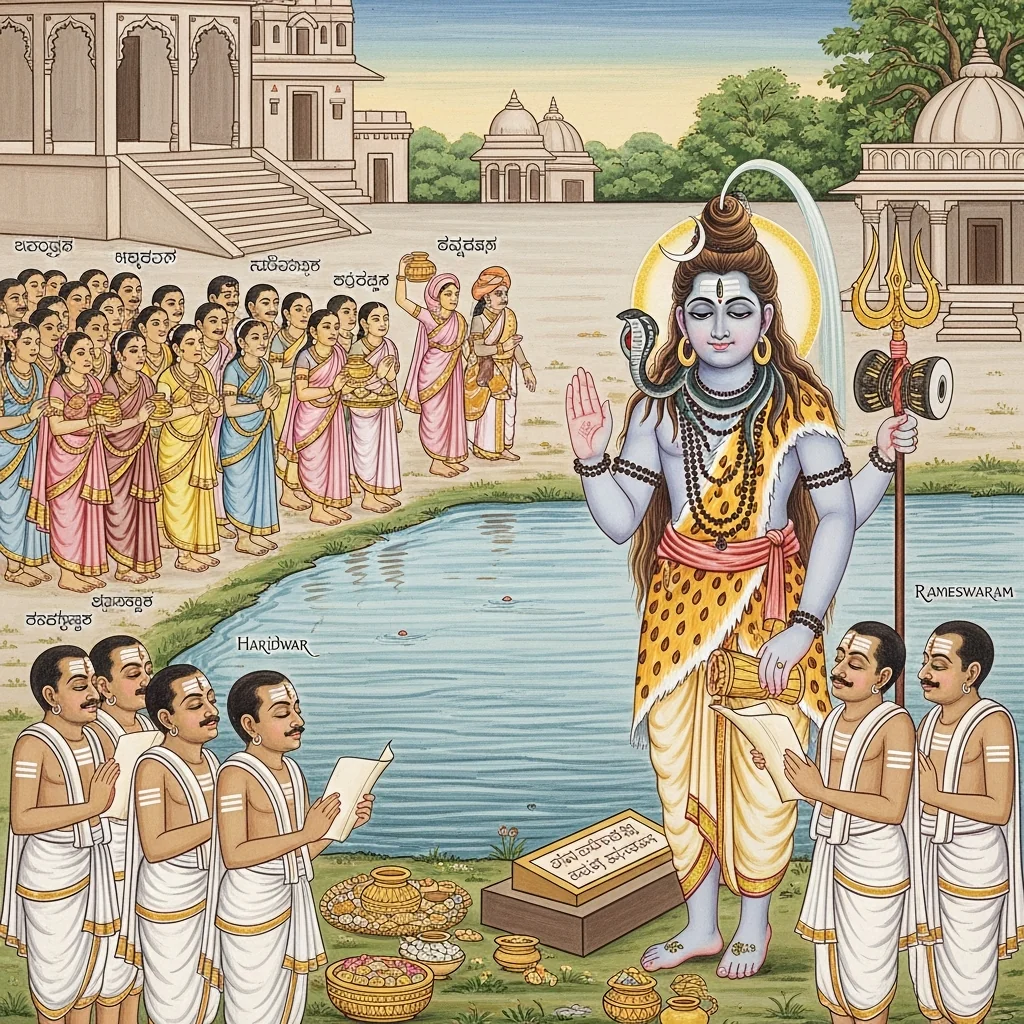
Agastya asks Skanda what took place in the supremely meritorious Jyeṣṭha-sthāna, beloved of the Lord. Skanda relates that while Śiva had gone to Mandara, the resident brāhmaṇas and field-renunciants, sustained by the sacred kṣetra’s economy, excavated a beautiful pond called Daṇḍakhātā and established many mahāliṅgas around it, observing Śaiva disciplines—vibhūti, rudrākṣa, liṅga-pūjā, and Śatarudrīya recitation. Hearing of Śiva’s return, vast numbers of brāhmaṇas come for darśana from many named tīrthas and kuṇḍas—Mandākinī, Haṃsatīrtha, Kapālamocana, Ṛṇamocana, Vaitaraṇī, Lakṣmītīrtha, Piśācamocana, and others—gathering on the Gaṅgā’s bank with offerings and auspicious hymns. Śiva reassures them and teaches that Kāśī is kṣema-mūrti, embodied security, and nirvāṇa-nagarī, the city of liberation; remembrance of “Kāśī” as a mantra is protective and transformative. He affirms the saving status of Kāśī-bhaktas, warns against dwelling in Kāśī without devotion, and grants boons: the Lord will not abandon Kāśī; devotees should maintain unwavering bhakti and continuous residence there; and Śiva’s presence will abide in the liṅgas established by devotees. The chapter lays down ethical duties for residents—service, worship, self-restraint, charity, compassion, and non-harmful speech—and describes karmic consequences for wrongdoing in Kāśī, including severe interim “rudra-piśāca” conditions and corrective sufferings before release. It concludes with Avimukta’s unique promise: none who die there fall into hell; Śiva bestows the tāraka-brahma at departure; even small gifts yield great merit; and reciting or teaching this “secret narrative” frees one from sins and leads to Śiva’s realm.
Shlokas
Verse 1
अगस्त्य उवाच । दृष्ट्वा भूदेवताः शंभुं किमाचख्युः षडानन । कानिकानि च लिंगानि तत्र तान्यपिचक्ष्व मे
Agastya said: “O Ṣaḍānana, when the bhūdevatās (the brāhmaṇas) beheld Śambhu, what did they declare? And what liṅgas were there—tell me of those as well.”
Verse 2
ज्येष्ठस्थाने महापुण्ये देवदेवस्य वल्लभे । आश्चर्यं किमभूत्तत्र तदाचक्ष्व षडानन
“At Jyeṣṭhasthāna—exceedingly meritorious and beloved of the God of gods—what wonder occurred there? O Ṣaḍānana, describe that to me.”
Verse 3
स्कंद उवाच । शृण्वगस्त्य यथा पृच्छि भवता तद्ब्रवीम्यहम् । मंदराद्रिं यदा देवो गतवान्ब्रह्मगौरवात्
Skanda said: “Listen, O Agastya—just as you have asked, so shall I tell it. When the Lord went to Mount Mandara, out of regard for Brahmā’s honor…”
Verse 4
तदा निराश्रया विप्राः क्षेत्रसंन्यासिनोनघाः । उपाकृताश्चाविरतं महाक्षेत्रप्रतिग्रहात्
Then the blameless brāhmaṇas—renunciants devoted to the holy kṣetra—were without worldly shelter; yet they were continually sustained by the offerings received in that great sacred field (Kāśī).
Verse 5
खातंखातं च दंडाग्रैर्भूमिं कंदादिवृत्तयः । चक्रुः पुष्करिणीं रम्यां दंडखाताभिधां मुने
Digging the ground again and again with the tips of their staffs, those ascetics living on roots and the like made a delightful pond, O sage—renowned by the name Daṇḍakhātā.
Verse 6
तत्तीर्थं परितः स्थाप्य महालिंगान्यनेकशः । महेशाराधनपरास्तपश्चक्रुः प्रयत्नतः
Having established many great liṅgas all around that tīrtha, they performed austerities with earnest effort, wholly intent on worshipping Maheśa (Śiva).
Verse 7
विभूतिधारिणो नित्यं नित्यरुद्राक्षधारिणः । लिंगपूजारता नित्यं शतरुद्रियजापिनः
They always wore sacred ash (vibhūti); always wore rudrākṣa beads; were ever devoted to liṅga-worship; and continually recited the Śatarudrīya.
Verse 8
ते श्रुत्वा देवदेवस्य पुनरागमनं मुने । तपःकृशा अतितरामासुरानंद मेदुराः
Hearing, O sage, of the God of gods’ return, those ascetics—though emaciated by austerities—became all the more filled, as if swollen with joy.
Verse 9
द्विजाः पंचसहस्राणि चरतो विपुलं तपः । दंडखातान्महातीर्थादाजग्मुर्देवदर्शने
Five thousand twice-born sages, engaged in abundant austerities, came from the great tīrtha called Daṇḍakhāta, seeking the auspicious darśana of the Lord in Kāśī.
Verse 10
तीर्थान्मंदाकिनी नाम्नो द्विजाः पाशुपतव्रताः । शिवैकाराधनपराः समेता अयुतोन्मिताः
From the tīrtha named Mandākinī came twice-born devotees observing the Pāśupata vow; intent solely on the worship of Śiva, they assembled in a company numbering ten thousand.
Verse 11
हंसतीर्थात्परिप्राप्ता अयुतं त्रिशतोत्तरम् । शतदुर्वाससस्तीर्थादेकादश शताधिकम्
From Haṃsatīrtha there arrived ten thousand and three hundred; and from the tīrtha of Śata-Durvāsas there came eleven hundred and more.
Verse 12
मत्स्योदर्याः परापेतुः सहस्राणि षडेव हि । कपालमोचनात्सप्त शतान्यभ्यागता द्विजाः
From Matsyodarī there came indeed six thousand; and from Kapālamocana, seven hundred twice-born men arrived.
Verse 13
ऋणमोचनतस्तीर्थात्सहस्रं द्विशताधिकम् । वैतरण्या अपि मुने द्विजानामयुतार्धकम्
From the tīrtha called Ṛṇamocana came one thousand and two hundred; and from Vaitaraṇī too, O sage, came five thousand twice-born men.
Verse 14
ततः पृथूदकात्कुंडात्पृथुना परिखानितात् । अयासिषुर्द्विजानां च शतान्येव त्रयोदश
Then, from the reservoir called Pṛthūdaka—trenched and excavated by King Pṛthu—there came thirteen hundred twice-born men.
Verse 15
तथैवाप्सरसः कुंडान्मेनकाख्याच्छतद्वयम् । उर्वशीकुंडतः प्राप्ताः सहस्रं द्विशताधिकम्
Likewise, from the Apsaras’ pond called Menakā came two hundred; and from Urvaśī’s pond there arrived one thousand and two hundred.
Verse 16
तथैरावतकुंडाच्च ब्राह्मणास्त्रिशतानि च । गंधर्वाप्सरसः सप्त शतानि द्विशतानि च
From Airāvata’s pond as well came three hundred brāhmaṇas; and gandharvas and apsarases arrived—seven hundred and two hundred (respectively).
Verse 17
वृषेशतीर्थादाजग्मुर्नवतिः सशतत्रया । यक्षिणीकुंडतः प्राप्ताः सहस्रं त्रिशतोत्तरम्
From Vṛṣeśa-tīrtha there came three hundred and ninety; and from Yakṣiṇī Kuṇḍa there arrived one thousand and three hundred.
Verse 18
लक्ष्मीतीर्थात्परं जग्मुः षोडशैव शतानि च । पिशाचमोचनात्सप्त सहस्राणि द्विजोत्तमाः
From Lakṣmī-tīrtha they journeyed onward—sixteen hundred in number; and from Piśācamocana came seven thousand eminent twice-born men.
Verse 19
पितृकुंडाच्छतंसाग्रं ध्रुवतीर्थाच्छतानि षट् । मानसाख्याच्च सरसो द्विशती सशतत्रया
From Pitṛ-kuṇḍa came a little more than a hundred; from Dhruva-tīrtha came six hundreds; and from the lake known as Mānasa came two hundred and another hundred besides—great companies drawn by the sanctity of Kāśī’s tīrthas.
Verse 20
ब्राह्मणा वासुकिहृदात्सहस्राणि दशैव तु । तथैवाष्टशतं द्रष्टुं जानकीकुंडतो द्विजाः
From Vāsuki-hrada came ten thousand brāhmaṇas; likewise, eight hundred twice-born came from Jānakī-kuṇḍa, all intent on beholding the Lord.
Verse 21
काशीनाथमनुप्राप्ताः परमानंददायिनम् । तथा गौतमकुंडाच्च शतानिनव चागताः
They reached Kāśīnātha, the giver of supreme bliss; and from Gautama-kuṇḍa as well, nine hundreds arrived.
Verse 22
तीर्थाद्दुर्गतिसंहर्तुर्बाह्मणाः प्रतिपेदिरे । एकादशशतान्येव द्रष्टुं देवमुमापतिम्
From the tīrtha of the Destroyer of evil destinies, brāhmaṇas set forth—eleven hundreds indeed—to behold the God, Umāpati (Śiva).
Verse 23
असीसंभेदमारभ्य गंगातीरस्थिता द्विजाः । आसंगमेश्वरात्तत्र परिप्राप्ता घटोद्भव
Beginning from the confluence of the Asī, the twice-born stationed along the sacred Gaṅgā’s bank arrived there from Āsaṅgameśvara—O Pot-born one (Agastya).
Verse 24
अष्टादशसहस्राणि तथा पंचशतान्यपि । ब्राह्मणाः पंचपंचाशद्गंगातीरात्समागताः
Eighteen thousand—and five hundred more—brāhmaṇas, in fifty-five companies, assembled from the sacred bank of the Gaṅgā.
Verse 25
सार्द्रदूर्वाक्षतकरैः सपुष्पफलपाणिभिः । सुगंधमाल्यहस्तैश्च ब्राह्मणैर्जयवादिभिः
Those brāhmaṇas came with hands bearing moist dūrvā grass and unbroken rice, with flowers and fruits in their palms, with fragrant garlands in hand—uttering cries of victory and auspicious acclamations.
Verse 26
स्तुतो मंगलसूक्तैश्च प्रणतश्च पुनःपुनः । तेभ्यो दत्ताभयः शंभुः पप्रच्छ कुशलं मुदा
Praised with auspicious hymns and bowed to again and again, Śambhu granted them fearlessness; then, with joy, He asked them of their welfare.
Verse 27
ततस्ते ब्राह्मणाः प्रोचुः प्रबद्धकरसंपुटाः । क्षेत्रे निवसतां नाथ सदानः कुशलोदयः
Then those brāhmaṇas spoke with hands joined in reverence: “O Lord, for us who dwell in this holy kṣetra, there is ever the arising of welfare.”
Verse 28
विशेषतः कृतोऽस्माभिः साक्षान्नयनगोचरः । त्वं यत्स्वरूपं श्रुतयो न विदुः परमार्थतः
Most especially, You have been made directly visible to our eyes—You whose true nature even the Śrutis (the Vedas) do not fully know in the highest sense.
Verse 29
सदैवाकुशलं तेषां ये त्वत्क्षेत्रपराङ्मुखाः । चतुर्दशापि वै लोकास्तेषां नित्यं पराङ्मुखाः
Misfortune ever attends those who turn away from Your sacred field (Kāśī). Indeed, even the fourteen worlds remain perpetually turned away from them, offering no favorable support.
Verse 30
येषां हृदि सदैवास्ते काशीत्वाशीविषां गद । संसाराशीविषविषं न तेषां प्रभवेत्क्वचित्
O sage, for those in whose heart the ‘Kāśī’-ness abides always—like a remedy against serpent-venom—the poison of saṃsāra, like serpent-venom, never overpowers them at any time.
Verse 31
गर्भरक्षामणिर्मंत्रः काशीवर्णद्वयात्मकः । यस्य कंठे सदा तिष्ठेत्तस्याकुशलता कुतः
The jewel-like mantra that protects like a guardian of the womb is formed of the two syllables of ‘Kāśī’. For one in whose throat it abides always, how could misfortune arise?
Verse 32
सुधां पिबति यो नित्यं काशीवर्णद्वयात्मिकाम् । स नैर्जरीं दशां हित्वा सुधैव परिजायते
Whoever daily ‘drinks’ the nectar that is the two-syllabled ‘Kāśī’ leaves behind the mortal condition and is born anew as nectar itself—immortal in essence.
Verse 33
श्रुतं कर्णामृतं येन काशीत्यक्षरयुग्मकम् । न समाकणर्यत्येव स पुनर्गर्भजां कथाम्
He who has heard the ear-nectar—the two syllables “Kāśī”—does not truly hear again the tale of entering the womb once more (rebirth).
Verse 34
काशी रजोपि यन्मूर्ध्नि पतेदप्यनिलाहतम् । चंद्रशेखरतन्मूर्धा भवेच्चंद्रकलांकितः
Even if a speck of Kāśī’s dust, struck by the wind, should fall upon one’s head, his head becomes like that of Candraśekhara (Śiva), adorned with the crescent moon.
Verse 35
प्रसंगतोपि यन्नेत्रपथमानंदकाननम् । यातं तेत्र न जायंते नेक्षेरन्पितृकान नम्
Even if, by mere chance, the Delightful Grove (Ānandakānana) comes into one’s line of sight, one does not go again to that realm where beings are born—nor does one behold the “forest of the Fathers” (the ancestral world) again.
Verse 36
गच्छता तिष्ठता वापि स्वपता जाग्रताथवा । काशीत्येष महामंत्रो येन जप्तः सनिर्भयः
Whether walking or standing, whether asleep or awake, whoever recites this great mantra, “Kāśī,” becomes fearless.
Verse 37
येन बीजाक्षरयुगं काशीति हृदि धारितम् । अबीजानि भवंत्येव कर्मबीजानि तस्य वै
For one who holds in the heart the seed-syllable pair “Kāśī,” the very seeds of karma become seedless—rendered incapable of sprouting.
Verse 38
काशी काशीति काशीति जपतो यस्य संस्थितिः । अन्यत्रापि सतस्तस्य पुरो मुक्तिः प्रकाशते
For one whose steady state is to chant “Kāśī, Kāśī, Kāśī,” liberation shines before him—even if he dwells elsewhere.
Verse 39
क्षेममूर्तिरियं काशी क्षेममूर्तिर्भवान्भव । क्षेममूर्तिस्त्रिपथगा नान्यत्क्षेमत्रयं क्वचित्
This Kāśī is the very embodiment of kṣema (spiritual safety and auspicious well-being). You too, O Bhava (Śiva), are kṣema embodied; and Tripathagā—the Gaṅgā who flows through the three worlds—is likewise kṣema in form. Nowhere at all is there any other “threefold kṣema” besides these.
Verse 40
ब्राह्मणानामिति वचः क्षेत्रभक्तिविबृंहितम् । निशम्य गिरिजाकांतस्तुतोष नितरां हरः
Hearing those words of the brāhmaṇas—words made resplendent with devotion to the sacred kṣetra—Hara, the beloved of Girijā (Pārvatī), became exceedingly pleased.
Verse 41
प्रोवाच च प्रसन्नात्मा धन्या यूयं द्विजर्षभाः । येषामिहेदृशी भक्तिर्मम क्षेत्रेतिपावने
And with a gracious heart he spoke: “Blessed are you, O best of brāhmaṇas, for in this supremely purifying kṣetra of mine you possess such devotion.”
Verse 42
जाने सत्त्वमया जाताः क्षेत्रस्यास्य निषेवणात् । नीरजस्का वितमसः संसारार्णवपारगाः
“I know that, by serving and resorting to this kṣetra, you have become filled with sattva; free from rajas and beyond tamas, you have crossed to the far shore of the ocean of worldly existence (saṃsāra).”
Verse 43
वाराणस्यास्तु ये भक्तास्ते भक्ता मम निश्चितम् । जीवन्मुक्ता हि ते नूनं मोक्षलक्ष्म्या कटाक्षिताः
But those who are devotees of Vārāṇasī—those are certainly my devotees. Indeed, they are surely jīvanmukta, graced by the glance of Lakṣmī herself, the very fortune of mokṣa.
Verse 44
यैश्च काशीस्थितो जंतुरल्पकोपि विरोधितः । तैर्वै विश्वंभरा सर्वा मया सह विरोधिता
And those by whom even a single creature dwelling in Kāśī is opposed or harmed, even slightly—by them, truly, the whole Earth, Viśvambharā, together with me, has been opposed.
Verse 45
वाराणस्याः स्तुतिमपि यो निशम्यानुमोदते । अपि ब्रह्मांडमखिलं ध्रुवं तेनानुमोदितम्
Whoever, on hearing even the praise of Vārāṇasī, approves and rejoices—by him, surely, the entire universe, the whole brahmāṇḍa, is approved and affirmed.
Verse 46
निवसंति हि ये मर्त्या अस्मिन्नानंदकानने । ममांतःकरणे ते वै निवसेयुरकल्मषाः
Indeed, those mortals who dwell in this Ānandakānana, the Forest of Bliss—stainless of sin, they truly dwell within my own inner heart.
Verse 47
निवसंति मम क्षेत्रे मम भक्तिं प्रकुर्वते । मम लिंगधरा ये तु तानेवोपदिशाम्यहम्
Those who dwell in my kṣetra and actively cultivate devotion to me—those who bear my liṅga—those alone do I personally instruct.
Verse 48
निवसंति मम क्षेत्रे मम भक्तिं न कुर्वते । मम लिंगधरा ये नो न तानुपदिशाम्यहम्
But those who dwell in my kṣetra and do not practice devotion to me—even if they bear my liṅga—such people I do not instruct.
Verse 49
काशी निर्वाणनगरी येषां चित्ते प्रकाशते । ते मत्पुरः प्रकाशंते नैःश्रेयस्या श्रिया वृताः
Those in whose heart Kāśī—the City of Nirvāṇa—shines forth, they themselves shine in my own abode, clothed in the splendor of the highest good.
Verse 50
मोक्षलक्ष्मीरियं काशी न येभ्यः परिरोचते । स्वर्लक्ष्मीं कांक्षमाणेभ्यः पतितास्ते न संशयः
This Kāśī is the very Lakṣmī of liberation. Those to whom she does not appear desirable—who long instead for the prosperity of heaven—are fallen souls, without doubt.
Verse 51
काथीं संकाक्षमाणानां पुरुषार्थचतुष्टयम् । पुरः किंकरवत्तिष्ठेन्ममानुग्रहतो द्विजाः
O brāhmaṇas, for those who earnestly desire Kāśī, the four human aims—dharma, artha, kāma, and mokṣa—stand before them like attendants, by my grace.
Verse 52
आनंदकानने ह्यत्र ज्वलद्दावानलोस्म्यहम् । कर्मबीजानि जंतूनां ज्वालये न प्ररोहये
Here, in this Forest of Bliss, I am like a blazing wildfire: I burn up the seeds of beings’ karma and do not allow them to sprout again.
Verse 53
वस्तव्यं सततं काश्यां यष्टव्योहं प्रयत्नतः । जेतव्यौ कलिकालौ च रंतव्या मुक्तिरंगना
One should dwell continually in Kāśī; I should be worshiped with earnest effort; the evils of the Kali age should be conquered; and one should delight in Liberation, the noble consort.
Verse 54
प्राप्यापि काशीं दुर्बुद्धिर्यो न मां परिसेवते । तस्य हस्तगताप्याशु कैवल्यश्रीः प्रणश्यति
Even after reaching Kāśī, the misguided person who does not serve and worship me—his splendor of absolute liberation, though as if already in hand, quickly slips away.
Verse 55
धन्या मद्भक्तिलक्ष्माणो ब्राह्मणाः काशिवासिनः । यूयं यच्चेतसो वृत्तेर्न दूरेहं न काशिका
Blessed indeed are the brāhmaṇas dwelling in Kāśī, marked by the wealth of devotion to me. For you, by the very movement of your mind, neither am I far away, nor is Kāśikā (Kāśī).
Verse 56
दातव्यो वो वरः कोत्र व्रियतां मे यथारुचि । प्रेयांसो मे यतो यूयं क्षेत्रसंन्यासकारिणः
What boon shall I grant you here? Choose it according to your desire. For you are dear to me, since you have undertaken renunciation in this sacred field (Kāśī).
Verse 57
इति पीत्वा महेशानमुखक्षीराब्धिजां सुधाम् । परितृप्ता द्विजाः सर्वे वव्रुर्वरमनुत्तमम्
Having thus drunk the nectar born of the Milk-Ocean from the mouth of Maheśāna, all the brāhmaṇas were fully satisfied and chose an unsurpassed boon.
Verse 58
ब्राह्मणा ऊचुः । उमापते महेशान सर्वज्ञ वर एष नः । काशी कदापि न त्याज्या भवता भवतापहृत्
The brāhmaṇas said: O Lord of Umā, O Maheśāna, O all-knowing One—this is our boon: may Kāśī never be abandoned by You, O remover of worldly affliction.
Verse 59
वचनाद्ब्राह्मणानां तु शापो मा प्रभवत्विह । कदाचिदपि केषांचित्काश्यां मोक्षांतरायकः
May the curse arising from the words of brāhmaṇas never take effect here, nor at any time become an obstacle to anyone’s liberation in Kāśī.
Verse 60
तव पादाबुंजद्वंद्वे निर्द्वंद्वा भक्तिरस्तु नः । आ कलेवरपातं च काशीवासोस्तु नोनिशम्
May we have unwavering devotion to Your twin lotus-feet; and may residence in Kāśī be ours continually, until the fall of the body (death).
Verse 61
किमन्येन वरेणेश देय एष वरो हि नः । अवधेह्यंधकध्वंसिन्वरमन्यं वृणीमहे
What need have we of any other boon, O Lord of boons? This alone is the boon we ask. O slayer of Andhaka, grant it—we choose no other blessing.
Verse 62
तव प्रतिनिधी कृत्यास्माभिस्त्वद्भक्तिभावितैः । प्रतिष्ठितेषु लिंगेषु सान्निध्यं भवतोऽस्त्विह
We, inspired by devotion to You, shall establish (these liṅgas) as Your representatives; may Your divine presence abide here in these consecrated liṅgas.
Verse 63
श्रुत्वेति तेषां वाक्यानि तथास्त्विति पिनाकिना । प्रोचेऽन्योपि वरो दत्तो ज्ञानं वश्च भविष्यति
Hearing their words, Pinākin (Śiva) said, “So be it.” And he declared, “Another boon too is granted: knowledge shall arise in you as well.”
Verse 64
पुनः प्रोवाच देवेशो निशामयत भो द्विजाः । हितं वः कथयाम्यत्र तदनुष्ठीयतां ध्रुवम्
Then the Lord of the gods spoke again: “Listen, O twice-born. I shall tell you what is truly beneficial here—let it be practiced without fail.”
Verse 65
सेव्योत्तरवहा नित्यं लिंगमर्च्यं प्रयत्नतः । दमो दानं दया नित्यं कर्तव्यं मुक्तिकांक्षिभिः
“Let the Uttaravāhā be served daily, and the liṅga be worshiped with earnest effort. Self-restraint, charity, and compassion must always be practiced by those who long for liberation.”
Verse 66
इदमेव रहस्यं च कथितं क्षेत्रवासिनाम् । मतिः परहिता कार्या वाच्यं नोद्वेगकृद्वचः
“This very secret teaching is declared for the residents of the sacred field: keep your intention set on others’ welfare, and speak words that do not cause agitation.”
Verse 67
मनसापि न कर्तव्यमेनोत्र विजिगीषुणा । अत्रत्यमक्षयं यस्मात्सुकृतं सुकृतेतरम्
“Even in the mind, one who seeks true victory should not commit wrongdoing here; for deeds done in this place become imperishable—whether merit or its opposite.”
Verse 68
अन्यत्र यत्कृतं पापं तत्काश्यां परिणश्यति । वाराणस्यां कृतं पापमंतर्गेहे प्रणश्यति
Sin committed elsewhere perishes upon coming to Kāśī; but sin committed in Vārāṇasī is destroyed only “within the house,” that is, with difficulty through inner rectification.
Verse 69
अंतर्गेहे कृतं पापं पैशाच्यनरकावहम् । पिशाचनरकप्राप्तिर्गच्छत्येव बहिर्यदि
Sin committed within the inner precinct leads to the hell called Paiśācya; but if one goes outside the holy boundary, one indeed falls into the Piśāca-hell.
Verse 70
न कल्पकोटिभिः काश्यां कृतं कर्म प्रमृज्यते । किंतु रुद्रपिशाचत्वं जायतेऽत्रायुतत्रयम्
Even over crores of aeons, the deed done in Kāśī is not wiped away; rather, in this very place one becomes a Rudra-Piśāca for thirty thousand years.
Verse 71
वाराणस्यां स्थितो यो वै पातकेषु रतः सदा । योनिं प्राप्यापि पैशाचीं वर्षाणामयुतत्रयम्
Whoever dwells in Vārāṇasī and is ever devoted to sins—having attained even a Paiśācī (demonic) womb—endures it for thirty thousand years.
Verse 72
पुनरत्रैव निवसञ्ज्ञानं प्राप्स्यत्यनुत्तमम् । तेन ज्ञानेथ संप्राप्ते मोक्षमाप्स्यत्यनुत्तमम्
Then, dwelling here again, one attains unsurpassed knowledge; and when that knowledge is gained, one reaches unsurpassed liberation (mokṣa).
Verse 73
दुष्कृतानि विधायेह बहिः पंचत्वमागताः । तेषां गतिं प्रवक्ष्यामि शृणुत द्विजसत्तमाः
Having done evil deeds here and then meeting death outside the sacred boundary, I shall declare their destiny—listen, O best of the twice-born.
Verse 74
यामाख्या मे गणाः संति घोरा विकृतमूर्त्तयः । मूषायां ते धमंत्यादौ क्षेत्रदुष्कृतकारिणः
There are my troops called the Yāmas—terrifying, of distorted forms. First, they blow into a furnace those who committed evil deeds within the sacred field.
Verse 75
नयंत्यनूपप्रायां च ततः प्राचीं दुरासदाम् । वर्षाकाले दुराचारान्पातयंति महाजले
They lead them to a marshy region, and then to the eastern tract that is hard to approach; in the rainy season, they cast the wicked into a vast flood of water.
Verse 76
जलौकाभिः सपक्षाभिर्दंदशूकैर्जलोद्भवैः । दुर्निवारैश्च मशकैर्दश्यंते ते दिवानिशम्
They are bitten day and night by leeches, by winged water-born serpents, and by irresistible mosquitoes.
Verse 77
ततो यामैर्हिमर्तौ ते नीयंतेऽद्रौ हिमालये । अशनावरणैर्हीनाः क्लेश्यंते ते दिवानिशम्
Then, in the winter season, the Yāmas take them to a mountain in the Himālayas; deprived of food and shelter, they suffer day and night.
Verse 78
मरुस्थले ततो ग्रीष्मे वारिवृक्षविवर्जिते । दिवाकरकरैस्तीव्रैस्ताप्यंते ते पिपासिताः
Then, in summer, in a desert bereft of water and trees, they are scorched by the fierce rays of the sun, tormented by thirst.
Verse 79
क्लेशितास्ते गणैरुग्रैर्यातनाभिः समंततः । इत्थं कालमसंख्यातमानीयंते ततस्त्विह
Thus, afflicted on every side by fierce attendants through manifold torments, they are kept suffering for an immeasurable span of time; thereafter, they are brought here, into this sacred jurisdiction.
Verse 80
निवेदयंति ते यामाः कालराजांतिके ततः । कालराजोपि तान्द्रष्ट्वा कर्मसंस्मार्य दुष्कृतम्
Then the Yāmas report them in the presence of the Lord of Time, Yama. And the Lord of Time, seeing them, calls to mind their deeds—especially their evil actions.
Verse 81
विवस्त्रान्क्षुत्तृषार्तांश्च लग्नपृष्ठोदरत्वचः । अन्यै रुद्रपिशाचैश्च सहसंयोजयत्यपि
Naked, tormented by hunger and thirst, their skin clinging to back and belly, he also forcibly yokes them together with other Rudra-piśācas, fierce spirits.
Verse 82
ततो रुद्रपिशाचास्ते भैरवानुचराः सदा । सहंते क्लममत्यर्थं क्षुत्तृष्णोग्रत्वसंभवम्
Then those Rudra-piśācas—ever attendants of Bhairava—endure extreme exhaustion arising from fierce hunger and thirst.
Verse 83
आहारं रुधिरोन्मिश्रं ते लभंते कदाचन । एवं त्र्ययुतसंख्याकं कालं तत्रातिदुःखिताः
At times they obtain food mixed with blood; and thus, for a span numbered as three ayutas, they remain there in intense misery.
Verse 84
श्मशानस्तंभमभितो नीयंते कंठपाशिताः । पिपासिता अपि न तेंऽबुस्पर्शमपि चाप्नुयुः
Dragged around the “pillar of the cremation-ground”, with nooses at their throats, though parched with thirst they do not attain even the touch of water.
Verse 85
अथ संक्षीणपापास्ते कालभैरवदर्शनात् । इहैव देहिनो भूत्वा मुच्यंते ते ममाज्ञया
Then, their sins being exhausted through the vision of Kālabhairava, they become embodied here itself and are released—by my command.
Verse 86
तस्मान्न कामयेतात्र वाङ्मनःकर्मणाप्यघह म् । शुचौ पथि सदा स्थेयं महालाभमभीप्सुभिः
Therefore, one should not desire sin there—even by speech, mind, or action. Those who seek the highest gain should always remain upon the pure path.
Verse 87
नाविमुक्ते मृतः कश्चिन्नरकं याति किल्बिषी । ममानुग्रहमासाद्य गच्छत्येव परां गतिम्
No sinner who dies in Avimukta goes to hell. Attaining my grace, he surely proceeds to the supreme state.
Verse 88
अनाशनं यः कुरुते मद्भक्त इह सुव्रतः । न तस्य पुनरावृत्तिः कल्पकोटिशतैरपि
Whoever, being My devotee and steadfast in righteous vows, observes fasting here—there is no return for him to rebirth, even after hundreds of crores of kalpas.
Verse 89
अशाश्वतमिदं ज्ञात्वा मानुष्यं बहुकिल्विषम् । अविमुक्तं सदा सेव्यं संसारभयमोचकम्
Knowing this human state to be impermanent and burdened with many faults, one should always resort to Avimukta (Kāśī), the liberator from the fear of saṃsāra.
Verse 90
नान्यत्पश्यामि जंतूनां मुक्त्वा वाराणसीं पुरीम् । सर्वपापप्रशमनीं प्रायश्चित्तं कलौ युगे
For living beings I see no other remedy apart from the city of Vārāṇasī—she who pacifies all sins, the very prāyaścitta (atonement) in the age of Kali.
Verse 91
जन्मांतरसहस्रेषु यत्पापं समुपार्जितम् । अविमुक्तं प्रविष्टस्य तत्सर्वं व्रजति क्षयम्
Whatever sin has been accumulated across thousands of births—upon entering Avimukta, all of it goes to destruction.
Verse 92
जन्मांतरसहस्रेषु युंजन्योगी यदाप्नुयात् । तदिहैव परो मोक्षो मरणादधि गम्यते
That supreme liberation which a yogin might attain only after striving through thousands of births—here itself it is reached, even through death (in Avimukta).
Verse 93
तिर्यग्योनिगताः सत्त्वा ये विमुक्तकृतालयाः । कालेन निधनं प्राप्तास्तेपि यांति परां गतिम्
Even beings born in animal wombs—if they have made their dwelling in Vimukta (Avimukta)—when in due time they meet death, they too attain the highest state.
Verse 94
अविमुक्तं न सेवंते ये मूढास्तमसावृताः । विण्मूत्ररेतसां मध्ये ते वसंति पुनः पुनः
Those deluded ones, shrouded in darkness, who do not resort to Avimukta—again and again they dwell amid filth: feces, urine, and semen, that is, repeated embodied birth.
Verse 95
अविमुक्तं समासाद्य यो लिंगं स्थापयेत्सुधीः । कल्पकोटिशतैर्वापि नास्ति तस्य पुनर्भवः
A wise person who reaches Avimukta and establishes a Śiva-liṅga—even across hundreds of crores of kalpas—for him there is no rebirth.
Verse 96
ग्रहनक्षत्रताराणां कालेन पतनं ध्रुवम् । अविमुक्ते मृतानां तु पतनं नैव विद्यते
With time, the fall of planets, constellations, and stars is certain; but for those who die in Avimukta, there is no falling away from the attained state.
Verse 97
ब्रह्महत्यां नरः कृत्वा पश्चात्संयतमानसः । प्राणांस्त्यजति यः काश्यां स मुक्तो नात्र संशयः
Even if a man has committed brahmin-slaying, if afterward he restrains his mind and gives up his life in Kāśī, he is liberated—of this there is no doubt.
Verse 98
स्त्रियः पतिव्रता याश्च मम भक्तिसमाहिताः । अविमुक्ते मृता विप्रा यांति ताः परमां गतिम्
Women devoted to their husbands and steadfastly absorbed in devotion to Me—O brāhmaṇa—if they die in Avimukta, they attain the highest destination.
Verse 99
अत्रोत्क्रमणकालेहं स्वयमेव द्विजोत्तमाः । दिशामि तारकं ब्रह्म देही स्याद्येन तन्मयः
O best of the twice-born, here in Kāśī at the time of departing the body, I Myself impart the Tāraka-Brahman—the saving mantra—by which the embodied soul becomes one with That (Supreme Reality).
Verse 100
मन्मना मम भक्तश्च मयि सर्वार्पितक्रियः । यथा मोक्षमिहाप्नोति न तथान्यत्रकुत्रचित्
One whose mind is fixed on Me, who is devoted to Me, and who offers all actions unto Me—such a person attains liberation here (in Kāśī) in a way not found anywhere else.
Verse 110
महादानेन चान्यत्र यत्फलं लभ्यते नरैः । अविमुक्ते तु काकिण्यां दत्तायां तदवाप्यते
The fruit that people obtain elsewhere by a great gift—here in Avimukta (Kāśī) that very fruit is gained even by giving a mere kākiṇī (a tiny coin).
Verse 120
तेपि साक्षाद्विरूपाक्षं प्रत्यक्षीकृत्य वाडवाः । प्रहृष्टमनसोऽत्यंतं प्रययुः स्वस्वमाश्रयम्
They too—the Vāḍavas—having beheld Virūpākṣa (Śiva) directly and made Him manifest to their sight, departed to their own abode, their hearts exceedingly delighted.
Verse 122
स्कंद उवाच । पठित्वा पाठयित्वा च रहस्याख्यानमुत्तमम् । श्रद्धालुः पातकैर्मुक्तः शिवलोके महीयते
Skanda said: Having read, and also caused others to read, this supreme secret teaching, the faithful one is freed from sins and is honored in Śiva’s world.