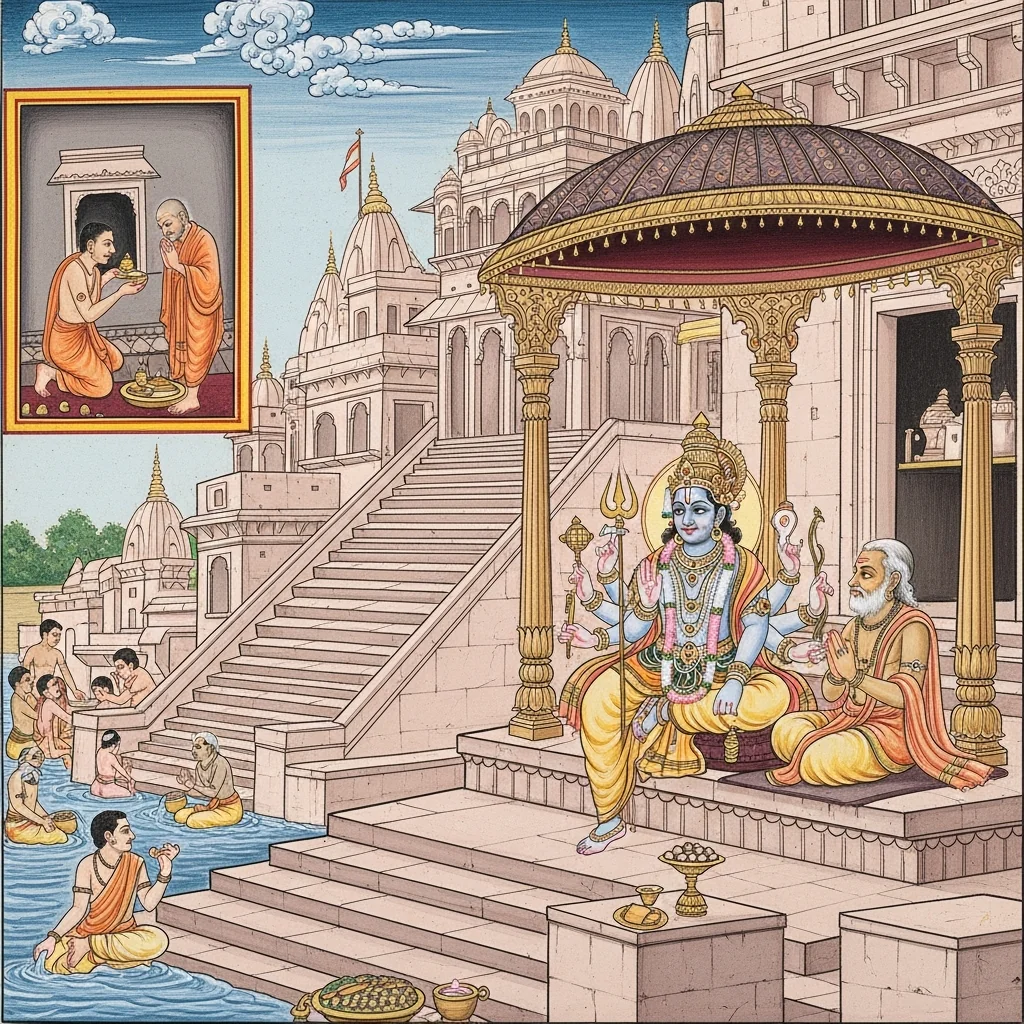
Adhyaya 46
The chapter opens with Agastya’s question about an apparent paradox: how Vyāsa—depicted as a Śiva-devotee and knower of the kṣetra’s secrets—could be connected with a curse narrative. Skanda answers by setting the matter within Vyāsa’s disciplined life in Kāśī: daily bathing, teaching the kṣetra’s greatness, and establishing a normative hierarchy—Viśveśvara as supreme among liṅgas and Manikarṇikā as supreme among tīrthas. It then lays out a practical rule of conduct for Kāśī’s residents and pilgrims: daily snāna and worship, never abandoning Manikarṇikā, adherence to varṇāśrama-dharma, discreet charity (especially anna-dāna), avoidance of slander and falsehood (with a limited protective exception to save beings), and a strong ethic of safeguarding all creatures, said to yield immense merit. Kṣetra-sannyāsins and resident ascetics are honored, their satisfaction being linked to Viśveśvara’s pleasure. The text stresses restraint of the senses, discourages self-harm or death-seeking, and presents Kāśī practice as uniquely efficient—one immersion, one worship, or a little japa/homa equaling great rites elsewhere. It provides a technical taxonomy of expiatory disciplines (kṛcchra types, parāka, prājāpatya, sāntapana/mahāsāntapana, tapta-kṛcchra) and multiple cāndrāyaṇa modes, culminating in a purification doctrine: the body by water, the mind by truth, the intellect by knowledge. The closing hints at a divine test through denying alms to Vyāsa, setting up the “Vyāsa-śāpa-vimokṣa” frame and promising a protective fruit for hearing this chapter.
Shlokas
Verse 1
अगस्त्य उवाच । कृप्णद्वैपायनः स्कंद शंभुभक्तिपरो यदि । यदि क्षेत्ररहस्यज्ञः क्षेत्रसंन्यासकृद्यदि
Agastya said: O Skanda, if Kṛṣṇa-Dvaipāyana (Vyāsa) is devoted in bhakti to Śambhu (Śiva), if he knows the secret truths of the sacred kṣetra, and if he is one who establishes renunciation (saṃnyāsa) with respect to the kṣetra—
Verse 2
तथा दृष्टप्रभावश्चेत्तथा चेज्ज्ञानिनां वरः । पुरीं वाराणसीं श्रेष्ठां कथं किल शपिष्यति
And if his power has indeed been witnessed, and if he is truly the foremost among the wise—how, then, could he ever curse the supreme city, Vārāṇasī?
Verse 3
स्कंद उवाच । सत्यमेतत्त्वया पृच्छि कथयामि मुने शृणु । तस्य व्यासस्य चरितं भविष्यं त्वयि पृच्छति
Skanda said: What you have asked is true and fitting. Listen, O sage—I shall relate it. The account of Vyāsa will unfold in response to your inquiry.
Verse 4
यदारभ्य मुनेस्तस्य नंदी स्तंभितवान्भुजम् । तदारभ्य महेशानं संस्तौति परमादृतः
From the time that Nandī restrained the arm of that sage, from that very time onward he has praised Maheśāna with the greatest reverence.
Verse 5
काश्यां तीर्थान्यनेकानि काश्यां लिगान्यनेकशः । तथापि सेव्यो विश्वेशः स्नातव्या मणिकर्णिका
In Kāśī there are many sacred bathing-places, and in Kāśī there are countless liṅgas; yet, above all, Viśveśa should be worshipped, and Maṇikarṇikā should be bathed in.
Verse 6
लिंगेष्वेको हि विश्वेशस्तीर्थेषु मणिकर्णिका । इति संव्याहरन्व्यासस्तद्द्वयं बहु मन्यते
‘Among liṅgas, Viśveśa alone; among tīrthas, Maṇikarṇikā’—speaking thus, Vyāsa holds these two in the highest esteem.
Verse 7
त्यक्त्वा स बहु वाग्जालं प्रातः स्नात्वा दिनेदिने । निर्वाणमंडपे वक्ति महिमानं महेशितुः
Abandoning excessive webs of disputation, he bathes each day at dawn; and in the Nirvāṇa-maṇḍapa he proclaims the greatness of the Lord Maheśa.
Verse 8
शिष्याणां पुरतो नित्यं क्षेत्रस्य महिमा महान् । व्याख्यायते मुदा तेन व्यासेन परमर्षिणा
Before his disciples each day, the supreme sage Vyāsa joyfully expounds the great glory of the sacred Kṣetra.
Verse 9
अत्र यत्क्रियते क्षेत्रे शुभं वाऽशुभमेव वा । संवर्तेपि न तस्यांतस्तस्माच्छ्रेयः समाचरेत्
Whatever is done in this sacred Field (Kāśī)—auspicious or even inauspicious—its consequence does not end even at the time of cosmic dissolution. Therefore, one should earnestly practice here what is truly beneficial and righteous.
Verse 10
क्षेत्रसिद्धिं समीहंते ये चात्र कृतिनो जनाः । यावज्जीवं न तैस्त्याज्या सुधीभिर्मणिकर्णिका
Those of merit who seek the spiritual fulfillment granted by this sacred Field—by the wise, Manikarṇikā must not be abandoned for as long as life endures.
Verse 11
चक्रपुष्करिणी तीर्थे स्नातव्यं प्रतिवासरम् । पुष्पैः पत्रैः फलैस्तोयैरर्च्यो विश्वेश्वरः सदा
At the tīrtha of Cakrapuṣkariṇī one should bathe each day, and Viśveśvara should ever be worshipped with flowers, leaves, fruits, and water.
Verse 12
स्ववर्णाश्रमधर्मश्च त्यक्तव्यो न मनागपि । प्रत्यहं क्षेत्रमहिमा श्रोतव्यः श्रद्धया सकृत्
One must not abandon even in the slightest one’s own duties of varṇa and āśrama; and every day, with faith, one should listen at least once to the greatness of the sacred Field (Kāśī).
Verse 13
यथाशक्ति च देयानि दानान्यत्र सुगुप्तवत् । अन्नान्यपि च देयानि विघ्नान्परिजिहीर्षुणा
Here one should give charity according to one’s capacity, discreetly and without display. One should also give food, for one who wishes to ward off obstacles.
Verse 14
परोपकरणं चात्र कर्तव्यं सुधिया सदा । पर्वस्वपि विशेषेण स्नानदानादिकाः क्रियाः
Here one should always, with good understanding, render help to others. And especially on festival or sacred observance days, acts such as bathing and charity and the like should be performed.
Verse 15
सरस्वती सरिद्रूपा ह्यतः शास्त्रनिकेतनम् । आनंदकाननं सर्वं धर्मशास्त्रकृतालयम्
Therefore Sarasvatī is present here in the form of a river; this place is a dwelling of sacred learning. The whole Ānandakānana is an abode fashioned by Dharma and the śāstras.
Verse 16
अत्र मर्म न वक्तव्यं सुधियां कस्यचित्क्वचित् । परदार परद्रव्य परापकरणं त्यजेत्
Here, a wise person should never disclose another’s secrets anywhere. One should renounce another’s spouse, another’s property, and harming others.
Verse 17
परापवादो नो वाच्यः परेर्ष्यां न च कारयेत् । असत्यं नैव वक्तव्यं प्राणैः कंठगतैरपि
One must not speak slander of others, nor incite envy toward others. One must never speak falsehood—even if one’s very life has come up to the throat (even at the cost of life).
Verse 18
अत्रत्य जंतुरक्षार्थमसत्यमपि भाषयेत् । येनकेनप्रकारेण शुभेनाप्यशुभेन वा
Here, for the sake of protecting a living being, one may even speak an untruth—by whatever means, whether seeming auspicious or even inauspicious—if it brings about that protection.
Verse 19
अत्रत्यः प्राणिमात्रोपि रक्षणीयः प्रयत्नतः । एकस्मिन्रक्षिते जंतावत्र काश्यां प्रयत्नतः । त्रैलोक्यरक्षणात्पुण्यं यत्स्यात्तत्स्यान्न संशयः
In this place, Kāśī, even the smallest living creature should be protected with all one’s effort. If here in Kāśī, through sincere striving, even one being is safeguarded, the merit gained equals that born of protecting the three worlds—of this there is no doubt.
Verse 20
ये वसंति सदा काश्यां क्षेत्रसंन्यासकारिणः । त एव रुद्रा मंतव्या जीवन्मुक्ता न संशयः
Those who dwell always in Kāśī, embracing renunciation within the sacred field (kṣetra-saṃnyāsa), are to be regarded as Rudras themselves; they are liberated while living—of this there is no doubt.
Verse 21
ते पूज्यास्ते नमस्कार्यास्ते संतोष्याः प्रयत्नतः । तेषु वै परितुष्टेषु तुष्येद्विश्वेश्वरः स्वयम्
They should be worshipped, they should be saluted with reverence, and they should be pleased through earnest effort. When they are truly satisfied, Viśveśvara Himself becomes pleased.
Verse 22
काश्यां वसंति ये मर्त्या दूरस्थैरपि सन्नरैः । योगक्षेमो विधातव्यस्तेषां विश्वेशितुर्मुदे
Even good people who live far away should provide for the yoga-kṣema—welfare and security—of those mortals who reside in Kāśī, so as to gladden Viśveśvara, the Lord of the universe.
Verse 23
प्रसरस्त्विंद्रियाणां च निवार्योत्र निवासिभिः । मनसोपि हि चांचल्यमिह वार्यं प्रयत्नतः
Here, those who dwell in Kāśī should restrain the outward rushing of the senses; indeed, even the mind’s restlessness must be checked here with diligent effort.
Verse 24
मरणं नाभिकांक्षेद्धि कांक्ष्यो मोक्षोऽपिनो पुनः । शरीरशोषणोपायः कर्तव्यः सुधिया नहि
One should not desire death; nor should one even desire liberation in a grasping way. A wise person should not undertake methods that emaciate or torment the body.
Verse 25
आत्मरक्षात्र कर्तव्या महाश्रेयोभिवृद्धये । अत्रात्म त्यजनोपायं मनसापि न चिंतयेत्
Here (in Kāśī), one should safeguard oneself for the increase of the highest good. Here, one should not even mentally contemplate any means of abandoning the body (self-destruction).
Verse 26
गर्वः परोत्र विद्यानां धनगर्वोत्र वै महान् । मुक्तिगर्वेण नो भिक्षां प्रयच्छंत्यत्र वासिनः
Here, pride in learning is a great obstacle; here, pride in wealth is indeed great. And because of pride about ‘liberation,’ the residents here do not give alms.
Verse 27
एकस्मिन्नपि यच्चाह्नि काश्यां श्रेयोभिलभ्यते । न तु वर्षशतेनापि तदन्यत्राप्यते क्वचित्
Whatever highest good is obtained in Kāśī even in a single day is not attained elsewhere—anywhere at all—even in a hundred years.
Verse 28
अन्यत्र योगाभ्यसनाद्यावज्जन्म यदर्ज्यते । वाराणस्यां तदेकेन प्राणायामेन लभ्यते
Whatever is earned elsewhere through lifelong practice of yoga is obtained in Vārāṇasī through a single prāṇāyāma, the discipline of the breath.
Verse 29
सर्वतीर्थावगाहाच्च यावज्जन्म यदर्ज्यते । तदानंदवने प्राप्यं मणिकर्ण्येकमज्जनात्
Whatever merit is gained in a lifetime by bathing at all sacred fords is obtained in Ānandavana (Kāśī) by a single immersion in Maṇikarṇikā.
Verse 30
सर्वलिंगार्चनात्पुण्यं यावज्जन्म यदर्ज्यते । सकृद्विश्वेशमभ्यर्च्य श्रद्धया तदवाप्यते
Whatever merit is earned in a lifetime by worship of all liṅgas is attained by worshipping Viśveśvara just once, with faith.
Verse 31
गृहिण्युवाच । भगवन्भिक्षुकास्तावदद्य दृष्टा न कुत्रचित् । असत्कृत्यातिथिं नाथो न मे भोक्ष्यति कर्हिचित्
The housewife said: “O venerable one, today I have not seen any mendicants anywhere. If I fail to honour a guest, my husband will never eat my food at any time.”
Verse 32
गवां कोटि प्रदानेन सम्यग्दत्तेन यत्फलम । तत्फलं सम्यगाप्येत विश्वेश्वर विलोकनात्
The fruit gained by properly gifting a crore of cows is fully attained by merely beholding Viśveśvara.
Verse 33
यत्षोडशमहादानैः पुण्यं प्रोक्तं महर्षिभिः । तत्पुण्यं जायते पुंसां विश्वेशे पुष्पदानतः
The merit that the great seers declare to arise from the sixteen great gifts—that very merit arises for people by offering flowers to Viśveśvara.
Verse 34
अश्वमेधादिभिर्यज्ञैर्यत्फलं प्राप्यतेखिलैः । पंचामृतानां स्नपनाद्विश्वेशे तदवाप्यते
The fruit that is obtained through sacrifices beginning with the Aśvamedha—that is attained by bathing (abluting) Viśveśvara with the pañcāmṛta.
Verse 35
विशेषपूजा कर्तव्या सुमहोत्सवपूर्वकम । कार्यास्तथाधिका यात्राः समर्च्याः क्षेत्रदेवताः
A special worship should be performed, preceded by a grand festival; likewise, additional pilgrim-processions should be undertaken, and the deities of the sacred precinct should be duly worshipped.
Verse 36
मन्ये धर्ममयी मूर्तिः कापि त्वं शुचिमानसा । त्वद्दर्शनात्परां प्रीतिं संप्राप्तानींद्रियाणि मे
I deem you to be some embodiment of Dharma itself, possessed of a pure mind. From seeing you, my senses have attained a supreme joy.
Verse 37
महापूजोपकरणं योर्पयेद्विश्वभर्तरि । न तं संपत्तिसंभारा विमुंचंतीह कुत्रचित्
Whoever offers the requisites for great worship to the Lord who sustains the universe—abundance of prosperity does not forsake that person anywhere in this world.
Verse 38
सर्वर्तुकुसुमाढ्यां च यः कुर्यात्पुष्पवाटिकाम् । तदंगणे कल्पवृक्षाश्छायां कुर्वंति शीतलाम्
Whoever makes a flower-garden abundant with blossoms in every season—in that person’s courtyard, the wish-fulfilling Kalpavṛkṣa trees bestow cool shade.
Verse 39
यः क्षीरस्नपनार्थं वै विश्वेशे धेनुमर्पयेत् । क्षीरार्णवतटे तस्य निवसेयुः पितामहाः
Whoever offers a cow to Lord Viśveśvara for the sake of a milk-ablution—his forefathers, the Pitṛs, come to dwell upon the shore of the Ocean of Milk.
Verse 40
विश्वेशराजसदने यः सुधां चित्रमेव वा । कारयेत्तस्य भवनं कैलासचित्रितं भवेत्
Whoever commissions white plaster-work (sudhā) or painting in the royal temple-court of Viśveśvara—his own dwelling becomes adorned like Kailāsa.
Verse 41
ब्राह्मणान्यतिनो वापि तथैव शिवयोगिनः । भोजयेद्योत्र वै काश्यामेकैक गणना क्रमात्
Whoever in Kāśī feeds Brāhmaṇas, renunciants, and likewise Śiva-yogins—counting and honoring them one by one in due order—earns great merit.
Verse 42
कोटिभोज्यफलं तस्य श्रद्धया नात्र संशयः । तपस्त्वत्र प्रकर्तव्यं दानमत्र प्रदापयेत्
With faith, he surely gains the fruit of feeding crores—of this there is no doubt. Therefore, austerity should be undertaken here, and charity should be given here, in Kāśī.
Verse 43
विश्वेशस्तोषणीयोत्र स्नानहोमजपादिभिः । अन्यत्र कोटिजप्येन यत्फलं प्राप्यते नरैः । अष्टोत्तरशतं जप्त्वा तदत्र समवाप्यते
Here in Kāśī, Viśveśvara is to be propitiated by sacred bathing, fire-offerings (homa), japa, and the like. The fruit that people obtain elsewhere by a crore of repetitions is gained here by chanting only one hundred and eight times.
Verse 44
कोटिहोमेन यत्प्रोक्तं फलमन्यत्र सूरिभिः । अष्टोत्तराहुतिशतात्तदत्रानंदकानने
The fruit that the wise declare elsewhere to arise from a crore of homas is attained here in Ānandakānana by only one hundred and eight oblations.
Verse 45
यो जपेद्रुद्रसूक्तानि काश्यां विश्वेशसन्निधौ । पारायणेन वेदानां सर्वेषां फलमाप्यते
Whoever chants the Rudra hymns in Kāśī, in the very presence of Viśveśvara, attains the fruit that comes from fully reciting all the Vedas.
Verse 46
तस्य पुण्यं न जानामि चिंतिते चाक्षरे परे । काश्यां नित्यं प्रवस्तव्यं सेव्योत्तरवहा सदा
I cannot measure the merit of one who contemplates the Supreme Imperishable (akṣara). One should ever dwell in Kāśī and always attend upon the northward-flowing river.
Verse 47
आपद्यपि हि घोरायां काशी त्याज्या न कुत्रचित् । यतः सर्वापदांहर्ता त्राता विश्वपतिः प्रभुः
Even in dreadful calamity, Kāśī should never be abandoned. For the Lord, the Master of the universe, removes all misfortunes and is the true protector.
Verse 48
अवंध्यं दिवसं कुर्यात्स्नानदानजपादिभिः । यतः काश्यां कृतं कर्म महत्त्वाय प्रकल्पते
One should make the day fruitful through sacred bathing, charity, japa, and similar acts; for whatever deed is done in Kāśī becomes a cause of great spiritual excellence.
Verse 49
कृच्छ्रचांद्रायणादीनि कर्तव्यानि प्रयत्नतः । तथेंद्रियविकाराश्च न बाधंतेत्र कर्हिचित्
One should diligently undertake observances such as the Kṛcchra and the Cāndrāyaṇa. Then the disorders and agitations of the senses do not obstruct one here at any time.
Verse 50
यदींद्रियाणि कुर्वंति विक्रियामिह देहिनाम् । तदात्रवाससं सिद्धिर्विघ्नेभ्यो नैव लभ्यते
If the senses produce agitation in embodied beings here, then success in the intended discipline is not obtained, for it is beset by obstacles.
Verse 51
अगस्त्य उवाच । कृच्छ्र चांद्रायणादीनि व्यासो वक्ष्यति यानि वै । तेषां स्वरूपमाख्याहि स्कंदेंद्रिय विशुद्धये
Agastya said: “The Kṛcchra, the Cāndrāyaṇa, and the like—those which Vyāsa will also describe—tell me their true forms, O Skanda, for the purification of the senses.”
Verse 52
स्कंद उवाच । कथयामि महाबुद्धे कृच्छ्रादीनि तवाग्रतः । यानि कृत्वात्र मनुजो देहशुद्धिं लभेत्पराम्
Skanda said: “O great-minded one, I shall explain before you the Kṛcchra and other observances—by performing which a person here attains the highest purification of the body.”
Verse 53
एकभक्तेन नक्तेन तथैवायाचितेन च । उपवासेन चैकेन पादकृच्छ्रः प्रकीर्तितः
Taking one meal a day, eating only at night, living on food not asked for, and then fasting for one day—this is proclaimed as the Pāda-Kṛcchra observance.
Verse 54
वटोदुंबरराजीव बिल्वपत्रकुशोदकम् । प्रत्येकं प्रत्यहं पीतं पर्णकृच्छ्रः प्रकीर्तितः
Drinking, each separately and on successive days, water infused with banyan, udumbara, lotus, bilva leaves, and kuśa—this is proclaimed as the Parṇa-Kṛcchra observance.
Verse 55
पिण्याकघृततक्रांबु सक्तूनां प्रतिवासरम् । एकैकमुपवासश्च कृच्छ्रः सौम्यः प्रकीर्तितः
Taking, on successive days, oil-cake, ghee, buttermilk, water, and roasted barley-flour—one each per day—together with the prescribed fasting: this is declared to be the Saumya Kṛcchra.
Verse 56
हविषा प्रातरश्नीत हविषा सायमेव च । हविषा याचितं त्रींस्तु सोपवासस्त्रयहं वसेत्
Let him eat havis in the morning and havis again in the evening; for three days let him take only havis obtained by begging, and then, with fasting, let him remain for three days.
Verse 57
एकैकग्रासमश्नीयादहानि त्रीणि पूर्ववत् । त्र्यहं चोपवसेदंत्यमतिकृच्छ्रं चरन्द्विजः
Following the earlier rule, for three days he should eat only a single mouthful each day; and at the end he should fast for three days. A twice-born who performs this is said to observe the Ati-Kṛcchra.
Verse 58
कृच्छ्रातिकृच्छ्रं पयसा दिवसानेकविंशतिः । द्वादशाहोपवासेन पराकः परिकीर्तितः
The Kṛcchra-Ati-Kṛcchra is observed by taking milk for twenty-one days. A fast of twelve days is declared to be the Parāka.
Verse 59
त्र्यहं प्रातस्त्रयहं सायं त्र्यहमद्यादयाचितम् । त्र्यहं चोपवसेदंत्यं प्राजापत्यं चरन्द्विजः
Thus should a twice-born perform the Prājāpatya observance: for three days he eats only in the morning, for three days only in the evening, for three days only what is given without asking, and for the final three days he fasts.
Verse 60
गोमूत्रं गोमयं क्षीरं दधिसर्पिः कुशोदकम् । एकरात्रोपवासश्च कृच्छ्रः सांतपनः स्मृतः
Cow’s urine, cow-dung, milk, curd, ghee, and kuśa-infused water—together with a fast for one night—this austerity is known as the Sāṃtapana kṛcchra.
Verse 61
पृथक्सांतपनद्रव्यैः षडहः सोपवासकः । सप्ताहेन तु कृच्छ्रोयं महासांतपनः स्मृतः
When the Sāṃtapana substances are taken separately over six days, with fasting included, then this kṛcchra, completed in a week, is called the Mahā-sāṃtapana.
Verse 62
तप्तकृच्छ्रं चरन्विप्रो जलक्षीरघृतानिलान् । एतांस्त्र्यहं पिबेदुष्णान्सकृत्स्नायी समाहितः
Performing the Tapta-kṛcchra, a brāhmaṇa should drink—warm—water, milk, and ghee, and then subsist on air; each for three days, bathing once daily, steady and composed.
Verse 63
त्र्यहमुष्णाः पिबेदापस्त्र्यहमुष्णं पयः पिबेत् । त्र्यहमुष्णघृतं प्राश्य वायुभक्षो दिनत्रयम्
For three days he should drink warm water; for three days he should drink warm milk; for three days he should take warm ghee; and for three days he should subsist on air alone.
Verse 64
पलमेकं पयः पीत्वा सर्पिषश्च पलद्वयम् । पलमेकं तु तोयस्य तप्तकृच्छ्र उदाहृतः
Drinking one pala of milk, two palas of ghee, and one pala of water—this measure is declared to be the Tapta-kṛcchra.
Verse 65
गोमूत्रेण समायुक्तं यावकं यः प्रयोजयेत् । कृच्छ्रमेकाह्न्किं प्रोक्तं शरीरस्य विशोधनम्
Whoever takes yāvaka (barley-gruel) mixed with cow’s urine—this is taught as a one-day kṛcchra, a purification of the body.
Verse 66
हस्तावुत्तानतः कृत्वा दिवसं मारुताशनः । रात्रौ जले स्थितो व्युष्टः प्राजापत्येन तत्समम्
Keeping his hands outstretched, living on air through the day, and spending the night standing in water until dawn—this is said to be equivalent to the Prājāpatya.
Verse 67
एकैकं ह्रासयेद्ग्रासं कृष्णे शुक्ले च वर्धयेत् । उपस्पृशं स्त्रिषवणमेतच्चांद्रायणं स्मृतम्
In the dark fortnight one should reduce the food-morsel day by day, and in the bright fortnight one should increase it day by day; with ritual sipping (ācamana/upaspṛśa) at the three sandhyās—this is remembered as the Cāndrāyaṇa observance.
Verse 68
एकैकं वर्धयेद्ग्रासं शुक्ले कृष्णे च ह्रासयेत् । भुंजीत दर्शे नो किंचिदेष चांद्रायणो विधिः
In the bright fortnight one should increase the morsel day by day, and in the dark fortnight decrease it; and on the new-moon day one should eat nothing—this is the rule of the Cāndrāyaṇa observance.
Verse 69
चतुरः प्रातरश्नीयात्पिंडान्विप्रः समाहितः । चतुरोस्तमिते सूर्ये शिशुचांद्रायणं स्मृतम्
A disciplined brāhmaṇa, composed in mind, should eat four morsels in the morning and four when the sun has set. This observance is remembered as the ‘Śiśu-Cāndrāyaṇa’ (the child form of the Cāndrāyaṇa vow).
Verse 70
अष्टावष्टौ समश्नीयात्पिंडान्मध्यंदिने स्थिते । नियतात्मा हविष्यस्य यतिचांद्रायणं स्मृतम्
When midday has come, one of disciplined mind should eat eight and eight morsels of haviṣya-food. This is remembered as the ‘Yati-Cāndrāyaṇa’ (the ascetic form of the Cāndrāyaṇa vow).
Verse 71
यथाकथंचित्पिंडानां तिस्रोशीतीः समाहितः । मासेनाश्नन्हविष्यस्य चंद्रस्यैति सलोकताम्
Even if one manages, somehow, to observe the measure of three-and-eighty morsels, remaining composed, and eats haviṣya in this way for a month—one attains residence in the world of the Moon (Candra).
Verse 72
अद्भिर्गात्राणि शुध्यंति मनः सत्येन शुद्ध्यति । विद्या तपोभ्यां भूतात्मा बुद्धिर्ज्ञानेन शुद्ध्यति
The body is purified by water; the mind is purified by truth. The living self is purified by learning and austerity, and the intellect is purified by true knowledge.
Verse 73
तच्च ज्ञानं भवेत्पुंसां सम्यक्काशीनिषेवणात् । काशीनिषेवणेन स्याद्विश्वेशकरुणोदयः
That true knowledge arises for people through proper devotion and right dwelling in Kāśī. By serving Kāśī, the compassionate grace of Viśveśa, Lord of the Universe, dawns.
Verse 74
ततो महोदयावाप्तिः कर्मनिर्मूलनक्षमा । अतः काश्यां प्रयत्नेन स्नान दान तपो जपः
From that comes the attainment of great spiritual prosperity, able to uproot karma. Therefore, in Kāśī one should earnestly practice sacred bathing, charity, austerity, and mantra-recitation.
Verse 75
व्रतं पुराणश्रवणं स्मृत्युक्ताध्व निषेवणम् । प्रतिक्षणे प्रतिदिनं विश्वेश पदचिंतनम्
Keeping vows, listening to the Purāṇas, following the path taught in the Smṛtis, and at every moment, every day, contemplating the holy feet of Viśveśa—this is the way of life (in Kāśī).
Verse 76
लिंगार्चनं त्रिकालं च लिंगस्यापि प्रतिष्ठितिः । साधुभिः सह संलापो जल्पः शिवशिवेति च
Worship of the Liṅga three times a day, and also the establishing of the Liṅga; conversing with the holy, and the repeated utterance, “Śiva, Śiva”—these are praised practices (in Kāśī).
Verse 77
अतिथेश्चापि सत्कारो मैत्रीतीर्थनिवासिभिः । आस्तिक्यबुद्धिर्विनयो मानामान समानधीः
Honoring guests as well, cultivating friendship with those who dwell at the sacred tīrthas, holding an āstika (faithful) outlook, humility and courtesy, and an even mind amid honor and dishonor—these are praised virtues (in Kāśī).
Verse 78
अकामिता त्वनौद्धत्यमरागित्वमहिंसनम् । अप्रतिग्रहवृत्तिश्च मतिश्चानुग्रहात्मिका
Freedom from self-seeking desire, absence of arrogance, detachment, non-violence, a livelihood that accepts no improper gifts, and a mind inclined to compassion and beneficence—these are the praised qualities of one who serves Kāśī.
Verse 79
अदंभितात्वमात्सर्यमप्रार्थितधनागमः । अलोभित्वमनालस्यमपारुष्यमदीनता
Freedom from pretence, absence of envy, receiving wealth only when unasked, non-greed, diligence, gentleness, and unbroken self-respect—these are the virtues to be cultivated by one who dwells in the sacred field of Kāśī.
Verse 80
इत्यादि सत्प्रवृत्तिश्च कर्तव्या क्षेत्रवासिना । प्रत्यहं चेति शिष्येभ्यः सधर्ममुपदेक्ष्यति
Such noble conduct and the like should be practiced by one who lives in the sacred field; and, day after day, he should instruct his disciples in that righteous way of life.
Verse 81
नित्यं त्रिषवणस्नायी नित्यं भिक्षाकृताशनः । लिंगपूजार्चको नित्यमित्थं व्यासो वसेत्पुरा
Bathing at the three daily junctions, living on food obtained by alms, and worshipping the Śiva-liṅga each day—thus did Vyāsa dwell in the city of Kāśī.
Verse 82
एकदा तस्य जिज्ञासां कर्तुं देवीं हरोवदत् । अद्य भिक्षाटनं प्राप्ते व्यासे परमधार्मिके
Once, wishing to test him, Hara spoke to the Goddess: “Today, when the supremely righteous Vyāsa comes for alms…”
Verse 83
अपि सर्वगते क्वापि भिक्षां मा यच्छ सुंदरि । तथेत्युक्ता भवानी सा भवं भवनिवारणम्
“Even if he may go everywhere, O fair one, do not give him alms anywhere.” Thus addressed, Bhavānī—she who removes worldly becoming—assented.
Verse 84
नमस्कृत्य प्रतिगृहं तस्य भिक्षां न्यषेधयत् । स मुनिः सहितः शिष्यैर्भिक्षामप्राप्य दूनवत्
Though he was saluted at each house, his alms were still refused. That sage, together with his disciples, obtained no food and became distressed.
Verse 85
वेलातिक्रममालोक्य पुनर्बभ्राम तां पुरीम् । गृहेगृहे परिप्राप्ता भिक्षान्यैः सर्वभिक्षुकैः
Seeing that the proper time had passed, he wandered through that city again. Yet in house after house, the alms were obtained by other mendicants.
Verse 86
तदह्निनालभद्भिक्षां सशिष्यः स मुनिः क्वचित् । अथ सायंतनं कर्म कृत्वा छात्रैः समन्वितः
That day the sage, even with his disciples, obtained alms nowhere. Then, accompanied by his students, he performed the evening religious duties.
Verse 87
उपोषणपरो भूत्वा तथैवासीदहर्निशम् । अथान्येद्युर्मुनिर्व्यासः कृत्वा माध्याह्निकं विधिम्
Resolved upon fasting, he remained so through day and night. Then, on the next day, the sage Vyāsa, having performed the midday rite…
Verse 88
ययौ भिक्षाटनं कर्तुं सशिष्यः परितः पुरीम् । सर्वत्र स परिभ्रांतः प्रतिसौधं मुहुर्मुहुः
Vyāsa went forth with his disciples to seek alms around the city. Everywhere he wandered, again and again, going to each mansion and each house.
Verse 89
न क्वापि लब्धवान्भिक्षां भाग्यहीनो धनं यथा । अथ चिंतितवान्व्यासः परिश्रांतः परिभ्रमन्
Wandering about in weariness, Vyāsa found no alms anywhere—just as a luckless man finds no wealth. Then Vyāsa began to ponder.
Verse 90
को हेतुर्यन्न लभ्येत भिक्षा यत्नेन रक्षिता । अंतेवासिन आहूय व्यासः पप्रच्छ चाखिलान्
“What could be the reason that alms are not obtained, though sought with care?” Thinking thus, Vyāsa summoned his resident disciples and questioned them all.
Verse 91
भवद्भिरपि नो भिक्षा परिप्राप्तेति गम्यते । किमत्र पुरि संवृत्तं द्वित्रा यात ममाज्ञया
“It seems that even you have not obtained alms. What has happened in this city? Go—two or three of you—by my command and find out.”
Verse 92
द्वितीयेह्न्यपि यद्भिक्षा न लभ्येतातियत्नतः । अनिष्टं किंचिदत्रासीन्महागुरुनिपातजम्
“If even on the second day alms are not obtained despite great effort, then surely some misfortune has occurred here—arising from the fall of some great elder (guru).”
Verse 93
अन्नक्षयो वा सर्वस्यां नगर्यामभवत्क्षणात् । राजदंडोथ युगपज्जातः सर्वपुरौकसाम्
Perhaps, in an instant, a scarcity of food arose throughout the whole city; or else, at that very same time, royal punishment fell upon all the city-dwellers.
Verse 94
अथवा वारिता भिक्षा केनाप्यस्मासु चेर्ष्यया । पुरौकसोभवन्दुस्थास्तूपसर्गेण केनचित्
Or perhaps someone, out of jealousy toward us, has stopped the giving of alms; or the townspeople have become distressed by some affliction.
Verse 95
किमेतदखिलमज्ञात्वा समागच्छत सत्वरम् । द्वित्राः पवित्रचरणात्प्राप्यानुज्ञां गुरोरथ । समाचख्युः समागम्य दृष्ट्वर्द्धि तत्पुरौकसाम्
“Without finding out what all this is, return quickly.” Then two or three, having obtained permission from the guru of holy feet, went and returned; and on coming back, they reported what they had seen—the prosperity of those townspeople.
Verse 96
शिष्या ऊचुः । शृण्वंत्वाराध्यचरणा नोपसर्गोत्र कश्चन । नान्नक्षयो वा सर्वस्यां नगर्यामिह कुत्रचित्
The disciples said: “Listen, O one whose feet are worthy of worship: there is no affliction here at all, nor is there any scarcity of food anywhere in this whole city.”
Verse 97
यत्र विश्वेश्वरः साक्षाद्यत्राऽमरधुनी स्वयम् । त्वादृशा यत्र मुनयः क्व भीस्तत्रोपसर्गजा
“Where Viśveśvara Himself is directly present, where the celestial Gaṅgā is present in person, and where sages like you dwell—how could fear born of calamity exist there?”
Verse 98
समृद्धिर्या गृहस्थानामिह विश्वेशितुः पुरि । न सर्द्धिरस्ति वैकुंठे स्वल्पास्ता अलकादयः
The prosperity that householders enjoy here, in the city of Lord Viśveśvara, is not found even in Vaikuṇṭha; beside it, Alakā and the other realms are truly small.
Verse 99
रत्नाकरेषु रत्नानि न तावंति महामुने । यावंति संति विश्वेशनिर्माल्योपभुजां गृहे
O great sage, the jewels within the ocean-treasuries are not so many as the riches found in the homes of those in Kāśī who partake of Lord Viśveśa’s nirmālya, the sacred remnants.
Verse 100
गृहेगृहेत्र धान्यानां राशयो यादृशः पुनः । न तादृशः कल्पवृक्षदत्ता ऐंद्रे पुरे क्वचित्
And again—such heaps of grain as are found in every house here are nowhere to be found, not even in Indra’s city, not even as gifts bestowed by the wish-fulfilling Kalpavṛkṣa.
Verse 110
श्रीकंठाः सर्व एवात्र सर्वे मृत्युंजया ध्रुवम् । मोक्षश्री श्रितवर्ष्माणस्त्वर्धनारीश्वरायतः
Here indeed all are Śrīkaṇṭhas; all are surely conquerors of death. Their very bodies are suffused with the splendor of liberation, for they are shaped by the grace of Ardhanārīśvara.
Verse 120
सर्वे सुरनिकायाश्च सर्व एव महर्षयः । योगिनः सर्व एवात्र काशीनाथमुपासते
All the hosts of gods, all the great sages, and all yogins here worship Kāśīnātha.
Verse 130
अथ गच्छन्महादेव्या गृहद्वारि निषण्णया । प्राकृतस्त्रीस्वरूपिण्या भिक्षायै प्रार्थितोतिथिः
Then, as the guest was proceeding, Mahādevī—seated at a house’s doorway in the guise of an ordinary woman—begged him for alms.
Verse 140
किंवा नु करुणामूर्तिरिह काशिनिवासिनाम् । सर्वदुःखौघहरिणी परानंदप्रदायिनी
Indeed, is she not the very embodiment of compassion for the dwellers of Kāśī—she who removes the flood of all sorrows and bestows the supreme bliss?
Verse 150
अत्रत्यस्यैव हि मुने गृहिणी गृहमेधिनः । नित्यं वीक्षे चरंतं त्वां भिक्षां शिष्यगणैर्वृतम्
O sage, I am the wife of a householder of this very place. Daily I see you moving about for alms, surrounded by your band of disciples.
Verse 160
यावतार्थिजनस्तृप्तिमेति सर्वोपि सर्वशः । वयं न तादृङ्महिला भर्तृसंदेहकारिकाः
Until every needy petitioner is satisfied in every way—so long we serve. We are not that sort of woman who would cause suspicion in her husband.
Verse 170
अतितृप्तिं समापन्नास्ते तदन्ननिषेवणात् । आचांताश्चंदनैः स्रग्भिरंबरैः परिभूषिताः
By eating that food, they became exceedingly satisfied; and, having rinsed after the meal, they were honored—adorned with sandal paste, garlands, and garments.
Verse 180
विचार्य कारिता नित्यं स्वधिष्ण्योदय चिंतनम् । गृहस्थ उवाच । एषु धर्मेषु भो विद्वंस्त्वयि कोस्तीह तद्वद
Having reflected, he continually engaged in contemplating the arising of his own sacred station—his duty and spiritual standing. The householder said: “O learned one, among these dharmas, what is found in you here? Tell me that.”
Verse 190
अद्य प्रभृति न क्षेत्रे मदीये शापवर्जिते । आवस क्रोधन मुने न वासे योग्यतात्र ते
“From today onward, O wrathful sage, you are not to dwell in My sacred Field, which is free from curses. In this abode you are not fit to reside.”
Verse 200
अहोरात्रं स पश्यन्वै क्षेत्रं दृष्टेरदूरगम् । प्राप्याष्टमीं च भूतां च मध्ये क्षेत्रं सदा विशेत्
“Gazing upon the sacred Field for a full day and night—so near that it is not far from one’s sight—when the Aṣṭamī (eighth lunar day) arrives, one should always enter and remain within the heart of the Kṣetra.”
Verse 204
श्रुत्वाध्यायमिमं पुण्यं व्यासशाप विमोक्षणम् । महादुर्गोपसर्गेभ्यो भयं तस्य न कुत्रचित्
“Having heard this holy chapter—the one that brings release from Vyāsa’s curse—he will have no fear anywhere from great calamities and severe afflictions.”
Verse 285
शरीरसौष्ठवं कांक्ष्यं व्रतस्नानादिसिद्धये । आयुर्बह्वत्र वै चिंत्यं महाफलसमृद्धये
“For the successful accomplishment of vows, sacred baths, and related observances, one should seek bodily well-being; and here one should also pray for long life, so that great fruits may be abundantly attained.”