Adhyaya 32
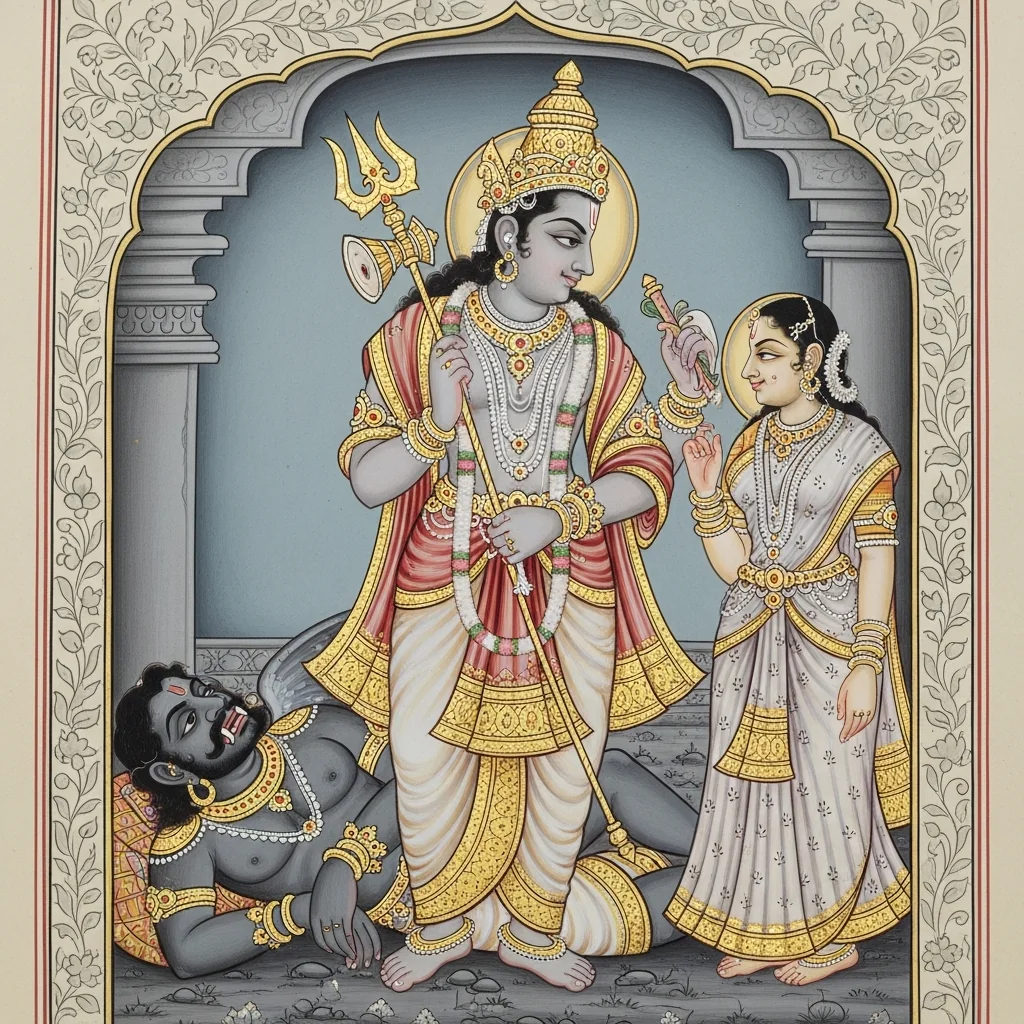
Pārvatī asks about the famed greatness of Vīreśa and how this liṅga in Kāśī manifested, celebrated for granting swift attainment. Maheśvara replies with an introduction grounded in the fruits of merit, then relates an exemplary tale of King Amitrajit—morally disciplined, capable in rule, and intensely devoted to Viṣṇu. His realm is portrayed as permeated with Hari’s names, images, and sacred stories; even ordinary conduct follows devotional norms, stressing non-violence and regular observance of Hari’s holy days. Nārada arrives, praises the king’s Viṣṇu-centered vision, and reports a crisis: Malayagandhinī, daughter of a Vidyādhara, has been abducted by the powerful asura Kaṅkālaketu, who is said to be vulnerable only to his own trident. Guided by Nārada’s directions, the king reaches the underworld city Campakāvatī, meets the distressed maiden, and is told to act when the demon sleeps. When the asura returns boasting of wealth and an impending forced marriage, he falls asleep with the trident; the king seizes it, confronts him with a warrior’s righteous challenge, and kills him, rescuing the maiden. The narrative then turns back to Kāśī’s salvific frame, implying that remembrance of Kāśī and its sacred power prevents moral taint, and preparing for the continuation on the explicit origin of the Vīreśa-liṅga and related vow-instructions.
Shlokas
Verse 1
पार्वत्युवाच । वीरेशस्य महेशान श्रूयते महिमा महान् । परां सिद्धिं परोपतुस्तत्र सिद्धाः परः शताः
Pārvatī said: “O Maheśāna, great indeed is the glory heard of Vīreśa. Having attained the highest perfection there, more than a hundred Siddhas have reached the supreme state.”
Verse 2
कथमाविर्भवस्तस्य काश्यां लिंगवरस्य तु । आशुसिद्धिप्रदस्येह तन्मे ब्रूहि जगत्पते
“How did that excellent Liṅga manifest in Kāśī—this one that bestows swift accomplishment here? Tell me that, O Lord of the world.”
Verse 3
महेश्वर उवाच । निशामय महादेवि वीरेशाविर्भवं परम् । यं श्रुत्वापि नरः पुण्यं प्राप्नोति विपुलं शिवे
Maheśvara said: “Listen, O Mahādevī, to the supreme account of Vīreśa’s manifestation; merely hearing it, a person gains abundant merit, O Śivā.”
Verse 4
आसीदमित्रजिन्नाम राजा परपुरंजयः । धार्मिकः सत्त्वसंपन्नः प्रजारंजनतत्परः
There was a king named Amitrajit, a conqueror of enemy cities—righteous, endowed with virtue, and devoted to delighting and protecting his subjects.
Verse 5
यशोधनो वदान्यश्च सुधीर्ब्राह्मणदैवतः । सदैवावभृथस्नानपरिक्लिन्न शिरोरुहः
He was rich in fame, generous, and wise—one for whom the Brahmins were as divinities; and his hair was ever damp, as though from constant avabhṛtha, the ceremonial bath.
Verse 6
विनीतो नीतिसंपन्नः कुशलः सर्वकर्मसु । विद्याब्धिपारदृश्वा च गुणवान्गुणिवत्सलः
He was humble, endowed with right conduct, and skilled in every undertaking. Having beheld the far shore of the ocean of learning, he was virtuous—and ever affectionate toward the virtuous.
Verse 7
कृतज्ञो मधुरालापः पापकर्मपराङ्मुखः । सत्यवाक्छौचनिलयः स्वल्पवाग्विजितेंद्रियः
He was grateful and sweet of speech, turning away from sinful deeds. Truthful in word, established in purity, sparing in talk, and master of his senses.
Verse 8
रणांगणे कृतांताभः संख्यावांश्च सदोजिरे । कामिनीकामकेलिज्ञो युवापि स्थविरप्रियः
On the battlefield he was like Death itself, and steadfast in reckoning and counsel. Though knowledgeable in the arts of love, even in youth he was devoted to what elders approve.
Verse 9
धर्मार्थैधितकोशश्च समृद्धबलवाहनः । सुभगश्च सुरूपश्च सुमेधाः सुप्रजाश्रयः
His treasury prospered through dharma and rightful wealth; his forces and conveyances were abundant. Fortunate and handsome, he was keen-minded and a refuge for good people.
Verse 10
स्थैर्य धैर्य समापन्नो देशकालविचक्षणः । मन्यमानप्रदो नित्यं सर्वदूषणवर्जितः
Endowed with steadiness and courage, he discerned place and time. Ever granting due honor, he was free from every fault.
Verse 11
वासुदेवांघ्रियुगले चेतोवृत्तिं निधाय सः । चकार राज्यं निर्द्वंद्वं विष्वगीति विवर्जितम्
Fixing the movements of his mind upon the pair of feet of Vāsudeva, he ruled a kingdom free from strife, devoid of discord and hostile outcry on every side.
Verse 12
अलंघ्यशासनः श्रीमान्विष्णुभक्तिपरायणः । अभुनक्प्रचुरान्भोगान्समंताद्विष्णुसात्कृतान्
His command was untransgressable; he was illustrious and wholly devoted to Viṣṇu. He enjoyed abundant pleasures—on all sides sanctified and bestowed through Viṣṇu’s grace.
Verse 13
हरेरायतनान्युच्चैः प्रतिसौधं पदेपदे । तस्य राज्ये समभवन्महाभाग्यनिधेः शिवे
In his realm, lofty shrines of Hari arose—at every mansion, at every step. O Śivā, in the kingdom of that treasure-house of great fortune, such splendor came to be.
Verse 14
गोविंदगोपगोपाल गोपीजनमनोहर । गदापाणे गुणातीत गुणाढ्य गरुडध्वज
O Govinda—protector of the cowherds, O Gopāla, delight of the Gopīs’ hearts! O bearer of the mace, beyond the guṇas yet full of all excellences, O He whose banner is Garuḍa!
Verse 15
केशिहृत्कैटभाराते कंसारे कमलापते । कृष्णकेशव कंजाक्ष कीनाश भयनाशन
O slayer of Keśin, foe of Kaiṭabha, destroyer of Kaṃsa, Lord of Kamalā! O Kṛṣṇa, O Keśava, lotus-eyed One—remover of fear and destroyer of death!
Verse 16
पुरुषोत्तम पापारे पुंडरीकविलोचन । पीतकौशेयवसन पद्मनाभ परात्पर
O Puruṣottama, foe of sin; O lotus-eyed One; clothed in yellow silk; O Padmanābha, Supreme beyond the supreme!
Verse 17
जनार्दन जगन्नाथ जाह्नवीजलजन्मभूः । जन्मिनां जन्महरण जंजपूकाघनाशन
O Janārdana, Lord of the universe; You whose manifestation is linked with the waters of the Jāhnavī (Gaṅgā); remover of the births of embodied beings; destroyer of dense heaps of impurity!
Verse 18
श्रीवत्सवक्षः श्रीकांत श्रीकर श्रेयसां निधे । श्रीरंगशार्ङ्गकोदंड शौरे शीतांशुलोचन
O You whose chest bears the Śrīvatsa; beloved of Śrī; bestower of auspiciousness; treasure-house of all welfare; O Lord of Śrīraṅga; wielder of the Śārṅga bow; O Śauri, moon-eyed One!
Verse 19
दैत्यारे दानवाराते दामोदर दुरंतक । देवकीहृदयानंद दंदशूकेश्वरेशय
O foe of the Daityas, enemy of the Dānavas; O Dāmodara, destroyer of the unassailable; joy of Devakī’s heart; Lord of lords, sovereign even over the serpent-kings!
Verse 20
विष्णो वैकुंठनिलय बाणारे विष्टरश्रवः । विष्वक्सेन विराधारे वनमालिन्वनप्रिय
O Viṣṇu, dweller in Vaikuṇṭha; slayer of Bāṇa; renowned in every quarter; O Viṣvaksena; destroyer of Virādha; wearer of the forest garland; lover of the forest!
Verse 21
त्रिविक्रमत्रिलोकीश चक्रपाणे चतुर्भुज । इत्यादीनि पवित्राणि नामानि प्रतिमंदिरम्
“Trivikrama,” “Lord of the three worlds,” “Bearer of the discus,” “Four-armed”—these and other sanctifying names are found in every temple.
Verse 22
स्त्रीवृद्धबालगोपाल वदनोदीरितानि तु । श्रूयते यत्रकुत्रापि रम्याणि मधुविद्विषः
Uttered from the mouths of women, the aged, children, and cowherd-boys—everywhere, in any place—are heard the delightful names of the foe of Madhu (Viṣṇu).
Verse 23
सुरसाकाननान्येव विलोक्यंते गृहेगृहे । चरित्राणि विचित्राणि पवित्राण्यब्धिजापतेः
In house after house, one sees as if divine pleasure-groves; the wondrous, purifying deeds of the Lord of the ocean-born goddess (Viṣṇu) are displayed.
Verse 24
सौधभित्तिषु दृश्यंते चित्रकृन्निर्मितानि तु । ऋते हरिकथायास्तु नान्या वार्ता निशम्यते
On the walls of mansions, paintings made by artists are seen; and apart from the narration of Hari, no other talk is heard.
Verse 25
हरिणा नैव विध्यंते हरिनामांशधारिणः । तस्य राज्ञो भयाद्व्याधैररण्यसुखचारिणः
Those who bear even a portion of Hari’s Name are not struck down by deer; for, fearing that King (Hari), the hunters—who roam the forest at ease—hold back and withdraw.
Verse 26
न मत्स्या नैव कमठा न वराहाश्च केनचित् । हन्यंते क्वापि तद्भीत्या मत्स्यमांसाशिनापि वै
In his dominion, neither fish, nor tortoises, nor boars were ever killed by anyone anywhere—out of fear of his rule—even by those who habitually ate fish and meat.
Verse 27
अप्युत्तानशयास्तस्य राष्ट्रे मित्रजितः क्वचित् । स्तनपानं न कुर्वंति संप्राप्य हरिवासरम्
In the realm of that king Mitrajit, even infants lying on their backs would, at times, refrain from suckling when the day sacred to Hari arrived.
Verse 28
पशवोपि तृणाहारं परित्यज्य हरेर्दिने । उपोषणपरा जाता अन्येषां का कथा नृणाम्
Even animals, abandoning their grass-fodder on Hari’s day, became devoted to fasting; what then need be said of other beings—especially humans?
Verse 29
महामहोत्सवः सर्वैः पुरौकोभिर्वितन्यते । तस्मिन्प्रशासति भुवं संप्राप्ते हरिवासरे
When that king ruled the earth and Hari’s sacred day arrived, a grand festival was celebrated by all the townspeople.
Verse 30
स एव दंड्योऽभूत्तस्य राज्ञो मित्रजितः क्षितौ । यो विष्णुभक्तिरहितः प्राणैरपि धनैरपि
Under King Mitrajit upon the earth, that person alone was punishable—who was devoid of devotion to Viṣṇu, whether in life itself or in wealth.
Verse 31
अंत्यजा अपि तद्राष्ट्रे शंखचक्रांकधारिणः । संप्राप्य वैष्णवीं दीक्षां दीक्षिता इव संबभुः
Even the marginalized communities in that kingdom bore the marks of conch and discus; having received Vaiṣṇava initiation, they appeared as if formally consecrated initiates.
Verse 32
शुभानि यानि कर्माणि क्रियंतेऽनुदिनं जनैः । वासुदेवे समर्प्यंते तानि तैरफलेप्सुभिः
Whatever auspicious deeds people performed day by day, they offered them to Vāsudeva—by those who sought no reward.
Verse 33
विना मुकुंदं गोविदं परमानंदमच्युतम् । नान्यो जप्येतमन्येत न भज्येत जनैः क्वचित्
Apart from Mukunda—Govinda, the supreme bliss, the Unfailing One—no other was ever held worthy of japa, nor worshiped by people anywhere.
Verse 34
कृष्ण एव परो देव कृष्णएव परागतिः । कृष्ण एव परो बंधुस्तस्यासीदवनीपतेः
For that lord of the earth, Kṛṣṇa alone was the supreme God; Kṛṣṇa alone the highest refuge; Kṛṣṇa alone the supreme kinsman and protector.
Verse 35
एवं तस्मिन्महीपाले राज्यं सम्यक्प्रशासति । एकदा नारदः श्रीमांस्तं दिदृक्षुः समाययौ
As that king governed his realm in righteous order, one day the illustrious Nārada arrived, desiring to behold him.
Verse 36
राज्ञा समर्चितः सोथ मधुपर्क विधानतः । नारदो वर्णयामास तममित्रजितं नृपम्
Duly honored by the king according to the madhuparka rite of welcome, Nārada then praised that monarch, the conqueror of foes.
Verse 37
नारद उवाच । धन्योसि कृतकृत्योसि मान्योप्यसि दिवौकसाम् । सर्वभूतेषु गोविंदं परिपश्यन्विशांपते
Nārada said: “Blessed are you; your life has found its fulfillment; you are worthy of honor even among the dwellers of heaven, O lord of men, for you behold Govinda in all beings.”
Verse 38
यो वेद पुरुषो विष्णुर्यो यज्ञपुरुषो हरिः । योंतरात्मास्य जगतः कर्ता हर्ताविता विभुः
He is Viṣṇu, the Person proclaimed by the Veda; He is Hari, the Person within sacrifice; He is the Inner Self of this universe—creator, withdrawer, protector, the all-pervading Lord.
Verse 39
तन्मयं पश्यतो विश्वं तव भूपालसत्तम । दर्शनं प्राप्य शुभदं शुचित्वमगमं परम्
O best of kings, because you behold the universe as pervaded by Him, you have attained that auspicious vision, and through it have reached supreme purity.
Verse 40
एक एव हि सारोत्र संसारे क्षणभंगुरे । कमलाकांत पादाब्ज भक्तिभावोऽखिलप्रदः
In this fleeting, moment-fragile world, only one thing is the true essence: loving devotion (bhakti) to the lotus-feet of Kamalākānta, Lord of Lakṣmī, which bestows every good.
Verse 41
परित्यज्य हि यः सर्वं विप्णुमेकं सदा भजेत् । सुमेधसं भजंते तं पदार्थाः सर्व एव हि
Indeed, one who sets aside all else and continually worships Viṣṇu alone—one of noble, wise mind—finds that every attainment comes to serve him.
Verse 42
हृषीकेशे हृषीकाणि यस्य स्थैर्यं गतान्यहो । स एव स्थैर्यमाप्नोति ब्रह्मांडेऽतीव चंचले
Ah! He whose senses become steady in Hṛṣīkeśa, the Lord of the senses, attains true steadiness—even within this exceedingly restless cosmos.
Verse 43
यौवनं धनमायुष्यं पद्मिनीजलबिंदुवत् । अतीव चपलं ज्ञात्वाऽच्युतमेकं समाश्रयेत्
Knowing that youth, wealth, and lifespan are as unsteady as a drop of water on a lotus leaf, one should take refuge in Acyuta alone.
Verse 44
वाचि चेतसि सर्वत्र यस्य देवो जनार्दनः । स एव सर्वदा वंद्यो नररूपी जनार्दनः
He for whom the divine Janārdana is present everywhere—in speech and in mind—is ever worthy of reverence, for Janārdana Himself abides within him in human form.
Verse 45
निर्व्याज प्रणिधानेन शीलयित्वा श्रियःपतिम् । पुरुषोत्तमतां को न प्राप्तवानिह भूतले
By sincere, guileless dedication, having cultivated devotion to Śriyaḥpati, the Lord of Lakṣmī—who on this earth would not attain the highest excellence of personhood?
Verse 46
अनया विष्णुभक्त्या ते संतुष्टेंद्रियमानसः । उपकर्तुमना ब्रूयां तन्निशामय भूपते
By this devotion of yours to Viṣṇu, your senses and mind have become serene and satisfied. Wishing to do you a good turn, I shall speak—listen carefully, O king.
Verse 47
बाला विद्याधरसुता नाम्ना मलयगंधिनी । क्रीडंती पितुराक्रोडे हृता कंकालकेतुना
A young girl, the daughter of a Vidyādhara, named Malayagandhinī, was playing in her father’s lap—when she was abducted by Kaṃkālaketu.
Verse 48
कपालकेतुपुत्रेण दानवेन बलीयसा । आगामिन्यां तृतीयायां तस्याः पाणिग्रहृं किल
By a powerful Dānava, the son of Kapālaketu, it is said that her ‘hand-taking’ (marriage) was to be performed on the coming third lunar day (tṛtīyā).
Verse 49
पाताले चंपकावत्यां नगर्यां सास्ति सांप्रतम् । हाटकेशात्समागच्छंस्तया हंसाश्रुनेत्रया
At present she is in Pātāla, in the city named Campakāvatī. Coming from Hāṭakeśa, I encountered her—her eyes filled with streaming tears.
Verse 50
दृष्टः प्रणम्य विज्ञप्तो यथा तच्च निथामय । ब्रह्मचारिन्मुनिश्रेष्ठ गंधमादनशैलतः
On seeing you, I bowed and reported the matter just as it truly is—please hear it. O brahmacārin, best of sages, I have come from Mount Gandhamādana.
Verse 51
बालक्रीडनकासक्तां मोहयित्वा निनाय सः । कंकालकेतुर्दुर्वृत्तो दुर्जयोन्यास्त्रघाततः
While she was absorbed in childish play, he deluded her and carried her off. That Kaṃkālaketu—of wicked conduct—was hard to conquer by the blows of other weapons.
Verse 52
स्वस्य त्रिशूलघातेन म्रियते नान्यथा रणे । जगत्पर्याकुलीकृत्य निद्रात्यत्रविनिर्भयः
He can be slain in battle only by the stroke of his own trident, and not otherwise. Having thrown the world into turmoil, he sleeps here without fear.
Verse 53
यदि कोपि कृतज्ञो मां हत्वेमं दुष्टदानवम् । मद्दत्तेन त्रिशूलेन नयेद्भद्रं भवेन्नरः
If some grateful person were to kill this wicked Dānava for my sake, using the trident given by me, that man would surely attain well-being and auspicious good.
Verse 54
यदत्रोपचिकीर्षुस्त्वं रक्ष मां दुष्टदानवात् । ममापि हि वरो दत्तो भगवत्या महामुने
If you truly wish to help here, protect me from this wicked Dānava. For I too have received a boon from the Goddess, O great sage.
Verse 55
विष्णुभक्तो युवा धीमान्पुत्रि त्वां परिणेष्यति । आ तृतीया तिथि यथा तद्वाक्यं तथ्यतां व्रजेत्
A young and wise devotee of Viṣṇu will wed you, O daughter, so that by the tṛtīyā lunar day those words may be fulfilled as truth.
Verse 56
तथा निमित्तमात्रं त्वं भव यत्नं समाचर । इति तद्वचनाद्राजन्विष्णुभक्तिपरायणम् । युवानं चापि धीमंतं त्वामनु प्राप्तवानहम्
“Be only an instrument, yet strive with diligence.” Thus, O King, obeying that counsel, I have come after you—young, wise, and wholly devoted to Viṣṇu.
Verse 57
तद्गच्छ कार्यसिद्ध्यै त्वं हत्वा तं दुष्टदानवम् । आनयाशु महाबाहो शुभां मलयगंधिनीम्
“Go then, that your mission may be fulfilled. Slay that wicked Dānava, and swiftly bring back, O mighty-armed one, the auspicious maiden fragrant as Malaya’s sandal-breeze.”
Verse 58
सा तु विद्याधरी जीवेद्विलोक्य त्वां नरेश्वर । पार्वतीवचनाद्दुष्टं घातयिष्यत्ययत्नतः
“That Vidyādharī will live on when she beholds you, O lord of men; and by Pārvatī’s word she will have the wicked one slain—without strain.”
Verse 59
इति नारदवाक्यं स निशम्यामित्रजिन्नृपः । अनल्पोत्कलिको जातो विद्याधरसुतां प्रति
Hearing Nārada’s words, that king—conqueror of foes—was filled with great eagerness toward the Vidyādhara’s daughter.
Verse 60
उपायं चापि पप्रच्छ गंतुं तां चंपकावतीम् । नारदेन पुनः प्रोक्तः स राजा गिरिराजजे
He also asked the means to reach that Campakāvatī. Then Nārada again instructed the king, O daughter of the Mountain-King.
Verse 61
तूर्णमर्णवमासाद्य पूर्णिमादिवसे नृप । भवान्द्रक्ष्यति पोतस्थः कल्पवृंदारथस्थितम्
“Swiftly reach the ocean on the day of the full moon, O King. Seated in a boat, you will behold her upon a chariot amid a grove of wish-fulfilling trees.”
Verse 62
तत्र दिव्यांगना काचिद्दिव्यपर्यंक संस्थिता । वीणामादाय गायंती गाथां गास्यति सुस्वरम्
“There, a certain celestial maiden, seated upon a divine couch, will take up a vīṇā and sing a verse with a sweet, auspicious melody.”
Verse 63
यत्कर्मविहितं येन शुभं वाथ शुभेतरम् । स एव भुंक्ते तत्तथ्यं विधिसूत्रनियंत्रितः
“Whatever deed is performed by anyone—good or otherwise—he alone surely experiences its result, bound by the thread of cosmic law.”
Verse 64
गाथामिमां सा संगीय सरथा स महीरुहा । सपर्यंका क्षणादेव मध्ये सिंधुं प्रवेक्ष्यति
“Having sung this very song, she—together with her chariot and that great tree, along with her couch—will in an instant enter into the midst of the ocean.”
Verse 65
भवानप्यविशंकं च ततः पोतान्महार्णवे । तामनु व्रजतु क्षिप्रं यज्ञवाराहमास्तुवन्
You too, without doubt, should swiftly follow her from the boat into the great ocean, praising Yajña-Varāha—the Boar-incarnation who is the very Sacrifice.
Verse 66
ततो द्रक्ष्यसि पाताले नगरीं चंपकावतीम् । महामनोहरा राजन्सहितां बालयानया
Then, O King, you will behold in Pātāla the city named Campakāvatī—exceedingly enchanting—together with this maiden who will lead you there.
Verse 67
इत्युक्त्वांतर्हितो देवि स चतुर्मुखनंदनः । राजाप्यर्णवमासाद्य यथोक्तं परिलक्ष्य च
Having said this, O Goddess, that son of the Four-faced One (Brahmā) vanished. The king too reached the ocean and, just as instructed, carefully observed the sign and place.
Verse 68
विवेशांतःसमुद्रं च नगरीमाससाद ताम् । साथ विद्याधरी बाला नेत्रप्राघुणकी कृता
He entered into the inner sea and reached that city. There, the Vidyādharī maiden became as though a feast for the eyes.
Verse 69
तेन राज्ञा त्रिजगती सौंदर्यश्रीरिवैकिका । पातालदेवतेयं वा ममनेत्रोत्सवाय किम्
To that king it seemed as though the very splendor of beauty of the three worlds stood embodied in one. Or is this some goddess of Pātāla, appearing for the festival of my eyes?
Verse 70
निरणायि मधुद्वेष्ट्रा स्रष्टुः सृष्टिविलक्षणा । कुहूराहुभयादेषा कांतिश्चांद्रमसी किमु
“Was she fashioned by Madhudveṣṭṛ (Viṣṇu) as a creation unlike the Creator’s usual making? Or is this moonlike radiance born from fear of the new-moon (amāvasyā) and Rāhu?”
Verse 71
योषिद्रूपं समाश्रित्य तिष्ठतेऽत्राकुतोऽभया । इत्थं क्षणं तां निर्वर्ण्य स राजागात्तदंतिकम्
“Assuming the form of a woman, she stands here—how could there be fear? Thus, after gazing at her for a moment, the king went near her.”
Verse 72
सा विलोक्याथ तं बाला नितरां मधुराकृतिम् । विशालोरस्थलतलं प्रलंबतुलसीस्रजम्
“Then the maiden looked upon him—of exceedingly charming form—broad-chested, with a long garland of tulasī hanging down.”
Verse 73
शंखचक्रांकसुभग भुजद्वयविराजितम् । हरिनामाक्षरसुधा सुधौत रदनावलिम्
“His two arms shone, beautified by the auspicious marks of conch and discus; and his row of teeth looked as though washed clean by the nectar of the syllables of Hari’s Name.”
Verse 74
भवानीभक्तिबीजोत्थं भूरुहं पुरुषाकृतिम् । मनोरथफलैः पूर्णमासीद्धृष्टतनूरुहा
“He seemed like a tree sprung from the seed of devotion to Bhavānī—taking a man’s form—laden with the fruits of fulfilled desires; and her body-hairs bristled in rapture.”
Verse 75
दोलापर्यंकमुत्सृज्य ह्रीभरा नम्रकंधरा । वेपथुं च परिष्टभ्य बाला प्रोवाच भूपतिम्
Leaving her swing-couch, laden with modesty and with neck bowed low, steadying her trembling, the maiden spoke to the king.
Verse 76
कस्त्वमत्र कृतांतस्य भवनं मधुराकृते । प्राप्तो मे मंदभाग्यायाश्चेतोवृत्तिं निरुंधयन्
Who are you here, in the very abode of Kṛtānta (Death), O sweet-formed one? You have come and, for me, the ill-fated, you restrain and steady the restless movements of my mind.
Verse 77
यावन्नायाति सुभग स कठोरतराकृतिः । अतिपर्याकुलीकृत्य त्रिलोकीं दानवो मुहुः
O fortunate one, before that dānava of exceedingly harsh form arrives—he who again and again throws the three worlds into extreme turmoil—act now.
Verse 78
कंकालकेतुर्दुर्वृत्तस्त्ववध्यः परहेतिभिः । तावद्गुप्तं समातिष्ठ शस्त्रागारेति गह्वरे
Kaṅkālaketu is wicked in conduct and cannot be slain by others’ weapons. Therefore, for the time being remain hidden in the armory, within this deep recess.
Verse 79
न मे कन्याव्रतं भंक्तुं स समर्थ उमा वरात् । आगामिन्यां तृतीयायां परश्वः पाणिपीडनम्
By Umā’s boon he is not able to break my maiden’s vow. On the coming third lunar day—on the day after tomorrow—will be the hand-clasping, the marriage rite.
Verse 80
संचिकीर्षति दुष्टात्मा गतायुर्मम शापतः । मा तद्भीतिं कुरु युवंस्तत्कार्यं भविताचिरम्
“That wicked-souled one intends evil, but his lifespan is spent by my curse. Do not be afraid of it; his end will come soon.”
Verse 81
विद्याधर्येति चोक्तः स शस्त्रागारे निगूढवत् । स्थितो वीरो महाबाहुर्दानवागमने क्षणः
Thus addressed by the Vidyādharī, the great-armed hero stayed concealed in the armory, awaiting the moment of the dānava’s arrival.
Verse 82
अथ सायं समायातो दानवो भीषणाकृतिः । त्रिशूलं कलयन्पाणौ मृत्योरपि भयावहम्
Then, in the evening, the dānava of terrifying form arrived, holding in his hand a trident (triśūla), fearsome even to Death itself.
Verse 83
आगत्य दानवो रौद्रः प्रलयांबुदनिस्वनः । विद्याधरीं जगादेति मदाघूर्णितलोचनः
Having come, the furious dānava—roaring like the clouds of dissolution—spoke to the Vidyādharī, his eyes rolling in intoxication.
Verse 84
गृहाणेमानि रत्नानि दिव्यानि वरवर्णिनि । कन्यात्वं च परश्वस्ते पाणिग्राहादपैष्यति
“Accept these divine jewels, O maiden of exquisite complexion. And the day after tomorrow your maidenhood will depart, when I take your hand in marriage.”
Verse 85
दासीनामयुतं प्रातर्दास्यामि तव सुंदरि । आसुरीणां सुरीणां च दानवीनां मनोहरम्
O beautiful one, tomorrow morning I shall give you ten thousand maidservants—charming ones drawn from Asura women, Deva women, and Dānava women.
Verse 86
गंधर्वीणां नरीणां च किन्नरीणां शतंशतम् । विद्याधरीणां नागीनां यक्षिणीनां शतानि षट्
There shall be hundreds upon hundreds of Gandharva-women and human maidens, and hundreds upon hundreds of Kinnarī-women; and there shall be six hundreds of Vidyādharī-women, Nāgī-women, and Yakṣiṇī-women.
Verse 87
राक्षसीनां शतान्यष्टौ शतमप्सरसां वरम् । एतास्ते परिचारिण्यो भविष्यंत्यमलाशये
There shall be eight hundred Rākṣasī-women, and a hundred excellent Apsarases. O pure-hearted one, these shall become your attendants.
Verse 88
यावत्संपत्तिसंभारो दिक्पालानां गृहेषु वै । मत्परिग्रहतां प्राप्य तावतस्त्वमिहेश्वरी
So long as the amassed splendors in the houses of the Guardians of the Directions endure—having attained the state of being under my protection—you shall, for that very long, be a sovereign lady here.
Verse 89
दिव्यान्भोगान्मया सार्धं भोक्ष्यसे मत्परिग्रहात् । कदा परश्वो भविता यस्मिन्वैवाहिको विधिः
By being under my protection, you shall enjoy divine pleasures together with me. When will it be—day after tomorrow—on which the marriage rite shall take place?
Verse 90
त्वदंगसंगसंस्पर्श सुखसंदोह मेदुरः । परां निर्वृतिमाप्स्यामि परश्वो निकटं यदि
Made rich with a mass of delight from the touch and close contact of your limbs, I shall attain supreme satisfaction—if day after tomorrow is indeed near.
Verse 91
मनोरथाश्चिरं यावद्यं मे हृदि समेधिताः । तान्कृतार्थी करिष्यामि परश्वस्तव संगमात्
The long-standing desires that have grown within my heart—I shall make them fulfilled, by meeting you day after tomorrow.
Verse 92
जित्वा देवान्रणे सर्वानिंद्रादीन्मृगलोचने । त्रैलोक्यैश्वर्यसंपत्तेस्त्वां करिष्यामि चेश्वरीम्
Having conquered all the gods in battle—beginning with Indra—O doe-eyed one, I shall make you a sovereign lady over the prosperity and lordship of the three worlds.
Verse 93
आधायांके त्रिशूलं स्वे सुष्वापेति प्रलप्य सः । नरमांसवसास्वाद प्रमत्तो वीतसाध्वसः
Placing his own trident upon his lap, he babbled thus and fell asleep—intoxicated by the taste of human flesh and fat, heedless and free from fear.
Verse 94
वरं स्मरंती सा गौर्या विद्याधरकुमारिका । विज्ञाय तं प्रमत्तं च सुसुप्तं चातिनिर्भयम्
That fair Vidyādhara maiden, remembering her chosen bridegroom, realized that he was reckless, fast asleep, and utterly fearless.
Verse 95
आहूय तं नरवरं वरं सर्वांगसुंदरम् । विष्णुभक्तिकृतत्राणं प्राणनाथेति जल्प्य च
Summoning that best of men—her beloved, perfectly beautiful in every limb—who had been saved through devotion to Viṣṇu, she spoke, calling him, “Lord of my life!”
Verse 96
शूलं तदंकादादाय गृहाणेमं जहि द्रुतम् । इति त्रिशूलं बालातो बालार्कसदृशद्युति
“Take up the spear from his lap; seize it and strike him down quickly!” Thus the trident—radiant like the newly risen sun—was taken from the maiden.
Verse 97
समादाय महाबाहुः स तदा मित्रजिन्नृपः । जहर्ष च जगादोच्चैर्बालायाश्चाभयं दिशन्
Then the mighty-armed king Mitrajit took it up; rejoicing, he cried aloud, granting fearlessness to the maiden.
Verse 98
वामपादप्रहारेण तमाताड्य स निर्भयः । संस्मरंश्चक्रिणं चित्ते जगद्रक्षामणिं हरिम्
Striking him with a blow of the left foot, he stood fearless—remembering in his heart Hari, the discus-bearer, the jewel-like protector of the world.
Verse 99
जर्गाद तिष्ठ रे दुष्ट कन्याधर्षणलालस । युध्यस्वात्र मया सार्धं न सुप्तं हन्म्यहं रिपुम्
He said, “Stand, you wicked one, eager to violate a maiden! Fight here with me—I do not strike an enemy who is asleep.”
Verse 100
इति संश्रुत्य संभ्रांत उत्थाय स दनोः सुतः । त्रिशूलं देहि मे कांते प्रोवाचेति मुहुर्मुहुः
Hearing this, the son of Danu sprang up in agitation and again and again cried, “Beloved, give me the trident!”
Verse 110
त्वया कपटरूपेण बलिनः कैटभादयः । न बलेन हताः संख्ये हता एवच्छलेन हि
“By you, assuming a deceptive form, mighty ones such as Kaiṭabha were slain— not by sheer strength in battle, but indeed by strategy and guile.”
Verse 120
निजघान महाबाहुः स च प्राणाञ्जहौ क्षणात् । इत्थं कंकालकेतुं स निहत्य सुरकंपनम्
The mighty-armed one struck him down, and he gave up his life in an instant. Thus he slew Kaṅkālaketu, the terror that made even the gods tremble.
Verse 130
अपि स्मृत्वा पुरीं यां वै काशीं त्रैलोक्यकांक्षिताम् । न नरो लिप्यते पापैस्तां विवेश स भूपतिः
Even by remembering that city—Kāśī, desired by the three worlds—a man is not tainted by sins. That very Kāśī the king then entered.
Verse 140
इति राज्ञोदिता राज्ञी प्रवक्तुमुपचक्रमे । इति कर्तव्यतां तस्य व्रतस्य सरहस्यकाम्
Thus urged by the king, the queen began to speak—desiring to set forth the duties of that vow, together with its inner secret.