Adhyaya 2
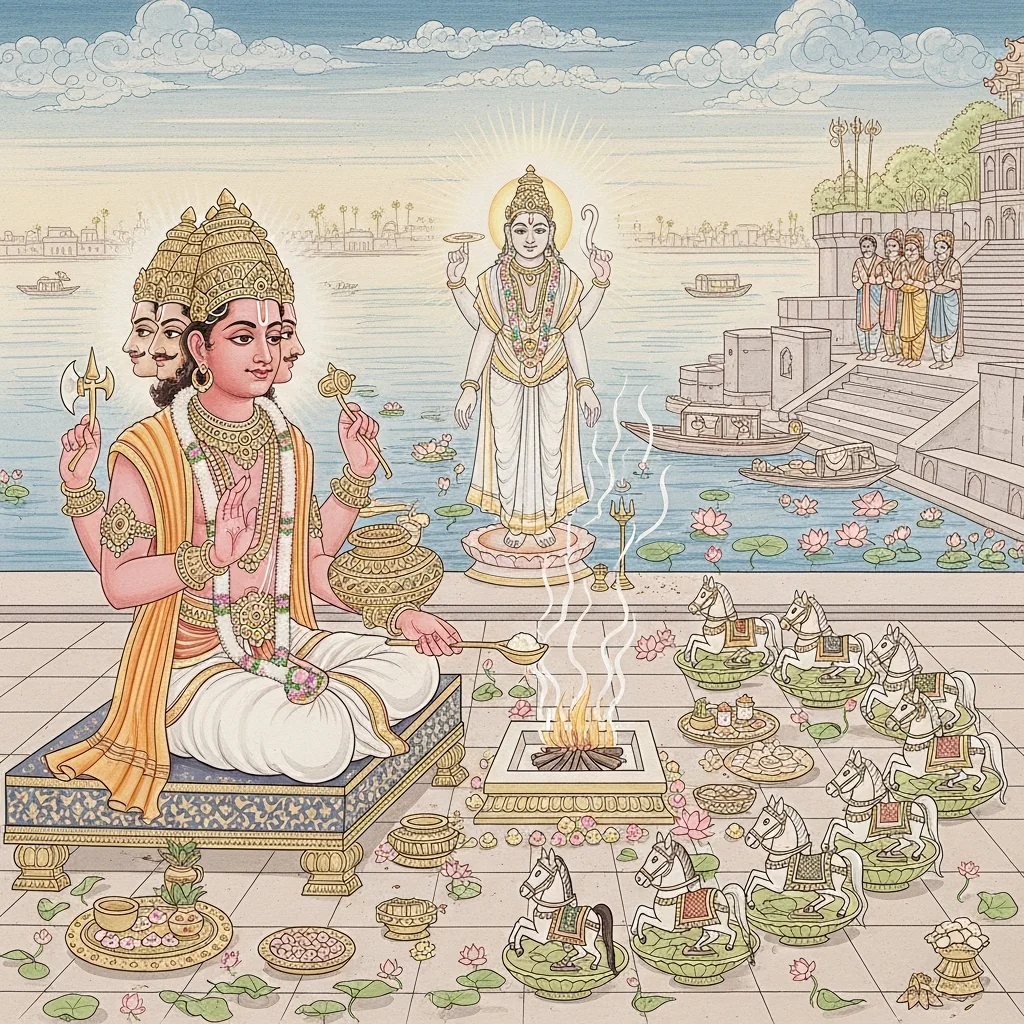
The chapter opens with Skanda describing how Śiva, though abiding on Mandara, is seized again by longing for Kāśī—portrayed as a sacred field of such theological magnetism that it unsettles even divine resolve. Śiva summons Brahmā (Vidhātā) and commissions him to investigate the mystery of Kāśī’s “non-departure,” since earlier emissaries (the yoginīs and Sahasragu) have not returned. Brahmā journeys to Vārāṇasī, praises the city’s blissful nature, and—disguised as an aged brāhmaṇa—approaches King Divodāsa. A sustained dialogue on royal ethics follows: Brahmā lauds Divodāsa’s rule, defines kingship as dharma through protecting subjects and safeguarding sacred space, and requests aid for sacrificial work. Divodāsa offers full support; Brahmā performs ten Aśvamedha sacrifices in Kāśī, and the tīrtha becomes renowned as Daśāśvamedha (formerly Rudrasaras). The narrative then turns to a prescriptive tīrtha-māhātmya: at Daśāśvamedha, snāna, dāna, japa, homa, svādhyāya, devatā-arcana, tarpaṇa, and śrāddha are declared akṣaya, of imperishable fruit. Specific calendrical baths—especially in Jyeṣṭha, bright fortnight, including Daśaharā—are said to erase sins of many births; the sight of the Daśāśvamedheśa liṅga purifies; and hearing or reciting this chapter is linked to attaining Brahmaloka. The chapter closes by reaffirming Kāśī’s unique salvific status and warning against abandoning it once it has been attained.
Shlokas
Verse 1
स्कंद उवाच । गभस्तिमालिनिगते काशीं त्रैलोक्यमोहिनीम् । पुनश्चिंतामवापोच्चैर्मंदरस्थो मुने हरः
Skanda said: When the radiant one (the Sun) had departed, Hara—dwelling upon Mount Mandara, O sage—again fell into intense reflection about Kāśī, the enchantress of the three worlds.
Verse 2
नाद्याप्यायांति योगिन्यो नाद्याप्यायाति तिग्मगुः । प्रवृत्तिरपि मे काश्याश्चित्रमत्यंत दुर्लभा
Even now the yoginīs have not come; even now the sharp-rayed Sun has not arrived. Yet my impulse toward Kāśī—how wondrous—is exceedingly hard to restrain.
Verse 3
किमत्र चित्रं यत्काशी मदीयमपिमानसम् । निश्चलं चंचलयति गणना केतरेसुरे
What is surprising in this—that Kāśī stirs even my mind, though steadfast, into restlessness? For what other divine power could compare?
Verse 4
अधाक्षिपमहं कामं त्रिजगज्जित्त्वरंदृशा । अहो काश्यभिलाषोत्र मामेव दुनुयात्तराम्
With a mere glance I cast down Kāma, the conqueror of the three worlds. Yet—marvel indeed—this longing for Kāśī torments even me all the more.
Verse 5
काशीप्रवृत्तिमन्वेष्टुं कं वा प्रहिणुयामितः । ज्ञातुं क एव निपुणो यतः स चतुराननः
“Whom indeed shall I dispatch from here to investigate the true course of events in Kāśī? Who is truly skilled to know it?—for he is Caturānana, four-faced Brahmā.”
Verse 6
इत्याहूय विधातारं बहुमानपुरःसरम् । तत्रोपवेश्य श्रीकंठः प्रोवाच चतुराननम्
So saying, he summoned Vidhātā (Brahmā) with due honor; and having seated him there, Śrīkaṇṭha (Śiva) spoke to Caturānana.
Verse 7
योगिन्यः प्रेषिताः पूर्वं प्रेषितोथ सहस्रगुः । नाद्यापि ते निवर्तंते काश्याः कलशसंभव
“Earlier, the Yoginīs were sent; and then Sahasragu, the thousand-eyed one, too was dispatched. Yet even today they have not returned from Kāśī, O Kalaśa-sambhava (Agastya).”
Verse 8
सा समुत्सुकयेत्काशी लोकेश मम मानसम् । प्राकृतस्य जनस्येव चंचलाक्षीव काचन
“That Kāśī makes my mind restless, O Lord of the worlds—like some fickle-eyed woman stirs the heart of an ordinary man.”
Verse 9
मंदरेत्र रतिर्मे न भृशं सुंदरकंदरे । अनच्छतुच्छपानीये नक्रस्येवाल्पपल्वले
My delight is not in Mandara at all, though it has lovely caves—just as a crocodile finds no joy in a small, shallow pool with poor, unclear water.
Verse 10
ना बाधिष्ट तथा मां स तापो हालाहलोद्भवः । काशीविरहजन्मात्र यथा मामतिबाधते
The anguish born of Hālāhala poison did not torment me so much as this pain—born solely from separation from Kāśī—torments me exceedingly.
Verse 11
शीतरश्मिः शिरःस्थोपि वर्षन्पीयूषसीकरैः । काशीविश्लेषजं तापं नाहो गमयितुं प्रभुः
Even Śītaraśmi (the cool-rayed Moon), though stationed upon my head and raining drops of nectar, is not able—alas—to dispel the burning born of separation from Kāśī.
Verse 12
विधे विधेहि मे कार्यमार्य धुर्य महामते । याहि काशीमितस्तूर्णं यतस्व च ममेहिते
O Vidhi (Brahmā), accomplish my task—O noble one, foremost, great-minded. Go swiftly from here to Kāśī, and strive to fulfill my intention.
Verse 13
ब्रह्मंस्त्वमेव तद्वेत्सि काशी त्यजनकारणम् । मंदोपि न त्यजेत्काशीं किमु यो वेत्ति किंचन
O Brahman (Brahmā), you alone know the reason for abandoning Kāśī. Even a dull-witted person would not leave Kāśī—how much more one who understands anything at all!
Verse 14
अद्यैव किं न गच्छेयं काशीं ब्रह्मन्स्वमायया । दिवोदासं स्वधर्मस्थं न तूल्लंघितुमुत्सहे
“Why should I not go to Kāśī this very day, O Brahman, by my own divine power? Yet I do not dare to overstep Divodāsa, who stands firm in his own dharma.”
Verse 15
विधे सर्वविधेयानि त्वमेव विदधासि यत् । इति चेति च वक्तव्यं त्वय्यपार्थमतोखिलम्
O Ordainer (Vidhe), since You alone accomplish all that is to be accomplished, any “thus it is” or “if it be so” that one might say is, in truth, meaningless with regard to You—therefore all such conditional talk is futile.
Verse 16
अरिष्टं गच्छ पंथास्ते शुभोदर्को भवत्वलम् । आदायाज्ञां विधि मूर्ध्नि ययौ वाराणसीं मुदा
“Go safely—may your journey be free from harm and end in auspiciousness.” Having received that command upon his head with reverence, Vidhi set out joyfully for Vārāṇasī.
Verse 17
सितहंसरथस्तूर्णं प्राप्य वाराणसीं पुरीम् । कृतकृत्यमिवात्मानममन्यत तदात्मभूः
Riding swiftly in his white-swan chariot, Ātmabhū (Brahmā) reached the city of Vārāṇasī and then felt within himself as though his life’s purpose had been fulfilled.
Verse 18
हंसयानफलं मेद्य जातं काशीसमागमे । काशी प्राप्तौ यतः प्रोक्ता अंतरायाः पदेपदे
The “fruit of traveling by the swan-vehicle” became evident upon meeting Kāśī; for it is said that, on the way to reaching Kāśī, obstacles arise at every step.
Verse 19
दृशि धातुरभूद्य मदृशो प्राप्य सान्वयः । स्पष्टं दृष्टिपथं प्राप्ता यदेषाऽनंदवाटिका
When the Creator (Dhātṛ), having found the proper steadiness of his gaze, set it in its rightful place, this Ānandavāṭikā—the Grove of Bliss—came clearly within the range of his sight.
Verse 20
स्वयं सिंचति या मद्भिः स्वाभिः स्वर्गतरंगिणी । यत्रानंदमया वृक्षा यत्रानंदमया जनाः
There the heaven-flowing river, with her own clouds of mist, waters the land by herself; there the trees are made of bliss, and there the people too are made of bliss.
Verse 21
निर्विशंति सदा काश्यां फलान्यानंदवंत्यपि । सदैवानंदभूः काशी सदैवानंददः शिवः
In Kāśī, they ever partake of fruits that are themselves filled with bliss. Kāśī is eternally the ground of bliss, and Śiva is eternally the giver of bliss.
Verse 22
आनंदरूपा जायंते तेन काश्यां हि जंतवः । चरणौ चरितुं वित्तस्तावेव कृतिनामिह
Therefore, in Kāśī, living beings are born with the very form of bliss. Indeed, only those feet are truly blessed here which are able to walk and wander in this place.
Verse 23
चरणौ विचरेतांयौ विश्वभर्तृ पुरी भुवि । तावेव श्रवणौ श्रोतुं संविदा ते बहुश्रुतौ
Only those feet are worthy that roam upon the earth in the city of the Sustainer of the universe; and only those ears are worthy to hear—truly learned are they—who listen with understanding.
Verse 24
इह श्रुतिमतां पुंसां याभ्यां काशी श्रुता सकृत् । तदेव मनुते सर्वं मनस्त्विह मनस्विनाम
Here, for discerning men whose ears have heard of Kāśī even once, the mind of the noble becomes fixed on that alone, taking it as everything.
Verse 25
येनानुमन्यते चैषा काशी सर्वप्रमाणभूः । बुद्धिर्बुध्यति सा सर्वमिह बुद्धिमतां सताम् । ययैतद्धूर्जटेर्धाम धृतं स्व विषयीकृतम्
That very Intelligence by which this Kāśī—herself the ground of all valid authority—is affirmed, is the Intelligence by which the wise and virtuous understand everything here. By that same divine power, this abode of Dhūrjaṭi (Śiva) is upheld and made wholly His own domain.
Verse 26
वरं तृणानि धान्यानि तानि वात्याहतान्यपि । काश्यां यान्या पतंतीह न जनाः काश्यदर्शनाः
Better are mere blades of grass or scattered grains—even when struck about by the wind—than those people who, though coming to Kāśī, do not truly behold Kāśī.
Verse 27
अद्य मे सफलं चायुः परार्धद्वय संमितम् । यस्मिन्सति मया प्रापि दुष्प्रापा काशिका पुरी
Today my life—though measured in two parārdhas—has become fruitful, since while I yet live I have attained the hard-to-attain city of Kāśikā.
Verse 28
अहो मे धर्मसंपत्तिरहोमे भाग्यगौरवम् । यदद्राक्षिषमद्याहं काशीं सुचिर चिंतिताम्
Ah, what a wealth of dharma is mine; ah, what grandeur of fortune—since today I have beheld Kāśī, long pondered and long desired.
Verse 29
अद्य मे स्वतपो वृक्षो मनोरथफलैरलम् । शिवभक्त्यंबुना सिक्तः फलितोति बृहत्तरैः
Today the tree of my own austerities is fully laden with the fruits of my desires; watered by the stream of devotion to Śiva, it has borne exceedingly great fruit.
Verse 30
मया व्यधायि बहुधा सृष्टिः सृष्टिं वितन्वता । परमन्यादृशी काशी स्वयं विश्वेश निर्मितिः
Many creations have I fashioned while expanding creation; yet Kāśī is utterly unlike any other—it is a creation wrought directly by Viśveśa (Śiva) Himself.
Verse 31
इति हृष्टमना वेधा दृष्ट्वा वाराणसीं पुरीम् । वृद्धब्राह्मणरूपेण राजानं च ददर्श ह
Thus, the Creator (Vedhā), delighted at heart upon seeing the city of Vārāṇasī, then beheld the king—having assumed the form of an aged brāhmaṇa.
Verse 32
जलार्द्राक्षतपाणिश्च स्वस्त्युक्त्वा पृथिवीभुजे । कृतप्रणामो राज्ञाथ भेजे तद्दत्तमासनम्
With his hand holding rice-grains moistened with water, and uttering a blessing to the ruler of the earth, he bowed respectfully; then, at the king’s invitation, he took the seat that was offered.
Verse 33
कृतमानो नृपतिना सोभ्युत्थानासनादिभिः । विप्रो व्यजिज्ञपद्भूपं पृष्टागमनकारणम्
Honored by the king through rising to greet him, offering a seat, and other courtesies, the brāhmaṇa then questioned the ruler, who had asked the reason for his coming.
Verse 34
ब्राह्मण उवाच । भूपाल बहुकालीनोस्म्यहमत्र चिरंतनः । त्वं तु मां नैव जानासि जाने त्वां हि रिपुंजयम्
The brāhmaṇa said: “O king, I have dwelt here for a very long time, ancient in this place. Yet you do not recognize me; I, however, truly know you as Ripuñjaya, the conqueror of foes.”
Verse 35
परःशता मया दृष्टा राजानो भूरिदक्षिणाः । विजितानेकसंग्रामा यायजूका जितेंद्रियाः
I have seen more than a hundred kings—lavish in gifts (dakṣiṇā), victorious in many battles, devoted to performing yajñas, and masters of their senses.
Verse 36
विनिष्कृतारिषड्वर्गाः सुशीलाः सत्त्वशालिनः । श्रुतस्यपारदृश्वानो राजनीतिविचक्षणाः
They had purified themselves of the six inner enemies; they were well-conducted and rich in noble strength—deeply learned in the śruti and skilled in the science of governance.
Verse 37
दयादाक्षिण्यनिपुणाः सत्यव्रतपरायणाः । क्षमया क्षमयातुल्या गांभीर्यजितसागराः
They were adept in compassion and generosity, devoted to vows of truth; in forbearance they were incomparable, and by their depth of character they surpassed the ocean itself.
Verse 38
जितरोषरयाः शूराः सौम्यसौंदर्यभूमयः । इत्यादि गुणसंपन्नाः सुसंचितयशोधनाः
They were heroes who had conquered the surge of anger; gentle, as though a very ground where beauty abides. Endowed with such qualities, they amassed a treasury of well-earned fame (yaśas).
Verse 39
परं द्वित्राः पवित्रा ये राजर्षे तव सद्गुणाः । तेष्वेषु राजसु मम प्रायशो न दृशं गताः
But these pure virtues of yours, O royal seer, are truly rare—seen only in one or two. Among those kings, I have scarcely found them at all.
Verse 40
प्रजानिजकुटुंबस्त्वं त्वं तु भूदेवदैवतः । महातपः सहायस्त्वं पथानान्ये तथा नृपाः
You treat your subjects as your own family; in truth you are as a very deity to the brāhmaṇas. You are a helper to great ascetics—while other kings are merely helpers for worldly paths.
Verse 41
धन्यो मान्योसि च सतां पूजनीयोसि सद्गुणैः । देवा अपि दिवोदास त्वत्त्रासान्न विमार्गगाः
Blessed are you; you are honored among the good and, by your virtues, worthy of worship. Even the gods, O Divodāsa, do not stray from the right path out of reverent fear of you.
Verse 42
किं नः स्तुत्या तव नृप द्विजानामस्पृहावताम् । किं कुर्मस्त्वद्गुणग्रामाः स्तावकान्नः प्रकुर्वते
What use is our praise to you, O king—when we brāhmaṇas are free from desire? Yet what can we do? The multitude of your virtues compels us to become your eulogists.
Verse 43
गोष्ठी तिष्ठत्वियं तावत्प्रस्तुतं स्तौमि सांप्रतम् । यष्टुकामोस्म्यहं राजंस्त्वां सहायमतो वृणे
Let this discourse pause for a moment; I shall now praise what is at hand. I desire to perform a sacrifice (yajña), O king—therefore I choose you as my helper.
Verse 44
त्वया राजन्वती चैषाऽवनिः सर्वर्धिभाजनम् । अहं चास्तिधनो राजन्न्यायोपात्तमहाधनः
With you as its king, O King, this land becomes a vessel of every prosperity. And I too am wealthy, O King—possessing great riches acquired by rightful means.
Verse 46
संचितं यद्धनं पुंभिर्नयसन्मार्गगामिभिः । तत्काश्यां विनियुज्येत क्लेशायेतरथा भवेत्
Wealth amassed by men who do not walk the righteous path should be redirected and spent in Kāśī; otherwise, that very wealth becomes a cause of suffering.
Verse 47
महिमानं परं काश्याः कोपि वेद न भूपते । ऋते त्रिनयनाच्छंभोः सर्वज्ञानप्रदायिनः
O King, no one truly knows the supreme greatness of Kāśī—except Śambhu, the Three-eyed Lord, the giver of all knowledge.
Verse 48
मन्ये धन्यतरोसि त्वं बहुजन्मशतार्जितैः । सुकृतैः पासि यत्काशीं विश्वभर्तुः परां तनुम्
I deem you most blessed: by merits earned across hundreds of births you are able to behold Kāśī—the supreme body of the Lord who sustains the universe.
Verse 49
इयं च राजधानी ते कर्मभूमावनुत्तमा । यस्यां कृतानां कार्याणां संवर्तेपि न संक्षयः
This royal city of yours is an unsurpassed field of action; deeds performed here do not perish even at the time of cosmic dissolution.
Verse 50
विश्वेशानुग्रहेणैव त्वयैषा पाल्यते पुरी । एकस्याप्यवनात्काश्यां त्रैलोक्यमवितं भवेत्
By the grace of Viśveśvara alone this city is protected by you; for by safeguarding even a single person in Kāśī, it is as though the three worlds are safeguarded.
Verse 51
अन्यच्च ते हितं वच्मि यदि ते रोचतेऽनघ । प्रीणनीयः सदैवैको विश्वेशः सर्वकर्मभिः
And I shall tell you another counsel for your welfare, O blameless one, if it pleases you: Viśveśvara alone should always be pleased through all your actions.
Verse 52
अन्यदेवधिया राजन्विश्वेशं पश्य मा क्वचित् । ब्रह्मविष्ण्विंद्र चंद्रार्का क्रीडेयं तस्य धूर्जटेः
O King, never regard Viśveśvara with the notion that he is merely ‘another god’. Brahmā, Viṣṇu, Indra, the Moon, and the Sun are but playthings of that matted-haired Lord.
Verse 53
विप्रैरुदर्कमिच्छद्भिः शिक्षणीया यतो नृपाः । अतस्तव हितं ख्यातं किं वा मे चिंतयानया
For kings are to be instructed by brāhmaṇas who seek the highest good; therefore your welfare has been made known—what more need I worry about this?
Verse 54
इति जोषं स्थितं विप्रं प्रत्युवाच नृपोत्तमः । सर्वं मया हृदि धृतं यत्त्वयोक्तं द्विजोत्तम
Thus, when the brāhmaṇa stood silent, the best of kings replied: “All that you have spoken, O best of the twice-born, I have held firmly in my heart.”
Verse 55
राजोवाच । अहं यियक्षमाणस्य तव साहाय्यकर्मणि । दासोस्मि यज्ञसंभारान्नयमेको शतोऽखिलान्
The King said: “In aiding you, who are about to perform the sacrifice, I am your servant. Let me alone procure the sacrificial requisites—hundreds of them, all complete.”
Verse 56
यदस्ति मेखिलं तत्र सप्तांगेपि भवान्प्रभुः । यजस्वैकमनाब्रह्मन्सिद्धं मन्यस्व वांछितम्
Whatever I possess—indeed all of it—together with the seven limbs of my kingdom, lies under your authority. O Brāhmaṇa, perform the sacrifice with single-pointed mind, and deem your desired end already fulfilled.
Verse 57
राज्यं करोमि यद्ब्रह्मन्स्वार्थं तन्न मनागपि । पुत्रैः कलत्रैर्देहेनपरोपकृतये यते
O Brāhmaṇa, if I exercise kingship, it is not even in the least for my own gain. With my sons, my wife, and my very body, I strive only for the welfare of others.
Verse 58
राज्ञां क्रतुक्रियाभ्योपि तीर्थेभ्योपि समंततः । प्रजापालनमेवैको धर्मः प्रोक्तो मनीषिभिः
For kings, more than sacrificial rites and even more than pilgrimages to tīrthas in every direction, the sages declare a single foremost dharma: the protection and care of the people.
Verse 59
प्रजासंतापजोवह्निर्वज्राग्नेरपि दारुणः । द्वित्रान्दहति वज्राग्निः पूर्वो राज्यं कुलं तनुम्
The fire born of the people’s suffering is more dreadful even than the thunderbolt-fire. The thunderbolt-fire burns only two or three; but the former consumes kingdom, lineage, and the ruler’s own body.
Verse 60
यदावभृथसिस्रासुर्भवेयं द्विजसत्तम । तदा विप्रपदांभोभिरभिषेकं करोम्यहम्
O best of Brāhmaṇas, whenever I am to proceed to the avabhṛtha, the concluding bath of a sacrifice, I perform my consecratory bathing with the water that has washed the feet of Brāhmaṇas.
Verse 61
हवनं ब्राह्मणमुखे यत्करोमि द्विजोत्तम । मन्ये क्रतुक्रियाभ्योपि तद्विशिष्टं महामते
O best of the twice-born, the offering I make into the mouth of a Brāhmaṇa—I consider that superior even to the ritual actions of great sacrifices, O wise one.
Verse 62
अभिलाषेषु सर्वेषु जागर्त्येको हृदीह मे । अद्यापि मार्गणः कोपि द्रष्टव्यः स्वतनोरपि
Among all my desires, one alone stays awake within my heart here: even today I must find someone—worthy even of my own body—to whom I may give.
Verse 63
अहो अहोभिर्बहुभिः फलितो मे मनोरथः । यत्त्वं मेद्य गृहे प्राप्तः किंचित्प्रार्थयितुं द्विज
After many cries of ‘ah! ah!’ my cherished wish has borne fruit: that you have come today to my house, O twice-born, to ask for something.
Verse 64
एकाग्रमानसो विप्र यज्ञान्विपुलदक्षिणान् । बहून्यजकृतं विद्धि साहाय्यं सर्ववस्तुषु
O Brāhmaṇa, with a focused mind perform many sacrifices rich in dakṣiṇā, the priestly gifts. Know that I shall render assistance in all matters and provisions.
Verse 65
इति राज्ञो महाबुद्धेर्धर्मशीलस्य भाषितम् । श्रुत्वा तुष्टमनाः स्रष्टा क्रतुसंभारमाहरत्
Thus spoke the great-minded king, steadfast in dharma. Hearing his words, the Creator, pleased at heart, brought forth the requisite materials for the yajña.
Verse 66
साहाय्यं प्राप्य राजर्षेर्दिवोदासस्य पद्मभूः । इयाज दशभिः काश्यामश्वमेधैर्महामखैः
Having obtained the aid of the royal sage Divodāsa, Padmabhū (Brahmā) performed in Kāśī ten Aśvamedha sacrifices—mighty and exalted mahāyajñas.
Verse 67
अद्यापि होमधूमोघैर्यद्व्याप्तं गगनांतरम् । तदा प्रभृति न व्योम नीलिमानं जहात्यदः
Even today, it is said, the expanse of sky there is pervaded by dense clouds of homa smoke; from that time onward, that firmament has not forsaken its deep-blue hue.
Verse 68
तीर्थं दशाश्वमेधाख्यं प्रथितं जगतीतले । तदा प्रभृति तत्रासीद्वाराणस्यां शुभप्रदम्
Thus, upon the face of the earth, the tīrtha became renowned as “Daśāśvamedha”; from that time onward, it has stood in Vārāṇasī as a bestower of auspiciousness.
Verse 69
पुरा रुद्रसरो नाम तत्तीर्थं कलशोद्भव । दशाश्वमेधिकं पश्चाज्जातं विधिपरिग्रहात्
Formerly, O Kalaśodbhava (Agastya), that tīrtha was called Rudra-saras; later, through Vidhi (Brahmā)’s formal undertaking of the rite, it came to be known as Daśāśvamedhika.
Verse 70
स्वर्धुन्यथ ततः प्राप्ता भगीरथसमागमात् । अतीव पुण्यवज्जातमतस्तत्तीर्थमुत्तमम्
Then Svardhunī—the holy Gaṅgā—came there through the coming and striving of Bhagīratha; therefore that tīrtha became exceedingly meritorious, indeed supreme.
Verse 71
विधिर्दशाश्वमेधेशं लिंगं संस्थाप्य तत्र वै । स्थितवान्न गतोद्यापि क्वापि काशीं विहाय तु
Having installed there the liṅga called Daśāśvamedheśa, Vidhi (Brahmā) remained there; even to this day he has not gone anywhere, forsaking Kāśī.
Verse 72
राज्ञो धर्मरतेस्तस्य च्छिद्रं नावाप किंचन । अतः पुरारेः पुरतो व्रजित्वा किं वदेद्विधिः
In that king—delighting in dharma—Vidhi (Brahmā) found no fault at all. Therefore, having gone into the presence of Purāri (Śiva), what could Vidhi possibly say?
Verse 73
क्षेत्रप्रभावं विज्ञाय ध्यायन्विश्वेश्वरं शिवम् । ब्रह्मेश्वरं च संस्थाप्य विधिस्तत्रैव संस्थितः
Recognizing the majestic power of the holy field (Kāśī), and meditating upon Śiva as Viśveśvara, Vidhi (Brahmā) established (the liṅga of) Brahmeśvara and remained there itself.
Verse 74
परातनुरियं काशी विश्वेशस्येति निश्चितम् । अस्याः संसेवनाच्छंभुर्न कुप्यति पुरो मयि
“This Kāśī is indeed the supreme body of Viśveśvara”—so it is certain. By devoted attendance upon her, Śambhu does not become displeased with me in his presence.
Verse 75
कः प्राप्य काशीं दुर्मेधाः पुनस्त्यक्तुमिहेह ते । अनेकजन्मजनितकर्मनिर्मूलनक्षमाम्
Who, having attained Kāśī, would be so dull-witted as to abandon her again—she who can uproot the karmas accumulated over many births?
Verse 76
विश्वसंतापसंहर्तुः स्थाने विश्वपतेस्तनुः । संताप्यतेतरां काश्या विश्लेषज महाग्निना
In the very abode of the Lord who removes the burning pains of the universe, the embodied being of the Lord of the world is, in Kāśī, intensely ‘heated’—burned by the great fire born of separation from worldly bondage.
Verse 77
प्राप्य काशीं त्यजेद्यस्तु समस्ताघौघनाशिनीम् । नृपशुः स परिज्ञेयो महासौख्यपराङमुखः
But whoever, having reached Kāśī—the destroyer of the flood of all sins—abandons her should be known as a ‘royal beast’, one who turns his face away from supreme bliss.
Verse 78
निर्वाणलक्ष्मीं यः कांक्षेत्त्यक्त्वा संसारदुर्गतिम् । तेन काशी न संत्याज्या यद्याप्तैशादनुग्रहात्
Whoever longs for the blessed fortune of nirvāṇa, renouncing the hard road of saṃsāra—must not abandon Kāśī, if indeed it has been obtained through the Lord’s grace.
Verse 79
यः काशीं संपरित्यज्य गच्छेदन्यत्र दुर्मतिः । तस्य हस्ततलाद्गच्छेच्चतुर्वर्गफलोदयः
The ill-minded person who abandons Kāśī and goes elsewhere— from the palm of his hand departs the arising fruit of the four aims of life.
Verse 80
निबर्हणी मधौघस्य सुपुण्य परिबृंहिणीम् । कः प्राप्य काशीं दुर्मेधास्त्यजेन्मोक्षसुखप्रदाम्
She who destroys the flood of honeyed temptations and greatly increases merit—what dull-witted person, having reached Kāśī, would abandon her, the giver of the bliss of liberation (mokṣa)?
Verse 81
सत्यलोके क्व तत्सौख्यं क्व सौख्यं वैष्णवे पदे । यत्सौख्यं लभ्यते काश्यां निमेषार्धनिषेवणात्
Where is such bliss even in Satyaloka, and where even in the Vaiṣṇava realm, compared to the bliss gained in Kāśī by serving her for but half a moment?
Verse 82
वाराणसीगुणगणान्निर्णीय द्रुहिणस्त्विति । व्यावृत्य मंदरगिरिं न पुनः प्रत्यगान्मुने
Having ascertained the multitude of Vārāṇasī’s virtues, Brahmā declared, “Thus indeed!” and, turning back from Mount Mandara, he did not return again, O sage.
Verse 83
स्कंद उवाच । मित्रावरुणयोः पुत्र महिमानं ब्रवीमि ते । काश्यां दशाश्वमेधस्य सर्वतीर्थशिरोमणेः
Skanda said: O son of Mitra and Varuṇa, I shall tell you the greatness of Daśāśvamedha in Kāśī—the crest-jewel among all tīrthas.
Verse 84
दशाश्वमेधिकं प्राप्य सर्वतीर्थोत्तमोत्तमम् । यत्किंचित्क्रियते कर्म तदक्षयमिहेरितम्
Having reached Daśāśvamedha—the best of the best among all tīrthas—whatever act is performed there is declared here to bear imperishable fruit.
Verse 85
स्नानं दानं जपो होमः स्वाध्यायो दे वतार्चनम् । संध्योपास्तिस्तर्पणं च श्राद्धं पितृसमर्चनम्
Ritual bathing, charity, mantra-recitation, fire-offering, Vedic study, worship of the deities; the observance of twilight-prayers, libations of water, śrāddha, and reverent worship of the ancestors—
Verse 86
दृष्ट्वा दशाश्वमेधेशं सर्वपापैः प्रमुच्यते
By merely beholding Daśāśvamedheśa, one is released from all sins.
Verse 87
ज्येष्ठे मासि सिते पक्षे प्राप्य प्रतिपदं तिथिम् । दशाश्वमेधिके स्नात्वा मुच्यते जन्मपातकैः
In the month of Jyeṣṭha, in the bright fortnight, upon reaching the Pratipadā lunar day—by bathing at Daśāśvamedhikā, one is freed from the sins that stain one’s very birth.
Verse 88
ज्येष्ठे शुक्ल द्वितीयायां स्नात्वा रुद्रसरोवरे । जन्मद्वयकृतं पापं तत्क्षणादेव नश्यति
On the second lunar day of Jyeṣṭha’s bright fortnight, by bathing in Rudra-sarovara, the sin accumulated across two births is destroyed that very instant.
Verse 89
एवं सर्वासु तिथिषु क्रमस्नायी नरोत्तमः । आशुक्लपक्षदशमि प्रतिजन्माघमुत्सृजेत्
Thus, on all the lunar days, the best of men who bathes in due sequence casts off the sin of each birth—up to the tenth day of the bright fortnight.
Verse 90
तिथिं दशहरां प्राप्य दशजन्माघहारिणीम् । दशाश्वमेधिके स्नातो यामीं पश्येन्न यातनाम्
Upon reaching the Daśaharā tithi—the remover of the sins of ten births—one who bathes at Daśāśvamedhikā will not behold Yama’s torments.
Verse 91
लिंगं दशाश्वमेधेशं दृष्ट्वा दशहरा तिथौ । दशजन्मार्जितैः पापैस्त्यज्यते नात्र संशयः
On the Daśaharā tithi, by beholding the Daśāśvamedheśa liṅga, the sins gathered over ten births are cast away—of this there is no doubt.
Verse 92
स्नातो दशहरायां यः पूजयेल्लिंगमुत्तमम् । भक्त्या दशाश्वमेधेशं न तं गर्भदशा स्पृशेत्
Whoever, after bathing on Daśaharā, worships with devotion the supreme liṅga—Daśāśvamedheśa—will not be touched again by the condition of dwelling in the womb.
Verse 93
ज्येष्ठे मासि सिते पक्षे पक्षं रुद्रसरे नरः । कुर्वन्वै वार्षिकीं यात्रां न विघ्नैरभिभूयते
In the month of Jyeṣṭha, during the bright fortnight, a person who performs the annual pilgrimage observance for a fortnight at Rudra-sara is not overcome by obstacles.
Verse 94
दशाश्वमेधावभृथैर्यत्फलं सम्यगाप्यते । दशाश्वमेधे तन्नूनं स्नात्वा दशहरा तिथौ
Whatever fruit is perfectly obtained by the concluding bath (avabhṛtha) of ten Aśvamedha sacrifices—that very fruit is surely gained by bathing at Daśāśvamedha on the Daśaharā tithi.
Verse 95
स्वर्धुन्याः पश्चिमे तीरे नत्वा दशहरेश्वरम् । न दुर्दशामवाप्नोति पुमान्पुण्यतमः क्वचित्
On the western bank of the celestial river Gaṅgā, having bowed to Daśahareśvara, the man of highest merit never falls into misfortune at any time.
Verse 96
यत्काश्यां दक्षिणद्वारमंतर्गेहस्य कीर्त्यते । तत्र ब्रह्मेश्वरं दृष्ट्वा ब्रह्मलोके महीयते
That which in Kāśī is famed as the southern gateway of the inner sanctuary—upon beholding Brahmeśvara there, one is honored and exalted in Brahmaloka, the world of Brahmā.
Verse 97
इति ब्राह्मणवेषेण वाराणस्यां महाधिया । द्रुहिणेन स्थितं तावद्यावद्विश्वेश्वरागमः
Thus, assuming the guise of a brāhmaṇa and with great discernment, Druhiṇa (Brahmā) remained in Vārāṇasī—until the arrival of Viśveśvara (Lord Śiva).
Verse 98
दिवोदासोपि राजेंद्रो वृद्धब्राह्मणरूपिणे । ब्रह्मणे कृतयज्ञाय ब्रह्मशालामकल्पयत्
King Divodāsa too, lord of kings, prepared a delightful brahmaśālā for Brahmā—who had assumed the form of an aged brāhmaṇa—so that he might perform his yajña (sacrifice).
Verse 99
ब्रह्मेश्वरसमीपे तु ब्रह्मशाला मनोहरा । ब्रह्मा तत्रावसद्व्योम ब्रह्मघोषैर्निनादयन्
Near Brahmeśvara stood a charming brahmaśālā; there Brahmā dwelt, resounding the expanse with Vedic proclamations and hymns to Brahmā.
Verse 100
इति ते कथितो ब्रह्मन्महिमातिमहत्तरः । दशाश्वमेधतीर्थस्य सर्वाघौघविनाशनः
Thus, O brāhmaṇa, I have told you the exceedingly great glory of the Daśāśvamedha Tīrtha—destroyer of the torrents of all sins.
Verse 101
श्रुत्वाध्यायमिमं पुण्यं श्रावयित्वा तथैव च । ब्रह्मलोकमवाप्नोति श्रद्धया मानवोत्तमः
Having heard this holy chapter—and likewise having it recited to others—the best of men, with faith, attains Brahmaloka.