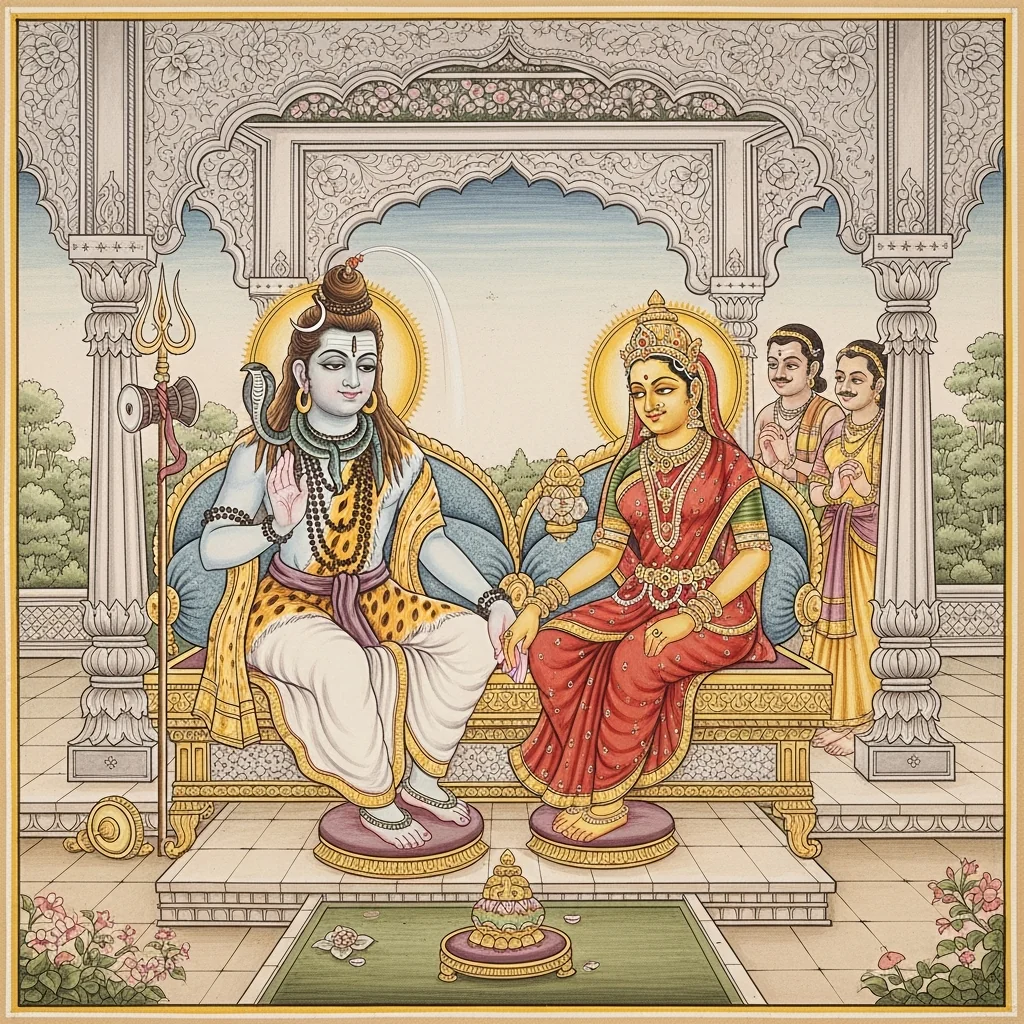
Adhyaya 23
This chapter unfolds as a layered dialogue. Agastya asks Skanda how Ṣaḍānana approaches Trilocana, and what the Virajā-pīṭha signifies within Kāśī’s sacred liṅga-topography. Skanda introduces the Virajā seat and points to key Kāśī nodes—Trilocana Mahāliṅga and the Pilipilā tīrtha—presenting them together as a complete tīrtha-complex. The focus then shifts to Devī’s request before Śiva: she seeks a clear enumeration of Kāśī’s anādi-siddha liṅgas that serve as causes of nirvāṇa and uphold Kāśī’s renown as a mokṣa-purī. Śiva replies with a structured catalogue of fourteen principal liṅgas, beginning with Oṃkāra and Trilocana and culminating in Viśveśvara, affirming their combined efficacy as the operative basis of the liberation-field and urging regular yātrā and worship. The chapter also notes further groups of liṅgas that remain concealed or not yet revealed in Kali’s age, approachable chiefly by devoted and informed practitioners. When Devī asks for each liṅga’s individual greatness, the narrative expands into the origin of the Oṃkāra liṅga: Brahmā’s austerities in Ānandakānana, the visionary emergence of the primal syllable (a-u-ma), and teaching on nāda-bindu metaphysics. Brahmā’s praise leads to boons and salvific assurances tied to darśana and japa. Thus the chapter unites sacred cartography, ritual guidance, and Pranava exegesis as śabda-brahman into a single liberation-oriented theological discourse.
Shlokas
Verse 1
अगस्त्य उवाच । त्रिलोचनं समासाद्य देवदेवः षडाननः । जगदंबिकयायुक्तः किं चकाराशु तद्वद
Agastya said: Having approached Trilocana, what did the six-faced Lord of gods do at once, accompanied by Jagadambikā? Tell me that.
Verse 2
स्कन्द उवाच । मुने कलशजाख्यामि यत्पृष्टं तन्निशामय । विरजःसंज्ञकं पीठं यत्प्रोक्तं सर्वसिद्धिदम्
Skanda said: O sage born of the water-pot (Agastya), I shall explain what you have asked—listen. There is a sacred seat called Viraja, proclaimed as bestowing all attainments.
Verse 3
तत्पीठदर्शनादेव विरजा जायते नरः । यत्रास्ति तन्महालिंगं वाराणस्यां त्रिलोचनम्
By the mere sight of that sacred seat, a man becomes viraja, free from impurity. There stands that great Liṅga—Trilocana—in Vārāṇasī.
Verse 4
तीर्थं पिलिपिलाख्यं तद्द्युनद्यंभसि विश्रुतम् । सर्वतीर्थमयं तीर्थं तत्काश्यां परिगीयते
The ford called Pilipilā is renowned in the waters of the heavenly river. In Kāśī it is praised as a tīrtha that holds the essence of all tīrthas.
Verse 5
विष्टपत्रितयांतर्ये देवर्षिमनुजोरगाः । ससरित्पर्वतारण्याः संति ते तत्र यन्मुने
Within the threefold heaven are gods, ṛṣis, humans, and serpents—along with rivers, mountains, and forests; all of these, O sage, are present there.
Verse 6
तदारभ्य च तत्तीर्थं तच्च लिंगं त्रिलोचनम् । त्रिविष्टपमिति ख्यातमतोहेतोर्महत्तरम्
From that time onward, that tīrtha and that liṅga of Trilocana became famed as “Triviṣṭapa”; for this reason it is regarded as exceedingly great.
Verse 7
त्रिविष्टपस्य लिंगस्य महिमोक्ताः पिनाकिना । जगज्जनन्याः पुरतो यथा वच्मि तथा मुने
The greatness of the Triviṣṭapa Liṅga was spoken by the Bearer of the bow (Śiva) in the presence of the Mother of the world. O sage, I shall relate it just as it was spoken.
Verse 8
देव्युवाच । देवदेव जगन्नाथ शर्व सर्वद सर्वग । सर्वदृक्सर्वजनक किंचित्पृच्छामि तद्वद
The Goddess said: O God of gods, Lord of the world—O Śarva, giver of all, all-pervading; all-seeing, source of all—there is something I ask; tell me that.
Verse 9
इदं तव प्रियं क्षेत्रं कर्मबीजमहौषधम् । नैःश्रेयस्याः श्रियो गेहं ममापि प्रीतिदं महत्
This is Your beloved sacred region—an exalted medicine for the seed of karma; the abode of the splendor of naiḥśreyasa (final beatitude). To me also it grants great joy.
Verse 10
यत्क्षेत्ररजसोप्यग्रे त्रिलोक्यपि तृणायते । तस्याखिलस्य महिमा विष्वक्केनावगम्यते
Even a speck of dust from this sacred field makes the three worlds seem like mere straw. Who indeed can fully comprehend the immeasurable greatness of this all-encompassing holy realm?
Verse 11
यानीह संति लिंगानि तानि सर्वाण्यसंशयम् । निर्वाणकारणान्येव स्वयंभून्यपि तान्यपि
Whatever liṅgas exist here, all of them—without doubt—are causes of nirvāṇa (final release); and among them are also self-manifest (svayaṃbhū) liṅgas.
Verse 12
यद्यप्येवं तथापीश विशेषं वक्तुमर्हसि । काश्यामनादिसिद्धानि कानि लिंगानि शंकर
Even if it is so, O Lord, still You should explain the distinction in detail. O Śaṅkara, which liṅgas in Kāśī are established from beginningless time (anādi-siddha)?
Verse 13
यत्र देवः सदा तिष्ठेत्संवर्तेऽपि स वल्लभः । यैरियं प्रथितिं प्राप्ता काशी मुक्तिपुरीति च
Those (liṅgas) where the Lord ever abides—beloved even at the time of cosmic dissolution—are the very ones by which Kāśī has attained the famed renown of being the “City of Liberation” (mukti-purī).
Verse 14
येषां स्मरणतोप्यत्र भवेत्पापस्य संक्षयः । दर्शनस्पर्शनाभ्यां च स्यातां स्वर्गापवर्गकौ
Of those liṅgas, even mere remembrance here brings about the destruction of sin; and by their sight and touch, one gains both heaven and final liberation.
Verse 15
येषां समर्चनादेव मध्ये जन्म सकृद्विभो । लिंगानि पूजितानि स्युः काश्यां सर्वाणि निश्चितम्
By the proper worship of which liṅgas, O Lord, even a single intervening birth is enough; it is certain that in Kāśī all the liṅgas become, as it were, worshipped.
Verse 16
विधाय मय्यनुक्रोशं कारुण्यामृतसागर । एतदाचक्ष्व मे शंभो पादयोः प्रणतास्म्यहम्
Show compassion to me, O Śambhu—o ocean of nectar-like mercy. Please tell me this; I bow down at your feet.
Verse 17
इत्याकर्ण्य महेशानस्तस्या देव्याः सुभाषितम् । कथयामास र्विध्यारे महालिंगानि सत्तम
Having thus heard the well-spoken words of that Goddess, Maheśāna began to describe—O best of the virtuous—the great liṅgas in proper order.
Verse 18
यन्नामाकर्णनादेव क्षीयंते पापराशयः । प्राप्यते पुण्यसंभारः काश्यां निवार्णकारणम्
By merely hearing its name, heaps of sins are destroyed; in Kāśī a store of merit is gained—(it is) a cause of liberation.
Verse 19
देवदेव उवाच । शृणु देवि परं गुह्यं क्षेत्रेऽस्मिन्मुक्तिकारणम् । इदं विदंति नैवापि ब्रह्मनारायणादयः
Devadeva said: Hear, O Goddess, this supreme secret—the cause of liberation in this sacred kṣetra. Even Brahmā, Nārāyaṇa, and others do not truly know it.
Verse 20
असंख्यातानि लिंगानि पार्वत्यानंदकानने । स्थूलान्यपि च सूक्ष्माणि नानारत्नमयानि च
In Pārvatī’s Ānandakānana there are countless Śiva-liṅgas—some large and some subtle, and many fashioned of diverse precious gems.
Verse 21
नानाधातुमयानीशे दार्षदान्यप्यनेकशः । स्वयंभून्यप्यनेकानि देवर्षिस्थापितान्यहो
O Goddess, many are made of various metals, and many indeed are of stone. Many also are self-manifest (svayambhū), and many—marvel indeed—were established by divine seers.
Verse 22
सिद्धचारणगंधर्व यक्षरक्षोर्चितान्यपि । असुरोरगमर्त्यैश्च दानवैरप्सरोगणैः
They are worshipped also by Siddhas, Cāraṇas, Gandharvas, Yakṣas, and Rākṣasas—indeed by Asuras, Nāgas, and humans as well, by Dānavas and hosts of Apsarases.
Verse 23
दिग्गजेर्गिरिभिस्तीर्थेरृक्ष वानर किन्नरैः । पतत्रिप्रमुखैर्देवि स्वस्वनामांकितानि वै
O Goddess, they are marked with the very names of those who established them—directional elephants, mountains, tīrthas, bears, monkeys, Kinnaras, and leaders among birds.
Verse 24
प्रतिष्ठितानि यानीह मुक्तिहेतूनि तान्यपि । अदृश्यान्यपि दृश्यानि दुरवस्थान्यपि प्रिये
Beloved, whatever liṅgas are established here—those too are causes of liberation. Even what is unseen may be seen; even what is in poor condition remains worthy within this kṣetra.
Verse 25
भग्नान्यपि च कालेन तानि पूज्यानि सुंदरि । परार्धशतसंख्यानि गणितान्येकदा मया
O fair one, even if time has broken them, they are still to be worshipped. Once I counted them as numbering in hundreds of parārdhas—an immeasurably vast total.
Verse 26
गंगाभस्यपि तिष्ठंति षष्टिकोटिमितानिहि । सिद्धलिंगानि तानीशे तिष्येऽदृश्यत्वमाययुः
On the very bank of the Gaṅgā stand liṅgas—indeed, sixty million in number. Those perfected (siddha) liṅgas, O Goddess, in the age of Tiṣya (Kali), have passed into invisibility.
Verse 27
गणनादिवसादवार्ङ्ममभक्तजनैःप्रिये । प्रतिष्ठितानि यानीह तेषां संख्या न विद्यते
Beloved, from the very day counting began, my devotees have been establishing liṅgas here; therefore, the number of those consecrated here is not known.
Verse 28
त्वया तु यानि पृष्टानि यैरिदं क्षेत्रमुत्तमम् । तानि लिंगानि वक्ष्यामि मुक्तिहेतूनि सुंदरि
But the liṅgas about which you have asked—by which this kṣetra is supreme—those liberation-bestowing liṅgas I shall now describe, O beautiful one.
Verse 29
कलावतीव गोप्यानि भविष्यंति गिरींद्रजे । परं तेषां प्रभावो यः स्वस्वस्थानं न हास्यति
O daughter of the Lord of Mountains, they will become hidden, as though veiled by art; yet such is their power that they will never forsake their own proper abodes.
Verse 30
कलिकल्मषपुष्टा ये ये दुष्टा नास्तिकाः शठाः । एतेषां सिद्धलिंगानां ज्ञास्यंत्याख्यामपीह न
Those wicked, atheistic, deceitful people, nourished by the sins of the Kali age—even they do not come to know here the very names and fame of these accomplished (self-manifest) Liṅgas.
Verse 31
नामश्रवणतोपीह यल्लिंगानां शुभानने । वृजिनानि क्षयं यांति वर्धंते पुण्यराशयः
O fair-faced one, even by merely hearing the names of these Liṅgas, sins are destroyed and the accumulations of merit increase.
Verse 32
ओंकारः प्रथमं लिंगं द्वितीयं च त्रिलोचनम् । तृतीयश्च महादेवः कृत्तिवासाश्चतुर्थकम्
Oṃkāra is the first Liṅga; Trilocana is the second. Mahādeva is the third, and Kṛttivāsa is the fourth.
Verse 33
रत्नेशः पंचमं लिंगं षष्ठं चंद्रेश्वराभिधम् । केदारः सप्तमं लिंगं धर्मेशश्चाष्टमं प्रिये
Ratneśa is the fifth Liṅga, and the sixth is called Candreśvara. Kedāra is the seventh Liṅga, and Dharmeśa the eighth, O beloved.
Verse 34
वीरेश्वरं च नवमं कामेशं दशमं विदुः । विश्वकर्मेश्वरं लिंगं शुभमेकादशं परम्
Vīreśvara is known as the ninth, and Kāmeśa as the tenth. The auspicious Viśvakarmeśvara Liṅga is the supreme eleventh.
Verse 35
द्वादशं मणिकर्णीशमविमुक्तं त्रयोदशम् । चतुर्दशं महालिंगं मम विश्वेश्वराभिधम्
Maṇikarṇīśa is the twelfth; Avimukta is the thirteenth. The fourteenth is the great Liṅga—my own—named Viśveśvara.
Verse 36
प्रिये चतुर्दशैतानि श्रियोहेतूनि सुंदरि । एतेषां समवायोयं मुक्तिक्षेत्रमिहेरितम्
O beloved, O beautiful one—these fourteen are the causes of prosperity. Their combined presence is what is proclaimed here as the Field of Liberation.
Verse 37
देवताः समधिष्ठात्र्यः क्षेत्रस्यास्य परा इमाः । आराधिताः प्रयच्छंति नृभ्यो नैःश्रेयसीं श्रियम्
These exalted deities are the presiding powers of this sacred field. When worshipped, they bestow upon human beings the auspicious prosperity that leads to the highest good.
Verse 38
आनंदकानने मुक्त्यै प्रोक्तान्येतानि सुंदरि । प्रिये चतुर्दशेज्यानि महालिंगानि देहिनाम्
O beautiful one, these have been declared for liberation in Ānandakānana. O beloved, for embodied beings these fourteen great Liṅgas are the objects of worship.
Verse 39
प्रतिमासं समारभ्य तिथिं प्रतिपदं शुभाम् । एतेषां लिंगमुख्यानां कार्या यात्रा प्रयत्नतः
Each month, beginning on the auspicious Pratipadā—the first lunar tithi—one should, with earnest effort, undertake pilgrimage to these foremost Liṅgas.
Verse 40
अनाराध्य महादेवमेषु लिंगेषु कुंभज । कः काश्यां मोक्षमाप्नोति सत्यं सत्यं पुनःपुनः
O Kumbhaja (Agastya), without worshipping Mahādeva in these Liṅgas, who could attain liberation in Kāśī? This is truth—truth indeed—repeated again and again.
Verse 41
तस्मात्सर्वप्रयत्नेन काशीफलमभीप्सुभिः । पूज्यान्येतानि लिंगानि भक्त्या परमया मुने
Therefore, O sage, those who seek the true fruit of Kāśī should, with every effort, worship these Liṅgas with supreme devotion.
Verse 42
अगस्त्य उवाच । एतान्येव किमन्यानि महालिंगानि षण्मुख । निर्वाणकारणानीह यदि संति तदा वद
Agastya said: O Ṣaṇmukha (Skanda), are these alone the great Liṅgas, or are there others here as well—Liṅgas that are causes of nirvāṇa? If they exist, then tell me.
Verse 43
स्कंद उवाच । अन्यान्यपि च संतीह महालिंगानि सुव्रत । कलिप्रभावाद्गुप्तानि भविष्यंत्येव तानि वै
Skanda said: O well-vowed one, other great Liṅgas also exist here; yet by the influence of Kali they will indeed remain hidden.
Verse 44
यस्येश्वरे सदाभक्तिर्यः काशीतत्त्ववित्तमः । स एवैतानि लिंगानि वेत्स्यत्यन्यो न कश्चन
Only one who has unwavering devotion to the Lord and truly knows the inner truth of Kāśī will recognize these liṅgas—no one else.
Verse 45
येषां नामग्रहेणापि कलिकल्मष संक्षयः । अमृतेशस्तारकेशो ज्ञानेशः करुणेश्वरः
By merely taking their names, the sins of the Kali age are destroyed—Amṛteśa, Tārakeśa, Jñāneśa, and Karuṇeśvara.
Verse 46
मोक्षद्वारेश्वरश्चैव स्वर्गद्वारेश्वरस्तथा । ब्रह्मेशो लांगलश्चैव वृद्धकालेश्वरस्तथा
Also named are: Mokṣadvāreśvara, Svargadvāreśvara, Brahmeśa, Lāṅgala, and likewise Vṛddhakāleśvara.
Verse 47
वृषेशश्चैव चंडीशो नंदिकेशो महेश्वरः । ज्योतीरूपेश्वरं लिंगं ख्यातमत्र चतुर्दशम्
And also Vṛṣeśa, Caṇḍīśa, Nandikeśa, and Maheśvara; and the liṅga known here as Jyotīrūpeśvara is renowned as the fourteenth.
Verse 48
काश्यां चतुर्दशैतानि महालिंगानि सुंदरि । इमानि मुक्तिहेतूनि लिंगान्यानंदकानने
O fair one, in Kāśī there are these fourteen great liṅgas—liṅgas that are causes of liberation—situated in Ānandakānana.
Verse 49
कलिकल्मषबुद्धीनां नाख्येयानि कदाचन । एतान्याराधयेद्यस्तु लिंगानीह चतुर्दश
For minds stained by the impurities of Kali, these are never to be proclaimed. Yet whoever worships here these fourteen liṅgas… (becomes worthy of their fruit).
Verse 50
न तस्य पुनरावृत्तिः संसाराध्वनि कर्हिचित् । काशीकोशोयमतुलो न प्रकाश्यो यतस्ततः
For him there is never again any return to the road of saṃsāra. This incomparable “treasure of Kāśī” is not to be revealed everywhere or to just anyone.
Verse 51
एतल्लिंगाभिधा देवि महापद्यपि दुःखहृत् । रहस्यं परमं चैतत्क्षेत्रस्यास्य वरानने
O Goddess, even amid great calamity, the utterance or knowledge of this liṅga’s name removes sorrow. This is the supreme secret of this sacred kṣetra, O fair-faced one.
Verse 52
चतुर्दशापि लिंगानि मत्सान्निध्यकराणि हि । अविमुक्तस्य हृदयमेतदेव गिरींद्रजे
These fourteen liṅgas indeed bring about My immediate presence. This very set is the “heart” of Avimukta, O daughter of the Lord of mountains.
Verse 53
इमानि यानि लिंगानि सर्वेषां मुक्तिदानि हि । एकैकभुवनस्येह सारमादाय सर्वतः । मयैतानि कृतान्येव महाभक्तिकृपावशात्
These liṅgas indeed grant liberation to all. Gathering here the very essence of each world from every side, I Myself established them—moved by compassion for great devotion.
Verse 54
अस्मिन्क्षेत्रे ध्रुवं मुक्तिरिति या प्रथिति प्रिये । कारणं तत्र लिंगानि ममैतानि चतुर्दश
Beloved, the well-known saying that “in this sacred field liberation is certain”—its cause is these fourteen liṅgas of Mine.
Verse 55
त एव व्रतिनः कांते त एव च तपस्विनः । ध्यातान्येतानि यैर्भक्तैर्लिंगान्यानंदकानने
O dear one, they alone are true observers of vows, and they alone are true ascetics—those devotees by whom these liṅgas in the Grove of Bliss are meditated upon.
Verse 56
त एवाभ्यस्तसद्योगा दत्तदानास्त एव हि । काश्यामिमानि लिंगानि यैर्दृष्टान्यपि दूरतः
They alone have truly practiced the right yoga, and they alone have truly given charity—those by whom these liṅgas in Kāśī have been seen, even from afar.
Verse 57
इष्टापूर्ताश्च ये धर्माः प्रणीता मुनिसत्तमैः । ते सर्वे तेन विहिता यावज्जीवं निरेनसा
Whatever duties of iṣṭa and pūrta have been taught by the best of sages—all of them are thereby accomplished by him, for his whole life, without sin.
Verse 58
येनाविमुक्तमासाद्य महालिंगानि पार्वति । सकृदभ्यर्चितानीह स मुक्तो नात्र संशयः
O Pārvatī, whoever reaches Avimukta and here worships the great liṅgas even once—he is liberated; of this there is no doubt.
Verse 59
स्कंद उवाच । अन्यान्यपि च विंध्यारे देव्यै प्रोक्तानि शंभुना । स्वभक्तानां हिताथार्य तान्यथाकर्णयाग्रज
Skanda said: Moreover, in the Vindhya forest Śambhu spoke other teachings also to the Goddess, for the welfare of his devotees. Hear them now in proper order, O revered sage.
Verse 60
शैलेशः संगमेशश्च स्वर्लीनो मध्यमेश्वरः । हिरण्यगर्भ ईशानो गोप्रेक्षो वृषभध्वजः
“(These are the revered Liṅgas of Kāśī:) Śaileśa, Saṃgameśa, Svarlīna, Madhyameśvara, Hiraṇyagarbha, Īśāna, Goprekṣa, and Vṛṣabhadhvaja.”
Verse 61
उपशांत शिवो ज्येष्ठो निवासेश्वर एव च । शुक्रेशो व्याघ्रलिंगं च जंबुकेशं चतुर्दशम्
“Upaśānta-Śiva, Jyeṣṭha, and also Nivāseśvara; Śukreśa, Vyāghraliṅga, and Jambukeśa—these complete the fourteen (great Liṅgas).”
Verse 62
मुने चतुर्दशैतानि महांत्यायतनानि वै । एतेषामपि सेवातो नरो मोक्षमवाप्नुयात्
“O sage, these fourteen are indeed great sanctuaries; by service and devoted attendance to them, a person attains liberation (mokṣa).”
Verse 63
चैत्रकृष्णप्रतिपदं समारभ्य प्रयत्नतः । आ चतुर्दशिपूज्यानि लिंगान्येतानि सत्तमैः
“Beginning carefully from the first lunar day of the dark fortnight of Caitra, these Liṅgas are to be worshipped diligently up to the fourteenth day, by the best of devotees.”
Verse 64
एतेषां वार्षिकी यात्रा सुमहोत्सवपूर्वकम् । कार्या मुमुक्षुभिः सम्यक्क्षेत्रसंसिद्धिदायिनी
Their annual pilgrimage should be undertaken with a great festival; it is to be performed rightly by seekers of liberation, for it bestows complete spiritual accomplishment in the sacred field of Kāśī.
Verse 65
मुने चतुर्दशैतानि महालिंगानि यत्नतः । दृष्ट्वा न जायते जंतुः संसारे दुःखसागरे
O sage, having carefully beheld these fourteen great Liṅgas, a being is not born again into saṃsāra—the ocean of suffering.
Verse 66
क्षेत्रस्य परमं तत्त्वमेतदेव प्रिये ध्रुवम् । संसाररोगग्रस्तानामिदमेव महौषधम्
Beloved, this indeed is the certain highest truth of the sacred field: for those afflicted by the disease of saṃsāra, this alone is the great medicine.
Verse 67
क्षेत्रस्योपनिषच्चैषा मुक्तिबीजमिदं परम् । कर्मकाननदावाग्निरेषा लिंगावलिः प्रिये
Beloved, this is the Upaniṣad-like secret of the sacred field, the supreme seed of liberation; this garland of Liṅgas is a forest-fire that burns down the woodland of karma.
Verse 68
एकैकस्यास्य लिंगस्य महिमाद्यंत वर्जितः । मयैव ज्ञायते देवि सम्यङ्नान्येन केनचित्
Goddess, the greatness of each and every one of these Liṅgas—endless, without beginning or end—is known properly only by me, and by no one else.
Verse 69
इति श्रुत्वा मुने प्राह देवी हृष्टतनूरुहा । प्रणम्य देवमीशानं सर्वज्ञं सर्वदं शिवम्
Hearing this, O sage, the Goddess—thrilled, her hairs standing on end—spoke, after bowing to Lord Īśāna, Śiva, the all-knowing and the giver of all.
Verse 70
देव्युवाच । रहस्यं परमं काश्यां यदेतत्समुदीरितम् । तच्छ्रुत्वोत्सुकतां प्राप्तं मनो मेतीव वल्लभ
The Goddess said: “Beloved, hearing this supreme secret that has been proclaimed concerning Kāśī, my mind has become intensely eager (to know more).”
Verse 71
यदुक्तं लिगमेकैकं महासारतरं परम् । काश्यां परमनिर्वाणकारणं कारणेश्वर
“O Kāraṇeśvara, you have said that each liṅga, one by one, is supremely essential—indeed the very cause of highest liberation in Kāśī.”
Verse 72
प्रत्येकं महिमानं मे ब्रूह्येषां भुवनेश्वर । चतुर्दशानां लिंगानां श्रवणादघहारिणाम्
“O Lord of the worlds, tell me the greatness of each of these fourteen liṅgas—whose very hearing destroys sin.”
Verse 73
ओंकारेशस्य लिंगस्य कथमत्र समागमः । अतिपुण्यतमात्तस्मात्क्षेत्रादमरकंटकात्
“How did the liṅga of Oṃkāreśa come to be here (in Kāśī), from that exceedingly holy sacred region—Amarakaṇṭaka?”
Verse 74
किमात्मकोऽयमोंकारो महिमास्य च को हर । केनाराधि पुरा चैष ददावाराधितश्च किम्
“O Hara, what is the true nature of this Oṃkāra, and what is its greatness? By whom was it worshipped in ancient times, and what did it grant when thus propitiated?”
Verse 75
मृडानीवाक्सुधामेतां विधाय श्रुतिगोचराम् । कथामकथयद्देव ओंकारस्यमहाद्भुताम्
Having thus composed this nectar-like speech of Mṛḍānī (Pārvatī), fit to be heard as sacred lore, the Lord then narrated the wondrous account of Oṃkāra.
Verse 76
देवदेव उवाच । कथामाकर्णयापर्णे वर्णयामि तवाग्रतः । यथोंकारस्य लिंगस्य प्रादुर्भाव इहाभवत्
The Lord of gods said: “Listen, O Aparṇā; I shall describe before you how the liṅga of Oṃkāra manifested here.”
Verse 77
पुरानंदवने चात्र ब्रह्मणा विश्वयोनिना । तपस्तप्तं महादेवि समाधिं दधतापरम्
“Formerly, here in Ānandavana, Brahmā—the source of the universe—performed austerities, O great goddess, abiding in supreme samādhi.”
Verse 78
पूर्णे युगसहस्रेऽथ भित्त्वा पातालसप्तकम् । उदतिष्ठत्पुरोज्योतिर्विद्योतित हरिन्मुखम्
“Then, when a thousand yugas were completed, a radiant Light arose in front—piercing through the seven netherworlds—illuminating Brahmā’s face.”
Verse 79
यदंतराविरभवन्निर्व्याजेन समाधिना । तदेव परमं धाम बहिराविरभूद्विधेः
That supreme abode which appeared inwardly through Brahmā’s unfeigned samādhi—appeared outwardly as well to the Creator.
Verse 80
योभूच्चटचटाशब्दः स्फुटतो भूमिभागतः । तच्छब्दाद्व्यसृजद्वेधाः समाधिं क्रमतो वशी
Then a clear “caṭa-caṭa” sound arose from a region of the earth; and from that sound, the self-mastered Creator, step by step, released himself from samādhi.
Verse 81
स्रष्टाविसृष्ट तद्ध्यानो यावदुन्मील्यलोचने । पुरः पश्येद्ददर्शाग्रे तावदक्षरमादिमम्
The Creator, intent upon that act of emanation, opened his eyes; and as soon as he looked before him, he beheld in front the primordial Imperishable, Akṣara.
Verse 82
अकारं सत्त्वसंपन्नमृक्क्षेत्रं सृष्टिपालकम् । नारायणात्मकं साक्षात्तमः पारे प्रतिष्ठितम्
He beheld the ‘A’-sound—filled with sattva, the field of the Ṛg Veda, the protector of creation—manifestly of the nature of Nārāyaṇa, established beyond darkness.
Verse 83
उकारमथ तस्याग्रे रजोरूपं यजुर्जनिम् । विधातारं समस्तस्य स्वाकारमिव बिंबितम्
Next, before him appeared the ‘U’-sound—of the form of rajas, the source of the Yajus (Yajurveda)—the Ordainer of all, reflected as though in his own form.
Verse 84
नीरवध्वांतसंकेत सदनाभं तदग्रतः । मकारं स ददर्शाथ तमोरूपं विशेषतः
Before him he then beheld the “M”-sound—marked by silent darkness, appearing like an abode; in particular, it was of the very form of tamas.
Verse 85
साम्नो योनिं लये हेतुं साक्षाद्रुद्रस्वरूपिणम् । अथ तत्पुरतो ध्याता व्यधात्स्वनयनातिथिम्
He saw it as the womb of the Sāman (Sāmaveda), the cause of dissolution, directly the very form of Rudra; then the meditator set it before himself as a guest for his own eyes to behold.
Verse 86
विश्वरूपमयाकारं सगुणं वापि निर्गुणम् । अनाख्यनादसदनं परमानंदविग्रहम्
It was a form made of the universe itself—whether with attributes or beyond attributes—an indescribable abode of nāda, a body of supreme bliss.
Verse 87
शव्दब्रह्मेति यत्ख्यातं सर्ववाङ्मयकारणम् । अथोपरिष्टान्नादस्य बिंदुरूपं परात्परम्
That which is renowned as Śabda-Brahman—the cause of all speech and expression—above that nāda, he beheld the Bindu-form, the Supreme beyond the supreme.
Verse 88
कारणं कारणानां च जगद्योनिं च तं परम् । विधिर्विलोकयांचक्रे तपसागोचरीकृतम्
That Supreme—cause of all causes and womb of the universe—Brahmā (Vidhi) gazed upon, made accessible to his perception through tapas.
Verse 89
अवनादोमिति ख्यातं सर्वस्यास्य प्रभावतः । भक्तमुन्नयते यस्मात्तदोमिति य ईरितः
It is famed as “Oṃ,” the descending Nāda, by whose power all this unfolds; and because it uplifts the devotee, it is therefore proclaimed as “Oṃ”.
Verse 90
अरूपोपि सरूपाढ्यः स धात्रा नेत्रगीकृतः । तारयेद्यद्भवांभोधेः स्वजपासक्तमानसम् । ततस्तार इति ख्यातो यस्तं ब्रह्मा व्यलोकयत्
Though formless, He is abundant with all forms. The Creator (Dhātṛ) made Him an object of inner vision; for He ferries across the ocean of becoming the mind devoted to His own japa. Therefore He is famed as “Tāra,” the saving sound—the One whom Brahmā beheld.
Verse 91
प्रणूयते यतः सर्वैः परनिर्वाणकामुकैः । सर्वेभ्योभ्यधिकस्तस्मात्प्रणवो यैः प्रकीर्तितः
Because it is sounded by all who yearn for the supreme Nirvāṇa, that syllable is praised as “Praṇava,” superior to all utterances.
Verse 92
स्वसेवितारं पुरुषं प्रणयेद्यः परंपदम् । अतस्तप्रणवं शांतं प्रत्यक्षीकृतवान्विधिः
He who leads the devoted servant-soul to the supreme state is that Puruṣa. Therefore Brahmā (Vidhi) made that tranquil Praṇava directly manifest in his realization.
Verse 93
त्रयीमयस्तुरीयोयस्तुर्यातीतोखिलात्मकः । नादबिंदुस्वरूपो यः स प्रैक्षि द्विजगामिना
He who is the essence of the Vedic triad, who is the Fourth (turīya) and also beyond the Fourth—whose nature is all-encompassing, and who appears as Nāda and Bindu—was beheld by the twice-born traveller (Brahmā).
Verse 94
प्रावर्तंत यतो वेदाः सांगाः सर्वस्य योनयः । सवेदादिः पद्मभुवा पुरस्तादवलोकितः
From Him the Vedas, together with their auxiliaries, set forth—He is the womb-source of all; He, the very beginning of the Vedas, was beheld beforehand by the Lotus-born (Brahmā).
Verse 95
वृषभो यस्त्रिधाबद्धो रोरवीति महोमयः । सनेत्रविषयी चक्रे परमः परमेष्ठिना
That exalted “Bull,” bound in a threefold manner and resounding with the great Oṃ, was made an object of vision by Parameṣṭhin (Brahmā), the supreme among embodied beings.
Verse 96
शृंगश्चत्वारि यस्यासन्हस्तासः सप्त एव च । द्वे शीर्षे च त्रयः पादाः स देवो विधिनैक्षत
He whose form had four horns, seven hands, two heads, and three feet—that Deity was beheld by Brahmā (Vidhi).
Verse 97
यदंतर्लीनमखिलं भूतं भावि भवत्पुनः । तद्बीजं बीजरहितं द्रुहिणेन विलोकितम्
That in which all beings—past, future, and present—lie dissolved within: that Seed which is itself seedless was beheld by Druhiṇa (Brahmā).
Verse 98
लीनं मृग्येत यत्रैतदाब्रह्मस्तंबभाजनम् । अतः स भाज्यते सद्भिर्यल्लिंगं तद्विलोकितम्
Where this entire cosmos—from Brahmā down to a blade of grass—is sought as dissolved, therefore the good strive to ‘part’ and discern that Reality; that very liṅga (mark, sign) was beheld.
Verse 99
पंचार्था यत्र भासंते पंचब्रह्ममयं हि यत् । आदिपंचस्वरूपंयन्निरैक्षि ब्रह्मणा हि तत्
Where the five principles shine forth—indeed, that which is made of the Five Brahmans—Brahmā beheld that primeval fivefold form.
Verse 100
तमालोक्य ततो वेधा लिंगरूपिणमीश्वरम् । पंचाक्षरं प्रपंचाच्च भिन्नं तुष्टाव शंकरम्
Seeing that Lord who had assumed the form of the Liṅga, Brahmā then praised Śaṅkara—who is distinct from the manifested world—and praised the five-syllabled mantra, the Pañcākṣarī.
Verse 110
नानावर्णस्वरूपाय वर्णानां पतये नमः । नमस्ते स्वररूपाय नमो व्यंजनरूपिणे
Salutations to You whose very form is the manifold letters, the Lord of all phonemes. Salutations to You as vowels, and salutations to You as consonants.
Verse 120
शब्दब्रह्म नमस्तुभ्यं परब्रह्म नमोस्तुते । नमो वेदांतवेद्याय वेदानां पतये नमः
Salutations to You as Śabdabrahman, and salutations to You as Parabrahman. Salutations to You who are known through Vedānta; salutations to You, the Lord of the Vedas.
Verse 130
सर्वभुक्सर्वकर्ता त्वं सर्वसंहारकारक । योगिनां हृदयाकाश कृतालय नमोस्तु ते
You are the Enjoyer of all, the Doer of all, and the Agent of all dissolution. O You who have made the heart-space of yogins Your dwelling—salutations to You.
Verse 140
त्वमेव हि शरण्यं मे त्वमेव हि गतिः परा । त्वामेव प्रणमामीश नमस्तुभ्यं नमो नमः
You alone are my refuge; You alone are my supreme goal. To You alone I bow, O Lord—salutations to You, again and again.
Verse 150
ईश्वर उवाच । सुरश्रेष्ठ तपःश्रेष्ठ सर्वाम्नाय निधिर्भव । सृष्टेःकरणसामर्थ्यं तवास्तु मदनुग्रहात्
Īśvara said: “O best among the gods, best among ascetics—become a treasury of all sacred transmissions. By My grace, may the power to accomplish creation be yours.”
Verse 160
अष्टम्यां च चतुर्दश्यां तीर्थानि सह सागरैः । षष्टि कोटि सहस्राणि मत्स्योदर्यां विशंति हि
On the eighth and the fourteenth lunar days, the tīrthas—together with the oceans—indeed enter Matsyodarī, in the measure of sixty crores and thousands.
Verse 170
केवलं भूमिभाराय जन्मिनो जन्म तस्य वै । येनानंदवने दृष्टो नोंकारः सर्वकामदः
For one who is born, that birth is truly only a burden upon the earth—unless in Ānandavana the Oṃkāra, the giver of all desired ends, has been beheld.
Verse 180
स्कंद उवाच । ब्रह्मापि भजतेद्यापि तल्लिंगं कलशोद्भव । स्तुवन्ब्रह्म स्तवेनैव स्वात्मना विहितेन हि
Skanda said: “O Agastya, born of the pot! Even today Brahmā worships that very Liṅga, praising the Supreme through this hymn composed by his own self.”
Verse 182
ब्रह्मस्तवमिमं जप्त्वा त्रिकालं परिवत्सरम् । अंतकाले भवेज्ज्ञानं येन बंधात्प्रमुच्यते
Having recited this Brahmā-hymn three times daily for a full year, at the final hour true knowledge arises—by which one is released from bondage.