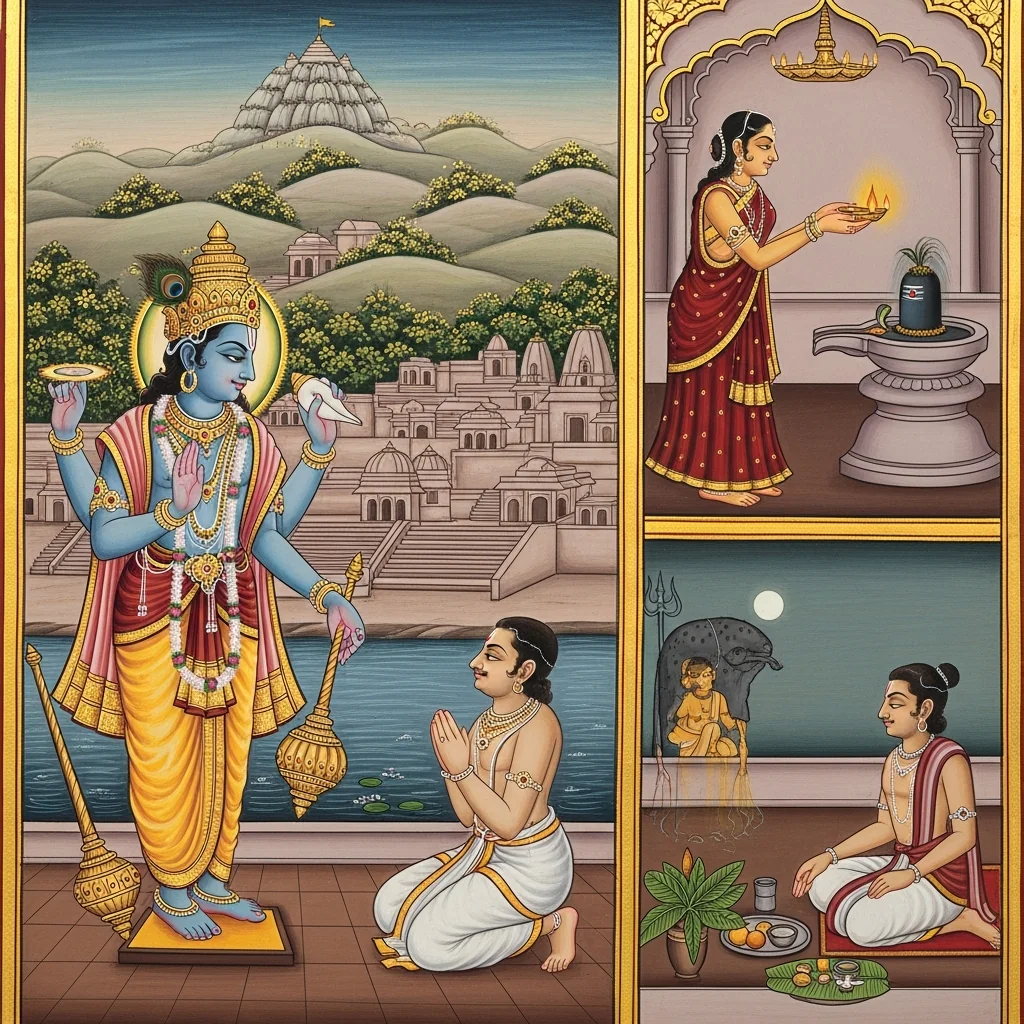
Adhyaya 10
Chapter 10 unfolds as a tīrtha origin account and a vow-manual within a theological dialogue. Skanda introduces it as the “manifestation of Mādhava,” assuring swift purification to those who hear with faith. Viṣṇu (Keśava) comes from Mandara, beholds the surpassing sanctity of Kāśī, and praises Pañcanada-hrada as purer than even cosmic exemplars. The narrative turns to the ascetic Agnibindu, who approaches and offers a long hymn portraying Viṣṇu as transcendent yet compassionately embodied for devotees. He asks that Viṣṇu remain established at Pañcanada for the welfare of beings, especially seekers of liberation. Viṣṇu grants this permanence, declares Kāśī uniquely potent for mokṣa through “relinquishing the body” (tanū-vyaya) there, and accepts a second boon: the site will be named Bindu-tīrtha, and devotion and bathing there bestow liberation even from afar and even if death comes later. The latter portion sets out the Kārtika/Ūrja vrata disciplines—dietary restraint, celibacy, bathing, lamp-offering, Ekādaśī vigil, truthfulness, controlled speech, purity rules, and graded fasting options. These are presented as ethical supports that steady dharma and uphold the four aims (caturvarga), with special emphasis on harboring no hatred toward the Supreme Deity and sustaining continuous devotional practice.
Shlokas
Verse 1
स्कंद उवाच । उक्ता पंचनदोत्पत्तिर्मित्रावरुणनंदन । इदानीं कथयिष्यामि माधवाविष्कृतिं पराम्
Skanda said: O son of Mitra and Varuṇa, I have explained the origin of Pañcanada; now I shall narrate the supreme manifestation of Mādhava (Viṣṇu) in Kāśī.
Verse 2
यां श्रुत्वा श्रद्धया धीमान्पापेभ्यो मुच्यते क्षणात् । न च श्रिया वियुज्येत संयुज्येत वृषेण च
Hearing it with faith, the wise are freed from sins in an instant; they are not separated from Śrī (prosperity), and are joined as well with Vṛṣa—Dharma, the Bull.
Verse 3
आगत्य मंदरादद्रेरुपेंद्रश्चंद्रशेखरम् । आपृच्छ्य तार्क्ष्यरथगः क्षणाद्वाराणसीं पुरीम्
Coming from Mount Mandara, Upendra (Viṣṇu) took leave of Candraśekhara (Śiva); then, with Tārkṣya (Garuḍa) as his chariot, he reached the city of Vārāṇasī in an instant.
Verse 4
दिवो दासं महीपालं समुच्चाट्य स्वमायया । स्थित्वा पादोदके तीर्थे केशवाख्य स्वरूपतः
By his own divine power he drove away the king named Divo-dāsa; and abiding at the Pādodaka tīrtha, he remained there in the form known as Keśava.
Verse 5
महिमानं परं काश्यां विचार्य सुविचार्य च । दृष्ट्वा पंचनदं तीर्थं परां मुदमवाप ह
Reflecting deeply on the supreme greatness of Kāśī, and beholding the Pañcanada tīrtha, he indeed attained the highest joy.
Verse 6
उवाच च प्रसन्नात्मा पुंडरीकविलोचनः । अगण्या अपि वैकुंठ गुणा विगणिता मया
Then the lotus-eyed Lord, serene in heart, spoke: “O Vaikuṇṭha, though your virtues are truly beyond counting, they have been counted by me.”
Verse 7
क्व क्षीरनीरधौ संति तावंतो निर्मला गुणाः । यावंतो विजयं तेत्र काश्यां पंचनदे ह्रदे
Where, in the Ocean of Milk, are there so many stainless virtues as there are victories here in Kāśī, at the Pañcanada lake?
Verse 8
श्वेतद्वीपेपि सामग्री क्व गुणानां गरीयसी । ईदृशी यादृशी काश्यां धूतपापेस्ति पावनी
Even in Śvetadvīpa, where is there such an exalted fullness of virtues? For a purifier like Dhūtapāpā, such as exists in Kāśī, is found nowhere else.
Verse 9
मुदे कौमोदकी स्पर्शस्तथा न मम जायते धूतपापांबु संपर्को यथा भवति सर्वथा
Even the touch of Kaumodakī, my mace, though delightful, does not give me such joy as the contact, in every way, with the waters of Dhūtapāpā.
Verse 10
न क्षीरनीरधिजया सुखं मे श्लिष्टगात्रया । तथा भवेद्यथात्र स्यात्स्पृष्टया धूतपापया
The joy I gain by embracing the Conqueror of the Ocean of Milk is not equal to the joy that arises here when Dhūtapāpā—she who shakes off sin—touches me.
Verse 11
इत्थं पंचनदे तीर्थे क्षीरनीरधिजाधवः । संप्रेष्य तार्क्ष्यं त्र्यक्षाग्रे वृत्तांतविनिवेदितुम्
Thus, at the sacred ford of Pañcanada, that Lord Mādhava—born of the Ocean of Milk—dispatched Tārkṣya (Garuḍa) to the Three-eyed Lord (Śiva) to report the full account of what had occurred.
Verse 12
आनंदकाननभवं दिवोदास क्षमापतेः । संवर्णयन्गुणग्रामं पुण्यं पांचनदोद्भवम्
He described the cluster of virtues—holy and merit-bestowing—arising from Pañcanada, and linked it with King Divodāsa, lord of the realm, associated with Ānandavana, the “Forest of Bliss” of Kāśī.
Verse 13
सुखोपविष्टः संहृष्टः सुदृष्टिर्विष्टरश्रवाः । दृष्टवांस्तपसा जुष्टमपुष्टांगं तपोधनम्
Seated at ease and filled with joy, that seer of auspicious vision—Viṣṭaraśravā—beheld an ascetic treasure: a sage whose body was lean, yet sanctified and strengthened by tapas.
Verse 14
स ऋषिस्तं समभ्येत्य पुंडरीकाक्षमच्युतम् । उपोपविष्टकमलं वनमालाविराजितम्
That sage approached Him—Puṇḍarīkākṣa, the Unfailing (Acyuta)—who was seated upon a lotus and resplendent with the forest-garland (vanamālā).
Verse 15
शंखपद्मगदाचक्र चंचत्करचतुष्टयम् । कौस्तुभोद्भासितोरस्कं पीतकौशेयवाससम्
His four hands moved, bearing conch, lotus, mace, and discus; His chest shone with the Kaustubha jewel, and He was clad in yellow silk.
Verse 16
सुनीलेंदीवररुचिं सुस्निग्ध मधुराकृतिम् । नाभीह्रदलसत्पद्म सुपाटलरदच्छदम्
His radiance was like a deep-blue lotus; His form was smooth and exquisitely pleasing. From the lake of His navel the lotus gleamed, and His lips, veiling lovely pink teeth, were beautiful.
Verse 17
दाडिमीबीजदशनं किरीटद्योतितांबरम् । देवेंद्रवंदितपदं सनकादिपरिष्टुतम्
His teeth were like pomegranate seeds; His garments shone beneath His crown. His feet were worshiped by Indra, and He was praised by Sanaka and the other primordial sages.
Verse 18
दिव्यर्षिभिर्नारदाद्यैः परिगीतमहोदयम् । प्रह्लादाद्यैर्भागवतैः परिनंदितमानसम्
His supreme glory was sung by the divine seers beginning with Nārada; and His heart was rejoiced and celebrated by devotees beginning with Prahlāda—the great Bhāgavatas.
Verse 19
धृतशार्ङ्गधनुर्दंडं दंडिताखिलदानवम् । मधुकैटभहंतारं कंसविध्वंससूचकम्
He bore the staff-like might of the Śārṅga bow, chastising all demons; the slayer of Madhu and Kaiṭabha, the very sign and herald of Kaṃsa’s destruction.
Verse 20
कैवल्यं यत्परं ब्रह्म निराकारमगोचरम् । तं पुं मूर्त्या परिणतं भक्तानां भक्तिहेतुतः
That supreme Brahman—Kaivalya itself—formless and beyond the senses: that very Reality assumes a bodily form for devotees, as the cause and support of their bhakti.
Verse 21
वेदाविदुर्यदाकारं नैवोपनिषदोदितम् । ब्रह्माद्या न च गीर्वाणाश्चक्रे नेत्रातिथिं सतम्
That form which even the Vedas do not fully know, and which the Upaniṣads do not exhaustively proclaim—neither Brahmā and the other gods nor the hosts of Devas could make Him a lasting “guest of the eyes,” wholly visible and graspable.
Verse 22
प्रणनाम मुदायुक्तः क्षितिविन्यस्तमस्तकः । स ऋषिस्तं हृषीकेशमग्निबिंदुर्महातपाः
Filled with joy, laying his head upon the earth in reverence, the great ascetic sage Agnibiṃdu bowed down to Hṛṣīkeśa, the Lord of the senses.
Verse 23
तुष्टाव परया भक्त्या मौलिबद्धकरांजलिः । अध्यस्तविस्तीर्णशिलं बलिध्वंसिनमच्युतम्
With supreme devotion, hands joined and raised to his head, he praised Acyuta—the destroyer of Bali—who was seated upon a broad stone-slab.
Verse 24
तत्र पंचनदाभ्याशे मार्कंडेयादि सेविते । गोविंदमग्निबिंदुः स स्तुतवांस्तुष्टमानसः
There, near Pañcanadā—frequented by Mārkaṇḍeya and other sages—Agnibiṃdu, his heart made glad, offered hymns to Govinda.
Verse 25
अग्निबिंदुरुवाच । ॐ नमः पुंडरीकाक्ष बाह्यांतः शौचदायिने । सहस्रशीर्षा पुरुषः सहस्राक्षः सहस्रपात्
Agnibiṃdu said: “Oṁ—obeisance to You, O lotus-eyed Lord, who grants purity within and without; You are the cosmic Puruṣa of a thousand heads, a thousand eyes, a thousand feet.”
Verse 26
नमामि ते पदद्वंद्वं सर्वद्वंद्वनिवारकम् । निर्द्वंद्वया धिया विष्णो जिष्ण्वादि सुरवंदित
I bow to Your pair of feet that removes every duality; with a mind freed from opposites I adore You, O Viṣṇu, worshipped by Jiṣṇu (Indra) and the other gods.
Verse 27
यं स्तोतुं नाधिगच्छंति वाचो वाचस्पतेरपि । तमीष्टे क इह स्तोतुं भक्तिरत्र बलीयसी
Even the words of Vācaspati, lord of speech, cannot reach Him to praise Him as He truly is. Who here could wish to extol Him? Yet in this matter devotion is the stronger power.
Verse 28
अपि यो भगवानीशो मनःप्राचामगोचरः । समादृशैरल्पधीभिः कथं स्तुत्यो वचः परः
How can that Blessed Lord, the Sovereign beyond the range of mind and sense-perception, be praised by people like us—small in understanding—using words so limited?
Verse 29
यं वाचो न विशंतीशं मनतीह मनो न यम् । मनो गिरामतीतं तं कः स्तोतुं शक्तिमान्भवेत्
Words do not enter into Him, the Lord; even the mind here cannot comprehend Him. He transcends both mind and speech—who could be truly capable of praising Him?
Verse 30
यस्य निःश्वसितं वेदाः स षडंगपदक्रमाः । तस्य देवस्य महिमा महान्कैरवगम्यते
The Vedas are but His exhalation, together with their six auxiliaries and ordered recitations. How, and by whom, can the vast glory of that God be truly comprehended?
Verse 31
अतंद्रितमनोबुद्धींद्रिया यं सनकादयः । ध्यायंतोपि हृदाकाशे न विंदंति यथार्थतः
Even the Sanakas—whose mind, intellect, and senses are ever vigilant—though meditating upon Him within the inner sky of the heart, do not truly fathom Him as He really is.
Verse 32
नारदाद्यैर्मुनिवरैराबाल ब्रह्मचारिभिः । गीयमानचरित्रोपि न सम्यग्योधिगम्यते
Though His deeds are sung by great sages such as Nārada—celibates from childhood—He still cannot be fully comprehended in the proper way.
Verse 33
तंसूक्ष्मरूपमजमव्ययमेकमाद्यं बह्माद्यगोचरमजेयमनंतशक्तिम् । नित्यं निरामयममूर्तमचिंत्यमूर्तिं कस्त्वां चराचर चराचरभिन्न वेत्ति
Who can truly know You—subtle in form, unborn, imperishable, the One and the First; beyond even Brahmā and the rest; unconquerable, of infinite powers; eternal, free from affliction; formless, yet possessing an inconceivable form—You who are distinct from all the moving and the unmoving?
Verse 34
एकैकमेव तव नामहरेन्मुरारे जन्मार्जिताघमघिनां च महापदाढ्यम् । दद्यात्फलं च महितं महतो मखस्य जप्तं मुकुंदमधुसूदनमाधवेति
Even a single one of Your names, O Hari, O slayer of Mura, destroys the accumulated sins of births and bestows great prosperity; and when chanted—‘Mukunda, Madhusūdana, Mādhava’—it grants the exalted fruit of a grand sacrifice.
Verse 35
नारायणेति नरकार्णव तारणेति दामोदरेति मधुहेति चतुर्भुजेति । विश्वंभरेति विरजेति जनार्दनेति क्वास्तीह जन्म जपतां क्व कृतांतभीतिः
“Nārāyaṇa,” “Deliverer who ferries one across the ocean of hell,” “Dāmodara,” “Slayer of Madhu,” “Four-armed One,” “Bearer of the universe,” “Stainless One,” “Janārdana”—for those who chant thus, where is rebirth here, and where is fear of Death?
Verse 36
ये त्वां त्रिविक्रम सदा हृदि शीलयंति कादंबिनी रुचिर रोचिषमंबुजाक्षम् । सौदामनीविलसितांशुकवीतमूर्ते तेपि स्पृशंति तव कांतिमचिंत्यरूपाम्
Those who ever cherish You in the heart, O Trivikrama—lotus-eyed, radiant like a lovely rain-cloud, Your form wrapped in garments flashing like lightning—those too come to touch Your splendor, though Your form is inconceivable.
Verse 37
श्रीवत्सलांछनहरेच्युतकैटभारे गोविंदतार्क्ष्य रथकेशवचक्रपाणे । लक्ष्मीपते दनुजसूदन शार्ङ्गपाणे त्वद्भक्तिभाजि न भयंक्वचिदस्ति पुंसि
O Hari marked with Śrīvatsa; O Acyuta who bore the burden against Kaiṭabha; O Govinda, O Keśava whose chariot is Garuḍa, O Discus-bearer; O Lord of Lakṣmī, slayer of the Dānavas, wielder of Śārṅga—there is no fear anywhere for the person who partakes of devotion to You.
Verse 38
यैरर्चितोसि भगवंस्तुलसीप्रसूनैर्दूरीकृतैणमदसौरभदिव्यगंधैः । तानर्चयंति दिवि देवगणाःसमस्ता मंदारदामभिरलं विमलस्वभावान्
Those who worship You, O Lord, with tulasī blossoms whose divine fragrance drives away even the scent of musk—those devotees of pure nature are honored in heaven by all the hosts of gods with garlands of mandāra flowers.
Verse 39
यद्वाचि नाम तव कामदमब्जनेत्र यच्छ्रोत्रयोस्तव कथा मधुराक्षराणि । यच्चित्तभित्तिलिखितं भवतोस्ति रूपं नीरूपभूपपदवी नहि तैर्दुरापा
Those in whose speech abides Your wish-fulfilling Name, O lotus-eyed Lord; in whose ears dwell Your stories of sweet syllables; and upon whose mind-wall Your form is inscribed—for them the state of the Formless King is not hard to attain.
Verse 40
ये त्वां भजंति सततं भुविशेषशायिंस्ताञ्छ्रीपते पितृपतींद्र कुबेरमुख्याः । वृंदारका दिवि सदैव सभाजयंति स्वर्गापवर्गसुखसंततिदानदक्ष
Those who worship You unceasingly—O Śrīpati, who reclines upon the wondrous couch—are ever honored in heaven by the hosts of gods, led by the Lord of the Pitṛs, Indra, and Kubera; for You are supremely able to bestow the unbroken joys of both heaven and liberation.
Verse 41
ये त्वां स्तुवंति सततं दिवितान्स्तुवंति सिद्धाप्सरोमरगणा लसदब्जपाणे । विश्राणयत्यखिलसिद्धिदकोविना त्वां निर्वाणचारुकमलां कमलायताक्ष
Those who ceaselessly praise You are praised in heaven by the shining hosts of Siddhas, Apsarases, and divine beings—O You whose hand bears the radiant lotus. For who, apart from You, can bestow every attainment and grant the beautiful lotus of nirvāṇa, O lotus-eyed Lord?
Verse 42
त्वं हंसि पासि सृजसि क्षणतः स्वलीला लीलावपुर्धर विरिंचिनतांघ्रियुग्म । विश्वं त्वमेव परविश्वपतिस्त्वमेव विश्वस्यबीजमसि तत्प्रणतोस्मि नित्यम्
In an instant, by Your own divine play (līlā), You destroy, protect, and create—O One whose very form is sacred sport, at whose pair of feet even Brahmā bows. You alone are this universe; You alone are the Supreme Lord of the universe; You are the seed of all that exists. Therefore I bow to You always.
Verse 43
स्तोता त्वमेव दनुजेंद्ररिपो स्तुतिस्त्वं स्तुत्यस्त्वमेव सकलं हि भवानिहैकः । त्वत्तो न किंचिदपि भिन्नमवैमि विष्णो तृष्णां सदा कृणुहि मे भवजांभवारे
You alone are the worshipper, O foe of the lord of the Dānavas; You are the hymn itself; You alone are what is to be praised—for in truth, here all is You alone. I know nothing whatsoever as separate from You, O Viṣṇu. In the ocean of worldly becoming, keep my thirst ever fixed upon You.
Verse 44
इति स्तुत्वा हृषीकेशमग्निबिंदुर्महातपाः । तस्थौ तूष्णीं ततो विष्णुरुवाच वरदो मुनिम्
Having thus praised Hṛṣīkeśa, the great ascetic Agnibindu stood in silence. Then Viṣṇu, the bestower of boons, spoke to the sage.
Verse 45
श्रीविष्णुरुवाच । अग्निबिंदो महाप्राज्ञ महता तपसांनिधे । वरं वरय सुप्रीतस्तवादेयं न किंचन
Śrī Viṣṇu said: “O Agnibindu, greatly wise one, treasure-house of mighty austerities—choose a boon. I am well pleased; there is nothing of yours that cannot be granted.”
Verse 46
अग्निबिंदुरुवाच । यदि प्रीतोसि भगवन्वैकुंठेश जगत्पते । कमलाकांत तद्देहि यदिह प्रार्थयाम्यहम्
Agnibindu said: “If You are pleased, O Lord—Master of Vaikuṇṭha, Lord of the world, beloved of Kamalā—then grant what I ask of You here.”
Verse 47
कृतानुज्ञोथ हरिणा भ्रूभंगेन स तापसः । कृतप्रणामो हृष्टात्मा वरयामास केशवम्
Then that ascetic, having received Hari’s consent by a mere movement of the brow, bowed down; joyful at heart, he proceeded to ask Keśava for a boon.
Verse 48
भगवन्सर्वगोपीह तिष्ठ पंचनदे ह्रदे । हिताय सर्व जंतूनां मुमुक्षूणां विशेषतः
O Lord who pervades all—remain here at Pañcanada Hrada, for the welfare of all beings, and especially for those who seek liberation.
Verse 49
लक्ष्मीशे न वरो मह्यमेष देयोऽविचारतः । नान्यं वरं समीहेहं भक्तिं च त्वपदांबुजे
O Lord of Lakṣmī, I desire no other boon. Grant this alone without hesitation: I seek only devotion at Your lotus-feet.
Verse 50
इति श्रुत्वा वरं तस्याग्निबिंदोर्मधुसूदनः । प्रीतः परोपकारार्थं तथेत्याहाब्धिजापतिः
Hearing the boon sought by Agnibindu, Madhusūdana was pleased; and for the welfare of others he replied, “So be it,” O Lord, consort of the ocean-born Goddess.
Verse 51
श्रीविष्णुरुवाच । अग्निबिंदो मुनिश्रेष्ठ स्थास्याम्यहमिह ध्रुवम् । काशीभक्तिमतां पुंसां मुक्तिमार्गं समादिशन्
Śrī Viṣṇu said: “O Agnibindu, best of sages, I shall dwell here unfailingly, firmly established, teaching the path of liberation to those devoted to Kāśī.”
Verse 52
मुने पुनः प्रसन्नोस्मि वरं ब्रूहि ददामि ते । अतीव मम भक्तोसि भक्तिस्तेस्तु दृढा मयि
“O sage, once again I am pleased. Speak a boon; I shall grant it to you. You are exceedingly my devotee—may your devotion to me be firm.”
Verse 53
आदावेव हि तिष्ठासुरहमत्र तपोनिधे । ततस्त्वया समभ्यर्थि स्थास्याम्यत्र सदैव हि
“Indeed, from the very beginning I intended to abide here, O treasure of austerity. And then, when you entreated me, I shall remain here forever.”
Verse 54
प्राप्य काशीं सुदुर्मेधाः कस्त्यजेज्ज्ञानवान्यदि । अनर्घ्यं प्राप्य माणिक्यं हित्वा काचं क ईहते
Having reached Kāśī, who—if truly wise—would abandon it? Having obtained a priceless ruby, who would cast it aside and desire mere glass?
Verse 55
अल्पीयसा श्रमेणेह वपुषो व्ययमात्रतः । अवश्यं गत्वरस्याशु यथामुक्तिस्तथा क्व हि
Here, with but little effort—indeed, merely by laying down the body that must soon depart—where else is liberation gained as surely and as swiftly as here?
Verse 56
विनिमय्य जराजीर्णं देहं पार्थिवमत्र वै । प्राज्ञाः किमु न गृह्णीयुरमृतं नैर्जरं वपुः
Having exchanged here this earthly body, worn out by age, would not the wise indeed accept an immortal, deathless form?
Verse 57
न तपोभिर्न वा दानैर्न यज्ञैर्बहुदक्षिणैः । अन्यत्र लभ्यते मोक्षो यथा काश्यां तनु व्ययात्
Not by austerities, nor by charities, nor by sacrifices rich in fees is liberation obtained elsewhere as it is in Kāśī—through the mere passing away of the body.
Verse 58
अपि योगं हि युंजाना योगिनो यतमानसाः । नैकेनजन्मना मुक्ताः काश्यां मुक्ता वपुर्व्ययात्
Even yogins who practice yoga with disciplined minds are not freed in a single lifetime; but in Kāśī they are freed through the passing away of the body.
Verse 59
इदमेव महादानमिदमेव महत्तपः । इदमेव व्रतं श्रेष्ठं यत्काश्यां म्रियते तनुः
This alone is the great gift; this alone is the great austerity; this alone is the most excellent vow: that one’s body meets death in Kāśī.
Verse 60
स एव विद्वाञ्जगति स एव विजितेंद्रियः । स एव पुण्यवान्धन्यो लब्ध्वा काशीं न यस्त्यजेत्
He alone is truly wise in the world; he alone has conquered his senses; he alone is meritorious and blessed—who, having attained Kāśī, does not abandon it.
Verse 61
तावत्स्थास्याम्यहं चात्र यावत्काशी मुने त्विह । प्रलयेपि न नाशोस्याः शिवशूलाग्र सुस्थितेः
“O sage, I shall remain established here for as long as Kāśī endures. Even at the time of cosmic dissolution, this Kāśī is not destroyed, for it stands firmly upon the very tip of Śiva’s trident.”
Verse 62
इत्याकर्ण्य गिरं विष्णोरग्निबिंदुर्महामुनिः । प्रहृष्टरोमा प्रोवाच पुनरन्यं वरं वृणे
Hearing these words of Viṣṇu, the great sage Agnibindu—his hair standing on end in joy—spoke again: “I choose yet another boon.”
Verse 63
मापते मम नाम्नात्र तीर्थे पंचनदे शुभे । अभक्तेभ्योपि भक्तेभ्यः स्थितो मुक्तिं सदादिश
“O Lord, in this auspicious Pañcanada tīrtha, let the sacred place bear my name. And abiding here, please ever bestow liberation—upon devotees, and even upon those lacking devotion.”
Verse 64
येत्र पंचनदे स्नात्वा गत्वा देशांतरेष्वपि । नरा पंचत्वमापन्ना मुक्तिं तेभ्योपि वै दिश
“And those men who bathe here at Pañcanada and then go to other lands—if they later meet death elsewhere—grant liberation even to them as well.”
Verse 65
येतु पंचनदे स्नात्वा त्वां भजिष्यंति मानवाः । चलाचलापि द्वैरूपा मा त्याक्षीच्छ्रीश्च तान्नरान्
But those people who, having bathed at Pañcanada, will worship You—may Śrī (Lakṣmī), though of twofold nature as fickle and steadfast, never abandon those men.
Verse 66
श्रीविष्णुरुवाच । एवमस्त्वग्निबिंदोत्र भवता यद्वृतंमुने । त्वन्नाम्नोऽर्धेन मे नाम मया सह भविष्यति
Śrī Viṣṇu said: “So be it, O Agnibindu. O sage, as you have chosen here, my name shall be joined with half of your name.”
Verse 67
बिंदुमाधव इत्याख्या मम त्रैलोक्यविश्रुता । काश्यां भविष्यति मुने महापापौघ घातिनी
O sage, in Kāśī there shall be my renowned name ‘Bindu-Mādhava,’ famed in the three worlds—destroyer of vast floods of great sins.
Verse 68
ये मामत्र नराः पुण्याः पुण्ये पंचनदे ह्रदे । सदा सपर्ययिष्यंति तेषां संसारभीः कुतः
Those virtuous people who here, at the holy Pañcanada pool, will always worship me—how could fear of saṃsāra remain for them?
Verse 69
वसुस्वरूपिणी लक्ष्मीर्लक्ष्मीर्निर्वाणसंज्ञिका । तत्पार्श्वगा सदा येषां हृदि पंचनदे ह्यहम्
Lakṣmī, whose form is prosperity (vasu), and Lakṣmī who is called ‘Nirvāṇa’—she ever stands at the side of those in whose hearts I dwell here at Pañcanada.
Verse 70
यैर्न पंचनदं प्राप्य वसुभिः प्रीणिता द्विजाः । आशुलभ्यविपत्तीनां तेषां तद्वसुरोदिति
But those who, without reaching Pañcanada, have not satisfied the twice-born (brāhmaṇas) with gifts—swiftly misfortunes arise for them; for them, that ‘Vasu’ (wealth and auspiciousness) is lost.
Verse 71
त एव धन्या लोकेस्मिन्कृतकृत्यास्त एव हि । प्राप्य यैर्मम सांनिध्यं वसवो मम सात्कृताः
Blessed indeed in this world—and truly fulfilled—are those who attain My presence, and by whom the Vasus are duly honored for My sake.
Verse 72
बिंदुतीर्थमिदं नाम तव नाम्ना भविष्यति । अग्निबिंदो मुनिश्रेष्ठ सर्वपातकनाशनम्
This sacred ford shall be known by your very name as ‘Bindu-tīrtha’; O Agni-bindu, best of sages, it destroys all sins.
Verse 73
कार्तिके बिंदुतीर्थे यो ब्रह्मचर्यपरायणः । स्नास्यत्यनुदिते भानौ भानुजात्तस्य भीः कुतः
Whoever, devoted to brahmacarya, bathes at Bindu-tīrtha in the month of Kārtika before the sun has risen—O son of the Sun—how could fear remain for him?
Verse 74
अपि पापसहस्राणि कृत्वा मोहेन मानवः । ऊर्जे धर्मनदे स्नातो निष्पापो जायते क्षणात्
Even if a man, through delusion, has committed thousands of sins, by bathing in the Dharmanadī during Ūrja (Kārtika) he becomes sinless in an instant.
Verse 75
यावत्स्वस्थोस्ति देहोयं यावन्नेंद्रियविक्लवः । तावद्व्रतानि कुर्वीत यतो देहफलं व्रतम्
So long as this body remains healthy and the senses are not impaired, one should undertake sacred vows; for the fruit of the body is attained through vrata-observance.
Verse 76
एकभक्तेन नक्तेन तथैवायाचितेन च । उपवासेन देहोयं संशोध्यो शुचिभाजनम्
By eating once a day, by the night-meal observance, by accepting only unsolicited food, and by fasting—this body, a vessel meant for purity, should be cleansed and refined.
Verse 77
कृच्छ्रचांद्रायणादीनि कर्तव्यानि प्रयत्नतः । अशुचिः शुचितामेति कायो यद्व्रतधारणात्
Austerities such as the Kṛcchra and Cāndrāyaṇa should be undertaken with earnest effort; for by upholding vows, even an impure body attains purity.
Verse 78
व्रतैः संशोधिते देहे धर्मो वसति निश्चलः । अर्थकामौ सनिर्वाणौ तत्र यत्र वृष स्थितिः
When the body is purified by vows, Dharma dwells there unwavering; and there—where the Bull of righteousness is established—prosperity and desire, and even liberation, are present.
Verse 79
तस्माद्व्रतानि सततं चरितव्यानि मानवैः । धर्मसान्निध्य कर्तृणि चतुर्वर्गफलेप्सुभिः
Therefore, people should practice vows continually—especially those who seek the fruits of the four aims of life—for vows create the very nearness and presence of Dharma.
Verse 80
सदा कर्तुं न शक्नोति व्रतानि यदि मानवः । चातुर्मास्यमनुप्राप्य तदा कुर्यात्प्रयत्नतः
If a person cannot observe vows at all times, then upon the advent of the sacred Cāturmāsya season he should undertake them with special effort.
Verse 81
भूशय्या ब्रह्मचर्यं च किंचिद्भक्ष्यनिषेधनम् । एकभक्तादि नियमो नित्यदानं स्वशक्तितः
While observing the vow, one should sleep upon the ground, maintain brahmacarya, refrain from certain foods, keep disciplines such as taking a single meal a day, and give charity daily according to one’s capacity.
Verse 82
पुराणश्रवणं चैव तदर्थाचरणं पुनः । अखंडदीपोद्बोधश्च महापूजेष्टदैवते
One should listen to the Purāṇas, practice their intended teaching, keep an unbroken lamp burning, and perform grand worship to one’s chosen deity.
Verse 83
प्रभूतांकुरबीजाढ्ये देशे चापि गतागतम् । यत्नेन वर्जयेद्धीमान्महाधर्मविवृद्धये
A wise observer of vows should carefully avoid needless coming and going—especially in places rich with sprouts and seeds—so that great dharma may increase.
Verse 84
असंभाष्या न संभाष्याश्चातुर्मास्य व्रतस्थितैः । मौनं चापि सदा कार्यं तथ्यं वक्तव्यमेव वा
Those established in the Cāturmāsya vow should not converse with persons unfit for discourse; silence should be maintained, or else, if one speaks, only truthful words should be spoken.
Verse 85
निष्पावांश्च मसूरांश्च कोद्रवान्वर्जयेद्व्रती । सदा शुचिभिरास्थेयं स्प्रष्टव्यो नाव्रती जनः
The observer of the vow should avoid niṣpāva beans, masūr lentils, and kodrava grain. One should ever dwell in the company of the pure, and should not even touch a person who does not keep the vow.
Verse 86
दंतकेशांबरादीनि नित्यं शोध्यानि यत्नतः । अनिष्टचिंता नो कार्या व्रतिना हृद्यपि क्वचित्
Teeth, hair, clothing, and the like should be cleansed daily with care. A vow-observer should never entertain harmful or inauspicious thoughts, not even within the heart.
Verse 87
द्वादशस्वपि मासेषु व्रतिनो यत्फलं भवेत् । चातुर्मास्यव्रतभृतां तत्फलं स्यादखंडितम्
Whatever fruit a vow-observer might gain across all twelve months— that very fruit becomes unbroken and complete for those who uphold the Cāturmāsya vow.
Verse 88
चतुर्ष्वपि च मासेषु न सामर्थ्यं व्रते यदि । तदोर्जे व्रतिना भाव्यमप्यब्दफलमिच्छता
If one lacks the capacity to observe the vow through all four months, then one should at least observe it in the month of Ūrja (Kārtika), if one desires the fruit of a full year.
Verse 89
अव्रतः कार्तिको येषां गतो मूढधियामिह । तेषां पुण्यस्य लेशोपि न भवेत्सूकरात्मनाम्
For the dull-minded who let Kārtika pass without any vow, not even a particle of merit arises; such people are spoken of as swine-souled.
Verse 90
कृच्छ्रं वा चातिकृच्छ्रं वा प्राजापत्यमथापि वा । संप्राप्ते कार्तिके मासि कुर्याच्छक्त्याति पुण्यवान्
When the sacred month of Kārtika arrives, a person of great merit should, according to his capacity, undertake the kṛcchra austerity, the atikṛcchra, or the prājāpatya penance.
Verse 91
एकांतरं व्रतं कुर्यात्त्रिरात्र व्रतमेव वा । पंचरात्रं सप्तरात्रं संप्राप्ते कार्तिके व्रती
When the month of Kārtika has arrived, the vowed devotee should undertake fasting on alternate days, or a three-night observance; or else a five-night or seven-night vow as well.
Verse 92
पक्षव्रतं वा कुर्वीत मासोपोषणमेव वा । नोर्जो वंध्यो विधातव्यो व्रतिना केनचित्क्वचित्
One may perform a fortnight-long vow, or even fast through the entire month. The Ūrja (Kārtika) observance should never be rendered barren—by any votary, at any time, in any way.
Verse 93
शाकाहारं पयोहारं फलाहारमथापि वा । चरेद्यवान्नाहारं वा संप्राप्ते कार्तिके व्रती
When Kārtika has come, the votary may live on vegetables, or on milk, or on fruits; or else, following the discipline of the vow, may subsist on barley-food.
Verse 94
नित्यनैमित्तिकं स्नानं कुर्यादूर्जे व्रती नरः । ब्रह्मचर्यं चरेदूर्जे महाव्रतफलार्थवान्
During Ūrja (Kārtika), the devoted man should perform daily bathing and bathing prescribed for special occasions. In Ūrja he should practice brahmacarya, seeking the fruit of a great vow.
Verse 95
बाहुलं ब्रह्मचर्येण यः क्षिपेच्छुचिमानसः । समस्तं हायनं तेन ब्रह्मचर्यकृतं भवेत्
He who, with a purified mind, passes through the abundant days of Ūrja by brahmacarya—by him the whole year is as though lived in continence.
Verse 96
यस्तु कार्तिकिकं मासमुपवासैः समापयेत् । अप्यब्दमपि तेनेह भवेत्सम्यगुपोषितम्
But he who completes the Kārtika month with fasts—by him, here itself, even a whole year is deemed to have been properly observed in fasting.
Verse 97
शाकाहारपयोहारैरूर्जों यैरतिवाहितः । अखंडिता शरत्तेन तदाहारेण यापिता
By those who pass through Ūrja (Kārtika) living on vegetables and milk, the entire autumn season is sustained unbroken by that very diet.
Verse 98
पत्रभोजी भवेदूर्जे कांस्यं त्याज्यं प्रयत्नतः । यो व्रती कांस्यभोजी स्यान्न तद्व्रतफलं लभेत्
In Ūrja (Kārtika) one should eat from leaves and carefully avoid bronze vessels. A votary who eats from bronze does not obtain the fruit of that vow.
Verse 99
कांस्यस्य नियमे दद्यात्कांस्यं सर्पिः प्रपूरितम् । ऊर्जे न भक्षयेत्क्षौद्रमतिक्षुद्रगतिप्रदम्
If one keeps the rule of avoiding bronze, one should give in charity a bronze vessel filled with ghee. In Ūrja (Kārtika) one should not eat honey, for it leads to an excessively low state.
Verse 100
मधुत्यागे घृतं दद्यात्पायसं च सशर्करम् । अभ्यंगेऽभ्यवहारे च तैलमूर्जे विवर्जयेत्
Upon renouncing honey, one should offer ghee and sweet rice-pudding with sugar. In Ūrja (Kārtika), one should abstain from oil, both for anointing the body and for eating.
Verse 110
पापांधकारसंक्रुद्धः कार्तिके दीपदानतः । क्रोधांधकारितमुखं भास्करिं स न वीक्षते
One hemmed in by the darkness of sin, through the offering of lamps in Kārttika, no longer beholds the sun whose face is veiled by the darkness of anger.
Verse 120
एकादशीं समासाद्य प्रबोधकरणीं मम । बिंदुतीर्थकृतस्नानो रात्रौ जागरणान्वितः
Having come to the Ekādaśī that brings about My awakening, after bathing at Bindu-tīrtha, he keeps vigil through the night.
Verse 130
तस्माद्द्वेषो न कर्तव्यो विश्वेशे परमात्मनि । विश्वेश द्वेषिणां पुंसां प्रायश्चित्तं यतो नहि
Therefore, one must not harbor hatred toward Viśveśvara, the Supreme Self; for those who hate Viśveśa, there is truly no expiation.
Verse 140
आनंदकाननं पुण्यं पुण्यं पांचनदं ततः । ततोपि मम सान्निध्यमग्निबिंदो महामुने
Holy is Ānandakānana; holy too is Pañcanada beyond that. Yet even beyond those is My immediate presence, O great sage Agnibindu.
Verse 145
भविष्याण्यपि कानीह तानि मे कथयाच्युत । यानि संपूज्यते भक्ताः प्राप्स्यंति कृतकृत्यताम्
Tell me, O Acyuta, what other sacred things are yet to arise here—those which, when duly worshipped, will lead devotees to the complete fulfillment of life’s purpose.