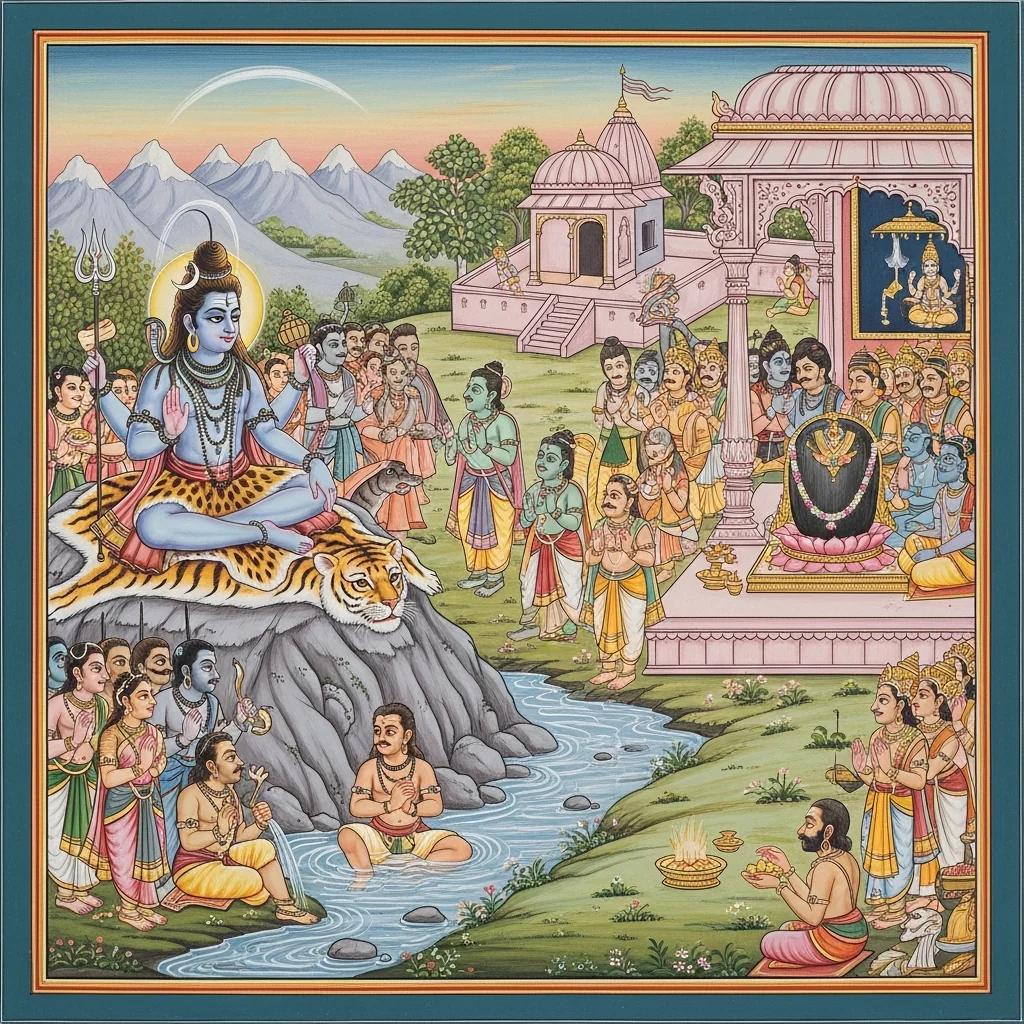
Adhyaya 3
Agastya asks Skanda about an “unprecedented” episode involving Brahmā, and what Śiva does while Brahmā is present in Kāśī. Skanda explains that Śiva is concerned: Kāśī’s incomparable power draws beings to remain there, unsettling the expected distribution of cosmic duties. Śiva therefore summons his gaṇas and sends them to Vārāṇasī to observe the yoginīs, the Sun (Bhānumān), and Brahmā’s ordinances. Named gaṇas such as Śaṅkukarṇa and Mahākāla arrive in Kāśī; on beholding the holy city they momentarily forget their commission, overcome by Kāśī’s “mohinī” (enchanting) potency. They establish eponymous liṅgas—Śaṅkukarṇeśvara and Mahākāleśvara—and remain there. Further emissaries (Ghantākārṇa and Mahodara; then a group of five; then four more) likewise enter Kāśī, institute liṅgas and ritual sites (including Ghantākārṇa-hrada and the śrāddha merit associated with it), and stay. The chapter interweaves praise of liṅga worship as surpassing great gifts and sacrifices, with notes on liṅga-snāna and its purificatory power. It also portrays Kāśī as a ground of liberation where death becomes auspicious, and even remembrance of the name “Kāśī” is extolled. It closes by continuing the mapping of gaṇa-named liṅgas (e.g., Tāreśa/Tārakeśa) and by stressing steadfast effort (udyama) even against adverse fate (daiva).
Shlokas
Verse 1
अगस्तिरुवाच । अपूवेंयं कथा ख्याता ब्रह्मणो ब्रह्मवित्तम । किं चकार पुनः शंभुस्तत्र ब्रह्मण्यपि स्थिते
Agastya said: This unprecedented account concerning Brahmā has been narrated, O knower of Brahman. What then did Śambhu (Śiva) do while Brahmā was staying there?
Verse 2
स्कंद उवाच । शृण्वगस्त्य महाभाग काश्यां ब्रह्मण्यपिस्थिते । गिरिशश्चिंतयामास भृशमुद्विग्नमानसः
Skanda said: Listen, O fortunate Agastya. Even while Brahmā was staying in Kāśī, Giriśa (Śiva) began to reflect deeply, his mind greatly troubled.
Verse 3
पुरी सा यादृशी काशी वशीकरणभूमिका । न तादृशीदृशीहासीत्क्वचिन्मे प्रायशो ध्रुवम्
That city, Kāśī, is a ground of irresistible spiritual mastery (vaśīkaraṇa); truly, and almost certainly, nowhere have I seen another like it.
Verse 4
यो यो याति पुरीं तां तु स स तत्रैव तिष्ठति । अभूवन्ननुयोगिन्योऽयोगिन्यः काशिसंगताः
Whoever goes to that city—each one remains there itself. Even those who were not yoginīs became yoginīs upon association with Kāśī.
Verse 5
अकिंचित्करतां प्राप्तः स सहस्रकरोप्यरम् । विधिर्विधानदक्षोपि न मे स सविधोभवत्
Even that Sun, famed for a thousand rays, has been brought to helplessness; and even Vidhi (Brahmā), though expert in ordinances, has not proved to be of any effective help to me.
Verse 6
चिंतयन्निति देवेशो गणानारहूय भूरिशः । प्रेषयामास भो यात क्षिप्रं वाराणसीं पुरीम्
Thinking thus, the Lord of gods, the mighty one, summoned his Gaṇas and dispatched them, saying, “Go—quickly—to the city of Vārāṇasī.”
Verse 7
किं कुर्वंति तु योगिन्यः किं करोति स भानुमान् । गत्वा वित्त त्वरायुक्ता विधिश्च विदधाति किम्
“What indeed are the Yoginīs doing? What is that Sun, Bhānumān, doing? Go there in haste and learn the facts—what is Vidhi (Brahmā) arranging (or attempting)?”
Verse 8
नामग्राहं ततःऽप्रैषीद्बहुमान पुरःसरम् । शंकुकर्ण महाकाल घटाकर्ण महोदर
Then, honoring them duly and setting them in the fore, he sent forth the named Gaṇas—Śaṅkukarṇa, Mahākāla, Ghaṭākarṇa, and Mahodara—
Verse 9
सोमनंदिन्नंदिषेण काल पिंगल कुक्कुट । कुंडोदर मयूराक्ष बाण गोकर्ण तारक
—Somanandin, Nandiṣeṇa, Kāla, Piṅgala, Kukkuṭa, Kuṇḍodara, Mayūrākṣa, Bāṇa, Gokarṇa, and Tāraka—
Verse 10
तिलपर्ण स्मृलकर्ण दृमिचंड प्रभामय । सुकेश विंदते छाग कपर्दिन्पिंगलाक्षक
—Tilaparṇa, Smṛlakarṇa, Dṛmicaṇḍa, Prabhāmaya, Sukeśa, Viṃdate, Chāga, Kapardin, and Piṅgalākṣaka—
Verse 11
वीरभद्र किराताख्य चतुर्मुख निकुंभक । पंचाक्षभारभूताख्य त्र्यक्ष क्षेमक लांगलिन्
—Vīrabhadra, Kirātākhya, Caturmukha, Nikuṃbhaka, Pañcākṣa, Bhārabhūtākhya, Tryakṣa, Kṣemaka, and Lāṅgalin—
Verse 12
विराध सुमुखाषाढे भवंतो मम सूनवः । यथेमौ स्कंदहेरंबौ नैगमेयो यथा त्वयम्
“Virādha, Sumukha, Āṣāḍha—you are my sons, just as these two are Skanda and Heramba, and as you are Naigameya.”
Verse 13
यथा शाखविशाखौ च यथेमौ नंदिभृंगिणौ । भवत्सु विद्यमानेषु महाविक्रमशालिषु
“Just as (there are) Śākha and Viśākha, and just as these two are Nandin and Bhṛṅgin—so long as you, possessed of great valor, are present…”
Verse 14
काशीप्रवृत्तिं नो जाने दिवोदासनृपस्य च । योगिन्यर्कविधीनां च तद्द्वौ यातं भवत्स्वमू
I do not know what is transpiring in Kāśī, nor the present state of King Divodāsa, nor of the Yoginīs, nor of the Sun and Vidhi (Brahmā). Therefore, you two—my own attendants—go.
Verse 15
शंकुकर्णमहाकालौ कालस्यापि प्रकंपनौ । ज्ञातुं वाराणसीवार्तामायातं चत्वरान्वितौ
Śaṅkukarṇa and Mahākāla—who can make even Time tremble—came together to the city marked by four crossroads, longing to learn the true tidings of Vārāṇasī.
Verse 16
कृतप्रतिज्ञौ तो तूर्णं प्राप्य वाराणसीं पुरीम् । शंकुकर्णमहाकालौ विस्मृत्य शांभवीं गिरम्
Though they had made a firm resolve, Śaṅkukarṇa and Mahākāla, upon swiftly reaching the city of Vārāṇasī, forgot even the words of Śambhu (Śiva).
Verse 17
यथैंद्रजालिकीं दृष्ट्वा मायामिह विचक्षणः । क्षणेन मोहमायाति काशीं वीक्ष्य तथैव तौ
Just as even a discerning person, on seeing a magician’s illusion, is swiftly drawn into bewilderment, so too those two, upon beholding Kāśī, fell at once into delusion.
Verse 18
अहो मोहस्य माहात्म्यमहो भाग्यविपर्ययः । निर्वाणराशिं यत्काशीं प्राप्य यांत्यन्यतोऽबुधाः
Ah, how mighty is delusion—and how inverted is fortune! For having reached Kāśī, a very treasury of liberation, the unwise still go elsewhere.
Verse 19
तत्यजे यैरियं काशी महाशीर्वादभूभिका । तेषां करतलान्मुक्तिः प्राप्तापि परितो गता
Those who abandoned this Kāśī—ground made of great blessings—from their very palms liberation, though attained, slipped away and departed on every side.
Verse 20
यत्र सर्वावभृथतः स्नानमात्रं विशिष्यते । अप्युष्णीकृतपानीयैस्तां काशीं कः परित्यजेत्
Where even a mere bath surpasses all concluding sacrificial baths—who would abandon that Kāśī, even if the water there were warmed?
Verse 21
यत्रैकपुष्पदानेन शिवलिंगस्य मूर्धनि । दशसौवर्णिकं पुण्यं कस्तां काशीं परित्यजेत्
Where, by offering just a single flower upon the head of a Śiva-liṅga, one gains merit equal to ten gifts of gold—who would abandon that Kāśī?
Verse 22
यत्र दंडप्रणामेन अप्येकेन शिवाग्रतः । तुच्छमेंद्रपदंप्राहुस्तां काशीं को विमुंचति
Where, by even a single full prostration (daṇḍavat) before Śiva, they declare Indra’s rank to be trivial—who would give up that Kāśī?
Verse 23
यत्रैकद्विजमात्रं तु भोजयित्वा यथेच्छया । वाजपेयाधिकं पुण्यं तां काशीं को विमुंचति
Where, by feeding even a single brāhmaṇa as one wishes, the merit becomes greater than that of the Vājapeya sacrifice—who would abandon that Kāśī?
Verse 24
एकां गां यत्र दत्त्वा वै विधिवद्ब्राह्मणाय वै । लभेदयुत गोपुण्यं कस्तां काशीं त्यजेत्सुधीः
Where, by duly gifting a single cow to a brāhmaṇa according to sacred rite, one gains the merit of ten thousand cows—what wise person would forsake that holy Kāśī?
Verse 25
एकलिंगं प्रतिष्ठाप्य यत्र संस्थापितं भवेत् । अपि त्रैलोक्यमखिलं तां काशीं कः समुज्झति
Where even a single liṅga is duly installed and firmly established—who could ever abandon Kāśī, even for the whole of the three worlds?
Verse 26
परिनिश्चित्य तावित्थं लिंगे संस्थाप्य पुण्यदे । तत्रैव संस्थितिं प्राप्तौ काशीं नाद्यापि मुंचतः
Thus, having resolved with certainty and establishing themselves in the merit-bestowing sacred liṅga, they attained abiding presence there; and even now they do not forsake Kāśī.
Verse 27
शंकुकर्णेश्वरं लिंगं शंकुकर्ण ग णार्चितम् । दृष्ट्वा न जायते जंतुर्जातु मातुर्महोदरे
Beholding the liṅga of Śaṃkukarṇeśvara, worshipped by the gaṇas of Śaṃkukarṇa, a being is never again born into a mother’s womb.
Verse 28
विश्वेशाद्वायुदिग्भागे शंकुकर्णेश्वरं नरः । संपूज्य न विशेदत्र घोरे संसारसागरे
One who duly worships Śaṃkukarṇeśvara, situated in the direction of Vāyu from Viśveśa, does not enter again into the dreadful ocean of saṃsāra.
Verse 29
महाकालेश्वरं लिंगं महाकालगणार्चितम् । अर्चयित्वा च नत्वा च स्तुत्वा कालभयं कुतः
Having worshipped the liṅga of Mahākāleśvara—adored by Mahākāla’s gaṇas—and having bowed and praised Him, whence could fear of Time (death) arise?
Verse 30
स्कंद उवाच । शंकुकर्णे महाकाले चिरंतन विलंबिते । ज्ञात्वा सर्वज्ञनाथोथ प्राहैपीदपरौ गणौ
Skanda said: When Śaṃkukarṇa and Mahākāla had long been delayed, the all-knowing Lord understood the matter and then addressed those two eminent gaṇas.
Verse 31
घंटाकर्ण त्वमागच्छ महोदर महामते । काशीं यातं युवां तूर्णं ज्ञातुं तत्रत्य चेष्टितम्
(The Lord said:) “O Ghaṃṭākarṇa, come; O Mahodara, wise one—go, both of you, swiftly to Kāśī to learn what has occurred there.”
Verse 32
इत्यगस्ते गणौ तौ तु गत्वा काशीं महापुरीम् । व्यावृत्याद्यापि नो यातौ क्वापि तत्रैव संस्थितौ
Thus, O Agastya, those two gaṇas went to the great city of Kāśī; but, turning back from their return, even to this day they have gone nowhere—they remain established right there.
Verse 33
घंटाकर्णेश्वरं लिंगं घंटाकर्ण गणोत्तमः । काश्यां संस्थाप्य विधिवत्स्वयं तत्रैव निर्वृतः
Ghaṃṭākarṇa, foremost among the gaṇas, duly established in Kāśī the liṅga of Ghaṃṭākarṇeśvara; and he himself found fulfillment and peace right there.
Verse 34
कुंडं तत्रैव संस्थाप्य लिंगस्नपनकर्मणे । नाद्यापि स त्यजेत्काशीं ध्यायंल्लिंगं तथैव हि
Establishing a pond right there for the sacred rite of bathing the liṅga, even now he does not leave Kāśī—ever meditating upon that very liṅga.
Verse 35
महोदरोपि तत्प्राच्यां शिवध्यानपरायणः । महोदरेश्वरं लिंगं ध्यायेदद्यापि कुंभज
O Kumbhaja (Agastya), even Mahodara—steadfast in meditation upon Śiva in that eastern quarter—still to this day contemplates the liṅga known as Mahodareśvara.
Verse 36
महोदरेश्वरं दृष्ट्वा वाराणस्यां द्विजोत्तम । कदाचिदपि वै मातुः प्रविशेन्नौदरीं दरीम्
O best of the twice-born, having beheld Mahodareśvara in Vārāṇasī, one should never at any time enter again the womb-cave of a mother—that is, fall back into rebirth.
Verse 37
घंटाकर्ण ह्रदे स्नात्वा दृष्ट्वा व्यासेश्वरं विभुम् । यत्र कुत्र विपन्नोपि वाराणस्यां मृतो भवेत्
Having bathed in the Gaṇṭākarṇa lake and having beheld the majestic Vyāseśvara, even if one meets misfortune anywhere, one will attain death in Vārāṇasī as a blessed end.
Verse 38
घंटाकर्णे महातीर्थे श्राद्धं कृत्वा विधानतः । अपि दुर्गतिमापन्नानुद्धरेत्सप्तपूर्वजान्
At the great tīrtha of Gaṇṭākarṇa, having performed śrāddha according to rule, one can uplift even seven ancestors who have fallen into an unhappy state.
Verse 39
निमज्ज्याद्यापि तत्कुंडे क्षण योवहितो भवेत् । विश्वेश्वरमहापूजा घंटारावाञ्शृणोति सः
Even today, whoever immerses in that pool and remains attentive for but a moment, hears the pealing bells of the great worship (pūjā) of Viśveśvara.
Verse 40
वदंति पितरः काश्यां घंटाकर्णेमलेजले । दाता तिलोदकस्यापि वंशे नः कोपि जायते
The ancestors declare: “In Kāśī, at Gaṇṭākarṇa’s spotless waters, even one who offers tilodaka—sesame-water—becomes a member of our lineage.”
Verse 41
यद्वंश्या मुनयः काश्यां घंटाकर्णे महाह्रदे । कृतोदकक्रियाः प्राप्ताः परां सिद्धिं घटोद्भव
O Ghaṭodbhava (Agastya), sages of that lineage, having performed the water-rites at the great lake of Gaṇṭākarṇa in Kāśī, attained the supreme perfection (siddhi).
Verse 42
स्कंद उवाच । घंटाकर्णे गणे याते प्रयाते च महोदरे । विसिस्माय स्मरद्वेष्टा मौलिमांदोलयन्मुहुः
Skanda said: When the Gaṇṭākarṇa gaṇa had departed and Mahodara too had gone, the foe of Smara (Śiva) marveled, repeatedly shaking His head in wonder.
Verse 43
उवाच च मनस्येव हरः स्मित्वा पुनःपुनः । महामोहनविद्यासि काशि त्वां पर्यवैम्यहम्
And Hara, smiling again and again, spoke as if within His own mind: “O Kāśī, you are the great power of enchantment (mahā-mohana-vidyā); I myself fully comprehend you.”
Verse 44
पुराविदः प्रशंसंति त्वां महामोहहारिणीम् । काशींत्विति न जानंति महामोहनभूरियम्
The knowers of ancient lore praise you as the remover of the great delusion; yet they do not truly know you as “Kāśī”—for this is indeed the very ground of the great enchantment.
Verse 46
तथापि प्रेषयिष्यामि यावान्मेस्ति परिच्छदः । नोद्यमाद्विरमंतीह ज्ञानिनः साध्यकर्मणि
Even so, I shall send forth (my forces), as much as my resources allow. For in this world, the wise do not desist from effort when a task is yet to be accomplished.
Verse 47
नोद्यमाद्विरतिः कार्या क्वापि कार्ये विचक्षणैः । प्रतिकूलोपि खिद्येत विधिस्तत्सततोद्यमात्
The discerning should never withdraw from effort in any undertaking. Even adverse fate is worn down—such is destiny—by continuous striving.
Verse 48
शीतोष्णभानू स्वर्भानु ग्रस्तावपि नभोंगणे । गतिं न त्यजतोद्यापि प्रक्रांतव्य कृतोद्यमौ
Even when the sun (of heat) and the moon (of coolness) are seized by Svarbhānu in the sky, they do not abandon their course. So too, one who has taken up effort must continue on the path begun.
Verse 49
प्रेषयिष्याम्यहं सर्वान्भवती मोहयिष्यति । इति सम्यग्विजानामि काशि त्वां मोहनोषधिम्
I shall send them all; and you will bewilder them. Thus I know well, O Kāśī, that you are an herb of enchantment—one who confounds worldly powers.
Verse 50
दैवं पूर्वकृतं कर्म कथ्यते नेतरत्पुनः । तन्निराकरणे यत्नः स्वयं कार्यो विपश्चिता
What is called “fate” is nothing but action done in the past—nothing else. Therefore, the wise must themselves exert effort to counteract it.
Verse 51
भाजनोपस्थितं दैवाद्भोज्यं नास्यं स्वयं विशेत् । हस्तवक्त्रोद्यमात्तच्च प्रविशेदौदरीं दरीम्
Food placed in a vessel by “fate” will not enter one’s mouth by itself. Only through the exertion of hand and mouth does it enter the cave of the belly.
Verse 52
इत्युद्यमं समर्थ्येशो निश्चितं दैवजित्वरम् । पुनश्च प्रेषयांचक्रे गणान्पंचमहारयान्
Thus, affirming the power of effort and convinced that destiny can be conquered, the Lord again dispatched his gaṇas—five great warriors.
Verse 53
सोमनंदी नंदिषेणः कालपिंगलकुक्कुटाः । तेद्यापि न निवर्तंते काश्यां जीवामृता यथा
Somanandī, Nandiṣeṇa, and Kālapīṅgala-Kukkuṭa—those gaṇas even today do not depart from Kāśī, as though they were living nectar (immortal).
Verse 54
तेपि स्वनाम्ना लिंगानि शंभुसंतुष्टि काम्यया । प्रतिष्ठाप्य स्थिताः काश्यां विश्वनिर्वाणजन्मनि
They too, desiring to please Śambhu, established liṅgas in their own names and dwelt in Kāśī—the birthplace of liberation for the world.
Verse 55
सोमनंदीश्वरं दृष्ट्वा लिंगं नंदवने परम् । सोमलोके परानंदं प्राप्नुयाद्भक्तिमान्नरः
Having beheld the supreme liṅga of Somanandīśvara in Nandavana, the devoted person attains the highest bliss in Soma’s realm.
Verse 56
तदुत्तरे विलोक्याथ नंदिषेणेश्वरं नरः । आनंदसेनां संप्राप्य जयेन्मृत्युमपि क्षणात्
Then, looking a little further on, one who beholds Nandiṣeṇeśvara attains Ānandasena, the blissful host, and in an instant conquers even death.
Verse 57
कालेश्वरं महालिंगं गंगायाः पश्चिमोत्तरे । प्रणम्य कालपाशेन नो बध्येत कदाचन
Having bowed to Kāleśvara, the great liṅga situated to the north-west of the Gaṅgā, one is never bound at any time by the noose of Time (Death).
Verse 58
पिंगलेश्वरमभ्यर्च्य कालेशात्किंचिदुत्तरे । लभते पिंगलज्ञानं येन तन्मयतां व्रजेत्
Worshipping Piṅgaleśvara, a little to the north of Kāleśa, one gains ‘piṅgala’ wisdom—by which one attains complete absorption in that Supreme Reality.
Verse 59
कुक्कुटेश्वर लिंगस्य येत्र भक्तिं वितन्वते । कुक्कुटांडाकृतेस्तस्य न ते गर्भमवाप्नुयुः
Those who there extend devotion to the liṅga of Kukkuṭeśvara—of a form resembling a hen’s egg—do not enter the womb again.
Verse 60
स्कंद उवाच । सोमनंदि प्रभृतिषु मुने पंचगणेष्वपि । आनंदकाननं प्राप्य स्थितेषु स्थाणुरब्रवीत्
Skanda said: O sage, when Somānandi and the other five gaṇas had reached and stood within the Ānandaka forest-grove, Sthāṇu (Śiva) spoke.
Verse 61
कार्यमस्माकमेवैतद्यदि सम्यग्विमृश्यते । अनेनोपाधिनाप्येते तत्र तिष्ठंतु मामकाः
If one reflects rightly, this task is truly ours alone; even by this arrangement, let these—my own attendants—remain stationed there.
Verse 62
प्रमथेषु प्रविष्टेषु मायावीर्यमहत्स्वपि । अहमेव प्रविष्टोस्मि वाराणस्यां न संशयः
Even though the Pramathas have entered with great magical power and might, it is I myself who have entered Vārāṇasī—of this there is no doubt.
Verse 63
क्रमेण प्रेषयिष्यामि योस्ति मे स्वपरिच्छदः । तत्र सर्वेषु यातेषु ततो यास्याम्यहं पुनः
I shall send, in due order, those who are my own retinue. When all of them have gone there, then I too shall go again.
Verse 64
संप्रधार्येति हृदये देवदेवेन शूलिना । प्रैषिष्ट प्रमथानां तु ततो गणचतुष्टयम्
Having thus resolved in his heart, the God of gods, the Trident-bearer, then dispatched a group of four from among the Pramathas.
Verse 65
कुंडोदरो मयूराख्यो बाणो गोकर्ण एव च । मायाबलं समाश्रित्य काशीं प्रविविशुर्गणाः
Kuṇḍodara, Mayūrākhya, Bāṇa, and also Gokarṇa—these gaṇas, relying on the power of māyā, entered sacred Kāśī.
Verse 66
कृत्वोपायशतं तैस्तु दिवोदासस्य संभ्रमे । यदैकोपि समर्थो न तदा तत्रैव संस्थितम्
Stirred by the turmoil caused by Divodāsa, they tried hundreds of stratagems; but when not even one succeeded, they remained right there, steadfast and unmoving.
Verse 67
अपराधशतेष्वीशः केन तुष्यति कर्मणा । संप्रधार्येति ते चक्रुर्लिंगाराधनमुत्तमम्
“After hundreds of offenses, by what deed will the Lord be pleased?”—thus reflecting, they undertook the supreme worship of the Liṅga.
Verse 68
एकस्मिञ्शांभवे लिंगे विधिनात्र समर्चिते । क्षमेत्त्र्यक्षोपराधानां शतं मोक्षं च यच्छति
If here a single Śāmbhava Liṅga is duly worshiped according to rite, the Three-eyed Lord forgives a hundred offenses and also grants mokṣa, liberation.
Verse 69
न तुष्यति तथा शंभुर्यज्ञदानतपोव्रतैः । यथा तुष्येत्सकृल्लिंगे विधिनाभ्यर्चिते सति
Śambhu is not so pleased by sacrifices (yajña), gifts (dāna), austerities (tapas), and vows (vrata), as He is pleased by even a single proper worship of the Liṅga according to rite.
Verse 70
लिंगार्चनविधानज्ञो लिंगार्चनरतः सदा । त्र्यक्ष एव स विज्ञेयः साक्षाद्द्व्यक्षोपि मानवः
One who knows the proper ordinance of Liṅga-worship and is ever devoted to it should be known as the Three-eyed Lord Himself—though outwardly he is a two-eyed human.
Verse 71
न गोशतप्रदानेन न स्वर्णशतदानतः । तत्फलं लभ्यते पुंभिर्यत्सकृल्लिंगपूजनात्
Neither by gifting a hundred cows nor by donating a hundred measures of gold does one gain the merit that arises from worshiping the Liṅga even once.
Verse 72
अश्वमेधादिभिर्यागैर्न तत्फलमवाप्यते । यत्फलं लभ्यते मर्त्यैर्नित्यं लिंगप्रपूजनात्
Even by sacrifices such as the Aśvamedha one does not obtain that fruit which mortals gain through continual and earnest worship of the Liṅga.
Verse 73
स्नापयित्वा विधानेन यो लिंगस्नपनोदकम् । त्रिः पिबेत्त्रिविधं पापं तस्येहाशु प्रणश्यति
After bathing the Liṅga according to rule, whoever drinks the water of that Liṅga-bath three times—his threefold sin quickly perishes here itself.
Verse 74
लिंग स्नपनवार्भिर्यः कुर्यान्मूर्ध्न्यभिषेचनम् । गंगास्नानफलं तस्य जायतेत्र विपाप्मनः
Whoever pours upon his head the water from bathing the Liṅga attains, here itself, the fruit of bathing in the Gaṅgā—becoming free from sin.
Verse 75
लिंगं समर्चितं दृष्ट्वा यः कुर्यात्प्रणतिं सकृत् । संदेहो जायते तस्य पुनर्देहनिबंधने
Having seen a duly worshiped Liṅga, whoever bows even once—doubt arises for him about being bound again to another body.
Verse 76
लिंगं यः स्थापयेद्भक्त्या सप्तजन्मकृतादघात् । मुच्यते नात्र संदेहो विशुद्धः स्वर्गभाग्भवेत्
Whoever, with devotion, installs a Śiva-liṅga is freed from the sin amassed over seven births—of this there is no doubt. Purified, he becomes a rightful partaker of heaven.
Verse 77
विचार्येति गणैः काश्यां स्वामिद्रोहोपशांतये । प्रतिष्ठितानि लिंगानि महापातकभिंद्यपि
After due deliberation, the Gaṇas established liṅgas in Kāśī to pacify the fault of betraying their lord; those consecrated liṅgas even break the power of great sins.
Verse 78
कुंडोदरेश्वरं लिंगं दृष्ट्वा लोलार्कसन्निधौ । सर्वपापविनिर्मुक्तः शिवलोके महीयते
Having beheld the liṅga of Kuṇḍodareśvara near Lolārka, one is freed from all sins and is honoured in Śiva’s world.
Verse 79
कुंडोदरेश्वराल्लिंगात्प्रतीच्यामसिरोधसि । मयूरेश्वरमभ्यर्च्य न गर्भं प्रतिपद्यते
To the west of the Kuṇḍodareśvara-liṅga, on the ridge called Asirodhas, by worshipping Mayūreśvara one does not fall again into the womb (is not reborn).
Verse 80
मयूरेशप्रतीच्यां च लिंगं बाणेश्वरं महत् । तस्य दर्शनमात्रेण सर्वैः पापैः प्रमुच्यते
And to the west of Mayūreśa stands the great liṅga called Bāṇeśvara. By merely beholding it, one is freed from all sins.
Verse 81
गोकर्णेशं महालिंगमंतर्गेहस्य पश्चिमे । द्वारे समर्च्य वै काश्यां न विघ्नैरभिभूयते
In Kāśī, at the western doorway of the inner precinct, is the great liṅga Gokarṇeśa. By duly worshipping it, one is not overcome by obstacles.
Verse 82
गोकर्णेश्वर भक्तस्य पंचत्व समये सति । ज्ञानभ्रंशो न जायेत क्वचिदप्यंतमृच्छतः
For a devotee of Gokarṇeśvara, when the time comes to merge into the five elements, no loss of spiritual awareness ever arises for one approaching the end.
Verse 83
स्कंद उवाच । चिरयत्सुगणेष्वेषु चतुर्ष्वपिगणेश्वरः । महिमानं महत्त्वं तु तत्काश्याः पर्यवर्णयत्
Skanda said: Among these four excellent hosts of Gaṇas, Gaṇeśvara, their lord, fully described the glory and greatness of that Kāśī.
Verse 84
वैष्णव्या मायया विश्वं भ्राम्येतात्र ययाखिलम् । ध्रुवं मूर्तिमती सैषा काशी विश्वैकमोहिनी
By the Vaiṣṇavī Māyā, through which the entire universe is made to wander, the world here is deluded. Truly, that very Māyā stands embodied as Kāśī—the unique enchantress of the whole universe.
Verse 85
अपास्य सोदरान्दारान्पुत्रं क्षेत्रं गृहं वसु । अप्यंगीकृत्य निधनं सर्वे काशीमुपासते
Casting aside brothers, wife, son, land, house, and wealth—and even embracing death itself—people nonetheless devote themselves to Kāśī.
Verse 86
मरणादपि नो काश्यां भयं यत्र मनागपि । गणास्तत्र तु तिष्ठंतः कुतो मत्तोपि बिभ्यति
In Kāśī there is not even the slightest fear—even of death. When the divine Gaṇas themselves abide there, how could they fear even me?
Verse 87
मरणं मंगलं यत्र विभूतिर्यत्र भूषणम् । कौपीनं यत्र कौशेयं काशी कुत्रोपमीयते
Where death itself becomes auspicious; where sacred ash is the ornament; where even a loincloth is as fine as silk—what place could ever be compared with Kāśī?
Verse 88
निर्वाणरमणी यत्र रंकं वाऽरंकमेव वा । ब्राह्मणं वा श्वपाकं वा वृणीते प्रांत्यभूषणम्
There, Liberation (Nirvāṇa)—like a gracious bride—chooses whom she will: whether a pauper or one not poor, whether a brāhmaṇa or even a śvapāka; she accepts them as the ornament of her domain.
Verse 89
मृतानां यत्र जंतूनां निर्वाणपदमृच्छताम् । कोट्यंशेनापि न समा अपि शक्रादयः सुराः
Where creatures who die attain the station of nirvāṇa—there even the gods, beginning with Śakra (Indra), are not equal to them, not even by a millionth part.
Verse 90
यत्र काश्यां मृतो जंतुर्ब्रह्मनारायणादिभिः । प्रबद्ध मूर्धांजलिभिर्नमस्येतातियत्नतः
There, in Kāśī, a being who has died is reverently saluted with great effort by Brahmā, Nārāyaṇa, and the other devas—hands joined and raised upon their heads.
Verse 91
यत्र काश्यां शवत्वेपि जंतुर्नाशुचितां व्रजेत् । अतस्तत्कर्णसंस्पर्शं करोम्यहमपि स्वयम्
There, in Kāśī, even in the state of a corpse a being does not fall into impurity; therefore I myself perform the rite of touching his ear.
Verse 92
यस्तु काशीति काशीति द्विस्त्रिर्जपति पुण्यवान् । अपि सर्वपवित्रेभ्यः स पवित्रतरो महान्
But whoever, endowed with merit, repeats “Kāśī, Kāśī” two or three times becomes supremely pure—indeed purer than all other purifiers.
Verse 93
येन काशी हृदि ध्याता येन काशीह सेविता । तेनाहं हृदि संध्यातस्तेनाहं सेवितः सदा
By whom Kāśī is meditated upon within the heart, and by whom Kāśī is served here—by him I am remembered in the heart; by him I am always attended in worship.
Verse 94
काशीं यः सेवते जंतुर्निर्विकल्पेन चेतसा । तमहं हृदये नित्यं धारयामि प्रयत्नतः
That being who serves Kāśī with an undistracted, unwavering mind—I hold him always within my heart, with deliberate care.
Verse 95
स्वयं वस्तुमशक्तोपि वासयेत्तीर्थवासिनम् । अप्येकमपि मूल्येन स वस्तुःफलभाग्ध्रुवम्
Even if one is unable to dwell there oneself, one should lodge a pilgrim who resides at the tīrtha; even at the cost of a single possession, one surely partakes of the fruit of that holy abode.
Verse 96
काश्यां वसंति ये धीरा आपंचत्व विनिश्चयाः । जीवन्मुक्तास्तु ते ज्ञेया वंद्याः पूज्यास्त एव हि
Those steadfast souls who dwell in Kāśī, having firmly ascertained the state beyond the fivefold (pañcatva), should be known as liberated while living; indeed, they alone are worthy of reverence and worship.
Verse 97
इत्थं विमृश्य बहुशः स्थाणुर्वाराणसीगुणान् । गणानन्यान्समाहूय प्राहिणोत्प्रीतिपूर्वकम्
Thus, after reflecting again and again upon the excellences of Vārāṇasī, Sthāṇu (Śiva) summoned other gaṇas and dispatched them with gracious goodwill.
Verse 98
तारकत्वं समागच्छ गच्छाति स्वच्छमानस । दिवोदासो वृषावासो यामधीष्टे वरां पुरीम्
“Attain the state of a Tāraka, a savior-guide; proceed with a purified mind. That excellent city which Divodāsa—Vṛṣāvāsa—presides over…”
Verse 99
तिलपर्ण स्धूलकर्ण दृमिचंड प्रभामय । सुकेश विंदते छाग कपर्दिन्पिंगलाक्षक
Tilaparṇa, Sthūlakarṇa, Dṛmicaṇḍa, Prabhāmaya; Sukeśa, Vindate, Chāga, Kapardin, and Piṅgalākṣaka—these are named among the gaṇas.
Verse 100
वीरभद्र किराताख्य चतुर्मुख निकुंभक । पंचाक्ष भारभूताख्य त्र्यक्ष क्षेमकलांगलिन्
Vīrabhadra, Kirātākhya, Caturmukha, Nikuṃbhaka; and also Pañcākṣa, Bhārabhūtākhya, Tryakṣa, and Kṣemakalāṅgalin—these too are named among the gaṇas.
Verse 110
नाद्रीणां न समुद्राणां न द्रुमाणां महीयसाम् । भूतधात्र्यास्तथा भारो यथा स्वामिद्रुहां महान्
Neither mountains, nor oceans, nor mighty trees weigh upon the Earth, the sustainer of beings, as heavily as the great burden of those who betray their own Lord.
Verse 120
तारकेशं महालिंगं तारकाख्यो गणोत्तमः । तारकज्ञानदं पुंसां मुनेऽद्यापि समर्चयेत्
O sage, even today one should duly worship the great Liṅga named Tārakeśa, together with the foremost gaṇa called Tāraka; for it grants men the saving knowledge, tāraka-jñāna.