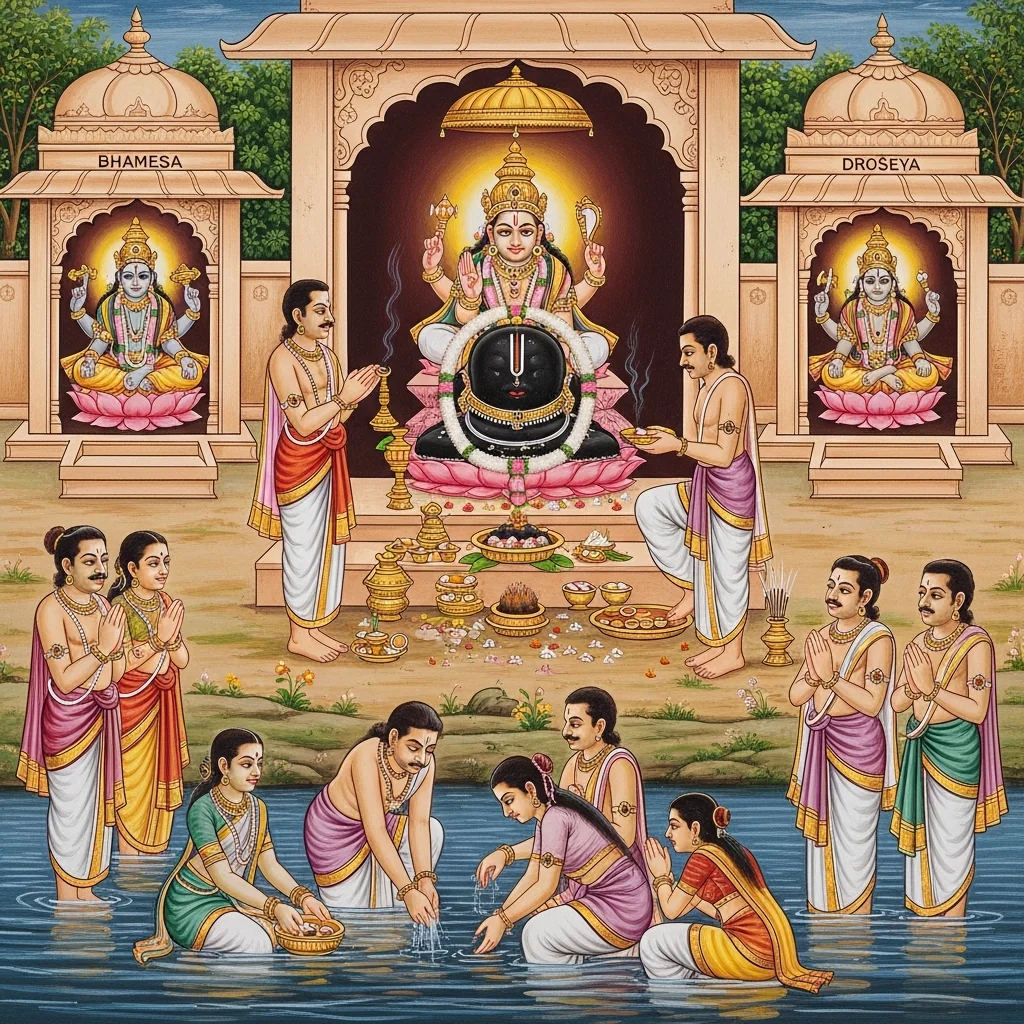
Adhyaya 25
Chapter 25 begins with Agastya, having heard a prior teaching on purification, asking Skanda to recount the “Triviṣṭapī” account. Skanda responds by outlining a sacred micro‑geography within Ānandakānana, placing the Triviṣṭapa liṅga and the superior form of Trilocana at the center and linking them to nearby tīrthas. A tri‑river motif—Sarasvatī, Kālin̄dī/Yamunā, and Narmadā—appears as repeatedly serving the liṅga through ritual bathing, and subsidiary liṅgas named for these rivers are described, each granting distinct fruits through darśana (seeing), sparśa (touch), and arcana (worship). The chapter prescribes an expiatory regimen: snāna at the Pilipilā tīrtha, offerings including śrāddha and piṇḍa rites, and worship at Triviṣṭapa/Trilocana are said to cleanse a wide range of transgressions. Yet it explicitly excludes Śiva‑nindā—denigrating Śiva and Śaiva devotees—as beyond remedy. It further details devotional procedures (pañcāmṛta, fragrances, garlands, incense and lamps, naivedya, music and flags, pradakṣiṇā, namaskāra, Brahmin recitation), notes auspicious monthly times and the claim of Triviṣṭapa’s constant auspiciousness, and lists nearby liṅgas such as Śāntanava, Bhīṣmeśa, Droṇeśa, Aśvatthāmeśvara, Vālakhilyeśvara, and Vālmīkeśvara with their promised results.
Shlokas
Verse 1
अगस्त्य उवाच । श्रुत्वोंकारकथामेतां महापातकनाशिनीम् । न तृप्तोस्मि विशाखाथ ब्रूहि त्रैविष्टपीं कथाम्
Agastya said: Having heard this Oṅkāra narrative that destroys even great sins, I am still not satisfied, O Viśākha; therefore tell me the sacred account concerning Traiviṣṭapī.
Verse 2
कथं च कथिता देव्यै देवदेवेन षण्मुख । आविर्भूतिर्महाबुद्धे पुण्या त्रैलोचनी परा
O Ṣaṇmukha, how was it narrated by the Lord of Lords to the Goddess? And, O great-minded one, how did that supremely holy manifestation of the Three-eyed Lord come to be?
Verse 3
स्कंद उवाच । आकर्णय मुने वच्मि कथां श्रमनिवारिणीम् । यथा देवेन कथितां त्रिविष्टपसमुद्भवाम्
Skanda said: Listen, O sage; I shall tell the tale that removes weariness—just as it was spoken by the Lord, a narrative that arose from Traiviṣṭapa (the heavenly realm).
Verse 4
विरजाख्यं हि तत्पीठं तत्र लिंगं त्रिविष्टपम् । तत्पीठदर्शनादेव विरजा जायते नरः
That sacred seat is indeed called Virajā, and there stands the Triviṣṭapa Liṅga. Merely by beholding that pīṭha, a person becomes ‘virajā’—free from defilement.
Verse 5
तिस्रस्तु संगतास्तत्र स्रोतस्विन्यो घटोद्भव । तिस्रः कल्मषहारिण्यो दक्षिणे हि त्रिलोचनात्
O Ghaṭodbhava (Agastya), three flowing streams meet there—three removers of impurity—indeed on the southern side of the Three-eyed Lord.
Verse 6
स्रोतोमूर्तिधराः साक्षाल्लिंगस्नपनहेतवे । सरस्वत्यथ कालिंदी नर्मदा चातिशर्मदा
They are manifest in the very form of streams, present for the bathing of the Liṅga: Sarasvatī, and also Kālin̄dī (Yamunā), and Narmadā—exceedingly bestowing peace and auspiciousness.
Verse 7
तिस्रोपि हि त्रिसंध्यं ताः सरितः कुंभपाणयः । स्नपयंति महाधाम लिंगं त्रैविष्टपं महत्
Indeed, those three rivers—bearing pitchers in their hands—bathe at the three sandhyās (dawn, noon, and dusk) the great Traviṣṭapa Liṅga, the mighty emblem of Śiva and a supreme abode.
Verse 8
लिंगानि परितस्ताभिः स्वनाम्नास्थापि तान्यपि । तेषां संदर्शनात्पुंसां तासां स्नानफलं भवेत्
And around (that great Liṅga), they have also established Liṅgas bearing their own names. By merely beholding them, a person gains the very merit of bathing in those rivers.
Verse 9
सरस्वतीश्वरं लिंगं दक्षिणेन त्रिविष्टपात् । सारस्वतं पदं दद्याद्दृष्टं स्पृष्टं च जाड्यहृत्
To the south of Triviṣṭapa is the Sarasvatīśvara Liṅga. When seen—and even touched—it bestows the Sarasvatī state (learning and eloquence) and removes dullness of mind.
Verse 10
यमुनेशं प्रतीच्यां च नरैर्भक्त्या समर्चितम् । अपि किल्बिषवद्भिश्च यमलोकनिवारणम्
And to the west is Yamuneśa, worshipped by people with devotion. Even for those burdened with sins, it prevents the (dreaded) realm of Yama.
Verse 11
दृष्टं त्रिलोचनात्प्राच्यां नर्मदेशं सुशर्मदम् । तल्लिंगार्चनतो नृणां गर्भवासो निषिध्यते
To the east of Trilocana stands the Liṅga called Narmadeśa, bestower of great well-being. By worshipping that Liṅga, a person’s return to womb-life (rebirth) is restrained.
Verse 12
स्नात्वा पिलिपिला तीर्थे त्रिविष्टपसमीपतः । दृष्ट्वा त्रिलोचनं लिंगं किं भूयः परिशोचति
Having bathed at the Pilipilā Tīrtha near Triviṣṭapa, and having beheld the Trilocana Liṅga—why would one ever grieve again?
Verse 13
त्रिविष्टपस्य लिंगस्य स्मरणादपि मानवः । त्रिविष्टप पतिर्भूयान्नात्र कार्या विचारणा
Even by merely remembering the Triviṣṭapa Liṅga, a human being becomes a lord of heaven—of this there is no need for doubt or deliberation.
Verse 14
त्रिविष्टपस्य द्रष्टारः स्रष्टारः स्युर्न संशयः । कृतकृत्यास्त एवात्र त एवात्र महाधियः
Those who behold Triviṣṭapa, the sacred Liṅga, become creators themselves—there is no doubt. They alone are fulfilled in purpose here; they alone are the truly great-minded.
Verse 15
आनंदकानने लिंगं प्रणतं यैस्त्रिविष्टपम् । त्रिलोचनस्य नामापि यैः श्रुतं शुद्धबुद्धिभिः
Those pure-minded ones who have bowed to the Triviṣṭapa Liṅga in Ānandakānana, and who have even heard the name of Trilocana—(are especially blessed).
Verse 16
सप्तजन्मार्जितात्पापात्ते पूता नात्र संशयः । पृथिव्यां यानि लिंगानि तेषु दृष्टेषु यत्फलम्
They are purified of sins amassed over seven births—there is no doubt. Whatever fruit arises from beholding all the Liṅgas upon the earth is obtained here.
Verse 17
तत्स्यात्रिविष्टपे दृष्टे काश्यां मन्ये ततोधिकम् । काश्यां त्रिविष्टपे दृष्टे दृष्टं सर्वं त्रिविष्टपम्
To behold heaven (Triviṣṭapa) is indeed a great attainment; yet I deem it greater still to behold it in Kāśī. For when Triviṣṭapa is seen in Kāśī, it is as though all of heaven itself has been seen.
Verse 18
क्षणान्निर्धूत पापोसौ न पुनर्गर्भभाग्भवेत । स स्नातः सर्वतीर्थेषु सर्वावभृथवान्स च
In an instant his sins are shaken off; he does not again become subject to the womb of rebirth. He is as one who has bathed at all tīrthas, and as one who has performed all concluding sacred baths (avabhṛtha).
Verse 19
यो वै पिलिपिला तीर्थे स्नात्वोत्तरवहांभसि । सरित्त्रयं महापुण्यं यत्र साक्षाद्वसेत्सदा
Whoever bathes at the Pilipilā-tīrtha, in the waters of the north-flowing stream—there abides, manifest and ever, the immensely meritorious confluence of the three sacred rivers.
Verse 20
तत्र श्राद्धादिकं कृत्वा गयायां किं करिष्यति । स्नात्वा पिलिपिला तीर्थे कृत्वा वै पिंडपातनम्
Having performed śrāddha and the like right there, what further need is there of Gayā? For after bathing at Pilipilā-tīrtha and duly offering the ancestral piṇḍas, the duty is fulfilled.
Verse 21
दृष्ट्वा त्रिविष्टपं लिंगं कोटितीर्थफलं लभेत् । यदन्यत्रार्जितं पापं तत्काशी दर्शनाद्व्रजेत्
By beholding the Triviṣṭapa-liṅga, one gains the fruit of ten million tīrthas. Whatever sin has been amassed elsewhere departs by the mere darśana of Kāśī.
Verse 22
काश्यां तु यत्कृतं पापं तत्पैशाचपदप्रदम् । प्रमादात्पातकं कृत्वा शंभोरानंदकानने
But whatever sin is committed in Kāśī yields the state of a piśāca. If, through heedlessness, one perpetrates a grave transgression in Śambhu’s Ānanda-kānana, the Forest of Bliss…
Verse 23
दृष्ट्वा त्रिविष्टपं लिंगं तत्पापमपि हास्यति । सर्वस्मिन्नपि भूपृष्ठे श्रेष्ठमानंदकाननम्
By beholding the Triviṣṭapa-liṅga, even that sin is destroyed. Upon the whole surface of the earth, Ānanda-kānana is the most excellent.
Verse 24
तत्रापि सर्वतीर्थानि ततोप्योंकारभूमिका । ओंकारादपि सल्लिंगान्मोक्षवर्त्म प्रकाशकात्
Even there are all the tīrthas; yet higher than them is the Oṃkāra-bhūmikā. Higher even than Oṃkāra is the auspicious Liṅga, revealer of the path to mokṣa.
Verse 25
अतिश्रेष्ठतरं लिंगं श्रेयोरूपं त्रिलोचनम्
Most excellent of all is the Liṅga known as Trilocana—embodiment of the highest good (śreyas).
Verse 26
तेजस्विषु यथा भानुर्दृश्येषु च यथा शशी । तथा लिंगेषु सर्वेषु परं लिंगं त्रिलोचनम्
As the sun among the radiant, and as the moon among things seen—so, among all liṅgas, the supreme Liṅga is Trilocana, the Three-Eyed.
Verse 27
त्रिलोचनार्चकानां सा पदवी न दवीयसी । परं निर्वाणपद्माया महासौख्यैकशेवधेः
The state attained by the worshippers of Trilocana is not far at all—it is the supreme abode: the lotus of liberation, the sole treasure-house of great bliss.
Verse 28
सकृत्त्रिलोचनार्चातो यच्छ्रेयः समुपार्ज्यते । न तदा जन्मसंपूंज्य लिंगान्यन्यानि लभ्यते
Whatever highest good is gained by even a single act of worship of Trilocana—once it is obtained, one need not accumulate further births to seek other liṅgas for attainment.
Verse 29
काश्यां त्रिलोचनं लिंगं येर्चयंति महाधियः । तेर्च्यास्त्रिभुवनौकोभिर्ममप्रीतिमभीप्सुभिः
Those great-minded ones who worship the Liṅga of Trilocana in Kāśī—those worshippers themselves become worthy of worship by the dwellers of the three worlds who seek to win my pleasure.
Verse 30
कृत्वापि सर्वसंन्यासं कृत्वा पाशुपतव्रतम् । नियमेभ्यः स्खलित्वापि कुतो बिभ्यति मानवाः
Even after undertaking complete renunciation, even after adopting the Pāśupata observance—though one may slip from disciplines and restraints—why should people be afraid, when such a refuge exists?
Verse 31
विद्यमाने महालिंगे महापापौघहारिणि । त्रिविष्टपे पुण्यराशौ मोक्षनिक्षेपसद्मनि
When the Great Liṅga is present—remover of the surging torrents of great sins—in the divine realm of Kāśī, it is a heap of merit, an abode where mokṣa (liberation) is deposited and made secure.
Verse 32
समभ्यर्च्य महालिंगं सकृदेव त्रिलोचनम् ऽ । मुच्यते कलुषैः सर्वैरपिजन्मशतार्जितैः
Having duly worshipped the Great Liṅga—Trilocana, the Three-Eyed—even just once, one is freed from every impurity, even those amassed through hundreds of births.
Verse 33
ब्रह्महापि सुरापो वा स्तेयी वा गुरुतल्पगः । तत्संयोग्यपि वा वर्षं महापापी प्रकीर्तितः
Even a slayer of a brāhmaṇa, or a drinker of intoxicants, or a thief, or one who violates the teacher’s bed—and even one who associates with such a sinner for a year—is declared a “great sinner”.
Verse 34
परदाररतश्चापि परहिंसा रतोपि वा । परापवादशीलोपि तथा विस्रंभघातकः
So too: one addicted to another’s spouse, or one devoted to harming others; one habituated to slander; and likewise one who betrays trust—(all are counted here among grievous sinners).
Verse 35
कृतघ्नोपि भ्रूणहापि वृषलीपतिरेव वा । मातापितृगुरुत्यागी वह्निदो गरदोपि वा
Even an ingrate, even a slayer of an embryo, or one who takes a low-born woman as wife; one who abandons mother, father, and teacher; an arsonist; or even a poisoner—(all are included in this reckoning of grievous sinners).
Verse 36
गोघ्नः स्त्रीघ्नोपि शूद्रघ्नः कन्यादूषयितापि च । क्रूरो वा पिशुनो वापि निजधर्मपराङ्मुखः
A slayer of a cow, a slayer of a woman, a slayer of a śūdra, and one who violates a maiden; or one who is cruel, or a malicious informer; and one who turns away from one’s own dharma—all are included here among the gravely sinful.
Verse 37
निंदको नास्तिको वापि कूटसाक्ष्यप्रवादकः । अभक्ष्यभक्षको वापि तथाऽविक्रेय विक्रयी
Whether one is a slanderer, an atheist, a spreader of false testimony, an eater of forbidden foods, or even a seller of what ought never to be sold—
Verse 38
इत्यादि पापशीलोपि मुक्त्वैकं शिवनिंदकम । पापान्निष्कृतिमाप्नोति नत्वा लिंगं त्रिलोचनम्
Even a person habituated to such sins—if he avoids just one thing, namely reviling Śiva—can obtain release from sins by bowing to the liṅga of the three-eyed Lord.
Verse 39
शिवनिंदारतो मूढः शिवशास्त्रविनिंदकः । तस्य नो निष्कृतिर्दृष्टा क्वापि शास्त्रेपि केनचित्
But the deluded person who delights in reviling Śiva and disparages Śiva’s scriptures—no expiation for him is seen anywhere, by anyone, in any śāstra.
Verse 40
आत्मघाती स विज्ञेयः सदा त्रैलोक्यघातकः । शिवनिंदां विधत्ते यः स नाभाष्योऽधमाधमः
Know that the one who engages in reviling Śiva is a slayer of his own self—ever a destroyer of the three worlds; he is the lowest of the low and unfit even to be spoken with.
Verse 41
शिवनिंदारता ये च शिवभक्तजनेष्वपि । ते यांति नरके घोरे यावच्चंद्रदिवाकरौ
Those intent on reviling Śiva—and even Śiva’s devotees—go to a dreadful hell for as long as the moon and the sun endure.
Verse 42
शैवाः पूज्याः प्रयत्नेन काश्या मोक्षमभीप्सुभिः । तेष्वर्चितेष्वपि शिवः प्रीतो भवत्यसंशयः
In Kāśī, those who long for liberation should earnestly honor the Śaivas; for when they are worshipped, Śiva Himself becomes pleased—without doubt.
Verse 43
सर्वेषामिह पापानां प्रायश्चित्तचिकीर्षया । निःशंकैरेव वक्तव्यं प्रमाणज्ञैरिदं वचः
For the sake of undertaking expiation for all sins here, this statement should be declared without hesitation by those who know the valid authorities (pramāṇas).
Verse 44
पुरश्चरणकामश्चेद्भीतोसि यदि पापतः । मन्यसे यदि नः सत्यं वाक्यशास्त्रप्रमाणतः
If you desire to perform puraścaraṇa, if you are fearful because of sin, and if you accept our words as true on the authority of scripture and testimony—
Verse 45
ततः सर्वं परित्यज्य कृत्वा मनसि निश्चयम् । आनंदकाननं याहि यत्र विश्वेश्वरः स्वयम्
Then, renouncing everything and making firm resolve in your heart, go to Ānandakānana—where Viśveśvara Himself is present.
Verse 46
यत्र क्षेत्रप्रविष्टानां नराणां निश्चितात्मनाम् । न बाधतेऽघनिचयः प्राप्येत च परोवृषः
In that sacred field, for men who enter with steadfast resolve, the amassed heap of sins does not afflict them—and the Supreme Bull, Śiva, is attained.
Verse 47
तत्राद्यापि महातीर्थं त्रिस्रोतस्यतिनिर्मले । पुण्ये पिलिपिलानाम्नि त्रिसरित्परिसेविते
Even today, there is there a great tīrtha, exceedingly pure, at Trisrotas—the confluence of three streams—in the holy place called Pilipilā, attended and sanctified by three rivers.
Verse 48
त्रिलोचनाक्षिविक्षेप परिक्षिप्त महैनसि । स्नात्वा गृह्योक्तविधिना तर्पणीयान्प्रतर्प्य च
In that place—where great sin is cast away by the mere glance of the Three-eyed Lord—having bathed according to the procedure taught in the Gṛhya rites, one should also offer tarpaṇa to those who are to be satisfied, the manes and the deities.
Verse 49
दत्त्वा देयं यथाशक्ति वित्तशाठ्यविवर्जितः । दृष्ट्वा त्रिविष्टपं लिंगं समभ्यर्च्यातिभक्तितः
Having given what ought to be given according to one’s capacity, free from stinginess in wealth, and having beheld the heavenly Liṅga, one should worship it with intense devotion.
Verse 50
गंधाद्यैर्विविधैर्माल्यैः पंचामृतपुरःसरैः । धूपैर्दीपैः सनैवेद्यैर्वासोभिर्बहुभूषणैः
With fragrances and other offerings, with various garlands, preceded by pañcāmṛta; with incense and lamps together with food offerings; with cloth and many ornaments—
Verse 51
पूजोपकरणैर्द्रव्यैर्घंटादर्पणचामरैः । चित्रध्वजपताकाभिर्नृत्यवाद्यसुगायनैः
With the materials and implements of worship—bells, mirrors, and fly-whisks (cāmara); with colorful banners and flags; with dance, instrumental music, and melodious singing—
Verse 52
जपैः प्रदक्षिणाभिश्च नमस्कारैर्मुदायुतैः । परिचारकसंतोषैः कृत्वेति परिपूजनम्
With japa (mantra-recitation), with pradakṣiṇā (circumambulations), with joyful prostrations, and by pleasing the attendants through proper service and gifts—thus one completes the full worship.
Verse 53
ब्राह्मणान्वाचयेत्पश्चान्निष्पापोहमिति ब्रुवन् । एवं कुर्वन्नरः प्राज्ञो निरेना जायते क्षणात्
Afterwards, he should have Brāhmaṇas recite the sacred texts and blessings, declaring, “I am free from sin.” Acting thus, a wise man becomes free from debt and obligation at once.
Verse 54
ततः पंचनदे स्नात्वा मणिकर्णी ह्रदे ततः । ततो विश्वेशमभ्यर्च्य प्राप्नोति सुकृतं महत्
Then, having bathed at Pañcanada, and then at the Maṇikarṇī lake, and thereafter worshipping Viśveśa, one attains a great store of merit.
Verse 55
प्रायश्चित्तमिदं प्रोक्तं महापापविशोधनम् । नास्तिके न प्रवक्तव्यं काशीमाहात्म्य निंदके
This expiation has been taught as a purifier of great sins. It should not be taught to an atheist, nor to one who reviles the Māhātmya—the glory of Kāśī.
Verse 57
क्षमां प्रदक्षिणीकृन्य यत्फलं सम्यगाप्यते । प्रदोषे तत्फलं काश्यां सप्तकृत्वस्त्रिलोचने
Whatever fruit is rightly obtained by performing the ‘Kṣamā-pradakṣiṇā’—circumambulation while seeking forgiveness—that very fruit is gained in Kāśī, at Trilocana, by performing it seven times at pradoṣa, the sacred evening twilight.
Verse 58
भुजंगमेखलं लिंगं काश्यां दृष्ट्वा त्रिविष्टपम् । जन्मांतरेपि मुक्तः स्यादन्यत्र मरणे सति
Having beheld in Kāśī that Liṅga girdled by serpents—Triviṣṭapa—one becomes liberated even in a later birth, even if death should occur elsewhere.
Verse 59
अन्यत्र सर्वलिंगेषु पुण्यकालो विशिष्यते । त्रिविष्टपे पुण्यकालः सदा रात्रिदिवं नृणाम्
Elsewhere, among all Liṅgas, the meritorious time is considered special only at certain times; but at Triviṣṭapa, for people, the meritorious time is always—by night and by day.
Verse 60
लिंगान्योंकारमुख्यानि सर्वपापप्रकृंत्यलम् । परं त्रैलोचनी शक्तिः काचिदन्यैव पार्वति
There are other Liṅgas—foremost among them Oṃkāra—fully capable of cutting away all sins; yet, O Pārvatī, the supreme power of the Trailocanī (Trilocana) is indeed something distinct.
Verse 61
यतः सर्वेषु लिंगेषु लिंगमेतदनुत्तमम् । तत्कारणं शृण्व पर्णे कर्णे कुरु वदाम्यहम्
Because, among all Liṅgas, this Liṅga is unsurpassed—hear its reason, O Pārvatī; lend your ear as I explain.
Verse 62
पुरा मे योगयुक्तस्य लिंगमेतद्भुवस्तलात् । उद्भिद्य सप्तपातालं निरगात्पुरतो महत्
Formerly, when I was absorbed in yoga, this great Liṅga burst forth from the surface of the earth, pierced the seven Pātālas, and emerged before me.
Verse 63
अस्मिंल्लिगे पुरा गौरि सुगुप्तं तिष्ठता मया । तुभ्यं नेत्रत्रयं दत्तं निरैक्षिष्ठास्तथोत्तमम्
Formerly, O Gaurī, while I remained hidden within this Liṅga, I bestowed upon you the three eyes; and then you beheld that supreme vision.
Verse 65
त्रिलोचनस्य ये भक्तास्तेपि सर्वे त्रिलोचनाः । मम पारिषदास्ते तु जीवन्मुक्ताऽस्त एव हि
Those who are devotees of Trilocana—indeed, all of them become ‘three-eyed’; they are my attendants, and truly they are jīvanmukta, liberated while still embodied.
Verse 66
त्रिलोचनस्य लिंगस्य महिमानं न कश्चन । सम्यग्वेत्ति महेशानि मयैव परिगोपितम्
No one fully knows the greatness of the Trilocana Liṅga, O Maheśānī; it has been kept concealed by me alone.
Verse 67
शुक्लराधतृतीयायां स्नात्वा पैलिपिले ह्रदे । उपोषणपरा भक्त्या रात्रौ जागरणान्विताः
On the third lunar day of the bright fortnight, having bathed in the Pailipila lake, devotedly observing a fast, they should keep vigil through the night.
Verse 68
त्रिलोचनं पूजयित्वा प्रातः स्नात्वापि तत्र वै । पुनर्लिंगं समभ्यर्च्य दत्त्वा धर्मघटानपि
Having worshipped Trilocana and bathed there again at dawn, one should once more duly adore the Liṅga and also bestow dharma-ghaṭas—pots given in charity.
Verse 69
सान्नान्सदक्षिणान्देवि पितॄनुद्दिश्य हर्षिताः । विधाय पारणं पश्चाच्छिवभक्तजनैः सह
O Goddess, joyfully offering cooked food and gifts (dakṣiṇā) in the name of the Pitṛs, they then duly conclude the observance with pāraṇa—the breaking of the fast—together with the community of Śiva’s devotees.
Verse 70
विसृज्य पार्थिवं देहं तेन पुण्येन नोदिताः । भवंति देवि नियतं गणा मम पुरोगमाः
Casting off the earthly body, stirred onward by that merit, O Goddess, they certainly become my gaṇas—my attendants—going before me.
Verse 71
तावद्धमंति संसारे देवा मर्त्या महोरगाः । गौरि यावन्न पश्यंति काश्यां लिंगं त्रिलोचनम्
So long do gods, mortals, and great serpents wander and toil within saṃsāra, O Gaurī, until they behold in Kāśī the Liṅga of the Three-eyed Lord, Trilocana.
Verse 72
सकृत्त्रिविष्टपं दृष्ट्वा स्नात्वा पैलिपिले ह्रदे । न जातुः मातुस्तनपो जायते जंतुरत्र हि
Having once beheld Triviṣṭapa and bathed in the Pailipila Lake, a being here is never again born as one who must drink his mother’s milk—thus, he is not reborn.
Verse 73
प्रतिमासं सदाष्टम्यां चतुर्दश्यां च भामिनि । आयांति सर्वतीर्थानि द्रष्टुं देवं त्रिविष्टपम्
Each month, on the eighth and on the fourteenth lunar day, O lovely one, all the tīrthas come to behold the god Triviṣṭapa.
Verse 74
त्रिविष्टपाद्दक्षिणतः स्नातः पैलिपिलेंऽभसि । तत्र संध्यामुपास्यैकां राजसूयफलं लभेत्
Having bathed in the waters of Pailipila to the south of Triviṣṭapa, and having worshipped a single Sandhyā there, one obtains the fruit of the Rājasūya sacrifice.
Verse 75
पादोदकाख्यस्तत्रैव कूपः पापविनाशकः । प्राश्य तस्योदकं मर्त्यो न मर्त्यो जायते पुनः
There itself is a well called Pādodaka, the destroyer of sins. Having sipped its water, a mortal is not born again as a mortal.
Verse 76
तस्य लिंगस्य पार्श्वे तु संति लिंगान्यनेकशः । कैवल्यदानि तान्यत्र दर्शनात्स्पर्शनादपि
Beside that liṅga are many other liṅgas. Here, they bestow kaivalya—even by merely seeing them, and even by touching them.
Verse 77
तत्र शांतनवं लिंगं गंगातीरे प्रतिष्ठितम् । तद्दृष्ट्वा शांतिमाप्नोति नरः संसारतापितः
There is the Śāṃtanava Liṅga, established on the bank of the Gaṅgā. Seeing it, a man scorched by saṃsāra attains peace.
Verse 78
तद्दक्षिणे महालिंगं मुने भीष्मेश संज्ञितम् । कलिः कालश्च कामश्च बाधंते न तदीक्षणात्
To its south, O sage, is a great Liṅga known as Bhīṣmeśa. By merely beholding it, Kali, Time, and Desire do not afflict one.
Verse 79
तत्प्रतीच्यां महालिंगं द्रोणेश इति कीर्तितम् । यल्लिंगपूजनाद्द्रोणो ज्योतीरूपं पुनर्दधौ
To its west stands a great Liṅga celebrated as Droṇeśa. By worshipping that Liṅga, Droṇa regained his radiant, light-like form once again.
Verse 80
अश्वत्थामेश्वरं लिंगं तदग्रे चातिपुण्यदम् । यदर्चनवशाद्द्रौणिर्न बिभेत्यपि कालतः
In front of it is the Liṅga called Aśvatthāmeśvara, exceedingly bestowing merit. Through the power of worshipping it, Droṇa’s son (Aśvatthāman) does not fear even Time (Death).
Verse 81
द्रोणेशाद्वायु दिग्भागे वालखिल्येश्वरं परम् । तल्लिंगं श्रद्धया दृष्ट्वा सर्वक्रतुफलं लभेत्
From Droṇeśa, in the quarter of Vāyu, is the supreme Liṅga known as Vālakhilyeśvara. One who beholds that Liṅga with faith gains the fruit of all sacrifices.
Verse 82
तद्वामे लिंगमालोक्य वाल्मीकेश्वरसंज्ञितम् । तस्य संदर्शनादेव विशोको जायते नरः
To its left, seeing the Liṅga known as Vālmīkeśvara—by its very sight alone—a person becomes free from sorrow.
Verse 83
अन्यच्चात्रैव यद्वृत्तं तद्ब्रवीमि घटोद्भव । त्रिविष्टपस्य माहात्म्यं देव्यै देवेन भाषितम्
And now, O Ghaṭodbhava, I shall relate another event that occurred right here—namely, the greatness of Triviṣṭapa, spoken by the God to the Goddess.