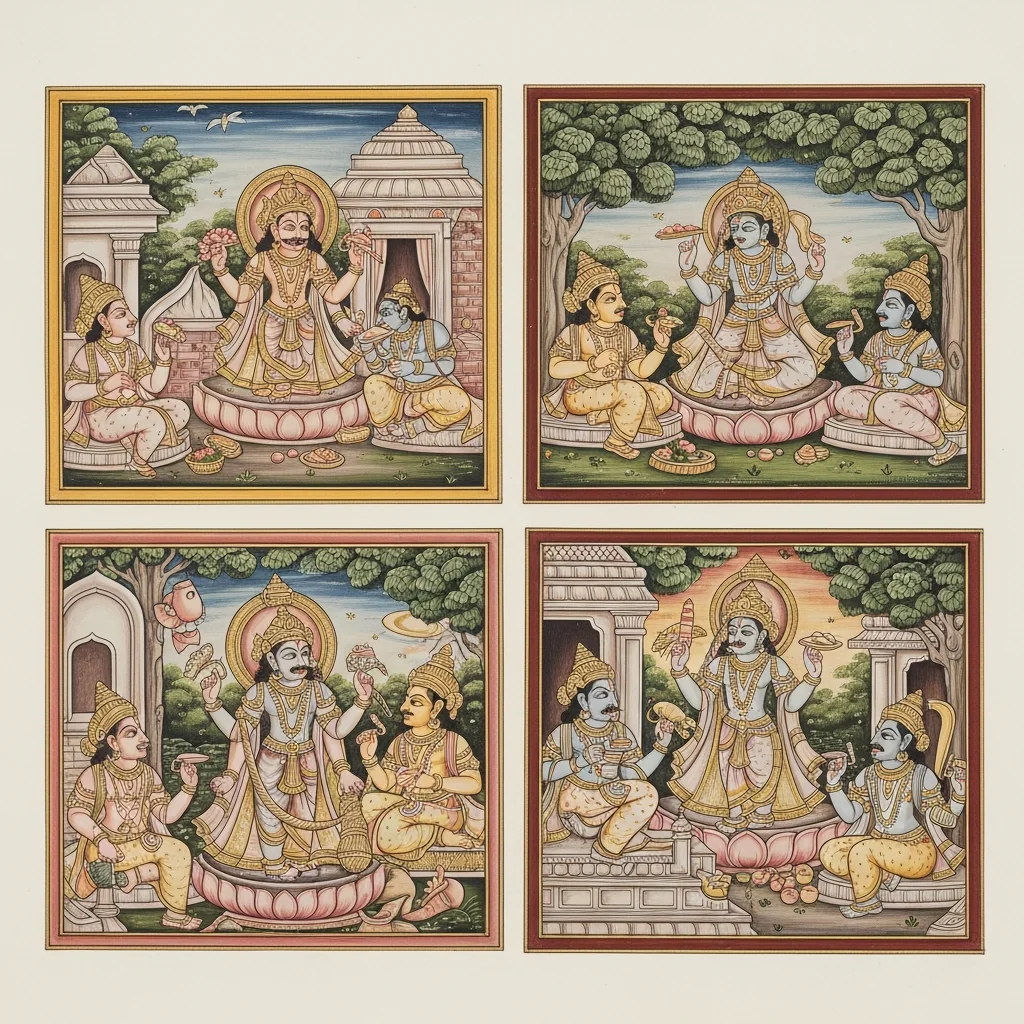
Adhyaya 29
Chapter 29 is presented as an embedded dialogue narrated by Skanda. Śiva, praised as an ocean of nectar, consoles and revives Dharmarāja with a compassionate touch, restoring his ascetic power (tapas). Dharmarāja then petitions Śiva on behalf of orphaned parrots (kīra)—sweet-speaking birds and witnesses of austerity—whose parents have died, asking that they receive divine protection and grace. Summoned before Śiva, the birds reflect on saṃsāra: innumerable births as gods, humans, and other beings, with joy and sorrow, victory and defeat, knowledge and ignorance endlessly alternating, without lasting stability. They declare the decisive turning point to be the darśana of tapas-born liṅga worship and the direct vision of Śiva, and they beg for liberating knowledge (jñāna) that severs worldly bonds. Rejecting heavenly offices, they ask instead for death in Kāśī that grants non-return (apunarbhāva). Śiva replies by unfolding a sacred map of Kāśī as his royal abode: the Mokṣalakṣmīvilāsa prāsāda, the Nirvāṇa-maṇḍapa and other maṇḍapas (mukti-, dakṣiṇa-, jñāna-), and the rites whose fruits are magnified there—japa, prāṇāyāma, śatarudriya, dāna, vrata, and vigil—along with the Jñānavāpī motif and culminating sites such as Maṇikarṇikā and Avimukteśvara. The chapter ends with Śiva granting the birds a divine conveyance and passage to his dwelling, affirming the salvific power of Kāśī-bound grace and knowledge.
Shlokas
Verse 1
स्कंद उवाच । आनंदबाष्पसलिलरुद्धकंठं विलोक्य तम् । मृडः पस्पर्श पाणिभ्यां सौधाभ्यां तु सुधांबुधिः
Skanda said: Seeing him with his throat choked by streams of tears born of bliss, gentle Rudra—Mṛḍa, the ocean of amṛta—touched him with both hands, cool and soothing.
Verse 2
अथ तत्स्पर्शसौख्येन धर्मराजो महातपाः । पुनरंकुरयामास तपोग्नि ज्वलितां तनुम्
Then, by the solace of that touch, Dharmarāja—the great ascetic—made his body, once scorched by the fire of austerity, revive and flourish again.
Verse 3
ततः प्रोवाच स ब्राध्निर्देव देवमुमापतिम् । प्रसन्नवदनं शांतं शांतपारिषदावृतम्
Thereupon the radiant one spoke to the God of gods, Umāpati—his face gracious, his being tranquil, and surrounded by a peaceful retinue.
Verse 4
प्रसन्नोसि यदीशान सर्वज्ञ करुणानिधे । किमन्येन वरेणात्र यत्त्वं साक्षात्कृतो मया
“If you are pleased, O Īśāna—omniscient one, ocean of compassion—what other boon is needed here, since I have beheld you directly?”
Verse 5
यं न वेदा विदुः सम्यङ्न च तौ वेदपूरुषौ । ततोपि वरयोग्योस्मि तन्नाथ प्रार्थयाम्यहम्
“He whom even the Vedas do not fully know—nor those two ‘persons of the Veda’—yet I am still fit to ask for a boon. Therefore, O Lord, I make my petition.”
Verse 6
श्रीकंठांडज डिंभानाममीषां मधुरब्रुवाम् । मत्तपश्चिरसाक्षीणां मत्पुरः प्राप्तजन्मनाम्
“As for these young ones, born from Śrīkaṇṭha’s egg, sweet-speaking—who have long been witnesses to my austerities and have taken birth in my city, now come before me…”
Verse 7
पितृभ्यां परिहीनानामितिहास कथाविदाम् । त्यक्ताहारविहाराणां कीराणां वरदो भव
Be the bestower of a boon upon these parrots—bereft of parents, skilled in tales and sacred narratives, and, through austerity, having renounced food and ordinary movement.
Verse 8
एतत्प्रसूतिसमये आमयेन प्रपीडिता । शुकी पंचत्वमापन्ना शुकः श्येनेन भक्षितः
At the very time of giving birth, the female parrot, afflicted by disease, met her end; and the young parrot was devoured by a hawk.
Verse 9
रक्षितानामनाथानां सदा मन्मुखदर्शिनाम् । अनाथनाथ भवता ह्यायुःशेषस्वरूपिणा
We, the helpless and shelterless whom you have protected, ever gaze upon your face; O Lord of the refuge-less, you who stand as the very embodiment of our remaining span of life, be our guardian.
Verse 10
इति धर्मवचः श्रुत्वा परोपकृतिनिर्मलम् । तानाहूय मुने शंभुर्विनयावनताननान्
Hearing these words of Dharma—pure with the spirit of helping others—Śambhu, O sage, summoned them, as they stood with faces bowed in humility.
Verse 11
उवाच धर्मेति प्रीतः शुकशावानिदं वचः । अयि पत्त्ररथा ब्रूत साधवो धर्मसंगताः
Pleased, he spoke these words to the young parrots, uttering “Dharma!”: “O wing-borne ones, speak—O good beings, aligned with righteousness.”
Verse 12
को वरो भवता देयो धर्मेश परिचारिणाम् । साधुसंसर्गसंक्षीण जन्मांतरमहैनसाम्
“What boon should be granted by you, O Lord of Dharma, to your attendants—whose great sins accumulated across births have been worn away by the company of the holy?”
Verse 13
इति श्रुत्वा महेशस्य वचनं ते पतत्त्रिणः । प्रोचुः प्रणम्य देवेशं नमस्ते भवनाशन
Having heard Maheśa’s words, those birds bowed to the Lord of the gods and replied: “Homage to you, O Destroyer of worldly becoming!”
Verse 14
पक्षिण ऊचुः । अनाथनाथ सर्वज्ञ को वरो नः समीहितः । इतोपि त्र्यक्ष यत्साक्षात्तिर्यक्त्वेपि समीक्षिताः
The birds said: “O Refuge of the refuge-less, O All-knowing One—what boon could we possibly desire? O Three-eyed Lord, this itself is more than enough: that we have been seen by you directly, even though we are but animals.”
Verse 15
लाभाः संतूद्यमवतां गिरीशेह परः शताः । परं परोयं लाभोत्र यत्त्वं दृग्गोचरी भवेः
Countless gains may come to living beings here, O Lord of the Mountain; yet higher than all those gains is this greatest gain—that you become visible to our eyes.
Verse 16
यदेतद्दृश्यते नाथ तत्सर्वं क्षणभंगुरम् । अभंगुरो भवानेकस्त्वत्सपर्याप्यभंगुरा
Whatever is seen in this world, O Lord, is all fragile—breaking in a moment. You alone are unperishing; and service to you as well is unperishing.
Verse 17
विचित्रजन्मकोटीनां स्मृतिर्नोत्र परिस्फुरेत् । एतत्तपस्विरचितलिंगपूजा विलोकनात्
Here the memory of our countless, varied births does not arise—because we behold this worship of the Liṅga, established by an ascetic.
Verse 18
देवयोनिरपि प्राप्ता चिरमस्माभिरीशितः । दिव्यांगना सहस्राणि तत्र भुक्त्वा स्वलीलया
O Lord, for a long time we even attained divine births; and there, by our own sportive karma, we enjoyed thousands of celestial maidens.
Verse 19
आसुरी दानवी नागी नैरृती चापि कैन्नरी । विद्याधरी च गांधर्वी योनिरस्माभिरर्जिता
We have also earned births as Asurīs, Dānavīs, Nāgīs, Nairṛtīs, Kinnarīs—along with Vidyādharīs and Gandharvīs.
Verse 20
नरत्वे भूपतित्वं च परिप्राप्तमनेकशः । जले जलचरत्वं च स्थले च स्थलचारिता
In human life we repeatedly attained kingship; in water we became aquatic creatures, and on land we moved about as land-dwellers.
Verse 21
वने वनौकसो जाता ग्रामेषु ग्रामवासिनः । दातारो याचितारश्च रक्षितारश्च घातुकाः
In forests we became forest-dwellers; in villages, village-folk—at times givers, at times beggars, at times protectors, and at times killers.
Verse 22
सुखिनोपि वयं जाता दुःखिनो वयमास्म च । जेतारश्च वयं जाताः पराजेतार एव च
We have been born in happiness, and we have also been miserable; we have become victors, and likewise we have become the defeated.
Verse 23
अधीतिनोपि मूर्खाश्च स्वामिनः सेवका अपि । चतुर्षु भूतग्रामेषु उत्तमाधममध्यमाः
We have been learned and yet foolish; masters and also servants—among the four communities of beings, as superior, inferior, and middling.
Verse 24
अभूम भूरिशः शंभो न क्वापि स्थैर्यमागताः । इतोयोनेस्ततो योनौ ततो योनेस्ततोन्यतः
O Śambhu, we have existed in countless ways, yet never found stability anywhere—moving from one birth to another, and from that birth to yet another.
Verse 25
पिनाकिन्क्वापि न प्रापि सुखलेशो मनागपि । इदानीं पुण्यसंभारैर्धर्मेश्वरविलोकनात्
O Pinākin, nowhere did we obtain even the slightest trace of happiness; but now, by accumulations of merit, through beholding Dharmēśvara, a new state has arisen in us.
Verse 26
तापनेःसुतपो वह्निज्वालाप्रज्वलितैनसः । संवीक्ष्य त्र्यक्ष साक्षात्त्वां कृतकृत्या बभूविम
Scorched by sins blazing like the flames of fire, we undertook severe austerity; and, O Three-Eyed One, having beheld You directly, we have become fulfilled—our purpose accomplished.
Verse 27
तथापि चेद्वरो देयस्तिर्यक्ष्वस्मासु धूर्जटे । कृपणेष्वपि शोच्येषु ज्ञानं सर्वज्ञ देहि तत्
Yet if a boon is to be granted to us—though we are low and wandering, O Dhūrjaṭi—then even to us pitiable and lamentable ones, O All-Knowing Lord, give that liberating knowledge.
Verse 28
येन ज्ञानेन मुक्ताः स्मोऽमुष्मात्संसारबंधनात् । यंत्रिताः प्राकृतैः पाशैरदुर्भेद्यैश्च मादृशैः
By that wisdom we have been released from this bondage of saṃsāra—though beings like us are held fast by natural, material nooses that are exceedingly hard to break.
Verse 29
ऐंद्रं पदं न वांछामो न चांद्रं नान्यदेव हि । वाञ्छामः केवलं मृत्युं काश्यां शंभोऽपुनर्भवम्
We do not desire the rank of Indra, nor the station of the Moon, nor any other divine status. We desire only this: to die in Kāśī, O Śambhu, and thus attain the state of no return.
Verse 30
त्वत्सान्निध्याद्विजानीमः सर्वज्ञ सकलं वयम् । यथा चंदनसंसर्गात्सर्वे सुरभयो द्रुमाः
By proximity to you, O All-knowing One, we understand everything—just as, by contact with sandalwood, all trees become fragrant.
Verse 31
एतदेव परं ज्ञानं संसारोच्छित्तिकारणम् । वपुर्विसर्जनं काले यत्तवानंदकानने
This alone is the supreme knowledge, the cause of the ending of saṃsāra: the casting off of the body at the destined time in your Ānanda-grove.
Verse 32
निर्मथ्य विष्वग्वाग्जालं सारभूतमिदं परम् । ब्रह्मणोदीरितं पूर्वं काश्यां मुक्तिस्तनुत्यजाम्
Having churned the vast net of words, this supreme essence is drawn forth—spoken long ago by Brahmā: in Kāśī, liberation comes to those who lay down the body.
Verse 33
यद्वाच्यं बहुभिर्ग्रंथैस्तदष्टाभिरिहाक्षरैः । हरिणोक्तं रविपुरः कैवल्यं काशिसंस्थितौ
What countless texts strive to express is here spoken in eight syllables: Hari declared before Ravi, “Kaivalya is for the one who abides in Kāśī.”
Verse 34
याज्ञवल्क्यो मुनिवरः प्रोक्तवान्मुनिसंसदि । रवेरधीत्य निगमान्काश्यामंते परं पदम्
Yājñavalkya, best of sages, declared in the assembly of seers: “Having learned the Vedas from Ravi, one attains, at the end, the supreme state in Kāśī.”
Verse 35
स्वामिनापि जगद्धात्री पुरतो मंदराचले । इदमेव पुरा प्रोक्तं काशीनिर्वाणजन्मभूः
Even the Lord, before Jagaddhātrī on Mount Mandara, declared this very truth long ago: Kāśī is the birthplace of nirvāṇa, the final release.
Verse 36
कृष्णद्वैपायनोप्येवं शंभो वक्ष्यति नान्यथा । यत्रविश्वेश्वरः साक्षान्मुक्तिस्तत्र पदेपदे
Even Kṛṣṇa Dvaipāyana (Vyāsa), O Śambhu, will declare it just so and not otherwise: where Viśveśvara is directly present, there is liberation at every step.
Verse 37
वदंत्यन्येपि मुनयस्तीर्थसंन्यासकारिणः । चिरंतना लोमशाद्याः काशिका मुक्तिकाशिका
Other sages too—ancient founders of renunciation and of pilgrimage tīrthas—such as Lomaśa and others, declare: “Kāśikā is Muktikāśikā, the Kāśī that bestows mokṣa, liberation.”
Verse 38
वयमप्येवं जानीमो यत्र स्वर्गतरंगिणी । आनंदकानने शंर्भोमोक्षस्तत्रैव निश्चितम्
We too know it to be so—where the heavenly river flows: in Ānandakānana, O Śambhu, liberation (mokṣa) is assured there alone, beyond doubt.
Verse 39
भूतं भावि भविष्यं यत्स्वर्गे मर्त्ये रसातले । तत्सर्वमेव जानीमो धर्मेशानुग्रहात्परात्
Whatever is past, present, and yet to come—whether in heaven, on earth, or in the nether realms—all of that we know entirely, through the supreme grace of Dharmarāja.
Verse 40
अतो हिरण्यगर्भोक्तं हरिप्रोक्तं मुनीरितम् । भवतोक्तं च निखिलं शंभो जानीमहे वयम्
Therefore, whatever was spoken by Hiraṇyagarbha (Brahmā), spoken by Hari (Viṣṇu), declared by the sages, and also all that is spoken by you—O Śambhu—we know it in full.
Verse 41
करामलकवत्सर्वमेतद्ब्रह्मांडगोलकम् । अस्मद्वाग्गोचरेऽस्त्येव धर्मपीठनिषेवणात्
This entire sphere of the cosmos is to us like an āmalaka fruit in the palm—within the range of our speech and understanding—because we have served the sacred seat of Dharma.
Verse 42
धर्मराजस्य तपसा तिर्यञ्चोपि वयं विभो । जाताः स्म निर्विकल्पं हि सर्वज्ञानस्य भाजनम्
By the austerity of Dharmarāja—even though we are but birds, O Lord—we have, without doubt, become vessels fit to bear omniscience.
Verse 43
मधुरं मृदुलं सत्यं स्वप्रमाणं सुसंस्कृतम् । हितं मितं सदृष्टांतं श्रुत्वा पक्षिसुभाषितम्
Hearing the birds’ well-spoken words—sweet, gentle, truthful, self-authenticating, and well-refined; beneficial, measured, and supported by apt examples—(he was moved).
Verse 44
देवोतिविस्मयापन्नो ऽवर्णयत्पीठगौरवम् । त्रैलोक्यनगरे चात्र काशीराजगृहं मम
Overcome with extraordinary amazement, the Deva described the majesty of that sacred seat; and here, in this city like the metropolis of the three worlds, he spoke of my royal residence in Kāśī.
Verse 45
तत्रापि भोगभवनमनर्घ्यमणिनिर्मितम् । मोक्षलक्ष्मीविलासाख्यः प्रासादो मेति शर्मभूः
There too stood a mansion of delights, built of priceless gems—my palace named ‘Mokṣalakṣmīvilāsa,’ a source of great joy to me.
Verse 46
पतत्त्रिणो पिमुच्यंते यं कुर्वाणाः प्रदक्षिणम् । स्वेच्छया विचरंतः खे खेचरा अपि देवताः
Even the flying beings are set free by circumambulating it in pradakṣiṇa; and the deities too—moving through the sky as khecaras—wander there at will.
Verse 47
मोक्षलक्ष्मीविलासाख्य प्रासादस्य विलोकनात् । शरीराद्दूरतो याति ब्रह्महत्यापि नान्यथा
By merely beholding the palace called “Mokṣalakṣmīvilāsa,” even the sin of brahmahatyā departs far away from one’s body—there is no other result than this.
Verse 48
मोक्षलक्ष्मीविलासस्य कलशो यैर्निरीक्षतः । निधानकलशास्तांस्तु न मुंचंति पदेपदे
Those who behold the kalaśa, the finial-pot, of the palace where Liberation and Fortune sport—such people are never abandoned at any step by the treasure-jars of prosperity.
Verse 49
दूरतोपि पताकापि मम प्रासादमूर्धगा । नेत्रातिथी कृता यैस्तु नित्यं तेऽतिथयो मम
Even from afar, those who make the flag upon the summit of My palace a “guest of their eyes”—they indeed become My constant guests.
Verse 50
भूमिं भित्त्वा स्वयं जातस्तत्प्रासादमिषेण हि । आनंदाख्यस्य कंदस्य कोप्येष परमोंकुरः
Piercing the earth, this has arisen of itself—indeed, under the pretext of that palace. It is, as it were, the supreme sprout of the root called “Bliss”.
Verse 51
ब्रह्मादिस्थावरांतानि यत्र रूपण्यनेकशः । मामेवोपासते नित्यं चित्रं चित्रगतान्यपि
Where forms of many kinds—from Brahmā onward, down to the immobile beings—continually worship Me alone; wondrous indeed, even the figures within paintings do so there.
Verse 52
ससौधो मेखिले लोके स्थानं परमनिर्वृतेः । रतिशाला स मे रम्या स मे विश्वासभूमिका
In this encircling world, that edifice is My seat of highest beatitude. That delightful hall is My chamber of delight; it is the very ground of My intimate assurance to devotees.
Verse 53
मम सर्वगतस्यापि प्रासादोयं परास्पदम् । परं ब्रह्म यदाम्नातं परमोपनिषद्गिरा । अमूर्तं तदहं मूर्तो भूयां भक्तकृपावशात्
Though I pervade all, this palace is My supreme seat. I am that Supreme Brahman proclaimed by the highest utterances of the Upaniṣads; though formless, I become embodied, moved by compassion for devotees.
Verse 54
नैःश्रेयस्याः श्रियो धाम तद्याम्यां मंडपोस्ति मे । तत्राहं सततं तिष्ठे तत्सदोमंडपं मम
On the southern side stands a pavilion for Me, an abode of the splendor of final beatitude. There I dwell continually; that is My assembly-pavilion.
Verse 55
निमेषार्धप्रमाणं च कालं तिष्ठति निश्चलः । तत्र यस्तेन वै योगः समभ्यस्तः समाः शतम्
Whoever remains motionless there even for the span of half a blink—by that alone, the yoga practiced there equals a hundred years of practice elsewhere.
Verse 56
निर्वाणमंडपं नाम तत्स्थानं जगतीतले । तत्रर्चं संजपन्नेकां लभेत्सर्वश्रुतेः फलम्
That place upon the earth is called the ‘Nirvāṇa Pavilion’. There, by chanting a single sacred formula before the deity-image, one obtains the fruit of all revealed scripture.
Verse 57
प्राणायामं तु यः कुर्यादप्येकं मुक्तिमंडपे । तेनाष्टांगः समभ्यस्तो योगोऽन्यत्रायुतं समाः
But whoever performs even a single prāṇāyāma in the “Liberation Pavilion”—by that, the eight-limbed yoga is deemed practiced, as though for ten thousand years elsewhere.
Verse 58
निर्वाणमंडपे यस्तु जपेदेकं षडक्षरम् । कोटिरुद्रेण जप्तेन यत्फलं तस्य तद्भवेत्
Whoever, in the Nirvāṇa Maṇḍapa, chants even once the six-syllabled mantra—he gains the very fruit obtained by the famed Koṭirudra-japa, the repetition of Rudra a crore of times.
Verse 59
शुचिर्गंगांभसि स्नातो यो जपेच्छतरुद्रियम् । निर्वाणमंडपे ज्ञेयः स रुद्रो द्विजवेषभृत्
Pure, having bathed in the waters of the Gaṅgā, whoever recites the Śatarudrīya—know him, in the Nirvāṇa Maṇḍapa, to be Rudra himself, though wearing the guise of a twice-born (brāhmaṇa).
Verse 60
ब्रह्मयज्ञसकृत्कृत्वा मम दक्षिणमंडपे । ब्रह्मलोकमवाप्याथ परं ब्रह्माधिगच्छति
Having performed the Brahma-yajña even once in my Southern Maṇḍapa, one attains Brahmaloka—and thereafter realizes the Supreme Brahman.
Verse 61
धर्मशास्त्रं पुराणानि सेतिहासानि तत्र यः । पठेन्निरभिलाषुः सन्स वसेन्मम वेश्मनि
There, whoever reads Dharmaśāstra, the Purāṇas, and the Itihāsas without selfish desire—he dwells in my own abode.
Verse 62
तिष्ठेदिंद्रियचापल्यं यो निवार्य क्षणं कृती । निर्वाणमंडपेन्यत्र तेन तप्तं महत्तपः
The capable one who, even for a moment, restrains the fickleness of the senses while abiding in the Nirvāṇa Maṇḍapa—by him a great austerity (tapas) is performed.
Verse 63
वायुभक्षणतोन्यत्र यत्पुण्यं शरदां शतम् । तत्पुण्यं घटिकार्धेन मौनं दक्षिणमंडपे
Whatever merit is gained elsewhere by living on air for a hundred autumns, that very puṇya is gained by observing silence for half a ghaṭikā in the Southern Maṇḍapa (Dakṣiṇa).
Verse 64
मितं कृष्णलकेनापि योदद्यान्मुक्तिमंडपे । स्वर्णं सौवर्णयानेन स तु संचरते दिवि
Even if one gives only a measured offering—were it but a single kṛṣṇalaka—in the Mukti Maṇḍapa, he roams in heaven in a golden chariot.
Verse 65
तत्रैकं जागरं कुर्याद्यस्मिन्कस्मिन्दिनेपि यः । उपोषितोर्चयेल्लिंगं स सर्वव्रतपुण्यभाक्
Whoever, on any day whatsoever, keeps a single night-vigil there, fasting and worshipping the Liṅga—he becomes a sharer in the merit of all vows.
Verse 66
तत्र दत्त्वा महादानं तत्र कृत्वा महाव्रतम् । तत्राधीत्याखिलं वेदं च्यवते न नरो दिवः
Having given great charity (mahādāna) there, having undertaken a great vow (mahāvrata) there, and having studied the entire Veda there—such a man does not fall from heaven.
Verse 67
प्रयाणं कुर्वते यस्य प्राणा मे मुक्तिमंडपे । समामनुप्रविष्टोत्र तिष्ठेद्यावदहं खलु
For the one whose life-breaths depart in My Mukti Maṇḍapa, I Myself enter there along with them and remain with that soul for as long as I indeed remain.
Verse 68
जलक्रीडां सदा कुर्यां ज्ञानवाप्यां सहोमया । यदंबुपानमात्रेण ज्ञानं जायेत निमर्लम्
“I ever sport in the waters of the Jñāna-vāpī, the Well of Knowledge, together with Umā. By merely drinking that water, spotless, pure knowledge arises.”
Verse 69
तज्जलक्रीडनस्थानं मम प्रीतिकरं महत् । अमुष्मिन्राजसदने जाड्यहृज्जलपूरितम्
“That very place of water-sport is greatly pleasing to Me. In that royal abode, it is filled with the water that removes the heart’s dullness and spiritual inertia.”
Verse 70
तत्प्रासादपुरोभागे मम शृंगारमंडपः श्री । पीठं तद्धि विज्ञेयं निःश्रीकश्रीसमर्पणम्
“In the forepart of that palace is My auspicious Śṛṅgāra-maṇḍapa, the pavilion of adornment. Know it as a sacred seat (pīṭha) where prosperity is bestowed even upon one who is without fortune.”
Verse 71
मदर्थं तत्र यो दद्याद्दुकूलानि शुचीन्यहो । माल्यानि सुविचित्राणि यक्षकर्दमवंति च
“Whoever there, for My sake, offers clean garments—also exquisitely varied garlands, and even fragrant unguents fit for divine beings—wins My favor.”
Verse 72
नाना नेपथ्यवस्तूनि पूजोपकरणाऽन्यपि । स श्रियालंकृतस्तिष्ठेद्यत्र कुत्रापि सत्तमः
By offering various adornments and other implements of worship as well, such a noble person remains adorned by Śrī (auspicious prosperity), wherever he may dwell.
Verse 73
निर्वाणलक्ष्मीर्वृणुते तं निर्वाणपदाप्तये । यत्र कुत्रापि निधनं प्राप्नुयादपि स ध्रुवम्
Nirvāṇa-Lakṣmī chooses that person for the attainment of the state of liberation; even if death meets him anywhere at all, that liberating destiny is assured for him.
Verse 74
मोक्षलक्ष्मीविलासाख्य प्रासादस्योत्तरे मम । ऐश्वर्यमडपं रम्यं तत्रैश्वर्यं ददाम्यहम्
To the north of My palace called “Mokṣa-Lakṣmī-Vilāsa” stands a charming pavilion of sovereignty, the Aiśvarya-maṇḍapa; there I bestow aiśvarya—lordly prosperity and power.
Verse 75
मत्प्रासादैंद्रदिग्भागे ज्ञानमंडपमस्ति यत् । ज्ञानं दिशामि सततं तत्र मां ध्यायतां सताम्
In the eastern quarter of My palace there is the Jñāna-maṇḍapa, the pavilion of knowledge; there I continually bestow wisdom upon the virtuous who meditate upon Me.
Verse 76
भवानि राजसदने ममास्ति हि महानसम् । यत्तत्रोपहृतं पुण्यं निर्विशामि मुदैव तत्
O Bhavānī, in the royal abode there is indeed My great kitchen; whatever sacred offering is brought there, I partake of it with joy.
Verse 77
विशालाक्ष्या महासौधे मम विश्रामभूमिका । तत्र संसृतिखिन्नानां विश्रामं श्राणयाम्यहम्
In the great palace of Viśālākṣī is My resting-place; there I grant repose to those wearied by saṃsāra.
Verse 78
नियमस्नानतीर्थं च चक्रपुष्करिणी मम । तत्र स्नानवतां पुंसां तन्नैर्मल्यं दिशाम्यहम्
This is My sacred ford of ritual bathing, the Cakra-Puṣkariṇī; for those who bathe there, I Myself bestow purity and stainlessness.
Verse 79
यदाहुः परमं तत्त्वं यदाहुर्ब्रह्मसत्तमम् । स्वसंवेद्यं यदाहुश्च तत्तत्रांते दिशाम्यहम्
That which they call the Supreme Reality, that which they call the highest Brahman, and that which they declare to be directly self-known—this I reveal there, at its final culmination.
Verse 80
यदाहुस्तारकं ज्ञानं यदाहुरतिनिर्मलम् । स्वात्मारामं यदाहुश्च तत्तत्रांते दिशाम्यहम्
That knowledge which they call the ‘Tāraka’, which they call supremely pure, and which they call delighting in the Self alone—this I reveal there, at its final culmination.
Verse 81
जगन्मंगलभूर्यात्र परमा मणिकर्णिका । विपाशयामि तत्राहं कर्मभिः पाशितान्पशून्
Here, the supreme Maṇikarṇikā—abounding in auspiciousness for the world—is the highest pilgrimage; there I loosen and release the bound creatures fettered by their own karma.
Verse 82
निर्वाणश्राणने यत्र पात्रापात्रं न चिंतये । आनंदकानने तन्मे दानस्थानं दिवानिशम्
In the ‘Nirvāṇa-Śrāṇaṇa’, where I do not weigh who is worthy or unworthy, in Ānandakānana lies my place of giving, by day and by night.
Verse 83
भवांबुधौ महागाधे प्राणिनः परिमज्जतः । भूत्वैव कर्णधारोंते यत्र संतारयाम्यहम्
In the vast and unfathomable ocean of worldly becoming, when beings are sinking, there—at the final moment—I become their helmsman and carry them across.
Verse 84
सौभाग्यभाग्यभूर्या वै विख्याता मणिकर्णिका । ददामि तस्यां सर्वस्वमग्रजायांत्यजाय वा
Maṇikarṇikā, renowned as a great ground of good fortune and destiny, is indeed famous. There I grant everything—whether to the foremost or even to one who is cast off.
Verse 85
महासमाधिसंपन्नैर्वेदांतार्थ निषेविभिः । दुष्प्रापोन्यत्र यो मोक्षः शोच्यैरपि स लभ्यते
That liberation which elsewhere is hard to attain even for those endowed with great samādhi and devoted to the meaning of Vedānta—here it is obtained even by the pitiable and fallen.
Verse 86
दीक्षितो वा दिवाकीर्तिः पंडितो वाप्यपंडितः । तुल्यो मे मोक्षदीक्षायां संप्राप्य मणिकर्णिकाम्
Whether one is initiated, famed like the light of day, learned or unlearned—upon reaching Maṇikarṇikā, all are equal in my initiation into liberation.
Verse 87
यत्त्यागेन्यत्र कृपणस्तत्प्राप्य मणिकर्णिकाम् । ददामि जंतुमात्राय सर्वस्वं चिरसंचितम्
What a miser elsewhere relinquishes only through arduous renunciation—upon reaching Maṇikarṇikā, I grant to every living being all that has been amassed over a long time.
Verse 88
यदि दैवादिह प्राप्तस्त्रिसंयोगोऽतिदुर्घटः । अविचारं तदा देयं सर्वस्वं चिरसंचितम्
If, by divine fortune, one attains here this exceedingly rare ‘triple conjunction’, then without hesitation one should give in charity even one’s entire wealth accumulated over a long time.
Verse 89
शरीरमथ संपत्तिरथ सा मणिकर्णिका । त्रिसंयोगोयमप्राप्यो देवैरिंद्रादिकैरपि
This ‘triple conjunction’—a human body, material means, and that Maṇikarṇikā—cannot be obtained even by the gods, beginning with Indra.
Verse 90
पुनः पुनर्विचार्येति जंतुमात्रेभ्य एव च । निर्वाणलक्ष्मीं यच्छामि सदोपमणिकर्णिकम्
Therefore, reflecting again and again—indeed for all beings—I bestow the prosperity of liberation; for Maṇikarṇikā is ever supreme.
Verse 91
मुक्तिदा न मही सा मे वाराणस्यां महीयसी । तन्मही रजसा साम्यं त्रिलोक्यपि न चोद्वहेत्
That earth of mine in Vārāṇasī is supremely great; it is not merely ‘earth’—it is the giver of liberation. Even the three worlds cannot equal even its dust.
Verse 92
परं लिंगार्चनस्थानमविमुक्तेश्वरेश्वरम् । तत्र पूजां सकृत्कृत्वा कृतकृत्यो नरो भवेत्
Avimukteśvara is the supreme place for worship of the Liṅga. By performing pūjā there even once, a person becomes one who has fulfilled life’s purpose.
Verse 93
सायं पाशुपतीं संध्यां कुर्यां पशुपतीश्वरे । विभूतिधारणात्तत्र पशुपाशैर्न बध्यते
In the evening one should perform the Pāśupata sandhyā at Paśupatīśvara. By wearing sacred ash (vibhūti) there, one is not bound by the bonds that fetter creatures.
Verse 94
प्रातःसध्याकरोम्येव सदोंकारनिकेतने । तत्रैकापि कृता संध्या सर्वपातककृंतनी
In the morning I perform the sandhyā at the ever-abiding abode of Oṃkāra. Even a single sandhyā performed there cuts down all sins.
Verse 96
रत्नेश्वरोर्चितो दद्यान्महारत्नानि भक्तितः । रत्नैः समर्च्य तल्लिंगं स्त्रीरत्नादि लभेन्नरः
When Ratneśvara is worshipped, one should, with devotion, offer great jewels. Having worshipped that Liṅga with gems, a man gains precious boons—such as an excellent wife and other ‘jewels’ of life.
Verse 97
विष्टपत्रितयांतःस्थोप्यहं लिंगे त्रिविष्टपे । तिष्ठामि सततं भक्तमनोरथसमृद्धये
Though dwelling within the triple world (trivisṭapa), I abide continually in this Liṅga, for the full flourishing of the devotee’s heartfelt wishes.
Verse 98
विरजस्कं महापीठं तत्र संसेव्य मानवः । विरजा जायते नूनं चतुर्नद कृतोदकः
By serving that great sacred seat called Virajaska, a person surely becomes free from impurity. One who performs there the water-rite of the “four rivers” is indeed purified.
Verse 99
वसामि कृत्तिवासेहं सदा प्रति चतुर्दशि । अत्र जागरणं कृत्वा चतुर्दश्यां न गर्भभाक्
“I ever dwell here at Kṛttivāsa on each fourteenth lunar day (caturdaśī). Having kept vigil here on that caturdaśī, one does not take birth in a womb again.”
Verse 100
पितृप्रीतिप्रदं पीठं वृषभध्वजसंज्ञकम् । पितृतर्पणकृत्तत्र पितॄंस्तारयति क्षणात्
“This sacred seat, known as Vṛṣabhadhvaja, bestows delight upon the ancestors. Whoever performs tarpaṇa for the Pitṛs there delivers the forefathers in an instant.”
Verse 110
ममानुग्रहतः कीरानेतान्पश्य रवेः सुत । दिव्यविमानमारुह्य गंतारो मत्पुरं महत्
“By my grace, behold these parrots, O son of the Sun. Mounting a divine vimāna, they shall go to my great abode.”
Verse 113
आरुह्यते न यानेन दिव्यरूपवराः खगाः । कैलासमभिसंजग्मुर्धर्ममापृच्छ्यतेऽमलाः
Those birds, now of excellent divine form and purified, did not need to mount any vehicle; they proceeded to Kailāsa to inquire about Dharma.