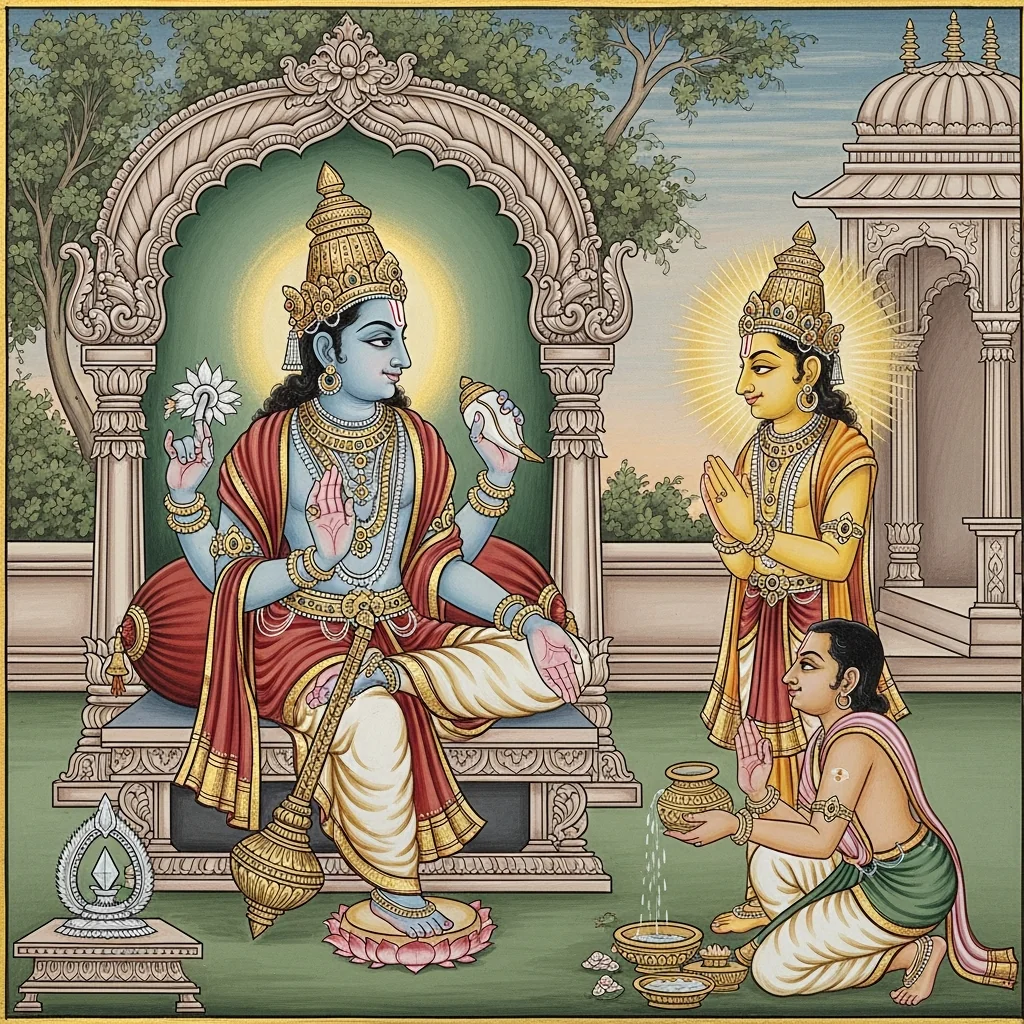
Adhyaya 1
The chapter begins with Agastya questioning Skanda about why Vinatā fell into servitude. Skanda recounts the birth-episode of Kadru and Vinatā: an egg is broken too soon, Aruṇa emerges only partly formed, and he utters a curse and instruction—do not break the third egg—while foretelling that the future child will free Vinatā from bondage. The narrative then turns to Kāśī’s solar sacred landscape. Aruṇa performs tapas in Vārāṇasī and is established as Arunāditya, granting worshippers freedom from fear, poverty, sin, and certain afflictions. Next comes Vṛddhāditya: the sage Hārīta’s devotion to the Sun wins the boon of restored youth, founding a solar form famed for removing old age and misfortune. In the Keśavāditya section, the Sun approaches Viṣṇu (Ādikēśava), yet a strongly Śaiva teaching is voiced: in Kāśī, Mahādeva alone is the supreme object of worship, and Śiva-liṅga worship swiftly purifies and bestows the four aims of life; the Sun is urged to worship a crystal liṅga, creating a linked shrine. The chapter also prescribes purification at the Pādodaka tīrtha near Ādikēśava—especially on Ratha-saptamī—through mantra-bathing to erase sins of many births. Finally, Vimalāditya is revealed through Vimala’s story: afflicted with kuṣṭha, she worships the Sun in Harikeśava-vana, is healed, and receives a protective boon for devotees, establishing this form as a remover of disease and sin. The chapter closes with phalaśruti assurances of merit for hearing these Āditya narratives.
Shlokas
Verse 1
अथ श्रीकाशीखंडोत्तरार्धं प्रारभ्यते । श्रीगणेशाय नमः । अगस्तिरुवाच । पार्वती हृदयानंद सर्वज्ञांगभव प्रभो । किंचित्प्रष्टुमनाः स्वामिंस्तद्भवान्वक्तुमर्हति
Now begins the revered latter half of the Kāśī Khaṇḍa. Salutations to Śrī Gaṇeśa. Agastya said: O Lord, delight of Pārvatī’s heart, O all-knowing one, O Aṅgabhava (Skanda), I wish to ask something; be pleased to explain it.
Verse 2
दक्ष प्रजापतेः पुत्री कश्यपस्य परिग्रहः । गरुत्मतः प्रसूः साध्वी कुतो दास्यमवाप सा
She is the daughter of Dakṣa Prajāpati, the consort of Kaśyapa, the virtuous mother of Garuḍa—how then did she come to fall into servitude?
Verse 3
स्कंद उवाच । हंजिकात्वं यथा प्राप्ता विनता सा तपस्विनी । तदप्यहं समाख्यामि निशामय महामते
Skanda said: How the ascetic Vinatā came to attain the state of Haṃjikā—this too I shall recount. Listen attentively, O great-minded one.
Verse 4
कद्रूरजीजनत्पुत्राञ्शतं कश्यपतः पुरा । उलूकमरुणं तार्क्ष्यमसूत विनता त्रयम्
Formerly, Kadrū bore a hundred sons to Kaśyapa; and Vinatā bore three—Ulūka, Aruṇa, and Tārkṣya (Garuḍa).
Verse 5
कौशिको राज्यमाप्यापि श्रेष्ठत्वात्पक्षिणां मुने । निर्गुणत्वाच्च तैः सर्वैः स राज्यादवरोपितः
O sage, though Kauśika attained kingship because of his superiority among birds, yet, due to his lack of virtues, he was deposed from the throne by them all.
Verse 6
क्रूराक्षोयं दिवांधोयं सदा वक्रनखस्त्वसौ । अतीवोद्वेगजनकं सर्वेषामस्य भाषणम्
Cruel are his eyes; by day he is blind; his claws are ever crooked. His speech brings extreme agitation upon all.
Verse 7
इत्थं तस्य गुणग्रामान्विकथ्य बहुशः खगाः । नाद्यापि वृण्वते राज्ये कमपि स्वैरचारिणः
Thus, again and again recounting the multitude of his virtues, the birds declared that even to this day they choose as king no one who acts merely by his own whim.
Verse 8
कौशिकेथ तथावृत्ते पुत्रवीक्षणलालसा । अंडं प्रस्फोटयामास मध्यमं विनता तदा
O Kauśika, when matters had turned out thus, Vinatā—eager to behold her son—then broke open the middle egg.
Verse 9
पूर्णे वर्षसहस्रे तु प्रस्फोट्य घटसंभव । तदभेदितयौत्सुक्यादंडमष्टमके शते
When a full thousand years had passed, O one born of the pitcher, driven by the eagerness that it had not yet been split, she burst open the egg in the eight-hundredth year thereafter.
Verse 10
तावत्सर्वाणि गात्राणि तस्यातिमहसः शिशोः । ऊर्वोरुपरिसिद्धानि दंडांतर्निवासिनः
Up to that point, all the limbs of that exceedingly radiant child were formed only above the thighs, as though he were destined to dwell within a staff.
Verse 11
अंडान्निर्गतमात्रेण क्रोधारुणमुखश्रिया । अर्धनिष्पन्नदेहेन शिशुना शापिता प्रसूः
The very moment he emerged from the egg, his face radiant and reddened with wrath, the child—his body only half-formed—cursed his mother.
Verse 12
जनयित्रि त्वया दृष्ट्वा काद्रवेयान्स्वलीलया । खेलतो मातुरुत्संगे यदंडं व्याधित द्विधा
“Mother, seeing the sons of Kadrū, out of mere playfulness—while I was sporting in your lap—you split the egg in two.”
Verse 13
तदनिष्पन्न सर्वांगः शपामि त्वा विहंगमे । तेषामेवैधि दासी त्वं सपत्न्यंग भुवामिह
“Therefore, since my limbs are left unfinished, O bird-mother, I curse you: here on earth, become a slave to them—O limb of a co-wife.”
Verse 14
वेपमानाथ तच्छापादिदं प्रोवाच पक्षिणी । अनूरो ब्रूहि मे शापावसानं मातुरंगज
Trembling at that curse, the bird-mother said: “O Anūru, child of my own body, tell me when this curse will come to an end.”
Verse 15
अनूरुरुवाच । अंडं तृतीयं मा भिंधि ह्यनिष्पन्नं ममेव हि । अस्मिन्नंडे भविष्यो यः स ते दास्यं हरिष्यति
Anūru said: “Do not break the third egg; it is indeed mine, still unformed. The one who will be born from this egg—he will take away your slavery.”
Verse 16
इत्युक्त्वा सोरुणोगच्छदुड्डीयानंदकाननम् । यत्र विश्वेश्वरो दद्यादपि पंगोः शुभां गतिम्
Having spoken thus, Aruṇa departed for the delightful forest of Uḍḍīyāna, where Viśveśvara grants even the lame an auspicious path.
Verse 17
एतत्ते पृच्छतः ख्यातं विनता दास्यकारणम् । मुने प्रसंगतो वच्मि अरुणादित्यसंभवम्
O sage, since you have asked, I have explained the well-known cause of Vinatā’s servitude. Now, in due sequence, I shall relate the account of Aruṇa and the manifestation of Aruṇāditya.
Verse 18
अनूरुत्वादनूरुर्योरुणः क्रोधारुणो यतः । वाराणस्यां तपस्तप्त्वा तेनाराधि दिवाकरः
Because he was ‘thighless’ (anūru), he became known as Aruṇa, reddened by anger. Having performed austerities in Vārāṇasī, he thereby propitiated Divākara, the Sun.
Verse 19
सोपि प्रसन्नो दत्त्वाथ वरांस्तस्मा अनूरवे । आदित्यस्तस्य नाम्नाभूदरुणादित्य इत्यपि
Pleased, the Sun then granted boons to that Anūru. And Āditya too became known by his name, as ‘Aruṇāditya’.
Verse 20
अर्क उवाच । तिष्ठानूरो मम रथे सदैव विनतात्मज । जगतां च हितार्थाय ध्वांतं विध्वंसयन्पुरः
Arka (the Sun) said: “Stand always upon my chariot, O Aruṇa, son of Vinatā, destroying the darkness before me for the welfare of the worlds.”
Verse 21
अत्र त्वत्स्थापितां मूर्तिं ये भजिष्यंति मानवाः । वाराणस्यां महादेवोत्तरे तेषां कुतो भयम्
Those who here worship the image established by you—on the northern side of Mahādeva in Vārāṇasī—how could any fear be theirs?
Verse 22
येर्चयिष्यंति सततमरुणादित्यसंज्ञकम् । मामत्र तेषां नो दुःखं न दारिद्र्यं न पातकम्
Those who continually worship me here, known as Aruṇāditya—there shall be for them neither sorrow, nor poverty, nor sin.
Verse 23
व्याधिभिर्नाभिभूयंते नो पसर्गैश्च कैश्चन । शोकाग्निना न दह्यंते ह्यरुणादित्यसेवनात्
Through service to Aruṇāditya, they are not overcome by diseases, nor by any afflictions; nor are they burned by the fire of grief.
Verse 24
अथ स्यंदनमारोप्य नीतवानरुणं रविः । अद्यापि स रथे सौरे प्रातरेव समुद्यति
Then Ravi, the Sun, placed Aruṇa upon the chariot and carried him along. Even today, upon the solar chariot, he rises at morning.
Verse 25
यः कुर्यात्प्रातरुत्थाय नमस्कारं दिनेदिने । अरुणाय ससूर्याय तस्य दुःखभयं कुतः
Whoever, rising in the morning, offers reverent salutations day after day to Aruṇa together with the Sun—how could sorrow or fear be his?
Verse 26
अरुणादित्यमाहात्म्यं यः श्रोष्यति नरोत्तमः । न तस्य दुष्कृतं किंचिद्भविष्यति कदाचन
The best of men who listens to the glory of Aruṇāditya—no evil deed shall ever arise for him at any time.
Verse 27
स्कंद उवाच । वृद्धादित्यस्य माहात्म्यं शृणु ते कथयाम्यहम् । यस्य श्रवणमात्रेण नरो नो दुष्कृतं भजेत्
Skanda said: Hear the greatness of Vṛddhāditya; I shall narrate it to you. By the mere hearing of it, a man does not fall into sinful deeds.
Verse 28
पुरात्र वृद्धहारीतो वाराणस्यां महातपाः । महातपः समृद्ध्यर्थं समाराधितवान्रविम्
Formerly, in Vārāṇasī, the great ascetic Vṛddhahārīta worshipped Ravi (the Sun) for the flourishing success of his mighty austerities.
Verse 29
मूर्तिं संस्थाप्य शुभदां भास्वतः शुभलक्षणाम् । दक्षिणेन विशालाक्ष्या दृढभक्तिसमन्वितः
Having installed an auspicious, boon-giving image of Bhāsvat (the radiant Sun), marked with holy signs, he stood to the south of Viśālākṣī, endowed with steadfast devotion.
Verse 30
तुष्टस्तस्मै वरं प्रादाद्ब्रध्नो वृद्धतपस्विने । अलं विलंब्य याचस्व कस्ते देयो वरो मया
Pleased, Bradhna (the Sun) granted a boon to that aged ascetic: “Enough of delay—ask! What boon should be given to you by me?”
Verse 31
सोथ प्रसन्नाद्द्युमणेरवृणीत वरं मुनिः । यदि प्रसन्नो भगवान्युवत्वं देहि मे पुनः
Then the sage chose a boon from the pleased Dyumaṇi (the Sun): “If the Lord is satisfied, grant me youth again.”
Verse 32
तपःकरण सामर्थ्यं स्थविरस्य न मे यतः । पुनस्तारुण्यमाप्तोहं चरिष्याम्युत्तमं तपः
For as an old man I lack the strength to perform tapas. Having regained youth, I shall undertake the highest austerity again.
Verse 33
तप एव परो धर्मस्तप एव परं वसु । तप एव परः कामो निर्वाणं तप एव हि
Austerity alone is the highest dharma; austerity alone is the supreme wealth. Austerity alone is the highest desire; indeed, liberation is attained through austerity alone.
Verse 34
ऋतेन तपसः क्वापि लभ्या ऐश्वर्यसंपदः । पदं ध्रुवादिभिः प्रापि केवलं तपसो बलात्
Without austerity, prosperity and lordly attainments are not gained anywhere. Even the exalted state attained by Dhruva and others was reached solely by the power of tapas.
Verse 36
धिग्जरांप्राणिनामत्र यया सर्वो विरज्यति । जरातुरेंद्रियग्रामे स्त्रियोपि नयतः स्वसात्
Fie upon old age among living beings—by which everyone becomes disenchanted. When the host of senses is afflicted by age, even women are carried off from one’s control by their own nature.
Verse 37
वरं मरणमेवास्तु मा जरास्त्वतिशोच्यकृत् । क्षणं दुःखं च मरणं जरा दुःखं क्षणेक्षणे
Better let there be death alone; let old age not bring excessive misery. Death is sorrow for a moment, but old age is sorrow at every moment.
Verse 38
कांक्षंति दीर्घतपसे चिरमायुर्जितेंद्रियाः । धनं दानाय पुत्राय कलत्रं मुक्तये धियम्
Those who have conquered their senses desire long austerities and a long life; they seek wealth for charity (dāna), a son for lineage, a spouse for dharma—and a discerning intellect for liberation (mokṣa).
Verse 39
वृद्धस्यवार्धकं ब्रध्नस्तत्क्षणादपहृत्य वै । ददौ च चारुता हेतुं तारुण्यं पुण्यसाधनम्
Bradhna at once removed the old man’s infirmity of age and bestowed youthful vigor, along with beauty—the very cause for undertaking meritorious deeds (puṇya).
Verse 40
एवं स वृद्धहारीतो वाराणस्यां महामुनिः । संप्राप्य यौवनं ब्रध्नात्तप उग्रं चचार ह
Thus that great sage Hārīta—once burdened by old age—having regained youth from Bradhna, performed fierce austerities (tapas) in Vārāṇasī.
Verse 41
वृद्धेनाराधितो यस्माद्धारीतेन तपस्विना । आदित्यो वार्धकहरो वृद्धादित्यस्ततः स्मृतः
Because the ascetic Hārīta worshipped Āditya in his old age, that Āditya who removes the affliction of aging is therefore remembered as Vṛddhāditya.
Verse 42
वृद्धादित्यं समाराध्य वाराणस्यां घटोद्भव । जरा दुर्गति रोगघ्नं बहवः सिद्धिमागताः
O Ghaṭodbhava, having duly worshipped Vṛddhāditya in Vārāṇasī, many have attained accomplishment—he who destroys old age, evil destiny, and disease.
Verse 43
वृद्धादित्यं नमस्कृत्य वाराणस्या रवौ नरः । लभेदभीप्सितां सिद्धिं न क्वचिद्दुर्गतिं लभेत्
A man who bows to Vṛddhāditya—the Sun in Vārāṇasī—gains the desired siddhi and nowhere falls into misfortune.
Verse 44
स्कंद उवाच । अतः परं शृणु मुने केशवादित्यमुत्तमम् । यथा तु केशवं प्राप्य सविता ज्ञानमाप्तवान्
Skanda said: Now listen, O sage, to the supreme Keśavāditya—how Savitṛ attained true knowledge after reaching Keśava.
Verse 45
व्योम्नि संचरमाणेन सप्ताश्वेनादिकेशवः । एकदा दर्शिभावेन पूजयंल्लिंगमैश्वरम्
Ādikeśava, borne through the sky by the seven-horsed one, once—moved by a yearning to behold—worshipped the sovereign Liṅga of Īśvara.
Verse 46
कौतुकादिव उत्तीर्य हरे रविरुपाविशत् । निःशब्दो निश्चलः स्वस्थो महाश्चर्यसमन्वितः
As if out of wonder, Ravi approached and sat near Hari—silent, motionless, composed, and filled with profound amazement.
Verse 47
प्रतीक्षमाणोवसरं किंचित्प्रष्टुमना हरिम् । हरिं विसर्जितार्चं च प्रणनाम कृतांजलिः
Waiting for a fitting moment and wishing to ask something, he bowed to Hari with folded hands, after completing the worship.
Verse 48
स्वागतं ते हरिः प्राह बहुमानपुरःसरम् । स्वाभ्याशं आसयामास भास्वंतं नतकंधरम्
Hari welcomed him with words of honor and, drawing him near, seated the radiant Sūrya beside Himself as he bowed his neck in reverence.
Verse 49
अथावसरमालोक्य लोकचक्षुरधोक्षजम् । नत्वा विज्ञापयामास कृतानुज्ञोऽसुरारिणा
Then, seeing the proper moment, the Eye of the world (Sūrya) bowed to Adhokṣaja, and, having been granted permission by the Foe of the asuras, submitted his request.
Verse 50
रविरुवाच । अंतरात्मासि जगतां विश्वंभर जगत्पते । तवापि पूज्यः कोप्यस्ति जगत्पूज्यात्र माधव
Ravi (Sūrya) said: “You are the inner Self of beings, O Sustainer of the universe, O Lord of the world. Yet is there someone whom even You worship here, O Mādhava—You who are worshipped by the world?”
Verse 51
त्वत्तश्चाविर्भवेदेतत्त्वयि सर्वं प्रलीयते । त्वमेव पाता सर्वस्य जगतो जगतांनिधे
“From You indeed this universe arises, and into You all dissolves. You alone are the protector of everything, O treasure-house of the worlds.”
Verse 52
इत्याश्चर्यं समालोक्य प्राप्तोस्म्यत्र तवांतिकम् । किमिदं पूज्यते नाथ भवता भवतापहृत्
Seeing this wonder, I have come into Your presence. What is it that You worship, O Lord—you who remove the suffering of those who seek refuge in You?
Verse 53
इति श्रुत्वा हृषीकेशः सहस्रांशोरुदीरितम् । उच्चैर्माशंस सप्ताश्वं वारयन्करसंज्ञया
Hearing these words spoken by the thousand-rayed Sun, Hṛṣīkeśa praised him aloud and, with a gesture of His hand, gently restrained the Seven-horsed one.
Verse 54
श्रीविष्णुरुवाच । देवदेवो महादेवो नीलकंठ उमापतिः । एक एव हि पूज्योत्र सर्वकारणकारणम्
Śrī Viṣṇu said: “The God of gods—Mahādeva, Nīlakaṇṭha, the Lord of Umā—He alone is to be worshipped here, the Cause behind all causes.”
Verse 55
अत्र त्रिलोचनादन्यं समर्चयतियोल्पधीः । सलोचनोपि विज्ञेयो लोचनाभ्यां विवर्जितः
Here, whoever—being of little understanding—worships anyone other than the Three-eyed Lord, though he has eyes, should be known as one bereft of true sight.
Verse 56
एको मृत्युंजयः पूज्यो जन्ममृत्युजराहरः । मृत्युंजयं किलाभ्यर्च्य श्वेतो मृत्युंजयोभवत्
Mṛtyuñjaya alone is to be worshipped—the remover of birth, death, and decay. Indeed, by worshipping Mṛtyuñjaya, Śveta became a conqueror of death.
Verse 57
कालकालं समाराध्य भृंगी कालं जिगायवै । शैलादिमपि तत्याज मृत्युर्मृत्युंजयार्चकम्
By propitiating Kāla-kāla, the Slayer of Time, Bhṛṅgī truly conquered Time. Even Death forsook Śailādi, a worshipper of Mṛtyuñjaya.
Verse 58
विजिग्ये त्रिपुरं यस्तु हेलयैकेषु मोक्षणात् । तं समभ्यर्च्य भूतेशं को न पूज्यतमो भवेत्
Who would not become most devoted in worship after honoring Bhūteśa (Śiva)—he who conquered Tripura and who, even by a mere casual act, grants liberation to some?
Verse 59
त्रिजगज्जयिनो हेतोस्त्र्यक्षस्याराधनं परम् । को नाराधयति ब्रध्नसारस्य स्मरविद्विषः
For the sake of conquering the three worlds, supreme indeed is the worship of the Three-eyed Lord. Who would not adore that foe of Kāma, the radiant-essenced one?
Verse 60
यस्याक्षिपक्ष्मसंकोचाज्जगत्संकोचमेत्यदः । विकस्वरं विकासाच्च कस्य पूज्यतमो न सः
By the closing of whose eyelids this world contracts, and by their opening it expands and blossoms—who would not hold him as the most worthy of worship?
Verse 61
शंभोर्लिंगं समभ्यर्च्य पुरुषार्थचतुष्टयम् । प्राप्नोत्यत्र पुमान्सद्यो नात्र कार्या विचारणा
By duly worshipping Śambhu’s liṅga here, a person immediately attains the four aims of life—dharma, artha, kāma, and mokṣa; of this there is no need for doubt.
Verse 62
समर्च्य शांभवं लिंगमपिजन्मशतार्जितम् । पापपुंजं जहात्येव पुमानत्र क्षणाद्ध्रुवम्
By worshipping the Śāmbhava liṅga here, a person surely casts off in an instant the heap of sins accumulated even over a hundred births.
Verse 63
किंकिं न संभवेदत्र शिवलिंगसमर्चनात् । पुत्राः कलत्र क्षेत्राणि स्वर्गो मोक्षोप्यसंशयम्
What is it that cannot come to pass here through worship of the Śiva-liṅga? Sons, spouse, lands, heaven—and even liberation—without doubt.
Verse 64
त्रैलोक्यैश्वर्यसंपत्तिर्मया प्राप्ता सहस्रगो । शिवलिंगार्चनादेकात्सत्यंसत्यं पुनःपुनः
Through a single act of worship of the Śiva-liṅga, I attained the sovereignty and prosperity of the three worlds a thousandfold—true, true, I say it again and again.
Verse 65
अयमेव परोयोगस्त्विदमेव परं तपः । इदमेव परं ज्ञानं स्थाणुलिंगं यदर्च्यते
This alone is the highest yoga; this alone is the supreme austerity; this alone is the highest knowledge—namely, the worship of Sthāṇu’s liṅga.
Verse 66
यैर्लिंगं सकृदप्यत्र पूजितं पार्वतीपतेः । कुतो दुःखभयं तेषां संसारे दुःखभाजने
For those who have worshipped, even once, the liṅga of Pārvatī’s Lord here—how could there be fear of sorrow for them in this world that is a vessel of suffering?
Verse 67
सर्वं परित्यज्य रवे यो लिंगं शरणं गतः । न तं पापानि बाधंते महांत्यपि दिवाकर
O Sun, whoever, abandoning all, has taken refuge in the Liṅga—no sins, even great ones, can afflict him, O Maker of Day.
Verse 68
लिंगार्चने भवेद्वृद्धिस्तेषामेवात्र भास्कर । येषां पुनर्भवच्छेदं चिकीर्षति महेश्वरः
O Bhāskara, in this sacred field the worship of the Liṅga brings true spiritual increase specifically to those whose cycle of rebirth Maheśvara intends to cut off.
Verse 69
न लिंगाराधनात्पुण्यं त्रिषुलोकेषु चापरम् । सर्वतीर्थाभिषेकः स्याल्लिंगस्नानांबु सेवनात्
In the three worlds there is no merit superior to the worship of the Liṅga; by partaking of the water used for bathing the Liṅga, one gains the benefit of ablution in all sacred tīrthas.
Verse 70
तस्माल्लिंगं त्वमप्यर्क समर्चय महेशितुः । संप्राप्तं परमां लक्ष्मीं महातेजोभि जृंभणीम्
Therefore, O Arka (Sun), you too should worship the Liṅga of the Great Lord; by doing so you attain the supreme prosperity—an exalted splendor that expands through great radiance.
Verse 71
इति श्रुत्वा हरेर्वाक्यं तदारभ्य सहस्रगुः । विधाय स्फाटिकं लिंगं मुनेद्यापि समर्चयेत्
Having heard Hari’s words, Sahasragu from that time onward fashioned a crystal Liṅga; and even today, O sage, he worships it.
Verse 72
गुरुत्वेन तदाकल्य विवस्वानादिकेशवम् । तत्रोपतिष्ठतेद्यापि उत्तरेणादिकेशवात्
Recognizing Ādikeśava as his spiritual superior, Vivasvān, the Sun, remains there in attendance even today, standing to the north of Ādikeśava.
Verse 73
अतः स केशवादित्यः काश्यां भक्ततमोनुदः । समर्चितः सदा देयान्मनसो वांछितं फलम्
Therefore, that Keśavāditya in Kāśī—dispeller of the darkness that afflicts devotees—when worshiped, always grants the fruit desired by the heart.
Verse 74
केशवादित्यमाराध्य वाराणस्यां नरोत्तमः । परमं ज्ञानमाप्नोति येन निर्वाणभाग्भवेत्
Having worshiped Keśavāditya in Vārāṇasī, the best of men attains supreme knowledge, by which he becomes a sharer in nirvāṇa, final release.
Verse 75
तत्र पादोदके तीर्थेकृतसर्वोदकक्रियः । विलोक्य केशवादित्यं मुच्यते जन्मपातकैः
There, at the Pādodaka Tīrtha, one who has performed the full rites involving sacred waters is freed from the sins accumulated through births upon merely beholding Keśavāditya.
Verse 76
अगस्ते रथसप्तम्यां रविवारो यदाप्यते । तदा पादोदके तीर्थे आदिकेशव सन्निधौ
When, in the month of Agasta (Bhādrapada), Ratha-saptamī falls on a Sunday, then at the Pādodaka Tīrtha—near Ādikeśava—a special sacred occasion arises.
Verse 77
स्नात्वोषसि नरो मौनी केशवादित्यपूजनात् । सप्तजन्मार्जितात्पापान्मुक्तो भवति तत्क्षणात्
Bathing at dawn and keeping the vow of silence, a man—by worshiping Keśavāditya—is instantly freed from sins amassed over seven births.
Verse 78
यद्यज्जन्मकृतं पापं मया सप्तसु जन्मसु । तन्मे रोगं च शोकं च माकरी हंतु सप्तमी
Whatever sin I have committed in each of seven births—may Mākarī Saptamī destroy it for me, along with my disease and sorrow.
Verse 79
एतज्जन्मकृतं पापं यच्च जन्मांतरार्जितम् । मनोवाक्कायजं यच्च ज्ञाताज्ञाते च ये पुनः
The sin committed in this very birth, and that accumulated in other births; and whatever arises from mind, speech, and body—whether done knowingly or unknowingly—
Verse 80
इति सप्तविधं पापं स्नानान्मे सप्तसप्तिके । सप्तव्याधिसमायुक्तं हर माकरि सप्तमि
Thus, this sevenfold sin—by my bath in the ‘seven-times-seven’ rite—remove it, O Mākarī Saptamī; and remove as well the cluster of seven afflictions bound up with it.
Verse 81
एतन्मंत्रत्रयं जप्त्वा स्नात्वा पादोदके नरः । केशवादित्यमालोक्य क्षणान्निष्कलुषो भवेत्
Having recited this set of three mantras and bathed in pādodaka—the water that has washed the feet—a man, upon beholding Keśavāditya, becomes free of defilement in an instant.
Verse 82
केशवादित्यमाहात्म्यं शृण्वञ्श्रद्धासमन्वितः । नरो न लिप्यते पापैः शिवभक्तिं च विंदति
One who listens with faith to the greatness of Keśavāditya is not tainted by sins, and he also attains devotion to Śiva.
Verse 83
स्कंद उवाच । अतः परं शृणु मुने विमलादित्यमुत्तमम् । हरिकेशवने रम्ये वाराणस्यां व्यवस्थितम्
Skanda said: Next, O sage, listen to the excellent Vimalāditya, established in the delightful Hari–Keśava grove within Vārāṇasī.
Verse 84
उच्चदेशेभवत्पूर्वं विमलो नाम बाहुजः । स प्राक्तनात्कर्मयोगाद्विमले पथ्यपि स्थितः
Formerly, in a high country there was a man of the Bāhuja lineage named Vimala. By the force of karma from the past, he became fixed in a state ‘vimala’ in name, yet contrary to well-being.
Verse 85
कुष्ठरोगमवाप्योच्चैस्त्यक्त्वा दारान्गृहं वसु । वाराणसीं समासाद्य ब्रध्नमाराधयत्सुधीः
Severely afflicted with leprosy, he abandoned wife, home, and wealth; then, reaching Vārāṇasī, that wise man worshipped Bradhna, the Sun.
Verse 86
करवीरैर्जपाभिश्च गंधकैः किंशुकैः शुभैः । रक्तोत्पलैरशोकैश्च स समानर्च भास्करम्
With oleander, hibiscus, fragrant blossoms, auspicious kiṃśuka flowers, red lotuses, and aśoka blooms, he duly worshipped Bhāskara, the Sun.
Verse 87
विचित्ररचनैर्माल्यैः पाटलाचंपकोद्भवैः । कुंकुमागुरुकर्पूरमिश्रितैः शोणचंदनैः
With garlands of varied and wondrous design, woven from pāṭalā and campaka blossoms, and with red sandalwood blended with saffron, agaru, and camphor—
Verse 88
देवमोहनधूपैश्च बह्वामोदततांबरैः । कर्पूरवर्तिदीपैश्च नैवेद्यैर्घृतपायसैः
He worshipped Sūrya with enchanting incense, with garments richly suffused with fragrance, with lamps whose wicks were of camphor, and with offerings of ghee and sweet rice.
Verse 89
अर्घदानैश्च विधिवत्सौरेः स्तोत्रजपैरपि । एवं समाराधयतस्तस्यार्को वरदोभवत्
And by duly offering arghya, and also by reciting hymns and repeating the Sūrya-mantras, he thus propitiated him—so that Arka, the Sun, became a giver of boons to him.
Verse 90
उवाच च वरं ब्रूहि विमलामलचेष्टित । कुष्ठश्च ते प्रयात्वेष प्रार्थयान्यं वरं पुनः
And (the Sun) said: “Speak your boon, O Vimala of pure and stainless conduct. This leprosy of yours shall depart—now ask again for another boon.”
Verse 91
आकर्ण्य विमलश्चेत्थमालापं रश्मिमालिनः । प्रणतो दंडवद्भूमौ संप्रहष्टतनूरुहः
Hearing these words of the Ray-garlanded One, Vimala bowed down upon the ground like a staff, his body thrilled with joyous rapture.
Verse 92
शनैर्विज्ञापयांचक्र एकचक्ररथं रविम् । जगच्चक्षुरमेयात्मन्महाध्वांतविधूनन
Then, with gentle humility, he addressed Ravi, whose chariot bears a single wheel: “O Eye of the world, O immeasurable Self, O dispeller of the great darkness!”
Verse 93
यदि प्रसन्नो भगवन्यदि देयो वरो मम । तदा त्वद्भक्तिनिष्ठा ये कुष्ठं मास्तु तदन्वये
“If you are pleased, O Lord, and if a boon may be granted to me, then let those who are steadfast in devotion to you never suffer leprosy—nor let it arise in their lineage.”
Verse 94
अन्येपि रोगा मा संतु मास्तु तेषां दरिद्रता । मास्तु कश्चन संतापस्त्वद्भक्तानां सहस्रगो
“Let there be no other diseases either; let there be no poverty for them. Let no suffering of any kind, in a thousand ways, ever befall your devotees.”
Verse 95
।श्रीसूर्य उवाच । तथास्त्विति महाप्राज्ञ शृण्वन्यं वरमुत्तमम् । त्वयेयं पूजिता मूर्तिरेवं काश्यां महामते
Śrī Sūrya said: “So be it, O greatly wise one. Hear another, excellent boon: in this very way, O great-minded one, this image has been worshipped by you here in Kāśī.”
Verse 96
अस्याः सान्निध्यमत्राहं न त्यक्ष्यामि कदाचन । प्रथिता तव नाम्ना च प्रतिमैषा भविष्यति
“Here, I shall never abandon my presence near this (image). And this icon shall become renowned by your name.”
Verse 97
विमलादित्य इत्याख्या भक्तानां वरदा सदा । सर्वव्याधि निहंत्री च सर्वपापक्षयंकरी
Known as Vimalāditya, she ever grants boons to devotees—destroying all diseases and causing the waning of all sins.
Verse 98
इति दत्त्वा वरान्सूर्यस्तत्रैवांतरधीयत । विमलो निर्मलतनुः सोपि स्वभवनं ययौ
Thus, having granted the boons, the Sun vanished on that very spot. Vimalā, her body now pure and spotless, also returned to her own abode.
Verse 99
इत्थं स विमलादित्यो वाराणस्यां शुभप्रदः । तस्य दर्शनमात्रेण कुष्ठरोगः प्रणश्यति
Thus, in Vārāṇasī, Vimalāditya bestows auspiciousness; by the mere darśana—sight of him—the disease of leprosy is destroyed.
Verse 100
यश्चैतां विमलादित्यकथां वै शृणुयान्नरः । प्राप्नोति निर्मलां शुद्धिं त्यज्यते च मनोमलैः
Whoever hears this sacred account of Vimalāditya attains stainless purity and is freed from the impurities of the mind.
Verse 110
यमेशं च यमादित्यं यमेन स्थापितं नमन् । यमतीर्थे कृतस्नानो यमलोकं न पश्यति
One who reverently bows to Yameśa and to Yamāditya—established by Yama—and who bathes at Yama-tīrtha, does not behold the world of Yama.
Verse 118
श्रुत्वाध्यायानिमान्पुण्यान्द्वादशादित्यसूचकान् । श्रावयित्वापि नो मर्त्यो दुर्गतिं याति कुत्रचित्
Having heard these meritorious chapters that proclaim the Twelve Ādityas—and even having them recited to others—no mortal goes to an evil fate anywhere.
Verse 383
ततस्तपश्चरिष्यामि लोकद्वयमहत्त्वदम् । प्राप्य त्वद्वरदानेन यौवनं सर्वसंमतम्
Thereafter I shall undertake austerity that grants greatness in both worlds; for by the boon you have given, I have obtained youthfulness approved by all.