Adhyaya 45
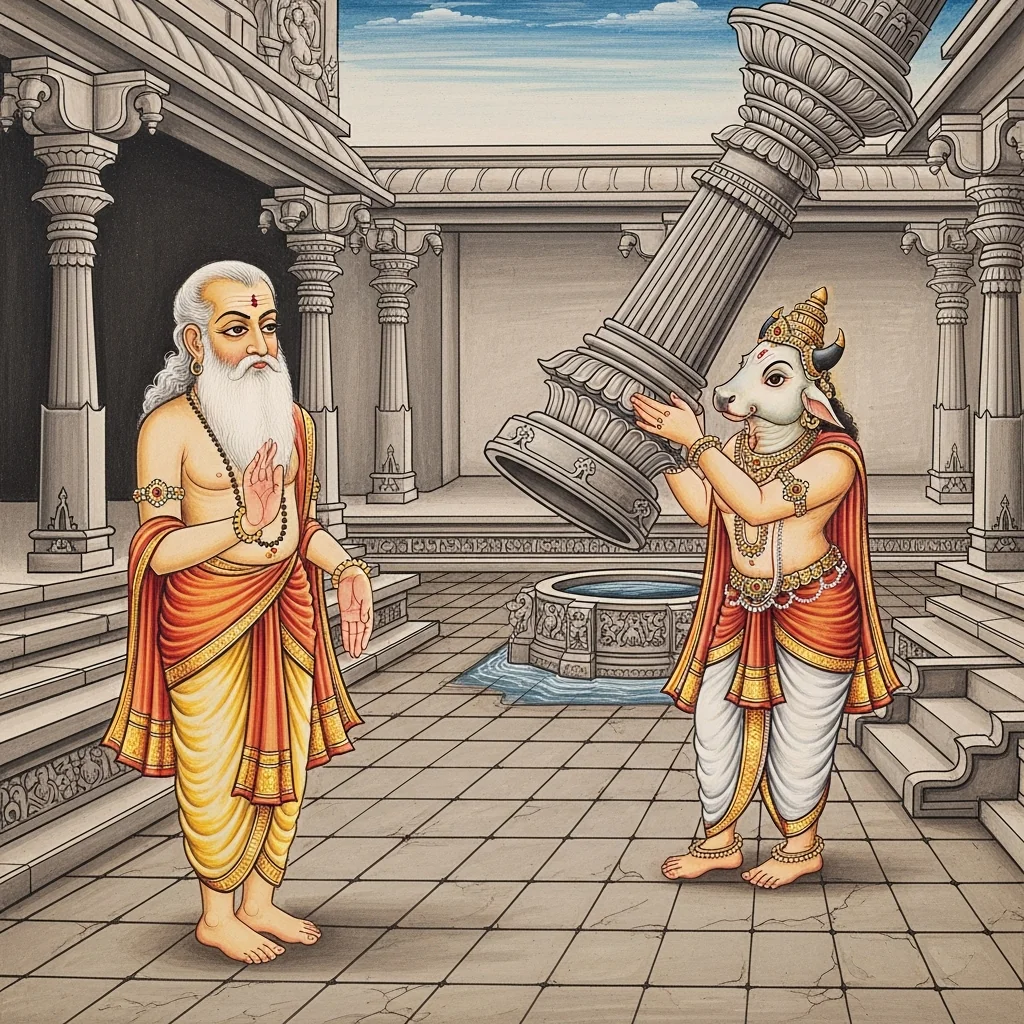
The chapter frames a theological dispute through Vyāsa’s encounter with Śaiva-leaning sages in Naimiṣāraṇya. Vyāsa advances an exclusivist Vaiṣṇava claim that Hari alone is to be served according to Veda, Itihāsa, and Purāṇa, and the sages direct him to Vārāṇasī/Kāśī, where Viśveśvara’s (Śiva’s) authority is final. Vyāsa goes to Kāśī, bathes and worships at Pañcanada-hrada, and enters the Viśveśvara precinct near Jñānavāpī amid Vaiṣṇava-style acclamations and a long litany of Viṣṇu’s names. As he repeats his claim with raised arm and emphatic recitation, a miraculous “stambha” immobilizes his arm and speech. Viṣṇu appears privately, acknowledges the error, and affirms Śiva as the sole Viśveśvara, explaining that Viṣṇu’s own powers and cosmic functions are bestowed through Śiva’s grace; Vyāsa is told to praise Śiva for an auspicious resolution. Vyāsa offers a focused Śiva-stotra (later known as the “Vyāsa-aṣṭaka”); Nandikeśvara releases the stambha and proclaims the hymn’s fruits—sin-removal and nearness to Śiva. The chapter ends with Vyāsa’s sustained Śaiva devotion, the स्थापना of the Vyāseśvara liṅga near Ghantākarṇa-hrada, and local assurances: bathing and darśana there grant Kāśī-linked salvific status and protect devotees from fear of sin and adversity in the Kali age.
Shlokas
Verse 1
व्यास उवाच । शृणु सूत महाबुद्धे यथा स्कंदेन भाषितम् । भविष्यं मम तस्याग्रे कुंभयोने महामते
Vyāsa said: Listen, O Sūta of great understanding, to what Skanda has spoken. (Hear) the future that concerns me, spoken before the wise Kumbhayoni Agastya, born of the pot.
Verse 2
स्कंद उवाच । निशामय महाभाग त्वं मैत्रावरुणे मुने । पाराशर्यो मुनिवरो यथा मोहमुपैष्यति
Skanda said: Listen with full attention, O noble sage Maitrāvaruṇa (Agastya). Hear how the eminent seer Pārāśarya (Vyāsa) will come to experience delusion (moha).
Verse 3
व्यस्य वेदान्महाबुद्धिर्नाना शाखा प्रभेदतः । अष्टादशपुराणानि सूतादीन्परिपाठ्य च
That great-minded Vyāsa arranged the Vedas into many śākhās, branches and divisions; and he also had the eighteen Purāṇas properly taught and recited by Sūta and others.
Verse 4
श्रुतिस्मृतिपुराणानां रहस्यं यस्त्वचीकरत् । महाभारतसंज्ञं च सर्वलोकमनोहरम्
He who set forth the inner secret of Śruti, Smṛti, and the Purāṇas also composed the work known as the Mahābhārata, enchanting to the hearts of all worlds.
Verse 5
सर्वपापप्रशमनं सर्वशांतिकरं परम् । यस्य श्रवणमात्रेण ब्रह्महत्या विनश्यति
It is the supreme means that pacifies all sins and brings every kind of peace; by the mere act of hearing it, even the sin of brahmin-slaying is destroyed.
Verse 6
एकदा स मुनिः श्रीमान्पर्यटन्पृथिवीतले । संप्राप्तो नैमिषारण्यं यत्र संति मुनीश्वराः
Once, that illustrious sage, wandering upon the face of the earth, arrived at Naimiṣāraṇya—where the lordly sages abide.
Verse 7
अष्टाशीतिसहस्राणि शौनकाद्यास्तपोधनाः । त्रिपुंड्रितमहाभाला लसद्रुद्राक्षमालिनः
Eighty-eight thousand ascetics—headed by Śaunaka—abounding in the wealth of tapas, with broad foreheads marked by the tripuṇḍra, the three lines of sacred ash, and wearing shining garlands of rudrākṣa beads.
Verse 8
विभूतिधारिणो भक्त्या रुद्रसूक्तजपप्रियान् । लिंगाराधनसंसक्ताञ्छिवनामकृतादरान्
They bore vibhūti, the sacred ash, with devotion, delighting in the japa of the Rudra-hymn; absorbed in worship of the liṅga, they revered with care the Name of Śiva.
Verse 9
एक एव हि विश्वेशो मुक्तिदो नान्य एव हि । इति ब्रुवाणान्सततं परिनिश्चितमानसान्
“Viśveśa alone is the giver of liberation—none other indeed!” Thus they spoke continually, their minds fixed in firm conviction.
Verse 10
विलोक्य स मुनिर्व्यासस्तासर्वान्गिरिशात्मनः । उत्क्षिप्य तर्जनीमुच्चैः प्रोवाचेदं वचः पुनः
Seeing them all—souls devoted to Girīśa—sage Vyāsa raised his index finger aloft and spoke these words again in a loud voice.
Verse 11
परिनिर्मथ्य वाग्जालं सुनिश्चित्यासकृद्बहु । इदमेकं परिज्ञातं सेव्यः सर्वेश्वरो हरिः
Having churned through the net of words and considered it again and again in many ways, this one conclusion is known: Hari, the Lord of all, is the One to be served.
Verse 12
वेदे रामायणे चैव पुराणेषु च भारते । आदिमध्यावसानेषु हरिरेकोऽत्र नापरः
In the Veda, in the Rāmāyaṇa, in the Purāṇas, and in the Bhārata—at the beginning, in the middle, and in the end—Hari alone is taught here; there is no other.
Verse 13
सत्यं सत्यं त्रिसत्यं पुनः सत्यं न मृषा पुनः । न वेदादपरं शास्त्रं न देवोच्युततः परः
Truth—truth—thrice truth; again, it is truth and never false. There is no scripture higher than the Veda, and there is no Deity higher than Acyuta (Viṣṇu).
Verse 14
लक्ष्मीशः सर्वदो नान्यो लक्ष्मीशोप्यपवर्गदः । एक एव हि लक्ष्मीशस्ततो ध्येयो न चापरः
None other than the Lord of Lakṣmī grants all attainments; and the Lord of Lakṣmī also bestows liberation. Indeed, Lakṣmīśa is one alone—therefore he alone is to be meditated upon, and not another.
Verse 15
भुक्तेर्मुक्तेरिहान्यत्र नान्यो दाता जनार्दनात् । तस्माच्चतुर्भुजो नित्यं सेवनीयः सुखेप्सुभिः
For enjoyment and for liberation—here and elsewhere—there is no giver other than Janārdana. Therefore the four-armed Lord should always be served by those who seek true well-being.
Verse 16
विहाय केशवादन्यं ये सेवंतेल्पमेधसः । संसारचक्रे गहने ते विशंति पुनःपुनः
Forsaking Keśava, those of little understanding who serve another fall again and again into the dense wheel of saṃsāra.
Verse 17
एक एव हि सर्वेशो हृषीकेशः परात्परः । तं सेवमानः सततं सेव्यस्त्रिजगतां भवेत्
For the Lord of all is one alone—Hṛṣīkeśa, higher than the highest. One who serves Him constantly becomes worthy of being served and honored by the three worlds.
Verse 18
एको धर्मप्रदो विष्णुस्त्वेको बह्वर्थदो हरिः । एकः कामप्रदश्चक्री त्वेको मोक्षप्रदोच्युतः
Viṣṇu alone grants dharma; Hari alone grants abundant prosperity. The discus-bearing Lord alone grants desires; Acyuta alone is said to grant liberation.
Verse 19
शार्ङ्गिणं ये परित्यज्य देवमन्यमुपासते । ते सद्भिश्च बहिष्कार्या वेदहीना यथा द्विजाः
Those who abandon Śārṅgin (Viṣṇu, bearer of the Śārṅga bow) and worship another deity should be excluded by the righteous, like twice-born men who are without the Veda.
Verse 20
श्रुत्वेति वाक्यं व्यासस्य नैमिषारण्यवासिनः । प्रवेपमानहृदयाः परिप्रोचुरिदं वचः
Hearing these words of Vyāsa, the dwellers in Naimiṣāraṇya, their hearts trembling, questioned him with the following speech.
Verse 21
ऋषय ऊचुः । पाराशर्य मुने मान्यस्त्वमस्माकं महामते । यतो वेदास्त्वया व्यस्ताः पुराणान्यपि वेत्ति यत्
The sages said: O Pārāśarya, revered muni, O great-minded one, you are honored among us; for it is you who arranged the Vedas, and you also know the Purāṇas.
Verse 22
यतश्च कर्ता त्वमसि महतो भारतस्य वै । धर्मार्थकाममोक्षाणां विनिश्चयकृतो ध्रुवम्
And since you are indeed the author of the great Bhārata, you are surely the one who has decisively determined the true conclusions concerning dharma, artha, kāma, and mokṣa.
Verse 23
तत्त्वज्ञः कोपरश्चात्र त्वत्तः सत्यवतीसुत । भवता यत्प्रतिज्ञातं निश्चित्योक्षिप्यतर्जनीम्
“O son of Satyavatī (Vyāsa), though you are a knower of truth, who here could be more wrathful than you? Having firmly resolved upon what you had vowed, you raised your forefinger in stern emphasis.”
Verse 24
अस्मिन्माणवकास्तत्र परिश्रद्दधते नहि । प्रतिज्ञा तस्य वचसस्तव श्रद्धा भवेत्तदा
“In this matter, the young students here do not place full confidence. Only then would they have faith in your words—if that statement becomes an actual vow (kept in deed).”
Verse 25
यदाऽनंदवने शंभोः प्रतिजानासि वै वचः
“When, in Ānandavana—the blissful grove of Śambhu (Śiva)—you make your declaration indeed…”
Verse 26
गच्छ वाराणसीं व्यास यत्र विश्वेश्वरः स्वयम् । न तत्र युगधर्मोस्ति न च लग्ना वसुंधरा
“Go to Vārāṇasī, O Vyāsa, where Viśveśvara Himself abides. There, the constraints of the age’s dharma do not prevail, nor is the earth bound by ordinary limitation.”
Verse 27
इति श्रुत्वा मुनिर्व्यासः किंचित्कुपितवद्धृदि । जगाम तूर्णं सहितः स्वशिष्यैरयुतोन्मितैः
Hearing this, the sage Vyāsa—his heart somewhat stirred as if in anger—set out swiftly, accompanied by his own disciples, countless in number.
Verse 28
प्राप्य वाराणसीं व्यासः स्नात्वा पंचनदे ह्रदे । श्रीमन्माधवमभ्यर्च्य ययौ पादोदकं ततः
Having reached Vārāṇasī, Vyāsa bathed in the lake of Pañcanada. Then, worshipping the venerable Mādhava, he proceeded thereafter to seek the sacred water from the Lord’s feet (pādodaka).
Verse 29
तत्र स्नानादिकं कृत्वा दृष्ट्वा चैवादिकेशवम् । पंचरात्रं ततः कृत्वा वैष्णवैरभिनंदितः
There, having performed bathing and the other observances, and having had darśana of Ādikeśava, he then observed the Pañcarātra rite, and was honored by the Vaiṣṇavas.
Verse 30
अग्रतः पृष्ठतः शंखैर्वाद्यमानैः प्रमोदितः । जयविष्णो हृषीकेश गोविंद मधुसूदन
Delighted as conches were being sounded before and behind him, they cried: “Victory to Viṣṇu—O Hṛṣīkeśa, Govinda, Madhusūdana!”
Verse 31
अच्युतानंतवैकुंठ माधवोपेंद्रकेशव । त्रिविक्रम गदापाणे शार्ङ्गपाणे जनार्दन
“O Acyuta, O Ananta, O Vaikuṇṭha; O Mādhava, Upendra, Keśava; O Trivikrama, wielder of the mace; wielder of Śārṅga, the bow; O Janārdana!”
Verse 32
श्रीवत्सवक्षः श्रीकांत पीतांबर मुरांतक । कैटभारे बलिध्वंसिन्कंसारे केशिसूदन
O You who bear Śrīvatsa upon Your chest, beloved of Śrī (Lakṣmī), clad in yellow robes; slayer of Mura, destroyer of Kaiṭabha, crusher of Bali’s pride, foe of Kaṃsa, and slayer of Keśin!
Verse 33
नारायणासुररिपो कृष्ण शौरे चतुर्भुज । देवकीहृदयानंद यशोदानंदवर्धन
O Nārāyaṇa, foe of the asuras; O Kṛṣṇa, descendant of Śūra, four-armed Lord—You are the joy of Devakī’s heart and the increaser of Yaśodā’s delight.
Verse 34
पुंडरीकाक्ष दैत्यारे दामोदर बलप्रिय । बलारातिस्तुत हरे वासुदेव वसुप्रद
O lotus-eyed One, slayer of the daityas; O Dāmodara, dear to Balarāma; O Hari praised by Indra—O Vāsudeva, bestower of prosperity and blessings.
Verse 35
विष्वक्चमूस्तार्क्ष्य रथवनमालिन्नरोत्तम । अधोक्षज क्षमाधार पद्मनाभ जलेशय
O Lord whose chariot is borne by Garuḍa and whose hosts pervade the universe; O wearer of the forest-garland, Supreme Person—O Adhokṣaja, support of the earth; O Padmanābha, You who repose upon the cosmic waters.
Verse 36
नृसिंह यज्ञवाराह गोपगोपालवल्लभ । गोपीपते गुणातीत गरुडध्वज गोत्रभृत्
O Narasiṃha; O Yajña-varāha, the Boar-incarnation who upholds the sacrifice; beloved of the cowherds and protector of the cows—O Lord of the gopīs, beyond the guṇas; O You whose banner is Garuḍa, lifter of the mountain (Govardhana).
Verse 37
जय चाणूरमथन जय त्रैलोक्यरक्षण । जयानाद्य जयानंद जय नीलोत्पलद्युते
Victory to You, slayer of Cāṇūra! Victory to You, protector of the three worlds! Victory to the Beginningless One, victory to Bliss itself—victory to You whose splendor is like the blue lotus.
Verse 38
कौस्तुभोद्भूषितोरस्क पूतनाधातुशोषण । रक्षरक्ष जगद्रक्षामणे नरकहारक
O You whose chest is adorned with the Kaustubha jewel; O You who drained Pūtanā’s very life-breath—protect, protect! O precious protector of the world, O destroyer of Naraka.
Verse 39
सहस्रशीर्षपुरुष पुरुहूत सुखप्रद । यद्भूतं यच्च भाव्यं वै तत्रैकः पुरुषो भवान्
O Thousand-headed Puruṣa, O much-invoked Lord, giver of happiness—whatever has been and whatever is yet to be, in all that You alone are the one Puruṣa.
Verse 40
इत्यादि नाममालाभिः संस्तुवन्वनमालिनम् । स्वच्छंदलीलया गायन्नृत्यंश्च परया मुदा
Thus, praising the Garlanded Lord with such garlands of names, he sang and danced in spontaneous play, filled with supreme joy.
Verse 41
व्यासो विश्वेशभवनं समायातः सुहृष्टवत् । ज्ञानवापी पुरोभागे महाभागवतैः सह
Vyāsa, rejoicing greatly, arrived at the abode of Viśveśvara; with great devotees he came to the fore at Jñānavāpī.
Verse 42
विराजमानसत्कंठस्तुलसीवरदामभिः । स्वयं तालधरो जातः स्वयं जातः सुनर्तकः
His noble neck shone, adorned with excellent garlands of tulasī; of his own accord he took up the tāla hand-cymbals, and of his own accord he became a graceful dancer.
Verse 43
वेणुवादनतत्त्वज्ञः स्वयं श्रुतिधरोभवत् । नृत्यं परिसमाप्येत्थं व्यासः सत्यवतीसुतः
Thus Vyāsa, the son of Satyavatī—master of the inner principles of flute-music and himself a true bearer of the Veda—brought his dance to its close.
Verse 44
पुनरूर्ध्वभुजं कृत्वा दक्षिणं शिष्यमध्यगः । पुनः पपाठ तानेव श्लोकान्गायन्निवोच्चकैः
Again raising his arm aloft, he turned toward the disciple on the right, and once more recited those very verses, chanting as though in song, in a loud voice.
Verse 45
परिनिर्मथ्य वाग्जालं सुनिश्चित्यासकृद्बहु । इदमेकं परिज्ञातं सेव्यः सर्वेश्वरो हरिः
Having thoroughly churned the net of words and repeatedly examined much learning, one conclusion alone is firmly known: Hari, the Lord of all, is to be worshipped.
Verse 46
इत्यादि श्लोकसंघातं स्वप्रतिज्ञा प्रबोधकम् । यावत्पठति स व्यासः सव्यमुत्क्षिप्य वै भुजम्
Reciting these and other clusters of verses that awakened his own resolve, Vyāsa continued to read on, lifting his left arm aloft.
Verse 47
तस्तंभ तावत्तद्बाहुं स शैलादिः स्वलीलया । वाक्स्तंभश्चापि तस्यासीन्मुनेर्व्यासस्य सन्मुनेः
Then the Lord—Śailādi (Śiva)—by his own sportive power at once made that arm rigid; and the speech of the sage Vyāsa, that noble seer, was also brought to a halt.
Verse 48
ततो गुप्तं समागम्य विष्णुर्व्यासमभाषत । अपराद्धं महच्चात्र भवता व्यास निश्चितम्
Then Viṣṇu came unseen and spoke to Vyāsa: “O Vyāsa, you have indeed committed a grave offence here.”
Verse 49
तवैतदपराधेन भीतिर्मेपि महत्तरा । एक एव हि विश्वेशो द्वितीयो नास्ति कश्चन
“Because of this offence of yours, even I feel a still greater fear. For the Lord of the universe is one alone; there is no second whatsoever.”
Verse 50
तत्प्रसादादहं चक्री लक्ष्मीशस्तत्प्रभावतः । त्रैलोक्यरक्षासामर्थ्यं दत्तं तेनैव शंभुना
“By his grace I became the wielder of the discus, the Lord of Lakṣmī; and by his very power, the capacity to protect the three worlds was bestowed—by that same Śambhu.”
Verse 51
तद्भक्त्या परमैश्वर्यं मया लब्धं वरात्ततः । इदानीं स्तुहि तं शंभुं यदि मे शुभमिच्छसि
“Through devotion to him, I obtained supreme sovereignty by his boon. Now praise that Śambhu, if you desire what is auspicious—for me and for yourself.”
Verse 52
अन्यदापि न वै कार्या भवता शेमुषीदृशी । पाराशर्य इति श्रुत्वा संज्ञया व्याजहार ह
“Never again should such a thought arise in you.” And on hearing the address “Pārāśarya!”, he replied with a sign of acknowledgement.
Verse 53
भुजस्तंभः कृतस्तेन नंदिना दृष्टिमात्रतः । वाक्स्तंभस्तद्भयाज्जातः स्पृश मे कंठकंदलीम्
By Nandin’s mere glance my arms were frozen stiff like pillars; and from fear of him my speech too was arrested. Touch, I pray, the knot at my throat and set me free.
Verse 54
यथा स्तोतुं भवानीश प्रभवाभि भवांतकम । संस्पृश्य विष्णुस्तत्कंठं गुप्तमेव जगाम ह
So that he might praise you, O Lord of Bhavānī, destroyer of worldly becoming, Viṣṇu touched his throat—and then departed unseen.
Verse 55
ततः सत्यवतीसूनुस्तथा स्तंभितदोर्लतः । प्रारब्धवान्महेशानं परितुष्टोतुमुदारधीः
Then Satyavatī’s son—his arms still held rigid—began, with noble intent, to praise Maheśa so as to please him.
Verse 57
यः क्षीराब्धेर्मंदराघातजातो ज्वालामाली कालकूटोति भीमः । तं सोढुं वा को परोऽभून्महेशाद्यत्कीलाभिः कृष्णतामाप विष्णुः
That dreadful Kālakūṭa poison—wreathed in flames—arose from the Milk-Ocean when Mount Mandara struck it. Who could have borne it besides Maheśa? So fierce was it that, by its burning prongs, even Viṣṇu turned dark.
Verse 58
यद्वाणोभूच्छ्रीपतिर्यस्य यंता लोकेशो यत्स्यंदनं भूः समस्ता । वाहा वेदा यस्य येनेषुपाताद्दग्धा ग्रामास्त्रैपुरास्तत्समः कः
He whose arrow was Śrīpati (Viṣṇu), whose charioteer was the Lord of the worlds (Brahmā), whose chariot was the whole earth, and whose steeds were the Vedas—by whose arrow’s release the cities of Tripura were burned: who can be equal to Him?
Verse 59
यं कदर्पो वीक्षमाणः समानं देवैरन्यैर्भस्मजातः स्वयं हि । पौष्पैर्बाणैः सर्वविश्वैकजेता को वा स्तुत्यः कामजेतुस्ततोन्यः
When Kāma, deeming Him no more than equal to other gods, cast his gaze upon Him, he himself was turned to ashes. Though he conquers the whole world with flower-arrows—who is worthy of praise but that Conqueror of Kāma?
Verse 60
यं वै वेदो वेद नो नैव विष्णुर्नोवा वेधा नो मनो नैव वाणी । तं देवेशं मादृशः कोल्पमेधा याथात्म्याद्वै वेत्त्यहो विश्वनाथम्
Him whom even the Veda knows only in part, and whom neither Viṣṇu nor Brahmā—nor mind, nor speech—can fully encompass: how could one of little intellect like me truly know Viśvanātha, the Lord of gods, as He really is?
Verse 61
यस्मिन्सर्वं यस्तु सर्वत्र सर्वो यो वै कर्ता योऽविता योऽपहर्ता । नो यस्यादिर्यः समस्तादिरेको नो यस्यांतो योंतकृत्तं नतोस्मि
In whom all exists; who is everywhere and is all; who is the doer, the protector, and the withdrawer; who has no beginning, yet is the one beginning of all; who has no end, yet is the maker of ends—to Him I bow.
Verse 62
यस्यैकाख्या वाजिमेधेन तुल्या यस्या न त्या चैकयाल्पेंद्रलक्ष्मीः । यस्य स्तुत्या लभ्यते सत्यलोको यस्यार्चातो मोक्षलक्ष्मीरदूरा
A single utterance of His Name equals an Aśvamedha sacrifice; beside Him even Indra’s meagre splendor is nothing. By praising Him one attains Satyaloka, and by worshipping Him the blessed fortune of liberation is not far away.
Verse 63
नान्यं देवं वेद्म्यहं श्रीमहेशान्नान्यं देवं स्तौमि शंभोरृतेऽहम् । नान्यं देवं वा नमामि त्रिनेत्रात्सत्यं सत्यं सत्यमेतन्मृषा न
I know no other god than glorious Maheśa; I praise no other god but Śambhu; I bow to no other god than the Three-eyed One. Truth—truth—this is truth; it is not false.
Verse 64
इत्थं यावत्स्तौति शंभुं महर्षिस्तावन्नंदी शांभवाद्दृक्प्रसादात् । तद्दोः स्तंभं त्यक्तवांश्चाबभाषे स्मायंस्मायं ब्राह्मणेभ्यो नमो वः
While the great sage continued praising Śambhu in this way, Nandī—through Śambhu’s gracious glance—was freed from the stiffness of his arms. Smiling again and again, he said: “Salutations to you, O brāhmaṇas.”
Verse 65
नंदिकेश्वर उवाच । इदं स्तवं महापुण्यं व्यास ते परिकीर्तितम् । यः पठिष्यति मेधावी तस्य तुष्यति शंकरः
Nandīkeśvara said: “O Vyāsa, this hymn you have proclaimed is supremely meritorious. The wise person who recites it—Śaṅkara becomes pleased with him.”
Verse 66
व्यासाष्टकमिदं प्रातः पठितव्यं प्रयत्नतः । दुःस्वप्नपापशमनं शिवसान्निध्यकारकम्
This “Vyāsa Aṣṭaka” should be recited in the morning with diligence. It pacifies evil dreams and sins, and it brings about the nearness of Śiva’s presence.
Verse 67
मातृहा पितृहा वापि गोघ्नो बालघ्र एव वा । सुरापी स्वर्णहृद्वापि निष्पापो स्याः स्तुतेर्जपात्
Even one who has slain mother or father, or killed a cow, or killed a child; even a drinker of liquor or a stealer of gold—by the repeated recitation of this hymn, one becomes free from sin.
Verse 68
स्कंद उवाच । पाराशर्यस्तदारभ्य शंभुभक्तिपरोभवत् । लिंगं व्यासेश्वरं स्थाप्य घंटाकर्ण ह्रदाग्रतः
Skanda said: “From that time onward, Pārāśarya (Vyāsa) became wholly devoted in bhakti to Śambhu (Śiva). Establishing the Vyāseśvara Liṅga before the Ghaṇṭākarṇa Lake…”
Verse 69
विभूतिभूषणो नित्यं नित्यरुद्राक्षभूषणः । रुद्रसूक्तपरो नित्यं नित्यं लिंगार्चकोभवत्
He ever wore vibhūti, sacred ash, as his adornment, and was ever adorned with rudrākṣa beads; ever devoted to the Rudra-hymns, he became one who constantly worshipped the Liṅga.
Verse 70
स कृत्वा क्षेत्रसंन्यासं त्यजेन्नाद्यापि काशिकाम् । तत्त्वं क्षेत्रस्य विज्ञाय निर्वाणपददायिनः
Having undertaken “renunciation unto the sacred kṣetra,” he did not abandon Kāśikā even to this day—having understood the true nature of that holy realm which bestows the state of nirvāṇa, liberation.
Verse 71
घंटाकर्णह्रदे स्नात्वा दृष्ट्वा व्यासेश्वरं नरः । यत्रकुत्र मृतो वापि वाराणस्यां मृतो भवेत्
A man who bathes in the Ghaṇṭākarṇa Lake and beholds Vyāseśvara—wherever he may die thereafter—attains the status of one who has died in Vārāṇasī.
Verse 72
काश्यां व्यासेश्वरं लिंगं पूजयित्वा नरोत्तमः । न ज्ञानाद्भ्रश्यते क्वापि पातकैर्नाभिभूयते
The best of men, having worshipped the Vyāseśvara Liṅga in Kāśī, never falls away from true knowledge, and is not overcome by sins anywhere.
Verse 73
व्यासेश्वरस्य ये भक्ता न तेषां कलिकालतः । न पापतो भयं क्वापि न च क्षेत्रोपसर्गतः
Those who are devotees of Vyāseśvara have no fear of the age of Kali; nowhere do they fear sin, nor do they fear misfortunes connected with the sacred region.
Verse 74
व्यासेश्वरः प्रयत्नेन द्रष्टव्यः काशिवासिभिः । घंटाकर्णकृतस्नानैः क्षेत्रपातकभीरुभिः
The residents of Kāśī should, with earnest effort, surely go to behold the liṅga of Vyāseśvara—those who have bathed at Ghaṇṭākarṇa and who, fearing sins committed within the sacred kṣetra, seek purification.
Verse 95
इति श्रीस्कांदे महापुराण एकाशीति साहस्र्यां संहितायां चतुर्थे काशीखंड उत्तरार्धे व्यासभुजस्तंभोनाम पंचनवतितमोऽध्यायः
Thus ends, in the venerable Skanda Mahāpurāṇa—within the eighty-one-thousand-verse compilation, in the fourth saṃhitā—within the Kāśī Khaṇḍa (Uttarārdha), the ninety-fifth chapter called “The Stopping of Vyāsa’s Arm.”