Adhyaya 50
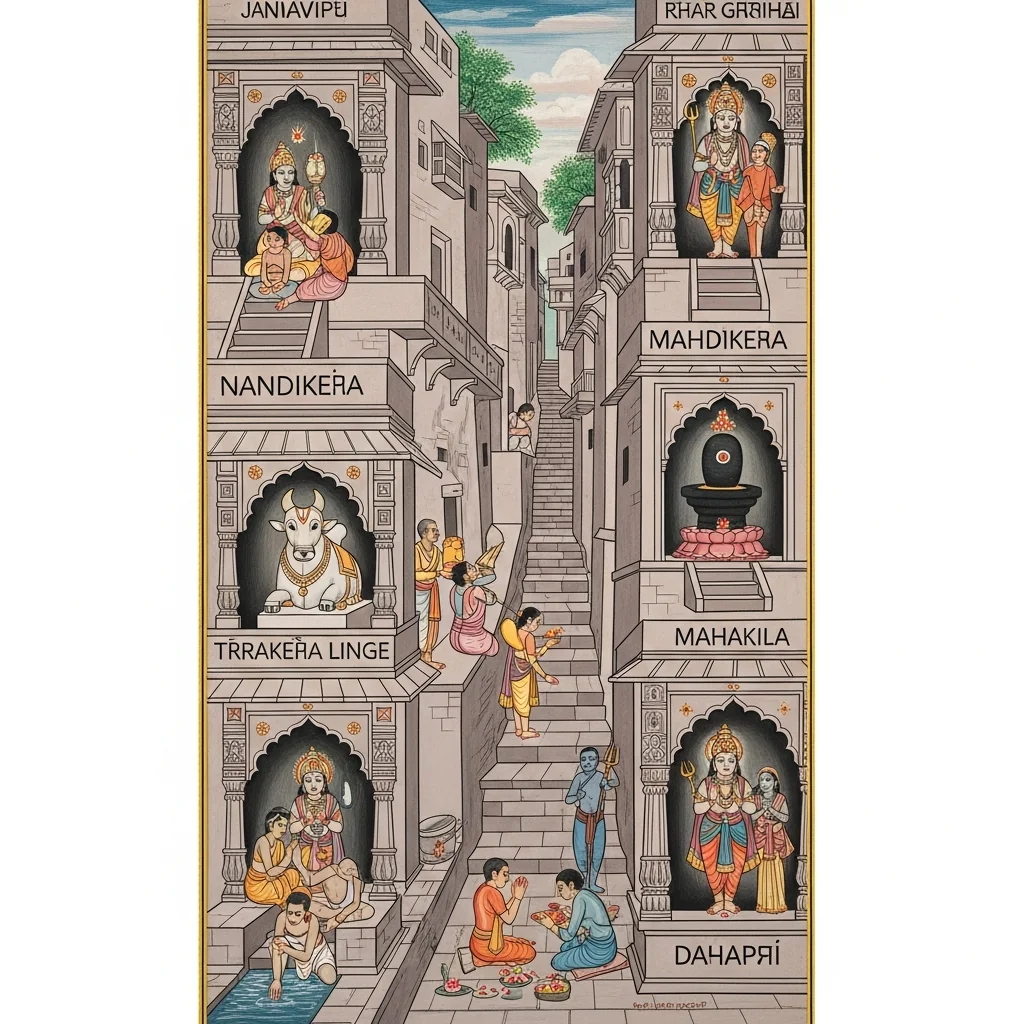
This chapter unfolds in two main movements. First, Vyāsa answers Sūta by giving an anukramaṇikā-style index of the Kāśī Khaṇḍa, listing in sequence its narrative materials—dialogues, praises of tīrthas, origin accounts of shrines, and deity-mahātmya themes—serving as an internal table of contents. Next, at Sūta’s prompting, Vyāsa sets out practical pilgrimage (yātrā) observances: an initial purificatory bath, offerings to the devas and pitṛs, and respectful gifts to brāhmaṇas, followed by multiple pilgrimage circuits. He describes the daily pañcatīrthikā sequence (such as Jñānavāpī, Nandikeśa, Tārakeśa, Mahākāla, Daṇḍapāṇi), broader Vaiśveśvarī and multi-āyatana routes, and specialized circuits including the aṣṭāyatana, an ekādaśaliṅga yātrā, and a Gaurī-yātrā aligned with lunar tithis. The chapter further details an extensive antar-gṛha (inner precinct) itinerary with many shrine visitations, recommending mauna (sacred silence) for greater fruit. It concludes with phalaśruti: hearing or reciting brings benefits comparable to wider study; written copies should be honored for auspiciousness; and properly performed yātrās remove obstacles, increase merit, and lead toward liberation-oriented results.
Shlokas
Verse 1
सूत उवाच । इदं स्कांदमहं श्रुत्वा काशीखंडमनुत्तमम् । नितरां परितृप्तोस्मि हृदि चापि विधारितम्
Sūta said: Having heard this unsurpassed Kāśīkhaṇḍa of the Skanda Purāṇa, I am deeply satisfied, and I have held it firmly within my heart.
Verse 2
अनुक्रमणिकाध्यायं तथा माहात्म्यमुत्तमम् । पाराशर्य समाचक्ष्व यथापूर्वमिदं भवेत्
“O Pārāśarya, son of Parāśara, expound the Anukramaṇikā chapter that serves as an index, and also this supreme Māhātmya, so that it may be set forth here exactly as it was before.”
Verse 3
व्यास उवाच । सूतावधेहि धर्मात्मञ्जातूकर्ण्य निशामय । शुकवैशंपायनाद्याः शृण्वंत्वपि च बालकाः
Vyāsa said: “O Sūta, righteous-souled one—listen, Jātūkarṇya. Let Śuka, Vaiśaṃpāyana, and the others, and even the young students, hear this as well.”
Verse 4
अनुक्रमणिकाध्यायं माहात्म्यं चापि खंडजम् । प्रवक्ष्याम्यघनाशाय महापुण्यप्रवर्धनम्
“I shall proclaim the index-chapter, Anukramaṇikā, and also the Māhātmya arising in this Khaṇḍa—destroying sin and greatly increasing merit.”
Verse 5
विंध्यनारदसंवादः प्रथमे परिकीर्तितः । सत्यलोकप्रभावश्च द्वितीयः समुदाहृतः
“In the first chapter, the dialogue between Vindhya and Nārada is recounted; in the second, the majestic power of Satyaloka is described.”
Verse 6
अगस्तेराश्रमपदे देवानामागमस्ततः । पतिव्रता चरित्रं च प्रस्थानं कुंभसंभवः
Then is recounted the coming of the gods to Agastya’s hermitage; the tale of a wife steadfast in her vow (pativratā); and the departure of the Pot-born sage, Agastya.
Verse 7
तीर्थप्रशंसा च ततः सप्तपुर्यस्ततः स्मृताः । संयमिन्याः स्वरूपं च ब्रध्नलोकस्ततः परम्
Thereafter comes the praise of the sacred tīrthas; then the famed seven holy cities are recalled; then the true nature of Saṃyaminī is revealed; and after that, the realm called Bradhnaloka.
Verse 8
इंद्राग्न्योर्लोकसंप्राप्तिस्ततश्च शिवशर्मणः । अग्नेः समुद्भवस्तस्मात् क्रव्याद्वरुणसंभवः
Then is told the attainment of the realms of Indra and Agni, and thereafter the account of Śivaśarman; next, the manifestation arising from Agni, and from that the origin of Kravyāda and Varuṇa.
Verse 9
गंधवत्यलकापुर्योरीशयोस्तु समुद्भवः । चंद्रलोकपरिप्राप्तिः शिवशर्मद्विजन्मनः
Then is described the origin of the lords of Gandhavatī and Alakāpurī; and the full attainment of the lunar realm by the twice-born Śivaśarman.
Verse 10
उडुलोक कथा तस्मात्ततः शुक्रसमुद्भवः । माहेय गुरुसौरीणां लोकानां वर्णनं ततः
Thereafter comes the account of Uḍuloka; then the origin of Śukra; and then the description of the realms of Māheya, Guru (Bṛhaspati), and Saurī (Śani).
Verse 11
सप्तर्षीणां ततो लोका ध्रुवस्य च तपस्ततः । ततो ध्रुवपदप्राप्तिर्ध्रुवलोक स्थितिस्ततः
Then are described the realms of the Seven Ṛṣis; then Dhruva’s austerities (tapas); then his attainment of the eternal station, the Dhruva‑pada; and thereafter his abiding in Dhruvaloka.
Verse 12
दर्शनं सत्यलोकस्य तस्य वै शिवशर्मणः । चतुर्भुजाभिषेकश्च निर्वाणं शिवशर्मणः
For the devotee named Śivaśarman there is the vision of Satyaloka; there is also the consecration (abhiṣeka) bestowing a four-armed divine form; and finally, for Śivaśarman, there is liberation (nirvāṇa).
Verse 13
स्कंदागस्त्योश्च संवादो मणिकर्ण्याः समुद्भवः । ततस्तु गंगामाहात्म्यं ततो दशहरास्तवः
Then comes the dialogue between Skanda and Agastya; the account of the origin of Maṇikarṇī; thereafter the greatness (māhātmya) of the Gaṅgā, and then the hymns of Daśaharā.
Verse 14
प्रभावश्चापि गंगाया गंगानामसहस्रकम् । वाराणस्याः प्रशंसाथ भैरवाविर्भवस्ततः
Also comes the account of the Gaṅgā’s power, and the “Gaṅgā-nāma-sahasra”, the thousand names of the Gaṅgā; then the praise of Vārāṇasī, and thereafter the manifestation of Bhairava.
Verse 15
दंडपाणेः समुद्भूतिर्ज्ञानवाप्युद्भवस्ततः । आख्यानं च कलावत्याः सदाचारस्ततः परम्
Then comes the account of the origin of Daṇḍapāṇi; thereafter the origin of Jñānavāpī; the narrative of Kalāvatī; and after that, the teaching on right conduct (sadācāra).
Verse 16
ब्रह्मचारि प्रकरणं ततः स्त्रीलक्षणानि च । कृत्याकृत्यप्रकरणमविमुक्तेशवर्णनम्
Then comes the section on the discipline of brahmacarya; the characteristics of women; the section on what is to be done and what is to be avoided; and the description of Avimukteśa.
Verse 17
ततो गृहस्थधर्माश्च ततो योगनिरूपणम् । कालज्ञानं ततः प्रोक्तं दिवोदासस्य वर्णनम्
Then come the duties of the householder; then an exposition of yoga. Next is taught the knowledge of time (auspicious timings), and thereafter the account of Divodāsa.
Verse 18
काश्याश्च वर्णनं तस्माद्योगिनीवर्णनं ततः । लोलार्कस्य समाख्यानमुत्तरार्ककथा ततः
Thereafter is the description of Kāśī; then the description of the Yoginīs. Next is the full account of Lolārka, and thereafter the narrative of Uttarārka.
Verse 19
सांबादित्यस्य महिमा द्रुपदादित्य शंसनम् । ततस्तु गरुडाख्यानमरुणार्कादयस्ततः
Then comes the greatness of Sāmbāditya and the praise of Drupadāditya. Thereafter is the narrative of Garuḍa, and then the accounts of Aruṇārka and other solar manifestations.
Verse 20
दशाश्वमेधिकं तीर्थं मंदराच्च गणागमः । पिशाचमोचनाख्यानं गणेशप्रेषणं ततः
Then comes the holy ford called Daśāśvamedhika, and the coming of Śiva’s gaṇas from Mandara. Next is the narrative of deliverance from piśācas, and thereafter the mission of Gaṇeśa.
Verse 21
मायागणपतेश्चाथ ढुंढिप्रादुर्भवस्ततः । विष्णुमायाप्रपंचोथ दिवोदासविसर्जनम्
Then comes the account of Māyāgaṇapati; thereafter the manifestation of Ḍhuṃḍhi. Next is the unfolding of Viṣṇu’s māyā, and then the departure (dismissal) of Divodāsa.
Verse 22
ततः पंचनदोत्पत्तिर्बिंदुमाधवसंभवः । ततो वैष्णवतीर्थानां माहात्म्यपरिवर्णनम्
Then comes the account of the arising of Pañcanada and the manifestation of Bindumādhava; thereafter is the full celebration of the greatness of the Vaiṣṇava sacred fords (tīrthas) of Kāśī.
Verse 23
प्रयाणं मंदरात्काशीं वृषभध्वजशूलिनः । जैगीषव्येन संवादो ज्येष्ठस्थाने महेशितुः
Then is told the journey of the Trident-bearing Lord, whose banner is the bull, from Mandara to Kāśī; and the dialogue with Jaigīṣavya at the sacred Jyeṣṭhasthāna of Maheśvara.
Verse 24
ततः क्षेत्ररहस्यस्य कथनं पापनाशनम् । अथातः कंदुकेशस्य व्याघ्रेशस्य समुद्भवः
Then is given the sin-destroying exposition of the secret of the sacred Field (Kāśī); and next, the account of the origin of Kaṇḍukeśa and of Vyāghreśa.
Verse 25
ततः शैलेश्वरकथा रत्नेशस्य च दर्शनम् । कृत्तिवासः समुत्पत्तिस्ततश्चायतनागमः
Then follows the account of Śaileśvara and the vision of Ratneśa; then the origin of Kṛttivāsa, and thereafter the tradition concerning the shrine/temple (āyatana).
Verse 26
देवतानामधिष्ठानं दुर्गासुरपराक्रमः । दुर्गाया विजयश्चाथ तत ओंकारवर्णनम्
Then are described the divine seat of the gods, the fierce onslaught of the Durgā-asura, and the victory of Goddess Durgā; and thereafter comes the exposition of Oṃkāra.
Verse 27
पुनरोंकारमाहात्म्यं त्रिलोचनसमुद्भवः । त्रिलोचनप्रभावोथ केदाराख्यानमेव च
Again is declared the greatness of Oṃkāra, the arising of Trilocana, and the power of Trilocana; and also the narrative of Kedāra.
Verse 28
ततो धर्मेशमहिमा ततः पक्षिकथा शुभा । ततो विश्वभुजाख्यानं दुर्दमस्य कथा ततः
Then comes the glory of Dharmeśa; then an auspicious tale of a bird; then the account of Viśvabhuja; and thereafter the story of Durdama.
Verse 29
ततो वीरेश्वराख्यानं वीरेश महिमा पुनः । गंगातीर्थैश्च संयुक्ता कामेश महिमा ततः
Then is narrated the account of Vīreśvara, and again the glory of Vīreśa; then, connected with the tīrthas of the Gaṅgā, comes the greatness of Kāmeśa.
Verse 30
विश्वकर्मेश महिमा दक्षयज्ञसमुद्भवः । सत्या देहविसर्गश्च ततो दक्षेश्वरोद्भवः
Then is proclaimed the greatness of Viśvakarmeśa, the arising connected with Dakṣa’s sacrifice, the relinquishing of Satī’s body, and thereafter the manifestation of Dakṣeśvara.
Verse 31
ततो वै पार्वतीशस्य महिम्नः परिकीर्तनम् । गंगेशस्याथ महिमा नर्मदेशसमुद्भवः
Then indeed is sung the greatness of Pārvatīśa (Śiva, Lord of Pārvatī); next, the glory of Gaṅgeśa, and the account of the origin connected with the land of the Narmadā.
Verse 32
सतीश्वरसमुत्पत्तिरमृतेशादि वणर्नम् । व्यासस्य हि भुजस्तंभो व्यासशापविमोक्षणम्
Here are recounted, in order, the origin of Satīśvara, the description of Amṛteśa and other sacred manifestations, the stiffening of Vyāsa’s arm, and the release from Vyāsa’s curse—topics that proclaim the greatness of Kāśī’s holy sites.
Verse 33
क्षेत्रतीर्थकदंबं च मुक्तिमंडप संकथा । विश्वेशाविर्भवश्चाथ ततो यात्रापरिक्रमः
The cluster of sacred sites and tīrthas of the holy field (Kāśī) is described, along with the account of the Mukti-maṇḍapa; then the manifestation of Viśveśa is told—and thereafter the pilgrimage-circuit (yātrā-parikramā) is set forth.
Verse 34
एतदाख्यानशतकं क्रमेण परिकीर्तितम् । यस्य श्रवणमात्रेण सर्वखंड श्रुतेः फलम् । अनुक्रमणिकाध्यायेप्यस्ति यात्रापरिक्रमः
Thus this “hundred narratives” has been recounted in due sequence; by merely hearing it, one gains the fruit of hearing all the sections. And even in this chapter of contents (anukramaṇikā), the pilgrimage-circuit (yātrā-parikramā) is included.
Verse 35
सूत उवाच । यात्रा परिक्रमं ब्रूहि जनानां हितकाम्यया । यथावत्सिद्धिकामानां सत्यवत्याः सुतोत्तम
Sūta said: O best of Satyavatī’s sons, out of compassion for the welfare of people, describe properly the pilgrimage-circuit (yātrā-parikramā), so that those who seek success and fulfillment may follow it rightly.
Verse 36
व्यास उवाच । निशामय महाप्राज्ञ लोमहर्षण वच्मि ते । यथा प्रथमतो यात्रा कर्तव्या यात्रिकैर्मुदा
Vyāsa said: Listen, O Lomaharṣaṇa of great wisdom; I shall tell you how, from the very beginning, pilgrims should joyfully perform the yātrā.
Verse 37
सचैलमादौ संस्नाय चक्रपुष्करिणीजले । संतर्प्यदेवासपितॄन्ब्राह्मणांश्च तथार्थिनः
First, having bathed—even with one’s garments on—in the waters of Cakrapuṣkariṇī, one should offer tarpana to satisfy the gods and the ancestors, and also give to brāhmaṇas and the needy.
Verse 38
आदित्यं द्रौपदीं विष्णुं दंडपाणिं महेश्वरम् । नमस्कृत्य ततो गच्छेद्द्रष्टुं ढुंढिविनायकम्
Having paid homage to Āditya, Draupadī, Viṣṇu, Daṇḍapāṇi, and Maheśvara, one should then proceed to behold Ḍhuṃḍhivināyaka.
Verse 39
ज्ञानवापीमुपस्पृश्य नंदिकेशं ततोर्चयेत् । तारकेशं ततोभ्यर्च्य महाकालेश्वरं ततः
After touching and ritually cleansing (ācaman) with the waters of Jñānavāpī, one should worship Nandikeśa; then, having worshiped Tārakeśa, one should thereafter worship Mahākāleśvara.
Verse 40
ततः पुनर्दंडपाणिमित्येषा पंचतीर्थिका
Then again one returns to Daṇḍapāṇi—this is what is called the ‘five-tīrtha’ circuit.
Verse 41
दैनंदिनी विधातव्या महाफलमभीप्सुभिः । ततो वैश्वेश्वरी यात्रा कार्या सर्वार्थ सिद्धिदा
Those who seek great fruit should keep this as a daily discipline; thereafter the Vaiśveśvarī pilgrimage should be performed, for it grants the accomplishment of all aims.
Verse 42
द्विसप्तायतनानां च कार्या यात्रा प्रयत्नतः । कृष्णां प्रतिपदं प्राप्य भूतावधि यथाविधि
With diligent effort one should undertake the pilgrimage of the fourteen shrines. Having reached the pratipad, the first lunar day of the dark fortnight, one should perform it according to rule and continue for the prescribed duration.
Verse 43
अथवा प्रतिभूतं च क्षेत्रसिद्धिमभीप्सुभिः । तत्तत्तीर्थकृतस्नानस्तत्तल्लिंगकृतार्चनः
Or else, as an effective means, those who desire fulfillment within the sacred field of Kāśī should bathe at each respective tīrtha and perform worship at each respective liṅga.
Verse 44
मौनेन यात्रां कुर्वाणः फलं प्राप्नोति यात्रिकः । ओंकारं प्रथमं पश्येन्मत्स्योदर्यां कृतोदकः
The pilgrim who performs the pilgrimage in silence attains its fruit. First, having completed the water-rite at Matsyodarī, he should behold Oṃkāra.
Verse 45
त्रिविष्टपं महादेवं ततो वै कृत्तिवाससम् । रत्नेशं चाथ चंद्रेशं केदारं च ततो व्रजेत्
Then one should proceed to Triviṣṭapa Mahādeva, and thereafter to Kṛttivāsa. Next, one should go to Ratneśa, then to Candraśa, and then onward to Kedāra.
Verse 46
धर्मेश्वरं च वीरेशं गच्छेत्कामेश्वरं ततः । विश्वकर्मेश्वरं चाथ मणिकर्णीश्वरं ततः
One should go to Dharmeśvara and Vīreśa; thereafter to Kāmeśvara. Then one should proceed to Viśvakarmeśvara, and thereafter to Maṇikarṇīśvara.
Verse 47
अविमुक्तेश्वरं दृष्ट्वा ततो विश्वेशमर्चयेत् । एषा यात्रा प्रयत्नेन कर्तव्या क्षेत्रवासिना
Having beheld Avimukteśvara, then one should worship Viśveśa. This pilgrimage must be performed with earnest effort by one who dwells in the sacred field (Kāśī).
Verse 48
यस्तु क्षेत्रमुषित्वा तु नैतां यात्रां समाचरेत् । विघ्नास्तस्योपतिष्ठंते क्षेत्रोच्चाटनसूचकाः
But whoever lives in the sacred field and does not undertake this pilgrimage—obstacles arise for him, indicating his impending expulsion from the kṣetra.
Verse 49
अष्टायतन यात्रान्या कर्तव्या विघ्रशांतये । दक्षेशः पार्वतीशश्च तथा पशुपतीश्वरः
Another pilgrimage—of eight shrines—should be performed for the pacification of obstacles: Dakṣeśa, Pārvatīśa, and likewise Paśupatīśvara.
Verse 50
गंगेशो नर्मदेशश्च गभस्तीशः सतीश्वरः । अष्टमस्तारकेशश्च प्रत्यष्टमि विशेषतः
Gaṅgeśa, Narmadeśa, Gabhastīśa, and Satīśvara; and as the eighth, Tārakeśa—especially to be visited on each aṣṭamī (the eighth lunar day).
Verse 51
दृश्यान्येतानि लिंगानि महापापोपशांतये । अपरापि शुभा यात्रा योगक्षेमकरी सदा
These liṅgas should be beheld to pacify great sins. There is also another auspicious pilgrimage, ever bestowing well-being, protection, and spiritual prosperity.
Verse 52
सर्वविघ्रोपहंत्री च कर्तव्या क्षेत्रवासिभिः । शैलेशं प्रथमं वीक्ष्य वरणास्नानपूर्वकम्
This rite, the destroyer of all obstacles, should be performed by the residents of the sacred field (Kāśī): first behold Śaileśa, after bathing beforehand in the Varaṇā River.
Verse 53
स्नानं तु संगमे कृत्वा द्रष्टव्यः संगमेश्वरः । स्वलीन तीर्थे सुस्नातः पश्येत्स्वलीनमीश्वरम्
After bathing at the confluence, one should behold Saṅgameśvara. Having bathed well at the Svalīna tīrtha, one should see the Lord Svalīna.
Verse 54
स्नात्वा मंदाकिनी तीर्थे द्रष्टव्यो मध्यमेश्वरः । पश्येद्धिरण्यगर्भेशं तत्र तीर्थे कृतोदकः
Having bathed at the Mandākinī tīrtha, one should behold Madhyameśvara. Having performed the water-offering rite there at that tīrtha, one should see Hiraṇyagarbheśa.
Verse 55
मणिकर्ण्यां ततः स्नात्वा पश्येदीशानमीश्वरम् । ततः कूपमुपस्पृश्य गोप्रेक्षमवलोकयेत्
Then, after bathing at Maṇikarṇī, one should behold the Lord Īśāna. Thereafter, touching the well (taking its water), one should view Goprekṣa.
Verse 56
कापिलेय ह्रदे स्नात्वा वीक्षेत वृषभध्वजम् । उपशांतशिवं पश्येत्तत्कूपविहितोदकः
Having bathed in the Kāpileya lake, one should behold Vṛṣabhadhvaja (Śiva, whose banner is the bull). Having performed the prescribed water-rite at that well, one should behold Upaśāntaśiva.
Verse 57
पंचचूडाह्रदे स्नात्वा ज्येष्ठस्थानं ततोर्चयेत् । चतुःसमुद्रकूपे तु स्नात्वा देवं समर्चयेत्
Having bathed in the Pañcacūḍā lake, one should then worship Jyeṣṭhasthāna. And having bathed at the well called Catuḥsamudra, one should duly worship the Deva (Lord).
Verse 58
देवस्याग्रे तु या वापी तत्रोपस्पर्शने कृते । शुक्रेश्वरं ततः पश्येत्तत्कूपविहितोदकः
Then, at the reservoir in front of the Deva, after performing the rite of touching its water, one who has carried out the prescribed water-rite at that well should behold Śukreśvara.
Verse 59
दंडखाते ततः स्नात्वा व्याघ्रेशं पूजयेत्ततः । शौनकेश्वरकुंडे तु स्नानं कृत्वा ततोर्चयेत्
Then, having bathed at Daṇḍakhāta, one should worship Vyāghreśa. And after bathing in the Śaunakeśvara pond, one should thereafter worship the Lord there.
Verse 60
जंबुकेशं महालिंगं कृत्वा यात्रामिमां नरः । क्वचिन्न जायते भूयः संसारे दुःखसागरे
Having completed this pilgrimage to the great liṅga of Jaṃbukeśa, a man is never again born anywhere in this world—this ocean of sorrow.
Verse 61
समारभ्य प्रतिपदं यावत्कृष्णा चतुर्दशी । एतत्क्रमेण कर्तव्यान्ये तदायतनानि वै
Beginning from the first lunar day (pratipad) up to the fourteenth day of the dark fortnight, the shrines belonging to this observance are indeed to be worshiped in this very order.
Verse 62
इमां यात्रां नरः कृत्वा न भूयोप्यभिजायते । अन्या यात्रा प्रकर्तव्यैका दशायतनोद्भवा
Having performed this pilgrimage, a man is not born again. There is also another pilgrimage to be undertaken—one that arises from the ten sacred abodes (āyatanas).
Verse 63
आग्नीध्र कुंडे सुस्नातः पश्येदाग्नीध्रमीश्वरम् । उर्वशीशं ततो गच्छेत्ततस्तु नकुलीश्वरम्
After bathing well in Āgnīdhra Kuṇḍa, one should behold Lord Āgnīdhreśvara. Then one should go to Urvaśīśa, and thereafter to Nakulīśvara.
Verse 64
आषाढीशं ततो दृष्ट्वा भारभूतेश्वरं ततः । लांगलीशमथालोक्य ततस्तु त्रिपुरांतकम्
Then, having beheld Āṣāḍhīśa, one should next see Bhārabhūteśvara. After viewing Lāṃgalīśa, one should thereafter proceed to Tripurāntaka.
Verse 65
ततो मनःप्रकामेशं प्रीतिकेशमथो व्रजेत् । मदालसेश्वरं तस्मात्तिलपर्णेश्वरं ततः
Then one should go to Manaḥprakāmeśa and to Prītikeśa. From there one should proceed to Madālaseśvara, and thereafter to Tilaparṇeśvara.
Verse 66
यात्रैकादशलिंगानामेषा कार्या प्रयत्नतः । इमां यात्रां प्रकुर्वाणो रुद्रत्वं प्राप्नुयान्नरः
This pilgrimage of the eleven liṅgas should be undertaken with earnest effort. Whoever performs this yātrā attains the state of Rudra.
Verse 67
अतः परं प्रवक्ष्यामि गारी यात्रामनुत्तमाम् । शुक्लपक्षे तृतीयायां या यात्रा विष्वगृद्धिदा
Now I shall describe the unsurpassed Gaurī pilgrimage. Performed on the third lunar day (tṛtīyā) of the bright fortnight, this yātrā bestows all-around prosperity and increase.
Verse 68
गोप्रेक्षतीर्थे सुस्नाय मुखनिर्मालिकां व्रजेत् । ज्येष्ठावाप्यां नरः स्नात्वा ज्येष्ठागौरीं समर्चयेत्
Having bathed well at Goprekṣa Tīrtha, one should go to Mukhanirmālikā. Then, after bathing in Jyeṣṭhāvāpī, one should worship Jyeṣṭhā-Gaurī with due reverence.
Verse 69
सौभाग्यगौरी संपूज्या ज्ञानवाप्यां कृतोदकैः । ततः शृंगारगौरीं च तत्रैव च कृतोदकः
At Jñānavāpī, after taking the sacred water, Saubhāgya-Gaurī should be worshipped with full offerings. Then, having likewise taken water there itself, one should worship Śṛṅgāra-Gaurī.
Verse 70
स्नात्वा विशालगंगायां विशालाक्षीं ततो व्रजेत् । सुस्नातो ललितातीर्थे ललितामर्चयेत्ततः
After bathing in the Viśālā-Gaṅgā, one should go to Viśālākṣī. Then, having bathed well at Lalitā Tīrtha, one should worship Lalitā.
Verse 71
स्नात्वा भवानीतीर्थेथ भवानीं परिपूजयेत् । मंगला च ततोभ्यर्च्या बिंदुतीर्थकृतोदकैः
After bathing at Bhavānī Tīrtha, one should worship Mother Bhavānī with full devotion. Then Maṅgalā too should be worshipped, using the sacred water drawn at Bindu Tīrtha.
Verse 72
ततो गच्छेन्महालक्ष्मीं स्थिरलक्ष्मीसमृद्धये । इमां यात्रां नरः कृत्वा क्षेत्रेस्मिन्मुक्तिजन्मनि
Thereafter one should go to the shrine of Mahālakṣmī, for the increase of steady and enduring prosperity. Having performed this pilgrimage in this sacred field that gives birth to liberation, a man attains auspicious fulfillment.
Verse 73
न दुःखैरभिभूयेत इहामुत्रापि कुत्रचित् । कुर्यात्प्रतिचतुर्थीह यात्रां विघ्नेशितुः सदा
He will not be overwhelmed by sorrows—here or hereafter, anywhere at all. Therefore, on every Caturthī (the fourth lunar day), one should always perform the pilgrimage of Vighneśa, the Lord who removes obstacles.
Verse 74
ब्राह्मणेभ्यस्तदुद्देशाद्देया वै मोदका मुदे । भौमे भैरवयात्रा च कार्या पातकहारिणी
For that very purpose, modakas should indeed be given joyfully to Brāhmaṇas. And on Tuesday, the Bhairava pilgrimage should be performed, for it removes sins.
Verse 75
रविवारे रवेर्यात्रा षष्ठ्यां वारविसंयुजि । तथैव रविसप्तम्यां सर्वविघ्नोपशांतये
On Sunday, one should undertake the pilgrimage of Ravi, the Sun. Likewise, when the sixth lunar day (Ṣaṣṭhī) coincides with Sunday, and also on Ravi-saptamī, it is for the complete pacification of all obstacles.
Verse 76
नवम्यामथवाष्टम्यां चंडीयात्रा शुभा मता । अंतर्गृहस्य वै यात्रा कर्तव्या प्रतिवासरम्
On the ninth—or else on the eighth—tithi, the pilgrimage to Caṇḍī is held to be auspicious. And indeed, the Antargṛha pilgrimage (the inner sanctum circuit) should be performed every single day.
Verse 77
प्रातःस्नानं विधायादौ नत्वा पंचविनायकान् । नमस्कृत्वाथ विश्वेशं स्थित्वा निर्वाणमंडपे
First, having performed the morning bath, one should bow to the Five Vināyakas. Then, having paid homage to Viśveśa, the Lord of the Universe, one should stand in the Nirvāṇa-maṇḍapa.
Verse 78
अंतर्गृहस्य यात्रा वै करिष्ये घौघशांतये । गृहीत्वा नियमं चेति गत्वाथ मणिकर्णिकाम्
(Resolving,) “Indeed I shall perform the Antargṛha pilgrimage to pacify the flood of sins,” and having undertaken the niyama, the vow of discipline, one should then go to Maṇikarṇikā.
Verse 79
स्नात्वा मौनेन चागत्य मणिकर्णीशमर्चयेत् । कंबलाश्वतरौ नत्वा वासुकीशं प्रणम्य च
Having bathed and returning in silence, one should worship Maṇikarṇīśa. Having bowed to Kambalā and Aśvatara, one should also bow to Vāsukīśa.
Verse 80
पर्वतेशं ततो दृष्ट्वा गंगाकेशवमप्यथ । ततस्तु ललितां दृष्ट्वा जरासंधेश्वरं ततः
Then, having had darśana of Parvateśa, and also of Gaṅgā-Keśava, thereafter having seen Lalitā, one should next proceed to Jarāsandheśvara.
Verse 81
ततो वै सोमनाथं च वाराहं च ततो व्रजेत् । ब्रह्मेश्वरं ततो नत्वा नत्वागस्तीश्वरं ततः
Then indeed one should go to Somanātha, and thereafter to Vārāha. Next, having bowed to Brahmeśvara, one should then bow to Agastīśvara.
Verse 82
कश्यपेशं नमस्कृत्य हरिकेशवनं ततः । वैद्यनाथं ततो दृष्ट्वा ध्रुवेशमथ वीक्ष्य च
Having bowed to Kaśyapeśa, one should then proceed to Harikeśavana. Thereafter, having beheld Vaidyanātha, one should also look upon Dhruveśa.
Verse 83
गोकर्णेश्वरमभ्यर्च्य हाटकेशमथो व्रजेत् । अस्थिक्षेप तडागे च दृष्ट्वा वै कीकसेश्वरम्
Having duly worshipped Gokarṇeśvara, one should then go to Hāṭakeśa. And at the pond known as Asthikṣepa, one should indeed behold Kīkaseśvara.
Verse 84
भारभूतं ततो नत्वा चित्रेगुप्तेश्वरं ततः । चित्रघंटां प्रणम्याथ ततः पशुपतीश्वरम्
Then, having bowed to Bhārabhūta, one should proceed to Citregupteśvara. Having saluted Citraghaṇṭā, one should thereafter go to Paśupatīśvara.
Verse 85
पितामहेश्वरं गत्वा ततस्तु कलशेश्वरम् । चंद्रेशस्त्वथ वीरेशो विद्येशोग्नीश एव च
Having gone to Pitāmaheśvara, one should then visit Kalaśeśvara. Thereafter (one should behold) Candreśa, then Vīreśa, Vidyeśa, and also Agnīśa.
Verse 86
नागेश्वरो हरिश्चंद्रश्चिंतामणिविनायकः । सेनाविनायकश्चाथ द्रष्टव्यः सर्वविघ्नहृत्
Nāgeśvara and Hariścandra are to be visited, as well as Cintāmaṇi Vināyaka. Then Senāvināyaka too should be seen—the remover of all obstacles.
Verse 87
वसिष्ठवामदेवौ च मूर्तिरूपधरावुभौ । द्रष्टव्यौ यत्नतः काश्यां महाविघ्नविनाशिनौ
And Vasiṣṭha and Vāmadeva—both present there in embodied form—should be visited with care in Kāśī, for they destroy great obstacles.
Verse 88
सीमाविनायकं चाथ करुणेशं ततो व्रजेत् । त्रिसंध्येशो विशालाक्षी धर्मेशो विश्वबाहुका । आशाविनायकश्चाथ वृद्धादित्यस्ततः पुनः
And then one should visit Sīmāvināyaka, and thereafter go to Karuṇeśa. One should also see Trisaṃdhyeśa, Viśālākṣī, Dharmeśa, and Viśvabāhukā. Then Āśāvināyaka, and again thereafter Vṛddhāditya.
Verse 89
चतुर्वक्त्रेश्वरं लिंगं ब्राह्मीशस्तु ततः परः । ततो मनःप्रकामेश ईशानेशस्ततः परम्
The liṅga of Caturvaktreśvara should be visited, and beyond that is Brāhmīśa. Thereafter is Manaḥprakāmeśa, and beyond that, Īśāneśa.
Verse 90
चंडीचंडीश्वरौ दृश्यौ भवानीशंकरौ ततः । ढुंढिं प्रणम्य च ततो राजराजेशमर्चयेत्
Caṇḍī and Caṇḍīśvara are to be seen, and thereafter Bhavānī and Śaṅkara. Having bowed to Ḍhuṇḍhi, one should then worship Rājarājeśa.
Verse 91
लांगलीशस्ततोभ्यर्च्यस्ततस्तु नकुलीश्वरः । परान्नेशमथो नत्वा परद्रव्येश्वरं ततः
Then Lāṃgalīśa should be worshipped; thereafter (one should visit) Nakulīśvara. Having bowed to Parānneśa, one should then proceed to Paradravyeśvara.
Verse 92
प्रतिग्रहेश्वरं वापि निष्कलंकेशमेव च । मार्कंडेयेशमभ्यर्च्य ततश्चाप्सरसेश्वरम्
One should worship Pratigraheśvara and also Niṣkalaṅkeśa; having duly honored Mārkaṇḍeyeśa, one should then worship Apsaraseśvara.
Verse 93
गंगेशोर्च्यस्ततो ज्ञानवाप्यां स्नानं समाचरेत् । नंदिकेशं तारकेशं महाकालेश्वरं ततः
After worshiping Gaṅgeśa, one should perform bathing in the Jñānavāpī; thereafter one should worship Nandikeśa, Tārakeśa, and then Mahākāleśvara.
Verse 94
दंडपाणिं महेशं च मोक्षेशं प्रणमेत्ततः । वीरभद्रेश्वरं नत्वा अविमुक्तेश्वरं ततः
Then one should bow to Daṇḍapāṇi, to Maheśa, and to Mokṣeśa; having saluted Vīrabhadreśvara, one should thereafter worship Avimukteśvara.
Verse 95
विनायकांस्ततः पंच विश्वनाथं ततो व्रजेत् । ततो मौनं विसृज्याथ मंत्रमेतमुदीरयेत्
Then one should visit the five Vināyakas, and thereafter proceed to Viśvanātha. After that, ending one’s silence, one should recite this mantra.
Verse 96
अंतर्गृहस्य यात्रेयं यथावद्या मया कृता । न्यूनातिरिक्तया शंभुः प्रीयतामनया विभुः
This Antargṛha pilgrimage I have performed in the proper manner, with neither omission nor excess; may Śambhu, the all-pervading Lord, the Sovereign, be pleased by it.
Verse 97
इति मंत्रं समुच्चार्य क्षणं वै मुक्तिमंडपे । विश्रम्य यायाद्भवनं निष्पापः पुण्यवान्नरः
Having thus recited the mantra, one should rest for a moment in the Maṇḍapa of Liberation; then, refreshed, the person returns home—free from sin and endowed with merit.
Verse 98
संप्राप्य वासरं विष्णोर्विष्णुतीर्थेषु सर्वतः । कार्या यात्रा प्रयत्नेन महापुण्य समृद्धये
When Viṣṇu’s sacred day arrives, one should, with effort, undertake pilgrimage to all the Viṣṇu-tīrthas everywhere, for the increase of great merit.
Verse 99
नभस्य पंचदश्यां च कुलस्तंभं समर्चयेत् । दुःखं रुद्रपिशाचत्वं न भवेद्यस्य पूजनात्
On the fifteenth day of Nabhas, one should duly worship Kulastambha; by worshiping him, sorrow and the state of being seized by Rudra-piśācas do not arise.
Verse 100
श्रद्धापूर्वमिमा यात्रा कर्तव्याः क्षेत्रवासिभिः । पर्वस्वपि विशेषेण कार्या यात्राश्च सर्वतः
These pilgrimages should be performed with faith by those who dwell in the sacred kṣetra; and especially on festival occasions, pilgrimages should be undertaken everywhere throughout the holy area.
Verse 110
अधीत्य चतुरो वेदान्सांगान्यत्फलमाप्यते । काशीखंडं समाकर्ण्य तत्फलं लभ्यते नरैः
Whatever fruit is gained by studying the four Vedas together with their ancillary disciplines—by hearing the Kāśīkhaṇḍa, people obtain that very fruit.
Verse 120
य इदं श्रावयेद्विद्वान्समस्तं त्वर्धमेव वा । पादमात्रं तदर्धं वा त्वेकं व्याख्यानमुत्तमम्
A learned person who causes this to be heard—whether the whole of it, or even just half; or only a quarter, or half of that; or even a single excellent exposition—indeed gains the stated merit.
Verse 130
तस्य पुत्रो भवत्येव शंभोराज्ञा प्रभावतः । किं बहूक्तेन सूतेह यस्य यस्य मनोरथः
By the power of Śambhu’s command, he surely obtains a son. What need is there to say more, O Sūta? Here, whatever wish anyone holds—is fulfilled.
Verse 134
सर्वेषां मंगलानां च महामंगलमुत्तमम् । गृहेपि लिखितं पूज्यं सर्वमंगलसिद्धये
Among all auspicious things, this is the supreme Great Auspiciousness. Even written down in one’s home, it should be worshipped, for the accomplishment of every auspicious good.