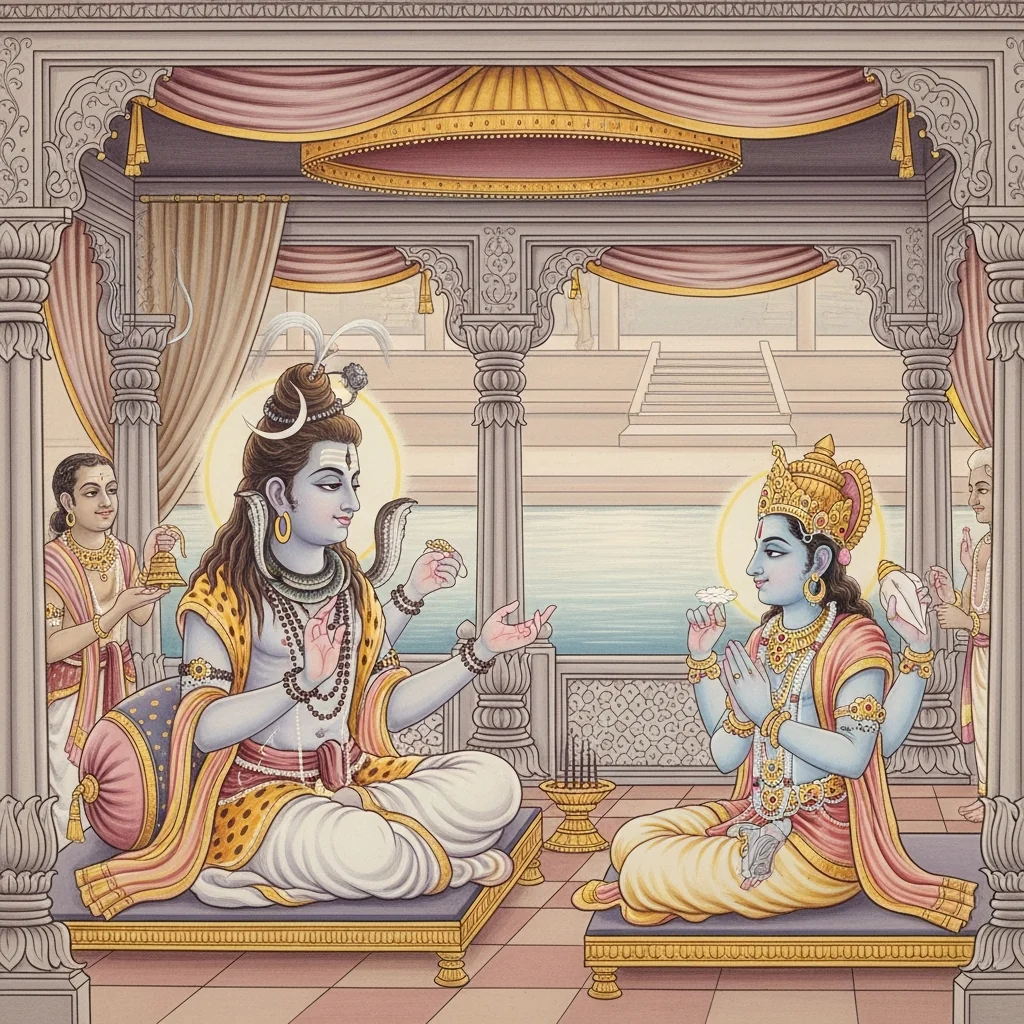
Adhyaya 48
The chapter begins with Vyāsa urging Sūta to hear Skanda’s narration of Śambhu’s (Śiva’s) magnificent ceremonial entry into the Muktimaṇḍapa. It is portrayed as a festival for all Kāśī—indeed, as if for the three worlds—filled with music, banners, lamps, fragrances, and shared rejoicing. Śiva enters the inner sanctum and is worshipfully received by Brahmā, sages, divine hosts, and the Mother-goddesses through offerings and ārati-like rites. A doctrinal dialogue follows in which Śiva addresses Viṣṇu, affirming Viṣṇu’s indispensable role in obtaining Ānandavana (Kāśī) and granting him abiding proximity, while also setting a hierarchy of access: devotion to Śiva in Kāśī is declared foremost for the fulfillment of aims. The discourse then lists liberation-oriented merits connected with the Muktimaṇḍapa, nearby pavilions, and sacred bathing places—especially Maṇikarṇikā—stressing that even brief, steady-minded presence and attentive listening can yield salvific results. The chapter also gives an etiological prophecy: in the Dvāpara age the pavilion will become widely known as Kukkutamaṇḍapa. This is explained through a future moral tale of the brāhmaṇa Mahānanda, who falls into hypocrisy and unethical acceptance of gifts, is degraded and reborn as a rooster, yet through remembrance of Kāśī and disciplined living near the pavilion rises upward and finally attains liberation, establishing the site’s popular name. The narration closes with ritual sound cues (bells), Śiva’s movement to another pavilion, and a phalaśruti promising joy and attainment to those who listen.
Shlokas
Verse 1
व्यास उवाच । शृणु सूत महाभाग यथा स्कंदेन भाषितः । महामहोत्सवः शंभोः पृच्छते कुंभसंभवे
Vyāsa said: Listen, O blessed Sūta, to what Skanda spoke—how the great festival of Śambhu was inquired about in the presence of the pot-born sage (Agastya).
Verse 2
स्कंद उवाच । निशामय महाप्राज्ञ शंभु प्रावेशिकीं कथाम् । त्रैलोक्यानंदजननीं महापातकतंकिनीम्
Skanda said: Hear attentively, O great sage, the account of Śambhu’s sacred entrance—an event that brings joy to the three worlds and strikes fear into great sins.
Verse 3
मंदरादागतः शंभुश्चैत्रे दमनपर्वणि । प्राप्याप्यानंदगहनमितश्चेतश्चचार ह
Śambhu arrived from Mandara; and in the month of Caitra, on the Damanaka festival day, having reached a dense grove of bliss, he wandered here and there at will.
Verse 4
मोक्षलक्ष्मीविलासेथ प्रासादे सिद्धिमागते । देवो विरजसः पीठादंतर्गेहं विवेश ह
Then, in the palace called ‘Mokṣa-Lakṣmī-Vilāsa,’ where fulfillment was attained, the Lord entered the inner chambers from the seat of Virajā.
Verse 5
ऊर्जशुक्लप्रतिपदि बुधराधासमायुजि । चंद्रे सप्तमराशिस्थे शेषेषूच्चग्रहेषु च
On the Pratipadā, the first day of the bright fortnight of Ūrja, with Budha (Mercury) joined to Rādhā (a lunar mansion), and the Moon situated in the seventh zodiac sign—while the remaining planets were likewise in exaltation—
Verse 6
वाद्यमानेषु वाद्येषु प्रसन्नासु हरित्सु च । ब्राह्मणानां श्रुतिरव न्यक्कृतान्यरवांतरे
As the instruments were played and the green groves stood serene, the Vedic chant of the Brāhmaṇas rose, drowning all other sounds between.
Verse 7
प्रतिशब्दित भूर्लोक भुवर्लोकांतराध्वनि । सर्वं प्रमुदितं चासीच्छंभोः प्रावेशिकोत्सवे
As the pathways between Bhūrloka and Bhuvarloka echoed all around, everything was filled with joy at Śambhu’s auspicious ceremonial entry.
Verse 8
चारणास्तु स्तुतिं कुर्युर्जर्हृषुर्देवतागणाः
The Cāraṇas offered hymns of praise, and the hosts of gods thrilled with exhilaration.
Verse 9
ववुर्गंधवहा वाता ववृषुः कुसुमैर्घनाः । सर्वे मंगलनेपथ्याः सर्वे मंगलभाषिणः
Fragrant breezes began to blow, and the clouds rained down flowers. All were adorned in auspicious attire, and all spoke words of blessing.
Verse 10
स्थावरा जंगमाः सर्वे जाता आनंदमेदुराः । सुरासुरेषु सर्वेषु गंधर्वेषूरगेषु च
All beings—stationary and moving—became brimming with bliss: among gods and asuras alike, and among Gandharvas and Nāgas as well.
Verse 11
विद्याधरेषु साध्येषु किन्नरेषु नरेषु च । स्त्रीपुंजातेषु सर्वेषु रेजुश्चत्वार एव च
Among the Vidyādharas, the Sādhyas, the Kinnaras, and among humans too—among all communities of women and men—splendor shone everywhere, in every way.
Verse 12
निष्प्रत्यूहं च नितरां पुरुषार्थाः पदेपदे । धूपधूमभरैर्व्योम यद्रक्तं तु तदा मुने
And, O sage, the aims of human life were attained without obstruction at every step; the sky at that time appeared reddened by the dense masses of incense-smoke.
Verse 13
नाद्यापि नीलिमानंतं परित्यजति कर्हिचित् । नीराजनाय ये दीपास्तदा सर्वे प्रबोधिताः
Even then the deep blueness did not depart at any time; and all the lamps meant for ārati (nīrājana) were lit and awakened to brilliance.
Verse 14
तेषां ज्योतींषि खेद्यापि राजंते तारकाच्छलात् । प्रतिसौधं पताकाश्च नानाकारा विचित्रिताः
Their lights shone splendidly, as though they were stars; and on every mansion, multiform banners were raised, richly ornamented.
Verse 15
रम्यध्वजप्रभाधौता रेजुः प्रति शिवालयम् । क्वचिद्गायंति गीतज्ञाः क्वचिन्नृत्यंति नर्तकाः
Washed in the glow of beautiful flags, the ways leading to each Śiva-temple shone brightly. In some places singers skilled in song sang; in others dancers danced.
Verse 16
चतुर्विधानि वाद्यानि वाद्यंते च क्वचित्क्वचित् । प्रत्यध्वं चंदनरसच्छटा पिच्छिलभूमयः
In certain places the four kinds of instruments were played; and along every road, sprays of sandal-paste were cast, making the ground smooth, fragrant, and gently slick.
Verse 17
हरित श्वेत मांजिष्ठ नील पीत बहुप्रभाः । प्रत्यंगणं शुभाकारा रंगमालाश्चकाशिरे
Garlands of many radiant hues—green, white, madder-red, blue, and yellow—shone with auspicious beauty, adorning every courtyard and inner precinct.
Verse 18
रत्नकुट्टिमभूभागा गोपुराग्रेषु रेजिरे । सुधोज्ज्वला हर्म्यमालाः सौधनामप्रपेदिरे
Gem-inlaid mosaic pavements gleamed upon the heights of the gateway-towers; and rows of mansions, dazzling with white plaster, truly merited the name of palatial edifices.
Verse 19
अचेतनान्यपि तदा चेतनानीव संबभुः । यानि कानीह कीर्त्यंते मंगलानि घटोद्भव
Then even insentient things seemed as though endowed with awareness, so vividly did every auspicious sign spoken of here manifest there, O Pot-born one.
Verse 20
तेषामेव हि सर्वेषां तत्तु जन्मदिवाभवत् । आगत्य देवदेवोथ मुक्तिमंडपमाविशत्
Indeed, for them all it was as though a day of birth had dawned; then the God of gods arrived and entered the Muktimaṇḍapa, the Pavilion of Liberation.
Verse 21
अथाभिषिक्तश्चतुराननेन महर्षिवृंदैः सह देवदेवः । शुभासनस्थः सहितो भवान्या कुमारवृंदैः परितो वृतश्च
Then the God of gods was ceremonially anointed by the four-faced Brahmā, together with hosts of great sages. Seated upon an auspicious throne, accompanied by Bhavānī, he was surrounded on every side by bands of youthful divine attendants.
Verse 22
रत्नैरसंख्यैर्बहुभिर्दुकूलैर्माल्यैर्विचित्रैर्लसदिष्टगंधैः । अपूपुजन्देवगणा महेशं तदा मुदाते च महोरग्रेंद्राः
With countless gems, abundant fine garments, and wondrous garlands fragrant with delightful scents, the hosts of gods worshipped Maheśa; and at that time even the great serpent-kings rejoiced.
Verse 23
रत्नाकरैश्चापि गिरींद्रव्यैर्यथा स्वमन्यैरपि पुण्यधीभिः । संपूजितः कुंभज तत्र शंभुर्नीराजितो मातृगणैरथेशः
O Kumbhaja, there Śambhu was duly worshipped with treasures from jewel-oceans and with substances from the lordly mountains, as well as with other offerings brought by the meritorious. Then the Lord was also honored with nīrājana (ārati) by the hosts of the Mothers (Mātṛgaṇas).
Verse 24
संतोष्य सर्वान्प्रथमं मुनींद्रान्स्वैस्वैर्हृदिस्थैश्च चिराभिलाषैः । ब्रह्माणमाभाष्य शिवोथ विष्णुं जगाद सर्वामरवृंदवंद्यः
First, Śiva gratified all the lordly sages by fulfilling their long-cherished desires held within their hearts. Then, after addressing Brahmā, he spoke to Viṣṇu—he who is revered by all the hosts of immortals.
Verse 25
इतो निषीदेति समानपूर्वं त्वं मे समस्तप्रभुतैकहेतुः । दूरेपि तिष्ठन्निकटस्त्वमेव त्वत्तो न कश्चिन्मम कार्यकर्ता
“Sit here, in the place befitting you. You alone are the single cause of all my lordship. Even if you stand far away, you are truly near; apart from you, there is no one who accomplishes my purposes.”
Verse 26
त्वया दिवोदास नरेंद्रवर्यः सदूपदेशैश्च तथोपदिष्टः । यथा स सिद्धिं परमामवाप समीहितं मे निखिलं च सिद्धम्
By you, King Divodāsa—the best among rulers—was rightly instructed through excellent counsel; thus he attained the highest success. In the same way, everything I have intended has also been completely accomplished.
Verse 27
विष्णो वरं ब्रूहि य ईप्सितस्ते नादेयमत्रास्ति किमप्यहो ते । इदं मयाऽनंदवनं यदाप्तं हेतुस्तु तत्रत्वमसौ गणेशः
O Viṣṇu, speak the boon you desire. Here there is truly nothing that cannot be granted to you. That I have obtained this Ānandavana—its very cause is you being there, and that Gaṇeśa as well.
Verse 28
जगुर्गंधर्वनिकरा ननृतुश्चाप्सरोगणाः
Hosts of Gandharvas sang, and companies of Apsarases danced.
Verse 29
श्रुत्वेति वाक्यं जगदीशितुश्च प्रोवाच विष्णुर्वरदं महेशम् । यदि प्रसन्नोसि पिनाकपाणे तदा पदाद्दूरमहं न ते स्याम्
Hearing these words of the Lord of the world, Viṣṇu addressed Maheśa, the granter of boons: “If you are pleased, O bearer of the Pināka bow, then may I never be far from your feet.”
Verse 30
श्रुत्वेति वाक्यं मधुसूदनस्य जगाद तुष्टो नितरां पुरारिः । सदा मुरारे मम सन्निधौ त्वं तिष्ठस्व निर्वाणरमाश्रयेत्र
Hearing the words of Madhusūdana, the foe of the three cities (Śiva) spoke, greatly pleased: “O Murāri, always remain here in my presence—here, the abode of the delight of liberation.”
Verse 31
आदावनाराध्य भवंतमत्र यो मां भजिष्यत्यपि भक्तियुक्तः । समीहितं तस्य न सेत्स्यति ध्रुवं परात्परान्मेंबुज चक्रपाणे
O Lord who bears the lotus and the discus, higher than the highest: whoever here, without first worshipping You, worships me—even with devotion—his desired aim will surely not succeed.
Verse 32
सर्वत्र सौख्यं मम मुक्तिमंडपे संतिष्ठमानस्य भवेदिहाच्युत । न तत्तु कैलासगिरौ सुनिर्मले न भक्तचेतस्यपि निश्चलश्रियि
O Acyuta, for one who stands within my Hall of Liberation, happiness arises everywhere here. But it is not so even on the stainless Mount Kailāsa, even for a devotee whose mind is steady and whose fortune is firm.
Verse 33
निमेषमात्रं स्थिरचित्तवृत्तयस्तिष्ठंति ये दक्षिणमंडपेत्र मे । अनन्यभावा अपि गाढमानसा न ते पुनर्गर्भदशामुपासते
Those who, with steady movements of mind, stand even for a moment in my Southern Pavilion here—single-minded and deep in intent—do not again enter the condition of the womb (rebirth).
Verse 34
संस्नाय ये चक्रसरस्यगाधे समस्ततीर्थैक शिरोविभूषणे । क्षणं विशंतीह निरीहमानसा निरेनसस्ते मम पार्षदा हि
Those who bathe in the deep waters of Cakra-sarasa—crowned as the foremost ornament among all tīrthas—and then enter here even for a moment with desireless minds become sinless, indeed becoming my attendants.
Verse 35
स्मरंति ये मामपवर्गमंडपे किंचिद्यथाशक्ति ददत्यपि स्वम् । शृण्वंति पुण्याश्च कथाः क्षणं स्थिरास्ते कोटिगोदानफलं भजंति
Those who remember me in the Pavilion of Liberation, give even a little of their own according to ability, and listen—steadfast even for a moment—to sacred stories obtain the fruit of donating ten million cows.
Verse 36
उपेंद्रतप्तानि तपांसि तैश्चिरं स्नाता हि ते चाखिलतीर्थसार्थकैः । स्नात्वेह ये वै मणिकर्णिका ह्रदे समासते मुक्तिजनाश्रयेक्षणम्
Through them, austerities equal to those of Upendra are as though practiced for a long time; indeed, it is as though one has bathed at once in the efficacy of all tīrthas. Having bathed here in the Maṇikarṇikā pool, whoever sits even for a moment at the refuge of those who seek mokṣa attains that sanctifying power.
Verse 37
तीर्थानि संतीह पदेपदे हरे तुला क्व तेषां मणिकर्णिकायाः । कतीहनो संति शुभाश्च मंडपाः परंपरोमुक्तिरमाश्रयोयम्
O Hari, in this Kāśī there are tīrthas at every step—yet what can compare with Maṇikarṇikā? And how many auspicious maṇḍapas are found here! This very place is a refuge where liberation is attained in unbroken succession.
Verse 38
कैवल्यमंडपस्यास्य भविष्ये द्वापरे हरे । लोके ख्यातिर्भवित्रीयमेष कुक्कुटमंडपः
O Hari, in the future—during the Dvāpara age—this Kaivalya-maṇḍapa will become renowned in the world by the name “Kukkuṭa-maṇḍapa.”
Verse 39
हरिरुवाच । भालनेत्रसमाख्याहि कथं निर्वाणमंडपः । तथा ख्यातिमसौ गंता यथा देवेन भाषितम्
Hari said: “How is the Nirvāṇa-maṇḍapa known by the name ‘Bhālanetra’? And how will it attain the very fame that the Deva has declared?”
Verse 40
देवदेव उवाच । महानंदो द्विजो नाम भविष्योत्र चतुर्भुज । अग्रवेदीसमाचारस्त्यक्ततीर्थप्रतिग्रहः
Devadeva said: “O Caturbhuja, in this place there will arise in the future a Brāhmaṇa named Mahānanda—one who follows the conduct of the foremost Vedic discipline and who has renounced accepting gifts connected with tīrthas.”
Verse 41
अदांभिकोऽक्रूरमनाः सदैवातिथिवल्लभः । अथ यौवनमासाद्य पितर्युपरते स हि
He was without pretence, gentle in nature, and ever fond of honoring guests. But when he came to youth—after his father had passed away—
Verse 42
विषमेषु शरैस्तीव्रैः कारितस्त्वपदे पदम् । जहार कस्यचिद्भार्या मैत्रीं कृत्वा तु तेन वै
In perilous circumstances, struck by sharp arrows, he was driven from one misstep to another. Then—having first made friendship with a certain man—he carried off that man’s wife.
Verse 43
तया च प्रेरितोऽपेयं पपौ चापि विमोहितः । अभक्ष्यभक्षणरुचिरभून्मदनमोहितः
Urged on by her, he drank what ought not to be drunk, and—deluded—he even did so openly. Bewildered by passion, he developed a taste for eating what is forbidden.
Verse 44
वैष्णवान्धनिनो दृष्ट्वा क्षणं वैष्णववेषभृत् । शैवान्निंदति मूढात्मा नरकत्राणकारणम्
Seeing wealthy Vaiṣṇavas, he wore the guise of a Vaiṣṇava for a moment; yet that deluded man reviled the Śaivas—thus making hell his so-called ‘means of deliverance.’
Verse 45
शिवभक्तान्समालोक्य किंचिच्च परिदित्सुकान् । गर्हयेद्वैष्णवान्सर्वाञ्शैवलिंगोपजीवकः
Seeing devotees of Śiva who were seeking even a little help, he—though living by serving Śiva’s liṅga—would censure all Vaiṣṇavas.
Verse 46
इति पाखंडधर्मज्ञः संध्यास्नानपराङ्मुखः । विशालतिलकः स्रग्वी शुद्धधौतांबरोज्वलः
Thus, though skilled in the ways of hypocrisy, he turned away from the duties of twilight Sandhyā-prayer and sacred bathing. Yet he bore a broad tilaka, wore garlands, and shone in spotless, freshly washed garments.
Verse 47
शिखी चोपग्रहकरः सर्वेभ्योऽसत्प्रतिग्रही । तस्यापत्यद्वयं जातमुन्मत्तपथवर्तिनः
Śikhī too lived by petty gains and accepted improper gifts from anyone. To him were born two children, who followed a reckless and deluded course of life.
Verse 48
एवं तस्य प्रवृत्तस्य कश्चित्पर्वतदेशतः । समागमिष्यति धनी तीर्थयात्रार्थसिद्धये
While he was thus engaged, a wealthy man would arrive from a mountainous region, seeking success in the purpose of his pilgrimage to the sacred tīrthas.
Verse 49
स्नात्वा स चक्रसरसि कथयिष्यति चेति वै । अहमस्ति धनोदित्सुर्जात्या चांडालसत्तमः
After bathing in Cakrasarasa, he would declare: “I have wealth and wish to give it in charity; yet by birth I am a Cāṇḍāla.”
Verse 50
अस्ति कश्चित्प्रतिग्राही यस्मै दद्यामहं धनम् । इति तस्य वचः श्रुत्वा कैश्चिच्चांगुलिसंज्ञया
“Is there some recipient who would accept, to whom I may give this wealth?” Hearing his words, certain people indicated (a person) by gestures of the finger.
Verse 51
उद्दिष्ट उपविष्टोसौ यो जपेद्ध्यानमुद्रया । एष प्रतिग्रहं त्वत्तो ग्रहीष्यति न चेतरः
“That one seated there, marked out by us, who is softly reciting prayers with the meditation mudrā—he will accept the gift from you, and none other.”
Verse 52
इति तेषां वचः श्रुत्वा स गत्वा तत्समीपतः । दंडवत्प्रणिपत्याथ तं बभाषे तदांत्यजः
Hearing their words, he went near that man; then, bowing in full prostration like a staff (daṇḍavat), that outcaste addressed him.
Verse 53
मामुद्धर महाविप्र तीर्थं मे सफलीकुरु । किंचिद्वस्त्वस्ति मे तत्त्वं गृहाणानुग्रहं कुरु
“Lift me up, O great Brāhmaṇa; make my pilgrimage to the tīrtha fruitful. I have some wealth—accept it and show me grace.”
Verse 54
अथाक्षमालिकां कर्णे कृत्वा ध्यानं विसृज्य च । कियद्धनं तवास्तीह पप्रच्छ करसंज्ञया
Then, placing the rosary (akṣamālā) by his ear and setting aside his meditation, he asked by a hand-gesture: “How much wealth do you have here?”
Verse 55
तस्य संज्ञां स वै बुद्ध्वा प्रोवाचाति प्रहृष्टवत् । संतृप्तिर्यावता ते स्यात्तावद्दास्यामि नान्यथा
Understanding his gesture, he replied with great joy: “I will give as much as will bring you satisfaction—no less than that.”
Verse 56
इति तद्वचनं श्रुत्वा त्यक्त्वा मौनमुवाच ह । सानंदः स महानंदो निःस्पृहोस्मि प्रतिग्रहे
Hearing those words, he broke his silence and spoke: “I am joyful—truly filled with great bliss; in the matter of accepting gifts, I am without desire.”
Verse 57
परं तेऽनुग्रहार्थं तु करिष्यामि प्रतिग्रहम् । किंच मे वचनं त्वं चेत्करिष्यस्युत्तमोत्तम
Yet, solely to show you grace, I will accept this gift. But if you will carry out my instruction, O best among the noble, then it shall be fitting.
Verse 58
यावदस्त्यखिलं वित्तं तन्मध्ये न्यस्य कस्यचित् । न स्तोकमपि दातव्यं तदाऽदास्यामि नान्यथा
As long as you possess any wealth at all, place it all together in one spot. Not even a little should be given elsewhere; then I will accept it—certainly not otherwise.
Verse 59
चांडाल उवाच । यावदस्ति मयानीतं विश्वेशप्रीतये वसु । तावत्तुभ्यं प्रदास्यामि विश्वेशस्त्वं यतो मम
The Caṇḍāla said: “Whatever wealth I have brought for the pleasure of Viśveśa—so much of it I shall give to you, for you are my Viśveśa, my Lord indeed.”
Verse 60
ये वसंतीह विश्वेश राजधान्यां द्विजोत्तम । क्षुद्राक्षुद्रा जंतुमात्रा विश्वेशां शास्त एव हि
O best of brāhmaṇas, whoever dwells here in the royal city of Viśveśa—whether lowly or not lowly, any creature at all—Viśveśa indeed becomes their protector and guide.
Verse 61
परोद्धरणशीला ये ये परेच्छाप्रपूरकाः । परोपकृतिशीला ये विश्वेशां शास्त एव हि
Those whose very nature is to uplift others, to fulfill others’ rightful wishes, and to devote themselves to the welfare of all—over such persons Viśveśa himself surely stands as guardian and guide.
Verse 62
इति तद्वचनं श्रुत्वा प्रहृष्टेंद्रियमानसः । उवाच पार्वतीयं तं सोऽग्रजन्मांत्यजं तदा
Hearing those words, his senses and mind brimming with joy, that noble brāhmaṇa then addressed the outcaste—one belonging to Pārvatī’s own company and line.
Verse 64
विश्वेशः प्रीयतां चेति प्रोच्य यातो यथागतः । स च द्विजो द्विजैरन्यैर्धिक्कृतोपि वसन्निह
Saying, “May Viśveśa be pleased,” he departed as he had come. Yet that brāhmaṇa, though reviled by other brāhmaṇas, continued to dwell there in Kāśī.
Verse 65
बहिर्निर्गतमात्रस्तु बहुभिः परिभूयते । चांडालब्राह्मणश्चैष चांडालात्त धनस्त्वसौ
But the moment he stepped outside, many people insulted and humiliated him: “This is a Caṇḍāla-brāhmaṇa! And that fellow has grown rich through a Caṇḍāla!”
Verse 66
असावेव हि चांडालः सर्वलोकबहिष्कृतः । इत्थं तमनुधावंति थूत्कुर्वंतः परितो हरे
“That man is indeed a Caṇḍāla, cast out by all people!” Thus they chased after him, spitting all around, O Hari.
Verse 67
स च तद्भयतो गेहात्काकभीतदिवांधवत् । न निःसरेत्क्वचिदपि लज्जाकृति नतास्यकः
Out of fear of them, he would not come out of his house at all—like a blind man frightened of crows—ashamed, with his face cast down.
Verse 68
स एकदा संप्रधार्य गृहिण्या लोकदूषितः । जगाम कीकटान्देशांस्त्यक्त्वा वाराणसीं पुरीम्
Once, after deliberating with his wife, that man—tainted by worldly censure—abandoned the city of Vārāṇasī and set out for the lands of Kīkaṭa.
Verse 69
मध्ये मार्गं स गच्छन्वै लक्षितस्तु सकांचनः । अपि कार्पटिकांतस्थः स रुद्धो मार्गरोधिभिः
While he was travelling along the road, he was noticed as one carrying gold; and though he was in the vicinity of a poor mendicant’s dwelling, he was stopped by highway-blockers.
Verse 70
नीत्वा ते तमरण्यानीं तस्कराः सपरिच्छदम् । उल्लुंठ्य धनमादाय समालोच्य परस्परम्
The thieves took him, along with his belongings, into the forest; after ransacking him and seizing his wealth, they consulted among themselves.
Verse 71
प्रोचुर्भूरिधनं चैतज्जीर्यत्यस्मिन्न जीवति । असौ धनी प्रयत्नेन वध्यः सपरिचारकः
They said, “This is abundant wealth; if this man remains alive, it will be wasted for us. That wealthy fellow must be killed—along with his attendant—without fail.”
Verse 72
संप्रधार्येति तेप्राहुः स्मर्तव्यं स्मर पांथिक । त्वां वयं घातयिष्यामो निश्चितं सपरिच्छदम्
They said, “Remember this—‘having deliberated’; remember it well, O traveller. We shall surely kill you and seize you together with all your possessions.”
Verse 73
निशम्येति मनस्येव कथयामास स द्विजः । अहो प्रतिगृहीतं मे यदर्थं वसु भूरिशः
Hearing this, the brāhmaṇa spoke within his own mind: “Alas! For what purpose did I accept such abundant wealth?”
Verse 74
कुटुंबमपि तन्नष्टं नष्टश्चापि प्रतिग्रहः । जीवितं चापि मे नष्टं नष्टा काशीपुरीस्थितिः
“My household too is ruined; the very gift I accepted is lost; my life as well is lost—and lost also is my dwelling in the city of Kāśī.”
Verse 75
युगपत्सर्वमेवाशु नष्टं दुर्बुद्धिचेष्टया । न काश्यां मरणं प्राप्तं तस्माद्दुष्टप्रतिग्रहात्
“All at once everything was swiftly destroyed by a foolish act; and because of that wicked acceptance of a gift, I did not obtain death in Kāśī.”
Verse 76
प्रांते कुटुंबस्मरणात्तथाकाशीस्मृतेरपि । चोरैर्हतोपि स तदा कीकटे कुक्कुटोऽभवत्
At the end—remembering his household, and also remembering Kāśī—though he was slain by thieves, he was then reborn in Kīkaṭa as a rooster.
Verse 77
सा कुक्कुटी सुतौ तौ तु ताम्रचूडत्वमापतुः । प्रांते काशीस्मरणतो जाता जातिस्मृतिः परा
That wife became a hen, and those two sons attained the state of crested cocks; and at the end, through remembrance of Kāśī, an extraordinary recollection of former births arose.
Verse 78
इत्थं बहुतिथेकाले गते कार्पटिकोत्तमाः । तस्मिन्नेवाध्वनि प्राप्ताश्चत्वारो यत्र कुक्कुटाः
Thus, after many days had passed, those excellent ascetics (kārpaṭikas) arrived on that very road—at the place where the four roosters were.
Verse 79
वाराणस्याः कथां प्रोच्चैः कुर्वंतोऽन्योन्यमेव हि । काशीकथां समाकर्ण्य तदा ते चरणायुधाः
They were loudly conversing with one another about Vārāṇasī; and hearing the account of Kāśī, those ‘foot-weaponed’ ones (the roosters) were then stirred within.
Verse 80
जातिस्मृतिप्रभावेण तत्संगेन तु निर्गताः । तैश्च कार्पटिकश्रेष्ठेः पथि दृष्ट्वा कृपालुभिः
Through the power of recollection of former births, and by that association, they came forth; and those compassionate roosters, seeing the foremost kārpaṭika on the road, responded with kindness.
Verse 81
तंदुलादिपरिक्षेपैः प्रापिताः क्षेत्रमुत्तमम् । ते तु क्षेत्रं समासाद्य चत्वारश्चरणायुधाः
By scattering grains of rice and the like, they were guided to that supreme sacred precinct. Having reached the holy kṣetra, those four ‘foot-weaponed’ ones (roosters) arrived there.
Verse 82
चरिष्यंतोऽत्र परितो मुक्तिमंडपमुत्तमम् । जिताहारान्सनियमान्कामक्रोधपराङ्मुखान्
They would dwell and move about here, around the most excellent Muktimaṇḍapa—restrained in food, disciplined in sacred observances, and turned away from desire and anger.
Verse 84
मन्नामोच्चारणपरान्मत्कथार्पितसुश्रुतीन् । मद्दत्तचित्तसद्वृत्तीन्दृष्ट्वा क्षेत्रनिवासिनः
Seeing them—intent on uttering my Name, with reverent hearing devoted to my sacred narratives, and endowed with good conduct and minds offered to me—the residents of the holy precinct took notice.
Verse 85
मानयामासुरथ तान्कुक्कुटान्साधुवर्त्मनः । प्राक्तनां वासनायोगात्संप्रधार्य परस्परम् । क्रमेणाहारमाकुंच्य प्राणांस्त्यक्ष्यंति चात्र वै
Then they honored those roosters, set upon the path of the good. Recalling former impressions and understanding one another, they would gradually reduce their food and, indeed, relinquish their life-breaths here.
Verse 86
पश्यतां सर्वलोकानां विष्णो ते मदनुग्रहात् । विमानमधिरुह्याशु कैलासं प्राप्य मत्पदम्
O Viṣṇu, before the eyes of all the worlds, by my grace they will swiftly ascend a celestial chariot, reach Kailāsa, and attain my own abode and state.
Verse 87
निर्विश्य सुचिरं कालं दिव्यान्भोगाननुत्तमान् । ततोऽत्र ज्ञानिनो भूत्वा मुक्तिं प्राप्स्यंति शाश्वतीम्
Having long enjoyed unsurpassed divine pleasures, thereafter—here—they will become possessors of true knowledge and attain everlasting liberation.
Verse 88
ततो लोकास्तददारभ्य कथयिष्यंति सर्वतः । मुक्तिमंडपनामैतदेष कुक्कुटमंडपः
From that time onward, people everywhere will recount: “This place is called the Muktimaṇḍapa—this is the Kukkuṭamaṇḍapa.”
Verse 89
चरित्रमपि वै तेषां ये स्मरिष्यंति मानवाः । मुक्तिमंडपमासाद्य श्रेयः प्राप्स्यंति तेपि हि
Even those who merely remember the sacred deeds of those devotees will surely attain the highest good; upon reaching the Muktimaṇḍapa, they too obtain spiritual excellence.
Verse 90
इति यावत्कथां शंभुर्भविष्यामग्रतो हरेः । अकरोत्तुमुलो नादो घंटानां तावदुद्गतः
While Śambhu was thus narrating the account in the presence of Hari, at that very moment a tumultuous sound of bells arose.
Verse 91
अथनंदिनमाहूय देवदेव उमाधवः । प्रोवाच नंदिन्विज्ञायागत्य ब्रूहि कुतो रवः
Then the God of gods, Umā’s Lord, summoned Nandin and said: “Nandin, find out and come—tell me, from where does this sound arise?”
Verse 92
अथ नंदी समागत्य प्रोवाच वृषभध्वजम् । नमस्कृत्य प्रहृष्टास्यः प्रबद्धकरसंपुटः
Then Nandin came and spoke to the Bull-bannered Lord. Having bowed down, with a delighted face and hands joined in reverence, he addressed him.
Verse 93
प्रहासान्मत्कथालापांल्लाभमोहविवर्जितान् । स्वर्धुनीस्नानसंक्लिन्न सुनिर्मलशिरोरुहान्
They are cheerful, speaking of me, free from greed and delusion; their head-hair, drenched by bathing in the celestial river, is thoroughly washed and made exceedingly pure.
Verse 94
अथ स्मित्वाब्रवीच्छंभुः सिद्धं नस्तु समीहितम् । उत्थाय देवदेवेशः सह देव्या सुमंगलः
Then Śambhu smiled and said, “May our cherished purpose be fulfilled.” Rising, the Lord of the gods—most auspicious—set forth together with the Goddess.
Verse 95
ब्रह्मणा हरिणा सार्धं ततोऽगाद्रंगमंडपम् । स्कंद उवाच । श्रुत्वाध्यायमिमं पुण्यं परमानंदकारणम् । नरः परां मुदं प्राप्य कैलासं प्राप्स्यति ध्रुवम्
Together with Brahmā and Hari, he then went to the Raṅgamaṇḍapa. Skanda said: “Whoever hears this holy chapter, a cause of supreme bliss, attains great joy and surely reaches Kailāsa.”
Verse 98
इति श्रीस्कांदे महापुराण एकाशीति साहस्र्यां संहितायां चतुर्थे काशीखंड उत्तरार्धे मुक्तिमंडपगमनं नामाष्टनवतितमोऽध्यायः
Thus ends the eighty-ninth chapter, titled “Muktimaṇḍapa-gamana (Going to the Pavilion of Liberation),” in the Uttarārdha of the Kāśīkhaṇḍa, in the fourth section of the Ekāśīti-sāhasrī Saṃhitā of the revered Skanda Mahāpurāṇa.