Adhyaya 12
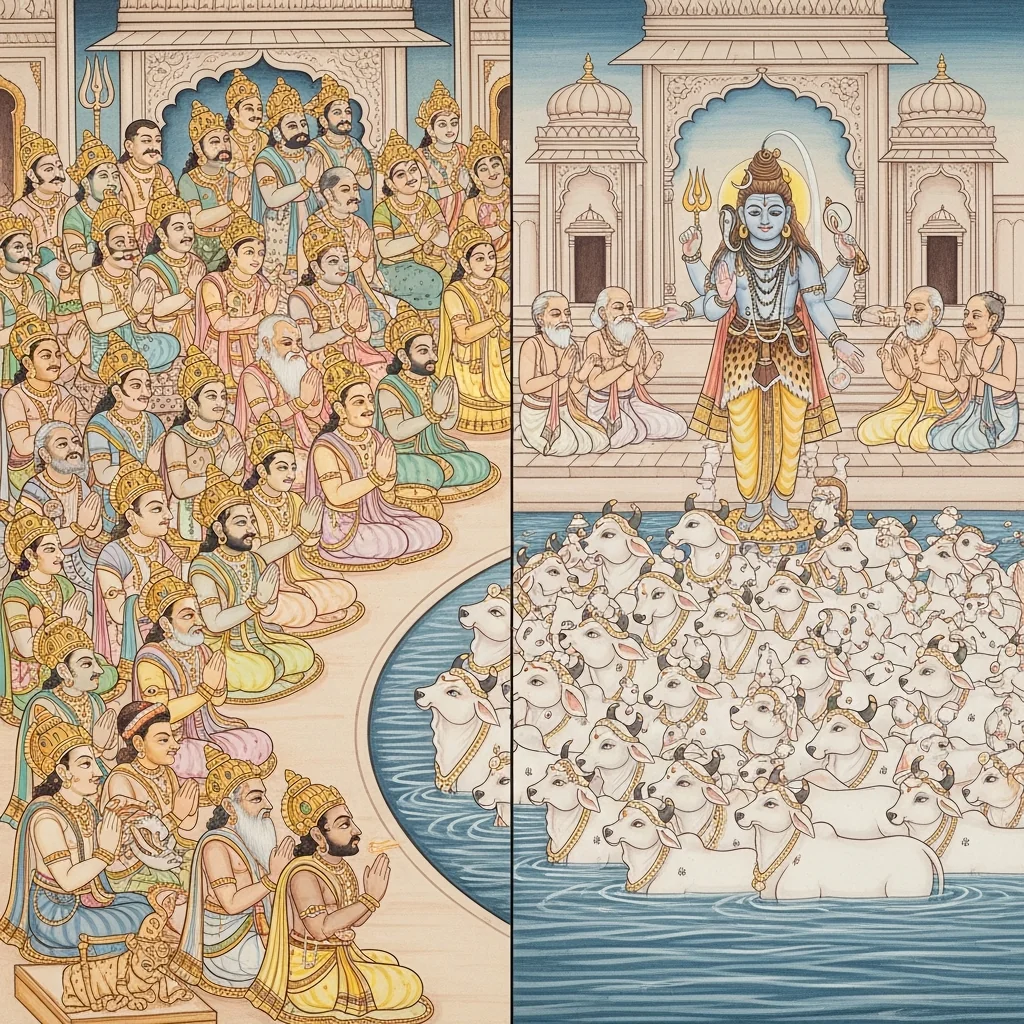
Agastya asks Skanda to recount in detail the divine convergence in Kāśī: Śiva (Vṛṣadhvaja) arrives and is honored according to sacred protocol, with Viṣṇu, Brahmā, Ravi (the Sun), the gaṇas, and the yoginīs in attendance. Skanda describes the assembly’s etiquette—prostrations, seating order, and blessings—then clarifies doctrine as Śiva reassures Brahmā about proper conduct, stresses the grave sin of offending Brahmins, and extols the sanctifying power of installing Śiva-liṅgas. Ravi explains his disciplined waiting outside Kāśī under Divodāsa’s rule, which Śiva frames as part of divine administration. A key tīrtha-origin follows: five celestial cows come from Goloka; their milk becomes a lake that Śiva names Kapilā-hrada, giving rise to a supreme tīrtha. The Pitṛs appear seeking a boon, and Śiva lays down rules for śrāddha and piṇḍa-offerings at this site, promising akṣaya (imperishable) satisfaction, especially at lunar conjunctions (Kuhū/Soma) and on the new moon. The tīrtha’s many names are listed—Madhusravā, Kṣīranīradhi, Vṛṣabhadhvaja-tīrtha, Gadādhara, Pitṛ-tīrtha, Kapiladhārā, Śivagayā, and more—and its benefits are declared widely accessible, extending to varied classes of the departed. The chapter ends with ceremonial mobilization imagery and a phalaśruti: hearing or reciting this account destroys great sins and grants Śiva-sāyujya, linking it to the “Kāśī-praveśa” japa-akhyāna tradition.
Shlokas
Verse 1
अगस्त्य उवाच । श्रुत्वा स्कंद न तृप्तोस्मि तव वक्त्रेरितां कथाम् । अत्याश्चर्यकरं प्रोक्तमाख्यानं बैंदुमाधवम्
Agastya said: O Skanda, even after hearing the tale spoken from your own mouth, I am not satisfied. The account of Bindu-Mādhava that you have narrated is exceedingly wondrous.
Verse 2
इदानीं श्रोतुमिच्छामि देवदेवसमागमम् । तार्क्ष्यात्त्र्यक्षः समाकर्ण्य दिवोदासस्य चेष्टितम्
Now I wish to hear of the meeting of the God of gods. How did the Three-eyed Lord, having heard it from Tārkṣya (Garuḍa), respond regarding the deeds of Divodāsa?
Verse 3
विष्णुमायाप्रपंचं च किमाह गरुडध्वजम् । के के च शंभुना सार्धं समीयुर्मंदराद्गिरेः
And what did he say to the One whose banner is Garuḍa about the manifold workings of Viṣṇu’s māyā? And who all went together with Śambhu from Mount Mandara?
Verse 4
ब्रह्मणेशः कथं दृष्टस्त्रपाकुलित चक्षुषा । किमाह देव ब्रह्माणं किमुक्तं भास्वतापि च
How was Brahmaṇeśa beheld, with eyes bewildered by awe and shame? What did the Lord say to Brahmā, and what was spoken also to Bhāsvat, the Sun?
Verse 5
योगिनीभिः किमाख्यायि गणाह्रीणाः किमब्रुवन् । एतदाख्याहि मे स्कंद महत्कौतूहलं मयि
What did the Yoginīs relate, and what did the bashful Gaṇas say? Tell me this, O Skanda—for great curiosity has arisen in me.
Verse 6
इमं प्रश्नं निशम्यैशिर्मुनेः कलशजन्मनः । प्रत्युवाच नमस्कृत्य शिवौ प्रणतसिद्धिदौ
Hearing this question of the sage born from the pot, the Lord replied—after bowing to the two Śivas, the bestowers of accomplishment to those who bow.
Verse 7
स्कंद उवाच । मुने शृणु कथामेतां सर्वपातकनाशिनीम् । अशेषविघ्नशमनीं महाश्रेयोभिवर्धिनीम्
Skanda said: O sage, listen to this account—destroyer of all sins, pacifier of every obstacle, and increaser of supreme well-being.
Verse 8
अथ देवोऽसुररिपुः श्रुत्वा शंभुसमागमम् । द्विजराजाय स मुदा समदात्पारितोषिकम्
Then the divine foe of the Asuras, having heard of Śambhu’s assembly, joyfully bestowed a reward upon the king among Brahmins.
Verse 9
आयानं शंसते शंभोरुपवाराणसिप्रियम् । ब्रह्माणमग्रतः कृत्वा ततश्चाभ्युद्ययौ हरिः
He proclaimed Śambhu’s coming—beloved of sacred Upavārāṇasī—and then Hari set forth, placing Brahmā at the forefront.
Verse 10
विवस्वता समेतश्च तैर्गणैः परितो वृतः । योगिनीभिरनूद्यातो गणेशमुपसंस्थितः
Accompanied by Vivasvān (the Sun) and surrounded on every side by those attendant hosts, and hymned by the Yoginīs, Gaṇeśa drew near and stood in attendance before the Lord.
Verse 11
अथनेत्रातिथीकृत्य देवदेवं वृषध्वजम् । मंक्षु तार्क्ष्यादवारुह्य प्रणनाम श्रियः पतिः
Then he welcomed the God of gods—Śiva, whose banner bears the bull—with the hospitality of his very eyes; and Viṣṇu, Lord of Śrī, swiftly descended from Tārkṣya (Garuḍa) and bowed down.
Verse 12
पितामहोपि स्थविरो भृशं नम्रशिरोधरः । प्रणतेन मृडेनैव प्रणमन्विनिवारितः
Even Pitāmaha (Brahmā), aged and bearing his head deeply bowed, was prevented from prostrating—by Mṛḍa (Śiva) himself, already bent in reverence.
Verse 13
स्वस्त्यभ्युदितपाणिश्च रुद्रसूक्तैरमंत्रयत् । अक्षतान्यथ सार्द्राणि दर्शयन्सफलान्यजः
With his hand raised in blessing, he invoked auspiciousness through Rudra-hymns; then Aja, the Unborn, displayed moist akṣata—unbroken grains—and offerings rich with fruit.
Verse 14
मौलिं पादाब्जयोः कृत्वा गणेशः सत्वरो नतः । मूर्ध्न्युपाजिघ्रयांचक्रे हरो हर्षाद्गजाननम्
Placing his crown upon the lotus-feet, Gaṇeśa bowed swiftly; and Hara, in joy, lifted Gajānanā and kissed (inhaled) him upon the head.
Verse 15
अभ्युपावेशयच्चापि परिष्वज्य निजासने । सोमनंदि प्रभृतयः प्रणेमुर्दंडवद्गणाः
He welcomed him and seated him, embracing him upon his own seat; and the gaṇas—beginning with Somanandin—prostrated themselves full-length, like a staff.
Verse 16
योगिन्योपि प्रणम्येशं चक्रुर्मंगलगायनम् । तरणिः प्रणनामाथ प्रमथाधिपतिं हरम्
The Yoginīs too, having bowed to the Lord, sang auspicious songs; then Taraṇi, the Sun, bowed to Hara, the lord of the Pramathas.
Verse 17
खंडेंदुशेखरश्चाथ उपसिंहासनं हरिम् । समुपावेशयद्वामपार्श्वे मानपुरःसरम्
Then Khaṇḍenduśekhara, crowned with the crescent moon, seated Hari upon a nearby throne at his left side, with honor going before him.
Verse 18
ब्रह्माणं दक्षिणे भागे परिविश्राणितासनम् । दृष्ट्वा संभाविताः सर्वे शर्वेण प्रणता गणाः
Brahmā, on the right side, was granted a seat of honor; seeing this, all the gaṇas—bowed to Śarva (Śiva)—felt themselves esteemed and honored.
Verse 19
मौलिचालनमात्रेण योगिन्योपि प्रसादिताः । संतोषितो रविश्चापि विशेति करसंज्ञया
By the mere stirring of the crown, a simple sign of acknowledgment, the Yoginīs too were graciously pleased; and Ravi, the Sun, satisfied, entered in—beckoned by the Lord’s hand-mudrā.
Verse 20
अथ शंभुं शतधृतिः प्रबद्धकरसंपुटः । परिविज्ञापयांचक्रे प्रसन्नवदनांबुजम्
Then Śatadhṛti (Brahmā), with hands joined in reverent supplication, respectfully addressed Śambhu, whose lotus-like face was serene and gracious.
Verse 21
ब्रह्मोवाच । भगवन्देवदेवेश क्षंतव्यं गिरिजापते । वाराणसीं समासाद्य यदहं नागतः पुनः
Brahmā said: O Blessed Lord, God of gods, O Consort of Girijā—please forgive this: though I had reached Vārāṇasī, I did not return again as I ought to have.
Verse 22
प्रसंगतोपि कः काशीं प्राप्य चंद्रविभूषण । किंचिद्विधातुं शक्तोपि त्यजेत्स्थविरतां दधत्
O Moon-crested One, who—even by mere association—having reached Kāśī, would abandon the grave restraint of self-control? Even one capable of acting otherwise would not do what is unworthy, bearing the steady firmness of maturity.
Verse 23
स्वरूपतो ब्राह्मणत्वादपाकर्तुं न शक्यते । अथ शक्तो व्यपाकर्तुं कः पुण्ये संचिकीर्षति
By one’s very nature, the state of being a brāhmaṇa cannot be cast aside. And even if someone were able to cast it aside, who would wish to do so in a place of merit, filled with puṇya?
Verse 24
विभोरपि समाज्ञेयं धर्मवर्त्मानुसारिणि । न किंचिदपकर्तव्यं जानता केनचित्क्वचित
Even the mighty should discern what is proper when walking in accord with the path of dharma. Knowing this, no one, anywhere, should commit even the slightest harmful act.
Verse 25
कस्तादृशि महीजानौ पुण्यवर्त्मन्यतंद्रिते । काशीपाले दिवोदासे मनागपि विरुद्धधीः
Who, knowing such truths, would harbor even the slightest opposing thought toward Divodāsa, the protector of Kāśī—tireless upon the meritorious path?
Verse 26
निशम्येति वचस्तुष्टः श्रीकंठोति विशुद्धधीः । हसन्प्रोवाच धातारं ब्रह्मन्सर्वमवैम्यहम्
Hearing these words, Śrīkaṇṭha (Śiva), pleased and of perfectly pure understanding, smiled and said to Dhātṛ (Brahmā): “O Brahman, I understand all of it.”
Verse 27
देवदेव उवाच । आदौ तावददोषं हि ब्रह्मत्वं ब्राह्मणस्य ते । वाजिमेधाध्वराणां च ततोपि दशकं कृतम्
The Lord of gods said: First of all, your brāhmaṇa-hood—your Brahmic status—is indeed blameless. Moreover, you have performed even ten Aśvamedha sacrifices.
Verse 28
ततोपि विहितं ब्रह्मन्भवता परमं हितम् । अपराधसहस्राणि यल्लिंगं स्थापितं मम
Yet beyond even that, O Brahman, you have done what is supremely beneficial: despite thousands of offenses, you established My liṅga.
Verse 29
येनैकमपि मे लिंगं स्थापितं यत्र कुत्रचित् । तस्यापराधलेशोपि नास्ति सर्वापराधिनः
Whoever has established even a single liṅga of Mine—anywhere at all—for that person, though burdened with every offense, not even the slightest trace of fault remains.
Verse 30
अपराधसहस्रेपि ब्राह्मणं योपराध्नुयात् । दिनैः कतिपयैरेव तस्यैश्वर्यं विनश्यति
Even if one has committed a thousand other faults, if he offends a brāhmaṇa, within only a few days his prosperity and lordly fortune are destroyed.
Verse 31
इति ब्रुवति देवेशेप्यंतरुच्छ्वसितं गणैः । समातृभिः समंताच्च विलोक्यास्यं परस्परम्
As the Lord of gods spoke thus, the gaṇas heaved deep sighs; with the Mother-goddesses around, they looked into one another’s faces on every side.
Verse 32
अर्कोप्यवसरं ज्ञात्वा नत्वा शंभुं व्यजिज्ञपत् । प्रसन्नास्यमुमाकांतं दृष्ट्वा दृष्टचराचरः
Then Arka (the Sun) too, recognizing the right moment, bowed to Śambhu and made his request. Seeing Umā’s beloved with a serene face—he who beholds all that moves and does not move—he spoke.
Verse 33
अर्क उवाच । नाथ काशीमितो गत्वा यथाशक्ति कृतोपधिः । अकिंचित्करतां प्राप्तः सहस्रकरवानपि
Arka said: “O Lord, having gone from here to Kāśī and acting there according to my limited power, I have come to a state of helplessness—though I am the one of a thousand rays.”
Verse 34
स्वधर्मपालके तस्मिन्दिवोदासे धरापतौ । निश्चितागमनं ज्ञात्वा देवस्याहमिह स्थितः
When Divodāsa, the king who safeguarded his own dharma, ruled the earth, and knowing the Lord’s fixed decree to come, I have remained here.
Verse 35
प्रतीक्षमाणो देवेश त्वदामनमुत्तमम् । विभज्य बहुधात्मानं त्वदाराधनतत्परः
Awaiting, O Lord of gods, your most excellent command, I have divided myself into many forms and remained intent upon your worship.
Verse 36
मनोरथद्रुमश्चाद्य फलितः श्रीमदीक्षशात् । किंचिद्भक्तिलवांभोभिः सिक्तो ध्यानेन पुष्पितः
Now the wish-fulfilling tree has borne fruit through your auspicious glance; sprinkled with a few drops of devotion, it has blossomed by meditation.
Verse 37
इत्युदीरितमाकर्ण्य रवेर्वैरविलोचनः । प्रोवाच देवदेवेशो नापराध्यसि भास्कर
Hearing these words of Ravi, the Lord—whose eyes are terrible to foes—spoke: “O Bhāskara, you have committed no offense.”
Verse 38
ममैव कार्यं विह्तिं त्वं यदत्र व्यवस्थितः । यस्यां सुरप्रवेशो न तस्मिन्राजनि शासति
Indeed, by remaining stationed here you are carrying out my very task; for in that realm, where the entry of the gods is not permitted, that king holds sway.
Verse 39
इति सूरं समाश्वास्य देवदेव कृपानिधिः । गणानाश्वासयामास व्रीडा नम्रशिरोधरान्
Thus, having consoled the Sun, the Lord of lords—an ocean of compassion—also comforted the gaṇas, whose heads were bowed down in shame.
Verse 40
योगिन्योपि सुदृष्ट्वाथ शंभुना संप्रसादिताः । त्रपाभरसमाक्रांत कंधरा इव सं गताः
Even the yoginīs, having beheld that auspicious sight, were graciously satisfied by Śambhu; their necks bent as though weighed down by modesty, they gathered together in reverent restraint.
Verse 41
ततो व्यापारयांचक्रे त्र्यक्षो नेत्राणि चक्रिणि । हरिर्न किंचिदप्यूचे सर्वज्ञाग्रे महामनाः
Then the Three-eyed Lord set his eyes in motion toward the discus-bearing one; yet Hari, great-souled, spoke not a single word in the presence of the All-knowing.
Verse 42
ईशोपि श्रुतवृत्तांतस्तार्क्ष्याद्गणप शार्ङ्गिणोः । मनसैव प्रसन्नोभून्न किंचित्पर्यभाषत
Īśa too, having heard the account—from Tārkṣya and from Gaṇapa concerning the wielder of Śārṅga—became pleased in his mind alone, and uttered no reply.
Verse 43
एतस्मिन्नंतरे प्राप्ता गोलोकात्पंच धेनवः । सुनंदा सुमनाश्चापि सुशीला सुरभिस्तथा
Meanwhile, five sacred cows arrived from Goloka—Sunandā, Sumanā, Suśīlā, and also Surabhi (with a fifth among them).
Verse 44
पंचमी कपिला चापि सर्वाघौघविघट्टिनी । वात्सल्यदृष्ट्या भर्गस्य तासामूधांसि सुस्रुवुः
The fifth, Kapilā too—she who shatters the torrents of all sins—looked upon Bharga with a mother’s tenderness, and at once their udders began to flow.
Verse 45
ववर्षुः पयसां पूरैस्तदूधांसि पयोधराः । धारासारैरविच्छिन्नैस्तावद्यावद्ध्रदोऽभवत्
Their udders, like rain-bearing clouds, poured forth floods of milk in unbroken streams, until a lake itself came into being.
Verse 46
पयःपयोधिरिव स द्वितीयः प्रैक्षि पार्षदैः । देवेश समधिष्ठानात्तत्तीर्थमभवत्परम्
Seen by the Lord’s attendants, it appeared like a second ocean of milk; and because the Lord of gods sanctified and presided over it, that place became a supreme tīrtha.
Verse 47
कपिला ह्रद इत्याख्यां चक्रे तस्य महेश्वरः । ततो देवाज्ञया सर्वे स्नातास्तत्र दिवौकसः
Maheśvara gave that lake the name “Kapilā-hrada.” Then, by the Lord’s command, all the celestial beings bathed there.
Verse 48
आविरासुस्ततस्तीर्थादथ दिव्यपितामहाः । तान्दृष्ट्वा ते सुराः सर्वे तर्पयांचक्रिरे मुदा
Then, from that tīrtha, the radiant Pitṛs—the ancestral Fathers—manifested. Seeing them, all the gods joyfully performed tarpaṇa, the offerings of satisfaction.
Verse 49
अग्निष्वात्ता बर्हिषद आज्यपाः सोमपास्तथा । इत्याद्या दिव्यपितरस्तृप्ताः शंभुं व्यजिज्ञपन्
Agniṣvāttas, Barhiṣads, Ājyapas, Somapas, and other divine Fathers—being satisfied—then informed and addressed Śambhu.
Verse 50
देवदेव जगन्नाथ भक्तानामभयप्रद । अस्मिंस्तीर्थे त्वदभ्याशाज्जाता नस्तृप्तिरक्षया
O God of gods, Lord of the universe, giver of fearlessness to devotees—at this sacred tīrtha, by drawing near to You, an inexhaustible satisfaction has arisen in us.
Verse 51
तस्माच्छंभो वरं देहि प्रसन्नेनांतरात्मना । इति दिव्यपितॄणां स श्रुत्वा वाक्यं वृषध्वजः
“Therefore, O Śambhu, grant a boon, with Your inward Self made gracious.” Hearing these words of the celestial Pitṛs, Vṛṣadhvaja (Śiva) listened attentively.
Verse 52
शृण्वतां सर्वदेवानामिदं वचनमब्रवीत् । शर्वः सर्वपितॄणां वै परतृप्तिकरं परम्
While all the gods were listening, Śarva (Śiva) spoke these words—supremely able to bring the highest satisfaction to all the Pitṛs.
Verse 53
श्रीदेवदेव उवाच । शृणु विष्णो महाबाहो शृणु त्वं च पि तामह । एतस्मिन्कापिले तीर्थे कापिलेय पयोभृते
Śrī Devadeva said: “Listen, O mighty-armed Viṣṇu; and you too, O Pitāmaha (Brahmā). In this Kāpilatīrtha—nourished by the waters of the Kāpilā—…”
Verse 54
ये पिंडान्निर्वपिष्यंति श्रद्धया श्राद्धदानतः । तेषां पितॄणां संतृप्तिर्भविष्यति ममाज्ञया
Those who, with faith, offer piṇḍas as part of śrāddha-giving—by My command, their ancestors shall attain full satisfaction.
Verse 55
अन्यं विशेषं वक्ष्यामि महातृप्तिकरं परम् । कुहूसोमसमायोगे दत्तं श्राद्धमिहाक्षयम्
I shall declare another special rule, supremely bestowing great satisfaction: śrāddha offered here at the conjunction of Kuhū and Soma becomes imperishable.
Verse 56
संवर्तकाले संप्राप्ते जलराशिर्जलान्यपि । क्षीयंते न क्षयत्यत्र श्राद्धं सोमकुहू कृतम्
When the time of cosmic dissolution arrives, even the oceans and all waters diminish; but the śrāddha performed here at Soma–Kuhū does not diminish.
Verse 57
अमासोमसमायोगे श्राद्धं यद्यत्र लभ्यते । तीर्थे कापिलधारेस्मिन्गयया पुष्करेण किम्
If, at the Amā–Soma conjunction, śrāddha is performed here—at this tīrtha of the Kāpilā current—what need is there then of Gayā or Puṣkara?
Verse 58
गदाधरभवान्यत्र यत्र त्वं च पितामह । वृषध्वजोस्म्यहं यत्र फल्गुस्तत्र न संशयः
Here are Gadādhara (Viṣṇu) and Bhavānī, and here you too, O Pitāmaha. Where I, Vṛṣadhvaja (Śiva), am present—there indeed is Phalgu; of this there is no doubt.
Verse 60
कुरुक्षेत्रे नैमिषे च गंगासागरसंगमे । ग्रहणे श्राद्धतो यत्स्यात्तत्तीर्थे वार्षभध्वजे
Whatever fruit arises from śrāddha at Kurukṣetra, at Naimiṣa, at the confluence of the Gaṅgā and the ocean, and during an eclipse—those very results arise at this tīrtha of Vārṣabhadhvaja (Śiva).
Verse 61
अस्य तीर्थस्य नामानि यानि दिव्य पितामहाः । तान्यहं कथयिष्यामि भवतां तृप्तिदान्यलम्
I shall now tell you the names of this sacred ford (tīrtha), as proclaimed by the divine Pitāmahas; hearing them is sufficient to grant you satisfaction and spiritual contentment.
Verse 62
मधुस्रवेति प्रथममेषा पुष्करिणी स्मृता । कृतकृत्या ततो ज्ञेया ततोऽसौ क्षीरनीरधिः
This sacred tank is first remembered as ‘Madhusravā’ (Honey-flowing). Next it is to be known as ‘Kṛtakṛtyā’ (She who fulfils all aims). Thereafter it is called the ‘Kṣīra-nīrādhi’—the ocean-like reservoir of milk-like waters.
Verse 63
वृषभध्वजतीर्थं च तीर्थं पैतामहं ततः । ततो गदाधराख्यं च पितृतीर्थं ततः परम्
It is also called ‘Vṛṣabhadhvaja-tīrtha’ (the ford of Śiva, whose banner bears the bull), and then ‘Paitāmaha-tīrtha’ (the grandsire’s holy ford). Next it is known as ‘Gadādhara’ (the mace-bearer), and beyond that as the supreme ‘Pitṛ-tīrtha’—the tīrtha for the Ancestors.
Verse 64
ततः कापिलधारं वै सुधाखनिरियं पुनः । ततः शिवगयाख्यं च ज्ञेयं तीर्थमिदं शुभम्
Thereafter it is indeed called ‘Kāpiladhārā’; again, this very place is ‘Sudhākhani’ (a mine of nectar). Then it is to be known as ‘Śiva-gayā’—this auspicious tīrtha.
Verse 65
एतानि दश नामानि तीर्थस्यास्य पितामहाः । भवतां तृप्तिकारीणि विनापि श्राद्धतर्पणैः
These are the ten names of this tīrtha, O venerable one; they bestow satisfaction upon you—even without performing śrāddha and tarpaṇa.
Verse 66
सूर्येंदु संगमे येत्र पितॄणां तृप्तिकामुकाः । ब्राह्मणान्भोजयिष्यंति तेषां श्राद्धमनंतकम्
At this confluence of Sun and Moon, those who desire the satisfaction of the ancestors and feed Brāhmaṇas—their śrāddha becomes inexhaustible in merit.
Verse 67
श्राद्धे पितॄणां संतृप्त्यै दास्यंति कपिलां शुभाम् । येत्र तेषां पितृगणो वसेत्क्षीरोदरोधसि
In śrāddha, for the full satisfaction of the ancestors, those who gift an auspicious tawny cow (kapilā) here—for them, the host of Pitṛs dwells upon the banks of the Milk-Ocean.
Verse 68
वृषोत्सर्गः कृतो यैस्तु तीर्थेस्मिन्वार्षभध्वजे । अश्वमेधपुरोडाशैः पितरस्तेन तर्पिताः
Those who perform the release-gift of a bull (vṛṣotsarga) at this Vṛṣabhadhvaja-tīrtha thereby satisfy their ancestors as though by the sacrificial cakes of an Aśvamedha.
Verse 69
गयातोष्टगुणं पुण्यमस्मिंस्तीर्थे पितामहाः । अमायां सोमयुक्तायां श्राद्धैः कापिलधारिके
O Pitāmahas, in this tīrtha the merit gained is eightfold compared to Gayā—when śrāddha is performed at Kāpiladhārā on the new-moon day joined with Soma (the Moon).
Verse 70
येषां गर्भेऽभवत्स्रावो येऽ दंतजननामृताः । तेषां तृप्तिर्भवेन्नूनं तीर्थे कापिलधारिके
Surely, at the Kāpiladhārā tīrtha there arises true satisfaction even for beings bound to troubled births—those for whom there was a flow or miscarriage in the womb, and those whose life was “amṛta” only at the time of tooth-birth, cut short in infancy.
Verse 71
अदत्तमौंजीदाना ये ये चादारपरिग्रहाः । तेभ्यो निर्वापितं पिंडमिह ह्यक्षयतां व्रजेत्
Even for those who never performed mauñjī-dāna, the gift of the sacred girdle, and for those who lived by accepting improper gifts, a piṇḍa-offering made here becomes imperishable in its fruit and grants them unfailing satisfaction.
Verse 72
अग्निदाहमृता ये वै नाग्निदाहश्च येषु वै । ते सर्वे तृप्तिमायांति तीर्थे कापिलधारिके
All those who died by burning, and also those for whom no cremation by fire was performed—every one of them attains satisfaction when offerings are made at the Kapiladhārikā Tīrtha.
Verse 73
और्द्ध्वदैहिकहीना ये षोडश श्राद्धवर्जिताः । ते तृप्तिमधिगच्छंति घृतकुल्यां निवापतः
Those deprived of post-death rites, and those for whom the sixteen śrāddhas were not performed—by offering piṇḍa here at Ghṛtakulyā, they attain satisfaction.
Verse 74
अपुत्राश्च मृता ये वै येषां नास्त्युकप्रदः । तेपि तृप्तिं परां यांति मधुस्रवसि तर्पिताः
Even those who died sonless, and those who have no one to offer the customary śrāddha gifts—when they are satisfied by tarpaṇa at Madhusravā, they attain supreme contentment.
Verse 75
अपमृत्युमृता ये वै चोरविद्युज्जलादिभिः । तेषामिह कृतं श्राद्धं जायते सुगतिप्रदम्
For those who died an untimely death—through thieves, lightning, drowning, and the like—śrāddha performed here becomes a giver of good passage and auspicious destiny.
Verse 76
आत्मघातेन निधनं यैषामिहविकमर्णाम् । तेपि तृप्तिं लभंतेत्र पिंडैः शिवगयाकृतैः
Even those who met death by self-destruction—people of grievous fate—attain satisfaction here through piṇḍa-offerings performed at Śiva-Gayā.
Verse 77
पितृगोत्रे मृता ये वै मातृपक्षे च ये मृताः । तेषामत्र कृतः पिंडो भवेदक्षयतृप्तिदः
Those who have died in the father’s lineage and those who have died in the mother’s side—when piṇḍa is offered here for them, it becomes a giver of imperishable satisfaction.
Verse 78
पत्नीवर्गे मृता ये वै मित्रवर्गे च ये मृताः । ते सर्वे तृप्तिमायांति तर्पिता वार्षभध्वजे
Those who have died among one’s spouse’s relatives, and those who have died among one’s friends—when propitiated at Vārṣabhadhvaja, all of them attain satisfaction.
Verse 80
तिर्यग्योनि मृता ये वै ये पिशाचत्वमागताः । तेप्यूर्ध्वगतिमायांति तृप्ताः कापिलधारिके
Those who have died and fallen into animal births, and those who have become piśācas—when satisfied at Kapiladhārikā, they too attain an upward course and higher destiny.
Verse 81
ये तु मानुषलोकेस्मिन्पितरो मर्त्ययोनयः । ते दिव्ययोनयः स्युर्वै मधुस्रवसि तर्पिताः
The ancestors who, in this human world, remain in mortal modes of birth—when satisfied at Madhusravā, they indeed become of divine modes of birth.
Verse 82
ये दिव्यलोके पितरः पुण्यैर्देवत्वमागताः । ते ब्रह्मलोके गच्छंति तृप्तास्तीर्थे वृषध्वजे
Those ancestral spirits (pitṛs) who, by their merits, have attained divine status in the heavenly realm—when they are satisfied at the sacred ford called Vṛṣadhvaja, they proceed onward to Brahmā’s world (Brahmaloka).
Verse 83
कृते क्षीरमयं तीर्थं त्रेतायां मधुमत्पुनः । द्वापरे सर्पिषा पूर्णं कलौ जलमयं भवेत्
In the Kṛta Yuga this sacred ford is of the nature of milk; in Tretā it becomes honey-like; in Dvāpara it is filled with ghee; and in Kali Yuga it becomes water in form.
Verse 84
सीमाबहिर्गतमपि ज्ञेयं तीर्थमिदं शुभम् । मध्ये वाराणसि श्रेष्ठं मम सान्निध्यतो नरैः
Even if it lies beyond the boundary, this auspicious place should be known as a tīrtha. Yet within the very heart of Vārāṇasī it is supreme for people, because of My special presence there.
Verse 85
काशीस्थितैर्यतो दर्शि ध्वजो मेषवृषलांछनः । वृषध्वजेन नाम्नातः स्थास्याम्यत्र पितामहाः
Because those dwelling in Kāśī behold my banner marked with the ram and the bull, therefore—O Forefathers—I shall abide here, being renowned by the name ‘Vṛṣadhvaja’.
Verse 86
पितामहेन सहितो गदाधरसमन्वितः । रविणा पार्षदैः सार्धं तुष्टये वः पितामहाः
Accompanied by Pitāmaha (Brahmā), attended by the mace-bearer Gadādhara, and together with Sūrya and the divine retinue, I am present for your satisfaction, O Forefathers.
Verse 87
इति यावद्वरं दत्ते पितृभ्यो वृषभध्वजः । तावन्नदी समागत्य प्रणम्येशं व्यजिज्ञपत्
While Vṛṣabhadhvaja was granting a boon to the ancestors, the river arrived, bowed to the Lord, and made a respectful inquiry.
Verse 88
नंदिकेश्वर उवाच । विहितः स्यदनः सज्जस्ततोस्तु विजयोदयः । अष्टौ कंठीरवा यत्र यत्रोक्ष्णामष्टकं शुभम्
Nandīkeśvara said: “Let the chariot be duly prepared and made ready; from that shall arise victory and prosperity. Where there are eight lions, and where there is the auspicious group of eight bulls…”
Verse 89
यत्रेभाः परिभांत्यष्टौ यत्राष्टौ जविनो हयाः । मनः संयमनं यत्र कशापाणि व्यवस्थितम्
Where eight elephants stand resplendent, where there are eight swift horses; where the restraint of the mind is established, and the whip is held ready in hand.
Verse 90
गंगायमुनयोरीषे चक्रे पवनदेवता । सायंप्रातर्मये चक्रे छत्रं द्यौर्मंडलं शुचि
The Wind-god fashioned the reins for (the powers of) Gaṅgā and Yamunā. He also made a canopy—the pure celestial sphere—formed of evening and morning.
Verse 91
तारावलीमयाः कीला आहेया उपनायकाः । श्रुतयो मार्गदर्शिन्यः स्मृतयो रथगुप्तयः
The pegs were fashioned from rows of stars; the serpents served as guiding attendants. The Śrutis became the revealers of the path, and the Smṛtis the guardians of the chariot.
Verse 92
दक्षिणाधूर्दृढा यत्र मखा यत्राभिरक्षकाः । आसनं प्रणवो यत्र गायत्रीपादपीठभूः
In that sacred place, dakṣiṇā—the sacrificial gift—stands firm, and the sacrifices are protected. There the seat is the Praṇava (Oṃ), and the very ground becomes the footstool of Gāyatrī’s four quarters.
Verse 93
सांगा व्याहृतयो यत्र शुभा सोपानवीथिकाः । सूर्याचंद्रमसौ यत्र सततं द्वाररक्षकौ
There the sacred Vyāhṛtis, together with their aṅgas, become auspicious stairways and paths; and there the Sun and the Moon stand perpetually as guardians of the gate.
Verse 94
अग्निर्मकरतुंडश्च रथभूः कौमुदीमयी । ध्वजदंडो महामेरुः पताका हस्करप्रभा
There are Agni and the Makara-faced power; the chariot-ground is made of moonlit radiance. The flagstaff is like mighty Meru itself, and the banner shines with brilliant splendor.
Verse 95
स्वयं वाग्देवता यत्र चंचच्चामरधारिणी । स्कंद उवाच । शैलादिनेति विज्ञप्तो देवदेव उमापतिः
There the very Goddess of Speech, Vāgdevatā, holds a trembling cāmara in attendance. Skanda said: When the Lord of Lords, Umāpati (Śiva), was petitioned with the words “Śailādi…”, he responded.
Verse 96
कृतनीराजनविधिरष्टभिर्देवमातृभिः । पिनाकपाणिरुत्तस्थौ दत्तहस्तोथ शार्ङ्गिणा
When the eight Divine Mothers had performed the rite of ārati (nīrājana), the Lord who bears the Pināka, Śiva, rose; then, hand in hand with the wielder of Śārṅga, Viṣṇu, he went forth—signifying concord among the highest deities in Kāśī’s sacred drama.
Verse 97
निनादो दिव्यवाद्यानां रोदसी पर्यपूरयत् । गीतमंगलगीर्भिश्च चारणैरनुवर्धितः
The roar of celestial instruments filled both heaven and earth, and swelled still more with auspicious songs and blessed words, amplified by the Cāraṇas—turning that moment into a festival of the worlds.
Verse 98
तेन दिव्यनिनादेन बधिरीकृतदिङ्मुखाः । आहूता इव आजग्मुर्विष्वग्भुवनवासिनः
By that divine thunder of sound, the faces of all directions were as though deafened; and the dwellers of the worlds in every quarter came, as if summoned—drawn irresistibly to the sacred center.
Verse 99
दिव्यांतरिक्षभौमानि यानि तीर्थानि सर्वतः । तान्यत्र निवसिष्यंति दर्शे सोमदिनान्विते
Whatever sacred fords (tīrthas) exist everywhere—celestial, atmospheric, and earthly—those will dwell here, especially at the new‑moon observance joined with Monday—proclaiming a convergence of all pilgrimage merit in Kāśī at that time.
Verse 100
षडाननाः कुमाराश्च मयूरवरवाहनाः । ममानुगाः समायाताः कोटयोष्टौ महाबलाः
The six‑faced Kumāras, mounted on excellent peacocks—my followers—have arrived: eight koṭis of them, mighty in strength—signaling the vast retinue that attends Skanda’s sacred presence.
Verse 110
स्कंद उवाच । श्रुत्वाख्यानमिदं पुण्यं कोटिजन्माघनाशनम् । पठित्वा पाठयित्वा च शिवसायुज्यमाप्नुयात्
Skanda said: Hearing this holy narrative destroys the sins amassed over tens of millions of births. And by reciting it—and causing others to recite it—one attains union with Śiva (śiva-sāyujya).
Verse 116
अलभ्यलाभो देवस्य जातोत्र हि यतः परः । ततः काशी प्रवेशाख्यं जप्यमाख्यानमुत्तमम्
Since, from that point onward, the Lord attained here what is otherwise unattainable, therefore this supreme sacred account—called “Entering Kāśī”—is to be recited as japa, devotional repetition.