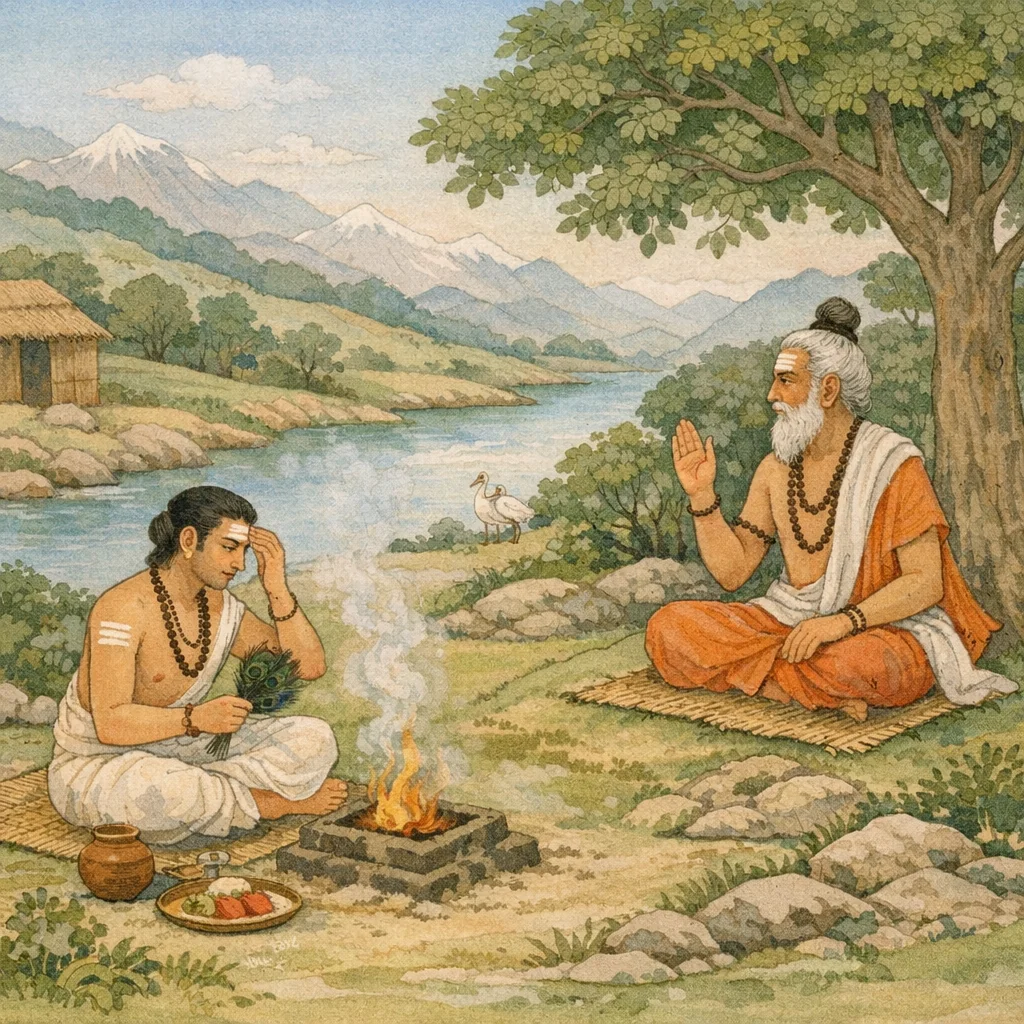
भस्म-प्रकार-त्रिपुण्ड्र-धारण-विधिः (Types of Bhasma and the Method of Wearing Tripuṇḍra)
Adhyāya 24, taught by Sūta, is a prescriptive and technical exposition defining bhasma (sacred ash) as a Shaiva ritual substance and identity-mark intended for liberation. It first classifies bhasma as mahābhasma and ‘svalpa’ bhasma, then further distinguishes śrauta, smārta, and laukika types. Eligibility and usage are differentiated: śrauta and smārta bhasma belong to dvija practice and require mantra-governed dhāraṇa, while laukika bhasma is accessible to others, generally without mantra. The chapter states that the preferred basis for āgneya bhasma is ash from burnt cow-dung, and accepts ash from agnihotra or other yajñas for applying the tripuṇḍra. It grounds the practice in scriptural mantra authority (notably Jābāla Upaniṣadic mantras beginning “agnir…”), prescribes sevenfold repeated smearing/ablution-like application (saptabhi-dhūlana) with ash (and water), and insists that one seeking mokṣa must not abandon the tripuṇḍra even inadvertently. Overall, it serves as a dense ritual manual: classification → sourcing → eligibility → mantra linkage → application protocol → soteriological injunction.
Shlokas
Verse 1
सूत उवाच । द्विविधं भस्म संप्रोक्तं सर्वमंगलदं परम् । तत्प्रकारमहं वक्ष्ये सावधानतया शृणु
Sūta said: “Sacred ash (bhasma) is declared to be of two kinds, supremely auspicious and bestowing all welfare. I shall now explain its proper method—listen with careful attention.”
Verse 2
एकं ज्ञेयं महाभस्म द्वितीयं स्वल्पसंज्ञकम् । महाभस्म इति प्रोक्तं भस्म नानाविधं परम्
Know that sacred ash (bhasma) is of two kinds: one is to be understood as the Great Bhasma (mahābhasma), and the second is known as the lesser kind. That ash which is declared “mahābhasma” is the supreme bhasma, spoken of as manifold in its forms and applications.
Verse 3
तद्भस्म त्रिविधं प्रोक्तं श्रोतं स्मार्तं च लौकिकम् । भस्मैव स्वल्पसंज्ञं हि बहुधा परिकीर्तितम्
That sacred ash (bhasma) is declared to be of three kinds: Śrauta (Vedic), Smārta (according to Smṛti), and Laukika (worldly). Indeed, ash itself—also known by the brief name “bhasma”—is spoken of in many ways (according to its sources and ritual applications).
Verse 4
श्रौतं भस्म तथा स्मार्तं द्विजानामेव कीर्तितम् । अन्येषामपि सर्वेषामपरं भस्म लौकिकम्
Two kinds of sacred ash are taught for the twice-born—namely, the śrauta ash (prepared according to Vedic rites) and the smārta ash (prepared according to the Smṛtis). For all others as well, there is another kind of ash, known as laukika (ordinary) ash.
Verse 5
धारणं मंत्रतः प्रोक्तं द्विजानां मुनिपुंगवैः । केवलं धारणं ज्ञेयमन्येषां मंत्रवर्जितम्
The foremost sages have taught that, for the twice-born, the sacred wearing of Śaiva insignia is to be done together with mantra. For others, it should be understood as mere wearing alone—without mantra.
Verse 6
आग्नेयमुच्यते भस्म दग्धगोमयसंभवम् । तदापि द्र व्यमित्युक्तं त्रिपुंड्रस्य महामुने
O great sage, the ash produced from burnt cow-dung is called ‘āgneya’ (fire-born). Even that is declared a proper sacred substance for applying the Tripuṇḍra, the three lines of ash.
Verse 7
अग्निहोत्रोत्थितं भस्मसंग्राह्यं वा मनीषिभिः । अन्ययज्ञोत्थितं वापि त्रिपुण्ड्रस्य च धारणे
For wearing the Tripuṇḍra, the wise should gather sacred ash produced from the Agnihotra; likewise, ash arising from other yajñas may also be used.
Verse 8
अग्निरित्यादिभिर्मंत्रैर्जाबालोपनिषद्गतेः । सप्तभिधूलनं कार्यं भस्मना सजलेन च
With the mantras beginning with “Agni…”, as taught in the Jābāla Upaniṣad, one should perform the sevenfold sprinkling and purification, using sacred ash (bhasma) mixed with water.
Verse 9
वर्णानामाश्रमाणां च मंत्रतो मंत्रतोपि च । त्रिपुंड्रोद्धूलनं प्रोक्तजाबालैरादरेण च
For all varṇas and all āśramas, with mantras—and indeed even beyond mantras—the reverent smearing of sacred ash to form the Tripuṇḍra has been taught by the Jābāla tradition.
Verse 10
भस्मनोद्धूलनं चैव यथा तिर्यक्त्रिपुंड्रकम् । प्रमादादपि मोक्षार्थी न त्यजेदिति विश्रुतिः
Sacred tradition attests that the seeker of liberation should not abandon the smearing of holy ash (bhasma) nor the wearing of the horizontal Tripuṇḍra mark, even through inadvertence, for these are established disciplines of Śaiva worship.
Verse 11
शिवेन विष्णुना चैव तथा तिर्यक्त्रिपुंड्रकम् । उमादेवी च लक्ष्मींश्च वाचान्याभिश्च नित्यशः
One should ever make the transverse Tripuṇḍra (three lines of sacred ash), along with the utterance of the names of Śiva and Viṣṇu; and likewise remember Devī Umā and Lakṣmī, and other sacred invocations—constantly.
Verse 12
ब्राह्मणैः क्षत्रियैर्वैश्यैः शूद्रै रपि च संस्करैः । अपभ्रंशैर्धृतं भस्मत्रिपुंड्रोद्धूलनात्मना
This observance is maintained by brāhmaṇas, kṣatriyas, vaiśyas, and śūdras alike, and also by those of mixed social conditions; even by those regarded as ‘apabhraṃśa’ (outside refined norms). It is upheld as an embodied devotional practice, by smearing sacred ash and bearing the Tripuṇḍra (three horizontal ash-lines).
Verse 13
उद्धूलनं त्रिपुंड्रं च श्रद्धया नाचरंति ये । तेषां नास्ति समाचारो वर्णाश्रमसमन्वितः
Those who, with faith, do not practice the holy smearing of sacred ash (uddhūlana) and the wearing of the Tripuṇḍra, the three ash-lines—for them there is no true established right conduct consistent with the disciplines of varṇa and āśrama.
Verse 14
उद्धूलनं त्रिपुंड्रं च श्रद्धया नाचरंति ये । तेषां नास्ति विनिर्मुक्तिस्संसाराज्जन्मकोटिभिः
Those who do not, with faith, practice the sacred smearing of holy ash (uddhūlana) and the wearing of the Tripuṇḍra marks—for them there is no complete liberation from saṃsāra, even through millions of births.
Verse 15
उद्धूलनं त्रिपुंड्रं च श्रद्धया नाचरन्ति ये । तेषां नास्ति शिवज्ञानं कल्पकोटिशतैरपि
Those who do not practice, with faith, the reverent application of sacred ash (uddhūlana) and the wearing of the three ash-lines (tripuṇḍra)—for them, true knowledge of Shiva does not arise even in hundreds of crores of kalpas.
Verse 16
उद्धूलनं त्रिपुंड्रं च श्रद्धया नाचरन्ति ये । ते महापातकैर्युक्ता इति शास्त्रीयनिर्णयः
Those who, with faith, do not practice the sacred smearing of holy ash (uddhūlana) and the wearing of the Tripuṇḍra are, according to the scriptural verdict, associated with great sins (mahāpātakas).
Verse 17
उद्धूलनं त्रिपुंड्रं च श्रद्धया नाचरन्ति ये । तेषामाचरितं सर्वं विपरीतफलाय हि
Those who do not, with faith, practice the sacred smearing of holy ash (bhasma-uddhūlana) and the wearing of the Tripuṇḍra—everything they perform bears an inverted result, yielding outcomes contrary to the intended spiritual fruit.
Verse 18
महापातकयुक्तानां जंतूनां शर्वविद्विषाम् । त्रिपुंड्रोद्धूलनद्वेषो जायते सुदृढं मुने
O sage, in beings tainted by great sins and hostile to Śarva (Lord Śiva), there arises a firmly rooted aversion to wearing the Tripuṇḍra and to smearing the body with sacred ash (bhasma).
Verse 19
शिवाग्निकार्यं यः कृत्वा कुर्यात्त्रियायुषात्मवित् । मुच्यते सर्वपापैस्तु स्पृष्टेन भस्मना नरः
A man who, having performed Śiva’s sacred fire rite, applies the holy ash (bhasma) with understanding of its life-giving power is freed from all sins; for by the very touch of that bhasma he is purified.
Verse 20
सितेन भस्मना कुर्य्यात्त्रिसन्ध्यं यस्त्रिपुण्ड्रकम् । सर्वपापविनिर्मुक्तः शिवेन सह मोदते
Whoever applies the Tripuṇḍra with pure white sacred ash at the three sandhyās of the day (morning, noon, and evening) is freed from all sins and rejoices in the company of Lord Śiva.
Verse 21
सितेन भस्मना कुर्याल्लाटे तु त्रिपुण्ड्रकम् । यो सावनादिभूतान्हि लोकानाप्तो मृतो भवेत्
With pure white sacred ash (bhasma) one should apply the Tripuṇḍra upon the forehead. For one who does not attain the worlds beginning with Sāvana and the rest, life is as good as death.
Verse 22
अकृत्वा भस्मना स्नानं न जपेद्वै षडक्षरम् । त्रिपुंड्रं च रचित्वा तु विधिना भस्मना जपेत्
Without first bathing with sacred ash (bhasma), one should not recite the six-syllabled mantra. But after properly applying the Tripuṇḍra with bhasma according to rule, one should perform the japa.
Verse 23
अदयो वाधमो वापि सर्वपापान्वितोपि वा । उषःपापान्वितो वापि मूर्खो वा पतितोपि वा
Whether one is without compassion, of low conduct, or even burdened with every kind of sin; whether steeped in grievous wrongdoing, ignorant, or even fallen—such a person too becomes fit to approach Śiva through bhakti.
Verse 24
यस्मिन्देशेव सेन्नित्यं भूतिशासनसंयुतः । सर्वतीर्थैश्च क्रतुभिः सांनिध्यं क्रियते सदा
In whatever land He abides continually—He who is united with the ordinance of sacred ash (bhasma)—in that very place the divine presence is ever established, as though all holy tīrthas and all sacrificial rites were gathered there.
Verse 25
त्रिपुंड्रसहितो जीवः पूज्यः सर्वैः सुरासुरैः । पापान्वितोपि शुद्धात्मा किं पुनः श्रद्धया युतः
A living being who bears the Tripuṇḍra—the three sacred ash marks—is worthy of reverence by all, by devas and asuras alike. Even if stained by sins, he is held to be pure in essence; how much more when he bears it with faith and devotion.
Verse 26
यस्मिन्देशे शिवज्ञानी भूतिशासनसंयुतः । गतो यदृच्छयाद्यापि तस्मिस्तीर्थाः समागताः
Even today, whichever land a knower of Śiva—adorned with sacred ash and rudrākṣa—happens to visit by chance, in that very place the holy tīrthas gather together.
Verse 27
बहुनात्र किमुक्तेन धार्यं भस्म सदा बुधैः । लिंगार्चनं सदा कार्यं जप्यो मंत्रः षडक्षरः
What more is there to say here? The wise should always wear sacred ash (bhasma). Worship of the Śiva-liṅga should be performed continually, and the six-syllabled mantra should be repeated in japa.
Verse 28
ब्रह्मणा विष्णुना वापि रुद्रे ण मुनिभिः सुरैः । भस्मधारणमाहात्म्यं न शक्यं परिभाषितुम्
Even by Brahmā, by Viṣṇu, by Rudra, and even by the sages and the gods, the greatness of wearing the sacred ash (bhasma)—the Tripuṇḍra of Śiva—cannot be fully described.
Verse 29
इति वर्णाश्रमाचारो लुप्तवर्णक्रियोपि च । पापात्सकृत्त्रिपुंड्रस्य धारणात्सोपि मुच्यते
Thus, even one whose conduct of varṇa and āśrama has fallen away—and even one who has neglected the prescribed rites of their station—can be released from sin by wearing the Tripuṇḍra (the three ash-lines) even once.
Verse 30
ये भस्मधारिणं त्यक्त्वा कर्म कुर्वंति मानवाः । तेषां नास्ति विनिर्मोक्षः संसाराज्जन्मकोटिभिः
Those who abandon the wearing of sacred ash (bhasma) and yet persist in worldly deeds— for them there is no complete release from saṃsāra, even through crores of births.
Verse 31
ते नाधीतं गुरोः सर्वं ते न सर्वमनुष्ठितम् । येन विप्रेण शिरसि त्रिपुंड्रं भस्मना कृतम्
That brāhmaṇa has not truly learned everything from his guru, nor has he properly carried out all disciplines—if he has made the Tripuṇḍra on his head with sacred ash.
Verse 32
ये भस्मधारिणं दृष्ट्वा नराः कुर्वंति ताडनम् । तेषां चंडालतो जन्म ब्रह्मन्नूह्यं विपश्चिता
O Brahmā, those people who, upon seeing a devotee bearing sacred ash (bhasma), strike him—such persons are born in the condition of a caṇḍāla. This is a truth to be understood by the wise.
Verse 33
मानस्तोकेन मंत्रेण मंत्रितं भस्म धारयेत् । ब्राह्मणः क्षत्रियश्चैव प्रोक्तेष्वंगेषु भक्तिमान्
A devoted Brāhmaṇa or Kṣatriya should wear the sacred ash (bhasma) consecrated by the Mānastoka mantra, applying it with reverence upon the prescribed limbs.
Verse 34
वैश्यस्त्रियं बकेनैव शूद्र ः पंचाक्षरेण तु । अन्यासां विधवास्त्रीणां विधिः प्रोक्तश्च शूद्र वत्
A Vaiśya woman should perform japa with the mantra called “Baka,” while a Śūdra should perform japa with the Pañcākṣarī. For other widowed women as well, the prescribed observance is declared to be the same as for a Śūdra.
Verse 35
पंचब्रह्मादिमनुभिर्गृहस्थस्य विधीयते । त्रियंबकेन मनुना विधिर्वै ब्रह्मचारिणः
For the householder, the rule of conduct is laid down by the sages beginning with the Pañcabrahma mantras; but for the brahmacārin, the student of sacred discipline, the rule is indeed prescribed by the Triyambaka mantra.
Verse 36
अघोरेणाथ मनुना विपिनस्थविधिः स्मृतः । यतिस्तु प्रणवेनैव त्रिपुंड्रादीनि कारयेत्
Then it is remembered that the rite prescribed for one dwelling in the forest is performed with the Aghora mantra. But the renunciate (yati) should apply the Tripuṇḍra and the other sacred marks using the Praṇava (Oṁ) alone.
Verse 37
अतिवर्णाश्रमी नित्यं शिवोहं भावनात्परात् । शिवयोगी च नियतमीशानेनापि धारयेत्
One who has transcended all social classes and stages of life should constantly abide in the supreme contemplation, “I am Śiva.” And the disciplined Śiva-yogin should also steadily maintain this realization, holding it through Īśāna, the Lord’s highest, upward-facing aspect.
Verse 38
न त्याज्यं सर्ववर्णैश्च भस्मधारणमुत्तमम् । अन्यैरपि यथाजीवैस्सदेति शिवशासनम्
The supreme observance of wearing bhasma, the sacred ash, should not be abandoned by people of any social order. Indeed, it is to be practiced by all—each according to one’s station in life—for such is the enduring command of Lord Śiva.
Verse 39
भस्मस्नानेन यावंतः कणाः स्वाण्गे प्रतिष्ठिताः । तावंति शिवलिंगानि तनौ धत्ते हि धारकः
By bathing with bhasma, as many particles as become established upon one’s own body—so many Śiva-liṅgas the wearer truly bears upon his person.
Verse 40
ब्राह्मणाः क्षत्रिया वैश्याः शूद्रा श्चापि च संकराः । स्त्रियोथ विधवा बालाः प्राप्ताः पाखंडिकास्तथा
Brahmins, Kshatriyas, Vaishyas, Shudras, and those of mixed social orders—women as well, widows, and children—along with even the heretical and hypocritical, all came there, drawn by the Lord’s sanctity.
Verse 41
ब्रह्मचारी गृही वन्यः संन्यासी वा व्रती तथा । नार्यो भस्म त्रिपुंड्रांका मुक्ता एव न संशयः
Whether one is a brahmacārin, a householder, a forest-dweller, a saṃnyāsin, or a vowed practitioner—and even women—those who bear the Tripuṇḍra marks made with sacred bhasma are indeed liberated; of this there is no doubt.
Verse 42
ज्ञानाज्ञानधृतो वापि वह्निदाहसमो यथा । ज्ञानाज्ञानधृतं भस्म पावयेत्सकलं नरम्
Just as fire burns the same whether handled by one who knows or by one who does not, so sacred bhasma—applied with understanding or without—purifies the whole person.
Verse 43
नाश्नीयाज्जलमन्नमल्पमपि वा भस्माक्षधृत्या विना । भुक्त्वावाथ गृही वनीपतियतिर्वर्णी तथा संकरः । एनोभुण्नरकं प्रयाति सत दागायत्रिजापेन तद्वर्णानां तु यतेस्तु मुख्यप्रणवाजपेन मुक्तंभवेत्
One should not partake even a little water or food without wearing the sacred bhasma and rudrākṣa. If, after eating, a householder, a forest-dweller, a renunciate (yati), a celibate student, or one of mixed caste neglects this, he incurs sin and falls into hell. That fault is removed for those āśramas by repeating the Gāyatrī a hundred times; but for a renunciate, release from that taint is attained by japa of the supreme Praṇava (Oṁ).
Verse 44
त्रिपुंड्रं ये विनिंदंति निन्दन्ति शिवमेव ते । धारयंति च ये भक्त्या धारयन्ति तमेव ते
Those who disparage the Tripuṇḍra—the three lines of sacred ash—truly disparage Lord Śiva Himself. And those who, with devotion, wear the Tripuṇḍra, those devotees truly bear Śiva Himself upon their person and within their being.
Verse 45
धिग्भस्मरहितं भालं धिग्ग्राममशिवालयम् । धिगनीशार्चनं जन्म धिग्विद्यामशिवाश्रयाम्
Shame upon a forehead devoid of sacred ash; shame upon a village that has no shrine of Śiva. Shame upon a life in which the Lord is not worshipped; and shame upon learning that does not take refuge in Śiva.
Verse 46
ये निंदंति महेश्वरं त्रिजगतामाधारभूतं हरं ये निन्दंति त्रिपुंड्रधारणकरं दोषस्तु तद्दर्शने । ते वै संकरसूकरासुरखरश्वक्रोष्टुकीटोपमा जाता एव भवंति पापपरमास्तेनारकाः केवलम्
Those who revile Maheśvara—Hara, the very support of the three worlds—and those who revile the wearing of the Tripuṇḍra, the three lines of sacred ash, incur fault even by merely beholding it with contempt. Such people, steeped in extreme sin, are indeed born with natures like the Śaṅkara-hog, the asura, the donkey, the dog, the jackal, and the insect; therefore they are bound only for hell.
Verse 47
ते दृष्ट्वा शशिभास्करौ निशि दिने स्वप्नेपि नो केवलं पश्यंतु श्रुतिरुद्र सूक्तजपतो मुच्येत तेनादृताः । सत्संभाषणतो भवेद्धि नरकं निस्तारवानास्थितं ये भस्मादिविधारणं हि पुरुषं निंदंति मंदा हि ते
May they not behold the Moon and the Sun—by night, by day, not even in dream—those dull-witted people who have no reverence for the japa of the Vedic Rudra-sūkta and who revile a man observing holy disciplines such as wearing sacred ash. Indeed, even conversing with them leads to hell; they are not established on the path that brings deliverance.
Verse 48
न तांत्रिकस्त्वधिकृतो नोर्द्ध्वपुंड्रधरो मुने । संतप्तचक्रचिह्नोत्र शिवयज्ञे बहिष्कृतः
O sage, one who follows Tantric rites that are not Śaiva has no entitlement here; nor does one who bears the vertical sect-mark (ūrdhva-puṇḍra). Likewise, one branded with the sign of the heated discus is excluded from this Śiva-sacrifice.
Verse 49
तत्रैते बहवो लोका बृहज्जाबालचोदिताः । ते विचार्याः प्रयत्नेन ततो भस्मरतो भवेत्
In this matter, many teachings are set forth, as enjoined in the Bṛhajjābāla (Upaniṣad). One should examine them carefully and with earnest effort; then one becomes devoted to bhasma, the sacred ash.
Verse 50
यच्चंदनैश्चंदनकेपि मिश्रं धार्यं हि भस्मैव त्रिपुंड्रभस्मना । विभूतिभालोपरि किंचनापि धार्यं सदा नो यदि संतिबुद्धयः
Even if sandal paste is mixed with sandalwood, one should still apply only sacred ash as the Tripuṇḍra. And upon the forehead—over the vibhūti—one should always bear some sign (a Śaiva emblem). If our understanding is steady, this should never be neglected.
Verse 51
स्त्रीभिस्त्रिपुण्ड्रमलकावधि धारणीयं भस्म द्विजादिभिरथो विधवाभिरेवम् । तद्वत्सदाश्रमवतां विशदाविभूतिर्धार्यापवर्गफलदा सकलाघहन्त्री
Women should wear the holy ash (bhasma) as the Tripuṇḍra up to the hairline on the forehead. Likewise, brāhmaṇas and other twice-born should wear the sacred ash, and widows also in the same manner. In the same way, for those established in a righteous āśrama, this pure vibhūti should be worn; it grants liberation and destroys all sin.
Verse 52
त्रिपुण्ड्रं कुरुते यस्तु भस्मना विधिपूर्वकम् । महापातकसंघातैर्मुच्यते चोपपातकैः
Whoever, in the prescribed manner, forms the Tripuṇḍra with sacred ash (bhasma) is freed from the accumulated mass of great sins, and also from subsidiary transgressions.
Verse 53
ब्रह्मचारी गृहस्थो वा वानप्रस्थोथ वा यतिः । ब्रह्मक्षत्त्राश्च विट्शूद्रा स्तथान्ये पतिताधमाः
Whether one is a celibate student (brahmacārin), a householder, a forest-dweller (vānaprastha), or a renunciant (yati); whether one is of the brāhmaṇa and kṣatriya orders, or of the vaiśya and śūdra communities—indeed even others deemed fallen and low—all are included, able to turn toward Lord Śiva through devotion (bhakti).
Verse 54
उद्धूलनं त्रिपुंड्रं च धृत्वा शुद्धा भवंति च । भस्मनो विधिना सम्यक्पापराशिं विहाय च
By duly smearing oneself with sacred ash and wearing the Tripuṇḍra marks, one becomes purified; and by applying the bhasma according to proper rule, one truly casts off the accumulated mass of sins.
Verse 55
भस्मधारी विशेषेण स्त्रीगोहत्यादिपातकैः । वीरहत्याश्वहत्याभ्यां मुच्यते नात्र संशयः
One who bears the sacred ash (bhasma), in a special manner, is freed from grievous sins such as killing a woman and a cow, and also from the sins of killing a hero and killing a horse—of this there is no doubt.
Verse 56
परद्र व्यापहरणं परदाराभिमर्शनम् । परनिन्दा परक्षेत्रहरणं परपीडनम्
Stealing another’s property, violating another’s spouse, slandering others, seizing another’s land, and harming others—these are injurious deeds that bind the soul in impurity and obstruct the path of Śiva-dharma.
Verse 57
सस्यारामादिहरणं गृहदाहादिकर्म च । गोहिरण्यमहिष्यादितिलकम्बलवाससाम्
Stealing crops, gardens, and the like, and deeds such as setting houses on fire; and stealing cows, gold, buffaloes and the like, as well as sesame, blankets, and garments—all such acts are condemned as grave wrongdoing.
Verse 58
अन्नधान्यजलादीनां नीचेभ्यश्च परिग्रहः । दशवेश्यामतंगीषु वृषलीषु नटीषु च
One should not accept food, grain, water, and the like from base or impure sources; likewise, to preserve the purity required for Śiva’s worship, one should avoid association and dependence upon prostitutes and other degrading company—such as outcaste women and actresses.
Verse 59
रजस्वलासु कन्यासु विधवासु च मैथुनम् । मांसचर्मरसादीनां लवणस्य च विक्रयः
Sexual intercourse with a menstruating woman, with an unmarried maiden, or with a widow; and the trade (selling) of meat, hides/skins, intoxicating liquids and the like, as well as salt—these are declared blameworthy acts for one who seeks purity on the path of Śiva-dharma.
Verse 60
पैशुन्यं कूटवादश्च साक्षिमिथ्याभिलाषिणाम् । एवमादीन्यसंख्यानि पापानि विविधानि च । सद्य एव विनश्यंति त्रिपुंड्रस्य च धारणात्
Slander, deceitful speech, and the craving to give false testimony—along with countless other varied sins of this kind—are destroyed at once by the very act of wearing the Tripuṇḍra, the three sacred ash-lines, the mark of devotion to Lord Śiva.
Verse 61
शिवद्र व्यापहरणं शिवनिंदा च कुत्रचित् । निंदा च शिवभक्तानां प्रायश्चित्तैर्न शुद्ध्यति
Stealing what belongs to Śiva, reviling Śiva in any manner, and reviling the devotees of Śiva—these are not purified merely by ordinary acts of expiation.
Verse 62
रुद्रा क्षं यस्य गात्रेषु ललाटे तु त्रिपंड्रकम् । सचांडालोपि संपूज्यस्सर्ववर्णोत्तमोत्तमः
He who bears Rudrākṣa beads upon his body and wears the Tripuṇḍra—three sacred lines of ash—upon his forehead, even if he be a Cāṇḍāla, is worthy of reverent worship; marked as a devotee of Śiva, he becomes the most excellent among all classes.
Verse 63
यानि तीर्थानि लोकेस्मिन्गंगाद्यास्सरितश्च याः । स्नातो भवति सर्वत्र ललाटे यस्त्रिपुंड्रकम्
Whoever bears the Tripuṇḍra—the three sacred lines of ash—upon the forehead is deemed to have bathed in all the tīrthas of this world, indeed in the Gaṅgā and in every holy river, everywhere and at all times.
Verse 64
सप्तकोटि महामंत्राः पंचाक्षरपुरस्सराः । तथान्ये कोटिशो मंत्राः शैवकैवल्यहेतवः
There are seventy million great mantras, foremost among them the five-syllabled mantra (Pañcākṣara). There are also other mantras in crores; yet all of them are causes that lead to Śaiva kaivalya—liberation in union with Śiva.
Verse 65
अन्ये मंत्राश्च देवानां सर्वसौख्यकरा मुने । ते सर्वे तस्य वश्याः स्युर्यो बिभर्ति त्रिपुंड्रकम्
O sage, even the other mantras of the gods, which bestow every kind of worldly happiness, become wholly subservient to the one who bears the Tripuṇḍra—the three sacred ash-lines of Śiva.
Verse 66
सहस्रं पूर्वजातानां सहस्रं जनयिष्यताम् । स्ववंशजानां ज्ञातीनामुद्धरेद्यस्त्रिपुंड्रकृत्
One who marks the body with the Tripuṇḍra of sacred ash uplifts a thousand ancestors already born and a thousand descendants yet to be born; indeed, he delivers his kinsmen of his own lineage.
Verse 67
इह भुक्त्वा खिलान्भोगान्दीर्घायुर्व्याधिवर्जितः । जीवितांते च मरणं सुखेनैव प्रपद्यते
Having enjoyed in this world all wholesome pleasures, he becomes long-lived and free from disease; and at life’s end, by the grace born of Śiva’s worship, he attains even death peacefully, departing with ease.
Verse 68
अष्टैश्वर्यगुणोपेतं प्राप्य दिव्यवपुः शिवम् । दिव्यं विमानमारुह्य दिव्यत्रिदशसेवितम्
Endowed with the eight divine lordly excellences, having attained a celestial body fit for the auspicious service of Śiva, one ascends a radiant heavenly vimāna, revered and attended by the gods.
Verse 69
विद्याधराणां सर्वेषां गंधर्वाणां महौजसाम् । इंद्रा दिलोकपालानां लोकेषु च यथाक्रमम्
And this is proclaimed for all the Vidyādharas, for the mighty, radiant Gandharvas, and for Indra and the other guardians of the worlds—each in their own realms, in due order.
Verse 70
भुक्त्वा भोगान्सुविपुलान्प्रजेशानां पदेषु च । ब्रह्मणः पदमासाद्य तत्र कन्याशतं रमेत्
Having enjoyed exceedingly abundant pleasures, even in the stations of the Prajāpatis, one attains the rank of Brahmā; and there he delights in the company of a hundred celestial maidens.
Verse 71
तत्र ब्रह्मायुषो मानं भुक्त्वा भोगाननेकशः । विष्णोर्लोके लभेद्भोगं यावद्ब्रह्मशतात्ययः
There, after enjoying many pleasures for a span equal to Brahmā’s full life, one then attains enjoyments in Viṣṇu’s world—lasting until the passing of a hundred Brahmā-cycles.
Verse 72
शिवलोकं ततः प्राप्य लब्ध्वेष्टं काममक्षयम् । शिवसायुज्यमाप्नोति संशयो नात्र जायते
Thereafter, having reached Śiva’s world and obtained the desired fulfillment, imperishable and inexhaustible, one attains Śiva-sāyujya—unity with Śiva. Of this, no doubt arises.
Verse 73
सर्वोपनिषदां सारं समालोक्य मुहुर्मुहुः । इदमेव हि निर्णीतं परं श्रेयस्त्रिपुंड्रकम्
Having again and again contemplated the essence of all the Upaniṣads, it has indeed been concluded: the Tripuṇḍra—the three sacred lines of Vibhūti, holy ash—alone is the supreme means to the highest good.
Verse 74
विभूतिं निंदते यो वै ब्राह्मणः सोन्यजातकः । याति च नरके घोरे यावद्ब्रह्मा चतुर्मुखः
That Brahmin who reviles Vibhūti (sacred ash) is to be regarded as one born of another lineage—fallen from true Brahminhood. He goes to a dreadful hell for as long as Brahmā, the four-faced, endures.
Verse 75
श्राद्धे यज्ञे जपे होमे वैश्वदेवे सुरार्चने । धृतत्रिपुंड्रः पूतात्मा मृत्युं जयति मानवः
In rites for the ancestors (Śrāddha), in sacrifices, in mantra-repetition (japa), in fire-offerings (homa), in the Vaiśvadeva rite, and in worship of the gods—when a person bears the Tripuṇḍra marks, purified in soul, that human being conquers death.
Verse 76
जलस्नानं मलत्यागे भस्मस्नानं सदा शुचि । मंत्रस्नानं हरेत्पापं ज्ञानस्नाने परं पदम्
Water-bathing removes bodily impurity; bathing with bhasma, the sacred ash, makes one ever pure. Bathing by mantra destroys sin; and in the bath of liberating knowledge one attains the supreme state.
Verse 77
सर्वतीर्थेषु यत्पुण्यं सर्वतीर्थेषु यत्फलम् । तत्फलं समवाप्नोति भस्मस्नानकरो नरः
Whatever merit and spiritual fruit are gained by bathing at all sacred tīrthas, that very fruit is fully attained by one who performs the bhasma-bath in the Śaiva manner.
Verse 78
भस्मस्नानं परं तीर्थं गंगास्नानं दिने दिने । भस्मरूपी शिवः साक्षाद्भस्म त्रैलोक्यपावनम्
Bathing with bhasma is the supreme tīrtha—equal to bathing in the Gaṅgā day after day. For Śiva is truly present in the form of bhasma, and that bhasma purifies all the three worlds.
Verse 79
न तदूनं न तद्ध्यानं न तद्दानं जपो न सः । त्रिपुंड्रेण विनायेन विप्रेण यदनुष्ठितम्
It is not a true vow, nor true meditation; it is not real charity, and it is not japa—whatever a brāhmaṇa performs without the Tripuṇḍra, the three ash-lines of Śiva.
Verse 80
वानप्रस्थस्य कन्यानां दीक्षाहीननृणां तथा । मध्याह्नात्प्राग्जलैर्युक्तं परतो जलवर्जितम्
For vānaprasthas (forest-dwelling ascetics), unmarried maidens, and men who have not received dīkṣā, the rite should be performed with water before midday; after midday it should be done without water.
Verse 81
एवं त्रिपुंड्रं यः कुर्य्यान्नित्यं नियतमानसः । शिवभक्तः सविज्ञेयो भुक्तिं मुक्तिं च विंदति
Thus, whoever applies the Tripuṇḍra (the three sacred ash-lines) daily with a disciplined and steady mind is known as a true devotee of Śiva; he attains both bhukti (worldly well-being) and mukti (liberation).
Verse 82
यस्यांगेनैव रुद्रा क्ष एकोपि बहुपुण्यदः । तस्य जन्मनिरर्थं स्यात्त्रिपुंड्ररहितो यदि
Even a single rudrākṣa worn upon the body bestows abundant merit; yet if a person is without the Tripuṇḍra (the three sacred ash-lines), that person’s very birth becomes futile.
Verse 83
एवं त्रिपुंड्रमाहात्म्यं समासात्कथितं मया । रहस्यं सर्वजंतूनां गोपनीयमिदं त्वया
Thus, I have briefly explained to you the greatness of the Tripuṇḍra. This is a secret teaching for all living beings; therefore, you should guard it and keep it confidential.
Verse 84
तिस्रो रेखा भवंत्येव स्थानेषु मुनिपुंगवाः । ललाटादिषु सर्वेषु यथोक्तेषु बुधैर्मुने
O best of sages, indeed three lines are to be made at the prescribed places—on the forehead and the other locations—as the wise have stated, O sage.
Verse 85
भ्रुवोर्मध्यं समारभ्य यावदंतो भवेद्भ्रुवोः । तावत्प्रमाणं संधार्यं ललाटे च त्रिपुंड्रकम्
Beginning from the space between the eyebrows and extending up to the end of the eyebrows, one should take that measure as the standard and, on the forehead, apply the Tripuṇḍra (the three sacred ash-lines) accordingly.
Verse 86
मध्यमानामिकांगुल्या मध्ये तु प्रतिलोमतः । अंगुष्ठेन कृता रेखा त्रिपुंड्राख्या भिधीयते
When, in the middle space, a line is drawn in the reverse direction using the thumb—after arranging the middle and ring fingers—this line is known as the Tripuṇḍra, the three sacred ash marks.
Verse 87
मध्येंगुलिभिरादाय तिसृभिर्भस्म यत्नतः । त्रिपुण्ड्रधारयेद्भक्त्या भुक्तिमुक्तिप्रदं परम्
Taking sacred ash carefully with the three middle fingers, one should, with devotion, apply the Tripuṇḍra. This supreme act bestows both worldly well-being (bhukti) and liberation (mukti).
Verse 88
तिसृणामपि रेखानां प्रत्येकं नवदेवताः । सर्वत्रांगेषु ता वक्ष्ये सावधानतया शृणु
For each of the three sacred lines, there are nine presiding deities. I shall declare them for all the limbs of the body—listen with careful attention.
Verse 89
अकारो गार्हपत्याग्निर्भूधर्मश्च रजोगुणः । ऋग्वेदश्च क्रियाशक्तिः प्रातःसवनमेव च
The syllable “A” is the Gārhapatya (householder’s) sacred fire; it is the earth-principle and the quality of rajas. It is also the Ṛgveda, the power of action (kriyā-śakti), and the morning Soma-pressing (prātaḥ-savana).
Verse 90
महदेवश्च रेखायाः प्रथमायाश्च देवता । विज्ञेया मुनिशार्दूलाः शिवदीक्षापरायणैः
O tiger-like sages, those devoted to Śiva’s initiation (Śiva-dīkṣā) should know that Mahādeva is the presiding deity of the first line (rekhā).
Verse 91
उकारो दक्षिणाग्निश्च नभस्तत्त्वं यजुस्तथा । मध्यंदिनं च सवनमिच्छाशक्त्यंतरात्मकौ
The syllable “U” is the southern sacred fire; it is also the principle of space (ākāśa) and the Yajurveda. It is the midday Soma-pressing (madhyandina-savana) as well, abiding inwardly as icchā-śakti, the power of will.
Verse 92
महेश्वरश्च रेखाया द्वितीयायाश्च देवता । विज्ञेया मुनिशार्दूल शिवदीक्षापरायणैः
O tiger among sages, know that Maheśvara is the presiding deity of the second line (rekhā), as understood by those devoted to Śiva’s initiation (Śiva-dīkṣā).
Verse 93
मकाराहवनीयौ च परमात्मा तमोदिवौ । ज्ञानशक्तिः सामवेदस्तृतीयं सवनं तथा
The syllable “ma” is also to be contemplated as the Āhavanīya sacred fire, as the Supreme Self (Paramātmā), and as the pair—darkness and day. It is likewise to be known as jñāna-śakti, the Sāma Veda, and the third Soma-pressing (tṛtīya-savana) as well.
Verse 94
शिवश्चैव च रेखायास्तृतियायाश्च देवता । विज्ञेया मुनिशार्दूल शिवदीक्षापरायणौ
Know, O tiger among sages, that Śiva Himself is the presiding deity of the third ritual line; thus is it to be understood by those devoted to Śiva’s initiation (Śiva-dīkṣā).
Verse 95
एवं नित्यं नमस्कृत्य सद्भक्त्या स्थानदेवताः । त्रिपुंड्रं धारयेच्छुद्धो भुक्तिं मुक्तिं च विंदति
Thus, having daily offered salutations with true devotion to the presiding deities of the sacred place, a purified person should wear the Tripuṇḍra, the three lines of holy ash; thereby one attains both worldly well-being (bhukti) and liberation (mukti).
Verse 96
इत्युक्ताः स्थानदेवाश्च सर्वांगेषु मुनीश्वरः । तेषां संबंधिनो भक्त्या स्थानानि शृणु सांप्रतम्
Thus addressed, the presiding deities of the sacred loci in all the limbs (of the divine form) spoke. O lord of sages, now listen with devotion to the holy places connected with them.
Verse 97
द्वात्रिंशत्स्थानके वार्द्धषोडशस्थानकेपि च । अष्टस्थाने तथा चैव पंचस्थानेपि नान्यसेत्
Whether the practice is arranged in thirty-two stations, in the extended sixteen-station method, or likewise in the eight- or five-station method, one should not insert any other (mantra or deity) in between—keeping the Śaiva placement and discipline undisturbed.
Verse 98
उत्तमांगे ललाटे च कर्णयोर्नेत्रयोस्तथा । नासावक्त्रगलेष्वेवं हस्तद्वय अतः परम्
Thereafter, one should apply the Vibhūti (sacred ash) upon the crown of the head and upon the forehead; likewise upon the ears and the eyes; and in the same manner upon the nose, the mouth, and the throat—then next upon both hands.
Verse 99
कूर्परे मणिबंधे च हृदये पार्श्वयोर्द्वयोः । नाभौ मुष्कद्वये चैवमूर्वोर्गुल्फे च जानुनि
On the elbow, the wrist, the heart, and on both sides of the torso; on the navel, on the two testes; likewise on the thighs, the ankles, and the knees—upon these places the devotee should set the sacred mark, applying the Vibhūti.
Verse 100
जंघाद्वयेपदद्वन्द्वे द्वात्रिंशत्स्थानमुत्तमम् । अग्न्यब्भूवायुदिग्देशदिक्पालान्वसुभिः सह
In the pair of shanks and in the pair of feet is the excellent thirty-second seat. There, along with the Vasus, one should contemplate Agni, the Waters, the Earth, the Wind, the directions and regions, and the guardians of the directions.
Verse 101
धरा ध्रुवश्च सोमश्च अपश्चेवानिलोनलः । प्रत्यूषश्च प्रभासश्च वसवोष्टौ प्रकीर्तिताः
Dharā, Dhruva, Soma, Āpaḥ, Anila, Anala, Pratyūṣa, and Prabhāsa—these are proclaimed to be the eight Vasus.
Verse 102
एतेषां नाममात्रेण त्रिपुंड्रं धारयेद्बुधाः । कुर्याद्वा षोडशस्थाने त्रिपुण्ड्रं तु समाहितः
By merely uttering these names, the wise should apply the Tripuṇḍra—the three sacred lines of ash. Or, with the mind well-collected, one may mark the Tripuṇḍra upon the sixteen prescribed places of the body.
Verse 103
शीर्षके च ललाटेच कंठे चांसद्वये भुजे । कूर्परे मणिबंधे च हृदये नाभिपार्श्वके
On the crown of the head and on the forehead, on the throat, on both shoulders and the arms, at the elbows and the wrists, upon the heart, and on the sides of the navel—on these places the sacred marks should be set.
Verse 104
पृष्ठे चैवं प्रतिष्ठाय यजेत्तत्राश्विदैवते । शिवशक्तिं तथा रुद्र मीशं नारदमेव च
Having thus established (the sacred form) on the back side as prescribed, one should worship there the Aśvinī deities; and also Śiva together with Śakti, Rudra, the Lord Īśa, and Narada as well.
Verse 105
वामादिनवशक्तीश्च एताः षोडशदेवताः । नासत्यो दस्रकश्चैव अश्विनौ द्वौ प्रकीर्तितौ
Thus, beginning with Vāmā and the other nine Śaktis, these are spoken of as the sixteen deities. Likewise, Nāsatya and Dasraka are proclaimed to be the two Aśvins.
Verse 106
अथवा मूर्द्ध्नि केशे च कर्मयोर्वदने तथा । बाहुद्वये च हृदये नाभ्यामूरुयुगे तथा
Or else, one may apply it upon the crown of the head and in the hair, upon the two hands and the face; likewise upon both arms, upon the heart, upon the navel, and upon the pair of thighs—thus sanctifying the body for Śiva’s worship.
Verse 107
जानुद्वये च पदयोः पृष्ठभागे च षोडश । शिवश्चन्द्र श्च रुद्र ः को विघ्नेशो विष्णुरेव वा
On both knees, on the feet, and on the back-side (of the body), there are sixteen (marks/placements). They are (to be contemplated as) Śiva, the Moon, Rudra, ‘Ka’ (Brahmā), Vighneśa (Gaṇeśa), or indeed Viṣṇu.
Verse 108
श्रीश्चैव हृदये शम्भुस्तथा नाभौ प्रजापतिः । नागश्च नागकन्याश्च उभयोरृषिकन्यकाः
Śrī (the auspicious power of prosperity) is to be contemplated in the heart; Śambhu (Lord Śiva) likewise in the heart; and Prajāpati (the Lord of progeny/creation) in the navel. The Nāgas and the Nāga-maidens are to be envisioned on both sides, together with the daughters of the Ṛṣis.
Verse 109
पादयोश्च समुद्रा श्च तीर्थाः पृष्ठे विशालतः । इत्येव षोडशस्थानमष्टस्थानमथोच्यते
In the two feet are the oceans, and upon the broad back are the sacred fords (tīrthas). Thus the set of sixteen loci is stated; and now the set of eight loci is also taught.
Verse 110
गुह्यस्थानं ललाटश्च कर्णद्वयमनुत्तमम् । अंसयुग्मं च हृदयं नाभिरित्येवमष्टकम्
The secret region, the forehead, the excellent pair of ears, the two shoulders, the heart, and the navel—thus are declared the eight sacred places.
Verse 111
ब्रह्मा च ऋषयः सप्तदेवताश्च प्रकीर्तिताः । इत्येवं तु समुद्दिष्टं भस्मविद्भिर्मुनीश्वराः
“Brahmā, the Ṛṣis, and the seven deities have thus been declared. In this very manner, O best of sages, it has been set forth by those munis who know the true discipline of sacred Bhasma.”
Verse 112
अथ वा मस्तकं बाहूहृदयं नाभिरेव च । पंचस्थानान्यमून्याहुर्धारणे भस्मविज्जनाः
Or else, the head, the two arms, the heart, and the navel—those who truly know the sacred ash (bhasma) declare these to be the five bodily places for wearing it, as a Shaiva mark of consecration.
Verse 113
यथासंभवनं कुर्य्याद्देशकालाद्यपेक्षया । उद्धूलनेप्यशक्तिश्चेत्त्रिपुण्ड्रादीनि कारयेत्
One should perform these observances as far as possible, considering place, time, and other circumstances. If one is unable even to apply the sacred ash by smearing, then one should at least have the Tripuṇḍra and related marks made on the body.
Verse 114
त्रिनेत्रं त्रिगुणाधारं त्रिवेदजनकं शिवम् । स्मरन्नमः शिवायेति ललाटे तु त्रिपुण्ड्रकम्
Meditating on Śiva—the Three-eyed Lord, the support of the three guṇas and the source of the three Vedas—one should remember the mantra “Namaḥ Śivāya” and then apply the Tripuṇḍra of sacred ash upon the forehead.
Verse 115
ईशाभ्यां नम इत्युक्त्वापार्श्वयोश्च त्रिपुण्ड्रकम् । बीजाभ्यां नम इत्युक्त्वा धारयेत्तु प्रकोष्ठयोः
Uttering, “Salutations to the two Īśas,” one should apply the Tripuṇḍra marks upon both sides of the body. Then, uttering, “Salutations to the two Bījas,” one should place the sacred marks upon the two forearms.
Verse 116
कुर्यादधः पितृभ्यां च उमेशाभ्यां तथोपरि । भीमायेति ततः पृष्ठे शिरसः पश्चिमे तथा
He should place it below for the Pitṛs (the ancestral deities), and likewise above for Umā and Īśa. Then, uttering “(namaḥ) Bhīmāya,” he should place it on the back, on the western side of the head as well.
Frequently Asked Questions
Rather than a mythic episode, the chapter advances a ritual-theological argument: bhasma and tripuṇḍra are not merely social identifiers but scripturally grounded disciplines with mokṣa-orientation, validated through mantra authority and strict procedural classification.
Bhasma symbolizes reduction of materiality to residue (ash) and functions as a purificatory sacrament; tripuṇḍra becomes the codified bodily inscription of Shaiva affiliation and renunciant intent, with repeated application presented as a disciplined, mantra-linked purification aimed at liberation.
No discrete iconographic manifestation (svarūpa) is foregrounded in the sampled portion; the emphasis is on Śiva’s ritual presence mediated through bhasma and mantra—Śiva as accessible through orthodox practice rather than through a narrative depiction of a particular form.