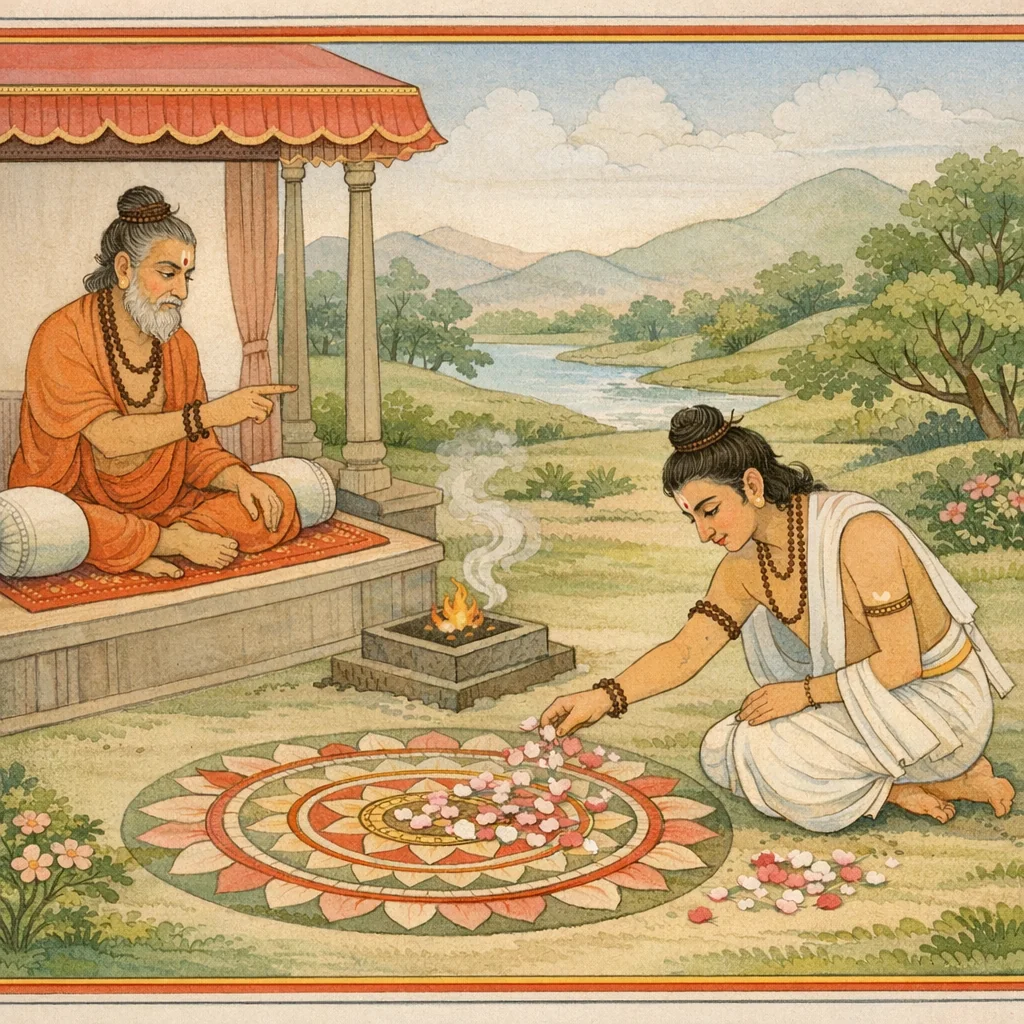
Maṇḍala–Pūjā–Homa Krama (Maṇḍala Worship and Homa Sequence for the Disciple)
Adhyāya 18 sets out a strictly ordered ritual procedure carried out under the ācārya’s command. After preliminary purifications such as bathing, the disciple approaches the Śiva-maṇḍala with joined hands and meditative focus. The guru reveals the maṇḍala up to the eye-binding stage (netrabandhana), then the disciple casts flowers (puṣpāvakiraṇa); where the flowers fall becomes an omen by which the guru assigns the disciple a corresponding name and role. The disciple is next led to the nirmālya-maṇḍala, worships Īśāna (Śiva), and offers oblations into the Śiva-fire (śivānala). The chapter also gives remedial rites: if the disciple has seen an inauspicious dream, a homa of 100, 50, or 25 offerings is prescribed using the root-mantra (mūla-vidyā) to pacify the fault. Further steps include bodily markers (a thread tied at the topknot and let down), foundational worship (ādhāra-pūjā) within the nivṛtti-kalā framework, and culminate in worship of Vāgīśvarī and a homa-led sequence. The guru’s mental act of yojana and the use of approved mudrā are said to grant the disciple simultaneous ritual access across all birth-states (sarva-yoniṣu), indicating a metaphysical reconfiguration of identity and eligibility. Overall, it functions as a procedural manual for maṇḍala-centered consecration where mantra, gesture, and fire offerings effect purification, assignment, and spiritual integration.
Shlokas
Verse 1
उपमन्युरुवाच । ततः स्नानादिकं सर्वं समाप्याचार्यचोदितः । गच्छेद्बद्धांजलिर्ध्यायञ्छिवमण्डलपार्श्वतः
Upamanyu said: “Then, having completed all the prescribed acts beginning with bathing, and being instructed by the teacher, he should go with hands joined in reverence, meditating on Śiva, to the side of the Śiva-maṇḍala.”
Verse 2
अथ पूजां विना सर्वं कृत्वा पूर्वदिने यथा । नेत्रबंधनपर्यंतं दर्शयेन्मण्डलं गुरुः
Then, without performing the formal worship, the guru should do everything just as on the previous day, and he should show the maṇḍala up to the stage of binding the eyes (netra-bandhana).
Verse 3
बद्धनेत्रेण शिष्येण पुष्पावकिरणे कृते । यत्रापतंति पुष्णाणि तस्य नामा ऽस्य संदिशेत्
When the disciple, with eyes bound, has scattered the flowers, the place where the flowers fall—its name should be pointed out to him, as the indicated sacred spot.
Verse 4
तं चोपनीय निर्माल्यमण्डले ऽस्मिन्यथा पुरा । पूजयेद्देवमीशानं जुहुयाच्च शिवानले
Bringing it here into this nirmālya-maṇḍala—the sacred enclosure of consecrated remnants—just as was done formerly, one should worship Lord Īśāna (Śiva) and offer oblations into the Śiva-fire.
Verse 5
शिष्येण यदि दुःस्वप्नो दृष्टस्तद्दोषशांतये । शतमर्धं तदर्धं वा जुहुयान्मूलविद्यया
If a disciple has seen an inauspicious dream, then to pacify that fault he should offer oblations with the Root-Mantra (Mūla-vidyā)—one hundred, or fifty, or even twenty-five.
Verse 6
ततः सूत्रं शिखाबद्धं लंबयित्वा यथा पुरा । आधारपूजाप्रभृति यन्निवृत्तिकलाश्रयम्
Thereafter, as before, he should let down the sacred thread (sūtra) that is tied up with the topknot (śikhā). Then, beginning with the worship of the base (ādhāra) onward, he should perform the rite established in nivṛtti-kalā—the inward-turning power of withdrawal that leads the soul toward Śiva.
Verse 7
वागीश्वरीपूजनांतं कुर्याद्धोमपुरस्सरम् । अथ प्रणम्य वागीशं निवृत्तेर्व्यापिकां सतीम्
He should complete the worship of Vāgīśvarī, preceded by offerings into the sacred fire (homa). Then, bowing down to Vāgīśa—Satī, the virtuous Power that pervades the path of withdrawal (nivṛtti)—he should proceed in reverent devotion.
Verse 8
मण्डले देवमभ्यर्च्य हुत्वा चैवाहुतित्रयम् । प्रापयेच्च शिशोः प्राप्तिं युगपत्सर्वयोनिषु
Having worshipped the Lord within the consecrated ritual maṇḍala and offered the three oblations (āhuti) into the fire, one should seek the attainment of a child—so that progeny may be granted at once, through whatever yoni (birth-channel) it is to arise.
Verse 9
सूत्रदेहे ऽथ शिष्यस्य ताडनप्रोक्षणादिकम् । कृत्वात्मानं समादाय द्वादशांते निवेद्य च
Then, in the disciple’s subtle body (sūtra-deha), after performing rites such as ritual striking and purificatory sprinkling, the ācārya gathers and steadies his own awareness and offers it at the end of the twelvefold course (dvādaśānta), placing it there in contemplative surrender.
Verse 10
ततो ऽप्यादाय मूलेन मुद्रया शास्त्रदृष्टया । योजयेन्मनसाचार्यो युगपत्सर्वयोनिषु
Then again, taking up the root mantra (mūla) together with the mudrā prescribed by the śāstra, the ācārya should, through focused contemplation, apply it simultaneously to all yonis (sources of manifestation), bringing every level of embodied existence under the discipline of Śiva’s ordinance.
Verse 11
देवानां जातयश्चाष्टौ तिरश्चां पञ्च जातयः । जात्यैकया च मानुष्या योनयश्च चतुर्दश
There are eight classes of divine beings and five classes of animals. Humans are of a single class; thus the sources of birth (yoni) are fourteen in all.
Verse 12
तासु सर्वासु युगपत्प्रवेशाय शिशोर्धिया । वागीशान्यां यथान्यायं शिष्यात्मानं निवेशयेत्
So that the child may be trained to enter and master them all together, the teacher should, according to proper rule, place the disciple’s inner self under the guidance of Vāgīśānī, the presiding power of speech and learning.
Verse 13
गर्भनिष्पत्तये देवं संपूज्य प्रणिपत्य च । हुत्वा चैव यथान्यायं निष्पन्नं तदनुस्मरेत्
For the successful fruition of conception, one should duly worship the Lord, bow down in reverence, and perform the prescribed oblation according to rule; then one should inwardly recollect and contemplate that accomplished rite and its sanctified outcome.
Verse 14
निष्पन्नस्यैवमुत्पत्तिमनुवृत्तिं च कर्मणा । आर्जवं भोगनिष्पत्तिः कुर्यात्प्रीतिं परां तथा
Thus, through right action one should understand both the arising and the continued course of what has come to be. Straightforwardness and the proper fruition of one’s enjoyments likewise bring about the highest joy, leading the soul toward Śiva’s grace.
Verse 15
निष्कृत्यर्थं च जात्यायुर्भोगसंस्कारसिद्धये । हुत्वाहुतित्रयं देवं प्रार्थयेद्देशिकोत्तमः
For the sake of expiation, and for the successful sanctification of birth, lifespan, and the experiences of enjoyment, the excellent preceptor, having offered the three oblations, should pray to the Lord (Śiva).
Verse 16
भोक्तृत्वविषयासंगमलं तत्कायशोधनम् । कृत्वैवमेव शिष्यस्य छिंद्यात्पाशत्रयं ततः
Having thus purified the disciple’s body by removing the impurity born of the sense of enjoyership and attachment to objects, the teacher should thereafter cut asunder the disciple’s three bonds (pāśas).
Verse 17
निकृत्या परि बद्धस्य पाशस्यात्यंतभेदतः । कृत्वा शिष्यस्य चैतन्यं स्वच्छं मन्येत केवलम्
Having utterly severed the bondage of the noose (pāśa) that tightly binds the soul, the teacher should make the disciple’s consciousness pure and crystal-clear, and recognize it as abiding solely in its own essential clarity.
Verse 18
हुत्वा पूर्णाहुतिं वह्नौ ब्रह्माणं पूजयेत्ततः । हुत्वाहुतित्रयं तस्मै शिवाज्ञामनुसंदिशेत्
Having offered the full oblation into the sacred fire, one should then worship Brahmā. Thereafter, offering three oblations for him, one should convey to him the command of Lord Śiva.
Verse 19
पितामह त्वया नास्य यातुः शैवं परं पदम् । प्रतिबन्धो विधातव्यः शैवाज्ञैषा गरीयसी
“O Grandfather (Brahmā), by you this one—who has become a yātu, a malign being—must not be allowed to attain the supreme abode of Śiva. A restraint must be imposed, for this command of Śiva is weightier than all else.”
Verse 20
इत्यादिश्य तमभ्यर्च्य विसृज च विधानतः । समभ्यर्च्य महादेवं जुहुयादाहुतित्रयम्
Having thus instructed him and duly worshipped him, one should formally dismiss him according to the prescribed rite. Then, after worshipping Mahādeva with full reverence, one should offer into the sacred fire three oblations.
Verse 21
निवृत्त्या शुद्धमुद्धृत्य शिष्यात्मानं यथा पुरा । निवेश्यात्मनि सूत्रे च वागीशं पूजयेत्ततः
Then, through withdrawal (nivṛtti), having purified and uplifted the disciple’s self as before, and having established it within the Self and also upon the sacred thread, one should thereafter worship Vāgīśa, the Lord of speech.
Verse 22
हुत्वाहुतित्रयं तस्मै प्रणम्य च विसृज्य ताम् । कुर्यान्निवृत्तः संधानं प्रतिष्ठां कलया सह
Having offered to Him the threefold oblation, and then bowing down, one should dismiss that invoked presence. Thereafter, withdrawing from external activity, one should perform the rite of re-integration (saṃdhāna) and the establishment (pratiṣṭhā), together with its prescribed kalā.
Verse 23
संधाने युगपत्पूजां कृत्वा हुत्वाहुतित्रयम् । शिष्यात्मनः प्रतिष्ठायां प्रवेशं त्वथ भावयेत्
At the time of saṃdhāna, having performed the simultaneous worship and offered the three oblations, the teacher should then contemplate the disciple’s self entering into pratiṣṭhā—becoming firmly established in Śiva.
Verse 24
ततः प्रतिष्ठामावाह्य कृत्वाशेषं पुरोदितम् । तद्व्याप्तिं व्यापिकां तस्य वागीशानीं च भावयेत्
Then, having invoked the power of consecratory establishment (pratiṣṭhā) and completed all that was previously enjoined, one should meditate upon Her as the all-pervading Presence that permeates that (deity/maṇḍala/liṅga), and also contemplate within it Vāgīśānī—the sovereign Śakti of sacred speech.
Verse 25
पूर्णेदुमंडलप्रख्यां कृत्वा शेषं च पूर्ववत् । विष्णवे संविशेदाज्ञां शिवस्य परमात्मनः
Having fashioned it to resemble the orb of the full moon, and arranging the remainder as before, he should then convey to Viṣṇu the command of Śiva, the Supreme Self.
Verse 26
विष्णोर्विसर्जनाद्यं च कृत्वा शेषं च विद्यया । प्रतिष्ठामनुसंधाय तस्यां चापि यथा पुरा
Having first performed the prescribed rite beginning with the dismissal (visarjana) of Viṣṇu, and then completing the remaining procedures through proper mantra-knowledge (vidyā), one should duly contemplate the consecration (pratiṣṭhā) and carry it out there as was done formerly, according to the established tradition.
Verse 27
कृत्वानुचिन्त्य तद्व्याप्तिं वागीशां च यथाक्रमम् । दीप्ताग्नौ पूर्णहोमान्तं कृत्वा शेषं च पूर्ववत्
Having performed the rite, one should meditate upon His all-pervasiveness and then, in proper order, worship Vāgīśā, the Goddess who presides over sacred speech. In the blazing fire, completing the homa offering to its full conclusion, one should carry out the remaining procedures exactly as enjoined earlier.
Verse 28
नीलरुद्रमुपस्थाप्य तस्मै पूजादिकं तथा । कृत्वा कर्म शिवाज्ञां च दद्यात्पूर्वोक्तवर्त्मना
Having duly installed Nīlarudra, one should then perform worship and the other rites for Him. After completing the observances enjoined by Śiva, one should make the prescribed offering, following the method described earlier.
Verse 29
तपस्तमपि चोद्वास्य कृत्वा तस्याथ शांतये । विद्याकलां समाधाय तद्व्याप्तिं चावलोकयेत्
Having also dispelled that austerity-born heat and, for its pacification, establishing the power of sacred knowledge in deep concentration, one should contemplate its all-pervading presence.
Verse 30
स्वात्मनो व्यापिकां तद्वद्वागीशीं च यथा पुरा । बालार्कसदृशाकारां भासयंतीं दिशो दश
Just as before, he beheld Vāgīśī as all-pervading like his own Self—radiant in form like the rising young sun, illuminating the ten directions.
Verse 31
ततः शेषं यथापूर्वं कृत्वा देवं महेश्वरम् । आवाह्याराध्य हुत्वास्मै शिवाज्ञां मनसा दिशेत्
Then, completing the remaining rites exactly as prescribed before, one should invoke the divine Maheshvara, worship Him, and offer the oblation to Him; thereafter, with the mind, one should receive and follow Shiva’s command—the inner ordinance.
Verse 32
महेश्वरं तथोत्सृज्य कृत्वान्यां च कलामिमाम् । शांत्यतीतां कलां नीत्वा तद्व्याप्तिमवलोकयेत्
Thus, setting aside even the notion of Maheśvara as an object of contemplation, and fashioning this other mode of meditation, one should lead awareness beyond the level of ‘śānti’ into the transcendent kalā; then one should behold Its all-pervasive permeation.
Verse 33
स्वात्मनो व्यापिकां तद्वद्वागीशां च विचिंतयेत् । नभोमंडलसंकाशां पूर्णांतं चापि पूर्ववत्
In the same way, one should contemplate the all-pervading power within one’s own Self, and likewise contemplate Vāgīśā, the goddess who presides over sacred speech. One should envision her as radiant like the expanse of the sky, and as complete—pervading from beginning to end—just as taught earlier.
Verse 34
कृत्वा शेषविधानेन समभ्यर्च्य सदाशिवम् । तस्मै समादिशेदाज्ञां शंभोरमितकर्मणः
Having completed the remaining rites according to the prescribed procedure, and having duly worshipped Sadāśiva, he should then convey to him the command—the directive of Śambhu, the Lord of immeasurable acts.
Verse 35
तत्रापि च यथापूर्वं शिवं शिरसि पूर्ववत् । समभ्यर्च्य च वागीशं प्रणम्य च विसर्जयेत्
There too, as before, one should (mentally) install Śiva upon one’s head in the same manner as previously. Having duly worshipped Vāgīśa, the Lord of sacred speech, one should bow and then formally dismiss the deity (visarjana), concluding the rite.
Verse 36
ततश्शिवेन सम्प्रोक्ष्य शिष्यं शिरसि पूर्ववत् । विलयं शांत्यतीतायाः शक्तितत्त्वे ऽथ चिंतयेत्
Then, as before, having consecrated the disciple by sprinkling sanctified water upon his head with the power of Śiva, the preceptor should meditate on the dissolution (of the limited self and its bonds) into the principle of Śakti that transcends even peace (śānti-atītā).
Verse 37
षडध्वनः परे पारे सर्वाध्वव्यापिनी पराम् । कोटिसूर्यप्रतीकाशं शैवीं शक्तिञ्च चिन्तयेत्
Beyond the six paths, on the farthest shore beyond them, one should meditate upon the supreme Śaiva Power—pervading all paths—radiant like ten million suns.
Verse 38
तदग्रे शिष्यमानीय शुद्धस्फटिकनिर्मलम् । प्रक्षाल्य कर्तरीं पश्चाच्छिवशास्त्रोक्तमार्गतः
Then, bringing the disciple before him, he should take a pair of scissors—spotless and clear like pure crystal—wash it, and thereafter proceed in the manner prescribed in the scriptures of Śiva.
Verse 39
कुर्यात्तस्य शिखाच्छेदं सह सूत्रेण देशिकः । ततस्तां गोमये न्यस्य शिवाग्नौ जुहुयाच्छिखाम्
The preceptor (dīkṣā-guru) should cut off his topknot (śikhā), together with the sacred thread. Then, placing that śikhā upon cow-dung (as a pure fuel), he should offer the topknot into the Śiva-fire as an oblation—symbolically consigning the former identity to the Lord and establishing the disciple in Śiva’s path.
Verse 40
वौषडंतेन मूलेन पुनः प्रक्षाल्य कर्तरीम् । हस्ते शिष्यस्य चैतन्यं तद्देहे विनिवर्तयेत्
Having again washed the scissors with the root-mantra ending in “vauṣaṭ”, the teacher should restore the disciple’s conscious vitality, placing it back into that body through the disciple’s hand.
Verse 41
ततः स्नातं समाचांतं कृतस्वस्त्ययनं शिशुम् । प्रवेश्य मंडलाभ्यासं प्रणिपत्य च दंडवत्
Thereafter, having bathed the child, having made him sip water for purification (ācamana), and having performed the rite of auspicious benediction (svastyayana), he led him into the consecrated ritual space for practice, and the child prostrated fully, like a staff, in reverence.
Verse 42
पूजां कृत्वा यथान्यायं क्रियावैकल्यशुद्धये । वाचकेनैव मंत्रेण जुहुयादाहुतित्रयम्
Having performed the worship according to proper rule, for the purification of any deficiency in the rite, one should offer three oblations into the fire using only the recited (prescribed) mantra.
Verse 43
उपांशूच्चारयोगेन जुहुयादाहुतित्रयम् । पुनस्संपूज्य देवेशं मन्त्रवैकल्यशुद्धये
With the discipline of softly uttered (sub-vocal) recitation, one should offer three oblations; then, worshipping the Lord of the gods again, one attains purification from any deficiency or lapse in the mantra.
Verse 44
हुत्वाहुतित्रयं पश्चात्प्रार्थयेत्प्रांजलिर्गुरुः । भगवंस्त्वत्प्रसादेन शुद्धिरस्य षडध्वनः
After offering the three oblations, the Guru—standing with joined palms—should pray: “O Blessed Lord! By Your grace, may this disciple’s sixfold path (ṣaḍ-adhvan) be purified.”
Verse 45
कृता तस्मात्परं धाम गमयैनं तवाव्ययम् । इति विज्ञाप्य देवाय नाडीसंधानपूर्वकम्
“Therefore, O Lord, lead him to Your supreme, imperishable abode.” Having thus petitioned the Divine, he then proceeded, as a preliminary discipline, with the yogic inner joining of the nāḍīs (vital channels).
Verse 46
पूर्णांतं पूर्ववत्कृत्वा ततो भूतानि शोधयेत् । स्थिरास्थिरे ततः शुद्ध्यै शीतोष्णे च ततः पदे
Having first completed the procedure up to the “pūrṇānta” (concluding fullness) as before, one should then purify the elemental principles. Thereafter, for inner purification, one should contemplate the stable and the unstable, and then proceed to the station of cold and heat.
Verse 47
ध्यायेद्व्याप्त्यैकताकारे भूतशोधनकर्मणि । भूतानां ग्रंथिविच्छेदं कृत्वा त्यक्त्वा सहाधिपैः
He should meditate on the rite of elemental purification as one all-pervading reality. Having cut apart the knots of the elements, he should relinquish them—together with their presiding rulers—so that consciousness may rest in Śiva, the Lord (Pati), beyond all bonds.
Verse 48
भूतानि स्थितयोगेन यो जपेत्परमे शिवे । विशोध्यास्य तनुं दग्ध्वा प्लावयित्वा सुधाकणैः
Whoever, established in steady Yoga, performs japa to the Supreme Śiva purifies his embodied nature; burning away its impurities, he then floods it with nectar-like drops of grace.
Verse 49
स्थाप्यात्मानं ततः कुर्याद्विशुद्धाध्वमयं वपुः । तत्रादौ शान्त्यतीतां तु व्यापिकां स्वाध्वनः कलाम्
Having first made the self steady, one should then fashion (in meditation) a body constituted of the purified paths (adhvans). There, at the beginning, one should contemplate the all-pervading Kalā of one’s own path—the Power that transcends even Śānti.
Verse 50
शुद्धामेव शिशोर्मूर्ध्नि न्यसेच्छान्तिमुखे तथा । विद्यां गलादिनाभ्यंतं प्रतिष्ठां तदधः क्रमात्
He should place (install) ‘Śuddhā’ upon the child’s head, and likewise ‘Śānti’ upon the face. ‘Vidyā’ should be placed from the throat down to the navel, and ‘Pratiṣṭhā’ below that—thus, in due order.
Verse 51
जान्वंतं तदधो न्यस्येन्निवृत्तिं चानुचिंतयेत् । स्वबीजैस्सूत्रमंत्रं च न्यस्यां गैस्तं शिवात्मकम्
He should place (the mantra) at the knees and then below them, and contemplate the principle of Nivṛtti, the Withdrawal. With their respective seed-syllables, he should also perform nyāsa, installing the Sūtra-mantra upon the limbs, knowing that this entire placement is of the very nature of Śiva.
Verse 52
बुद्ध्वा तं हृदयांभोजे देवमावाह्य पूजयेत् । आशास्य नित्यसांनिध्यं शिवस्वात्म्यं शिशौ गुरुः
Having understood Him, one should invoke that Deity into the lotus of the heart and worship. The Guru, instructing the disciple, should pray for the Lord’s constant presence and for the disciple’s realization of identity with Śiva.
Verse 53
शिवतेजोमयस्यास्य शिशोरापादयेद्गुणान् । अणिमादीन्प्रसीदेति प्रदद्यादाहुतित्रयम्
Recognizing this child as constituted of Śiva’s radiant energy (tejas), one should invoke in him the divine excellences—beginning with aṇimā and the other yogic perfections—and, uttering “prasīda” (“be gracious”), one should offer the three oblations.
Verse 54
तथैव तु गुणानेव पुनरस्योपपादयेत् । सर्वज्ञातां तथा तृप्तिं बोधं चाद्यन्तवर्जितम्
Likewise, one should again establish in one’s understanding His very attributes: His omniscience, His perfect fullness and contentment (tṛpti), and His consciousness (bodha), devoid of beginning and end.
Verse 55
अलुप्तशक्तिं स्वातन्त्र्यमनंतां शक्तिमेव च । ततो देवमनुज्ञाप्य सद्यादिकलशैस्तु तम्
Meditate upon the Lord as One whose power never diminishes—whose nature is absolute freedom, and whose energy is infinite. Then, having sought the Deity’s permission, perform the rite for Him with the consecration vessels beginning with the Sadyaḥ (Sadyojāta) kalaśa.
Verse 56
अभिषिंचेत देवेशं ध्यायन्हृदि यथाक्रमम् । अथोपवेश्य तं शिष्यं शिवमभ्यर्च्य पूर्ववत्
Meditating in his heart, step by step in the prescribed order, he should perform the abhiṣeka of the Lord of gods. Then, seating that disciple, he should worship Lord Śiva again, just as done before.
Verse 57
लब्धानुज्ञः शिवाच्छैवीं विद्यामस्मै समादिशेत् । ओंकारपूर्विकां तत्र संपुटान्तु नमो ऽंतगाम्
Having obtained Lord Śiva’s permission, he should impart to him the Śaiva mantra‑science. It is to be begun with the praṇava “Oṁ”; and there, within the enclosing saṁpuṭa (protective framing), the inwardly placed salutation—“namo”—is to be applied.
Verse 58
शिवशक्तियुताञ्चैव शक्तिविद्यां च तादृशीम् । ऋषिं छन्दश्च देवं च शिवतां शिवयोस्तथा
He should likewise know that Śakti‑Vidya as endowed with Śiva and Śakti; and also its seer (ṛṣi), its metre (chandas), its presiding deity (deva), and the Śivatā—i.e., the intrinsic Śiva‑nature—of the Divine Couple as well.
Verse 59
पूजां सावरणां शम्भोरासनानि च सन्दिशेत् । पुनः संपूज्य देवेशं यन्मया समनुष्ठितम्
One should worship Śambhu together with His attendant deities (the āvaraṇas) and duly arrange the sacred seats (āsanas). Then, having again worshipped the Lord of the gods, one should reverently declare: “This is the rite that has been performed by me.”
Verse 60
सुकृतं कुरु तत्सर्वमिति विज्ञापयेच्छिवम् । सहशिष्यो गुरुर्देवं दण्डवत्क्षितिमंडले
“Do all that is meritorious”—thus should the guru, together with his disciples, submit the request to Lord Śiva, and then prostrate like a staff upon the earth before that Divine One.
Verse 61
प्रणम्योद्वासयेत्तस्मान्मंडलात्पावकादपि । ततः सदसिकाः सर्वे पूज्याः पूजार्हकाः क्रमात्
Having bowed in reverence, he should then formally dismiss the invoked presence from that sacred circle—even from the fire itself. Thereafter, all the officiants who sit in the assembly, being worthy recipients of worship, should be honoured in due order.
Verse 63
सेव्या वित्तानुसारेण सदस्याश्च सहर्त्विजः । वित्तशाठ्यं न कुर्वीत यदीच्छेच्छिवमात्मनः
Let the attendants and the officiating priests be duly served according to one’s means. One should not practice deceit with respect to wealth; if one truly desires Śiva as one’s own Self, one must be straightforward and fair.
Frequently Asked Questions
A structured maṇḍala-centered rite under the guru: the disciple approaches after purification, undergoes netrabandhana, performs puṣpāvakiraṇa (flower-casting), then proceeds to Īśāna worship and homa in the Śiva-fire, with additional steps involving thread placement, Vāgīśvarī worship, and mantra–mudrā application.
Eye-binding regulates perception and marks a liminal transition; flower-casting functions as a divinatory/allocative mechanism whereby the guru interprets the fall of flowers to assign an associated name/placement, signaling the disciple’s ritual ‘fit’ within the maṇḍala order.
The mūla-vidyā is presented as a corrective and transformative force: it pacifies doṣa (e.g., inauspicious dream effects) through quantified oblations and enables the guru’s yojana (joining) via mudrā and mental operation, implying a comprehensive reconfiguration of the disciple’s ritual-spiritual status (sarva-yoniṣu framing).