Umāyāḥ Kriyāyoga-Rahasya (The Esoteric Teaching on Umā’s Kriyāyoga)
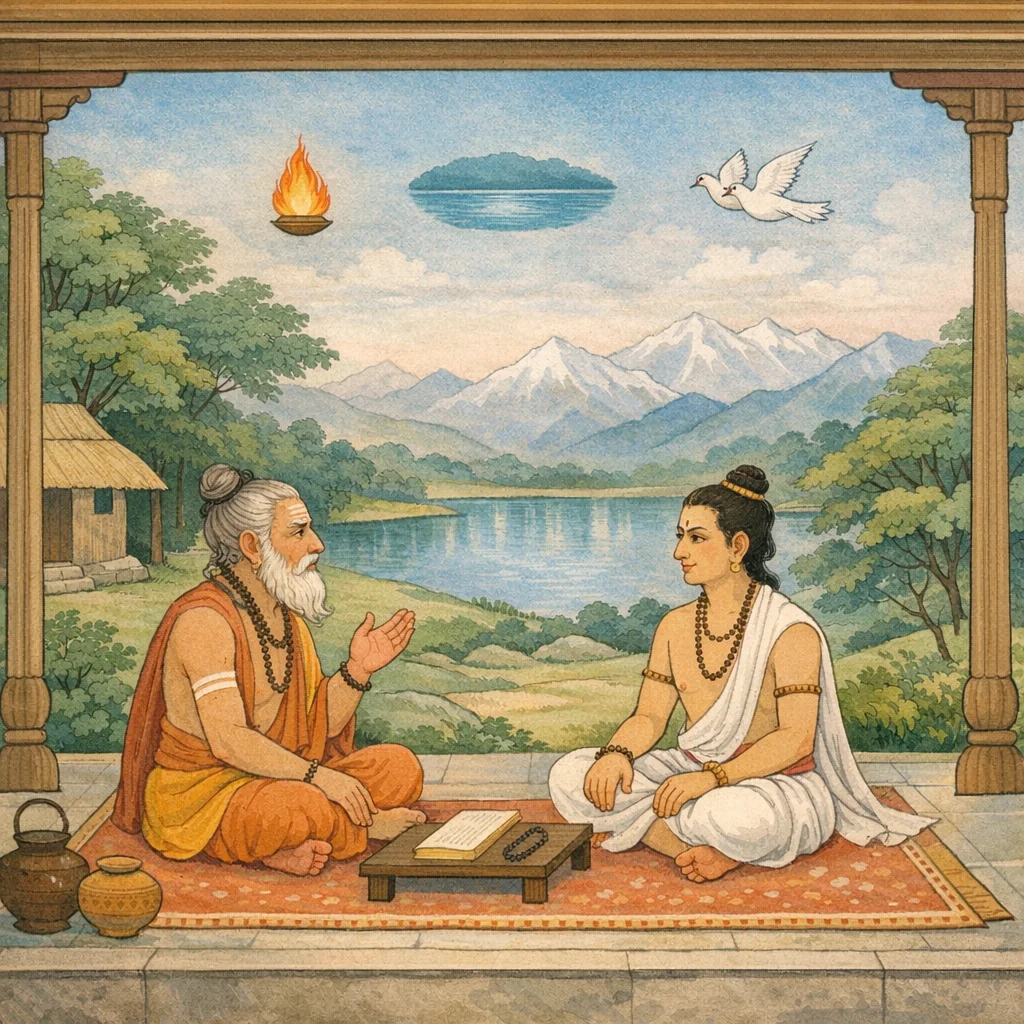
Adhyāya 51 begins with the sages asking Sūta, the foremost Purāṇic narrator, to reveal a further īśa-centered teaching—namely the unsurpassed kriyāyoga of Jagadambā Umā, earlier taught by Sanatkumāra to Vyāsa. Sūta calls it a “supremely guarded secret” and turns to an instructive dialogue: Vyāsa asks Sanatkumāra for the definition (lakṣaṇa), method, and fruit (phala) of Umā’s kriyāyoga, and what is especially dear (priya) to the Supreme Mother. Sanatkumāra then systematizes three paths (mārga): jñānayoga, kriyāyoga, and bhaktiyoga, each granting mokṣa when rightly understood. Jñānayoga is defined as the inward joining of mind with ātman; kriyāyoga as the mind’s joining with external supports (bahyārtha) through disciplined action and ritual; and bhakti as cultivating a sense of unity (aikya-bhāvanā) between the devotee’s self and the Goddess. The chapter establishes a spiritual sequence: karma gives rise to bhakti, bhakti to jñāna, and jñāna to mukti, presenting kriyā as the practical ground that ripens into liberating knowledge.
Shlokas
Verse 1
मुनय ऊचुः । व्यासशिष्य महाभाग सूत पौराणिकोत्तम । अपरं श्रोतुमिच्छामः किमप्याख्यानमीशितुः
The sages said: “O fortunate Sūta, disciple of Vyāsa, best among the Purāṇa-knowers—we wish to hear further some sacred account concerning the Lord (Īśa).”
Verse 2
उमाया जगदम्बायाः क्रियायोगमनुत्तमम् । प्रोक्तं सनत्कुमारेण व्यासाय च महात्मने
Sanatkumāra taught the unsurpassed path of Kriyā-yoga belonging to Umā—the Mother of the universe—and he imparted it to the great-souled sage Vyāsa.
Verse 3
सूत उवाच । धन्या यूयं महात्मानो देवीभक्तिदृढव्रताः । पराशक्तेः परं गुप्तं रहस्यं शृणुतादरात्
Sūta said: “Blessed are you, noble-souled ones, steadfast in your firm vow of devotion to the Goddess. Hear with reverence the supremely secret mystery concerning the Supreme Śakti.”
Verse 4
व्यास उवाच । सनत्कुमार सर्वज्ञ ब्रह्मपुत्र महामते । उमायाश्श्रोतुमिच्छामि क्रियायोगं महाद्भुतम्
Vyāsa said: “O Sanatkumāra—omniscient one, noble son of Brahmā, great-souled sage—I wish to hear about Umā’s wondrous Kriyā-yoga.”},{
Verse 5
कीदृक्च लक्षणं तस्य किं कृते च फलं भवेत् । प्रियं यच्च पराम्बायास्तदशेषं वदस्व मे
“What are its characteristics, and what fruit arises when it is performed? And whatever is dear to the Supreme Mother (Pārvatī)—tell me all of that in full.”},{
Verse 6
सनत्कुमार उवाच । द्वैपायन यदेतत्त्वं रहस्यं परिपृच्छसि । तच्छृणुष्व महाबुद्धे सर्वं मे वर्णयिष्यतः
Sanatkumāra said: O Dvaipāyana, the secret truth that you are inquiring about—listen to it, O great-minded one. I shall explain it all to you in full.
Verse 7
ज्ञानयोगः क्रियायोगो भक्तियोगस्तथैव च । त्रयो मार्गास्समाख्याताः श्रीमातुर्मुक्तिमुक्तिदा
The Yoga of Knowledge, the Yoga of Sacred Action, and likewise the Yoga of Devotion—these three paths are declared; through the grace of Śrī Mother Umā they bestow liberation and the freedom that is liberation.
Verse 8
ज्ञानयोगस्तु संयोगश्चित्तस्यैवात्मना तु यः । यस्तु बाह्यार्थसंयोगः क्रियायोगः स उच्यते
Jñāna-yoga is that union in which the mind (citta) is joined to the Self (Ātman). But the union with external objects is called Kriyā-yoga (the yoga of action and ritual performance).
Verse 9
भक्तियोगो मतो देव्या आत्मनश्चैक्यभावनम् । त्रयाणामपि योगानां क्रियायोगस्स उच्यते
The Goddess teaches that Bhakti-yoga is the contemplation of oneness between the individual self and the Supreme Self (Paramātman). And this too is called Kriyā-yoga, for it integrates the three yogas as one harmonious discipline.
Verse 10
कर्मणा जायते भक्तिर्भक्त्या ज्ञानं प्रजायते । ज्ञानात्प्रजायते मुक्तिरिति शास्त्रेषु निश्चयः
From righteous action arises devotion; from devotion arises true knowledge; and from knowledge arises liberation—this is the settled conclusion taught in the scriptures.
Verse 11
प्रधानं कारणं योगो विमुक्तेर्मुनिसत्तम । क्रियायोगस्तु योगस्य परमन्ध्येयसाधनम्
O best of sages, Yoga is the foremost cause of liberation. And among the disciplines of Yoga, Kriyā-yoga is the supreme means for attaining the highest object of meditation—Śiva, the Lord beyond bondage.
Verse 12
मायान्तु प्रकृतिं विद्यान्मायावि ब्रह्म शाश्वतम् । अभिन्नं तद्वपुर्ज्ञात्वा मुच्यते भवबन्धनात्
Know Māyā to be Prakṛti, and know the eternal Brahman to be the wielder of Māyā. Realizing that His very being is non-different from that power, one is released from the bondage of worldly becoming (saṃsāra).
Verse 13
यस्तु देव्यालयं कुर्यात्पाषाणन्दारवन्तथा । मृन्मयं वाथ कालेय तस्य पुण्यफलं शृणु । अहन्यहनियोगेन जयतो यन्महाफलम्
Whoever causes a temple of the Goddess to be built—of stone, of wood, or of clay—listen to the fruit of merit that is his. By daily, unbroken union with that sacred work, he attains victory and a great spiritual reward.
Verse 14
प्राप्नोति तत्फलन्देव्या यः कारयति मन्दिरम् । सहस्रकुलमागामि व्यतीतं च सहस्रकम् । तारयति धर्मात्मा श्रीमातुर्धाम कारयन्
Whoever causes a temple to be built for the Goddess attains that very fruit promised by her. By establishing the sacred abode of the Holy Mother, that righteous soul delivers a thousand future lineages and also a thousand past lineages (ancestors).
Verse 15
कोटिजन्मकृतं पापं स्वल्पं वा यदि वा बहु । श्रीमातुर्मन्दिरारम्भक्षणादेव प्रणश्यति
Sin accumulated across millions of births—whether small or great—perishes at that very moment one begins the undertaking of building the temple of the Blessed Mother (Umā).
Verse 16
नदीषु च यथा गंगा शोणः सर्वनदेषु च । क्षमायां च यथा पृथ्वी गांभीर्ये च यथोदधिः
Just as the Gaṅgā is foremost among rivers, and the Śoṇa among all streams; just as the Earth is the very model of forbearance, and the ocean the very model of depth—so should a devotee of Śiva cultivate these supreme qualities upon the path.
Verse 17
ग्रहाणां च समस्तानां यथा सूर्यो विशिष्यते । तथा सर्वेषु देवेषु श्रीपराम्बा विशिष्यते
Just as the Sun excels among all the planets, so does Śrī Parāmbā, the Supreme Mother, excel among all the deities.
Verse 18
सर्वदेवेषु सा मुख्या यस्तस्याः कारयेद्गृहम् । प्रतिष्ठां समवाप्नोति स च जन्म निजन्मनि
Among all the deities, She is foremost. Whoever causes a temple, a sacred abode, to be built for Her attains honored renown—and in birth after birth he continues to obtain such esteem.
Verse 19
वाराणस्यां कुरुक्षेत्रे प्रयागे पुष्करे तथा । गंगासमुद्रतीरे च नैमिषेऽमरकण्टके
In Vārāṇasī, in Kurukṣetra, in Prayāga, and likewise in Puṣkara; on the banks where the Gaṅgā meets the sea, and also at Naimiṣa and at Amarakāṇṭaka—these are supremely sanctifying sacred places.
Verse 20
श्रीपर्वते महापुण्ये गोकर्णे ज्ञानपर्वते । मथुरायामयोध्यायां द्वारावत्यां तथैव च
At Śrīparvata, supremely holy; at Gokarṇa, the mountain of sacred knowledge; likewise in Mathurā, in Ayodhyā, and in Dvāravatī as well—there the Lord’s sanctifying presence is to be sought and worshiped.
Verse 21
इत्यादि पुण्यदेशेषु यत्र कुत्र स्थलेऽपि वा । कारयन्मातुरावासं मुक्तो भवति बन्धनात्
Thus, in holy regions—or indeed in any place whatsoever—one who causes a dwelling to be made for the Mother (Devī) becomes freed from bondage.
Verse 22
इष्टकानां तु विन्यासो यावद्वर्षाणि तिष्ठति । तावद्वर्षसहस्राणि मणिद्वीपे महीयते
As long as the arrangement of the consecrated bricks remains in place for (so many) years, for that same count in thousands of years one is honored and exalted in Maṇidvīpa.
Verse 23
प्रतिमाः कारयेद्यस्तु सर्वलक्षणलक्षिताः । स उमायाः परं लोकं निर्भयो व्रजति धुवम्
Whoever commissions sacred images (pratimās) endowed with all the auspicious marks and canonical features, that devotee—free from fear—surely attains the supreme world of Umā.
Verse 24
देवीमूर्तिं प्रतिष्ठाप्य शुभर्तुं ग्रहतारके । कृतकृत्यो भवेन्मर्त्यो योगमायाप्रसादतः
Having duly installed the Goddess’s sacred image in an auspicious season, under favorable planetary and stellar influences, a mortal becomes fulfilled in life—by the grace of Yogamāyā.
Verse 25
ये भविष्यन्ति येऽतीता आकल्पात्पुरुषाः कुले । तांस्तांस्तारयते देव्या मूर्तिं संस्थाप्य शोभनाम्
All those persons in one’s lineage—those yet to be born and those already departed from time without beginning—are each and all carried across to liberation when the Goddess’s splendid form (image) is duly established.
Verse 26
त्रिलोकीस्थापनात्पुण्यं यद्भवेन्मुनिपुंगव । तत्कोटिगुणितं पुण्यं श्रीदेवीस्थापनाद्भवेत्
O best of sages, whatever merit arises from establishing the three worlds—ten million times that merit is obtained by establishing (installing) Śrī Devī.
Verse 27
मध्ये देवीं स्थापयित्वा पञ्चायतनदेवताः । चतुर्द्दिक्षु स्थापयेद्यस्तस्य पुण्यं न गण्यते
One who installs the Goddess in the center and then arranges the deities of the pañcāyatana in the four directions—his merit cannot be measured.
Verse 28
विष्णोर्नाम्नां कोटिजपाद्ग्रहणेचन्द्रसूर्ययोः । यत्फलं लभ्यते तस्माच्छतकोटिगुणोत्तरम्
Whatever merit is obtained by repeating a crore of Viṣṇu’s names during an eclipse of the Moon or the Sun—this observance in Śiva’s tradition yields a fruit a hundred crores of times greater than that.
Verse 29
शिवनाम्नो जपादेव तस्मात्कोटि गुणोत्तरम् । श्रीदेवीनामजापात्तु ततः कोटिगुणोत्तरम्
From the japa of Śiva’s Name alone, the fruit is a crore-fold greater than that; and from the japa of the auspicious Devī’s Name, it is again a crore-fold greater than even that.
Verse 30
देव्याः प्रासादकरणात्पुण्यन्तु समवाप्यते । स्थापिता येन सा देवी जगन्माता त्रयीमयी
By building a temple-palace for the Goddess, one surely attains great merit. For she—the Goddess established there—is the Mother of the worlds, the very embodiment of the three Vedas.
Verse 31
न तस्य दुर्लभं किंचिच्छ्रीमातुः करुणावशात् । वर्द्धते पुत्रपौत्राद्या नश्यत्यखिलकश्मलम्
By the compassion of the auspicious Divine Mother, nothing remains difficult for him to attain. His line of sons and grandsons flourishes, and all impurity and sin are utterly destroyed.
Verse 32
मनसा ये चिकीर्षंति मूर्तिस्थापनमुत्तमम् । तेत्युमायाः परं लोकं प्रयान्ति मुनिदुर्लभम्
Those who, even in their mind, sincerely intend to perform the excellent act of establishing a sacred mūrti attain the supreme realm of Umā—a state difficult to reach even for sages.
Verse 33
क्रियमाणन्तु यः प्रेक्ष्य चेतसा ह्यनुचिन्तयेत् । कारयिष्याम्यहं यर्हि संपन्मे संभविष्यति
But whoever, seeing a work being done, reflects within the mind—thinking, “When prosperity comes to me, I too shall have this done”—that inward resolve itself becomes the seed of future accomplishment.
Verse 34
एवन्तस्य कुलं सद्यो याति स्वर्गं न संशयः । महामायाप्रभावेण दुर्लभं किं जगत्त्रये
Surely, the entire family-line of such a person attains heaven at once—there is no doubt. By the power of Mahāmāyā, what indeed is difficult to obtain in the three worlds?
Verse 35
श्रीपराम्बाजगद्योनिं केवलं ये समाश्रिताः । ते मनुष्या न मन्तव्यास्साक्षाद्देवीगणाश्च ते
Those who take sole refuge in Śrī Parāmbā—the womb and source of the universe—should not be regarded as mere human beings; they are, in truth, directly the hosts of the Goddess.
Verse 36
ये व्रजन्तः स्वपन्तश्च तिष्ठन्तो वाप्यहर्निशम् । उमेति द्व्यक्षरं नाम ब्रुवते ते शिवागणाः
Those who, whether walking, sleeping, or standing—day and night—utter the two-syllabled name “Umā,” are truly counted among Śiva’s attendants (Śiva-gaṇas).
Verse 37
नित्ये नैमित्तिके देवीं ये यजन्ति परां शिवाम् । पुष्पैर्धूपैस्तथादीपैस्ते प्रयास्यन्त्युमालयम्
Those who worship the Supreme Goddess—Śivā (Umā)—through daily and occasional rites, offering flowers, incense, and lamps, attain the abode of Umā.
Verse 38
ये देवीमण्डपं नित्यं गोमयेन मृदाथवा । उपलिंपन्ति मार्जन्ति ते प्रयास्यन्त्युमालयम्
Those who, every day, smear and cleanse the Goddess’ pavilion with cow-dung or with earth—such devotees shall attain Umā’s abode.
Verse 39
यैर्देव्या मन्दिरं रम्यं निर्मापि तमनुत्तमम् । तत्कुलीनाञ्जनान्माता ह्याशिषः संप्रयच्छति
Those who have built for the Goddess a beautiful, unsurpassed temple—upon the people born in their lineage, the Divine Mother truly bestows her blessings.
Verse 40
मदीयाः शतवर्षाणि जीवन्तु प्रेमभाग्जनाः । नापदामयनानीत्थं श्रीमाता वक्त्यहर्निशम्
“May those who are Mine—people endowed with loving devotion—live for a hundred years. Thus, day and night, Śrīmātā, the auspicious Mother, declares: ‘May no calamity or disease be brought upon them.’”
Verse 41
येन मूर्तिर्म्महादेब्या उमायाः कारिता शुभा । नरायुतन्तत्कुलजं मणिद्वीपे महीयते
He by whom the auspicious image of the Great Goddess Umā was fashioned—his lineage becomes exceedingly renowned and honoured in Maṇidvīpa for tens of thousands of generations.
Verse 42
स्थापयित्वा महामायामूर्तिं सम्यक्प्रपूज्य च । यंयं प्रार्थयते कामं तंतं प्राप्नोति साधकः
Having installed the image-form of Mahāmāyā and worshipped Her properly, whatever desired aim the practitioner prays for—that very aim the sādhaka attains.
Verse 43
यः स्नापयति श्रीमातुः स्थापितां मूर्तिमुत्तमाम् । घृतेन मधुनाक्तेन तत्फलं गणयेत्तु कः
Who could possibly measure the fruit of that act—when a person bathes (performs abhiṣeka for) the supremely excellent, duly installed image of Śrī Mātā, anointing it with ghee and honey?
Verse 44
चन्दनागुरुकर्पूर मांसीमुस्तादियुग्जलैः । एकवर्णगवां क्षीरैः स्नापयेत्परमेश्वरीम्
With water infused with sandalwood, agaru, camphor, and fragrant herbs such as māṃsī and mustā, and also with the milk of cows of one uniform color, one should bathe the Supreme Goddess, Parameśvarī.
Verse 45
धूपेनाष्टादशांगेन दद्यादाहुतिमुत्तमाम् । नीराजनं चरेद्देव्या स्साज्यकर्पूरवर्तिभिः
With incense prepared from the eighteen sacred ingredients, one should offer the finest oblation. Thereafter, one should perform nīrājana (ārati) for the Goddess, using wicks made with ghee and camphor.
Verse 46
कृष्णाष्टम्यां नवम्यां वामायां वा पंचदिक्तिथौ । पूजयेज्जगतां धात्रीं गंधपुष्पैर्विशेषतः
On the dark fortnight’s eighth day, the ninth day, or on the Vāmā tithi—indeed on the auspicious five directional tithis—one should worship the Sustainer of the worlds, the Divine Mother, especially with fragrant substances and flowers.
Verse 47
संपठञ्जननीसूक्तं श्रीसूक्तमथ वा पठन् । देवीसूक्तमथो वापि मूकमन्त्रमथापि वा
Reciting the Jananī Sūkta, or the Śrī Sūkta; or else reciting the Devī Sūkta; or even uttering the so‑called “mute mantra” as well—through such reverent japa and hymn-recitation, the Mother’s worship is brought to fulfillment.
Verse 48
विष्णुक्रान्तां च तुलसीं वर्जयित्वाखिलं सुमम् । देवीप्रीतिकरं ज्ञेयं कमलन्तु विशेषतः
Except for viṣṇukrāntā and tulasī, all flowers are understood to please the Goddess; among them, the lotus is especially dear for her worship.
Verse 49
अर्पयेत्स्वर्णपुष्पं यो देव्यै राजतमेव वा । स याति परमं धाम सिद्धकोटि भिरन्वितम्
Whoever offers to the Goddess a golden flower—or even a silver one—attains the supreme abode, accompanied by countless perfected beings (siddhas).
Verse 50
पूजनान्ते सदा कार्यं दासैरेनः क्षमापनम् । प्रसीद परमेशानि जगदानन्ददायिनि
At the conclusion of worship, the devotee should always perform an act of atonement—begging forgiveness for any faults. O Supreme Lady (Parameśānī), be gracious; O bestower of the world’s bliss, be pleased.
Verse 51
इति श्रीशिव महापुराणे पञ्चम्यामुमासंहितायां क्रियायोगनिरूपणं नामैकपञ्चाशत्तमोऽध्यायः
Thus, in the glorious Śiva Mahāpurāṇa—within the fifth book, the Umāsaṃhitā—ends the fifty-first chapter entitled “The Exposition of Kriyāyoga.”
Verse 52
इत्थं ध्यात्वा महेशानीं भक्ताभीष्टफलप्रदाम् । नानाफलानि पक्वानि नैवेद्यत्वे प्रकल्पयेत्
Thus, having meditated upon Maheśānī (Umā), who grants devotees the fruits they truly desire, one should arrange various ripe fruits as naivedya, a food-offering for worship.
Verse 53
नैवेद्यं भक्षयेद्यस्तु शंभुशक्तेः परात्मनः । स निर्भूयाखिलं पङ्कं निर्मलो मानवो भवेत्
Whoever partakes of the naivedya, the consecrated food-offering to the Supreme Self—Śambhu together with His Śakti—burns away all the mire of impurity; that person becomes purified and stainless.
Verse 54
चैत्रशुक्लतृतीयायां यो भवानीव्रतं चरेत् । भववन्धननिर्मुक्तः प्राप्नुयात्परमं पदम्
Whoever observes the Bhavānī-vrata on the third lunar day (tṛtīyā) of the bright fortnight of Caitra is freed from the bonds of saṃsāra and attains the supreme state through the grace of Bhavānī and Śiva.
Verse 55
अस्यामेव तृतीयायां कुर्याद्दोलोत्सवं बुधः । पूजयेज्जगतां धात्रीमुमां शंकरसंयुताम्
On this very third lunar day, the wise devotee should perform the dolotsava, the swing-festival, and worship Umā—the Mother and Sustainer of the worlds—ever united with Śaṅkara.
Verse 56
कुसुमैः कुंकुमैर्वस्त्रैः कर्पूरागुरुचन्दनैः । धूपैर्द्दीपैस्सनैवेद्यैः स्रग्गन्धैरपरैरपि
With flowers, kumkuma, garments, camphor, agaru, and sandalwood—along with incense, lamps, and naivedya (food-offerings)—and also with garlands, perfumes, and other fragrances, one should worship (Śiva) with devotion.
Verse 57
आन्दोलयेत्ततो देवीं महामायां महेश्वरीम् । श्रीगौरीं शिवसंयुक्तां सर्वकल्याणकारिणीम्
Then one should gently swing the Goddess—Mahāmāyā, the great Sovereign Lady—Śrī Gaurī, ever united with Śiva, who bestows every auspicious blessing.
Verse 58
प्रत्यब्दं कुरुते योस्यां बतमान्दोलनं तथा । नियमेन शिवा तस्मै सर्वमिष्टं प्रयच्छति
Whoever, year after year, performs for her the prescribed swinging-rite with disciplined observance—Śivā (Pārvatī), pleased by that rule-bound devotion, grants that devotee all that is desired and auspicious.
Verse 59
माधवस्य सिते पक्षे तृतीया याऽक्षयाभिधा । तस्यां यो जगदम्बाया व्रतं कुर्यादतन्द्रितः
In the bright fortnight of Mādhava (Vaiśākha), on the third lunar day known as Akṣayā, whoever diligently observes the vow (vrata) of Jagadambā, the World-Mother Umā, on that day…
Verse 60
मल्लिकामालतीचंपाजपाबन्धूकपंकजैः । कुसुमैः पूजयेद्गौरीं शंकरेण समन्विताम्
With flowers such as jasmine, mālatī, campā, japā (hibiscus), bandhūka, and lotus, one should worship Goddess Gaurī—ever united with Śaṅkara.
Verse 61
कोटिजन्मकृतं पापं मनोवाक्कायसम्भवम् । निर्धूय चतुरो वर्गानक्षयानिह सोऽश्नुते
Having shaken off the sins amassed over tens of millions of births—sins arising from mind, speech, and body—one attains here the four human aims in an imperishable, unfailing manner.
Verse 62
ज्येष्ठे शुक्लतृतीयायां व्रतं कृत्वा महेश्वरीम् । योऽर्चयेत्परमप्रीत्या तस्यासाध्यं न किंचन
Whoever, on the tṛtīyā—the third lunar day—of the bright fortnight in the month of Jyeṣṭha, undertakes the vowed observance and worships Mahēśvarī (Pārvatī) with supreme devotion—for that devotee, nothing remains impossible to accomplish.
Verse 63
आषाढशुक्लपक्षीयतृतीयायां रथोत्सवम । देव्याः प्रियतमं कुर्याद्यथावित्तानुसारतः
On the tṛtīyā—the third lunar day—of the bright fortnight in Āṣāḍha, one should celebrate the rathotsava, the chariot festival, as an offering most dear to the Goddess, performing it according to one’s means.
Verse 64
रथं पृथ्वीं विजानीयाद्रथांगे चन्द्रभास्करौ । वेदानश्वान्विजानीयात्सारथिं पद्मसं भवम्
One should understand the Earth to be the chariot; the Moon and the Sun are its wheels. The Vedas are to be known as the horses, and the charioteer is Padma-saṃbhava (Brahmā), the Lotus-born.
Verse 65
नानामणिगणाकीर्णं पुष्पमालाविराजितम् । एवं रथं कल्पयित्वा तस्मिन्त्संस्थापयेच्छिवाम्
Having fashioned a chariot in this way—studded with clusters of many kinds of gems and adorned with garlands of flowers—one should then enthrone Śivā (the Goddess Umā) upon it.
Verse 66
लोकसंरक्षणार्थाय लोकं द्रष्टुं पराम्बिका । रथमध्ये संस्थितेति भावयेन्मतिमान्नरः
The wise person should contemplate thus: “For the protection of the worlds, the Supreme Mother (Parāmbikā) has taken her place in the middle of the chariot, to behold the world.”
Verse 67
रथे प्रचलिते मन्दं जयशब्दमुदीरयेत् । पाहि देवि जनानस्मान्प्रपन्नान्दीनवत्सले
When the chariot begins to move slowly, one should softly raise the cry of victory: “Protect us, O Goddess—us people who have taken refuge in you, O tender mother to the distressed.”
Verse 68
इति वाक्यैस्तोषयेच्च नानावादित्रनिस्वनैः । सीमान्ते तु रथं नीत्वा तत्र संपूजये द्रथे
With such words, and with the resonant sounds of many kinds of musical instruments, one should gladden the honored deity or revered person. Then, taking the chariot to the boundary (of the village or city), one should there perform full worship while they are seated in the chariot.
Verse 69
नानास्तोत्रैस्ततः स्तुत्वाप्यानयेत्तां स्ववेश्मनि । प्रणिपातशतं कृत्वा प्रार्थयेज्जगदम्बिकाम्
Then, having praised her with many hymns, one should bring her into one’s own home. Having performed a hundred prostrations, one should pray to Jagadambikā, the Mother of the universe.
Verse 70
एवं यः कुरुते विद्वान्पूजाव्रतरथोत्सवम् । इह भुक्त्वाखिलान्भोगान्सोन्ते देवीपदं व्रजेत्
Thus, the wise devotee who duly performs this worship, the sacred vow, and the festival of the chariot-procession enjoys all worthy pleasures in this very world; and at life’s end, by the grace of Śiva and Umā, he attains the divine state—the realm of the Goddess.
Verse 71
शुक्लायान्तु तृतीयायामेवं श्रावणभाद्रयोः । यो व्रतं कुरुतेऽम्बायाः पूजनं च यथाविधि
But in the bright fortnight, on the third lunar day—thus, in the months of Śrāvaṇa and Bhādrapada—whoever undertakes the vow for Ambā and performs her worship according to the prescribed rite attains the promised fruit of that observance.
Verse 72
मोदते पुत्रपौत्राद्यैर्धनाद्यैरिह सन्ततम् । सोऽन्ते गच्छेदुमालोकं सर्वलोकोपरि स्थितम्
Here, such a person continually rejoices in sons, grandsons, and the like, and in wealth and other prosperities; and at life’s end he attains Umā’s world, which stands above all the worlds.
Verse 73
आश्विने धवले पक्षे नवरात्रव्रतं चरेत् । यत्कृते सकलाः कामास्सिद्ध्यन्त्येव न संशयः
In the bright fortnight of the month of Āśvina, one should observe the Navarātra vow; by performing it, all desired aims are surely fulfilled—of this there is no doubt.
Verse 74
नवरात्रव्रतस्यास्य प्रभावं वक्तुमीश्वरः । चतुरास्यो न पंचास्यो न षडास्यो न कोऽपरः
The power of this Navarātra vow cannot be fully described even by the Lord—neither by the Four-faced (Brahmā), nor the Five-faced, nor the Six-faced, nor by anyone else.
Verse 75
नवरात्रव्रतं कृत्वा भूपालो विरथात्मजः । हृतं राज्यं निजं लेभे सुरथो मुनिसत्तमाः
O best of sages, Suratha—the king, son of Viratha—having performed the Navarātra vow, regained his own kingdom that had been taken away.
Verse 76
ध्रुवसंधिसुतो धीमानयोध्याधिपतिर्नृपः । सुदर्शनो हृतं राज्यं प्रापदस्य प्रभावतः
Sudarśana—the wise son of Dhruvasaṃdhi and the king ruling Ayodhyā—regained his kingdom that had been taken away, by the power of this holy observance alone.
Verse 77
व्रतराजमिमं कृत्वा समाराध्य महेश्वरीम् । संसारबन्धनान्मुक्तः समाधिर्मुक्तिभागभूत्
Having performed this ‘king of vows’ and duly worshipped Maheshvarī, one is freed from the bonds of saṃsāra; one’s samādhi matures into a true share in liberation (mukti), through Śiva’s grace.
Verse 78
तृतीयायां च पञ्चम्यां सप्तम्याम ष्टमीतिथौ । नवम्यां वा चतुर्दश्यां यो देवी पूजयेन्नरः
A man who worships the Goddess on the third, fifth, seventh, or eighth lunar day—or on the ninth or the fourteenth—performs a highly meritorious act of Devī-bhakti.
Verse 79
आश्विनस्य सिते पक्षे व्रतं कृत्वा विधानतः । तस्य सर्वं मनोभीष्टं पूरयत्यनिशं शिवा
If, in the bright fortnight of the month of Āśvina, one performs the vow according to the prescribed rule, then Śivā, the auspicious Divine Mother, continually fulfills all that person’s heart-desired aims.
Verse 80
यः कार्त्तिकस्य मार्गस्य पौषस्य तपसस्तथा । तपस्यस्य सिते पक्षे तृतीयायां व्रतं चरेत्
Whoever performs the vowed rite on the third lunar day (tṛtīyā) of the bright fortnight in the month of Phālguna (Tapasya)—and likewise in Kārttika, Mārgaśīrṣa, Pauṣa, and Māgha—practises a purifying Śaiva discipline that leads the devotee toward the grace of Lord Śiva.
Verse 81
लोहितैः करवीराद्यैः पुष्पैर्धूपैस्सुगन्धितैः । पूजयेन्मङ्गलान्देवीं स सर्वं मंगलं लभेत्
With red flowers—such as karavīra and the like—and with fragrant incense, one should worship the auspicious Goddess Maṅgalā (Umā). Such a devotee attains every kind of auspiciousness and well-being.
Verse 82
सौभाग्याय सदा स्त्रीभिः कार्य्यमेतन्महाव्रतम् । विद्याधनसुताप्त्यर्थं विधेयं पुरुषैरपि
For enduring good fortune, women should always observe this great vow. Men too should perform it, in order to obtain learning, wealth, and worthy offspring.
Verse 83
उमामहेश्वरादीनि व्रतान्यन्यानि यान्यपि । देवीप्रियाणि कार्याणि स्वभक्त्यैवं मुमुक्षुभिः
Seekers of liberation should, with their own steadfast devotion, also undertake the observances beginning with the Uma–Maheśvara vow and other such vows, and perform those deeds that are dear to the Goddess.
Verse 84
संहितेयं महापुण्या शिवभक्तिविवर्द्धिनी । नानाख्यानसमायुक्ता भुक्तिमुक्तिप्रदा शिवा
This Saṃhitā is supremely meritorious; it increases devotion to Lord Śiva. Filled with many sacred narratives, it is auspicious and bestows both worldly enjoyment and liberation.
Verse 85
य एनां शृणुयाद्भक्त्या श्रावयेद्वा समाहितः । पठेद्वा पाठयेद्वापि स याति परमां गतिम्
Whoever hears this with devotion, or, with a collected mind, causes it to be heard; whoever recites it or even has it recited—such a person attains the supreme state (the highest liberation granted by Lord Śiva).
Verse 86
यस्य गेहे स्थिता चेयं लिखिता ललिताक्षरैः । संपूजिता च विधिवत्सर्वान्कामान्स आप्नुयात्
In whose home this sacred text is kept—written in beautiful letters—and duly worshipped according to proper rite, that person attains all desired aims.
Verse 87
भूतप्रेतपिशाचादिदुष्टेभ्यो न भयं क्वचित । पुत्रपौत्रादिसम्पत्तिं लभत्येव न संशयः
He never has fear at any time from wicked beings such as bhūtas, pretas, and piśācas; and he surely attains prosperity in the form of sons, grandsons, and the like—of this there is no doubt.
Verse 88
तस्मादियं महापुण्या रम्योमासंहिता सदा । श्रोतव्या पठितव्या च शिवभक्तिमभीप्सुभिः
Therefore, this ever-auspicious and delightful Umā-saṃhitā, bestowing great merit, should always be listened to and also recited by those who seek devotion to Lord Śiva.
Frequently Asked Questions
The chapter argues for an integrated soteriology: rather than treating karma, bhakti, and jñāna as rival paths, it presents them as sequentially and causally linked—ritual/action (karma/kriyā) stabilizes devotion, devotion ripens into knowledge, and knowledge culminates in liberation.
The ‘rahasya’ is that outward ritual engagement is reclassified as yoga: external objects and rites are not mere preliminaries but deliberate cognitive-ritual supports that shape consciousness. By defining kriyāyoga as the mind’s union with disciplined externals, the text legitimizes embodied practice as a direct instrument for inner transformation.
Gaurī/Umā is highlighted as Jagadambā and Parāśakti, the supreme devotional and yogic focus of the teaching. The chapter frames what is ‘priya’ to the Supreme Mother and treats devotion to the Goddess as a valid and potent route that yields jñāna and mokṣa.