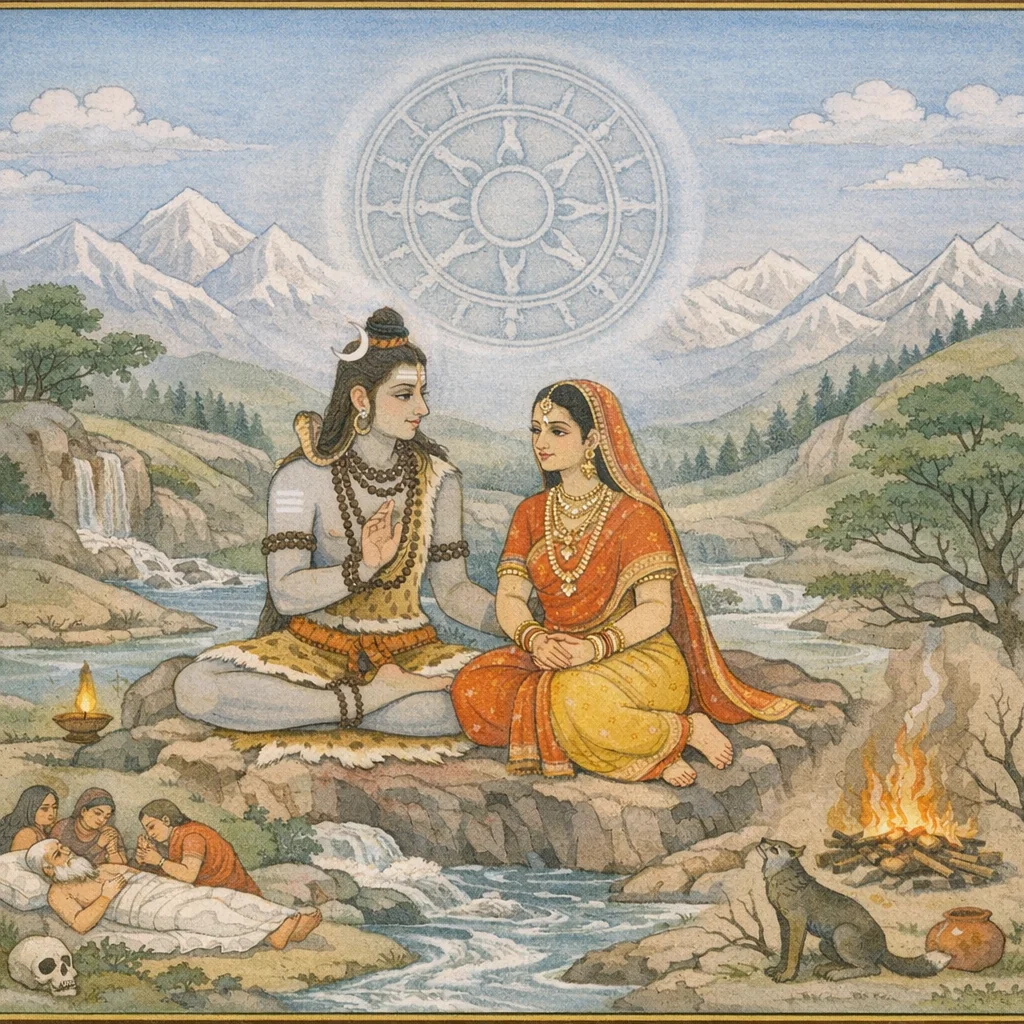
Kālajñāna (Knowledge of Time) and Mṛtyu-cihna (Signs of Death): Śiva’s Instruction to Umā
The chapter unfolds as a nested dialogue: Vyāsa asks Sanatkumāra to teach kālajñāna (knowledge of time) after hearing of strīsvabhāva (women’s nature), and Sanatkumāra recounts an earlier exchange where Pārvatī questions Parameśvara. Pārvatī says she has understood Śiva’s worship-method (arcana) and mantras, yet retains one doubt about the kālacakra (wheel of time): how lifespan is measured and what mṛtyu-cihna (signs of death) reveal death’s approach. Śiva promises a “supreme śāstra” by which humans grasp time, listing its units—day, fortnight, month, seasons, ayana (solstitial courses), year—and explaining how to read gross and subtle, internal and external signs. The verses then turn to prognostic marks: sudden pallor, upward discoloration, and the stalling of senses and organs, given as time-bound warnings (e.g., death within six months). The deeper intent is not fatalism but Purāṇic instruction in impermanence: time is knowable through signs, and such knowledge serves lokānāṃ upakāra (practical benefit) and vairāgya (dispassion), urging more intense sādhanā.
Shlokas
Verse 1
व्यास उवाच । सनत्कुमार सर्वज्ञ त्वत्सकाशान्मया मुने । स्त्रीस्वभावः श्रुतः प्रीत्या कालज्ञानं वदस्व मे
Vyāsa said: “O all-knowing Sanatkumāra, O sage—gladly I have heard from you about the nature of women. Now, I pray, teach me the knowledge of Time (kāla).”
Verse 2
सनत्कुमार उवाच । इदमेव पुराऽपृच्छत्पार्वती परमेश्वरम् । श्रुत्वा नानाकथां दिव्यां प्रसन्ना सुप्रणम्य तम्
Sanatkumāra said: Long ago, this very matter was asked by Pārvatī of the Supreme Lord, Parameśvara. Having heard many divine accounts, she became pleased and—bowing down with deep reverence—(then questioned) Him.
Verse 3
पार्वत्युवाच । भगवंस्त्वत्प्रसादेन ज्ञातं मे सकलं मतम् । यथार्चनं तु ते देव यैर्मंत्रैश्च यथाविधि
Pārvatī said: “O Blessed Lord, by your grace I have understood the whole teaching. Now tell me, O Deva, how your worship is to be performed—by which mantras, and according to what prescribed method.”
Verse 4
अद्यापि संशयस्त्वेकः कालचक्रं प्रति प्रभो । मृत्युचिह्नं यथा देव किं प्रमाणं यथायुषः
O Lord, even now I have one doubt concerning the wheel of Time (Kāla). O God, just as there are signs of death, what measure or sure sign reveals a person’s destined span of life?
Verse 5
तथा कथय मे नाथ यद्यहं तव वल्लभा । इति पृष्टस्तया देव्या प्रत्युवाच महेश्वरः
“Then tell me, O Lord—if indeed I am dear to you.” Thus questioned by the Goddess, Maheshvara replied.
Verse 6
ईश्वर उवाच । सत्यं ते कथयिष्यामि शास्त्रं सर्वोत्तमं प्रिये । येन शास्त्रेण देवेशि नरैः कालः प्रबुध्यते
Īśvara said: “Beloved, I shall tell you the truth—the most excellent sacred teaching. O Goddess, by this teaching human beings awaken to the reality of Kāla, Time, and become spiritually alert.”
Verse 7
अहः पक्षं तथा मासमृतुं चायनवत्सरौ । स्थूलसूक्ष्मगतैश्चिह्नैर्बहिरंतर्गतैस्तथा
“(Time is known as) the day, the fortnight, the month, the season, the solstice-course (ayana), and the year; and it is likewise recognized by its signs—gross and subtle—operating both outwardly and inwardly.”
Verse 8
तत्तेहं सम्प्रवक्ष्यामि शृणु तत्त्वेन सुन्दरि । लोकानामुपकारार्थं वैराग्यार्थमुमेऽधुना
Now I shall proclaim that truth to you—listen with lucid understanding, O beautiful one. O Umā, at this time I speak for the welfare of the worlds and for the awakening of vairāgya, holy dispassion.
Verse 9
अकस्मात्पांडुरं देहमूर्द्ध्वरागं समंततः । तदा मृत्युं विजानीयात्षण्मासाभ्यन्तरे प्रिये
Beloved, if the body suddenly turns pale, and an unnatural discoloration rises upward and spreads on every side, then one should know that death is near—within six months.
Verse 10
मुखं कर्णौ तथा चक्षुर्जिह्वास्तम्भो यदा भवेत् । तदा मृत्युं विजानीयात्षण्मासाभ्यन्तरे प्रिये
Beloved, when rigidity or loss of function arises in the face, the ears, the eyes, and the tongue, one should know that death is near—within six months.
Verse 11
रौरवानुगतं भद्र ध्वनिं नाकर्णयेद्द्रुतम् । षण्मासाभ्यंतरे मृत्युर्ज्ञातव्यः कालवेदिभिः
O auspicious one, if a person suddenly hears a sound accompanied by a dreadful, raurava-like cry, then those who know the signs of Time should understand that death is to occur within six months.
Verse 12
रविसोमाग्निसंयोगाद्यदोद्योतं न पश्यति । कृष्णं सर्वं समस्तं च षण्मासं जीवितं तथा
If, due to an ominous conjunction of the Sun, Moon, and Fire, one does not behold the expected radiance, then everything appears wholly dark; and in such a condition, life too is said to remain only for six months.
Verse 13
वामहस्तो यदा देवि सप्ताहं स्पंदते प्रिये । जीवितं तु तदा तस्य मासमेकं न संशयः
Beloved Goddess, when a person’s left hand trembles continuously for a week, then—dear one—his life will last only one more month; of this there is no doubt.
Verse 14
उन्मीलयति गात्राणि तालुकं शुष्यते यदा । जीवितं तु तदा तस्य मासमेकं न संशयः
When his limbs begin to open out (in distress) and the palate becomes dry, then his life will last only one month—of this there is no doubt.
Verse 15
नासा तु स्रवते यस्य त्रिदोषे पक्षजीवितम् । वक्त्रं कंठं च शुष्येत षण्मासांते गतायुषः
When a person’s nose begins to run due to a disorder of the three doṣas, his remaining life is said to be only a fortnight. And if the mouth and throat become dried up, he is understood to have reached the end of his lifespan within six months.
Verse 16
स्थूलजिह्वा भवेद्यस्य द्विजाः क्लिद्यंति भामिनि । षण्मासाज्जायते मृत्युश्चिह्नैस्तैरुपलक्षयेत्
O fair lady, if a person’s tongue becomes thick and the twice-born (the learned brāhmaṇas) appear to grow listless and weakened, then death arises within six months. One should recognize it by these signs.
Verse 17
अंबुतैलघृतस्थं तु दर्पणे वरवर्णिनि । न पश्यति यदात्मानं विकृतं पलमेव च
O fair-complexioned one, when water, oil, or ghee (ghṛta) lies upon a mirror, a person does not behold one’s own reflection clearly—only a distorted, fleeting appearance is perceived.
Verse 18
षण्मासायुस्स विज्ञेयः कालचक्रं विजानता । अन्यच्च शृणु देवेशि येन मृत्युर्विबुद्ध्यते
One who understands the wheel of Time should know that the span spoken of here is six months. And hear further, O Goddess, that by which the truth about death is clearly understood.
Verse 19
शिरोहीनां यदा छायां स्वकीयामुपलक्षयेत् । अथवा छायया हीनं मासमेकं न जीवति
When one perceives one’s own shadow as headless, or when one becomes without a shadow, one does not live even for a single month.
Verse 20
आंगिकानि मयोक्तानि मृत्युचिह्नानि पार्वति । बाह्यस्थानि ब्रुवे भद्रे चिह्नानि शृणु सांप्रतम्
O Pārvatī, I have already spoken of the bodily signs that foretell death. Now, O auspicious one, I shall describe the external signs—listen to these marks at present.
Verse 21
रश्मिहीनं यदा देवि भवेत्सोमार्कमण्डलम् । दृश्यते पाटलाकारं मासार्दे्धेन विपद्यते
O Goddess, when the orb of the Moon or the Sun becomes bereft of rays and is seen with a pale reddish hue, it is an ominous sign—within half a month calamity befalls.
Verse 22
अरुंधती महायानमिंदुलक्षणवर्जितम् । अदृष्टतारको योऽसौ मासमेकं स जीवति
He who beholds the great celestial sign called Arundhatī—devoid of the moon’s marks, and in which no stars are seen—such a person is said to live for one more month.
Verse 23
दृष्टे ग्रहे च दिङ्मोहः षण्मासाज्जायते ध्रुवम् । उतथ्यं न ध्रुवं पश्येद्यदि वा रविमण्डलम्
If a planet is seen under an inauspicious sign, then surely bewilderment about the directions arises for six months. One should not look upon the Pole Star, nor should one gaze upon the orb of the Sun.
Verse 24
रात्रौ धनुर्यदापश्येन्मध्याह्ने चोल्कपातनम् । वेष्ट्यते गृध्रकाकैश्च षण्मासायुर्न संशयः
If one sees a rainbow at night, or a meteor falling at midday, and if one is surrounded by vultures and crows, then one’s lifespan is reduced to six months—of this there is no doubt.
Verse 25
ऋषयस्स्वर्गपंथाश्च दृश्यंते नैव चाम्बरे । षण्मासायुर्विजनीयात्पुरुषैः कालवेदिभिः
In the sky, neither the sages (ṛṣis) nor the pathway to heaven is ever seen. Therefore, those who truly know Time (Kāla) should understand that life is but six months.
Verse 26
अकस्माद्राहुणा ग्रस्तं सूर्यं वा सोममेव च । दिक्चक्रं भ्रांतवत्पश्येत्षण्मासान्म्रियते स्फुटम्
If one suddenly sees the Sun or the Moon as though seized by Rāhu, and beholds the circle of directions whirling as if in confusion, then—clearly—he dies within six months.
Verse 27
नीलाभिर्मक्षिकाभिश्च ह्यकस्माद्वेष्ट्यते पुमान् । मासमेकं हि तस्यायुर्ज्ञातव्यं परमार्थतः
If a man is suddenly encircled by blue flies, then know in truth that his remaining lifespan is only one month.
Verse 28
गृध्रः काकः कपोतश्च शिरश्चाक्रम्य तिष्ठति । शीघ्रं तु म्रियते जंतुर्मासैकेन न संशयः
If a vulture, a crow, or a pigeon steps upon one’s head and stands there, that person dies quickly—within a single month, without doubt.
Verse 29
एवं चारिष्टभेदस्तु बाह्यस्थः समुदाहृतः । मानुषाणां हितार्थाय संक्षेपेण वदाम्यहम्
Thus the distinctions of ariṣṭa—inauspicious portents of an external kind—have been stated. For the welfare of human beings, I shall explain them briefly.
Verse 30
हस्तयोरुभयोर्देवि यथा कालं विजानते । वामदक्षिणयोर्मध्ये प्रत्यक्षं चेत्युदाहृतम्
O Goddess, just as time can be known by observing both hands, so too that which is directly evident is declared to be what is perceived—manifestly present between the left and the right.
Verse 31
एवं पक्षौ स्थितौ द्वौ तु समासात्सुरसुंदरि । शुचिर्भूत्वा स्मरन्देवं सुस्नातस्संयतेन्द्रियः
Thus, O fairest among the gods, when both fortnights had passed in due course, he became pure, bathed well, restrained his senses, and—remembering the Lord, Śiva—remained intent upon Him.
Verse 32
हस्तौ प्रक्षाल्य दुग्धेनालक्तकेन विमर्दयेत् । गंधैः पुष्पैः करौ कृत्वा मृगयेच्च शुभाशुभम्
Having washed the hands with milk, one should rub them with lac-dye; then, adorning the hands with fragrances and flowers, one should examine the signs to discern what is auspicious and inauspicious.
Verse 33
कनिष्ठामादितः कृत्वा यावदंगुष्ठकं प्रिये । पर्वत्रयक्रमेणैव हस्तयोरुभयोरपि
O beloved, beginning with the little finger and proceeding up to the thumb, one should count in the sequence of the three joints, doing so on both hands as well.
Verse 34
प्रतिपदादिविन्यस्य तिथिं प्रतिपदादितः । संपुटाकारहस्तौ तु पूर्वदिङ्मुखसंस्थितः
Having duly fixed the lunar day (tithi) beginning with Pratipadā, one should commence from Pratipadā itself. With the hands held in the ‘saṃpuṭa’ (cupped, joined) gesture, one should remain seated facing the eastern direction.
Verse 35
स्मरेन्नवात्मकं मंत्रं यावदष्टोत्तरं शतम् । निरीक्षयेत्ततो हस्तौ प्रतिपर्वणि यत्नतः
One should mentally repeat the nine-syllabled mantra up to one hundred and eight times. Thereafter, with care, one should examine both hands attentively, joint by joint.
Verse 36
तस्मिन्पर्वणि सा रेखा दृश्यते भृंगसन्निभा । तत्तिथौ हि मृतिर्ज्ञेया कृष्णे शुक्ले तथा प्रिये
On that parvan, a line is seen on the joint, resembling a black bee. On that very tithi one should understand that death is indicated—whether in the dark fortnight (kṛṣṇa) or the bright fortnight (śukla), O beloved.
Verse 37
अधुना नादजं वक्ष्ये संक्षेपात्काललक्षणम् । गमागमं विदित्वा तु कर्म कुर्याञ्छृणु प्रिये
Now I shall explain, in brief, the marks of time that arise from nāda, the inner sound. Having understood its coming and going—its movements and cycles—one should then perform one’s rites and duties; listen, O beloved.
Verse 38
आत्मविज्ञानं सुश्रोणि चारं ज्ञात्वा तु यत्नतः । क्षणं त्रुटिर्लवं चैव निमेषं काष्ठकालिकम्
O fair-hipped one, having diligently understood the true course of Self-knowledge (ātma-jñāna), one should also comprehend the measures of time—kṣaṇa (moment), truṭi (instant), lava (brief interval), nimeṣa (blink), and kāṣṭhā (a unit of time).
Verse 39
मुहूर्तकं त्वहोरात्रं पक्षमासर्तुवत्सरम् । अब्दं युगं तथा कल्पं महाकल्पं तथैव च
“Time is reckoned as the muhūrta, the day-and-night, the fortnight, the month, the season, and the year; likewise the solar year, the yuga, the kalpa, and also the mahākalpa.”
Verse 40
एवं स हरते कालः परिपाट्या सदाशिवः । वामदक्षिणमध्ये तु पथि त्रयमिदं स्मृतम्
Thus, in due succession, Sadāśiva draws time onward; and on the path—through the left, the right, and the middle—this threefold course is remembered.
Verse 41
दिनानि पंच चारभ्य पंचविंशद्दिनावधि । वामाचारगतौ नादः प्रमाणं कथितं तव
From the fifth day up to the twenty-fifth day, when one proceeds in the discipline along the leftward course (vāmācāra), the arising inner sound (nāda) is declared to you as the reliable sign and measure of progress.
Verse 42
भूतरंध्रदिशश्चैव ध्वजश्च वरवर्णिनि । वामचारगतौ नादः प्रमाणं कालवेदिनः
O fair-complexioned one, the direction indicated by the gaps (between beings/objects), the banner as a sign, and the sound that arises when moving on the left path (vāmācāra)—these are regarded as valid indicators by those who know the workings of Time (Kāla).
Verse 43
ऋतोर्विकारभूताश्च गुणास्तत्रैव भामिनि । प्रमाणं दक्षिणं प्रोक्तं ज्ञातव्यं प्राणवेदिभिः
O radiant lady, the qualities that arise as transformations of the seasons are present there itself. The right side is declared to be the proper measure (standard), and it should be understood by those who know the science of prāṇa, the vital energies.
Verse 44
भूतसंख्या यदा प्राणान्वहंते च इडादयः । वर्षस्याभ्यंतरे तस्य जीवितं हि न संशयः
When the breaths flowing through iḍā and the other nāḍīs proceed only up to the measure indicated by the “bhūta-number” (bhūta-saṅkhyā), then indeed—without any doubt—his life will end within the span of a year.
Verse 45
दशघस्रप्रवाहेण ह्यब्दमानं स जीवति । पंचदशप्रवाहेण ह्यब्दमेकं गतायुषम्
By the measure of ten continuous streams (of time), one is said to live out a year. But by the measure of fifteen such streams, a single year is already spent—one’s lifespan is thereby diminished.
Verse 46
विंशद्दिनप्रवाहेण षण्मासं लक्षयेत्तदा । पंचविंशद्दिनमितं वहते वामनाडिका
By a flow measured as twenty days, one should then reckon it as six months. The vāma-nāḍikā, the left channel, is said to carry a measure amounting to twenty-five days.
Verse 47
जीवितं तु तदा तस्य त्रिमासं हि गतायुषः । षड्विंशद्दिनमानेन मासद्वयमुदाहृतम्
Then, indeed, the remaining life of that one—whose allotted span was already running out—was said to be only three months; and by reckoning a month as twenty-six days, it was declared to amount to two months.
Verse 48
सप्तविंशद्दिनमितं वहतेत्यतिविश्रमा । मासमेकं समाख्यातं जीवितं वामगोचरे
“Even after bearing it for a measured span of twenty-seven days, she becomes exceedingly exhausted. In the left-side course (vāma-gocara), the life (span) is declared to be one month.”
Verse 49
एतत्प्रमाणं विज्ञेयं वामवायुप्रमाणतः । सव्येतरे दिनान्येव चत्वारश्चानुपूर्वशः
This measure should be understood according to the standard of the leftward-moving breath (vāma-vāyu). The days on the right and the other (left) are four, in due sequence.
Verse 50
चतुस्स्थाने स्थिता देवि षोडशैताः प्रकीर्तिताः । तेषां प्रमाणं वक्ष्यामि साम्प्रतं हि यथार्थतः
O Goddess, these sixteen—said to be established in the four abodes—have been proclaimed. Now I shall declare their true measure and proper standard, exactly as it is in reality.
Verse 51
षड्दिनान्यादितः कृत्वा संख्यायाश्च यथाविधि । एतदंतर्गते चैव वामरंध्रे प्रकाशितम्
Having performed the prescribed counting in proper order, beginning from the first, for six days—when this practice becomes inwardly established, it is revealed in the left channel (vāma-randhra).
Verse 52
षड्दिनानि यदा रूढं द्विवर्षं च स जीवति । मासानष्टौ विजानीयाद्दिनान्यष्ट च तानि तु
When the (calculated period) has risen to six days, he lives for two years. Know it as eight months—and those, in turn, as eight days as well.
Verse 53
प्राणः सप्तदशे चैव विद्धि वर्षं न संशयः । सप्तमासान्विजानीयाद्दिनैः षड्भिर्न संशयः
Know without doubt that the seventeen prāṇas are to be understood as one year. Likewise, know without doubt that seven months are to be reckoned as six days.
Verse 54
अष्टघस्रप्रभेदेन द्विवर्षं हि स जीवति । चतुर्मासा हि विज्ञेयाश्चतुर्विंशद्दिनावधिः
By the division called “aṣṭa-ghasra,” he indeed lives for two years. Know that, by that measure, the four months are reckoned as having a span of twenty-four days each.
Verse 55
यदा नवदिनं प्राणा वहंत्येव त्रिमासकम् । मासद्वयं च द्वे मासे दिना द्वादश कीर्तिताः
When the vital breaths (prāṇas) are sustained for nine days, it is spoken of as equal to three months; and when they are sustained for two months, it is declared to be, in effect, twelve days.
Verse 56
पूर्ववत्कथिता ये तु कालं तेषां तु पूर्वकम् । अवांतरदिना ये तु तेन मासेन कथ्यते
The time-divisions explained earlier should be understood here in the same way, in their former order. Whatever is reckoned by intermediate (intercalary) days is to be described and calculated within that very month.
Verse 57
एकादश प्रवाहेण वर्षमेकं स जीवति । मासा नव तथा प्रोक्ता दिनान्यष्टमितान्यपि
By the course of eleven (units), he lives for one year; it is also said that this measure is nine months and likewise eight days as well.
Verse 58
द्वादशेन प्रवाहेण वर्षमेकं स जीवति । मासान् सप्त विजानीयात्षड्घस्रांश्चाप्युदाहरेत्
By the twelvefold flow of the vital current (prāṇa), a being lives for one year. Know further that it is reckoned as seven months, and it is also spoken of as six thousand units in count.
Verse 59
नाडी यदा च वहति त्रयोदशदिनावधि । सम्वत्सरं भवेत्तस्य चतुर्मासाः प्रकीर्तिताः
When the nāḍī-current flows for a span of thirteen days, that is called a “year” for it; and its four months (cāturmāsya) are thus spoken of.
Verse 60
चतुर्विशद्दिनं शेषं जीवितं च न संशयः । प्राणवाहा यदा वामे चतुर्द्दशदिनानि तु
No doubt, only twenty days of life remain. And when the life-breath (prāṇa) flows in the left channel, it indicates fourteen days remaining.
Verse 61
सम्वत्सरं भवेत्तस्य मासाः षट् च प्रकीर्तिताः । चतुर्विंशद्दिनान्येव जीवितं च न संशयः
For him, a “year” becomes only six months; and his span of life is said to be merely twenty-four days—of this there is no doubt.
Verse 62
पंचदशप्रवाहेण नव मासान्स जीवति । चतुर्विशद्दिनान्येव कथितं कालवेदिभिः
By a flow measured as “fifteen,” he lives for nine months; and the remaining term is declared by those who know the reckoning of time to be exactly twenty-four days.
Verse 63
षोडशाहप्रवाहेण दशमासान्स जीवति । चतुर्विशद्दिनाधिक्यं कथितं कालवेदिभिः
By the continuous flow of sixteen-day cycles, he lives for ten months; and those who know the measures of time declare an additional twenty-four days.
Verse 64
सप्तदशप्रवाहेण नवमासैर्गतायुषम् । अष्टादशदिनान्यत्र कथितं साधकेश्वरि
O Mistress of the sādhakas, it is taught here that by the flow of seventeen successive observances, the span of life is carried through nine months; and here, moreover, eighteen days are also declared.
Verse 65
वामचारं यदा देवि ह्यष्टादशदिनावधिः । जीवितं चाष्टमासं तु घस्रा द्वादश कीर्तिताः
O Devī, when the discipline known as Vāmācāra is undertaken, its prescribed period is said to be eighteen days. The sustaining period of life is also spoken of as eight months, and the days (ghasrāḥ) are declared to be twelve.
Verse 66
चतुर्विंशद्दिनान्यत्र निश्चयेनावधारय । प्राणवाहो यदा देवि त्रयोविंशद्दिनावधिः
Here, O Goddess, know with certainty that the cycle is of twenty-four days; and when the vital current (prāṇa-vāha) is considered, O Devī, its course extends up to twenty-three days.
Verse 67
चत्वारः कथिता मासाः षड्दिनानि तथोत्तरे । चतुर्विंशप्रवाहेण त्रीन्मासांश्च स जीवति
It has been stated to be four months, and thereafter another six days. By the continuous flow of twenty-four (measures), he lives on for a further three months as well.
Verse 68
दिनान्यत्र दशाष्टौ च संहरंत्येव चारतः । अवांतरदिने यस्तु संक्षेपात्ते प्रकीर्तितः
Here, in due order, they also compress the count of days—ten and eight—according to the proper sequence. But as for the intermediate day, it has been told to you only in brief.
Verse 69
वामचारः समाख्यातो दक्षिणं शृणु सांप्रतम् । अष्टाविंशप्रवाहेण तिथिमानेन जीवति
Thus the leftward course (vāmacāra) has been described. Now, at this very time, hear of the rightward course (dakṣiṇa): it proceeds by the stream of twenty-eight and is governed by the measure of the lunar days (tithis).
Verse 70
प्रवाहेण दशाहेन तत्संस्थेन विपद्यते । त्रिंशद्धस्रप्रवाहेन पञ्चाहेन विपद्यते
By a continuous flow, when kept in that condition, it perishes in ten days; but with a stream of thirty thousand (in measure or force), it perishes in five days.
Verse 71
एकत्रिंशद्यदा देवि वहते च निरंतरम् । दिनत्रयं तदा तस्य जीवितं हि न संशयः
O Devī, when it continues to flow without interruption for thirty-one (units), then that person’s life lasts only three more days—of this there is no doubt.
Verse 72
द्वात्रिंशत्प्राणसंख्या च यदा हि वहते रविः । तदा तु जीवितं तस्य द्विदिनं हि न संशयः
When the Sun is said to carry a measure of thirty-two breaths, then a person’s remaining lifespan is only two days—of this there is no doubt.
Verse 73
दक्षिणः कथितः प्राणो मध्यस्थं कथयामि ते । एकभागगतो वायुप्रवाहो मुखमण्डले
The right-side current has been spoken of as prāṇa. Now I shall tell you of the one that abides in the center: in the region of the face, the breath flows as a single, unified stream.
Verse 74
धावमानप्रवाहेण दिनमेकं स जीवति । चक्रमे तत्परासोर्हि पुराविद्भिरुदाहृतम्
Swept along by a rushing current, he survives for only a single day. Indeed, that state in which life is cut short was declared by the ancient sages to be an entering into the “cakra,” the cycle.
Verse 75
एतत्ते कथितं देवि कालचक्रं गतायुषः । लोकानां च हितार्थाय किमन्यच्छ्रोतुमिच्छसि
O Goddess, thus have I explained to you the Wheel of Time (kālacakra) that bears beings toward the end of their span of life. I have spoken it also for the welfare of the worlds. What else do you wish to hear?
Frequently Asked Questions
A theological instruction-scene: Pārvatī, after learning worship and mantras, requests clarification on the wheel of time (kālacakra) and the evidences of lifespan and death; Śiva responds by authorizing kālajñāna as a ‘supreme śāstra’ meant for human benefit and spiritual detachment.
The chapter treats the body and time as readable texts: ‘gross/subtle’ and ‘outer/inner’ signs become a semiotic system through which kāla is discerned, converting mortality-awareness into a disciplined contemplative tool that generates vairāgya and urgency for practice.
Rather than a distinct iconographic form, Śiva is highlighted functionally as Īśvara/Parameśvara—the sovereign knower and regulator of kāla—while Umā/Pārvatī appears as the paradigmatic inquirer whose questions elicit systematic doctrine for the welfare of beings.