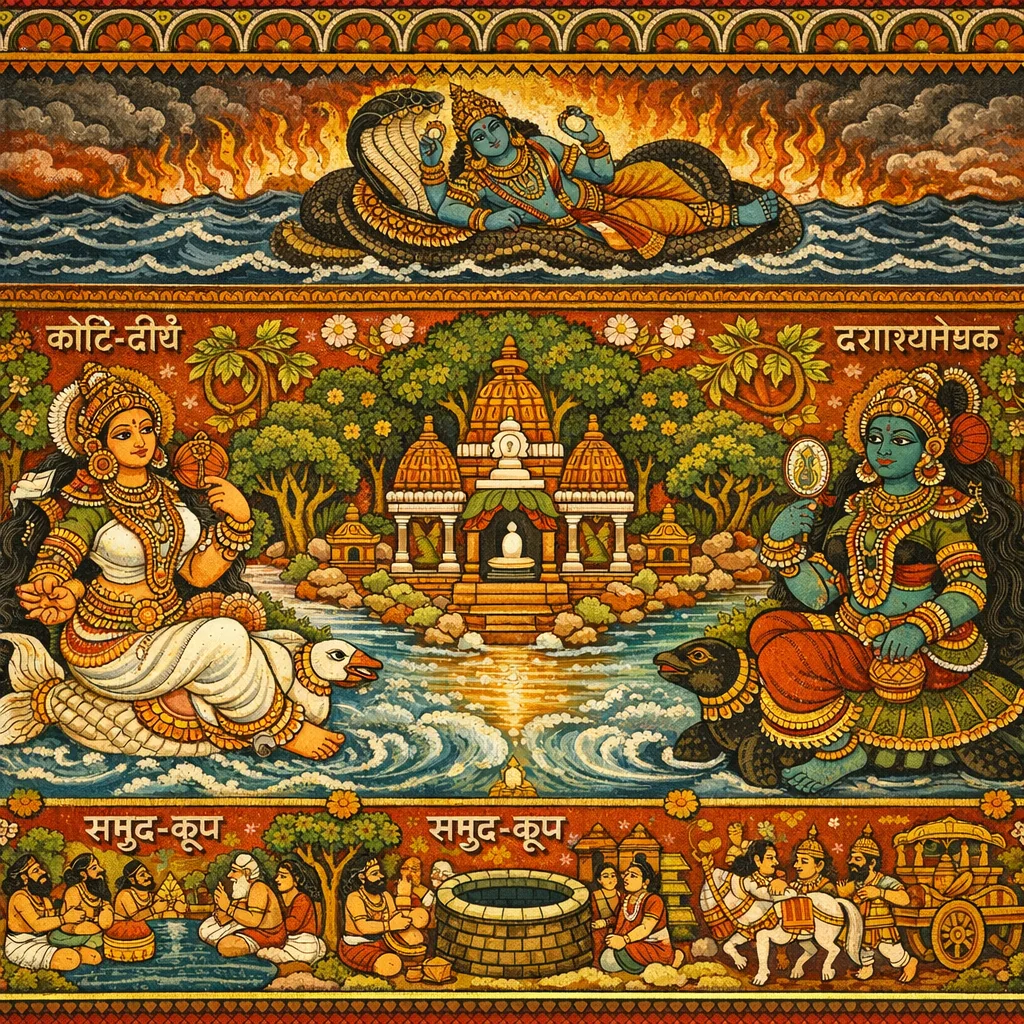
Adhyaya 106: Procedure for Going to Prayaga and the Greatness of the Ganga (Pilgrimage, Vows, and Liberation)
प्रयागगमनविधिः गङ्गामाहात्म्यं च
Speaker: Yudhiṣṭhira, Mārkaṇḍeya
Yudhiṣṭhira affirms that repeatedly hearing Prayāga’s greatness dissolves sin, and asks the exact method by which dharma-minded people should undertake the Prayāga yātrā. Mārkaṇḍeya replies in an āṛṣa (seer-transmitted) sequence: merit begins from the very resolve to depart, and one’s intention must remain unwavering despite divine or social discouragement. He warns that travel driven by aiśvarya (power), lobha (greed), or moha (delusion) becomes fruitless, and urges dāna according to capacity to magnify tīrtha-phala. He then lists Prayāga’s sacred sites and their fruits—abhiṣeka at the saṅgama equals the Rājasūya/Aśvamedha; Sandhyā worship at Sandhyāvaṭa leads to Brahmaloka; death at certain tīrthas yields vast heavenly honor and auspicious rebirths. The discourse expands into cosmic and theological praise: the banyan root’s imperishability at dissolution, Viṣṇu’s recurring role as yajamāna, and the Gaṅgā as Tripathagā and the foremost salvific path—especially in Kali Yuga, with special potency at Gaṅgādvāra, Prayāga, and Gaṅgā-sāgara.
Key Concepts
Shlokas in Adhyaya 106
Verse 1
*युधिष्ठिर उवाच यथा यथा प्रयागस्य माहात्म्यं कथ्यते त्वया तथा तथा प्रमुच्ये ऽहं सर्वपापैर्न संशयः //
Yudhiṣṭhira said: “As you recount again and again the greatness of Prayāga, so too, again and again, I am released from all sins; of this there is no doubt.”
Verse 2
भगवन्केन विधिना गन्तव्यं धर्मनिश्चयैः प्रयागे यो विधिः प्रोक्तस् तन्मे ब्रूहि महामुने //
O revered one, by what procedure should those who are resolved upon dharma go to Prayāga? Whatever rite has been taught for Prayāga—tell that to me, O great sage.
Verse 3
*मार्कण्डेय उवाच कथयिष्यामि ते राजंस् तीर्थयात्राविधिक्रमम् आर्षेण विधिनानेन यथादृष्टं यथाश्रुतम् //
Mārkaṇḍeya said: O King, I shall tell you the proper procedure and sequence for pilgrimage to the sacred tīrthas, according to the seers’ tradition—exactly as it has been seen and as it has been heard through authoritative transmission.
Verse 4
प्रयागतीर्थयात्रार्थी यः प्रयाति नरः क्वचित् बलीवर्दसमारूढः शृणु तस्यापि यत्फलम् //
Hear also the merit that accrues to a man who sets out from anywhere at all, intending a pilgrimage to the sacred tīrtha of Prayāga, even if he undertakes the journey riding upon a bull or ox.
Verse 5
नरके वसते घोरे गवां क्रोष्टा हि दारुणे सलिलं न च गृह्णन्ति पितरस्तस्य देहिनः //
When a person dwells in a dreadful hell—the terrible one called ‘Gavāṃ-kroṣṭā’—the Pitṛs (ancestral spirits) do not accept even the water-offering (udaka) made on behalf of that embodied being.
Verse 6
यस्तु पुत्रांस्तथा बालान् स्नापयेत् पाययेत्तथा यथात्मना तथा सर्वं दानं विप्रेषु दापयेत् //
But whoever bathes his sons and young children and likewise provides them drink should, according to his own means, have all charitable gifts bestowed upon the Brāhmaṇas.
Verse 7
ऐश्वर्यलोभमोहाद्वा गच्छेद्यानेन यो नरः निष्फलं तस्य तत्सर्वं तस्माद्यानं विवर्जयेत् //
If a man travels by a conveyance driven by obsession with power, greed, or delusion, then all of that becomes fruitless for him; therefore one should abstain from such travel by conveyance.
Verse 8
गङ्गायमुनयोर्मध्ये यस्तु कन्यां प्रयच्छति आर्षेणैव विवाहेन यथाविभवसम्भवम् //
Whoever, in the region between the Gaṅgā and the Yamunā, gives a maiden in marriage according to the Ārṣa form, doing so in keeping with his means and capacity, is declared to gain exceedingly great merit.
Verse 9
न स पश्यति तं घोरं नरकं तेन कर्मणा उत्तरान्स कुरून्गत्वा मोदते कालमक्षयम् पुत्रान्दारांश्च लभते धार्मिकान्रूपसंयुतान् //
By that very deed he does not behold that dreadful hell. Having gone to the Northern Kurus, he rejoices through imperishable ages and obtains sons and a wife—righteous in dharma and endowed with beauty.
Verse 10
तत्र दानं प्रकर्तव्यं यथाविभवसम्भवम् तेन तीर्थफलं चैव वर्धते नात्र संशयः स्वर्गे तिष्ठति राजेन्द्र यावदाभूतसंप्लवम् //
Therefore one should make gifts there, in accordance with one’s means and capacity. By that, the merit of the tīrtha‑pilgrimage indeed increases—of this there is no doubt. O best of kings, the giver abides in heaven until the cosmic dissolution.
Verse 11
वटमूलं समासाद्य यस्तु प्राणान्विमुञ्चति सर्वलोकानतिक्रम्य रुद्रलोकं स गच्छति //
Whoever, having reached the root of a banyan tree, relinquishes his life‑breath—he passes beyond all the worlds and goes to Rudra’s world.
Verse 12
तत्र ते द्वादशादित्यास् तपन्ति रुद्रसंश्रिताः निर्दहन्ति जगत्सर्वं वटमूलं न दह्यते //
There the twelve Ādityas, abiding in association with the Rudras, blaze forth; they burn up the entire universe—yet the root of the banyan tree is not burned.
Verse 13
नष्टचन्द्रार्कभुवनं यदा चैकार्णवं जगत् स्थीयते तत्र वै विष्णुर् यजमानः पुनः पुनः //
When the worlds—bereft of moon and sun—remain as a single ocean (ekārṇava), then indeed Viṣṇu abides there again and again as the yajamāna, the presiding patron of the cosmic sacrifice.
Verse 14
देवदानवगन्धर्वा ऋषयः सिद्धचारणाः सदा सेवन्ति तत्तीर्थं गङ्गायमुनसंगमम् //
Gods, Dānavas, Gandharvas, sages, Siddhas, and Cāraṇas ever resort to that sacred tīrtha—the confluence of the Gaṅgā and Yamunā.
Verse 15
ततो गच्छेत राजेन्द्र प्रयागं संस्तुवंश्च यत् यत्र ब्रह्मादयो देवा ऋषयः सिद्धचारणाः //
Then, O best of kings, one should proceed to Prayāga, praising it—where Brahmā and the other gods, the sages, and the Siddhas and Cāraṇas are present.
Verse 16
लोकपालाश्च साध्याश्च पितरो लोकसंमताः सनत्कुमारप्रमुखास् तथैव परमर्षयः //
There too are the Lokapālas, the Guardians of the Directions, the Sādhyas, and the Pitṛs revered throughout the world; likewise the supreme seers, headed by Sanatkumāra.
Verse 17
अङ्गिरःप्रमुखाश्चैव तथा ब्रह्मर्षयः परे तथा नागाः सुपर्णाश्च सिद्धाश्च खेचराश्च ये //
Led by Aṅgiras, and likewise other great Brahmarṣis; and also the Nāgas, the Suparṇas (Garuda-like beings), the Siddhas, and the Khecaras who move through the sky—all of them (were present/are enumerated).
Verse 18
सागराः सरितः शैला नागा विद्याधराश्च ये हरिश्च भगवनास्ते प्रजापतिपुरःसरः //
Oceans, rivers, and mountains—together with the Nāgas and the Vidyādharas—and also Hari, the Blessed Lord: all these stand in attendance before Prajāpati, with him as their foremost head.
Verse 19
गङ्गायमुनयोर्मध्ये पृथिव्या जघनं स्मृतम् प्रयागं राजशार्दूल त्रिषु लोकेषु विश्रुतम् ततः पुण्यतमं नास्ति त्रिषु लोकेषु भारत //
Between the Gaṅgā and the Yamunā lies what is remembered as the earth’s “lower region”—Prayāga, O tiger among kings—renowned throughout the three worlds. Beyond it, O Bhārata, there is nowhere in the three worlds anything more supremely meritorious.
Verse 20
श्रवणात्तस्य तीर्थस्य नामसंकीर्तनादपि मृत्तिकालम्भनाद्वापि नरः पापात्प्रमुच्यते //
By merely hearing of that sacred tīrtha, by chanting its name, or even by applying its holy earth to the body, a person is released from sin.
Verse 21
तत्राभिषेकं यः कुर्यात् संगमे शंसितव्रतः तुल्यं फलमवाप्नोति राजसूयाश्वमेधयोः //
Whoever performs the ritual ablution (abhiṣeka) there, at the sacred confluence (saṅgama), observing a duly proclaimed vow, attains a reward equal to that of the Rājasūya and the Aśvamedha sacrifices.
Verse 22
न देववचनात्तात न लोकवचनात्तथा मतिर् उत्क्रमणीया ते प्रयागगमनं प्रति //
Dear one, neither at the bidding of the gods nor at the urging of people should your resolve be turned away; your intention to go to Prayāga must not waver.
Verse 23
दश तीर्थसहस्राणि षष्टिकोट्यस्तथा पराः तेषां सांनिध्यमत्रैव ततस्तु कुरुनन्दन //
Here itself are present ten thousand sacred fords (tīrthas), and beyond that sixty crores more; their very proximity is found right at this place—therefore, O delight of the Kurus.
Verse 24
या गतिर् योगयुक्तस्य सत्यस्थस्य मनीषिणः सा गतिस्त्यजतः प्राणान् गङ्गायमुनसंगमे //
The very same destiny attained by a wise person established in truth and absorbed in yoga is attained by one who gives up his life-breath at the confluence of the Gaṅgā and Yamunā.
Verse 25
न ते जीवन्ति लोके ऽस्मिंस् तत्र तत्र युधिष्ठिर ये प्रयागं न सम्प्राप्तास् त्रिषु लोकेषु वञ्चिताः //
O Yudhiṣṭhira, those who have not reached Prayāga do not truly live in this world; wherever they may be, they remain deprived of merit across the three worlds.
Verse 26
एवं दृष्ट्वा तु तत्तीर्थं प्रयागं परमं पदम् मुच्यते सर्वपापेभ्यः शशाङ्क इव राहुणा //
Thus, merely by beholding that sacred ford—Prayāga, the supreme holy station—one is released from all sins, just as the moon is freed from Rāhu’s grasp.
Verse 27
कम्बलाश्वतरौ नागौ विपुले यमुनातटे तत्र स्नात्वा च पीत्वा च सर्वपापैः प्रमुच्यते //
On the broad bank of the Yamunā are the two Nāgas, Kambala and Aśvatara; by bathing there and drinking the water, one is released from all sins.
Verse 28
तत्र गत्वा च संस्थानं महादेवस्य विश्रुतम् नरस्तारयते सर्वान् दश पूर्वान्दशापरान् //
Having gone there to the renowned holy abode of Mahādeva, a man delivers all his kin from suffering—ten generations before and ten generations after.
Verse 29
कृत्वाभिषेकं तु नरः सो ऽश्वमेधफलं लभेत् स्वर्गलोकमवाप्नोति यावदाभूतसंप्लवम् //
Having performed the consecratory rite (abhiṣeka), a man obtains the fruit of the Aśvamedha sacrifice; he attains the world of heaven and remains there until the cosmic dissolution at the end of the age.
Verse 30
पूर्वपार्श्वे तु गङ्गायास् त्रिषु लोकेषु भारत कूपं चैव तु सामुद्रं प्रतिष्ठानं च विश्रुतम् //
O Bhārata, on the eastern side of the Gaṅgā there is the famed Samudra-kūpa (the “Ocean Well”), and also Pratiṣṭhāna—both renowned throughout the three worlds.
Verse 31
ब्रह्मचारी जितक्रोधस् त्रिरात्रं यदि तिष्ठति सर्वपापविशुद्धात्मा सो ऽश्वमेधफलं लभेत् //
If a celibate student (brahmacārin), having conquered anger, maintains the observance for three nights, he is purified of all sins and attains the merit of an Aśvamedha sacrifice.
Verse 32
उत्तरेण प्रतिष्ठानाद् भागीरथ्यास्तु पूर्वतः हंसप्रपतनं नाम तीर्थं त्रैलोक्यविश्रुतम् //
To the north of Pratiṣṭhāna, and to the east of the Bhāgīrathī, lies the sacred ford called Haṃsaprapatana—celebrated throughout the three worlds.
Verse 33
अश्वमेधफलं तस्मिन् स्नानमात्रेण भारत यावच्चन्द्रश्च सूर्यश्च तावत्स्वर्गे महीयते //
O Bhārata, by bathing there alone one gains the fruit of an Aśvamedha sacrifice; and as long as the moon and the sun endure, so long is one honored in heaven.
Verse 34
उर्वशीरमणे पुण्ये विपुले हंसपाण्डुरे परित्यजति यः प्राणाञ् शृणु तस्यापि यत्फलम् //
In the holy place called Urvaśī-ramaṇa—vast and swan-white—whoever gives up his life there: hear now the fruit that comes to him as well.
Verse 35
षष्टिवर्षसहस्राणि षष्टिवर्षशतानि च सेव्यते पितृभिः सार्धं स्वर्गलोके नराधिप //
O king, in the heavenly world he is attended and honored together with the Pitṛs for sixty thousand years and a further six hundred years.
Verse 36
उर्वशीं तु सदा पश्येत् स्वर्गलोके नरोत्तम पूज्यते सततं पुत्र ऋषिगन्धर्वकिंनरैः //
O best of men, in the world of heaven one continually beholds Urvaśī; and, O son, he is ever honored there by sages, Gandharvas, and Kiṃnaras.
Verse 37
ततः स्वर्गात्परिभ्रष्टः क्षीणकर्मा दिवश्च्युतः उर्वशीसदृशीनां तु कन्यानां लभते शतम् //
Then, having fallen from heaven—his merit exhausted and cast down from the celestial realm—he obtains a hundred maidens resembling Urvaśī.
Verse 38
मध्ये नारीसहस्राणां बहूनां च पतिर्भवेत् दशग्रामसहस्राणां भोक्ता भवति भूमिपः //
Amid many thousands of women, he becomes their lord and husband; and the king (bhūmipa) becomes the enjoyer and ruler of tens of thousands of villages.
Verse 39
काञ्चीनूपुरशब्देन सुप्तो ऽसौ प्रतिबुध्यते भुक्त्वा तु विपुलान् भोगांस् तत्तीर्थं भजते पुनः //
Awakened from sleep by the sound of jeweled girdles and anklets, he rises; and after enjoying abundant pleasures, he returns again to resort to that sacred ford (tīrtha).
Verse 40
शुक्लाम्बरधरो नित्यं नियतः संयतेन्द्रियः एकं कालं तु भुञ्जानो मासं भूमिपतिर्भवेत् //
Wearing white garments daily, living under discipline with the senses restrained, and eating only once a day—by such a regimen one becomes a lord of the earth for a month.
Verse 41
सुवर्णालंकृतानां तु नारीणां लभते शतम् पृथिव्याम् आसमुद्रायां महाभूमिपतिर्भवेत् //
But he who obtains (or bestows) a hundred women adorned with gold becomes a great sovereign lord of the earth, his dominion extending up to the encircling seas.
Verse 42
धनधान्यसमायुक्तो दाता भवति नित्यशः भुक्त्वा तु विपुलान्भोगांस् तत्तीर्थं लभते पुनः //
Endowed with wealth and grain, one becomes a constant giver. And after enjoying abundant pleasures, one attains that very sacred tīrtha again.
Verse 43
अथ संध्यावटे रम्ये ब्रह्मचारी जितेन्द्रियः उपवासी शुचिः संध्यां ब्रह्मलोकमवाप्नुयात् //
Then, at the delightful Sandhyāvaṭa (the sacred banyan of twilight worship), a brahmacārin who has conquered his senses—fasting and pure—by performing the Sandhyā rite attains the world of Brahmā (Brahmaloka).
Verse 44
कोटितीर्थं समासाद्य यस्तु प्राणान्परित्यजेत् कोटिवर्षसहस्राणां स्वर्गलोके महीयते //
Whoever reaches Koti-tīrtha and there relinquishes the life-breath is honored in the heavenly world for thousands of crores of years.
Verse 45
ततः स्वर्गात्परिभ्रष्टः क्षीणकर्मा दिवश्च्युतः सुवर्णमणिमुक्ताढ्यकुले जायेत रूपवान् //
Then, having fallen away from heaven—his merit exhausted, cast down from the celestial world—he is born in a family rich in gold, jewels, and pearls, endowed with beauty.
Verse 46
ततो भोगवतीं गत्वा वासुकेरुत्तरेण तु दशाश्वमेधकं नाम तीर्थं तत्रापरं भवेत् //
Then, having gone to Bhogavatī, and to the north of Vāsuki, there is another sacred ford there, known as Daśāśvamedhaka (the ‘Ten Horse-Sacrifices’ Tīrtha).
Verse 47
कृताभिषेकस्तु नरः सो ऽश्वमेधफलं लभेत् धनाढ्यो रूपवान्दक्षो दाता भवति धार्मिकः //
A man who has duly undergone consecration (abhiṣeka) attains the merit of the Aśvamedha sacrifice. He becomes wealthy, handsome, capable, a generous giver, and established in righteousness.
Verse 48
चतुर्वेदेषु यत्पुण्यं यत्पुण्यं सत्यवादिषु अहिंसायां तु यो धर्मो गमनादेव तत्फलम् //
Whatever merit is found in the four Vedas, whatever merit belongs to the truthful, and whatever righteousness lies in non-violence (ahiṃsā)—one attains that very fruit merely by setting forth on the pilgrimage journey.
Verse 49
कुरुक्षेत्रसमा गङ्गा यत्र यत्रावगाह्यते कुरुक्षेत्राद्दशगुणा यत्र विन्ध्येन संगता //
Wherever the Gaṅgā is entered for a sacred bath, she is equal in merit to Kurukṣetra; and where she meets the Vindhya, she becomes tenfold more meritorious than Kurukṣetra.
Verse 50
यत्र गङ्गा महाभागा बहुतीर्था तपोधना सिद्धक्षेत्रं हि तज्ज्ञेयं नात्र कार्या विचारणा //
Where the greatly fortunate Gaṅgā flows—abounding in many tīrthas and endowed with spiritual potency through austerity (tapas)—that place should be known as a Siddha-kṣetra, a perfected sacred field; no further deliberation is needed.
Verse 51
क्षितौ तारयते मर्त्यान् नागांस्तारयते ऽप्यधः दिवि तारयते देवांस् तेन त्रिपथगा स्मृता //
On the earth she carries mortals across; below, she also delivers the Nāgas; and in heaven she conveys the gods—therefore she is remembered as “Tripathagā,” the river that flows along the three paths (worlds).
Verse 52
यावदस्थीनि गङ्गायां तिष्ठन्ति हि शरीरिणः तावद्वर्षसहस्राणि स्वर्गलोके महीयते //
So long as a person’s bones remain in the Gaṅgā, for that many thousands of years that embodied being is honored and exalted in the world of heaven.
Verse 53
ततः स्वर्गात्परिभ्रष्टो जम्बूद्वीपपतिर्भवेत् तीर्थानां तु परं तीर्थं नदीनां तु महानदी मोक्षदा सर्वभूतानां महापातकिनामपि //
Thereupon, even one who has fallen away from heaven may become a lord of Jambūdvīpa. This is the supreme tīrtha among all tīrthas, and among rivers it is the Great River; it bestows mokṣa upon all beings, even upon those stained by great sins.
Verse 54
सर्वत्र सुलभा गङ्गा त्रिषु स्थानेषु दुर्लभा गङ्गाद्वारे प्रयागे च गङ्गासागरसंगमे तत्र स्नात्वा दिवं यान्ति ये मृतास्ते ऽपुनर्भवाः //
The Gaṅgā is easy to access in many places, yet she is truly rare in three sites in her highest potency: at Gaṅgādvāra, at Prayāga, and at the confluence where the Gaṅgā meets the ocean. Those who bathe there and then die attain heaven; they do not return again to rebirth.
Verse 55
सर्वेषामेव भूतानां पापोपहतचेतसाम् गतिम् अन्विष्यमाणानां नास्ति गङ्गासमा गतिः //
For all beings whose minds have been struck down by sin and who seek a saving course, there is no path of deliverance equal to the Gaṅgā.
Verse 56
पवित्राणां पवित्रं च मङ्गलानां च मङ्गलम् महेश्वरशिरोभ्रष्टा सर्वपापहरा शुभा //
She is the purest among all purifiers, and the most auspicious among all auspicious things. Fallen from the head of Maheśvara (Śiva), she is благessing itself, removing every sin.
Verse 57
कृते तु नैमिषं क्षेत्रं त्रेतायां पुष्करं परम् द्वापरे तु कुरुक्षेत्रं कलौ गङ्गा विशिष्यते //
In the Kṛta Yuga, the Naimiṣa sacred region is foremost; in the Tretā Yuga, supreme is Puṣkara; in the Dvāpara Yuga, Kurukṣetra is pre-eminent; and in the Kali Yuga, the Gaṅgā is regarded as the most distinguished.
Verse 58
गङ्गामेव निषेवेत प्रयागं तु विशेषतः नान्यत्कलियुगे घोरे भेषजं नृप विद्यते //
One should resort to the Gaṅgā alone—above all, to Prayāga in particular; for in the dreadful Kali Age, O King, no other remedy is found.
Frequently Asked Questions
The chapter teaches that Prayāga pilgrimage must be undertaken with steady dharmic resolve and pure motive. Mārkaṇḍeya emphasizes that merit begins from the intention to go, is increased through charity (dāna) according to one’s capacity, and becomes fruitless if the journey is driven by power, greed, or delusion. The text also highlights specific Prayāga rites—saṅgama bathing and abhiṣeka under a vow, and Sandhyā worship at Sandhyāvaṭa—as yielding yajña-equivalent fruits and higher worlds, with Prayāga and the Gaṅgā presented as supreme remedies in Kali Yuga.
This adhyaya is primarily Dharma and sacred geography (tīrtha-māhātmya). It covers yātrā ethics (intention, restraint, brahmacarya), dāna, vrata, abhiṣeka, and the salvific theology of the Gaṅgā (Tripathagā, Kali Yuga remedy). It does not focus on Vastu-śāstra measurements or Purāṇic genealogy in this chapter.
It states that merely hearing about the Prayāga tīrtha, chanting its name, or even applying its sacred earth (mṛttikā) releases a person from sin—placing śravaṇa (hearing) and nāma-saṅkīrtana (name-recitation) alongside physical pilgrimage as valid means of purification.
Key named sites include the Gaṅgā–Yamunā saṅgama (confluence), Sandhyāvaṭa, Koti-tīrtha, Samudra-kūpa, Pratiṣṭhāna, Haṃsaprapatana, Urvaśī-ramaṇa, Daśāśvamedhaka, the Yamunā bank site of Nāgas Kambala and Aśvatara, and the famed abode of Mahādeva in the region.
The chapter explains that the Gaṅgā “carries across” beings in three realms: on earth she delivers mortals, below she delivers Nāgas, and in heaven she conveys the gods—hence Tripathagā, the river moving along three paths/worlds.