Adhyaya 1
अनुक्रमणिकाध्यायः (Anukramaṇikā Adhyāya) — Invocation, Narrator Frame, and Textual Scope
Upa-parva: Anukramaṇikā-Upa-Parva (Table of Contents / Epic Preface)
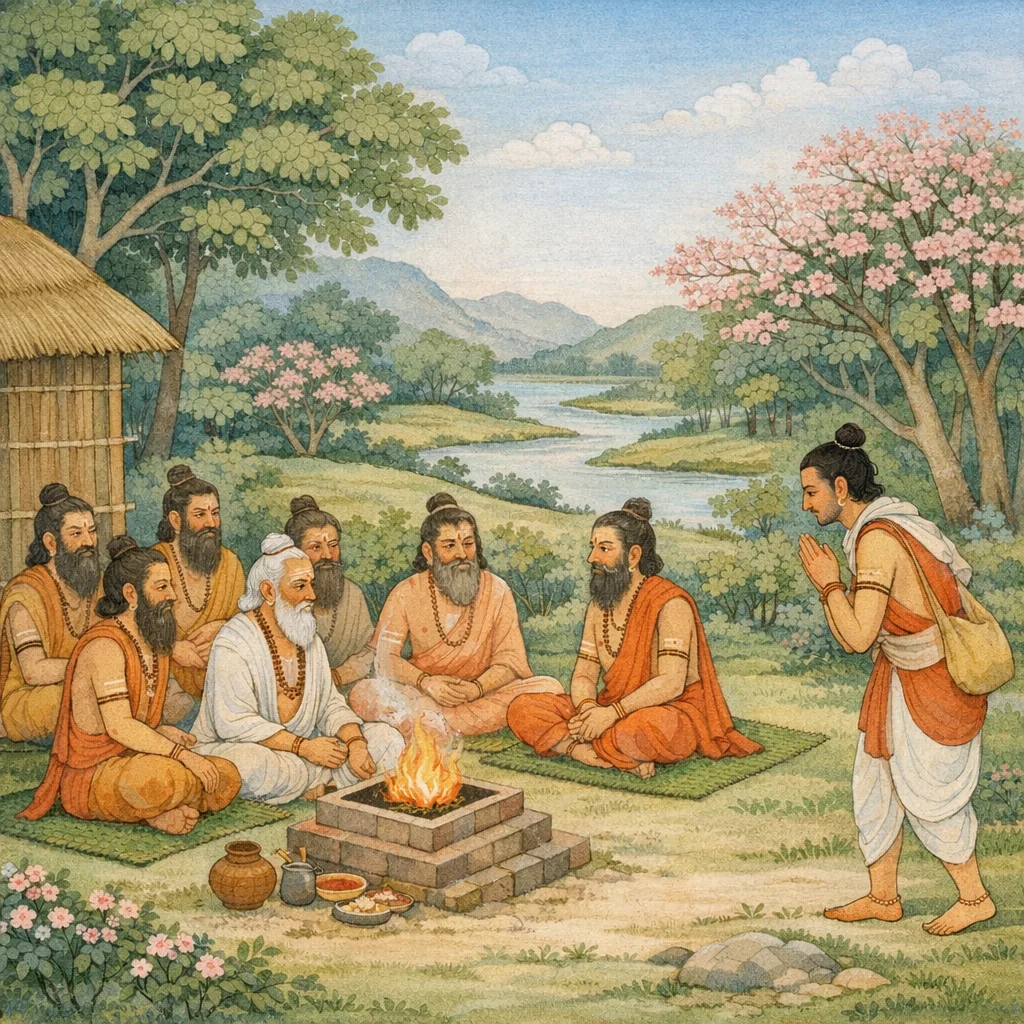
The chapter begins with the customary maṅgala-invocation to Nārāyaṇa, Nara-Narottama, and Sarasvatī, establishing auspiciousness and the hermeneutic posture for recitation. Ugraśravā Sauti, son of Lomaharṣaṇa, arrives at Naimiṣāraṇya where Śaunaka conducts a twelve-year satra; he approaches the seated sages with humility, is welcomed, and is questioned about his travels and sources. Sauti reports that he attended King Janamejaya’s sarpasatra where Vaiśaṃpāyana recited the Mahābhārata as spoken by Kṛṣṇa Dvaipāyana Vyāsa; he also mentions pilgrimage and visiting Samantapañcaka (Kurukṣetra region) associated with the ancient conflict. The sages request the ‘best of narratives’—the Bhārata—described as subtle in meaning, structured by parvans, and adorned with Vedic sense. Sauti proceeds into a cosmological and textual self-description: creation motifs, cycles of time (kāla), enumerations of beings and lineages, and the epic’s comprehensive inclusion of dharma-artha-kāma and śāstric materials. The chapter also includes strong meta-commentary (phalāśruti): study, recitation, and attentive hearing are presented as purificatory, and the Mahābhārata is positioned as weightier than the four Vedas when placed on a scale, thus justifying its epithet ‘Mahābhārata’.
Chapter Arc: नारायण–नर–सरस्वती–व्यास को नमस्कार कर ‘जय’ का उच्चारण—कथा का द्वार मंगलाचरण से खुलता है, मानो समस्त जगत् के लिए धर्मकथा का दीप प्रज्वलित हो। → नैमिषारण्य में बारह-वर्षीय सत्र के तपस्वी ऋषि शौनक के आश्रम में सूतनन्दन उग्रश्रवा (सौति) विनयपूर्वक आते हैं; ऋषि ‘चित्रा: कथाः’ सुनने को आतुर होकर उनसे महाभारत/पुराणसंहिता, राजर्षियों और महात्मा ऋषियों के वृत्तान्त का निवेदन करते हैं। → सौति व्यास के ‘अद्भुतकर्मण’ ग्रन्थ की महिमा का उद्घोष करते हैं—यह धर्मार्थसंश्रित, उपाख्यानों सहित ‘आद्यं भारतमुत्तमम्’ है; रचना-परम्परा में गणेश का लेखन-स्मरण और ब्रह्मा आदि देव-ऋषियों का आगमन/अनुमोदन संकेतित होता है, जिससे कथा का दैवी-प्रामाण्य शिखर पर पहुँचता है। → कथावाचक-श्रोता का अनुबंध दृढ़ होता है: ऋषियों के स्नान-संध्या-जप-अग्निहोत्र के उपरान्त, सौति व्यासपरम्परा से प्राप्त ‘पुण्य’ मत/कथा को क्रम से कहने का व्रत लेते हैं—महाभारत को ‘धर्म’ का दर्पण और ‘इतिहास’ का आधार घोषित कर। → कथा-फलक दूर तक फैलता है—भीष्म-वध (शिखण्डी को आगे रखकर अर्जुन का पराक्रम) और संजय-धृतराष्ट्र संवाद जैसी भविष्य-झलकें देकर श्रोता को अगले प्रसंगों के लिए उत्कंठित छोड़ देता है।
Shlokas
Verse 1
नारायणं नमस्कृत्य नरं चैव नरोत्तमम् | देवीं सरस्वतीं व्यासं ततो जयमुदीरयेत् ।। “बदरिकाश्रमनिवासी प्रसिद्ध ऋषि श्रीनारायण तथा श्रीनर (अन्तर्यामी नारायणस्वरूप भगवान् श्रीकृष्ण, उनके नित्यसखा नरस्वरूप नरश्रेष्ठ अर्जुन), उनकी लीला प्रकट करनेवाली भगवती सरस्वती और उसके वक्ता महर्षि वेदव्यासको नमस्कार कर (आसुरी सम्पत्तियोंका नाश करके अन्त:करणपर दैवी सम्पत्तियोंको विजय प्राप्त करानेवाले) जयः (महाभारत एवं अन्य इतिहास-पुराणादि)-का पाठ करना चाहिये।/3 39 नमो भगवते वासुदेवाय। ३० नमः पितामहाय। ३9 नम: प्रजापतिभ्य:। ३० नम: कृष्णद्वेपायनाय। ३० नम: सर्वविघ्नविनायकेशभ्य:। ३“कारस्वरूप भगवान् वासुदेवको नमस्कार है। $४कारस्वरूप भगवान् पितामहको नमस्कार है। ३“कारस्वरूप प्रजापतियोंको नमस्कार है। ३“कारस्वरूप श्रीकृष्णद्वैपायनको नमस्कार है। >कारस्वरूप सर्व-विघ्नविनाशक विनायकोंको नमस्कार है। लोमहर्षणपुत्र उग्रश्नवा: सौति: पौराणिको नैमिषारण्ये शौनकस्य कुलपते्द्धादशवार्षिके सत्रे,एक समयकी बात है, नैमिषारण्यमें: कुलपति* महर्षि शौनकके बारह वर्षोतक चालू रहनेवाले सत्रमें* जब उत्तम एवं कठोर ब्रह्मचर्यादि व्रतोंका पालन करनेवाले ब्रह्मर्षिगण अवकाशके समय सुखपूर्वक बैठे थे, सूतकुलको आनन्दित करनेवाले लोमहर्षणपुत्र उमग्रश्रवा सौति स्वयं कौतूहलवश उन ब्रह्मर्षियोंक समीप बड़े विनीतभावसे आये। वे पुराणोंके विद्वान और कथावाचक थे
Having bowed to Nārāyaṇa, and also to Nara—the best of men—then to the goddess Sarasvatī and to Vyāsa, one should thereafter recite “Jaya” (the Mahābhārata), the victory-bringing sacred history. The verse frames the epic as a disciplined, reverent act of learning: knowledge and speech (Sarasvatī), inspired authorship (Vyāsa), and divine-human exemplars (Nārāyaṇa and Nara) are invoked so that the listener’s inner life may be guided toward clarity, virtue, and the triumph of dharma.
Verse 2
सुखासीनानभ्यगच्छद् ब्रह्मर्षीन् संशितव्रतान् | विनयावनतो भूत्वा कदाचित् सूतनन्दन:,एक समयकी बात है, नैमिषारण्यमें: कुलपति* महर्षि शौनकके बारह वर्षोतक चालू रहनेवाले सत्रमें* जब उत्तम एवं कठोर ब्रह्मचर्यादि व्रतोंका पालन करनेवाले ब्रह्मर्षिगण अवकाशके समय सुखपूर्वक बैठे थे, सूतकुलको आनन्दित करनेवाले लोमहर्षणपुत्र उमग्रश्रवा सौति स्वयं कौतूहलवश उन ब्रह्मर्षियोंक समीप बड़े विनीतभावसे आये। वे पुराणोंके विद्वान और कथावाचक थे
Once, when the Brahmin seers—disciplined by well-honed vows—were seated at ease during a pause in their rites, the son of the Sūta lineage approached them. Bowing with humility and proper decorum, he came near, ready to speak in a manner befitting learned ascetics and the sacred setting.
Verse 3
तमाश्रममनुप्राप्तं नैमिषारण्यवासिनाम् । चित्रा: श्रोतुं कथास्तत्र परिवब्रुस्तपस्विन:,उस समय नैमिषारण्यवासियोंके आश्रममें पधारे हुए उन उग्रश्रवाजीको, उनसे चित्र- विचित्र कथाएँ सुननेके लिये, सब तपस्वियोंने वहीं घेर लिया
When Ugraśravas arrived at the hermitage of the sages dwelling in Naimiṣāraṇya, the ascetics gathered around him there, eager to hear wondrous and varied tales. The scene frames a dharmic setting: disciplined seekers approach sacred narrative as a means of learning and moral reflection.
Verse 4
अभिवाद्य मुनींस्तांस्तु सर्वानेव कृताञ्जलि: । अपृच्छत् स तपोवृद्धि सद्धिश्वैवाभिपूजित:,उम्रश्रवाजीनी पहले हाथ जोड़कर उन सभी मुनियोंकों अभिवादन किया और “आपलोगोंकी तपस्या सुखपूर्वक बढ़ रही है न?” इस प्रकार कुशल-प्रश्न किया। उन सत्पुरुषोंने भी उग्रश्रवाजीका भलीभाँति स्वागत-सत्कार किया
Having respectfully greeted all those sages with folded hands, he inquired after the increase and well-being of their austerities—asking whether their penance was prospering comfortably. The virtuous sages, in turn, duly honored and welcomed Ugraśravas with fitting respect.
Verse 5
अथ तेषूपविष्टेषु सर्वेष्वेव तपस्विषु । निर्दिष्टमासनं भेजे विनयाललौमहर्षणि:
Then, when all those ascetics had taken their seats, Lomaharṣaṇa—out of humility and proper decorum—took the seat that was assigned to him. The scene emphasizes disciplined conduct: even a learned narrator honors the assembly by accepting his place with modesty rather than self-assertion.
Verse 6
इसके अनन्तर जब वे सभी तपस्वी अपने-अपने आसनपर विराजमान हो गये, तब लोमहर्षणपुत्र उग्रश्रवाजीने भी उनके बताये हुए आसनको विनयपूर्वक ग्रहण किया ।। सुखासीनं ततस्तं तु विश्रान्तमुपलक्ष्य च । अथापच्छदृषिस्तत्र कश्रित् प्रस्तावयन् कथा:,तत्पश्चात् यह देखकर कि उग्रश्रवाजी थकावटसे रहित होकर आरामसे बैठे हुए हैं, किसी महर्षिने बातचीतका प्रसंग उपस्थित करते हुए यह प्रश्न पूछा--
Then, when all the ascetics had taken their seats, Ugraśravas—Lomaharṣaṇa’s son—accepted with due humility the seat they indicated. And seeing him seated at ease and fully rested, a certain sage there, wishing to open the way for conversation, put a question to him.
Verse 7
कुत आगम्यते सौते क्व चायं विह्वतस्त्वया । काल: कमलपपत्राक्ष शंसैतत् पृच्छतो मम,कमलनयन सूतकुमार! आपका शुभागमन कहाँसे हो रहा है? अबतक आपने कहाँ आनन्दपूर्वक समय बिताया है? मेरे इस प्रश्नका उत्तर दीजिये
“O Sūta, from where have you come, and where have you spent your time so pleasantly? O lotus-petaled-eyed one, tell me—answer this, for I ask you.”
Verse 8
एवं पृष्टो5ब्रवीत् सम्यग् यथावल्लौमहर्षणि: । वाक््यं वचनसम्पन्नस्तेषां च चरिताश्रयम्
Thus questioned, Lomaharṣaṇa replied correctly and in due order. His speech was well-formed and apt in expression, and it rested upon the deeds and life-stories of those ancients, grounding his words in their conduct.
Verse 9
सौतिरुवाच जनमेजयस्य राजर्षे: सर्पसत्रे महात्मन:,उग्रश्रवाजीने कहा--महर्षियो! चक्रवर्ती सम्राट् महात्मा राजर्षि परीक्षित्-नन्दन जनमेजयके सर्पयज्ञमें उन्हींके पास वैशम्पायनने श्रीकृष्णद्वैपायन व्यासजीके द्वारा निर्मित परम पुण्यमयी चित्र-विचित्र अर्थसे युक्त महाभारतकी जो विविध कथाएँ विधिपूर्वक कही हैं, उन्हें सुनकर मैं आ रहा हूँ इति श्रीमन्न्महाभारते आदिपर्वणि अनुक्रमणिकापर्वणि प्रथमो<ध्याय: ।। १२ ।। इस प्रकार श्रीमह्ाभारत आदिपर्वके अन्तर्गत अनुक्रमाणिकापरबववमें पहला अध्याय पूरा हुआ
Sauti said: “At the serpent-sacrifice of the great-souled royal sage Janamejaya, Ugraśravas addressed the seers: ‘O great Ṛṣis! I have just come after hearing, there at the very side of the emperor—Janamejaya, son of the royal sage Parīkṣit—the many narratives of the Mahābhārata, that supremely meritorious work composed by Śrī Kṛṣṇa Dvaipāyana Vyāsa, rich with wondrous and varied meanings, which Vaiśampāyana recited in due ritual order at the serpent-yajña.’”
Verse 10
समीपे पार्थिवेन्द्रस्य सम्यक् पारिक्षितस्य च । कृष्णद्वैपायनप्रोक्ता: सुपुण्या विविधा: कथा:,उग्रश्रवाजीने कहा--महर्षियो! चक्रवर्ती सम्राट् महात्मा राजर्षि परीक्षित्-नन्दन जनमेजयके सर्पयज्ञमें उन्हींके पास वैशम्पायनने श्रीकृष्णद्वैपायन व्यासजीके द्वारा निर्मित परम पुण्यमयी चित्र-विचित्र अर्थसे युक्त महाभारतकी जो विविध कथाएँ विधिपूर्वक कही हैं, उन्हें सुनकर मैं आ रहा हूँ
Near the sovereign lord of the earth—Janamejaya, Parīkṣit’s descendant—were recited, in due order, many supremely meritorious narratives of the Mahābhārata, as composed and taught by Kṛṣṇa Dvaipāyana Vyāsa. Having heard those varied accounts, rich in meaning and moral import, I have come (to relate them).
Verse 11
कथिताश्चापि विधिवद् या वैशम्पायनेन वै । श्र॒ुत्वाहं ता विचित्रार्था महाभारतसंश्रिता:,उग्रश्रवाजीने कहा--महर्षियो! चक्रवर्ती सम्राट् महात्मा राजर्षि परीक्षित्-नन्दन जनमेजयके सर्पयज्ञमें उन्हींके पास वैशम्पायनने श्रीकृष्णद्वैपायन व्यासजीके द्वारा निर्मित परम पुण्यमयी चित्र-विचित्र अर्थसे युक्त महाभारतकी जो विविध कथाएँ विधिपूर्वक कही हैं, उन्हें सुनकर मैं आ रहा हूँ
Ugraśravas (Sauti) said: “I have come here after hearing those narratives of the Mahābhārata—rich with wondrous meanings—recited in due ritual order by Vaiśampāyana at the serpent-sacrifice of King Janamejaya, the son of the royal sage Parīkṣit, that supremely meritorious work composed by Śrī Kṛṣṇa Dvaipāyana Vyāsa.”
Verse 12
बहूनि सम्परिक्रम्य तीर्थान्यायतनानि च | समनतपजञ्चकं नाम पुण्यं द्विजनिषेवितम्,मैं बहुत-से तीर्थों एवं धामोंकी यात्रा करता हुआ ब्राह्मणोंके द्वारा सेवित उस परम पुण्यमय समन्तपंचक क्षेत्र कुरुक्षेत्र देशमें गया, जहाँ पहले कौरव-पाण्डव एवं अन्य सब राजाओंका युद्ध हुआ था
Having journeyed through many sacred fords (tīrthas) and holy shrines, I reached Samantapañcaka, a supremely sanctified region, tended and frequented by the twice-born (brāhmaṇas).
Verse 13
गतवानस्मि त॑ देशं युद्ध यत्राभवत् पुरा । कुरूणां पाण्डवानां च सर्वेषां च महीक्षिताम्,मैं बहुत-से तीर्थों एवं धामोंकी यात्रा करता हुआ ब्राह्मणोंके द्वारा सेवित उस परम पुण्यमय समन्तपंचक क्षेत्र कुरुक्षेत्र देशमें गया, जहाँ पहले कौरव-पाण्डव एवं अन्य सब राजाओंका युद्ध हुआ था
I reached that land—Kurukṣetra—where in ancient times the war was waged between the Kurus and the Pāṇḍavas, and indeed among all the kings.
Verse 14
दिदृक्षुरागतस्तस्मात् समीपं भवतामिह । आयुष्मन्त: सर्व एव ब्रह्मभूता हि मे मता: । अस्मिन् यज्ञे महाभागा: सूर्यपावकवर्चस:,वहींसे आपलोगोंके दर्शनकी इच्छा लेकर मैं यहाँ आपके पास आया हूँ। मेरी यह मान्यता है कि आप सभी दीर्घायु एवं ब्रह्मस्वरूप हैं। ब्राह्मणो! इस यज्ञमें सम्मिलित आप सभी महात्मा बड़े भाग्यशाली तथा सूर्य और अग्निके समान तेजस्वी हैं
Therefore I have come here, wishing to behold you and to draw near to you all. For in my understanding, every one of you is long-lived and truly established in Brahman. O brāhmaṇas, participating in this sacrifice, you great-souled and fortunate ones shine with the splendor of the sun and of fire—worthy of reverence and honor in this sacred rite.
Verse 15
कृताभिषेका: शुचय: कृतजप्याहुताग्नय: । भवन्त आसने स्वस्था ब्रवीमि किमहं द्विजा:,इस समय आप सभी स्नान, संध्या-वन्दन, जप और अग्निहोत्र आदि करके शुद्ध हो अपने-अपने आसनपर स्वस्थचित्तसे विराजमान हैं। आज्ञा कीजिये, मैं आपलोगोंको क्या सुनाऊँ? क्या मैं आपलोगोंको धर्म और अर्थके गूढ़ रहस्यसे युक्त, अन्तःकरणको शुद्ध करनेवाली भिन्न-भिन्न पुराणोंकी कथा सुनाऊँ अथवा उदारचरित महानुभाव ऋषियों एवं सम्राटोंके पवित्र इतिहास?
“You have completed your ritual ablutions and are purified; you have performed your japa and offered oblations into the sacred fire. Seated comfortably upon your respective seats, composed and at ease—tell me, O twice-born ones, what shall I recite to you? Shall I narrate various Purāṇic accounts—subtle in their teachings of dharma and artha and purifying to the inner mind—or the holy histories of noble-souled sages and emperors of exalted conduct?”
Verse 16
पुराणसंहिता: पुण्या: कथा धर्मार्थसंश्रिता: । इति वृत्तं नरेन्द्राणामृषीणां च महात्मनाम्,इस समय आप सभी स्नान, संध्या-वन्दन, जप और अग्निहोत्र आदि करके शुद्ध हो अपने-अपने आसनपर स्वस्थचित्तसे विराजमान हैं। आज्ञा कीजिये, मैं आपलोगोंको क्या सुनाऊँ? क्या मैं आपलोगोंको धर्म और अर्थके गूढ़ रहस्यसे युक्त, अन्तःकरणको शुद्ध करनेवाली भिन्न-भिन्न पुराणोंकी कथा सुनाऊँ अथवा उदारचरित महानुभाव ऋषियों एवं सम्राटोंके पवित्र इतिहास?
“There are sacred compilations of ancient lore—holy narratives grounded in dharma and artha. Or else, I can recount the hallowed histories of kings and the great-souled seers.”
Verse 17
ऋषय ऊचु: द्वैपायनेन यत् प्रोक्त पुराणं परमर्षिणा । सुरैब्रह्रार्षिभिश्वैव श्रुव्वा यदभिपूजितम्
The sages said: “That ancient sacred narrative which was proclaimed by Dvaipāyana, the supreme seer—having been heard, it was duly honored and revered by the gods and by the Brahmarṣis as well.”
Verse 18
तस्याख्यानवरिष्ठस्य विचित्रपदपर्वण: । सूक्ष्मार्थन्याययुक्तस्य वेदार्थभ्रूषितस्य च
It is the finest of narratives, arranged in chapters and verses of varied and striking expression; it is furnished with subtle meanings and sound reasoning, and it is adorned with the purport of the Vedas.
Verse 19
भारतस्येतिहासस्य पुण्यां ग्रन्थार्थसंयुताम् । संस्कारोपगतां ब्राह्मीं नानाशास्त्रोपबृंहिताम्
This sacred account of the Bhārata—rich in the meaning of its narrative and teachings—has been refined through proper tradition and discipline, expressed in elevated, Vedic speech, and strengthened by many branches of learning. It presents history not as mere record, but as ethically charged instruction shaped by culture, scripture, and reasoned knowledge.
Verse 20
जनमेजयस्य यां राज्ञो वैशम्पायन उत्तवान् | यथावत् स ऋषिस्तुष्ट्या सत्रे द्वैघायनाज्ञया
At the sacrificial session of King Janamejaya, the sage Vaiśampāyana recounted the narrative in due order, doing so with satisfaction, in obedience to the command of Dvaighāyana (Vyāsa).
Verse 21
वेदैश्वतुर्भि: संयुक्तां व्यासस्याद्भुतकर्मण: । संहितां श्रोतुमिच्छाम: पुण्यां पापभयापहाम्
We wish to hear that sacred compendium—joined with the four Vedas—composed by Vyāsa of wondrous deeds, a holy work that removes the fear born of sin.
Verse 22
ऋषियोंने कहा--उग्रश्रवाजी! परमर्षि श्रीकृष्ण-द्वैधायनने जिस प्राचीन इतिहासरूप पुराणका वर्णन किया है और देवताओं तथा ऋषियोंने अपने-अपने लोकमें श्रवण करके जिसकी भूरि-भूरि प्रशंसा की है, जो आख्यानोंमें सर्वश्रेष्ठ है, जिसका एक-एक पद, वाक्य एवं पर्व विचित्र शब्दविन्यास और रमणीय अर्थसे परिपूर्ण है, जिसमें आत्मा-परमात्माके सूक्ष्म स्वरूपका निर्णय एवं उनके अनुभवके लिये अनुकूल युक्तियाँ भरी हुई हैं और जो सम्पूर्ण वेदोंके तात्पर्यानुकूल अर्थसे अलंकृत है, उस भारत-इतिहासकी परम पुण्यमयी, ग्रन्थके गुप्त भावोंको स्पष्ट करनेवाली, पदों-वाक्योंकी व्युत्पत्तिसे युक्त, सब शास्त्रोंके अभिप्रायके अनुकूल और उनसे समर्थित जो अदभुतकर्मा व्यासकी संहिता है, उसे हम सुनना चाहते हैं। अवश्य ही वह चारों वेदोंके अर्थोंसे भरी हुई तथा पुण्यस्वरूपा है। पाप और भयका नाश करनेवाली है। भगवान् वेदव्यासकी आज्ञासे राजा जनमेजयके यज्ञमें प्रसिद्ध ऋषि वैशम्पायनने आनन्दमें भरकर भलीभाँति इसका निरूपण किया है ।। १७-- २१ || सौतिर्वाच आट्य॑ पुरुषमीशान पुरुहूतं पुरुष्ठतम् । ऋतमेकाक्षरं ब्रह्म व्यक्ताव्यक्ते सनातनम्,उग्रश्रवाजीने कहा--जो सबका आदि कारण, अन्तर्यामी और नियन्ता है, यज्ञोंमें जिसका आवाहन और जिसके उद्देश्यसे हवन किया जाता है, जिसकी अनेक पुरुषोंद्वारा अनेक नामोंसे स्तुति की गयी है, जो ऋत (सत्यस्वरूप), एकाक्षर ब्रह्म (प्रणव एवं एकमात्र अविनाशी और सर्वव्यापी परमात्मा), व्यक्ताव्यक्त (साकार-निराकार)-स्वरूप एवं सनातन है, असत-सत् एवं उभयरूपसे जो स्वयं विराजमान है; फिर भी जिसका वास्तविक स्वरूप सत्-असत् दोनोंसे विलक्षण है, यह विश्व जिससे अभिन्न है, जो सम्पूर्ण परावर (स्थूल- सूक्ष्म) जगत्का स्रष्टा, पुराणपुरुष, सर्वोत्कृष्ट परमेश्वर एवं वृद्धि-क्षय आदि विकारोंसे रहित है, जिसे पाप कभी छू नहीं सकता, जो सहज शुद्ध है, वह ब्रह्म ही मंगलकारी एवं मंगलमय विष्णु है। उन्हीं चराचरगुरु हृषीकेश (मन-इन्द्रियोंके प्रेरक) श्रीहरिको नमस्कार करके सर्वलोकपूजित अद्भुतकर्मा महात्मा महर्षि व्यासदेवके इस अन्तःकरणशोधक मतका मैं वर्णन करूँगा
Sauti said: I shall speak of that auspicious Vishnu—Hari, Hṛṣīkeśa—who is the primal Person, the inner ruler and supreme Lord; who is invoked in sacrifices and for whose sake oblations are offered; who is praised by many people under many names; who is Truth itself, the imperishable one-syllabled Brahman (the praṇava), eternal, and present as both the manifest and the unmanifest. Though appearing as being and non-being and as both, his real nature transcends both. The universe is not separate from him; he is the creator of all higher and lower realms, the ancient Person, the highest God, untouched by growth, decay, or any taint of sin—self-pure by nature. Having bowed to that teacher of all moving and unmoving beings, worshipped in all worlds, I shall relate the heart-purifying teaching embodied in the wondrous composition of the great seer Vyāsa.
Verse 23
असच्च सदसच्चैव यद् विश्व सदसत्परम् । परावराणां स्रष्टारं पुराणं परमव्ययम्,उग्रश्रवाजीने कहा--जो सबका आदि कारण, अन्तर्यामी और नियन्ता है, यज्ञोंमें जिसका आवाहन और जिसके उद्देश्यसे हवन किया जाता है, जिसकी अनेक पुरुषोंद्वारा अनेक नामोंसे स्तुति की गयी है, जो ऋत (सत्यस्वरूप), एकाक्षर ब्रह्म (प्रणव एवं एकमात्र अविनाशी और सर्वव्यापी परमात्मा), व्यक्ताव्यक्त (साकार-निराकार)-स्वरूप एवं सनातन है, असत-सत् एवं उभयरूपसे जो स्वयं विराजमान है; फिर भी जिसका वास्तविक स्वरूप सत्-असत् दोनोंसे विलक्षण है, यह विश्व जिससे अभिन्न है, जो सम्पूर्ण परावर (स्थूल- सूक्ष्म) जगत्का स्रष्टा, पुराणपुरुष, सर्वोत्कृष्ट परमेश्वर एवं वृद्धि-क्षय आदि विकारोंसे रहित है, जिसे पाप कभी छू नहीं सकता, जो सहज शुद्ध है, वह ब्रह्म ही मंगलकारी एवं मंगलमय विष्णु है। उन्हीं चराचरगुरु हृषीकेश (मन-इन्द्रियोंके प्रेरक) श्रीहरिको नमस्कार करके सर्वलोकपूजित अद्भुतकर्मा महात्मा महर्षि व्यासदेवके इस अन्तःकरणशोधक मतका मैं वर्णन करूँगा
Ugraśravas (Sauti) describes the Supreme as the ground of all origins and the inner ruler: present as both the unreal and the real, yet ultimately transcending both. From that imperishable, primeval Lord arises the entire range of higher and lower creation—subtle and gross. By invoking and honoring this Reality, the narrator frames the Mahābhārata as a purifying teaching: devotion to the timeless source is the ethical foundation from which right understanding of dharma can proceed.
Verse 24
मड़ल्यं मड़लं विष्णुं वरेण्यमनघं शुचिम् । नमस्कृत्य हृषीकेशं चराचरगुरुं हरिम्,उग्रश्रवाजीने कहा--जो सबका आदि कारण, अन्तर्यामी और नियन्ता है, यज्ञोंमें जिसका आवाहन और जिसके उद्देश्यसे हवन किया जाता है, जिसकी अनेक पुरुषोंद्वारा अनेक नामोंसे स्तुति की गयी है, जो ऋत (सत्यस्वरूप), एकाक्षर ब्रह्म (प्रणव एवं एकमात्र अविनाशी और सर्वव्यापी परमात्मा), व्यक्ताव्यक्त (साकार-निराकार)-स्वरूप एवं सनातन है, असत-सत् एवं उभयरूपसे जो स्वयं विराजमान है; फिर भी जिसका वास्तविक स्वरूप सत्-असत् दोनोंसे विलक्षण है, यह विश्व जिससे अभिन्न है, जो सम्पूर्ण परावर (स्थूल- सूक्ष्म) जगत्का स्रष्टा, पुराणपुरुष, सर्वोत्कृष्ट परमेश्वर एवं वृद्धि-क्षय आदि विकारोंसे रहित है, जिसे पाप कभी छू नहीं सकता, जो सहज शुद्ध है, वह ब्रह्म ही मंगलकारी एवं मंगलमय विष्णु है। उन्हीं चराचरगुरु हृषीकेश (मन-इन्द्रियोंके प्रेरक) श्रीहरिको नमस्कार करके सर्वलोकपूजित अद्भुतकर्मा महात्मा महर्षि व्यासदेवके इस अन्तःकरणशोधक मतका मैं वर्णन करूँगा
Having bowed to Hari—Hṛṣīkeśa, the guide of all that moves and all that is still—Vishnu who is auspiciousness itself, the supreme object of choice, stainless and pure, Ugraśravas (Sauti) proceeds to relate the purifying teaching of the great sage Vyāsa, revered in all worlds.
Verse 25
महर्षे: पूजितस्येह सर्वलोकैर्महात्मन: । प्रवक्ष्यामि मतं॑ पुण्यं व्यासस्याद्भुतकर्मण:,उग्रश्रवाजीने कहा--जो सबका आदि कारण, अन्तर्यामी और नियन्ता है, यज्ञोंमें जिसका आवाहन और जिसके उद्देश्यसे हवन किया जाता है, जिसकी अनेक पुरुषोंद्वारा अनेक नामोंसे स्तुति की गयी है, जो ऋत (सत्यस्वरूप), एकाक्षर ब्रह्म (प्रणव एवं एकमात्र अविनाशी और सर्वव्यापी परमात्मा), व्यक्ताव्यक्त (साकार-निराकार)-स्वरूप एवं सनातन है, असत-सत् एवं उभयरूपसे जो स्वयं विराजमान है; फिर भी जिसका वास्तविक स्वरूप सत्-असत् दोनोंसे विलक्षण है, यह विश्व जिससे अभिन्न है, जो सम्पूर्ण परावर (स्थूल- सूक्ष्म) जगत्का स्रष्टा, पुराणपुरुष, सर्वोत्कृष्ट परमेश्वर एवं वृद्धि-क्षय आदि विकारोंसे रहित है, जिसे पाप कभी छू नहीं सकता, जो सहज शुद्ध है, वह ब्रह्म ही मंगलकारी एवं मंगलमय विष्णु है। उन्हीं चराचरगुरु हृषीकेश (मन-इन्द्रियोंके प्रेरक) श्रीहरिको नमस्कार करके सर्वलोकपूजित अद्भुतकर्मा महात्मा महर्षि व्यासदेवके इस अन्तःकरणशोधक मतका मैं वर्णन करूँगा
I shall now proclaim the holy and heart-purifying doctrine of the great sage Vyāsa—he of wondrous deeds—who is honored here by all the worlds.
Verse 26
आचख्यु: कवय: केचित् सम्प्रत्याचक्षते परे । आख््यास्यन्ति तथैवान्ये इतिहासमिमं भुवि,पृथ्वीपर इस इतिहासका अनेकों कवियोंने वर्णन किया है और इस समय भी बहुत-से वर्णन करते हैं। इसी प्रकार अन्य कवि आगे भी इसका वर्णन करते रहेंगे
Some poets and sages have already recounted this great history; others are recounting it even now. In the same way, still other poets will continue to narrate this Itihāsa upon the earth in times to come.
Verse 27
इदं तु त्रिषु लोकेषु महज्ज्ञानं प्रतिष्ठितम् । विस्तरैश्व॒ समासैश्न धार्यते यद् द्विजातिभि:,इस महाभारतकी तीनों लोकोंमें एक महान् ज्ञानके रूपमें प्रतिष्ठा है। ब्राह्मणादि द्विजाति संक्षेप और विस्तार दोनों ही रूपोंमें अध्ययन और अध्यापनकी परम्पराके द्वारा इसे अपने हृदयमें धारण करते हैं
This Mahābhārata is renowned across the three worlds as a great treasury of wisdom. The twice-born—especially the Brahmins—preserve it within their hearts by maintaining the tradition of studying and teaching it, both in detailed exposition and in concise summary.
Verse 28
अलंकृतं शुभै: शब्दै: समयैर्दिव्यमानुषै: । छन््दोवृत्तैश्न विविधैरन्वितं विदुषां प्रियम्,यह शुभ (ललित एवं मंगलमय) शब्दविन्याससे अलंकृत है तथा वैदिक-लौकिक या संस्कृत-प्राकृत संकेतोंसे सुशोभित है। अनुष्टप्, इन्द्रवज्ञा आदि नाना प्रकारके छन््द भी इसमें प्रयुक्त हुए हैं; अतः यह ग्रन्थ विद्वानोंकों बहुत ही प्रिय है
It is embellished with auspicious and graceful diction, and adorned with conventions drawn from both the divine (Vedic) and human (worldly) spheres. Composed in many kinds of metrical patterns, it is therefore especially dear to the learned.
Verse 29
(पुण्ये हिमवत: पादे मध्ये गिरिगुहालये । विशोध्य देहं धर्मात्मा दर्भसंस्तरमाश्रित: ।। शुचि: सनियमो व्यास: शान्तात्मा तपसि स्थित: । भारतस्येतिहासस्य धर्मेणान्वीक्ष्य तां गतिम् ।। प्रविश्य योगं ज्ञानेन सो5पश्यत् सर्वमन्ततः ।) हिमालयकी पवित्र तलहटीमें पर्वतीय गुफाके भीतर धर्मात्मा व्यासजी स्नानादिसे शरीर-शुद्धि करके पवित्र हो कुशका आसन बिछाकर बैठे थे। उस समय नियमपालनपूर्वक शान्तचित्त हो वे तपस्यामें संलग्न थे। ध्यानयोगमें स्थित हो उन्होंने धर्मपूर्वक महाभारत- इतिहासके स्वरूपका विचार करके ज्ञानदृष्टिद्वारा आदिसे अन्ततक सब कुछ प्रत्यक्षकी भाँति देखा (और इस ग्रन्थका निर्माण किया)। निष्प्रभेडस्मिन् निरालोके सर्वतस्तमसावृते । बृहदण्डम भूदेक॑ प्रजानां बीजमव्ययम्,सृष्टिके प्रारम्भमें जब यहाँ वस्तुविशेष या नामरूप आदिका भान नहीं होता था, प्रकाशका कहीं नाम नहीं था, सर्वत्र अन्धकार-ही-अन्धकार छा रहा था, उस समय एक बहुत बड़ा अण्ड प्रकट हुआ, जो सम्पूर्ण प्रजाओंका अविनाशी बीज था
On the holy slopes of Himavat, within a mountain cave, the righteous Vyāsa purified his body and, seated upon a spread of darbha grass, remained pure and disciplined. With a tranquil mind, established in austerity, he reflected—according to dharma—on the course and meaning of the Bhārata history. Entering yogic concentration through knowledge, he beheld everything from beginning to end as if directly before his eyes. And in that primeval time, when this world was without radiance, without distinct forms, and covered on all sides by darkness, there appeared a single vast cosmic egg—the imperishable seed of all beings.
Verse 30
युगस्यादौ निमित्तं तन््महद्दिव्यं प्रचक्षते । यस्मिन् संश्रूयते सत्यं ज्योतिर्त्रह्या सनातनम्,ब्रह्मकल्पके आदिमें उसी महान् एवं दिव्य अण्डको चार प्रकारके प्राणिसमुदायका कारण कहा जाता है। जिसमें सत्यस्वरूप ज्योतिर्मय सनातन ब्रह्म अन्तर्यामीरूपसे प्रविष्ट हुआ है, ऐसा श्रुति वर्णन करती हैः
At the beginning of the age, the tradition declares that great and divine entity to be the originating cause. Within it, the eternal Brahman—luminous and identical with Truth—is said by the Veda to be present (as the indwelling reality).
Verse 31
अद्भुतं चाप्यचिन्त्यं च सर्वत्र समतां गतम् | अव्यक्तं कारण सूक्ष्मं यत्तत् सदसदात्मकम्,वह ब्रह्म अदभुत, अचिन्त्य, सर्वत्र समानरूपसे व्याप्त, अव्यक्त, सूक्ष्म, कारणस्वरूप एवं अनिर्वचनीय है और जो कुछ सत्-असत्रूपमें उपलब्ध होता है, सब वही है
That supreme Reality is wondrous and beyond the reach of thought; it pervades all things with an equal presence. Unmanifest and subtle as the causal ground, it is spoken of as embracing both being and non-being—so that whatever is encountered as existent or non-existent is, in truth, nothing other than That Brahman.
Verse 32
यस्मात् पितामहो जज्ञे प्रभुरेक: प्रजापति: । ब्रह्मा सुरगुरु: स्थाणुर्मनु: कः परमेष्ठ्यूथ,उस अण्डसे ही प्रथम देहधारी, प्रजापालक प्रभु, देवगुरु पितामह ब्रह्मा तथा रुद्र, मनु, प्रजापति, परमेष्ठी, प्रचेताओंके पुत्र, दक्ष तथा दक्षके सात पुत्र (क्रोध, तम, दम, विक्रीत, अंगिरा, कर्दम और अश्व) प्रकट हुए। तत्पश्चात् इक्कीस प्रजापति (मरीचि आदि सात ऋषि और चौदह मनु)- पैदा हुए
From that primordial source was born the Grandsire—the single sovereign Lord as Prajāpati. Thereafter appeared Brahmā, the preceptor of the gods, Sthāṇu (Rudra), Manu, Ka, and Parameṣṭhī. The passage situates creation as an ordered unfolding of cosmic authority and responsibility, grounding later human lineages and duties in a sacred genealogy.
Verse 33
प्राचेतसस्तथा दक्षो दक्षपुत्राश्च॒ सप्त वै । ततः प्रजानां पतय: प्राभवन्नेकविंशति:,उस अण्डसे ही प्रथम देहधारी, प्रजापालक प्रभु, देवगुरु पितामह ब्रह्मा तथा रुद्र, मनु, प्रजापति, परमेष्ठी, प्रचेताओंके पुत्र, दक्ष तथा दक्षके सात पुत्र (क्रोध, तम, दम, विक्रीत, अंगिरा, कर्दम और अश्व) प्रकट हुए। तत्पश्चात् इक्कीस प्रजापति (मरीचि आदि सात ऋषि और चौदह मनु)- पैदा हुए
Then appeared Prācetasa (the son of the Pracetas) and Dakṣa, along with the seven sons of Dakṣa. Thereafter arose the twenty-one lords of creatures (Prajāpatis), who are described as the progenitors entrusted with the ordering, protection, and continuation of living beings. The passage situates creation as a structured lineage of responsibility—authority is presented not as mere power, but as stewardship over life and social-cosmic order.
Verse 34
पुरुषश्चाप्रमेयात्मा यं सर्व ऋषयो विदु: । विश्वेदेवास्तथादित्या वसवो<5थाश्विनावपि,जिन्हें मत्स्य-कूर्म आदि अवतारोंके रूपमें सभी ऋषि-मुनि जानते हैं, वे अप्रमेयात्मा विष्णुरूप पुरुष और उनकी विभूतिरूप विश्वेदेव, आदित्य, वसु एवं अश्विनीकुमार आदि भी क्रमश: प्रकट हुए हैं
That Supreme Person, whose true nature is beyond all measurement and definition—whom all the sages know—along with the Viśvedevas, the Ādityas, the Vasus, and also the two Aśvins, manifested in due order. The passage situates the divine as the source and ground of the Vedic gods, emphasizing a hierarchy in which the many deities are understood as expressions of the one immeasurable Purusha.
Verse 35
यक्षा: साध्या: पिशाचाश्च गुह्मका: पितरस्तथा । ततः प्रसूता विद्वांस: शिष्टा ब्रद्यूर्षिसत्तमा:,तदनन्तर यक्ष, साध्य, पिशाच, गुहाक और पितर एवं तत्त्वज्ञानी सदाचारपरायण साधुशिरोमणि ब्रह्मर्षिगण प्रकट हुए
Thereafter were brought forth the Yakṣas, the Sādhyas, and the Piśācas; likewise the Guhyakas and the Pitṛs. Following them appeared the wise—cultured and disciplined in right conduct—the foremost of the Brahmarṣis. The passage situates the emergence of various classes of beings within a cosmic genealogy, implicitly valuing knowledge (vidyā) and ethical refinement (śiṣṭācāra) as marks of the highest sages.
Verse 36
राजर्षयश्न बहव: सर्वे समुदिता गुणै: । आपो द्यौ: पृथिवी वायुरन्तरिक्षं दिशस्तथा,इसी प्रकार बहुत-से राजर्षियोंका प्रादुर्भाव हुआ है, जो सब-के-सब शौर्यादि सदगुणोंसे सम्पन्न थे। क्रमश: उसी ब्रह्माण्डसे जल, द्युलोक, पृथ्वी, वायु, अन्तरिक्ष और दिशाएँ भी प्रकट हुई हैं
Many royal seers also came into manifestation, all endowed with noble qualities such as valor. In due sequence, from that same cosmic source there also arose the waters, the heavenly realm, the earth, the wind, the mid-space, and the directions—presenting creation as an ordered unfolding in which excellence and cosmic order appear together.
Verse 37
संवत्सरर्तवो मासा: पक्षाहोरात्रय: क्रमात् । यच्चान्यदपि तत् सर्व सम्भूतं लोकसाक्षिकम्,संवत्सर, ऋतु, मास, पक्ष, दिन तथा रात्रिका प्राकट्य भी क्रमश: उसीसे हुआ है। इसके सिवा और भी जो कुछ लोकमें देखा या सुना जाता है, वह सब उसी अण्डसे उत्पन्न हुआ है
In due sequence arose the year, the seasons, the months, the fortnights, and the days and nights. Indeed, whatever else is seen or heard in the world likewise came into being—attested by the world itself—as part of that same cosmic manifestation.
Verse 38
यदिदं दृश्यते किंचिद् भूत॑ स्थावरजड्रमम् | पुन: संक्षिप्यते सर्व जगत् प्राप्ते युगक्षये,यह जो कुछ भी स्थावर-जंगम जगत दृष्टिगोचर होता है, वह सब प्रलयकाल आनेपर अपने कारणमें विलीन हो जाता है
Whatever in this world is seen—be it living beings or the moving and unmoving creation—at the end of an age it is all gathered back again, dissolving into its causal source when cosmic dissolution arrives.
Verse 39
यर्थर्तावृतुलिड्रानि नानारूपाणि पर्यये । दृश्यन्ते तानि तान्येव तथा भावा युगादिषु,जैसे ऋतुके आनेपर उसके फल-पुष्प आदि नाना प्रकारके चिह्न प्रकट होते हैं और ऋतु बीत जानेपर वे सब समाप्त हो जाते हैं उसी प्रकार कल्पका आरम्भ होनेपर पूर्ववत् वे-वे पदार्थ दृष्टिगोचर होने लगते हैं और कल्पके अन्तमें उनका लय हो जाता है
Just as, with the coming of a season, its distinctive signs appear in many forms, and when that season passes those signs subside, so too at the beginning of each age (yuga) the same states of existence become manifest again as before, and at the end they dissolve. The passage underscores the cyclical order of time: manifestation and dissolution recur according to cosmic law rather than personal whim.
Verse 40
एवमेतदनाद्यन्तं भूतसंहारकारकम् । अनादिनिधन लोके चक्र सम्परिवर्तते,इस प्रकार यह अनादि और अनन्त काल-चक्र लोकमें प्रवाहरूपसे नित्य घूमता रहता है। इसीमें प्राणियोंकी उत्पत्ति और संहार हुआ करते हैं। इसका कभी उद्धव और विनाश नहीं होता
Thus this beginningless and endless wheel of time turns ceaselessly in the world. Within its unbroken flow, living beings arise and are destroyed; it has neither origin nor final annihilation. The passage underscores a moral perspective of impermanence and cosmic order: individual fortunes change, but the larger law of cyclical becoming remains constant.
Verse 41
त्रयस्त्रिंशत्सहस्राणि त्रयस्त्रिंशच्छतानि च । त्रयस्त्रिंशच्च देवानां सृष्टि: संक्षेपलक्षणा,देवताओंकी सृष्टि संक्षेपसे तैंतीस हजार, तैंतीस सौ और तैंतीस लक्षित होती है
In brief, the creation—or reckoning—of the gods is marked by the number “thirty-three”: spoken of as thirty-three thousand, thirty-three hundred, and also as thirty-three, thus conveying in condensed form the traditional count of the divine orders.
Verse 42
दिव:पुत्रो बृहद्धानुश्चक्षुरात्मा विभावसु: । सविता स ऋचीकोड को भानुराशावहो रवि:,पूर्वकालमें दिव:पुत्र, बृहत्, भानु, चक्षु, आत्मा, विभावसु, सविता, ऋचीक, अर्क, भानु, आशावह तथा रवि--ये सब शब्द विवस्वान्के बोधक माने गये हैं, इन सबमें जो अन्तिम 'रवि' हैं वे 'महा' (मही--पृथ्वीमें गर्भ स्थापन करनेवाले एवं पूज्य) माने गये हैं। इनके तनय देवश्राट् हैं और देवभ्राटके तनय सुभ्राट माने गये हैं
In earlier tradition, the names Divaḥputra, Bṛhaddhānu, Bhānu, Cakṣu, Ātmā, Vibhāvasu, Savitṛ, Ṛcīka, Arka, Bhānu, Āśāvaha, and Ravi are all understood as appellations of Vivasvān (the Sun). Among these, the final name “Ravi” is revered as “Mahā,” the one who plants the seed of life in the earth. From him is born Devāśrāṭ; and from Devabhrāṭ is born Subhrāṭ.
Verse 43
पुरा विवस्वत: सर्वे महास्तेषां तथावर: । देवभ्राट् तनयस्तस्य सुभाडिति ततः स्मृतः,पूर्वकालमें दिव:पुत्र, बृहत्, भानु, चक्षु, आत्मा, विभावसु, सविता, ऋचीक, अर्क, भानु, आशावह तथा रवि--ये सब शब्द विवस्वान्के बोधक माने गये हैं, इन सबमें जो अन्तिम 'रवि' हैं वे 'महा' (मही--पृथ्वीमें गर्भ स्थापन करनेवाले एवं पूज्य) माने गये हैं। इनके तनय देवश्राट् हैं और देवभ्राटके तनय सुभ्राट माने गये हैं
In ancient times, all these were names of Vivasvān (the Sun). Among them, the last appellation, “Ravi,” is regarded as “Mahā”—venerable and life-giving to the earth. From him was born Devabhrāṭ; and Devabhrāṭ’s son is remembered thereafter as Subhrāṭ.
Verse 44
सुभ्राजस्तु त्रय: पुत्रा: प्रजावन्तो बहुश्रुता: । दशज्योति: शतज्योति: सहस्रज्योतिरेव च,सुभ्राटके तीन पुत्र हुए, वे सब-के-सब संतानवान् और बहुश्रुत (अनेक शास्त्रोंके) ज्ञाता हैं। उनके नाम इस प्रकार हैं--दशज्योति, शतज्योति तथा सहस्रज्योति
Subhrāja had three sons, all blessed with offspring and renowned for wide learning. Their names were Daśajyoti, Śatajoti, and Sahasrajyoti.
Verse 45
दशपुत्रसहसत्राणि दशज्योतेर्महात्मन: । ततो दशगुणाश्चान्ये शतज्योतेरिहात्मजा:,महात्मा दशज्योतिके दस हजार पुत्र हुए। उनसे भी दस गुने अर्थात् एक लाख पुत्र यहाँ शतज्योतिके हुए
The great-souled Daśajyoti had ten thousand sons. Thereafter came others ten times as many—here, the sons of Śatajoti numbered one hundred thousand—thus the tale proclaims the astounding increase of that ancient line.
Verse 46
भूयस्ततो दशगुणा: सहस्रज्योतिष: सुता: । तेभ्यो5यं कुरुवंशश्व॒ यदूनां भरतस्य च,फिर उनसे भी दस गुने अर्थात् दस लाख पुत्र सहस्रज्योतिके हुए। उन्हींसे यह कुरुवंश, यदुवंश, भरतवंश, ययाति और इक्ष्वाकुके वंश तथा अन्य राजर्षियोंके सब वंश चले। प्राणियोंकी सृष्टिपरम्परा और बहुत-से वंश भी इन्हींसे प्रकट हो विस्तारको प्राप्त हुए हैं
Thereafter, ten times as many sons were born—offspring of Sahasrajyotis. From them arose and spread the great royal lineages: the Kuru line, the Yadu line, and the Bharata line (and, by extension, many other dynasties of royal seers). Thus the succession of creation and numerous genealogical branches became manifest and expanded in the world.
Verse 47
ययातीक्ष्वाकुवंशश्व राजर्षीणां च सर्वशः । सम्भूता बहवो वंशा भूतसर्गा: सुविस्तरा:,फिर उनसे भी दस गुने अर्थात् दस लाख पुत्र सहस्रज्योतिके हुए। उन्हींसे यह कुरुवंश, यदुवंश, भरतवंश, ययाति और इक्ष्वाकुके वंश तथा अन्य राजर्षियोंके सब वंश चले। प्राणियोंकी सृष्टिपरम्परा और बहुत-से वंश भी इन्हींसे प्रकट हो विस्तारको प्राप्त हुए हैं
From them arose the lineages of Yayāti and of Ikṣvāku, and likewise, in every way, the many dynasties of the royal seers. Numerous branches of descent came into being, and the generations of living creatures spread out in vast and far-reaching succession—establishing the great hereditary streams through which kingship, duty, and social order would later be carried forward.
Verse 48
भूतस्थानानि सर्वाणि रहस्यं त्रिविधं च यत् । वेदा योग: सविज्ञानो धर्मो5र्थ: काम एव च,भगवान् वेदव्यासने, अपनी ज्ञानदृष्टिसे सम्पूर्ण प्राणियोंके निवासस्थान, धर्म, अर्थ और कामके भेदसे त्रिविध रहस्य, कर्मोपासनाज्ञानरूप वेद, विज्ञानसहित योग, धर्म, अर्थ एवं काम, इन धर्म, काम और अर्थरूप तीन पुरुषार्थोंके प्रतिपादन करनेवाले विविध शास्त्र, लोकव्यवहारकी सिद्धिके लिये आयुर्वेद, धरनुर्वेद, स्थापत्यवेद, गान्धर्ववेद आदि लौकिक शास्त्र सब उन्हीं दशज्योति आदिसे हुए हैं--इस तत्त्वको और उनके स्वरूपको भलीभाँति अनुभव किया
He fully realized, through his own inner vision, the abodes and conditions of all living beings, and the threefold secret taught through the distinctions of dharma, artha, and kāma. He also comprehended the Vedas in their complete scope—ritual action, worship, and knowledge—together with yoga supported by discriminative understanding (vijñāna), and the aims of life: dharma, artha, and kāma. From that same luminous source, the various treatises that expound these human goals, as well as the practical sciences for success in worldly conduct—such as Āyurveda, Dhanurveda, Sthāpatyaveda, and Gāndharvaveda—are understood to arise; he grasped their true principle and nature.
Verse 49
धर्मकामार्थयुक्तानि शास्त्राणि विविधानि च । लोकयात्राविधानं च सर्व तद् दृष्टवानृषि:,भगवान् वेदव्यासने, अपनी ज्ञानदृष्टिसे सम्पूर्ण प्राणियोंके निवासस्थान, धर्म, अर्थ और कामके भेदसे त्रिविध रहस्य, कर्मोपासनाज्ञानरूप वेद, विज्ञानसहित योग, धर्म, अर्थ एवं काम, इन धर्म, काम और अर्थरूप तीन पुरुषार्थोंके प्रतिपादन करनेवाले विविध शास्त्र, लोकव्यवहारकी सिद्धिके लिये आयुर्वेद, धरनुर्वेद, स्थापत्यवेद, गान्धर्ववेद आदि लौकिक शास्त्र सब उन्हीं दशज्योति आदिसे हुए हैं--इस तत्त्वको और उनके स्वरूपको भलीभाँति अनुभव किया
The sage beheld in full the many treatises that pertain to dharma, artha, and kāma, and also the ordinances that sustain the conduct of worldly life. In other words, he comprehended the entire range of sacred and practical knowledge that guides human aims and social order.
Verse 50
इतिहासा: सवैयाख्या विविधा: श्रुतयोडपि च । इह सर्वमनुक्रान्तमुक्तं ग्रन्थस्य लक्षणम्,उन्होंने ही इस महाभारत ग्रन्थमें, व्याख्याके साथ उस सब इतिहासका तथा विविध प्रकारकी श्रुतियोंके रहस्य आदिका पूर्णरूपसे निरूपण किया है और इस पूर्णताको ही इस ग्रन्थका लक्षण बताया गया है
The itihāsas, together with their explanations, and the hidden purport of the various śrutis as well—everything has been traced and set forth here in its entirety; and this very completeness is declared to be the mark of this work.
Verse 51
विस्तीर्यैतन्महज्ज्ञानमृषि: संक्षिप्य चाब्रवीत् । इष्ट हि विदुषां लोके समासव्यासधारणम्,महर्षिने इस महान् ज्ञानका संक्षेप और विस्तार दोनों ही प्रकारसे वर्णन किया है; क्योंकि संसारमें विद्वान् पुरुष संक्षेप और विस्तार दोनों ही रीतियोंको पसंद करते हैं
Having first set forth this great knowledge in detail, the sage then stated it again in a concise form. For in the world, learned people value the capacity to grasp and convey a teaching both in summary and in full elaboration.
Verse 52
मन्वादि भारतं केचिदास्तीकादि तथा परे | तथोपरिचराद्यन्ये विप्रा: सम्पगधीयते,कोई-कोई इस ग्रन्थका आरम्भ “नारायणं नमस्कृत्य'-से मानते हैं और कोई-कोई आस्तीकपर्वसे। दूसरे विद्वान् ब्राह्मण उपरिचर वसुकी कथासे इसका विधिपूर्वक पाठ प्रारम्भ करते हैं
Some authorities hold that the Mahābhārata begins with the account of Manu, while others say it begins with Āstīka. Yet other learned brāhmaṇas, following established tradition, commence the proper recitation from the narrative of Uparicara Vasu. The verse highlights how revered texts may be approached through different traditional starting points, each grounded in lineage and method rather than mere preference.
Verse 53
विविध संहिताज्ञानं दीपयन्ति मनीषिण: । व्याख्यातुं कुशला: केचिद् ग्रन्थान् धारयितुं परे,विद्वान् पुरुष इस भारतसंहिताके ज्ञानको विविध प्रकारसे प्रकाशित करते हैं। कोई- कोई ग्रन्थकी व्याख्या करके समझानेमें कुशल होते हैं तो दूसरे विद्वान् अपनी तीक्षण मेधाशक्तिके द्वारा इन ग्रन्थोंको धारण करते हैं
Wise scholars illuminate the knowledge contained in the various recensions and compilations. Some are skilled in expounding the texts through explanation, while others, through keen intellect and retentive power, preserve and uphold those works in memory—thus keeping the Bhārata tradition alive and intelligible.
Verse 54
तपसा ब्रद्म॒चर्येण व्यस्य वेदं सनातनम् । इतिहासमिमं चक्रे पुण्यं सत्यवतीसुत:,सत्यवतीनन्दन भगवान् व्यासने अपनी तपस्या एवं ब्रह्मचर्यकी शक्तिसे सनातन वेदका विस्तार करके इस लोकपावन पवित्र इतिहासका निर्माण किया है
By the power of austerity and disciplined celibacy, Vyāsa systematized and expanded the eternal Veda; and he composed this sacred, world-purifying history—he, the son of Satyavatī. The verse frames the Mahābhārata not as mere story, but as an ethically charged record meant to cleanse and instruct society through dharma.
Verse 55
पराशरात्मजो दिद्वान ब्रद्मर्षि: संशितव्रत: । तदाख्यानवरिष्ठं स कृत्वा द्वैपायन: प्रभु:,प्रशस्त व्रतधारी, निग्रहानुग्रह-समर्थ, सर्वज्ञ पराशरनन्दन ब्रह्मर्षि श्रीकृष्णद्वैघयायन इस इतिहासशिरोमणि महाभारतकी रचना करके यह विचार करने लगे कि अब शिष्योंको इस ग्रन्थका अध्ययन कैसे कराऊँ? जनतामें इसका प्रचार कैसे हो? द्वैपायन ऋषिका यह विचार जानकर लोकगुरु भगवान् ब्रह्मा उन महात्माकी प्रसन्नता तथा लोककल्याणकी कामनासे स्वयं ही व्यासजीके आश्रमपर पधारे
The mighty Dvaipāyana—son of Parāśara, a learned brahmarṣi of firm and disciplined vows—having composed this supreme and excellent narrative, began to reflect on how his disciples might study it and how it could be disseminated among the people. Knowing the sage’s intention and wishing for his satisfaction and for the welfare of the world, Brahmā, the teacher of the worlds, came in person to Vyāsa’s hermitage.
Verse 56
कथमध्यापयानीह शिष्यान्नित्यन्वचिन्तयत् । तस्य तच्चिन्तितं ज्ञात्वा ऋषेद्वैपायनस्य च,प्रशस्त व्रतधारी, निग्रहानुग्रह-समर्थ, सर्वज्ञ पराशरनन्दन ब्रह्मर्षि श्रीकृष्णद्वैघयायन इस इतिहासशिरोमणि महाभारतकी रचना करके यह विचार करने लगे कि अब शिष्योंको इस ग्रन्थका अध्ययन कैसे कराऊँ? जनतामें इसका प्रचार कैसे हो? द्वैपायन ऋषिका यह विचार जानकर लोकगुरु भगवान् ब्रह्मा उन महात्माकी प्रसन्नता तथा लोककल्याणकी कामनासे स्वयं ही व्यासजीके आश्रमपर पधारे
Day after day, the sage Dvaipāyana (Vyāsa) kept reflecting: “How, here in this world, shall I have my disciples study and master this work?” Knowing what the seer Dvaipāyana was contemplating—moved by goodwill toward that great soul and by a desire for the welfare of the world—Lord Brahmā, the teacher of the worlds, came of his own accord to Vyāsa’s hermitage.
Verse 57
तत्राजगाम भगवान् ब्रह्मा लोकगुरु: स्वयम् । प्रीत्यर्थ तस्य चैवर्षेलोकानां हितकाम्पया,प्रशस्त व्रतधारी, निग्रहानुग्रह-समर्थ, सर्वज्ञ पराशरनन्दन ब्रह्मर्षि श्रीकृष्णद्वैघयायन इस इतिहासशिरोमणि महाभारतकी रचना करके यह विचार करने लगे कि अब शिष्योंको इस ग्रन्थका अध्ययन कैसे कराऊँ? जनतामें इसका प्रचार कैसे हो? द्वैपायन ऋषिका यह विचार जानकर लोकगुरु भगवान् ब्रह्मा उन महात्माकी प्रसन्नता तथा लोककल्याणकी कामनासे स्वयं ही व्यासजीके आश्रमपर पधारे
Then the Blessed Brahmā himself—the preceptor of the worlds—came there, wishing to gladden that seer and desiring the welfare of all beings. The passage frames Brahmā’s arrival as both a personal encouragement to the composer-sage and an act undertaken for the public good, underscoring that the transmission of sacred history is a responsibility tied to universal benefit.
Verse 58
त॑ दृष्टवा विस्मितो भूत्वा प्राउजलि: प्रणत: स्थित: । आसन कल्पयामास सर्वर्मुनिगणैर्वृत:,व्यासजी ब्रह्माजीको देखकर आश्चर्यवकित रह गये। उन्होंने हाथ जोड़कर प्रणाम किया और खड़े रहे। फिर सावधान होकर सब ऋषि-मुनियोंके साथ उन्होंने ब्रह्माजीके लिये आसनकी व्यवस्था की
Seeing him, Vyāsa was struck with wonder. With palms joined in reverence, he bowed and stood respectfully. Then, composed and attentive, and surrounded by the assembled sages, he arranged a seat for Brahmā—an act of due honor to the highest guest and spiritual authority.
Verse 59
हिरण्यगर्भमासीनं तस्मिंस्तु परमासने । परिवृत्यासनाभ्याशे वासवेय: स्थितो5भवत्,जब उस श्रेष्ठ आसनपर ब्रह्माजी विराज गये, तब व्यासजीने उनकी परिक्रमा की और ब्रह्माजीके आसनके समीप ही विनयपूर्वक खड़े हो गये
When Hiraṇyagarbha (Brahmā) had taken his seat upon that supreme throne, Vāsaveya (Vyāsa), having respectfully circumambulated him, stood with humility near Brahmā’s seat. The scene underscores the ethic of reverence toward the source of knowledge and the proper conduct of a disciple before a venerable teacher.
Verse 60
अनुज्ञातो5थ कृष्णस्तु ब्रह्मणा परमेषछ्ठिना । निषसादासनाभ्याशे प्रीयमाण: शुचिस्मित:,परमेष्ठी ब्रह्माजीकी आज्ञासे वे उनके आसनके पास ही बैठ गये। उस समय व्यासजीके हृदयमें आनन्दका समुद्र उमड़ रहा था और मुखपर मन्द-मन्द पवित्र मुसकान लहरा रही थी
Then Kṛṣṇa, having received permission from Brahmā, the Supreme Lord (Parameṣṭhin), sat down close to his seat. He was inwardly delighted, and a gentle, pure smile played upon his face—signaling reverence, composure, and the harmony of proper conduct in the presence of a venerable authority.
Verse 61
उवाच स महातेजा ब्रह्माणं परमेषछ्ठिनम् । कृतं मयेदं भगवन् काव्यं परमपूजितम्,परम तेजस्वी व्यासजीने परमेष्ठी ब्रह्माजीसे निवेदन किया--“भगवन्! मैंने यह सम्पूर्ण लोकोंसे अत्यन्त पूजित एक महाकाव्यकी रचना की है”
That mighty, radiant sage addressed Brahmā, the Supreme Ordainer: “O Blessed Lord, I have composed this great poem—an epic worthy of the highest reverence among all worlds.”
Verse 62
ब्रह्मन् वेदरहस्यं च यच्चान्यत् स्थापितं मया । साज़्रोपनिषदां चैव वेदानां विस्तरक्रिया,ब्रह्मन! मैंने इस महाकाव्यमें सम्पूर्ण वेदोंका गुप्ततम रहस्य तथा अन्य सब शास्त्रोंका सार-सार संकलित करके स्थापित कर दिया है। केवल वेदोंका ही नहीं, उनके अंग एवं उपनिषदोंका भी इसमें विस्तारसे निरूपण किया है
O Brahmin, I have here set down the most secret essence of the Vedas, along with whatever else I have established as the distilled substance of the other śāstras. Not only the Vedas, but their ancillary disciplines and the Upaniṣads too have been expounded here in full detail.
Verse 63
इतिहासपुराणानामुन्मेषं निर्मितं च यत् । भूतं भव्यं भविष्य॑ च त्रिविधं कालसंज्ञितम्,इस ग्रन्थमें इतिहास और पुराणोंका मन्थन करके उनका प्रशस्त रूप प्रकट किया गया है। भूत, वर्तमान और भविष्यकालकी इन तीनों संज्ञाओंका भी वर्णन हुआ है
Here, by churning and drawing out the essence of the Itihāsas and Purāṇas, their finest and most illuminating form has been set forth. It also explains time in its threefold designation—what has been, what is, and what is yet to come—so that the listener may understand events in their proper moral and narrative order.
Verse 64
जरामृत्युभयव्याधिभावाभावविनिश्चय: । विविधस्य च धर्मस्य ह्याश्रमाणां च लक्षणम्,इस ग्रन्थमें बुढ़ापा, मृत्यु, भय, रोग और पदार्थोंके सत्यत्व और मिथ्यात्वका विशेषरूपसे निश्चय किया गया है तथा अधिकारी-भेदसे भिन्न-भिन्न प्रकारके धर्मों एवं आश्रमोंका भी लक्षण बताया गया है
In this work, old age, death, fear, and disease are examined, and the truth and falsity of things are decisively discerned. It also sets forth the marks of the many kinds of dharma, and the characteristics of the āśramas, according to one’s station and rightful qualification.
Verse 65
चातुर्व्ण्यविधानं च पुराणानां च कृत्स्नश: । तपसो ब्रह्मचर्यस्य पृथिव्याश्रन्द्रसूर्ययो:,ब्राह्मण, क्षत्रिय, वैश्य और शूद्र--इन चारों वर्णोंके कर्तव्यका विधान, पुराणोंका सम्पूर्ण मूलतत्त्व भी प्रकट हुआ है। तपस्या एवं ब्रह्मचर्यके स्वरूप, अनुष्ठान एवं फलोंका विवरण, पृथ्वी, चन्द्रमा, सूर्य, ग्रह, नक्षत्र, तारा, सत्ययुग, त्रेता, द्वापर, कलियुग--इन सबके परिमाण और प्रमाण, ऋग्वेद, यजुर्वेद, सामवेद और इनके आध्यात्मिक अभिप्राय और अध्यात्मशास्त्रका इस ग्रन्थमें विस्तारसे वर्णन किया गया है
This work sets forth, in full, the ordinances of duty for the four social orders, and also the complete essential purport of the Purāṇas. It further explains the nature, disciplines, and fruits of austerity and celibate studentship, and describes the measures and standards relating to the earth, the moon, and the sun—thus presenting a comprehensive map of dharma, sacred tradition, and cosmic order.
Verse 66
ग्रहनक्षत्रताराणां प्रमाणं च युगै:ः सह । ऋचो यजूषि सामानि वेदाध्यात्मं तथैव च,ब्राह्मण, क्षत्रिय, वैश्य और शूद्र--इन चारों वर्णोंके कर्तव्यका विधान, पुराणोंका सम्पूर्ण मूलतत्त्व भी प्रकट हुआ है। तपस्या एवं ब्रह्मचर्यके स्वरूप, अनुष्ठान एवं फलोंका विवरण, पृथ्वी, चन्द्रमा, सूर्य, ग्रह, नक्षत्र, तारा, सत्ययुग, त्रेता, द्वापर, कलियुग--इन सबके परिमाण और प्रमाण, ऋग्वेद, यजुर्वेद, सामवेद और इनके आध्यात्मिक अभिप्राय और अध्यात्मशास्त्रका इस ग्रन्थमें विस्तारसे वर्णन किया गया है
It sets forth the measures and reckonings of the planets, lunar mansions, and stars, together with the spans of the world-ages. It also expounds the hymns of the Ṛgveda, the formulas of the Yajurveda, and the chants of the Sāmaveda, along with their inner spiritual purport—showing that this work aims to ground right living (dharma) in a comprehensive understanding of cosmic order and sacred knowledge.
Verse 67
न्यायशिक्षाचिकित्सा च दान॑ पाशुपतं तथा । हेतुनैव सम॑ जन्म दिव्यमानुषसंज्ञितम्,न्याय, शिक्षा, चिकित्सा, दान तथा पाशुपत (अन्तर्यामीकी महिमा)-का भी इसमें विशद निरूपण है। साथ ही यह भी बतलाया गया है कि देवता, मनुष्य आदि भिन्न-भिन्न योनियोंमें जन्मका कारण क्या है?
It sets forth, in due order, the disciplines of jurisprudence, education, medicine, and charity, along with the Pāśupata doctrine. It also explains that birth into the various conditions called “divine” and “human” arises from specific causes—implying that one’s conduct and the forces that shape it determine the kind of embodiment one attains.
Verse 68
तीर्थानां चैव पुण्यानां देशानां चैव कीर्तनम् । नदीनां पर्वतानां च वनानां सागरस्य च,लोकपावन तीर्थों, देशों, नदियों, पर्वतों, वनों और समुद्रका भी इसमें वर्णन किया गया है
It also contains an account of sacred pilgrimage-places and other holy sites, and a description of regions—together with rivers, mountains, forests, and the ocean. Thus the work presents a world-purifying survey of the land and its sanctifying geography, guiding the listener toward merit and reverence for sacred places.
Verse 69
पुराणां चैव दिव्यानां कल्पानां युद्धकौशलम् । वाक्यजातिविशेषाक्ष लोकयात्राक्रमक्ष यः,दिव्य नगर एवं दुर्गोके निर्माणका कौशल तथा युद्धकी निपुणताका भी वर्णन है। भिन्न- भिन्न भाषाओं और जातियोंकी जो विशेषताएँ हैं, लोकव्यवहारकी सिद्धिके लिये जो कुछ आवश्यक है तथा और भी जितने लोकोपयोगी पदार्थ हो सकते हैं, उन सबका इसमें प्रतिपादन किया गया है; परंतु मुझे इस बातकी चिन्ता है कि पृथ्वीमें इस ग्रन्थको लिख सके ऐसा कोई नहीं है”
It sets forth the lore of ancient and divine traditions, the ordered cycles (kalpas), and the arts of warfare. It also explains the distinctive features of various forms of speech and peoples, and whatever is necessary for the successful conduct of worldly life—indeed, all other things that may be of practical use to human society. Yet I am troubled by this: on earth there seems to be no one capable of writing down this vast work.
Verse 70
यच्चापि सर्वगं वस्तु तच्चैव प्रतिपादितम् । परं न लेखक: कश्चिदेतस्य भुवि विद्यते,दिव्य नगर एवं दुर्गोके निर्माणका कौशल तथा युद्धकी निपुणताका भी वर्णन है। भिन्न- भिन्न भाषाओं और जातियोंकी जो विशेषताएँ हैं, लोकव्यवहारकी सिद्धिके लिये जो कुछ आवश्यक है तथा और भी जितने लोकोपयोगी पदार्थ हो सकते हैं, उन सबका इसमें प्रतिपादन किया गया है; परंतु मुझे इस बातकी चिन्ता है कि पृथ्वीमें इस ग्रन्थको लिख सके ऐसा कोई नहीं है”
Moreover, whatever exists everywhere in the world has been set forth in this work as well. Yet I am troubled by this: on earth there is no scribe capable of writing it down—so vast and comprehensive is this composition.
Verse 71
ब्रह्मोवाच तपोविशिष्टादपि वै विशिष्टान्मुनिसंचयात् । मन्ये श्रेष्ठतरं त्वां वै रहस्यज्ञानवेदनात्,ब्रह्माजीने कहा--व्यासजी! संसारमें विशिष्ट तपस्या और विशिष्ट कुलके कारण जितने भी श्रेष्ठ ऋषि-मुनि हैं, उनमें मैं तुम्हें सर्वश्रेष्ठ समझता हूँ; क्योंकि तुम जगत्, जीव और ईश्वर-तत्त्वका जो ज्ञान है, उसके ज्ञाता हो
Brahmā said: “O Vyāsa, even among the gathered sages eminent for exceptional austerity and distinguished lineage, I regard you as the foremost—because you know the secret, profound knowledge of reality: the principles of the world, the individual self, and the Lord.”
Verse 72
जन्मप्रभृति सत्यां ते वेझि गां ब्रह्म॒वादिनीम् । त्वया च काव्यमित्युक्त तस्मात् काव्यं भविष्यति,मैं जानता हूँ कि आजीवन तुम्हारी ब्रह्मवादिनी वाणी सत्य भाषण करती रही है और तुमने अपनी रचनाको काव्य कहा है, इसलिये अब यह काव्यके नामसे ही प्रसिद्ध होगी
“From birth onward, I know your speech has been truthful and worthy of a brahmavādinī. And since you yourself have called this composition a ‘kāvya’, therefore it shall indeed become known as a kāvya.”
Verse 73
अस्य काव्यस्य कवयो न समर्था विशेषणे । विशेषणे गृहस्थस्य शेषास्त्रय इवाश्रमा:
The poets are not capable of fully describing the excellence of this epic. In particular, the greatness of the householder’s stage of life is beyond adequate praise—for the other three āśramas are, as it were, dependent upon it.
Verse 74
सौतिरुवाच एवमाभाष्य त॑ ब्रह्मा जगाम स्वं निवेशनम्,उग्रश्रवाजी कहते हैं--महात्माओ! ब्रह्माजी व्यासजीसे इस प्रकार सम्भाषण करके अपने धाम ब्रह्मलोकमें चले गये
Sauti said: Having thus spoken to him, Brahmā departed for his own abode. The narrative underscores the reverent closure of a divine instruction: once counsel is delivered, the cosmic order is maintained by returning each being to their proper station and duty.
Verse 75
ततः सस्मार हेरम्बं व्यास: सत्यवतीसुतः । स्मृतमात्रो गणेशानो भक्तचिन्तितपूरक:,निष्पाप शौनक! तदनन्तर सत्यवतीनन्दन व्यासजीने भगवान् गणेशका स्मरण किया और स्मरण करते ही भक्तवांछाकल्पतरु विष्नेश्वर श्रीगणेशजी महाराज वहाँ आये, जहाँ व्यासजी विद्यमान थे। व्यासजीने गणेशजीका बड़े आदर और प्रेमसे स्वागत-सत्कार किया और वे जब बैठ गये, तब उनसे कहा--
Then Vyāsa, the son of Satyavatī, remembered Heramba (Gaṇeśa). The moment he was remembered, Lord Gaṇeśa—who fulfills what devotees have in mind—appeared. The passage underscores the ethical and devotional idea that sincere remembrance (smaraṇa) and reverence invite divine assistance for a righteous undertaking, here the composition of the Mahābhārata.
Verse 76
तत्राजगाम विघ्नेशो वेदव्यासो यतः स्थित: । पूजितश्लोपविष्ट श्न॒ व्यासेनोक्तस्तदाउनघ,निष्पाप शौनक! तदनन्तर सत्यवतीनन्दन व्यासजीने भगवान् गणेशका स्मरण किया और स्मरण करते ही भक्तवांछाकल्पतरु विष्नेश्वर श्रीगणेशजी महाराज वहाँ आये, जहाँ व्यासजी विद्यमान थे। व्यासजीने गणेशजीका बड़े आदर और प्रेमसे स्वागत-सत्कार किया और वे जब बैठ गये, तब उनसे कहा--
Then Vighneśa (Gaṇeśa) came to the place where Vedavyāsa was seated. Having been duly honored, he sat down; and then Vyāsa addressed him. O blameless Śaunaka, this marks the beginning of the sacred collaboration in which reverence, humility, and right intention remove obstacles to a great work meant for the welfare of the world.
Verse 77
लेखको भारतस्यास्य भव त्वं गणनायक । मयैव प्रोच्यमानस्य मनसा कल्पितस्य च,“गणनायक! आप मेरे द्वारा निर्मित इस महाभारत-ग्रन्थके लेखक बन जाइये; मैं बोलकर लिखाता जाऊँगा। मैंने मन-ही-मन इसकी रचना कर ली है'
“O Gaṇanāyaka, become the scribe of this Bhārata. As I dictate it aloud, write it down—this whole work I have already fashioned within my mind.”
Verse 78
श्रुत्वैतत् प्राह विघ्नेशो यदि मे लेखनी क्षणम् | लिखितो नावतिषछ्ेत तदा स्यां लेखको हाहम्,यह सुनकर विघ्नराज श्रीगणेशजीने कहा--“व्यासजी! यदि लिखते समय क्षणभरके लिये भी मेरी लेखनी न रुके तो मैं इस ग्रन्थका लेखक बन सकता हूँ
Hearing this, Vighneśa (Gaṇeśa) replied: “If, while writing, my stylus does not have to stop even for a moment, then I will indeed become the scribe of this work.” The condition underscores the gravity of the undertaking: the epic is to be transmitted with unwavering continuity, demanding both the composer’s clarity and the scribe’s unbroken attention.
Verse 79
व्यासो<5प्युवाच तं देवमबुद्ध्वा मा लिख क्वचित् | ओमित्युक्त्वा गणेशो5पि बभूव किल लेखक:,व्यासजीने भी गणेशजीसे कहा--“बिना समझे किसी भी प्रसंगमें एक अक्षर भी न लिखियेगा।” गणेशजीने “३5” कहकर स्वीकार किया और लेखक बन गये
Vyāsa, too, addressed that divine being (Gaṇeśa): “Do not write anything anywhere without first understanding it.” Gaṇeśa, saying “Oṃ,” accepted the condition and, it is said, became the scribe.
Verse 80
ग्रन्थग्रन्थिं तदा चक्रे मुनिर्गूठं कुतूहलात् । यस्मिन् प्रतिज्ञया प्राह मुनिर्द्धपायनस्त्विदम्,तब व्यासजी भी कुतूहलवश ग्रन्थमें गाँठ लगाने लगे। वे ऐसे-ऐसे श्लोक बोल देते जिनका अर्थ बाहरसे दूसरा मालूम पड़ता और भीतर कुछ और होता। इसके सम्बन्धमें प्रतिज्ञापूर्वक श्रीकृष्णद्वैपायन मुनिने यह बात कही है--
Then the sage, moved by curiosity, began to tie “knots” in the text—deliberately composing passages with hidden turns of meaning. In that very context, the sage Kṛṣṇa-Dvaipāyana (Vyāsa) made a solemn declaration about this practice: that certain verses would appear to mean one thing outwardly, while conveying another meaning within, thereby testing discernment and safeguarding the integrity of the narrative.
Verse 81
अष्टौ श्लोकसहस्राणि अष्टौ श्लोकशतानि च । अहं वेि शुको वेत्ति संजयो वेत्ति वान वा,इस ग्रन्थमें ८८०० (आठ हजार आठ सौ) श्लोक ऐसे हैं, जिनका अर्थ मैं समझता हूँ, शुकदेव समझते हैं और संजय समझते हैं या नहीं, इसमें संदेह है
There are eight thousand verses, and eight hundred more besides, whose meaning I understand; Śuka understands them as well. As for Saṁjaya—whether he understands them or not—remains uncertain.
Verse 82
तच्छलोककूटमद्यापि ग्रथितं सुदृढं मुने । भेत्तुं न शक््यते<र्थस्य गूढत्वात् प्रश्मनितस्थ च,मुनिवर! वे कूट श्लोक इतने गुँथे हुए और गम्भीरार्थक हैं कि आज भी उनका रहस्य- भेदन नहीं किया जा सकता; क्योंकि उनका अर्थ भी गूढ़ है और शब्द भी योगवृत्ति और रूढवृत्ति आदि रचनावैचित्रयके कारण गम्भीर हैं
O sage, that intricate cluster of verses remains, even today, woven together with unyielding firmness. Its secret cannot be broken open, for the meaning is deeply hidden and the wording is also profound—resting on subtle modes of expression that conceal as much as they reveal.
Verse 83
तस्मिन् सदसि विस्तीर्णे मुनीनां भावितात्मनाम् । उम्रश्रवाजी एक कुशल वक्ता थे। इस प्रकार प्रश्न किये जानेपर वे शुद्ध अन्तःकरणवाले मुनियोंकी उस विशाल सभामें ऋषियों तथा राजाओंसे सम्बन्ध रखनेवाली उत्तम एवं यथार्थ कथा कहने लगे,सर्वज्ञोडपि गणेशो यत् क्षणमास्ते विचारयन् | तावच्चकार व्यासो5पि श्लोकानन्यान् बहूनपि स्वयं सर्वज्ञ गणेशजी भी उन श्लोकोंका विचार करते समय क्षणभरके लिये ठहर जाते थे। इतने समयमें व्यासजी भी और बहुत-से श्लोकोंकी रचना कर लेते थे
In that spacious assembly of sages whose minds were disciplined and purified, the narration is set to proceed in a solemn, truth-seeking atmosphere—one fit for an accurate account of events connected with seers and kings.
Verse 84
अज्ञानतिमिरान्धस्य लोकस्य तु विचेष्टत: । ज्ञानाज्जनशलाकाभिर्नेत्रोन्मीलनकारकम्,संसारी जीव अज्ञानान्धकारसे अंधे होकर छटपटा रहे हैं। यह महाभारत ज्ञानांजनकी शलाका लगाकर उनकी आँख खोल देता है। वह शलाका क्या है? धर्म, अर्थ, काम और मोक्षरूप पुरुषार्थोका संक्षेप और विस्तारसे वर्णन। यह न केवल अज्ञानकी रतौंधी दूर करता, प्रत्युत सूर्यके समान उदित होकर मनुष्योंकी आँखके सामनेका सम्पूर्ण अन्धकार ही नष्ट कर देता है
For a world blinded by the darkness of ignorance and struggling in confusion, the Mahābhārata functions as the instrument that opens the eyes—like a collyrium-tipped probe of knowledge. By setting forth the aims of human life—dharma, artha, kāma, and mokṣa—both in summary and in detail, it dispels the night-blindness of ignorance and, rising like the sun, destroys the darkness that stands before human sight.
Verse 85
धर्मार्थकाममोीक्षार्थ: समासव्यासकीर्तनै: । तथा भारतसूर्येण नृणां विनिहतं तम:,संसारी जीव अज्ञानान्धकारसे अंधे होकर छटपटा रहे हैं। यह महाभारत ज्ञानांजनकी शलाका लगाकर उनकी आँख खोल देता है। वह शलाका क्या है? धर्म, अर्थ, काम और मोक्षरूप पुरुषार्थोका संक्षेप और विस्तारसे वर्णन। यह न केवल अज्ञानकी रतौंधी दूर करता, प्रत्युत सूर्यके समान उदित होकर मनुष्योंकी आँखके सामनेका सम्पूर्ण अन्धकार ही नष्ट कर देता है
By proclaiming the aims of life—dharma, artha, kāma, and mokṣa—both in concise summary and in detailed exposition, this Mahābhārata, like a sun, destroys the darkness for human beings. It dispels the blindness born of ignorance and brings ethical clarity by illuminating the full range of human purposes and their proper ordering.
Verse 86
पुराणपूर्णचन्द्रेण श्रुतिज्योत्स्ना: प्रकाशिता: । नृबुद्धिकेरवाणां च कृतमेतत् प्रकाशनम्,यह भारत-पुराण पूर्ण चन्द्रमाके समान है, जिससे श्रुतियोंकी चाँदनी छिटकती है और मनुष्योंकी बुद्धिरूपी कुमुदिनी सदाके लिये खिल जाती है
This Bhārata, like the full moon of ancient lore, sheds the moonlight of the Vedas; by its radiance the lotus-like intellects of human beings are made to bloom—this work has been composed as an illumination for them.
Verse 87
इतिहासप्रदीपेन मोहावरणघातिना । लोकगर्भगृहं कृत्स्नं यथावत् सम्प्रकाशितम्,यह भारत-इतिहास एक जाज्वल्यमान दीपक है। यह मोहका अन्धकार मिटाकर लोगोंके अन्तःकरण-रूप सम्पूर्ण अन्तरंग गृहको भलीभाँति ज्ञानालोकसे प्रकाशित कर देता है
By the lamp of sacred history—one that strikes down the veil of delusion—the entire inner chamber of the world, the heart within, is rightly and fully illuminated. Thus the Bhārata, as an itihāsa, dispels ignorance and brings clear understanding to human beings.
Verse 88
संग्रहाध्यायबीजो वै पौलोमास्तीकमूलवान् । सम्भवस्कन्धविस्तार: सभारण्यविटड्कवान्,महाभारत-वृक्षका बीज है संग्रहाध्याय और जड़ है पौलोम एवं आस्तीकपर्व। सम्भवपर्व इसके स्कन्धका विस्तार है और सभा तथा अरण्यपर्व पक्षियोंके रहनेयोग्य कोटर हैं
The Mahābhārata is likened to a great tree: its seed is the ‘Saṅgraha’ (the summary chapter), its roots are the Pauloma and Āstīka sections, its trunk spreads out as the Sambhava section, and its hollows—fit for birds to dwell in—are the Sabhā and Āraṇya sections. The image conveys an ethical-literary vision of the epic as an organically growing whole: a single source unfolding into many branches of instruction, story, and dharma.
Verse 89
अरणीपर्वरूपाढ्यो विराटोद्योगसारवान् | भीष्मपर्वमहाशाखो द्रोणपर्वपलाशवान्,अरणीपर्व इस वृक्षका ग्रन्थिस्थल है। विराट और उद्योगपर्व इसका सारभाग है। भीष्मपर्व इसकी बड़ी शाखा है और द्रोणपर्व इसके पत्ते हैं
The Mahābhārata is likened to a great tree: the Araṇī-parvan forms its knotty joints; the Virāṭa- and Udyoga-parvans constitute its essential sap and substance; the Bhīṣma-parvan stands as its mighty branch; and the Droṇa-parvan spreads forth as its leaves. The image suggests an organic unity in which each section nourishes the whole—preparing the moral and strategic ground for the war while continually pointing back to questions of dharma and rightful conduct.
Verse 90
कर्णपर्वसितै: पुष्पै: शल्यपर्वसुगन्धिभि: । स्त्रीपर्वीषीकविश्राम: शान्तिपर्वमहाफल:,कर्णपर्व इसके श्वेत पुष्प हैं और शल्यपर्व सुगन्ध। स्त्रीपर्व और ऐषीकपर्व इसकी छाया है तथा शान्तिपर्व इसका महान् फल है
Its Karṇa Parva is like white blossoms, and its Śalya Parva like fragrance. The Strī Parva and the Aiṣīka Parva provide its shade and repose, while the Śānti Parva is its great fruit—suggesting that after the harsh flowering and scent of war, the epic culminates in the mature harvest of peace, counsel, and dharma.
Verse 91
अश्वमेधामृतरसस्त्वाश्रमस्थानसंश्रय: । मौसल: श्रुतिसंक्षेप: शिष्टद्धिजनिषेवित:,अश्वमेधपर्व इसका अमृतमय रस है और आश्रम-वासिकपर्व आश्रय लेकर बैठनेका स्थान। मौसलपर्व श्रुति-रूपा ऊँची-ऊँची शाखाओंका अन्तिम भाग है तथा सदाचार एवं विद्यासे सम्पन्न द्विजाति इसका सेवन करते हैं
The Aśvamedha-parva is its ambrosial essence; the Āśrama-vāsika-parva is its sheltering seat and place of refuge. The Mausala-parva is like a compendium of śruti, the final crest of the lofty branches; and it is savored by the dvija, perfected in right conduct and learning.
Verse 92
सर्वेषां कविमुख्यानामुपजीव्यो भविष्यति । पर्जन्य इव भूतानामक्षयो भारतद्रुम:,संसारमें जितने भी श्रेष्ठ कवि होंगे उनके काव्यके लिये यह मूल आश्रय होगा। जैसे मेघ सम्पूर्ण प्राणियोंके लिये जीवनदाता है, वैसे ही यह अक्षय भारत-वृक्ष है
For all the foremost poets, this (Mahābhārata) will become a sustaining source and foundation for their poetry. Just as rain-clouds are life-giving to all beings, so too is this inexhaustible ‘Bhārata-tree’, ever providing nourishment and support.
Verse 93
सौतिरुवाच तस्य वृक्षस्य वक्ष्यामि शश्रत्पुष्पफलोदयम् | स्वादुमेध्यरसोपेतमच्छेद्यममरैरपि,उग्रश्रवाजी कहते हैं-यह भारत एक वृक्ष है। इसके स्वादु, पवित्र, सरस एवं अविनाशी पुष्प तथा फल हैं--धर्म और मोक्ष। उन्हें देवता भी इस वृक्षसे अलग नहीं कर सकते; अब मैं उन्हींका वर्णन करूँगा
Sauti said: “I shall speak of that tree—of its ever-renewed blossoming and fruiting. It is endowed with a sweet, pure, and noble essence, and it cannot be cut down—even by the gods.”
Verse 94
मातुर्नियोगाद् धर्मात्मा गाड़ेयस्य च धीमत: । क्षेत्रे विचित्रवीर्यस्य कृष्णद्वैधायन: पुरा,पहलेकी बात है--शक्तिशाली, धर्मात्मा श्रीकृष्णद्वैपायन (व्यास)-ने अपनी माता सत्यवती और परमज्ञानी गंगापुत्र भीष्मपितामहकी आज्ञासे विचित्रवीर्यकी पत्नी अम्बिका आदिके गर्भसे तीन अग्नियोंके समान तेजस्वी तीन कुरुवंशी पुत्र उत्पन्न किये, जिनके नाम हैं--धृतराष्ट्र, पाण्डु और विदुर
In former times, Kṛṣṇa Dvaipāyana Vyāsa—righteous in spirit—acted under the command of his mother (Satyavatī) and with the assent of the wise son of the Gaṅgā (Bhīṣma). For the continuation of Vicitravīrya’s line, he approached Vicitravīrya’s wives as the appointed begetter under niyoga, thereby bringing forth heirs for the Kuru dynasty—not from personal desire, but as a duty to preserve the royal lineage and uphold the order of dharma.
Verse 95
त्रीनग्नीनिव कौरव्यान् जनयामास वीर्यवान् | उत्पाद्य धृतराष्ट्रं च पाण्डंं विदुरमेव च,पहलेकी बात है--शक्तिशाली, धर्मात्मा श्रीकृष्णद्वैपायन (व्यास)-ने अपनी माता सत्यवती और परमज्ञानी गंगापुत्र भीष्मपितामहकी आज्ञासे विचित्रवीर्यकी पत्नी अम्बिका आदिके गर्भसे तीन अग्नियोंके समान तेजस्वी तीन कुरुवंशी पुत्र उत्पन्न किये, जिनके नाम हैं--धृतराष्ट्र, पाण्डु और विदुर
The mighty one begot three Kuru princes, radiant like three fires—bringing forth Dhṛtarāṣṭra, Pāṇḍu, and Vidura. The verse underscores a dynastic duty fulfilled through extraordinary means, setting the moral stage for how lineage, legitimacy, and dharma will later be tested in the Kuru house.
Verse 96
जगाम तपसे धीमान् पुनरेवाश्रमं प्रति । तेषु जातेषु वृद्धेषु गतेषु परमां गतिम्
The wise one set out again toward the hermitage to pursue austerity. And when those had been born, grown old, and departed to the highest state, the course of time moved on—marking the completion of their life’s duties and the quiet culmination of their lives in a supreme end.
Verse 97
अब्रवीद् भारतं॑ लोके मानुषे5स्मिन् महानृषि: । जनमेजयेन पृष्ट: सन् ब्राह्मणैश्व सहस्रश:
The great sage proclaimed the Bhārata in this human world—having been questioned by King Janamejaya, and also repeatedly by thousands of brāhmaṇas. The epic is thus presented as a sacred teaching delivered in response to earnest inquiry, meant for the moral and spiritual guidance of society.
Verse 98
शशास शिष्यमासीनं वैशम्पायनमन्तिके । ससदस्यै: सहासीन: श्रावयामास भारतम्
Seated with the assembled council, he instructed his disciple Vaiśampāyana, who sat nearby, and had him recite the Bhārata—thus setting the sacred history before the gathered listeners in an orderly, authoritative manner.
Verse 99
कर्मान्तरेषु यज्ञस्य चोद्यमान: पुन: पुनः । इन तीन पुत्रोंको जन्म देकर परम ज्ञानी व्यासजी फिर अपने आश्रमपर चले गये। जब वे तीनों पुत्र वृद्ध हो परम गतिको प्राप्त हुए, तब महर्षि व्यासजीने इस मनुष्यलोकमें महाभारतका प्रवचन किया। जनमेजय और हजारों ब्राह्मणोंके प्रश्न करनेपर व्यासजीने पास ही बैठे अपने शिष्य वैशम्पायनको आज्ञा दी कि तुम इन लोगोंको महाभारत सुनाओ। वैशम्पायन याज्ञिक सदस्योंके साथ ही बैठे थे, अतः जब यज्ञकर्ममें बीच-बीचमें अवकाश मिलता, तब यजमान आदिके बार-बार आग्रह करनेपर वे उन्हें महाभारत सुनाया करते थे ।। ९६-९८ $ || विस्तरं कुरुवंशस्य गान्धार्या धर्मशीलताम्,उपाख्यानै: सह ज्ञेयमाद्यं भारतमुत्तमम् । इस महाभारत-पग्रन्थमें व्यासजीने कुरुवंशके विस्तार, गान्धारीकी धर्मशीलता, विदुरकी उत्तम प्रज्ञा और कुन्तीदेवीके धैर्यका भलीभाँति वर्णन किया है। महर्षि भगवान् व्यासने इसमें वसुदेवनन्दन श्रीकृष्णके माहात्म्य, पाण्डवोंकी सत्यपरायणता तथा धुृतराष्ट्रपुत्र दुर्योधन आदिके दुर्व्यवहारोंका स्पष्ट उल्लेख किया है। पुण्यकर्मा मानवोंके उपाख्यानोंसहित एक लाख श्लोकोंके इस उत्तम ग्रन्थको आद्यभारत (महाभारत) जानना चाहिये
Whenever the sacrificial rite paused between its various acts, and again and again at the urging of the patron and others, Vaiśampāyana would recite the Mahābhārata to the assembled ritualists. This ‘First Bhārata’ is to be known as the supreme epic: together with its many instructive tales it sets forth the full expansion of the Kuru lineage and the steadfast righteousness of Gāndhārī—presenting history as moral instruction through exemplary lives and consequences.
Verse 100
क्षत्तु: प्रज्ञां धृतिं कृन्त्या: सम्यग् द्वैघधायनोडब्रवीत् । वासुदेवस्य माहात्म्यं पाण्डवानां च सत्यताम्
Then Dvaighadhāyana spoke rightly of Kṣattṛ’s wisdom and steadfast resolve, and he also declared the greatness of Vāsudeva and the truthfulness of the Pāṇḍavas—setting forth the moral stature that undergirds their cause.
Verse 101
दुर्वत्त धार्तराष्ट्राणामुक्तवान् भगवानृषि: । इदं शतसहसंरं तु लोकानां पुण्यकर्मणाम्
The revered sage declared that the Dhārtarāṣṭras were of wicked conduct. He further proclaimed: “This (Mahābhārata) is a work of a hundred thousand verses, meant for the peoples of the world who seek merit through righteous action,” thus setting the epic forth as both a moral judgment upon adharma and a guide toward puṇya (ethical merit).
Verse 102
चतुर्विशतिसाहस्रीं चक्रे भारतसंहिताम्,तदनन्तर व्यासजीने उपाख्यानभागको छोड़कर चौबीस हजार श्लोकोंकी भारतसंहिता बनायी; जिसे विद्वान् पुरुष भारत कहते हैं। इसके पश्चात् महर्षिने पुनः पर्वसहित ग्रन्थमें वर्णित वृत्तान्तोंकी अनुक्रमणिका (सूची)-का एक संक्षिप्त अध्याय बनाया, जिसमें केवल डेढ़ सौ श्लोक हैं। व्यासजीने सबसे पहले अपने पुत्र शुकदेवजीको इस महाभारत-ग्रन्थका अध्ययन कराया
Vyāsa composed the Bhārata compendium in twenty-four thousand verses. After that, setting aside the subsidiary tales (upākhyānas), he shaped a Bhārata-saṃhitā of twenty-four thousand ślokas—what learned people call “Bhārata.” Thereupon the sage again prepared a brief chapter serving as an index (anukramaṇikā) to the events described in the work together with its books (parvans), consisting of only one hundred and fifty verses. Vyāsa first taught this Mahābhārata text to his own son, Śukadeva.
Verse 103
उपाख्यानैर्विना तावद् भारतं प्रोच्यते बुधैः । ततो<प्यर्धशतं भूय: संक्षेपं कृतवानृषि:,तदनन्तर व्यासजीने उपाख्यानभागको छोड़कर चौबीस हजार श्लोकोंकी भारतसंहिता बनायी; जिसे विद्वान् पुरुष भारत कहते हैं। इसके पश्चात् महर्षिने पुनः पर्वसहित ग्रन्थमें वर्णित वृत्तान्तोंकी अनुक्रमणिका (सूची)-का एक संक्षिप्त अध्याय बनाया, जिसमें केवल डेढ़ सौ श्लोक हैं। व्यासजीने सबसे पहले अपने पुत्र शुकदेवजीको इस महाभारत-ग्रन्थका अध्ययन कराया
The wise declare that the work called the Bhārata is first recited without the subsidiary tales (upākhyānas). Thereafter, the sage again composed a further concise summary—amounting to a hundred and fifty verses—serving as an index of the events described in the book together with its divisions (parvans).
Verse 104
अनुक्रमणिकाध्यायं वृत्तान्तं सर्वपर्वणाम् | इदं द्वैपायन: पूर्व पुत्रमध्यापयच्छुकम्,तदनन्तर व्यासजीने उपाख्यानभागको छोड़कर चौबीस हजार श्लोकोंकी भारतसंहिता बनायी; जिसे विद्वान् पुरुष भारत कहते हैं। इसके पश्चात् महर्षिने पुनः पर्वसहित ग्रन्थमें वर्णित वृत्तान्तोंकी अनुक्रमणिका (सूची)-का एक संक्षिप्त अध्याय बनाया, जिसमें केवल डेढ़ सौ श्लोक हैं। व्यासजीने सबसे पहले अपने पुत्र शुकदेवजीको इस महाभारत-ग्रन्थका अध्ययन कराया
This is the Anukramaṇikā (table-of-contents) chapter, a synopsis of the events of all the Parvans. First, Dvaipāyana (Vyāsa) taught this work to his son Śuka. Thereafter, having composed the Bhārata-saṃhitā of twenty-four thousand verses—known among learned men as the Bhārata—he again produced a concise index-chapter that summarizes the narratives described in the Parvans.
Verse 105
ततोडन््येभ्यो5नुरूपेभ्य: शिष्येभ्य: प्रददौ विभु: । षष्टिं शतसहस््राणि चकारान्यां स संहिताम्,तदनन्तर उन्होंने दूसरे-दूसरे सुयोग्य (अधिकारी एवं अनुगत) शिष्योंको इसका उपदेश दिया। तत्पश्चात् भगवान् व्यासने साठ लाख श्लोकोंकी एक दूसरी संहिता बनायी
Thereafter, the mighty sage imparted this teaching to other disciples who were fit and duly qualified. Then Vyāsa composed another recension of the work, consisting of sixty lakhs (six million) of verses—signaling the vastness of the tradition and the careful transmission of sacred knowledge through worthy students.
Verse 106
त्रिंशच्छतसहस्रं च देवलोके प्रतिछ्ठितम् । पित्रये पज्चदश प्रोक्तं गन्धर्वेषु चतुर्देश,उसके तीस लाख श्लोक देवलोकमें समादृत हो रहे हैं, पितृलोकमें पंद्रह लाख तथा गन्धर्वलोकमें चौदह लाख श्लोकोंका पाठ होता है
In the world of the gods, thirty hundred-thousands—three million—verses are established and revered. For the world of the Pitṛs, the ancestors, fifteen hundred-thousands are declared; and among the Gandharvas, fourteen hundred-thousands are recited.
Verse 107
एकं शतसहसंर तु मानुषेषु प्रतिक्तितम् । नारदो5श्रावयद् देवानसितो देवल: पितृन्,इस मनुष्यलोकमें एक लाख शलोकोंका आद्यभारत (महाभारत) प्रतिष्ठित है। देवर्षि नारदने देवताओंको और असित-देवलने पितरोंको इसका श्रवण कराया है
Among human beings, this Ādi-Bhārata—the Mahābhārata—is established as a work of one hundred thousand verses. The divine sage Nārada recited it for the gods, and Asita Devala caused the Pitṛs, the ancestors, to hear it.
Verse 108
गन्धर्वयक्षरक्षांसि श्रावयामास वै शुक: । अस्मिंस्तु मानुषे लोके वैशम्पायन उतक्तवान्,शुकदेवजीने गन्धर्व, यक्ष तथा राक्षसोंको महाभारतकी कथा सुनायी है; परंतु इस मनुष्यलोकमें सम्पूर्ण वेदवेत्ताओंके शिरोमणि व्यास-शिष्य धर्मात्मा वैशम्पायनजीने इसका प्रवचन किया है। मुनिवरो! वही एक लाख श्लोकोंका महाभारत आपलोग मुझसे श्रवण कीजिये
Śuka, it is said, recited this tale for Gandharvas, Yakṣas, and Rākṣasas; but in this human world it was Vaiśampāyana who proclaimed it. Thus the tradition is shown as a sacred transmission: the same Mahābhārata, fit for beings of many realms, is authoritatively taught among humans through a disciplined lineage of teacher and disciple, inviting listeners to receive it with reverence and ethical attentiveness to dharma.
Verse 109
शिष्यो व्यासस्य धर्मात्मा सर्ववेदविदां वर: | एकं शतसहसंं तु मयोक्तं वै निबोधत,शुकदेवजीने गन्धर्व, यक्ष तथा राक्षसोंको महाभारतकी कथा सुनायी है; परंतु इस मनुष्यलोकमें सम्पूर्ण वेदवेत्ताओंके शिरोमणि व्यास-शिष्य धर्मात्मा वैशम्पायनजीने इसका प्रवचन किया है। मुनिवरो! वही एक लाख श्लोकोंका महाभारत आपलोग मुझसे श्रवण कीजिये
The righteous disciple of Vyāsa—Vaiśampāyana, foremost among all who know the Vedas—has delivered this narration in the human world. O best of sages, listen attentively to what I declare: the Mahābhārata of one hundred thousand verses, recited to beings such as Gandharvas, Yakṣas, and Rākṣasas, is to be heard from me here as well.
Verse 110
दुर्योधनो मन्युमयो महाद्रुम: स्कन्ध: कर्ण: शकुनिस्तस्य शाखा: । दुःशासन: पुष्पफले समद्धे मूलं राजा धृतराष्ट्रोडमनीषी,दुर्योधन क्रोधमय विशाल वृक्षके समान है। कर्ण स्कन्ध, शकुनि शाखा और दुःशासन समृद्ध फल-पुष्प है। अज्ञानी राजा धृतराष्ट्र ही इसके मूल हैं-
Duryodhana is like a great tree made of wrath. Karna is its trunk, Shakuni its branch, and Duhshasana its luxuriant flowers and fruits. The root of this tree is King Dhritarashtra, whose understanding is base—thus the entire growth of hostility is traced back to misguided kingship and indulgence of adharma.
Verse 111
युधिष्ठिरो धर्ममयो महाद्रुम: स्कन्धो<र्जुनो भीमसेनो5स्य शाखा: । माद्रीसुतौ पुष्पफले समद्धे मूलं कृष्णो ब्रह्म च ब्राह्मणाश्व॒,युधिष्ठिर धर्ममय विशाल वृक्ष हैं। अर्जुन स्कनध, भीमसेन शाखा और माद्रीनन्दन इसके समृद्ध फल-पुष्प हैं। श्रीकृष्ण, वेद और ब्राह्मण ही इस वृक्षके मूल (जड़) हैं"
Yudhiṣṭhira is a great tree made of dharma; Arjuna is its trunk, and Bhīmasena its branches. The two sons of Mādrī are its flourishing flowers and fruits. Its roots are Kṛṣṇa, the Veda (brahman), and the brāhmaṇas—showing that the Pāṇḍavas’ strength and prosperity rest upon divine guidance, sacred knowledge, and the custodians of dharma.
Verse 112
पाण्ड््जित्वा बहून् देशान् बुद्धया विक्रमणेन च । अरण्ये मृगयाशीलो नन््यवसन्मुनिभि: सह,महाराज पाण्डु अपनी बुद्धि और पराक्रमसे अनेक देशोंपर विजय पाकर (हिंसक) मृगोंकों मारनेके स्वभाववाले होनेके कारण ऋषि-मुनियोंके साथ वनमें ही निवास करते थे
Having conquered many lands through intelligence and valor, King Pāṇḍu—by nature inclined to hunting—came to dwell in the forest together with sages.
Verse 113
मृगव्यवायनिधनात् कृच्छां प्राप स आपदम् | जन्मप्रभृति पार्थानां तत्राचारविधिक्रम:,एक दिन उन्होंने मृगरूपधारी महर्षिको मैथुनकालमें मार डाला। इससे वे बड़े भारी संकटमें पड़ गये (ऋषिने यह शाप दे दिया कि स्त्री-सहवास करनेपर तुम्हारी मृत्यु हो जायगी), यह संकट होते हुए भी युधिष्ठिर आदि पाण्डवोंके जन्मसे लेकर जातकर्म आदि सब संस्कार वनमें ही हुए और वहीं उन्हें शील एवं सदाचारकी रक्षाका उपदेश हुआ
Because he killed a great sage who had assumed the form of a deer at the time of mating, he fell into a grievous calamity. Yet, from the very birth of the Pārthas, their rites of passage—beginning with the birth-ceremony and other prescribed sacraments—were carried out in the forest, and there they were instructed in the safeguarding of character and proper conduct.
Verse 114
मात्रोरभ्युपपत्तिश्व धर्मोपनिषदं प्रति । धर्मस्य वायो: शक्रस्य देवयोशक्ष तथाश्विनो:,(पूर्वोक्त शाप होनेपर भी संतान होनेका कारण यह था कि) कुल-धर्मकी रक्षाके लिये दुर्वासदद्वारा प्राप्त हुई विद्याका आश्रय लेनेके कारण पाण्डवोंकी दोनों माताओं कुन्ती और माद्रीके समीप क्रमश: धर्म, वायु, इन्द्र तथा दोनों अश्विनीकुमार--इन देवताओंका आगमन सम्भव हो सका (इन्हींकी कृपासे युधिष्ठिर, भीमसेन, अर्जुन एवं नकुल-सहदेवकी उत्पत्ति हुई)
Even though a prior curse had been pronounced, the birth of sons to the two mothers became possible for the sake of preserving the family’s dharma. By resorting to the sacred mantra-knowledge obtained from Durvāsas—an upaniṣadic, authoritative means connected with Dharma—Kuntī and Mādrī were able to receive the approach of the gods: Dharma, Vāyu, Śakra (Indra), and the two Aśvin twins. Through their grace were born Yudhiṣṭhira, Bhīmasena, Arjuna, and Nakula–Sahadeva.
Verse 115
(ततो धर्मोपनिषद: श्रुत्वा भर्तु: प्रिया पृथा । धर्मानिलेन्द्रान् स्तुतिभिर्जुहाव सुतवाउछया । तद्दत्तोपनिषन्माद्री चाश्विनावाजुहाव च ।) तापसै: सह संवृद्धा मातृभ्यां परिरक्षिता: । मेध्यारण्येषु पुण्येषु महतामाश्रमेषु च,पतिप्रिया कुन्तीने पतिके मुखसे धर्म-रहस्यकी बातें सुनकर पुत्र पानेकी इच्छासे मन्त्र- जप॒पूर्वक स्तुतिद्वारा धर्म, वायु और इन्द्र देववाका आवाहन किया। कुन्तीके उपदेश देनेपर माद्री भी उस मन्त्र-विद्याको जान गयी और उसने संतानके लिये दोनों अश्विनीकुमारोंका आवाहन किया। इस प्रकार इन पाँचों देवताओंसे पाण्डवोंकी उत्पत्ति हुई। पाँचों पाण्डव अपनी दोनों माताओंद्वारा ही पाले-पोसे गये। वे वनोंमें और महात्माओंके परम पुण्य आश्रमोंमें ही तपस्वी लोगोंके साथ दिनोदिन बढ़ने लगे
Then Pṛthā (Kuntī), beloved of her husband, having heard from him the secret doctrine concerning Dharma, invoked through hymns and mantra-recitation—out of a longing for sons—the deities Dharma, Vāyu, and Indra. Instructed by her, Mādrī too learned that sacred formula and invoked the two Aśvin twins for offspring. Thus were the Pāṇḍavas born from these five divine powers. The five brothers, protected and nurtured by their two mothers, grew up among ascetics, in pure and holy forests and in the sacred hermitages of great seers.
Verse 116
ऋषिभिर्यत्तदा5<नीता धार्तराष्ट्रान् प्रति स््वयम् । शिशवश्चाभिरूपाश्न जटिला ब्रह्मब॒चारिण:,(पाण्डुकी मृत्यु होनेके पश्चात्) बड़े-बड़े ऋषि-मुनि स्वयं ही पाण्डवोंको लेकर धृतराष्ट्र एवं उनके पुत्रोंक पास आये। उस समय पाण्डव नन््हे-नन््हे शिशुके रूपमें बड़े ही सुन्दर लगते थे। वे सिरपर जटा धारण किये ब्रह्मचारीके वेशमें थे
After Pāṇḍu’s death, great seers themselves brought the Pāṇḍavas to Dhṛtarāṣṭra and his sons. At that time the Pāṇḍavas appeared as very young children, handsome to behold, wearing matted locks and the dress of celibate students—an image that underscores their innocence and the elders’ duty to protect and educate them within the Kuru household.
Verse 117
पुत्राश्न भ्रातरश्नेमे शिष्या श्व सुहृदश्ष व: । पाण्डवा एत इत्युक्त्वा मुनयो<न्तर्हितास्तत:,ऋषियोंने वहाँ जाकर धृतराष्ट्र एवं उनके पुत्रोंसे कहा--“ये तुम्हारे पुत्र, भाई, शिष्य और सुहृद् हैं। ये सभी महाराज पाण्डुके ही पुत्र हैं।। इतना कहकर वे मुनि वहाँसे अन्तर्धान हो गये
The sages went there and said to Dhṛtarāṣṭra and his sons, “These are your sons, your brothers, your pupils, and your well-wishers—these are the Pāṇḍavas, the sons of King Pāṇḍu.” Having spoken thus, the munis vanished from that place.
Verse 118
तांस्तै्निवेदितान् दृष्टवा पाण्डवान् कौरवास्तदा । शिष्टाश्च वर्णा: पौरा ये ते हर्षाच्चुक्रुशुर्भशम्,ऋषियोंद्वारा लाये हुए उन पाण्डवोंको देखकर सभी कौरव और नगरनिवासी, शिष्ट तथा वर्णाश्रमी हर्षसे भरकर अत्यन्त कोलाहल करने लगे
When the Kauravas saw the Pāṇḍavas—brought and presented by those sages—the Kuru princes and the townspeople alike, men of good conduct and of the social orders, were filled with joy and raised a great clamour.
Verse 119
आहु: केचिन्न तस्यैते तस्यैत इति चापरे । यदा चिरमृत: पाण्डु: कथं तस्येति चापरे
Some said, “These are not his,” while others insisted, “These are his indeed.” Yet others objected, “Pāṇḍu has long been dead—how can they be his?” Thus conflicting voices questioned the legitimacy of the heirs.
Verse 120
कोई कहते, “ये पाण्डुके पुत्र नहीं हैं। दूसरे कहते, “अजी! ये उन्हींके हैं।! कुछ लोग कहते, “जब पाण्डुको मरे इतने दिन हो गये, तब ये उनके पुत्र कैसे हो सकते हैं?” ।। स्वागतं सर्वथा दिष्ट्या पाण्डो: पश्याम संततिम् | उच्यतां स्वागतमिति वाचो<श्रूयन्त सर्वश:,फिर सब लोग कहने लगे, “हम तो सर्वथा इनका स्वागत करते हैं। हमारे लिये बड़े सौभाग्यकी बात है कि आज हम महाराज पाण्डुकी संतानको अपनी आँखोंसे देख रहे हैं।' फिर तो सब ओरसे स्वागत बोलनेवालोंकी ही बातें सुनायी देने लगीं
Some said, “They are not Pāṇḍu’s sons,” while others replied, “Indeed they are!” and some asked, “Pāṇḍu has been dead so long—how can they be his?” But then people everywhere began to say, “Welcome—welcome in every way! It is truly our good fortune that today we behold with our own eyes the lineage of King Pāṇḍu.” Soon, from all sides, only words of welcome could be heard.
Verse 121
तस्मिन्नुपरते शब्दे दिश: सर्वा निनादयन् | अन्तर्हितानां भूतानां नि:ःस्वनस्तुमुलो5भवत्,दर्शकोंका वह तुमुल शब्द बन्द होनेपर सम्पूर्ण दिशाओंको प्रतिध्वनित करती हुई अदृश्य भूतों--देवताओंकी यह सम्मिलित आवाज (आकाशवाणी) गूँज उठी--'ये पाण्डव ही हैं!
When that sound had ceased, all the directions seemed to resound in echo; then there arose a tumultuous cry—the reverberating voice of unseen beings, as if gods speaking from the sky—proclaiming, “These are the Pāṇḍavas!”
Verse 122
पुष्पवृष्टि: शुभा गन्धा: शड्खदुन्दुभिनि:स्वना: । आसन प्रवेशे पार्थानां तदद्भुतमिवाभवत्,जिस समय पाण्डवोंने नगरमें प्रवेश किया, उसी समय फूलोंकी वर्षा होने लगी, सब ओर सुगन्ध छा गयी तथा शंख और दुन्दुभियोंके मांगलिक शब्द सुनायी देने लगे। यह एक अद्भुत चमत्कारकी-सी बात हुई
As the Pāṇḍavas entered the city, an auspicious rain of flowers fell, sweet fragrances spread on every side, and the blessed sounds of conches and dundubhi drums were heard. It seemed like a wondrous marvel.
Verse 123
तत्प्रीत्या चैव सर्वेषां पौराणां हर्षसम्भव: । शब्द आसीन्महांस्तत्र दिव:स्पृक्कीर्तिवर्धन:,सभी नागरिक पाण्डवोंके प्रेमसे आनन्दमें भरकर ऊँचे स्वरसे अभिनन्दन-ध्वनि करने लगे। उनका वह महान् शब्द स्वर्गलोकतक गूँज उठा जो पाण्डवोंकी कीर्ति बढ़ानेवाला था
Delighted by their affection, all the citizens were filled with joy and raised a great acclamation there. That mighty sound seemed to reach up to heaven itself, and it served to increase the fame of the Pāṇḍavas.
Verse 124
ते5धीत्य निखिलान् वेदाउ्छास्त्राणि विविधानि च । न्यवसन् पाण्डवास्तत्र पूजिता अकुतोभया:,वे सम्पूर्ण वेद एवं विविध शास्त्रोंका अध्ययन करके वहीं निवास करने लगे। सभी उनका आदर करते थे और उन्हें किसीसे भय नहीं था
Having mastered the entire Vedas and a variety of śāstras, the Pāṇḍavas settled there. Honoured by all, they lived without fear from any quarter.
Verse 125
युधिष्ठटिरस्य शौचेन प्रीता: प्रकृतयो5भवन् | धृत्या च भीमसेनस्य विक्रमेणार्जुनस्य च
Because of Yudhiṣṭhira’s purity of conduct, the people and ministers were pleased; and likewise, through Bhīmasena’s steadfast resolve and Arjuna’s heroic prowess, they became well-disposed.
Verse 126
गुरुशुश्रूषया क्षान्त्या यमयोर्विनयेन च । तुतोष लोक: सकलस्तेषां शौर्यगुणेन च
By their devoted service to elders and teachers, by their forbearance, and by their disciplined humility, the whole world was pleased with them; and it was pleased also by the excellence of their valorous qualities.
Verse 127
राष्ट्रकी सम्पूर्ण प्रजा युधिष्ठिके शौचाचार, भीमसेनकी धृति, अर्जुनके विक्रम तथा नकुल-सहदेवकी गुरुशुश्रूषा, क्षमाशीलता और विनयसे बहुत ही प्रसन्न होती थी। सब लोग पाण्डवोंके शौर्यगुणसे संतोषका अनुभव करते थे- ।। समवाये ततो राज्ञां कन्यां भर्त॒स्वयंवराम् | प्राप्तवानर्जुन: कृष्णां कृत्वा कर्म सुदुष्करम्,तदनन्तर कुछ कालके पश्चात् राजाओंके समुदायमें अर्जुनने अत्यन्त दुष्कर पराक्रम करके स्वयं ही पति चुननेवाली द्रुपदकन्या कृष्णाको प्राप्त किया
Thereafter, in the great assembly of kings, Arjuna—having accomplished an exceedingly difficult feat—won Kṛṣṇā (Draupadī), the daughter of Drupada, who was to choose her husband in a svayaṃvara.
Verse 128
ततः प्रभृति लोके5स्मिन् पूज्य: सर्वधनुष्मताम् । आदित्य इव दुष्प्रेक्ष्य: समरेष्वपि चाभवत्,तभीसे वे इस लोकमें सम्पूर्ण धनुर्धारियोंक पूजनीय (आदरणीय) हो गये और समरांगणमें प्रचण्ड मार्तण्डकी भाँति प्रतापी अर्जुनकी ओर किसीके लिये आँख उठाकर देखना भी कठिन हो गया
From that time onward in this world, he became worthy of reverence among all who bore the bow. In battles too he became, like the Sun, hard to look upon—so overpowering was his splendor and prowess.
Verse 129
स सर्वान् पार्थिवाज् जित्वा सर्वाश्ष महतो गणान् । आजहारार्जुनो राज्ञो राजसूयं महाक्रतुम्,उन्होंने पृथकू-पृथक् तथा महान् संघ बनाकर आये हुए सब राजाओंको जीतकर महाराज युधिष्ठिरके राजसूय नामक महायज्ञको सम्पन्न कराया
Having conquered all the kings—along with their great confederated hosts—Arjuna secured for King Yudhiṣṭhira the grand Rājasūya sacrifice, the mighty royal rite.
Verse 130
अन्नवान् दक्षिणावांश्व सर्व: समुदितो गुणै: । युधिष्ठटिरेण सम्प्राप्तो राजसूयो महाक्रतु:,भगवान् श्रीकृष्णकी सुन्दर नीति और भीमसेन तथा अर्जुनकी शक्तिसे बलके घमण्डमें चूर रहनेवाले जरासन्ध और चेदिराज शिशुपालको मरवाकर धर्मराज युधिष्ठिरने महायज्ञ राजसूयका सम्पादन किया। वह यज्ञ सभी उत्तम- गुणोंसे सम्पन्न था। उसमें प्रचुर अन्न और पर्याप्त दक्षिणाका वितरण किया गया था
The great Rājasūya sacrifice was accomplished by Yudhiṣṭhira. It was rich in every excellence, marked by abundant provisions of food and the proper distribution of sacrificial gifts (dakṣiṇā).
Verse 131
सुनयाद् वासुदेवस्य भीमार्जुनबलेन च । घातयित्वा जरासन्धं चैद्यं च बलगर्वितम्,भगवान् श्रीकृष्णकी सुन्दर नीति और भीमसेन तथा अर्जुनकी शक्तिसे बलके घमण्डमें चूर रहनेवाले जरासन्ध और चेदिराज शिशुपालको मरवाकर धर्मराज युधिष्ठिरने महायज्ञ राजसूयका सम्पादन किया। वह यज्ञ सभी उत्तम- गुणोंसे सम्पन्न था। उसमें प्रचुर अन्न और पर्याप्त दक्षिणाका वितरण किया गया था
Having heeded Vāsudeva’s counsel, and upheld by the strength of Bhīma and Arjuna, Dharmarāja Yudhiṣṭhira brought about the death of Jarāsandha and of the Cedi king Śiśupāla—men intoxicated with pride in their power. By Śrī Kṛṣṇa’s sound policy and the might of his brothers, Yudhiṣṭhira then accomplished the great Rājasūya sacrifice. That sacrifice was endowed with every excellent quality, marked by abundant food and the generous distribution of adequate gifts (dakṣiṇā).
Verse 132
दुर्योधनं समागच्छन्नहणानि ततस्तत: । मणिकाउज्चनरत्नानि गोहस्त्यश्वधनानि च,उस समय इधर-उधर विभिन्न देशों तथा नृपतियोंके यहाँसे मणि, सुवर्ण, रत्न, गाय, हाथी, घोड़े, धन-सम्पत्ति, विचित्र वस्त्र, तम्बू, कनात, परदे, उत्तम कम्बल, श्रेष्ठ मृगचर्म तथा रंकुनामक मृगके बालोंसे बने हुए कोमल बिछौने आदि जो उपहारकी बहुमूल्य वस्तुएँ आतीं, वे दुर्योधनके हाथमें दी जातीं--उसीकी देख-रेखमें रखी जाती थीं
From various regions and from different kings, tributes and gifts kept arriving for Duryodhana—gems, gold, precious stones, cattle, elephants, horses, and wealth. These valuable offerings were placed into Duryodhana’s hands and remained under his supervision, showing how royal prosperity and political influence were being gathered around him.
Verse 133
विचित्राणि च वासांसि प्रावारावरणानि च । कम्बलाजिनरत्नानि राड़कवास्तरणानि च,उस समय इधर-उधर विभिन्न देशों तथा नृपतियोंके यहाँसे मणि, सुवर्ण, रत्न, गाय, हाथी, घोड़े, धन-सम्पत्ति, विचित्र वस्त्र, तम्बू, कनात, परदे, उत्तम कम्बल, श्रेष्ठ मृगचर्म तथा रंकुनामक मृगके बालोंसे बने हुए कोमल बिछौने आदि जो उपहारकी बहुमूल्य वस्तुएँ आतीं, वे दुर्योधनके हाथमें दी जातीं--उसीकी देख-रेखमें रखी जाती थीं
“Variegated garments, outer wraps and coverings; fine blankets, animal-skins, precious items, and soft bed-spreads made of the hair of the rādaka (a kind of deer) as well.” In context, this is part of the account of costly gifts arriving from many lands and kings, wealth being amassed and placed under Duryodhana’s control.
Verse 134
समृद्धां तां तथा दृष्टवा पाण्डवानां तदा श्रियम् । ईर्ष्यासमुत्थ: सुमहांस्तस्य मन्युरजायत,उस समय पाण्डवोंकी वह बढ़ी-चढ़ी समृद्धि-सम्पत्ति देखकर दुर्योधनके मनमें ईर्ष्याजनित महान् रोष एवं दुःखका उदय हुआ
Seeing then the Pāṇḍavas’ prosperity—so abundant and splendid—Duryodhana’s heart was stirred by envy; from that jealousy there arose in him a very great wrath, accompanied by inner anguish.
Verse 135
विमानप्रतिमां तत्र मयेन सुकृतां सभाम् | पाण्डवानामुपद्तां स दृष्टवा पर्यतप्यत,उस अवसरपर मयदानवने पाण्डवोंको एक सभाभवन भेंटमें दिया था, जिसकी रूपरेखा विमानके समान थी। वह भवन उसके शिल्पकौशलका एक अच्छा नमूना था। उसे देखकर दुर्योधनको और अधिक संताप हुआ
There, Maya had fashioned a splendid assembly hall, shaped like a celestial vimāna, and presented it to the Pāṇḍavas as a gift. When Duryodhana saw that hall—an outstanding display of Maya’s artistry—he was consumed by deeper anguish, as envy and wounded pride intensified at the sight of the Pāṇḍavas’ rising fortune.
Verse 136
तत्रावहसितश्नासीत् प्रस्कन्दन्निव सम्भ्रमात् । प्रत्यक्ष वासुदेवस्थ भीमेनानभिजातवत्,उसी सभाभवनमें जब सम्भ्रम (जलमें स्थल और स्थलमें जलका भ्रम) होनेके कारण दुर्योधनके पाँव फिसलने-से लगे, तब भगवान् श्रीकृष्णके सामने ही भीमसेनने उसे गँवार- सा सिद्ध करते हुए उसकी हँसी उड़ायी थी
There, in that hall, when—through confusion (mistaking water for solid ground and solid ground for water)—Duryodhana slipped as if stumbling in agitation, Bhīmasena, right in the presence of Vāsudeva (Kṛṣṇa), mocked him with laughter, making him appear like an uncultured fool.
Verse 137
स भोगान् विविधान् भुज्जन् रत्नानि विविधानि च । कथितो धृतराष्ट्रस्य विवर्णो हरिण: कृश:,दुर्योधन नाना प्रकारके भोग तथा भाँति-भाँतिके रत्नोंका उपयोग करते रहनेपर भी दिनोदिन दुबला रहने लगा। उसका रंग फीका पड़ गया। इसकी सूचना कर्मचारियोंने महाराज धृतराष्ट्रको दी
Though he continued to enjoy many kinds of pleasures and to use various precious jewels, he grew thinner day by day and his complexion became pale. The attendants reported this condition to King Dhṛtarāṣṭra.
Verse 138
अन्वजानातू ततो द्ूतं धृतराष्ट्र: सुतप्रिय: । तच्छुत्वा वासुदेवस्थ कोप: समभवन्महान्,धृतराष्ट्र अपने उस पुत्रके प्रति अधिक आसक्त थे, अत: उसकी इच्छा जानकर उन्होंने उसे पाण्डवोंके साथ जूआ खेलनेकी आज्ञा दे दी। जब भगवान् श्रीकृष्णने यह समाचार सुना, तब उन्हें धृतराष्ट्रपर बड़ा क्रोध आया
Thereupon Dhṛtarāṣṭra, blinded by affection for his son, assented to the messenger’s proposal. Hearing this news, Vāsudeva (Kṛṣṇa) was seized by great anger toward Dhṛtarāṣṭra.
Verse 139
नातिप्रीतमनाश्नासीद् विवादांश्वान्चमोदत । द्यूतादीननयान् घोरान् विविधांश्षाप्युपैक्षत,यद्यपि उनके मनमें कलहकी सम्भावनाके कारण कुछ विशेष प्रसन्नता नहीं हुई, तथापि उन्होंने (मौन रहकर) इन विवादोंका अनुमोदन ही किया और भिन्न-भिन्न प्रकारके भयंकर अन्याय, द्यूत आदिको देखकर भी उनकी उपेक्षा कर दी
Though he was not especially pleased—sensing that these quarrels could lead to further strife—he nevertheless, by keeping silent, effectively assented to the disputes. Even when he witnessed many kinds of dreadful injustices, such as gambling and the like, he chose to overlook them.
Verse 140
निरस्य विदुरं भीष्म द्रोणं शारद्वतं कृपम् । विग्रहे तुमुले तस्मिन् दहन् क्षत्रं परस्परम्,(इस अनुमोदन या उपेक्षाका कारण यह था कि वे धर्मनाशक दुष्ट राजाओंका संहार चाहते थे। अतः उन्हें विश्वास था कि) इस विग्रहजनित महान् युद्धमें विदुर, भीष्म, द्रोणाचार्य तथा कृपाचार्यकी अवहेलना करके सभी दुष्ट क्षत्रिय एक-दूसरेको अपनी क्रोधाग्निमें भस्म कर डालेंगे
Setting aside (disregarding) Vidura, Bhīṣma, Droṇa, and Kṛpa, in that fierce conflict, the kṣatriya host would burn one another down in mutual strife—each consumed by the fire of anger.
Verse 141
जयत्सु पाण्डुपुत्रेषु श्रुव्वा सुमहदप्रियम् । दुर्योधनमतं ज्ञात्वा कर्णस्य शकुनेस्तथा
Hearing the exceedingly unwelcome report that the sons of Pāṇḍu were prospering, and having understood the intention of Duryodhana—as well as that of Karṇa and Śakuni—the narrative turns to their reaction and the counsel that followed.
Verse 142
धृतराष्ट्रश्निरं ध्यात्वा संजयं वाक्यमब्रवीत् । शृणु संजय सर्व मे न चासूयितुमहसि
Having reflected quietly for a moment, Dhṛtarāṣṭra spoke to Sañjaya: “Listen, Sañjaya, to everything I have to say, and you should not take it with resentment or fault-finding.”
Verse 143
श्रुतवानसि मेधावी बुद्धिमान् प्राज्ञसम्मतः । न विग्रहे मम मतिर्न च प्रीये कुलक्षये
You are learned, sharp-minded, intelligent, and regarded as wise. Yet my resolve is not for quarrel, nor do I take any pleasure in the destruction of the family line.
Verse 144
जब युद्धमें पाण्डवोंकी जीत होती गयी, तब यह अत्यन्त अप्रिय समाचार सुनकर तथा दुर्योधन, कर्ण और शकुनिके दुराग्रहपूर्ण निश्चित विचार जानकर धृतराष्ट्र बहुत देरतक चिन्तामें पड़े रहे। फिर उन्होंने संजयसे कहा--'संजय! मेरी सब बातें सुन लो। फिर इस युद्ध या विनाशके लिये मुझे दोष न दे सकोगे। तुम विद्धानू, मेधावी, बुद्धिमान् और पण्डितके लिये भी आदरणीय हो। इस युद्धमें मेरी सम्मति बिलकुल नहीं थी और यह जो हमारे कुलका विनाश हो गया है, इससे मुझे तनिक भी प्रसन्नता नहीं हुई है ।। १४१-- १४३ || न मे विशेष: पुत्रेषु स्वेषु पाण्डुसुतेषु वा । वृद्ध मामभ्यसूयन्ति पुत्रा मन्युपरायणा:,मेरे लिये अपने पुत्रों और पाण्डवोंमें कोई भेद नहीं था। किंतु क्या करूँ? मेरे पुत्र क्रोधके वशीभूत हो मुझपर ही दोषारोपण करते थे और मेरी बात नहीं मानते थे
As the Pāṇḍavas’ victory kept advancing in the war, Dhṛtarāṣṭra, hearing this most unwelcome news and recognizing the obstinate resolve of Duryodhana, Karṇa, and Śakuni, remained sunk in anxious reflection for a long time. Then he said to Sañjaya: “Sañjaya, listen to everything I have to say; then you will not be able to blame me for this war or for the ruin that follows. You are learned, discerning, intelligent, and respected even among scholars. I never truly consented to this war, and the destruction of our lineage has brought me no joy at all. I made no distinction between my own sons and the sons of Pāṇḍu; yet what could I do? My sons, driven by anger, resented me, laid the fault upon me, and would not accept my counsel.”
Verse 145
अहं त्वचक्षु: कार्पण्यात् पुत्रप्रीत्या सहामि तत् | मुहान्तं चानुमुह्यामि दुर्योधनमचेतनम्,मैं अंधा हूँ, अतः कुछ दीनताके कारण और कुछ पुत्रोंके प्रति अधिक आसक्ति होनेसे भी वह सब अन्याय सहता आ रहा हूँ। मन्दबुद्धि दुर्योधन जब मोहवश दुःखी होता था, तब मैं भी उसके साथ दुःखी हो जाता था
I am blind; and out of pitiable weakness, and out of excessive affection for my sons, I have been enduring all that wrongdoing. When the senseless Duryodhana, deluded, would fall into distress, I too would become distressed along with him.
Verse 146
राजसूये श्रियं दृष्टवा पाण्डवस्य महौजस: । तच्चावहसन प्राप्प सभारोहणदर्शने,राजसूय-यज्ञमें महापराक्रमी पाण्डुपुत्र युधिष्ठिरकी सर्वोपरि समृद्धि-सम्पत्ति देखकर तथा सभाभवनकी सीढ़ियोंपर चढ़ते और उस भवनको देखते समय भीमसेनके द्वारा उपहास पाकर दुर्योधन भारी अमर्षमें भर गया था। युद्धमें पाण्डवोंको हरानेकी शक्ति तो उसमें थी नहीं; अतः क्षत्रिय होते हुए भी वह युद्धके लिये उत्साह नहीं दिखा सका। परंतु पाण्डवोंकी उस उत्तम सम्पत्तिको हथियानेके लिये उसने गान्धारराज शकुनिको साथ लेकर कपट॒पूर्ण द्यूत खेलनेका ही निश्चय किया। संजय! इस प्रकार जूआ खेलनेका निश्चय हो जानेपर उसके पहले और पीछे जो-जो घटनाएँ घटित हुई हैं उन सबका विचार करते हुए मैंने समय-समयपर विजयकी आशाके विपरीत जो-जो अनुभव किया है उसे कहता हूँ, सुनो--
Seeing, at the Rājasūya, the supreme splendor and prosperity attained by the mighty Pāṇḍava (Yudhiṣṭhira), and then being mocked—especially during the episode of ascending and observing the royal assembly hall—Duryodhana was filled with burning resentment. Lacking the power to defeat the Pāṇḍavas in open battle, he did not show the martial resolve expected of a kṣatriya; instead, driven by envy and the desire to seize their wealth, he resolved—together with Śakuni, king of Gandhāra—to pursue a deceitful game of dice. This moment marks the ethical turning-point where humiliation and jealousy harden into adharma, setting the course toward catastrophe.
Verse 147
अमर्षण: स्वयं जेतुमशक्त: पाण्डवान् रणे | निरुत्साहश्व सम्प्राप्तुं सुश्रियं क्षत्रियोडपि सन्,राजसूय-यज्ञमें महापराक्रमी पाण्डुपुत्र युधिष्ठिरकी सर्वोपरि समृद्धि-सम्पत्ति देखकर तथा सभाभवनकी सीढ़ियोंपर चढ़ते और उस भवनको देखते समय भीमसेनके द्वारा उपहास पाकर दुर्योधन भारी अमर्षमें भर गया था। युद्धमें पाण्डवोंको हरानेकी शक्ति तो उसमें थी नहीं; अतः क्षत्रिय होते हुए भी वह युद्धके लिये उत्साह नहीं दिखा सका। परंतु पाण्डवोंकी उस उत्तम सम्पत्तिको हथियानेके लिये उसने गान्धारराज शकुनिको साथ लेकर कपट॒पूर्ण द्यूत खेलनेका ही निश्चय किया। संजय! इस प्रकार जूआ खेलनेका निश्चय हो जानेपर उसके पहले और पीछे जो-जो घटनाएँ घटित हुई हैं उन सबका विचार करते हुए मैंने समय-समयपर विजयकी आशाके विपरीत जो-जो अनुभव किया है उसे कहता हूँ, सुनो--
Burning with resentment, Duryodhana—though a kṣatriya—found himself unable to muster the spirit for open battle, for he lacked the power to defeat the Pāṇḍavas in war. Enraged at Yudhiṣṭhira’s supreme prosperity displayed at the Rājasūya and humiliated by Bhīmasena while ascending and beholding the splendid hall, he resolved instead to seize that prosperity through deceit, taking Śakuni of Gāndhāra as his ally and choosing the crooked path of gambling. Thus, reflecting on the chain of events that followed this decision, the narrator turns to recount what was experienced—often contrary to hopes of victory—inviting the listener to hear the account.
Verse 148
गान्धारराजसहितश्छट्द्यूतममन्त्रयत् । तत्र यद् यद् यथा ज्ञातं मया संजय तच्छुणु,राजसूय-यज्ञमें महापराक्रमी पाण्डुपुत्र युधिष्ठिरकी सर्वोपरि समृद्धि-सम्पत्ति देखकर तथा सभाभवनकी सीढ़ियोंपर चढ़ते और उस भवनको देखते समय भीमसेनके द्वारा उपहास पाकर दुर्योधन भारी अमर्षमें भर गया था। युद्धमें पाण्डवोंको हरानेकी शक्ति तो उसमें थी नहीं; अतः क्षत्रिय होते हुए भी वह युद्धके लिये उत्साह नहीं दिखा सका। परंतु पाण्डवोंकी उस उत्तम सम्पत्तिको हथियानेके लिये उसने गान्धारराज शकुनिको साथ लेकर कपट॒पूर्ण द्यूत खेलनेका ही निश्चय किया। संजय! इस प्रकार जूआ खेलनेका निश्चय हो जानेपर उसके पहले और पीछे जो-जो घटनाएँ घटित हुई हैं उन सबका विचार करते हुए मैंने समय-समयपर विजयकी आशाके विपरीत जो-जो अनुभव किया है उसे कहता हूँ, सुनो--
Along with the king of Gandhāra, he devised a deceitful game of dice. O Saṃjaya, listen to what I have understood—how each event unfolded there, in the manner it became known to me.
Verse 149
श्रुत्वा तु मम वाक्यानि बुद्धियुक्तानि तत्त्वतः । ततो ज्ञास्यसि मां सौते प्रज्ञाचक्षुषमित्युत,सूतनन्दन! मेरे उन बुद्धिमत्तापूर्ण वचनोंको सुनकर तुम ठीक-ठीक समझ लोगे कि मैं कितना प्रज्ञाचक्षु हूँ
"But after hearing my words—spoken with discernment and grounded in truth—you will then understand, O Sauti, that I am one whose vision is guided by wisdom."
Verse 150
यदाओ्ष॑ धनुरायम्य चित्र विद्धं लक्ष्यं पातितं वै पृथिव्याम् । कृष्णां द्वतां प्रेक्षतां सर्वराज्ञां तदा नाशंसे विजयाय संजय,संजय! जब मैंने सुना कि अर्जुनने धनुषपर बाण चढ़ाकर अद्भुत लक्ष्य बेध दिया और उसे धरतीपर गिरा दिया। साथ ही सब राजाओंके सामने, जबकि वे टुकुर-टुकुर देखते ही रह गये, बलपूर्वक द्रौपदीको ले आया, तभी मैंने विजयकी आशा छोड़ दी थी
When I heard that Arjuna, drawing his bow, had struck the wondrous target and caused it to fall upon the earth—and that, while all the kings stood staring on, he then carried off Kṛṣṇā (Draupadī) by force—at that moment, O Sañjaya, I abandoned all hope of victory.
Verse 151
यदाश्रौषं द्वारकायां सुभद्रां प्रसह्योढां माधवीमर्जुनेन । इन्द्रप्रस्थं वृष्णिवीरी च यातौ तदा नाशंसे विजयाय संजय,संजय! जब मैंने सुना कि अर्जुनने द्वारकामें मधुवंशकी राजकुमारी (और श्रीकृष्णकी बहिन) सुभद्राको बलपूर्वक हरण कर लिया और श्रीकृष्ण एवं बलराम (इस घटनाका विरोध न कर) दहेज लेकर इन्द्रप्रस्थमें आये, तभी समझ लिया था कि मेरी विजय नहीं हो सकती
When I heard that in Dvārakā, Subhadrā—the Mādhava princess—had been carried off by Arjuna by force, and that the Vṛṣṇi heroes too had come to Indraprastha, accepting the situation rather than opposing it, then, Sañjaya, I no longer expected victory for myself. The very alignment of Kṛṣṇa’s clan with the Pāṇḍavas made my triumph seem impossible.
Verse 152
यदाश्रौषं देवराजं प्रविष्टें शर्रैं्दिव्यैर्वारितं चार्जुनेन अग्निं तथा तर्पितं खाण्डवे च तदा नाशंसे विजयाय संजय,जब मैंने सुना कि खाण्डवदाहके समय देवराज इन्द्र तो वर्षा करके आग बुझाना चाहते थे और अर्जुनने उसे अपने दिव्य बाणोंसे रोक दिया तथा अग्निदेवको तृप्त किया, संजय! तभी मैंने समझ लिया कि अब मेरी विजय नहीं हो सकती
When I heard that the king of the gods, Indra, had intervened, yet was held back by Arjuna with divine arrows, and that Agni was fully satisfied in the Khāṇḍava forest, then, Sañjaya, I no longer hoped for victory. For where such prowess can restrain even a god’s intent and uphold a vowed undertaking, there the balance of fate and righteousness turns away from my side.
Verse 153
यदाश्रौष॑ जातुषाद् वेश्मनस्तान् मुक्तान् पार्थान् पज्च कुन्त्या समेतान् । युक्त चैषां विदुरं स्वार्थसिद्धौ तदा नाशंसे विजयाय संजय,जब मैंने सुना कि लाक्षाभवनसे अपनी मातासहित पाँचों पाण्डव बच गये हैं और स्वयं विदुर उनकी स्वार्थसिद्धिके प्रयत्नमें तत्पर हैं, संजय! तभी मैंने विजयकी आशा छोड़ दी थी
When I heard that the five Pārthas, together with Kuntī, had escaped from the house of lac, and that Vidura himself was actively engaged in securing their purpose, then, Sañjaya, I no longer held any hope of victory.
Verse 154
यदाश्रौष द्रौपदी रड्गम ध्ये लक्ष्यं भित्त्वा निर्जितामर्जुनेन । शूरान् पज्चालान् पाण्डवेयांश्व युक्तां- स््तदा नाशंसे विजयाय संजय,जब मैंने सुना कि रंगभूमिमें लक्ष्यवेध करके अर्जुनने द्रौपदी प्राप्त कर ली है और पांचाल वीर तथा पाण्डव वीर परस्पर सम्बद्ध हो गये हैं, संजय! उसी समय मैंने विजयकी आशा छोड़ दी
When I heard that, in the midst of the arena, Arjuna had won Draupadī by piercing the target, and that the valiant Pāñcālas and the Pāṇḍava heroes had become allied, then, Sañjaya, at that very moment I gave up hope of victory. The news signaled not merely a martial success but a decisive strengthening of righteous alliance and legitimacy, making the Kauravas’ prospects collapse in my mind.
Verse 155
यदाओषं मागधानां वरिष्ठ जरासन्धं क्षत्रमध्ये ज्वलन्तम् । दोर्भ्या हतं भीमसेनेन गत्वा तदा नाशंसे विजयाय संजय,जब मैंने सुना कि मगधराज-शिरोमणि, क्षत्रियजातिके जाज्वल्यमान रत्न जरासन्धको भीमसेनने उसकी राजधानीमें जाकर बिना अस्त्र-शस्त्रके हाथोंसे ही चीर दिया। संजय! मेरी जीतकी आशा तो तभी टूट गयी
When I heard that Bhīmasena, going to his very capital, slew Jarāsandha—the foremost of the Magadhas, blazing in renown among the kṣatriyas—using only the strength of his arms and no weapons, then, Sañjaya, my hope of victory was shattered at that very moment. The report is not merely of a death, but of the collapse of a political and moral pillar: if such a champion could be brought down by sheer prowess and resolve, the balance of power—and the confidence built upon it—was decisively overturned.
Verse 156
यदाश्रौषं दिग्विजये पाण्डुपुत्रै- व॑शीकृतान् भूमिपालान् प्रसहा । महाक्रतुं राजसूयं कृतं च तदा नाशंसे विजयाय संजय,जब मैंने सुना कि दिग्विजयके समय पाण्डवोंने बलपूर्वक बड़े-बड़े भूमिपतियोंको अपने अधीन कर लिया और महायज्ञ राजसूय सम्पन्न कर दिया। संजय! तभी मैंने समझ लिया कि मेरी विजयकी कोई आशा नहीं है
When I heard that, in their campaign of conquest, the sons of Pāṇḍu had forcibly brought great kings under their control, and that they had also completed the grand sacrifice—the Rājasūya—then, Sañjaya, I no longer held any hope of victory.
Verse 157
यदाश्रौषं द्रौपदीमश्रुकण्ठीं सभां नीतां दुःखितामेकवस्त्राम् । रजस्वलां नाथवतीमनाथवत् तदा नाशंसे विजयाय संजय,संजय! जब मैंने सुना कि दु:खिता द्रौपदी रजस्वलावस्थामें आँखोंमें आँसू भरे केवल एक वस्त्र पहने वीर पतियोंके रहते हुए भी अनाथके समान भरी सभामें घसीटकर लायी गयी है, तभी मैंने समझ लिया था कि अब मेरी विजय नहीं हो सकती
When I heard that Draupadī—her voice choked with tears—had been dragged into the royal assembly in misery, wearing only a single garment, and that she, though protected by husbands, was treated as if she had no protector, then, Saṃjaya, I no longer hoped for victory.
Verse 158
यदाओईषं वाससां तत्र राशिं समाक्षिपत् कितवो मन्दबुद्धि: । दुःशासनो गतवान् नैव चान्तं तदा नाशंसे विजयाय संजय,जब मैंने सुना कि धूर्त एवं मन्दबुद्धि दुःशासनने द्रौपदीका वस्त्र खींचा और वहाँ वस्त्रोंका इतना ढेर लग गया कि वह उसका पार न पा सका; संजय! तभीसे मुझे विजयकी आशा नहीं रही
When I heard that Duḥśāsana—cunning and dull-witted—had pulled at Draupadī’s garment, and that there a heap of cloth grew so vast that he could not reach its end, then, Sañjaya, from that moment I no longer had any hope of victory.
Verse 159
यदाश्रौषं हृतराज्यं युधिष्ठिरं पराजितं सौबलेनाक्षवत्याम् | अन्वागतं भ्रातृभिरप्रमेयै- स्तदा नाशंसे विजयाय संजय,संजय! जब मैंने सुना कि धर्मराज युधिष्ठिरको जूएमें शकुनिने हगा दिया और उनका राज्य छीन लिया, फिर भी उनके अतुल बलशाली धीर गम्भीर भाइयोंने युधिष्ठिरका अनुगमन ही किया, तभी मैंने विजयकी आशा छोड़ दी
When I heard that Yudhiṣṭhira, deprived of his kingdom, had been defeated by Śakuni, the son of Subala, at the dice-game—and yet was followed faithfully by his immeasurable, steadfast brothers—then, Saṃjaya, I no longer held out hope for victory.
Verse 160
यदाश्रौष॑ विविधास्तत्र चेष्टा धर्मात्मनां प्रस्थितानां वनाय । ज्येष्प्रीत्या क्लिश्यतां पाण्डवानां तदा नाशंसे विजयाय संजय,जब मैंने सुना कि वनमें जाते समय धर्मात्मा पाण्डव धर्मराज युधिष्ठिरके प्रेमवश दुःख पा रहे थे और अपने हृदयका भाव प्रकाशित करनेके लिये विविध प्रकारकी चेष्टाएँ कर रहे थे; संजय! तभी मेरी विजयकी आशा नष्ट हो गयी
When I heard of the many different outward signs and gestures shown there by the righteous Pāṇḍavas as they set out for the forest—how, out of love for their eldest (Yudhiṣṭhira), they were suffering—then, Sañjaya, my hope of victory was destroyed.
Verse 161
यदाओ्रौष॑ स्नातकानां सहस्रै- रन्वागतं धर्मराजं वनस्थम् | भिक्षाभुजां ब्राह्मणानां महात्मनां तदा नाशंसे विजयाय संजय,जब मैंने सुना कि हजारों स्नातक वनवासी युधिष्ठिरके साथ रह रहे हैं और वे तथा दूसरे महात्मा एवं ब्राह्मण उनसे भिक्षा प्राप्त करते हैं। संजय! तभी मैं विजयके सम्बन्धमें निराश हो गया
When I heard that Dharmarāja Yudhiṣṭhira, living in the forest, was attended by thousands of snātakas, and that great-souled brāhmaṇas lived on alms received from him, then, Sañjaya, I lost hope of victory. The report revealed a king whose dharma and generosity endured even in exile—an ethical strength that foretells moral and, in time, strategic advantage.
Verse 162
यदाश्रौषमर्जुन देवदेवं किरातरूपं त्र्यम्बकं तोष्य युद्धे । अवाप्तवन्तं पाशुपतं महास्त्र तदा नाशंसे विजयाय संजय,संजय! जब मैंने सुना कि किरातवेषधारी देवदेव त्रिलोचन महादेवको युद्धमें संतुष्ट करके अर्जुनने पाशुपत नामक महान् अस्त्र प्राप्त कर लिया है, तभी मेरी आशा निराशामें परिणत हो गयी
When I heard, O Sañjaya, that Arjuna had pleased the God of gods—Tryambaka (Śiva), who had assumed the form of a Kirāta—amidst the ordeal of combat, and had obtained the great weapon called Pāśupata, then my hope for victory collapsed into despair. The report signals that divine favor and disciplined devotion have armed the Pāṇḍavas with an overwhelming, dharma-backed power that mere human strategy cannot easily counter.
Verse 163
(यदाश्रौषं वनवासे तु पार्थान् समागतान् महर्षिशि: पुराणै: । उपास्यमानान् सगणैर्जातसख्यान् तदा नाशंसे विजयाय संजय ।॥) यदाश्रौषं त्रिदिवस्थं धनज्जयं शक्रात् साक्षाद् दिव्यमस्त्रं यथावत् | अधीयानं शंसितं सत्यसन्ध॑ तदा नाशंसे विजयाय संजय,जब मैंने सुना कि वनवासमें भी कदुन्तीपुत्रोंके पास पुरातन महर्षिगण पधारते और उनसे मिलते हैं। उनके साथ उठते-बैठते और निवास करते हैं तथा सेवक-सम्बन्धियोंसहित पाण्डवोंके प्रति उनका मैत्रीभाव हो गया है। संजय! तभीसे मुझे अपने पक्षकी विजयका विश्वास नहीं रह गया था। जब मैंने सुना कि सत्यसंध धनंजय अर्जुन स्वर्गमें गये हुए हैं और वहाँ साक्षात् इन्द्रसे दिव्य अस्त्र-शस्त्रकी विधिपूर्वक शिक्षा प्राप्त कर रहे हैं और वहाँ उनके पौरुष एवं ब्रह्मचर्य आदिकी प्रशंसा हो रही है, संजय! तभीसे मेरी युद्धमें विजयकी आशा जाती रही
When I heard that, even during their forest exile, the sons of Pṛthā were being visited by ancient seers—who associated with them, lived among them with their retinues, and had grown friendly toward the Pāṇḍavas—I lost confidence that victory could be ours, O Sañjaya. And when I heard that the truth-bound Dhanañjaya (Arjuna), dwelling in heaven, was receiving directly from Śakra (Indra) the proper instruction in divine weapons, and that his valor and disciplined conduct were being praised there—then again, O Sañjaya, my hope of victory in war slipped away.
Verse 164
यदाशओ्रौषं कालकेयास्ततस्ते पौलोमानो वरदानाच्च दृप्ता: | देवैरजेया निर्जिताश्चार्जुनेन तदा नाशंसे विजयाय संजय,जबसे मैंने सुना कि वरदानके प्रभावसे घमंडके नशेमें चूर कालकेय तथा पौलोम नामके असुरोंको, जिन्हें बड़े-बड़े देवता भी नहीं जीत सकते थे, अर्जुनने बात-की-बातमें पराजित कर दिया, तभीसे संजय! मैंने विजयकी आशा कभी नहीं की
When I heard that the Kālakeya and Pauloma demons—made arrogant by the power of their boon and said to be unconquerable even by the gods—had nevertheless been swiftly defeated by Arjuna, from that moment, Sañjaya, I no longer held any hope of victory. The report is not merely about strength; it signals that pride fortified by divine favors still collapses before disciplined valor and righteous resolve.
Verse 165
यदाओ्रषमसुराणां वधार्थे किरीटिनं यान्तममित्रकर्शनम् | कृतार्थ चाप्यागतं शक्रलोकात् तदा नाशंसे विजयाय संजय,मैंने जब सुना कि शत्रुओंका संहार करनेवाले किरीटी अर्जुन असुरोंका वध करनेके लिये गये थे और इन्द्रलोकसे अपना काम पूरा करके लौट आये हैं, संजय! तभी मैंने समझ लिया--अब मेरी जीतकी कोई आशा नहीं
When I heard that the diadem-wearing Arjuna—crusher of foes—had gone forth to slay the Asuras, and that he returned from Indra’s world with his mission accomplished, then, Sañjaya, I understood at once: I could no longer hope for victory. The report of his divinely sanctioned success revealed the moral and strategic weight behind the Pāṇḍavas, and exposed the fragility of my own cause.
Verse 166
(यदाश्रौषं तीर्थयात्राप्रवृत्तं पाण्डो: सुतं सहितं लोमशेन । तस्मादश्रौषीदर्जुनस्या रर्थला भं तदा नाशंसे विजयाय संजय ।।) यदाश्रौष॑ वैश्रवणेन सार्ध समागतं भीममन्यांश्व पार्थान् । तस्मिन् देशे मानुषाणामगम्ये तदा नाशंसे विजयाय संजय,जब मैंने सुना कि पाण्डुनन्दन युधिष्ठिर महर्षि लोमशजीके साथ तीर्थयात्रा कर रहे हैं और लोमशजीके मुखसे ही उन्होंने यह भी सुना है कि स्वर्गमें अर्जुनको अभीष्ट वस्तु (दिव्यास्त्र)-की प्राप्ति हो गयी है, संजय! तभीसे मैंने विजयकी आशा ही छोड़ दी। जब मैंने सुना कि भीमसेन तथा दूसरे भाई उस देशमें जाकर, जहाँ मनुष्योंकी गति नहीं है, कुबेरके साथ मेल-मिलाप कर आये, संजय! तभी मैंने विजयकी आशा छोड़ दी थी
When I heard that the son of Pāṇḍu, accompanied by the sage Lomaśa, had set out on pilgrimage, and then heard—through Lomaśa himself—that Arjuna had obtained his desired gain in heaven, namely the divine weapons, O Saṃjaya, from that moment I ceased to hope for victory. And when I heard that Bhīma and the other sons of Pṛthā had gone to that region inaccessible to men and had met with Vaiśravaṇa (Kubera), O Saṃjaya, then too I abandoned hope of victory.
Verse 167
यदाओ्रौष॑ घोषयात्रागतानां बन्ध॑ गन्धर्वैर्मोक्षणं चार्जुनेन । स्वेषां सुतानां कर्णबुद्धौ रतानां तदा नाशंसे विजयाय संजय,जब मैंने सुना कि कर्णकी बुद्धिपर विश्वास करके चलनेवाले मेरे पुत्र घोषयात्राके निमित्त गये और गन्धर्वोके हाथ बन्दी बन गये और अर्जुनने उन्हें उनके हाथसे छुड़ाया। संजय! तभीसे मैंने विजयकी आशा छोड़ दी
When I heard, Sañjaya, that my sons—having gone out for the cattle-raid expedition and relying on Karṇa’s counsel—were captured and bound by the Gandharvas, and that Arjuna released them from captivity, from that very moment I ceased to hope for victory.
Verse 168
यदाश्रौष॑ं यक्षरूपेण धर्म समागतं धर्मराजेन सूत । प्रश्नान् कांश्चिद् विब्रुवाणं च सम्यक् तदा नाशंसे विजयाय संजय,सूत संजय! जब मैंने सुना कि धर्मराज यक्षका रूप धारण करके युधिष्ठिरसे मिले और युधिष्ठिरने उनके द्वारा किये गये गूढ़ प्रश्नोंका ठीक-ठीक समाधान कर दिया, तभी विजयके सम्बन्धमें मेरी आशा टूट गयी
O Sūta, when I heard that Dharma, assuming the form of a Yakṣa, had met King Yudhiṣṭhira, and that Yudhiṣṭhira had correctly resolved the profound questions put to him, then, Saṃjaya, my hope for victory was shattered.
Verse 169
यदाश्रौष॑ न विदुर्मामकास्तान् प्रच्छन्नरूपान् वसत: पाण्डवेयान् | विराटराष्ट्रे सह कृष्णया च तदा नाशंसे विजयाय संजय,संजय! विराटकी राजधानीमें गुप्तरूपसे द्रौपदीके साथ पाँचों पाण्डव निवास कर रहे थे, परंतु मेरे पुत्र और उनके सहायक इस बातका पता नहीं लगा सके; जब मैंने यह बात सुनी, मुझे यह निश्चय हो गया कि मेरी विजय सम्भव नहीं है
When I heard that my own sons and their supporters had failed to discover the Pāṇḍavas living there in disguise—together with Kṛṣṇā (Draupadī) in the kingdom of Virāṭa—I became convinced, Saṃjaya, that victory could not be mine.
Verse 170
(यदाओ्रषं कीचकानां वरिष्ठ निषूदितं भ्रातृशतेन सार्धम् द्रौपद्यर्थ भीमसेनेन संख्ये तदा नाशंसे विजयाय संजय ।।) यदाश्रौषं मामकानां वरिष्ठान् धनज्जयेनैकरथेन भग्नान् | विराटराष्ट्रे वसता महात्मना तदा नाशंसे विजयाय संजय,संजय! जब मैंने सुना कि भीमसेनने द्रौपदीके प्रति किये हुए अपराधका बदला लेनेके लिये कीचकोंके सर्वश्रेष्ठ वीरको उसके सौ भाइयोंसहित युद्धमें मार डाला था, तभीसे मुझे विजयकी बिलकुल आशा नहीं रह गयी थी। संजय! जब मैंने सुना कि विराटकी राजधानीमें रहते समय महात्मा धनंजयने एकमात्र रथकी सहायतासे हमारे सभी श्रेष्ठ महारथियोंको (जो गो-हरणके लिये पूर्ण तैयारीके साथ वहाँ गये थे) मार भगाया, तभीसे मुझे विजयकी आशा नहीं रही
Sañjaya, when I heard that Bhīmasena, to avenge the outrage done to Draupadī, had slain in battle the foremost of the Kīcakas together with his hundred brothers, from that moment I no longer held any hope of victory. And when I heard that the great-souled Dhanañjaya, while living in the kingdom of Virāṭa, had routed our best warriors single-handedly with but one chariot, then too, Sañjaya, I ceased to expect victory.
Verse 171
यदाश्रौषं सत्कृतां मत्स्यराज्ञा सुतां दत्तामुत्तरामर्जुनाय । तां चार्जुन: प्रत्यगृह्नात् सुतार्थे तदा नाशंसे विजयाय संजय,जिस दिन मैंने यह बात सुनी कि मत्स्यराज विराटने अपनी प्रिय एवं सम्मानित पुत्री उत्तराको अर्जुनके हाथ अर्पित कर दिया, परंतु अर्जुनने अपने लिये नहीं, अपने पुत्रके लिये उसे स्वीकार किया, संजय! उसी दिनसे मैं विजयकी आशा नहीं करता था
When I heard that King Virāṭa of the Matsyas had offered his honored daughter Uttarā to Arjuna, and that Arjuna accepted her not for himself but for his son, then, Sañjaya, from that very day I no longer expected victory.
Verse 172
यदाश्रौष॑ निर्जितस्याधनस्य प्रत्राजितस्य स्वजनात् प्रच्युतस्य । अक्षौहिणी: सप्त युधिष्ठिरस्य तदा नाशंसे विजयाय संजय,संजय! युथधिष्छिर जूएमें पराजित हैं, निर्धन हैं, घरसे निकाले हुए हैं और अपने सगे- सम्बन्धियोंसे बिछुड़े हुए हैं। फिर भी जब मैंने सुना कि उनके पास सात अक्षौहिणी सेना एकत्र हो चुकी है, तभी विजयके लिये मेरे मनमें जो आशा थी, उसपर पानी फिर गया
When I heard that Yudhiṣṭhira—defeated in the dice-game, stripped of wealth, driven out, and cut off from his own kin—had nevertheless gathered seven akṣauhiṇīs of troops, then, Sañjaya, all the hope I had for victory was extinguished.
Verse 173
यदाश्रौष॑ माधवं वासुदेवं सर्वात्मना पाण्डवार्थे निविष्टम् । यस्थेमां गां विक्रममेकमाहु- स्तदा नाशंसे विजयाय संजय,(वामनावतारके समय) यह सम्पूर्ण पृथ्वी जिनके एक डगमें ही आ गयी बतायी जाती है, वे लक्ष्मीपति भगवान् श्रीकृष्ण पूरे हृदयसे पाण्डवोंकी कार्यसिद्धिके लिये तत्पर हैं, जब यह बात मैंने सुनी, संजय! तभीसे मुझे विजयकी आशा नहीं रही
When I heard that Mādhava Vāsudeva—who is said, in the Vāmana incarnation, to have encompassed this entire earth in a single stride—had committed himself with his whole being to the Pāṇḍavas’ cause, then, Sañjaya, from that moment I no longer held out hope for victory.
Verse 174
यदाश्रौष॑ नरनारायणौ तौ कृष्णार्जुनौ वदतो नारदस्य । अहं द्रष्टा ब्रह्मलोके च सम्यक् तदा नाशंसे विजयाय संजय,जब देवर्षि नारदके मुखसे मैंने यह बात सुनी कि श्रीकृष्ण और अर्जुन साक्षात् नर और नारायण हैं और इन्हें मैंने ब्रह्मलोकमें भलीभाँति देखा है, तभीसे मैंने विजयकी आशा छोड़ दी
When I heard from the divine seer Nārada that Kṛṣṇa and Arjuna are indeed Nara and Nārāyaṇa themselves—and when I had also seen them clearly in Brahmaloka—then, O Sañjaya, from that very time I gave up any hope of victory.
Verse 175
यदाश्रौषं लोकहिताय कृष्णं शमार्थिनमुपयातं कुरूणाम् | शमं कुर्वाणमकृतार्थ च यातं तदा नाशंसे विजयाय संजय,संजय! जब मैंने सुना कि स्वयं भगवान् श्रीकृष्ण लोककल्याणके लिये शान्तिकी इच्छासे आये हुए हैं और कौरव-पाण्डवोंमें शान्ति-सन्धि करवाना चाहते हैं, परंतु वे अपने प्रयासमें असफल होकर लौट गये, तभीसे मुझे विजयकी आशा नहीं रही
When I heard that Kṛṣṇa—seeking the welfare of the world—had gone to the Kurus desiring peace, and that though he strove to bring about reconciliation he returned unsuccessful, from that moment, Sañjaya, I no longer held any hope of victory.
Verse 176
यदाश्रौषं कर्णदुर्योधनाभ्यां बुद्धि कृतां निग्रहे केशवस्य । त॑ चात्मानं बहुधा दर्शयानं तदा नाशंसे विजयाय संजय,संजय! जब मैंने सुना कि कर्ण और दुर्योधन दोनोंने यह सलाह की है कि श्रीकृष्णको कैद कर लिया जाय और श्रीकृष्णने अपने-आपको अनेक रूपोंमें विराट् या अखिल विश्वके रूपमें दिखा दिया, तभीसे मैंने विजयाशा त्याग दी थी
Sañjaya, when I heard that Karṇa and Duryodhana had devised a plan to seize Keśava (Kṛṣṇa), and then saw Him reveal Himself in many forms—unfolding the vast, all-encompassing vision of the cosmos—at that very moment I abandoned all hope of victory. The resolve to violate dharma by imprisoning a divine envoy, met by the disclosure of Kṛṣṇa’s immeasurable power, made the moral and strategic outcome unmistakable.
Verse 177
शा हल 0 हर १. 90) गीताप्रेस, गोरखपुर... अवतारके लिये प्रार्थना सिंह-बाघोंमें बालक भरत हि $0॥ 2 “|: ५4 ० पे हः का ५ - ' ; +- |! 5 0 8 ७ च्चचछ क । म हल >> न > ! ै।ए तक सच्ञ्ञ दे झ | + हे रु जब | * रंिि हि ४ न । .. 0 (५८ एकलव्यकी गुरु-दक्षिणा द्रौपदी-स्वयंवर प्रभासक्षेत्रमें श्रीकृष्ण और अर्जुनका मिलन है] $/00:।: (4 यदाश्रौषं वासुदेवे प्रयाते रथस्यैकामग्रतस्तिष्ठमानाम् । आर्ता पृथां सान्त्वितां केशवेन तदा नाशंसे विजयाय संजय,जब मैंने सुना--यहाँसे श्रीकृष्णके लौटते समय अकेली कुन्ती उनके रथके सामने आकर खड़ी हो गयी और अपने हृदयकी आर्ति-वेदना प्रकट करने लगी, तब श्रीकृष्णने उसे भलीभाँति सान्त्वना दी। संजय! तभीसे मैंने विजयकी आशा छोड़ दी
Sañjaya, when I heard that, as Vāsudeva (Kṛṣṇa) was departing from here, Pṛthā (Kuntī) stood alone before his chariot, distressed at heart and pouring out her anguish, and that Keśava consoled her with care—then from that very moment I ceased to hope for victory. For where Kṛṣṇa’s compassion and resolve stand with the afflicted righteous, the moral and practical outcome is already decided.
Verse 178
यदाश्रौषं मन्त्रिणं वासुदेव॑ तथा भीष्मं शान्तनवं च तेषाम् | भारद्वाजं चाशिषो*नुब्रुवा्ं तदा नाशंसे विजयाय संजय,संजय! जब मैंने सुना कि श्रीकृष्ण पाण्डवोंके मन्त्री हैं और शान्तनुनन्दन भीष्म तथा भारद्वाज द्रोणाचार्य उन्हें आशीर्वाद दे रहे हैं, तब मुझे विजय- प्राप्तिकी किंचित् भी आशा नहीं रही
When I heard that Vāsudeva (Kṛṣṇa) had become the Pāṇḍavas’ counsellor, and that Bhīṣma, the son of Śāntanu, and Bhāradvāja’s son (Droṇa) were pronouncing blessings upon them, then, Sañjaya, I no longer held even the slightest hope of victory. The force of righteous counsel and the elders’ benediction made defeat feel inevitable.
Verse 179
यदाश्रौषं कर्ण उवाच भीष्म॑ नाहं योत्स्ये युध्यमाने त्वयीति । हित्वा सेनामपचक्राम चापि तदा नाशंसे विजयाय संजय,जब कर्णने भीष्मसे यह बात कह दी कि “जबतक तुम युद्ध करते रहोगे तबतक मैं पाण्डवोंसे नहीं लडूँगा', इतना ही नहीं--वह सेनाको छोड़कर हट गया, संजय! तभीसे मेरे मनमें विजयके लिये कुछ भी आशा नहीं रह गयी
When I heard that Karṇa said to Bhīṣma, “So long as you are fighting, I will not fight,” and that he even withdrew, abandoning the army at that time—then, Sañjaya, I no longer held any hope at all for victory. The episode shows how wounded honor and rivalry within one’s own side can fracture unity and weaken a cause, even before the enemy strikes.
Verse 180
यदाश्रौष॑ वासुदेवार्जुनौ तौ तथा धनुर्गाण्डीवमप्रमेयम् । त्रीण्युग्रवीयाणि समागतानि तदा नाशंसे विजयाय संजय,संजय! जब मैंने सुना कि भगवान् श्रीकृष्ण, वीरवर अर्जुन और अतुलित शक्तिशाली गाण्डीव धनुष--ये तीनों भयंकर प्रभावशाली शक्तियाँ इकट्टी हो गयी हैं, तभी मैंने विजयकी आशा छोड़ दी
When I heard that Vāsudeva (Kṛṣṇa) and Arjuna were together, and that the immeasurable bow Gāṇḍīva was there as well—when these three forces of terrible prowess had united—then, O Sañjaya, I no longer held out hope for victory. The verse frames victory not as mere numbers or strategy, but as the moral and spiritual weight that gathers where Kṛṣṇa’s guidance and Arjuna’s disciplined heroism stand united.
Verse 181
यदाश्रौषं कश्मलेनाभिपन्ने रथोपस्थे सीदमानेअर्जुने वै । कृष्णं लोकान् दर्शयानं शरीरे तदा नाशंसे विजयाय संजय,संजय! जब मैंने सुना कि रथके पिछले भागमें स्थित मोहग्रस्त अर्जुन अत्यन्त दुःखी हो रहे थे और श्रीकृष्णने अपने शरीरमें उन्हें सब लोकोंका दर्शन करा दिया, तभी मेरे मनसे विजयकी सारी आशा समाप्त हो गयी
When I heard that Arjuna, overcome by delusion, was sinking in despair upon the rear of the chariot, and that Kṛṣṇa was showing him all the worlds within his own body, then, Sañjaya, I no longer held any hope of victory. The moment divine revelation entered the battlefield, mere martial strength ceased to be the measure of the outcome.
Verse 182
यदाश्रौष॑ भीष्मममित्रकर्शनं निघ्नन्तमाजावयुतं रथानाम् । नैषां कश्चिद् वध्यते ख्यातरूप- स््तदा नाशंसे विजयाय संजय,जब मैंने सुना कि शत्रुघाती भीष्म रणांगणमें प्रतिदिन दस हजार रथियोंका संहार कर रहे हैं, परंतु पाण्डवोंका कोई प्रसिद्ध योद्धा नहीं मारा जा रहा है, संजय! तभी मैंने विजयकी आशा छोड़ दी
When I heard that Bhīṣma, the crusher of foes, was slaying in battle ten thousand chariot-warriors, yet that none among the Pāṇḍavas’ renowned champions was being killed, then, Saṃjaya, I ceased to hope for victory. The report suggested a grim imbalance: immense slaughter was occurring, but it was not breaking the enemy’s moral and strategic backbone—so the prospect of a righteous and decisive triumph appeared to slip away.
Verse 183
यदाश्रौष॑ चापगेयेन संख्ये स्वयं मृत्युं विहितं धार्मिकेण । तच्चाकार्षु: पाण्डवेया: प्रह्ृष्टा- स््तदा नाशंसे विजयाय संजय,जब मैंने सुना कि परम धार्मिक गंगानन्दन भीष्मने युद्धभूमिमें पाण्डवोंको अपनी मृत्युका उपाय स्वयं बता दिया और पाण्डवोंने प्रसन्न होकर उनकी उस आज्ञाका पालन किया। संजय! तभी मुझे विजयकी आशा नहीं रही
When I heard that, on the battlefield, the supremely righteous Bhīṣma—the son of Gaṅgā—had himself disclosed to the Pāṇḍavas the means by which his own death could be brought about, and that the Pāṇḍavas, rejoicing, carried out his instruction—then, Sañjaya, I no longer held any hope of victory. The moment reveals a grim ethical paradox of war: even the mightiest warrior, bound by dharma and vows, may choose truth and the rightful course over partisan success, and that very righteousness can decide the outcome of the conflict.
Verse 184
यदाओ्रौष॑ भीष्ममत्यन्तशूरं हत॑ पार्थेनाहवेष्वप्रधृष्यम् । शिखण्डिनं पुरत: स्थापयित्वा तदा नाशंसे विजयाय संजय,जब मैंने सुना कि अर्जुनने सामने शिखण्डीको खड़ा करके उसकी ओटसे सर्वथा अजेय अत्यन्त शूर भीष्मपितामहको युद्धभूमिमें गिरा दिया। संजय! तभी मेरी विजयकी आशा समाप्त हो गयी
When I heard that Arjuna, placing Śikhaṇḍin before him and shooting from behind that screen, brought down Bhīṣma Pitāmaha—so supremely valiant and deemed unassailable in battle—then, Sañjaya, my hope of victory was extinguished.
Verse 185
यदाश्रौषं शरतल्पे शयानं वृद्ध वीरं सादितं चित्रपुड्खै: । भीष्म कृत्वा सोमकानल्पशेषां- स््तदा नाशंसे विजयाय संजय,जब मैंने सुना कि हमारे वृद्ध वीर भीष्मपितामह अधिकांश सोमकवंशी योद्धाओंका वध करके अर्जुनके बाणोंसे क्षत-विक्षत शरीर हो शरशय्यापर शयन कर रहे हैं, संजय! तभी मैंने समझ लिया अब मेरी विजय नहीं हो सकती
When I heard that the aged hero Bhīṣma—after leaving the Somakas with only a few survivors—had been struck and torn by Arjuna’s arrows and now lay upon a bed of shafts, then, Saṃjaya, I no longer expected victory. The fall of the venerable grandsire, even after his terrible slaughter, is taken as an ethical and strategic omen: if such a pillar of the Kuru cause can be brought down, the war’s outcome has turned against us.
Verse 186
यदाओ्रौष॑ शान्तनवे शयाने पानीयार्थे चोदितेनार्जुनेन । भूमिं भित्त्वा तर्पितं तत्र भीष्म॑ तदा नाशंसे विजयाय संजय,संजय! जब मैंने सुना कि शान्तनुनन्दन भीष्मपितामहने शरशय्यापर सोते समय अर्जुनको संकेत किया और उन्होंने बाणसे धरतीका भेदन करके उनकी प्यास बुझा दी, तब मैंने विजयकी आशा त्याग दी
When I heard that Bhīṣma, the son of Śāntanu, lying upon his bed of arrows, asked for water, and that Arjuna—at his prompting—pierced the earth with an arrow and thereby satisfied Bhīṣma’s thirst, then, O Sañjaya, I abandoned all hope of victory.
Verse 187
यदा वायुश्नन्द्रसूर्यों च युक्तौ कौन्तेयानामनुलोमा जयाय । नित्यं चास्माउश्वापदा भीषयन्ति तदा नाशंसे विजयाय संजय,जब वायु अनुकूल बहकर और चन्द्रमा-सूर्य लाभस्थानमें संयुक्त होकर पाण्डवोंकी विजयकी सूचना दे रहे हैं और कुत्ते आदि भयंकर प्राणी प्रतिदिन हमलोगोंको डरा रहे हैं। संजय! तब मैंने विजयके सम्बन्धमें अपनी आशा छोड़ दी
When the wind blows favorably and the Moon and Sun appear conjoined in auspicious positions—seeming to announce victory for the sons of Kuntī—yet, at the same time, terrifying beasts such as dogs continually frighten us, then, Sañjaya, I no longer hold any hope for victory.
Verse 188
यदा द्रोणो विविधानस्त्रमार्गान् निदर्शयन् समरे चित्रयोधी । न पाण्डवाउश्रेष्ठतरान् निहन्ति तदा नाशंसे विजयाय संजय,संजय! हमारे आचार्य ट्रोण बेजोड़ योद्धा थे और उन्होंने रणांगणमें अपने अस्त्र-शस्त्रके अनेकों विविध कौशल दिखलाये, परंतु जब मैंने सुना कि वे वीर- शिरोमणि पाण्डवोंमेंसे किसी एकका भी वध नहीं कर रहे हैं, तब मैंने विजयकी आशा त्याग दी
When Droṇa, that wondrous warrior, was displaying in battle the many different courses and applications of weapons, yet did not strike down the foremost of the Pāṇḍavas, then, O Sañjaya, I ceased to hope for victory.
Verse 189
यदाश्रौष॑ चास्मदीयान् महारथान् व्यवस्थितानर्जुनस्यान्तकाय । संशप्तकान् निहतानर्जुनेन तदा नाशंसे विजयाय संजय,संजय! मेरी विजयकी आशा तो तभी नहीं रही जब मैंने सुना कि मेरे जो महारथी वीर संशप्तक योद्धा अर्जुनके वधके लिये मोर्चेपर डटे हुए थे, उन्हें अकेले ही अर्जुनने मौतके घाट उतार दिया
Sanjaya, Sanjaya—my hope of victory vanished the moment I heard that our own great chariot-warriors, the Saṁśaptakas, who had taken their stand in battle to bring about Arjuna’s death, were slain by Arjuna alone.
Verse 190
यदाश्रौषं व्यूहमभेद्यमन्यै- भरिद्वाजेनात्तशस्त्रेण गुप्तम् । भित्त्वा सौभद्रं वीरमेकं प्रविष्टं तदा नाशंसे विजयाय संजय,संजय! स्वयं भारद्वाज द्रोणाचार्य अपने हाथमें शस्त्र उठाकर उस चक्रव्यूहकी रक्षा कर रहे थे, जिसको कोई दूसरा तोड़ ही नहीं सकता था, परंतु सुभद्रानन्दन वीर अभिमन्यु अकेला ही छित्न-भिन्न करके उसमें घुस गया, जब यह बात मेरे कानोंतक पहुँची, तभी मेरी विजयकी आशा लुप्त हो गयी
When I heard that the battle-formation—deemed unbreakable by others—was being guarded by Bhāradvāja’s son, Droṇa, with weapons in hand, yet that the heroic son of Subhadrā, Abhimanyu, had single-handedly shattered it and entered within, then, Sañjaya—Sañjaya!—my hope of victory collapsed.
Verse 191
यदाभिमन्युं परिवार्य बालं सर्वे हत्वा हृष्टरूपा बभूवु: । महारथा: पार्थमशवनुवन्त- स््तदा नाशंसे विजयाय संजय,संजय! मेरे बड़े-बड़े महारथी वीरवर अर्जुनके सामने तो टिक न सके और सबने मिलकर बालक अभिमन्युको घेर लिया और उसको मारकर हर्षित होने लगे, जब यह बात मुझतक पहुँची, तभीसे मैंने विजयकी आशा त्याग दी
When they had surrounded the boy Abhimanyu and, all together, slain him, they became exultant. Those great chariot-warriors, unable to stand against Pārtha (Arjuna), resorted to encircling the youth; and when this news reached me, Saṃjaya, from that moment I abandoned all hope of victory.
Verse 192
यदाओऔषमभिमन्युं निहत्य हर्षान्मूढान् क्रोशतो धार्तराष्ट्रानू । क्रोधादुक्तं सैन्धवे चार्जुनेन तदा नाशंसे विजयाय संजय,जब मैंने सुना कि मेरे मूढ़ पुत्र अपने ही वंशके होनहार बालक अभिमन्युकी हत्या करके हर्षपूर्ण कोलाहल कर रहे हैं और अर्जुनने क्रोधवश जयद्रथको मारनेकी भीषण प्रतिज्ञा की है, संजय! तभी मैंने विजयकी आशा छोड़ दी
When I heard that my deluded sons, having slain Abhimanyu—an exceptionally promising youth of our own lineage—were shouting in exultant uproar, and that Arjuna, driven by wrath, had uttered a terrible vow to kill Jayadratha, then, Sañjaya, I no longer held any hope for victory.
Verse 193
यदाश्रौषं सैन्धवार्थे प्रतिज्ञां प्रतिज्ञातां तद्गधायार्जुनेन । सत्यां तीर्णा शत्रुमध्ये च तेन तदा नाशंसे विजयाय संजय,जब मैंने सुना कि अर्जुनने जयद्रथको मार डालनेकी जो दृढ़ प्रतिज्ञा की थी, उसने वह शत्रुओंसे भरी रणभूमिमें सत्य एवं पूर्ण करके दिखा दी। संजय! तभीसे मुझे विजयकी सम्भावना नहीं रह गयी
When I heard of the vow Arjuna had made concerning the Saindhava (Jayadratha), and then learned that he fulfilled that vow in truth—cutting through the midst of enemies—O Sañjaya, from that moment I no longer held out hope for victory.
Verse 194
यदाओष॑ श्रान्तहये धनज्जये मुक्त्वा हयान् पाययित्वोपवृत्तान् | पुनर्युक्त्वा वासुदेवं प्रयातं तदा नाशंसे विजयाय संजय,युद्धभूमिमें धनज्जय अर्जुनके घोड़े अत्यन्त श्रान्त और प्याससे व्याकुल हो रहे थे। स्वयं श्रीकृष्णने उन्हें रथसे खोलकर पानी पिलाया। फिरसे रथके निकट लाकर उन्हें जोत दिया और अर्जुनसहित वे सकुशल लौट गये। जब मैंने यह बात सुनी, संजय! तभी मेरी विजयकी आशा समाप्त हो गयी
When Dhanañjaya (Arjuna) had horses that were utterly exhausted and tormented by thirst, Vāsudeva (Kṛṣṇa) unyoked them, gave them water, and let them recover. Then, yoking them again, he set out and returned safely with Arjuna. Hearing of this, O Sañjaya, I lost all hope of victory.
Verse 195
यदाश्रौषं वाहनेष्वक्षमेषु रथोपस्थे तिष्ठता पाण्डवेन । सर्वान् योधान् वारितानर्जुनेन तदा नाशंसे विजयाय संजय,जब संग्रामभूमिमें रथके घोड़े अपना काम करनेमें असमर्थ हो गये, तब रथके समीप ही खड़े होकर पाण्डववीर अर्जुनने अकेले ही सब योद्धाओंका सामना किया और उन्हें रोक दिया। मैंने जिस समय यह बात सुनी, संजय! उसी समय मैंने विजयकी आशा छोड़ दी
When I heard that the horses had become incapable of doing their work, and that the Pāṇḍava hero Arjuna, standing close by the chariot, single-handedly faced and checked all the warriors, then, Saṃjaya, at that very moment I abandoned all hope of victory.
Verse 196
यदाश्रौष॑ नागबलै: सुदुःसहं द्रोणानीक॑ युयुधानं प्रमथ्य । यात॑ वार्ष्णेयं यत्र तौ कृष्णपार्थो तदा नाशंसे विजयाय संजय,जब मैंने सुना कि वृष्णिवंशावतंस युयुधान--सात्यकिने अकेले ही द्रोणाचार्यकी उस सेनाको, जिसका सामना हाथियोंकी सेना भी नहीं कर सकती थी, तितर-बितर और तहस-नहस कर दिया तथा श्रीकृष्ण और अर्जुनके पास पहुँच गये। संजय! तभीसे मेरे लिये विजयकी आशा असम्भव हो गयी
When I heard that Yuyudhāna (Sātyaki), a scion of the Vṛṣṇis, had single-handedly shattered the Drona-led battle-formation—so formidable that even an elephant-force could scarcely withstand it—and had then reached the place where Kṛṣṇa and Pārtha (Arjuna) stood, then, Sañjaya, I could no longer hold any hope of victory.
Verse 197
यदाश्रौषं कर्णमासाद्य मुक्त वधाद् भीम॑ कुत्सयित्वा वचोभि: । धनुष्कोट्या55तुद्य कर्णेन वीरं तदा नाशंसे विजयाय संजय,संजय! जब मैंने सुना कि वीर भीमसेन कर्णके पंजेमें फँस गये थे, परंतु कर्णने तिरस्कारपूर्वक झिड़ककर और धनुषकी नोक चुभाकर ही छोड़ दिया तथा भीमसेन मृत्युके मुखसे बच निकले। संजय! तभी मेरी विजयकी आशापर पानी फिर गया
When I heard that the hero Bhīma, having fallen into Karṇa’s grasp, was nevertheless released from death—Karṇa merely rebuking him with contemptuous words and pricking him with the tip of his bow before letting him go—then, Sañjaya, my hope of victory was dashed.
Verse 198
यदा द्रोण: कृतवर्मा कृपश्न कर्णो द्रौणिर्मद्रराजश्व शूर: । अमर्षयन् सैन्धवं वध्यमानं तदा नाशंसे विजयाय संजय,जब मैंने सुना कि द्रोणाचार्य, कृतवर्मा, कृपाचार्य, कर्ण और अभश्वत्थामा तथा वीर शल्यने भी सिन्धुराज जयद्रथका वध सह लिया, प्रतीकार नहीं किया। संजय! तभी मैंने विजयकी आशा छोड़ दी
When I heard that Droṇa, Kṛtavarmā, Kṛpa, Karṇa, Droṇa’s son (Aśvatthāmā), and the valiant Śalya, king of Madra, endured the slaying of Saindhava (Jayadratha) without mounting a counterstroke or coming to his rescue—then, Sañjaya, I abandoned all hope of victory.
Verse 199
यदाश्रौष॑ देवराजेन दत्तां दिव्यां शक्ति व्यंसितां माधवेन । घटोत्कचे राक्षसे घोररूपे तदा नाशंसे विजयाय संजय,संजय! देवराज इन्द्रने कर्णको कवचके बदले एक दिव्य शक्ति दे रखी थी और उसने उसे अर्जुनपर प्रयुक्त करनेके लिये रख छोड़ा था; परंतु मायापति श्रीकृष्णने भयंकर राक्षस घटोत्कचपर छुड़वाकर उससे भी वंचित करवा दिया। जिस समय यह बात मैंने सुनी, उसी समय मेरी विजयकी आशा टूट गयी
Sañjaya! When I heard that the divine weapon—the Śakti granted by Indra, king of the gods—had been rendered futile by Mādhava (Kṛṣṇa), being discharged upon the fearsome Rākṣasa Ghaṭotkaca, then in that very moment my hope of victory collapsed.
Verse 200
यदाश्रौष॑ कर्णघटोत्कचाभ्यां युद्धे मुक्तां सूतपुत्रेण शक्तिम् । यया वध्य: समरे सव्यसाची तदा नाशंसे विजयाय संजय,जब मैंने सुना कि कर्ण और घटोत्कचके युद्धमें कर्णने वह शक्ति घटोत्कचपर चला दी, जिससे रणांगणमें अर्जुनका वध किया जा सकता था। संजय! तब मैंने विजयकी आशा छोड़ दी
When I heard that, in the battle between Karṇa and Ghaṭotkaca, Karṇa—the charioteer’s son—had hurled that Śakti at Ghaṭotkaca, the very weapon by which Savyasācī (Arjuna) could have been slain in the fight, then, Sañjaya, I gave up all hope of victory.
Frequently Asked Questions
The chapter’s ethical focus is not a single contested choice but a normative dilemma of authority and trust: how a listener should evaluate and receive a vast tradition—resolved by emphasizing disciplined inquiry, humility, and validated transmission through recognized narrators and teachers.
The chapter teaches that comprehensive understanding of human action requires a layered framework—cosmology (kāla and creation), social duty (dharma), and textual discipline (study and listening)—so that events are interpreted as ethically meaningful, not merely episodic.
Yes. It presents explicit merit claims: even partial study or attentive hearing purifies wrongdoing; recitation in ritual contexts benefits ancestors; and the text is praised as ‘heavier’ than the four Vedas, framing engagement with this adhyāya as spiritually and intellectually consequential within a mokṣa-oriented horizon.