Adhyaya 2
भविष्य-मन्वन्तराः (अष्टम-चतुर्दश) तथा कल्प-युग-व्यवस्था
Maitreya asks to hear of the remaining Manvantaras yet to come. Parāśara first recounts the solar lineage around Saṃjñā and Chāyā, introducing Sāvarṇi Manu, and tells how Viśvakarmā tempered the Sun’s radiance, from which divine weapons were forged—especially Viṣṇu’s cakra. He then outlines the future Manvantaras (8–14), naming for each the Manu, the deva-gaṇas and their numbers, the Indra, the Saptarṣis, and Manu’s royal sons. The chapter widens to cosmic time: at yuga-ends Vedic transmission is disrupted and the Saptarṣis re-establish it; in every Kṛta age a Manu promulgates Smṛti; devas endure for the Manvantara’s span; and the earth is protected through Manu’s line. Parāśara defines a kalpa as the completion of fourteen Manvantaras within the thousand-yuga measure, followed by an equally long night of dissolution when Janārdana rests on Śeṣa, then recreates in successive kalpas. Finally, Viṣṇu is praised as the yuga-ordinator: Kapila-like in Kṛta (jñāna), a cakravartin in Tretā (curbing evil), Vyāsa in Dvāpara (dividing the Veda), and Kalki at Kali’s end (restoring dharma).
Shlokas
Verse 1
प्रोक्तान्य् एतानि भवता सप्त मन्वन्तराणि वै भविष्याण्य् अपि विप्रर्षे ममाख्यातुं त्वम् अर्हसि
You have spoken of these seven Manvantara ages; now, O brahmin-sage, you are fit to tell me also of the Manvantaras that are yet to come.
Verse 2
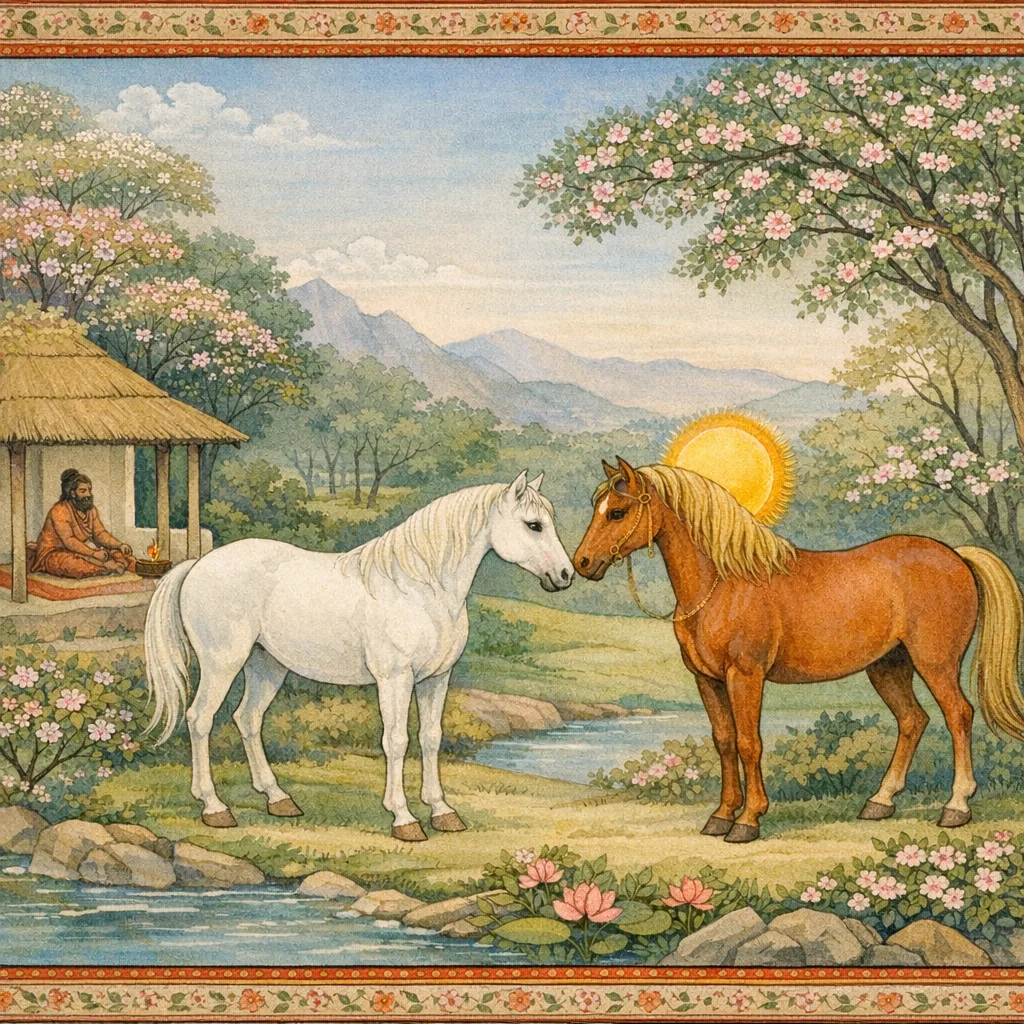
सूर्यस्य पत्नी संज्ञाभूत् तनया विश्वकर्मणः मनुर् यमो यमी चैव तदपत्यानि वै मुने
O sage, Saṃjñā—daughter of Viśvakarman—became the wife of Sūrya; and from her were born Manu, Yama, and Yamī.
Verse 3
असहन्ती तु सा भर्तुस् तेजश् छायां युयोज वै भर्तुः शुश्रूषणे ऽरण्यं स्वयं च तपसे ययौ
Unable to endure her husband’s blazing splendor, she fashioned a shadow-form—Chhāyā—to remain in her place in service to him; and she herself departed to the forest, turning to austerity.
Verse 4
संज्ञेयम् इत्य् अथार्कश् च छायायाम् आत्मजत्रयम् शनैश्चरं मनुं चान्यं तपतीं चाप्य् अजीजनत्
Then Arka, the Sun-god, begot through Chhāyā three children: Śanaiścara, another Manu, and also Tapatī. Thus the appointed lineage continued, moving in harmony with the ṛta-dharma upheld by Viṣṇu.
Verse 5
छायासंज्ञा ददौ शापं यमाय कुपिता यदा तदान्येयम् असौ बुद्धिर् इत्य् आसीद् यमसूर्ययोः
When Chāyā, bearing the name Saṃjñā, grew wrathful, she laid a curse upon Yama. From that moment Yama and the Sun understood alike: “Her mind is not truly her own; it belongs to another.”
Verse 6
ततो विवस्वान् आख्याते तयैवारण्यसंस्थिताम् समाधिदृष्ट्या ददृशे ताम् अश्वां तपसि स्थिताम्
Then Vivasvān, thus informed by her, beheld with the inner sight born of samādhi that Aśvā dwelt in the forest, steadfast and absorbed in austerity.
Verse 7
वाजिरूपधरः सो ऽपि तस्यां देवाव् अथाश्विनौ जनयाम् आस रेवन्तं रेतसो ऽन्ते च भास्करः
Assuming the form of a horse, he too drew near to her; and from her the two divine Aśvins were born. From the final issue of that seed, Bhāskara—the Sun—brought forth Revanta.
Verse 8
आनिन्ये च पुनः संज्ञां स्वस्थानं भगवान् रविः तेजसः शमनं चास्य विश्वकर्मा चकार ह
Then the blessed Ravi brought Saṃjñā back again to her rightful abode; and Viśvakarmā indeed undertook the calming and reduction of his blazing radiance.
Verse 9
भ्रमम् आरोप्य सूर्यं तु तस्य तेजोविशातनम् कृतवान् अष्टमं भागं न व्यशातयताव्ययम्
Having imposed the appointed circuit upon the Sun, he regulated the Sun’s blazing radiance—diminishing it only by an eighth part, while the imperishable essence was not impaired.
Verse 10
यत् सूर्याद् वैष्णवं तेजः शातितं विश्वकर्मणा जाज्वल्यमानम् अपतत् तद् भूमौ मुनिसत्तम
O best of sages, the Vaiṣṇava splendor that Viśvakarmā pared away from the Sun—still blazing with fierce brilliance—fell down upon the earth.
Verse 11
त्वष्टैव तेजसा तेन विष्णोश् चक्रम् अकल्पयत् त्रिशूलं चैव शर्वस्य शिबिकां धनदस्य च
Then Tvaṣṭṛ, by that very concentrated tejas, fashioned the discus of Lord Viṣṇu; likewise he wrought the trident for Śarva (Śiva) and a celestial palanquin for Dhanada (Kubera).
Verse 12
शक्तिं गुहस्य देवानाम् अन्येषां च यद् आयुधम् तत् सर्वं तेजसा तेन विश्वकर्मा व्यवर्धयत्
And the spear of Guha, along with whatever other weapons belonged to the gods, all of that Viśvakarmā augmented—empowering them by that very radiance (tejas).
Verse 13
छायासंज्ञासुतो यो ऽसौ द्वितीयः कथितो मनुः पूर्वजस्य सवर्णो ऽसौ सावर्णिस् तेन कथ्यते
That Manu who is declared as the second—born of Chāyā, the shadow-form of Saṃjñā—is of the same varṇa and nature as his predecessor; therefore he is spoken of as Sāvarṇi.
Verse 14
तस्य मन्वन्तरं ह्य् एतत् सावर्णिकम् अथाष्टमम् तच् छृणुष्व महाभाग भविष्यं कथयामि ते
This, indeed, is his Manvantara—called the Sāvarṇika, the eighth in the great sequence. Listen, O greatly fortunate one; I shall now recount to you what is yet to come.
Verse 15
सावर्णिस् तु मनुर् यो ऽसौ मैत्रेय भविता ततः सुतपाश् चामिताभाश् च मुख्याश् चापि तदा सुराः
Then, O Maitreya, that Manu shall be Sāvarṇi; and in that Manvantara the gods Sutapās, Amitābhās, and the Mukhyas—foremost among the devas—shall preside according to the sovereign order established by Lord Viṣṇu.
Verse 16
तेषां गणस् तु देवानाम् एकैको विंशकः स्मृतः सप्तर्षीन् अपि वक्ष्यामि भविष्यान् मुनिसत्तम
Each of those divine groups is remembered as consisting of twenty deities. And now, O best of sages, I shall also declare to you the Saptarishis who are yet to come.
Verse 17
दीप्तिमान् गालवो रामः कृपो द्रौणिस् तथापरः मत्पुत्रश् च तथा व्यास ऋश्यशृङ्गश् च सप्तमः
Dīptimān, Gālava, Rāma, and Kṛpa; likewise Drauṇi; then my own son; thereafter Vyāsa; and Ṛśyaśṛṅga as the seventh—these are the revered ones enumerated here.
Verse 18
विष्णुप्रसादाद् अनघः पातालान्तरगोचरः विरोचनसुतस् तेषां बलिर् इन्द्रो भविष्यति
By the grace of Lord Viṣṇu, O sinless one, Bali, son of Virocana—who moves within the regions of Pātāla—shall become Indra among them.
Verse 19
विरजाश् चार्वरीवंश् च निर्मोहाद्यास् तथापरे सावर्णेस् तु मनोः पुत्रा भविष्यन्ति नरेश्वराः
In the Sāvarṇi Manvantara, the sons of Manu—Virajā, Cārvarīvaṃśa, Nirmoha, and others—shall arise as rulers of men.
Verse 20
नवमो दक्षसावर्णिर् मैत्रेय भविता मनुः
O Maitreya, the ninth Manu shall be Dakṣa-sāvarṇi; by Vishnu’s supreme will he will rule that Manvantara and uphold the cosmic order of dharma.
Verse 21
पारा मरीचिगर्भाश् च सुधर्माणस् तथा त्रिधा भविष्यन्ति तदा देवा एकैको द्वादशो गणः
Then, in that Manvantara, the Devas will arise in distinct companies—the Pārās, the Marīcigarbhas, and likewise the Sudharmāṇas—threefold in division, each company a gaṇa of twelve.
Verse 22
तेषाम् इन्द्रो महावीर्यो भविष्यत्य् अद्भुतो द्विज
Among them, O twice-born sage, Indra will be of mighty valor, marvelous in power, destined to preside as sovereign of the gods.
Verse 23
सवनो द्युतिमान् भव्यो वसुर् मेधातिथिस् तथा ज्योतिष्मान् सप्तमः सत्यस् तत्रैते च महर्षयः
Savana, Dyutimān, Bhavya, Vasu, and Medhātithi; Jyotiṣmān as the seventh, and Satya—these are the great Ṛṣis established there, in that Manvantara.
Verse 24
धृतकेतुर् दीप्तिकेतुः पञ्चहस्तो निरामयः पृथुश्रवाद्याश् च तथा दक्षसावर्णिकात्मजाः
And among the sons of Dakṣa-sāvarṇi were Dhṛtaketu and Dīptiketu; Pañcahasta and Nirāmaya; and also Pṛthuśravā and the others—thus is the progeny of Dakṣa-sāvarṇi recounted in the ordered course of the Manvantara.
Verse 25
दशमो ब्रह्मसावर्णिर् भविष्यति मुने मनुः सुधामानो विरुद्धाश् च शतसंख्यास् तथा सुराः
O sage, the tenth Manu shall be Brahma-sāvarṇi. In his Manvantara, the gods will be the Sudhāmans and the Viruddhas, and the Suras will arise in a hundredfold host.
Verse 26
तेषाम् इन्द्रश् च भविता शान्तिर् नाम महाबलः सप्तर्षयो भविष्यन्ति ये तदा ताञ् छृणुष्व च
Among them, the Indra shall be Śānti, mighty in power. And as for the Seven Ṛṣis who will preside in that time, listen now as I declare them.
Verse 27
हविष्मान् सुकृतिः सत्यो ह्य् अपांमूर्तिस् तथापरः नाभागो ऽप्रतिमौजाश् च सत्यकेतुस् तथैव च
Then came Haviṣmān, Sukṛti, and Satya; likewise Apāṃmūrti and the next in succession. Thereafter were Nābhāga, Pratimaujā of peerless splendour, and also Satyaketu.
Verse 28
सुक्षेत्रश् चोत्तमौजाश् च भूरिषेणादयो दश ब्रह्मसावर्णिपुत्रास् तु रक्षिष्यन्ति वसुंधराम्
Sukṣetra and Uttamaujā, and Bhūriṣeṇa and the rest—ten in all—these sons of Brahma-sāvarṇi will protect the Earth.
Verse 29
एकादशश् च भविता धर्मसावर्णिको मनुः
And the eleventh Manu shall be Dharma-sāvarṇika.
Verse 30
विहंगमाः कामगमा निर्माणरुचयस् तथा गणास् त्व् एते तदा मुख्या देवानां च भविष्यताम् एकैकस् त्रिंशकस् तेषां गणश् चेन्द्रश् च वै वृषः
Then, as foremost among the gods, there shall arise the gaṇas called the Vihaṅgamas, the Kāmagamas, and the Nirmāṇarucayas. Each divine company shall be thirty in number, and their gaṇa-leader will be Indra, bearing the name Vṛṣa.
Verse 31
निश्चरश् चाग्नितेजाश् च वपुष्मान् विष्णुर् आरुणिः हविष्मान् अनघश् चैते भव्याः सप्तर्षयस् तथा
Niścara and Agnitejas; Vapuṣmān, Viṣṇu, and Āruṇi; Haviṣmān and the stainless Anagha—these are remembered as the seven seers (Saptarṣis) of the Bhavya Manvantara.
Verse 32
सर्वगः सर्वधर्मा च देवानीकादयस् तथा भविष्यन्ति मनोस् तस्य तनयाः पृथिवीश्वराः
From that Manu will arise sons—Sarvaga, Sarvadharmā, and Devānīka and others—who shall become sovereign rulers of the earth.
Verse 33
रुद्रपुत्रस् तु सावर्णिर् भविता द्वादशो मनुः ऋतधामा च तत्रेन्द्रो भविता शृणु मे सुरान्
But Sāvarṇi, the son of Rudra, will become the twelfth Manu. And in that very Manvantara, Ṛtadhāmā will be Indra—now hear from me of the gods who preside there.
Verse 34
हरिता लोहिता देवास् तथा सुमनसो द्विज सुकर्माणः सुपाराश् च दशकाः पञ्च वै गणाः
O twice-born one, the divine hosts are named Harita, Lohita, and Sumanasa; likewise Sukarmāṇa and Supārāśa. These are five gaṇas, each a company of ten.
Verse 35
तपस्वी सुतपाश् चैव तपोमूर्तिस् तपोरतिः तपोधृतिर् द्युतिश् चान्यः सप्तमस् तु तपोधनः
There were also Tapasvī and Sutapā; Tapomūrti and Taporati; Tapodhṛti and another named Dyuti—while the seventh among them was Tapodhana.
Verse 36
देववान् उपदेवश् च देवश्रेष्ठादयस् तथा मनोस् तस्य महावीर्या भविष्यन्ति सुता नृपाः
From that Manu will arise mighty sons—kings of great valor—namely Devavān and Upadeva, and also Devaśreṣṭha and others; thus will his royal progeny be established in the world’s order.
Verse 37
त्रयोदशो रौच्यनामा भविष्यति मुने मनुः
O sage, the thirteenth Manu will arise bearing the name Raucyā.
Verse 38
सुत्रामाणः सुकर्माणः सुधर्माणस् तथा सुराः त्रयस् त्रिंशद्विभेदास् ते देवानां ये तु वै गणाः
Sutrāmāṇas, Sukarmāṇas, and Sudharmāṇas—these too are divine beings. These are, indeed, the thirty-threefold divisions: the companies (gaṇas) that constitute the hosts of the gods.
Verse 39
दिवस्पतिर् महावीर्यस् तेषाम् इन्द्रो भविष्यति
Among them, Divaspati—mighty in valor—shall become their Indra, the sovereign ruler of the gods, appointed within that cosmic order upheld by Viṣṇu.
Verse 40
निर्मोहस् तत्त्वदर्शी च निष्प्रकम्पो निरुत्सुकः धृतिमान् अव्ययश् चान्यः सप्तमः सुतपा मुनिः सप्तर्षयस् त्व् इमे तस्य पुत्रान् अपि निबोध मे
(They are) Nirmoha and Tattvadarśin; Niṣprakampa and Nirutsuka; Dhṛtimān and also Avyaya; and as the seventh, the sage Sutapā. These indeed are the Seven Ṛṣis of that Manvantara; now learn from me their sons as well.
Verse 41
चित्रसेनविचित्राद्या भविष्यन्ति महीक्षितः
Thereafter, kings of the earth shall arise—beginning with Citrasena and Vicitra—who will rule in due succession.
Verse 42
भौत्यश् चतुर्दशश् चात्र मैत्रेय भविता मनुः शुचिर् इन्द्रः सुरगणास् तत्र पञ्च शृणुष्व तान्
And here, O Maitreya, in the fourteenth (and final) Manvantara, Bhautya will be the Manu. Śuci will be the Indra; and the divine hosts there will be five in number—listen as I recount them.
Verse 43
चाक्षुषाश् च पवित्राश् च कनिष्ठा भ्राजिरास् तथा वाचावृद्धाश् च वै देवाः सप्तर्षीन् अपि मे शृणु
Hear from me of the divine classes as well: the Cākṣuṣas and the Pavitras; the Kaniṣṭhas and the Bhrājiras; and likewise the Vācāvṛddhas—these indeed are the gods. And now, listen also as I recount the Seven Ṛṣis.
Verse 44
अग्निबाहुः शुचिः शुक्रो मागधो ऽग्नीध्र एव च युक्तस् तथा जितश् चान्यो मनुपुत्रान् अतः शृणु
Agnibāhu, Śuci, Śukra, Māgadha, and Agnīdhra; likewise Yukta and Jita, and others besides—now listen as I recount the sons of Manu.
Verse 45
ऊरुगम्भीरबुध्नाद्या मनोस् तस्य सुता नृपाः कथिता मुनिशार्दूल पालयिष्यन्ति ये महीम्
O tiger among sages, I have thus recounted the royal sons of that Manu—beginning with Ūrugambhīra and Budhna—who, in due course, shall protect and govern the earth.
Verse 46
चतुर्युगान्ते वेदानां जायते किल विप्लवः प्रवर्तयन्ति तान् एत्य भुवि सप्तर्षयो दिवः
At the close of the fourfold age-cycle, a disruption of the Vedas is said to arise. Then the Seven Ṛṣis descend from heaven to the earth and set the Vedas in motion again, restoring their living transmission.
Verse 47
कृते कृते स्मृतेर् विप्र प्रणेता जायते मनुः देवा यज्ञभुजस् ते तु यावन् मन्वन्तरं तु तत्
O brāhmaṇa, in each Kṛta age there arises a Manu, the authoritative promulgator of the ordinances remembered as Smṛti. The gods, enjoyers of the sacrificial offerings, endure for exactly as long as that Manvantara lasts.
Verse 48
भवन्ति ये मनोः पुत्रा यावन् मन्वन्तरं तु तैः तदन्वयोद्भवैश् चैव तावद् भूः परिपाल्यते
Those who become the sons of Manu—through them, and likewise through those born in their line—for as long as that Manvantara endures, the earth is governed and protected.
Verse 49
मनुः सप्तर्षयो देवा भूपालाश् च मनोः सुताः मन्वन्तरे भवन्त्य् एते शक्रश् चैवाधिकारिणः
In every Manvantara there come to be the Manu, the Seven Ṛṣis, the gods, the kings, and the sons of Manu; and Śakra (Indra) too is appointed to his governing office, each according to that age’s divine order.
Verse 50
चतुर्दशभिर् एतैस् तु गतैर् मन्वन्तरैर् द्विज सहस्रयुगपर्यन्तः कल्पो निःशेष उच्यते
O twice-born, when these fourteen Manvantara periods have passed, then—up to the full measure of a thousand Yuga-cycles—the Kalpa is said to be complete in its entirety.
Verse 51
तावत्प्रमाणा च निशा ततो भवति सत्तम ब्रह्मरूपधरः शेते शेषाहाव् अम्बुसंप्लवे
Of that very measure is the Night that then ensues, O best of the good. There, bearing the form of Brahmā, the Supreme lies in yogic repose upon Śeṣa, while the deluge of waters overwhelms all.
Verse 52
त्रैलोक्यम् अखिलं ग्रस्त्वा भगवान् आदिकृद् विभुः स्वमायासंस्थितो विप्र सर्वभूतो जनार्दनः
Having engulfed the entire threefold world, the Blessed Lord—the primal maker, the all-pervading Sovereign—abides established in His own māyā; O brāhmaṇa, that Janārdana is the very being within all creatures.
Verse 53
ततः प्रबुद्धो भगवान् यथा पूर्वं तथा पुनः सृष्टिं करोत्य् अव्ययात्मा कल्पे कल्पे रजोगुणः
Then the Blessed Lord, re-awakened, creates the universe once again—just as before. Though His Self is imperishable and unchanged, in every kalpa He presides through the rajo-guṇa, setting creation into motion anew.
Verse 54
मनवो भूभुजः सेन्द्रा देवाः सप्तर्षयस् तथा सात्त्विको ऽंशः स्थितिकरो जगतो द्विजसत्तम
The Manus; the kings who rule the earth; the gods together with Indra; and likewise the Seven Sages—O best of twice-born—these are the sāttvika manifestations through whom the stability and orderly continuance of the world is maintained.
Verse 55
चतुर्युगे ऽप्य् असौ विष्णुः स्थितिव्यापारलक्षणः युगव्यवस्थां कुरुते यथा मैत्रेय तच् छृणु
Even through the cycle of the four Yugas, that very Viṣṇu—whose essential work is the sustaining governance of existence—ordains the proper arrangement of the ages. Hear, O Maitreya, how He establishes the order of the Yugas.
Verse 56
कृते युगे परं ज्ञानं कपिलादिस्वरूपधृक् ददाति सर्वभूतात्मा सर्वभूतहिते रतः
In the Kṛta Yuga, the Supreme Self—who is the very soul of all beings—bestows the highest knowledge, assuming forms such as Kapila; ever intent on the welfare of every creature, He teaches for the good of the whole world.
Verse 57
चक्रवर्तिस्वरूपेण त्रेतायाम् अपि स प्रभुः दुष्टानां निग्रहं कुर्वन् परिपाति जगत्त्रयम्
Even in the Tretā Yuga, that Supreme Lord—assuming the form of a universal sovereign (cakravartin)—restrains the wicked; and by curbing wrongdoing, He safeguards the three worlds.
Verse 58
वेदम् एकं चतुर्भेदं कृत्वा शाखाशतैर् विभुः करोति बहुलं भूयो वेदव्यासस्वरूपधृक्
The all-pervading Lord—again assuming the form of Vedavyāsa—takes the single Veda and divides it into four; and then, through hundreds of branches (śākhās), He makes that sacred knowledge expansive and widely accessible once more.
Verse 59
वेदांस् तु द्वापरे व्यस्य कलेर् अन्ते पुनर् हरिः कल्किस्वरूपी दुर्वृत्तान् मार्गे स्थापयति प्रभुः
In the Dvāpara age, having divided and arranged the Vedas, Hari again—at the end of Kali—assumes the form of Kalki; and the Lord sets the wicked back upon the path of righteousness.
Verse 60
एवम् एष जगत् सर्वं परिपाति करोति च हन्ति चान्तेष्व् अनन्तात्मा नास्त्य् अस्माद् व्यतिरेकि यत्
Thus the Infinite Self protects this entire universe, sets it into activity, and at the end of time withdraws it again; there is nothing whatsoever apart from Him.
Verse 61
भूतं भव्यं भविष्यं च सर्वभूतान् महात्मनः तद् अत्रान्यत्र वा विप्र सद्भावः कथितस् तव
The past, the present, and the future—indeed the whole condition of all beings—abides in that Great-Souled Lord; whether here or elsewhere, O brāhmaṇa, His true nature has been declared to you.
Verse 62
मन्वन्तराण्य् अशेषाणि कथितानि मया तव मन्वन्तराधिपांश् चैव किम् अन्यत् कथयामि ते
I have told you in full of all the Manvantaras, and also of the sovereign regents who preside over them; what more, then, shall I relate to you?
Frequently Asked Questions
The eighth Manu is Sāvarṇi, born of Chāyā. He is called Sāvarṇi because he is ‘of the same varṇa/nature’ as his predecessor in the solar line, hence ‘similar in kind’ (sa-varṇa).
When Viśvakarmā reduces the Sun’s radiance by an eighth, the pared Vaiṣṇava tejas falls to earth; using that concentrated splendor, Tvaṣṭṛ fashions Viṣṇu’s cakra (and also weapons for other deities).
A kalpa is described as complete when the fourteen Manvantaras have passed, reaching the full measure associated with a thousand yuga-cycles; an equally long night follows, with dissolution, before creation resumes.