जलंधरयुद्धे मायाप्रयोगः — Jalandhara’s Māyā in the Battle with Śiva
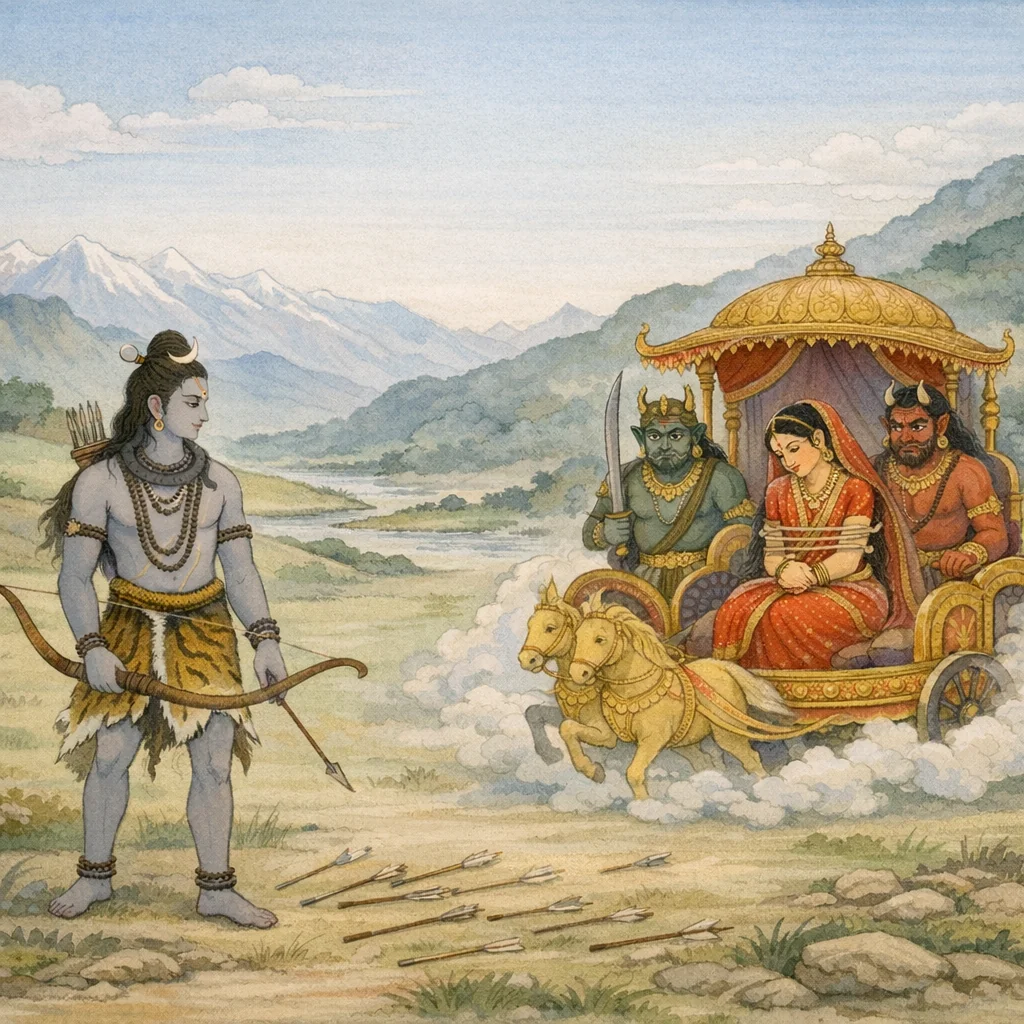
Adhyāya 24 continues the Jalaṃdhara–Śiva battle in a dialogic frame: Vyāsa asks Sanatkumāra what happened next and how the daitya would be overcome. As the fight resumes, Śiva (Vṛṣadhvaja/Tryambaka) notices Girijā is no longer visible and understands it as a māyā-born disappearance. Though omnipotent, he assumes a “laukikī gati” (worldly posture), showing anger and astonishment as part of līlā. Jalaṃdhara showers arrows, but Śiva effortlessly cuts them down, displaying Rudra’s superior martial and cosmic power. Jalaṃdhara then escalates with illusion, creating a vision of Gaurī bound and weeping on a chariot, as if held by demonic figures (Śuṃbha/Niśuṃbha), to shake Śiva’s focus and resolve. Śiva’s response is rendered psychologically—silence, downcast face, slackened limbs, a momentary seeming forgetfulness of his own might—highlighting māyā as both test and dramatic device. The chapter ends with Jalaṃdhara striking Śiva with many arrows in the head, chest, and abdomen, setting up the next sequence where the illusion’s purpose and theological meaning are further clarified.
Shlokas
Verse 1
व्यास उवाच । विधेः श्रेष्ठसुत प्राज्ञः कथेयं श्राविताद्भुता । ततश्च किमभूदाजौ कथं दैत्यो हतो वद
Vyāsa said: O wise and excellent son of the Creator (Brahmā), you have recounted this wondrous narrative. Now tell me—what then happened in the battle, and in what manner was the demon slain?
Verse 2
सनत्कुमार उवाच । अदृश्य गिरिजां तत्र दैत्येन्द्रे रणमागते । गांधर्वे च विलीने हि चैतन्योऽभूद्वृषध्वजः
Sanatkumāra said: When Girijā (Pārvatī) was no longer seen there, and when the lord of the Dānavas had come to the battle—then indeed, as the Gandharva dissolved and vanished, Vṛṣadhvaja (Śiva, whose banner bears the bull) became fully conscious and alert.
Verse 3
अंतर्धानगतां मायां दृष्ट्वा बुद्धो हि शंकरः । चुक्रोधातीव संहारी लौकिकीं गतिमाश्रितः
Seeing Māyā vanish into concealment, Śaṅkara understood the matter clearly; then the great Dissolver, Lord of saṃhāra, grew intensely wrathful, assuming a worldly mode of action for the sake of the battle.
Verse 4
ततश्शिवो विस्मितमानसः पुनर्जगाम युद्धाय जलंधरं रुषा । स चापि दैत्यः पुनरागतं शिवं दृष्ट्वा शरोघैस्समवाकिरद्रणे
Then Śiva, his mind filled with astonishment, once again advanced in wrath to battle Jalandhara. And that demon too—seeing Śiva return—showered him in the battlefield with torrents of arrows.
Verse 5
क्षिप्तं प्रभुस्तं शरजालमुग्रं जलंधरेणातिबलीयसा हरः । प्रचिच्छेद शरैर्वरैर्निजैर्नचित्रमत्र त्रिभवप्रहंतुः
Then Hara, the Lord, cut to pieces with His own excellent arrows that fierce net of missiles hurled by the exceedingly mighty Jalandhara. This is no wonder at all—for He is the destroyer of the three worlds.
Verse 6
ततो जलंधरो दृष्ट्वा रुद्र्मद्भुतविक्रमम् । चकार मायया गौरीं त्र्यम्बकं मोहयन्निव
Then Jalandhara, beholding Rudra’s wondrous prowess, employed his māyā and conjured the semblance of Gaurī, as though to delude Tryambaka (Śiva) Himself.
Verse 7
रथोपरि गतां बद्धां रुदंतीं पार्वतीं शिवः । निशुंभ शुंभदैत्यैश्च बध्यमानां ददर्श सः
Seated upon the chariot, bound and weeping, Pārvatī was seen by Lord Śiva—being seized and restrained by the demons Niśumbha and Śumbha.
Verse 8
गौरीं तथाविधां दृष्ट्वा लौकिकीं दर्शयन्गतिम् । बभूव प्राकृत इव शिवोप्युद्विग्नमानसः
Seeing Gaurī in that condition, displaying an ordinary, worldly demeanor, even Lord Śiva—though the Supreme—became as if a common man, his mind troubled with concern.
Verse 9
अवाङ्मुखस्थितस्तूष्णीं नानालीलाविशारदः । शिथिलांगो विषण्णात्मा विस्मृत्य स्वपराक्रमम्
Though skilled in many stratagems and displays, he stood with his face cast down, silent. His limbs slack and his heart dejected, he seemed to have forgotten his own valor.
Verse 10
ततो जलंधरो वेगात्त्रिभिर्विव्याध सायकैः । आपुंखमग्नैस्तं रुद्रं शिरस्युरसि चोदरे
Then Jalandhara, rushing forward with force, pierced Rudra with three arrows—driven in up to the feathers—striking him in the head, the chest, and the belly.
Verse 11
ततो रुद्रो महालीलो ज्ञानतत्त्वः क्षणात्प्रभुः । रौद्ररूपधरो जातो ज्वालामालातिभीषणः
Then Rudra—the Lord of mighty divine play, the very principle of spiritual knowledge—instantly manifested in a fierce form, terrifying with garlands of blazing flames.
Verse 12
तस्यातीव महारौद्ररूपं दृष्ट्वा महासुराः । न शेकुः प्रमुखे स्थातुं भेजिरे ते दिशो दश
Beholding His exceedingly terrible, supremely wrathful form, the great asuras could not stand before Him; they fled and took to the ten directions.
Verse 13
निशुंभशुंभावपि यौ विख्यातौ वीरसत्तमौ । आपे तौ शेकतुर्नैव रणे स्थातुं मुनीश्वर
O best of sages, even Niśumbha and Śumbha—renowned as the foremost among heroes—were seized with fear, and they were unable to stand firm in the battle.
Verse 14
जलंधरकृता मायांतर्हिताभूच्च तत्क्षणम् । हाहाकारो महानासीत्संग्रामे सर्वतोमुखे
At that very moment, the illusion wrought by Jalandhara caused concealment and disappearance. In that battle—facing every side—there arose a great cry of alarm and confusion.
Verse 15
ततश्शापं ददौ रुद्रस्तयोश्शुंभनिशुंभयोः । पलायमानौ तौ दृष्ट्वा धिक्कृत्य क्रोधसंयुतः
Then Rudra hurled a curse upon those two—Śumbha and Niśumbha. Seeing them flee, He rebuked them with contempt, and, inflamed with wrath, pronounced His judgment.
Verse 16
रुद्र उवाच । युवां दुष्टावतिखलावपराधकरौ मम । पार्वतीदंडदातारौ रणादस्मात्पराङ्मुखौ
Rudra said: “You two are wicked and utterly depraved, offenders against Me. You are fit to receive punishment at Pārvatī’s hands; therefore turn your faces away and withdraw from this battle.”
Verse 17
पराङ्मुखो न हंतव्य इति वध्यौ न मे युवाम् । मम युद्धादतिक्रांतौ गौर्य्या वध्यौ भविष्यतः
“One who has turned away should not be struck”—therefore you two are not to be slain by me. But since you have transgressed the bounds of my battle, you shall become fit to be slain by Gaurī.
Verse 18
एवं वदति गौरीशे सिन्धुपुत्रो जलंधरः । चुक्रोधातीव रुद्राय ज्वलज्ज्वलनसन्निभः
As he spoke thus to Gaurī’s Lord, Jalandhara—the son of the ocean—grew exceedingly wrathful toward Rudra, blazing like a fiercely kindled fire.
Verse 19
रुद्रे रणे महावेगाद्ववर्ष निशिताञ्छरान् । बाणांधकारसंछन्नं तथा भूमितलं ह्यभूत्
In the battle, Rudra, with tremendous force, rained down sharp arrows; and the earth’s surface was covered, as though by a darkness made of arrows.
Verse 20
यावद्रुद्रः प्रचिच्छेद तस्य बाणगणान्द्रुतम् । तावत्सपरिघेणाशु जघान वृषभं बली
As long as Rudra swiftly kept cutting down the volleys of arrows shot by that mighty one, so long did the powerful warrior quickly strike the bull (Vṛṣa) with his iron club.
Verse 21
वृषस्तेन प्रहारेण परवृत्तो रणांगणात् । रुद्रेण कृश्यमाणोऽपि न तस्थौ रणभूमिषु
Struck by that blow upon the bull (Vṛṣa), he turned back from the battlefield; and though being worn down by Rudra, he could not hold his ground anywhere on the field of war.
Verse 22
अथ लोके महारुद्रस्स्वीयं तेजोऽतिदुस्सहम् । दर्शयामास सर्वस्मै सत्यमेतन्मुनीश्वर
Then, in the midst of the worlds, Mahārudra revealed to everyone His own radiance—utterly irresistible to behold. This indeed is the truth, O lord among sages.
Verse 23
ततः परमसंक्रुद्धो रुद्रो रौद्रवपुर्धरः । प्रलयानलवद्धोरो बभूव सहसा प्रभुः
Then Rudra, the Lord, becoming supremely enraged, assumed a fierce Rudra-form; suddenly he appeared terrifying—like the fire of cosmic dissolution—manifesting his saguna might to subdue adharma.
Verse 24
इति श्रीशिवमहापुराणे द्वितीयायां रुद्रसंहितायां पञ्चमे युद्धखण्डे जलंधरवर्णनं नाम चतुर्विशोऽध्यायः
Thus ends the twenty-fourth chapter, called “The Description of Jalandhara,” in the fifth section, the Yuddha-khaṇḍa, of the second compilation (Rudra-saṃhitā) of the glorious Śiva Mahāpurāṇa.
Verse 25
ब्रह्मणो वचनं रक्षन्रक्षको जगतां प्रभुः । हृदानुग्रहमातन्वंस्तद्वधाय मनो दधत्
Honouring Brahmā’s command, the Lord—the Protector of the worlds—unfolded gracious favour from within His heart and set His mind upon the slaying of that foe.
Verse 26
कोपं कृत्वा परं शूली पादांगुष्ठेन लीलया । महांभसि चकाराशु रथांगं रौद्रमद्भुतम्
Then the Trident-bearing Lord, assuming intense wrath, playfully with the great toe of His foot, swiftly fashioned in the vast waters a wondrous, terrifying discus-like weapon.
Verse 27
कृत्वार्णवांभसि शितं भगवान्रथांगं स्मृत्वा जगत्त्रयमनेन हतं पुरारिः । दक्षान्धकांतकपुरत्रययज्ञहंता लोकत्रयांतककरः प्रहसन्नुवाच
Having sharpened his discus in the waters of the ocean, the Blessed Lord—Śiva, foe of the cities—remembered how by this very weapon the three worlds had once been subdued. The destroyer of Dakṣa’s sacrifice, the slayer of Andhaka, the annihilator of the three cities, he who can bring the three worlds to their end—smiling, he spoke.
Verse 28
महारुद्र उवाच । पादेन निर्मितं चक्रं जलंधर महाम्भसि । बलवान्यदि चोद्धर्त्तुं तिष्ठ योद्धुं न चान्यथा
Mahārudra said: “O Jalandhara, in the midst of these great waters I have fashioned a discus with my foot. If you are truly strong enough to lift it, then stand and fight—there is no other way.”
Verse 29
सनत्कुमार उवाच । तस्य तद्वचनं श्रुत्वा क्रोधेनादीप्तलोचनः । प्रदहन्निव चक्षुर्भ्यां प्राहालोक्य स शंकरम्
Sanatkumāra said: Hearing those words, he blazed with anger, his eyes aflame; as though burning with his gaze, he looked upon Śaṅkara and spoke.
Verse 30
जलंधर उवाच । रेखामुद्धृत्य हत्वा च सगणं त्वां हि शंकर । हत्वा लोकान्सुरैस्सार्द्धं स्वभागं गरुडो यथा
Jalandhara said: “O Śaṅkara, after drawing the boundary line and slaying you together with your attendants, I shall also destroy the worlds along with the gods, and seize my rightful share—just as Garuḍa takes his own portion.”
Verse 32
हंतुं चराचरं सर्वं समर्थोऽहं सवासवम् । को महेश्वर मद्बाणैरभेद्यो भुवनत्रये । बालभावेन भगवांतपसैव विनिर्जितः । ब्रह्मा बलिष्ठः स्थाने मे मुनिभिस्सुरपुंगवैः
“I am capable of destroying all that moves and all that is unmoving—even along with Indra and the gods. O Maheśvara, who in the three worlds is not pierceable by my arrows? Indeed, even the Lord (Brahmā) was subdued by my austerity, as though by a mere childish sport. Brahmā, though deemed the strongest, stands in his place because of me—(supported as he is) by sages and the foremost of the gods.”
Verse 33
दग्धं क्षणेन सकलं त्रैलोक्यं सचराचरम् । तपसा किं त्वया रुद्र निर्जितो भगवानपि
“In a single moment the whole of the three worlds—moving and unmoving—has been burned. O Rudra, what austerity have you performed, that even the Blessed Lord has been overpowered by you?”
Verse 34
इन्द्राग्नियमवित्तेशवायुवारीश्वरादयः । न सेहिरे यथा नागा गंधं पक्षिपतेरिव
Indra, Agni, Yama, Kubera the Lord of wealth, Vāyu, Varuṇa, Īśvara and the other gods could not endure it—just as serpents cannot bear a fragrance, as though it were cast by Garuḍa, lord of birds.
Verse 35
न लब्धं दिवि भूमौ च वाहनं मम शंकर । समस्तान्पर्वतान्प्राप्य धर्षिताश्च गणेश्वराः
“O Śaṅkara, neither in heaven nor on earth have I found a mount for myself. Though I reached all the mountains, even the lords of the Gaṇas have been driven back and put to shame.”
Verse 36
गिरीन्द्रो मन्दरः श्रीमान्नीलो मेरुस्सुशोभनः । धर्षितो बाहुदण्डेन कण्डा उत्सर्पणाय मे
Even Mandara—the lord of mountains—together with glorious Nīla and the splendid Meru, has been struck by the force of my arm; therefore, may this swelling be driven away from me.
Verse 37
गंगा निरुद्धा बाहुभ्यां लीलार्थं हिमवद्गिरौ । अरोणां मम भृत्यैश्च जयो लब्धो दिवौकसात्
“For sport, upon Mount Himavat, I held back the Gaṅgā with my two arms; and by my servants the host of Aruṇa was subdued—thus victory was won over the dwellers in heaven, the Devas.”
Verse 38
वडवाया मुखं बद्धं गृहीत्वा तां करेण तु । तत्क्षणादेव सकलमेकार्णवमभूत्तदा
Seizing her with his hand and restraining the mouth of the mare-faced one, at that very instant everything became a single ocean.
Verse 39
ऐरावतादयो नागाः क्षिप्ताः सिन्धुजलोपरि । सरथो भगवानिन्द्रः क्षिप्तश्च शतयोजनम्
Airāvata and the other mighty elephants were hurled upon the waters of the ocean; and Indra himself—still with his chariot—was flung a hundred yojanas away.
Verse 40
गरुडोऽपि मया बद्धो नागपाशेन विष्णुना । उर्वश्याद्या मयानीता नार्यः कारागृहांतरम्
Even Garuḍa was bound by me with the Nāga-pāśa, the serpent-noose, though he is protected by Viṣṇu. And Urvaśī and the other celestial women were carried off by me into the inner chambers of my prison.
Verse 41
मां न जानासि रुद्र त्वं त्रैलोक्यजयकारिणाम् । जलंधरं महादैत्यं सिंधुपुत्रं महाबलम्
O Rudra, do you not recognize me? I am Jalandhara, the great asura, son of the Ocean, of mighty strength—he who brings about the conquest of the three worlds.
Verse 42
सनत्कुमार उवाच । इत्युक्त्वाथ महादेवं तदा वारिधिनन्दनः । न चचाल न सस्मार निहतान्दानवान्युधि
Sanatkumāra said: Having thus addressed Mahādeva, the Ocean-born one then became utterly unmoved—he neither stirred nor even recollected anything else—as the Dānavas lay slain in the battle.
Verse 43
दुर्मदेनाविनीतेन दोर्भ्यामास्फोट्य दोर्बलात् । तिरस्कृतो महादेवो वचनैः कटुकाक्षरैः
Blinded by wicked pride and devoid of humility, he struck his own arms in arrogant display; and with harsh, bitter words he insulted Mahādeva.
Verse 44
तच्छ्रुत्वा दैत्यवचनममंगलमतीरितम् । विजहास महादेवाः परमं क्रोधमादधे
Hearing those words of the demon—spoken with an inauspicious intent—Mahādeva laughed; yet, in that very moment, He assumed supreme wrath.
Verse 45
सुदर्शनाख्यं यच्चक्रं पदांगुष्ठविनिर्मितम् । जग्राह तत्करे रुद्रस्तेन हंतुं समुद्यतः
Then Rudra seized in His hand that discus named Sudarśana, fashioned from the great toe of the foot, and, raising it up, He prepared to strike down His foe.
Verse 46
सुदर्शनाख्यं तच्चक्रं चिक्षेप भगवान्हरः । कोटिसूर्यप्रतीकाशं प्रलयानलसन्निभम्
Then the Blessed Lord Hara hurled that discus renowned as Sudarśana—radiant like ten million suns, and resembling the blazing fire that rises at the time of cosmic dissolution.
Verse 47
प्रदहद्रोदसी वेगात्तदासाद्य जलंधरम् । जहार तच्छिरो वेगान्महदायतलोचनम्
Surging forth with blazing force, as though scorching the very two worlds, he reached Jalandhara and, in that same momentum, swiftly carried off his head—the one with the large, wide eyes.
Verse 48
रथात्कायः पपातोर्व्यां नादयन्वसुधातलम् । शिरश्चाप्यब्धिपुत्रस्य हाहाकारो महानभूत्
The body fell from the chariot onto the earth, making the ground resound. The head, too, of the Ocean’s son fell—whereupon a great cry of lamentation arose.
Verse 49
द्विधा पपात तद्देहो ह्यंजनाद्रिरिवाचलः । कुलिशेन यथा वारांनिधौ गिरिवरो द्विधा
Then that body fell apart into two, unmoving like Mount Añjana—just as a great mountain is split in two by Indra’s thunderbolt in the midst of the ocean.
Verse 50
तस्य रौद्रेण रक्तेन सम्पूर्णमभवज्जगत् । ततस्समस्ता पृथिवी विकृताभून्मुनीश्वर
By his fierce, Rudra-like blood, the entire world became filled. Thereupon, O lord among sages, the whole earth was thrown into a distorted, unnatural state.
Verse 51
तद्रक्तमखिलं रुद्रनियोगान्मांसमेव च । महारौरवमासाद्य रक्तकुंडमभूदिह
By Rudra’s very ordinance, all that blood—and the flesh as well—fell into the great Raurava (hell); and thus, in this very episode, it became the dreadful “pit of blood.”
Verse 52
तत्तेजो निर्गतं देहाद्रुद्रे च लयमागमत् । वृन्दादेहोद्भवं यद्वद्गौर्य्यां हि विलयं गतम्
That radiance departed from the body and entered into Rudra, attaining dissolution in Him—just as the manifestation that had arisen from Vṛndā’s body ultimately merged and was absorbed into Gaurī.
Verse 53
जलंधरं हतं दृष्ट्वा देवगन्धर्वपन्नगाः । अभवन्सुप्रसन्नाश्च साधु देवेति चाब्रुवन्
Seeing Jalandhara slain, the Devas, Gandharvas, and Nāgas were filled with great joy and cried out, “Well done, O Lord!”
Verse 54
सर्वे प्रसन्नतां याता देवसिद्धमुनीश्वराः । पुष्पवृष्टिं प्रकुर्वाणास्तद्यशो जगुरुच्चकैः
All the gods, the Siddhas, and the great sage-lords were filled with joy. Showering flowers, they sang aloud the glory of Him (the Lord) and of that victorious deed.
Verse 55
देवांगना महामोदान्ननृतुः प्रेमविह्वलाः । कलस्वराः कलपदं किन्नरैस्सह संजगुः
Overjoyed, the celestial maidens danced, overwhelmed with love; and, with sweet voices and graceful rhythms, they sang melodiously together with the Kinnaras.
Verse 56
दिशः प्रसेदुस्सर्वाश्च हते वृन्दापतौ मुने । ववुः पुण्यास्सुखस्पर्शा वायवस्त्रिविधा अपि
O sage, when Vṛndā’s lord was slain, all the directions became serene. Even the winds—of three kinds—began to blow, holy and gentle to the touch, as though nature itself had returned to auspiciousness after hostility to dharma was removed.
Verse 57
चन्द्रमाः शीततां यातो रविस्तेपे सुतेजसा । अग्नयो जज्वलुश्शांता बभूव विकृतं नभः
The moon lost its cooling nature, and the sun scorched with its own fierce radiance. Even fires that had been quiet blazed up, and the very sky became distorted—an ominous upheaval of the cosmos in that battle.
Verse 58
एवं त्रैलोक्यमखिलं स्वास्थ्यमापाधिकं मुने । हतेऽब्धितनये तस्मिन्हरेणानतमूर्तिना
Thus, O sage, the entire threefold world attained an even greater well-being, when that son of the Ocean was slain by Hari, whose form is bowed to by all.
Frequently Asked Questions
The renewed Śiva–Jalaṃdhara battle, where Jalaṃdhara deploys māyā to create a deceptive vision of Gaurī/Pārvatī bound and distressed, aiming to unsettle Śiva during combat.
It signals līlā: the text portrays Śiva momentarily mirroring human affect (anger, shock, grief) to dramatize māyā’s reach and to teach that even overwhelming illusion functions within divine governance, not outside it.
Śiva is presented as Vṛṣadhvaja and Tryambaka, and as Rudra the world-destroyer (saṃhārī), emphasizing both royal-warrior iconography and cosmic authority within the battle narrative.