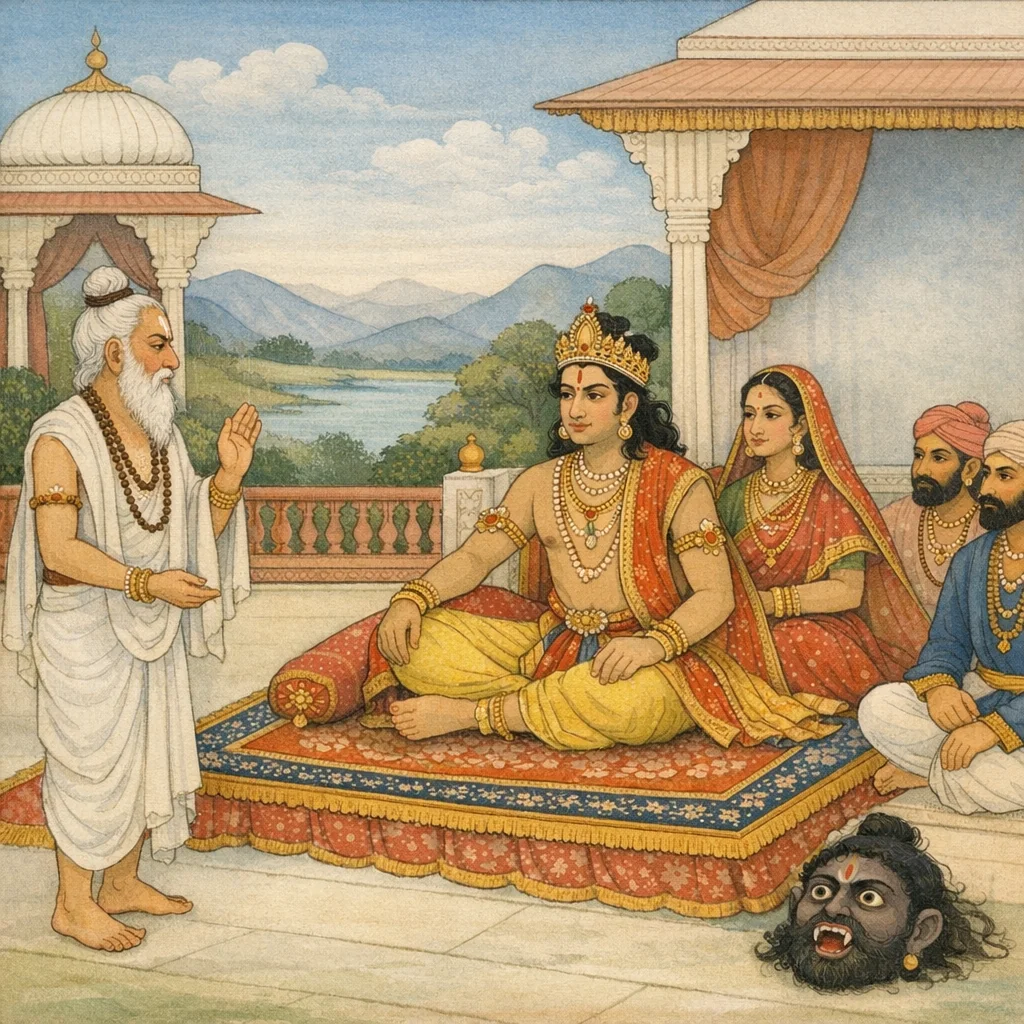
राहोः शिरच्छेदन-कारणकथनम् / The Account of Rāhu’s Beheading (Cause and Background)
Adhyāya 15 opens in Jalandhara’s royal court: the ocean-born asura-king sits with his queen and the assembled asuras when Śukra (Bhārgava), radiant like embodied splendor, arrives and is duly honored. Confident in the authority granted by his boon, Jalandhara notices Rāhu present in a beheaded state (chinna-śiras) and at once asks Śukra who caused this severing and what the full truth of the event is. Śukra, after inwardly invoking Śiva’s lotus-feet, begins a structured, itihāsa-like retrospective, starting from earlier asura history—such as Bali, son of Virocana and descendant of Hiraṇyakaśipu—thereby placing Rāhu’s condition within a wider causal genealogy of deva–asura encounters and the moral law of deception, merit, and retribution. The chapter thus serves as a courtly inquiry that turns into didactic narration: the guru explains an anomalous bodily state, legitimizes present politico-religious choices in Jalandhara’s court, and foreshadows conflicts to come.
Shlokas
Verse 1
सनत्कुमार उवाच । एकदा वारिधिसुतो वृन्दापति रुदारधीः । सभार्य्यस्संस्थितो वीरोऽसुरैस्सर्वैः समन्वितः
Sanatkumāra said: Once, the heroic son of Varidhi—Vṛndāpati, fierce in intent—stood prepared for action, together with his wife and accompanied by all the asuras.
Verse 2
तत्राजगाम सुप्रीतस्सुवर्चास्त्वथ भार्गवः । तेजः पुंजो मूर्त इव भासयन्सकला दिशः
Then the Bhārgava, the sage of the Bhṛgu lineage, arrived there exceedingly delighted and radiant, shining like a visible embodiment of concentrated splendor, illuminating all the directions.
Verse 3
तं दृष्ट्वा गुरुमायान्तमसुरास्तेऽखिला द्रुतम् । प्रणेमुः प्रीतमनसस्सिंधुपुत्रोऽपि सादरम्
Seeing their preceptor approaching, all those asuras quickly bowed down with delighted hearts; and the son of Sindhu too, with due reverence, offered salutations.
Verse 4
दत्त्वाशीर्वचनं तेभ्यो भार्गवस्तेजसां निधिः । निषसादासने रम्ये संतस्थुस्तेऽपि पूर्ववत्
Having bestowed words of blessing upon them, the Bhārgava—an inexhaustible treasury of spiritual radiance—sat down upon a delightful seat; and they too stood there again, just as before.
Verse 5
अथ सिंध्वात्मजो वीरो दृष्ट्वा प्रीत्या निजां सभाम् । जलंधरः प्रसन्नोऽभूदनष्टवरशासनः
Then Jalandhara, the heroic son of Sindhu, beheld his own assembly with delight and was well pleased, standing firm in the authority of the boon that could not be thwarted.
Verse 6
तत्स्थितं छिन्नशिरसं दृष्ट्वा राहुं स दैत्यराट् । पप्रच्छ भार्गवं शीघ्रमिदं सागरनन्दनः
Seeing Rāhu standing there with his head severed, the lord of the Daityas—Sāgara’s son—quickly questioned Bhārgava (Śukra) as to what this was.
Verse 7
जलंधर उवाच । केनेदं विहितं राहोश्शिरच्छेदनकं प्रभो । तद्ब्रूहि निखिलं वृत्तं यथावत्तत्त्वतो गुरो
Jalandhara said: “O Lord, by whom was this ordained—the severing of Rāhu’s head? O Master, tell me the entire account, correctly and in accordance with the truth, O Guru.”
Verse 8
सनत्कुमार उवाच । इत्याकर्ण्य वचस्तस्य सिन्धुपुत्रस्य भार्गवः । स्मृत्वा शिवपदांभोजं प्रत्युवाच यथार्थवत्
Sanatkumāra said: Hearing those words of the son of Sindhu, Bhārgava, remembering the lotus-feet of Lord Śiva, replied with what was true and fitting.
Verse 9
शुक्र उवाच । जलंधर महावीर सर्वासुरसहायक । शृणु वृत्तांतमखिलं यथावत्कथयामि ते
Śukra said: “O Jalandhara, great hero and supporter of all the Asuras—listen. I shall tell you the entire account, exactly as it happened.”
Verse 10
पुराभवद्बलिर्वीरो विरोचनसुतो बली । हिरण्यकशिपोश्चैव प्रपौत्रो धर्मवित्तमः
In former times there was the heroic Bali—mighty, the son of Virocana—indeed the great-grandson of Hiraṇyakaśipu, and foremost among those who knew dharma.
Verse 11
पराजितास्सुरास्तेन रमेशं शरणं ययुः । सवासवास्स्ववृत्तांतमाचख्युः स्वार्थसाधकाः
Defeated by him, the Asuras went for refuge to Rameśa. Along with the Vasus and the Ādityas, they reported the entire account of what had occurred—seeking the fulfillment of their own aims.
Verse 12
तदाज्ञया सुरैः सार्द्धं चक्रुस्संधिमथो सुराः । स्वकार्यसिद्धये तातच्छलकर्मविचक्षणाः
Obeying his command, the gods then made a treaty together with the devas. O dear one, skilled in strategic deception, they did so in order to accomplish their own objective.
Verse 13
अथामृतार्थे सिंधोश्च मंथनं चक्रुरादरात् । विष्णोस्सहायिनस्ते हि सुरास्सर्वेऽसुरैस्सह
Then, to obtain amṛta—the nectar of immortality—they zealously and reverently undertook the churning of the Ocean. Indeed, all the Devas, aided by Viṣṇu, performed it together with the Asuras.
Verse 14
ततो रत्नोपहरणमकार्षुर्दैत्यशत्रवः । जगृहुर्यत्नतो देवाः पपुरप्यमृतं छलात्
Then the gods—foes of the Daityas—carefully carried off the precious jewels; and, by a strategic ruse, they also drank amṛta, the nectar of immortality.
Verse 15
ततः पराभवं चक्रुरसुराणां सहायतः । विष्णोस्सुरास्सचक्रास्तेऽमृतापानाद्बलान्विताः
Then, supported by their allies, the Devas brought about the defeat of the Asuras. Strengthened by drinking amṛta, they fought under Viṣṇu, armed with the discus, and prevailed.
Verse 16
शिरश्छेदं चकारासौ पिबतश्चामृतं हरिः । राहोर्देवसभां हि पक्षपाती हरेस्सदा
Hari (Viṣṇu), even as Rāhu was drinking amṛta, cut off his head. Indeed, in the assembly of the gods, Hari ever takes the side of the Devas against Rāhu.
Verse 17
सनत्कुम्रार उवाच । एवं कविस्तस्य शिरश्छेदं राहोश्शशंस च । अमृतार्थे समुद्रस्य मंथनं देवकारितम्
Sanatkumāra said: “Thus did Kavi recount the severing of Rāhu’s head. And for the sake of obtaining amṛta, the Devas caused the churning of the Ocean to be undertaken.”
Verse 18
रत्नोपहरणं चैव दैत्यानां च पराभवम् । देवैरमृतपानं च कृतं सर्वं च विस्तरात्
He narrated in full detail how the jewels were seized, how the Daityas were defeated, and how the Devas drank the nectar of immortality.
Verse 19
तदाकर्ण्य महावीरोम्बुधिबालः प्रतापवान् । चुक्रोध क्रोधरक्ताक्षस्स्वपितुर्मंथनं तदा
Hearing that, the mighty and valiant Ambudhibāla became enraged; his eyes reddened with wrath, and then he set about inciting his own father.
Verse 20
अथ दूतं समाहूय घस्मराभिधमुत्तमम् । सर्वं शशंस चरितं यदाह गुरुरात्मवान्
Then, summoning the excellent messenger named Ghasmara, he related in full the entire course of events—exactly as his wise and self-possessed guru had instructed.
Verse 21
अथ तं प्रेषयामास स्वदूतं शक्रसन्निधौ । संमान्य बहुशः प्रीत्याऽभयं दत्त्वा विशारदम्
Then he dispatched his own messenger to the presence of Śakra (Indra). Honouring him repeatedly with affection, he granted him assurance of safety and sent that skilled envoy forth.
Verse 22
दूतस्त्रिविष्टपं तस्य जगामारमलं सुधीः । घस्मरोंऽबुधिबालस्य सर्वदेवसमन्वितम्
Then that wise and pure messenger went to his Triviṣṭapa (heaven)—a spotless celestial realm—accompanied by all the gods, to the presence of Ghasmara, the childish one of immature understanding.
Verse 23
तत्र गत्वा स दूतस्तु सुधर्मां प्राप्य सत्वरम् । गर्वादखर्वमौलिर्हि देवेन्द्रं वाक्यमब्रवीत्
Having gone there, the messenger quickly reached Sudharmā. Then, with pride—his head held high—he spoke these words to Devendra (Indra).
Verse 24
घस्मर उवाच । जलंधरोऽब्धि तनयस्सर्वदैत्यजनेश्वरः । सुप्रतापी महावीरस्स्वयं कविसहायवान्
Ghasmara said: “Jalandhara, the son of the Ocean, is the sovereign of all the hosts of the Daityas. Mighty in prowess, a great hero, he is upheld by Kavi himself.”
Verse 25
दूतोऽहं तस्य वीरस्य घस्मराख्यो न घस्मरः । प्रेषितस्तेन वीरेण त्वत्सकाशमिहागतः
“I am the messenger of that hero—named Ghasmara, not a mere devourer. Sent by that valiant one, I have come here into your presence.”
Verse 26
अव्याहताज्ञस्वर्वत्र जलंधर उदग्रधीः । निर्जिताखिलदैत्यारिस्स यदाह शृणुष्व तत्
Listen to what Jalandhara said—his command was unimpeded everywhere, his intellect fierce and resolute, and he had conquered all the enemies of the Daityas.
Verse 27
जलंधर उवाच । कस्मात्त्वया मम पिता मथितस्सागरोऽद्रिणा । नीतानि सर्वरत्नानि पितुर्मे देवताधम
Jalandhara said: “Why did you churn my father—the Ocean—with a mountain? And why did you carry away all the jewels belonging to my father, O basest among the gods?”
Verse 28
उचितं न कृतं तेऽद्य तानि शीघ्रं प्रयच्छ मे । ममायाहि विचार्येत्थं शरणं दैवतैस्सह
Even today you have not done what is proper. Therefore, quickly grant those things to me. Reflecting thus, come to me for refuge—together with the gods.
Verse 29
अन्यथा ते भयं भूरि भविष्यति सुराधम । राज्यविध्वंसनं चैव सत्यमेतद्ब्रवीम्यहम्
Otherwise, O worst among the gods, a great fear will surely befall you; and the ruin of your kingdom as well—this I speak to you as the truth.
Verse 30
सनत्कुमार उवाच । इति दूतवचः श्रुत्वा विस्मितस्त्रिदशाधिपः । उवाच तं स्मरन्निन्द्रो भयरोषसमन्वितः
Sanatkumāra said: Having thus heard the messenger’s words, the lord of the gods stood astonished. Remembering that message, Indra spoke—his mind seized by fear and anger together.
Verse 31
अद्रयो मद्भयात्त्रस्तास्स्वकुक्षिस्था यतः कृताः । अन्येऽपि मद्द्विषस्तेन रक्षिता दितिजाः पुरा
“Because the mountains, terrified of my fearsome power, were made to remain within their own bellies (that is, to keep their inner fires and energies contained). And formerly, even other Diti-born demons—though hostile to me—were protected by him.”
Verse 32
तस्मात्तद्रत्नजातं तु मया सर्वं हृतं किल । न तिष्ठति मम द्रोही सुखं सत्यं ब्रवीम्यहम्
Therefore, I have indeed taken away all that collection of jewels. One who is treacherous toward me does not remain in happiness—this I speak as the truth.
Verse 33
शंखोप्येव पुरा दैत्यो मां द्विषन्सागरात्मजः । अभवन्मूढचित्तस्तु साधुसंगात्समुज्झित
“Formerly, even Śaṅkha—the Daitya, born of the ocean—hated me. Yet, uplifted through the company of the holy, that deluded-minded one was transformed and raised up from his fallen state.”
Verse 34
ममानुजेन हरिणा निहतस्य हि पापधीः । हिंसकस्साधुसंधस्य पापिष्ठस्सागरोदरे
“My younger brother Hari has indeed slain him. That wicked-minded one—violent, a tormentor of the company of the righteous, and most sinful—has now gone down into the belly of the ocean.”
Verse 35
तद्गच्छ दूत शीघ्रं त्वं कथयस्वास्य तत्त्वतः । अब्धिपुत्रस्य सर्वं हि सिंधोर्मंथनकारणम्
Go then, O messenger, swiftly; and tell him truthfully and in full detail everything concerning the Ocean’s son—indeed, the entire cause behind the churning of the sea.
Verse 36
सनत्कुमार उवाच । इत्थं विसर्जितो दूतो घस्मराख्यस्सुबुद्धिमान् । तदेन्द्रेणागमत्तूर्ण्णं यत्र वीरो जलंधरः
Sanatkumāra said: “Thus dismissed, the wise messenger named Ghasmara quickly went; sent by Indra, he hastened to the place where the hero Jalandhara was.”},{
Verse 37
तदिदं वचनं दैत्यराजो हि तेन धीमता । कथितो निखिलं शक्रप्रोक्तं दूतेन वै तदा
Then, at that time, the wise messenger conveyed in full to the king of the Daityas this entire message that had been spoken by Śakra (Indra).
Verse 38
तन्निशम्य ततो दैत्यो रोषात्प्रस्फुरिताधरः । उद्योगमकरोत्तूर्णं सर्वदेवजिगीषया
Hearing that, the demon—his lips quivering with anger—at once began his preparations, driven by the desire to conquer all the gods.
Verse 39
तदोद्योगेऽसुरेन्द्रस्य दिग्भ्यः पातालतस्तथा । दितिजाः प्रत्यपद्यंत कोटिशःकोटिशस्तथा
When the lord of the Asuras set forth for battle, the Diti-born Daityas assembled from all directions and even from Pātāla—by tens of millions upon tens of millions.
Verse 40
अथ शुंभनिशुंभाद्यै बलाधिपतिकोटिभिः । निर्जगाम महावीरः सिन्धुपुत्रः प्रतापवान्
Then, accompanied by Śumbha, Niśumbha and the rest—along with crores of commanders of their armies—the mighty and valorous hero, the son of Sindhu, marched forth.
Verse 41
प्राप त्रिविष्टपं सद्यः सर्वसैन्यसमावृतः । दध्मौ शंखं जलधिजो नेदुर्वीराश्च सर्वतः
Surrounded by his entire army, he at once reached Triviṣṭapa (the celestial realm). Thereupon the conch—born of the ocean—was blown, and warriors roared on every side.
Verse 42
गत्वा त्रिविष्टपं दैत्यो नन्दनाधिष्ठितोऽभवत् । सर्व सैन्यं समावृत्य कुर्वाणः सिंहवद्रवम्
Having gone to Triviṣṭapa (the heaven of the gods), the Daitya took his stand in Nandana (Indra’s celestial garden). Encircling the entire army, he raised a roar like a lion—terrifying and warlike.
Verse 43
पुरमावृत्य तिष्ठत्तद्दृष्ट्वा सैन्यबलं महत् । निर्ययुस्त्वमरावत्या देवा युद्धाय दंशिताः
Seeing that great force of the army standing there after surrounding the city, the gods—arrayed and armed for battle—marched out from Amarāvatī to fight.
Verse 44
ततस्समभवद्युद्धं देवदानवसेनयोः । मुसलैः परिघैर्बाणैर्गदापरशुशक्तिभिः
Then a fierce battle arose between the armies of the Devas and the Dānavas, fought with clubs, iron bludgeons, arrows, maces, axes, and spears.
Verse 45
तेऽन्योन्यं समधावेतां जघ्नतुश्च परस्परम् । क्षणेनाभवतां सेने रुधिरौघपरिप्लुते
They rushed at one another and struck each other down. In a moment, both armies became flooded with torrents of blood.
Verse 46
पतितैः पात्यमानैश्च गजाश्वरथपत्तिभिः । व्यराजत रणे भूमिस्संध्याभ्रपटलैरिव
In that battle, the ground shone—strewn with elephants, horses, chariots, and foot-soldiers, some fallen and others being struck down—like the sky at twilight adorned with layered banks of clouds.
Verse 47
तत्र युद्धे मृतान्दैत्यान्भार्गवस्तानजीवयत् । विद्ययामृतजीविन्या मंत्रितैस्तोयबिन्दुभिः
In that battle, Bhārgava (Śukrācārya) revived the slain Daityas by means of the life-restoring Vidyā Amṛtajīvinī, using drops of water empowered with mantras.
Verse 48
देवानपि तथा युद्धे तत्राजीवयदंगिराः । दिव्यौषधैस्समानीय द्रोणाद्रेस्स पुनःपुनः
In that very battle, the sage Aṅgirā also revived the gods. Repeatedly, he brought divine healing herbs from Mount Droṇa and restored them again and again.
Verse 49
दृष्टवान्स तथा युद्धे पुनरेव समुत्थितान् । जलंधरः क्रोधवशो भार्गवं वाक्यमब्रवीत्
Seeing them rise up again in the battle, Jalandhara—overpowered by anger—addressed Bhārgava (Śukrācārya) with these words.
Verse 50
जलंधर उवाच । मया देवा हता युद्धे उत्तिष्ठंति कथं पुनः । ततः संजीविनी विद्या नैवान्यत्रेति वै श्रुता
Jalandhara said: “In battle I have slain the gods—how then do they rise again? Indeed, I have heard that the reviving science, saṃjīvinī-vidyā, exists nowhere else than there.”
Verse 51
सनत्कुमार उवाच । इत्याकर्ण्य वचस्तस्य सिन्धुपुत्रस्य भार्गवः । प्रत्युवाच प्रसन्नात्मा गुरुश्शुक्रो जलंधरम्
Sanatkumāra said: Having thus heard the words of that son of Sindhu (Jalandhara), Bhārgava—Śukra, the preceptor—serene in mind, replied to Jalandhara.
Verse 52
शुक्र उवाच । दिव्यौषधीस्समानीय द्रोणाद्रेरंगिरास्सुरान् । जीवयत्येष वै तात सत्यं जानीहि मे वचः
Śukra said: “Having brought the divine healing herbs from Mount Droṇa, Aṅgirā will indeed revive the gods, dear one. Know my words to be true.”
Verse 53
जयमिच्छसि चेत्तात शृणु मे वचनं शुभम् । ततः सोऽरं भुजाभ्यां त्वं द्रोणमब्धावुपाहर
“If you desire victory, dear one, then listen to my auspicious counsel. Thereafter, using your two arms, bring that droṇa and place it into the ocean.”
Verse 54
सनत्कुमार उवाच । इत्युक्तस्स तु दैत्येन्द्रो गुरुणा भार्गवेण ह । द्रुतं जगाम यत्रासावास्ते चैवाद्रिराट् च सः
Sanatkumāra said: Thus instructed by his guru Bhārgava, the lord of the Daityas swiftly went to the place where Adrirāṭ, the sovereign of mountains, was dwelling.
Verse 55
भुजाभ्यां तरसा दैत्यो नीत्वा द्रोणं च तं तदा । प्राक्षिपत्सागरे तूर्णं चित्रं न हरतेजसि
Then the demon, with great force, seized Droṇa in his arms and swiftly hurled him into the ocean—an astonishing deed, for Droṇa’s splendor was not easily overcome.
Verse 56
पुनरायान्महावीरस्सिन्धुपुत्रो महाहवम् । जघानास्त्रैश्च विविधैस्सुरान्कृत्वा बलं महत्
Then the great hero—the son of Sindhu—advanced again into the mighty battle. Mustering vast force, he struck down the gods with many kinds of missiles.
Verse 57
अथ देवान्हतान्दृष्ट्वा द्रोणाद्रिमगमद्गुरुः । तावत्तत्र गिरीद्रं तं न ददर्श सुरार्चितः
Then, seeing the gods struck down, the revered one hastened to Mount Droṇa. But when he reached that place, the lord of the mountain was nowhere to be seen—though he had been worshipped by the celestials.
Verse 58
ज्ञात्वा दैत्यहृतं द्रोणं धिषणो भयविह्वलः । आगत्य देवान्प्रोवाच जीवो व्याकुलमानसः
On learning that the vessel (droṇa) had been seized by the demons, Dhīṣaṇa—shaken with fear—came to the Devas and spoke to them, his mind thrown into great agitation.
Verse 59
गुरुरुवाच । पलायध्वं सुरास्सर्वे द्रोणो नास्ति गिरिर्महान् । ध्रुवं ध्वस्तश्च दैत्येन पाथोधितनयेन हि
The preceptor said: “O Devas, all of you flee! The great mountain Droṇa is no more. Truly, it has been destroyed by the Daitya, the son of the Ocean.”
Verse 60
जलंधरो महादैत्यो नायं जेतुं क्षमो यतः । रुद्रांशसंभवो ह्येष सर्वामरविमर्दनः
“Jalandhara is a mighty Daitya; therefore he cannot be conquered by ordinary means. For he is born from a portion of Rudra’s power, and he crushes all the Devas.”
Verse 61
मया ज्ञातः प्रभावोऽस्य यथोत्पन्नः स्वयं सुराः । शिवापमानकृच्छक्रचेष्टितं स्मरताखिलम्
“I have understood the true power of this, exactly as it arose; and you Devas, recall in full how Indra acted when he committed the offence of dishonouring Śiva.”
Verse 62
सनत्कुमार उवाच । श्रुत्वा तद्वचनं देवास्सुराचार्यप्रकीर्तितम् । जयाशां त्यक्तवंतस्ते भयविह्वलितास्तथा
Sanatkumāra said: Hearing those words, proclaimed by the preceptor of the gods, the devas abandoned their hope of victory and became overwhelmed with fear.
Verse 63
दैत्यराजेन तेनातिहन्यमानास्समंततः । धैर्यं त्यक्त्वा पलायंत दिशो दश सवासवाः
Assailed on every side and grievously struck by that king of demons, the Vasus and the other gods, abandoning their courage, fled in all the ten directions.
Verse 64
देवान्विद्रावितान्दृष्ट्वा दैत्यस्सागरनंदनः । शंखभेरी जयरवैः प्रविवेशामरावतीम्
Seeing the gods driven into flight, the demon—Sāgara’s son—entered Amarāvatī amid the triumphant clamour of conches and war-drums, with cries of victory.
Verse 65
प्रविष्टे नगरीं दैत्ये देवाः शक्रपुरोगमाः । सुवर्णाद्रिगुहां प्राप्ता न्यवसन्दैत्यतापिताः
When the Daitya entered the city, the Devas—led by Śakra (Indra)—fled to the cave of the Golden Mountain; tormented by the Daitya’s oppression, they remained there seeking refuge.
Verse 66
तदैव सर्वेष्वसुरोऽधिकारेष्विन्द्रादिकानां विनिवेश्य सम्यक् । शुंभादिकान्दैत्यवरान् पृथक्पृथक्स्वयं सुवर्णादिगुहां व्यगान्मुने
Then, at that very time, the Asura duly installed Indra and the other gods in their respective jurisdictions, posted the foremost Daityas such as Śumbha separately at different stations, and himself, O sage, went to the cave called Suvarṇa and the like.
Frequently Asked Questions
Jalandhara’s inquiry into the cause of Rāhu’s severed head (śiracchedana) and Śukra’s ensuing explanatory narration that anchors the event in earlier divine–asura history.
It marks Śiva as the ultimate ground of truthful discourse and frames the guru’s narration as aligned with higher authority, not merely political counsel within an asuric court.
Śukra appears as the luminous guru-counselor; Jalandhara as boon-secured sovereign; Rāhu as an anomalous, etiologically explained figure; Sanatkumāra as the transmitting narrator.