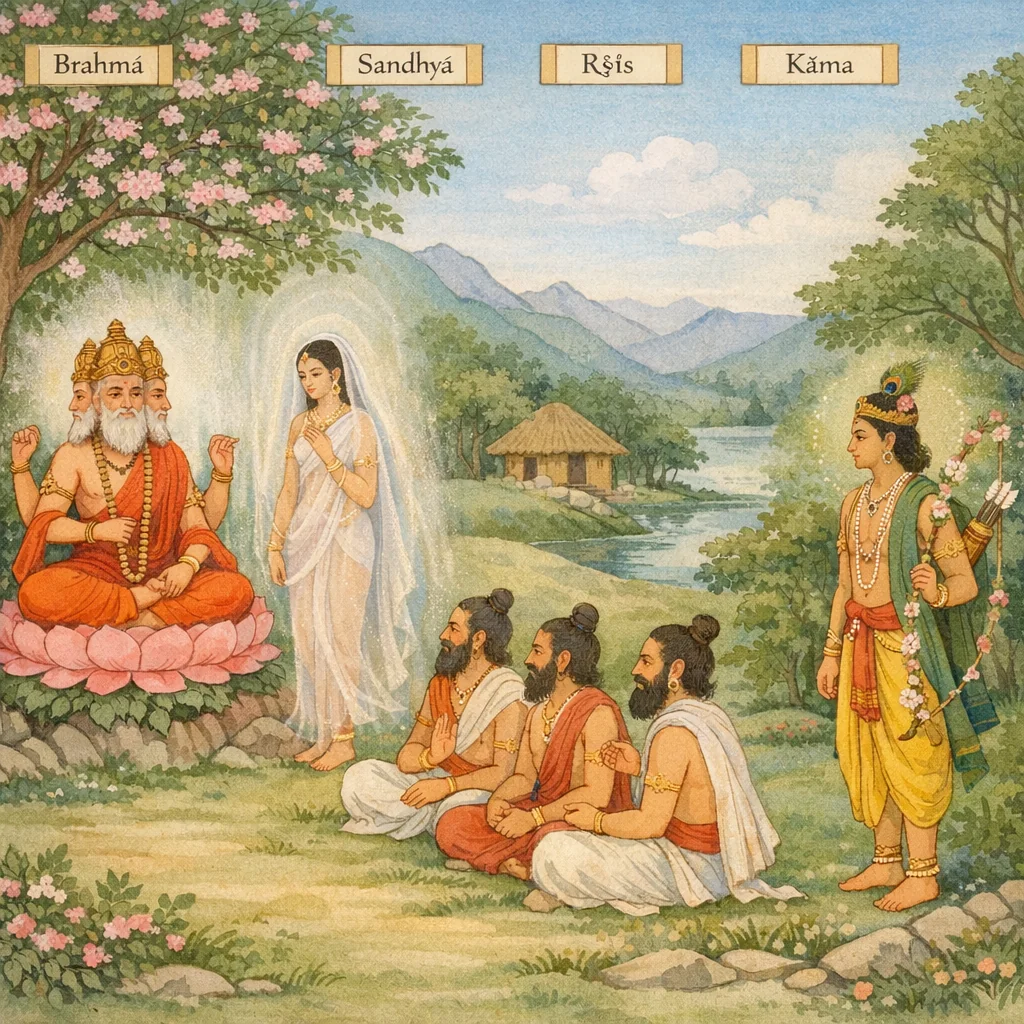
कामशापानुग्रहः (Kāmaśāpānugraha) — “The Curse and Grace Concerning Kāma”
Adhyāya 3 gives an etiological account of Kāma’s identity and cosmic station through the authoritative words of Brahmā and the sages. By “mere observation,” Marīci and the other creators assign names and functions to the newly arisen being of desire: Manmatha (agitator of minds), Kāma (embodiment of desire), Madana (the intoxicating enchanter), and Kandarpa (linked with pride and erotic potency). These are not mere synonyms but distinct operational aspects of desire across the worlds. The sages grant him pervasive reach in “all stations” and connect him to Dakṣa’s lineage, declaring that Dakṣa will give him a wife. The bride is Sandhyā, a supremely beautiful maiden born from Brahmā’s mind (manobhavā), establishing desire’s ontological pedigree within creation itself. The chapter title foreshadows the larger arc: desire will later be restrained by a curse, yet also integrated by grace into cosmic order.
Shlokas
Verse 1
ब्रह्मोवाच । ततस्ते मुनयः सर्वे तदाभिप्रायवेदिनः । चक्रुस्तदुचितं नाम मरीचिप्रमुखास्सुताः
Brahmā said: Then all those sages—understanding that intention—devised an appropriate name: the sons of Marīci and the other primordial seers.
Verse 2
मुखावलोकनादेव ज्ञात्वा वृत्तांतमन्यतः । दक्षादयश्च स्रष्टारः स्थानं पत्नीं च ते ददुः
Merely by beholding his face, they understood the true account, even from other sources. Therefore Dakṣa and the other creator-lords bestowed upon him an honoured station and also a wife.
Verse 3
इति श्रीशिवमहापुराणे द्वितीयायां रुद्रसंहितायां द्वितीये सतीखंडे कामशापानुग्रहो नाम तृतीयोऽध्यायः
Thus, in the Śrī Śiva Mahāpurāṇa, in the Second Book known as the Rudra Saṃhitā, within its second section, the Satī Khaṇḍa, concludes the third chapter entitled “Kāmaśāpānugraha”—the account of Kāma’s curse and the Lord’s gracious favor.
Verse 4
ऋषय ऊचुः । यस्मात्प्रमथसे तत्त्वं जातोस्माकं यथा विधेः । तस्मान्मन्मथनामा त्वं लोके ख्यातो भविष्यसि
The sages said: “Since you have arisen from our churning—according to Brahmā’s ordinance—therefore you shall become renowned in the world by the name Manmatha, the Agitator of the mind.”
Verse 5
जगत्सु कामरूपस्त्वं त्वत्समो न हि विद्यते । अतस्त्वं कामनामापि ख्यातो भव मनोभव
In all the worlds, you are the very embodiment of desire; none is equal to you. Therefore, O Mind-born one (Manobhava), become renowned also by the name “Kāma”.
Verse 6
मदनान्मदनाख्यस्त्वं जातो दर्पात्सदर्पकः । तस्मात्कंदर्पनामापि लोके ख्यातो भविष्यसि
Born from desire (madana), you will be known as Madana; and since you arise from pride (darpa), you will ever be prideful. Therefore, in this world you shall also become renowned by the name Kandarpa.
Verse 7
त्वत्समं सर्वदेवानां यद्वीर्यं न भविष्यति । ततः स्थानानि सर्वाणि सर्वव्यापी भवांस्ततः
Since none among all the gods will possess power equal to yours, therefore all abodes and stations will, from that very fact, be pervaded by you—you will become all-pervading.
Verse 8
दक्षोयं भवते पत्नी स्वयं दास्यति कामिनीम् । आद्यः प्रजापतिर्यो हि यथेष्टं पुरुषोत्तमः
O Puruṣottama, this Dakṣa will of his own accord give you his daughter as your wife, the beloved maiden. For he is indeed the primordial Prajāpati, acting according to his will.
Verse 9
एषा च कन्यका चारुरूपा ब्रह्ममनोभवा । संध्या नाम्नेति विख्याता सर्वलोके भविष्यति
This maiden is of lovely form, born of Brahmā’s mind. She will become renowned throughout all the worlds by the name “Sandhyā.”
Verse 10
ब्रह्मणो ध्यायतो यस्मात्सम्यग्जाता वरांगना । अतस्संध्येति विख्याता क्रांताभा तुल्यमल्लिका
Since that excellent maiden was duly born from Brahmā while he was in meditation, she therefore became renowned as “Sandhyā”. Her radiance was enchanting, and in beauty she was like the jasmine flower.
Verse 11
ब्रह्मोवाच । कौसुमानि तथास्त्राणि पंचादाय मनोभवः । प्रच्छन्नरूपी तत्रैव चिंतयामास निश्चयम्
Brahmā said: Taking up his five floral weapons, Manobhava (Kāma), assuming a concealed form, remained right there and deliberated upon his resolve.
Verse 12
हर्षणं रोचनाख्यं च मोहनं शोषणं तथा । मारणं चेति प्रोक्तानि मुनेर्मोहकराण्यपि
They are declared to be: delighting (harṣaṇa), the rite called ‘rocana’, deluding (mohana), drying up (śoṣaṇa), and killing (māraṇa). These too are said to be acts that bewilder even a sage.
Verse 13
ब्रह्मणा मम यत्कर्म समुद्दिष्टं सनातनम् । तदिहैव करिष्यामि मुनीनां सन्निधौ विधे
O Brahmā, the eternal duty you have enjoined upon me—I shall fulfill it here itself, in the presence of these sages, in accordance with the ordained rule.
Verse 14
तिष्ठंति मुनयश्चात्र स्वयं चापि प्रजापतिः । एतेषां साक्षिभूतं मे भविष्यंत्यद्य निश्चयम्
Here the sages stand present, and Prajāpati himself is here as well. Surely, today they shall be witnesses on my behalf.
Verse 15
संध्यापि ब्रह्मणा प्रोक्ता चेदानीं प्रेषयेद्वचः । इह कर्म परीक्ष्यैव प्रयोगान्मोहयाम्यहम्
Even if Brahmā has enjoined the sandhyā worship (the twilight rite), should he now send forth his command, I shall first examine the rite performed here; and by interfering with its application, I will cast them into delusion.
Verse 16
ब्रह्मोवाच । इति संचित्य मनसा निश्चित्य च मनोभवः । पुष्पजं पुष्पजातस्य योजयामास मार्गणैः
Brahmā said: Having thus gathered his thoughts and come to a firm resolve in his mind, Manobhava (Kāma, the god of desire) then fitted his flower-born arrows to the flower-born bow and made them ready for use.
Verse 17
आलीढस्थानमासाद्य धनुराकृष्य यत्नतः । चकार वलयाकारं कामो धन्विवरस्तदा
Then Kāma, the excellent archer, taking his stance in the ālīḍha posture and drawing his bow with deliberate effort, shaped his shot/aim into a circular, ring-like form.
Verse 18
संहिते तेन कोदंडे मारुताश्च सुगंधयः । ववुस्तत्र मुनिश्रेष्ठ सम्यगाह्लादकारिणः
O best of sages, within that well-joined bow, fragrant breezes began to blow there, bringing complete delight—an auspicious sign attending the sacred unfolding of Śiva’s divine purpose.
Verse 19
ततस्तानपि धात्रादीन् सर्वानेव च मानसान् । पृथक् पुष्पशरैस्तीक्ष्णैर्मोहयामास मोहनः
Then that Deluder (Kāma), with sharp flower-arrows, separately bewildered even Dhātṛ and the other deities, and indeed all those mind-born beings as well.
Verse 20
ततस्ते मुनयस्सर्वे मोहिताश्चाप्यहं मुने । सहितो मनसा कंचिद्विकारं प्रापुरादितः
Then all those sages became deluded—and I too, O sage. Along with them, my mind from the very outset fell into a certain disturbance (of understanding).
Verse 21
संध्यां सर्वे निरीक्षंतस्सविकारं मुहुर्मुहुः । आसन् प्रवृद्धमदनाः स्त्री यस्मान्मदनैधिनी
Again and again, all of them looked at Sandhyā with a disturbed, altered mind; for she was a woman who kindled Kāma, and thus desire arose powerfully in them.
Verse 22
ततः सर्वान्स मदनो मोहयित्वा पुनःपुनः । यथेन्द्रियविकारं त प्रापुस्तानकरोत्तथा
Thereafter, Madana (Kāma), repeatedly deluding them all, caused them to fall into the very modifications of the senses that they had come to experience.
Verse 23
उदीरितेंद्रियो धाता वीक्ष्याहं स यदा च ताम् । तदैव चोनपंचाशद्भावा जाताश्शरीरतः
When Dhātā, the Creator, his senses stirred into activity, beheld her, he said, “I look upon her.” At that very moment, from his own body arose the forty-nine formative principles (bhāvas).
Verse 24
सापि तैर्वीक्ष्यमाणाथ कंदर्पशरपातनात् । चक्रे मुहुर्मुहुर्भावान्कटाक्षावरणादिकान्
And she too, being watched by them, struck by the falling arrows of Kāma, again and again displayed the tender moods of love—casting sidelong glances and then veiling them in modesty, and the like.
Verse 25
निसर्गसुंदरी संध्या तान्भावान् मानसोद्भवान् । कुर्वंत्यतितरां रेजे स्वर्णदीव तनूर्मिभिः
That twilight, beautiful by nature, as she manifested those mind-born states, shone exceedingly—like a golden lamp—through waves of radiance streaming from her own body.
Verse 26
अथ भावयुतां संध्यां वीक्ष्याकार्षं प्रजापतिः । धर्माभिपूरित तनुरभिलाषमहं मुने
Then Prajāpati (Brahmā), seeing Sandhyā endowed with enchanting allure, was inwardly drawn toward her. O sage, though his body was filled with the sense of dharma, desire nevertheless arose within him.
Verse 27
ततस्ते मुनयस्सर्वे मरीच्यत्रिमुखा अपि । दक्षाद्याश्च द्विजश्रेष्ठ प्रापुर्वेकारिकेन्द्रियम्
Then all those sages—Marīci, Atri, and the others—along with Dakṣa and the rest, O best of the twice-born, attained the vaikārika sense-faculties, the refined organs of perception and action.
Verse 28
दृष्ट्वा तथाविधा दक्षमरीचिप्रमुखाश्च माम् । संध्यां च कर्मणि निजे श्रद्दधे मदनस्तदा
Seeing me in that condition, Dakṣa and the sages headed by Marīci became intent on their own sandhyā worship and prescribed rites; at that time Madana (Kāma) too applied himself to his appointed task.
Verse 29
यदिदं ब्रह्मणा कर्म ममोद्दिष्टं मयापि तत् । कर्तुं शक्यमिति ह्यद्धा भावितं स्वभुवा तदा
“That task which Brahmā assigned to me—then indeed the Self-born Brahmā became firmly convinced that I too was capable of accomplishing it.”
Verse 30
इत्थं पापगतिं वीक्ष्य भ्रातॄणां च पितुस्तथा । धर्मस्सस्मार शंभुं वै तदा धर्मावनं प्रभुम्
Thus, seeing the sinful fate of his brothers and of his father as well, Dharma remembered Śambhu—Lord Śiva, the supreme Protector of dharma—and sought refuge in Him.
Verse 31
संस्मरन्मनसा धर्मं शंकरं धर्मपालकम् । तुष्टाव विविधैर्वाक्यैर्दीनो भूत्वाजसंभवः
Remembering within his mind Śaṅkara—the very embodiment and protector of dharma—Aja-sambhava (Brahmā), humbled and distressed, praised Him with many kinds of supplicatory words.
Verse 32
धर्म उवाच । देवदेव महादेव धर्मपाल नमोस्तु ते । सृष्टिस्थितिविनाशानां कर्ता शंभो त्वमेव हि
Dharma said: “O God of gods, O Mahādeva, O Protector of dharma—salutations to You. O Śambhu, You alone indeed are the agent of creation, preservation, and dissolution.”
Verse 33
सृष्टौ ब्रह्मा स्थितौ विष्णुः प्रलये हररूपधृक् । रजस्सत्त्वतमोभिश्च त्रिगुणैरगुणः प्रभो
In creation He appears as Brahmā; in preservation as Viṣṇu; and at dissolution He assumes the form of Hara. Yet, though He functions through the three guṇas—rajas, sattva, and tamas—the Lord remains truly without guṇas, the supreme Master.
Verse 34
निस्त्रैगुण्यः शिवः साक्षात्तुर्यश्च प्रकृतेः परः । निर्गुणो निर्विकारी त्वं नानालीलाविशारदः
You are Shiva Himself in truth—beyond the three guṇas, the transcendent Fourth (turya), and higher than Prakṛti. You are without attributes and free from modification, yet supremely adept in manifesting countless divine līlās.
Verse 35
रक्षरक्ष महादेव पापान्मां दुस्तरादितः । मत्पितायं तथा चेमे भ्रातरः पापबुद्धयः
“Protect me, protect me, O Mahādeva, from these sins—so hard to cross. My father here, and these brothers of mine as well, are of sinful intent.”
Verse 36
ब्रह्मोवाच । इति स्तुतो महेशानो धर्मेणैव परः प्रभुः । तत्राजगाम शीघ्रं वै रक्षितुं धर्ममात्मभूः
Brahmā said: Thus praised, the supreme Lord Maheśāna—ever established in Dharma—came there swiftly indeed, to protect Dharma, the Self-born One.
Verse 37
जातो वियद्गतश्शंभुर्विधिं दृष्ट्वा तथाविधम् । मां दक्षाद्यांश्च मनसा जहासोपजहास च
Having manifested and then moved through the sky, Śambhu, seeing Brahmā (Vidhī) in that condition, inwardly laughed—smiling to Himself—at me and at Dakṣa and the others as well.
Verse 38
स साधुवादं तान् सर्वान्विहस्य च पुनः पुनः । उवाचेदं मुनिश्रेष्ठ लज्जयन् वृषभध्वजः
O best of sages, the Bull-bannered Lord (Śiva), smiling again and again at the praise offered by them all, spoke these words with humility, as though abashed.
Verse 39
शिव उवाच । अहो ब्रह्मंस्तव कथं कामभावस्समुद्गतः । दृष्ट्वा च तनयां नैव योग्यं वेदानुसारिणाम्
Śiva said: “Alas, O Brahmā—how has this surge of lust arisen in you? Even upon seeing your own daughter, such a thought is not at all fitting for those who claim to follow the Veda.”
Verse 40
यथा माता च भगिनी भ्रातृपत्नी तथा सुता । एतः कुदृष्ट्या द्रष्टव्या न कदापि विपश्चिता
Just as one regards one’s mother, sister, brother’s wife, and daughter, so too should a wise person never look upon these women with a corrupt or lustful gaze.
Verse 41
एष वै वेदमार्गस्य निश्चयस्त्वन्मुखे स्थितः । कथं तु काममात्रेण स ते विस्मारितो विधे
This firm conclusion regarding the path of the Vedas abides upon your very lips. How then, O Ordainer (Brahmā), has it been forgotten by you merely on account of desire?
Verse 42
धैर्ये जागरितं ब्रह्मन्मनस्ते चतुरानन । कथं क्षुद्रेण कामेन रंतुं विगटितं विधे
O Brahmā, O four-faced one—your mind is awakened and steady in fortitude. How, then, O Ordainer, has it become loosened to seek delight in a petty desire?
Verse 43
एकांतयोगिनस्तस्मात्सर्वदादित्यदर्शिनः । कथं दक्षमरीच्याद्या लोलुपाः स्त्रीषु मानसाः
Therefore those who are solitary yogins, ever beholding the inner Sun of consciousness, cannot be of a mind that runs after women. How, then, could Dakṣa, Marīci and the other sages be mentally lustful toward women?
Verse 44
कथं कामोपि मंदात्मा प्राबल्यात्सोधुनैव हि । विकृतान्बाणैः कृतवानकालज्ञोल्पचेतनः
How indeed has Kāma—though dull-minded, driven by force and arrogance—just now acted with his distorted arrows, being untimely in judgment and small in understanding?
Verse 45
धिक्तं श्रुतं सदा तस्य यस्य कांता मनोहरत् । धैर्यादाकृष्य लौल्येषु मज्जयत्यपि मानसम्
Cursed indeed is all the learning of that man whose lovely wife, by her captivating charm, draws his mind away from steadfastness and plunges it into fickle cravings.
Verse 46
ब्रह्मोवाच । इति तस्य वचः श्रुत्वा लोके सोहं शिवस्य च । व्रीडया द्विगुणीभूतस्स्वेदार्द्रस्त्वभवं क्षणात्
Brahmā said: Hearing those words, I—before the world and before Śiva—became doubly ashamed; and in an instant my body became moist with sweat.
Verse 47
ततो निगृह्यैंद्रियकं विकारं चात्यजं मुने । जिघृक्षुरपि तद्भीत्या तां संध्यां कामरूपिणीम्
Then, O sage, restraining the sense-born agitation, he abandoned that impulse; and though he had wished to seize her, out of fear of that consequence he let go of that Sandhyā, who could assume any form at will.
Verse 48
मच्छरीरात्तु घर्मांभो यत्पपात द्विजोत्तम धर्मांभो । अग्निष्वात्ताः पितृगणा जाताः पितृगणास्ततः
O best of twice-born ones, from my body the drops of perspiration that fell—those sacred waters—became the Pitṛ hosts known as the Agniṣvāttas; thus the Pitṛ-gaṇas came into being.
Verse 49
भिन्नांजननिभास्सर्वे फुल्लराजीवलोचनाः । नितांतयतयः पुण्यास्संसारविमुखाः परे
All of them were dark-hued like powdered collyrium, with eyes like fully blossomed lotuses. They were utterly disciplined ascetics—pure and meritorious—supremely turned away from worldly existence, intent on liberation along Shiva’s path.
Verse 50
सहस्राणां चतुःषष्टिरग्निष्वात्ताः प्रकीर्तिता । षडशीतिसहस्राणि तथा बर्हिषदो मुने
Of the thousands, sixty-four are proclaimed as the Agniṣvātta Pitṛs; and likewise, O sage, eighty-six thousand are said to be the Barhiṣad Pitṛs.
Verse 51
घर्मांभः पतितं भूमौ तदा दक्षशरीरतः । समस्तगुणसंपन्ना तस्माज्जाता वरांगना
Then, as the perspiration-water fell upon the earth from Dakṣa’s body, from that drop a noble maiden was born—endowed with every auspicious quality.
Verse 52
तन्वंगी सममध्या च तनुरोमावली श्रुता । मृद्वंगी चारुदशना नवकांचनसुप्रभा
She was slender-limbed and evenly waisted, famed for the delicate line of hair upon her body. Soft in her graceful form, she had lovely teeth and shone with the radiant splendor of freshly refined gold.
Verse 53
सर्वावयवरम्या च पूर्णचन्द्राननाम्बुजा । नाम्ना रतिरिति ख्याता मुनीनामपि मोहिनी
She was lovely in every limb; her lotus-like face shone like the full moon. She was famed by the name Rati, and her beauty could enchant even ascetics—yet in Śaiva understanding such charm abides within māyā and cannot surpass the liberating grace of Lord Śiva.
Verse 54
मरीचिप्रमुखा षड् वै निगृहीतेन्द्रियक्रियाः । ऋते क्रतुं वसिष्ठं च पुलस्त्यांगिरसौ तथा
Indeed, the six sages headed by Marīci had restrained the operations of their senses; Pulastya and Aṅgiras too had done likewise—except for Kratu and Vasiṣṭha.
Verse 55
क्रत्वादीनां चतुर्णां च बीजं भूमौ पपात च । तेभ्यः पितृगणा जाता अपरे मुनिसत्तम
And the seed of the four—Kratvā and the others—fell upon the earth. From that, O best of sages, other hosts of the Pitṛs, the ancestral beings, were born.
Verse 56
सोमपा आज्यपा नाम्ना तथैवान्ये सुकालिनः । हविष्मंतस्तु तास्सर्वे कव्यवाहाः प्रकीर्तिताः
They are called the Somapās and the Ājyapās; and there are others too, timely and auspicious in their appointed seasons. All of them, bearers of the sacrificial oblations (havis), are famed as Kavyavāhas—the conveyers of offerings to the Pitṛs, the ancestral ones.
Verse 57
क्रतोस्तु सोमपाः पुत्रा वसिष्ठात्कालिनस्तथा । आज्यपाख्याः पुलस्त्यस्य हविष्मंतोंगिरस्सुताः
From Kratu were born the sons called Somapās; from Vasiṣṭha likewise the Kālinas. From Pulastya were born those known as Ājyapās; and from Aṅgiras were born the Haviṣmants.
Verse 58
जातेषु तेषु विप्रेन्द्र अग्निष्वात्तादिकेष्वथ । लोकानां पितृवर्गेषु कव्यवाह स समंततः
O best of Brahmins, when those classes of Pitṛs—such as the Agniṣvāttas and the rest—had come into being, then Kavyavāha, the bearer of the oblation, became established everywhere among the ancestral orders of the worlds, conveying the offerings made with faith.
Verse 59
संध्या पितृप्रसूर्भूत्वा तदुद्देशयुताऽभवत् । निर्दोषा शंभुसंदृष्टा धर्मकर्मपरायणा
Becoming Sandhyā, the daughter born of the Pitṛs, she lived devoted to that very purpose. Blameless in conduct, she was beheld by Śambhu (Śiva) and remained wholly intent on righteous duties and dharmic action.
Verse 60
एतस्मिन्नंतरे शम्भुरनुगृह्याखिलान्द्विजान् । धर्मं संरक्ष्य विधिवदंतर्धानं गतो द्रुतम्
Meanwhile, Lord Śambhu, having graciously blessed all the twice-born sages and duly safeguarded dharma according to sacred ordinance, swiftly withdrew from their sight and became unmanifest.
Verse 61
अथ शंकरवाक्येन लज्जितोहं पितामहः । कंदर्प्पायाकोपिंत हि भ्रुकुटीकुटिलाननः
Then, stung with shame by Śaṅkara’s words, I—Pitāmaha (Brahmā)—became wrathful toward Kāma; my face contorted, my brows knit into a crooked frown.
Verse 62
दृष्ट्वा मुखमभिप्रायं विदित्वा सोपि मन्मथः । स्वबाणान्संजहाराशु भीतः पशुपतेर्मुने
Seeing (Śiva’s) face and understanding His inner intention, Manmatha too immediately withdrew his own arrows, terrified of Paśupati—O sage.
Verse 63
ततः कोपसमायुक्तः पद्मयोनिरहं मुने । अज्वलं चातिबलवान् दिधक्षुरिव पावकः
Then I—Brahmā, the Lotus-born—filled with anger, O sage, blazed forth with immense power, like a fire intent on burning all things.
Verse 64
भवनेत्राग्निनिर्दग्धः कंदर्पो दर्पमोहितः । भविष्यति महादेवे कृत्वा कर्मं सुदुष्करम्
Maddened by pride, Kandarpa (Kāma) will undertake a most difficult deed against Mahādeva—and, scorched by the fire from Your eye, he will be reduced to ashes.
Verse 65
इति वेधास्त्वहं काममक्षयं द्विजसत्तम । समक्षं पितृसंघस्य मुनीनां च यतात्मनाम्
“Thus, O best of Brahmins, I—Vedhā (Brahmā)—grant this unfailing boon, in the very presence of the hosts of the Pitṛs and the self-controlled sages.”
Verse 66
इति भीतो रतिपतिस्तत्क्षणात्त्यक्तमार्गणः । प्रादुर्बभूव प्रत्यक्षं शापं श्रुत्वातिदारुणम्
Hearing that exceedingly dreadful curse, Kāma, Lord of Love, was struck with fear and at once abandoned his arrow; then he manifested himself directly, visible before them.
Verse 67
ब्रह्माणं मामुवाचेदं स दक्षादिसुतं मुने । शृण्वतां पितृसंघानां संध्यायाश्च विगर्वधीः
O sage, that son of Dakṣa—his mind swollen with pride—spoke these words to me even in Brahmā’s presence, while the hosts of the Pitṛs and Saṃdhyā were listening.
Verse 68
काम उवाच । किमर्थं भवता ब्रह्मञ् शप्तोहमिति दारुणम् । अनागास्तव लोकेश न्याय्यमार्गानुसारिणः
Kāma said: “O Brahmā, for what reason have you cursed me so harshly? O Lord of the worlds, I am without fault; I am one who follows the proper and righteous path.”
Verse 69
त्वया चोक्तं नु मत्कर्म यत्तद्ब्रह्मन् कृतं मया । तत्र योग्यो न शापो मे यतो नान्यत्कृतं मया
O Brahman, you have indeed said that the act was done by me. Yet I am not fit to be cursed for it, for I have done nothing else—no other deed beyond that.
Verse 70
अहं विष्णुस्तथा शंभुः सर्वे त्वच्छ रगोचराः । इति यद्भवता प्रोक्तं तन्मयापि परीक्षितम्
“I (Brahmā), Viṣṇu, and even Śambhu (Śiva)—all of us move only within the range of Your pure, stainless radiance. What you have declared thus, I too have personally examined and verified.”
Verse 71
नापराधो ममाप्यत्र ब्रह्मन् मयि निरागसि । दारुणः समयश्चैव शापो देव जगत्पते
O Brahmā, I have committed no offense here; truly I am without fault. Yet the time is dreadful, and the curse—O Lord, Master of the worlds—has indeed come to pass.
Verse 72
ब्रह्मोवाच । इति तस्य वचः श्रुत्वा ब्रह्माहं जगतां पतिः । प्रत्यवोचं यतात्मानं मदनं दमयन्मुहुः
Brahmā said: Having thus heard his words, I—Brahmā, lord of the worlds—replied to that self-controlled one, repeatedly restraining within myself Madana, the god of desire.
Verse 73
ब्रह्मोवाच । आत्मजा मम संध्येयं यस्मादेतत्स कामतः । लक्ष्यीकृतोहं भवता ततश्शापो मया कृतः
Brahmā said: “Because you, moved by desire, contemplated my own daughter at twilight and for that reason fixed your gaze upon me, I therefore pronounced this curse.”
Verse 74
अधुना शांतरोषोहं त्वां वदामि मनोभव । शृणुष्व गतसंदेहस्सुखी भव भयं त्यज
Now my anger has been calmed. O Manobhava (Kāma), I shall speak to you—listen with all doubt removed. Be at ease; cast off fear.
Verse 75
त्वं भस्म भूत्वा मदन भर्गलोचनवह्निना । तथैवाशु समं पश्चाच्छरीरं प्रापयिष्यसि
O Madana (Kāma), having been reduced to ash by the fire from Bharga’s (Śiva’s) eye, you shall soon thereafter, in due course, regain a body again.
Verse 76
यदा करिष्यति हरोंजसा दारपरिग्रहम् । तदा स एव भवतश्शरीरं प्रापयिष्यति
When Hara (Śiva), of His own accord, accepts a wife in marriage, then He Himself will cause you to attain a body fit for that destined union.
Verse 77
ब्रह्मोवाच । एवमुक्त्वाथ मदनमहं लोकपितामहः । अंतर्गतो मुनीन्द्राणां मानसानां प्रपश्यताम्
Brahmā said: Having spoken thus, I—the grandsire of the worlds—withdrew within and disappeared, even as the foremost sages beheld it with their mind’s vision.
Verse 78
इत्येवं मे वचश्श्रुत्वा मदनस्तेपि मानसाः । संबभूवुस्सुतास्सर्वे सुखिनोऽरं गृहं गताः
Hearing these words of mine, those mind-born sons too were filled with delight; and all of them, content and at peace, returned to their own abodes.
Frequently Asked Questions
The chapter formalizes Kāma’s identity through multiple canonical names and assigns his cosmic station, including the statement that Dakṣa will provide him a wife—Sandhyā—thereby integrating desire into the created order.
Each name encodes a functional aspect of desire (agitation of mind, universal desirability, intoxicating fascination, pride-linked erotic force), turning myth into a taxonomy of kāma’s operations across worlds.
Kāma is portrayed as all-pervading in reach, legitimized by Brahmā/ṛṣis, and relationally anchored through Dakṣa and the mind-born maiden Sandhyā, indicating desire’s sanctioned role within progenitive cosmology.