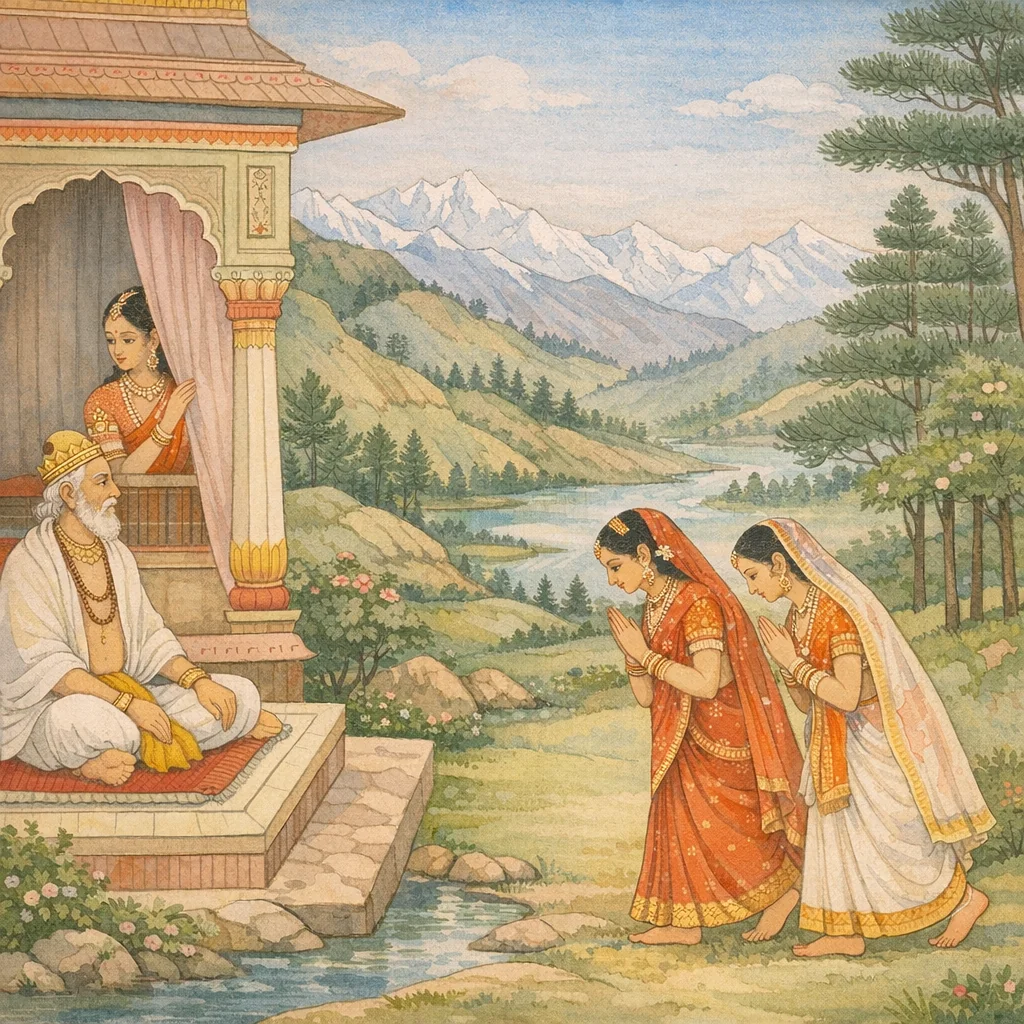
गिरिजाया तपोऽनुज्ञा (Permission for Girijā’s Austerities)
Adhyaya 22 continues Pārvatī’s tapas narrative by moving from inner resolve to formal family sanction. Brahmā relates that after Deva-muni departs, Pārvatī rejoices and fixes her mind on attaining Hara (Śiva) through tapas. Her companions Jayā and Vijayā serve as intermediaries: they respectfully approach Himavān, convey Pārvatī’s intention, and argue that the destiny of the lineage is fulfilled through tapas as the means to “accomplish” Śiva. Himavān approves, while stressing that Menā’s consent is also essential, and declares the outcome certainly auspicious for the family. The companions then go to the mother to secure permission. The chapter thus frames renunciation within dharma: the plan for forest austerities is not an impulsive escape, but an authorized, purposeful sādhana aligned with familial and cosmic ends, leading into further permissions, preparations, and the transition toward the forest-based tapas that culminates in Śiva’s acceptance.
Shlokas
Verse 1
ब्रह्मोवाच । त्वयि देवमुने याते पार्वती हृष्टमानसा । तपस्साध्यं हरं मेने तपोर्थं मन आदधे
Brahmā said: “When you, O divine sage, had departed, Pārvatī—her mind filled with joy—considered Lord Hara to be attainable through tapas (austerity). Therefore she resolved in her heart to undertake austerities for that purpose.”
Verse 2
ततः सख्यौ समादाय जयां च विजयां तथा । मातरं पितरं चैव सखीभ्यां पर्यपृच्छत
Then, taking along her two companions—Jaya and Vijaya—she, through those friends, inquired of her mother and father as well.
Verse 3
प्रथमं पितरं गत्वा हिमवन्तं नगेश्वरम् । पर्यपृच्छत्सुप्रणम्य विनयेन समन्विता
First she went to her father Himavān, the lord of mountains; and, bowing down properly, she respectfully questioned him with humble courtesy.
Verse 4
सख्यावूचतुः । हिमवञ्च्छ्रूयतां पुत्री वचनं कथ्यतेऽधुना । सा स्वयं चैव देहस्य रूपस्यापि तथा पुनः
The companions said: “O Himavān, please listen. Now we shall convey the words of your daughter—how she herself has spoken again and again about her body and her very form.”
Verse 5
भवतो हि कुलस्यास्य साफल्यं कर्तुमिच्छति । तपसा साधनीयोऽसौ नान्यथा दृश्यतां व्रजेत्
Indeed, he desires to make your lineage truly fruitful. He can be attained through tapas (austerity) alone; in no other way will he come into view and be reached.
Verse 6
तस्माच्च पर्वतश्रेष्ठ देह्याज्ञां भवताधुना । तपः करोतु गिरिजा वनं गत्वेति सादरम्
“Therefore, O best of mountains, grant your permission now. Let Girijā go to the forest and perform tapas (austerities)”—thus they spoke with reverence.
Verse 7
ब्रह्मोवाच । इत्येवं च तदा पृष्टस्सखीभ्यां मुनिसत्तम । पार्वत्या सुविचार्याथ गिरिराजोऽब्रवीदिदम्
Brahmā said: “Thus, O best of sages, when he was then questioned by the two companions about Pārvatī, the king of mountains—having reflected well—spoke these words.”
Verse 8
हिमालय उवाच । मह्यं च रोचतेऽत्यर्थं मेनायै रुच्यतां पुनः । यथेदं भवितव्यं च किमतः परमुत्तमम्
Himālaya said: “This proposal is exceedingly pleasing to me; let Menā, too, approve it once again. Let it come to pass exactly so—for what could be more supremely auspicious than this?”
Verse 9
साफल्यं तु मदीयस्य कुलस्य च न संशयः । मात्रे तु रुच्यते चेद्वै ततः शुभतरं नु किम्
“There is no doubt that my lineage will attain fulfillment and blessed success. And if my mother truly approves, what could possibly be more auspicious than that?”
Verse 10
ब्रह्मोवाच । इत्येवं वचनं पित्रा प्रोक्तं श्रुत्वा तु ते तदा । जग्मतुर्मातरं सख्यौ तदाज्ञप्ते तया सह
Brahmā said: “Having thus heard the words spoken by their father at that time, the two friends went to their mother; and along with her—who instructed them—they proceeded accordingly.”
Verse 11
गत्वा तु मातरं तस्याः पार्वत्यास्ते च नारद । सुप्रणम्य करो बध्वोचतुर्वचनमादरात्
Then Nārada went to the mother of Pārvatī. Having bowed down with great reverence and folding his hands, he addressed her with respectful words.
Verse 12
सख्यावूचतुः । मातस्त्वं वचनं पुत्र्याः शृणु देवि नमोऽस्तु ते । सुप्रसन्नतया तद्वै श्रुत्वा कर्तुमिहार्हसि
The companions said: “O Mother, O Goddess—salutations to you. Please listen to your daughter’s words; having heard them with a gracious and well-pleased heart, you ought to carry out what is to be done here.”
Verse 13
तप्तुकामा तु ते पुत्री शिवार्थं परमं तपः । प्राप्तानुज्ञा पितुश्चैव तुभ्यं च परिपृच्छति
Your daughter, desiring to undertake austerity for the sake of attaining Śiva, wishes to perform the highest tapas. Having obtained her father’s permission, she now comes to you as well and seeks your consent.
Verse 14
इयं स्वरूपसाफल्यं कर्तुकामा पतिव्रते । त्वदाज्ञया यदि जायेत तप्यते च तथा तपः
O devoted wife, she wishes to make her very nature fulfilled; if, by your command, it is permitted, then she will indeed undertake that austerity accordingly.
Verse 15
ब्रह्मोवाच । इत्युक्त्वा च ततस्सख्यौ तूष्णीमास्तां मुनीश्वर । नांगीचकार मेना सा तद्वाक्यं खिन्नमानसा
Brahmā said: Having spoken thus, the two friends then remained silent, O best of sages. But Menā, her heart distressed, did not accept those words.
Verse 16
ततस्सा पार्वती प्राह स्वयमेवाथ मातरम् । करौ बद्ध्वा विनीतात्मा स्मृत्वा शिवपदांबुजम्
Then Pārvatī herself addressed her mother. With her hands folded, her mind humble and disciplined, she spoke after remembering the lotus-feet of Lord Śiva.
Verse 17
पार्वत्युवाच । मातस्तप्तुं गमिष्यामि प्रातः प्राप्तुं महेश्वरम् । अनुजानीहि मां गंतुं तपसेऽद्य तपोवनम्
Pārvatī said: “Mother, I shall go to perform sacred austerity, so that by morning I may attain Maheśvara. Grant me leave to depart today for the forest of penance, to undertake tapas.”
Verse 18
ब्रह्मोवाच । इत्याकर्ण्य वचः पुत्र्या मेना दुःख मुपागता । सोपाहूय तदा पुत्रीमुवाच विकला सती
Brahmā said: Hearing her daughter’s words, Menā was overcome with sorrow. Then she called her daughter close, and that noble lady, distressed and shaken, spoke to her.
Verse 19
मेनोवाच । दुःखितासि शिवे पुत्री तपस्तप्तुं पुरा यदि । तपश्चर गृहेऽद्य त्वं न बहिर्गच्छ पार्वति
Menā said: “O Śivā, my daughter—if you are sorrowful and had earlier resolved to undertake austerities, then practice your tapas today within the home; do not go outside, O Pārvatī.”
Verse 20
कुत्र यासि तपः कर्तुं देवास्संति गृहे मम । तीर्थानि च समस्तानि क्षेत्राणि विविधानि च
“Where are you going to perform austerities? In My own abode the gods are present; and within it are found all sacred fords (tīrthas) and all the many holy fields (kṣetras).”
Verse 21
कर्तव्यो न हठः पुत्रि गंतव्यं न बहिः क्वचित् । साधितं किं त्वया पूर्वं पुनः किं साधयिष्यसि
“O daughter, do not be obstinate; do not go outside anywhere. What have you already accomplished before? And what, again, do you think you will accomplish now?”
Verse 22
इति श्रीशिवमहापुराणे द्वितीयायां रुद्रसं तृतीये पार्वती पार्वतीतपोव नाम द्वाविंशोऽध्यायः
Thus ends the twenty-second chapter, titled “Pārvatītapova—The Austerities of Pārvatī,” in the third section, the Pārvatī-khaṇḍa, of the Rudra Saṃhitā, within the Second Book of the Śrī Śiva Mahāpurāṇa.
Verse 23
स्त्रीणां तपोवनगतिर्न श्रुता कामनार्थिनी । तस्मात्त्वं पुत्रि मा कार्षीस्तपोर्थं गमनं प्रति
A maiden driven by desire is not known to go to the forest-hermitages for austerities. Therefore, my daughter, do not set your mind on going away for the sake of tapas.
Verse 24
ब्रह्मोवाच । इत्येवं बहुधा पुत्री तन्मात्रा विनवारिता । संवेदे न सुखं किंचिद्विनाराध्य महेश्वरम्
“Brahmā said: Thus, in many ways, the daughter was restrained and earnestly entreated by her mother. Yet she found no happiness at all—unless she worshipped Mahēśvara, Mahādeva.”
Verse 25
तपोनिषिद्धा तपसे वनं गंतुं च मेनया । हेतुना तेन सोमेति नाम प्राप शिवा तदा
“When Menā restrained Śivā (Pārvatī) from going to the forest to perform tapas, then, for that very reason, she at that time obtained the name ‘Somā.’”
Verse 26
अथ तां दुखितां ज्ञात्वा मेना शैलप्रिया शिवाम् । निदेशं सा ददौ तस्याः पार्वत्यास्तपसे मुने
“Then, understanding that Śivā (Pārvatī)—beloved of the Mountain (Himālaya)—was distressed, Menā gave her an instruction, O sage, directing Pārvatī toward the practice of tapas for the sake of attaining Śiva.”
Verse 27
मातुराज्ञां च संप्राप्य सुव्रता मुनिसत्तम । ततः स्वांते सुखं लेभे पार्वती स्मृतशंकरा
Having obtained her mother’s permission, O best of sages, that virtuous Pārvatī—remembering Śaṅkara within her heart—thereafter found deep contentment in her own inner being.
Verse 28
मातरं पितरं साथ प्रणिपत्य मुदा शिवा । सखीभ्यां च शिवं स्मृत्वा तपस्तप्तुं समुद्गता
With joy, Śivā (Pārvatī) bowed down to her mother and father; and, accompanied by her two companions, remembering Lord Śiva, she set forth to undertake austerities.
Verse 29
हित्वा मतान्यनेकानि वस्त्राणि विविधानि च । वल्कलानि धृतान्याशु मौंजीं बद्ध्वा तु शोभनाम्
Casting aside many kinds of opinions and various garments, she quickly donned bark-cloth, and, for the sake of disciplined beauty, tied on a fine girdle of muñja grass.
Verse 30
हित्वा हारं तथा चर्म्म मृगस्य परमं धृतम् । जगाम तपसे तत्र गंगावतरणं प्रति
Casting aside the garland and donning the excellent hide of a deer, he went there to perform austerities, intent upon bringing about the descent of the river Gaṅgā.
Verse 31
शंभुना कुर्वता ध्यानं यत्र दग्धो मनोभवः । गंगावतरणो नाम प्रस्थो हिमवतस्स च
That plateau of Himavat is known as “Gaṅgāvataraṇa,” the Place of Gaṅgā’s Descent—where, as Śambhu was absorbed in meditation, Manobhava (Kāma, the god of desire) was burned.
Verse 32
हरशून्योऽथ ददृशे स प्रस्थो हिमभूभृतः । काल्या तत्रेत्य भोस्तात पार्वत्या जगदम्बया
Then that Himalayan plateau was seen to be bereft of Hara (Śiva). There Kālikā spoke: “O dear one, here it is,” as Pārvatī—the Mother of the universe—looked on and responded in that moment.
Verse 33
यत्र स्थित्वा पुरा शंभुस्तप्तवान्दुस्तरं तपः । तत्र क्षणं तु सा स्थित्वा बभूव विरहार्दिता
Standing at the very place where Śambhu (Śiva) had formerly performed an arduous, unsurpassable austerity, she remained there for a moment—and at once was tormented by the pain of separation from Him.
Verse 34
हा हरेति शिवा तत्र रुदन्ती सा गिरेस्सुता । विललापातिदुःखार्ता चिन्ताशोकसमन्विता
There, Śivā—Girijā, the daughter of the Mountain—began to weep, crying, “Hā! Hari!” Overwhelmed by intense sorrow, she lamented, filled with anxious worry and grief.
Verse 35
ततश्चिरेण सा मोहं धैर्य्या त्संस्तभ्य पार्वती । नियमायाऽभवत्तत्र दीक्षिता हिमवत्सुता
Then, after a long time, Pārvatī—steadfast through courage—restrained her delusion; and there, the daughter of Himavān became consecrated for observance, entering disciplined vows (niyama) in pursuit of Śiva.
Verse 36
तपश्चकार सा तत्र शृंगितीर्थे महोत्तमे । गौरीशिखर नामासीत्तत्तपःकरणाद्धि तत्
There, at the supremely sacred Śṛṅgī-tīrtha, she undertook austerities (tapas). By the power of that tapas, that peak came to be known as “Gaurī-Śikhara.”
Verse 37
सुंदराश्च द्रुमास्तत्र पवित्राश्शिवया मुने । आरोपिताः परीक्षार्थं तपसः फलभागिनः
O sage, there too were beautiful and sanctifying trees, planted by Śivā (Pārvatī) as a test; they became sharers in the fruits of her austerity (tapas).
Verse 38
भूभिशुद्धिं ततः कृत्वा वेदीं निर्माय सुन्दरी । तथा तपस्समारब्धं मुनीनामपि दुष्करम्
Then, having purified the ground and constructed an altar (vedī), that lovely Goddess began such austerity—an undertaking difficult even for great sages.
Verse 39
विगृह्य मनसा सर्वाणींद्रियाणि सहाशु सा । समुपस्थानिके तत्र चकार परमं तपः
With her mind firmly restraining all the senses, she quickly went to that sacred place of worship and there undertook the highest austerity—single-pointed in purpose, intent on attaining Lord Śiva.
Verse 40
ग्रीष्मे च परितो वह्निं प्रज्वलंतं दिवानिशम् । कृत्वा तस्थौ च तन्मध्ये सततं जपती मनुम
In the heat of summer, she kindled fire all around, blazing day and night; and standing in the midst of it, she continuously repeated the sacred mantra—absorbed in unwavering japa for Lord Śiva.
Verse 41
सततं चैव वर्षासु स्थंडिले सुस्थिरासना । शिलापृष्ठे च संसिक्ता बभूव जलधारया
Even during the rains, she remained continuously seated with unwavering steadiness upon the bare ground; and upon the surface of a rock too, she was drenched again and again by streams of falling water—yet she did not waver from her austerity.
Verse 42
शीते जलांतरे शश्वत्तस्थौ सा भक्तितत्परा । अनाहारातपत्तत्र नीहारे निशासु च
In bitter cold she stood ceaselessly in the midst of the waters, wholly intent on bhakti. There she performed tapas without food, enduring the night-mist as well.
Verse 43
एवं तपः प्रकुर्वाणा पंचाक्षरजपे रता । दध्यौ शिवं शिवा तत्र सर्वकामफलप्रदम्
Thus, performing austerities and devoted to the japa of the five-syllabled mantra, Śivā (Pārvatī) there meditated upon Lord Śiva, bestower of the fruits of all rightful desires.
Verse 44
स्वारोपिताच्छुभान्वृक्षान्सखीभिस्सिंचती मुदा । प्रत्यहं सावकाशे सा तत्रातिथ्यमकल्पयत्
With joy she, along with her companions, watered the auspicious trees that she herself had planted; and every day, when there was leisure, she arranged hospitality for guests there.
Verse 45
वातश्चैव तथा शीतवृष्टिश्च विविधा तथा । दुस्सहोऽपि तथा घर्म्मस्तया सेहे सुचित्तया
There were fierce winds, and many kinds of cold rains; and even the scorching heat, though hard to endure, was borne by her with a pure and steadfast mind.
Verse 46
दुःखं च विविधं तत्र गणितं न तयागतम् । केवलं मन आधाय शिवे सासीत्स्थिता मुने
Many kinds of sorrow were present there, yet she did not take them into account. Fixing her mind solely upon Śiva, she remained unwavering, O sage.
Verse 47
प्रथमं फलभोगेन द्वितीयं पर्णभोजनैः । तपः प्रकुर्वती देवी क्रमान्निन्येऽमिताः समाः
First, the Goddess Pārvatī sustained herself by eating fruits; in the second stage, by eating only leaves. Thus, steadily performing tapas in disciplined order, Devī passed immeasurable years in austerity, directing her whole being toward attaining Lord Śiva, the Supreme Pati.
Verse 48
ततः पर्णान्यपि शिवा निरस्य हिमवत्सुता । निराहाराभवद्देवी तपश्चरणसंरता
Then Śivā—Himavān’s daughter—renounced even leaves as food. The Goddess became wholly fasting, steadfastly absorbed in the practice of tapas, intent on attaining Lord Śiva.
Verse 49
आहारे त्यक्तपर्णाभूद्यस्माद्धिमवतः सुतः । तेन देवैरपर्णेति कथिता नामतः शिवा
Because Himavān’s daughter renounced even leaves as food during her austerity, the gods therefore addressed Śivā (Pārvatī) by the name “Aparṇā” (she who is without leaves).
Verse 50
एका पादस्थिता सासीच्छिवं संस्मृत्य पार्वती । पंचाक्षरं जपंती च मनुं तेपे तपो महत्
Standing on one foot, Pārvatī remained absorbed in remembrance of Śiva; continually repeating the five-syllabled mantra “Namaḥ Śivāya,” she performed a great and intense austerity.
Verse 51
चीरवल्कलसंवीता जटासंघातधारिणी । शिवचिंतनसंसक्ता जिगाय तपसा मुनीम्
Clad in bark-garments and rags, bearing a mass of matted locks, and wholly absorbed in contemplation of Śiva, she surpassed the sage-woman by the power of her austerities.
Verse 52
एवं तस्यास्तपस्यन्त्या चिंतयंत्या महेश्वरम् । त्रीणि वर्ष सहस्राणि जग्मुः काल्यास्तपोवने
Thus, as she continued her austerities and kept Maheśvara ever in her contemplation, three thousand years passed in Kālī’s forest of penance.
Verse 53
षष्टिवर्षसहस्राणि यत्र तेपे तपो हरः । तत्र क्षणमथोषित्वा चिंतयामास सा शिवा
At that place where Hara had performed austerities for sixty thousand years, Śivā (Pārvatī) stayed for a moment; then she began to contemplate deeply.
Verse 54
नियमस्थां महादेव किं मां जानासि नाधुना । येनाहं सुचिरं तेन नानुयाता तवोरता
Pārvatī said: “O Mahādeva, do You not recognize me even now—me who is established in sacred observance (niyama)? By that very resolve through which I have practiced tapas for so long, I have not turned away from my vow of devotion to You.”
Verse 55
लोके वेदे च गिरिशो मुनिभिर्गीयते सदा । शंकरस्य हि सर्वज्ञस्सर्वात्मा सर्वदर्शनः
In the world and in the Vedas, Girīśa is ever sung by the sages. For Śaṅkara is truly the All-knowing—He is the Self within all, and the One whose vision encompasses everything.
Verse 56
सर्वभूतिप्रदो देवस्सर्वभावानुभावनः । भक्ताभीष्टप्रदो नित्यं सर्वक्लेशनिवारणः
That God bestows every prosperity and brings all states of being to full fruition. He ever grants the cherished desires of His devotees and unfailingly removes all afflictions.
Verse 57
सर्वकामान्परित्यज्य यदि चाहं वृषध्वजे । अनुरक्ता तदा सोत्र संप्रसीदतु शंकरः
O Śiva, Lord of the bull-banner, if I have cast away all worldly desires and am truly devoted to You, then may Śaṅkara, ever-auspicious, be gracious to me here and now.
Verse 58
यदि नारद तत्रोक्तमंत्रो जप्तश्शराक्षरः । सुभक्त्या विधिना नित्यं संप्रसीदतु शंकरः
O Nārada, if the mantra taught there is recited daily, syllable by syllable, in the prescribed manner and with sincere devotion, then Śaṅkara is fully pleased and bestows grace.
Verse 59
यदि भक्त्या शिवस्याहं निर्विकारा यथोदितम् । सर्वेश्वरस्य चात्यंतं संप्रसीदतु शंकरः
If, through devotion to Śiva, I have truly become free from all change, just as has been declared, then may Śaṅkara—the Lord of all—be wholly and graciously pleased.
Verse 60
एवं चिंतयती नित्यं तेपे सा सुचिरं तपः । अधोमुखी निर्विकारा जटावल्कलधारिणी
Thus, ever contemplating in this way, she performed austerities for a very long time—face turned downward in inwardness, unmoved amid changing conditions, wearing matted locks and bark-garments—steadfastly directing her discipline toward Śiva, the Lord who grants liberation.
Verse 61
तथा तया तपस्तप्तं मुनीनामपि दुष्करम् । स्मृत्वा च पुरुषास्तत्र परमं विस्मयं गताः
Thus did she perform austerities so severe that even sages would find them difficult. Recalling that tapas, the people there were struck with the highest amazement.
Verse 62
तत्तपोदर्शनार्थं हि समाजग्मुश्च तेऽखिलाः । धन्यान्निजान्मन्यमाना जगदुश्चेति सम्मताः
Indeed, all of them assembled there to behold that austerity (tapas). Deeming their own people blessed, they proclaimed to the world—firmly convinced—that it was truly so.
Verse 63
महतां धर्म्मवृद्धेषु गमनं श्रेय उच्यते । प्रमाणं तपसो नास्ति मान्यो धर्म्मस्सदा बुधैः
To approach the great ones—those advanced in dharma—is declared to be a true good. There is no fixed measure for austerity (tapas); therefore the wise ever honor dharma as worthy of reverence.
Verse 64
श्रुत्वा दृष्ट्वा तपोऽस्यास्तु किमन्यैः क्रियते तपः । अस्मात्तपोऽधिकं लोके न भूतं न भविष्यति
Having heard of it and having seen her austerity, what need is there for others to perform penance? In this world, no austerity greater than this has ever existed, nor will it ever come to be.
Verse 65
जल्पंत इति ते सर्वे सुप्रशस्य शिवातपः । जग्मुः स्वं धाम मुदिताः कठिनांगाश्च ये ह्यपि
Thus speaking among themselves, they all greatly praised the austerity performed for Śiva. Rejoicing, they departed to their own abodes—even those whose bodies had been hardened by severe discipline.
Verse 66
अन्यच्छृणु महर्षे त्वं प्रभावं तपसोऽधुना । पार्वत्या जगदम्बायाः पराश्चर्य्यकरं महत्
O great sage, now hear further of the power of austerity—how vast and utterly wondrous it was in the case of Pārvatī, the Mother of the universe.
Verse 67
तदाश्रमगता ये च स्वभावेन विरोधिनः । तेप्यासंस्तत्प्रभावेण विरोधरहि तास्तदा
And those who had come to that hermitage—though by nature inclined to opposition—became, by the power of that sacred presence, free from all hostility at that time.
Verse 68
सिंहा गावश्च सततं रागादिदोषसंयुताः । तन्महिम्ना च ते तत्र नाबाधंत परस्परम्
Lions and cows, though ever subject to faults such as passion and the like, did not harm one another there—restrained by the power of His glory.
Verse 69
अथान्ये च मुनिश्रेष्ठ मार्ज्जारा मूषकादयः । निसर्गाद्वैरिणो यत्र विक्रियंते स्म न क्वचित्
And there too, O best of sages, other creatures—cats, mice, and the like—though natural enemies by disposition, never at any time displayed hostility or harmful conduct in that place.
Verse 70
वृक्षाश्च सफलास्तत्र तृणानि विविधानि च । पुष्पाणि च विचित्राणि तत्रासन्मुनिसत्तम
O best of sages, there were fruit-bearing trees there, many kinds of grasses, and wondrous, variegated flowers as well.
Verse 71
तद्वनं च तदा सर्वं कैलासेनोपमान्वितम् । जातं च तपस्तस्यास्सिद्धिरूपमभूत्तदा
Then that entire forest became comparable to Kailāsa itself; and at that very time, the fruit of her austerity manifested as siddhi—spiritual accomplishment—through the grace that perfects tapas.
Frequently Asked Questions
Pārvatī’s decision to undertake tapas to attain Śiva is formally taken to her parents through her companions; Himavān explicitly approves and directs that Menā’s assent also be obtained.
It encodes tapas as dharma-aligned sādhana: renunciation is framed not as social rupture but as a sanctioned transition, integrating personal resolve with cosmic purpose and familial order.
Pārvatī is highlighted as Girijā—the ascetic aspirant; Jayā and Vijayā function as ritual-social mediators; Himavān appears as dharmic authority validating the tapas pathway toward Hara (Śiva).