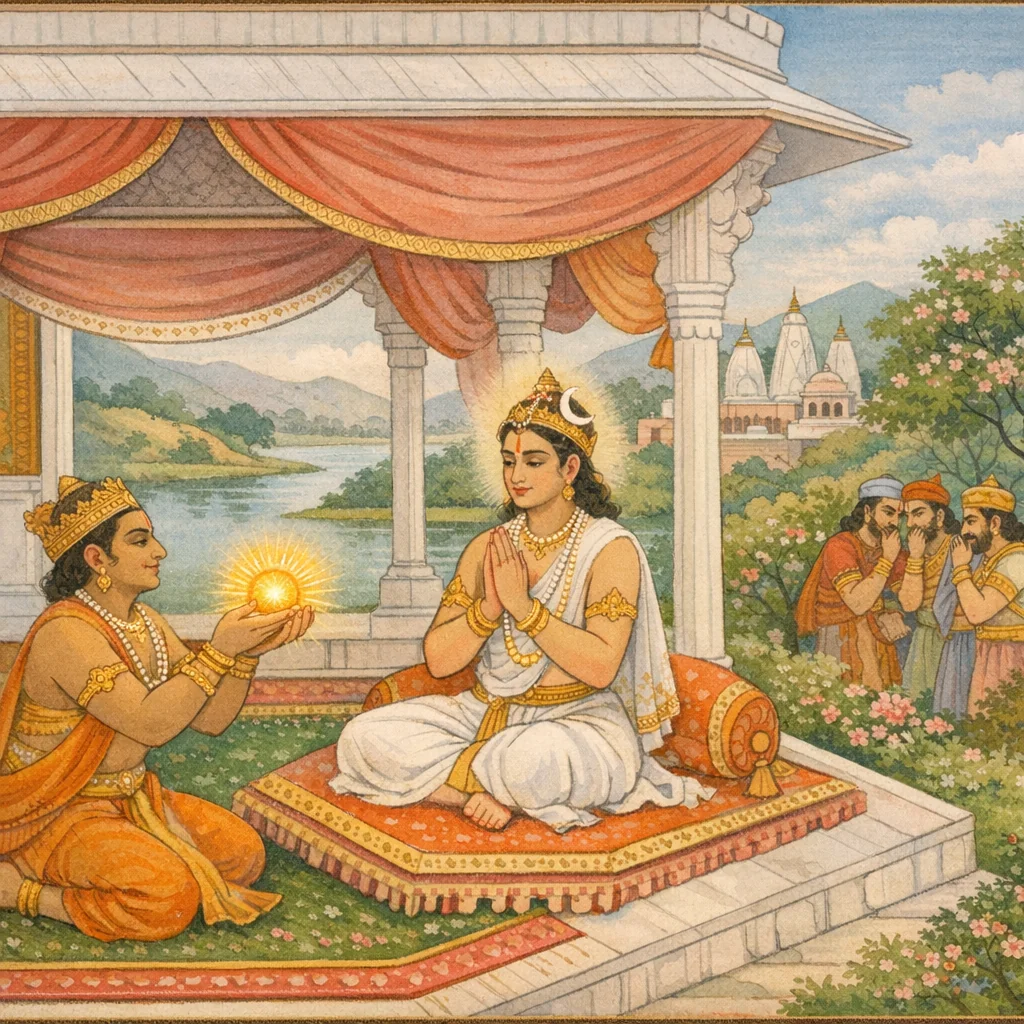
महाकालज्योतिर्लिङ्गमाहात्म्ये चन्द्रसेन-चिन्तामणि-प्रसङ्गः (Mahākāla Jyotirliṅga Māhātmya: The Episode of King Candrasena and the Cintāmaṇi)
Adhyāya 17 unfolds as a question-and-answer: the ṛṣis ask Sūta to restate the greatness of the Protector connected with the Mahākāla jyotirliṅga and the glory of devotees. Sūta narrates an exemplum from Ujjayinī, portraying King Candrasena as śāstra-learned, self-controlled, and steadfast as a Śiva-bhakta. His bond with Maṇibhadra, a prominent gaṇa of Girīśa, becomes pivotal when Maṇibhadra bestows the Cintāmaṇi—sun-bright and auspicious even by mere remembrance, sight, or hearing. The gem’s radiance is said to transmute base things into gold, and the king’s public splendor provokes political envy. Other kings, driven by matsara and craving, attempt to seize the divine gift through varied stratagems. The chapter’s inner teaching shows that worldly tejas, wealth, and prestige attract hostility, while true safety lies in Śiva’s protection at Mahākāla and in unwavering bhakti, not in portable talismans.
Shlokas
Verse 1
ऋषय ऊचुः । महाकालसमाह्वस्थज्योतिर्लिंगस्य रक्षिणः । भक्तानां महिमानं च पुनर्ब्रूहि महामते
The sages said: “O great-minded one, please tell again the glory of the devotees, and also of the protecting power associated with the Jyotirliṅga renowned as Mahākāla.”
Verse 2
सूत उवाच । शृणुतादरतो विप्रो भक्तरक्षाविधायिनः । महाकालस्य लिंगस्य माहात्म्यं भक्तिवर्द्धनम्
Sūta said: “O Brahmin sages, listen with reverence to the glory of Mahākāla’s Liṅga—He who ordains the protection of devotees—(a narration) that increases devotion.”
Verse 3
उज्जयिन्यामभूद्राजा चन्द्रसेनाह्वयो महान् । सर्वशास्त्रार्थतत्त्वज्ञश्शिवभक्तो जितेन्द्रियः
In Ujjayinī there lived a great king named Candrasena—one who knew the true purport of all the śāstras, was a devoted worshipper of Lord Śiva, and had mastered his senses.
Verse 4
तस्याभवत्सखा राज्ञो मणिभद्रो गणो द्विजाः । गिरीशगणमुख्यश्च सर्वलोकनमस्कृतः
O twice-born sages, the king had as his friend Maṇibhadra, a gaṇa of Girīśa (Lord Śiva)—a foremost leader among Śiva’s attendants, revered and saluted by all the worlds.
Verse 5
एकदा स गणेन्द्रो हि प्रसन्नास्यो महामणिम् । मणिभद्रो ददौ तस्मै चिंतामणिमुदारधीः
Once, that lord of the Gaṇas, with a joyful face, bestowed upon him a great jewel—the noble-minded Maṇibhadra gave him the exalted wish-fulfilling gem, the Cintāmaṇi.
Verse 6
स वै मणिः कौस्तुभवद्द्योतमानोर्कसन्निभः । ध्यातो दृष्टः श्रुतो वापि मंगलं यच्छति ध्रुवम्
That gem indeed—radiant like the Kaustubha and brilliant as the sun—surely bestows auspiciousness, whether it is meditated upon, seen, or even merely heard of.
Verse 7
तस्य कांतितलस्पृष्टं कांस्यं ताम्रमयं त्रपु । पाषाणादिकमन्यद्वा द्रुतं भवति हाटकम्
Whatever is touched by the surface of its radiant splendor—whether bronze, copper, tin, or even stone and the like—swiftly becomes gold.
Verse 8
स तु चिन्तामणिं कंठे बिभ्रद्राजा शिवाश्रयः । चन्द्रसेनो रराजाति देवमध्येव भानुमान्
That king Chandrasena—having taken refuge in Lord Śiva—wore the wish-fulfilling gem (Cintāmaṇi) upon his neck; and he shone forth among the gods like the radiant sun itself.
Verse 9
श्रुत्वा चिन्तामणिग्रीवं चन्द्रसेनं नृपोत्तमम् । निखिलाः क्षितिराजानस्तृष्णाक्षुब्धहृदोऽभवन्
Hearing of Candrasena—the foremost of kings, famed as “Cintāmaṇigrīva” (the jewel-throated one)—all the rulers of the earth became inwardly agitated, their hearts churned by craving.
Verse 10
नृपा मत्सरिणस्सर्वे तं मणिं चन्द्रसेनतः । नानोपायैरयाचंत देवलब्धमबुद्धयः
All the kings, consumed by envy, tried by various means to beg that jewel from Candrasena—foolish men, for it had been obtained through the grace of the gods.
Verse 11
सर्वेषां भूभृतां याञ्चा चन्द्रसेनेन तेन वै । व्यर्थीकृता महाकालदृढभक्तेन भूसुराः
O brāhmaṇas, the petitions of all the ruling kings were rendered fruitless by that Candrasena—an unwavering devotee, firmly devoted to Mahākāla.
Verse 12
ते कदर्थीकृतास्सर्वे चन्द्रसेनेन भूभृता । राजानस्सर्वदेशानां संरम्भं चक्रिरे तदा
All those kings, humiliated by King Candrasena, then became enraged and stirred up hostility—rulers from many regions joining in that fury.
Verse 13
अथ ते सर्वराजानश्चतुरंगबलान्विताः । चन्द्रसेनं रणे जेतुं संबभूवुः किलोद्यताः
Then all those kings—equipped with the fourfold army—became fully bent on conquering Candrasena in battle.
Verse 14
ते तु सर्वे समेता वै कृतसंकेतसंविदः । उज्जयिन्याश्चतुर्द्वारं रुरुधुर्बहुसैनिकाः
Then they all assembled together, their plan already fixed by mutual agreement; with many soldiers they blocked the four gates of Ujjayinī.
Verse 15
संरुध्यमानां स्वपुरीं दृष्ट्वा निखिल राजभिः । तमेव शरणं राजा महाकालेश्वरं ययौ
Seeing his own city besieged by all the kings, the king took refuge in Mahākāleśvara alone and went to Him for protection.
Verse 16
निर्विकल्पो निराहारस्स नृपो दृढनिश्चयः । समानर्च महाकालं दिवा नक्तमनन्यधीः
That king, free from wavering, fasting and firm in resolve, worshipped Mahākāla with unwavering devotion—by day and by night—his mind fixed on none other.
Verse 17
ततस्स भगवाञ्छंभुर्महाकालः प्रसन्नधीः । तं रक्षितुमुपायं वै चक्रे तं शृणुतादरात्
Then Bhagavān Śambhu—Mahākāla, whose mind was serene and gracious—devised a sure means to protect him. Listen to that remedy with reverent attention.
Verse 18
तदैव समये गोपि काचित्तत्र पुरोत्तमे । चरंती सशिशुर्विप्रा महाकालांतिकं ययौ
Just at that very time, in that excellent city, a certain cowherd woman—who was also a brāhmaṇa woman—was walking along with her infant child, and she went near Mahākāla.
Verse 19
पञ्चाब्दवयसं बालं वहन्ती गतभर्तृका । राज्ञा कृतां महाकालपूजां सापश्यदादरात्
A widow, carrying a five-year-old child, beheld with reverent attention the worship of Mahākāla that was being performed by the king.
Verse 20
सा दृष्ट्वा सुमहाश्चर्यां शिवपूजां च तत्कृताम् । प्रणिपत्य स्वशिविरं पुनरेवाभ्यपद्यत
Having seen that most wondrous worship of Lord Śiva performed by him, she bowed down in reverence and then returned again to her own camp.
Verse 21
तत्सर्वमशेषेण स दृष्ट्वा बल्लवीसुतः । कुतूहलेन तां कर्त्तुं शिवपूजां मनोदधे
Seeing all of that in its entirety, the son of the cowherd woman, stirred by eager curiosity, formed in his heart the resolve to perform that worship of Lord Śiva.
Verse 22
आनीय हृद्यं पाषाणं शून्ये तु शिविरांतरे । अविदूरे स्वशिबिराच्छिवलिगं स भक्तितः
Bringing a pleasing stone, he devoutly set up a Śiva-liṅga in an unoccupied spot within the camp, not far from his own encampment, with heartfelt devotion.
Verse 23
गन्धालंकारवासोभिर्धूपदीपाक्षतादिभिः । विधाय कृत्रिमैर्द्रव्यैर्नैवेद्यं चाप्यकल्पयत्
With fragrances, ornaments, and garments—along with incense, lamps, unbroken rice (akṣata), and other offerings—he arranged the worship. Using artificially prepared items, he also prepared the naivedya, the food-offering for Lord Śiva.
Verse 24
भूयोभूयस्समभ्यर्च्य पत्रैः पुष्पैर्मनोरमैः । नृत्यं च विविधं कृत्वा प्रणनाम पुनःपुनः
Again and again he worshipped (Śiva) with charming leaves and delightful flowers; and having performed various dances, he repeatedly bowed down in prostration.
Verse 25
एतस्मिन्समये पुत्रं शिवासक्तसुचेतसम् । प्रणयाद्गोपिका सा तं भोजनाय समाह्वयत्
At that very time, the cowherd woman, moved by tender love, called her son—whose mind was deeply devoted to Śiva—to come and partake of his meal.
Verse 26
यदाहूतोऽपि बहुशश्शिवपूजाक्तमानसः । बालश्च भोजनं नैच्छत्तदा तत्र ययौ प्रसूः
Though he was called again and again, the boy—his mind absorbed in the worship of Śiva—did not wish to eat. Then his mother went there to him.
Verse 27
तं विलोक्य शिवस्याग्रे निषण्णं मीलितेक्षणम् । चकर्ष पाणिं संगृह्य कोपेन समताडयत्
Seeing him seated before Lord Śiva with his eyes closed, the other person seized his hand, dragged him away, and—overcome by anger—struck him.
Verse 28
आकृष्टस्ताडितश्चापि नागच्छत्स्वसुतो यदा । तां पूजां नाशयामास क्षिप्त्वा लिंगं च दूरतः
When his own son, though dragged and even beaten, still would not come, he destroyed that act of worship—hurling the Śiva-liṅga far away.
Verse 29
हाहेति दूयमानं तं निर्भर्त्स्य स्वसुतं च सा । पुनर्विवेश स्वगृहं गोपी क्रोधसमन्विता
Crying out “Alas! Alas!” and burning with distress, she scolded her own son; then the cowherd woman—overcome with anger—entered her house again.
Verse 30
मात्रा विनाशितां पूजां दृष्ट्वा देवस्य शूलिनः । देवदेवेति चुक्रोश निपपात स बालकः
Seeing that his mother had ruined the worship of the Trident-bearing Lord (Śiva), the boy cried, “O God of gods!” and fell down in anguish.
Verse 31
प्रनष्टसंज्ञः सहसा स बभूव शुचाकुलः । लब्धसंज्ञो मुहूर्तेन चक्षुषी उदमीलयत्
Suddenly he lost consciousness, overwhelmed by grief. After a short while he regained awareness and opened his eyes.
Verse 32
तदैव जातं शिबिरं महाकालस्य सुन्दरम् । ददर्श स शिशुस्तत्र शिवानुग्रहतोऽचिरात्
At that very moment, the beautiful encampment of Mahākāla came into being. There, that child beheld it before long—through the gracious favor of Lord Śiva.
Verse 33
हिरण्मयबृहद्द्वारं कपाटवरतोरणम् । महार्हनीलविमलवज्रवेदीविराजितम्
It had a vast doorway gleaming like gold, with splendid doors and an excellent ornamental arch; it shone with a precious, deep-blue, immaculate diamond-like altar-platform.
Verse 34
संतप्तहेमकलशैर्विचित्रैर्बहुभिर्युतम् । प्रोद्भासितमणिस्तंभैर्बद्धस्फटिकभूतलैः
It was adorned with many wondrous urns of refined gold, and it shone with radiant jeweled pillars, its ground inlaid and set with crystal slabs.
Verse 35
तन्मध्ये रत्नलिंगं हि शंकरस्य कृपानिधे । स्वकृतार्चनसंयुक्तमपश्यद्गोपिकासुतः
Within it, O treasure-house of Śaṅkara’s compassion, the son of the cowherd-woman beheld a jewel-like Liṅga of Lord Śaṅkara—already joined with the worship that he himself had performed.
Verse 36
स दृष्ट्वा सहसोत्थाय शिशुर्विस्मितमानसः । संनिमग्न इवासीद्वै परमानंदसागरे
On seeing Him, the child at once sprang up, his mind filled with wonder; and he remained as though immersed in an ocean of supreme bliss.
Verse 37
ततः स्तुत्वा स गिरिशं भूयोभूयः प्रणम्य च । सूर्ये चास्तं गते बालो निर्जगाम शिवालयात्
Then, having praised Girīśa (Lord Śiva) and bowing again and again, the boy—when the sun had set—departed from the abode of Śiva.
Verse 38
अथापश्यत्स्वशिबिरं पुरंदरपुरोपमम् । सद्यो हिरण्मयीभूतं विचित्रं परमोज्ज्वलम्
Then he beheld his own encampment, resembling the city of Purandara (Indra). In an instant it had become golden—wondrous in form and supremely radiant.
Verse 39
सोन्तर्विवेश भवनं सर्वशोभासमन्वितम् । मणिहेमगणाकीर्ण मोदमानो निशामुखे
At the very onset of night, he entered the mansion—endowed with every kind of splendor—strewn with clusters of jewels and gold, and he rejoiced within it.
Verse 40
तत्रापश्यत्स्वजननीं स्वपंतीं दिव्यलक्षणाम् । रत्नालंकारदीप्तांगीं साक्षात्सुरवधूमिव
There he beheld his own mother, asleep and adorned with divine auspicious marks; her limbs shone with jeweled ornaments, as though she were a celestial lady among the gods.
Verse 41
अथो स तनयो विप्राश्शिवानुग्रहभाजनम् । जवेनोत्थापयामास मातरं सुखविह्वलः
Then that son—O brāhmaṇas—having become a worthy vessel of Śiva’s grace, swiftly raised up his mother, who was overwhelmed with joy.
Verse 42
सोत्थिताद्भुतमालक्ष्यापूर्वं सर्वमिवाभवत् । महानंदसुमग्ना हि सस्वजे स्वसुतं च तम्
Seeing that wondrous event that had just arisen, everything appeared as though wholly unprecedented. Immersed in great bliss, she embraced that very son of hers.
Verse 43
श्रुत्वा पुत्रमुखात्सर्वं प्रसादं गिरिजापतेः । प्रभुं विज्ञापयामास यो भजत्यनिशं शिवम्
Having heard from his son’s mouth the full account of the gracious favor of Girijā’s Lord (Śiva), he then informed the sovereign Lord—affirming that one who worships Śiva unceasingly attains His grace.
Verse 44
स राजा सहसागत्य समाप्तनियमो निशि । ददर्श गोपिकासूनोः प्रभावं शिवतोषणम्
That king, having suddenly arrived at night after completing his vowed observances, beheld the wondrous power of the son of the cowherdess—power that brought satisfaction to Lord Śiva.
Verse 45
दृष्ट्वा महीपतिस्सर्वं तत्सामात्यपुरोहितः । आसीन्निमग्नो विधृतिः परमानंदसागरे
Seeing all this, the king—together with his ministers and family priest—became utterly absorbed, as though plunged into the ocean of supreme bliss.
Verse 46
प्रेम्णा वाष्पजलं मुञ्चञ्चन्द्रसेनो नृपो हि सः । शिवनामोच्चरन्प्रीत्या परिरेभे तमर्भकम्
King Candrasena, shedding tears of love, joyfully uttered Śiva’s Name and, with heartfelt affection, embraced that little child.
Verse 47
महामहोत्सवस्तत्र प्रबभूवाद्भुतो द्विजाः । महेशकीर्तनं चक्रुस्सर्वे च सुखविह्वलाः
O brāhmaṇas, there an extraordinary grand festival arose. All of them, overwhelmed with joy, performed the kīrtana—devotional singing—of Maheśa (Lord Śiva).
Verse 48
एवमत्यद्भुताचाराच्छिवमाहात्म्यदर्शनात् । पौराणां सम्भ्रमाच्चैव सा रात्रिः क्षणतामगात्
Thus, because of that supremely wondrous conduct and the direct beholding of Śiva’s greatness, and also due to the citizens’ awestruck excitement, that night passed as though it were but a single moment.
Verse 49
अथ प्रभाते युद्धाय पुरं संरुध्य संस्थिताः । राजानश्चारवक्त्रेभ्यश्शुश्रुवुश्चरितं च तत्
Then, at daybreak, they stood ready for battle, having surrounded and blockaded the city. And the kings, from the mouths of their spies and messengers, heard the account of all that had occurred.
Verse 50
ते समेताश्च राजानः सर्वे येये समागताः । परस्परमिति प्रोचुस्तच्छ्रुत्वा चकित अति
Then all those kings who had assembled there came together and spoke among themselves; and on hearing that, they became exceedingly astonished.
Verse 51
राजान ऊचुः । अयं राजा चन्द्रसेनश्शिवभक्तोति दुर्जयः । उज्जयिन्या महाकालपुर्याः पतिरनाकुलः
The kings said: “This king Candrasena is a devotee of Śiva and is therefore unconquerable. He is the untroubled lord of Ujjayinī, the city of Mahākāla.”
Verse 52
ईदृशाश्शिशवो यस्य पुर्य्यां संति शिवव्रताः । स राजा चन्द्रसेनस्तु महाशंकरसेवकः
In whose city even the children are such—steadfast observers of Śiva’s vows—he indeed is King Candrasena, a great servant and devotee of Mahāśaṅkara.
Verse 53
नूनमस्य विरोधेन शिवः क्रोधं करिष्यति । तत्क्रोधाद्धि वयं सर्वे भविष्यामो विनष्टकाः
Surely, by opposing him, Lord Śiva will become wrathful; and from that wrath, indeed, we all will end up utterly ruined.
Verse 54
तस्मादनेन राज्ञा वै मिलापः कार्य एव हि । एवं सति महेशानः करिष्यति कृपां पराम्
Therefore, a meeting with this king must certainly be arranged; for when this is done, Lord Maheśāna (Śiva) will bestow His supreme grace.
Verse 55
सूत उवाच । इति निश्चित्य ते भूपास्त्यक्तवैरास्सदाशयाः । सर्वे बभूवुस्सुप्रीता न्यस्तशस्त्रास्त्रपाणयः
Sūta said: Having thus resolved, those kings—abandoning hostility and holding noble intentions—became fully pleased; laying aside their weapons and missiles, they stood with hands no longer bearing arms.
Verse 56
विविशुस्ते पुरीं रम्यां महाकालस्य भूभृतः । महाकालं समानर्चुश्चंद्रसेनानुमोदिताः
Those kings entered the lovely city of Mahākāla; and, with King Candrasena’s approval, they duly worshipped Mahākāla—Śiva, the great Lord of Time.
Verse 57
ततस्ते गोपवनिता गेहं जग्मुर्महीभृतः । प्रसंशंतश्च तद्भाग्यं सर्वे दिव्यमहोदयम्
Then those cowherd women, together with the kings, went to their homes, all praising that extraordinary fortune—an auspicious, truly divine rise of grace.
Verse 58
ते तत्र चन्द्रसेनेन प्रत्युद्गम्याभिपूजिताः । महार्हविष्टरगताः प्रत्यनंदन्सुविस्मिताः
There, they were received by Candrasena, who came forward to welcome them and honored them duly. Seated upon highly valued and excellent seats, they rejoiced in return, filled with wonder.
Verse 59
गोपसूनोः प्रसादात्तत्प्रादुर्भूतं शिवालयम् । संवीक्ष्य शिवलिंगं च शिवे चकुः परां मतिम्
By the grace of the son of the cowherd, that Śiva-temple manifested. Beholding the Śiva-liṅga as well, they fixed their highest resolve upon Śiva alone.
Verse 60
ततस्ते गोपशिशवे प्रीता निखिलभूभुजः । ददुर्बहूनि वस्तूनि तस्मै शिवकृपार्थिनः
Then all the kings of the earth, pleased with that young cowherd boy, bestowed many gifts upon him—seeking the compassionate grace of Lord Śiva.
Verse 61
येये सर्वेषु देशेषु गोपास्तिष्ठंति भूरिशः । तेषां तमेव राजानं चक्रिरे सर्वपार्थिवाः
In every region, wherever many cowherds dwelt, all the rulers upon the earth chose that very one among them and installed him as their king.
Verse 62
अथास्मिन्नन्तरे सर्वैस्त्रिदशैरभिपूजितः । प्रादुर्बभूव तेजस्वी हनूमान्वानरेश्वरः
Then, in that very moment, Hanūmān—the radiant lord of the Vānaras—manifested, duly honored by all the gods.
Verse 63
ते तस्याभिगमादेव राजानो जातसंभ्रमाः । प्रत्युत्थाय नमश्चकुर्भक्तिनम्रात्ममूर्तयः
At his very approach, the kings were filled with reverent awe. Rising up to receive him, they bowed in salutation—embodiments of humility made gentle by devotion.
Verse 64
तेषां मध्ये समासीनः पूजितः प्लवगेश्वरः । गोपात्मजं तमालिंग्य राज्ञो वीक्ष्येदमब्रवीत्
Seated in their midst and duly honored, the lord of the Vānaras embraced that son of the cowherds. Then, looking toward the king, he spoke these words.
Verse 65
हनूमानुवाच । सर्वे शृण्वन्तु भद्रं वो राजानो ये च देहिनः । ऋते शिवं नान्यतमो गतिरस्ति शरीरिणाम्
Hanuman said: “May auspiciousness be yours—let all listen, O kings and all embodied beings. Apart from Shiva, there is no other true refuge or final goal for those who dwell in a body.”
Verse 66
एवं गोपसुतो दिष्ट्या शिवपूजां विलोक्य च । अमंत्रेणापि संपूज्य शिवं शिवमवाप्तवान्
Thus, by good fortune, the cowherd’s son beheld the worship of Lord Shiva; and even worshipping Shiva without any mantra, he attained Shiva—auspiciousness and liberation through union with the Lord.
Verse 67
एष भक्तवरश्शंभोर्गोपानां कीर्तिवर्द्धनः । इह भुक्त्वाखिलान्भोगानंते मोक्षमवाप्स्यति
He is the foremost devotee of Śambhu, an increaser of the cowherds’ fame. Here he will enjoy all delights, and in the end he will attain liberation (mokṣa).
Verse 68
अस्य वंशेऽष्टमो भावी नन्दो नाम महायशाः । प्राप्स्यते तस्य पुत्रत्वं कृष्णो नारायणस्स्वयम्
In this lineage, the eighth in succession shall be Nanda, of great renown. And Lord Nārāyaṇa Himself, as Kṛṣṇa, will be born as his son.
Verse 69
अद्यप्रभृति लोकेस्मिन्नेष गोप कुमारकः । नाम्ना श्रीकर इत्युच्चैर्लोकख्यातिं गमिष्यति
From this day onward in this world, this young cowherd boy shall be known by the name Śrīkara, and he will attain wide renown among the people.
Verse 70
सूत उवाच । एवमुक्त्वाञ्जनीसूनुः शिवरूपो हरीश्वरः । सर्वान्राज्ञश्चन्द्रसेनं कृपादृष्ट्या ददर्श ह
Sūta said: Having spoken thus, Anjanī’s son—Hariśvara, bearing the very form of Śiva—then looked upon everyone, and upon King Candrasena as well, with a compassionate gaze.
Verse 71
अथ तस्मै श्रीकराय गोपपुत्राय धीमते । उपादिदेश सुप्रीत्या शिवाचारं शिवप्रियम्
Then, with great affection, he instructed Śrīkara, the wise cowherd’s son, in Śiva’s sacred conduct—those disciplines and observances beloved of Lord Śiva.
Verse 72
हनूमानथ सुप्रीतः सर्वेषां पश्यतां द्विजः । चन्द्रसेनं श्रीकरं च तत्रैवान्तरधी यत
Then Hanumān, wholly delighted, vanished from that very place before the eyes of all. And the brahmin—together with Candrasena and Śrīkara—also disappeared there itself.
Verse 73
तं सर्वे च महीपालास्संहृष्टाः प्रतिपूजिताः । चन्द्रसेनं समामंत्र्य प्रतिजग्मुर्यथागतम्
All those kings, delighted and duly honoured, took leave of Candrasena and then returned to their own places, just as they had come.
Verse 74
श्रीकरोपि महातेजा उपदिष्टो हनूमता । ब्राह्मणैस्सहधर्मज्ञैश्चक्रे शम्भोस्समर्हणम्
Śrīkara too, radiant with great splendour and instructed by Hanumān, together with Brahmins who knew dharma, performed the proper worship and honouring of Lord Śambhu (Śiva).
Verse 75
चन्द्रसेनो महाराजः श्रीकरो गोपबालकः । उभावपि परप्रीत्या महाकालं च भेजतुः
King Candrasena and the cowherd boy Śrīkara—both with supreme devotion—took refuge in Lord Mahākāla, worshipping and serving Him.
Verse 76
कालेन श्रीकरस्सोपि चन्द्रसेनश्च भूपतिः । समाराध्य महाकालं भेजतुः परमं पदम्
In due course, Śrīkara and King Candrasena, having duly worshipped Mahākāla (Lord Śiva), attained the supreme state.
Verse 77
एवंविधो महाकालश्शिवलिंगस्सतां गतिः । सर्वथा दुष्टहंता च शंकरो भक्तवत्सलः
Such is this Mahākāla—this Śiva-liṅga—the refuge and final goal of the virtuous. In every way he is the destroyer of the wicked; Śaṅkara is ever tender toward his devotees.
Verse 78
इदं पवित्रं परमं रहस्यं सर्वसौख्यदम् । आख्यानं कथितं स्वर्ग्यं शिवभक्तिविवर्द्धनम्
This sacred narrative is the supreme secret; it bestows every happiness. It has been told as a heaven-leading account, and it increases devotion to Lord Śiva.
Frequently Asked Questions
It presents a Mahākāla-centered exemplum: Candrasena receives the Cintāmaṇi from Maṇibhadra, after which rival kings—stirred by envy—seek to seize it, setting up a theological lesson that Śiva’s protection and devotion outweigh unstable political power.
The Cintāmaṇi symbolizes condensed ‘auspicious power’ (maṅgala/tejas) that can transmute conditions, yet also exposes the bearer to the karmic-social forces of craving and jealousy; the jyotirliṅga context implies that enduring safety and liberation are grounded in Śiva’s presence and bhakti, not in externalized magical capital.
Śiva is highlighted as Mahākāla associated with a jyotirliṅga (a localized, luminous manifestation), and his gaṇa Maṇibhadra functions as an extension of Śiva’s protective agency within the narrative economy.