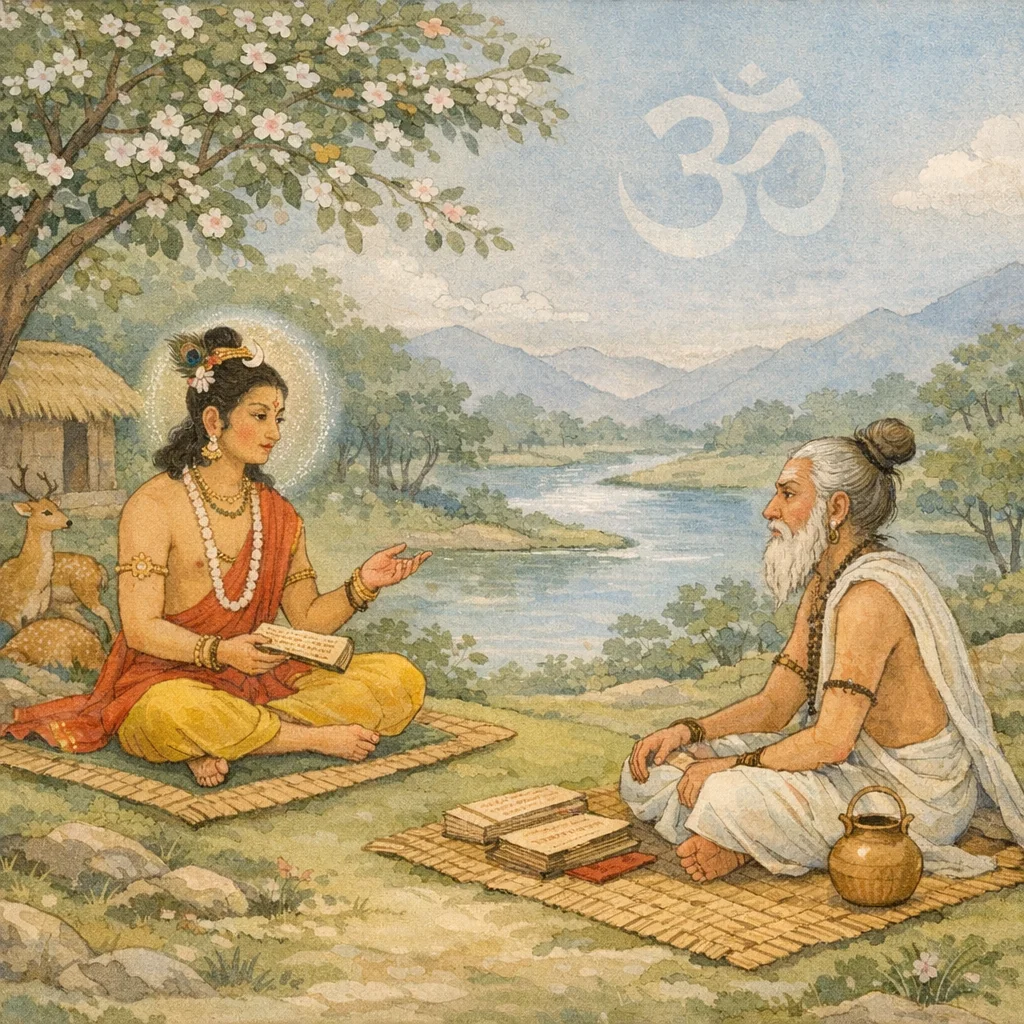
प्रणवार्थ-शिवतत्त्व-निर्णयः (The Determination of Śiva as the Meaning of Praṇava)
Adhyāya 12 is framed as an authoritative instruction to the sage Vāmadeva, first praising his Śiva-bhakti and mastery of the śāstras, and then stating that the teaching is spoken for loka-anugraha (the world’s benefit) even though he is already learned. It diagnoses a spiritual-cognitive confusion: beings, bewildered by many śāstras and deceived by Parameśvara’s manifold māyā, fail to recognize the supreme reality that is the true purport of the praṇava (Om). The chapter then asserts its theological thesis: the praṇavārtha is Śiva himself, affirmed as primary in śruti, smṛti, purāṇa, and āgama. Upaniṣadic markers describe the Supreme as that which speech and mind cannot reach; the source from which the cosmos first proceeds, including Brahmā/Viṣṇu/Indra and the bhūtas and indriyas; the unborn and unproduced; and that wherein neither lightning, sun, nor moon shines—yet by whose radiance all shines. The argument culminates by identifying this self-luminous Absolute with Sarveśvara, integrating nirguṇa/saguṇa Brahman language into a Śaiva conclusion centered on the praṇava and divine lordship (īśvaratva).
Shlokas
Verse 1
श्रीब्रह्मण्य उवाच । साधुसाधु महाभाग वामदेव मुनीश्वर । त्वमतीव शिवे भक्तश्श्विज्ञानवतांवरः
Śrī Brahmaṇya said: “Well done, well done, O greatly fortunate Vāmadeva, lord among sages. You are exceedingly devoted to Śiva, and you are foremost among those who possess true knowledge of Śiva.”
Verse 2
त्वया त्वविदितं किंचिन्ना स्ति लोकेषु कुत्रचित् । तथापि तव वक्ष्यामि लोकानुग्रहकारिणः
Nothing whatsoever anywhere in the worlds is unknown to you. Yet, for the welfare of the worlds, I shall still speak to you of those matters that bestow grace upon all beings.
Verse 3
लोकेस्मिन्पशवस्सर्व्वे नानाशास्त्रविमोहिताः । वञ्चिताः परमेशस्य माययातिविचित्रया
In this world, all embodied souls (paśus) become deluded by the many divergent doctrines and are thus led astray by the exceedingly wondrous Māyā of Parameśvara (Lord Śiva).
Verse 4
न जानति परं साक्षात्प्रणवार्थम्महेश्वरम् । सगुणन्निर्गुणं ब्रह्म त्रिदेवजनकम्परम्
He does not truly know the Supreme—Mahādeva Himself—who is directly the very meaning of Praṇava (Oṁ): the transcendent Brahman who is both with attributes and beyond attributes, the highest Reality, the Father (source) of the three gods.
Verse 5
दक्षिणम्बाहुमुद्धृत्य शपथम्प्रब्रवीमि ते । सत्यं सत्यं पुनस्सत्यं सत्यं सत्यं पुनः पुनः
Raising my right arm, I declare an oath to you: it is true—true indeed—true again; true, true, again and again.
Verse 6
प्रणवार्थश्शिवः साक्षात्प्राधान्येन प्रकीर्त्तितः । श्रुतिषु स्मृतिशास्त्रेषु पुराणेष्वागमेषु च
The meaning of Praṇava (Oṁ) is verily Śiva Himself; this is proclaimed as primary and foremost in the Śrutis, in the Smṛti-śāstras, in the Purāṇas, and in the Āgamas.
Verse 7
यतो वाचो निवर्त्तन्ते अप्राप्य मनसा सह । आनन्दं यस्य वे विद्वान्न बिभेति कुतश्च न
That Reality from which speech returns—together with the mind—unable to reach It: the wise knower of that Bliss (Ānanda) fears nothing whatsoever.
Verse 8
यस्माज्जगदिदं सर्वं विधिविष्ण्विन्द्रपूर्वकम् । सह भूतेन्द्रियग्रामैः प्रथमं सम्प्रसूयते
From whom this entire universe first comes forth—together with the hosts of elements and the senses—preceded by Brahmā (the Ordainer), Viṣṇu, and Indra.
Verse 9
न सम्प्रसूयते यो वै कुतश्चन कदाचन । यस्मिन्न भासते विद्युन्न न सूर्यो न चन्द्रमाः
The Supreme Lord (Śiva) is He who is never born—at no time, from nowhere; within Him neither lightning shines, nor the sun, nor the moon—beyond all created lights and beyond all becoming.
Verse 10
यस्य भासो विभातीदञ्जगत्सर्वं समन्ततः । सर्व्वैश्वर्य्येण सम्पन्नो नाम्ना सर्व्वेश्वरस्स्वयम्
By whose radiance this entire universe shines on every side—He, endowed with all divine sovereignties, is Himself known as Sarveśvara, the Lord of all.
Verse 11
यो वै मुमुक्षुभिर्ध्येयः शम्भुराकाशमध्यगः । सर्वव्यापी प्रकाशात्मा भासरूपो हि चिन्मयः
Śambhu, abiding in the very midst of space, is indeed the One to be meditated upon by seekers of liberation. He is all-pervading; His essence is luminous awareness—truly, His form is radiance, for He is of the nature of pure Consciousness.
Verse 12
इति श्रीशिवमहापुराणे षष्ठ्यां कैलाससंहितायां संन्यासविधिवर्णनं नाम द्वादशोऽध्यायः
Thus, in the Śrī Śiva Mahāpurāṇa, in the Sixth (Book), the Kailāsa-saṃhitā, ends the twelfth chapter, entitled “The Description of the Procedure of Saṃnyāsa (Renunciation).”
Verse 13
तदीयन्त्रिविधंरूपं स्थूलं सूक्ष्मं परन्ततः । ध्येयं मुमुक्षुभिर्नित्यं क्रमतो योगिभिर्मुने
O sage, His reality is threefold in form—gross, subtle, and ultimately transcendent. Therefore, seekers of liberation should meditate upon it continually, with yogins proceeding step by step in due order.
Verse 14
निष्कलस्सर्व्वदेवानामादिदेवस्सनातनः । ज्ञानक्रियास्वभावो यः पर मात्मेति गीयते
He is the partless (niṣkala) One, the primordial and eternal Deity of all the gods. He whose very nature is consciousness (jñāna) and divine activity (kriyā) is sung of as the Supreme Self (Paramātmā).
Verse 15
तस्य देवाधिदेवस्य मूर्त्तिस्साक्षात्सदाशिवः । पञ्चमंत्रतनुर्देवः कलापञ्चकविग्रहः
The manifest form of that God of gods is verily Sadāśiva Himself—He whose very body is constituted of the five sacred mantras, and whose embodiment is formed of the five divine kalās (powers/parts).
Verse 16
शुद्धस्फटिकसंकाशः प्रसन्नः शीतलद्युतिः । पंचवक्त्रो दशभुजस्त्रिपंचनयनः प्रभुः
The Lord appeared like pure crystal—serene, with a cool and soothing radiance. He was the sovereign Master, five-faced, ten-armed, and endowed with fifteen eyes.
Verse 17
ईशानमुकुटोपेतः पुरुषास्यः पुरातनः । अघोरहृदयो वामदेवगुह्यप्रदेशवान्
He bears the crown of Īśāna; His face is that of the primeval Puruṣa. His heart is Aghora, and the hidden region is Vāmadeva—thus is the Lord’s sacred form taught through these divine correspondences.
Verse 18
सद्यपादश्च तन्मूर्त्तिः साक्षात्सकलनिष्कलः । सर्व्वज्ञत्वादिषट्शक्तिषडंगीकृतविग्रहः
That very Form is called Sadyapāda—He who is directly both with attributes and beyond attributes. His embodied manifestation is constituted by the six powers beginning with omniscience, and is integrated with the sixfold limbs of divine expression.
Verse 19
शब्दादिशक्तिस्फुरितहृत्पंकजविराजितः । स्वशक्त्या वामभागे तु मनोन्मन्या विभूषितः
He shines with the lotus of his heart awakened and radiant through the powers beginning with sound (Śabda). And on his left side he is adorned by his own Śakti—Manonmanī—who transcends the mind, revealing the Lord as Pati inseparable from his divine Power.
Verse 20
मन्त्रादिषड्विधार्थानामर्थोपन्याससार्गतः । समष्टिव्यष्टिभावार्थं वक्ष्यामि प्रणवात्मकम्
Drawing upon the essential purport of the presented meanings of the sixfold categories beginning with mantra, I shall now explain the Pranava (Oṁ) as embodying the meaning of both the collective (cosmic totality) and the individual (particular being).
Verse 21
उपदेशक्रमो ह्यादौ वक्तव्यश्श्रूयतामयम् । चातुर्व्वर्ण्यं हि लोकेस्मिन्प्रसिद्धम्मानुषे मुने
First, the proper sequence of instruction should be stated—listen to it now. For in this human world, O sage, the fourfold order of society (the four varṇas) is well established.
Verse 22
त्रैवर्णिकानामेवात्र श्रुत्याचारसमन्वयः । शुश्रूषामात्रसारा हि शूद्राः श्रुतिबहिष्कृताः
Here, the concordance of Vedic revelation (Śruti) and customary conduct (ācāra) pertains only to the three twice-born classes. The Śūdras, being excluded from Vedic study, have attentive service as their principal duty.
Verse 23
त्रैवर्णिकानां सर्व्वेषां स्वस्वाश्रमरतात्मनाम् । श्रुतिस्मृत्युदितो धर्मोऽनुष्ठेयो नापरः क्वचित्
For all the twice-born of the three varṇas, devoted to their respective āśramas, the dharma taught in Śruti and Smṛti alone is to be practiced—never any other, at any time.
Verse 24
श्रुतिस्मृत्युदितं कर्म्म कुर्व्व न्सिद्धिमवाप्स्यति । इत्युक्तम्परमेशेन वेदमार्गप्रदर्शिना
“He who performs the actions enjoined in Śruti and Smṛti attains spiritual accomplishment.” Thus was it declared by Parameśa (Lord Śiva), the revealer of the Vedic path.
Verse 25
वर्णाश्रमाचारपुण्यैरभ्यर्च्य परमेश्वरम् । तत्सायुज्यं गतास्सर्वे बहवो मुनिसत्तमाः
Having worshipped the Supreme Lord (Parameśvara) through the meritorious duties of varṇa and āśrama, many of those foremost sages all attained sāyujya—union in nearness with Him.
Verse 26
ब्रह्मचर्येण मुनयो देवा यज्ञक्रियाध्वना । पितरः प्रजया तृप्ता इति हि श्रुतिरब्रवीत्
Indeed, the Śruti declares: sages are fulfilled through brahmacarya (disciplined continence); the gods are satisfied by the path of sacrificial rites; and the Pitṛs (ancestors) are gratified through progeny. Thus each order is nourished by its proper means—yet all such duties find their higher completion when offered in devotion to Lord Śiva, the supreme Pati who grants liberation beyond all bonds.
Verse 27
एवं ऋणत्रयान्मुक्तो वानप्रस्थाश्रमं गतः । शीतोष्णसुखदुःखादिसहिष्णुर्विजितेन्द्रियः
Thus, freed from the three debts, he enters the stage of life called vānaprastha. Enduring heat and cold, pleasure and pain, and the like, he becomes self-restrained, with the senses brought under control.
Verse 28
तपस्वी विजिताहारो यमाय योगम भ्यसेत् । यथा दृढतरा बुद्धिरविचाल्या भवेत्तथा
Let the ascetic, having mastered his diet, practice yoga for the sake of yama (self-restraint), so that his intellect grows ever firmer and remains unshaken.
Verse 29
एवं क्रमेण शुद्धात्मा सर्व्वकर्म्माणि विन्यसेत् । सन्यस्य सर्व्वकर्म्माणि ज्ञानपूजापरो भवेत्
Thus, step by step, when the self becomes purified, one should lay aside all actions. Having renounced all actions, one should become devoted to the worship that is knowledge—steady contemplation of Śiva, the Lord (Pati), as the liberating Reality.
Verse 30
सा हि साक्षाच्छिवैक्येन जीवन्मुक्तिफलप्रदा । सर्व्वोत्तमा हि विज्ञेया निर्विकारा यतात्म नाम्
For that realization directly bestows the fruit of liberation-while-living (jīvanmukti) through immediate oneness with Śiva. It is to be known as the supreme teaching—changeless, without modification—for those whose selves are disciplined and restrained.
Verse 31
तत्प्रकारमहं वक्ष्ये लोकानुग्रहकाम्यया । तव स्तेहान्महाप्राज्ञ सावधानतया शृणु
Now I shall explain that method, desiring the welfare of the worlds. Out of affection for you, O greatly wise one, listen with full attention.
Verse 32
सर्व्वशास्त्रार्थतत्त्वज्ञं वेदांतज्ञानपारगम् । आचार्य्यमुपगच्छेत्स यतिर्म्मतिमतां वरम्
That wise renunciate should approach a true ācārya—the best among the discerning—who knows the essential truth of the meanings of all śāstras and has fully crossed to mastery in the knowledge of Vedānta.
Verse 33
तत्समीपमुपव्रज्य यथाविधि विचक्षणः । दीर्घदण्डप्रणामाद्यैस्तोषयेद्यत्नतस्सुधीः
Approaching him closely, the discerning and wise devotee should, according to the prescribed rite, diligently please him through acts beginning with daṇḍavat-praṇāma—the long, staff-like prostration—and other forms of reverent worship.
Verse 34
यो गुरु्स्स शिवः प्रोक्तो यश्शिवस्स गुरुस्स्मृतः । इति निश्चित्य मनसा स्वविचारन्निवेदयेत्
He who is declared to be the Guru is verily Śiva, and Śiva Himself is remembered as the Guru. Having firmly ascertained this in the mind, one should humbly present to that Guru one’s own inner discernment and reflection.
Verse 35
लब्धानुज्ञस्तु गुरुणा द्वादशाहं पयोव्रती । शुक्लपक्षे चतुर्थ्यां वा दशम्यां वा विधानतः
Having obtained his guru’s permission, he should observe the milk-vow for twelve days, performing it according to rule—on the fourth lunar day or on the tenth, in the bright fortnight.
Verse 36
प्रातः स्नात्वा विशुद्धात्मा कृतनित्य क्रियस्सुधीः । गुरुमाहूय विधिना नांदीश्राद्धं समारभेत्
Having bathed at dawn and become inwardly pure, the wise one—having completed the daily obligatory observances—should, in accordance with proper rule, invite the guru and then commence the Nāndī-śrāddha rite.
Verse 37
विश्वेदेवाः सत्यवसुसंज्ञावंतः प्रकीर्त्तिताः । देवश्राद्धे ब्रह्मविष्णु महेशाः कथितास्त्रयः
The Viśvedevas are proclaimed as those known by the designation “Satyavasus.” And in the rite of Deva-śrāddha, three are specifically mentioned—Brahmā, Viṣṇu, and Maheśa (Śiva).
Verse 38
ऋषिश्राद्धे तु सम्प्रोक्ता देवक्षेत्रमनुष्यजाः । देवश्राद्धे तु वसुरुद्रादित्यास्सम्प्रकीर्त्तिताः
In the śrāddha offered for the ṛṣis, the recipients are declared to be the deva-class, those born of sacred lineages (kṣetra), and human beings. But in the śrāddha offered for the devas, the Vasus, Rudras, and Ādityas are specifically proclaimed as the recipients.
Verse 39
चत्वारो मानुषश्राद्धे सनकाद्या मुनीश्वराः । भूतश्राद्धे पंच महाभूतानि च ततः परम्
In the śrāddha offered to human ancestors, the four lordly sages beginning with Sanaka are to be contemplated as the recipients. In the bhūta-śrāddha, thereafter, the offering is made to the five great elements.
Verse 40
चक्षुरादीन्द्रियग्रामो भूतग्रामश्चतुर्विधः । पितृश्राद्धे पिता तस्य पिता तस्य पिता त्रयः
The host of sense-faculties beginning with the eye, and the host of beings in its fourfold division—all these are to be understood in relation to the śrāddha for the Pitṛs. In the Pitṛ-śrāddha, the “father” is threefold: one’s father, grandfather, and great-grandfather.
Verse 41
मातृश्राद्धे मातृपितामह्यौ च प्रपितामही । आत्मश्राद्धे तु चत्वार आत्मा पितृपितामहौ
In the śrāddha performed for the mother, one should offer rites for the maternal grandmother and the maternal great-grandmother as well. In the śrāddha performed for oneself, however, there are four recipients—oneself, one’s father, and one’s paternal grandfather—according to the prescribed line of offerings.
Verse 42
प्रपितामहनामा च सपत्नीकाः प्रकीर्त्तिताः । मातामहात्मकश्राद्धे त्रयो मातामहादयः
Likewise, the great-grandfathers are to be mentioned by name, together with their wives. And in the śrāddha performed for the maternal line, the three beginning with the maternal grandfather are to be invoked and honored.
Verse 43
प्रतिश्राद्धं ब्राह्मणानां युग्मं कृत्वोपकल्पितान् । आहूय पादौ प्रक्षाल्य स्वयमाचम्य यत्नतः
For each śrāddha observance, he should arrange the prepared Brāhmaṇas in pairs; having invited them, he should wash their feet, and then—after himself performing ācamana with care—proceed attentively with the rite.
Verse 44
समस्तसंपत्समवाप्तिहेतवः समुत्थितापत्कुलधूमकेतवः । अपारसंसारसमुद्रसेतवः पुनन्तु मां ब्राह्मणपादरेणवः
May the dust from the feet of the Brahmanas purify me—(that dust) which brings every prosperity, rises like a banner of smoke proclaiming the ruin of all calamities, and becomes a bridge across the boundless ocean of saṃsāra.
Verse 45
आपद्धनध्वान्तसहस्रभानवः समीहिता र्थार्पणकामधेनवः । समस्ततीर्थांबुपवित्रमूर्त्तयो रक्षंतु मां ब्राह्मणपादपांसवः
May the dust from the feet of the Brahmanas protect me—shining like a thousand suns to dispel the darkness of misfortune; granting all desired aims like the wish-fulfilling cow Kāmadhenu; and sanctified in form as though bathed in the waters of all sacred tīrthas.
Verse 46
इति जप्त्वा नमस्कृत्य साष्टांगं भुवि दण्डवत् । स्थित्वा तु प्राङ्मुखः शम्भोः पादाब्जयुगलं स्मरन्
Having thus repeated the mantra, he bowed in reverence and performed a full prostration on the earth in sāṣṭāṅga, like a staff. Then, standing facing the east, he meditated, remembering the pair of lotus-feet of Śambhu—Lord Śiva.
Verse 47
सपवित्रकरश्शुद्ध उपवीती दृढासनः । प्राणायामत्रयं कुर्य्या च्छ्रुत्वातिथ्यादिकं पुनः
With hands purified by the pavitra and established in cleanliness, wearing the sacred thread (upavīta) and seated firmly, he should perform the threefold prāṇāyāma. Then, having again heard and attended to the duties beginning with hospitality to guests, he should proceed further.
Verse 48
मत्संन्यासांगभूतं यद्विश्वेदेवादिकं तथा । श्राद्धमष्टविधं मातामहगतं पार्वणेन वै
Also included among the limbs of My renunciatory discipline (saṃnyāsa) are the offerings beginning with those to the Viśvedevas; likewise, the eightfold śrāddha—especially that performed for the maternal grandfather—together with the pārvana rite.
Verse 49
विधानेन करिष्यामि युष्मदाज्ञापुरस्सरम् । एवं विधाय संकल्पं दर्भानुत्तरतस्त्यजेत्
“I shall perform it according to the prescribed rite, placing your command foremost.” Having thus formed the saṅkalpa, one should then cast the kuśa-grass (darbha) to the north.
Verse 50
उपस्पृश्याप उत्थाय वरणक्रममारभेत् । पवित्रपाणिः संस्पृश्य पाणी ब्राह्मणयोर्वदेत्
Having sipped water for purification and then rising, one should begin the proper sequence of formally inviting and honoring the officiants. With the hand made ritually pure, and after touching in reverence, he should address the hands of the two Brāhmaṇas, requesting their participation in the rite.
Verse 51
विश्वेदेवार्थ इत्यादि भवद्भ्यां क्षण इत्यपि
“Beginning with the words ‘for the sake of the Viśvedevās,’ and also the expression ‘even for a moment’—these phrases have been spoken by you both.”
Verse 52
प्रसादनीय इत्यन्तं सर्व्व त्रैवं विधिक्रमः । एवं समाप्य वरणं मण्डलानि प्रकल्पयेत्
Thus is laid down the complete Vedic sequence of rites, beginning with the acts that bring about divine grace and ending with what is called “prasādanīya.” Having completed the enclosing rite (varaṇa) in this manner, one should then arrange and prepare the sacred ritual diagrams (maṇḍalas).
Verse 53
उदगारभ्य दश च कृत्वाभ्यर्चनमक्षतैः । तेषु क्रमेण संस्थाप्य ब्राह्मणान्पादयोः पुनः
Beginning from the northern direction, he should worship the ten stations with unbroken rice-grains (akṣata). Then, arranging them in proper order, he should once again seat the Brāhmaṇas at those feet.
Verse 54
विश्वेदेवादिनामानि ससंवबोधनमुच्चरेत् । इदं वः पाद्यमिति सकुशपुष्पाक्षतोदकैः
He should recite the names of the Devas beginning with the Viśvedevās, invoking them with due reverence; then he should offer, saying, “This is water for your feet (pādya),” with water accompanied by kuśa grass, flowers, and akṣata (unbroken rice grains).
Verse 55
पाद्यं दत्त्वा स्वयमपि क्षालितांघ्रिरुदङ्मुखः । आचम्य युग्मक्लृप्तांस्तानासनेषूपवेश्य च
After offering the foot-water (pādya), he himself washed his feet, facing north. Then, having performed ācamana (the ritual sipping for purity), he seated those honored guests upon the prepared seats arranged in pairs.
Verse 56
विश्वेदेवस्वरूपस्य ब्राह्मणस्येदमासनम् । इति दर्भासनं दत्त्वा दर्भपाणिस्स्वयं स्थितः
“This seat is for the Brāhmaṇa who embodies the form of the Viśvedevas.” Saying so, he offered a seat made of sacred darbha grass; then, holding darbha in his own hand, he himself stood ready.
Verse 57
अस्मिन्नान्दीमुखश्राद्धे विश्वेदेवार्थ इत्यपि । भवद्भ्यां क्षण इत्युक्त्वा क्रियतामिति संवदेत्
In this Nāndīmukha-śrāddha, even while saying, “This is meant for the Viśvedevas,” one should address the two invited recipients with, “Please wait a moment,” and then say, “Let it be performed,” thus directing the rite to proceed.
Verse 58
प्राप्नुतामिति सम्प्रोच्य भवन्ताविति संवदेत् । वदेतां प्राप्नुयावेति तौ च ब्राह्मणपुंगवौ
Having respectfully said, “May you both attain it,” one should address them as “you two (venerable ones).” And those two foremost Brāhmaṇas should reply, “May we attain it.”
Verse 59
संपूर्णमस्तु संकल्पसिद्धिरस्त्विति तान्प्रति । भवन्तोऽनुगृह्णंत्विति प्रार्थयेद्द्विजपुंगवान्
The foremost among the twice-born should say to them: “May it be complete; may your saṅkalpa (sacred resolve) be fulfilled. O venerable ones, please bestow your gracious favor.”
Verse 60
ततश्शुद्धकदल्यादिपात्रेषु क्षालितेषु च । अन्नादिभोज्यद्रव्याणि दत्त्वा दर्भैः पृथक्पृथक्
Then, in clean vessels such as those made of banana leaves, duly washed, one should place the edible offerings—rice and other foods—setting each portion separately with darbha grass.
Verse 61
परिस्तीर्य्य स्वयं तत्र परिषिच्योदकेन च । हस्ताभ्यामवलंब्याथ पात्रं प्रत्येकमादरात्
There, he himself should spread out the ritual arrangement and then sprinkle it with pure water. Thereafter, with both hands, he should carefully lift and hold each vessel, one by one, with reverence.
Verse 62
पृथिवी ते पात्रमित्यादि कृत्वा तत्र व्यवस्थितान् । देवादींश्च चतुर्थ्यन्ताननूद्याक्षतसंयुतान्
Having performed the rite beginning with the formula, “Earth is your vessel,” he then, in that place, invoked the Devas and the rest—addressing them in the dative—and offered them together with akṣata, unbroken rice-grains.
Verse 63
उदग्गृहीत्वा स्वाहेति देवार्थेऽन्नं यजेत्पुनः । न ममेति वदेदन्ते सर्वत्रायं विधिक्रमः
Lifting the offering up in reverence and uttering “svāhā,” one should again make the food-offering for the sake of the Devas. At the end one should say, “not mine.” This sequence of rite is the prescribed procedure everywhere.
Verse 64
यत्पादपद्मस्मरणाद्यस्य नामजपादपि । न्यूनं कर्म भवेत्पूर्णन्तं वन्दे साम्बमीश्वरम्
I bow to Lord Īśvara—Śiva united with Umā—by the remembrance of whose lotus-feet, and even by the repetition of whose Name, whatever worship or spiritual practice is deficient becomes complete.
Verse 65
इति जप्त्वा ततो ब्रूयान्मया कृत मिदं पुनः । नान्दीमुखश्राद्धमिति यथोक्तं च वदेत्ततः
Having thus recited, he should then say: “This has again been performed by me.” Thereafter, as prescribed, he should declare it to be the Nāndīmukha-śrāddha.
Verse 66
अस्विति ब्रूतेति च तान्प्रसाद्य द्विजपुंगवान् । विसृज्य स्वकरस्थोदं प्रणम्य भुवि दण्डवत्
Saying, “So be it,” he gratified those foremost Brāhmaṇas. Then, letting go of the water held in his own hand, he bowed upon the earth in full prostration (daṇḍavat).
Verse 67
उत्थाय च ततो ब्रूयादमृतम्भवतु द्विजान् । प्रार्थयेच्च परं प्रीत्या कृतांजलिरुदारधीः
Then rising, the noble-minded one should say to the twice-born: “May this be as nectar—a blessing—for you.” With hands joined in reverence, he should lovingly beseech the Supreme with heartfelt devotion.
Verse 68
श्रीरुद्रं चमकं सूक्तं पौरुषं च यथाविधि । चित्ते सदाशिवन्ध्यात्वा जपेद्ब्रह्माणि पञ्च च
He should, in the prescribed manner, recite the Śrī Rudra hymn, the Camaka, and the Pauruṣa Sūkta; and, meditating upon Sadāśiva in his heart, he should also repeat the five Brahma-mantras.
Verse 69
भोजनान्ते रुद्रसूक्तं क्षमा पय्य द्विजान्मुनः । तन्मन्त्रेण ततो दद्यादुत्तरापोशणं पुरः
At the conclusion of the meal, the sage should respectfully seek pardon from the twice-born and then recite the Rudra-sūkta. Thereafter, using that very mantra, he should offer the concluding ācamana—sipping of sanctified water—before them.
Verse 70
प्रक्षालितांघ्रिराचम्य पिण्डस्थानं व्रजेत्ततः । आसीनः प्राङ्मुखो मौनी प्राणायामत्रयं चरेत्
Having washed the feet and performed ācāmana, one should then go to the appointed place for the piṇḍa-offering. Seated there, facing east, observing silence, one should practice the threefold prāṇāyāma.
Verse 71
नान्दीमुखोक्तश्राद्धांगं करिष्ये पिण्डदानकम् । इति संकल्प्य दक्षादिसमारभ्योदकान्ति कम्
Resolving, “I shall perform the piṇḍa-offering as a limb of the śrāddha taught by Nandīmukha,” he began the rite—starting with Dakṣa and the others—and carried it through to the concluding libations of water.
Verse 72
नव रेखाः समालिख्य प्रागग्रान्द्वादश क्रमात् । संस्तीर्य्य दर्भान्दक्षादिदेवादिस्थानपञ्चकम्
Having neatly drawn nine lines, and then, in sequence, twelve divisions with their tips facing east, one should spread darbha grass and arrange the five sacred stations beginning with Dakṣa and the other gods.
Verse 73
तूष्णीं दद्यात्साक्षतोदं त्रिषु स्थानेषु च क्रमात् । स्थानेष्वन्येषु मातृषु मार्ज्जयन्तास्ततः परम्
Remaining silent, one should offer that water directly, in due sequence, at the three prescribed places. Thereafter, at the other places connected with the Mother-goddesses (Mātṛs), one should proceed to wipe and cleanse.
Verse 74
अत्रेति पितरः पश्चात्साक्षतोदं समर्च्य च । दद्यात्ततः क्रमेणैव देवादिस्थानपञ्चके
Then, uttering “atretī” (the invocation for the Pitṛs), one should worship the Pitṛs directly; thereafter, in due order, one should present the offering in the five sacred stations beginning with the deities.
Verse 75
तत्तद्देवादिनामानि चतुर्थ्यन्तान्युदीर्य्य च । पिण्डत्रयं ततो दद्यात्प्रत्येकं स्थानपञ्चके
Having uttered the respective names of the deities and others in the dative case, one should then offer three rice-balls (piṇḍas), placing them one by one at each of the five appointed places.
Verse 76
स्वगृह्योक्तेन मार्गेण दद्यात्पिण्डान्पृथक्पृथक् । दद्यादिदं साक्षतं च पितृसाङ्गुण्यहेतवे
Following the procedure taught in one’s own Gṛhya tradition, one should offer the piṇḍa-balls separately, one by one. One should also present this offering together with akṣata—unbroken grains—for the sake of increasing the auspicious welfare and merit of the Pitṛs (ancestors).
Verse 77
ध्यायेत्सदाशिवं देवं हृदयाम्भोजमध्यतः । तत्पादपद्मस्मरणादिति श्लोकं पठन्पुनः
One should meditate on the Lord Sadāśiva in the very center of the lotus of the heart; and, remembering His lotus-feet, one should again and again recite this verse.
Verse 78
नमस्कृत्य ब्राह्मणेभ्यो दक्षिणां च स्वश क्तितः । दत्त्वा क्षमापय्य च तान्विसृज्य च ततः क्रमात्
Having bowed to the brāhmaṇas and given them the dakṣiṇā (honorarium) according to one’s capacity, one should seek their pardon; then, respectfully dismissing them, one should proceed thereafter in due order.
Verse 79
पिण्डानुत्सृज्य गोग्रासं दद्यान्नोचेज्जले क्षिपेत् । पुण्याहवाचनं त्वां भुंजीत स्वजनैस्सह
After offering the piṇḍas (rice-balls), one should give a mouthful of food to a cow; if that cannot be done, one should cast it into water. Then, after the auspicious sanctifying rite of puṇyāha-vācana, he should partake of the meal together with his own people.
Verse 80
अन्येद्युः प्रातरुत्थाय कृतनित्यक्रियस्सुधीः । उपोष्य क्षौरकर्मादि कक्षोपस्थविवर्जितम्
On the following day, the wise devotee should rise early, complete the daily purificatory duties, and observe a fast. He should avoid shaving and similar grooming, and abstain from indulgence connected with the armpits and the generative region, maintaining bodily restraint as part of the vow in worship of Lord Śiva.
Verse 81
केशश्मश्रुनखानेव कर्म्मावधि विसृज्य च । समाष्टकेशान्विधिवत्कारयित्वा विधानतः
For the duration of the sacred observance, he should refrain from cutting the hair, beard, and nails. Then, in accordance with the prescribed rule, he should have the hair duly arranged and trimmed in the proper manner.
Verse 82
स्नात्वा धौतपटश्शुद्धो द्विराचम्याथ वाग्यतः । भस्म संधार्य्य विधिना कृत्वा पुण्याहवाचनम्
Having bathed, wearing clean washed garments and becoming purified, he should perform ācamana twice and restrain his speech. Then, according to the prescribed rule, he should apply the sacred ash (bhasma) and perform the auspicious invocatory rite (puṇyāha-vācana).
Verse 83
तेन संप्रोक्ष्य संप्राप्य शुद्धदेहस्वभावतः । होमद्रव्यार्थमाचार्य्य दक्षिणार्थं विहाय च
Having been ritually sprinkled with that consecrated water and thus attaining the body’s natural purity, one should then set aside resources for the materials of the homa; and, O teacher, one should also offer the dakṣiṇā intended as the priestly honorarium.
Verse 84
द्रव्यजातं महेशाय द्विजेभ्यश्च विशेषतः । भक्तेभ्यश्च प्रदायाथ शिवाय गुरुरूपिणे
Then, offering the gathered articles of worship—especially to the twice-born (Brāhmaṇas) and also to devoted worshippers—one should give in charity for Maheśa, to Śiva who abides in the form of the Guru.
Verse 85
वस्त्रादि दक्षिणां दत्त्वा प्रणम्य भुवि दण्डवत् । दोरकौपीनवसनं दण्डाच्च क्षालितम्भुवि
Having offered dakṣiṇā such as cloth and other gifts, he should bow down upon the earth like a staff in full prostration. Then, on the ground, he should wash the staff and the ascetic’s simple garments—such as the arm-band (dora), loincloth (kaupīna), and clothing—thus preserving the purity and discipline of the vow in devotion to Śiva.
Verse 86
आदाय होमद्रव्याणि समिधादीनि च क्रमात् । समुद्रतीरे नद्यां वा पर्व्वते वा शिवालये
Having taken, in due order, the materials for the fire-offering—beginning with the sacred fuel-sticks (samidh)—one should perform it on the seashore, or by a river, or on a mountain, or in a temple of Śiva.
Verse 87
अरण्ये चापी गोष्ठे वा विचार्य्य स्थानमुत्तमम् । स्थित्वाचम्य ततः पूर्व्वं कृत्वा मानसमञ्जरीम्
Whether in a forest or even in a cowshed, one should thoughtfully choose the most suitable spot. Standing there, one should first perform ācamana (ritual sipping for purification) and then arrange the ‘mental offering’—a garland-bouquet of worship fashioned within the mind.
Verse 88
ब्राह्ममोंकारसहितं नमो ब्रह्मण इत्यपि । जपित्वा त्रिस्ततो ब्रूयादग्निमीऌए पुरोहितम्
Having thrice repeated the Brahma-mantra together with the sacred syllable Oṁ—namely, “Namo Brahmaṇe” (“Salutations to Brahman”)—one should then recite the opening Ṛgvedic invocation: “Agnim īḷe purohitam” (“I praise Agni, the divine priest”).
Verse 89
अथ महाव्रतमिति अग्निर्वै देवा नामतः । तथैतस्य समाम्नायमिषेत्वोर्ज्जे त्वा वेति तत्
Next, the rite called “Mahāvrata” is, in truth, Agni—known among the gods by that very name. Likewise, its traditional recitation is: “iṣe tvā, ūrje tvā”—‘for nourishment I invoke you; for strength I invoke you.’
Verse 90
अग्न आयाहि वीतये शन्नो देवीरभिष्टये । पश्चात्प्रोच्य मयरसतजभनलगैः सह
“O Agni, come for the rite of offering; may the divine powers grant us auspiciousness for our cherished aim.” Having recited this, he then continued the prescribed utterances together with the accompanying syllabic formulae, thus completing the worship in due order.
Verse 91
सम्मितं च ततः पञ्चसंवत्सरमयं ततः । समाम्नायस्समाम्नातः अथ शिक्षां वदेत्पुनः । प्रवक्ष्यामीत्युदीर्याथ वृद्धिरादैच्च सम्वदेत्
Thereafter, the measured discipline of recitation is to be maintained for five years. When the sacred oral corpus (samāmnāya) has thus been duly received and preserved, one should again teach Śikṣā, the science of phonetics and right articulation. Declaring, “I shall now expound,” one should then explain the principles of vṛddhi (vowel-strengthening) and the diphthongs ai and au as well.
Verse 92
अथातो धर्मजिज्ञासेत्युच्चार्य पुनरंजसा । अथातो ब्रह्मजिज्ञासा वेदादीनपि संजपेत्
Then, clearly pronouncing the aphorism, “Now, therefore, one should inquire into Dharma,” he should again, without delay, recite: “Now, therefore, the inquiry into Brahman”—and likewise repeat the Vedas and the other sacred texts.
Verse 93
ब्रह्माणमिन्द्रं सूर्य्यञ्च सोमं चैव प्रजापतिम् । आत्मानमन्तरात्मानं ज्ञानात्मानमतः परम्
He is Brahmā, Indra, the Sun and Soma, and also Prajāpati. He is the Self, the Inner Self, the Self as pure Knowledge—and beyond all these, the Transcendent Supreme.
Verse 94
परमात्मानमपि च प्रणवाद्यं नमोंतकम् । चतुर्थ्यन्तं जपित्वाऽथ सक्तुमुष्टिं प्रगृह्य च
Then, having repeated in japa the sacred formula that begins with Oṃ and ends with “namaḥ,” in the dative—addressed even to the Supreme Self—he should thereafter take up in his hand a fistful of barley-flour (saktu).
Verse 95
प्राश्याथ प्रणवेनैव द्विराचम्याथ संस्पृशेत् । नाभिं मन्त्रान्वक्ष्यमाणन्प्रणवाद्यान्नमोन्तकान्
Then, after sipping water with the Praṇava “Oṃ” and performing ācamana twice, one should touch the navel, applying the mantras that will be stated—beginning with the Praṇava and ending with “namaḥ.”
Verse 96
आत्मानमन्तरात्मानं ज्ञानात्मानं पुरं पुनः । आत्मानं च समुच्चार्य प्रजापतिमतः परम्
Again and again, he should utter (and contemplate) the Self—the Inner Self, the Self of pure knowledge—and in that very way proclaim the Self as the supreme Reality, beyond even the sphere of Prajāpati (Brahmā’s cosmic ordinance).
Verse 97
स्वाहांतान्प्रजपेत्पश्चात्पयोदधिघृतं पृथक् । त्रिवारं प्रणवेनैव प्राश्याचम्य द्विधा पुनः
Thereafter, he should repeat the mantras ending with “svāhā”. Then, separately taking milk, curd, and ghee, he should sip each three times while uttering the Praṇava (Oṃ). Having sipped, he should perform ācamana again—twice more.
Verse 98
प्रागास्य उपविश्याथ दृढचित्तः स्थिरासनः । यथोक्तविधिना सम्यक्प्राणायामत्रयञ्चरेत्
Then, facing east, one should sit down with a resolute mind in a steady posture and—exactly as prescribed—properly perform the threefold regulation of the vital breath (prāṇāyāma).
Frequently Asked Questions
It argues that the true purport (artha) of praṇava (Oṃ) is Śiva himself, and that failure to recognize this is due to māyā and śāstric dispersion; the chapter supports the claim by describing the supreme as beyond speech/mind, unborn, and the source and radiance of all.
It encodes the doctrine of self-luminosity: the absolute is not illuminated by external lights (cosmic or cognitive) but is the condition for all illumination—epistemic and cosmic—thereby positioning Śiva as the foundational consciousness/reality to which praṇava points.
Śiva is emphasized primarily as Sarveśvara/Parameśvara—the all-sovereign Lord—identified with praṇava’s meaning and described using both nirguṇa (beyond attributes) and saguṇa (lordly agency, cosmic origination) registers.