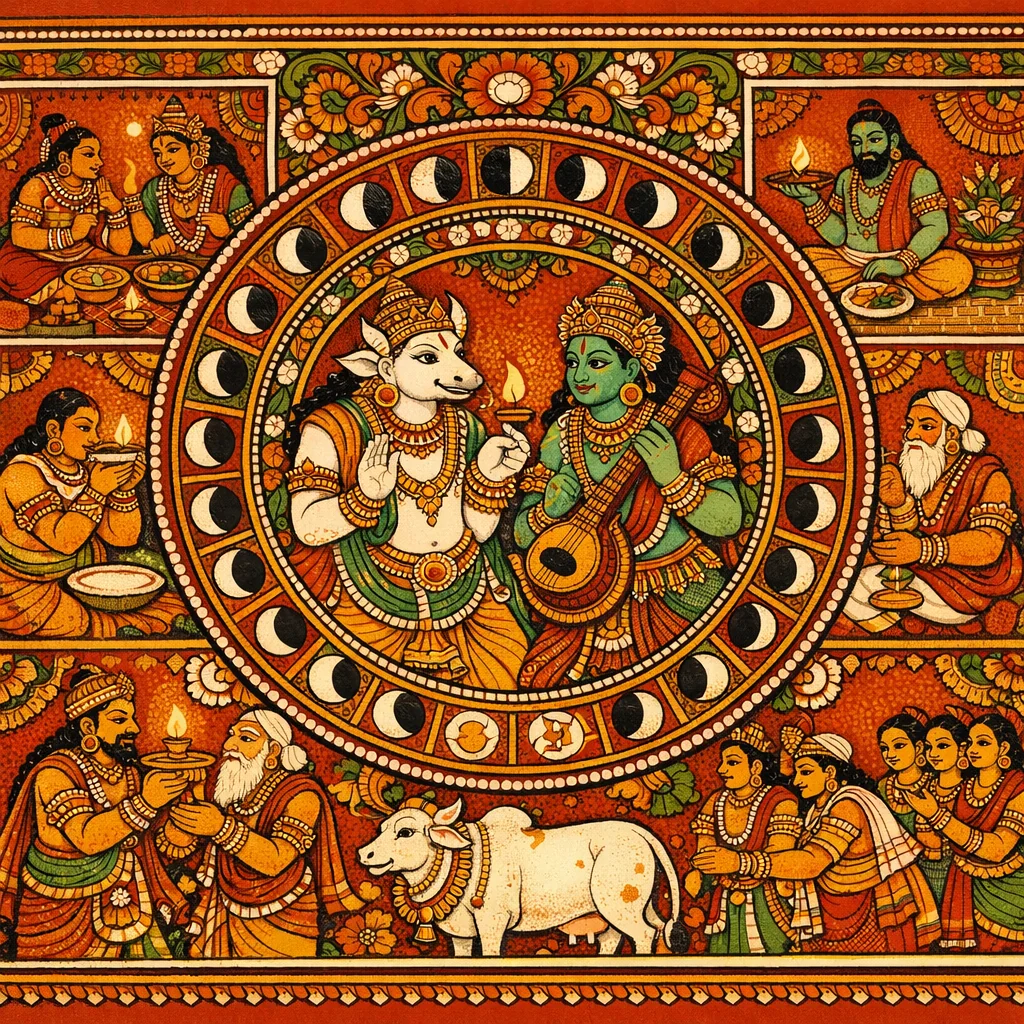
Adhyaya 101: Vrata-Ṣaṣṭhī: The Sixty Sacred Vows (Nandikeśvara’s Teaching to Nārada)
व्रतषष्ठी (षष्टिव्रतानि) — नन्दिकेश्वर-नारदसंवादः
Speaker: Nandikeśvara, Nārada
In response to Nārada’s wish to know merit-bearing observances, Nandikeśvara proclaims the teaching of Vrata-Ṣaṣṭhī—the sixty sacred vows. Speaking as an instructor, he lists vow after vow, giving for each: (1) the discipline (fasting, food restriction, or abstinence), (2) its calendrical setting (tithi, month, season, or Cāturmāsya), (3) the concluding dāna to brāhmaṇas or worship of couples/maidens, and (4) the promised phala—attainment of a deity’s loka, kingship across births, fame, prosperity, knowledge, or liberation. He ends by declaring that even hearing or reciting the whole set yields merit, and tells Nārada he will describe further observances next.
Key Concepts
Shlokas in Adhyaya 101
Verse 1
*नन्दिकेश्वर उवाच अथातः सम्प्रवक्ष्यामि व्रतषष्ठीमनुत्तमाम् रुद्रेणाभिहितां दिव्यां महापातकनाशनम् //
Nandikeśvara said: Now I shall fully expound the unsurpassed observance called Vrata-Ṣaṣṭhī—a divine vow taught by Rudra, which destroys even the gravest sins.
Verse 2
नक्तमब्दं चरित्वा तु गवा सार्धं कुटुम्बिने हैमं चक्रं त्रिशूलं च दद्याद्विप्राय वाससी //
Having observed for a year the vow of taking only the night-meal, a householder should, along with a cow, donate to a brāhmaṇa a golden discus and a trident, as well as a pair of garments.
Verse 3
शिवरूपस्ततो ऽस्माभिः शिवलोके स मोदते एतद्देवव्रतं नाम महापातकनाशनम् //
Thereafter, having assumed the form of Śiva through this observance, he rejoices in Śiva’s world. This is called the Devavrata, the vow that destroys even the greatest sins.
Verse 4
यस्त्वेकभक्तेन समां शिवं हैमवृषान्वितम् धेनुं तिलमयीं दद्यात् स पदं याति शांकरम् एतद्रुद्रव्रतं नाम पापशोकविनाशनम् //
Whoever, with single-minded devotion, offers a sesame-made cow (dhenu-dāna) together with an image of Śiva accompanied by a golden bull, attains the abode of Śaṅkara. This is called the Rudra-vrata, the vow that destroys sin and sorrow.
Verse 5
यस्तु नीलोत्पलं हैमं शर्करापात्रसंयुतम् एकान्तरितनक्ताशी समान्ते वृषसंयुतम् स वैष्णवं पदं याति लीलाव्रतमिदं स्मृतम् //
Whoever offers a blue lotus together with a golden vessel containing sugar, observing a regimen of eating only at night on alternate days, and at the conclusion gives a bull as well—such a person attains the supreme Vaiṣṇava state. This observance is known as the Līlā-vrata.
Verse 6
आषाढादिचतुर्मासम् अभ्यङ्गं वर्जयेन्नरः भोजनोपस्करं दद्यात् स याति भवनं हरेः जने प्रीतिकरं नॄणां प्रीतिव्रतमिहोच्यते //
From the month of Āṣāḍha onward, during the sacred four-month season (Cāturmāsya), a man should refrain from oil-massage (abhyaṅga). He should donate utensils and provisions for food; by this he attains the abode of Hari (Viṣṇu). Since it brings delight among people, this vow is here called the Prīti-vrata, the vow of pleasing others.
Verse 7
वर्जयित्वा मधौ यस्तु दधिक्षीरघृतैक्षवम् दद्याद्वस्त्राणि सूक्ष्माणि रसपात्रैश्च संयुतम् //
But whoever, avoiding intoxicating liquor, gives curds (dadhi), milk, ghee (ghṛta), and sugarcane-juice, and also donates fine garments together with vessels meant for liquids, performs a highly meritorious act of charity.
Verse 8
सम्पूज्य विप्रमिथुनं गौरी मे प्रीयतामिति एतद्गौरीव्रतं नाम भवानीलोकदायकम् //
Having duly worshipped a brāhmaṇa couple, one should pray, “May Gaurī be pleased with me.” This observance is called the Gaurī-vrata, and it bestows the blessed realm of Bhavānī (Pārvatī).
Verse 9
पुष्यादौ यस्त्रयोदश्यां कृत्वा नक्तं मधौ पुनः अशोकं काञ्चनं दद्याद् इक्षुयुक्तं दशाङ्गुलम् //
If, beginning with the auspicious time of Puṣya, a person observes the thirteenth lunar day (trayodaśī) by taking only a night-meal (nakta), then again in the spring month of Madhu he should give as a gift a golden aśoka sprig (or tree), together with sugarcane measuring ten aṅgulas.
Verse 10
विप्राय वस्त्रसंयुक्तं प्रद्युम्नः प्रीयतामिति कल्पं विष्णुपदे स्थित्वा विशोकः स्यात्पुनर्नरः एतत् कामव्रतं नाम सदा शोकविनाशनम् //
Having offered to a brāhmaṇa a gift accompanied by garments, with the utterance “May Pradyumna be pleased,” a person who duly abides in the prescribed ordinance (kalpa) and stands established in the state of Viṣṇu (Viṣṇu-pada) becomes sorrowless again. This is called the Kāma-vrata, a vow that ever destroys grief.
Verse 11
आषाढादिव्रतं यस्तु वर्जयेन्नखकर्तनम् वार्ताकं च चतुर्मासं मधुसर्पिर्घटान्वितम् //
Whoever undertakes the vow beginning in Āṣāḍha should refrain from cutting the nails; and throughout the four months of Caturmāsa he should also abstain from vārtāka (eggplant), maintaining the vow with offerings of honey and ghee kept in pots.
Verse 12
कार्त्तिक्यां तत्पुनर्हैमं ब्राह्मणाय निवेदयेत् स रुद्रलोकमाप्नोति शिवव्रतमिदं स्मृतम् //
Then, again in the month of Kārttika, one should present that golden gift to a brāhmaṇa; by doing so he attains Rudra’s realm. This is remembered as the vow dedicated to Śiva.
Verse 13
वर्जयेद्यस्तु पुष्पाणि हेमन्तशिशिरावृतू पुष्पत्रयं च फाल्गुन्यां कृत्वा शक्त्या च काञ्चनम् //
But one who refrains from offering flowers during the Hemanta and Śiśira seasons should, in the month of Phālguna, make a triple offering of flowers and—according to one’s capacity—also offer gold as a compensatory gift.
Verse 14
दद्याद्द्विकालवेलायां प्रीयेतां शिवकेशवौ दत्त्वा परं पदं याति सौम्यव्रतमिदं स्मृतम् //
One should make the offering at the two daily junctures (morning and evening); then Śiva and Keśava are pleased. Having given thus, one attains the supreme state—this is remembered as the Saumya-vrata.
Verse 15
फाल्गुन्यादितृतीयायां लवणं यस्तु वर्जयेत् समाप्ते शयनं दद्याद् गृहं चोपस्करान्वितम् //
Whoever abstains from salt on the third tithi beginning in the month of Phālguna—when the observance is completed—should give in charity a bed, and also a house furnished with its necessary household implements.
Verse 16
सम्पूज्य विप्रमिथुनं भवानी प्रीयतामिति गौरीलोके वसेत्कल्पं सौभाग्यव्रतमुच्यते //
After duly worshipping a brāhmaṇa couple, saying, “May Bhavānī (Pārvatī) be pleased,” one should perform the prescribed observance and abide (in devotion) in the realm of Gaurī for the full ritual period; this is called the Saubhāgya-vrata, the vow for conjugal good fortune.
Verse 17
संध्यामौनं ततः कृत्वा समान्ते घृतकुम्भकम् वस्त्रयुग्मं तिलान्घण्टां ब्राह्मणाय निवेदयेत् //
Having then observed silence during the Sandhyā rite, at its conclusion one should present to a brāhmaṇa a pot of ghee (ghṛta), a pair of garments, and sesame together with a bell.
Verse 18
सारस्वतं पदं याति पुनरावृत्तिदुर्लभम् एतत्सारस्वतं नाम रूपविद्याप्रदायकम् //
He attains the Sārasvata state—the station of Sarasvatī—from which return is rare. This attainment is called “Sārasvata,” and it bestows knowledge of forms (rūpa-vidyā).
Verse 19
लक्ष्मीमभ्यर्च्य पञ्चम्याम् उपवासी भवेन्नरः समान्ते हेमकमलं दद्याद्धेनुसमन्वितम् //
Having worshipped Lakṣmī on the fifth lunar day (Pañcamī), a man should observe a fast; and at its conclusion he should give a golden lotus as a gift, accompanied by a cow.
Verse 20
स वैष्णवं पदं याति लक्ष्मीवाञ्जन्मजन्मनि एतत् सम्पद्व्रतं नाम सदा पापविनाशनम् //
He attains the supreme Vaiṣṇava state and is endowed with Lakṣmī (prosperity) in birth after birth. This is called the Sampad-vrata, and it is ever a destroyer of sins.
Verse 21
कृत्वोपलेपनं शम्भोर् अग्रतः केशवस्य च यावदब्दं पुनर्दद्याद् धेनुं जलघटान्विताम् //
Having performed the ritual plastering and purification in the presence of Śambhu (Śiva) and also before Keśava (Viṣṇu), one should, for the span of a year, repeatedly gift a cow together with water-pots.
Verse 22
जन्मायुतं स राजा स्यात् ततः शिवपुरं व्रजेत् एतद् आयुर्व्रतं नाम सर्वकामप्रदायकम् //
He would become a king for ten thousand births; thereafter he goes to Śiva’s abode. This is called the Āyur-vrata, the vow that grants all desired aims.
Verse 23
अश्वत्थं भास्करं गङ्गां प्रणम्यैकत्र वाग्यतः एकभक्तं नरः कुर्याद् अब्दमेकं विमत्सरः //
Having bowed in reverence to the sacred aśvattha tree, the Sun, and the river Gaṅgā in one place, and having restrained his speech (remaining in one spot), a man—free from malice—should observe for one full year the discipline of taking a single meal a day.
Verse 24
व्रतान्ते विप्रमिथुनं पूज्यं धेनुत्रयान्वितम् वृक्षं हिरण्मयं दद्यात् सोऽश्वमेधफलं लभेत् एतत् कीर्तिव्रतं नाम भूतिकीर्तिफलप्रदम् //
At the conclusion of the vow, having duly honoured a Brahmin couple together with three cows, one should gift a golden tree. By doing so, one attains the fruit of the Aśvamedha sacrifice. This is called the Kīrti-vrata, bestowing the results of prosperity and lasting fame.
Verse 25
घृतेन स्नपनं कुर्याच् छम्भोर् वा केशवस्य च अक्षताभिः सुपुष्पाभिः कृत्वा गोमयमण्डलम् //
One should perform the ritual bathing with ghee for either Śambhu (Śiva) or Keśava (Viṣṇu), and, using unbroken rice-grains and fine flowers, prepare a consecrated circle (maṇḍala) made with cow-dung.
Verse 26
तिलधेनुसमोपेतं समान्ते हेमपङ्कजम् शुद्धमष्टाङ्गुलं दद्याच् छिवलोके महीयते सामगाय ततश्चैतत् सामव्रतमिहोच्यते //
Along with the gift of a “sesame-cow” (tiladhenu), at the conclusion of the observance one should also offer a pure golden lotus, eight aṅgulas in measure. Having done so, the chanter of the Sāma is honored in Śiva’s world; therefore this observance is here called the Sāma-vrata.
Verse 27
नवम्यामेकभक्तं तु कृत्वा कन्याश्च शक्तितः भोजयित्वासनं दद्याद् धैमकञ्चुकवाससी //
On the ninth day, having observed the one-meal fast, one should, according to one’s means, feed young maidens; and then one should gift them a seat (āsana), along with a golden bodice and garments.
Verse 28
हैमं सिंहं च विप्राय दत्त्वा शिवपदं व्रजेत् जन्मार्बुदं सुरूपः स्याच् छत्रुभिश्चापराजितः एतद्वीरव्रतं नाम नारीणां च सुखप्रदम् //
Having given a golden lion to a brāhmaṇa, one attains the state of Śiva. For ten million births one becomes handsome in form and remains unconquered by enemies. This is called the Vīravrata, and it is also a giver of happiness to women.
Verse 29
यावत्समा भवेद्यस्तु पञ्चदश्यां पयोव्रतः समान्ते श्राद्धकृद्दद्यात् पञ्च गास्तु पयस्विनीः //
Whoever undertakes the milk-vow (payo-vrata) on the fifteenth lunar day and continues it for as many years as he has resolved—at the completion of those years, having performed the Śrāddha, he should give in donation five milk-yielding cows.
Verse 30
वासांसि च पिशङ्गानि जलकुम्भयुतानि च स याति वैष्णवं लोकं पितॄणां तारयेच्छतम् कल्पान्ते राजराजः स्यात् पितृव्रतम् इदं स्मृतम् //
He who offers tawny-hued garments together with water-pots (for ritual gifting) attains the Vaiṣṇava realm; he delivers a hundred of his ancestors. At the end of the aeon he becomes a king of kings—such is declared to be the Pitṛ-vrata, the vow for the ancestors.
Verse 31
चैत्रादिचतुरो मासाञ् जलं दद्यादयाचितम् व्रतान्ते मणिकं दद्याद् अन्नवस्त्रसमन्वितम् //
Beginning with the month of Caitra, for four months one should give water freely, without waiting to be asked. At the conclusion of the vow (vrata), one should give a gem, together with food and clothing.
Verse 32
तिलपात्रं हिरण्यं च ब्रह्मलोके महीयते कल्पान्ते भूपतिर्नूनम् आनन्दव्रतमुच्यते //
An offering of a vessel of sesame, and also of gold, is honored in Brahmā’s world; and at the end of the aeon (kalpa), the king—surely—attains what is called the Ānandavrata, the vow leading to bliss.
Verse 33
पञ्चामृतेन स्नपनं कृत्वा संवत्सरं विभोः वत्सरान्ते पुनर्दद्याद् धेनुं पञ्चामृतेन हि //
Having performed the Lord’s ceremonial bathing (abhiṣeka) with pañcāmṛta for a full year, at the end of that year one should again present a cow, accompanied by pañcāmṛta.
Verse 34
विप्राय दद्याच्छङ्खं च स पदं याति शांकरम् राजा भवति कल्पान्ते धृतिव्रतमिदं स्मृतम् //
If one gives a conch (śaṅkha) to a brāhmaṇa, one attains the station of Śaṅkara; and at the end of the aeon (kalpa) one becomes a king—this is remembered as the Dhṛti-vrata, the vow of steadfastness.
Verse 35
वर्जयित्वा पुमान्मांसम् अब्दान्ते गोप्रदो भवेत् तद्वद्धेममृगं दद्यात् सोऽश्वमेधफलं लभेत् अहिंसाव्रतमित्युक्तं कल्पान्ते भूपतिर्भवेत् //
Having abstained from meat, a man should, at the end of the year, become a giver of cows. Likewise, he should donate a golden deer; by that he attains the fruit of the Aśvamedha sacrifice. This is declared to be the ahiṃsā-vrata, the vow of non-violence; at the end of the aeon he becomes a lord of the earth.
Verse 36
माघमास्युषसि स्नानं कृत्वा दाम्पत्यमर्चयेत् भोजयित्वा यथाशक्त्या माल्यवस्त्रविभूषणः सूर्यलोके वसेत्कल्पं सूर्यव्रतमिदं स्मृतम् //
In the month of Māgha, at dawn, having bathed, one should worship a married couple; and, according to one’s capacity, feed them and honor them with garlands, clothing, and ornaments. By this it is said that one dwells in the world of the Sun for a kalpa—this is remembered as the Sūrya-vrata, the vow of the Sun.
Verse 37
आषाढादिचतुर्मासं प्रातःस्नायी भवेन्नरः विप्रेषु भोजनं दद्यात् कार्त्तिक्यां गोप्रदो भवेत् स वैष्णवं पदं याति विष्णुव्रतमिदं शुभम् //
If a man, throughout the four months beginning with Āṣāḍha, bathes at dawn, gives food to the Brāhmaṇas, and in Kārttika donates a cow, he attains the Vaiṣṇava abode. This auspicious observance is the Viṣṇu-vrata, the vow of Viṣṇu.
Verse 38
अयनादयनं यावद् वर्जयेत्पुष्पसर्पिषी तदन्ते पुष्पदामानि घृतधेन्वा सहैव तु //
From one ayana (half-year) until the next, one should abstain from offerings of flowers and ghee (sarpis). At the completion of that period, one should offer garlands of flowers together with a ghṛta-dhenu—a cow-donation symbolically endowed with ghee.
Verse 39
दत्त्वा शिवपदं गच्छेद् विप्राय घृतपायसम् एतच्छीलव्रतं नाम शीलारोग्यफलप्रदम् //
Having given a Brāhmaṇa ghṛta-pāyasa—rice-pudding cooked with ghee—one attains the auspicious state, Śiva’s abode. This is called the Śīla-vrata, the vow of good conduct, and it bestows the fruits of virtuous character and freedom from disease.
Verse 40
संध्यादीपप्रदो यस्तु समां तैलं विवर्जयेत् समान्ते दीपिकां दद्याच् चक्रशूले च काञ्चने //
Whoever regularly offers a lamp at twilight (sandhyā) should avoid using oil (taila) for a full year. At the end of the year, he should offer a small lamp made of gold, bearing the emblems of the discus (cakra) and the trident (śūla).
Verse 41
वस्त्रयुग्मं च विप्राय तेजस्वी स भवेदिह रुद्रलोकमवाप्नोति दीप्तिव्रतमिदं स्मृतम् //
By giving a pair of garments to a brāhmaṇa, one becomes radiant in this very life and attains Rudra’s world. This is remembered as the Dīpti-vrata, the vow that bestows brilliance.
Verse 42
कार्त्तिक्यादितृतीयायां प्राश्य गोमूत्रयावकम् नक्तं चरेदब्दमेकम् अब्दान्ते गोप्रदो भवेत् //
Beginning from the third lunar day in the month of Kārttika, having partaken of barley prepared with cow’s urine, one should observe the ‘night-only’ regimen for one full year; at the end of the year, one should give a cow in donation.
Verse 43
गौरीलोके वसेत्कल्पं ततो राजा भवेदिह एतद्रुद्रव्रतं नाम सदा कल्याणकारकम् //
He dwells for a kalpa in Gaurī’s realm; thereafter, here (on earth) he becomes a king. This observance is called the Rudra-vrata, and it is ever a cause of auspicious welfare.
Verse 44
वर्जयेच्चैत्रमासे च यश्च गन्धानुलेपनम् शुक्तिं गन्धभृतां दत्त्वा विप्राय सितवाससी वारुणं पदमाप्नोति दृढव्रतमिदं स्मृतम् //
He who, in the month of Caitra, abstains from applying perfumed unguents, and who gives to a brāhmaṇa a conch-shell vessel filled with fragrance along with white garments, attains the realm of Varuṇa. This is remembered as a firm and steadfast vow.
Verse 45
वैशाखे पुष्पलवणं वर्जयित्वाथ गोप्रदः भूत्वा विष्णुपदे कल्पं स्थित्वा राजा भवेदिह एतत्कान्तिव्रतं नाम कान्तिकीर्तिफलप्रदम् //
In the month of Vaiśākha, having abstained from flowers and salt, and having become a giver of cows, one abides for a kalpa in Viṣṇu’s realm; and here (on earth) one becomes a king. This is called the Kānti-vrata, and it bestows the fruits of radiance and fame.
Verse 46
ब्रह्माण्डं काञ्चनं कृत्वा तिलराशिसमन्वितम् त्र्यहं तिलप्रदो भूत्वा वह्निं संतर्प्य सद्विजम् //
Having fashioned a golden ‘Brahmāṇḍa’ (the emblem of the cosmic egg) and filled it with heaps of sesame, one should for three days become a giver of sesame; having satisfied the sacred fire (Agni) and the worthy Brāhmaṇa, one attains merit.
Verse 47
सम्पूज्य विप्रदाम्पत्यं माल्यवस्त्रविभूषणैः शक्तितस्त्रिपलादूर्ध्वं विश्वात्मा प्रीयतामिति //
Having duly honoured a Brāhmaṇa couple with garlands, garments, and ornaments, one should offer according to one’s capacity—no less than three palas—saying: “May Viśvātmā, the Universal Self, be pleased.”
Verse 48
पुण्ये ऽह्नि दद्यात्स परं ब्रह्म यात्यपुनर्भवम् एतद्ब्रह्मव्रतं नाम निर्वाणपददायकम् //
If one makes the prescribed gift on an auspicious day, one attains the Supreme Brahman and reaches the state of no rebirth. This is called the Brahma-vrata, a vow that bestows the station of nirvāṇa (liberation).
Verse 49
यश्चोभयमुखीं दद्यात् प्रभूतकनकान्विताम् दिनं पयोव्रतस्तिष्ठेत् स याति परमं पदम् एतद्धेनुव्रतं नाम पुनरावृत्तिदुर्लभम् //
Whoever donates a cow fashioned with two mouths and adorned with abundant gold, and who for one day observes the milk-vow (payo-vrata), attains the supreme state. This observance is called the Henu-vrata, and it is said to grant a goal from which return to repeated rebirth is hard to come by.
Verse 50
त्र्यहं पयोव्रते स्थित्वा काञ्चनं कल्पपादपम् पलादूर्ध्वं यथाशक्त्या तण्डुलैस् तूपसंयुतम् दत्त्वा ब्रह्मपदं याति कल्पव्रतमिदं स्मृतम् //
Having observed a milk-only vow for three days, one should, according to one’s capacity, offer a golden wish-fulfilling tree (kalpa-tree) filled—above the measure of one pala—with rice-grains mixed with ghee. By giving this, one attains the state/abode of Brahmā; this is remembered as the Kalpa-vrata.
Verse 51
मासोपवासी यो दद्याद् धेनुं विप्राय शोभनाम् स वैष्णवं पदं यति भीमव्रतमिदं स्मृतम् //
Whoever observes a month-long fast and gives a fine cow to a brāhmaṇa attains the Vaiṣṇava state, the supreme abode of Viṣṇu. This is remembered as the Bhīma-vrata (the Great Vow).
Verse 52
दद्याद् विंशत्पलादूर्ध्वं महीं कृत्वा तु काञ्चनीम् दिनं पयोव्रतस्तिष्ठेद् रुद्रलोके महीयते धराव्रतमिदं प्रोक्तं सप्तकल्पशतानुगम् //
Having fashioned a golden representation of the Earth weighing more than twenty palas, one should donate it; then, observing a milk-only vow for a day, one is honored in Rudra’s world. This observance is declared to be the Dharā-vrata, whose merit endures for seven hundred kalpas.
Verse 53
माघे मासे ऽथवा चैत्रे गुडधेनुप्रदो भवेत् गुडव्रतस्तृतीयायां गौरीलोके महीयते महाव्रतमिदं नाम परमानन्दकारकम् //
In the month of Māgha—or else in Caitra—one should make the gift of a “jaggery-cow” (guḍa-dhenu). Observing the Guḍa-vrata on the third lunar day (tṛtīyā), one is honored in Gaurī’s world. This vow is called the Mahā-vrata, and it bestows supreme bliss.
Verse 54
पक्षोपवासी यो दद्याद् विप्राय कपिलाद्वयम् ब्रह्मलोकमवाप्नोति देवासुरसुपूजितम् कल्पान्ते राजराजः स्यात् प्रभाव्रतमिदं स्मृतम् //
Whoever, observing a fortnight-long fast, gives a brāhmaṇa a pair of tawny (kapilā) cows attains the world of Brahmā, revered by gods and demons alike; and at the end of the kalpa he becomes a king of kings. This is remembered as the Prabhā-vrata.
Verse 55
वत्सरं त्वेकभक्ताशी सभक्ष्यजलकुम्भदः शिवलोके वसेत्कल्पं प्राप्तिव्रतमिदं स्मृतम् //
But if, for a year, one eats only a single meal a day and donates a water-pot together with provisions, one is said to dwell in Śiva’s world for a kalpa. This is remembered as the Prāpti-vrata (the vow that yields attainment).
Verse 56
नक्ताशी चाष्टमीषु स्याद् वत्सरान्ते च धेनुदः पौरंदरं पुरं याति सुगतिव्रतमुच्यते //
On the Aṣṭamī days (the eighth lunar days), let him eat only at night; and at the end of the year, having gifted a cow, he attains the city of Purandara (Indra). This is called the Sugati-vrata, the vow that leads to a good destiny.
Verse 57
विप्रायेन्धनदो यस्तु वर्षादिचतुरस्त्वृतून् घृतधेनुप्रदो ऽन्ते च स परं ब्रह्म गच्छति वैश्वानरव्रतं नाम सर्वपापविनाशनम् //
Whoever, through the four seasons beginning with the rains, gives firewood to a Brāhmaṇa, and at the conclusion of the vow donates a ghee-yielding cow (ghṛta), attains the Supreme Brahman. This is called the Vaiśvānara-vrata, the vow that destroys all sins.
Verse 58
एकादश्यां च नक्ताशी यश्चक्रं विनिवेदयेत् समान्ते वैष्णवं हैमं स विष्णोः पदमाप्नुयात् एतत् कृष्णव्रतं नाम कल्पान्ते राज्यभाग्भवेत् //
Whoever, on Ekādaśī, eats only at night and offers to Viṣṇu a golden discus (cakra), in due course attains the supreme abode of Viṣṇu. This observance is called the Kṛṣṇa-vrata; at the end of the kalpa one becomes a sharer in sovereignty (royal fortune).
Verse 59
पायसाशी समान्ते तु दद्याद्विप्राय गोयुगम् लक्ष्मीलोकमवाप्नोति ह्य् एतद् देवीव्रतं स्मृतम् //
Living on pāyasa (rice cooked in milk) during the observance, one should, at its conclusion, gift a pair of cows to a Brāhmaṇa; thereby one attains the world of Lakṣmī—this is remembered as the Devī-vrata.
Verse 60
सप्तम्यां नक्तभुग्दद्यात् समान्ते गां पयस्विनीम् सूर्यलोकमवाप्नोति भानुव्रतमिदं स्मृतम् //
On Saptamī (the seventh lunar day), one should eat only at night and, at the completion of the observance, gift a milk-yielding cow. By this one attains the world of the Sun; this is remembered as the Bhānu-vrata (vow of the Sun).
Verse 61
चतुर्थ्यां नक्तभुग्दद्याद् अब्दान्ते हेमवारणम् व्रतं वैनायकं नाम शिवलोकफलप्रदम् //
On the fourth lunar day, one should eat only at night and, at the end of a year, donate a golden elephant. This vow is called the Vaināyaka Vrata, and it bestows the fruit of attaining Śiva’s world.
Verse 62
महाफलानि यस्त्यक्त्वा चतुर्मासं द्विजातये हैमानि कार्त्तिके दद्याद् गोयुगेन समन्वितम् एतत् फलव्रतं नाम विष्णुलोकफलप्रदम् //
Whoever, having abstained from choice fruits for the four months, gives golden gifts to a twice-born (brāhmaṇa) in the month of Kārttika, together with a pair of cows—this is called the Phala-vrata (“Fruit-vow”), and it bestows the reward of attaining Viṣṇu’s world.
Verse 63
यश्चोपवासी सप्तम्यां समान्ते हैमपङ्कजम् गाश्च वै शक्तितो दद्याद् धेमान्नघटसंयुताः एतत् सौरव्रतं नाम सूर्यलोकफलप्रदम् //
Whoever fasts on the seventh lunar day and, at the conclusion of the observance, offers a golden lotus and also, according to one’s capacity, donates cows together with pots filled with food—this is called the Sauravrata, and it bestows the fruit of attaining the world of the Sun (Sūryaloka).
Verse 64
द्वादश द्वादशीर्यस्तु समाप्योपोषणेन च गोवस्त्रकाञ्चनैर्विप्रान् पूजयेच्छक्तितो नरः परमं पदं प्राप्नोति विष्णुव्रतमिदं स्मृतम् //
Whoever completes twelve Dvādaśī observances, concludes them with fasting, and—according to one’s capacity—honors brāhmaṇas with gifts of cows, garments, and gold, attains the supreme abode. This is remembered as a Viṣṇu-vrata.
Verse 65
कार्त्तिक्यां च वृषोत्सर्गं कृत्वा नक्तं समाचरेत् शैवं पदमवाप्नोति वार्षव्रतमिदं स्मृतम् //
Having performed the vṛṣotsarga rite (the ritual gift/release of a bull) in the month of Kārttika, one should observe the vow of eating only at night; by this, one attains the Śaiva state, the abode of Śiva. This is remembered as the vārṣa-vrata (“annual vow”).
Verse 66
कृच्छ्रान्ते गोप्रदः कुर्याद् भोजनं शक्तितः पदम् विप्राणां शांकरं याति प्राजापत्यमिदं व्रतम् //
When the Kṛcchra observance is completed, one who has gifted a cow should, according to one’s capacity, provide a meal to the Brahmins; by this Prajāpatya vow, one attains the state or abode of Śāṃkara (Śiva).
Verse 67
चतुर्दश्यां तु नक्ताशी समान्ते गोधनप्रदः शैवं पदमवाप्नोति त्रैयम्बकमिदं व्रतम् //
On the fourteenth lunar day one should eat only at night; and at the conclusion (of the vow) one should gift wealth in cattle. By this Tryambaka vow, one attains the state (abode) of Śiva.
Verse 68
सप्तरात्रोषितो दद्याद् घृतकुम्भं द्विजातये घृतव्रतमिदं प्राहुर् ब्रह्मलोकफलप्रदम् //
After observing (the vow) for seven nights, one should give a pot filled with clarified butter (ghee) to a twice-born (Brāhmaṇa). This is declared to be the “ghee-vow” (ghṛta-vrata), bestowing the fruit of attaining Brahma-loka.
Verse 69
आकाशशायी वर्षासु धेनुमन्ते पयस्विनीम् शक्रलोके वसेन्नित्यम् इन्द्रव्रतमिदं स्मृतम् //
He who sleeps on an elevated, open bed during the rainy season, and who gifts a milch-cow together with its calf, dwells forever in Śakra’s (Indra’s) world—this is remembered as the Indra-vrata.
Verse 70
अनग्निपक्कम् अश्नाति तृतीयायां तु यो नरः गां दत्त्वा शिवमभ्येति पुनरावृत्तिदुर्लभम् इह चानन्दकृत्पुंसां श्रेयोव्रतमिदं स्मृतम् //
That man who, on the third lunar day, eats food not cooked on fire and then gifts a cow, attains Śiva’s auspicious state—one from which return (to rebirth) is hard to come by. In this world too it becomes a source of joy for people; this observance is remembered as the Śreyovrata, the vow that leads to the highest good.
Verse 71
हैमं पलद्वयादूर्ध्वं रथमश्वयुगान्वितम् ददत्कृतोपवासः स्याद् दिवि कल्पशतं वसेत् कल्पान्ते राजराजः स्याद् अश्वव्रतमिदं स्मृतम् //
One who, having observed a fast, donates a golden chariot furnished with a yoke of horses—whose gold exceeds two palas—dwells in heaven for a hundred kalpas; and at the end of a kalpa becomes a king of kings. This is remembered as the Aśvavrata (the horse-vow).
Verse 72
तद्वद्धेमरथं दद्यात् करिभ्यां संयुतं नरः सत्यलोके वसेत्कल्पं सहस्रमथ भूपतिः भवेदुपोषितो भूत्वा करिव्रतमिदं स्मृतम् //
Likewise, a man should donate a golden chariot yoked with two elephants. Thereafter he dwells in Satyaloka for a thousand kalpas, and he becomes a king. Having observed fasting, this is declared to be the Elephant-vow (Kari-vrata).
Verse 73
उपवासं परित्यज्य समान्ते गोप्रदो भवेत् यक्षाधिपत्यमाप्नोति सुखव्रतमिदं स्मृतम् //
After completing the fast, one should conclude by gifting a cow. By this observance, one attains lordship among the Yakṣas; this is remembered as the Sukha-vrata (the vow that brings ease and well-being).
Verse 74
निशि कृत्वा जले वासं प्रभाते गोप्रदो भवेत् वारुणं लोकमाप्नोति वरुणव्रतमुच्यते //
Having spent the night dwelling in water, one should, at dawn, give a cow in charity. He attains Varuṇa’s realm; this observance is called the Varuṇa-vrata (vow of Varuṇa).
Verse 75
चान्द्रायणं च यः कुर्याद् धैमं चन्द्रं निवेदयेत् चन्द्रव्रतमिदं प्रोक्तं चन्द्रलोकफलप्रदम् //
Whoever performs the Cāndrāyaṇa observance and offers a golden image of the Moon—this is declared to be the Candravrata (Moon-vow), bestowing as its fruit attainment of the Moon’s world (Candraloka).
Verse 76
ज्येष्ठे पञ्चतपाः सायं हेमधेनुप्रदो दिवम् यात्यष्टमीचतुर्दश्यो रुद्रव्रतमिदं स्मृतम् //
In the month of Jyeṣṭha, one who performs the fivefold austerity (pañcatapā) in the evening and donates a golden cow attains heaven. This is remembered as the Rudra-vrata, to be observed on the eighth and the fourteenth lunar days.
Verse 77
सकृद्वितानकं कुर्यात् तृतीयायां शिवालये समान्ते धेनुदो याति भवानीव्रतमुच्यते //
On the third lunar day, one should set up a ceremonial canopy (vitāna) once in Śiva’s temple; at the conclusion, one should gift a cow. This is declared to be the Bhavānī-vrata.
Verse 78
माघे निश्यार्द्रवासाः स्यात् सप्तम्यां गोप्रदो भवेत् दिवि कल्पमुषित्वेह राजा स्यात्पवनं व्रतम् //
In the month of Māgha, one should wear garments moistened by the night (dew). On the seventh lunar day, one should give a cow in charity. Having dwelt in heaven for an aeon (kalpa), one becomes a king here on earth. This is called the Pavana vow (Wind/Purifying vow).
Verse 79
त्रिरात्रोपोषितो दद्यात् फाल्गुन्यां भवनं शुभम् आदित्यलोकमाप्नोति धामव्रतमिदं स्मृतम् //
Having fasted for three nights, one should, in the month of Phālguna, gift a fine and auspicious house; by this observance one attains the world of Āditya (the Sun). This is known as the Dhāma-vrata.
Verse 80
त्रिसंध्यं पूज्य दाम्पत्यम् उपवासी विभूषणैः अन्नं गाश्च समाप्नोति मोक्षमिन्द्रव्रतादिह //
By worshipping at the three sandhyās (dawn, noon, and dusk), honoring the conjugal state, and observing fasts with proper adornment and ritual propriety, one obtains food and cows—and, through the Indra-vrata here, ultimately attains liberation (mokṣa).
Verse 81
दत्त्वा सितद्वितीयायाम् इन्दोर्लवणभाजनम् समान्ते गोप्रदो याति विप्राय शिवमन्दिरम् कल्पान्ते राजराजः स्यात् सोमव्रतमिदं स्मृतम् //
On the second lunar day of the bright fortnight, having offered a vessel of salt to the Moon, and at the completion of the observance having also gifted a cow, one should go to a brāhmaṇa at a temple of Śiva. At the end of the aeon, he becomes a “king of kings”—this is remembered as the Soma‑vrata (Moon‑vow).
Verse 82
प्रतिपद्येकभक्ताशी समान्ते कपिलाप्रदः वैश्वानरपदं याति शिवव्रतमिदं स्मृतम् //
He who, beginning on the pratipad (first lunar day), eats only once a day, and at the conclusion gives a tawny cow (kapilā) as a gift, attains the state of Vaiśvānara. This is remembered as the Śiva‑vrata (vow sacred to Śiva).
Verse 83
दशम्याम् एकभक्ताशी समान्ते दशधेनुदः दिशश्च काञ्चनैर्दद्याद् ब्रह्माण्डाधिपतिर्भवेत् एतद् विश्वव्रतं नाम महापातकनाशनम् //
On the tenth lunar day, eating only once, one should at the conclusion make a gift of ten cows and also give gold to the quarters (as offerings to the deities of the directions). He becomes, as it were, a lord over the brahmāṇḍa, the cosmic egg (the universe). This is called the Viśvavrata, the “Universal Vow,” and it destroys even great sins.
Verse 84
यः पठेच्छृणुयाद्वापि व्रतषष्टिम् अनुत्तमाम् मन्वन्तरशतं सो ऽपि गन्धर्वाधिपतिर्भवेत् //
Whoever recites—or even listens to—this unsurpassed set of sixty sacred observances (vratas), that person too becomes a lord among the Gandharvas for a hundred Manvantaras.
Verse 85
षष्टिव्रतं नारद पुण्यमेतत् तवोदितं विश्वजनीनमन्यत् श्रोतुं तवेच्छा तदुदीरयामि प्रियेषु किं वाकथनीयम् अस्ति //
O Nārada, this Ṣaṣṭi‑vrata is indeed a meritorious observance, proclaimed by you and beneficial to all people. Since you desire to hear further, I shall expound another observance. For what need is there to withhold words from those who are dear?
Frequently Asked Questions
The chapter teaches a structured system of sixty vratas where personal restraint (fasting, abstentions, regulated conduct) is completed by dāna (especially cows, gold emblems, lamps, conch, beds/houses, food and water vessels) and directed devotion to specific deities. It emphasizes that disciplined practice plus charitable redistribution destroys sin and sorrow and yields defined results—from prosperity and fame to attainment of Śiva-, Viṣṇu-, Sūrya-, Varuṇa-, Indra-, or Brahmā-worlds, and in select cases liberation (apunarbhava/nirvāṇa).
This adhyāya is primarily Dharma in the form of vrata-vidhi and dāna-dharma. It is not a Vāstu-śāstra chapter and does not present genealogy or creation narrative. Its focus is ritual ethics, calendrical observance (tithi/month/season), and merit-fruits (phala) mapped to deity-realms and royal prosperity.
Nandikeśvara is the main speaker and Nārada is the listener/inquirer. The teaching is delivered as a continuing dialogue where Nandikeśvara, responding to Nārada’s desire to hear, expounds the Vrata-Ṣaṣṭhī and then promises to describe additional observances afterward.
The chapter frames vrata as incomplete without a terminal dāna that transfers merit and supports the social-religious economy: cows (sustenance and ritual value), gold emblems/icons (symbolic embodiment of the deity and cosmic principles), and household goods like beds, houses, pots, food provisions (practical welfare). This pairing of austerity with generosity is presented as the mechanism for sin-destruction and attainment of higher lokas.
Read Matsya Purana in the Vedapath app
Scan the QR code to open this directly in the app, with audio, word-by-word meanings, and more.