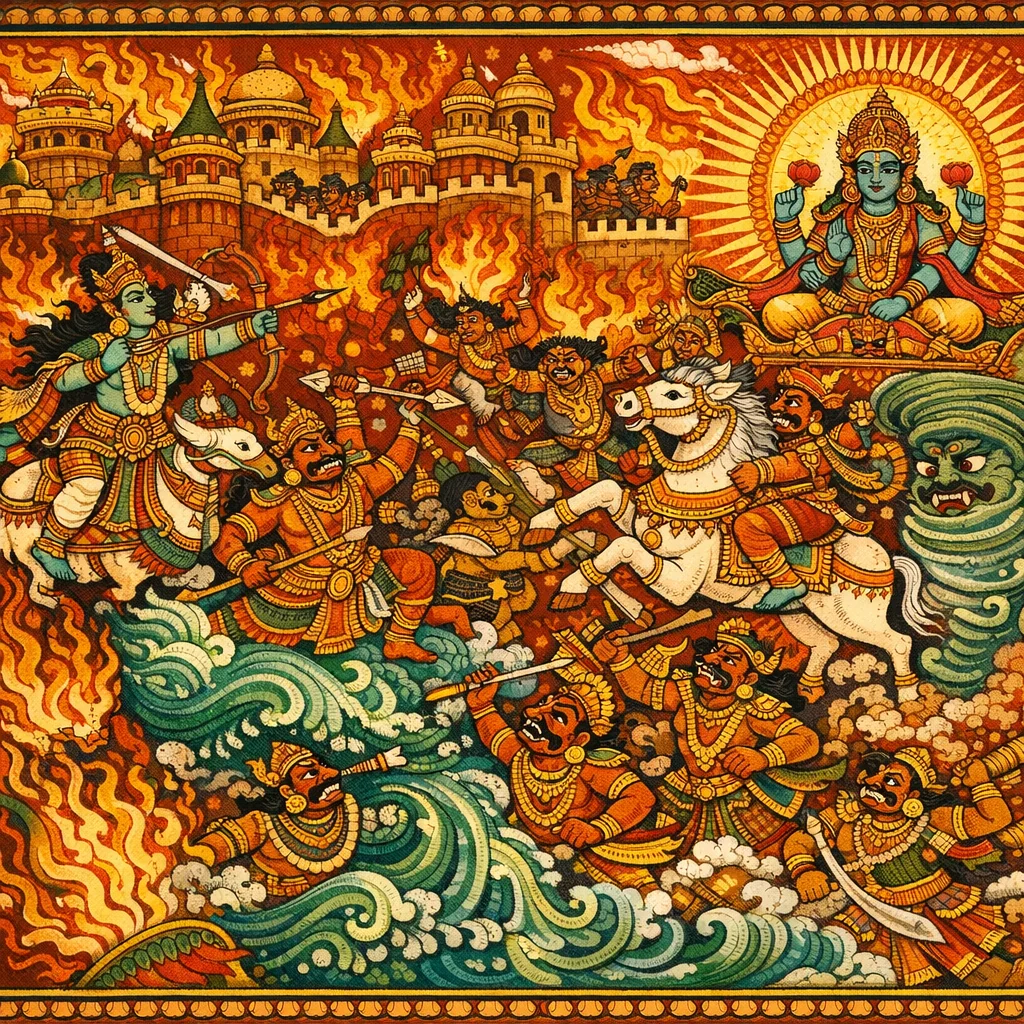
Adhyaya 135: The Battle at Tripura: Shiva’s Strategy, Maya’s Illusions, and the Devas’ Counterattack
त्रिपुरयुद्धवर्णनम्
Speaker: Sūta, Mahēśvara (Śiva/Rudra), Vāsava (Indra)
Adhyaya 135 unfolds as a high-intensity martial and cosmological episode within the Tripura narrative. Sūta describes Nārada’s arrival and frames Ilāvṛta as a sacral geography where divine rites—marriage, yajña, and saṃskāras beginning with jātakarma—are properly performed, establishing the battlefield as a ritually charged landscape. Mahēśvara (Śiva) addresses Indra, revealing Tripura’s splendor and defenses and outlining a precise tactical-astrological condition: when Tripura aligns into “one unity” under Puṣya-yoga, Śiva will incinerate it with a single arrow. The chapter then details the clash between Devas/gaṇas (Pramathas) and Daityas/Dānavas, marked by sonic warfare, vivid similes, and escalating violence. Key turns include Vidyunmālī’s assault on Nandin, Nandin’s recovery and vajra-strike that kills Vidyunmālī, and Tāraka’s rise aided by Maya’s māyā—deploying fire, floods, winds, and monstrous projections that paralyze the gaṇa-leaders. Finally, major Devas (Yama, Varuṇa, Sūrya, Skanda, Indra) enter to stabilize the battle, pushing the demons back as Hara’s army advances after Maya toward Tripura’s core conflict.
Key Concepts
Shlokas in Adhyaya 135
Verse 1
*सूत उवाच ततो रणे देवबलं नारदो ऽभ्यगमत्पुनः आगत्य चैव त्रिपुरात् सभायामास्थितः स्वयम् //
Sūta said: Then, in the midst of the battle, Nārada approached the host of the gods again; and having returned from Tripura, he himself stood present in the assembly hall.
Verse 2
इलावृतमिति ख्यातं तद्वर्षं विस्तृतायतम् यत्र यज्ञो बलेर्वृत्तो बलिर्यत्र च संयतः //
That region is renowned as Ilāvṛta; it is vast and widely extended. There the sacrifice of Bali was performed, and there too Bali was restrained (subdued and bound).
Verse 3
देवानां जन्मभूमिर्या त्रिषु लोकेषु विश्रुता विवाहाः क्रतवश्चैव जातकर्मादिकाः क्रियाः //
That land, famed throughout the three worlds as the birthplace of the gods—there, marriages, sacrificial rites, and the life-cycle ceremonies beginning with the birth-ritual (jātakarma) are duly performed.
Verse 4
देवानां यत्र वृत्तानि कन्यादानानि यानि च रेमे नित्यं भवो यत्र सहायैः पार्षदैर्गणैः //
There—where the deeds of the Devas and the sacred rite of kanyādāna (the giving of a maiden in marriage) were celebrated—Bhava (Lord Śiva) ever sported, accompanied by his helpers: the attendants and hosts of gaṇas.
Verse 5
लोकपालाः सदा यत्र तस्थुर्मेरुगिरौ यथा मधुपिङ्गलनेत्रस्तु चन्द्रावयवभूषणः देवानामधिपं प्राह गणपांश्च महेश्वरः //
There the Lokapālas (guardians of the directions) ever stood, as they stand upon Mount Meru. Then Mahēśvara, honey-tawny-eyed and adorned with the crescent moon upon his body, addressed the Lord of the Devas and also spoke to his gaṇas.
Verse 6
वासवैतद् अरीणां ते त्रिपुरं परिदृश्यते विमानैश्च पताकाभिर् ध्वजैश्च समलंकृतम् //
O Vāsava (Indra), behold—this is the Tripura of your enemies, now come into view; it is splendidly adorned with vimānas (aerial chariots), banners, and standards.
Verse 7
इदं वृत्तमिदं ख्यातं वह्निवद्भृशतापनम् एते जना गिरिप्रख्याः सकुण्डलकिरीटिनः //
This has come to pass—this is the renowned account—scorching fiercely like fire. These beings appear mountain-like in stature, adorned with earrings and crowned with diadems.
Verse 8
प्राकारगोपुराट्टेषु कक्षान्ते दानवाः स्थिताः इमे च तोयदाभासा दनुजा विकृताननाः //
Upon the ramparts and at the gate-towers, and at the edge of the inner enclosure, the Dānavas were stationed—these sons of Danu, cloud-dark in appearance, with distorted and fearsome faces.
Verse 9
निर्गच्छन्ति पुरो दैत्याः सायुधा विजयैषिणः //
The Daityas marched forth in the vanguard, fully armed, seeking victory.
Verse 10
स त्वं सुरशतैः सार्धं ससहायो वरायुधः सहद्भिर्मामकैर्भृत्यैर् व्यापादय महासुरान् //
Therefore you—bearing excellent weapons—together with hundreds of gods and your allies, and aided by my attendants, should strike down the mighty Asuras.
Verse 11
अहं च रथवर्येण निश्चलाचलवत्स्थितः पुरः पुरस्य रन्ध्रार्थी स्थास्यामि विजयाय वः //
“And I too, with an excellent chariot, will take my stand before the city, immovable like a mountain, seeking its weak point—a breach—for your victory.”
Verse 12
यदा तु पुष्ययोगेण एकत्वं स्थास्यते पुरम् तदेतन्निर्दहिष्यामि शरेणैकेन वासव //
But when, through the Puṣya-yoga, the city comes to stand in a single aligned unity, then, O Vāsava (Indra), I shall burn it down with a single arrow.
Verse 13
इत्युक्तो वै भगवता रुद्रेणेह सुरेश्वरः ययौ तत्त्रिपुरं जेतुं तेन सैन्येन संवृतः //
Thus addressed here by the Blessed Lord Rudra, the Lord of the gods set out to conquer that Tripura, surrounded by that very army.
Verse 14
प्रक्रान्तरथभीमैस्तैः सदेवैः पार्षदां गणैः कृतसिंहरवोपेतैर् उद्गच्छद्भिरिवाम्बुदैः //
Those formidable troops of divine attendants—pressing forward in dreadful chariots, accompanied by the gods and by companies of their retinue, and endowed with lion-like roars—advanced like clouds rising and swelling across the sky.
Verse 15
तेन नादेन त्रिपुराद् दानवा युद्धलालसाः उत्पत्य दुद्रुवुश्चेलुः सायुधाः खे गणेश्वरान् //
Stirred by that thunderous roar, the Dānavas—eager for battle—leapt up from Tripura and rushed forth; armed, they surged through the sky toward the hosts of the Gaṇa-lords.
Verse 16
अन्ये पयोधरारावाः पयोधरसमा बभुः ससिंहनादं वादित्रं वादयामासुरुद्धताः //
Others gave forth thundering roars like rain-clouds; and, exalted in their fervour, they sounded instruments whose blare resounded with the roar of lions.
Verse 17
देवानां सिंहनादश्च सर्वतूर्यरवो महान् ग्रस्तो ऽभूद्दैत्यनादैश्च चन्द्रस्तोयधरैरिव //
The Devas’ lion-roar and the mighty clamour of all their war-instruments were swallowed up by the Daityas’ uproar—just as the moon is engulfed by water-bearing clouds.
Verse 18
चन्द्रोदयात्समुद्भूतः पौर्णमास इवार्णवः त्रिपुरं प्रभवत्तद्वद् भीमरूपमहासुरैः //
As the ocean seems to swell with the rising of the moon on the night of the full moon, so too did Tripura come into being—brought forth by mighty great Asuras of dreadful form.
Verse 19
प्राकारेषु पुरे तत्र गोपुरेष्वपि चापरे अट्टालकान्समारुह्य केचिच् चलितवादिनः //
There, in that city, some stood upon the ramparts, others upon the gatehouses; and some, climbing the watchtowers, raised the alarm, shouting in agitated voices.
Verse 20
स्वर्णमालाधराः शूराः प्रभासितकराम्बराः केचिन् नदन्ति दनुजास् तोयमत्ता इवाम्बुदाः //
Some heroic Dānavas, wearing golden garlands and shining in their armlets and garments, roared aloud—like rain-laden clouds swollen with water.
Verse 21
इतश्चेतश्च धावन्तः केचिदुद्भूतवाससः किमेतदिति पप्रच्छुर् अन्योन्यं गृहमाश्रिताः //
Some—clothes thrown into disarray—ran here and there. Having taken refuge in their houses, they kept asking one another, “What is this?”
Verse 22
किमेतन्नैव जानामि ज्ञानमन्तर्हितं हि मे ज्ञास्यसे ऽनन्तरेणेति कालो विस्तारतो महान् //
“What is this? I do not understand it at all, for my knowledge is indeed veiled. (Yet you say,) ‘You will know it before long’—but time, in its full expanse, is immense.”
Verse 23
सो ऽप्यसौ पृथ्वीसारं च सिंहश्च रथमास्थितः तिष्ठते त्रिपुरं पीड्य देहं व्याधिरिवोच्छ्रितः //
He too—mounted upon the chariot with lion-like might that is the very essence of the earth—stood there, pressing hard upon Tripura, towering over it like a disease that rises up to afflict the body.
Verse 24
य एषो ऽस्ति स एषो ऽस्तु का चिन्ता सम्भ्रमे सति एहि आयुधम् आदाय क्व मे पृच्छा भविष्यति //
Let it be as it is—whatever it may be. When confusion has arisen, what need is there for anxiety? Come, take up your weapon—then where would there be any questioning from me?
Verse 25
इति ते ऽन्योन्यमाविद्धा उत्तरोत्तरभाषिणः आसाद्य पृच्छन्ति तदा दानवास्त्रिपुरालयाः //
Thus the Dānavas dwelling in Tripurā—provoking one another and replying with ever more heated words—then drew near and began to question one another directly.
Verse 26
तारकाख्यपुरे दैत्यास् तारकाख्यपुरःसराः निर्गताः कुपितास्तूर्णं बिलादिव महोरगाः //
In the city called Tārakākhya, the Daityas—led by the foremost of that very city—burst forth in anger, swiftly, like great serpents emerging from their holes.
Verse 27
निर्धावन्तस्तु ते दैत्याः प्रमथाधिपयूथपैः निरुद्धा गजराजानो यथा केसरियूथपैः //
But those Daityas, rushing forward, were checked and held back by the troop-leaders of the Pramathas—just as lordly elephants are restrained by bands of lions.
Verse 28
दर्पितानां ततश्चैषां दर्पितानाम् इवाग्नीनाम् रूपाणि जज्वलुस्तेषाम् अग्नीनामिव धम्यताम् //
Then, among those arrogant ones, their forms blazed forth—like swollen, raging fires—like flames that flare up when the furnace-fire is fanned.
Verse 29
ततो बृहन्ति चापानि भीमनादानि सर्वशः निकृष्य जघ्नुरन्योन्यम् इषुभिः प्राणभोजनैः //
Then, drawing their great bows that thundered with dreadful sound on every side, they struck one another down with life-devouring arrows—deadly shafts that stole away the breath.
Verse 30
मार्जारमृगभीमास्यान् पार्षदान्विकृताननान् दृष्ट्वा दृष्ट्वाहसन्नुच्चैर् दानवा रूपसम्पदा //
Again and again, seeing those attendants with terrifying, cat- and beast-like faces and grotesque visages, the Dānavas—proud of their own splendid forms—laughed aloud.
Verse 31
बाहुभिः परिघाकारैः कृष्यतां धनुषां शराः भटवर्मेषु विविशुस् तडागानीव पक्षिणः //
As the warriors drew their bows with arms like iron clubs, the arrows plunged into the soldiers’ armor—like birds darting into a pond.
Verse 32
मृताः स्थ क्व नु यास्यध्वं हनिष्यामो निवर्तताम् इत्येवं परुषाण्युक्त्वा दानवाः पार्षदर्षभान् //
“You are as good as dead—where do you think you will go? We will kill you; turn back!” Thus, having spoken such harsh words, the Dānavas addressed the foremost of the attendants (pārṣadas).
Verse 33
बिभिदुः सायकैस्तीक्ष्णैः सूर्यपादा इवाम्बुदान् प्रमथा अपि सिंहाक्षाः सिंहविक्रान्तविक्रमाः खण्डशैलशिलावृक्षैर् बिभिदुर् दैत्यदानवान् //
With sharp arrows they pierced them—like the sun’s rays cleaving the clouds. Those Pramathas too, lion-eyed and lion-striding in valor, shattered the Daityas and Dānavas with fragments of mountains, boulders, and trees.
Verse 34
अम्बुदैराकुलमिव हंसाकुलमिवाम्बरम् दानवाकुलमत्यर्थं तत्पुरं सकलं बभौ //
That entire city appeared utterly crowded with Dānavas—like the sky thronged with rain-clouds, like the heavens filled with flocks of swans.
Verse 35
विकृष्टचापा दैत्येन्द्राः सृजन्ति शरदुर्दिनम् इन्द्रचापाङ्कितोरस्का जलदा इव दुर्दिनम् //
With bows fully drawn, the lords of the Daityas bring on a gloomy autumn day; like storm-clouds whose chests are marked by Indra’s rainbow, they generate a day of darkness and bad weather.
Verse 36
इषुभिस्ताड्यमानास्ते भूयो भूयो गणेश्वराः चक्रुस्ते देहनिर्यासं स्वर्णधातुमिवाचलाः //
Though struck again and again by arrows, those mighty lords of the gaṇas repeatedly caused their bodies to exude a discharge—like a mountain yielding a vein of gold-ore.
Verse 37
तथा वृक्षशिलावज्रशूलपट्टिपरश्वधैः चूर्ण्यन्ते ऽभिहता दैत्याः काचाष्टङ्कहता इव //
So too, the Daityas—struck down—were pulverized by trees, rocks, thunderbolts, spears, clubs, and axes, like glass shattered by a stone-cutter’s tool.
Verse 38
चन्द्रोदयात्समुद्भूतः पौर्णमास इवार्णवः त्रिपुरं प्रभवत् तद्वद् भीमरूपमहासुरैः //
As the ocean swells up at the rising of the moon on the full-moon night, so too did Tripura come into mighty being—brought forth by the great asuras of dreadful form.
Verse 39
तारकाख्यो जयत्येष इति दैत्या अघोषयन् जयतीन्द्रश्च रुद्रश्च इत्येव च गणेश्वराः //
The Daityas loudly proclaimed, “This Tāraka is victorious!” while the hosts of Gaṇas cried out in return, “Victory to Indra, and victory to Rudra!”
Verse 40
वारिता दारिता बाणैर् योधास्तस्मिन्बलार्णवे निःस्वनन्तो ऽम्बुसमये जलगर्भा इवाम्बुदाः //
In that ocean-like surge of armed might, the warriors—checked and torn apart by arrows—roared aloud, like water-laden clouds rumbling in the rainy season.
Verse 41
करैश्छिन्नैः शिरोभिश्च ध्वजैश्छत्त्रैश्च पाण्डुरैः युद्धभूमिर्भयवती मांसशोणितपूरिता //
With severed hands and heads, with banners and pale parasols scattered about, the battlefield became dreadful—filled with flesh and blood.
Verse 42
व्योम्नि चोत्प्लुत्य सहसा तालमात्रं वरायुधैः दृढाहताः पतन् पूर्वं दानवाः प्रमथास्तथा //
Leaping suddenly into the sky to the height of a palm-tree, the Dānavas and the Pramathas, struck hard by excellent weapons, fell down headlong.
Verse 43
सिद्धाश्चाप्सरसश्चैव चारणाश्च नभोगताः दृढप्रहारहृषिताः साधु साध्विति चुक्रुशुः //
The Siddhas, the Apsarases, and the Cāraṇas—moving through the sky—delighted by the mighty blow, cried out again and again, “Well done! Well done!”
Verse 44
अनाहताश्च वियति देवदुन्दुभयस्तथा नदन्तो मेघशब्देन शरभा इव रोषिताः //
In the sky, the divine kettledrums (devadundubhi) resounded of their own accord, roaring with a thunder-like sound—like śarabhas roused to fury.
Verse 45
ते तस्मिंस्त्रिपुरे दैत्या नद्यः सिन्धुपताविव विशन्ति क्रुद्धवदना वल्मीकमिव पन्नगाः //
There, in that Tripura, the Daityas entered—faces contorted with rage—like rivers flowing into the lord of rivers (the ocean), or like serpents slipping into an anthill (valmīka).
Verse 46
तारकाख्यपुरे तस्मिन् सुराः शूराः समन्ततः सशस्त्रा निपतन्ति स्म सपक्षा इव भूधराः //
In that city called Tāraka, the heroic gods, armed on every side, rushed down from all directions—like mountains with wings descending.
Verse 47
योधयन्ति त्रिभागेण त्रिपुरे तु गणेश्वराः विद्युन्माली मयश्चैव मग्नौ च द्रुमवद्रणे //
In Tripura, the leaders of Śiva’s hosts (Gaṇeśvaras) fought after dividing themselves into three divisions. There, Vidyunmālī and Maya—along with Maghna—stood in the battle like trees rooted in a forest, unshaken.
Verse 48
विद्युन्माली स दैत्येन्द्रो गिरीन्द्रसदृशद्युतिः आदाय परिघं घोरं ताडयामास नन्दिनम् //
That Vidyunmālī, lord of the Daityas, radiant like the king of mountains, seized a dreadful iron club (parigha) and struck Nandin.
Verse 49
स नन्दी दानवेन्द्रेण परिघेण दृढाहतः भ्रमते मधुना व्यक्तः पुरा नारायणो यथा //
Then Nandī, struck hard by the lord of the Dānavas with an iron club (parigha), reeled about—just as Nārāyaṇa once did when, in battle with Madhu, he was plainly shaken.
Verse 50
नन्दीश्वरे गते तत्र गणपाः ख्यातविक्रमाः दुद्रुवुर्जातसंरम्भा विद्युन्मालिनमासुरम् //
When Nandīśvara had gone there, the Gaṇas—renowned for their prowess—rushed forward, their fury aroused, against the Asura Vidyunmālin.
Verse 51
घण्टाकर्णः शङ्कुकर्णो महाकालश्च पार्षदाः ततश्च सायकैः सर्वान् गणपान्गणपाकृतीन् //
Ghaṇṭākarṇa, Śaṅkukarṇa, and Mahākāla are among the pārṣadas (attendant retinue). Thereafter, with their arrows, they struck down all the Gaṇapas—those of Gaṇapa-form.
Verse 52
भूयो भूयः स विव्याध गणेश्वरमहत्तमान् भित्त्वा भित्त्वा रुरावोच्चैर् नभस्यम्बुधरो यथा //
Again and again he pierced the mightiest lords of the Gaṇas; striking and striking, he roared aloud—like a thundercloud rumbling in the sky.
Verse 53
तस्यारम्भितशब्देन नन्दी दिनकरप्रभः संज्ञां प्राप्य ततः सो ऽपि विद्युन्मालिनमाद्रवत् //
Roused by the sound of his onset (battle-cry), Nandī—radiant like the sun—regained awareness; and then he too rushed after Vidyunmālin.
Verse 54
रुद्रदत्तं तदा दीप्तं दीप्तानलसमप्रभम् वज्रं वज्रनिभाङ्गस्य दानवस्य ससर्ज ह //
Then he hurled the blazing vajra—bestowed by Rudra—shining with the splendor of a flaming fire, against that Dānava whose limbs were like adamant.
Verse 55
तं नन्दिभुजनिर्मुक्तं मुक्ताफलविभूषितम् पपात वक्षसि तदा वज्रं दैत्यस्य भीषणम् //
Then that terrible vajra—released from Nandī’s arm and adorned with strings of pearls—fell upon the demon’s chest.
Verse 56
स वज्रनिहतो दैत्यो वज्रसंहननोपमः पपात वज्राभिहतः शक्रेणाद्रिरिवाहतः //
Struck down by the thunderbolt, that Daitya—whose frame was as hard as the thunderbolt itself—fell, smitten by Śakra’s vajra, like a mountain shattered by a blow.
Verse 57
दैत्येश्वरं विनिहतं नन्दिना कुलनन्दिना चुक्रुशुर्दानवाः प्रेक्ष्य दुद्रुवुश्च गणाधिपाः //
Seeing the lord of the Daityas slain by Nandī—delight of his lineage—the Dānavas cried out, and the chiefs of Gaṇa troops fled in confusion.
Verse 58
दुःखामर्षितरोषास्ते विद्युन्मालिनि पातिते द्रुमशैलमहावृष्टिं पयोदाः ससृजुर्यथा //
Stung by grief and intolerant anger when Vidyunmālinī was struck down, they unleashed a torrential downpour—like rain-clouds pouring in a great storm that fells trees and batters mountains.
Verse 59
ते पीड्यमाना गुरुभिर् गिरिभिश्च गणेश्वराः कर्तव्यं न विदुः किंचिद् वन्द्यमाधार्मिका इव //
Crushed by heavy burdens and by mountains, those chiefs of the gaṇa-hosts could discern no duty to be done—like impious men who have forgotten what is worthy of reverence.
Verse 60
ततो ऽसुरवरः श्रीमांस् तारकाख्यः प्रतापवान् सतरूणां गिरीणां वै तुल्यरूपधरो बभौ //
Then that illustrious and mighty lord of the Asuras, named Tāraka, appeared—assuming a form comparable to the lofty mountains, like Satarūṇa in grandeur and aspect.
Verse 61
भिन्नोत्तमाङ्गा गणपा भिन्नपादाङ्किताननाः विरेजुर्भुजगा मन्त्रैर् वार्यमाणा यथा तथा //
The gaṇapas, their heads shattered and their faces marked by wounded feet, and the serpents as well—though checked and driven back by mantras—still appeared there, in one way or another.
Verse 62
मयेन मायावीर्येण वध्यमाना गणेश्वराः भ्रमन्ति बहुशब्दालाः पञ्जरे शकुना इव //
Assailed by Maya’s sorcerous might, the lords of the gaṇa-hosts wander about in confusion, clamoring with many cries—like birds trapped inside a cage.
Verse 63
तयासुरवरः श्रीमांस् तारकाख्यः प्रतापवान् ददाह च बलं सर्वं शुष्केन्धनमिवानलः //
By that power (or boon), the illustrious and mighty lord of the Asuras, famed as Tāraka, burned up the entire host like fire consuming dry fuel.
Verse 64
तारकाख्येन वार्यन्ते शरवर्षैस्तदा गणाः मयेन मायानिहतास् तारकाख्येन चेषुभिः गणेशा विधुरा जाता जीर्णमूला यथा द्रुमाः //
Then the Gaṇas were checked and driven back by Tāraka with a rain of arrows. Struck down by Māya’s māyā (illusion-power) and also by Tāraka’s shafts, the chiefs of the Gaṇas became shaken and impaired—like trees whose roots have grown old and decayed.
Verse 65
भूयः संपतते चाग्निर् ग्रहान्ग्राहान्भुजंगमान् गिरीन्द्रांश्च हरीन्व्याघ्रान् वृक्षान् सृमरवर्णकान् //
Again the blazing fire rushes down, consuming the graspers (grāhas) and crocodiles, serpents, the lordly mountains, deer and tigers, and even trees—beings of many kinds and colors.
Verse 66
शरभानष्टपादांश्च अपः पवनमेव च मयो मायाबलेनैव पातयत्येव शत्रुषु //
And Māya, by the sheer power of māyā (illusion), unleashes against the enemies the śarabhas with their legs ruined, along with torrents of water and even violent winds.
Verse 67
ते तारकाख्येन मयेन मायया संमुह्यमाना विवशा गणेश्वराः नाशक्नुवंस्ते मनसापि चेष्टितुं यथेन्द्रियार्था मुनिनाभिसंयताः //
Those leaders of the celestial hosts (gaṇeśvaras), bewildered and overpowered by the māyā (illusion) produced by the asura named Tāraka, were unable to make even a movement in their minds—just as sense-objects become powerless when a sage has thoroughly restrained the senses.
Verse 68
महाजलाग्न्यादिसकुञ्जरोरगैर् हरीन्द्रव्याघ्रर्क्षतरक्षुराक्षसैः विबाध्यमानास्तमसा विमोहिताः समुद्रमध्येष्विव गाधकाङ्क्षिणः //
Assailed by great waters, fires, and the like—along with elephants and serpents, and by lions, tigers, bears, hyenas, and rākṣasas—beings, deluded by darkness, yearn for a foothold, as if stranded in the midst of the ocean seeking firm ground.
Verse 69
संमर्द्यमानेषु गणेश्वरेषु संनर्दमानेषु सुरेतरेषु ततः सुराणां प्रवराभिरक्षितुं रिपोर्बलं संविविशुः सहायुधाः //
When the commanders of the hosts were being hard pressed, and the non-gods (asuras and their allies) roared aloud, then the foremost warriors of the devas—together with their weapons—entered the enemy’s army to protect the gods’ side.
Verse 70
यमो गदास्त्रो वरुणश्च भास्करस् तथा कुमारो ऽमरकोटिसंयुतः स्वयं च शक्रः सितनागवाहनः कुलीशपाणिः सुरलोकपुंगवः //
Yama, bearing the mace as his weapon; Varuṇa; and Bhāskara (the Sun); and Kumāra (Skanda), attended by crores of immortals—together with Śakra (Indra) himself, whose mount is the white elephant, the wielder of the thunderbolt (vajra), the foremost champion of the heavenly world—(all were present).
Verse 71
स चोडुनाथः ससुतो दिवाकरः स सान्तकस्त्र्यक्षपतिर् महाद्युतिः एते रिपूणां प्रबलाभिरक्षितं तदा बलं संविविशुर्मदोद्धताः //
And Coḍunātha, along with his son Divākara, and Sāntaka—the lord of Tryakṣa, of great splendor—these warriors, intoxicated with martial pride, then entered the enemy’s army, strongly guarded by mighty defenders.
Verse 72
यथा वनं दर्पितकुञ्जराधिपा यथा नभः साम्बुधरं दिवाकरः यथा च सिंहैर्विजनेषु गोकुलं तथा बलं तत्त्रिदशैर् अभिद्रुतम् //
Just as a proud lord of elephants storms through a forest, just as the sun drives away a sky laden with clouds, and just as lions in a lonely wilderness scatter a cowherd settlement—so was that host’s strength assailed and put to flight by the gods.
Verse 73
कृतप्रहारातुरदीनदानवं ततस्त्वभज्यन्त बलं हि पार्षदाः स्वर्ज्योतिषां ज्योतिर् इवोष्मवान् हरिर् यथा तमो घोरतरं नराणाम् //
When the demon host had been struck and was distressed and dispirited, then indeed the attendants of Hari shattered their army. For radiant Hari—like the very light of the heavenly luminaries—drove them back, just as a blazing brilliance dispels the densest darkness for men.
Verse 74
विशान्तयामास यथा सदैव निशाकरः संचितशार्वरं तमः ततो ऽपकृष्टे च तमःप्रभावे अस्त्रप्रभावे च विवर्धमाने //
As the moon ever soothes and dispels the darkness amassed through the night, so too—when the power of darkness was driven back—the radiance and potency of the weapons continually increased.
Verse 75
दिग्लोकपालैर् गणनायकैश्च कृतो महान्सिंहरवो मुहूर्तम् संख्ये विभग्ना विकरा विपादाश् छिन्नोत्तमाङ्गाः शरपूरिताङ्गाः //
Then, for a while, the guardians of the quarters and the commanders of the hosts raised a mighty, lion-like battle-cry. In the conflict the enemy ranks were shattered—some mangled, some with their legs crippled, some beheaded, their bodies filled through with arrows.
Verse 76
देवेतरा देववरैर्विभिन्नाः सीदन्ति पङ्केषु यथा गजेन्द्राः वज्रेण भीमेन च वज्रपाणिः शक्त्या च शक्त्या च मयूरकेतुः //
Sundered by the foremost of the gods, the non-gods (demons) sank down—like lordly elephants stuck in mire. Vajrapāṇi (Indra) struck them with his dreadful thunderbolt, and Mayūraketu smote them again and again with his spear.
Verse 77
दण्डेन चोग्रेण च धर्मराजः पाशेन चोग्रेण च वारिगोप्ता शूलेन कालेन च यक्षराजो वीर्येण तेजस्वितया सुकेशः //
Dharmarāja is marked by his fierce staff; the guardian of the waters by his fierce noose; the lord of the Yakṣas by his trident and by Kāla (Time) as his power. Sukeśa is distinguished by valor and radiant splendor.
Verse 78
गणेश्वरास्ते सुरसंनिकाशाः पूर्णाहुतीसिक्तशिखिप्रकाशाः उत्सादयन्ते दनुपुत्रवृन्दान् यथैव इन्द्राशनयः पतन्त्यः //
Those Gaṇeśvara hosts—radiant like the gods—shone like blazing fire fed by full oblations, and they annihilated the multitudes of Danu’s sons, just as Indra’s thunderbolts fall (and shatter all before them).
Verse 79
मयस्तु देवान्परिरक्षितारम् उमात्मजं देववरं कुमारम् शरेण भित्त्वा स हि तारकासुतं स तारकाख्यासुरम् आबभाषे //
But Maya, having pierced with an arrow the divine and excellent Kumāra—Umā’s son, the protector of the gods—then addressed Tāraka’s son, the asura named Tāraka.
Verse 80
कृत्वा प्रहारं प्रविशामि वीरं पुरं हि दैत्येन्द्रबलेन युक्तः विश्राममूर्जस्करमप्यवाप्य पुनः करिष्यामि रणं प्रपन्नैः //
Having delivered a decisive blow, I shall enter that heroic fortress, for it is reinforced by the might of the lord of the Daityas. And having gained even a brief rest that restores strength, I will again wage battle against those who have taken refuge in that cause.
Verse 81
वयं हि शस्त्रक्षतविक्षताङ्गा विशीर्णशस्त्रध्वजवर्मवाहाः जयैषिणस्ते जयकाशिनश्च गणेश्वरा लोकवराधिपाश्च //
For we are warriors whose bodies are torn and scarred by weapons; our weapons are shattered, our banners and armour ruined, and our mounts broken. Yet we are seekers of victory—radiant with triumph—commanders of troops and rulers over the best of realms.
Verse 82
मयस्य श्रुत्वा दिवि तारकाख्यो वचो ऽभिकाङ्क्षन्क्षतजोपमाक्षः विवेश तूर्णं त्रिपुरं दितेः सुतैः सुतैरदित्या युधि वृद्धहर्षैः //
Hearing in heaven the message of Maya, Tāraka—whose eyes were like red blood—eagerly accepted it and swiftly entered Tripura together with the sons of Diti, while the sons of Aditi, grown exultant in battle, pressed on in the war.
Verse 83
ततः सशङ्खानकभेरिभीमं ससिंहनादं हरसैन्यमाबभौ / मयानुगं घोरगभीरगह्वरं यथा सिंहनादितम् //
Then Hara’s army came into view—terrifying with conches, kettle-drums, and great war-drums, and resounding with lion-like roars—following after Maya, like a deep and dreadful ravine echoing with the roar of a lion.
Frequently Asked Questions
The chapter teaches that victory over entrenched “fortress-like” evil (Tripura) requires both dhārmic alliance and right timing: Śiva’s plan hinges on Puṣya-yoga, when Tripura aligns into a single unity, enabling destruction with one arrow. It also illustrates how māyā (illusion) can paralyze even powerful leaders, and why divine order is restored when the Devas regroup under clear command (Indra, Skanda, Lokapālas) and counter confusion with coordinated force.
This adhyaya is primarily Itihāsa-mythic warfare and Shaiva theology rather than Vastu measurements or genealogies. It does, however, touch ritual-dharma through references to yajña, vivāha, kanyādāna, and jātakarma in Ilāvṛta, and it uses an astrological framework (Puṣya-yoga) as a governing principle for action—linking dharma, cosmic time, and successful outcomes.
Ilāvṛta is presented as a renowned, expansive region, celebrated as the devas’ birthplace and as a proper ground for sacrifices and life-cycle rites. Its emphasis sacralizes the setting: the narrative signals that the conflict unfolds within a ritually legitimate cosmic geography, where divine actions and rites have precedent and authority.
Maya unleashes illusion-based assaults—fire, floods, winds, and terrifying projections involving beasts and rākṣasas—that bewilder the gaṇa commanders and make them unable to act even mentally. The text frames māyā as more than spectacle: it is a strategic weapon that disrupts cognition, formation, and morale until reinforced Deva forces enter and restore momentum.