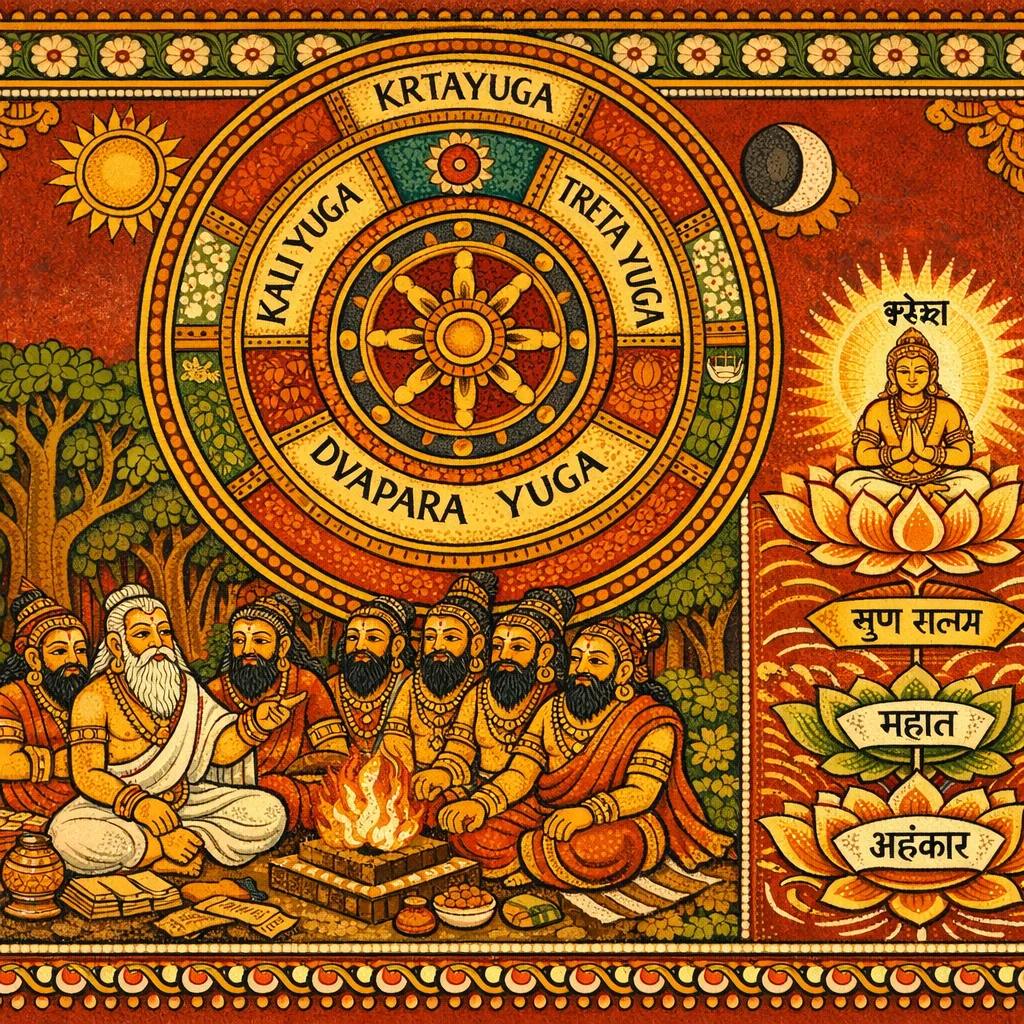
Adhyaya 145: Manvantaras, Yuga-Dharma, Śiṣṭācāra (Normative Conduct), and the Genealogy/Classifications of Ṛṣis
मन्वन्तर-युगधर्म-शिष्टाचार-ऋषिवंश-वर्णनम्
Speaker: Sūta, Ṛṣis (implied audience at Naimiṣāraṇya)
In dialogue form, Sūta continues teaching the assembled sages: he first outlines the Manvantara scheme and the Yuga-wise shifts in lifespan and bodily standards. He then establishes dharma’s sources (Śruti and Smṛti) and its two modes of practice—Śrauta sacrifice (yajña) and Smārta conduct within varṇa–āśrama. Living authority is grounded in śiṣṭācāra, upheld by Manu and the Saptaṛṣis in every Manvantara, and eight hallmark virtues of the cultured are listed. Next he defines key ethical and ascetic terms: truth, tapas, compassion, forbearance, non-greed, śama/dama, dispassion, and renunciation. The discourse turns to cosmology and consciousness: guṇa-equilibrium at pralaya, evolution from mahat to ahaṃkāra and the elements, the role of Time, and the kṣetrajña distinct from the kṣetra. Finally, Sūta gives etymologies and classifications of ṛṣis and supplies long genealogical/pravara-style lists of mantra-composers, ṛṣikās, and ṛṣiputras.
Key Concepts
Shlokas in Adhyaya 145
Verse 1
*सूत उवाच मन्वन्तराणि यानि स्युः कल्पे कल्पे चतुर्दश व्यतीतानागतानि स्युर् यानि मन्वन्तरेष्विह //
Sūta said: In each Kalpa there are fourteen Manvantaras; among them, some have passed and some are yet to come—these Manvantara cycles are described here.
Verse 2
विस्तरेणानुपूर्व्याच्च स्थितिं वक्ष्ये युगे युगे तस्मिन्युगे च सम्भूतिर् यासां यावच्च जीवितम् //
I shall explain, in detail and in proper sequence, the established order of each Yuga—how matters stand in that age, what beings arise therein, and how far their lifespan extends.
Verse 3
युगमात्रं तु जीवन्ति न्यूनं तत्स्याद्द्वयेन च चतुर्दशसु तावन्तो ज्ञेया मन्वन्तरेष्विह //
They live for a span equal to a Yuga; and in each successive case it becomes less by two (units). Thus, within the fourteen Manvantaras, their lifespans are to be understood in that manner.
Verse 4
मनुष्याणां पशूनां च पक्षिणां स्थावरैः सह तेषामायुरुपक्रान्तं युगधर्मेषु सर्वशः //
For humans, animals, and birds—together with immobile beings—the course and measure of their lifespans is set forth in every way in accordance with the dharma of the yugas.
Verse 5
तथैवायुः परिक्रान्तं युगधर्मेषु सर्वशः अस्थितिं च कलौ दृष्ट्वा भूतानामायुषश्च वै //
So too, the span of life has shifted in every way according to the dharma of each age; and seeing the instability in the Kali age, one understands indeed the diminished lifespan of living beings.
Verse 6
परमायुः शतं त्वेतन् मानुषाणां कलौ स्मृतम् देवासुरमनुष्याश्च यक्षगन्धर्वराक्षसाः //
In Kali Yuga, the maximum lifespan of human beings is remembered to be one hundred years. Here are mentioned the gods, demons (asuras), humans, as well as the Yakṣas, Gandharvas, and Rākṣasas.
Verse 7
परिणाहोच्छ्रये तुल्या जायन्ते ह कृते युगे षण्णवत्यङ्गुलोत्सेधो ह्य् अष्टानां देवयोनिनाम् //
In the Kṛta Yuga, they are said to be equal in girth and in height; and the canonical height for the eight divine types (deva-yonis) is ninety-six aṅgulas.
Verse 8
नवाङ्गुलप्रमाणेन निष्पन्नेन तथाष्टकम् एतत्स्वाभाविकं तेषां प्रमाणमधिकुर्वताम् //
When the measure is established as nine aṅgulas, and likewise the set of eight (units) is fixed accordingly—this is the natural (standard) measure for those who are increasing the proportions beyond the base standard.
Verse 9
मनुष्या वर्तमानास्तु युगसंध्यांशकेष्विह देवासुरप्रमाणं तु सप्तसप्ताङ्गुलं क्रमात् //
Humans living now, in these transitional junctures of the yugas, are measured in relation to the standards of the gods and the asuras; their scale is set forth step by step as “seven and seven” aṅgulas.
Verse 10
चतुरशीतिकैश्चैव कलिजैरङ्गुलैः स्मृतम् आ पादतलमस्तको नवतालो भवेत्तु यः //
It is taught that, when measured in aṅgulas according to the Kali standard, the full height—from the soles of the feet to the crown of the head—should be nine tālas, amounting to eighty-four aṅgulas.
Verse 11
संहृत्याजानुबाहुश्च दैवतैरभिपूज्यते गवां च हस्तिनां चैव महिषस्थावरात्मनाम् //
With arms reaching down to the knees and gathered in a composed posture, he is revered and duly worshipped by the gods as the indwelling divine principle of cows, elephants, buffaloes, and even of immovable beings.
Verse 12
क्रमेणैतेन विज्ञेये ह्रासवृद्धी युगे युगे षट्सप्तत्यङ्गुलोत्सेधः पशुर् आककुदो भवेत् //
By this very sequence, decreases and increases are to be understood from yuga to yuga. A beast whose height is seventy-six aṅgulas is called “ākakuda,” that is, one with a pronounced hump or withers.
Verse 13
अङ्गुलानामष्टशतम् उत्सेधो हस्तिनां स्मृतः अङ्गुलानां सहस्रं तु द्विचत्वारिंशदङ्गुलम् //
The prescribed height (utsedha) of elephants is said to be eight hundred aṅgulas; and, by the larger standard, it is one thousand aṅgulas—namely, forty-two aṅgulas above the base measure.
Verse 14
शतार्धमङ्गुलानां तु ह्य् उत्सेधः शाखिनां परः मानुषस्य शरीरस्य संनिवेशस्तु यादृशः //
The supreme (standard) height of the limbs of an image is said to be one hundred and fifty aṅgulas; and the proportional arrangement of the human body is to be made accordingly.
Verse 15
तल्लक्षणं तु देवानां दृश्यते ऽन्वयदर्शनात् बुद्ध्यातिशयसंयुक्तो देवानां काय उच्यते //
That distinctive mark of the gods is understood by observing the consistent sequence of their attributes and indications. A form endowed with an extraordinary excellence of intelligence is said to be the body (form) of the gods.
Verse 16
तथा नातिशयश्चैव मानुषः काय उच्यते इत्येव हि परिक्रान्ता भावा ये दिव्यमानुषाः //
Likewise, that body which is without extraordinary (superhuman) features is called ‘human’. Thus are set forth the characteristics of those beings who are of a divine-human (semi-divine) nature.
Verse 17
पशूनां पक्षिणां चैव स्थावराणां च सर्वशः गावो ऽजाश्वाश्च विज्ञेया हस्तिनः पक्षिणो मृगाः //
Among animals, birds, and even all stationary beings, distinct classes are to be recognized: cows, goats, and horses; likewise elephants, birds, and wild beasts.
Verse 18
उपयुक्ताः क्रियास्वेते यज्ञियास्त्विह सर्वशः यथाक्रमोपभोगाश्च देवानां पशुमूर्तयः //
These (forms) are to be employed in their respective rites; here they are all sacrificial in character. And, in due order, the animal-forms of the gods are to be understood as their proper objects of ritual offering and enjoyment.
Verse 19
तेषां रूपानुरूपैश्च प्रमाणैः स्थिरजङ्गमाः मनोज्ञैस्तत्र तैर्भोगैः सुखिनो ह्युपपेदिरे //
There, both the immobile and the mobile beings attained bodies with measures proportionate to their respective forms; and, enjoying those delightful pleasures in that place, they indeed came to dwell in happiness.
Verse 20
अथ शिष्टान्प्रवक्ष्यामि साधूनथ ततश्च वै ब्राह्मणाः श्रुतिशब्दाश्च देवानां पशुमूर्तयः संयुज्य ब्रह्मणा ह्यन्तस् तेन सन्तः प्रचक्षते //
Now I shall explain the śiṣṭas—the cultured and exemplary—and likewise the sādhus. Indeed, the Brāhmaṇas and the very words of Śruti, together with the gods who assume animal-forms, are joined inwardly with Brahman; therefore they are spoken of as ‘saints’ (santaḥ).
Verse 21
सामान्येषु च धर्मेषु तथा वैशिषिकेषु च ब्रह्मक्षत्रविशो युक्ताः श्रौतस्मार्तेन कर्मणा //
In duties that are common (to all) and in those that are specific (to each class) as well, the Brāhmaṇa, Kṣatriya, and Vaiśya are to be properly engaged in actions prescribed by Śruti and Smṛti.
Verse 22
वर्णाश्रमेषु युक्तस्य सुखोदर्कस्य स्वर्गतौ श्रौतस्मार्तो हि यो धर्मो ज्ञानधर्मः स उच्यते //
For one who is properly established in the duties of varṇa and āśrama, whose practice culminates in happiness and leads toward heaven, that dharma taught in the Śruti and the Smṛti is indeed called the Dharma of Knowledge (jñāna-dharma).
Verse 23
दिव्यानां साधनात्साधुर् ब्रह्मचारी गुरोर्हितः कारणात्साधनाच्चैव गृहस्थः साधुरुच्यते //
A brahmacārin is called a sādhu because he pursues the means to what is divine and acts for the welfare of his teacher. Likewise, a householder is said to be a sādhu because he upholds the proper causes and the practical means (of sustaining dharma).
Verse 24
तपसश्च तथारण्ये साधुर्वैखानसः स्मृतः यतमानो यतिः साधुः स्मृतो योगस्य साधनात् //
Likewise, one who practices tapas (austerity) in the forest is regarded as a true Vaikhānasa, a forest-ascetic. And the disciplined yati, striving with restraint, is called a good person, because he undertakes the sādhana—the means—of Yoga.
Verse 25
धर्मो धर्मगतिः प्रोक्तः शब्दो ह्येष क्रियात्मकः कुशलाकुशलौ चैव धर्माधर्मौ ब्रवीत्प्रभुः //
Dharma is declared to be the course, the guiding path of righteousness; this term is indeed action-oriented. The Lord explains that what is wholesome and what is unwholesome are called, respectively, dharma and adharma.
Verse 26
अथ देवाश्च पितर ऋषयश्चैव मानुषाः अयं धर्मो ह्ययं नेति ब्रुवते मौनमूर्तिना //
Then the gods, the ancestors (pitṛ), the seers (ṛṣi), and even human beings declare—through the very form of silence—“This indeed is Dharma; this indeed is not.”
Verse 27
धर्मेति धारणे धातुर् महत्त्वे चैव उच्यते आधारणे महत्त्वे वा धर्मः स तु निरुच्यते //
The verbal root (dhātu) behind the word “dharma” is said to convey the sense of “upholding/maintaining,” and also that of “greatness.” Thus dharma is explained as that which supports and sustains, and as that which is great in value and authority.
Verse 28
तत्रेष्टप्रापको धर्म आचार्यैरुपदिश्यते अधर्मश्चानिष्टफल आचार्यैर्नोपदिश्यते //
In this matter, dharma—which leads to the attainment of what is desired—is taught by the teachers (ācārya). But adharma, which yields undesirable results, is not taught by the teachers.
Verse 29
वृद्धाश्चालोलुपाश्चैव आत्मवन्तो ह्यदाम्भिकाः सम्यग्विनीता मृदवस् तानाचार्यान्प्रचक्षते //
Those who are mature in years, free from greed, self-possessed and without pretence, well-disciplined and gentle—such persons are recognized and spoken of as true teachers (ācāryas).
Verse 30
धर्मज्ञैर्विहितो धर्मः श्रौतस्मार्तो द्विजातिभिः दाराग्निहोत्रसम्बन्धम् इज्या श्रौतस्य लक्षणम् //
The dharma prescribed by those who know dharma—taught for the twice-born—is of two kinds: Śrauta and Smārta. Worship (ijyā) that is bound up with one’s wife and the maintaining of the sacred fires (agnihotra) is the defining mark of Śrauta practice.
Verse 31
स्मार्तो वर्णाश्रमाचारो यमैश्च नियमैर्युतः पूर्वेभ्यो वेदयित्वेह श्रौतं सप्तर्षयो ऽब्रुवन् //
The Smārta code of conduct for the disciplines of varṇa and āśrama—endowed with the yamas and niyamas—having been taught here to the ancients, the Seven Sages then proclaimed the Śrauta (Vedic sacrificial) system.
Verse 32
ऋचो यजूंषि सामानि ब्रह्मणो ऽङ्गानि वै श्रुतिः मन्वन्तरस्यातीतस्य स्मृत्वा तन्मनुरब्रवीत् //
The Ṛk, Yajus, and Sāman—indeed the Veda (Śruti)—are the very limbs of Brahmā. Remembering the manvantara that had passed, that Manu then spoke.
Verse 33
तस्मात्स्मार्तः सूतो धर्मो वर्णाश्रमविभागशः एवं वै द्विविधो धर्मः शिष्टाचारः स उच्यते //
Therefore, the Smārta (scripture-based) dharma is taught as being apportioned according to the divisions of varṇa and āśrama. Thus, dharma is indeed of two kinds; the second is called the conduct (ācāra) of the cultured and disciplined (śiṣṭas).
Verse 34
शिषेर् धातोश्च निष्ठान्ताच् छिष्टशब्दं प्रचक्षते मन्वन्तरेषु ये शिष्टा इह तिष्ठन्ति धार्मिकाः //
From the verbal root śiṣ (to instruct/discipline), with the niṣṭhā-ending, the word “śiṣṭa” is explained. Those who are the śiṣṭas—righteous, well-disciplined exemplars—remain established here through the Manvantaras.
Verse 35
मनुः सप्तर्षयश्चैव लोकसंतानकारिणः तिष्ठन्तीह च धर्मार्थं ताञ्छिष्टान्सम्प्रचक्षते //
Manu and the Seven Sages—who bring about the continuance of the world’s progeny—abide here for the sake of Dharma; therefore they are rightly proclaimed to be the Śiṣṭas, authoritative learned exemplars.
Verse 36
तैः शिष्टैश्चलितो धर्मः स्थाप्यते वै युगे युगे त्रयी वार्त्ता दण्डनीतिः प्रजावर्णाश्रमेप्सया //
By those śiṣṭas, the Dharma that has been set in motion is indeed re-established age after age—through the Vedic triad (trayi), through vārttā (productive livelihood and economy), and through daṇḍanīti (the science of punishment and governance)—so that the people may be guided toward the proper order of varṇa and āśrama.
Verse 37
शिष्टैराचर्यते यस्मात् पुनश्चैव मनुक्षये पूर्वैःपूर्वैर्मतत्वाच्च शिष्टाचारः स शाश्वतः //
Because it is practiced by the śiṣṭas, and because—even when a Manu’s age comes to an end—it is upheld again; and because it is approved by the ancients, generation after generation, that śiṣṭācāra, the established conduct of the learned, is eternal.
Verse 38
दानं सत्यं तपो लोको विद्येज्या पूजनं दमः अष्टौ तानि चरित्राणि शिष्टाचारस्य लक्षणम् //
Charity, truthfulness, austerity (tapas), proper worldly conduct, learning, ijyā—worship of the gods, reverential honoring, and self-restraint (dama)—these eight traits are the hallmarks of śiṣṭācāra, the refined conduct of the śiṣṭas.
Verse 39
शिष्टा यस्माच्चरन्त्येनं मनुः सप्तर्षयश्च ह मन्वन्तरेषु सर्वेषु शिष्टाचारस्ततः स्मृतः //
Because cultured and exemplary people practice this, and because Manu and the Seven Sages indeed follow it in every Manvantara, it is therefore remembered as śiṣṭācāra—authoritative customary conduct.
Verse 40
विज्ञेयः श्रवणाच्छ्रौतः स्मरणात्स्मार्त उच्यते इज्यावेदात्मकः श्रौतः स्मार्तो वर्णाश्रमात्मकः प्रत्यङ्गानि प्रवक्ष्यामि धर्मस्येह तु लक्षणम् //
That which is known through hearing (śruti) is to be understood as Śrauta; that which is known through remembrance (smṛti) is called Smārta. The Śrauta is of the nature of Vedic sacrifice and Vedic ordinance, while the Smārta is of the nature of the disciplines of varṇa and āśrama. Now I shall declare the subsidiary limbs—indeed the defining marks—of dharma here.
Verse 41
दृष्टानुभूतमर्थं च यः पृष्टो न विगूहते यथाभूतप्रवादस्तु इत्येतत्सत्यलक्षणम् //
When questioned, one who does not conceal a matter that has been seen or personally experienced—who states things as they truly are—this is the defining mark of truthfulness.
Verse 42
ब्रह्मचर्यं तपो मौनं निराहारत्वमेव च इत्येतत्तपसो रूपं सुघोरं तु दुरासदम् //
Celibacy (brahmacarya), austerity, silence (mauna), and even fasting—these are the forms of tapas; indeed, this discipline is exceedingly fierce and difficult to undertake.
Verse 43
पशूनां द्रव्यहविषाम् ऋक्सामयजुषां तथा ऋत्विजां दक्षिणायाश्च संयोगो यज्ञ उच्यते //
The coordinated union of sacrificial animals, material offerings and oblations (havis), the recitations of the Ṛk, Sāman, and Yajus, the officiating priests (ṛtvij), and the priestly fee (dakṣiṇā)—this is what is called a yajña (sacrifice).
Verse 44
आत्मवत्सर्वभूतेषु यो हिताय शुभाय च वर्तते सततं हृष्टः क्रिया श्रेष्ठा दया स्मृता //
One who regards all beings as oneself and continually acts for their welfare and good, ever remaining glad—such conduct is remembered as the highest deed: compassion (dayā).
Verse 45
आक्रुष्टो ऽभिहतो यस्तु नाक्रोशेत्प्रहरेदपि अदुष्टो वाङ्मनःकायैस् तितिक्षुः सा क्षमा स्मृता //
Even when abused and struck, one who neither abuses in return nor strikes back, remaining untainted in speech, mind, and body, and who endures—this is remembered as kṣamā (true forbearance).
Verse 46
स्वामिना रक्ष्यमाणानाम् उत्सृष्टानां च सम्भ्रमे परस्वानाम् अनादानम् अलोभ इति संज्ञितम् //
Not taking what belongs to others—whether it is being guarded by its owner or has been left behind in a moment of confusion—is what is designated as non-greed (alobha).
Verse 47
मैथुनस्यासमाचारो जल्पनाच्चिन्तनात्तथा निवृत्तिर्ब्रह्मचर्यं च तदेतच्छमलक्षणम् //
Refraining from sexual intercourse, and likewise withdrawing from idle talk and from brooding thoughts—this is brahmacarya; and this is the defining mark of śama (inner tranquility and self-restraint).
Verse 48
आत्मार्थे वा परार्थे वा इन्द्रियाणीह यस्य वै विषये न प्रवर्तन्ते दमस्यैतत्तु लक्षणम् //
Whether for one’s own benefit or for another’s, when a person’s senses here do not rush toward sense-objects—this indeed is the defining mark of dama (self-restraint).
Verse 49
पञ्चात्मके यो विषये कारणे चाष्टलक्षणे न क्रुध्येत प्रतिहतः स जितात्मा भविष्यति //
He who, even when restrained or opposed, does not grow angry with regard to the fivefold objects of sense and the cause endowed with eight characteristics—he shall become a conqueror of himself (jitātmā).
Verse 50
यद्यदिष्टतमं द्रव्यं न्यायेनैवागतं च यत् तत्तद्गुणवते देयम् इत्येतद्दानलक्षणम् //
Whatever substance is most dear to oneself, and whatever has been obtained by rightful means—this should be given, just as it is, to a worthy person of good qualities: this is the defining mark of true charity (dāna).
Verse 51
श्रुतिस्मृतिभ्यां विहितो धर्मो वर्णाश्रमात्मकः शिष्टाचारप्रवृद्धश्च धर्मो ऽयं साधुसंमतः //
Dharma, as enjoined by Śruti and Smṛti, is grounded in the system of varṇa and āśrama; and this dharma—strengthened by the conduct of the cultured and disciplined (śiṣṭa)—is approved by the virtuous.
Verse 52
अप्रद्वेषो ह्यनिष्टेषु इष्टं वै नाभिनन्दति प्रीतितापविषादानां विनिवृत्तिर् विरक्तता //
One who bears no hatred toward the unpleasant and does not exult over the pleasant—whose delight, anguish, and dejection have ceased—such withdrawal is called dispassion (virakti).
Verse 53
संन्यासः कर्मणां न्यासः कृतानामकृतैः सह कुशलाकुशलाभ्यां तु प्रहाणं न्यास उच्यते //
Renunciation (saṃnyāsa) is the laying down of actions—both those already done and those yet to be done; and the abandonment of both the meritorious (kuśala) and the unmeritorious (akuśala) is what is called ‘laying down’ (nyāsa).
Verse 54
अव्यक्तादिविशेषान्तव् इकारे ऽस्मिन्निवर्तते चेतनाचेतनं ज्ञात्वा ज्ञाने ज्ञानी स उच्यते //
From the Unmanifest up to the differentiated particulars, all this is resolved and comes to rest in this very principle; having discerned what is conscious and what is unconscious, one is called a knower, established in true knowledge.
Verse 55
प्रत्यङ्गानि तु धर्मस्य चेत्येतल्लक्षणं स्मृतम् ऋषिभिर्धर्मतत्त्वज्ञैः पूर्वैः स्वायम्भुवे ऽन्तरे //
“These are remembered as the defining marks—namely, the subsidiary limbs (pratyaṅgas) of dharma—taught by the ancient seers who knew the true principle of dharma, in the Svāyambhuva Manvantara.”
Verse 56
अत्र वो वर्णयिष्यामि विधिं मन्वन्तरस्य तु तथैव चातुर्होत्रस्य चातुर्वर्ण्यस्य चैव हि //
Here I shall describe to you the proper procedure (vidhi) concerning the Manvantara, and likewise the four-priest sacrificial system (cāturhotra), and also the order and duties of the four social classes (cāturvarṇya).
Verse 57
प्रतिमन्वन्तरं चैव श्रुतिरन्या विधीयते ऋचो यजूंषि सामानि यथावत्प्रतिदैवतम् //
In each Manvantara, a distinct recension of the Śruti is duly established; and the Ṛk-verses, Yajus-formulas, and Sāman-chants are arranged properly, deity by deity.
Verse 58
विधिस्तोत्रं तथा हौत्रं पूर्ववत्सम्प्रवर्तते द्रव्यस्तोत्रं गुणस्तोत्रं कर्मस्तोत्रं तथैव च //
Likewise, the stotra that lays down the rite (vidhi-stotra) and the priestly recitation (hautra) proceed as previously described; and so too do the stotras concerning the offering-substances (dravya), the qualities (guṇa), and the ritual actions (karma).
Verse 59
तथैवाभिजनस्तोत्रं स्तोत्रमेवं चतुर्विधम् मन्वन्तरेषु सर्वेषु यथा भेदा भवन्ति हि //
Likewise, the hymn concerning noble lineage is of this very kind; thus the hymn is fourfold, for in all the Manvantaras such distinctions indeed arise according to the differences of each age.
Verse 60
प्रवर्तयन्ति तेषां वै ब्रह्मस्तोत्रं पुनः पुनः एवं मन्त्रगुणानां तु समुत्पत्तिश्चतुर्विधा //
For them indeed, the Brahma-hymn is set in motion again and again—repeatedly recited and applied. Thus, the manifestation of the qualities of mantras is fourfold.
Verse 61
अथर्वऋग्यजुःसाम्नां वेदेष्विह पृथक्पृथक् ऋषीणां तप्यतां तेषां तपः परमदुश्चरम् //
Here, within the Vedas—Atharva, Ṛg, Yajus, and Sāman—each stream stands distinct. For those seers who undertook austerities, their tapas was supremely difficult to perform.
Verse 62
मन्त्राः प्रादुर्भवन्त्यादौ पूर्वमन्वन्तरस्य ह असंतोषाद्भयाद्दुःखान् मोहाच्छोकाच्च पञ्चधा //
At the very beginning of the former Manvantara, the mantras manifest in a fivefold manner—arising from discontent, fear, suffering, delusion, and grief.
Verse 63
ऋषीणां तारका येन लक्षणेन यदृच्छया ऋषीणां यादृशत्वं हि तद्वक्ष्यामीह लक्षणम् //
By whatever distinguishing mark one may, even incidentally, recognize the sages, I shall state here that defining characteristic by which the ṛṣis are known as they truly are.
Verse 64
अतीतानागतानां च पञ्चधा ह्यार्षकं स्मृतम् तथा ऋषीणां वक्ष्यामि आर्षस्येह समुद्भवम् //
Concerning what is past and what is yet to come, the Ārṣa tradition (born of the ṛṣis) is remembered as fivefold. Likewise, here I shall explain the origin and arising of the ṛṣis’ Ārṣa lineage.
Verse 65
गुणसाम्येन वर्तन्ते सर्वसंप्रलये तदा अविभागेन देवानाम् अनिर्देश्ये तमोमये //
At the time of total dissolution (sarva-saṃpralaya), all beings abide in an equilibrium of the guṇas; the gods too remain undifferentiated—within that indescribable, darkness-suffused state.
Verse 66
अबुद्धिपूर्वकं तद्वै चेतनार्थं प्रवर्तते तेनार्षं बुद्धिपूर्वं तु चेतनेनाप्यधिष्ठितम् //
That (ordinary utterance or action) proceeds without prior deliberation, merely aiming at conscious intention; therefore the seers’ Ārṣa utterance, however, is preceded by understanding and is upheld—even governed—by awakened consciousness (cetanā).
Verse 67
प्रवर्तते तथा ते तु यथा मत्स्योदकावुभौ चेतनाधिकृतं सर्वं प्रावर्तत गुणात्मकम् कार्यकारणभावेन तथा तस्य प्रवर्तते //
So too do they function—just as fish and water exist in mutual dependence. In the same way, all that is constituted of the guṇas comes into operation when presided over by consciousness (cetanā), and it proceeds according to the relation of cause and effect; thus does its activity unfold.
Verse 68
विषयो विषयित्वं च तदा ह्यर्थपदात्मकौ कालेन प्रापणीयेन भेदाश्च कारणात्मकाः //
At that stage, the “object” (viṣaya) and “objecthood” (viṣayitva) are indeed constituted by the ‘thing’ and its ‘designation’; and the differentiations that arise—through time as the factor that brings about attainment—are themselves of the nature of causes.
Verse 69
सांसिद्धिकास्तदा वृत्ताः क्रमेण महदादयः महतो ऽसावहंकारस् तस्माद्भूतेन्द्रियाणि च //
Then, in the order of manifestation, the innate (primordial) principles became active—beginning with Mahat and the rest. From Mahat arose Ahaṃkāra (the sense of “I”), and from that, the elements and the sense-faculties as well.
Verse 70
भूतभेदाश्च भूतेभ्यो जज्ञिरे तु परस्परम् संसिद्धिकारणं कार्यं सद्य एव विवर्तते //
From the elements, the various distinctions among beings arise mutually, one from another; and the effect—when its cause is fully in place—transforms at once into manifestation.
Verse 71
यथोल्मुकात्तु विटपा एककालाद्भवन्ति हि तथा प्रवृत्ताः क्षेत्रज्ञाः कालेनैकेन कारणात् //
Just as shoots may arise from a firebrand in a single moment, so too the kṣetrajña, the conscious “knower of the field,” when impelled into activity, comes to operate by Time alone—through that one causal principle.
Verse 72
यथान्धकारे खद्योतः सहसा सम्प्रदृश्यते तथा निवृत्तो ह्यव्यक्तः खद्योत इव संज्वलन् //
As a firefly is suddenly seen in the darkness, so too the Unmanifest (Avyakta)—when the mind turns back from outward objects—shines forth, blazing like a firefly.
Verse 73
स महात्मा शरीरस्थस् तत्रैवेह प्रवर्तते महतस्तमसः पारे वैलक्षण्याद्विभाव्यते //
That Great Self (Mahātman), though abiding within the body, functions right here, in this very life. Yet, by virtue of its distinctness, it is discerned as existing beyond the vast darkness (tamas).
Verse 74
तत्रैव संस्थितो विद्वांस् तपसो ऽन्त इति श्रुतम् बुद्धिर्विवर्धतस्तस्य प्रादुर्भूता चतुर्विधा //
There itself the wise one—so it is heard—reached the culmination of austerity (tapas); and as his understanding kept expanding, a fourfold wisdom manifested within him.
Verse 75
ज्ञानं वैराग्यमैश्वर्यं धर्मश्चेति चतुष्टयम् सांसिद्धिकान्यथैतानि अप्रतीतानि तस्य वै //
Knowledge (jñāna), dispassion (vairāgya), lordly power (aiśvarya), and righteousness (dharma)—this set of four is said to be the marks of spiritual accomplishment; and when these are absent, it is indeed a sign that perfection has not been realized.
Verse 76
महात्मनः शरीरस्य चैतन्यात्सिद्धिरुच्यते पुरि शेते यतः पूर्वं क्षेत्रज्ञानं तथापि च //
The true attainment (siddhi) of the great embodied being is said to arise from the body’s consciousness; for the Knower of the Field (kṣetrajña) abides within the “city” (the body) from the very beginning, and so it remains.
Verse 77
पुरे शयनात्पुरुषो ज्ञानात्क्षेत्रज्ञ उच्यते यस्माद्धर्मात्प्रसूते हि तस्माद्वै धार्मिकस्तु सः //
Because he abides (as if resting) within the city/body, and because he is of the nature of knowing, the Person (puruṣa) is called the Kṣetrajña, the “Knower of the Field”. And since he is indeed born from Dharma, therefore he is truly called dhārmika—righteous.
Verse 78
सांसिद्धिके शरीरे च बुद्ध्याव्यक्तस्तु चेतनः एवं विवृत्तः क्षेत्रज्ञः क्षेत्रं ह्यनभिसंधितः //
Even in the perfected (sāṃsiddhika) body, the conscious principle remains unmanifest to the buddhi (intellect). Thus the Knower of the Field (kṣetrajña), being so distinguished, is not truly bound up with the Field (kṣetra).
Verse 79
निवृत्तिसमकाले तु पुराणं तदचेतनम् क्षेत्रज्ञेन परिज्ञातं भोग्यो ऽयं विषयो मम //
At the time of withdrawal (nivṛtti), the body—ancient and insentient—is clearly understood by the Kṣetrajña (the Knower of the Field, consciousness) as: “This object of experience is to be enjoyed by me.”
Verse 80
ऋषिर्हिंसागतौ धातुर् विद्या सत्यं तपः श्रुतम् एष सन्निलयो यस्माद् ब्राह्मणस्तुततस् त्व् ऋषिः //
The verbal root (dhātu) ‘ṛṣ’ is said to denote ‘to go/move’ and ‘to harm’. Yet, where knowledge, truth, austerity (tapas), and sacred learning (śruta) are firmly established as an abiding seat—by that settled presence—such a Brāhmaṇa is praised as an ‘Ṛṣi’.
Verse 81
निवृत्तिसमकालाच्च बुद्ध्याव्यक्त ऋषिस्त्वयम् ऋषते परमं यस्मात् परमर्षिस्ततः स्मृतः //
And because you arise at the very time of withdrawal (nivṛtti), you are a Ṛṣi whose intelligence is unmanifest (avyakta). Since you attain the supreme state of ṛṣi-hood, you are therefore remembered as a Paramarṣi.
Verse 82
गत्यर्थाद् ऋषतेर् धातोर् नामनिर्वृत्तिकारणम् यस्मादेष स्वयंभूतस् तस्माच्च ऋषिता मता //
Because the name is derived from the verbal root ṛṣ, used in the sense of ‘going/moving’, this is the cause of the word’s formation. And since this one is svayaṃbhū (self-born), he is therefore regarded as possessing ṛṣitā—true Ṛṣi-hood.
Verse 83
सेश्वराः स्वयमुद्भूता ब्रह्मणो मानसाः सुताः निवर्तमानैस्तैर्बुद्ध्या महान्परिगतः परः //
Those mind-born sons of Brahmā—self-arisen and endowed with lordly powers—turned back; and by their awakened intelligence they comprehended the Supreme Great One who is beyond all.
Verse 84
यस्माद् दृशपरत्वेन सह तस्मान्महर्षयः ईश्वराणां सुतास्तेषां मानसाश्चौरसाश्च वै //
Therefore, because they were foremost in spiritual vision, those great seers are regarded as the sons of the divine Lords—some being mind-born (mānasa), and others being auras-born, that is, naturally born through the body (aurasa).
Verse 85
ऋषिस्तस्मात्परत्वेन भूतादिरृषयस्ततः ऋषिपुत्रा ऋषीकास्तु मैथुनाद्गर्भसम्भवाः //
Therefore, by virtue of their higher (spiritual) status they are called Ṛṣis; thereafter, the primordial sages beginning with Bhūta are so named. The Ṛṣīkās, however, are the daughters of Ṛṣis, born from sexual union and conceived in the womb.
Verse 86
परत्वेन ऋषन्ते वै भूतादीनृषिकास्ततः ऋषिकाणां सुता ये तु विज्ञेया ऋषिपुत्रकाः //
Those who, by their superior (spiritual) status, are called ‘ṛṣis’—beginning with the primordial beings such as Bhūta—are therefore termed ṛṣikās; and those born as the sons of the ṛṣikās are to be understood as ‘ṛṣiputrakas’ (sons of sages).
Verse 87
श्रुत्वा ऋषं परत्वेन श्रुतास्तस्माच्छ्रुतर्षयः अव्यक्तात्मा महात्मा वा-हंकारात्मा तथैव च //
Having heard the seer spoken of as the Supreme, those sages—thus renowned for what they had heard—taught that the Self (Ātman) is of three kinds: the Unmanifest Self (avyakta-ātman), the Great Self (mahātman), and likewise the Ego-Self (ahaṃkāra-ātman).
Verse 88
भूतात्मा चेन्द्रियात्मा च तेषां तज्ज्ञानमुच्यते इत्येवमृषिजातिस्तु पञ्चधा नामविश्रुता //
“The elemental self (bhūtātman) and the sensory self (indriyātman)”—such is said to be their distinctive knowledge. Thus, in this manner, the class of sages (ṛṣis) is renowned by name as fivefold.
Verse 89
भृगुर्मरीचिरत्रिश्च अङ्गिराः पुलहः क्रतुः मनुर्दक्षो वसिष्ठश्च पुलस्त्यश्चापि ते दश //
Bhrigu, Marichi, Atri, Angiras, Pulaha, Kratu, Manu, Daksha, Vasiṣṭha, and Pulastya—these are the ten (primeval sages).
Verse 90
ब्रह्मणो मानसा ह्येते उत्पन्नाः स्वयमीश्वराः परत्वेनर्षयो यस्मान् मतास्तस्मान्महर्षयः //
These sages were indeed mind-born from Brahmā, self-possessed and lordly in their own right. Since they are regarded as foremost among the ṛṣis, therefore they are called the Mahārṣis (Great Sages).
Verse 91
ईश्वराणां सुतास्त्वेषाम् ऋषयस्तान्निबोधत काव्यो बृहस्पतिश्चैव कश्यपश्च्यवनस्तथा //
Know that the sons of these divine beings are sages: Kāvya (Śukra), Bṛhaspati, Kaśyapa, and likewise Cyavana.
Verse 92
उतथ्यो वामदेवश्च अगस्त्यः कौशिकस्तथा कर्दमो वालखिल्याश्च विश्रवाः शक्तिवर्धनः //
Utathya, Vāmadeva, Agastya, and likewise Kauśika; Kardama; the Vālakhilyas; Viśravā; and Śaktivardhana—these revered sages are (here) enumerated.
Verse 93
इत्येते ऋषयः प्रोक्तास् तपसा ऋषितां गताः तेषां पुत्रानृषीकांस्तु गर्भोत्पन्नान्निबोधत //
Thus these sages have been described—through austerity they attained the state of perfected seers. Now learn of their sons, the Ṛṣikās, who were born from the womb (i.e., through embodied generation).
Verse 94
वत्सरो नग्नहूश् चैव भरद्वाजश्च वीर्यवान् ऋषिर्दीर्घतमाश्चैव बृहद्वक्षाः शरद्वतः //
Also named are Vatsara and Nagnahū, and the mighty sage Bharadvāja; likewise the sage Dīrghatamas, and Bṛhadvakṣa, and Śaradvata.
Verse 95
वाजिश्रवाः सुचिन्तश्च शावश्च सपराशरः शृङ्गी च शङ्खपाच् चैव राजा वैश्रवणस्तथा //
Vājiśravā, Sucinta, Śāva, and Parāśara; Śṛṅgī and Śaṅkhapāc; and likewise King Vaiśravaṇa—these are the names enumerated.
Verse 96
इत्येते ऋषिकाः सर्वे सत्येन ऋषितां गताः ईश्वरा ऋषयश्चैव ऋषीका ये च विश्रुताः //
Thus all these ṛṣikās (female seers), through the power of truth, attained the state befitting the ṛṣis; and likewise the lordly sages and the renowned ṛṣikās became celebrated within the seer-tradition.
Verse 97
एवं मन्त्रकृतः सर्वे कृत्स्नशश्च निबोधत भृगुः काश्यपः प्रचेता दधीचो ह्यात्मवानपि //
Thus, understand in full that all these were composers of mantras—Bhṛgu, Kāśyapa, Pracetā, and Dadhīci also, the self-possessed sage.
Verse 98
ऊर्षो ऽथ जमदग्निश्च वेदः सारस्वतस्तथा आर्ष्टिषेणश्च्यवनश्च वीतहव्यः सवेधसः //
Then are named Ūrṣa and Jamadagni; Veda and likewise Sārasvata; also Ārṣṭiṣeṇa and Cyavana; and Vītahavya and Savedhas—these sages are to be remembered in this lineage-list.
Verse 99
वैन्यः पृथुर्दिवोदासो ब्रह्मवान्गृत्सशौनकौ एकोनविंशतिर्ह्येते भृगवो मन्त्रकृत्तमाः //
Vainya, Pṛthu, Divodāsa, Brahmavān, and Gṛtsa and Śaunaka—these, numbering nineteen in all, are the Bhṛgus, the foremost composers of mantras.
Verse 100
अङ्गिराश्चैव त्रितश्च भरद्वाजो ऽथ लक्ष्मणः कृतवाचस्तथा गर्गः स्मृतिसंकृतिरेव च //
And (the sages) Aṅgiras, Trita, Bharadvāja, and also Lakṣmaṇa; likewise Kṛtavāk, Garga, and Smṛti-saṃkṛti as well—these are the authorities remembered in this lineage-listing.
Verse 101
गुरुवीतश्च मान्धाता अम्बरीषस्तथैव च युवनाश्वः पुरुकुत्सः स्वश्रवस्तु सदस्यवान् //
And (there were) Guruvīta, Māndhātā, and likewise Ambarīṣa; Yuvanāśva, Purukutsa, and Svaśravas—a king endowed with a worthy council of advisors.
Verse 102
अजमीढो ऽस्वहार्यश्च ह्य् उत्कलः कविरेव च पृषदश्वो विरूपश्च काव्यश्चैवाथ मुद्गलः //
Ajamīḍha, Asvahārya, and also Utkala; likewise Kavi; Pṛṣadaśva, Virūpa, Kāvyā, and then Mudgala—these are the named descendants in this lineage.
Verse 103
उतथ्यश्च शरद्वांश्च तथा वाजिश्रवा अपि अपस्यौषः सुचित्तिश्च वामदेवस्तथैव च //
Utathya, Śaradvān, and also Vājiśravā; likewise Apasyauṣa, Sucitti, and Vāmadeva as well—these are the sages being enumerated.
Verse 104
ऋषिजो बृहच्छुक्लश्च ऋषिर्दीर्घतमा अपि कक्षीवांश्च त्रयस्त्रिंशत् स्मृता ह्यङ्गिरसां वराः //
Ṛṣija, Bṛhacchukla, the sage Dīrghatamas, and Kakṣīvān—these are remembered as thirty-three eminent seers of the lineage of Aṅgiras.
Verse 105
एते मन्त्रकृतः सर्वे काश्यपांस्तु निबोधत काश्यपः सहवत्सारो नैध्रुवो नित्य एव च //
Know that all these are Kāśyapa-type forms “made by mantra” (mantra-kṛta, consecrated through mantra). Understand the Kāśyapa classifications: Kāśyapa, Sahavatsāra, Naidhruva, and also Nitya.
Verse 106
असितो देवलश्चैव षडेते ब्रह्मवादिनः अत्रिर् अर्धस्वनश्चैव शावास्यो ऽथ गविष्ठिरः //
Asita and Devala—these six are proclaimed as expounders of Brahman: Atri, Ardhasvana, Śāvāsya, and Gaviṣṭhira.
Verse 107
कर्णकश्च ऋषिः सिद्धस् तथा पूर्वातिथिश्च यः //
Also (there are) the seer Karṇaka, the perfected one Siddha, and likewise the one named Pūrvātithi.
Verse 108
इत्येते त्वत्रयः प्रोक्ता मन्त्रकृत्षण्महर्षयः वसिष्ठश्चैव शक्तिश्च तृतीयश्च पराशरः //
Thus, these three are declared here as the great seers who were the composers of sacred mantras (“mantra-kṛt”): Vasiṣṭha, Śakti, and, as the third, Parāśara.
Verse 109
ततस्तु इन्द्रप्रतिमः पञ्चमस्तु भरद्वसुः षष्ठस्तु मित्रावरुणः सत्तमः कुण्डिनस्तथा //
Then came Indrapratima; the fifth was Bharadvasu; the sixth was Mitrāvaruṇa; and likewise the seventh was Kuṇḍina.
Verse 110
इत्येते सप्त विज्ञेया वासिष्ठा ब्रह्मवादिनः विश्वामित्रश्च गाधेयो देवरातस्तथा बलः //
Thus, these seven are to be known as the Vāsiṣṭha brahma-vādins (expounders of sacred knowledge); and also Viśvāmitra, the son of Gādhi, along with Devarāta and Bala.
Verse 111
तथा विद्वान्मधुच्छन्दा ऋषिश्चान्यो ऽघमर्षणः अष्टको लोहितश्चैव भृतकीलश्च माम्बुधिः //
Likewise, O ocean-like one, there was the learned sage Madhucchandā; and another sage, Aghamarṣaṇa; also Aṣṭaka and Lohita, and Bhṛtakīla as well.
Verse 112
देवश्रवा देवरातः पुराणश्च धनंजयः शिशिरश्च महातेजाः शालङ्कायन एव च //
Devaśravā, Devarāta, Purāṇa, Dhanaṃjaya, Śiśira of great splendor, and also Śālaṅkāyana—these are the names mentioned.
Verse 113
त्रयोदशैते विज्ञेया ब्रह्मिष्ठाः कौशिका वराः अगस्त्यो ऽथ दृढद्युम्न इन्द्रबाहुस्तथैव च //
These thirteen are to be known as the foremost, Brahman-realized sages among the excellent Kauśikas—namely Agastya, as well as Dṛḍhadyumna, and likewise Indrabāhu.
Verse 114
ब्रह्मिष्ठागस्तयो ह्येते त्रयः परमकीर्तयः मनुर्वैवस्वतश्चैव ऐलो राजा पुरूरवाः //
Among these, Brahmiṣṭha and Agastya, together with Vaivasvata Manu and King Purūravas of the Aila line, are figures of the highest renown and supreme fame.
Verse 115
क्षत्रियाणां वरा ह्येते विज्ञेया मन्त्रवादिनः भलन्दकश्च वासाश्वः संकीलश्चैव ते त्रयः //
These are to be known as the foremost among the Kshatriyas, skilled as mantravādins in the recitation and utterance of mantras: Bhalandaka, Vāsāśva, and Saṃkīla—these three indeed.
Verse 116
एते मन्त्रकृतो ज्ञेया वैश्यानां प्रवराः सदा इति द्विनवतिः प्रोक्ता मन्त्रायैश्च बहिष्कृताः //
These are to be known always as the Vaiśyas’ pravaras, established through mantras. Thus ninety-two have been declared, and they are excluded from the entitlement to Vedic mantra-recitation (mantra-adhikāra).
Verse 117
ब्राह्मणाः क्षत्रिया वैश्या ऋषिपुत्रान्निबोधत ऋषीकाणां सुता ह्येते ऋषिपुत्राः श्रुतर्षयः //
O Brāhmaṇas, Kṣatriyas, and Vaiśyas, understand who are called Ṛṣiputras: they are indeed the sons of the Ṛṣikās (female seers), and thus are known as Ṛṣiputras, the Śrutarṣis—‘seers of the śruti, the heard revelation’.
Frequently Asked Questions
It teaches that cosmic time (Manvantara and Yuga) governs the conditions of embodied life (lifespan and bodily measures), while dharma is preserved through two scriptural modes—Śrauta (Vedic sacrifice with agnihotra) and Smārta (varṇa–āśrama conduct). It then establishes śiṣṭācāra (the enduring conduct of cultured exemplars like Manu and the Saptaṛṣis) as a living authority that re-stabilizes society in every age, and it grounds this in ethical definitions (truth, tapas, compassion, forbearance, self-restraint, renunciation) and in seer-lineages that transmit mantra and tradition.
Dharma is central: Śrauta vs Smārta dharma, śiṣṭācāra, and detailed definitions of virtues and restraints. Genealogy is extensive: classifications and long lists of ṛṣis, ṛṣikās, and ṛṣiputras (mantra-composers and lineages). Vastu/architecture is not the main focus, but the chapter includes measurement science (aṅgula/tāla-based standards for bodies and animals) that overlaps with traditional Indian proportional canons used in iconometry and related śāstric measurement systems.
Yes. It states that in Kali Yuga the maximum human lifespan is remembered as one hundred years (paramāyuḥ śataṃ).
Śiṣṭācāra is the established conduct of the cultured, disciplined exemplars (śiṣṭas). It is called eternal because it is practiced by the learned, approved by successive generations of ancients, and re-established even when a Manu’s age ends—being upheld across all Manvantaras by Manu and the Seven Sages.
A yajña is defined as the coordinated union of sacrificial animals, material offerings/oblations, Ṛk–Sāman–Yajus recitations, officiating priests (ṛtvij), and the priestly fee (dakṣiṇā).
It describes a pralaya state of guṇa-equilibrium, followed by manifestation in order: mahat and other principles become active, from mahat arises ahaṃkāra, and from that arise the elements (bhūtas) and sense-faculties (indriyas). Time functions as an activator, while consciousness (cetanā/kṣetrajña) presides over guṇa-based activity.