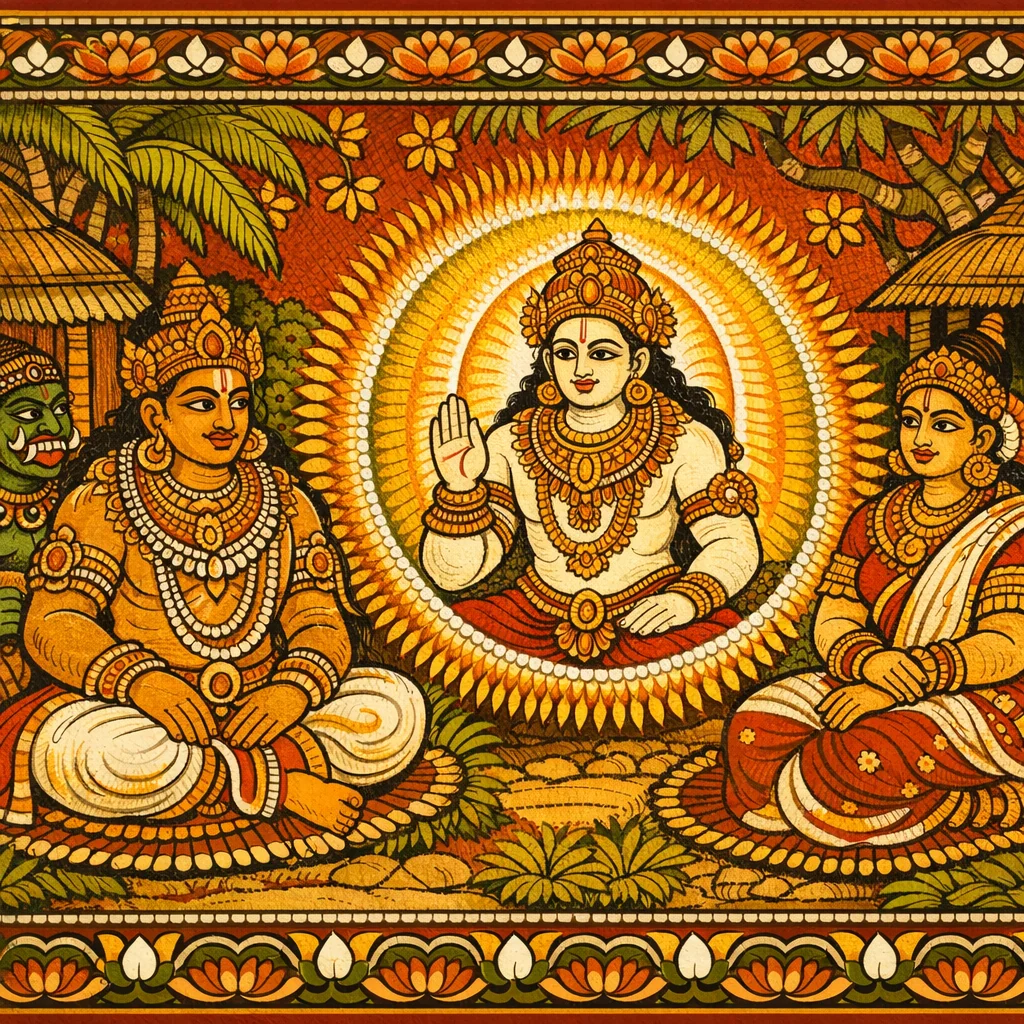
Adhyaya 25: Inquiry into Yayāti’s Story and the Kacha–Devayānī Episode (Origin of the Sañjīvanī Lore Context)
ययातिचरितप्रश्नः कचदेवयानी-शुक्रसंजीवनीविद्योपाख्यानम्
Speaker: ऋषयः (Sages), सूत (Sūta), शतानीक (Śatānīka), शौनक (Śaunaka), शुक्र/उशनस् (Śukra Uśanas), देवयानी (Devayānī), कच (Kaca)
Sages ask Sūta why the Pauravas rose while the Yadus declined, and they request the meritorious story of Yayāti. Sūta recalls an earlier dialogue in which King Śatānīka questioned Ṛṣi Śaunaka about Yayāti and Puru’s royal succession. Śaunaka sets Yayāti’s age amid the Deva–Asura conflict: the gods choose Bṛhaspati, while the asuras choose Śukra, whose Sañjīvanī lore revives fallen Dānavas. Unable to match this power, the gods send Kaca to Śukra as a brahmacārin disciple, instructing him to win Devayānī’s favor through exemplary conduct. Kaca serves for centuries, yet the Dānavas kill him repeatedly; Śukra revives him once. Later Kaca is burned and fed to Śukra in surā, and he speaks from within Śukra’s belly. To preserve Devayānī’s vow and fulfill Kaca’s mission, Śukra transmits the Sañjīvanī, enabling Kaca to emerge and later to revive Śukra in return. Śukra then establishes a strict dharmic boundary, condemning brāhmaṇas who drink surā. The chapter ends with Kaca, after long service, seeking leave to return to the gods.
Key Concepts
Shlokas in Adhyaya 25
Verse 1
*ऋषय ऊचुः किमर्थं पौरवो वंशः श्रेष्ठत्वं प्राप भूतले ज्येष्ठस्यापि यदोर्वंशः किमर्थं हीयते श्रिया //
The sages said: “For what reason did the Paurava dynasty attain preeminence upon the earth? And why is the Yadu dynasty—though belonging to the elder line—deprived of prosperity and splendor?”
Verse 2
अन्यद्ययातिचरितं सूत विस्तरतो वद यस्मात्तत्पुण्यमायुष्यम् अभिनन्द्यं सुरैरपि //
Now, O Sūta, recount in full detail the story of Yayāti; for that narrative is meritorious, life-enhancing, and praised even by the gods.
Verse 3
*सूत उवाच एतदेव पुरा पृष्टः शतानीकेन शौनकः पुण्यं पवित्रमायुष्यं ययातिचरितं महत् //
Sūta said: Long ago, Śatānīka asked Śaunaka this very matter—namely, the great narrative of King Yayāti, which is meritorious, purifying, and life-enhancing.
Verse 4
*शतानीक उवाच ययातिः पूर्वजो ऽस्माकं दशमो यः प्रजापतेः कथं स शुक्रतनयां लेभे परमदुर्लभाम् //
Śatānīka said: “Yayāti—our ancestor, the tenth in descent from Prajāpati—how did he obtain the daughter of Śukra, who is exceedingly difficult to attain?”
Verse 5
एतदिच्छाम्यहं श्रोतुं विस्तरेण तपोधन आनुपूर्व्याच्च मे शंस पूरोर्वंशधरान्नृपान् //
I wish to hear this in detail, O treasure of austerity. Please recount to me, in proper sequence, the kings who were the descendants and upholders of Puru’s lineage.
Verse 6
*शौनक उवाच ययातिरासीद्राजर्षिर् देवराजसमद्युतिः तं शुक्रवृषपर्वाणौ वव्राते वै यथा पुरा //
Śaunaka said: There was a royal sage named Yayāti, whose splendor equaled that of Indra, king of the gods. Just as in former times, Śukra and Vṛṣaparvan sought him out (and chose him for their purpose).
Verse 7
तत्ते ऽहं सम्प्रवक्ष्यामि पृच्छतो राजसत्तम देवयान्याश्च संयोगं ययातेर्नाहुषस्य च //
Now I shall declare to you—since you inquire, O best of kings—the account of the union of Devayānī and Yayāti, the son of Nahūṣa.
Verse 8
सुराणामसुराणां च समजायत वै मिथः ऐश्वर्यं प्रति संघर्षस् त्रैलोक्ये सचराचरे //
Between the gods and the demons there truly arose a mutual clash—a struggle for dominion—throughout the three worlds, with all that moves and all that is unmoving.
Verse 9
जिगीषया ततो देवा वव्रुराङ्गिरसं मुनिम् पौरोहित्ये च यज्ञार्थे काव्यं तूशनसं परे //
Then, desiring victory, the gods chose the sage of the Aṅgiras lineage as their chief priest; and the others, for the purpose of sacrifice, chose Kāvya Uśanas (Śukra) as their officiant.
Verse 10
ब्राह्मणौ ताव् उभौ नित्यम् अन्योन्यं स्पर्धिनौ भृशम् तत्र देवा निजघ्नुर्यान् दानवान् युधि संगतान् //
Those two brāhmaṇas were ever in fierce rivalry with one another. Thereupon, in that battle, the gods struck down the Dānavas who had assembled for war.
Verse 11
तान्पुनर् जीवयामास काव्यो विद्याबलाश्रयात् ततस्ते पुनरुत्थाय योधयांचक्रिरे सुरान् //
Then Kāvya (Śukra) revived them again, relying on the power of his sacred knowledge; and they, rising once more, resumed battle against the gods.
Verse 12
असुरास्तु निजघ्नुर्यान् सुरान्समरमूर्धनि न तान्संजीवयामास बृहस्पतिरुदारधीः //
But the Asuras struck down those Devas on the very crest of the battlefield; and Bṛhaspati (Bṛhaspati), noble in mind, did not restore them to life.
Verse 13
न हि वेद स तां विद्यां यां काव्यो वेद वीर्यवान् संजीवनीं ततो देवा विषादमगमन्परम् //
For he did not know that knowledge which the mighty Kāvya (Śukrācārya) knew—the life-restoring Sañjīvanī. Therefore the gods fell into profound despondency.
Verse 14
अथ देवा भयोद्विग्नाः काव्यादुशनसस्तदा ऊचुः कचमुपागम्य ज्येष्ठं पुत्रं बृहस्पतेः //
Then the gods, shaken with fear, approached Kaca, the eldest son of Bṛhaspati, and spoke to him of the danger arising from Kāvya Uśanas (Śukra).
Verse 15
भजमानान्भजस्वास्मान् कुरु साहाय्यमुत्तमम् यासौ विद्या निवसति ब्राह्मणे ऽमिततेजसि //
Show favor to us who are devoted to you; grant us your highest assistance—for that sacred learning (vidyā) abides in the Brāhmaṇa of immeasurable splendor.
Verse 16
शुक्रे तामाहर क्षिप्रं भागभाङ्नो भविष्यसि वृषपर्वणः समीपे ऽसौ शक्यो द्रष्टुं त्वया द्विजः //
“On Friday, bring her back quickly; you will receive a share of the reward. Near Vṛṣaparvan, that dvija (twice-born brāhmaṇa) can indeed be seen by you.”
Verse 17
रक्षते दानवांस्तत्र न स रक्षत्यदानवान् तम् आराधयितुं शक्तो नान्यः कश्चिदृते त्वया //
There he protects the Dānavas, but he does not protect those who are not Dānavas. None other than you is able to propitiate him and win his favor.
Verse 18
देवयानी च दयिता सुता तस्य महात्मनः ताम् आराधयितुं शक्तो नान्यः कश्चन विद्यते //
Devayānī, the beloved daughter of that great-souled one, was such that no one else could win her favor and serve her with due devotion.
Verse 19
शीलदाक्षिण्यमाधुर्यैर् आचारेण दमेन च देवयान्यां तु तुष्टायां विद्यां तां प्राप्स्यसि ध्रुवम् //
By good character, gracious generosity, and gentle sweetness—by proper conduct and self-restraint as well—when Devayānī is pleased, you will surely attain that sacred knowledge.
Verse 20
तदा हि प्रेषितो देवैः समीपे वृषपर्वणः तथेत्युक्त्वा तु स प्रायाद् बृहस्पतिसुतः कचः //
Then, dispatched by the gods to the presence of Vṛṣaparvan, Kaca—the son of Bṛhaspati—set out, saying, “So be it.”
Verse 21
स गत्वा त्वरितो राजन् देवैः सम्पूजितः कचः असुरेन्द्रपुरे शुक्रं प्रणम्येदमुवाच ह //
Having gone there in haste, O King, Kaca—honoured by the gods—bowed to Śukra in the city of the lord of the Asuras, and then spoke these words.
Verse 22
ऋषेर् अङ्गिरसः पौत्रं पुत्रं साक्षाद्बृहस्पतेः नाम्ना कचेति विख्यातं शिष्यं गृह्णातु मां भवान् //
I am the grandson of the sage Aṅgiras and the direct son of Bṛhaspati; I am renowned by the name Kaca. Please accept me as your disciple.
Verse 23
ब्रह्मचर्यं चरिष्यामि त्वय्यहं परमं गुरो अनुमन्यस्व मां ब्रह्मन् सहस्रपरिवत्सरान् //
O supreme Guru, I shall practise the highest brahmacarya in your presence. O Brahman, grant me permission to undertake it for a thousand years.
Verse 24
*शुक्र उवाच कच सुस्वागतं ते ऽस्तु प्रतिगृह्णामि ते वचः अर्चयिष्ये ऽहमर्च्यं त्वाम् अर्चितो ऽस्तु बृहस्पतिः //
Śukra said: “O Kacha, welcome to you. I accept your words (request). I shall honor you—worthy of honor; and may Bṛhaspati (your teacher) be honored through this.”
Verse 25
*शौनक उवाच कचस्तु तं तथेत्युक्त्वा प्रतिजग्राह तद्व्रतम् आदिष्टं कविपुत्रेण शुक्रेणोशनसा स्वयम् //
Śaunaka said: “Kaca, having replied ‘So be it,’ accepted that vow of discipline which was personally prescribed to him by Śukra—Uśanas himself, the son of Kavi.”
Verse 26
व्रतं च व्रतकालं च यथोक्तं प्रत्यगृह्णत आराधयन्नुपाध्यायं देवयानीं च भारत //
He duly accepted the vow and its prescribed duration exactly as instructed, worshipping and serving his preceptor; and he attended upon Devayānī as well, O Bhārata.
Verse 27
नित्यमाराधयिष्यंस्तां युवा यौवनगोचराम् गायन्नृत्यन्वादयंश्च देवयानीमतोषयत् //
Ever attending upon her, the young man—moving in the sphere of youth and charm—pleased Devayānī by singing, dancing, and playing music.
Verse 28
संशीलयन्देवयानीं कन्यां सम्प्राप्तयौवनाम् पुष्पैः फलैः प्रेषणैश्च तोषयामास भार्गवीम् //
Courting and attending upon Devayānī—the maiden who had come of age—he pleased the Bhārgavī with flowers, fruits, and various services and messages.
Verse 29
देवयान्यपि तं विप्रं नियमव्रतचारिणम् अनुगायन्ती ललना रहः पर्यचरत्तदा //
Then Devayānī too—singing after him—secretly attended upon that Brahmin, who was devoted to disciplined vows and observances.
Verse 30
पञ्च वर्षशतान्येवं कचस्य चरतो भृशम् तत्तत्तीव्रं व्रतं बुद्ध्वा दानवास्तं ततः कचम् //
Thus, for five hundred years Kaca continued his arduous course of discipline. Recognizing the intensity of that severe vow, the Dānavas then turned their attention toward Kaca.
Verse 31
गा रक्षन्तं वने दृष्ट्वा रहस्येनममर्षिताः जघ्नुर् बृहस्पतेर् द्वेषान् निजरक्षार्थम् एव च //
Seeing him in the forest guarding the cattle, they—seething with resentment—secretly killed him, out of hatred for Bṛhaspati and also for their own self-protection.
Verse 32
हत्वा सालावृकेभ्यश्च प्रायच्छंस्तिलशः कृतम् ततो गावो निवृत्तास्ता अगोपाः स्वनिवेशनम् //
Having slain the sālā-vṛkas as well, he made restitution, measured out in portions like sesame-seeds. Thereupon those cows, now without their herdsmen, returned to their own dwelling-place.
Verse 33
ता दृष्ट्वा रहिता गास्तु कचेनाभ्यागता वनात् उवाच वचनं काले देवयान्यथ भार्गवम् //
Seeing those cows left unattended, Kacha came back from the forest; and at the proper moment Devayānī then spoke these words to the Bhārgava (Kacha).
Verse 34
हुतं चैवाग्निहोत्रं ते सूर्यश्चास्तं गतः प्रभो अगोपाश्चागता गावः कचस्तात न दृश्यते //
Your agnihotra offering has indeed been performed, and the sun has set, O Lord. The cows have returned without their cowherds—yet, dear one, Kaca is nowhere to be seen.
Verse 35
व्यक्तं हतो धृतो वापि कचस्तात भविष्यति तं विना नैव जीवामि वचः सत्यं ब्रवीम्यहम् //
Surely, dear one, Kaca has either been killed or is being held captive. Without him I will not go on living—this I speak as the truth.
Verse 36
*शुक्र उवाच अथेह्येहीति शब्देन मृतं संजीवयाम्यहम् ततः संजीवनीं विद्यां प्रयुक्त्वा कचमाह्वयत् //
Śukra said: “By the utterance ‘atha ihyehi’—‘now, come here!’—I shall revive the dead.” Then, applying the Saṃjīvanī (reviving) lore, he called Kaca back.
Verse 37
आहूतः प्रादुरभवत् कचः शुक्रं ननाम स हतो ऽहमिति चाचख्यौ राक्षसैर् धिषणात्मजः //
When summoned, Kaca manifested before him. Bowing to Śukra, he reported, “I have been slain by the rākṣasas,”—thus spoke the son of Bṛhaspati.
Verse 38
स पुनर्देवयान्युक्तः पुष्पाहारे यदृच्छया वनं ययौ कचो विप्रः पठन्ब्रह्म च शाश्वतम् //
Then Kaca, the brahmin, urged once more by Devayānī, went into the forest—living as chance allowed, taking flowers as his food—while reciting the eternal Brahman, the sacred Vedic teaching.
Verse 39
वने पुष्पाणि चिन्वन्तं ददृशुर् दानवाश्च तम् ततो ऽद्वितीयं तं हत्वा दग्धं कृत्वा च चूर्णवत् प्रायच्छन् ब्राह्मणायैव सुरायामसुरास्तदा //
In the forest the Dānavas saw him gathering flowers. Then those Asuras killed that peerless one; having burned him and ground him into powder-like ash, they offered it to a brāhmaṇa mixed in liquor (surā).
Verse 40
देवयान्यथ भूयो ऽपि पितरं वाक्यमब्रवीत् पुष्पाहारप्रेषणकृत् कचस्तात न दृश्यते //
Then Devayānī once again spoke to her father: “Dear father, Kaca—who used to send flowers and offerings of food—cannot be seen anywhere.”
Verse 41
व्यक्तं हतो मृतो वापि कचस्तात भविष्यति तं विना नैव जीवामि वचः सत्यं ब्रवीमि ते //
“Surely, dear one, Kaca must have been slain or has died. Without him I will not go on living—this is the truth I speak to you.”
Verse 42
*शुक्र उवाच बृहस्पतेः सुतः पुत्रि कचः प्रेतगतिं गतः विद्यया जीवितो ऽप्येवं हन्यते करवाणि किम् //
Śukra said: “O daughter, Kaca—the son of Bṛhaspati—had gone to the state of the dead; yet by my knowledge he was restored to life. Even so, he is again being slain—what am I to do?”
Verse 43
मैनं शुचो मा रुद देवयानि न त्वादृशी मर्त्यमनु प्रशोचेत् यस्यास्तव ब्रह्म च ब्राह्मणाश्च सेन्द्राश्च देवा वसवो ऽश्विनौ च //
Do not grieve; do not weep, O divine lady. One such as you should not lament after a mortal—since for you there are Brahmā, the Brahmins, and the gods with Indra, the Vasus, and the two Aśvins as well.
Verse 44
सुरद्विषश्चैव जगच्च सर्वम् उपस्थितं मत्तपसः प्रभावात् अशक्यो ऽयं जीवयितुं द्विजातिः संजीवितो यो वध्यते चैव भूयः //
By the potency of my austerities, even the enemies of the gods—and indeed the whole world—stand present before me. Yet this twice-born one cannot be kept alive: though revived, he is fated to be slain again.
Verse 45
*देवयान्युवाच यस्याङ्गिरा वृद्धतमः पितामहो बृहस्पतिश्चापि पिता तपोनिधिः ऋषेः सुपुत्रं तमथापि पौत्रं कथं न शोचे यमहं न रुद्याम् //
Devayānī said: “He whose grandfather is the most ancient Aṅgiras, whose father is Bṛhaspati—the treasure-house of austerity—how could I not grieve for that excellent son of a sage, that very grandson? How could I not weep?”
Verse 46
स ब्रह्मचारी च तपोधनश्च सदोत्थितः कर्मसु चैव दक्षः कचस्य मार्गं प्रतिपत्स्ये न भोक्ष्ये प्रियो हि मे तात कचो ऽभिरूपः //
“He is a celibate student and rich in ascetic merit, ever vigilant and skilled in duties. I shall take the path after Kaca; I will not eat, dear father—for Kaca is beloved to me and handsome.”
Verse 47
*शौनक उवाच स त्व् एवमुक्तो देवयान्या महर्षिः संरम्भेण व्याजहाराथ काव्यः असंशयं मामसुरा द्विषन्ति ये मे शिष्यानागतान्सूदयन्ति //
Śaunaka said: Thus addressed by Devayānī, the great sage Kāvya (Śukra) spoke in anger: “Without doubt the Asuras hate me—those who even slay my disciples when they come before them.”
Verse 48
अब्राह्मणं कर्तुमिच्छन्ति रौद्रा एभिर् व्यर्थं प्रस्तुतो दानवैर्हि तत्कर्मणाप्यस्य भवेदिहान्तः कं ब्रह्महत्या न दहेदपीन्द्रम् //
These fierce Dānavas wish to make me a non-Brahmin; therefore it is futile to reason with them. By that deed their end will come even here; whom would the fire of the sin of Brahmin-slaying (brahmahatyā) not burn—Indra himself included?
Verse 49
स तेनापृष्टो विद्यया चोपहूतः शनैर्वाचं जठरे व्याजहार तमब्रवीत्केन चेहोपनीतो ममोदरे तिष्ठसि ब्रूहि वत्स //
Questioned by him and, as if summoned by Manu’s sacred knowledge, it slowly uttered speech from within its belly. It said to him: “By whom have you been brought here? You dwell in my stomach—tell me, dear one.”
Verse 50
*कच उवाच भवत्प्रसादान्न जहाति मां स्मृतिः सर्वं स्मरेयं यच्च यथा च वृत्तम् न त्व् एवं स्यात्तपसः क्षयो मे तत क्लेशं घोरतरं स्मरामि //
Kaca said: By your grace my memory does not leave me; I can recall everything—what happened, and how it happened. Yet if this should mean the wasting away of my austerity (tapas), then I remember a suffering even more dreadful than that.
Verse 51
असुरैः सुरायां भवतो ऽस्मि दत्तो हत्वा दग्ध्वा चूर्णयित्वा च काव्य ब्राह्मीं मायां त्व् आसुरी त्व् अत्र माया त्वयि स्थिते कथम् एवाभिबाधते //
“By the Asuras I have been offered to you in the sacrificial liquor (surā). Having slain, burned, and ground to powder the Brahmanical power of Kāvya (Śukra), this Asuric Māyā is now present here; yet, when you yourself abide as the support of Māyā, how can it possibly afflict you?”
Verse 52
*शुक्र उवाच किं ते प्रियं करवाण्यद्य वत्से विनैव मे जीवितं स्यात्कचस्य नान्यत्र कुक्षेर्मम भेदनाच्च दृश्येत् कचो मद्गतो देवयानि //
Śukra said: “My child, what can I do today that is dear to you? Without Kaca, my very life would not remain. Kaca cannot be found elsewhere—only by splitting open my own belly would Kaca be seen, for, Devayānī, Kaca has entered into me.”
Verse 53
*देवयान्युवाच द्वौ मां शोकाव् अग्निकल्पौ दहेतां कचस्य नाशस्तव चैवोपघातः कचस्य नाशे मम नास्ति शर्म तवोपघाते जीवितुं नास्मि शक्ता //
Devayānī said: “Two griefs, like fire, burn me—Kacha’s destruction, and your own injury. If Kacha is lost, there is no peace for me; and if you are harmed, I am not able to go on living.”
Verse 54
*शुक्र उवाच संसिद्धरूपो ऽसि बृहस्पतेः सुत यत्त्वां भक्तं भजते देवयानी विद्यामिमां प्राप्नुहि जीवनीं त्वं न चेदिन्द्रः कचरूपी त्वमद्य //
Śukra said: “O son of Bṛhaspati, your purpose has been fully accomplished. Since Devayānī, devoted to you, seeks you with bhakti, receive from me this life-restoring knowledge—the Sañjīvanī. Otherwise, Indra himself is here today in the guise of Kaca.”
Verse 55
न निवर्तेत्पुनर्जीवन् कश्चिदन्यो ममोदरात् ब्राह्मणं वर्जयित्वैकं तस्माद्विद्याम् अवाप्नुहि //
No one else will return alive from within my belly—except for a single brāhmaṇa. Therefore, obtain (and preserve) the sacred knowledge.
Verse 56
पुत्रो भूत्वा निष्क्रमस्वोदरान्मे भित्त्वा कुक्षिं जीवय मां च तात अवेक्षेथा धर्मवतीमवेक्षां गुरोः सकाशात्प्राप्य विद्यां सविद्यः //
Becoming my son, dear one, come forth from my womb—pierce this belly, and restore me to life. And then, having obtained true knowledge from the presence of a teacher, look after (and protect) the righteous woman with due care, as one endowed with learning.
Verse 57
*शौनक उवाच गुरोः सकाशात्समवाप्य विद्यां भित्त्वा कुक्षिं निर्विचक्राम विप्रः प्रालेयाद्रेः शुक्लमुद्भिद्य शृङ्गं रात्र्यागमे पौर्णमास्यामिवेन्दुः //
Śaunaka said: Having obtained sacred knowledge in the presence of his guru, the brāhmaṇa burst forth, splitting the womb, appearing like the full moon on the night of the full-moon day, breaking out in shining whiteness from the snowy mountain’s peak.
Verse 58
दृष्ट्वा च तं पतितं वेदराशिम् उत्थापयामास ततः कचो ऽपि विद्यां सिद्धां तामवाप्याभिवाद्य ततः कचस्तं गुरुमित्युवाच //
Seeing that heap of the Vedas lying fallen, Kaca lifted it up. Having thus attained that perfected knowledge, he offered reverence, and then Kaca addressed him, saying, “You are my guru.”
Verse 59
निधिं निधीनां वरदं वराणां ये नाद्रियन्ते गुरुमर्चनीयम् प्रालेयाद्रिप्रोज्ज्वलद्भालसंस्थं पापांल्लोकांस्ते व्रजन्त्यप्रतिष्ठाः //
Those who do not honor the Guru—worthy of worship, the treasure among treasures and bestower of the highest boons, radiant like the shining summit of the Himālaya—go, without standing or dignity, to sinful realms.
Verse 60
*शौनक उवाच सुरापानाद् वञ्चनात् प्रापयित्वा संज्ञानाशं चेतसश्चापि घोरम् दृष्ट्वा कचं चापि तथाभिरूपं पीतं तथा सुरया मोहितेन //
Śaunaka said: Through deception and the drinking of surā, there arose a loss of consciousness and a terrible bewilderment of mind; and seeing Kaca—so handsome—thus intoxicated and deluded by wine…
Verse 61
समन्युरुत्थाय महानुभावस् तदोशना विप्रहितं चिकीर्षुः काव्यः स्वयं वाक्यमिदं जगाद सुरापानं प्रत्यसौ जातशङ्कः //
Then the great-souled Kāvya (Śukra), rising in anger and intending to carry out what Uśanā had enjoined, spoke these words himself, having become suspicious regarding the drinking of surā.
Verse 62
*शुक्र उवाच यो ब्राह्मणो ऽद्यप्रभृतीह कश्चिन् मोहात्सुरां पास्यति मन्दबुद्धिः अपेतधर्मा ब्रह्महा चैव स स्यादस्मिंल्लोके गर्हितः स्यात्परे च //
Śukra said: From this day onward, any brāhmaṇa who, through delusion and dull understanding, drinks surā (liquor) will fall away from dharma and become as a slayer of a brāhmaṇa; he will be condemned in this world and in the next.
Verse 63
मया चेमां विप्रधर्मोक्तसीमां मर्यादां वै स्थापितां सर्वलोके सन्तो विप्राः शुश्रुवांसो गुरूणां देवा दैत्याश्चोपशृण्वन्तु सर्वे //
And I have indeed established throughout all the worlds this boundary and rule of conduct, as enjoined by the dharma of the brāhmaṇas. Let the virtuous brāhmaṇas—obedient hearers of their teachers—remain so; and let all, gods and Daityas alike, listen and heed it.
Verse 64
*शौनक उवाच इतीदमुक्त्वा स महाप्रभावस् तपोनिधीनां निधिर् अप्रमेयः तान्दानवांश्चैव निगूढबुद्धीन् इदं समाहूय वचो ऽभ्युवाच //
Śaunaka said: Having spoken thus, that immensely powerful one—an immeasurable treasure among the storehouses of ascetic merit—then summoned those Dānavas of concealed intent and addressed these words to them.
Verse 65
*शुक्र उवाच आचक्षे वो दानवा बालिशाः स्थ शिष्यः कचो वत्स्यति मत्समीपे संजीवनीं प्राप्य विद्यां मयायं तुल्यप्रभावो ब्राह्मणो ब्रह्मभूतः //
Śukra said: “I tell you, O Dānavas—you are foolish. My disciple Kaca will dwell close by me; having obtained from me the knowledge of Saṃjīvanī, this brāhmaṇa will become equal to me in power, as one who has attained Brahman.”
Verse 66
*शौनक उवाच गुरोरुष्य सकाशे च दश वर्षशतानि सः अनुज्ञातः कचो गन्तुम् इयेष त्रिदशालयम् //
Śaunaka said: After dwelling near his teacher for a hundred sets of ten years, Kaca—having obtained permission—desired to depart for the abode of the gods.
Frequently Asked Questions
The chapter teaches that true power and dynastic preeminence are grounded in dharma and disciplined transmission of sacred knowledge. Through Kaca’s brahmacarya and service to Śukra and Devayānī, it highlights guru-bhakti, restraint, and ethical conduct as the proper means to attain high vidyā like Sañjīvanī, while warning against adharmic tactics (betrayal, murder, intoxicants) that destabilize spiritual and social order.
This adhyāya is primarily Genealogy and Dharma: it begins with a genealogical-political question (Paurava vs Yadu fortune) and sets up the Yayāti narrative and Puru lineage succession. It also strongly emphasizes dharma through brahmacarya, guru–śiṣya ethics, and Śukra’s rule condemning surā-drinking among brāhmaṇas. Vastu/architecture is not a focus in this chapter.
It functions as the narrative gateway: the sages’ question about dynastic supremacy prompts Sūta to introduce Śatānīka’s inquiry to Śaunaka about Yayāti, the ancestor linked to Puru’s line. The Kaca–Devayānī–Śukra episode supplies the wider mythic context involving Śukra (Devayānī’s father), preparing the ground for how Yayāti later gains Devayānī and how lineage outcomes are interpreted through merit and dharma.
Śukra establishes a strict boundary of brāhmaṇa-dharma: any brāhmaṇa who, through delusion, drinks surā is declared fallen from dharma and treated as blameworthy in this world and the next. The episode uses Kaca’s forced intoxication to justify the rule as a universal ‘maryādā’ (ethical limit) meant to be heeded by gods and demons alike.