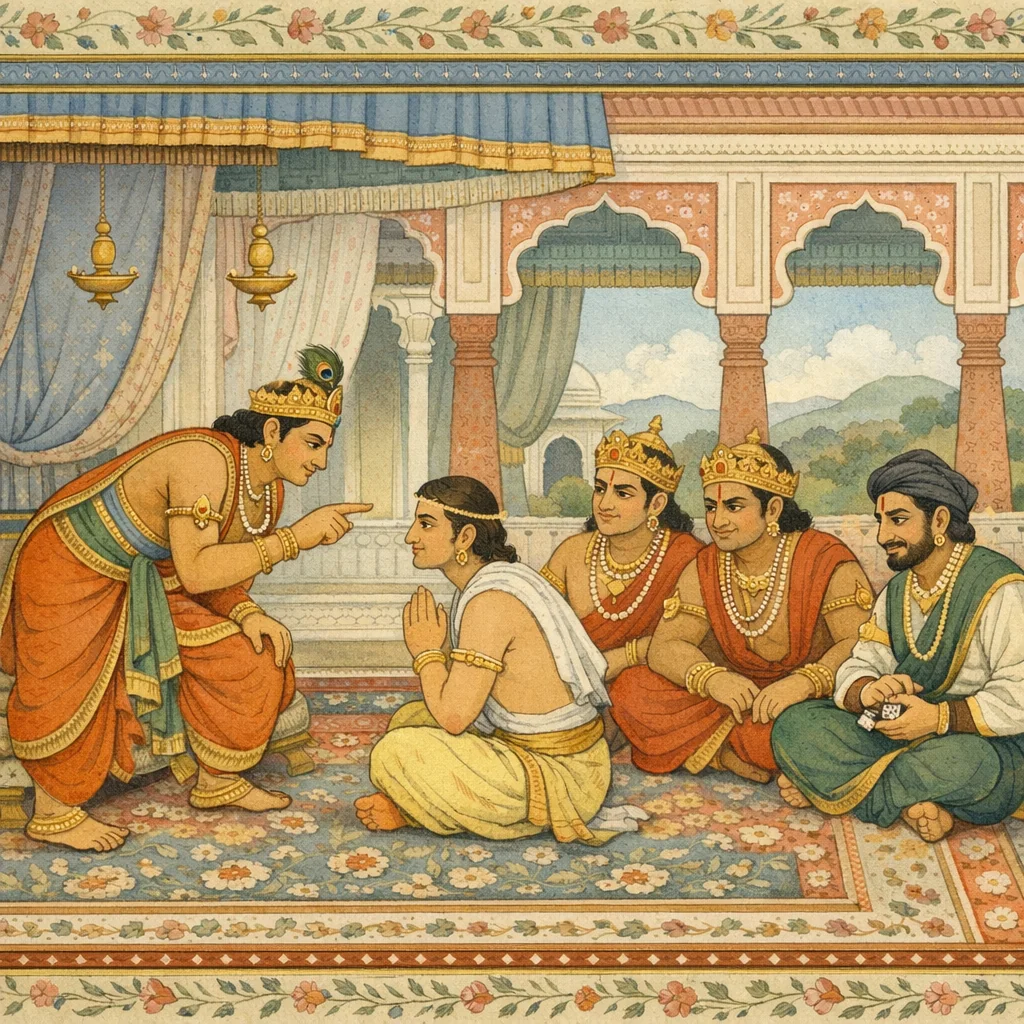
Adhyaya 159
Ulūka’s Provocation and Keśava’s Counter-Message (उलूकदूत्ये केशवप्रत्युत्तरम्)
Upa-parva: Ulūka-dūta Parva (Ulūka’s Embassy Episode)
Saṃjaya reports that Ulūka again addresses Arjuna with previously delivered, stinging words, compared to the piercing of an enraged serpent (1). Hearing this, the Pāṇḍavas become intensely agitated; their anger is described as pre-existing and sharpened by perceived deceit and harassment (2). They do not remain seated, and their physical agitation (casting about their arms) mirrors a group of enraged serpents exchanging fierce looks (3). Bhīmasena, with head lowered, fixes Keśava with reddened eyes, breathing like an angered serpent—an image of contained but dangerous force (4). Observing the distressed son of Vāyu overwhelmed by anger, Krishna (Dāśārha) responds with controlled, almost ironic composure, addressing Ulūka (5). Krishna instructs the envoy to depart quickly and tell Duryodhana that the message has been heard and understood, and that Ulūka’s opinion is noted (6). He adds a direct warning: Duryodhana should be told that by tomorrow morning he will ‘see’ (encounter) them—an assertion of imminent readiness and a rebuke to poor judgment (7). Krishna rejects Ulūka’s assumption that Janārdana will not fight because he serves only as charioteer; he states that, even in the worst case, he could burn the assembled kings in wrath like fire consumes grass, though he will drive Arjuna’s chariot by Yudhiṣṭhira’s directive (8–10). He further asserts the inevitability of Arjuna’s presence: wherever the opponent goes—across the three worlds or into the earth—Arjuna’s chariot will be seen at dawn in front (11). Krishna also validates Bhīma’s vow by instructing that the drinking of Duḥśāsana’s blood should be regarded as certain, not empty roaring (12). Finally, he declares that Arjuna, Yudhiṣṭhira, Bhīma, and the twins will not even look upon Ulūka, portraying him as one who speaks adversarially—thereby denying the envoy personal significance while still using him as a channel for policy communication (13).
Chapter Arc: संजय धृतराष्ट्र को बताता है कि दुर्योधन ने अपनी सेना को व्यवस्थित रूप से ठहराकर राजाओं का सत्कार किया और फिर एक तीखे उद्देश्य से सभा बुलाई—पाण्डवों के पास दूत भेजकर उन्हें अपमानित और उत्तेजित करना। → रक्षा-विधान रचकर दुर्योधन कर्ण, दुःशासन और शकुनि के साथ मंत्रणा करता है; वह इस निष्कर्ष पर पहुँचता है कि ‘पाँच गाँव’ जैसी माँग को ठुकराकर अब पाण्डवों को क्रोध में धकेलना ही नीति है, ताकि युद्ध अनिवार्य बने और कौरव-पक्ष की प्रतिष्ठा ‘दृढ़’ दिखे। → उलूक को दूत बनाकर दुर्योधन उसे राजसभा में पाण्डवों के सामने कठोर संदेश बोलने का आदेश देता—सहदेव को ललकार, शिखण्डी को ‘स्त्री’ कहकर नीचा दिखाना, अर्जुन को भीष्म-द्रोण जैसे महाबलों के सामने चुनौती देना, और कृष्ण के बढ़ते यश पर कटाक्ष कर पाण्डवों की मनोभूमि को भड़काना। → दुर्योधन का संदेश स्पष्ट हो जाता है: समझौते का द्वार बंद, अपमान की भाषा खुली, और युद्ध को ही ‘पुरुषार्थ’ का प्रमाण घोषित करना—उलूक को निर्देश देकर वह कौरव-नीति को एक आक्रामक दूत-यात्रा में बदल देता है। → उलूक पाण्डवों की सभा की ओर निकलता है—अब प्रश्न यह है कि यह विष-बाण समान संदेश पाण्डवों और कृष्ण के उत्तर को किस दिशा में मोड़ेगा।
Shlokas
Verse 1
अफड-#-र- जा (उलूकदूतागमनपर्व) षष्टयधिकशततमो<ध्याय: दुर्योधनका उलूकको दूत बनाकर पाण्डवोंके पास भेजना और उनसे कहनेके लिये संदेश देना संजय उवाच हिरण्वत्यां निविष्टेषु पाण्डवेषु महात्मसु । न्यविशन्त महाराज कौरवेया यथाविधि,संजय कहते हैं--महाराज! महात्मा पाण्डवोंने जब हिरण्वती नदीके तटपर अपना पड़ाव डाल दिया, तब कौरवोंने भी विधिपूर्वक दूसरे स्थानपर अपनी छावनी डाली इस प्रकार श्रीमह्याभारत उद्योगपर्वके अन्तर्गत उलूकदूतागगनपर्वमें दुर्योधनवाक्यविषयक एक सौ साठवाँ अध्याय पूरा हुआ ॥/ १६० ॥/ है ० बक। है २ >> एकषष्ट्याधिकशततमोड< ध्याय: पाण्डवोंके शिविरमें पहुँचकर उलूकका भरी सभामें दुर्योधनका संदेश सुनाना संजय उवाच सेनानिवेशं सम्प्राप्त: कैतव्य: पाण्डवस्य ह । समागतः: पाण्डवेयैर्युधेष्ठटिमभाषत
Sañjaya said: O King, when the high-souled Pāṇḍavas had pitched their camp on the bank of the Hiraṇvatī, the Kauravas too, in due order and according to proper procedure, established their own encampment elsewhere. The scene sets the disciplined, deliberate approach of both sides as the conflict moves toward open war, with outward propriety masking deep moral rupture.
Verse 2
तत्र दुर्योधनो राजा निवेश्य बलमोजसा । सम्मानयित्वा नृपतीन् यस्य गुल्मांस्तथैव च,राजा दुर्योधनने वहाँ अपनी शक्तिशालिनी सेना ठहराकर समस्त राजाओंका समादर करके उन सबकी रक्षाके लिये कई गुल्म सैनिकोंकी टुकड़ियोंको तैनात कर दिया
There, King Duryodhana, with forceful energy, stationed his army; and after honoring the assembled kings, he likewise deployed troop-formations (gulmas) to secure and protect them. The scene underscores his political calculation: he maintains outward respect toward allies while arranging the battlefield order to keep control and ensure their safety within his command structure.
Verse 3
आरक्षस्य विधिं कृत्वा योधानां तत्र भारत | कर्ण दुःशासनं चैव शकुनिं चापि सौबलम्,आनाय्य नृपतिस्तत्र मन्त्रयामास भारत | भारत! इस प्रकार योद्धाओंके संरक्षणकी व्यवस्था करके राजा दुर्योधनने कर्ण, दुःशासन तथा सुबलपुत्र शकुनिको बुलाकर गुप्तरूपसे मन्त्रणा की
O Bhārata, having made the proper arrangements there for the guarding and protection of the warriors, King Duryodhana summoned Karṇa, Duḥśāsana, and Śakuni the son of Saubala, and conferred with them in secret.
Verse 4
तत्र दुर्योधनो राजा कर्णेन सह भारत
Sañjaya said: There, King Duryodhana—together with Karṇa—was present, O Bhārata. The line sets the scene by highlighting Duryodhana’s reliance on Karṇa, a bond that strengthens his resolve even as it draws him further into the path of conflict and adharma.
Verse 5
सम्भाषित्वा च कर्ण क्रात्रा द:ःशासनेन च । सौबलेन च राजेन्द्र मन्त्रयित्वा नरर्षभ
Sañjaya said: After conversing with Karṇa, with Kṛpa, with Duḥśāsana, and also with Śakuni the son of Subala, O best of men, the king (Duryodhana) took counsel—gathering his chief supporters to deliberate on the course that would shape the coming conflict and its moral consequences.
Verse 6
आहृक्योपद्वरे राजन्नुलूकमिदमब्रवीत् । राजेन्द्र! भरतनन्दन! नरश्रेष्ठ! दुर्योधनने कर्ण, भाई दुःशासन तथा सुबलपुत्र शकुनिसे सम्भाषण एवं सलाह करके उलूकको एकान्तमें बुलाकर उसे इस प्रकार कहा-- || ४-५ ६ || उलूक गच्छ कैतव्य पाण्डवान् सहसोमकान्,पाण्डवानां कुरूणां च युद्धं लोकभयंकरम् । द्यूतकृशल शकुनिके पुत्र उलूक! तुम सोमकों और पाण्डवोंके पास जाओ तथा वहाँ पहुँचकर वासुदेव श्रीकृष्णके सामने ही उनसे मेरा यह संदेश कहो--“कितने ही वर्षोंसे जिसका विचार चल रहा था, वह सम्पूर्ण जगत्के लिये अत्यन्त भयंकर कौरव-पाण्डवोंका युद्ध अब सिरपर आ पहुँचा है
Sanjaya said: O King, at the assembly-hall’s threshold, Uluka spoke these words. Addressing him with honorifics—“O lord of kings, joy of the Bharatas, best of men”—Duryodhana, after conferring with Karna, his brother Duhshasana, and Shakuni the son of Subala, summoned Uluka in private and said: “Uluka, you deceitful one, go at once to the Pandavas together with the Somakas. Declare to them that the war between the Pandavas and the Kurus—long contemplated—has now drawn near, a conflict that will bring terror to the whole world.”
Verse 7
गत्वा मम वचो ब्रूहि वासुदेवस्य शृण्वत: । इदं तत् समनुप्राप्तं वर्षपूगाभिचिन्तितम्
“Go, and convey my message while Vāsudeva is listening. This very outcome—long pondered over through many years—has now come to pass.”
Verse 8
यदेतत् कत्थनावाक्यं संजयो महदब्रवीत्,यथा व: सम्प्रतिज्ञातं तत् सर्व क्रियतामिति । “कुन्तीकुमार युधिष्ठिर! श्रीकृष्णकी सहायता पाकर भाइयोंसहित गर्जना करते हुए तुमने संजयसे जो आत्मश्लाघापूर्ण बातें कही थीं और जिन्हें संजयने कौरवोंकी सभामें बहुत बढ़ा-चढ़ाकर सुनाया था, उन सबको सत्य करके दिखानेका यह अवसर आ गया है। तुमलोगोंने जो-जो प्रतिज्ञाएँ की हैं, उन सबको पूर्ण करो'
Sanjaya said: “This boastful speech that I, Sanjaya, proclaimed so grandly—just as you all had vowed—let all of it now be carried out. Fulfill every pledge you have made.”
Verse 9
वासुदेवसहायस्य गर्जत: सानुजस्य ते । मध्ये कुरूणां कौन्तेय तस्य कालो5यमागत:
Sañjaya said: “O son of Kuntī, the time has now come for him—your younger-brother-accompanied warrior who roars in battle, supported by Vāsudeva—to stand in the very midst of the Kurus. With Kṛṣṇa as his aid, his destined hour for decisive action has arrived.”
Verse 10
ज्येष्ठं तथैव कौन्तेयं ब्रूयास्त्वं वचनान्मम,उलूक! तुम मेरे कहनेसे कुन्तीके ज्येष्ठ पुत्र युधिष्ठिरके सामने जाकर इस प्रकार कहना --
Sañjaya said: “O Ulūka, you must repeat my message exactly. Go before Yudhiṣṭhira, the eldest son of Kuntī, and speak to him in this manner.”
Verse 11
भ्रातृभि: सहित: सर्व: सोमकैश्व सकेकयै: । कथं वा धार्मिको भूत्वा त्वमधर्मे मन: कृथा:,“राजन! तुम तो अपने सभी भाइयों, सोमकों और केकयोंसहित बड़े धर्मात्मा बनते हो। धर्मात्मा होकर अधर्ममें कैसे मन लगा रहे हो?
Sañjaya said: “O King, you stand together with all your brothers, along with the Somakas and the Kekayas, presenting yourself as righteous. How, then, while being devoted to dharma, can you set your mind upon adharma?”
Verse 12
य इच्छसि जगत् सर्व नश्यमानं नृशंसवत् | अभयं सर्वभूते भ्यो दाता त्वमिति मे मति:,“मेरा तो ऐसा विश्वास था कि तुमने समस्त प्राणियोंको अभयदान दे दिया है; परंतु इस समय तुम एक निर्दय मनुष्यकी भाँति सम्पूर्ण जगत्का विनाश देखना चाहते हो
Sañjaya said: “You wish to see the entire world perishing, like a ruthless man. Yet my conviction was that you were one who grants fearlessness to all beings.”
Verse 13
श्रूयते हि पुरा गीत: श्लोको5यं भरतर्षभ । प्रह्मदेनाथ भद्रें ते हृते राज्ये तु दैवतैः,“भरतश्रेष्ठ! तुम्हारा कल्याण हो। सुना जाता है कि पूर्वकालमें जब देवताओंने प्रह्नादका राज्य छीन लिया था, तब उन्होंने इस शलोकका गान किया था
Sañjaya said: “Indeed, O bull among the Bharatas, it is heard that in ancient times this very verse was sung by Prahlāda. When the gods had taken away his kingdom, he uttered this saying—‘O best of the Bharatas, may good befall you.’”
Verse 14
यस्य धर्मध्वजो नित्यं सुरा ध्वज इवोच्छित: । प्रच्छन्नानि च पापानि बैडालं नाम तद् व्रतम्,“देवताओ! साधारण ध्वजकी भाँति जिसकी धर्ममयी ध्वजा सदा ऊँचेतक फहराती रहती है; परंतु जिसके द्वारा गुप्तरूपसे पाप भी होते रहते हैं, उसके उस व्रतको बिडालव्रत कहते हैं
“He whose banner of dharma is ever held aloft, raised high like the standard of a drunkard, yet whose sins are concealed—such a vow is called Baidāla-vrata, the ‘cat’s vow’.”
Verse 15
अत्र ते वर्तयिष्यामि आख्यानमिदमुत्तमम् । कथितं नारदेनेह पितुर्मम नराधिप,“नरेश्वर! इस विषयमें तुम्हें यह उत्तम आख्यान सुना रहा हूँ, जिसे नारदजीने मेरे पिताजीसे कहा था
Here I shall recount to you this excellent tale, O king—one that the sage Nārada related in this very matter to my father.
Verse 16
मार्जार: किल दुष्टात्मा निश्रेष्ट: सर्वकर्मसु । ऊर्ध्वबाहुः स्थितो राजन् गड्भातीरे कदाचन,“राजन! यह प्रसिद्ध है कि किसी समय एक दुष्ट बिलाव दोनों भुजाएँ ऊपर किये गंगाजीके तटपर खड़ा रहा। वह किसी भी कार्यके लिये तनिक भी चेष्टा नहीं करता था
Sañjaya said: “O King, it is well known that once a wicked cat, utterly base in every kind of conduct, stood on the bank of the Gaṅgā with its forelegs raised aloft. It made no effort at any work—posing as if engaged in austerity.”
Verse 17
स वै कृत्वा मन: शुद्धि प्रत्ययार्थ शरीरिणाम् । करोमि धर्ममित्याह सर्वानिव शरीरिण:,“इस प्रकार समस्त देहधारियोंपर विश्वास जमानेके लिये वह सभी प्राणियोंसे यही कहा करता था कि अब मैं मानसिक शुद्धि करके-हिंसा छोड़कर धर्माचरण कर रहा हूँ
Having (professedly) undertaken purification of mind, and with the aim of winning the trust of embodied beings, he would say to all creatures: “I am practicing dharma.”
Verse 18
तस्य कालेन महता विश्रम्भं जग्मुरण्डजा: । समेत्य च प्रशंसन्ति मार्जारं तं विशाम्पते,“राजन! दीर्घकालके पश्चात् धीरे-धीरे पक्षियोंने उसपर विश्वास कर लिया। अब वे उस बिलावके पास आकर उसकी भूरि-भूरि प्रशंसा करने लगे
Sañjaya said: After a long passage of time, the egg-born creatures (the birds) gradually came to trust him. Then, gathering around, they began to praise that cat—O lord of the people.
Verse 19
पूज्यमानस्तु तै: सर्वे: पक्षिभि: पक्षिभोजन: । आत्मकार्य कृतं मेने चर्यायाश्व॒ कृतं फलम्,'पक्षियोंको अपना आहार बनानेवाला वह बिलाव जब उन समस्त पक्षियोंद्वारा अधिक आदर-सत्कार पाने लगा, तब उसने यह समझ लिया कि मेरा काम बन गया और मुझे धर्मानुष्ठानका भी अभीष्ट फल प्राप्त हो गया
Sañjaya said: Honoured and reverenced by all those birds, the cat—who in truth made the birds his food—concluded that his own purpose had been accomplished, and that he had also obtained the desired ‘fruit’ of his outwardly pious conduct.
Verse 20
अथ दीर्घस्य कालस्य त॑ देशं मूषिका ययु: । ददृशुस्तं च ते तत्र धार्मिक ब्रतचारिणम्,“तदनन्तर बहुत समयके पश्चात् उस स्थानमें चूहे भी गये। वहाँ जाकर उन्होंने कठोर व्रतका पालन करनेवाले उस धर्मात्मा बिलावको देखा
Then, after a long time, the mice too went to that place. There they saw him—a righteous-seeming cat, observing a severe vow—displaying outwardly the marks of dharma and self-restraint as the tale unfolded.
Verse 21
कार्येण महता युक्त दम्भयुक्तेन भारत । तेषां मतिरियं राजन्नासीत् तत्र विनिश्चये,“भारत! दम्भयुक्त महान् कर्मोके अनुष्ठानमें लगे हुए उस बिलावको देखकर उनके मनमें यह विचार उत्पन्न हुआ
Sañjaya said: “O Bhārata, seeing that cat engaged in a seemingly great undertaking, yet tainted with hypocrisy, their minds formed this conclusion at that decisive moment, O King.”
Verse 22
बहुमित्रा वयं सर्वे तेषां नो मातुलो हायम् । रक्षां करोतु सततं वृद्धबालस्य सर्वश:,“हम सब लोगोंके बहुत-से मित्र हैं, अतः अब यह बिलाव भी हमारा मामा होकर रहे और हमारे यहाँ जो वृद्ध तथा बालक हैं, उन सबकी सदा रक्षा करता रहे
Sañjaya said: “We all have many friends among them; therefore let this cat now be regarded as our maternal uncle. Let him always provide protection in every way to the old and to the young in our household.”
Verse 23
उपगम्य तु ते सर्वे बिडालमिदमन्लरुवन् भवत्प्रसादादिच्छामश्चर्तु चैव यथासुखम्,“यह सोचकर वे सभी उस बिलावके पास गये और इस प्रकार बोले--“मामाजी! हम सब लोग आपकी कृपासे सुखपूर्वक विचरना चाहते हैं। आप ही हमारे निर्भय आश्रय हैं और आप ही हमारे परम सुहृद् हैं। हम सब लोग एक साथ संगठित होकर आपकी शरणमें आये हैं
Then all of them approached the cat and spoke as follows: “O maternal uncle! By your favor we wish to move about in comfort and safety. You are our fearless refuge and our highest well-wisher. United together, we have come to seek your protection.”
Verse 24
भवान् नो गतिरव्यग्रा भवान् नः परम: सुह्ृत् । ते वयं सहिता: सर्वे भवन्तं शरणं गता:,“यह सोचकर वे सभी उस बिलावके पास गये और इस प्रकार बोले--“मामाजी! हम सब लोग आपकी कृपासे सुखपूर्वक विचरना चाहते हैं। आप ही हमारे निर्भय आश्रय हैं और आप ही हमारे परम सुहृद् हैं। हम सब लोग एक साथ संगठित होकर आपकी शरणमें आये हैं
Sañjaya said: “You are our untroubled refuge; you are our highest well-wisher. Therefore all of us, united together, have come to you for protection.”
Verse 25
भवान् धर्मपरो नित्यं भवान् धर्मे व्यवस्थित: । सनो रक्ष महाप्रज्ञ त्रिदशानिव वज्रभूत्
Sañjaya said: “You are ever devoted to dharma; you stand firmly established in righteousness. O great-minded one, protect us—like Indra, armed with the thunderbolt, protects the gods.”
Verse 26
“आप सदा धर्ममें तत्पर रहते हैं और धर्ममें ही आपकी निष्ठा है। महामते! जैसे वज्रधारी इन्द्र देवताओंकी रक्षा करते हैं, उसी प्रकार आप हमारा संरक्षण करें ।। एवमुक्तस्तु तै: सर्वेर्मूषिके: स विशाम्पते | प्रत्युवाच तत: सर्वान् मूषिकान् मूषिकान्तकृत्,'प्रजानाथ! उन सम्पूर्ण चूहोंके द्वारा इस प्रकार कहे जानेपर मूषकोंके लिये यमराजस्वरूप उस बिलावने उन सबको इस प्रकार उत्तर दिया--“मैं तपस्या भी करूँ: और तुम्हारी रक्षा भी--इन दोनों कार्योंका परस्पर सम्बन्ध मुझे दिखायी नहीं देता है--ये दोनों काम एक साथ नहीं चल सकते हैं। तथापि मुझे तुमलोगोंके हितकी बात भी अवश्य करनी चाहिये
The mice appealed: “You are ever devoted to dharma and steadfast in it. O wise one, just as Indra, wielder of the thunderbolt, protects the gods, so too protect us.” Thus addressed by all the mice, the lord of the people—who was, for the mice, like Death itself, the cat, the destroyer of mice—replied to them: “I do not see how these two aims can go together: to practice austerity and also to guard you. These two cannot proceed side by side. Yet I must still speak for your welfare.”
Verse 27
द्वयोयोंगं न पश्यामि तपसो रक्षणस्य च | अवश्यं तु मया कार्य वचन भवतां हितम्,'प्रजानाथ! उन सम्पूर्ण चूहोंके द्वारा इस प्रकार कहे जानेपर मूषकोंके लिये यमराजस्वरूप उस बिलावने उन सबको इस प्रकार उत्तर दिया--“मैं तपस्या भी करूँ: और तुम्हारी रक्षा भी--इन दोनों कार्योंका परस्पर सम्बन्ध मुझे दिखायी नहीं देता है--ये दोनों काम एक साथ नहीं चल सकते हैं। तथापि मुझे तुमलोगोंके हितकी बात भी अवश्य करनी चाहिये
Sanjaya said: “I do not see how these two can be joined together—practising austerity and providing protection. These two tasks do not seem able to proceed side by side. Yet I must certainly speak what is beneficial for you.”
Verse 28
युष्माभिरपि कर्तव्यं वचनं मम नित्यश: । तपसास्मि परिश्रान्तो दृढे नियममास्थित:,“तुम्हें भी प्रतिदिन मेरी एक आज्ञाका पालन करना होगा। मैं तपस्या करते-करते बहुत थक गया हूँ और दृढ़तापूर्वक संयम-नियमके पालनमें लगा रहता हूँ। बहुत सोचनेपर भी मुझे अपने भीतर चलने-फिरनेकी कोई शक्ति नहीं दिखायी देती; अतः तात! तुम्हें सदा मुझे यहाँसे नदीके तटतक पहुँचाना पड़ेगा
Sañjaya said: “You too must carry out my instruction every day. I am worn out by austerities, yet I remain firmly established in strict self-restraint and observance. Even after much reflection, I find no strength within me to move about; therefore, dear one, you must always convey me from here to the riverbank.”
Verse 29
न चापि गमने शक्ति काज्चित् पश्यामि चिन्तयन् । सो<5स्मि नेय: सदा तात नदीकूलमित:ः परम्,“तुम्हें भी प्रतिदिन मेरी एक आज्ञाका पालन करना होगा। मैं तपस्या करते-करते बहुत थक गया हूँ और दृढ़तापूर्वक संयम-नियमके पालनमें लगा रहता हूँ। बहुत सोचनेपर भी मुझे अपने भीतर चलने-फिरनेकी कोई शक्ति नहीं दिखायी देती; अतः तात! तुम्हें सदा मुझे यहाँसे नदीके तटतक पहुँचाना पड़ेगा
Sanjaya said: “Even after reflecting, I do not perceive in myself any strength at all for walking. Therefore, dear child, I must always be led; you must carry me from here to the farther bank-side of the river.”
Verse 30
तथेति त॑ प्रतिज्ञाय मूषिका भरतर्षभ । वृद्धबालमथो सर्व मार्जाराय न्यवेदयन्,“भरतश्रेष्ठ! “बहुत अच्छा” कहकर चूहोंने बिलावकी आज्ञाका पालन करनेके लिये हामी भर ली और वृद्ध तथा बालकोंसहित अपना सारा परिवार उस बिलावको सौंप दिया
Sañjaya said: “So be it,” the mice agreed, O bull among the Bhāratas. Having thus assented, they handed over their entire community—elders and children alike—to the cat. The episode shows how uncritical obedience and misplaced trust in a predatory power can carry a whole society, including its most vulnerable, into ruin.
Verse 31
ततः स पापो दुष्टात्मा मूषिकानथ भक्षयन् | पीवरश्न सुवर्णश्न॒ दृढबन्धश्न जायते,“फिर तो वह पापी एवं दुष्टात्मा बिलाव प्रतिदिन चूहोंको खा-खाकर मोटा और सुन्दर होने लगा। उसके अंगोंकी एक-एक जोड़ मजबूत हो गयी
Sañjaya said: Then that sinful, wicked-souled creature, feeding on mice, began to grow stout and handsome day by day; and his limbs became firmly knit, each joint gaining strength. The verse warns that wrongdoing can still yield outward prosperity and bodily vigor, so virtue must not be judged by visible success.
Verse 32
मूषिकाणां गणश्नात्र भृशं संक्षीयतेडथ सः । मार्जारो वर्धते चापि तेजोबलसमन्वित:,“इधर चूहोंकी संख्या बड़े वेगसे घटने लगी और वह बिलाव तेज और बलसे सम्पन्न हो प्रतिदिन बढ़ने लगा
Sañjaya said: Here, the multitude of mice rapidly began to dwindle; meanwhile that cat—endowed with vigor and strength—kept growing day by day. The scene shows how unchecked predation and power, met by helplessness, quickly harden into steady imbalance and decline.
Verse 33
ततस्ते मूषिका: सर्वे समेत्यान्यो<न्यमन्रुवन् । मातुलो वर्धते नित्यं वयं क्षीयामहे भूशम्,“तब वे चूहे परस्पर मिलकर एक-दूसरेसे कहने लगे--'क्यों जी! क्या कारण है कि मामा तो नित्य मोटा-ताजा होता जा रहा है और हमारी संख्या बड़े वेगसे घटती चली जा रही है!
Sañjaya said: Then all the mice gathered together and spoke to one another: “Our maternal uncle grows plump day by day, while we are steadily dwindling away in great measure.” The line conveys moral unease at unequal gain and collective loss, prompting inquiry into hidden exploitation or danger within the community.
Verse 34
ततः प्राज्ञतम: कश्चिड्डिण्डिको नाम मूषिक: । अब्रवीद् वचनं राजन् मूषिकाणां महागणम्,“राजन! उन चूहोंमें कोई डिंडिक नामवाला चूहा सबसे अधिक समझदार था। उसने मूषकोंके उस महान् समुदायसे इस प्रकार कहा--“तुम सब लोग विशेषत: एक साथ नदीके तटपर जाओ। पीछेसे मैं भी मामाके साथ ही वहाँ जाऊँगा”
Sañjaya said: Then there was a certain mouse named Ḍiṇḍika, the wisest among them. Addressing the great multitude of mice, he spoke: “O King…” The verse sets the stage for counsel: prudent leadership arises within the community, and the wise one prepares to guide the group toward a safer, more coordinated course.
Verse 35
गच्छतां वो नदीतीरं सहितानां विशेषतः । पृष्ठतो5हं गमिष्यामि सहैव मातुलेन तु,“राजन! उन चूहोंमें कोई डिंडिक नामवाला चूहा सबसे अधिक समझदार था। उसने मूषकोंके उस महान् समुदायसे इस प्रकार कहा--“तुम सब लोग विशेषत: एक साथ नदीके तटपर जाओ। पीछेसे मैं भी मामाके साथ ही वहाँ जाऊँगा”
Sañjaya said: “All of you should proceed to the riverbank—above all, remain together as a single band. I will follow behind, and I will come there along with my maternal uncle.”
Verse 36
साधु साध्विति ते सर्वे पूजयांचक्रिरे तदा । चक्कुश्वैव यथान्यायं डिण्डिकस्य वचो<र्थवत्,“तब बहुत अच्छा, बहुत अच्छा” कहकर उन सबने डिंडिककी बड़ी प्रशंसा की और यथोचितरूपसे उसके सार्थक वचनोंका पालन किया
Sañjaya said: Then all of them, exclaiming “Well said, well said!”, honored Diṇḍika. In due and proper manner they accepted his words and acted upon them, recognizing them as meaningful and to the point.
Verse 37
अविज्ञानात् ततः सो5थ डिण्डिकं हुपभुक्तवान् | ततस्ते सहिता: सर्वे मन्त्रयामासुरञ्जसा,“बिलावको चूहोंकी जागरूकताका कुछ पता नहीं था। अतः वह डिंडिकको भी खा गया। तदनन्तर एक दिन सब चूहे एक साथ मिलकर आपसमें सलाह करने लगे
Sañjaya said: Because he lacked awareness, the cat then went on to devour Ḍiṇḍika as well. After that, all the mice gathered together and, with clear purpose, began to deliberate among themselves.
Verse 38
तत्र वृद्धतम: कश्चित् कोलिको नाम मूषिक: । अब्रवीद् वचन राजन् ज्ञातिमध्ये यथातथम्,“उनमें कोलिक नामसे प्रसिद्ध कोई चूहा था, जो अपने भाई-बन्धुओंमें सबसे बूढ़ा था। उसने सब लोगोंको यथार्थ बात बतायी--
There, O King, a certain mouse named Kolika—the eldest among his kinsmen—spoke out in the midst of his relatives, stating the matter plainly and as it truly was.
Verse 39
न मातुलो धर्मकामश्छट्ममात्र॑ कृता शिखा । न मूलफलभक्षस्य विष्ठा भवति लोमशा,“भाइयो! मामाको धर्माचरणकी रत्तीभर भी कामना नहीं है। उसने हम-जैसे लोगोंको धोखा देनेके लिये ही जटा बढ़ा रखी है। जो फल-मूल खानेवाला है, उसकी विष्ठामें बाल नहीं होते
Sañjaya said: “My maternal uncle has not the slightest desire for dharma. He has grown this topknot only to deceive people like us. For one who truly lives on roots and fruits, the excrement is not hairy.”
Verse 40
अस्य गात्राणि वर्धन्ते गणश्ष परिहीयते । अद्य सप्ताष्टदिवसान् डिण्डिको5पि न दृश्यते,“उसके अंग दिनोंदिन हृष्ट-पुष्ट होते जाते हैं और हमारा यह दल रोज-रोज घटता जा रहा है। आज सात-आठ दिनोंसे डिंडिकका भी दर्शन नहीं हो रहा है”
Sañjaya said: “His limbs grow stronger and more robust day by day, while our own company keeps dwindling. And now, for seven or eight days, even Ḍiṇḍika has not been seen.”
Verse 41
एतच्छुत्वा वच: सर्वे मूषिका विप्रदुद्गुवुः । बिडालो<पि स दुष्टात्मा जगामैव यथागतम्,“कोलिककी यह बात सुनकर सब चूहे भाग गये और वह दुष्टात्मा बिलाव भी अपना- सा मुँह लेकर जैसे आया था, वैसे चला गया
Sañjaya said: “Hearing these words, all the mice fled in panic; and that wicked cat too, crestfallen, went away just as it had come.”
Verse 42
तथा त्वमपि दुष्टात्मन् बैडालं व्रतमास्थित: । चरसि ज्ञातिषु सदा बिडालो मूषिकेष्विव,“दुष्टात्मन! तुमने भी इसी प्रकार बिडालव्रत धारण कर रखा है। जैसे चूहोंमें बिडालने धर्मांचरणका ढोंग रच रखा था, उसी प्रकार तुम भी जाति-भाइयोंमें धर्माचारी बने फिरते हो
“So you too, wicked-souled one, have taken up the ‘cat’s vow’ (baiḍāla-vrata). You move about among your own kinsmen pretending to be righteous—just as a cat, among mice, puts on the guise of piety only to deceive and prey upon them.”
Verse 43
अन्यथा किल ते वाक्यमन्यथा कर्म दृश्यते । दम्भनार्थाय लोकस्य वेदाश्लोपशमश्न ते,“तुम्हारी बातें तो कुछ और हैं; परंतु कर्म कुछ और ही ढंगका दिखायी देता है। तुम्हारा वेदाध्ययन और शान्त स्वभाव लोगोंको दिखानेके लिये पाखण्डमात्र है
Sañjaya said: “Your words, it seems, are of one kind, yet your conduct is seen to be of another. Your study of the Veda and your display of calmness are merely a pretense—performed only to impress and deceive the people.”
Verse 44
त्यक्त्वा छम्म त्विदं राजन क्षत्रधर्म समाश्रित: । कुरु कार्याणि सर्वाणि धर्मिष्ठोडसि नरर्षभ,“राजन! नरश्रेष्ठ! यदि तुम धर्मनिष्ठ हो तो यह छल-छठ्म छोड़कर क्षत्रियधर्मका आश्रय ले उसीके अनुसार सब कार्य करो
Sañjaya said: “O King, O best of men—abandon this deceit. Take refuge in the warrior’s code, and then carry out all your actions in accordance with it, for you are one who stands by dharma.”
Verse 45
बाहुवीर्येण पृथिवीं लब्ध्वा भरतसत्तम । देहि दानं॑ द्विजातिभ्य: पितृभ्यश्ष॒ यथोचितम्,“भरतश्रेष्ठ अपने बाहुबलसे इस पृथ्वीका राज्य प्राप्त करके तुम ब्राह्मणोंको दान दो और पितरोंको उनका यथोचित भाग अर्पण करो
Sañjaya said: “O best of the Bharatas, having won sovereignty over the earth by the strength of your own arms, give gifts to the twice-born, and offer to the ancestors their due share in the proper manner.”
Verse 46
क्लिष्टाया वर्षपूगांश्न मातुर्मातृहिते स्थित: । प्रमार्जाश्रु रणे जित्वा सम्मानं परमावह,“तुम्हारी माता वर्षोंसे कष्ट भोग रही है; अतः माताके हितमें तत्पर हो उसके आँसू पोंछो और युद्धमें विजय प्राप्त करके परम सम्मानके भागी बनो
Sañjaya said: “Your mother has endured a multitude of years in hardship. Therefore, stand firmly for your mother’s welfare—wipe away her tears, and by winning in battle, attain the highest honor.”
Verse 47
पज्च ग्रामा वृता यत्नान्नास्माभिरपवर्जिता: । युध्यामहे कथं संख्ये कोपयेम च पाण्डवान्,“तुमने केवल पाँच गाँव माँगे थे, परंतु हमने प्रयत्नपूर्वक तुम्हारी वह माँग इसलिये ठुकरा दी है कि पाण्डवोंको किसी प्रकार कुपित करें, जिससे संग्राम-भूमिमें उनके साथ युद्ध करनेका अवसर प्राप्त हो
Sañjaya said: “You asked only for five villages; yet we have deliberately refused that request. Our aim was to provoke the Pāṇḍavas somehow, so that we might gain the chance to meet them in battle on the field of war.”
Verse 48
त्वत्कृते दुष्टभावस्य संत्यागो विदुरस्य च । जातुषे च गृहे दाहं समर तं पुरुषो भव,“तुम्हारे लिये ही मैंने दुष्टात्मा विदुरका परित्याग कर दिया है। लाक्षागृहमें अपने जलाये जानेकी घटनाका स्मरण करो और अबसे भी मर्द बन जाओ
Sañjaya said: “For your sake I abandoned Vidura, whose mind was set against us. Remember that burning in the house of lac, and from now on—be a man.”
Verse 49
यच्च कृष्णमवोचस्त्वमायान्तं कुरुसंसदि । अयमस्मि स्थितो राजन् शमाय समराय च,“तुमने कौरव-सभामें आये हुए श्रीकृष्णसे जो यह संदेश दिलाया था कि *राजन्! मैं शान्ति और युद्ध दोनोंके लिये तैयार हूँ।' नरेश्वर! उस समरका यह उपयुक्त अवसर आ गया है। युधिष्ठिर! इसीके लिये मैंने यह सब कुछ किया है
Sañjaya said: “And the message you had conveyed to Krishna when he came to the Kuru assembly—‘O King, I stand ready for peace as well as for war’—that very moment has now arrived. The occasion for battle has become fitting; it is for this end that all these efforts have been undertaken.”
Verse 50
तस्यायमागतः काल: समरस्य नराधिप । एतदर्थ मया सर्व कृतमेतद् युधिष्ठिर,“तुमने कौरव-सभामें आये हुए श्रीकृष्णसे जो यह संदेश दिलाया था कि *राजन्! मैं शान्ति और युद्ध दोनोंके लिये तैयार हूँ।' नरेश्वर! उस समरका यह उपयुक्त अवसर आ गया है। युधिष्ठिर! इसीके लिये मैंने यह सब कुछ किया है
Sañjaya said: “O king, the proper time for that battle has now arrived. O Yudhiṣṭhira, it was for this very purpose that I have done all this—conveying the message that you were prepared for either peace or war, and bringing matters to this decisive moment.”
Verse 51
किं नु युद्धात् परं लाभ क्षत्रियो बहु मन्यते । किं च त्वं क्षत्रियकुले जात: सम्प्रथितो भुवि,“भला, क्षत्रिय युद्धसे बढ़कर दूसरे किस लाभको महत्त्व देता है? इसके सिवा, तुमने भी तो क्षत्रियकुलमें उत्पन्न होकर इस पृथ्वीपर बड़ी ख्याति प्राप्त की है
Sañjaya said: “What gain does a kṣatriya regard as greater than battle? And besides, you too were born in a warrior lineage and have become widely renowned upon this earth.”
Verse 52
द्रोणादस्त्राणि संप्राप्प कृपाच्च भरतर्षभ । तुल्ययोनौ समबले वासुदेव॑ समाश्रित:,'भरतश्रेष्ठ! द्रोणाचार्य और कृपाचार्यसे अस्त्र-विद्या प्राप्त करके जाति और बलमें हमारे समान होते हुए भी तुमने वसुदेवनन्दन श्रीकृष्णका आश्रय ले रखा है (फिर तुम्हें युद्धसे क्यों डरना या पीछे हटना चाहिये?)'
Sañjaya said: “O bull among the Bharatas, having learned the science of weapons from Droṇa and also from Kṛpa—though you are of equal birth and equal strength to us—you have taken refuge in Vāsudeva (Kṛṣṇa). With such support, why should you fear battle or think of withdrawing?”
Verse 53
ब्रूयास्त्वं वासुदेवं च पाण्डवानां समीपत: । आत्मार्थ पाण्डवार्थ च यत्ता मां प्रति योधय,उलूक! तुम पाण्डवोंके समीप वासुदेव श्रीकृष्णसे भी कहना--“जनार्दन! अब तुम पूरी तैयारी और तत्परताके साथ अपनी और पाण्डवोंकी भलाईके लिये मेरे साथ युद्ध करो
Sañjaya said: “You should also speak to Vāsudeva in the presence of the Pāṇḍavas: ‘O Janārdana, now, fully prepared and resolute, fight against me—for your own good and for the good of the Pāṇḍavas as well, O Ulūka.’”
Verse 54
सभामध्ये च यद् रूपं मायया कृतवानसि । तत् तथैव पुनः कृत्वा सार्जुनो मामभिद्रव,“तुमने सभामें मायाद्वारा जो विकट रूप बना लिया था; उसे पुनः उसी रूपमें प्रकट करके अर्जुनके साथ मुझपर धावा बोल दो
Sañjaya said: “The fearsome form you once assumed in the royal assembly by means of illusion—assume that very same form again, and, together with Arjuna, rush upon me.”
Verse 55
इन्द्रजालं च माया वै कुहका वापि भीषणा । आत्तशस्त्रस्य संग्रामे वहन्ति प्रतिगर्जना:,“इन्द्रजाल, माया अथवा भयानक कृत्या--ये युद्धमें हथियार उठाये हुए शूरवीरके क्रोध एवं सिंहनादको और भी बढ़ा देती हैं (उसे डरा नहीं सकतीं)
Sañjaya said: “Whether it be Indra’s net of illusion, mere sorcery, or even terrifying deceptive rites—such things cannot cow a warrior who has taken up his weapons in battle; rather, they only intensify his wrath and lion-like roar.”
Verse 56
वयमप्युत्सहेम द्यां खं च गच्छेम मायया । रसातलं विशामो&पि ऐन्द्रं वा पुरमेव तु,“हम भी मायासे आकाशमें उड़ सकते हैं, अन्तरिक्षमें जा सकते हैं तथा रसातल या इन्द्रपुरीमें भी प्रवेश कर सकते हैं
Sañjaya said: “We too are capable—by the power of illusion—of rising into the sky and moving through the mid-air; we could even enter Rasātala below, or indeed the very city of Indra.”
Verse 57
दर्शयेम च रूपाणि स्वशरीरे बहुन्यपि । न तु पर्यायतः सिद्धिर्बुद्धिमाप्रोति मानुषीम्,“इतना ही नहीं, हम अपने शरीरमें बहुत-से रूप भी प्रकट करके दिखा सकते हैं; परंतु इन सब प्रदर्शनोंसे न तो अपने अभीष्टकी सिद्धि होती है और न अपना शत्रु ही मानवीय बुद्धि अर्थात् भयको प्राप्त हो सकता है
Sañjaya said: “We can even reveal many different forms within our own body and display them. Yet such successive displays do not accomplish our intended aim, nor do they make an enemy fall into merely human calculation—into fear and confusion.”
Verse 58
मनसैव हि भूतानि धातैव कुरुते वशे । यद् ब्रवीषि च वार्ष्णेय धार्तराष्ट्रानहं रणे,“एकमात्र विधाता ही अपने मानसिक संकल्पमात्रसे समस्त प्राणियोंको वशमें कर लेता है। वार्ष्णेय! तुम जो यह कहा करते थे कि मैं युद्धमें धृतराष्ट्रके सभी पुत्रोंकोी मरवाकर उनका सारा उत्तम राज्य कुन्तीके पुत्रोंको दे दूँगा। तुम्हारा वह सारा भाषण संजयने मुझे सुना दिया था
Sañjaya said: “Indeed, the Disposer (the divine Ordainer) brings all beings under control by the mind alone. And, O Vārṣṇeya, as for what you used to declare—‘In battle I shall cause the sons of Dhṛtarāṣṭra to be slain and hand over their entire excellent kingdom to Kuntī’s sons’—that whole speech Sañjaya had recited to me.”
Verse 59
घातयित्वा प्रदास्यामि पार्थेभ्यो राज्यमुत्तमम् । आचचतक्षे च मे सर्व संजयस्तव भाषितम्,“एकमात्र विधाता ही अपने मानसिक संकल्पमात्रसे समस्त प्राणियोंको वशमें कर लेता है। वार्ष्णेय! तुम जो यह कहा करते थे कि मैं युद्धमें धृतराष्ट्रके सभी पुत्रोंकोी मरवाकर उनका सारा उत्तम राज्य कुन्तीके पुत्रोंको दे दूँगा। तुम्हारा वह सारा भाषण संजयने मुझे सुना दिया था
Sañjaya said: “Having caused them to be slain, I will bestow the excellent kingdom upon the sons of Pṛthā.” All of that speech of yours, O King, was fully reported to me by Sañjaya.
Verse 60
मदद्वितीयेन पार्थन वैरं व: सव्यसाचिना । स सत्यसंगरो भूत्वा पाण्डवार्थे पराक्रमी,“तुमने यह भी कहा था कि '“कौरवो! मैं जिनका सहायक हूँ, उन्हीं सव्यसाची अर्जुनके साथ तुम्हारा वैर बढ़ रहा है, इत्यादि। अतः अब सत्यप्रतिज्ञ होकर पाण्डवोंके लिये पराक्रमी बनो
Sañjaya said: “With me as his second, O sons of Pṛthā, your enmity with Savyasācin (Arjuna) is indeed intensifying. Therefore, become one whose resolve is true and unwavering, and be valiant for the cause of the Pāṇḍavas.”
Verse 61
युध्यस्वाद्य रणे यत्त: पश्याम: पुरुषो भव | यस्तु शत्रुमभिज्ञाय शुद्धं पौरुषमास्थित:
Sañjaya said: “Fight today in the battle with full resolve; let us see—be a true man. For the one who, having clearly recognized the enemy, stands firm in pure manly valor, follows the straight dharma of the warrior: courage without deceit, facing the foe as he is.”
Verse 62
करोति द्विषतां शोक॑ स जीवति सुजीवितम् । 'युद्धमें अब प्रयत्नपूर्वक डट जाओ। हम तुम्हारी राह देखते हैं। अपने पुरुषत्वका परिचय दो। जो पुरुष शत्रुको अच्छी तरह समझ-बूझकर विशुद्ध पुरुषार्थका आश्रय ले शत्रुओंको शोकमग्न कर देता है, वही श्रेष्ठ जीवन व्यतीत करता है || ६१ ह ।। अकस्माच्चैव ते कृष्ण ख्यातं लोके महद् यश:
Sañjaya said: “He who casts his enemies into grief truly lives a well-lived life. And, O Kṛṣṇa, suddenly indeed your great fame has become renowned in the world.”
Verse 63
मद्विधो नापि नृपतिस्त्वयि युक्त: कथड्चन
Sañjaya said: “A king like me is in no way fit to be joined with you (as your ally or companion).”
Verse 64
संनाहं संयुगे कर्तु कंसभृत्ये विशेषत: । “मेरे-जैसे राजाको तुम्हारे साथ, विशेषतः कंसके एक सेवकके साथ लड़नेके लिये कवच धारण करके युद्धभूमिमें उतरना किसी तरह उचित नहीं है” ।। ६३ है ।। तं च तूबरकं॑ बाल॑ बह्लाशिनमविद्यकम्
Sañjaya said: “To don armor and enter the battlefield to fight is not proper for a king like me—especially when the opponent is merely a servant of Kaṃsa.”
Verse 65
उलूक मद्वचो ब्रूहि असकृद्धीमसेनकम् | विराटनगरे पार्थ यस्त्वं सूदो हा भू: पुरा
Sañjaya said: “Ulūka, carry my words again and again to Bhīmasena. And remind Pārtha too: ‘In the city of Virāṭa you once became a sūta (charioteer)—alas!’”
Verse 66
बललवो नाम विख्यातस्तन्ममैव हि पौरुषम् | 'उलूक! उस बिना मूँछोंके मर्द (अथवा बोझ ढोनेवाले बैल), अधिक खानेवाले, अज्ञानी और मूर्ख भीमसेनसे भी बारंबार मेरा यह संदेश कहना “कुन्तीकुमार! पहले विराटनगरमें जो तू रसोइया बनकर रहा और बललवके नामसे विख्यात हुआ, वह सब मेरा ही पुरुषार्थ था ।। ६४-६५ ह || प्रतिज्ञातं भामध्ये न तन्मिथ्या त्वया पुरा,दुःशासनस्य रुधिरं पीयतां यदि शक््यते । “पहले कौरवसभामें तूने जो प्रतिज्ञा की थी, वह मिथ्या नहीं होनी चाहिये। यदि तुझमें शक्ति हो तो आकर दुःशासनका रक्त पी लेना
Sañjaya said: “You became famous by the name ‘Ballava’—that, indeed, was due to my own prowess. And the vow you once made in the midst of the assembly must not turn out false because of you: if you have the power, then come and drink Duḥśāsana’s blood.”
Verse 67
यद् ब्रवीमि च कौन्तेय धार्तराष्ट्रानहं रणे
Sañjaya said: “O son of Kuntī, whatever I declare about the sons of Dhṛtarāṣṭra in the midst of battle…”
Verse 68
निहनिष्यामि तरसा तस्य कालो5यमागत: । “कुन्तीकुमार! तुम जो कहा करते हो कि मैं युद्धमें धृतराष्ट्रके पुत्रोंको वेगपूर्वक मार डालूँगा, उसका यह समय आ गया है || ६७ ह || त्वं हि भाज्ये पुरस्कार्यो भक्ष्ये पेये च भारत
Sañjaya said: “I shall strike him down with swift force; the appointed time for that has now arrived.”
Verse 69
क्व युद्ध क्व च भोक्तव्यं युध्यस्व पुरुषो भव । 'भारत! तुम निरे भोजनभट्ट हो। अत: अधिक खाने-पीनेमें पुरस्कार पानेके योग्य हो। किंतु कहाँ युद्ध और कहाँ भोजन? शक्ति हो तो युद्ध करो और मर्द बनो || ६८ ई || शयिष्यसे हतो भूमौ गदामालिड्ग्य भारत
Sañjaya said: “What has battle to do with feasting? If you have strength, then fight—be a man. Otherwise, O Bhārata, you will lie slain upon the earth, still clutching your mace.”
Verse 70
तद् वृथा च सभामध्ये वल्गितं ते वृकोदर | “भारत! युद्धभूमिमें मेरे हाथसे मारे जाकर तुम गदाको छातीसे लगाये सदाके लिये सो जाओगे। वृकोदर! तुमने सभामें जाकर जो उछल-कूद मचायी थी, वह व्यर्थ ही है” || ६९ - उलूक नकुलं ब्रूहि वचनान्मम भारत,उलूक! नकुलसे भी कहना--'भारत! तुम मेरे कहनेसे अब स्थिरतापूर्वक युद्ध करो। हम तुम्हारा पुरुषार्थ देखेंगे। तुम युधिष्ठिरके प्रति अपने अनुरागको, मेरे प्रति बढ़े हुए द्वेषको तथा द्रौपदीके क्लेशको भी इन दिनों अच्छी तरहसे याद कर लो”
Sanjaya said: “Vṛkodara, all that boasting of yours in the midst of the royal assembly was futile. ‘O Bhārata, struck down by my hand on the battlefield, you will fall, clasping your mace to your chest, and lie asleep forever. Vṛkodara, the commotion you made after going into the assembly—was pointless.’ ‘Ulūka, convey my words to Nakula as well: “O Bhārata, now fight steadily, as I command. We shall witness your manly effort. In these days remember clearly your devotion to Yudhiṣṭhira, your swelling hatred toward me, and the suffering of Draupadī.”’
Verse 71
युध्यस्वाद्य स्थिरो भूत्वा पश्यामस्तव पौरुषम् | युधिष्ठिरानुरागं च द्वेषं च मयि भारत । कृष्णायाश्व परिक््लेशं स्मरेदानीं यथातथम्,उलूक! नकुलसे भी कहना--'भारत! तुम मेरे कहनेसे अब स्थिरतापूर्वक युद्ध करो। हम तुम्हारा पुरुषार्थ देखेंगे। तुम युधिष्ठिरके प्रति अपने अनुरागको, मेरे प्रति बढ़े हुए द्वेषको तथा द्रौपदीके क्लेशको भी इन दिनों अच्छी तरहसे याद कर लो”
Sañjaya said: “Fight today, standing firm; let us witness your manly prowess. O Bhārata, remember well—your affection for Yudhiṣṭhira, your deepened hatred toward me, and also the suffering endured by Kṛṣṇā (Draupadī). Recall it all now, just as it happened, O Ulūka.”
Verse 72
ब्रूयास्त्वं सहदेव॑ च राजमध्ये वचो मम । युद्ध्येदानीं रणे यत्त: क्लेशान् समर च पाण्डव,उलूक! तुम राजाओंके बीच सहदेवसे भी मेरी यह बात कहना--'पाण्डुनन्दन! पहलेके दिये हुए क्लेशोंको याद कर लो और अब तत्पर होकर समरभूमिमें युद्ध करो”
Sañjaya said: “In the midst of the assembled kings, convey my words also to Sahadeva: ‘O Pāṇḍava, remember the hardships that were inflicted earlier, and now—exerting yourself—fight on the battlefield.’”
Verse 73
विराटद्रुपदौ चोभौ ब्रूयास्त्वं वचनान्मम । न दृष्टपूर्वा भर्तारो भृत्यैरपि महागुणै:,“तदनन्तर विराट और ट्रपदसे भी मेरी ओरसे कहना--“विधाताने जबसे प्रजाकी सृष्टि की है, तभीसे परम गुणवान् सेवकोंने भी अपने स्वामियोंकी अच्छी तरह परख नहीं की; उनके गुण-अवगुणको भलीभाँति नहीं पहचाना। इसी प्रकार स्वामियोंने भी सेवकोंको ठीक-ठीक नहीं समझा। इसीलिये युधिष्ठिर श्रद्धाके योग्य नहीं हैं, तो भी तुम दोनों उन्हें अपना राजा मानकर उनकी ओससे युद्धके लिये यहाँ आये हो
Sañjaya said: “Convey my words to both Virāṭa and Drupada: ‘Since the Creator first brought forth beings, it has never been seen that even servants of great excellence fully discern their masters—truly recognizing their virtues and faults; nor, likewise, have masters accurately understood their servants. Therefore, even if Yudhiṣṭhira were not worthy of trust, you two have still accepted him as your king and have come here for war at his command.’”
Verse 74
तथार्थपतिभिर्भुत्या यत: सृष्टा: प्रजास्ततः । अश्लाघ्यो5यं नरपतिर्युवयोरिति चागतम्,“तदनन्तर विराट और ट्रपदसे भी मेरी ओरसे कहना--“विधाताने जबसे प्रजाकी सृष्टि की है, तभीसे परम गुणवान् सेवकोंने भी अपने स्वामियोंकी अच्छी तरह परख नहीं की; उनके गुण-अवगुणको भलीभाँति नहीं पहचाना। इसी प्रकार स्वामियोंने भी सेवकोंको ठीक-ठीक नहीं समझा। इसीलिये युधिष्ठिर श्रद्धाके योग्य नहीं हैं, तो भी तुम दोनों उन्हें अपना राजा मानकर उनकी ओससे युद्धके लिये यहाँ आये हो
Sañjaya said: “Convey also my message to Virāṭa and Drupada: Ever since the Creator brought forth living beings, servants have not truly discerned their masters—failing to recognize clearly their virtues and faults; and likewise masters have not properly understood their servants. In that light, even if Yudhiṣṭhira were not worthy of reverence, you two have nevertheless accepted him as your king and have come here for war at his command.”
Verse 75
ते यूयं संहता भूत्वा तद्वधार्थ ममापि च | आत्मार्थ पाण्डवार्थ च प्रयुद्धयध्वं मया सह,“इसलिये तुम सब लोग संगठित होकर मेरे वधके लिये प्रयत्न करो। अपनी और पाण्डवोंकी भलाईके लिये मेरे साथ युद्ध करो”
Sañjaya said: “Therefore, all of you, having united together, strive to slay him—and me as well. For your own welfare and for the welfare of the Pāṇḍavas, join battle along with me.”
Verse 76
धृष्टद्युम्नं च पाज्चाल्यं ब्रूयास्त्वं वचनान्मम । एष ते समय: प्राप्तो लब्धव्यश्ष॒ त्वयापि सः,पाण्डवानां कुरूणां च युद्धं लोकभयंकरम् । द्यूतकृशल शकुनिके पुत्र उलूक! तुम सोमकों और पाण्डवोंके पास जाओ तथा वहाँ पहुँचकर वासुदेव श्रीकृष्णके सामने ही उनसे मेरा यह संदेश कहो--“कितने ही वर्षोंसे जिसका विचार चल रहा था, वह सम्पूर्ण जगत्के लिये अत्यन्त भयंकर कौरव-पाण्डवोंका युद्ध अब सिरपर आ पहुँचा है 'फिर पांचालराजकुमार धृष्टद्युम्नको भी मेरा यह संदेश सुना देना--'राजकुमार! यह तुम्हारे योग्य समय प्राप्त हुआ है। तुम्हें आचार्य द्रोण अपने सामने ही मिल जायूँगे
Sañjaya said: “And you should also convey my words to Dhṛṣṭadyumna, the Pāñcāla prince: ‘This is the moment that has come for you; the very opportunity you too must seize is now at hand. The war between the Pāṇḍavas and the Kurus—terrifying to the whole world—has drawn near.’”
Verse 77
द्रोणमासाद्य समरे ज्ञास्यसे हितमुत्तमम् । युध्यस्व ससुह्ृत् पापं कुरु कर्म सुदुष्करम्,“समरभूमिमें ट्रोणाचार्यके सामने जाकर ही तुम यह जान सकोगे कि तुम्हारा उत्तम हित किस बातमें है। आओ, अपने सुहृदोंके साथ रहकर युद्ध करो और गुरुके वधका अत्यन्त दुष्कर पाप कर डालो”
Sañjaya said: “Only by going up to Droṇa on the battlefield will you truly learn what your highest welfare is. Come—fight while standing with your well-wishers, and commit that most difficult sin: the grievous deed of slaying your own teacher.”
Verse 78
शिखण्डिनमथो ब्रूहि उलूक वचनान्मम । स्त्रीति मत्वा महाबाहुर्न हनिष्पति कौरव:,“उलूक! इसके बाद तुम शिखण्डीसे भी मेरी यह बात कहना--“धनुर्धारियोंमें श्रेष्ठ गंगापुत्र कुरुवंशी महाबाहु भीष्म तुम्हें स्त्री समझकर नहीं मारेंगे; इसलिये तुम अब निर्भय होकर युद्ध करना और समरभूमिमें यत्नपूर्वक पराक्रम प्रकट करना। हम तुम्हारा पुरुषार्थ देखेंगे”
Sañjaya said: “And then, O Ulūka, convey my words to Śikhaṇḍin as well: ‘The mighty-armed Kaurava, Bhīṣma—the Gaṅgā-born, foremost among bowmen—will not strike you, taking you to be a woman. Therefore fight without fear, and on the battlefield display your valor with careful effort; we shall witness your manly prowess.’”
Verse 79
गाड़ेयो धन्विनां श्रेष्ठो युद्धोदानीं सुनिर्भय: । कुरु कर्म रणे यत्त: पश्याम: पौरुषं तव,“उलूक! इसके बाद तुम शिखण्डीसे भी मेरी यह बात कहना--“धनुर्धारियोंमें श्रेष्ठ गंगापुत्र कुरुवंशी महाबाहु भीष्म तुम्हें स्त्री समझकर नहीं मारेंगे; इसलिये तुम अब निर्भय होकर युद्ध करना और समरभूमिमें यत्नपूर्वक पराक्रम प्रकट करना। हम तुम्हारा पुरुषार्थ देखेंगे”
Sañjaya said: “Gāḍeya—foremost among archers—now enter the battle utterly fearless. Apply yourself with full effort to your duty in the fight; we shall witness your manly prowess.”
Verse 80
एवमुक्त्वा ततो राजा प्रहस्योलूकमब्रवीत् । धनंजयं पुनर्ब्रूहि वासुदेवस्य शृण्वत:,ऐसा कहते-कहते राजा दुर्योधन खिलखिलाकर हँस पड़ा। तत्पश्चात् उलूकसे पुनः इस प्रकार बोला--'उलूक! तुम वसुदेवनन्दन श्रीकृष्णके सामने ही अर्जुनसे पुनः इस प्रकार कहना--
Having spoken thus, the king (Duryodhana) burst into derisive laughter and addressed Ulūka: “Go, and once again deliver my message to Dhanañjaya (Arjuna)—speak it while Vāsudeva (Kṛṣṇa) himself is listening.”
Verse 81
अस्मान् वा त्वं पराजित्य प्रशाधि पृथिवीमिमाम् | अथवा निर्जितो<5स्माभी रणे वीर शयिष्यसि,“वीर धनंजय! या तो तुम्हीं हमलोगोंको परास्त करके इस पृथ्वीका शासन करो या हमारे ही हाथोंसे मारे जाकर रणभूमिमें सदाके लिये सो जाओ
“O hero Dhanañjaya! Either defeat us and rule this earth, or, vanquished by us in battle, you will lie upon the field.”
Verse 82
राष्ट्रन्निवॉसनक्लेशं वनवासं च पाण्डव । कृष्णायाश्व परिक्लेश संस्मरन् पुरुषो भव,'पाण्डुनन्दन! राज्यसे निर्वासित होने, वनमें निवास करने तथा द्रौपदीके अपमानित होनेके क्लेशोंको याद करके अब भी तो मर्द बनो
“O Pāṇḍava, remember the anguish of being driven from the kingdom, the hardship of dwelling in the forest, and the suffering inflicted upon Kṛṣṇā (Draupadī). Keeping these wrongs in mind, be a man—stand firm and act with resolve.”
Verse 83
यदर्थ क्षत्रिया सूते सर्व तदिदमागतम् | बलं॑ वीर्य च शौर्य च परं चाप्यस्त्रलाघवम्
“O charioteer, everything for which kṣatriyas are brought forth has now come fully to the fore—strength, manly vigor, valor, and, above all, swift mastery in the use of weapons.”
Verse 84
परिक्लिष्टस्य दीनस्य दीर्घकालोषितस्य च । ह्ृदयं कस्य न स्फोटेदैश्वर्याद् भ्रंशितस्य च,“जिसे नाना प्रकारका क्लेश दिया गया हो, दीर्घकालके लिये राज्यसे निर्वासित किया गया हो तथा जिसे राज्यसे वंचित होकर दीनभावसे जीवन बिताना पड़ा हो, ऐसे किस स्वाभिमानी पुरुषका हृदय विदीर्ण न हो जायगा?
“Whose heart would not break—seeing one who has been tormented by many hardships, kept long in exile from his kingdom, and forced to live in humiliation after being deprived of sovereignty?”
Verse 85
कुले जातस्य शूरस्य परवित्तेष्वगृध्यत: । आशस्थितं राज्यमाक्रम्य कोपं कस्य न दीपयेत्,“जो उत्तम कुलमें उत्पन्न, शूरवीर तथा पराये धनके प्रति लोभ न रखनेवाला हो, उसके राज्यको यदि कोई दबा बैठा हो तो वह किस वीरके क्रोधको उद्दीप्त न कर देगा?
Sañjaya said: When a man is born in a noble lineage, is truly valiant, and is not greedy for others’ wealth—if someone has seized and sits upon his rightful kingdom, whose warrior’s wrath would that not ignite?
Verse 86
यत् तदुक्तं महद् वाक््यं कर्मणा तद् विभाव्यताम् | अकर्मणा कत्थितेन सन्त: कुपुरुषं विदु:,“तुमने जो बड़ी-बड़ी बातें कही हैं, उन्हें कार्यरूपमें परिणत करके दिखाओ। जो क्रियाद्वारा कुछ न करके केवल मुँहसे बातें बनाता है, उसे सज्जन पुरुष कायर मानते हैं
Sañjaya said: “Those grand words you spoke should now be proved through action. For the good regard as a base man the one who, without deeds, merely boasts with empty talk.”
Verse 87
अमित्राणां वशे स्थान राज्यं च पुनरुद्धर । द्वावर्थो युद्धकामस्य तस्मात् तत् कुरु पौरुषम्,“तुम्हारा स्थान और राज्य शत्रुओंके हाथमें पड़ा है, उसका पुनरुद्धार करो। युद्धकी इच्छा रखनेवाले पुरुषके ये दो ही प्रयोजन होते हैं; अतः उनकी सिद्धिके लिये पुरुषार्थ करो
Recover your seat and your kingdom, now held in the enemies’ power. For the man who longs for war, these two alone are the aims; therefore, exert your manly valor to win them.
Verse 88
पराजितो$सि द्यूतेन कृष्णा चानायिता सभाम् | शक््यो<मर्षो मनुष्येण कर्तु पुरुषमानिना
Sañjaya said: “You were defeated in the game of dice, and Kṛṣṇā (Draupadī) was dragged into the royal assembly. Yet a man who prides himself on being truly manly can still endure and master such humiliation.”
Verse 89
“तुम जूएमें पराजित हुए और तुम्हारी स्त्री द्रौषदीको सभामें लाया गया। अपनेको पुरुष माननेवाले किसी भी मनुष्यको इन बातोंके लिये भारी अमर्ष हो सकता है ।। द्वादशैव तु वर्षाणि वने धिष्ण्याद् विवासित: । संवत्सरं विराटस्य दास्यमास्थाय चोषित:,“तुम बारह वर्षोतक राज्यसे निर्वासित होकर वनमें रहे हो और एक वर्षतक तुम्हें विराटका दास होकर रहना पड़ा है
Sañjaya said: “You were defeated at the dice, and your wife Draupadī was brought into the royal assembly. For any man who considers himself a man, these things can kindle a fierce, unbearable indignation. And you were driven from your rightful seat and made to live in the forest for twelve years; then for one year you had to dwell in the service of King Virāṭa as a servant.”
Verse 90
राष्ट्रान्निर्वासनक्लेशं वनवासं च पाण्डव | कृष्णायाश्व परिक्लेशं संस्मरन् पुरुषो भव,'पाण्डुनन्दन! राज्यसे निर्वासनका, वनवासका और द्रौपदीके अपमानका क्लेश याद करके तो मर्द बनो
Sañjaya said: “O son of Pāṇḍu, remember the anguish of being driven from the kingdom, the hardship of exile in the forest, and the suffering inflicted upon Kṛṣṇā (Draupadī). With these wrongs held in mind, be a man—stand firm in resolve and act in accordance with honor and duty (dharma).”
Verse 91
अप्रियाणां च वचन प्रब्र॒ुवत्सु पुन: पुनः । अमर्ष दर्शयस्व त्वममर्षो होव पौरुषम्,“हमलोग बार-बार तुमलोगोंके प्रति अप्रिय वचन कहते हैं। तुम हमारे ऊपर अपना अमर्ष तो दिखाओ; क्योंकि अमर्ष ही पौरुष है
Sañjaya said: “Though we repeatedly speak words that are displeasing to you, you should show your indignation toward us; for indignation—refusal to endure insult and wrongdoing—is indeed the mark of manly spirit.”
Verse 92
क्रोधो बल॑ तथा वीर्य ज्ञानयोगो<स्त्रलाघवम् | इह ते दृश्यतां पार्थ युद्धयस्व पुरुषो भव,'पार्थ! यहाँ लोग तुम्हारे क्रोध, बल, वीर्य, ज्ञानयोग और अस्त्र चलानेकी फुर्ती आदि गुणोंको देखें। युद्ध करो और अपने पुरुषत्वका परिचय दो
Sañjaya said: “Let your wrath, strength, valor, disciplined insight, and swift mastery in the use of weapons be seen here, O Pārtha. Fight, and prove yourself a true man.”
Verse 93
लोहाभिसारो निर्वेत्त: कुरुक्षेत्रमकर्दमम् । पुष्टास्तेडश्वा भूता योधा: श्वो युद्धयस्व सकेशव:,“अब लोहमय अस्त्र-शस्त्रोंकोी बाहर निकालकर तैयार करनेका कार्य पूरा हो चुका है। कुरुक्षेत्रक्री कीच भी सूख गयी है। तुम्हारे घोड़े खूब हृष्ट-पुष्ट हैं और सैनिकोंका भी तुमने अच्छी तरह भरण-पोषण किया है; अतः कल सबेरेसे ही श्रीकृष्णके साथ आकर युद्ध करो
Sañjaya said: “The preparations of iron—arms and weapons—have been completed. Kurukṣetra is now free of mire, the ground having dried. Your horses are well-fed and strong, and the warriors have been properly maintained. Therefore, come at dawn tomorrow with Kṛṣṇa at your side and engage in battle.”
Verse 94
असमागम्य भीष्मेण संयुगे कि विकत्थसे । आरुरुक्षुर्यथा मन्द: पर्वतं गन्धमादनम्
Sañjaya said: “Without even coming face to face with Bhīṣma in battle, why do you boast? You are like a dull-witted man trying to climb Mount Gandhamādana.”
Verse 95
सूतपुत्र॑ सदुर्धर्ष शल्यं च बलिनां बरम्,'पार्थ! अत्यन्त दुर्जय वीर सूतपुत्र कर्ण, बलवानोंमें श्रेष्ठ शल्य तथा युद्धमें इन्द्रके समान पराक्रमी एवं बलवानोंमें अग्रगण्य द्रोणाचार्यको युद्धमें परास्त किये बिना तुम यहाँ राज्य कैसे लेना चाहते हो?
Sañjaya said: “O Pārtha, how do you mean to take the kingdom here without first defeating in battle Karṇa, the charioteer’s son—heroic, utterly unconquerable and hard to assail—together with Śalya, foremost among the mighty, and Droṇa, preeminent among the powerful, whose prowess in war is like Indra’s?”
Verse 96
द्रोणं च बलिनां श्रेष्ठ शचीपतिसमं युधि । अजित्वा संयुगे पार्थ राज्यं कथमिहेच्छसि,यथा व: सम्प्रतिज्ञातं तत् सर्व क्रियतामिति । “कुन्तीकुमार युधिष्ठिर! श्रीकृष्णकी सहायता पाकर भाइयोंसहित गर्जना करते हुए तुमने संजयसे जो आत्मश्लाघापूर्ण बातें कही थीं और जिन्हें संजयने कौरवोंकी सभामें बहुत बढ़ा-चढ़ाकर सुनाया था, उन सबको सत्य करके दिखानेका यह अवसर आ गया है। तुमलोगोंने जो-जो प्रतिज्ञाएँ की हैं, उन सबको पूर्ण करो' 'पार्थ! अत्यन्त दुर्जय वीर सूतपुत्र कर्ण, बलवानोंमें श्रेष्ठ शल्य तथा युद्धमें इन्द्रके समान पराक्रमी एवं बलवानोंमें अग्रगण्य द्रोणाचार्यको युद्धमें परास्त किये बिना तुम यहाँ राज्य कैसे लेना चाहते हो?
Sañjaya said: “O best among the mighty! And as for Droṇa—equal in battle to the lord of Śacī (Indra)—without defeating him in the clash of war, O Pārtha, how can you wish to claim the kingdom here? Let everything be done exactly as you have pledged.”
Verse 97
ब्राह्मे धनुषि चाचार्य वेदयोरन्तगं द्वयो: । युधि धुर्यमविक्षो भ्यमनीकचरमच्युतम्,“कुन्तीपुत्र! आचार्य द्रोण ब्राह्मवेद और धरनुर्वेद इन दोनोंके पारंगत पण्डित हैं। ये युद्धका भार वहन करनेमें समर्थ, अक्षोभ्य, सेनाके मध्यभागमें विचरनेवाले तथा युद्धके मैदानसे पीछे न हटनेवाले हैं। इन महातेजस्वी द्रोणको जो तुम जीतनेकी इच्छा रखते हो, वह मिथ्या साहसमात्र है। वायुने सुमेरु पर्वतको उखाड़ फेंका हो, यह कभी हमारे सुननेमें नहीं आया है (इसी प्रकार तुम्हारे लिये भी आचार्यको जीतना असम्भव है)
Sañjaya said: “O son of Kuntī, the preceptor Droṇa has reached the farthest limit of mastery in both sacred learning (brahma-vidyā) and the science of the bow. In battle he is a foremost bearer of the war’s burden, unshakable, moving amid the ranks, and never turning back from the field. To desire to conquer that blazing Droṇa is only reckless bravado. We have never heard of the wind uprooting Mount Sumeru—so too, for you, defeating the preceptor is impossible.”
Verse 98
द्रोणं महाद्युतिं पार्थ जेतुमिच्छसि तन्मृषा । न हि शुश्रुम वातेन मेरुमुन्मथितं गिरिम्,“कुन्तीपुत्र! आचार्य द्रोण ब्राह्मवेद और धरनुर्वेद इन दोनोंके पारंगत पण्डित हैं। ये युद्धका भार वहन करनेमें समर्थ, अक्षोभ्य, सेनाके मध्यभागमें विचरनेवाले तथा युद्धके मैदानसे पीछे न हटनेवाले हैं। इन महातेजस्वी द्रोणको जो तुम जीतनेकी इच्छा रखते हो, वह मिथ्या साहसमात्र है। वायुने सुमेरु पर्वतको उखाड़ फेंका हो, यह कभी हमारे सुननेमें नहीं आया है (इसी प्रकार तुम्हारे लिये भी आचार्यको जीतना असम्भव है)
Sañjaya said: “O Pārtha, your wish to conquer Droṇa, the man of great splendor, is mere delusion. For we have never heard of the wind uprooting Mount Meru.”
Verse 99
अनिलो वा वहेन्मेरुं द्यौर्वापि निपतेन्महीम् । युगं वा परिवर्तेत यद्येवं सस््थादू यथा55तथ माम्,“तुमने मुझसे जो कुछ कहा है, वह यदि सत्य हो जाय, तब तो हवा मेरुको उठा ले, स्वर्गलोक इस पृथ्वीपर गिर पड़े अथवा युग ही बदल जाय
Sañjaya said: “If what you have told me were to turn out true, then the impossible would happen: the wind might carry off Mount Meru, heaven itself might fall upon the earth, or the very age (yuga) might be overturned. Such a claim would upend the established order of the world.”
Verse 100
को हास्ति जीविताकाड्क्षी प्राप्पेममरिमर्दनम् । पार्थों वा इतरो वापि को<न्यःस्वस्ति गृहान् व्रजेत्,“अर्जुन हो या दूसरा कोई, जीवनकी इच्छा रखने-वाला कौन ऐसा वीर है, जो युद्धमें इन शत्रुदमन आचार्यके पास पहुँचकर कुशलपूर्वक घरको लौट सके?
Sanjaya said: “Who, still desiring to live, could confront this enemy-crushing warrior and then return home in safety? Whether it be Arjuna himself or anyone else—who could come near him in battle and yet go back unharmed?”
Verse 101
कथमाभ्यामभि ध्यात: संस्पृष्टो दारुणेन वा । रणे जीवन प्रमुच्येत पदा भूमिमुपस्पृशन्,'ये दोनों द्रोण और भीष्म जिसे मारनेका निश्चय कर लें अथवा उनके भयानक अस्त्र आदिसे जिसके शरीरका स्पर्श हो जाय, ऐसा कोई भी भूतल-निवासी मरणधर्मा मनुष्य युद्धमें जीवित कैसे बच सकता है?
Sanjaya said: “How could any mortal who treads the earth escape alive in battle—if Bhishma and Drona have resolved to strike him down, or if he is even touched by their dreadful weapons?”
Verse 102
कि दर्दुर: कूपशयो यथेमां न बुध्यसे राजचमूं समेताम् । दुराधर्षा देवचमूप्रकाशां गुप्तां नरेन्द्रैस्त्रिदशैरिव द्याम्ू,'जैसे देवता स्वर्गकी रक्षा करते हैं, उसी प्रकार पूर्व, पश्चिम, दक्षिण और उत्तर दिशाओंके नरेश तथा काम्बोज, शक, खश, शास्त्र, मत्स्य, कुरु और मध्यप्रदेशके सैनिक एवं म्लेच्छ, पुलिन्द, द्रविड़, आन्ध और कांचीदेशीय योद्धा जिस सेनाकी रक्षा करते हैं, जो देवताओंकी सेनाके समान दुर्धर्ष एवं संगठित है, कौरवराजकी (समुद्रतुल्य) उस सेनाको क्या तुम कूपमण्डूककी भाँति अच्छी तरह समझ नहीं पाते?
Sañjaya said: “Why, like a frog living in a well, do you fail to comprehend this assembled royal host? It is hard to assail, radiant like the army of the gods, and guarded by kings—as heaven is guarded by the Thirty-three deities.”
Verse 103
प्राच्यै: प्रतीच्यैरथ दाक्षिणात्यै- रुदीच्यकाम्बोजशकै: खशैश्न । शाल्वै: समत्स्यै: कुरुमध्यदेश्यै- म्लेच्छै: पुलिन्दैर्द्रविडान्ध्रकाउचयै:,'जैसे देवता स्वर्गकी रक्षा करते हैं, उसी प्रकार पूर्व, पश्चिम, दक्षिण और उत्तर दिशाओंके नरेश तथा काम्बोज, शक, खश, शास्त्र, मत्स्य, कुरु और मध्यप्रदेशके सैनिक एवं म्लेच्छ, पुलिन्द, द्रविड़, आन्ध और कांचीदेशीय योद्धा जिस सेनाकी रक्षा करते हैं, जो देवताओंकी सेनाके समान दुर्धर्ष एवं संगठित है, कौरवराजकी (समुद्रतुल्य) उस सेनाको क्या तुम कूपमण्डूककी भाँति अच्छी तरह समझ नहीं पाते?
Sañjaya said: “The Kaurava host is guarded on every side—by kings of the East, West, South, and North; by the Kāmbojas, Śakas, and Khaśas; by the Śālvas together with the Matsyas; by the Kurus and the warriors of the Madhyadeśa; and by frontier peoples such as the Mlecchas and Pulindas, as well as the Draviḍas, Āndhras, and men of Kāñcī. Thus protected like heaven is protected by the gods, that army—hard to assail and well-knit like the hosts of the devas—should not be underestimated.”
Verse 104
नानाजनीघं युधि सम्प्रवृद्धं गाड़ं यथा वेगमपारणीयम् | मां च स्थितं नागबलस्य मध्ये युयुत्ससे मन्द किमल्पबुद्धे,'ओ अल्पबुद्धि मूढ़ अर्जुन! जिसका वेग युद्धकालमें गंगाके वेगके समान बढ़ जाता है और जिसे पार करना असम्भव है, नाना प्रकारके जनसमुदायसे भरी हुई मेरी उस विशाल वाहिनीके साथ तथा गजसेनाके बीचमें खड़े हुए मुझ दुर्योधनके साथ भी तुम युद्धकी इच्छा कैसे रखते हो?
Sañjaya said: “In battle my host swells into a dense, many-peopled flood, like the surging current of the Gaṅgā—its force impossible to cross. And I, Duryodhana, stand amid the strength of the elephant-corps. O dull-witted one, how can you still desire to fight?”
Verse 105
अक्षय्याविषुधी चैव अग्निदत्तं च ते रथम् । जानीमो हि रणे पार्थ केतुं दिव्यं च भारत,“भारत! हम अच्छी तरह जानते हैं कि तुम्हारे पास अक्षय बाणोंसे भरे हुए दो तरकस हैं, अग्निदेवका दिया हुआ दिव्य रथ है और युद्धकालमें उसपर दिव्य ध्वजा फहराने लगती है
Sañjaya said: “O Bhārata, we know well that you possess two inexhaustible quivers, and that your chariot was bestowed by Agni. We also know that, in the press of battle, a divine banner rises and streams upon it.”
Verse 106
अकत्थमानो युद्धयस्व कत्थसेअर्जुन कि बहु | पर्यायात् सिद्धिरेतस्य नैतत् सिध्यति कत्थनात्,“अर्जुन! बातें न बनाकर युद्ध करो। बहुत शेखी क्यों बघारते हो? विभिन्न प्रकारोंसे युद्ध करनेपर ही राज्यकी सिद्धि हो सकती है। झूठी आत्मप्रशंसा करनेसे इस कार्यमें सफलता नहीं मिल सकती
Sañjaya said: “Arjuna, do not indulge in boastful talk—fight. Why do you brag so much? Success in this undertaking is achieved only through the actual course of battle and its proper execution; it is not won by empty self-praise.”
Verse 107
यदीदं कत्थनाल्लोके सिध्येत् कर्म धनंजय । सर्वे भवेयु: सिद्धार्था: कत्थने को हि दुर्गतः,“धनंजय! यदि जगतमें अपनी झूठी प्रशंसा करनेसे ही अभीष्ट कार्यकी सिद्धि हो जाती, तब तो सब लोग सिद्धकाम हो जाते; क्योंकि बातें बनानेमें कौन दरिद्र और दुर्बल होगा?
Sanjaya said: “O Dhanañjaya, if in this world one’s aims could be accomplished merely by boastful talk, then everyone would attain success; for who is ever poor or powerless when it comes to making claims?”
Verse 108
जानामि ते वासुदेव॑ सहायं जानामि ते गाण्डिवं तालमात्रम् | जानाम्यहं त्वादृशो नास्ति योद्धा जानानस्ते राज्यमेतद्धरामि,“मैं जानता हूँ कि तुम्हारे सहायक वसुदेवनन्दन श्रीकृष्ण हैं, मैं यह भी जानता हूँ कि तुम्हारे पास चार हाथ लंबा गाण्डीव धनुष है तथा मुझे यह भी मालूम है कि तुम्हारे-जैसा दूसरा कोई योद्धा नहीं है; यह सब जानकर भी मैं तुम्हारे इस राज्यका अपहरण करता हूँ
Sañjaya said: “I know that Vāsudeva (Kṛṣṇa) stands as your ally; I know too of your Gāṇḍīva bow, a tāla in length; and I know that there is no warrior equal to you. Yet, knowing all this, I still seize this kingdom from you.”
Verse 109
नतु पर्यायधर्मेण सिद्धि प्राप्नोति मानव: । मनसैवानुकूलानि धातैव कुरुते वशे,“कोई भी मनुष्य नाममात्रके धर्मद्वारा सिद्धि नहीं पाता, केवल विधाता ही मानसिक संकल्पमात्रसे सबको अपने अनुकूल और अधीन कर लेता है
Sañjaya said: “A person does not attain true success merely by a nominal or conventional show of dharma. It is the Ordainer alone—by the sheer force of intention—who bends events and beings to what is favorable, bringing all under His control.”
Verse 110
त्रयोदश समा भुक्त राज्यं विलपतस्तव । भूयश्चैव प्रशासिष्ये त्वां निहत्य सबान्धवम्,“तुम रोते-बिलखते रह गये और मैंने तेरह वर्षोतक तुम्हारा राज्य भोगा। अब भाइयोंसहित तुम्हारा वध करके आगे भी मैं ही इस राज्यका शासन करूँगा
Sañjaya said: “While you were left lamenting and wailing, I enjoyed your kingdom for thirteen years. And now, after killing you together with your kinsmen, I alone will continue to rule this realm.”
Verse 111
क्व तदा गाण्डिवं ते5भूद् यत् त्वं दासपणैर्जित: । क्व तदा भीमसेनस्य बलमासीच्च फाल्गुन,“दास अर्जुन! जब तुम जूएके दाँवपर जीत लिये गये, उस समय तुम्हारा गाण्डीव धनुष कहाँ था? भीमसेनका बल भी उस समय कहाँ चला गया था?
Sañjaya said: “Where then was your Gāṇḍīva bow, when you were won by the throw of slaves in the gambling match? And where, O Phālguna, was Bhīmasena’s strength at that time?”
Verse 112
सगदाद् भीमसेनादू् वा फाल्गुनाद् वा सगाण्डिवात् । न वै मोक्षस्तदा भूद् वो विना कृष्णामनिन्दिताम्,“गदाधारी भीमसेन अथवा गाण्डीवधारी अर्जुनसे भी उस समय सती साध्वी द्रौपदीका सहारा लिये बिना तुमलोगोंका दासभावसे उद्धार न हो सका
Sañjaya said: “Whether it was Bhīmasena bearing the mace, or Arjuna (Phālguna) bearing the Gāṇḍīva—without Kṛṣṇā (Draupadī), the blameless one, there would have been no deliverance for you then. Even the might of your greatest warriors could not, by itself, free you from the condition of servitude; her presence and claim for justice became the decisive support for your rescue.”
Verse 113
सा वो दास्ये समापन्नान् मोचयामास पार्षती । अमानुष्यं समापन्नान् दासकर्मण्यवस्थितान्
Sañjaya said: “That daughter of Pārṣata (Draupadī) released you from the condition of servitude—when you had fallen into slavery, reduced to an inhuman state, and made to stand in the work of slaves.”
Verse 114
“तुम सब लोग अमनुष्योचित दीन दशाको प्राप्त हो दासभावमें स्थित थे। उस समय ट्रपदकुमारी कृष्णाने ही दासताके संकटमें पड़े हुए तुम सब लोगोंको छुड़ाया था ।। अवोचं यत् षण्ढतिलानहं वस्तथ्यमेव तत् | धृता हि वेणी पार्थेन विराटनगरे तदा,“मैंने जो उन दिनों तुमलोगोंको हिजड़ा या नपुंसक कहा था, वह ठीक ही निकला; क्योंकि अज्ञातवासके समय विराटनगरमें अर्जुनको अपने सिरपर स्त्रियोंकी भाँति वेणी धारण करनी पड़ी
Sañjaya said: “All of you had fallen into a wretched condition unworthy of men, living in the mindset of slaves. At that time it was Draupadī—Kṛṣṇā, the princess—who alone rescued all of you when you were trapped in the calamity of servitude. And what I said then—that you were like eunuchs—proved true; for during the period of concealment in Virāṭa’s city, Pārtha (Arjuna) had to wear his hair in a braid like a woman.”
Verse 115
सूदकर्मणि विश्रान्तं विराटस्य महानसे । भीमसेनेन कौन्तेय यत् तु तन्मम पौरुषम्,“कुन्तीकुमार! तुम्हारे भाई भीमसेनको राजा विराटके रसोईघरमें रसोइयेके काममें ही संलग्न रहकर जो भारी श्रम उठाना पड़ा, वह सब मेरा ही पुरुषार्थ है
Sañjaya said: “O son of Kuntī, the great toil that Bhīmasena had to endure—remaining confined to the work of a cook in King Virāṭa’s great kitchen—was, in truth, the fruit of my own exertion.”
Verse 116
एवमेव सदा दण्डं क्षत्रिया: क्षत्रिये दधु: । वेणीं कृत्वा षण्ढवेष: कन्यां नर्तितवानसि
Sañjaya said: “Thus, indeed, it has always been the way: kṣatriyas impose punishment upon kṣatriyas. Yet you—having braided your hair and assuming the guise of a eunuch—have made a young maiden dance.”
Verse 117
“इसी प्रकार सदासे ही क्षत्रियोंने अपने विरोधी क्षत्रियको दण्ड दिया है। इसीलिये तुम्हें भी सिरपर वेणी रखाकर और हिजड़ोंका वेष बनाकर राजाके अन्तःपुरमें लड़कियोंको नचानेका काम करना पड़ा ।। न भयाद् वासुदेवस्य न चापि तव फाल्गुन । राज्यं प्रतिप्रदास्यामि युद्धयस्व सहकेशव:,'फाल्गुन! श्रीकृष्णके या तुम्हारे भयसे मैं राज्य नहीं लौटाऊँगा। तुम श्रीकृष्णके साथ आकर युद्ध करो
Sañjaya said: “Thus, from olden times, kṣatriyas have punished rival kṣatriyas. Therefore you too were compelled to bind your hair in a braid upon your head, assume the guise of a eunuch, and take up the task of making the palace girls dance in the king’s inner apartments. Not out of fear of Vāsudeva, nor of you, Phālguna, will I restore the kingdom. Come and fight, with Keśava at your side.”
Verse 118
न माया हीन्द्रजालं वा कुहका वापि भीषणा । आत्तशस्त्रस्य संग्रामे वहन्ति प्रतिगर्जना:,“माया, इन्द्रजाल अथवा भयानक छलना संग्रामभूमिमें हथियार उठाये हुए वीरके क्रोध और सिंहनादको ही बढ़ाती हैं (उसे भयभीत नहीं कर सकती हैं)
Sañjaya said: “Neither sorcery nor Indra’s illusion, nor even terrifying deception, can unnerve a warrior who has taken up his weapons in battle; such tricks only fan his wrath and intensify his lion-like roar of defiance.”
Verse 119
वासुदेवसहस्रं वा फाल्गुनानां शतानि वा । आसाद्य माममोधेषुं द्रविष्पन्ति दिशो दश,“हजारों श्रीकृष्ण और सैकड़ों अर्जुन भी अमोघ बाणोंवाले मुझ वीरके पास आकर दसों दिशाओंमें भाग जायँगे
Sañjaya said: “Even if a thousand Vāsudevas or hundreds of Phālgunas were to confront me—me whose arrows never fail—they would be forced to flee in all ten directions.”
Verse 120
संयुगं गच्छ भीष्मेण भिन्धि वा शिरसा गिरिम् | तरस्व वा महागाध॑ बाहुभ्यां पुरुषोदधिम्,“तुम भीष्मके साथ युद्ध करो या सिरसे पहाड़ फोड़ो या सैनिकोंके अत्यन्त गहरे महासागरको दोनों बाँहोंसे तैरकर पार करो
Sañjaya said: “Go and enter battle with Bhīṣma; or else split a mountain with your head; or swim across, with your two arms, the vast and unfathomable ocean of men.”
Verse 121
शारद्वतमहामीनं विविंशतिमहोरगम् । बृहद्धलमहोद्वेलं सौमदत्तितिमिड्लिलम्,“हमारे सैन्यरूपी महासमुद्रमें कृपाचार्य महा-मत्स्यके समान हैं, विविंशति उसके भीतर रहनेवाला महान् सर्प है, बृहदबल उसके भीतर उठनेवाले विशाल ज्वारके समान है, भूरिश्रवा तिमिंगिल नामक मत्स्यके स्थानमें है
Sañjaya said: “In our army, which is like a vast ocean, Kṛpācārya (Śāradvata) is like a mighty fish; Viviṃśati is like a great serpent dwelling within it; Bṛhadbala is like a towering tidal surge rising in it; and Bhūriśravā (the son of Somadatta) is like the fearsome sea-creature called a timiṅgila.”
Verse 122
भीष्मवेगमपर्यन्तं द्रोणग्राहदुरासदम् | कर्णशल्यझषावर्त काम्बोजवडवामुखम्,'भीष्म उसके असीम वेग हैं, द्रोणाचार्यरूपी ग्राहके होनेसे इस सैन्यसागरमें प्रवेश करना अत्यन्त दुष्कर है, कर्ण और शल्य क्रमश: मत्स्य तथा आवर्त (भँवर)-का काम करते हैं और काम्बोजराज सुदक्षिण इसमें बड़वानल हैं
Sañjaya said: “This army is like an ocean whose surge is Bhīṣma—limitless in force. It is exceedingly hard to enter, for Droṇa stands like a crocodile guarding it. Karṇa and Śalya act within it as a great fish and a whirlpool, and the Kāmboja king Sudakṣiṇa is like the submarine fire that burns from within.”
Verse 123
दुःशासनौघं शलशल्यमत्स्यं सुषेणचित्रायुधनागनक्रम् । जयद्रथाद्रिं पुरुमित्रगाधं दुर्मर्षणोदं शकुनिप्रपातम्,“दुःशासन उसके तीव्र प्रवाहके समान है, शल और शल्य मत्स्य हैं, सुषेण और चित्रायुध नाग और मकरके समान हैं, जयद्रथ पर्वत है, पुरुमित्र उसकी गम्भीरता है, दुर्मर्षण जल है और शकुनि प्रपात (झरने)-का काम देता है
Sañjaya said: “That host is like a river in spate: Duḥśāsana is its rushing current; Śala and Śalya are the fish within it; Suṣeṇa and Citrāyudha are like serpents and crocodiles; Jayadratha stands like a mountain; Purumitra is its deep channel; Durmarṣaṇa is its water; and Śakuni serves as its waterfall.”
Verse 124
शस्त्रौघमक्षय्यमभिप्रवृद्धं यदावगाहा श्रमनष्टचेता: । भविष्यसि त्वं हतसर्वबान्धव- स््तदा मनस्ते परितापमेष्यति,'भाँति-भाँतिके शस्त्र इस सैन्यसागरके जल-प्रवाह हैं। यह अक्षय होनेके साथ ही खूब बढ़ा हुआ है। इसमें प्रवेश करनेपर अधिक श्रमके कारण जब तुम्हारी चेतना नष्ट हो जायगी, तुम्हारे समस्त बन्धु मार दिये जायूँगे, उस समय तुम्हारे मनको बड़ा संताप होगा
Sañjaya said: “When you plunge into this surging flood of weapons—seemingly inexhaustible and ever swelling—you will be so worn down by exertion that your clarity of mind will fail. Then, when all your kinsmen have been slain, you will find your heart seized by burning remorse.”
Verse 125
तदा मनस्ते त्रिदिवादिवाशुचे- निवर्तिता पार्थ महीप्रशासनात् | प्रशाम्य राज्यं हि सुदुर्लभं त्वया बुभूषित: स्वर्ग इवातपस्विना,'पार्थ! जैसे अपवित्र मनुष्यका मन स्वर्गकी ओरसे निवृत्त हो जाता है (क्योंकि उसके लिये स्वर्गकी प्राप्ति असम्भव है), उसी प्रकार तुम्हारा मन भी उस समय इस पृथ्वीपर राज्यशासन करनेसे निराश होकर निवृत्त हो जायगा। अर्जुन! शान्त होकर बैठ जाओ। राज्य तुम्हारे लिये अत्यन्त दुर्लभ है। जिसने तपस्या नहीं की है, वह जैसे स्वर्ग पाना चाहे, उसी प्रकार तुमने भी राज्यकी अभिलाषा की है
Sanjaya said: “O Partha, just as the mind of an impure man turns away from heaven—because heaven is beyond his reach—so too, at that time, your mind will turn away in despair from ruling the earth. Be calm and sit down: kingship is exceedingly hard for you to obtain. As one who has not practiced austerity may still long for heaven, so have you longed for sovereignty.”
Verse 160
इति श्रीमहाभारते उद्योगपर्वणि उलूकदूतागमनपर्वणि दुर्योधनवाक्ये षष्टयधिकशततमो< ध्याय:
Thus, in the Śrī Mahābhārata, within the Udyoga Parva—specifically the section on the arrival of Ulūka as an envoy—ends the one-hundred-and-sixtieth chapter, centered on Duryodhana’s words.
Verse 623
अद्येदानीं विजानीम: सन्ति षण्ढा: सशृज्भका: । “श्रीकृष्ण! मैं देखता हूँ संसारमें अकस्मात् ही तुम्हारा महान् यश फैल गया है; परंतु अब इस समय हमें मालूम हुआ है कि जो लोग तुम्हारे पूजक हैं, वे वास्तवमें पुरुषत्वका चिह्न धारण करनेवाले हिजड़े ही हैं
Sanjaya said: “Only now do we understand: there are indeed impotent men—mere pretenders. O Śrī Kṛṣṇa, I see that your great fame has suddenly spread through the world; yet at this moment we have come to know that those who claim to be your worshippers are, in truth, eunuchs who merely bear the outward mark of manhood.”
Verse 836
पौरुषं दर्शयन् युद्धे कोपस्य कुरु निष्कृतिम् । 'क्षत्राणी जिसके लिये पुत्र पैदा करती है, वह सब प्रयोजन सिद्ध करनेका यह समय आ गया है। तुम युद्धमें बल, पराक्रम, उत्तम शौर्य, अस्त्र-संचालनकी फुर्ती और पुरुषार्थ दिखाते हुए अपने बड़े हुए क्रोधको (हमारे ऊपर प्रयोग करके) शान्त कर लो
Sañjaya said: “Displaying your manly valor in battle, make expiation for your wrath. This is the time to fulfill the very purpose for which kṣatriya women bear sons—show strength, heroic prowess, excellent courage, swift mastery in the use of weapons, and resolute effort, and let your long-grown anger be spent and brought to rest through the ordeal of war.”
Verse 946
एवं कत्थसि कौन्तेय अकत्थन् पुरुषो भव | “अभी युद्धमें भीष्मजीके साथ मुठभेड़ किये बिना तुम क्यों अपनी झूठी प्रशंसा करते हो? कुन्तीनन्दन! जैसे कोई शक्तिहीन एवं मन्दबुद्धि पुरुष गन्धमादन पर्वतपर चढ़ना चाहता हो, उसी प्रकार तुम भी अपनी झूठी बड़ाई करते हो। मिथ्या आत्मप्रशंसा न करके पुरुष बनो'
Sanjaya said: “O son of Kunti, why do you boast in this way? Do not indulge in self-praise; be a true man. Without even having faced Bhishma in battle, why do you speak as though you have proved your valor?”
Frequently Asked Questions
The chapter stages a dharma-sankat between immediate retaliation against insulting speech and adherence to dūta-dharma: leaders must absorb provocation without harming the envoy, while still communicating firm consequences to the sender.
Power is ethically and strategically effective when governed by restraint: anger is acknowledged as real, but it is converted into disciplined messaging, credible deterrence, and role-based action (Krishna as charioteer by mandate, not by incapacity).
No explicit phalaśruti appears here; the chapter’s meta-function is documentary—preserving the logic of escalation and the normative boundary that even hostile diplomacy must proceed through protected channels.