Adhyaya 177
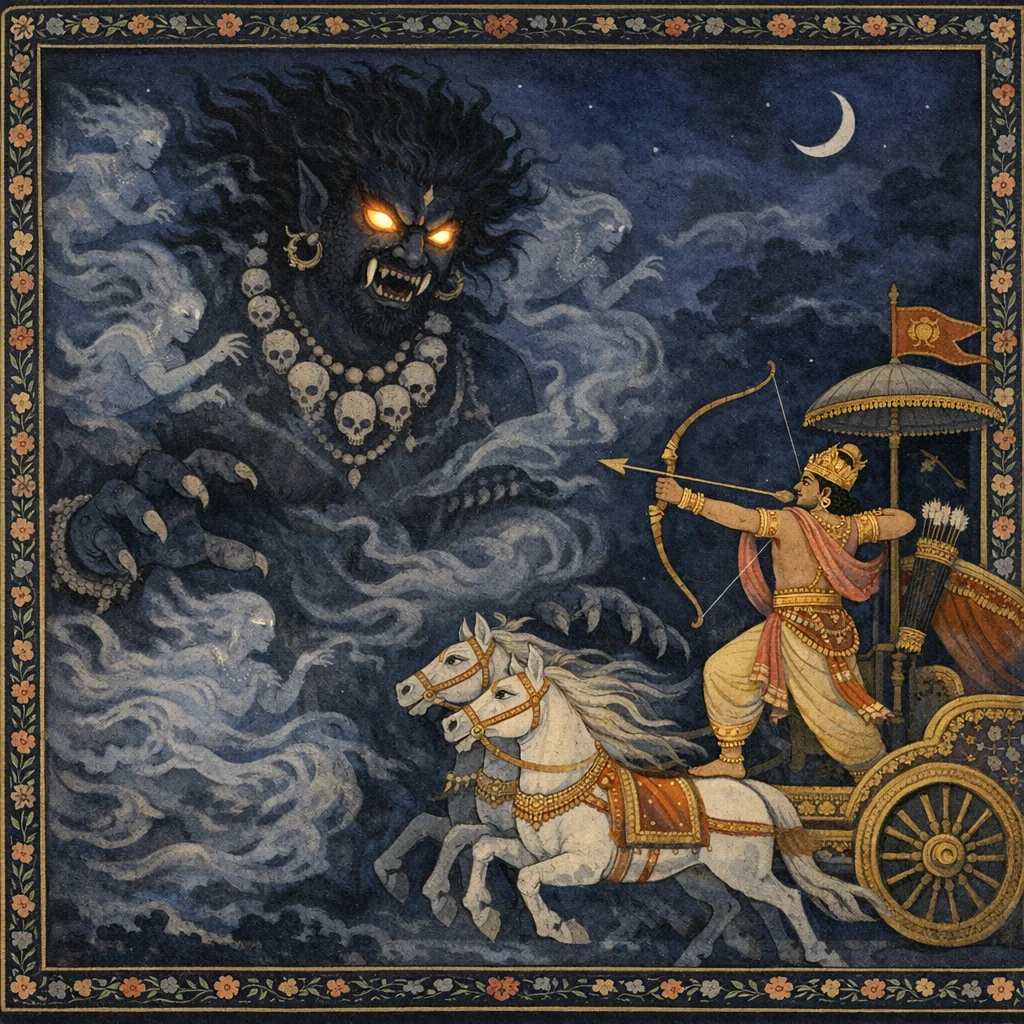
Chapter Arc: धृतराष्ट्र, संजय से पूछते हैं—भीमपुत्र घटोत्कच का वह भयानक रूप कैसा था, उसका रथ, ध्वजा, धनुष, कवच और शस्त्र-समूह कैसे थे; मानो अंधे राजा की जिज्ञासा स्वयं युद्ध-रात्रि के भय को आकार देना चाहती हो। → संजय घटोत्कच के राक्षसी वैभव, मायावी सामर्थ्य और युद्ध-उपकरणों का वर्णन करते हुए बतलाते हैं कि वह रणभूमि में प्रलय-सा उपस्थित हुआ। कर्ण उसके निकट आता है और दोनों के अस्त्र-वर्षा से दिशाएँ ढँक जाती हैं; घटोत्कच महामाया प्रकट कर कर्ण की सेना में भ्रम, आतंक और अराजकता फैलाने लगता है। → घटोत्कच क्रुद्ध होकर नेत्रों से अग्नि-सा तेज प्रकट करता है और मायावी रूपों/अस्त्रों से कर्ण को घेरता है; प्रत्युत्तर में राधेय कर्ण मुसकराते हुए-सा, तीव्रता से आगे बढ़कर उसके प्रहारों को रोकता है और उसके चलाए अस्त्रों को काट डालता है—राक्षसी माया बनाम क्षत्रिय-धैर्य का घोर शिखर-संघर्ष। → कर्ण की प्रतिरोध-शक्ति घटोत्कच की अनेक मायाओं को निष्फल करती है; युद्ध का प्रवाह क्षण भर के लिए कर्ण के पक्ष में स्थिर होता है, पर घटोत्कच की प्रचंडता और पुनः-पुनः रूप बदलने की क्षमता से संकट पूरी तरह टलता नहीं। → रात्रि-युद्ध की काली छाया में घटोत्कच अपनी महामाया को और उग्र करने को उद्यत दिखता है—अगला प्रहार किस पर गिरेगा, यह अनिश्चित रह जाता है।
Shlokas
Verse 1
नशा (0) अल अन+- पजञ्चसप्तत्यधिकशततमोड< ध्याय: घटोत्कच और उसके रथ आदिके स्वरूपका वर्णन तथा कर्ण और घटोत्कचका घोर संग्राम धृतराष्ट उवाच यत्तद् वैकर्तन: कर्णो राक्षसश्व॒ घटोत्कच: । निशीथे समसज्जेतां तद् युद्धमभवत् कथम्,धृतराष्ट्रने पूछा--संजय! आधी रातके समय सूर्यपुत्र कर्ण तथा राक्षस घटोत्कच जो एक-दूसरेसे भिड़े हुए थे, उनका वह युद्ध किस प्रकार हुआ?
Dhṛtarāṣṭra said: “Sañjaya, how did that battle unfold—when Karṇa, the son of the sun (Vaikartana), and the rākṣasa Ghaṭotkaca, met and grappled with each other at midnight?”
Verse 2
कीदृशं चाभवद् रूप॑ तस्य घोरस्य रक्षस: । रथश्न कीदृशस्तस्य हया: सर्वायुधानि च,उस भयंकर राक्षसका रूप उस समय कैसा था? उसका रथ कैसा था? उसके घोड़े और सम्पूर्ण आयुध कैसे थे?
Dhṛtarāṣṭra said: “What was the appearance of that dreadful Rākṣasa like? And what was his chariot like? What were his horses like, and what were all his weapons?”
Verse 3
किंप्रमाणा हयास्तस्य रथकेतुर्धनुस्तथा । कीदृशं वर्म चैवास्य शिरस्त्राणं च कीदृशम्
Dhṛtarāṣṭra asked: “Of what size and measure are his horses? And what are his chariot-banner and his bow like? What kind of armour does he wear, and what sort of head-protection (helmet) does he have?”
Verse 4
पृष्टस्त्वमेतदाचक्ष्य कुशलो हासि संजय । उसके घोड़े कितने बड़े थे, रथकी ध्वजाकी ऊँचाई और धनुषकी लंबाई कितनी थी? उसके कवच और शिरस्त्राण कैसे थे, संजय! मेरे प्रश्नंके अनुसार ये सारी बातें बताओ; क्योंकि तुम इस कार्यमें कुशल हो ।। ३ $ ।। संजय उवाच लोहिताक्षो महाकायस्ताम्रास्थो निम्नितोदर:,संजयने कहा--राजन्! घटोत्कचका शरीर बहुत बड़ा था। उसकी आँँखें सुर्ख रंगकी थीं। मुँह ताँबेके रंगका और पेट धँसा हुआ था। उसके रोएँ ऊपरकी ओर उठे हुए थे, दाढ़ी- मूँछ काली थी, ठोड़ी बड़ी दिखायी देती थी। मुँह कानोंतक फटा हुआ था, दाढ़ें तीखी होनेके कारण वह विकराल जान पड़ता था
Sañjaya said: “O King, Ghaṭotkaca was of immense stature. His eyes were red; his face had a coppery hue; his belly was drawn in. His body-hair bristled upward; his beard and moustache were black; his chin appeared large. His mouth seemed split up to the ears, and with sharp fangs he looked terrifying.”
Verse 5
ऊर्ध्वरोमा हरिश्मश्रु: शड्कुकर्णो महाहनु: । आकर्णदारितास्यश्व तीक्ष्णदंष्ट: करालवान्,संजयने कहा--राजन्! घटोत्कचका शरीर बहुत बड़ा था। उसकी आँँखें सुर्ख रंगकी थीं। मुँह ताँबेके रंगका और पेट धँसा हुआ था। उसके रोएँ ऊपरकी ओर उठे हुए थे, दाढ़ी- मूँछ काली थी, ठोड़ी बड़ी दिखायी देती थी। मुँह कानोंतक फटा हुआ था, दाढ़ें तीखी होनेके कारण वह विकराल जान पड़ता था
Sañjaya said: “O King, he was bristling with hair standing on end, with tawny-dark moustache and beard, conch-shaped ears, and a massive jaw. His mouth was split wide up to the ears; with sharp fangs and a terrifying visage, he appeared utterly dreadful.”
Verse 6
सुदीर्घताम्रजिद्दीष्ठो लम्बभ्रू: स्थूलनासिक: । नीलाज़रे लोहितग्रीवो गिरिवर्ष्मा भयंकर:,जीभ और ओठ ताँबेके समान लाल और लम्बे थे, भौंहें बड़ी-बड़ी, नाक मोटी, शरीरका रंग काला, गर्दन लाल और शरीर पर्वताकार था। वह देखनेमें बड़ा भयंकर जान पड़ता था
Sañjaya said: “He appeared terrifying—his tongue and lips were long and copper-red; his eyebrows were heavy and prominent; his nose was thick; his complexion was dark; his neck was ruddy; and his body was massive like a mountain.”
Verse 7
महाकायो महाबाहुर्महाशीर्षो महाबल: । विकृत: परुषस्पर्शो विकटोद्वृद्धपिण्डक:,उसकी देह, भुजा और मस्तक सभी विशाल थे। उसका बल भी महान् था। आकृति बेडौल थी। उसका स्पर्श कठोर था। उसकी पिंडलियाँ विकट एवं सुदृढ़ थीं
Sañjaya said: “He was of enormous body, with mighty arms and a massive head, and his strength was great. His form was misshapen, his touch was harsh, and his calves were formidable and powerfully built.”
Verse 8
स्थूलस्फिग्गूढनाभिश्न शिथिलोपचयो महान् । तथैव हस्ताभरणी महामायो<5ड्रदी तथा,उसके नितम्बभाग स्थूल थे। उसकी नाभि छोटी होनेके कारण छिपी हुई थी। उसके शरीरकी बढ़ती रुक गयी थी। वह लंबे कदका था। उसने हाथोंमें आभूषण पहन रखे थे। भुजाओंमें बाजूबन्द धारण कर रखे थे। वह बड़ी-बड़ी मायाओंका जानकार था
Sañjaya said: “He had broad hips, and his navel was hidden; his bodily growth had slackened, yet he was of great stature. His hands were adorned with ornaments, and he wore armlets upon his arms. He was a master of great deceptions and illusions.”
Verse 9
उरसा धारयन् निष्कमग्निमालां यथाचल: । तस्य हेममयं चित्र बहुरूपाज्शशोभितम्
Sañjaya said: Bearing upon his chest a radiant garland of fire, he stood unmoving like a mountain. Upon him there shone a wondrous golden adornment, splendid with many forms—an awe-inspiring sign of power amid the turmoil of war.
Verse 10
कुण्डले बालसूर्याभे मालां हेममयीं शुभाम्
Sañjaya said: “(He had) earrings gleaming like the young sun, and a beautiful garland made of gold.”
Verse 11
धारयन् विपुलं कांस्यं कवचं च महाप्रभम् | वह प्रभातकालके सूर्यकी भाँति कान्तिमान् दो कुण्डल, सोनेकी सुन्दर माला और काँसीका विशाल एवं चमकीला कवच धारण किये हुए था || १० ई ।। किंकिणीशतनिर्घोष॑ रक्तध्वजपताकिनम्
Sañjaya said: He wore a broad, gleaming cuirass of bronze and a splendid coat of mail, radiant like the sun at dawn. With the clamor of a hundred tinkling bells and marked by a red banner and pennon, he appeared as a formidable warrior—his outward brilliance mirroring the martial resolve that drives the battle onward.
Verse 12
सर्वायुधवरोपेतमास्थितो ध्वजशालिनम्
Sañjaya said: He took his stand upon the banner-bearing chariot, fully equipped with an excellent array of weapons—ready for the grim duties of battle and the responsibilities that accompany martial power.
Verse 13
मत्तमातड्रसंकाशा लोहिताक्षा विभीषणा:
Sañjaya said: They appeared like intoxicated elephants—red-eyed and terrifying—an image that heightens the dread and moral gravity of the battlefield, where unchecked fury and martial frenzy eclipse restraint and compassion.
Verse 14
वहन्तो राक्षसं घोरं वालवन्तो जितश्रमा:
Sañjaya said: Bearing along a fearsome rākṣasa, those youthful warriors—strong and unwearied—pressed on, their vigor undiminished amid the harsh demands of battle.
Verse 15
राक्षसो<स्य विरूपाक्ष: सूतो दीप्तास्यकुण्डल:,दीप्तिमान् मुख और कुण्डलोंसे युक्त विरूपाक्ष नामक राक्षस घटोत्कचका सारथि था, जो रणभूमिमें सूर्युकी किरणोंके समान चमकीली बागडोर पकड़कर उन घोड़ोंको काबूमें रखता था। उसके साथ रथपर बैठा हुआ घटोत्कच ऐसा जान पड़ता था, मानो अरुण नामक सारथिके साथ सूर्यदेव अपने रथपर विराजमान हों
Sañjaya said: His charioteer was a rākṣasa named Virūpākṣa, whose face and earrings shone brilliantly. Holding the reins that flashed like the sun’s rays, he kept the horses firmly under control. With such a driver beside him, Ghaṭotkaca seated on the chariot appeared like the Sun-god himself enthroned in his car with Aruṇa as his charioteer—an image that heightens the awe of war and the formidable power now entering the battlefield.
Verse 16
रश्मिश्रि: सूर्यरश्म्याभै: संजग्राह हयान् रणे | स तेन सहितस्तस्थावरुणेन यथा रवि:,दीप्तिमान् मुख और कुण्डलोंसे युक्त विरूपाक्ष नामक राक्षस घटोत्कचका सारथि था, जो रणभूमिमें सूर्युकी किरणोंके समान चमकीली बागडोर पकड़कर उन घोड़ोंको काबूमें रखता था। उसके साथ रथपर बैठा हुआ घटोत्कच ऐसा जान पड़ता था, मानो अरुण नामक सारथिके साथ सूर्यदेव अपने रथपर विराजमान हों
Sañjaya said: On the battlefield, Raśmiśrī seized and held the horses with reins that shone like the sun’s rays. With him beside him, Ghaṭotkaca stood out like the Sun himself seated on his chariot together with Aruṇa. The image underscores the terrifying splendor of war—brilliance and power harnessed for destruction—while also highlighting the disciplined control (the charioteer’s mastery) that makes such force effective.
Verse 17
संसक्त इव चाशभ्रेण यथाद्रिर्महता महान् । दिव:स्पृक् सुमहान् केतु: स्यन्दने5स्य समुच्छित:
Sañjaya said: “Like a great mountain seeming to be clung to by a massive cloud, his exceedingly lofty banner—raised upon his chariot—stood towering, as though touching the very heavens.”
Verse 18
वासवाशनिनिर्घोषं दृढज्यमतिविक्षिपन्,तस्यां वीरापहारिण्यां निशायां कर्णम भ्ययात् । वीरोंका संहार करनेवाली उस रात्रिमें इन्द्रके वज़्की भाँति भयानक टंकार करनेवाले और सुदृढ़ प्रत्यंचावाले एक हाथ चौड़े एवं बारह अरत्नि लंबे धनुषको खींचता और रथके धुरेके समान मोटे बाणोंसे सम्पूर्ण दिशाओंको आच्छादित करता हुआ घटोत्कच ([पूर्वोक्त रथपर आरूढ़ हो) कर्णकी ओर चला
Sañjaya said: In that night which was a snatcher-away of heroes, Ghaṭotkaca advanced toward Karṇa, drawing and powerfully hurling with a firmly strung bow whose roar was like Indra’s thunderbolt—filling the directions with thick, axle-like arrows. The scene intensifies the moral darkness of nocturnal warfare: valor is displayed, yet the night itself is portrayed as consuming warriors, underscoring the tragic, dehumanizing momentum of battle.
Verse 19
व्यक्त किष्कुपरीणाहं द्वादशारत्निकार्मुकम् । रथाक्षमात्रैरिषुभि: सर्वा: प्रच्छादयन् दिश:
Sañjaya said: “With a bow of manifest, thick girth—twelve ratnis in length—he rained down arrows as long as a chariot’s axle, veiling all the directions. In that moment the battlefield’s horizon of dharma narrowed: martial force, displayed without restraint, made every quarter seem covered and inescapable.”
Verse 20
तस्य विक्षिपतश्षापं रथे विष्टभ्य तिछत:
Sañjaya said: Standing firm upon his chariot, bracing himself, he warded off the curse being hurled at him—remaining steady amid the turmoil of battle and the moral weight of hostile imprecations.
Verse 21
तेन वित्रास्यमानानि तव सैन्यानि भारत
Sañjaya said: “O Bhārata (Dhṛtarāṣṭra), because of him, your forces were being thrown into panic.”
Verse 22
तमापततन्तं सम्प्रेक्ष्य विरूपाक्षं विभीषणम्
Sañjaya said: Seeing that fearsome, misshapen-eyed warrior rushing in, they beheld him with alarm—an oncoming presence that inspired dread on the battlefield.
Verse 23
ततः कर्णो5 भ्ययादेनमस्यन्नस्यन्तमन्तिकात्
Sañjaya said: Then Karṇa rushed toward him, hurling weapons at close range against the one who was himself casting missiles—pressing the fight into immediate, deadly proximity.
Verse 24
स संनिपातस्तुमुलस्तयोरासीद् विशाम्पते
Sañjaya said: O lord of the people, the clash between those two forces became a tumultuous, thunderous melee—an encounter marked by the overwhelming din and fury of war.
Verse 25
तौ प्रगृह्य महावेगे धनुषी भीमनि:स्वने
Sañjaya said: Seizing those two bows—both of tremendous force and sounding with a fearsome, awe-inspiring roar—they prepared for the next surge of combat, their weapons themselves proclaiming the gravity of the war’s violence.
Verse 26
ततः पूर्णायतोत्सूष्टैरिषुभिर्नतपर्वभि:
Sañjaya said: Then, with arrows drawn to their full length and released, their joints bent from the force, the battle pressed forward—an image of relentless martial resolve where skill and intent converge in the harsh ethics of war.
Verse 27
तौ नखैरिव शार्दूलौ दन्तैरिव महाद्विपौ
Sañjaya said: The two fought like tigers with their claws, and like mighty elephants with their tusks—locked in a fierce, close-quarters struggle where raw strength and relentless resolve drove the combat onward.
Verse 28
संछिन्दन्तौ च गात्राणि संदधानौ च सायकान्
Sañjaya said: “They were severing one another’s limbs, and again fitting arrows to the bow.” The line captures the grim rhythm of battle—injury inflicted without pause, and immediate readiness to strike again—showing how, in war, skill and resolve can become instruments of relentless violence, pressing the listener to reflect on the ethical cost of such unbroken aggression.
Verse 29
तौ तु विक्षतसर्वाड्री रुधिरौचपरिप्लुती
Sañjaya said: But those two, wounded over their entire bodies, were drenched in torrents of blood—an image of the war’s brutal cost, where valor and duty are pursued amid grievous suffering.
Verse 30
तौ शराग्रविनुन्नाड्ौ निर्भिन्दन्तौ परस्परम्
Sañjaya said: Struck and driven on by the sharp points of arrows, the two warriors pierced one another in turn—each meeting the other’s assault with equal ferocity, as the battle’s violence intensified without regard for mercy.
Verse 31
तत् प्रवृत्तं निशायुद्धं चिरें सममिवाभवत्
Sañjaya said: That night-battle, once it had begun, went on for a long time and seemed, as it unfolded, to be evenly matched—an ominous sign of how darkness and fury can suspend any clear advantage and prolong suffering on both sides.
Verse 32
तस्य संदधतस्ती क्ष्णान् शरांश्षासक्तमस्यत:
Sañjaya said: And as he fitted and drew his bow, he kept loosing keen arrows without pause—arrows that lodged fast in the foe’s body, like a cord braided of death.
Verse 33
घटोत्कचं यदा कर्णो विशेषयति नो नूप
Sañjaya said: “When Karṇa singles out Ghaṭotkaca for special attention—” (the narration turns to Karṇa’s deliberate focus on the formidable rākṣasa-warrior, highlighting the tactical and moral pressure of choosing whom to confront amid the chaos of battle).
Verse 34
ततः प्रादुष्करोद् दिव्यमस्त्रमस्त्रविदां वर: । नरेश्वर! जब कर्ण घटोत्कचसे बढ़ न सका, तब उस अस्त्रवेत्ताओंमें श्रेष्ठ वीरने दिव्यास्त्र प्रकट किया ।। कर्णेन संधितं दृष्टवा दिव्यमस्त्रं घटोत्कच:
Sañjaya said: Then the foremost among the masters of weapons revealed a celestial missile. O king, when Karṇa could no longer withstand Ghaṭotkaca’s assault, that heroic expert in arms brought forth a divine weapon. Seeing that celestial missile fixed and aimed by Karṇa, Ghaṭotkaca took note of it.
Verse 35
शूलमुद्गरधारिण्या शैलपादपहस्तया
Sañjaya said: She advanced bearing a spear and a mace, with feet like rocky crags and hands that struck like stone—an image of overwhelming, almost inhuman martial force on the battlefield.
Verse 36
तमुद्यतमहाचापं दृष्टवा ते व्यथिता नृपा:
Sañjaya said: Seeing him with his great bow raised and ready, those kings were shaken with fear and anxiety—an instant in which martial prowess overwhelms resolve and exposes the fragile line between courage and panic in war.
Verse 37
घटोत्कचप्रयुक्तेन सिंहनादेन भीषिता:
Sañjaya said: Terrified by the lion-like roar raised by Ghaṭotkaca, they were struck with fear—an instance of how psychological force in war can unsettle even armed warriors and test their steadiness of mind and duty.
Verse 38
ततो&श्मवृष्टिरत्युग्रा महत्यासीत् समन्तत:ः
Sañjaya said: Then, on every side, there arose a vast and exceedingly fierce shower of stones—an ominous intensification of the battle’s violence, where the field itself seemed to turn against restraint and humane conduct.
Verse 39
अर्धरात्रेडधिकबलै विंमुक्ता रक्षसां बलै: । तदनन्तर चारों ओरसे पत्थरोंकी अत्यन्त भयंकर एवं भारी वर्षा होने लगी। आधी रातके समय अधिक बलशाली हुए राक्षसोंके समुदाय वह प्रस्तर-वर्षा कर रहे थे || ३८ ६ || आयसानि च चक्राणि भुशुण्ड्य: शक्तितोमरा:
Sañjaya said: At midnight, when the hosts of rākṣasas had grown even more formidable, they unleashed on every side a terrifying, heavy shower of stones. With that barrage came iron wheels, bhusuṇḍīs, spears, and tomara-javelins—an assault meant to overwhelm by fear and sheer force rather than by fair contest.
Verse 40
तदुग्रमतिरौद्रं च दृष्टवा युद्ध नराधिप
Sañjaya said: O king, having beheld that battle—fierce in intent and terrible in its violence—the warriors were shaken; for such a sight reveals how swiftly wrath and resolve can eclipse restraint and dharma in war.
Verse 41
पुत्राश्न तव योधाश्व व्यथिता वि्रदुद्रुवु: । नरेश्वरर उस अत्यन्त भयंकर और उग्र संग्रामको देखकर आपके पुत्र और योद्धा भयभीत होकर भाग चले || ४० $ || तत्रैको<स्त्रबलश्लाघी कर्णो मानी न विव्यथे
Sañjaya said: Seeing that exceedingly dreadful and fierce battle, your sons and your warriors, shaken with fear, fled in confusion. Yet there, one man—Karna—proud of his prowess in weapons and strength, did not waver.
Verse 42
मायायां तु प्रहीणायाममर्षाच्च घटोत्कच:
Sañjaya said: When his magical power had been cast off, and stung by intolerable rage, Ghaṭotkaca rose to act.
Verse 43
विससर्ज शरान् घोरान् सूतपुत्रं त आविशन् | उस मायाके नष्ट हो जानेपर घटोत्कचने अमर्षमें भरकर भयंकर बाण छोड़े, जो सूतपुत्रके शरीरमें समा गये ।। ततस्ते रुधिराभ्यक्ता भित्त्वा कर्ण महाहवे
Sañjaya said: He discharged dreadful arrows that entered the charioteer’s son, Karna. Then, when that illusion had been destroyed, Ghaṭotkaca, filled with fierce indignation, released terrifying shafts that sank into Karna’s body. Thereupon, those arrows, smeared with blood, having pierced Karna in the great battle… (continue).
Verse 44
विविशुर्धरणीं बाणा: संक्रुद्धा इव पन्नगा: । तदनन्तर वे रुधिरसे रँगे हुए बाण उस महासमरमें कर्णको छेदकर कुपित हुए सर्पोके समान धरतीमें समा गये ।। ४३ $ ।। सूतपुत्रस्तु संक्रुद्धो लघुहस्त: प्रतापवान्
Sañjaya said: The arrows plunged into the earth like enraged serpents. Immediately thereafter, those blood-stained shafts, having pierced Karṇa amid that great battle, sank into the ground as if they were wrathful snakes—signaling the battle’s relentless violence and the inescapable consequence of martial fury.
Verse 45
घटोत्कचो विनिर्भिन्न: सूतपुत्रेण मर्मसु
Sañjaya said: Ghaṭotkaca was pierced through in his vital points by the charioteer’s son. The line underscores the grim moral weight of war: even the mightiest fall when struck at the vulnerable core, and victory is purchased through lethal skill rather than righteousness alone.
Verse 46
चक्र दिव्यं सहस्रारमगृह्नाद् व्यथितो भृशम् | सूतपुत्रके द्वारा मर्मस्थानोंमें विदीर्ण होकर अत्यन्त व्यथित हुए घटोत्कचने दिव्य सहस्रार चक्र हाथमें लिया ।। क्षुरान्तं बालसूर्याभं मणिरत्नविभूषितम्
Sanjaya said: Ghaṭotkaca, grievously wounded—his vital points torn open by the charioteer’s son—was in extreme agony. Yet, even in that shattered state, he seized a divine discus with a thousand spokes, razor-edged, glowing like the rising sun, and adorned with gems. The moment underscores a warrior’s resolve amid suffering and the relentless escalation of violence in the war, where extraordinary weapons are drawn when ordinary strength fails.
Verse 47
प्रविद्धमतिवेगेन विक्षिप्तं कर्णममायकै:
Sañjaya said: “Hurled with tremendous speed, the missile—aimed at Karṇa—was deftly deflected by those who fought without guile.”
Verse 48
घटोत्कचस्तु संक्रुद्धों दृष्टवा चक्रं निपातितम्
Sañjaya said: Seeing the discus brought down, Ghaṭotkaca flared up in wrath—his anger rising at the sudden check to the weapon and the shifting fortunes of battle.
Verse 49
कर्ण प्राच्छादयद् बाणै: स्वर्भानुरिव भास्करम् । चक्रको गिराया हुआ देख क्रोधमें भरे हुए घटोत्कचने अपने बाणोंद्वारा कर्णको उसी प्रकार आच्छादित कर दिया, जैसे राहु सूर्यको ढक देता है || ४८ $ ।। सूतपुत्रस्त्वसम्भ्रान्तो रुद्रोपेन्द्रेन्द्रविक्रम:
Sañjaya said: Ghaṭotkaca covered Karṇa with a dense shower of arrows, just as Svarbhānu (Rāhu) veils the Sun. Yet Karṇa—the charioteer’s son—unshaken, displayed a prowess like Rudra, Upendra (Viṣṇu), and Indra, meeting the assault with steadfast courage amid the fury of battle.
Verse 50
घटोत्कचेन क्रुद्धेन गदा हेमाड़दा तदा
Sañjaya said: Then, Ghaṭotkaca—enraged—wielded his mace, richly adorned with gold. The line underscores how wrath on the battlefield immediately turns into forceful action, intensifying the cycle of violence that war unleashes.
Verse 51
क्षिप्ता55 भ्राम्प शरै: सापि कर्णेनाभ्याहतापतत् । तब कुपित हुए घटोत्कचने सोनेके कड़ेसे विभूषित गदा घुमाकर चलायी, किंतु कर्णके बाणोंसे आहत होकर वह भी नीचे गिर पड़ी ।। ५० इ || ततोअन्तरिक्षमुत्पत्य कालमेघ इवोन्नदन्
Sañjaya said: Struck down by Karṇa’s fierce arrows, that weapon too—though hurled with force—fell to the ground. Then Ghaṭotkaca sprang up into the sky, roaring like a dark, thunder-laden cloud. The scene underscores how, in war, even great strength and resolve can be checked by superior skill, and how wrath, when ungoverned, rises again seeking renewed violence.
Verse 52
ततो मायाविनं कर्णो भीमसेनसुतं दिवि
Sañjaya said: Then Karṇa beheld in the sky the illusion-wielding son of Bhīmasena—an ominous sign that the battle was not to be decided by strength alone, but also by stratagem and extraordinary powers.
Verse 53
मार्गणैरभिविव्याध घन सूर्य इवांशुभि: । तब कर्ण भीमसेनके मायावी पुत्रको अपने बाणोंद्वारा आकाशमें उसी प्रकार बींधने लगा, जैसे सूर्य अपनी किरणोंद्वारा मेघोंको विद्ध कर देते हैं ।। ५२ ई ।। तस्य सर्वान् हयान् हत्वा संछिद्य शतधा रथम्
Sañjaya said: With his arrows he pierced him repeatedly, like the sun piercing through dense clouds with its rays. Then, after killing all his horses, he shattered the chariot into a hundred pieces—an image of relentless martial force where skill and fury eclipse restraint, and the battlefield’s ethic becomes one of decisive destruction rather than reconciliation.
Verse 54
अभ्यवर्षच्छरै: कर्ण: पर्जन्य इव वृष्टिमान् उसके सारे घोड़ोंको मारकर और रथके सैकड़ों टुकड़े करके कर्णने वर्षा करनेवाले मेघकी भाँति बाणोंकी वृष्टि आरम्भ कर दी ।। ५३ $ ।। न चास्यासीदनिर्भिन्न गात्रे द्यडुगुलमन्तरम्
Sañjaya said: Karṇa poured down a rain of arrows like a cloud heavy with rain. So unrelenting was his assault that on the warrior’s body there was not even a space of two fingers left unpierced.
Verse 55
सो<दृश्यत मुहूर्तेन श्वाविच्छधललितो यथा । घटोत्कचके शरीरमें दो अंगुल भी ऐसा स्थान नहीं बचा था, जो बाणोंसे विदीर्ण न हो गया हो। वह दो ही घड़ीमें काँटोंसे युक्त साहीके समान दिखायी देने लगा ।। न हयान्न रथं तस्य न ध्वजं न घटोत्कचम्
Sañjaya said: In a very short time he appeared like a porcupine bristling with quills. On Ghaṭotkaca’s body there was not even a space of two fingers’ breadth left that had not been torn open by arrows. Within only two ghaṭikās he looked like a hedgehog covered with spikes. Neither his horses, nor his chariot, nor his banner—nor even Ghaṭotkaca himself—remained unpierced by that shower of arrows.
Verse 56
स तु कर्णस्य तद् दिव्यमस्त्रमस्त्रेण शातयन्
Sañjaya said: He, however, neutralized that celestial weapon of Karṇa by means of another weapon.
Verse 57
सो5योधयत् तदा कर्ण मायया लाघवेन च
Sañjaya said: Then he engaged Karṇa in battle, relying on strategic illusion and swift maneuvering.
Verse 58
भैमसेनिर्महामायो मायया कुरुसत्तम
Sañjaya said: “O best of the Kurus, Bhīmasena’s son—mighty in magical power—by his own illusion…”
Verse 59
स तु कृत्वा विरूपाणि वदनान्यशुभानि च
Sañjaya said: “But he, having assumed hideous and inauspicious faces….”
Verse 60
पुनश्चापि महाकाय: संछिन्न: शतधा रणे
Sañjaya said: And yet again, in the battle, that mighty-bodied warrior was cut down—sundered into a hundred pieces.
Verse 61
तं॑ हतं मन्यमाना: सम प्राणदन् कुरुपुड़वा:
Sañjaya said: Believing him to have been slain, the foremost of the Kurus raised a united cry—an exultant shout.
Verse 62
अथ देहैर्नवैरन्यैर्दिक्षु सर्वास्वदृश्यत । उस समय उसे मरा हुआ मानकर कौरव-दलके प्रमुख वीर जोर-जोरसे गर्जना करने लगे। इतनेहीमें वह दूसरे बहुत-से नये-नये शरीर धारण करके सम्पूर्ण दिशाओंमें दिखायी देने लगा ।। ६१ $ ।। पुनश्चापि महाकाय: शतशीर्ष: शतोदर:
Sañjaya said: Then he was seen again in all directions, assuming other, ever-new bodies. The foremost warriors of the Kaurava host, taking him to be slain, roared aloud; yet in that very moment he appeared once more, manifesting many fresh forms—vast of frame, with a hundred heads and a hundred bellies.
Verse 63
अड्गुष्ठमात्रो भूत्वा च पुनरेव स राक्षस:
Sañjaya said: The rākṣasa, having become no bigger than a thumb, then again resumed his form.
Verse 64
सागरोर्मिरिवोद्धूतस्तिर्यगूर्ध्वमवर्तत । तत्पश्चात् वह राक्षस अँगूठेके बराबर होकर उछलती हुई समुद्रकी लहरके समान कभी ऊपर और कभी इधर-उधर होने लगा ।। ६३ $ ।। वसुधां दारयित्वा च पुनरप्सु न्यमज्जत
Sañjaya said: Like an ocean-wave driven up by the wind, it surged—now sideways, now upward. Then, after rending the earth, it plunged once more into the waters.
Verse 65
सो<वतीर्य पुनस्तस्थौ रथे हेमपरिष्कृते,इसके बाद आकाशसे उतरकर वह पुन: अपने सुवर्णमण्डित रथपर स्थित हो गया और मायासे ही पृथ्वी, आकाश एवं सम्पूर्ण दिशाओंमें घूमता हुआ कवचसे सुसज्जित हो कर्णके रथके समीप जाकर विचरने लगा। उस समय उसका मुख कुण्डलोंसे सुशोभित हो रहा था
Then he descended from the sky and once more stood upon his chariot, adorned with gold. By the power of illusion he moved through the earth, the sky, and all the directions, armoured, and drew near to Karṇa’s chariot, ranging about beside it—his face made splendid by earrings.
Verse 66
क्षितिं खं च दिशश्वैव माययाभ्येत्य दंशित: । गत्वा कर्णरथाभ्याशं व्यचरत् कुण्डलानन:,इसके बाद आकाशसे उतरकर वह पुन: अपने सुवर्णमण्डित रथपर स्थित हो गया और मायासे ही पृथ्वी, आकाश एवं सम्पूर्ण दिशाओंमें घूमता हुआ कवचसे सुसज्जित हो कर्णके रथके समीप जाकर विचरने लगा। उस समय उसका मुख कुण्डलोंसे सुशोभित हो रहा था
Sañjaya said: Armoured and empowered by illusion, he moved through the earth, the sky, and all the directions. Then, approaching Karṇa’s chariot, he ranged about near it—his face adorned with earrings.
Verse 67
प्राह वाक्यमसम्भ्रान्त: सूतपुत्र॑ विशाम्पते । तिछ्लेदानीं क्व मे जीवन सूतपुत्र गमिष्यसि
Sañjaya said: Unshaken, the lord of men addressed the charioteer’s son: “Stand now—where will you go, leaving me alive? O son of a sūta, where do you think you can depart?”
Verse 68
युद्धश्रद्धामहं तेड्द्य विनेष्यामि रणाजिरे । प्रजानाथ! अब घटोत्कच सम्भ्रमरहित हो सूतपुत्र कर्णसे बोला--'सारथिके बेटे! खड़ा रह। अब तू मुझसे जीवित बचकर कहाँ जायगा? आज मैं समरांगणमें तेरा युद्धका हौसला मिटा दूँगा” || ६७ $ ।। इत्युक्त्वा रोषताम्राक्ष॑ रक्ष: क्रूरपराक्रमम्,क्रोधसे लाल आँखें किये वह क्रूर पराक्रमी राक्षस उपर्युक्त बात कहकर आकाशमें उछला और बड़े जोरसे अट्टहास करने लगा। फिर जैसे सिंह गजराजपर चोट करता है, उसी प्रकार वह कर्णपर आघात करने लगा
Sañjaya said: “Today, on the battlefield, I shall destroy your confidence in war, O lord of men!” Thus spoke Ghaṭotkaca, unshaken and fearless, to Karṇa, the charioteer’s son: “Charioteer’s son, stand your ground! Where will you escape alive from me today? Here in the arena of battle I will shatter your martial pride.” Having said this, the rākṣasa—his eyes reddened with wrath, fierce in prowess—leapt up into the sky and let out a thunderous, terrifying laugh. Then, like a lion striking down a lordly elephant, he fell upon Karṇa with violent blows.
Verse 69
उत्पपातान्तरिक्षं च जहास च सुविस्तरम् | कर्णमभ्यहनच्चैव गजेन्द्रमिव केसरी,क्रोधसे लाल आँखें किये वह क्रूर पराक्रमी राक्षस उपर्युक्त बात कहकर आकाशमें उछला और बड़े जोरसे अट्टहास करने लगा। फिर जैसे सिंह गजराजपर चोट करता है, उसी प्रकार वह कर्णपर आघात करने लगा
The cruel, mighty rākṣasa, his eyes reddened with wrath, spoke thus, sprang into the sky, and burst into a vast, thunderous laugh. Then, as a lion strikes the lord of elephants, so he fell upon Karṇa with blows.
Verse 70
रथाक्षमात्रैरिषुभिरभ्यवर्षद् घटोत्कच: । रथिनामृषभं कर्ण धाराभिरिव तोयद:,जैसे बादल पर्वतपर जलकी धारा बरसाता है, उसी प्रकार घटोत्कच रथियोंमें श्रेष्ठ कर्णपर रथके धुरेके समान मोटे-मोटे बाणोंकी वर्षा करने लगा
Sañjaya said: Ghaṭotkaca showered Karṇa—the foremost bull among chariot-warriors—with arrows as thick as a chariot-axle, pouring them down like a rain-cloud sends torrents in streaming sheets.
Verse 71
शरवृष्टिं च तां कर्णो दूरात् प्राप्तामशातयत् । दृष्टवा च विहतां मायां कर्णेन भरतर्षभ
Sañjaya said: Karṇa shattered that oncoming shower of arrows even from a distance. And when he saw that his māyā and stratagem had been broken by Karṇa, O bull among the Bharatas, the illusion and device stood defeated.
Verse 72
सो5भवद् गिरिरत्युच्च: शिखरैस्तरुसंकटै:
Sañjaya said: It became like a mountain—exceedingly lofty—its peaks crowded and choked with trees.
Verse 73
तमज्जनचयप्रख्यं कर्णो दृष्टयवा महीधरम्,घटोत्कचको अंजनराशिके समान काला पर्वत बनकर अपने झरनोंद्वारा भयंकर अस्त्र- शस्त्रोंको प्रवाहित करते देखकर भी कर्णके मनमें तनिक भी क्षोभ नहीं हुआ। उसने मुसकराते हुए-से अपना दिव्यास्त्र प्रकट किया
Sañjaya said: Seeing Ghaṭotkaca, mountain-like and dark as a heap of collyrium, pouring forth dreadful missiles and weapons as if in torrents, Karṇa’s mind was not shaken in the least. Rather, with a faint smile, he revealed and readied his divine weapon.
Verse 74
प्रपातैरायुधान्युग्राण्युद्वहन्तं न चुक्षुभे । स्मयन्निव तत: कर्णो दिव्यमस्त्रमुदैरयत्,घटोत्कचको अंजनराशिके समान काला पर्वत बनकर अपने झरनोंद्वारा भयंकर अस्त्र- शस्त्रोंको प्रवाहित करते देखकर भी कर्णके मनमें तनिक भी क्षोभ नहीं हुआ। उसने मुसकराते हुए-से अपना दिव्यास्त्र प्रकट किया
Sañjaya said: Even on seeing Ghaṭotkaca—like a dark mountain, hurling down torrents of dreadful weapons—Karna’s mind did not waver in the least. Rather, as though smiling, Karna brought forth and set in motion his divine missile, meeting overwhelming force with unwavering resolve and mastery of arms.
Verse 75
ततः सोउस्त्रेण शैलेन्द्रो विक्षिप्तो वै व्यनश्यत । ततः स तोयदो भूत्वा नील: सेन्द्रायुधो दिवि
Sañjaya said: Then that mountain-king, struck and hurled away by the weapon, vanished from sight. Thereafter it appeared in the sky as a dark rain-cloud, bearing Indra’s bow (the rainbow)—a portent-like transformation that underscores how, in the fury of war, even mighty, seemingly immovable things are made to yield and assume new forms under irresistible force.
Verse 76
अथ संधाय वायव्यमस्त्रमस्त्रविदां वर:
Sañjaya said: Then the foremost among masters of weaponry, having fixed his aim, invoked the Vāyavya weapon—the wind-born missile—signaling a deliberate escalation in the battle through specialized astras rather than mere physical force.
Verse 77
स मार्गणगणै: कर्णो दिश: प्रच्छाद्य सर्वश:
Sañjaya said: Karṇa, with volleys of arrows in dense clusters, blanketed all directions on every side—an overwhelming display of martial force that intensifies the moral darkness of the battlefield, where prowess and fury eclipse restraint.
Verse 78
ततः प्रहस्य समरे भैमसेनिर्महाबल:
Sañjaya said: Then, laughing aloud in the midst of battle, the mighty Bhīmasena—strong and unshaken—advanced with grim confidence, as if to declare by his very demeanor that fear has no place where resolve and righteous wrath have been awakened.
Verse 79
स दृष्टवा पुनरायान्तं रथेन रथिनां वरम्
Sañjaya said: Seeing that foremost of chariot-warriors returning again in his chariot, the onlookers recognized a renewed surge in the battle’s momentum—where valor and resolve, for good or ill, drive men back into the fray.
Verse 80
घटोत्कचमसम्भान्तं राक्षसैर्बहुभिव॒तम् । सिंहशार्दूलसदृशैर्मत्तमातड्विक्रमै:
Sañjaya said: Ghaṭotkaca stood unshaken, surrounded by many rākṣasas—fighters whose prowess was like that of intoxicated elephants, and who resembled lions and tigers. The scene underscores the terrifying force of the night-stalking warriors, yet also highlights steadfastness amid chaos and fear on the battlefield.
Verse 81
उस समय कर्णने रथियोंमें श्रेष्ठ घटोत्कचको पुनः रथपर बैठकर आते देखा। उसके मनमें तनिक भी घबराहट नहीं थी। सिंह, शार्टूल और मतवाले गजराजके समान पराक्रमी बहुत-से राक्षस उसे घेरे हुए थे ।। गजस्थैश्नव रथस्थैश्न वाजिपृष्ठगतैस्तथा । नानाशस्त्रधरैघोरैर्नानाकवच भूषणै:,उन राक्षसोंमेंसे कुछ हाथियोंपर, कुछ रथोंपर और कुछ घोड़ोंकी पीठोंपर सवार थे। वे भयंकर निशाचर नाना प्रकारके अस्त्र-शस्त्र, कवच और आभूषण धारण किये हुए थे
Sañjaya said: At that time Karṇa saw Ghaṭotkaca—foremost among chariot-warriors—once again coming forward, mounted upon his chariot. Not the slightest fear stirred in him. Many rākṣasas of tremendous might, like lions, tigers, and rutting lordly elephants, surrounded him. Some of those rākṣasas were seated on elephants, some on chariots, and others upon the backs of horses—terrifying night-roamers bearing diverse weapons, and adorned with various armours and ornaments.
Verse 82
वृतं घटोत्कचं क्र्रैर्मरुद्धिरिव वासवम् । दृष्टवा कर्णो महेष्वासो योधयामास राक्षसम्,देवताओंसे घिरे हुए इन्द्रके समान क्रूर राक्षसोंस आवृत घटोत्कचको सामने देखकर महाधनुर्धर कर्णने उस निशाचरके साथ युद्ध आरम्भ किया
Sañjaya said: Seeing Ghaṭotkaca surrounded by fierce warriors—like Vāsava (Indra) encircled by the Maruts—the great archer Karṇa engaged that rākṣasa in battle.
Verse 83
घटोत्कचस्तत: कर्ण विद्ध्वा पञ्चभिराशुगै: । ननाद भैरवं नादं भीषयन् सर्वपार्थिवान्,तदनन्तर घटोत्कचने कर्णको पाँच बाणोंसे घायल करके समस्त राजाओंको भयभीत करते हुए वहाँ भयानक गर्जना की
Sañjaya said: Then Ghaṭotkaca, having pierced Karṇa with five swift arrows, let out a dreadful roar, terrifying all the kings.
Verse 84
भूयश्वाञज्जलिकेनाथ सम्मार्गणगणं महत् | कर्णहस्तस्थितं चापं चिच्छेदाशु घटोत्कच:,तत्पश्चात् अंजलिक नामक बाण मारकर घटोत्कचने कर्णके हाथमें स्थित हुए विशाल धनुषको बाणसमूहोंसहित शीघ्र काट डाला
Sañjaya said: Then again, with an Añjalika arrow, Ghaṭotkaca swiftly cut down the great cluster of missiles, and also severed the mighty bow that was held in Karṇa’s hand. In the relentless ethics of battlefield duty, the act is not mere display of strength: it is a tactical disabling of an adversary’s means of combat, turning the contest from personal hatred to the immediate demands of war and survival.
Verse 85
अथान्यद् धनुरादाय दृढं भारसहं महत् | विचकर्ष बलात् कर्ण इन्द्रायुधमिवोच्छितम्,तब कर्णने भार सहन करनेमें समर्थ दूसरा विशाल, सुदृढ़ एवं इन्द्रधनुषके समान ऊँचा धनुष हाथमें लेकर उसे बलपूर्वक खींचा
Sañjaya said: Then Karṇa took up another great bow—firm and capable of bearing heavy strain—and, raising it high like Indra’s weapon, he drew it back with sheer force. The scene underscores the warrior’s resolve and the escalating intensity of battle, where prowess and determination are displayed as instruments of one’s chosen allegiance.
Verse 86
तत: कर्णो महाराज प्रेषयामास सायकान् | सुवर्णपुड्खाउछत्रुघ्नान् खेचरान् राक्षसान् प्रति,महाराज! तदनन्तर कर्णने उन आकाशबचारी राक्षसोंको लक्ष्य करके सोनेके पंखवाले बहुत-से शत्रुनाशक बाण चलाये
Sañjaya said: Then Karṇa, O King, discharged his arrows—golden-feathered and deadly to foes—aiming them at the rākṣasas who were moving through the sky. In the moral atmosphere of the war, the verse underscores Karṇa’s unwavering martial resolve: he responds to a supernatural threat not with hesitation but with immediate, forceful action, treating the aerial assailants as legitimate combatants on the battlefield.
Verse 87
तद् बाणैररदितं यूथं रक्षसां पीनवक्षसाम् । सिंहेनेवार्दितं वन््यं गजानामाकुलं कुलम्,उन बाणोंसे पीड़ित हुआ चौड़ी छातीवाले राक्षसोंका वह समूह सिंहके सताये हुए जंगली हाथियोंके झुंडकी भाँति व्याकुल हो उठा
Sañjaya said: Struck and harried by those arrows, that band of broad-chested Rākṣasas became distressed and scattered—like a wild herd of elephants thrown into confusion when assailed by a lion. The image underscores how disciplined martial force can break even formidable strength when it is driven by fear and disorder rather than steadiness.
Verse 88
विधम्य राक्षसान् बाणै: साशथ्वसूतगजान् विभु: । ददाह भगवान् वद्ठिर्भूतानीव युगक्षये,जैसे प्रलयकालमें भगवान् अग्निदेव सम्पूर्ण भूतोंको भस्म कर डालते हैं, उसी प्रकार शक्तिशाली कर्णने अपने बाणोंद्वारा घोड़े, सारथि और हाथियोंसहित उन राक्षसोंको संतप्त करके जला डाला
Sañjaya said: Mighty Karṇa, striking down the rākṣasas with his arrows—along with their horses, charioteers, and elephants—burned them up, as the divine Fire at the end of an age consumes all beings. The verse underscores the terrifying, near-cosmic scale of violence on the battlefield, where martial prowess becomes indistinguishable from annihilating force.
Verse 89
स हत्वा राक्षसीं सेनां शुशुभे सूतनन्दन: । पुरेव त्रिपुरं दग्ध्वा दिवि देवो महेश्वर:,जैसे पूर्वकालमें भगवान् महेश्वर आकाशमें त्रिपुरासुरका दाह करके सुशोभित हुए थे, उसी प्रकार उस राक्षस-सेनाका संहार करके सूतनन्दन कर्ण बड़ी शोभा पाने लगा
Sañjaya said: Having slain the rākṣasa host, Karṇa—the charioteer’s son—shone with renewed splendor, just as in former times Lord Maheśvara (Śiva) shone in the heavens after burning the Triple City, Tripura.
Verse 90
तेषु राजसहस्रेषु पाण्डवेयेषु मारिष | नैनं निरीक्षितुमपि कश्चिच्छक्नोति पार्थिव:,माननीय नरेश! पाण्डवपक्षके सहस्रों राजाओंमेंसे कोई भी भूपाल उस समय कर्णकी ओर आँख उठाकर देख भी नहीं सकता था
Sañjaya said: “O venerable one, among those thousands of kings aligned with the Pāṇḍavas, not a single ruler at that moment had the strength even to raise his eyes and look toward Karṇa.”
Verse 91
ऋते घटोत्कचादू राजन् राक्षसेन्द्रान्महाबलात् । भीमवीर्यबलोपेतात् क्रुद्धाद् वैवस्चतादिव,राजन! क्रोधमें भरे हुए यमराजके समान भयंकर बल-पराक्रमसे सम्पन्न महाबली राक्षसराज घटोत्कचको छोड़कर दूसरा कोई कर्णका सामना न कर सका
Sañjaya said: O King, except for Ghaṭotkaca—the mighty lord of the Rākṣasas, endowed with Bhīma’s heroic strength—none could stand against Karṇa. In his wrath he was like Vaivasvata (Yama), terrifying in power and prowess.
Verse 92
तस्य क्ुद्धस्य नेत्राभ्यां पावक: समजायत । महोल्काभ्यां यथा राजन् सार्चिष: स्नेहबिन्दव:,नरेश्वरर जैसे मशालोंसे जलती हुई तेलकी बूँदें गिरती हैं, उसी प्रकार क्रुद्ध हुए घटोत्कचके दोनों नेत्रोंस आगकी चिनगारियाँ छूटने लगीं
Sañjaya said: As he flared up in wrath, fire seemed to spring from his two eyes. O King, just as blazing drops of oil fall from great torches with sparks, so did fiery sparks burst forth from his eyes.
Verse 93
तोरणप्रतिमं शुभ्र॑ किरीटं मूर्थ्यशोभत । वह अपनी छातीपर सुवर्णमय निष्क (पदक) पहनकर अग्निकी माला धारण किये पर्वतके समान प्रतीत होता था। उसके मस्तकपर सोनेका बना हुआ विचित्र उज्ज्वल मुकुट तोरणके समान सुशोभित हो रहा था। उस मुकुटकी विविध अंगोंसे बड़ी शोभा हो रही थी,तल॑ तलेन संहत्य संदश्य दशनच्छदम् । रथमास्थाय च पुनर्मायया निर्मितं तदा उसने उस समय हाथसे हाथ मलकर, दाँतोंसे ओठ चबाकर, पुनः हाथी-जैसे बलवान् एवं पिशाचोंके-से मुखवाले प्रखर गधोंसे जुते हुए मायानिर्मित रथपर बैठकर अपने सारथिसे कहा--“तुम मुझे सूतपुत्र कर्णके पास ले चलो”
Sañjaya said: Upon his head a bright, splendid crown shone, resembling a ceremonial gateway. Then, rubbing his palms together and biting his lip in tense resolve, he mounted again a chariot fashioned by illusion, and commanded his charioteer: “Take me to Karṇa, the charioteer’s son.”
Verse 94
युक्त गजनिभेर्वाहै: पिशाचवदनै: खरै: । स सूतमत्रवीत् क्रुद्ध: सूतपुत्राय मां वह,उसने उस समय हाथसे हाथ मलकर, दाँतोंसे ओठ चबाकर, पुनः हाथी-जैसे बलवान् एवं पिशाचोंके-से मुखवाले प्रखर गधोंसे जुते हुए मायानिर्मित रथपर बैठकर अपने सारथिसे कहा--“तुम मुझे सूतपुत्र कर्णके पास ले चलो”
Sañjaya said: Enraged, he commanded his charioteer, “Yoke the fierce donkeys—elephant-strong, with faces like piśācas—and carry me to Karṇa, the son of a sūta.”
Verse 95
स ययौ घोररूपेण रथेन रथिनां वर: । द्वैरथं सूतपुत्रेण पुनरेव विशाम्पते,प्रजानाथ! ऐसा कहकर रथियोंमें श्रेष्ठ घटोत्कच पुनः: उस भयंकर रथके द्वारा सूतपुत्र कर्णके साथ द्वैरथ युद्ध करनेके लिये गया
Sañjaya said: Then the foremost of chariot-warriors set forth again in his fearsome chariot, O lord of the people, to engage once more in a direct chariot-duel with Karṇa, the son of a sūta.
Verse 96
स चिक्षेप पुनः क्रुद्ध: सूतपुत्राय राक्षस: । अष्टचक्रां महाघोरामशनिं रुद्रनिर्मिताम्,उस राक्षसने कुपित होकर पुनः सूतपुत्र कर्णपर आठ चक्रोंसे युक्त एक अत्यन्त भयंकर रुद्रनिर्मित अशनि चलायी, जिसकी ऊँचाई दो योजन और लंबाई-चौड़ाई एक-एक योजनकी थी। लोहेकी बनी हुई उस शक्तिमें शूल चुने गये थे। इससे वह केसरोंसे युक्त कदम्ब-पुष्पके समान जान पड़ती थी
Sañjaya said: Enraged once again, the rākṣasa hurled at Karṇa, the son of a sūta, a terribly fearsome thunderbolt-weapon, fashioned by Rudra and fitted with eight wheels.
Verse 97
द्वियोजनसमुत्सेधां योजनायामविस्तराम् । आयसी निचितां शूलै: कदम्बमिव केसरै:,उस राक्षसने कुपित होकर पुनः सूतपुत्र कर्णपर आठ चक्रोंसे युक्त एक अत्यन्त भयंकर रुद्रनिर्मित अशनि चलायी, जिसकी ऊँचाई दो योजन और लंबाई-चौड़ाई एक-एक योजनकी थी। लोहेकी बनी हुई उस शक्तिमें शूल चुने गये थे। इससे वह केसरोंसे युक्त कदम्ब-पुष्पके समान जान पड़ती थी
Sañjaya said: “It was two yojanas in height, and a yojana in length and breadth—an iron missile densely set with spikes, appearing like a kadamba blossom crowned with filaments. In wrath, that rākṣasa again hurled this exceedingly dreadful, Rudra-fashioned thunderbolt-like weapon at Karṇa, the son of a sūta.”
Verse 98
तामवसप्लुत्य जग्राह कर्णो न्यस्य महद् धनु: । चिक्षेप चैनां तस्यैव स्यन्दनात् सो5वपुप्लुवे,कर्णने अपना विशाल धनुष नीचे रख दिया और उछलकर उस अशनिको हाथसे पकड़ लिया; फिर उसे घटोत्कचपर ही चला दिया। घटोत्कच शीघ्र ही उस रथसे कूद पड़ा
Sañjaya said: Setting aside his great bow, Karṇa leapt down and seized that weapon with his hand. He then hurled it straight at Ghaṭotkaca; and Ghaṭotkaca, swift to respond, sprang down from his chariot.
Verse 99
साश्वसूतध्वजं यान भस्म कृत्वा महाप्रभा । विवेश वसुधां भिन्त्वा सुरास्तत्र विसिस्मियु:,वह अतिशय प्रभापूर्ण अशनि घोड़े, सारथि और ध्वजसहित घटोत्कचके रथको भस्म करके धरती फाड़कर समा गयी। यह देख वहाँ खड़े हुए सब देवता आश्वर्यवकित हो उठे
Sañjaya said: The exceedingly radiant missile reduced Ghaṭotkaca’s chariot—together with its horses, charioteer, and banner—to ashes, and then, splitting the earth, it disappeared into the ground. Seeing this, the gods who were standing there were struck with astonishment.
Verse 100
कर्ण तु सर्वभूतानि पूजयामासुरञ्जसा । यदवप्लुत्य जग्राह देवसृष्टां महाशनिम्,उस समय वहाँ सम्पूर्ण प्राणी कर्णकी प्रशंसा करने लगे; क्योंकि उसने महादेवजीकी बनायी हुई उस विशाल अशनिको अनायास ही उछलकर पकड़ लिया था
Sañjaya said: Then all beings readily began to praise Karṇa, for he had leapt up and effortlessly seized that mighty thunderbolt-like weapon fashioned by the god (Mahādeva).
Verse 101
एवं कृत्वा रणे कर्ण आरुरोह रथं पुन: । ततो मुमोच नाराचान् सूतपुत्र: परंतप,रणभूमिमें ऐसा पराक्रम करके कर्ण पुनः अपने रथपर आ बैठा। शत्रुओंको संताप देनेवाले नरेश! फिर सूतपुत्र कर्ण नाराचोंकी वर्षा करने लगा
Sañjaya said: Having thus displayed his prowess in the battle, Karṇa mounted his chariot again. Then the charioteer’s son, a scorcher of foes, released a volley of nārāca arrows.
Verse 102
अशव्यं कर्तुमन्येन सर्वभूतेषु मानद । यदकार्षीत् तदा कर्ण: संग्रामे भीमदर्शने,दूसरोंको सम्मान देनेवाले महाराज! उस भयंकर संग्राममें कर्णने उस समय जो कार्य किया था, उसे सम्पूर्ण प्राणियोंमें दूसरा कोई नहीं कर सकता था
Sañjaya said: O king, bestower of honor, what Karṇa accomplished then in that dreadful battle—so terrifying to behold—was a deed that no other being anywhere could have performed.
Verse 103
स हन्यमानो नाराचैर्धाराभिरिव पर्वत: । गन्धर्वनगराकार: पुनरन्तरधीयत,जैसे पर्वतपर जलकी धाराएँ गिरती हैं, उसी प्रकार नाराचोंके प्रहारसे आहत हुआ घटोत्कच गन्धर्व-नगरके समान पुन: अदृश्य हो गया
Sañjaya said: Though struck by volleys of nārāca arrows, Ghaṭotkaca—like a mountain lashed by cascading streams—again vanished from sight, appearing like a phantom city of the Gandharvas.
Verse 104
एवं स वै महाकायो मायया लाघवेन च । अस्त्राणि तानि दिव्यानि जघान रिपुसूदन:,इस प्रकार शत्रुओंका संहार करनेवाले विशालकाय घटोत्कचने अपनी माया तथा अस्त्र-संचालनकी शीघ्रतासे कर्णके उन दिव्यास्त्रोंको नष्ट कर दिया
Sañjaya said: Thus that mighty, colossal warrior—an enemy-slayer—by the power of his illusion and by swift mastery in the use of weapons, neutralized those celestial missiles.
Verse 105
निहन्यमानेष्वस्त्रेषु मायया तेन रक्षसा । असम्भ्रान्तस्तदा कर्णस्तदू रक्ष: प्रत्ययुध्यत,उस राक्षसके द्वारा मायासे अपने अस्त्रोंके नष्ट हो जानेपर भी उस समय कर्णके मनमें तनिक भी घबराहट नहीं हुई। वह उस राक्षसके साथ युद्ध करता ही रहा
Sañjaya said: Even as his missiles were being rendered ineffective by the rākṣasa through deceptive magic, Karṇa did not lose his composure. Unshaken in mind, he continued to counterfight that rākṣasa.
Verse 106
ततः क्रुद्धो महाराज भैमसेनिर्महाबल: । चकार बहुधा55त्मानं भीषयाणो महारथान्,महाराज! तत्पश्चात् क्रोधमें भरे हुए महाबली भीमसेनकुमार घटोत्कचने महारथियोंको भयभीत करते हुए अपने बहुत-से रूप बना लिये
Sañjaya said: Then, O King, the mighty son of Bhīmasena, inflamed with wrath, assumed many forms, terrifying the great chariot-warriors.
Verse 107
ततो दिग्भ्य: समापेतु: सिंहव्याप्रतरक्षव: । अग्निजिद्नाश्व भुजगा विहगाश्चाप्ययोमुखा:,तदनन्तर सम्पूर्ण दिशाओंसे सिंह, व्याप्र, तरक्षु (जरख) अग्निमयी जिहद्नावाले सर्प तथा लोहमय चंचुवाले पक्षी आक्रमण करने लगे
Sañjaya said: Then, from all directions, lions, tigers, and tarakṣus (hyenas) surged in; fiery-tongued serpents and iron-beaked birds also began to attack.
Verse 108
स कीर्यमाणो विशिखै: कर्णचापच्युतै: शरै: । नागराडिव दुष्प्रेक्ष्यस्तत्रैवान्तरधीयत,नागराजके समान घटोत्कचकी ओर देखना कठिन हो रहा था। वह कर्णके धनुषसे छूटे हुए शिखाहीन बाणोंद्वारा आच्छादित हो वहीं अन्तर्धान हो गया
Sañjaya said: As he was being covered over by the headless arrows released from Karṇa’s bow, he became hard to look at—like the lord of serpents—and then, right there on the battlefield, he vanished from sight.
Verse 109
राक्षसाश्न पिशाचाश्न यातुधानास्तथैव च । शालावृकाश्न बहवो वृकाश्न विकृतानना:,उस समय बहुत-से राक्षस, पिशाच, यातुधान, कुत्ते और विकराल मुखवाले भेड़िये कर्णको काटनेके लिये सब ओरसे उसपर टूट पड़े और अपनी भयंकर गर्जनाओंद्वारा उसे भयभीत करने लगे
Sañjaya said: Many rākṣasas, piśācas, and yātudhānas—along with packs of jackals and wolves with grotesque faces—appeared on all sides. Their presence and dreadful howls signaled an ominous turn in the battle, as if predatory forces were closing in to terrify and overwhelm the warrior amid the chaos of war.
Verse 110
ते कर्ण क्षपयिष्यन्त: सर्वतः समुपाद्रवन् अथीैनं वाग्भिरुग्राभिस्त्रासयांचक्रिरे तदा,उस समय बहुत-से राक्षस, पिशाच, यातुधान, कुत्ते और विकराल मुखवाले भेड़िये कर्णको काटनेके लिये सब ओरसे उसपर टूट पड़े और अपनी भयंकर गर्जनाओंद्वारा उसे भयभीत करने लगे
Sañjaya said: Then, intent on destroying Karṇa, they rushed upon him from every side and sought to terrify him with harsh, fearsome cries. In that moment many rākṣasas, piśācas, yātudhānas, dogs, and wolves with dreadful jaws sprang at Karṇa to tear him, and by their terrible roaring tried to overwhelm him with fear—an ominous vision amid the moral darkness of war.
Verse 111
उद्यतैर्बहुभिघेरिरायुधै: शोणितो क्षितै: । तेषामनेकैरेकैकं कर्णो विव्याध सायकै:,कर्णने खूनसे रँगे हुए अपने बहुत-से भयंकर आयुधों तथा बाणोंद्वारा उनमेंसे प्रत्येकको बींध डाला
Sañjaya said: With many dreadful weapons raised aloft, and with arrows stained in blood, Karṇa pierced each of them—one by one—again and again with his shafts. The scene underscores the grim momentum of battle, where prowess and resolve drive men to relentless violence, even as the moral weight of slaughter silently accumulates.
Verse 112
प्रतिहत्य तु तां मायां दिव्येनास्त्रेण राक्षसीम् । आजपघान हयानस्य शरै: संनतपर्वभि:,अपने दिव्यास्त्रसे उस राक्षसी मायाका विनाश करके उसने झुकी हुई गाँठवाले बाणोंसे घटोत्कचके घोड़ोंको मार डाला
Sañjaya said: Having countered and destroyed that rākṣasī illusion by means of a divine weapon, he then struck down Ghaṭotkaca’s horses with arrows whose joints were bent—showing how, in the press of war, supernatural deception is met with higher skill and consecrated arms, and the battle turns to disabling the enemy’s mobility rather than mere display of power.
Verse 113
ते भग्ना विक्षताड्श्च भिन्नपृष्ठाश्न सायकै: । वसुधामन्वपद्यन्त पश्यतस्तस्य रक्षस:,उन घोड़ोंके सारे अंग क्षत-विक्षत हो गये थे, बाणोंकी मारसे उनके पृष्ठभाग फट गये थे, अत: उस राक्षसके देखते-देखते वे पृथ्वीपर गिर पड़े
Sañjaya said: Those horses, their limbs shattered and torn, their backs split open by the arrows, collapsed to the earth before the very eyes of that rākṣasa. The scene underscores the pitiless momentum of battle, where even the innocent instruments of war—animals bound to human conflict—are destroyed by the relentless exchange of weapons.
Verse 114
स भग्नमायो हैडिम्बि: कर्ण वैकर्तनं तदा । एष ते विदथे मृत्युमित्युक्त्वान्तरधीयत,इस प्रकार अपनी माया नष्ट हो जानेपर हिडिम्बाकुमार घटोत्कचने सूर्यपुत्र कर्णसे कहा --“यह ले, मैं अभी तेरी मृत्युका आयोजन करता हूँ” ऐसा कहकर वह वहीं अदृश्य हो गया
Sañjaya said: When his magical power had been broken, the Haiḍimba (Ghaṭotkaca) then addressed Karṇa Vaikartana: “Here—on this battlefield I now arrange your death.” Having spoken thus, he vanished from sight.
Verse 116
ऋक्षचर्मावनद्धाड़ं नल्वमात्रं महारथम् | उसके रथमें सैकड़ों क्षुद्र घण्टिकाओंका मधुर घोष होता था। उसपर लाल रंगकी ध्वजा-पताका फहरा रही थी। उस रथके सम्पूर्ण अंगोंपर रीछकी खाल मढ़ी गयी थी। वह विशाल रथ चारों ओरसे चार सौ हाथ लंबा था
Sañjaya said: “That great chariot—richly covered with bearskin—was of immense build. From it arose a sweet, ringing sound from hundreds of small bells. A red banner streamed upon it. Every part of the chariot was sheathed in bearskin, and the vast car measured four hundred cubits all around.”
Verse 126
अष्टचक्रसमायुक्त मेघगम्भीरनि:स्वनम् । उसपर सभी प्रकारके श्रेष्ठ आयुध रखे गये थे। उसमें आठ पहिये लगे थे और चलते समय उस रथसे मेघ-गर्जनाके समान गम्भीर ध्वनि होती थी। विशाल ध्वज उस रथकी शोभा बढ़ा रहा था। उसीपर घटोत्कच आरूढ़ था
Sañjaya said: “(There appeared) a chariot fitted with eight wheels, whose rumbling sound was deep like the roar of thunderclouds.” The chariot bore excellent weapons of every kind; a great banner heightened its splendor. Upon it rode Ghaṭotkaca.
Verse 136
कामवर्णजवा युक्ता बलवन्त: शतं हया: । मतवाले हाथीके समान प्रतीत होनेवाले सौ बलवान् एवं भयंकर घोड़े उस रथमें जुते हुए थे। जिनकी आँखें लाल थीं तथा जो इच्छानुसार रूप धारण करनेवाले और मनचाहे वेगसे चलनेवाले थे
Sañjaya said: A hundred powerful horses were yoked to that chariot—terrifying in their might, seeming like rut-maddened elephants. Their eyes were red; they could assume forms at will and moved with whatever speed was desired.
Verse 146
विपुलाभि: सटाभिस्ते ह्लेषमाणा मुहुर्मुहु: । उन घोड़ोंके कंधोंपर लंबे-लंबे बाल थे। वे परिश्रमको जीत चुके थे। वे सभी अपने विशाल केसरों (गर्दनके लंबे बालों)-से सुशोभित थे और उस भयानक राक्षसका भार वहन करते हुए वे बारंबार हिनहिना रहे थे
Sañjaya said: Those horses, adorned with abundant flowing manes, kept neighing again and again. With long hair upon their shoulders and great neck-man es enhancing their appearance, they bore the dreadful rākṣasa’s weight, having already overcome the strain of exertion.
Verse 174
इस प्रकार श्रीमह्माभारत द्रोणपर्वके अन्तर्गत घटोत्कचवधपर्वमें रात्रियुद्धके प्रसंगमें अलगम्बुषवधविषयक एक सौ चौहत्तरवाँ अध्याय पूरा हुआ
Sanjaya concludes: Thus, in the revered Mahabharata, within the Drona Parva—specifically in the section on the slaying of Ghaṭotkaca—during the episode of the night-battle, the one-hundred-and-seventy-fourth chapter, dealing with the slaying of Alagambuṣa, is completed. The colophon frames the narrative amid the moral and strategic turbulence of nocturnal warfare, where ordinary conventions of battle break down and questions of duty, restraint, and necessity grow more severe.
Verse 175
इति श्रीमहाभारते द्रोणपर्वणि घटोत्कचवधपर्वणि रात्रियुद्धे कर्णघटोत्कचयुद्धि पडज्चसप्तत्यधिकशततमो< ध्याय:,इस प्रकार श्रीमहाभारत द्रोणपर्वके अन्तर्गत घटोत्कचवधपर्वमें रात्रियुद्धके प्रयंगगें कर्ण और घटोत्कचका युद्धविषयक एक सौ पचहत्तरवाँ अध्याय पूरा हुआ
Sanjaya said: Thus, in the Śrī Mahābhārata, within the Droṇa Parva, in the sub-episode concerning the slaying of Ghaṭotkaca, in the account of the night-battle, the chapter describing the combat between Karṇa and Ghaṭotkaca—being the one hundred and seventy-fifth—comes to an end. Ethically, the colophon underscores the grim escalation of war into nocturnal fighting, where ordinary restraints weaken and the struggle turns toward decisive, often ruthless, outcomes.
Verse 176
रक्तोत्तमाज़: क्रव्यादो गृध्र: परमभीषण: । जैसे महान् पर्वत किसी महामेघसे संयुक्त हो जाय, उसी प्रकार अपने सारथिके साथ बैठे हुए घटोत्कचकी शोभा हो रही थी। उसके रथपर बहुत ऊँची गगन-चुम्बिनी पताका फहरा रही थी, जिसपर एक लाल सिरवाला अत्यन्त भयंकर मांसभोजी गीध दिखायी देता था
On his sky-kissing banner was seen a red-headed, flesh-devouring vulture, dreadful beyond measure. And as a mighty mountain seems joined to a vast thundercloud, so did Ghaṭotkaca appear in splendor, seated upon his chariot beside his charioteer. Above his car a towering standard streamed in the wind, bearing that fearsome red-headed carrion-eater.
Verse 193
तस्यां वीरापहारिण्यां निशायां कर्णम भ्ययात् । वीरोंका संहार करनेवाली उस रात्रिमें इन्द्रके वज़्की भाँति भयानक टंकार करनेवाले और सुदृढ़ प्रत्यंचावाले एक हाथ चौड़े एवं बारह अरत्नि लंबे धनुषको खींचता और रथके धुरेके समान मोटे बाणोंसे सम्पूर्ण दिशाओंको आच्छादित करता हुआ घटोत्कच ([पूर्वोक्त रथपर आरूढ़ हो) कर्णकी ओर चला
Sañjaya said: In that night which was a snatcher away of heroes, Ghaṭotkaca advanced against Karṇa. Drawing a bow a hand’s breadth wide and twelve cubits long, with a dreadful twang like Indra’s thunderbolt and a taut, unyielding bowstring, he covered all directions with arrows as thick as a chariot’s axle, and—mounted on the chariot described earlier—moved toward Karṇa. The scene underscores the terror and moral weight of nocturnal warfare, where prowess becomes a force that indiscriminately consumes the brave.
Verse 206
अश्रूयत धनुर्घोषो विस्फूर्जितमिवाशने: । रथपर स्थिरतापूर्वक खड़े हो जब वह अपने धनुषको खींच रहा था, उस समय उसकी टंकार वजकी गड़गड़ाहटके समान सुनायी देती थी
Sañjaya said: The twang of the bow was heard—like the crackling roar of a thunderbolt—when the warrior, standing firm upon his chariot, drew the bowstring. The sound signals unwavering resolve and the fearful momentum of battle, where steadfastness becomes both a martial virtue and a portent of impending destruction.
Verse 213
समकम्पन्त सर्वाणि सिन्धोरिव महोर्मय: । भारत! उस घोर शब्दसे डरायी हुई आपकी सारी सेनाएँ समुद्रकी बड़ी-बड़ी लहरोंके समान काँपने लगीं
Sañjaya said: “O Bhārata, struck with fear by that dreadful roar, all your forces began to tremble—like the great surging waves of the ocean.”
Verse 233
मातड़ इव मातड़ं यूथर्षभमिवर्ष भ: । जैसे एक यूथपति गजराजका सामना करनेके लिये दूसरे यूथका अधिपति गजराज चढ़ आता है, उसी प्रकार बाणोंकी वर्षा करते हुए घटोत्कचपर बाणोंकी बौछार करते हुए कर्णने उसके ऊपर निकटसे आक्रमण किया
Sañjaya said: Like one mighty elephant charging another, like a dominant bull confronting a rival leader, Karṇa closed in on Ghaṭotkaca at close quarters. Showering him with a dense rain of arrows, Karṇa pressed the attack to check the terrifying onslaught on the battlefield.
Verse 243
कर्णराक्षसयो राजन्निन्द्रशम्बरयोरिव । प्रजानाथ! राजन! पूर्वकालमें जैसे इन्द्र और शम्बरासुरमें युद्ध हुआ था, उसी प्रकार कर्ण और राक्षसका वह संग्राम बड़ा भयंकर हुआ
Sañjaya said: O King, the battle between Karṇa and the rākṣasa became exceedingly dreadful—like the ancient combat between Indra and the asura Śambara.
Verse 253
प्राच्छादयेतामन्योन्यं तक्षमाणौ महेषुभि: । वे दोनों भयंकर टंकार करनेवाले अत्यन्त वेगशाली धनुष लेकर बड़े-बड़े बाणोंद्वारा एक-दूसरेको क्षत-विक्षत करते हुए आच्छादित करने लगे
Sañjaya said: Wielding exceedingly swift bows that thundered with a dreadful twang, the two warriors began to cover one another with great shafts, lacerating and mangling each other in the press of battle.
Verse 266
न्यवारयेतामन्योन्यं कांस्ये निर्भिद्य वर्मणी । तदनन्तर वे दोनों वीर धनुषको पूर्णतः खींचकर छोड़े गये झुकी हुई गाँठवाले बाणोंद्वारा परस्पर कांस्यनिर्मित कवचोंको छिजत्न-भिन्न करके एक-दूसरेको रोकने लगे
Sañjaya said: Having pierced each other’s bronze armour, the two warriors checked one another—drawing their bows to the full and releasing bent-knot (barbed) arrows that tore and split the metal cuirasses.
Verse 273
रथशक्तिभिरन्योन्यं विशिखैश्व ततक्षतु: । जैसे दो सिंह नखोंसे और दो महान् गजराज दाँतोंसे परस्पर प्रहार करते हैं, उसी प्रकार वे दोनों योद्धा रथशक्तियों और बाणोंद्वारा एक-दूसरेको घायल करने लगे
Sañjaya said: The two warriors struck each other in turn with javelins hurled from their chariots and with sharp arrows, wounding one another—like two lions raking with claws, or two mighty lordly elephants goring with tusks. Thus was revealed the battle’s relentless give-and-take, where valor and enmity drive both sides to harm without pause.
Verse 283
दहन्तौ च शरोलकाभिर्दष्प्रेक्ष्या च बभूवतु: । वे सायकोंका संधान करके एक-दूसरेके अंगोंको छेदते और बाणमयी उल्काओंसे दग्ध करते थे। उससे उन दोनोंकी ओर देखना अत्यन्त कठिन हो रहा था
Sañjaya said: The two warriors, scorching one another with meteoric, arrow-like flames, became almost impossible to look upon. As they set their missiles and pierced each other’s limbs, the blaze of those fiery shafts made the scene dreadful and unbearable to the eye—war’s consuming fury, where skill and wrath eclipse all gentleness.
Verse 296
व्यभ्राजेतां यथा वारि स्रवन्ती गैरिकाचलौ । उन दोनोंके सारे अंग घावोंसे भर गये थे और दोनों ही खूनसे लथपथ हो गये थे। उस समय वे जलका स्रोत बहाते हुए गेरूके दो पर्वतोंके समान शोभा पा रहे भे
Sañjaya said: The two of them shone like two ochre-red mountains from which streams of water flow. Their bodies were covered with wounds, and both were drenched in blood—yet, amid the horror of battle, their steadfastness made them appear striking and formidable.
Verse 303
नाकम्पयेतामन्योन्यं यतमानौ महाद्युती । दोनोंके अंग बाणोंके अग्रभागसे छिदकर छलनी हो रहे थे। दोनों ही एक-दूसरेको विदीर्ण कर रहे थे, तो भी वे महातेजस्वी वीर परस्पर विजयके प्रयत्नमें लगे रहे और एक- दूसरेको कम्पित न कर सके
Sañjaya said: Though both radiant warriors strove with all their might, they could not make one another waver. Even as their bodies were pierced and riddled by the sharp points of arrows, each continued to rend the other, intent only on victory—steadfast in the grim discipline of battle.
Verse 316
प्राणयोर्दीव्यतो राजन् कर्णराक्षसयोर्मुथे । राजन! युद्धके जूएमें प्राणोंकी बाजी लगाकर खेलते हुए कर्ण और राक्षसका वह रात्रियुद्ध दीर्थकालतक समानरूपमें ही चलता रहा
Sañjaya said: “O King, as though gambling with their very lives, Karṇa and the Rākṣasa fought on in that battle. With life staked like a wager in the dice-game of war, their night-fight continued for a long time, evenly matched, neither gaining a clear advantage.”
Verse 326
धनुर्घोषेण वित्रस्ता: स्वे परे च तदाभवन् | घटोत्कच तीखे बाणोंका संधान करके उन्हें इस प्रकार छोड़ता कि वे एक-दूसरेसे सटे हुए निकलते थे। उसके धनुषकी टंकारसे अपने और शत्रुपक्षके योद्धा भी भयसे थर्रा उठते थे
Sañjaya said: At that time, both sides—his own warriors and the enemy alike—were shaken with fear by the thunderous twang of the bow. Ghaṭotkaca, having fitted sharp arrows, released them so that they flew forth tightly clustered, as if clinging to one another—an overwhelming display of force that intensified the dread and confusion of the battlefield.
Verse 343
प्रादुश्षक्रे महामायां राक्षसीं पाण्डुनन्दन: । कर्णको दिव्यास्त्रका संधान करते देख पाण्डवनन्दन घटोत्कचने अपनी राक्षसी महामाया प्रकट की
Sañjaya said: The son of Pāṇḍu manifested his great, rākṣasa-born illusion (mahāmāyā). In the midst of battle, this signaled a turn to extraordinary means—where power, deception, and counter-deception became instruments of war, heightening the ethical tension between necessity in combat and the ideal of straightforward conduct.
Verse 356
रक्षसां घोररूपाणां महत्या सेनया वृत:ः । वह तत्काल ही शूल, मुद्गर, शिलाखण्ड और वृक्ष हाथमें लिये हुए घोररूपधारी राक्षसोंकी विशाल सेनासे घिर गया
Sañjaya said: At that moment he found himself surrounded by a vast host of terrifying rākṣasas—grim in form and bearing in their hands spears, maces, boulders, and uprooted trees. The scene underscores how, in war, brute force and fearsome spectacle can close in suddenly, testing a warrior’s steadiness and discernment amid chaos.
Verse 363
भूतान्तकमिवायान्तं कालदण्डोग्रधारिणम् । भयानक कालदण्ड धारण किये, समस्त भूतोंके प्राणहन्ता यमराजके समान उसे विशाल धनुष उठाये आते देख वहाँ उपस्थित हुए वे सभी नरेश व्यथित हो उठे
Sañjaya said: Seeing him advance like the Ender of all beings—bearing a fearsome staff of Time, like Yama the slayer of life—coming forward with a great bow raised, all the kings present there were shaken with distress. The scene casts the warrior’s approach as an embodiment of inevitable death, making the battlefield feel like the court of fate itself.
Verse 376
प्रसुखुवुर्गजा मूत्र विव्यथुश्न नरा भृशम् । घटोत्कचके सिंहनादसे भयभीत हो हाथियोंके पेशाब झरने लगे और मनुष्य भी अत्यन्त व्यथित हो गये
Sañjaya said: At the lion-like roar of Ghaṭotkaca, the elephants, seized by terror, began to void urine, and the men too were grievously shaken—an image of how fear can unman even seasoned warriors amid the chaos of battle.
Verse 396
पतन्त्यविरला: शूला: शतघ्न्य: पट्टिशास्तथा । लोहेके चक्र, भुशुण्डी, शक्ति, तोमर, शूल, शतघ्नी और पट्टिश आदि अस्त्र-शस्त्रोंकी अविरल धाराएँ गिर रही थीं
Sañjaya said: Unceasingly, heavy weapons rained down—spears, śataghnīs, and paṭṭiśas—so that the battlefield seemed covered by a relentless shower of iron, intensifying the terror and moral strain of the war.
Verse 413
व्यधमच्च शरैर्मायां तां घटोत्कचनिर्मिताम् | अपने अस्त्रबलकी प्रशंसा करनेवाला एकमात्र अभिमानी कर्ण ही वहाँ खड़ा रहा। उसके मनमें तनिक भी व्यथा नहीं हुई। उसने अपने बाणोंसे घटोत्कचद्वारा निर्मित मायाको नष्ट कर दिया
Sañjaya said: With his arrows he shattered that illusion conjured by Ghaṭotkaca. Standing there alone, Karṇa—proudly proclaiming the might of his own weapons—remained unshaken and without the slightest distress, and by his shafts he destroyed the deceptive magic raised against the Kaurava host.
Verse 446
घटोत्कचमतिक्रम्य बिभेद दशभि: शरै: । इससे शीघ्रतापूर्वक हाथ चलानेवाला प्रतापी वीर सूतपुत्र कर्ण अत्यन्त कुपित हो उठा। उसने घटोत्कचका उल्लंघन करके उसे दस बाणोंसे घायल कर दिया
Sañjaya said: Overstepping and pressing past Ghaṭotkaca, Karṇa pierced him with ten arrows. In the heat of battle, the charioteer’s son—swift-handed and mighty—flared up in wrath and struck Ghaṭotkaca decisively.
Verse 463
चिक्षेपाधिरथे: क्रुद्धों भैमसेनिर्जिघांसया । उस चक्रके किनारे-किनारे छुरे लगे हुए थे। मणि एवं रत्नोंसे विभूषित हुआ वह चक्र प्रातःकालीन सूर्यके समान प्रतीत होता था। क्रोधमें भरे हुए भीमसेनकुमार घटोत्कचने अधिरथपुत्र कर्णको मार डालनेकी इच्छासे उस चक्रको चला दिया
Sanjaya said: Enraged and intent on killing, Ghaṭotkaca—the son of Bhīmasena—hurled a wheel-like weapon at Karṇa, the son of Adhiratha. Its rim was set with sharp blades; adorned with gems and precious stones, it shone like the morning sun. Driven by wrath in the midst of battle, Ghaṭotkaca cast it with the purpose of taking Karṇa’s life.
Verse 473
अभाग्यस्येव संकल्पस्तन्मोघमपतद् भुवि । परंतु अत्यन्त वेगसे फेंका गया वह घूमता हुआ चक्र कर्णके बाणोंद्वारा आहत हो भाग्यहीनके संकल्पकी भाँति व्यर्थ होकर पृथ्वीपर गिर पड़ा
Sañjaya said: Like the resolve of an unfortunate man, it came to nothing and fell to the ground. Though that discus had been hurled with tremendous force and was spinning as it flew, it was struck by Karṇa’s arrows and, becoming futile like a luckless intention, dropped upon the earth.
Verse 493
घटोत्कचरथं तूर्ण छादयामास पत्रिभि: । परंतु रुद्र, विष्णु और इन्द्रके समान पराक्रमी सूतपुत्र कर्णको इससे तनिक भी घबराहट नहीं हुई। उसने तुरंत ही पंखदार बाणोंसे घटोत्कचके रथको आच्छादित कर दिया
Sañjaya said: Ghaṭotkaca swiftly covered Karṇa’s chariot with a shower of arrows. Yet Karṇa—the charioteer’s son, whose prowess was likened to Rudra, Viṣṇu, and Indra—did not falter even slightly. At once he answered in kind, blanketing Ghaṭotkaca’s chariot on every side with winged shafts.
Verse 513
प्रववर्ष महाकायो द्रुमवर्ष नभस्तलात् । तदनन्तर अन्तरिक्षमें उछलकर वह विशालकाय राक्षस प्रलयकालके मेघकी भाँति गर्जना करता हुआ आकाशशसे वृक्षोंकी वर्षा करने लगा
Sañjaya said: The gigantic one began to rain down a shower of trees from the sky. Then, leaping into the mid-air, that huge rākṣasa—roaring like a cloud at the time of cosmic dissolution—poured down trees from the heavens, intensifying the terror of battle.
Verse 533
मायायुद्धेन मायावी सूतपुत्रमयोधयत् | वह मायावी राक्षस कर्णके दिव्यास्त्रको अपने अस्त्रद्वारा काटते हुए वहाँ सूतपुत्रके साथ मायामय युद्ध करने लगा
Sañjaya said: The illusion-skilled warrior engaged the charioteer’s son (Karṇa) in a battle of deception. That māyā-wielding rākṣasa, cutting down Karṇa’s divine weapons with his own, began there a war of phantoms and stratagems against the charioteer’s son.
Verse 553
दृष्टवन्त: सम समरे शरौघैरभिसंवृतम् । समरांगणमें बाणोंके समूहसे घिरे हुए घटोत्कचको, उसके घोड़ोंको, रथको तथा ध्वजको भी कोई नहीं देख पाते थे
Sañjaya said: In that even and furious battle, Ghaṭotkaca was so completely enveloped by torrents of arrows that no one could clearly make out even him—much less his horses, his chariot, or his banner—amid the dense mass of shafts.
Verse 573
अलक्ष्यमाणानि दिवि शरजालानि चापतन् । उस समय माया तथा शीघ्रकारिताके द्वारा वह कर्णको लड़ा रहा था। आकाशसे कर्णपर अलक्षित बाणसमूहोंकी वर्षा हो रही थी
Sañjaya said: “In the sky, showers of arrows—forming dense nets—fell in such a way that they could not be perceived. By means of illusion and swift, deceptive maneuvering, he was pressing Karṇa in battle; unseen volleys rained down upon Karṇa from above.”
Verse 583
विचचार महाकायो मोहयन्निव भारत । कुरुश्रेष्ठ! भरतनन्दन! वह विशालकाय महामायावी भीमसेनकुमार घटोत्कच मायासे सबको मोहित करता हुआ-सा सब ओर विचरने लगा
Sañjaya said: O descendant of Bharata—O best of the Kurus, O joy of the Bharatas—Ghaṭotkaca, the son of Bhīmasena, vast of body and a master of great māyā, began to roam on every side, as though bewildering all the warriors by his magical power.
Verse 593
अग्रसत् सूतपुत्रस्य दिव्यान्यस्त्राणि मायया । उसने मायाद्वारा बहुत-से विकराल एवं अमंगल-सूचक मुख बनाकर सूतपुत्रके दिव्यास्त्रोंको अपना ग्रास बना लिया
Sañjaya said: By a feat of māyā, he swallowed up the divine missiles of the charioteer’s son (Karna), conjuring many dreadful, ill-omened faces and making those sacred weapons his own prey.
Verse 603
गतसत्त्वो निरुत्साह: पतितः खाद्धयदृश्यत । फिर वह महाकाय राक्षस धैर्यहीन एवं उत्साहशून्य-सा होकर रणभूमिमें आकाशसे सैकड़ों टुकड़ोंमें कटकर गिरा हुआ दिखायी दिया
Sañjaya said: Deprived of strength and spirit, without ardor or resolve, that fallen one was seen—hewn into hundreds of pieces as he dropped upon the battlefield.
Verse 623
व्यदृश्यत महाबाहुर्मैनाक इव पर्वत: । फिर वह बड़ी-बड़ी बाँहोंवाला एक ही विशालकाय रूप धारण करके मैनाक पर्वतके समान दृष्टिगोचर हुआ। उस समय उसके सौ मस्तक तथा सौ पेट हो गये थे
Sañjaya said: The mighty-armed one became visible like Mount Maināka, assuming a single, colossal form. In that moment he appeared with a hundred heads and a hundred bellies.
Verse 646
अदृश्यत तदा तत्र पुनरुन्मज्जितोडन्यत: । फिर पृथ्वीको फाड़कर वह पानीमें डूब गया और दूसरी जगह पुनः जलसे ऊपर आकर दिखायी देने लगा
Sañjaya said: At that moment it vanished from sight there; then, having submerged, it reappeared elsewhere, rising again above the waters—an elusive, mysterious movement that confounds ordinary perception amid the chaos of war.
Verse 716
घटोत्कचस्ततो मायां ससर्जान्तर्हित: पुन: । अपने ऊपर प्राप्त हुई उस बाण-वर्षाको कर्णने दूरसे ही काट गिराया। भरतश्रेष्ठ! कर्णके द्वारा अपनी मायाको नष्ट हुई देख घटोत्कचने अदृश्य होकर पुनः दूसरी मायाकी सृष्टि की
Sañjaya said: Then Ghaṭotkaca, vanishing from sight, again projected an illusion. Seeing his earlier magical assault neutralized by Karṇa, he turned once more to deception and concealment—showing that in war, prowess is tested not only by weapons, but by the steadiness to meet trickery with skill.
Verse 726
शूलप्रासासिमुसलजलप्रस्रवणो महान् | वह वृक्षावलियोंद्वारा हरे-भरे शिखरोंसे सुशोभित एक अत्यन्त ऊँचा महान् पर्वत बन गया और उससे पानीके झरनेकी भाँति शूल, प्रास, खड्ग और मूसल आदि अस्त्र-शस्त्रोंका स्रोत बहने लगा
Sañjaya said: He became like a vast, exceedingly lofty mountain, its green and flourishing peaks adorned with rows of trees. From that “mountain” there poured forth, like a cascading waterfall, an unbroken stream of weapons—spears, lances, swords, clubs, and the like—an image of war’s overwhelming force, when human agency turns into a destructive torrent.
Verse 753
अभ्मवृष्टिभिरत्युग्र: सूतपुत्रमवाकिरत् । उस दिव्यास्त्रद्वारा दूर फेंका गया वह पर्वतराज क्षणभरमें अदृश्य हो गया और पुनः आकाशमें इन्द्रधनुषसहित काला मेघ बनकर वह अत्यन्त भयंकर राक्षस सूतपुत्र कर्णपर पत्थरोंकी वर्षा करने लगा
Sañjaya said: With a most dreadful shower of stones, he pelted Karṇa, the charioteer’s son. Though that mountain-king had been hurled far away by a divine missile and vanished for a moment, it reappeared in the sky as a dark cloud accompanied by a rainbow, and that exceedingly terrifying rākṣasa again began to rain stones upon Karṇa.
Verse 763
व्यधमत् कालमेघं तं कर्णो वैकर्तनो वृष: । तब अस्त्रवेत्ताओंमें श्रेष्ठ वैकर्तन दानी कर्णने वायव्यास्त्रका संधान करके उस काले मेघको नष्ट कर दिया
Sañjaya said: Karṇa Vaikartana, the bull among warriors, dispersed that dark, time-like cloud. Supreme among masters of weapons, the generous Karṇa invoked the Vāyavya weapon and, by its force, destroyed the ominous cloud.
Verse 773
जघानास्त्रं महाराज घटोत्कचसमीरितम् । महाराज! कर्णने अपने बाणसमूहोंद्वारा सारी दिशाओंको आच्छादित करके घटोत्कचद्वारा चलाये गये अस्त्रोंको काट डाला
Sañjaya said: O King, Karṇa struck down the missile launched by Ghaṭotkaca. Filling all directions with volleys of arrows, he cut apart the weapons hurled by Ghaṭotkaca—an image of relentless martial skill against a fearsome, unconventional foe amid war’s moral turbulence.
Verse 783
प्रादुश्षक्रे महामायां कर्ण प्रति महारथम् | तब महाबली भीमसेनकुमारने जोर-जोरसे हँसकर समरभूमिमें महारथी कर्णके प्रति अपनी महामाया प्रकट की
Sañjaya said: Then the mighty son of Bhīmasena, laughing loudly, revealed a great illusion (Mahāmāyā) on the battlefield against Karṇa, the foremost chariot-warrior. In the war’s moral atmosphere, this moment shows how, alongside valor and skill, stratagem and deceptive appearances could be used to unsteady an opponent—raising questions about the limits of righteous conduct amid desperate struggle.
Verse 2236
उत्स्मयन्निव राधेयस्त्वरमाणो5 भ्यवारयत् । विकराल नेत्रोंवाले उस भयानक राक्षसको आते देख राधापुत्र कर्णने मुसकराते हुए-से शीघ्रतापूर्वक आगे बढ़कर उसे रोका
Sañjaya said: Karṇa, the son of Rādhā, as though smiling, swiftly stepped forward and checked the oncoming foe; seeing the dreadful, wide-eyed rākṣasa approach, he met him without hesitation, with the fearless composure of a warrior resolved to stand his ground.