Adhyaya 29
मातङ्ग–शक्रसंवादः (Mataṅga–Śakra Dialogue on Tapas, Status, and Moral Qualities)
Upa-parva: Varṇa–Saṃskāra–Phala Anuśāsana (Matanga–Śakra Saṃvāda episode)
Bhīṣma recounts that Mataṅga, described as disciplined and firm in vow, undertakes severe austerity—standing on one foot for a hundred years. Śakra (Indra) addresses him repeatedly as Mataṅga petitions for a “supreme station” that is characterized as extremely difficult to obtain. Śakra warns that such overreaching is not Mataṅga’s proper dharma-path and that seeking the unattainable can lead to ruin; even with tapas, the requested transformation “will not be” in the manner desired. The discourse then outlines a graded sequence of births and statuses over extended time—moving from stigmatized human conditions through śūdra, vaiśya, rājanya, and further designations—emphasizing long durations of “parivartana” (repeated turning/recurrence) in each state. Finally, the text introduces moral-psychological obstacles (anger, elation, desire, aversion, excessive pride, and contentious speech) that can “enter” and degrade a twice-born person; if conquered, one attains a good end, but if they conquer him, he falls. Śakra concludes by advising Mataṅga to choose another boon, stating that brāhmaṇya is exceedingly rare.
Chapter Arc: वैशम्पायन जनमेजय से कहते हैं कि पाण्डवों के समक्ष एक अद्भुत प्रसंग खुलता है—गड़ाजी (गङ्गा-तीर्थ) का माहात्म्य, जिसकी कीर्ति सूर्य-तप्त जल तक में पुण्य का संचार करती है। → युधिष्ठिर, भ्राताओं सहित, पितामह भीष्म से प्रश्नों की माला बाँधते हैं—कौन-से देश, जनपद, आश्रम, पर्वत और नदियाँ विशेष पुण्यदायी हैं? इसी जिज्ञासा के साथ गड़ाजी के जल, दर्शन और व्रत-तप की तुलनाएँ सामने आती हैं, जो साधारण पुण्य-कल्पनाओं को चुनौती देती हैं। → गड़ाजी के माहात्म्य का उत्कर्ष—सूर्य-किरणों से तपे गड़ाजल के पान, गड़ाजी में एक मास-निवास, और गङ्गा-दर्शन से उत्पन्न प्रसाद की तुलना ऐसे महातप से की जाती है जो युग-सहस्र तक एक पाँव पर खड़े रहने जैसा है; यहाँ तीर्थ-शक्ति का चरम प्रतिपादन होता है। → उपदेश का फल यह कि पाण्डवों का चित्त प्रसन्न और स्थिर होता है; मन्त्र-कोविद ब्राह्मण उदित सूर्य की भाँति उपस्थान करते हैं, और तप-प्रभाव से दिशाएँ प्रकाशित-सी प्रतीत होती हैं—श्रद्धा, विस्मय और शान्ति में अध्याय ठहरता है। → महर्षिगण भीष्म और पाण्डवों की अनुमति लेकर सबके देखते-देखते अन्तर्धान हो जाते हैं—यह संकेत छोड़ते हुए कि आगे भीष्म के मुख से तीर्थ-धर्म और पुण्य-मार्ग का प्रवाह और गहन होगा।
Shlokas
Verse 1
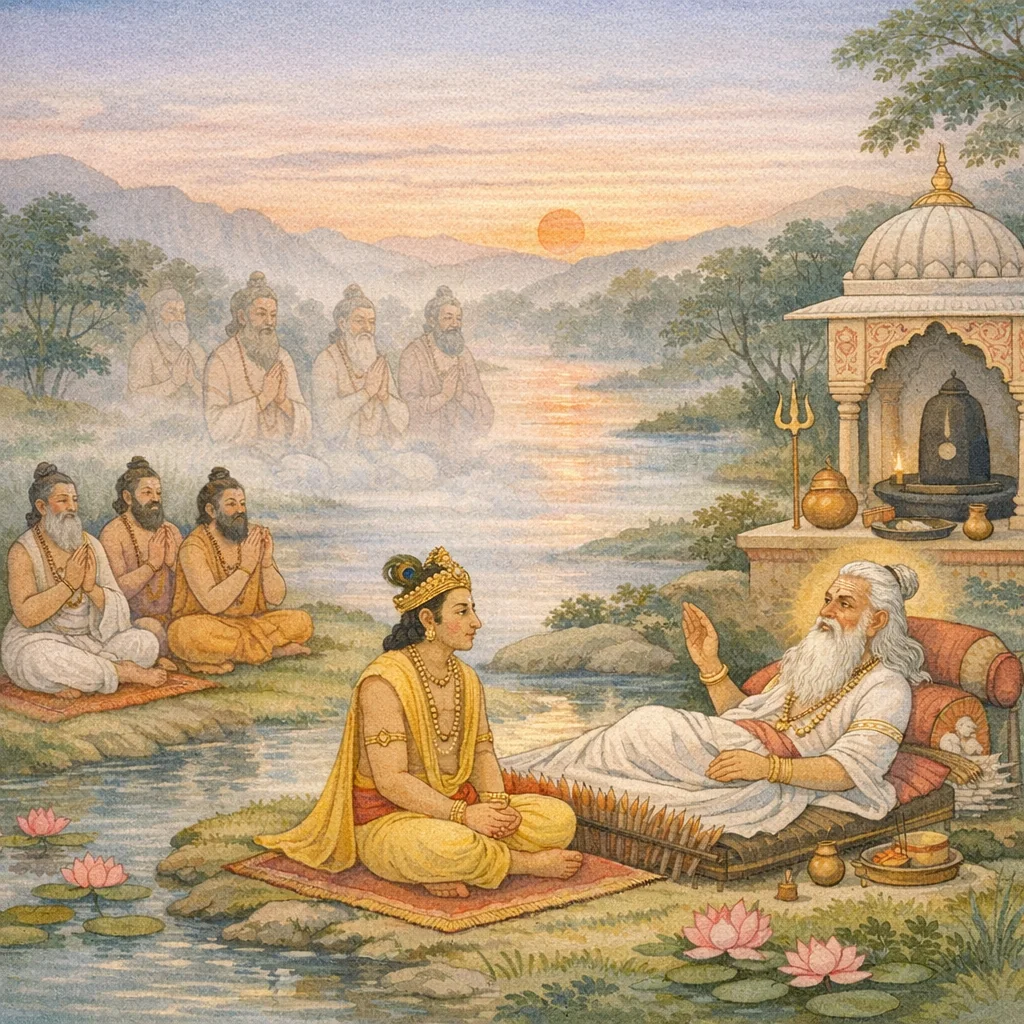
अत-#-#क+ षड्विशो<5ध्याय: श्रीगड़ाजीके माहात्म्यका वर्णन वैशम्पायन उवाच बृहस्पतिसमं बुद्ध्या क्षमया ब्रह्मण: समम् । पराक्रमे शक्रसममादित्यसमतेजसम्,वैशम्पायनजी कहते हैं--जनमेजय! जो बुद्धिमें बृहस्पतिके, क्षमामें ब्रह्माजीके, पराक्रममें इन्द्रके और तेजमें सूर्यके समान थे, अपनी मर्यादासे कभी च्युत न होनेवाले वे महातेजस्वी गड़ानन्दन भीष्मजी जब अर्जुनके हाथसे मारे जाकर युद्धमें वीरशय्यापर पड़े हुए कालकी बाट जोह रहे थे और भाइयों तथा अन्य लोगोंसहित राजा युधिष्ठिर उनसे तरह- तरहके प्रश्न कर रहे थे, उसी समय बहुत-से दिव्य महर्षि भीष्मजीको देखनेके लिये आये
Vaiśampāyana said: O Janamejaya, Bhīṣma—the mighty son of Gaṅgā—was endowed with an intellect like Bṛhaspati’s, patience like Brahmā’s, valor like Śakra’s, and radiance like the Sun’s. Never straying from his own code, he lay upon the hero’s bed of arrows after being struck down by Arjuna, awaiting the appointed time. As King Yudhiṣṭhira, with his brothers and others, questioned him in many ways, numerous divine seers arrived to behold Bhīṣma.
Verse 2
गाड़ेयमर्जुनेनाजी निहतं भूरितेजसम् । भ्रातृभि: सहितो<अ्यैश्न पर्यपृच्छद् युधिछ्िर:,वैशम्पायनजी कहते हैं--जनमेजय! जो बुद्धिमें बृहस्पतिके, क्षमामें ब्रह्माजीके, पराक्रममें इन्द्रके और तेजमें सूर्यके समान थे, अपनी मर्यादासे कभी च्युत न होनेवाले वे महातेजस्वी गड़ानन्दन भीष्मजी जब अर्जुनके हाथसे मारे जाकर युद्धमें वीरशय्यापर पड़े हुए कालकी बाट जोह रहे थे और भाइयों तथा अन्य लोगोंसहित राजा युधिष्ठिर उनसे तरह- तरहके प्रश्न कर रहे थे, उसी समय बहुत-से दिव्य महर्षि भीष्मजीको देखनेके लिये आये
Vaiśampāyana said: In that battle, the radiant Bhīṣma—the son of the Gaṅgā, mighty in splendor—was struck down by Arjuna. Then King Yudhiṣṭhira, accompanied by his brothers, approached him and questioned him on many matters. (This sets the ethical frame for Bhīṣma’s forthcoming instruction on dharma, offered from the threshold of death after the devastation of war.)
Verse 3
शयानं वीरशयने कालाकाड्'क्षिणमच्युतम् । आज ममुर्भरतश्रेष्ठ द्रष्टकामा महर्षय:,वैशम्पायनजी कहते हैं--जनमेजय! जो बुद्धिमें बृहस्पतिके, क्षमामें ब्रह्माजीके, पराक्रममें इन्द्रके और तेजमें सूर्यके समान थे, अपनी मर्यादासे कभी च्युत न होनेवाले वे महातेजस्वी गड़ानन्दन भीष्मजी जब अर्जुनके हाथसे मारे जाकर युद्धमें वीरशय्यापर पड़े हुए कालकी बाट जोह रहे थे और भाइयों तथा अन्य लोगोंसहित राजा युधिष्ठिर उनसे तरह- तरहके प्रश्न कर रहे थे, उसी समय बहुत-से दिव्य महर्षि भीष्मजीको देखनेके लिये आये हि. न विन न मु 73
Vaiśampāyana said: O best of the Bharatas, as Bhīṣma lay upon the hero’s bed of arrows, steadfast and unshaken, waiting for the destined hour of death, many great seers—desiring to behold him—came there. The scene frames Bhīṣma’s unwavering self-mastery even in suffering, and the reverence shown by sages to a life devoted to duty.
Verse 4
अन्रिर्वसिष्ठो5थ भृगुः पुलस्त्य: पुलह:ः क्रतुः । अज्धिरागौतमोडगस्त्य: सुमति: सुयतात्मवान्,उनके नाम ये हैं--अत्रि, वसिष्ठ, भृगु, पुलस्त्य, पुलह, क्रतु, अड्िरा, गौतम, अगस्त्य, संयतचित्त सुमति, विश्वामित्र, स्थूलशिरा, संवर्त, प्रमति, दम, बृहस्पति, शुक्राचार्य, व्यास, च्यवन, काश्यप, ध्रुव, दुर्वासा, जमदग्नि, मार्कण्डेय, गालव, भरद्वाज, रैभ्य, यवक्रीत, त्रित, स्थूलाक्ष, शबलाक्ष, कण्व, मेधातिथि, कृश, नारद, पर्वत, सुधन्वा, एकत, नितम्भू, भुवन, धौम्य, शतानन्द, अकृतव्रण, जमदग्निनन्दन परशुराम और कच
Vaiśampāyana said: “These are the sages—Atri, Vasiṣṭha, Bhṛgu, Pulastya, Pulaha, Kratu, Aṅgiras, Gautama, Agastya, and Sumati, whose self is well-restrained.” In context, the verse begins a reverential catalogue of eminent ṛṣis, presenting them as exemplars of disciplined conduct and spiritual authority—figures whose lives and teachings are invoked to ground ethical instruction (dharma) in venerable lineage.
Verse 5
विश्वामित्र: स्थूलशिरा: संवर्त: प्रमतिर्दम: । बृहस्पत्युशनोव्यासाश्ष्यवन: काश्यपो ध्रुव:,उनके नाम ये हैं--अत्रि, वसिष्ठ, भृगु, पुलस्त्य, पुलह, क्रतु, अड्िरा, गौतम, अगस्त्य, संयतचित्त सुमति, विश्वामित्र, स्थूलशिरा, संवर्त, प्रमति, दम, बृहस्पति, शुक्राचार्य, व्यास, च्यवन, काश्यप, ध्रुव, दुर्वासा, जमदग्नि, मार्कण्डेय, गालव, भरद्वाज, रैभ्य, यवक्रीत, त्रित, स्थूलाक्ष, शबलाक्ष, कण्व, मेधातिथि, कृश, नारद, पर्वत, सुधन्वा, एकत, नितम्भू, भुवन, धौम्य, शतानन्द, अकृतव्रण, जमदग्निनन्दन परशुराम और कच प्न्गागाए ए््ग्राक्प्नार्याफ्रसाणक व्याप्त दत्गत्च एन नण्ड्डगाए 05 कि 0 377 “आते %&फस!! )॥| “-< ज।ड्ल 50 छ्ी(84॥( ्त पल 4 54॥&8
Vaiśampāyana said: “(Among those great seers are) Viśvāmitra, Sthūlaśiras, Saṃvarta, Pramati, Dama, Bṛhaspati, Uśanas (Śukra), Vyāsa, Cyavana, Kāśyapa, and Dhruva.” In this passage, the narrative context is a reverential enumeration of authoritative ṛṣis—figures whose lives and teachings are treated as ethical exemplars and sources of dharma, grounding later instruction in the weight of sacred lineage and remembered wisdom.
Verse 6
दुर्वासा जमदन्निश्चव मार्कण्डेयोडथ गालव: । भरद्वाजो<थ रैभ्यक्ष यवक्रीतस्त्रितस्तथा,उनके नाम ये हैं--अत्रि, वसिष्ठ, भृगु, पुलस्त्य, पुलह, क्रतु, अड्िरा, गौतम, अगस्त्य, संयतचित्त सुमति, विश्वामित्र, स्थूलशिरा, संवर्त, प्रमति, दम, बृहस्पति, शुक्राचार्य, व्यास, च्यवन, काश्यप, ध्रुव, दुर्वासा, जमदग्नि, मार्कण्डेय, गालव, भरद्वाज, रैभ्य, यवक्रीत, त्रित, स्थूलाक्ष, शबलाक्ष, कण्व, मेधातिथि, कृश, नारद, पर्वत, सुधन्वा, एकत, नितम्भू, भुवन, धौम्य, शतानन्द, अकृतव्रण, जमदग्निनन्दन परशुराम और कच
Vaiśampāyana said: “(Among those sages) are Durvāsā, Jamadagni, Mārkaṇḍeya, and then Gālava; Bharadvāja and also Raibhya; Yavakrīta and likewise Trita.” In this passage, the epic continues a reverential catalogue of ṛṣis—figures remembered for austerity, learning, and moral authority—implicitly presenting them as exemplars and witnesses of dharma whose lives and teachings guide right conduct.
Verse 7
स्थूलाक्ष: शबलाक्षश्न कण्वो मेधातिथि: कृश: । नारद: पर्वतश्चैव सुधन्वाथैकतो द्विज:,उनके नाम ये हैं--अत्रि, वसिष्ठ, भृगु, पुलस्त्य, पुलह, क्रतु, अड्िरा, गौतम, अगस्त्य, संयतचित्त सुमति, विश्वामित्र, स्थूलशिरा, संवर्त, प्रमति, दम, बृहस्पति, शुक्राचार्य, व्यास, च्यवन, काश्यप, ध्रुव, दुर्वासा, जमदग्नि, मार्कण्डेय, गालव, भरद्वाज, रैभ्य, यवक्रीत, त्रित, स्थूलाक्ष, शबलाक्ष, कण्व, मेधातिथि, कृश, नारद, पर्वत, सुधन्वा, एकत, नितम्भू, भुवन, धौम्य, शतानन्द, अकृतव्रण, जमदग्निनन्दन परशुराम और कच
Vaiśampāyana said: “Among those sages were Sthūlākṣa, Śabalākṣa, Kaṇva, Medhātithi, and Kṛśa; and also Nārada and Parvata, together with Sudhanvā and the Brahmin Ekata.” Here the epic continues its reverent catalogue of eminent ṛṣis—figures of austerity, sacred learning, and the transmission of dharma—thereby affirming that moral authority in the Mahābhārata rests upon the witness and presence of realized seers.
Verse 8
नितम्भूरभुवनो धौम्य: शतानन्दो5कृतव्रण: । जामदग्न्यस्तथा राम: कचश्चेत्येवमादय:,उनके नाम ये हैं--अत्रि, वसिष्ठ, भृगु, पुलस्त्य, पुलह, क्रतु, अड्िरा, गौतम, अगस्त्य, संयतचित्त सुमति, विश्वामित्र, स्थूलशिरा, संवर्त, प्रमति, दम, बृहस्पति, शुक्राचार्य, व्यास, च्यवन, काश्यप, ध्रुव, दुर्वासा, जमदग्नि, मार्कण्डेय, गालव, भरद्वाज, रैभ्य, यवक्रीत, त्रित, स्थूलाक्ष, शबलाक्ष, कण्व, मेधातिथि, कृश, नारद, पर्वत, सुधन्वा, एकत, नितम्भू, भुवन, धौम्य, शतानन्द, अकृतव्रण, जमदग्निनन्दन परशुराम और कच
Vaiśampāyana said: “(Among those sages) are Nitambhū, Bhuvana, Dhaumya, Śatānanda, Akṛtavraṇa, and Jāmadagnya Rāma (Paraśurāma), as well as Kaca—along with many others.” In context, the verse serves as a reverential catalogue of revered ṛṣis whose presence and authority sanctify the discourse on dharma, reminding the listener that ethical teaching is grounded in the lived austerity, learning, and restraint of exemplary seers.
Verse 9
समागता महात्मानो भीष्म द्रष्टे महर्षय: । तेषां महात्मनां पूजामागतानां युधिष्ठिर:
Vaiśampāyana said: Great-souled sages (maharṣis) assembled there to see Bhīṣma. Yudhiṣṭhira, mindful of dharma and proper conduct, went forth to honor and worship those noble ones who had arrived.
Verse 10
ते पूजिता: सुखासीना: कथाश्षक्रुर्महर्षय:
Vaiśampāyana said: Having been duly honored, the great sages sat at ease and then engaged in discourse.
Verse 11
भीष्मस्तेषां कथा: श्रुत्वा ऋषीणां भावितात्मनाम्
Vaiśampāyana said: Having heard the accounts related by those sages—men of disciplined and purified minds—Bhīṣma reflected upon them, taking their words as weighty guidance for righteous conduct.
Verse 12
ततस्ते भीष्ममामन्त्रय पाण्डवांश्व महर्षय:
Then those great sages, having respectfully addressed Bhīṣma, also addressed the Pāṇḍavas—marking a turn in the discourse, as elders and seers formally sought their assent and attention before proceeding with counsel grounded in dharma.
Verse 13
तानृषीन् सुमहाभागानन्तर्धानगतानपि
Vaiśampāyana said: “Even those exceedingly fortunate sages—though they had already withdrawn from sight and passed into invisibility—were still being spoken of and kept in mind.”
Verse 14
पाण्डवास्तुष्टवुः सर्वे प्रणेमुश्न मुहुर्मुहुः । उन महाभाग मुनियोंके अदृश्य हो जानेपर भी समस्त पाण्डव बारंबार उनकी स्तुति और उन्हें प्रणाम करते रहे ।। १३ $ ।। प्रसन्नमनस: सर्वे गाज़ेयं कुरुसत्तमम्
Vaiśampāyana said: All the Pāṇḍavas, filled with reverence, repeatedly praised those great-souled sages and bowed to them again and again. Even after the illustrious ascetics had vanished from sight, the Pāṇḍavas continued their salutations—showing that true honor is not dependent on physical presence but on steadfast gratitude and dharmic humility.
Verse 15
प्रभावात् तपसस्तेषामृषीणां वीक्ष्य पाण्डवा:
Vaiśampāyana said: Seeing the radiance born of those sages’ austerities, the Pāṇḍavas stood in reverent attention, recognizing the moral authority and spiritual power that disciplined self-restraint confers.
Verse 16
महाभाग्यं पर॑ं तेषामृषीणामनुचिन्त्य ते । पाण्डवा: सह भीष्मेण कथाश्षक्रुस्तदाश्रया:,उन महर्षियोंके महान् सौभाग्यका चिन्तन करके पाण्डव भीष्मजीके साथ उन्हींके सम्बन्धमें बातें करने लगे
Vaiśampāyana said: Reflecting upon the supreme good fortune of those sages, the Pāṇḍavas, together with Bhīṣma, began to speak about matters connected with them, grounding their conversation in that very theme.
Verse 17
वैशम्पायन उवाच कथान्ते शिरसा पादौ स्पृष्टवा भीष्मस्य पाण्डव: । धर्म्य धर्मसुतः प्रश्न॑ पर्यपृच्छद् युधिष्ठिर:,वैशम्पायनजी कहते हैं--जनमेजय! बातचीतके अन्तमें भीष्मके चरणोंमें सिर रखकर धर्मपुत्र पाण्डुनन्दन युधिष्ठिरने यह धर्मानुकूल प्रश्न पूछा--
Vaishampayana said: “O Janamejaya, when the discourse had ended, Yudhishthira—the son of Pandu, the son of Dharma—bowed and touched Bhishma’s feet with his head, and then asked this question in accordance with dharma.”
Verse 18
युधिछ्िर उवाच के देशा: के जनपदा आश्रमा: के च पर्वता: । प्रकृष्टा: पुण्यत: काश्न ज्ञेया नद्य: पितामह,युधिष्ठिर बोले--पितामह! कौन-से देश, कौन-से प्रान्त, कौन-कौन आश्रम, कौन-से पर्वत और कौन-कौन-सी नदियाँ पुण्यकी दृष्टिसे सर्वश्रेष्ठ समझने योग्य हैं?
Yudhishthira said: “Grandfather, which regions and kingdoms, which hermitages, which mountains, and which rivers should be known as the most excellent from the standpoint of sacred merit? On what basis are they to be regarded as especially holy?”
Verse 19
भीष्म उवाच अत्राप्युदाहरन्तीममितिहासं पुरातनम् । शिलोज्छवृत्ते: संवादं सिद्धस्य च युधिष्ठिर,भीष्मजीने कहा--युधिष्ठिर! इस विषयमें शिलोज्छवृत्तिसे जीविका चलानेवाले एक पुरुषका किसी सिद्ध पुरुषके साथ जो संवाद हुआ था, वह प्राचीन इतिहास सुनो
Bhishma said: “Here too, O Yudhishthira, they cite an ancient precedent. Listen to that old account—the dialogue between a man who lived by gleaning fallen grains (śiloccavṛtti) and a perfected sage (siddha)—recalled to illuminate this very matter of dharma.”
Verse 20
इमां कक्ित् परिक्रम्य पृथिवीं शैलभूषणाम् । असकृद ड्विपदां श्रेष्ठ: श्रेष्टस्य गृहमेधिन:,मनुष्योंमें श्रेष्ठ कोई सिद्ध पुरुष शैलमालाओंसे अलंकृत इस समूची पृथ्वीकी अनेक बार परिक्रमा करनेके पश्चात् शिलोज्छवृत्तिसे जीविका चलानेवाले एक श्रेष्ठ गृहस्थके घर गया। उस गृहस्थने उसकी विधिपूर्वक पूजा की। वह समागत ऋषि वहाँ बड़े सुखसे रातभर रहा। उसके मुखपर प्रसन्नता छा रही थी 5॥ ता ध ] गा 5त
Bhishma said: “After repeatedly circumambulating this earth adorned with mountain ranges, a certain accomplished man—foremost among men—came to the house of an excellent householder. That householder honored him in due form and with proper rites. The visiting sage spent the night there in great comfort, his face suffused with contentment—showing the quiet joy that arises when hospitality is offered and received according to dharma.”
Verse 21
शिलवृत्तेगहं प्राप्त: स तेन विधिनार्चित: । उवास रजनी तत्र सुमुख: सुखभागृषि:,मनुष्योंमें श्रेष्ठ कोई सिद्ध पुरुष शैलमालाओंसे अलंकृत इस समूची पृथ्वीकी अनेक बार परिक्रमा करनेके पश्चात् शिलोज्छवृत्तिसे जीविका चलानेवाले एक श्रेष्ठ गृहस्थके घर गया। उस गृहस्थने उसकी विधिपूर्वक पूजा की। वह समागत ऋषि वहाँ बड़े सुखसे रातभर रहा। उसके मुखपर प्रसन्नता छा रही थी
Bhishma said: “Having reached the house of a householder who lived by the austere practice of subsisting on gleaned grains (śiloccavṛtti), the accomplished sage was honored by him according to proper rites. The sage then spent the night there in great comfort; his face was serene and pleased—showing the contentment that arises when hospitality is offered in accordance with dharma.”
Verse 22
शिलवृत्तिस्तु यत् कृत्यं प्रातस्तत् कृतवान् शुचि: । कृतकृत्यमुपातिष्ठत् सिद्ध तमतिथिं तदा,सबेरा होनेपर वह शिलवृत्तिवाला गृहस्थ स्नान आदिसे पवित्र होकर प्रातः:कालीन नित्यकर्ममें लग गया। नित्यकर्म पूर्ण करके वह उस सिद्ध अतिथिकी सेवामें उपस्थित हुआ। इसी बीचमें अतिथिने भी प्रातःकालके स्नान-पूजन आदि आवश्यक कृत्य पूर्ण कर लिये थे
Bhishma said: At daybreak, that householder of disciplined conduct, having purified himself, performed the morning duties that were to be done. When his daily observances were complete, he then stood ready to attend upon the accomplished guest—who, in the meantime, had also finished his own necessary morning rites such as bathing and worship.
Verse 23
तौ समेत्य महात्मानौ सुखासीनौ कथा: शुभा: । चक्रतुर्वेदसम्बद्धास्तच्छेषकृतलक्षणा:,वे दोनों महात्मा एक-दूसरेसे मिलकर सुखपूर्वक बैठे तथा वेदोंसे सम्बद्ध और वेदान्तसे उपलक्षित शुभ चर्चाएँ करने लगे
Those two great-souled men met together and, seated at ease, began to engage in auspicious conversations—discourses grounded in the Vedas and marked by the concluding purport of Vedānta.
Verse 24
शिलवृत्ति: कथान्ते तु सिद्धमामन्त्रय यत्नत: । प्रश्न॑ पप्रच्छ मेधावी यन्मां त्वं परिपृच्छसि,बातचीत पूरी होनेपर शिलोउ्छवृत्तिवाले बुद्धिमान् गृहस्थ ब्राह्मणने सिद्धको सम्बोधित करके यत्नपूर्वक वही प्रश्न पूछा, जो तुम मुझसे पूछ रहे हो
Bhishma said: When the conversation had come to its end, the wise householder Brahmin—one who lived by gleaning—carefully addressed the Siddha and asked him the very question that you are now asking me.
Verse 25
शिलवृत्तिस्वाच के देश:के जनपदा: के55श्रमा: के च पर्वता: । प्रकृष्टा: पुण्यत: काश्न ज्ञेया नद्यस्तदुच्यताम्,शिलवृत्तिवाले ब्राह्मणने पूछा--ब्रह्म! कौन-से देश, कौन-से जनपद, कौन-कौन आश्रम, कौन-से पर्वत और कौन-कौन-सी नदियाँ पुण्यकी दृष्टिसे सर्वश्रेष्ठ समझनेयोग्य हैं? यह बतानेकी कृपा करें
The Brahmin living by a disciplined, austere livelihood said: “Which regions and kingdoms, which hermitages, which mountains, and which rivers should be regarded as foremost from the standpoint of sacred merit? Please tell me.”
Verse 26
सिद्ध उवाच ते देशास्ते जनपदास्ते5<श्रमास्ते च पर्वता: । येषां भागीरथी गड्ा मध्येनैति सरिद्वरा,सिद्धने कहा--ब्रह्मन्! वे ही देश, जनपद, आश्रम और पर्वत पुण्यकी दृष्टिसे सर्वश्रेष्ठ हैं, जिनके बीचसे होकर सरिताओंमें उत्तम भागीरथी गड़ा बहती हैं इति श्रीमहाभारते अनुशासनपर्वणि दानधर्मपर्वणि गज्भामाहात्म्यक थने षड्विंशो5ध्याय:
The Siddha said: ‘O Brahmin, those lands, those provinces, those hermitages, and those mountains are supremely meritorious—indeed the most blessed—through whose midst flows Bhāgīrathī Gaṅgā, the foremost of rivers.’
Verse 27
/८-] __ 200+“7:. 5 फ्ड्लि कक तपसा ब्रह्मचर्येण यज्ञैस्त्यागेन वा पुन: । गतिं तां न लभेज्जन्तुर्गज्भां संसेव्य यां लभेत्,गड़ाजीका सेवन करनेसे जीव जिस उत्तम गतिको प्राप्त करता है उसे वह तपस्या, ब्रह्मचर्य, यज्ञ अथवा त्यागसे भी नहीं पा सकता
A being does not attain that supreme destination by austerity, by celibate discipline, by sacrifices, or even by renunciation. That very exalted state is attained by devotedly resorting to the Gaṅgā.
Verse 28
स्पृष्टानि येषां गाड़ेयैस्तोयैर्गात्राणि देहिनाम् न्यस्तानि न पुनस्तेषां त्याग: स्वर्गाद् विधीयते,जिन देहधारियोंके शरीर गड्ाजीके जलसे भीगते हैं अथवा मरनेपर जिनकी हडियाँ गंगाजीमें डाली जाती हैं वे कभी स्वर्गसे नीचे नहीं गिरते
The Siddha declares that those embodied beings whose limbs are touched by the waters of the Gaṅgā—or whose bones are consigned to the Gaṅgā after death—do not fall away from heaven again.
Verse 29
सर्वाणि येषां गाड़ेयैस्तोयै: कार्याणि देहिनाम् । गां त्यक्त्वा मानवा विप्र दिवि तिष्ठन्ति ते जना:,विप्रवर! जिन देहधारियोंके सम्पूर्ण कार्य गड़ाजलसे ही सम्पन्न होते हैं वे मानव मरनेके बाद पृथ्वीका निवास छोड़कर स्वर्गमें विराजमान होते हैं
The Siddha said: “O brāhmaṇa, those human beings for whom all the duties and necessities of embodied life are accomplished by means of Gaṅgā-water—having abandoned the earth at death—abide in heaven.”
Verse 30
पूर्वे वयसि कर्माणि कृत्वा पापानि ये नरा: । पश्चात् गड्ां निषेवन्ते तेडपि यान्त्युत्तमां गतिम्,जो मनुष्य जीवनकी पहली अवस्थामें पापकर्म करके भी पीछे गड़ाजीका सेवन करने लगते हैं वे भी उत्तम गतिको ही प्राप्त होते हैं
The Siddha said: Those people who commit sinful deeds in the earlier stage of life, but later take up the practice of resorting to the Gaṅgā, even they attain the highest state.
Verse 31
स््नातानां शुचिभिस्तोयैर्गाज़ियै: प्रयतात्मनाम् । व्युष्टिर्भवति या पुंसां न सा क्रतुशतैरपि,गड़ाजीके पवित्र जलसे स्नान करके जिनका अन्तःकरण शुद्ध हो गया है उन पुरुषोंके पुण्यकी जैसी वृद्धि होती है; वैसी सैकड़ों यज्ञ करनेसे भी नहीं हो सकती
Siddha said: For those disciplined men who bathe in the pure waters of the Gaṅgā and thereby purify their inner being, the increase of merit that arises is such as cannot be attained even by performing a hundred sacrificial rites.
Verse 32
यावदस्थि मनुष्यस्य गड्ातोयेषु तिष्ठतति । तावद्वर्षसहस्त्राणि स्वर्गलोके महीयते,मनुष्यकी हड्डी जितने समयतक गड्ाजीके जलमें पड़ी रहती है, उतने हजार वर्षोंतक वह स्वर्गलोकमें प्रतिष्ठित होता है
The Siddha declares: so long as a person’s bone remains in the waters of the Gaṅgā, for that many thousands of years is that person honored and exalted in heaven.
Verse 33
अपहत्य तमस्तीव्रं यथा भात्युदये रवि: । तथापहत्य पाप्मानं भाति गड़ाजलोक्षित:,जैसे सूर्य उदयकालमें घने अन्धकारको विदीर्ण करके प्रकाशित होते हैं, उसी प्रकार गड़ाजलमें स्नान करनेवाला पुरुष अपने पापोंको नष्ट करके सुशोभित होता है
Just as the sun at sunrise shines forth after driving away dense darkness, so too one who has bathed in the waters of Gaḍā becomes radiant after destroying one’s sins.
Verse 34
विसोमा इव शर्वर्यों विपुष्पास्तरवो यथा । तद्धद् देशा दिशश्वैव हीना गज्भाजलै: शिवै:,जैसे बिना चाँदनीकी रात और बिना फूलोंके वृक्ष शोभा नहीं पाते, उसी प्रकार गड़ाजीके कल्याणमय जलसे वज्चित हुए देश और दिशाएँ भी शोभा एवं सौभाग्य हीन हैं
As a night without the moon’s cool radiance, and as trees without blossoms fail to appear beautiful, so too lands and directions are without splendor and good fortune when deprived of the auspicious waters of Gaḍā.
Verse 35
वर्णाश्रमा यथा सर्वे धर्मज्ञानविवर्जिता: । क्रतवश्चन॒ यथासोमास्तथा गड़ां विना जगत्,जैसे धर्म और ज्ञानसे रहित होनेपर सम्पूर्ण वर्णों और आश्रमोंकी शोभा नहीं होती है तथा जैसे सोमरसके बिना यज्ञ सुशोभित नहीं होते, उसी प्रकार गड़ाके बिना जगत्की शोभा नहीं है
As all varṇas and āśramas, when bereft of dharma and knowledge, lose their dignity, and as sacrifices without soma do not shine, so too the world has no splendor without Gaḍā.
Verse 36
यथा हीन॑ नभो<र्केण भू:शैलै: खं च वायुना । तथा देशा दिशश्वैव गड़ाहीना न संशय:,जैसे सूर्यके बिना आकाश, पर्वतोंके बिना पृथ्वी और वायुके बिना अन्तरिक्षकी शोभा नहीं होती, उसी प्रकार जो देश और दिशाएँ गड़ाजीसे रहित हैं उनकी भी शोभा नहीं होती --इसमें संशय नहीं है
As the sky loses its splendor without the sun, the earth without mountains, and the firmament without wind, so too lands and directions are without splendor when they lack Gaḍā—of this there is no doubt.
Verse 37
त्रिषु लोकेषु ये केचित् प्राणिन: सर्व एव ते । तर्प्पमाणा: परां तृप्तिं यान्ति गज़ाजलै: शुभै:,तीनों लोकोंमें जो कोई भी प्राणी हैं, उन सबका गड़ाजीके शुभ जलसे तर्पण करनेपर वे सब परम तृप्ति लाभ करते हैं
The Siddha said: “Whatever living beings there are in the three worlds—all of them—when they are satisfied by offerings (tarpaṇa) made with the auspicious water associated with the elephant, attain the highest contentment.”
Verse 38
यस्तु सूर्येण निष्टप्तं गाड़ेयं पिबते जलम् । गवां निहरिनिर्मुक्तादू यावकात् तद् विशिष्यते,जो मनुष्य सूर्यकी किरणोंसे तपे हुए गड़ाजलका पान करता है, उसका वह जलपान गायके गोबरसे निकले हुए जौकी लप्सी खानेसे अधिक पवित्रकारक है
The Siddha said: “Whoever drinks water heated by the sun—water drawn from a firm, deep source—gains a purity superior to that obtained by eating barley gruel made from grains separated from cattle-dung.”
Verse 39
इन्दुब्रतसहस्र॑ तु यश्चरेत् कायशोधनम् । पिबेद् यश्चापि गज्भाम्भ: समौ स्यातां न वा समौ,जो शरीरको शुद्ध करनेवाले एक सहस्र चान्द्रायण व्रतोंका अनुष्ठान करता है और जो केवल गड़ाजल पीता है, वे दोनों समान ही हैं अथवा यह भी हो सकता है कि दोनों समान नहों (गड़ाजल पीनेवाला बढ़ जाय)
The Siddha said: “One person may undertake a thousand lunar expiatory vows (Cāndrāyaṇa) to purify the body; another may simply drink the waters of the Gaṅgā. These two may be regarded as equal—or it may even be that they are not equal, with the drinking of Gaṅgā-water surpassing the other.”
Verse 40
तिछेद् युगसहस्न॑ तु पदेनैकेन यः पुमान् । मासमेकं तु गज्जायां समौ स्यातां न वा समौ,जो पुरुष एक हजार युगोंतक एक पैरसे खड़ा होकर तपस्या करता है और जो एक मासतक गड़ातटपर निवास करता है, वे दोनों समान हो सकते हैं अथवा यह भी सम्भव है कि समान न हों
The Siddha said: “A man may stand performing austerities on one foot for a thousand yugas; another may dwell for a single month on the bank of the Gaṅgā. These two may be equal in spiritual merit—or they may not be equal.”
Verse 41
लंबते5वाक्शिरा यस्तु युगानामयुतं पुमान् । तिष्ठेद् यथेष्टं यश्चापि गड़ायां स विशिष्यते,जो मनुष्य दस हजार युगोंतक नीचे सिर करके वृक्षमें लटका रहे और जो इच्छानुसार गड़ाजीके तटपर निवास करे, उन दोनोंमें गड़ाजीपर निवास करनेवाला ही श्रेष्ठ है
The Siddha said: “Even if a man were to hang from a tree with his head downward for ten thousand yugas, the one who dwells on the banks of the Gaṅgā as he chooses is deemed superior.”
Verse 42
अग्नौ प्रास्तं प्रधूयेत यथा तूल॑ द्विजोत्तम । तथा गज्भजावगाढस्य सर्वपापं प्रधूयते,द्विजश्रेष्ठट जैसे अतामें डाली हुई रूई तुरंत जलकर भस्म हो जाती है, उसी प्रकार गड़ामें गोता लगानेवाले मनुष्यके सारे पाप नष्ट हो जाते हैं
The Siddha said: “O best of the twice-born, as a tuft of cotton cast into fire is instantly consumed and reduced to ash, so too are all the sins of one who plunges into the waters of the Gaṅgā washed away.”
Verse 43
भूतानामिह सर्वेषां दुः:खोपहतचेतसाम् | गतिमन्वेषमाणानां न गड़ासदृशी गति:,इस संसारमें दुःखसे व्याकुलचित होकर अपने लिये कोई आश्रय ढूँढ़नेवाले समस्त प्राणियोंके लिये गंगाजीके समान कोई दूसरा सहारा नहीं है
For all living beings in this world, whose minds are struck and shaken by sorrow and who seek a refuge and a way forward, there is no support—no saving course—comparable to the river Gaṅgā.
Verse 44
भवन्ति निर्विषा: सर्पा यथा तार्क्ष्यस्य दर्शनात् । गज्जाया दर्शनात् तद्वत् सर्वपापै: प्रमुच्यते,जैसे गरुड़को देखते ही सारे सर्पोंके विष झड़ जाते हैं, उसी प्रकार गड़ाजीके दर्शनमात्रसे मनुष्य सब पापोंसे छुटकारा पा जाता है
Just as snakes become free of venom at the mere sight of Tārkṣya (Garuḍa), so too, by the mere sight of the Gaṅgā, a person is released from all sins.
Verse 45
अप्रतिष्ठाक्ष ये केचिदर्धर्मशरणाश्ष ये । तेषां प्रतिष्ठा गड़ेह शरणं शर्म वर्म च,जगत्में जिनका कहीं आधार नहीं है; तथा जिन्होंने धर्मकी शरण नहीं ली है, उनका आधार और उन्हें शरण देनेवाली श्रीगड़ाजी ही हैं। वे ही उसका कल्याण करनेवाली तथा कवचकी भाँति उसे सुरक्षित रखनेवाली हैं
Those who have no support anywhere, and those who have not taken refuge in dharma—for them the Gaṅgā herself becomes a firm foundation. She is their refuge, their well-being and peace, and like armor she protects them.
Verse 46
प्रकृष्टेरशुभै्ग्रस्ताननेकै: पुरुषाधमान् । पततो नरके गज्ज संश्रितान् प्रेत्य तारयेत्,जो नीच मानव अनेक बड़े-बड़े अमड्नलकारी पापकर्मोंसे ग्रस्त होकर नरकमें गिरनेवाले हैं, वे भी यदि गड़ाजीकी शरणमें आ जाते हैं तो ये मरनेके बाद उनका उद्धार कर देती हैं
Even the most degraded of men, overwhelmed by many grievous sins and falling toward hell, are rescued after death if they take refuge in the Gaṅgā.
Verse 47
ते संविभक्ता मुनिभिरननुनं देवैः सवासवै: । येडभिगच्छन्ति सततं गड्जां मतिमतां वर,बुद्धिमानोंमें श्रेष्ठ ब्राह्यण! जो लोग सदा गड्जाजीकी यात्रा करते हैं, उनपर निश्चय ही इन्द्र आदि सम्पूर्ण देवता तथा मुनिलोग पृथक्-पृथक् कृपा करते आये हैं
Those who constantly go to the Gaṅgā are surely the recipients of distinct and abundant favor from the sages and from the gods—together with Vāsava (Indra). The Siddha affirms that such steady pilgrimage draws divine and ascetic grace, marking the pilgrim as one who seeks purification and lives in reverence for dharma.
Verse 48
विनयाचारहीनाश्न अशिवाश्षन नराधमा: । ते भवन्ति शिवा विप्र ये वै गड़ामुपाश्रिता:,विप्रवर! विनय और सदाचारसे हीन अमड्रलकारी नीच मनुष्य भी गड़ाजीकी शरणमें जानेपर कल्याणस्वरूप हो जाते हैं
The Siddha said: “O brāhmaṇa, even the lowest of men—those devoid of humility and good conduct, and inclined to inauspicious ways—become auspicious and welfare-bearing when they take refuge in Gaḍā. O best of brāhmaṇas, humility and right conduct are the true means of refinement; yet even those who lack them can be turned toward good when they seek the protection of a righteous support.”
Verse 49
यथा सुराणाममृतं पितृणां च यथा स्वधा । सुधा यथा च नागानां तथा गड्भाजलं नृणाम्,जैसे देवताओंको अमृत, पितरोंको स्वधा और नागोंको सुधा तृप्त करती है, उसी प्रकार मनुष्योंके लिये गंगाजल ही पूर्ण तृप्तिका साधन है
As nectar satisfies the gods, as the svadhā-offering satisfies the ancestors, and as sudhā satisfies the nāgas, so does the water of the Gaṅgā alone bring complete satisfaction to human beings. The Siddha thus extols Gaṅgā-water as a uniquely purifying and fulfilling support for human religious life, placing it alongside the proper sustenance of each order of beings.
Verse 50
उपासते यथा बाला मातर क्षुधयार्दिता: । श्रेयस्कामास्तथा गड़ामुपासन्तीह देहिन:,जैसे भूखसे पीड़ित हुए बच्चे माताके पास जाते हैं, उसी प्रकार कल्याणकी इच्छा रखनेवाले प्राणी इस जगतमें गड़ाजीकी उपासना करते हैं
The Siddha said: “Just as hungry children, distressed by hunger, seek their mother, so too embodied beings in this world—desiring true welfare—seek refuge through worship of Gaḍā.”
Verse 51
स्वायम्भुवं यथा स्थान सर्वेषां श्रेष्ठमुच्यते । सस््नातानां सरितां श्रेष्ठा गड़ा तद्गदिहोच्यते,जैसे ब्रह्मलोक सब लोकोंसे श्रेष्ठ बताया जाता है, वैसे ही स्नान करनेवाले पुरुषोंके लिये गड़ाजी ही सब नदियोंमें श्रेष्ठ कही गयी हैं
The Siddha said: “Just as the realm of Svāyambhuva (Brahmā)—the highest station—is declared the supreme among all worlds, so too, for those who seek purification by bathing, the river Gaḍā is proclaimed the best among rivers.”
Verse 52
यथोपजीविनां धेनुर्देवादीनां धरा स्मृता । तथोपजीविनां गज्जा सर्वप्राणभृतामिह,जैसे धेनुस्वरूपा पृथ्वी उपजीवी देवता आदिके लिये आदरणीय है, उसी प्रकार इस जगतमें गंगा समस्त उपजीवी प्राणियोंके लिये आदरणीय हैं
Just as the Earth is remembered as a cow to those who live by her gifts—and is therefore revered by the gods and others—so too, in this world, the Gaṅgā is to be revered by all beings who sustain life.
Verse 53
देवा: सोमार्कसंस्थानि यथा सत्रादिभिर्मखै: । अमृतान्युपजीवन्ति तथा गज्ाजलं नस:,जैसे देवता सत्र आदि यज्ञोंद्वारा चन्द्रमा और सूर्यमें स्थित अमृतसे आजीविका चलाते हैं, उसी प्रकार संसारके मनुष्य गंगाजलका सहारा लेते हैं
The Siddha said: “Just as the gods sustain themselves by the nectar abiding in the Moon and the Sun through sacrificial rites such as satras, so too do human beings in this world sustain themselves by relying on the waters of the Gaṅgā.”
Verse 54
जाह्नववीपुलिनोत्थाभि: सिकताभि: समुक्षितम् । आत्मानं मन्यते लोको दिविषछ्ठमिव शोभितम्,गंगाजीके तटसे उड़े हुए बालुका-कणोंसे अभिषिक्त हुए अपने शरीरको ज्ञानी पुरुष स्वर्गलोकमें स्थित हुआ-सा शोभासम्पन्न मानता है
Sprinkled with the sand that rises from the broad banks of the Jāhnavī (Gaṅgā), a person comes to regard his own body as if it were beautified like one dwelling in heaven.
Verse 55
जाह्नवीतीरसम्भूतां मृदं मूर्थध्ना बिभर्ति यः । बिभर्ति रूप॑ सो<र्कस्य तमोनाशाय निर्मलम्,जो मनुष्य गंगाके तीरकी मिट्टी अपने मस्तकमें लगाता है वह अज्ञानान्धकारका नाश करनेके लिये सूर्यके समान निर्मल स्वरूप धारण करता है
Whoever bears upon his head the earth taken from the bank of the Jāhnavī (Gaṅgā) assumes a pure form like that of the Sun, meant for the destruction of the darkness of ignorance.
Verse 56
गड़ोर्मिभिरथो दिग्ध: पुरुषं पवनो यदा । स्पृशते सो<स्य पाप्मानं सद्य एवापकर्षति,गंगाकी तरंगमालाओंसे भीगकर बहनेवाली वायु जब मनुष्यके शरीरका स्पर्श करती है, उसी समय वह उसके सारे पापोंको नष्ट कर देती है
When the wind, moistened by the waves of the Gaṅgā, touches a person’s body, it immediately draws away and destroys that person’s sin.
Verse 57
व्यसनैरभितप्तस्य नरस्य विनशिष्यत: । गड्जादर्शनजा प्रीतिव्यसनान्यपकर्षति,दुर्व्स्सनजनित दु:खोंसे संतप्त होकर मरणासन्न हुआ मनुष्य भी यदि गंगाजीका दर्शन करे तो उसे इतनी प्रसन्नता होती है कि उसकी सारी पीड़ा तत्काल नष्ट हो जाती है
A man scorched by calamities and sinking toward ruin—even at the edge of death—if he beholds the river Gaṅgā, a joy born of that sight arises within him and at once draws away his afflictions, dispelling the pain produced by misfortune.
Verse 58
हंसारावै: कोकरवै रवैरन्यैश्व पक्षिणाम् । पस्पर्थ गज गन्धर्वान् पुलिनैश्व शिलोच्चयान्,हंसोंकी मीठी वाणी, चक्रवाकोंके सुमधुर शब्द तथा अन्यान्य पक्षियोंके कलरवोंद्वारा गंगाजी गन्धर्वोंसे होड़ लगाती हैं तथा अपने ऊँचे-ऊँचे तटोंद्वारा पर्वतोंके साथ स्पर्धा करती हैं
The river Gaṅgā, with the calls of swans, the sweet cries of cakravāka-birds, and the varied songs of other birds, seems to vie with the Gandharvas themselves; and with her lofty sandbanks and riverbanks she appears to compete with rocky mountain-heights.
Verse 59
हंसादिभि: सुबहुभिवविविधी: पक्षिभिवव॒ताम् | गड्ां गोकुलसम्बाधां दृष्टवा स्वर्गोडपि विस्मृत:,हंस आदि बहुसंख्यक एवं विविध पक्षियोंसे घिरी हुई तथा गौओंके समुदायसे व्याप्त हुई गंगाजीको देखकर मनुष्य स्वर्गलोकको भी भूल जाता है
Seeing the river Gaṅgā—encircled by countless and varied birds such as swans, and thronged with herds of cows—a person becomes so captivated that even the thought of heaven is forgotten.
Verse 60
न सा प्रीतिर्दिविष्ठस्थ सर्वकामानुपाश्रत: । सम्भवेद् या परा प्रीतिर्गड्राया: पुलिने नृूणाम्,गंगाजीके तटपर निवास करनेसे मनुष्योंको जो परम प्रीति--अनुपम आनन्द मिलता है वह स्वर्गमें रहकर सम्पूर्ण भोगोंका अनुभव करनेवाले पुरुषको भी नहीं प्राप्त हो सकता
That joy is not attainable—even for one who dwells in heaven and has access to every pleasure. The supreme delight that human beings gain by living on the sandy banks of the Gaṅgā is of a higher order, surpassing celestial enjoyments.
Verse 61
वाड्मन:कर्मजै ग्रस्त: पापैरपि पुमानिह । वीक्ष्य गड़ां भवेत् पूतो अत्र मे नास्ति संशय:,मन, वाणी और क्रियाद्वारा होनेवाले पापोंसे ग्रस्त मनुष्य भी गंगाजीका दर्शन करने मात्रसे पवित्र हो जाता है--इसमें मुझे संशय नहीं है
The Siddha declares that even a person in this world who is burdened by sins arising from speech, mind, and bodily action becomes purified merely by beholding the Gaṅgā. On this point, he says, he has no doubt.
Verse 62
सप्तावरान् सप्त परान् पितृस्तेभ्यश्व ये परे । पुमांस्तारयते गज्जां वीक्ष्य स्पृष्टवावगाहु च,गंगाजीका दर्शन, उनके जलका स्पर्श तथा उस जलके भीतर स्नान करके मनुष्य सात पीढ़ी पहलेके पूर्वजोंका और सात पीढ़ी आगे होनेवाली संतानोंका तथा इनसे भी ऊपरके पितरों और संतानोंका उद्धार कर देता है
The Siddha said: By merely beholding the Gaṅgā, by touching her waters, and by bathing within them, a person becomes a cause of deliverance for his lineage—seven generations of ancestors and seven generations of descendants, and even those forebears and progeny beyond them.
Verse 63
श्रुताभिलषिता पीता स्पृष्टा दृष्टावगाहिता । गज्जा कप वंशौ विशेषत:,जो पुरुष ग॑ माहात्म्य सुनता, उनके तटपर जानेकी अभिलाषा रखता, उनका दर्शन करता, जल पीता, स्पर्श करता तथा उनके भीतर गोते लगाता है, उसके दोनों कुलोंका भगवती गंगा विशेषरूपसे उद्धार कर देती हैं
The Siddha declares that the holy Gaṅgā becomes a saving power for a person in many ways: when her greatness is heard, when one longs to go to her banks, when one beholds her, drinks her waters, touches her, and immerses oneself in her stream. For such a person, the Blessed Gaṅgā grants a special deliverance—uplifting both his paternal and maternal lineages.
Verse 64
दर्शनात् स्पर्शनात् पानात् तथा गड़्ेति कीर्तनात् । पुनात्यपुण्यान् पुरुषान शतशो5थ सहस्रश:,गंगाजी अपने दर्शन, स्पर्श, जलपान तथा अपने गंगानामके कीर्तनसे सैकड़ों और हजारों पापियोंको तार देती हैं
The Siddha said: By merely beholding her, by touching her, by drinking her waters, and likewise by chanting her name as “Gaṅgā,” she purifies sinful people—by the hundreds and even by the thousands.
Verse 65
य इच्छेत् सफलं जन्म जीवितं श्रुतमेव च । स पितुृंस्तर्पयेद् गाड्रमभिगम्य सुरांसतथा,जो अपने जन्म, जीवन और वेदाध्ययनको सफल बनाना चाहता हो वह गंगाजीके पास जाकर उनके जलसे देवताओं तथा पितरोंका तर्पण करे
He who wishes to make his birth, his life, and even his sacred learning truly fruitful should go to the Gaṅgā and, with her waters, offer libations of satisfaction (tarpaṇa) to the gods and to the ancestors.
Verse 66
न सुतैर्न च वित्तेन कर्मणा न च तत्फलम् | प्राप्तुयात् पुरुषो&त्यन्तं गड्जां प्राप्प यदाप्रुयात्,मनुष्य गंगास्नान करके जिस अक्षय फलको प्राप्त करता है उसे पुत्रोंसे, धनसे तथा किसी कर्मसे भी नहीं पा सकता
The Siddha said: A man cannot obtain—by sons, by wealth, or by any ritual act and its reward—that supreme, imperishable fruit which he gains upon reaching the Gaṅgā and bathing there.
Verse 67
जात्यन्धैरिह तुल्यास्ते मृत: पड़गुभिरेव च । समर्था ये न पश्यन्ति गड़ां पुण्यजलां शिवाम्,जो सामर्थ्य होते हुए भी पवित्र जलवाली कल्याणमयी गंगाका दर्शन नहीं करते वे जन्मके अन्धों, पंगुओं और मुर्दोके समान हैं
The Siddha said: Here, those who are able yet do not behold the auspicious Gaṅgā—whose waters are holy—are no better than the congenitally blind, the lame, or even the dead.
Verse 68
सा,भूतभव्यभविष्यज्ञैर्महर्षिभिरुपस्थिताम् । देवै: सेन्द्रैश्न को गड़ां नोपसेवेत मानव: भूत, वर्तमान और भविष्यके ज्ञाता महर्षि तथा इन्द्र आदि देवता भी जिनकी उपासना करते हैं, उन गंगाजीका सेवन कौन मनुष्य नहीं करेगा?
She—Gaṅgā—who is attended and honored by great seers endowed with knowledge of the past, present, and future, and who is worshipped even by the gods together with Indra: what human being would not resort to and partake of the Gaṅgā?
Verse 69
वानप्रस्थैर्गहस्थैश्व यतिभिरन्रह्मचारिभि: । विद्यावद्धि: श्रितां गड़ां पुमान् को नाम नाश्रयेत्,ब्रह्मचारी, गृहस्थ, वानप्रस्थ, संन्यासी और विद्वान् पुरुष भी जिनकी शरण लेते हैं, ऐसी गंगाजीका कौन मनुष्य आश्रय नहीं लेगा?
The Siddha said: “When forest-dwellers and householders, renunciant ascetics and brahmacārins, and even learned men take refuge in the Gaṅgā, what person could possibly not seek her shelter?”
Verse 70
उत्क्रामद्िश्व यः प्राण: प्रयत: शिष्टसम्मत: । चिन्तयेन्मनसा गड़ां स गतिं परमां लभेत्,जो साधु पुरुषोंद्वारा सम्मानित तथा संयतचित्त मनुष्य प्राण निकलते समय मन-ही-मन गंगाजीका स्मरण करता है, वह परम उत्तम गतिको प्राप्त कर लेता है
The Siddha said: A disciplined person, esteemed by the virtuous, who—at the moment the life-breath departs—remembers the river Gaṅgā within the mind, attains the highest state.
Verse 71
न भयेभ्यो भयं तस्य न पापेभ्यो न राजतः । आ देहपतनाद् गड़ामुपास्ते यः: पुमानिह,जो पुरुष यहाँ जीवनपर्यन्त गंगाजीकी उपासना करता है उसे भयदायक वस्तुओंसे, पापोंसे तथा राजासे भी भय नहीं होता
The Siddha declares: A man who, in this world, worships the river Gaṅgā continuously until the fall of his body (i.e., until death) is not overcome by fear arising from fearful things, nor by fear of sins, nor even by fear of the king’s power.
Verse 72
महापुण्यां च गगनात् पतन्तीं वै महेश्वर: । दधार शिरसा गड्जां तामेव दिवि सेवते,भगवान् महेश्वरने आकाशसे गिरती हुई परम पवित्र गंगाजीको सिरपर धारण किया, उन्हींका वे स्वर्गमें सेवन करते हैं
The supremely meritorious, most holy Gaṅgā, falling from the sky, was borne upon the head of Bhagavān Maheśvara. Even in heaven he reverently partakes of and honors that very Gaṅgā—showing the restraint and sanctifying power by which the divine upholds what is pure and beneficial to the worlds.
Verse 73
अलंकृतास्त्रयो लोका: पथिभिविंमलैस्त्रिभि: | यस्तु तस्या जल॑ सेवेत् कृतकृत्य: पुमान् भवेत्,जिन्होंने तीन निर्मल मार्गोद्रारा आकाश, पाताल तथा भूतल--इन तीन लोकोंको अलंकृत किया है उन गंगाजीके जलका जो मनुष्य सेवन करेगा वह कृतकृत्य हो जायगा
The three worlds are adorned by her three stainless courses—heaven, the nether regions, and the earth. Whoever partakes of that river’s water becomes one who has fulfilled life’s purpose, for such contact is held to purify and complete one’s dharmic striving.
Verse 74
दिवि ज्योतिर्यथा5<दित्य: पितृणां चैव चन्द्रमा: । देवेशश्व॒ तथा नृणां गज्ञा च सरिता तथा,स्वर्गवासी देवताओंमें जैसे सूर्यका तेज श्रेष्ठ है, जैसे पितरोंमें चन्द्रमा तथा मनुष्योंमें राजाधिराज श्रेष्ठ है, उसी प्रकार समस्त सरिताओं में गंगाजी उत्तम हैं
The Siddha said: “Just as in heaven the Sun’s radiance is pre-eminent; just as among the Pitṛs the Moon is foremost; and just as among human beings the sovereign king stands supreme—so too, among all rivers, the Gaṅgā is the best.” The verse teaches a dharmic way of ranking excellence: recognizing what is most elevating and exemplary in each domain, and honoring it accordingly.
Verse 75
मात्रा पित्रा सुतैदरिर्विमुक्तस्य धनेन वा । न भवेद्धि तथा दुःख यथा गड़ावियोगजम्,(गंगाजीमें भक्ति रखनेवाले पुरुषको) माता, पिता, पुत्र, स्त्री और धनका वियोग होनेपर भी उतना दुःख नहीं होता, जितना गंगाके बिछोहसे होता है
The Siddha said: Even if one is separated from one’s mother, father, sons, wife, or wealth, the sorrow is not as great as the sorrow born from separation from the Gaṅgā. The verse elevates devotion to the sacred river as a supreme refuge: worldly losses grieve, yet the loss of contact with a holy source of purification and dharmic support is portrayed as the deepest deprivation.
Verse 76
नारपण्यैनेष्टविषयैर्न सुतैर्न धनागमै: । तथा प्रसादो भवति गज्जां वीक्ष्य यथा भवेत्,इसी प्रकार उसे गंगाजीके दर्शनसे जितनी प्रसन्नता होती है, उतनी वनके दर्शनोंसे, अभीष्ट विषयसे, पुत्रोंसे तथा धनकी प्राप्तिसे भी नहीं होती
Not by bartering with men, nor by the enjoyment of desired objects, nor by sons, nor by the acquisition of wealth does such serenity arise. Rather, the joy and inner clarity that come from beholding the river Gaṅgā surpass all these.
Verse 77
पूर्णमिन्दु यथा दृष्ट्वा नृणां दृष्टि: प्रसीदति । तथा त्रिपथगां दृष्टवा नृणां दृष्टि: प्रसीदति,जैसे पूर्ण चन्द्रमाका दर्शन करके मनुष्योंकी दृष्टि प्रसन्न हो जाती है, उसी तरह त्रिपथगा गंगाका दर्शन करके मनुष्योंके नेत्र आनन्दसे खिल उठते हैं
As people’s sight and mind grow serene upon beholding the full moon, so too does one’s vision become gladdened and purified upon seeing the Tripathagā—Gaṅgā—whose very presence brings calm and auspiciousness.
Verse 78
तद्भावस्तद्गतमनास्तन्निष्ठस्तत्परायण: । गड्जां योडनुगतो भकक््त्या स तस्या: प्रियतां व्रजेत्,जो गंगाजीमें श्रद्धा रखता, उन्हींमें मन लगाता, उन्हींके पास रहता, उन्हींका आश्रय लेता तथा भक्तिभावसे उन्हींका अनुसरण करता है वह भगवती भागीरथीका स्नेह-भाजन होता है
Whoever places faith in the Gaṅgā, fixes the mind upon her, abides near her, takes refuge in her, and follows her with devotion—such a one becomes dear to the blessed Bhāgīrathī.
Verse 79
भूस्थै: स्वःस्थैर्दिविष्ठै क्ष भूतिरुच्चावचैरपि । गड्जा विगाह्मया सततमेतत् कार्यतमं सताम्,पृथ्वी, आकाश तथा स्वर्गमें रहनेवाले छोटे-बड़े सभी प्राणियोंको चाहिये कि वे निरन्तर गंगाजीमें स्नान करें। यही सत्पुरुषोंका सबसे उत्तम कार्य है
Those beings who dwell on earth, those established in heaven, and those who abide in the celestial realms—high and low alike—should continually immerse themselves in the Gaṅgā. This is held to be the most excellent practice of the virtuous.
Verse 80
विश्वलोकेषु पुण्यत्वाद् गड़ाया: प्रथितं यश: । यत्पुत्रान्सगरस्येतो भस्माख्याननयद् दिवम्,सम्पूर्ण लोकोंमें परम पवित्र होनेके कारण गंगाजीका यश विख्यात है; क्योंकि उन्होंने भस्मीभूत होकर पड़े हुए सगरपुत्रोंको यहाँसे स्वर्गमें पहुँचा दिया
Across all the worlds, the fame of the river Gaṅgā is celebrated because of her supreme sanctity; for she carried the sons of Sagara—who lay reduced to ashes—from this realm to heaven.
Verse 81
वाय्वीरिताभि: सुमनोहराभि- द्रुताभिरत्यर्थसमुत्थिताभि: । गड़ोर्मिभिर्भानुमतीभिरिद्धा: सहस्नरश्मिप्रतिमा भवन्ति,वायुसे प्रेरित हो बड़े वेगसे अत्यन्त ऊँचे उठनेवाली गंगाजीकी परम मनोहर एवं कान्तिमयी तरंगमालाओंसे नहाकर प्रकाशित होनेवाले पुरुष परलोकमें सूर्यके समान तेजस्वी होते हैं
Those who are bathed and illumined by the exceedingly delightful, swiftly rising, radiant waves of the Gaṅgā—driven upward by the wind—become in the next world resplendent like the sun with a thousand rays.
Verse 82
पयस्विनीं घृतिनीमत्युदारां समृद्धिनीं वेगिनीं दुर्विगाह्माम् । गड्डां गत्वा यै: शरीर विसूष्टं गता धीरास्ते विबुधै: समत्वम्,दुग्धके समान उज्ज्वल और घृतके समान स्निग्ध जलसे भरी हुई, परम उदार, समृद्धिशालिनी, वेगवती तथा अगाध जलराशिवाली गंगाजीके समीप जाकर जिन्होंने अपना शरीर त्याग दिया है वे धीर पुरुष देवताओंके समान हो गये
The Siddha said: Those steadfast men who went to the Gaṅgā—whose waters are like milk, whose flow is like ghee, exceedingly generous, prosperity-bestowing, swift, and hard to ford—and there relinquished their bodies, attained equality with the gods.
Verse 83
अन्धान् जडान द्रव्यहीनांश्व गड़ा यशस्विनी बृहती विश्वरूपा । देवै: सेन्द्रैमुनिभिमाननवैश्व निषेविता सर्वकामैर्युनक्ति,इन्द्र आदि देवता, मुनि और मनुष्य जिनका सदा सेवन करते हैं वे यशस्विनी, विशालकलेवरा, विश्वरूपा गंगादेवी अपनी शरणमें आये हुए अन्धों, जडों और धनहीनोंको भी सम्पूर्ण मनोवाज्छित कामनाओंसे सम्पन्न कर देती हैं
The Siddha said: The river-goddess Gaṅgā—glorious, vast in form, and manifold in manifestation—though constantly resorted to by the gods with Indra, by sages, and by human beings, also grants every desired aim to those who take refuge in her, even if they are blind, dull-witted, or bereft of wealth.
Verse 84
ऊर्जावतीं महापुण्यां मधुमतीं त्रिवर्त्मगाम् । त्रिलोकगोफ्तीं ये गड्डां संश्रितास््ते दिवं गता:,गंगाजी ओजस्विनी, परम पुण्यमयी, मधुर जलराशिसे परिपूर्ण तथा भूतल, आकाश और पाताल--इन तीन मार्गोपर विचरनेवाली हैं। जो लोग तीनों लोकोंकी रक्षा करनेवाली गंगाजीकी शरणमें आये हैं, वे स्वर्गलोकको चले गये
The Siddha said: ‘The river Gaṅgā is full of spiritual vigor, supremely meritorious, and sweet in her waters. She moves along the three paths—earth, sky, and the netherworlds—and thus protects the three worlds. Those who take refuge in Gaṅgā attain heaven.’
Verse 85
यो वत्स्यति द्रक्ष्यति वापि मर्त्य- स्तस्मै प्रयच्छन्ति सुखानि देवा: । तद्धभाविता: स्पर्शनदर्शनेन इष्टां गतिं तस्य सुरा दिशन्ति,जो मनुष्य गंगाजीके तटपर निवास और उनका दर्शन करता है उसे सब देवता सुख देते हैं। जो गंगाजीके स्पर्श और दर्शनसे पवित्र हो गये हैं उन्हें गंगाजीसे ही महत्त्वको प्राप्त हुए देवता मनोवाञ्छित गति प्रदान करते हैं
Any mortal who dwells on the bank of the Gaṅgā, or even beholds her, is granted happiness by the gods. Those whose being has been purified and transformed through her touch and sight are, by the very gods who have attained greatness through the Gaṅgā, led to the desired and auspicious destiny.
Verse 86
दक्षां पृश्चिं बृहतीं विप्रकृष्टां शिवामृद्धां भागिनीं सुप्रसन्नाम् । विभावरीं सर्वभूतप्रतिष्ठां गड़्ां गता ये त्रिदिवं गतास्ते,गंगा जगत्का उद्धार करनेमें समर्थ हैं। भगवान् पृश्चिगर्भकी जननी 'पृश्रि” के तुल्य हैं, विशाल हैं, सबसे उत्कृष्ट हैं, मंगलकारिणी हैं, पुण्यराशिसे समृद्ध हैं, शिवजीके द्वारा मस्तकपर धारित होनेके कारण सौभाग्यशालिनी तथा भक्तोंपर अत्यन्त प्रसन्न रहनेवाली हैं। इतना ही नहीं, पापोंका विनाश करनेके लिये वे कालरात्रिके समान हैं तथा सम्पूर्ण प्राणियोंकी आश्रयभूत हैं। जो लोग गंगाजीकी शरणमें गये हैं वे स्वर्गलोकमें जा पहुँचे हैं
The Siddha said: “Ganga is Daksha’s daughter, Pṛśni’s sister—vast, exalted, auspicious, and rich in merit. Ever gracious to devotees, she is blessed, for Śiva bears her upon his head. For the destruction of sin she is like the night of dissolution, and she is a refuge and support for all beings. Those who take shelter in the Ganga attain the heavenly worlds.”
Verse 87
ख्यातिर्यस्या: खं दिवं गां च नित्यं पुरा दिशो विदिशश्चवावतस्थे । तस्या जल सेव्य सरिद्वराया मर्त्या: सर्वे कृतकृत्या भवन्ति,आकाश, स्वर्ग, पृथ्वी, दिशा और विदिशाओंमें भी जिनकी ख्याति फैली हुई है, सरिताओंमें श्रेष्ठ उन भगवती भागीरथीके जलका सेवन करके सभी मनुष्य कृतार्थ हो जाते हैं
Her fame has long pervaded the sky, heaven, and earth, and has ever stood established in all directions and sub-directions. By drinking the waters of that supreme river—Bhagavatī Bhāgīrathī—all mortals become fulfilled, having accomplished what is truly to be done.
Verse 88
इयं गज्नेति नियतं प्रतिष्ठा गुहस्य रुक्मस्य च गर्भयोषा । प्रातस्त्रिवर्गा घृतवहा विपाष्मा गड़ावतीर्णा वियतो विश्वतोया,'ये गंगाजी हैं--ऐसा कहकर जो दूसरे मनुष्योंको उनका दर्शन कराता है, उसके लिये भगवती भागीरथी सुनिश्चित प्रतिष्ठा (अक्षय पद प्रदान करनेवाली) हैं। वे कार्तिकेय और सुवर्णको अपने गर्भमें धारण करनेवाली, पवित्र जलकी धारा बहानेवाली और पाप दूर करनेवाली हैं। वे आकाशसे पृथ्वीपर उतरी हुई हैं। उनका जल सम्पूर्ण विश्वके लिये पीने योग्य है। उनमें प्रातः:काल स्नान करनेसे धर्म, अर्थ और काम तीनों वर्गोंकी सिद्धि होती है
Saying with certainty, ‘This is the Gaṅgā,’ and enabling others to behold her, one gains the assured, unfailing refuge of the blessed Bhāgīrathī. She is the sacred river who bears within her the divine Skanda (Guha) and also gold; she pours forth pure, ghee-like (nourishing) streams and removes sin. Descending from the sky to the earth, her waters are fit for the whole world to drink. Bathing in her at dawn brings success in the three aims of life—dharma, artha, and kāma.
Verse 89
(नारायणादक्षयात् पूर्वजाता विष्णो: पादात् शिशुमाराद् ध्रुवाच्च । सोमात् सूर्यान्मेरुरूपाच्च विष्णो: समागता शिवमूर्थ्नो हिमाद्रिम् ।।) भगवती गंगा पूर्वकालमें अविनाशी भगवान् नारायणसे प्रकट हुई हैं। वे भगवान् विष्णुके चरण, शिशुमार चक्र, ध्रुव, सोम, सूर्य तथा मेरुरूप विष्णुसे अवतरित हो भगवान् शिवके मस्तकपर आयी हैं और वहाँसे हिमालय पर्वतपर गिरी हैं ।। सुतावनी ध्रस्य हरस्य भार्या दिवो भुवश्चापि कृतानुरूपा । भव्या पृथिव्यां भागिनी चापि राजन् गड्जा लोकानां पुण्यदा वै त्रयाणाम्,गंगाजी गिरिराज हिमालयकी पुत्री, भगवान् शंकरकी पत्नी तथा स्वर्ग और पृथ्वीकी शोभा हैं। राजन! वे भूमण्डलपर निवास करनेवाले प्राणियोंका कल्याण करनेवाली, परम सौभाग्यवती तथा तीनों लोकोंको पुण्य प्रदान करनेवाली हैं
The Siddha said: In ancient time the blessed Gaṅgā arose from the imperishable Nārāyaṇa. Descending from Viṣṇu’s feet—passing through the celestial sphere of Śiśumāra, Dhruva, Soma, Sūrya, and the Meru-form of Viṣṇu—she came to rest upon Lord Śiva’s head, and from there fell upon the Himālaya. She is the daughter of the king of mountains, Himālaya; the consort of Hara (Śiva); an ornament befitting both heaven and earth. O king, she is auspicious on the earth, a benefactress to living beings, and a giver of merit to all the three worlds.
Verse 90
मधुस्रवा घृतधारा घृतार्चि- महोर्मिभि: शोभिता ब्राह्मणैश्न । दिवश्ष्युता शिरसा55प्ता शिवेन गज्भावनीधात् त्रिदिवस्य माता,श्रीभागीरथी मधुका स्रोत एवं पवित्र जलकी धारा बहाती हैं। जलती हुई घीकी ज्वालाके समान उनका उज्ज्वल प्रकाश है। वे अपनी उत्ताल तरड़ों तथा जलमें स्नान- संध्या करनेवाले ब्राह्मणोंसे सुशोभित होती हैं। वे जब स्वर्गसे नीचेकी ओर चलीं तब भगवान् शिवने उन्हें अपने सिरपर धारण किया। फिर हिमालय पर्वतपर आकर वहाँसे वे इस पृथ्वीपर उतरी हैं। श्रीगंगाजी स्वर्गलोककी जननी हैं
The Siddha said: “Śrī Bhāgīrathī (Gaṅgā) flows with sweetness, pouring forth like a stream of clarified butter, and shining like a flame of ghee. She is made splendid by her mighty waves and by the Brahmins who bathe in her and perform their twilight rites. When she descended from heaven, Lord Śiva received and held her upon his head; then, reaching the Himālaya, she came down to the earth. Thus Gaṅgā, the Bhāgīrathī, is praised as the mother of the celestial world—purifying, auspicious, and sustaining dharmic life through sacred practice.”
Verse 91
योनिर्वरिष्ठा विरजा वितन्वी शय्याचिरा वारिवहा यशोदा । विश्वावती चाकृतिरिष्टसिद्धा गज़ोक्षितानां भुवनस्य पन्था:
The Siddha said: “She is the most excellent source and womb of beings—stainless, all-pervading, and of vast extension; an ancient resting-place; the bearer of waters; the giver of fame and nourishment. She upholds the whole universe; her very form is the fulfillment of what is desired and rightly accomplished. She is the path and support of the world, sustaining even the mighty and the enduring.”
Verse 92
सबका कारण, सबसे श्रेष्ठ, रजोगुणरहित, अत्यन्त सूक्ष्म, मरे हुए प्राणियोंके लिये सुखद शगय्या, तीव्र वेगसे बहनेवाली, पवित्र जलका स्रोत बहानेवाली, यश देनेवाली, जगत्की रक्षा करनेवाली, सत्स्वरूपा तथा अभीष्टको सिद्ध करनेवाली भगवती गंगा अपने भीतर स्नान करनेवालोंके लिये स्वर्गका मार्ग बन जाती हैं ।। क्षान्त्या मह्मा गोपने धारणे च दीप्त्या कृशानोस्तपनस्य चैव । तुल्या गड्जा सम्मता ब्राह्मणानां गुहस्य ब्रह्म॒ण्यतया च नित्यम्,क्षमा, रक्षा तथा धारण करनेमें पृथ्वीके समान और तेजमें अग्नि एवं सूर्यके समान शोभा पानेवाली गंगाजी ब्राह्मणजातिपर सदा अनुग्रह करनेके कारण सुब्रह्मण्य कार्तिकेय तथा ब्राह्मणोंके लिये भी प्रिय एवं सम्मानित हैं
The Siddha declares that the Goddess Gaṅgā is the universal cause and the highest among purifiers—free from the turbulence of passion, exceedingly subtle, and a comforting bed even for departed beings. Swift in her current, she pours forth a holy stream, bestows fame, protects the world, embodies true being, and grants the fulfillment of cherished aims. For those who bathe within her waters, she becomes a pathway to heaven. In forbearance she is like the earth; in guarding and sustaining she is like the earth again; and in radiance she is like fire and the sun. Ever honored by the Brāhmaṇas, she is also dear and revered by Guha (Kārttikeya), because she continually favors what is brahmaṇya—devotion to Brahman and the protection of sacred order.
Verse 93
भ्रातृभि: सहितश्चक्रे यथावदनुपूर्वश: । ये सभी महात्मा महर्षि जब भीष्मजीको देखनेके लिये वहाँ पधारे, तब भाइयोंसहित राजा युधिष्ठिरने उनकी क्रमश: विधिवत् पूजा की,ऋषिष्टतां विष्णुपदीं पुराणां सुपुण्यतोयां मनसापि लोके । सर्वात्मना जाह्ववीं ये प्रपन्ना- स्ते ब्रह्मण: सदनं सम्प्रयाता: ऋषियोंद्वारा जिनकी स्तुति होती है, जो भगवान् विष्णुके चरणोंसे उत्पन्न, अत्यन्त प्राचीन तथा परम पावन जलसे भरी हुई हैं, उन गंगाजीकी जगत्में जो लोग मनके द्वारा भी सब प्रकारसे शरण लेते हैं वे देहत्यागके पश्चात् ब्रह्मलोकमें जाते हैं
Vaiśampāyana said: Accompanied by his brothers, King Yudhiṣṭhira duly performed, in proper order, the prescribed honors and worship for those great-souled sages who had come there to see Bhīṣma. And as for the river Jāhnavī—praised by seers, sprung from the feet of Lord Viṣṇu, ancient, and filled with supremely purifying waters—those who, even in their minds, take refuge in her with their whole being, attain the abode of Brahmā after casting off the body.
Verse 94
लोकानवेक्ष्य जननीव पुत्रान् सर्वात्मना सर्वगुणोपपन्नान् । तत्स्थनकं ब्राह्ममभीप्समानै- गज़ा सदैवात्मवशैरुपास्या,जैसे माता अपने पुत्रोंको स्नेहभरी दृष्टिसे देखती है और उनकी रक्षा करती है, उसी प्रकार गंगाजी सर्वात्मभावसे अपने आश्रयमें आये हुए सर्वगुणसम्पन्न लोकोंको कृपादृष्टिसे देखकर उनकी रक्षा करती हैं; अतः जो ब्रह्मलोकको प्राप्त करनेकी इच्छा रखते हैं उन्हें अपने मनको वशमें करके सदा मातृभावसे गंगाजीकी उपासना करनी चाहिये
Beholding the worlds as a mother looks upon her sons, and protecting them with her whole being—those worlds that are endowed with every excellence—Gaṅgā is to be worshipped always by those who have mastered themselves and who long to attain the Brahman-world. For she watches over all who take refuge in her, with a compassionate gaze, and grants them protection like a mother.
Verse 95
उस्रां पुष्टां मिषतीं विश्वभोज्या- मिरावतीं धारिणीं भूधराणाम् | शिष्टाश्रयाममृतां ब्रह्म॒कान्तां गड्जां श्रयेदात्मवान् सिद्धिकाम:,जो अमृतमय दूध देनेवाली, गौके समान सबको पुष्ट करनेवाली, सब कुछ देखनेवाली, सम्पूर्ण जगत्के उपयोगमें आनेवाली, अन्न देनेवाली तथा पर्वतोंको धारण करनेवाली हैं, श्रेष्ठ पुरुष जिनका आश्रय लेते हैं और जिन्हें ब्रह्माजी भी प्राप्त करना चाहते हैं; तथा जो अमृतस्वरूप हैं, उन भगवती गंगाजीका सिद्धिकामी जितात्मा पुरुषोंको अवश्य आश्रय लेना चाहिये
The Siddha said: A self-controlled person who seeks spiritual accomplishment should take refuge in the goddess Gaṅgā—she who is nourishing and ever-watchful, beneficial to the whole world, a giver of sustenance, and the supporter of mountains; she in whom the noble take shelter, whom even Brahmā longs to attain, and who is of the nature of immortality. The verse frames devotion to Gaṅgā not as mere praise, but as an ethical discipline: humility, self-mastery, and reliance on a purifying sacred presence for inner success.
Verse 96
प्रसाद्य देवान् सविभून् समस्तान् भगीरथस्तपसोग्रेण गड्भाम् । गामानयत् तामभिगम्य शश्चत् पुंसां भयं नेह चामुत्र विद्यात्,राजा भगीरथ अपनी उग्र तपस्यासे भगवान् शंकरसहित सम्पूर्ण देवताओंको प्रसन्न करके गंगाजीको इस पृथ्वीपर ले आये। उनकी शरणमें जानेसे मनुष्यको इहलोक और परलोकमें भय नहीं रहता
By his intense austerities, King Bhagīratha pleased all the gods together with the great Lord (Śiva) and brought the river Gaṅgā down to this earth. One who approaches her for refuge comes to be free from fear—both in this world and in the world beyond—always.
Verse 97
उदाह्नत: सर्वथा ते गुणानां मयैकदेश: प्रसमीक्ष्य बुद्ध्या । शक्तिर्न मे काचिदिहास्ति वक्तुं गुणान् सर्वान् परिमातुं तथैव,ब्रह्मन्! मैंने अपनी बुद्धिसे सर्वथा विचारकर यहाँ गंगाजीके गुणोंका एक अंशमात्र बताया है। मुझमें कोई इतनी शक्ति नहीं है कि मैं यहाँ उनके सम्पूर्ण गुणोंका वर्णन कर सकूँ
O Brahman, after reflecting with my understanding, I have stated here only a small portion of her qualities, as best as I could. I have no power in this world to recount—or to measure in full—the entirety of her virtues.
Verse 98
मेरो: समुद्रस्य च सर्वयत्नै: संख्योपलानामुदकस्य वापि | शक्यं वक्तुं नेह गड़ाजलानां गुणाख्यानं परिमातुं तथैव,कदाचित् सब प्रकारके यत्न करनेसे मेरु गिरिके प्रस्तरकणों और समुद्रके जलविन्दुओंकी गणना की जा सके; परंतु यहाँ गंगाजलके गुणोंका वर्णन तथा गणना करना कदापि सम्भव नहीं है
The Siddha said: Even if one were to exert every possible effort, it might be feasible to state the number of the pebbles of Mount Meru and even to count the drops of the ocean’s water; but here, to recount and to measure the virtues of the waters of the Gaṅgā is never truly possible.
Verse 99
तस्मादेतान् परया श्रद्धयोक्तान् गुणान् सर्वान् जाह्नवीयात् सदैव । भवेद् वाचा मनसा कर्मणा च भक््त्या युक्त: श्रद्धया श्रद्दधान:,अतः मैंने बड़ी श्रद्धाके साथ जो ये गंगाजीके गुण बताये हैं, उन सबपर विश्वास करके मन, वाणी, क्रिया, भक्ति और श्रद्धाके साथ आप सदा ही उनकी आराधना करें
Therefore, having full faith in all these virtues of Jāhnavī (Gaṅgā) that have been declared with supreme devotion, one should worship her continually—being disciplined in speech, mind, and action, and remaining devoted, faithful, and reverent.
Verse 100
लोकानिमांस्त्रीन्ू यशसा वितत्य सिद्धि प्राप्प महतीं तां दुरापाम् । गड्जाकृतानचिरेणैव लोकान् यथ्थेष्टमिष्टान् विहरिष्यसि त्वम्,इससे आप परम दुर्लभ उत्तम सिद्धि प्राप्त करके इन तीनों लोकोंमें अपने यशका विस्तार करते हुए शीघ्र ही गंगाजीकी सेवासे प्राप्त हुए अभीष्ट लोकोंमें इच्छानुसार विचरेंगे
The Siddha says: “Spreading your fame through these three worlds, you will attain that great and hard-to-win supreme accomplishment. And before long, by the merit born of service to the river Gaṅgā, you will reach the desired worlds gained thereby, and you will move about in them freely, according to your wish.”
Verse 101
तव मम च गुणैर्महानुभावा जुषतु मतिं सतत स्वधर्मयुक्तै: । अभिमतजनवत्सला हि गड्जा जगति युनक्ति सुखैश्ष भक्तिमन्तम्,महान् प्रभावशाली भगवती भागीरथी आपकी और मेरी बुद्धिको सदा स्वधर्मानुकूल गुणोंसे युक्त करें। श्रीगंगाजी बड़ी भक्तवत्सला हैं। वे संसारमें अपने भक्तोंको सुखी बनाती हैं
May the great-souled Goddess Bhāgīrathī (Gaṅgā), through virtues aligned with one’s own dharma, continually refine and steady the understanding of both you and me. For Gaṅgā is truly affectionate toward those dear to her—she grants happiness and well-being to her devotees in this world.
Verse 102
भीष्म उवाच इति परममतिर्गुणानशेषान् शिलरतसये त्रिपथानुयोगरूपान् । बहुविधमनुशास्य तथ्यरूपान् गगनततलं द्युतिमान् विवेश सिद्ध:,भीष्मजी कहते हैं-युधिष्ठि!र! वह उत्तम बुद्धिवाला परम तेजस्वी सिद्ध शिलोख्छतृत्तिद्वारा जीविका चलानेवाले उस ब्राह्मणसे त्रिपथगा गंगाजीके उपर्युक्त सभी यथार्थ गुणोंका नाना प्रकारसे वर्णन करके आकाशगमें प्रविष्ट हो गया
Bhishma said: Thus that perfected sage, supremely intelligent and radiant, instructed in many ways the virtuous Brahmin who lived by śilavṛtti (gleaning what grains remained), and having fully described the true and manifold qualities of Tripathagā—the Gaṅgā who moves along three paths—entered the vast expanse of the sky.
Verse 103
शिलवृत्तिस्तु सिद्धस्य वाक्यै: सम्बोधितस्तदा | गड़ामुपास्य विधिवत् सिद्धि प्राप सुदुर्लभाम्,वह शिलोज्छतवृत्तिवाला ब्राह्मण सिद्धके उपदेशसे गंगाजीके माहात्म्यको जानकर उनकी विधिवत् उपासना करके परम दुर्लभ सिद्धिको प्राप्त हुआ
Then the Brahmin who lived by śilavṛtti, instructed by the words of the perfected sage, duly worshipped the river Gaṅgā; and through that disciplined devotion he attained a very rare siddhi.
Verse 104
तथा त्वमपि कौन्तेय भक््त्या परमया युत: । गड्भामभ्येहि सतत प्राप्स्यसे सिद्धिमुत्तमाम्,कुन्तीनन्दन! इसी प्रकार तुम भी पराभक्तिके साथ सदा गंगाजीकी उपासना करो। इससे तुम्हें उत्तम सिद्धि प्राप्त होगी
So you too, O son of Kunti, endowed with supreme devotion, continually approach and worship the river Gaṅgā; by doing so, you will attain the highest siddhi.
Verse 105
वैशम्पायन उवाच श्रुत्वेतिहासं भीष्मोक्तं गज़ाया: स्तवसंयुतम् । युधिष्ठिर: परां प्रीतिमगच्छद् भ्रातृभि: सह,वैशम्पायनजी कहते हैं--जनमेजय! भीष्मजीके द्वारा कहे हुए श्रीगंगाजीकी स्तुतिसे युक्त इस इतिहासको सुनकर भाइयोंसहित राजा युधिष्ठिरको बड़ी प्रसन्नता हुई
Vaiśampāyana said: O Janamejaya, hearing this account spoken by Bhīṣma—joined with praise of the Gaṅgā—King Yudhiṣṭhira, together with his brothers, was filled with great delight.
Verse 106
भीष्मश्रिता: सुमधुरा: सर्वेन्द्रियमनोहरा: । पूजनके पश्चात् वे महर्षि सुखपूर्वक बैठकर भीष्मजीसे सम्बन्ध रखनेवाली मधुर एवं मनोहर कथाएँ कहने लगे। उनकी वे कथाएँ सम्पूर्ण इन्द्रियों और मनको मोह लेती थीं,इतिहासमिमं पुण्यं शृूणुयाद् यः पठेत वा । गड़्जाया: स्तवसंयुक्त स मुच्येत् सर्वकिल्बिषै: जो गड़्ाजीके स्तवनसे युक्त इस पवित्र इतिहासका श्रवण अथवा पाठ करेगा वह समस्त पापोंसे मुक्त हो जायगा
Vaiśampāyana said: After the rites of honoring were completed, the great sages sat at ease and began to recount sweet, delightful narratives connected with Bhīṣma—stories so charming that they captivated all the senses and the mind. Whoever listens to, or recites, this sacred history, accompanied by praise of the river Gaṅgā, is freed from every stain of sin.
Verse 113
मेने दिविष्ठमात्मानं तुष्टया परमया युत:ः । शुद्ध अन्तःकरणवाले उन ऋषि-मुनियोंकी बातें सुनकर भीष्मजी बहुत संतुष्ट हुए और अपनेको स्वर्गमें ही स्थित मानने लगे
Vaiśaṃpāyana said: Endowed with supreme contentment, Bhīṣma regarded himself as already abiding in heaven. Hearing the pure-hearted words of the sages, he became deeply satisfied—suggesting that inner purity and wise counsel can confer a foretaste of liberation even while one remains in the world.
Verse 123
अन्तर्धानं गता: सर्वे सर्वेषामेव पश्यताम् । तदनन्तर वे महर्षिगण भीष्मजी और पाण्डवोंकी अनुमति लेकर सबके देखते-देखते ही वहाँसे अदृश्य हो गये
Vaiśampāyana said: All of them vanished from sight while everyone was watching. Thereafter, the assembled great sages—having taken leave with the permission of Bhīṣma and the Pāṇḍavas—disappeared then and there before the eyes of all. The scene underscores the reverence due to realized seers and the disciplined etiquette of departure: even those endowed with extraordinary powers act within the bounds of consent and propriety.
Verse 143
उपतस्थुर्यथोद्यन्तमादित्यं मन्त्रकोविदा: । जैसे वेदमन्त्रोंके ज्ञाता ब्राह्मण उगते हुए सूर्यका उपस्थान करते हैं, उसी प्रकार प्रसन्न चित्त हुए समस्त पाण्डव कुरुश्रेष्ठ गड़ानन्दन भीष्मको प्रणाम करने लगे
Vaiśampāyana said: Just as Brahmins skilled in sacred mantras reverently attend upon the rising sun, so too did all the Pāṇḍavas—serene in mind—bow in homage to Bhīṣma, the foremost of the Kurus, the son of Gaṅgā. The scene frames their devotion and humility: even amid the aftermath of war, they approach the elder with ritual-like reverence, seeking guidance grounded in dharma.
Verse 153
प्रकाशन्तो दिश: सर्वा विस्मयं परम ययु: । उन ऋषियोंकी तपस्याके प्रभावसे सम्पूर्ण दिशाओंको प्रकाशित होती देख पाण्डवोंको बड़ा विस्मय हुआ
Vaiśampāyana said: As all the directions shone forth, the Pāṇḍavas were seized by the highest wonder. Seeing the quarters illuminated on every side by the power of those sages’ austerities, they recognized the palpable force of tapas—spiritual discipline that upholds dharma and can transform even the visible world.
Frequently Asked Questions
The tension lies between intense austerity aimed at acquiring a supreme social-spiritual status and the claim that such status cannot be secured merely by desire or forceful striving when ethical qualification and inner discipline are lacking.
Śakra advises redirecting effort away from hazardous over-aspiration and toward conquering internal adversaries—anger, desire, aversion, pride, and contentiousness—since these determine elevation or decline more reliably than status-seeking tapas.
Rather than a formal phalāśruti, it provides an evaluative closure: brāhmaṇya is declared “sudur-labha” (exceedingly rare), and the outcome is framed conditionally—victory over inner enemies yields a good end; defeat by them results in a fall.