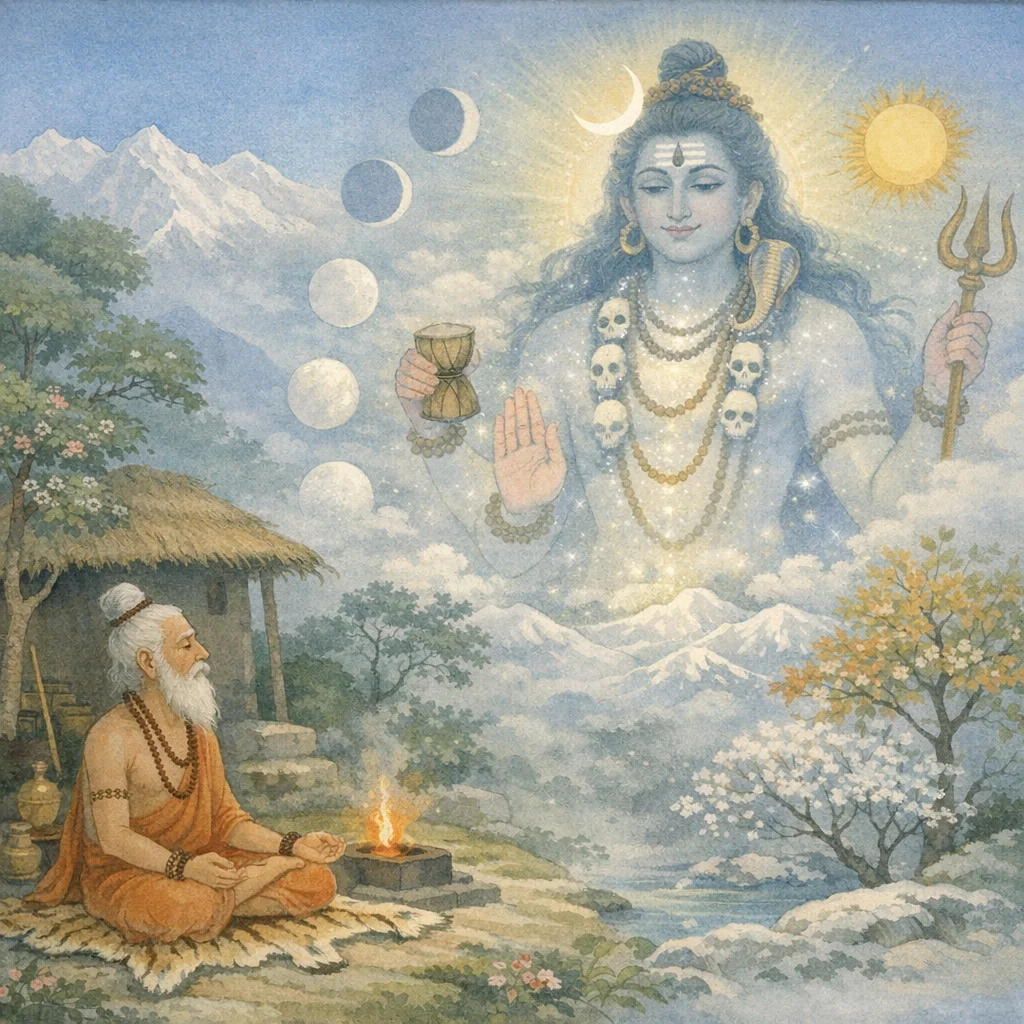
Adhyaya 16
अध्याय १६ — शङ्कर-उमा-वरदानम् तथा तण्डि-स्तुतिः (Śaṅkara–Umā Boon-Granting and Taṇḍi’s Hymn)
Upa-parva: Śiva-stuti and Vara-pradāna (Śarva/Īśāna praise and boon-bestowal episode)
Chapter 16 presents a composite devotional narrative framed as Vāsudeva-Kṛṣṇa’s speech. It opens with Kṛṣṇa’s prostration and petition for qualities and prosperities—steadfastness in dharma, victory in conflict, eminent fame, strength, affinity for yoga, closeness to the deity, and abundant progeny—followed by Śaṅkara’s assent. Umā (Śarvāṇī) then grants additional boons, including the birth of Sāmba and further social goods (non-anger among dvijas, parental favor, lineage harmony, calmness, competence), along with statements about marital abundance and enduring affection. The narrative transitions to a report addressed to Upamanyu, culminating in a panegyric: a ṛṣi named Taṇḍi performs long austerities, beholds Mahādeva, and praises him as the supreme principle underlying time, gods, elements, guṇas, and the paths of sacrifice, asceticism, renunciation, and knowledge. The hymn articulates a monistic-theological synthesis (Śiva as source, support, and dissolution of all), asserts liberation through knowing him, and enumerates multiple ‘gatis’ (destinations) obtainable only by divine grace. The chapter closes with Śiva granting Taṇḍi a boon (firm devotion), the ṛṣi’s later transmission of the account, and the introduction of secret names of Śarva said to be vast in the Vedas and condensed in śāstric lists.
Chapter Arc: उपमन्यु शिष्य-भाव से कथा का द्वार खोलते हैं—सत्ययुग के ऋषि तण्डि ने कठोर तप से महादेव को प्रसन्न किया और स्तुतियों द्वारा उस दुर्विद्य परमात्मा का साक्षात्कार किया। → तण्डि की स्तुति शिव को ‘आत्मदेहस्थ’—सबके भीतर स्थित, देवताओं के लिए भी दुर्जेय—रूप में पहचानती हुई गहराती जाती है; वह बताता है कि अनेक जन्मों के प्रयत्नों से उसे साक्षात् भक्ति-जन्य अनुभूति मिली है, और उसी भक्ति से अमृत-तत्त्व का ज्ञान होता है। → महादेव का विराट-कालस्वरूप उद्घाटित होता है—रात-दिन उनके नेत्र-कर्ण, पक्ष-मास उनके अंग, और मृत्यु-यम-अग्नि तथा संहार-वेगवान काल उनके ही रूप; वे काल के भी परम कारण और सनातन क्षय हैं—यह ब्रह्माण्ड-देह का दर्शन अध्याय की चरम ऊँचाई बनता है। → स्तुति वेद-मार्ग से स्थिर होती है—ऋग, यजुः आदि वेदज्ञ यज्ञ में जिनकी महिमा गाते हैं; पितृयान-देवयान के द्वार, दिशाएँ, संवत्सर-युग आदि सब उन्हीं में प्रतिष्ठित बताए जाते हैं, और निष्कर्ष यह कि भक्तानुग्रहकारी देव को जानकर अमृतत्व की ओर गति होती है। → उपमन्यु की वाणी संकेत देती है कि इस स्तुति-परंपरा का फल केवल दर्शन नहीं—वरदान/अनुग्रह की अगली कड़ी में शिव-भक्ति का प्रत्यक्ष प्रतिफल प्रकट होने वाला है।
Shlokas
Verse 1
/ अपन बछ। है २ >> - यहाँ श्रीकृष्णके माँगे हुए आठ वरोंको एवं 'भविष्यति' इस वाक्यके द्वारा देनेके पश्चात् पार्वतीजी अपनी ओरसे आठ वर और देती हैं। इनमें 'अमरप्रभाव” इस सम्बोधनके द्वारा देवोपम प्रभावका दान ही पहला वरदान सूचित किया गया है। “मैं कभी झूठ नहीं बोलती” इस कथनके द्वारा “तुम भी कभी झूठ नहीं बोलोगे” यह दूसरा वर सूचित होता है। सोलह हजार रानियोंके प्राप्त होनेका वर तीसरा है। उनका प्रिय होना चौथा वर है। अक्षय धनधान्यकी प्राप्ति पाँचवाँ वर है। बान्धवोंकी प्रीति छठा, शरीरकी कमनीयता सातवाँ और सात हजार अतिथियोंका भोजन आठवाँ वर है। इससे पहले जो सोलह और आठ वरके प्राप्त होनेकी बात कही गयी थी, उसकी संगति लग जाती है। घोडशो< ध्याय: उपमन्यु-श्रीकृष्ण-संवाद--महात्मा तण्डिद्वारा की गयी महादेवजीकी स्तुति, प्रार्थना और उसका फल उपमन्युरुवाच ऋषिरासीत् कृते तात तण्डिरित्येव विश्रुत: । दशवर्षसहस्राणि तेन देव: समाधिना,उपमन्यु कहते हैं--तात! सत्ययुगमें तण्डि नामसे विख्यात एक ऋषि थे जिन्होंने भक्तिभावसे ध्यानके द्वारा दस हजार वर्षोतक महादेवजीकी आराधना की थी। उन्हें जो फल प्राप्त हुआ था, उसे बता रहा हूँ, सुनिये। उन्होंने महादेवजीका दर्शन किया और स्तोत्रोंद्वारा उन प्रभुकी स्तुति की
Upamanyu said: “Dear one, in the Kṛta Age there lived a sage renowned by the name Taṇḍi. With devoted concentration, abiding in samādhi, he worshipped the Lord (Mahādeva) for ten thousand years. I shall tell you what fruit he obtained—listen.”
Verse 2
आराधितो<भूद् भक्तेन तस्योदर्क निशामय । स दृष्टवान् महादेवमस्तौषीच्च स्तवैर्विभुम्,उपमन्यु कहते हैं--तात! सत्ययुगमें तण्डि नामसे विख्यात एक ऋषि थे जिन्होंने भक्तिभावसे ध्यानके द्वारा दस हजार वर्षोतक महादेवजीकी आराधना की थी। उन्हें जो फल प्राप्त हुआ था, उसे बता रहा हूँ, सुनिये। उन्होंने महादेवजीका दर्शन किया और स्तोत्रोंद्वारा उन प्रभुकी स्तुति की
Vāyu said: “Listen to the outcome of that devotion. Worshipped with faith by his devotee, the Lord granted its fruit: he beheld Mahādeva and praised that all-pervading Sovereign with hymns.”
Verse 3
इति तण्डिस्तपोयोगात् परमात्मानमव्ययम् | चिन्तयित्वा महात्मानमिदमाह सुविस्मित:,इस तरह तण्डिने तपस्यामें संलग्न होकर अविनाशी परमात्मा महामना शिवका चिन्तन करके अत्यन्त विस्मित हो इस प्रकार कहा था--
Thus, Taṇḍi—absorbed in ascetic discipline and yogic concentration—meditated upon the imperishable Supreme Self, the great-souled Lord Śiva. Filled with wonder, he then spoke these words.
Verse 4
यं पठन्ति सदा सांख्याश्षिन्तयन्ति च योगिन: । परं प्रधानं पुरुषमधिष्ठातारमी श्वरम्,'सांख्यशास्त्रके विद्वान् पर, प्रधान, पुरुष, अधिष्ठाता और ईश्वर कहकर सदा जिनका गुणगान करते हैं, योगीजन जिनके चिन्तनमें लगे रहते हैं, विद्वान् पुरुष जिन्हें जगत्की उत्पत्ति और विनाशका कारण समझते हैं, देवताओं, असुरों और मुनियोंमें भी जिनसे श्रेष्ठ दूसरा कोई नहीं है, उन अजन्मा, अनादि, अनन्त, अनघ और अत्यन्त सुखी, प्रभावशाली ईश्वर महादेवजीकी मैं शरण लेता हूँ
Vāyu said: “He whom the Sāṅkhya sages continually recite and praise, and whom the yogins steadily contemplate—Him they describe as the Supreme, the Pradhāna, the Puruṣa, the Overseer, and the Lord. To that sovereign reality, the ultimate ground of the world and the object of disciplined meditation, I take refuge.”
Verse 5
उत्पत्तौ च विनाशे च कारण य॑ विदुर्बुधा: । देवासुरमुनीनां च परं यस्मान्न विद्यते,'सांख्यशास्त्रके विद्वान् पर, प्रधान, पुरुष, अधिष्ठाता और ईश्वर कहकर सदा जिनका गुणगान करते हैं, योगीजन जिनके चिन्तनमें लगे रहते हैं, विद्वान् पुरुष जिन्हें जगत्की उत्पत्ति और विनाशका कारण समझते हैं, देवताओं, असुरों और मुनियोंमें भी जिनसे श्रेष्ठ दूसरा कोई नहीं है, उन अजन्मा, अनादि, अनन्त, अनघ और अत्यन्त सुखी, प्रभावशाली ईश्वर महादेवजीकी मैं शरण लेता हूँ
Vāyu said: “He whom the wise know to be the cause behind both the arising and the dissolution of the world, and than whom no one higher is found even among the gods, the asuras, and the sages—unto that supreme Lord (Mahādeva) I take refuge.”
Verse 6
अजं तमहमीशानमनादिनिधन प्रभुम् अत्यन्तसुखिनं देवमनघं शरणं व्रजे,'सांख्यशास्त्रके विद्वान् पर, प्रधान, पुरुष, अधिष्ठाता और ईश्वर कहकर सदा जिनका गुणगान करते हैं, योगीजन जिनके चिन्तनमें लगे रहते हैं, विद्वान् पुरुष जिन्हें जगत्की उत्पत्ति और विनाशका कारण समझते हैं, देवताओं, असुरों और मुनियोंमें भी जिनसे श्रेष्ठ दूसरा कोई नहीं है, उन अजन्मा, अनादि, अनन्त, अनघ और अत्यन्त सुखी, प्रभावशाली ईश्वर महादेवजीकी मैं शरण लेता हूँ
Vāyu-deva said: I seek refuge in that unborn Lord—beginningless and endless, the sovereign Master—supremely blissful, divine, and stainless. He is the One whom the learned in Sāṅkhya praise as the Supreme, Pradhāna, Puruṣa, Overseer, and Īśvara; whom yogins continually contemplate; whom wise men know as the cause of the world’s arising and dissolution; and than whom none is greater among gods, asuras, or sages. To that powerful Mahādeva I go for shelter.
Verse 7
एवं ब्रुवन्नेव तदा ददर्श तपसां निधिम् । तमव्ययमनौपम्यमचिन्त्यं शाश्वतं ध्रुवम्,इतना कहते ही तण्डिने उन तपोनिधि, अविकारी, अनुपम, अचिन्त्य, शाश्वत, ध्रुव, निष्कल, सकल, निर्गुण एवं सगुण ब्रह्मका दर्शन प्राप्त किया, जो योगियोंके परमानन्द, अविनाशी एवं मोक्षस्वरूप हैं
As he was still speaking, he beheld the very treasury of austerity. He saw that Brahman—imperishable, incomparable, inconceivable, eternal, and steadfast—who is the supreme bliss of yogins, the indestructible reality, and the very form of liberation. The passage underscores that disciplined tapas and truthful utterance culminate not merely in merit, but in direct vision of the highest, which transcends yet can also be approached through yogic realization.
Verse 8
निष्कलं सकल ब्रह्म निर्गुणं गुणणोचरम् । योगिनां परमानन्दमक्षरं मोक्षसंज्ञितम्,इतना कहते ही तण्डिने उन तपोनिधि, अविकारी, अनुपम, अचिन्त्य, शाश्वत, ध्रुव, निष्कल, सकल, निर्गुण एवं सगुण ब्रह्मका दर्शन प्राप्त किया, जो योगियोंके परमानन्द, अविनाशी एवं मोक्षस्वरूप हैं
Vāyu-deva said: “That Brahman is both partless and all-inclusive; beyond the guṇas yet accessible through the guṇas. For yogins it is the supreme bliss—imperishable, and known as liberation itself.” As soon as these words were spoken, the ascetic Taṇḍin—treasury of austerity—received the vision of that unchanging, incomparable, inconceivable, eternal, steadfast Reality: the same Brahman described as both nirguṇa and saguṇa, the yogins’ highest joy, the indestructible, the very form of mokṣa.
Verse 9
मनोरिन्द्राग्निमरुतां विश्वस्य ब्रह्मणो गतिम् । अग्राह्ममचलं शुद्ध बुद्धिग्राह्मा मनोमयम्,वे ही मनु, इन्द्र, अग्नि, मरुद्गण, सम्पूर्ण विश्व तथा ब्रह्माजीकी भी गति हैं। मन और इन्द्रियोंके द्वारा उनका ग्रहण नहीं हो सकता। वे अग्राह्यु, अचल, शुद्ध, बुद्धिके द्वारा अनुभव करने योग्य तथा मनोमय हैं
Vāyu said: “He is the very course and reach of Mind, Indra, Agni, and the Maruts—indeed of the whole universe and even of Brahmā. Yet He cannot be grasped by the mind and senses. Unseizable, unmoving, pure—He is to be realized by the awakened intellect, and is present as the inner essence of the mind.”
Verse 10
दुर्विज्ञेगमसंख्येयं दुष्प्रपमकृतात्मभि: । योनिं विश्वस्थ जगतस्तमस: परत: परम्,उनका ज्ञान होना अत्यन्त कठिन है। वे अप्रमेय हैं। जिन्होंने अपने अन्त:ः:करणको पवित्र एवं वशीभूत नहीं किया है, उनके लिये वे सर्वथा दुर्लभ हैं। वे ही सम्पूर्ण जगत्के कारण हैं। अज्ञानमय अन्धकारसे अत्यन्त परे हैं
Vāyu said: He is exceedingly hard to know, beyond all counting, and unattainable for those who have not mastered and purified themselves. He is the very source-womb of the entire universe, and He stands far beyond the darkness of ignorance—supremely transcendent.
Verse 11
यः प्राणवन्तमात्मानं ज्योतिर्जीवस्थितं मन: । त॑ देवं दर्शनाकाड्क्षी बहून् वर्षमणानूषि:
Vāyu said: “Whoever recognizes within himself the life-breathing Self—mind established in the living light—longs to behold that divine Reality; and he dwells for many years sustained by that aspiration.”
Verse 12
तण्डिस्वाच पवित्राणां पवित्रस्त्वं गतिर्गतिमतां वर
Taṇḍi said: “O best among those who move, you yourself are the purifier of all that is pure, and the supreme refuge and course for those who seek the right path.”
Verse 13
अत्युग्रं तेजसां तेजस्तपसां परमं तप: । तण्डिने कहा--सर्वश्रेष्ठ परमेश्वर! आप पवित्रोंमें भी परम पवित्र तथा गतिशील प्राणियोंकी उत्तम गति हैं। तेजोंमें अत्यन्त उग्र तेज और तपस्याओंमें उत्कृष्ट तप हैं ।। १२ ई || विश्वावसुहिरण्याक्षपुरुहूतनमस्कृत
Vāyu-deva praised the Supreme Lord: “O best of all, highest Lord! You are the purest even among the pure, and the highest destination of all moving beings. Among splendors you are the fiercest splendor; among austerities (tapas) you are the supreme tapas.”
Verse 14
जातीमरणभीरूणां यतीनां यततां विभो
O Lord, (this is said) concerning the yatis—renunciant ascetics who fear the cycle of birth and death—those who strive with disciplined effort (toward liberation).
Verse 15
ब्रह्मा शतक्रतुर्विष्णुर्विश्वेदेवा महर्षय:,ब्रह्मा, विष्णु, इन्द्र, विश्वेदेव तथा महर्षि भी आपको यथार्थरूपसे नहीं जानते हैं। फिर हम कैसे जान सकते हैं। आपसे ही सबकी उत्पत्ति होती है तथा आपमें ही यह सारा जगत् प्रतिष्ठित है
Vāyu said: “Brahmā, Śatakratu (Indra), Viṣṇu, the Viśvedevas, and the great seers do not truly know you as you are. How then could we know? From you alone all beings arise, and in you this entire world is established.”
Verse 16
न विदुस्त्वां तु तत्त्वेन कुतो वेत्स्यामहे वयम् । त्वत्त: प्रवर्तते सर्व त्वयि सर्व प्रतिष्ठितम्,ब्रह्मा, विष्णु, इन्द्र, विश्वेदेव तथा महर्षि भी आपको यथार्थरूपसे नहीं जानते हैं। फिर हम कैसे जान सकते हैं। आपसे ही सबकी उत्पत्ति होती है तथा आपमें ही यह सारा जगत् प्रतिष्ठित है इति श्रीमहाभारते अनुशासनपर्वणि दानधर्मपर्वणि मेघवाहनपवख्याने षोडशो<ध्याय:
Vāyu said: “They do not truly know you in your real essence—how then could we know you? From you everything proceeds, and in you the whole universe stands established: Brahmā, Viṣṇu, Indra, the Viśvedevas, and the great seers as well.”
Verse 17
कालाख्य: पुरुषाख्यश्ष ब्रह्माख्यश्न त्वमेव हि । तनवस्ते स्मृतास्तिस््र: पुराणज्ञै: सुर्िभि:,काल, पुरुष और ब्रह्म--इन तीन नामोंद्वारा आप ही प्रतिपादित होते हैं। पुराणवेत्ता देवर्षियोंने आपके ये तीन रूप बताये हैं
Vāyu said: “Truly, you alone are spoken of by the three names—Time (Kāla), Person (Puruṣa), and Brahman. The divine seers, learned in the Purāṇas, have declared these to be your three manifestations.”
Verse 18
अधिपौरुषमध्यात्ममधि भूताधिदैवतम् । अधिलोकाधिविज्ञानमधियज्ञस्त्वमेव हि,अधिपौरुष, अध्यात्म, अधिभूत, अधिदैवत, अधिलोक, अधिविज्ञान और अधियज्ञ आप ही हैं
Vāyu said: “You alone are the supreme Person, the inner ruler; you alone are the Self within, the realm of beings and the realm of the gods. You alone are the worlds and the higher knowledge that illumines them; and you alone are the sacrifice. In every domain—spiritual, cosmic, divine, worldly, and ritual—your presence is the ultimate ground.”
Verse 19
त्वां विदित्वात्मदेहस्थं दुर्विदं दैवतैरपि । विद्वांसो यान्ति निर्मुक्ता: परं भावमनामयम्,आप देवताओंके लिये भी दुर्ज्ेय हैं। विद्वान् पुछण आपको अपने ही शरीरमें स्थित अन्तर्यामी आत्माके रूपमें जानकर संसार-बन्धनसे मुक्त हो रोग-शोकसे रहित परमभावको प्राप्त होते हैं
Even the gods find you hard to comprehend. But the wise, recognizing you as the indwelling Self (antaryāmin) within their own body, are freed from worldly bondage and attain the supreme, untroubled state—beyond disease, grief, and affliction.
Verse 20
अनिच्छतस्तव विभो जन्ममृत्युरनेकत: । द्वारं तु स्वर्गमोक्षाणामाक्षेप्ता त्वं ददासि च,प्रभो! यदि आप स्वयं ही कृपा करके जीवका उद्धार करना न चाहें तो उसके बारंबार जन्म और मृत्यु होते रहते हैं। आप ही स्वर्ग और मोक्षके द्वार हैं। आप ही उनकी प्राप्तिमें बाधा डालनेवाले हैं तथा आप ही ये दोनों वस्तुएँ प्रदान करते हैं
Vāyu says: “O all-powerful Lord, when you do not will to show grace, a being undergoes repeated births and deaths in many ways. You yourself are the gate to heaven and liberation; you can obstruct their attainment, and you alone also bestow them, O Master.”
Verse 21
आप ही स्वर्ग और मोक्ष हैं। आप ही काम और क्रोध हैं तथा आप ही सत्त्व, रज, तम, अधोलोक और ऊर्ध्वलोक हैं
Vāyu-deva declares: “You alone are heaven and liberation. You alone appear as desire and anger; and you alone are the three qualities—sattva, rajas, and tamas—as well as the lower and the higher worlds.”
Verse 22
ब्रह्मा भवश्व विष्णुश्न स्कन्देन्द्री सविता यम: । वरुणेन्दू मनुर्धाता विधाता त्वं धनेश्वर:,ब्रह्मा, विष्णु, शिव, स्कन्द, इन्द्र, सूर्य, यम, वरुण, चन्द्रमा, मनु, धाता, विधाता और धनाध्यक्ष कुबेर भी आप ही हैं
Vāyu said: “You are Brahmā, Bhava (Śiva), and Viṣṇu; you are Skanda, Indra, the Sun (Savitṛ), and Yama. You are Varuṇa, the Moon, Manu, Dhātā and Vidhātā; and you are also Kubera, the Lord of wealth.”
Verse 23
त्वं वै स्वर्गश्न मोक्षक्ष॒ काम: क्रोधस्त्वमेव च । सत्त्वं रजस्तमश्नैव अधश्चोर्थ्व त्वमेव हि,भूर्वायु: सलिलान्निश्च खं बाग्बुद्धि: स्थितिर्मति: । कर्म सत्यानृते चोभे त्वमेवास्ति च नास्ति च पृथ्वी, वायु, जल, अग्नि, आकाश, वाणी, बुद्धि, स्थिति, मति, कर्म, सत्य, असत्य तथा अस्ति और नास्ति भी आप ही हैं
Vāyu-deva said: “You alone are heaven and you alone are liberation; you are desire and you are anger as well. You are the three guṇas—sattva, rajas, and tamas—and you are both the higher and the lower states of existence. You are earth, wind, water, fire, and space; you are speech and intellect, steadiness and understanding. You are action, and you are both truth and untruth; indeed, you are what is, and you are what is not.”
Verse 24
इन्द्रियाणीन्द्रियार्थाश्व॒ प्रकृतिभ्य: परं ध्रुवम् । विश्वाविश्वपरोभावद्चिन्त्याचिन्त्यस्त्वमेव हि,आप ही इन्द्रियाँ और इन्द्रियोंक विषय हैं। आप ही प्रकृतिसे परे निश्चल एवं अविनाशी तत्त्व हैं। आप ही विश्व और अविश्व--दोनोंसे परे विलक्षण भाव हैं तथा आप ही चिन्त्य और अचिन्त्य हैं
Vāyu said: “You are the very senses and the objects they apprehend. You are the steadfast, imperishable Reality beyond Prakṛti. Transcending both the manifest world and what is beyond manifestation, you are that unique state of being; and you alone are both thinkable and unthinkable.”
Verse 25
यच्चैतत् परमं ब्रह्म यच्च तत् परमं पदम् । या गति: सांख्ययोगानां स भवान् नात्र संशय:,जो यह परम ब्रह्म है, जो वह परमपद है तथा जो सांख्यवेत्ताओं और योगियोंकी गति है, वह आप ही हैं--इसमें संशय नहीं है
Vāyu-deva said: “That which is the Supreme Brahman, that which is the highest state, and that goal attained by the followers of Sāṅkhya and Yoga—You alone are that. Of this there is no doubt.”
Verse 26
नूनमद्य कृतार्था: सम नून॑ प्राप्ता: सतां गतिम् । यां गतिं प्रार्थयन्तीह ज्ञाननिर्मलबुद्धयः,ज्ञानसे निर्मल बुद्धिवाले ज्ञानी पुरुष यहाँ जिस गतिको प्राप्त करना चाहते हैं, सत्पुरुषोंकी उसी गतिको निश्चित रूपसे हम प्राप्त हो गये हैं; अतः आज हम निश्चय ही कृतार्थ हो गये
Vāyu said: “Surely today we have fulfilled our purpose; indeed we have attained the very state reached by the virtuous. That goal which the wise—whose understanding is purified by true knowledge—seek here in this world, that very goal we have certainly obtained. Therefore, today we are truly accomplished.”
Verse 27
अहो मूढा: सम सुचिरमिमं कालमचेतसा । यन्न विद्य: परं देवं शाश्व॒तं यं विदुर्बुधा:,अहो, हम अज्ञानवश इतने दीर्घकालतक मोहमें पड़े रहे हैं, क्योंकि जिन्हें विद्वान् पुरुष जानते हैं, उन्हीं सनातन परमदेवको हम अबतक नहीं जान सके थे
Vāyu said: “Alas, how deluded we have been—unthinking for so long a span of time! For we did not recognize that eternal Supreme God whom the wise truly know.”
Verse 28
सेयमासादिता साक्षात् त्वद्धक्तिजन्मभिमया । भक्तानुग्रहकृद् देवो य॑ ज्ञात्वामृतमश्लुते,अब अनेक जन्मोंके प्रयत्नसे मैंने यह साक्षात् आपकी भक्ति प्राप्त की है। आप ही भक्तोंपर अनुग्रह करनेवाले महान् देवता हैं, जिन्हें जानकर ज्ञानी पुरुष मोक्ष प्राप्त कर लेते हैं
“Through the striving of many births, I have now attained—directly and unmistakably—devotion to you. You are that great divine Lord who shows grace to devotees; by truly knowing you, the wise attain immortality (liberation).”
Verse 29
देवासुरमुनीनां तु यच्च गुहां सनातनम् । गुहायां निहितं ब्रह्म दुर्विज्ञेयं मुनेरपि,जो सनातन ब्रह्म देवताओं, असुरों और मुनियोंके लिये भी गुह् है, जो हृदयगुहामें स्थित रहकर मननशील मुनिके लिये भी दुर्विज्ञेय बने हुए हैं, वही ये भगवान् हैं। ये ही सबकी सृष्टि करनेवाले देवता हैं। इनके सब ओर मुख हैं। ये सर्वात्मा, सर्वदर्शी, सर्वव्यापी और सर्वज्ञ हैं
Vāyu said: “That eternal ‘cave’ which even the gods, the asuras, and the sages cannot truly penetrate—Brahman hidden within the inner cave (of the heart), difficult to know even for a contemplative seer—this indeed is the Lord. He is the divine source who brings forth all beings; He has faces in every direction, is the Self of all, all-seeing, all-pervading, and all-knowing.”
Verse 30
स एष भगवान् देव: सर्वकृत् सर्वतोमुख: । सर्वात्मा सर्वदर्शी च सर्वग: सर्ववेदिता,जो सनातन ब्रह्म देवताओं, असुरों और मुनियोंके लिये भी गुह् है, जो हृदयगुहामें स्थित रहकर मननशील मुनिके लिये भी दुर्विज्ञेय बने हुए हैं, वही ये भगवान् हैं। ये ही सबकी सृष्टि करनेवाले देवता हैं। इनके सब ओर मुख हैं। ये सर्वात्मा, सर्वदर्शी, सर्वव्यापी और सर्वज्ञ हैं
Vāyu said: “He indeed is the Blessed Lord, the divine one—creator of all, facing in every direction. He is the Self of all, the all-seeing, all-pervading, and all-knowing. He is the eternal Brahman, hidden even from gods, asuras, and sages; dwelling in the cave of the heart, he remains difficult to know even for a contemplative sage. He alone is the deity who brings forth all creation; his faces are everywhere. He is the inner Self, the universal witness, the omnipresent, the omniscient.”
Verse 31
देहकृद् देहभद् देही देहभुगदेहिनां गति: । प्राणकृत् प्राणभृत् प्राणी प्राणद: प्राणिनां गति:,आप शरीरके निर्माता और शरीरधारी हैं, इसीलिये देही कहलाते हैं। देहके भोक्ता और देहधारियोंकी परम गति हैं। आप ही प्राणोंके उत्पादक, प्राणधारी, प्राणी, प्राणदाता तथा प्राणियोंकी गति हैं
Vāyu-deva said: You are the maker of bodies and the sustainer of bodies; therefore you are called the embodied Self. You are the enjoyer of the body and the supreme destination of all embodied beings. You are the producer of vital breaths, the bearer of life, the living principle itself, the giver of life, and the final refuge and goal of all living creatures.
Verse 32
अध्यात्मगतिरिष्टानां ध्यायिनामात्मवेदिनाम् | अपुनर्भवकामानां या गति: सोडयमी श्वरः,ध्यान करनेवाले प्रियभक्तोंकी जो अध्यात्मगति हैं तथा पुनर्जन्मकी इच्छा न रखनेवाले आत्मज्ञानी पुरुषोंकी जो गति बतायी गयी है, वह ये ईश्वर ही हैं
Vāyudeva said: The spiritual destination taught for beloved devotees who meditate, and for self-knowing sages who seek freedom from rebirth—this very Lord is that goal. In other words, the highest end of disciplined contemplation and the ethical longing for liberation is not merely a place or state, but direct attainment of the Supreme.
Verse 33
अयं च सर्वभूतानां शुभाशुभगतिप्रद: । अयं च जन्ममरणे विदध्यात् सर्वजन्तुषु,ये ही समस्त प्राणियोंको शुभ और अशुभ गति प्रदान करनेवाले हैं। ये ही समस्त प्राणियोंको जन्म और मृत्यु प्रदान करते हैं
Vāyu said: “He is the one who grants to all beings their auspicious and inauspicious courses of life. He is also the one who ordains, for every creature, the coming of birth and the inevitability of death.”
Verse 34
अयं संसिद्धिकामानां या गति: सो5यमीश्वर: । भूराद्यान् सर्वभुवनानुत्पाद्य सदिवौकस: । दधाति देवस्तनुभिरष्टाभियों बिभर्ति च,संसिद्धि (मुक्ति)-की इच्छा रखनेवाले पुरुषोंकी जो परम गति है, वह ये ईश्वर ही हैं। देवताओंसहित भू आदि समस्त लोकोंको उत्पन्न करके ये महादेव ही (पृथ्वी, जल, वायु, अग्नि, आकाश, सूर्य, चन्द्र, यजमान--इन) अपनी आठ मूर्तियोंद्वारा उनका धारण और पोषण करते हैं
Vāyu said: “He alone is the Lord—the supreme goal attained by those who long for final perfection and liberation. Having brought forth all worlds beginning with the earth, together with the celestial beings, this divine Mahādeva upholds and sustains them by means of his eight embodied forms.”
Verse 35
अतः: प्रवर्तते सर्वमस्मिन् सर्व प्रतिष्ठितम् । अम्मिंक्ष प्रलयं याति अयमेक: सनातन:,इन्हींसे सबकी उत्पत्ति होती है और इन्हींमें सारा जगत् प्रतिष्ठित है और इन्हींमें सबका लय होता है। ये ही एक सनातन पुरुष हैं
Therefore, from Him everything proceeds; in Him the whole universe is established; and into Him all things dissolve at the time of dissolution. He alone is the one eternal Person—the abiding ground, source, and end of all beings.
Verse 36
अयं स सत्यकामानां सत्यलोक: परं सताम् | अपवर्गश्न मुक्तानां कैवल्यं चात्मवेदिनाम्,ये ही सत्यकी इच्छा रखनेवाले सत्पुरुषोंके लिये सर्वोत्तम सत्यलोक हैं। ये ही मुक्त पुरुषोंके अपवर्ग (मोक्ष) और आत्मज्ञानियोंके कैवल्य हैं
Vāyu said: “This indeed is that Satyaloka—the supreme realm for the virtuous who cherish truth and seek it. This itself is the apavarga (final release) for the liberated, and the kaivalya (absolute aloneness of the Self) for those who truly know the Ātman.”
Verse 37
अयं ब्रह्मादिभि: सिद्धैर्गुहायां गोपित: प्रभु: । देवासुरमनुष्याणामप्रकाशो भवेदिति,देवता, असुर और मनुष्योंको इनका पता न लगने पाये, मानो इसीलिये ब्रह्मा आदि सिद्ध पुरुषोंने इन परमेश्वरको अपनी हृदयगुफामें छिपा रखा है
Vāyu said: “This Supreme Lord has been concealed in the cave of the heart by Brahmā and the perfected sages, as though with the intent that He should not become manifest to gods, demons, and human beings.”
Verse 38
त॑ त्वां देवासुरनरास्तत्त्वेन न विदुर्भवम् मोहिता: खल्वनेनैव हृदिस्थेनाप्रकाशिना,हृदयमन्दिरमें गूढ़भावसे रहकर प्रकाशित न होनेवाले इन परमात्मदेवने सबको अपनी मायासे मोहित कर रखा है। इसीलिये देवता, असुर और मनुष्य आप महादेवको यथार्थ रूपसे नहीं जान पाते हैं
Vāyu said: “The gods, the asuras, and human beings do not truly know you as you are, O Bhava (Śiva). For they are indeed deluded by this very power—hidden within the heart and not manifest—by which the Supreme Lord keeps beings under the spell of māyā. Therefore they fail to recognize Mahādeva in his real nature.”
Verse 39
ये चैन॑ प्रतिपद्यन्ते भक्तियोगेन भाविता: । तेषामेवात्मना5>त्मानं दर्शयत्येष हृच्छय:,जो लोग भक्तियोगसे भावित होकर उन परमेश्वरकी शरण लेते हैं, उन्हींको यह हृदय- मन्दिरमें शयन करनेवाले भगवान् स्वयं अपना दर्शन देते हैं
Those who, refined and inwardly formed by the discipline of devotion, take refuge in that Supreme Lord—to them alone does He, who lies hidden in the heart’s sanctuary, reveal His own presence by His very Self.
Verse 40
य॑ ज्ञात्वा न पुनर्जन्म मरणं चापि विद्यते । यं विदित्वा पर वेद्यं वेदितव्यं न विद्यते,जिन्हें जान लेनेपर फिर जन्म और मरणका बन्धन नहीं रह जाता तथा जिनका ज्ञान प्राप्त हो जानेपर फिर दूसरे किसी उत्कृष्ट ज्ञेय तत््वका जानना शेष नहीं रहता है, जिन्हें प्राप्त कर लेनेपर विद्वान् पुरुष बड़े-से-बड़े लाभको भी उनसे अधिक नहीं मानता है, जिस सूक्ष्म परम पदार्थको पाकर ज्ञानी मनुष्य हास और नाशसे रहित परमपदको प्राप्त कर लेता है, सत्त्व आदि तीन गुणों तथा चौबीस तत्त्वोंको जाननेवाले सांख्यज्ञान-विशारद सांख्ययोगी विद्वान् जिस सूक्ष्म तत्वको जानकर उस सूक्ष्मज्ञानरूपी नौकाके द्वारा संसारसमुद्रसे पार होते और सब प्रकारके बन्धनोंसे मुक्त हो जाते हैं, प्राणायाम-परायण पुरुष वेदवेत्ताओंके जानने योग्य तथा वेदान्तमें प्रतिष्ठित जिस नित्य तत्त्वका ध्यान और जप करते हैं और उसीमें प्रवेश कर जाते हैं; वही ये महेश्वर हैं। 3>काररूपी रथपर आरूढ़ होकर वे सिद्ध पुरुष इन्हींमें प्रवेश करते हैं। ये ही देवयानके द्वाररूप सूर्य कहलाते हैं
Vāyu said: “By knowing Him, there is no return to birth, and even death is no longer a binding reality. Having realized Him, nothing higher remains to be known; no further supreme object of knowledge is left.”
Verse 41
यं लब्ध्वा परमं लाभ॑ नाधिकं मन्यते बुध: । यां सूक्ष्मां परमां प्राप्तिं गच्छन्नव्ययमक्षयम्,जिन्हें जान लेनेपर फिर जन्म और मरणका बन्धन नहीं रह जाता तथा जिनका ज्ञान प्राप्त हो जानेपर फिर दूसरे किसी उत्कृष्ट ज्ञेय तत््वका जानना शेष नहीं रहता है, जिन्हें प्राप्त कर लेनेपर विद्वान् पुरुष बड़े-से-बड़े लाभको भी उनसे अधिक नहीं मानता है, जिस सूक्ष्म परम पदार्थको पाकर ज्ञानी मनुष्य हास और नाशसे रहित परमपदको प्राप्त कर लेता है, सत्त्व आदि तीन गुणों तथा चौबीस तत्त्वोंको जाननेवाले सांख्यज्ञान-विशारद सांख्ययोगी विद्वान् जिस सूक्ष्म तत्वको जानकर उस सूक्ष्मज्ञानरूपी नौकाके द्वारा संसारसमुद्रसे पार होते और सब प्रकारके बन्धनोंसे मुक्त हो जाते हैं, प्राणायाम-परायण पुरुष वेदवेत्ताओंके जानने योग्य तथा वेदान्तमें प्रतिष्ठित जिस नित्य तत्त्वका ध्यान और जप करते हैं और उसीमें प्रवेश कर जाते हैं; वही ये महेश्वर हैं। 3>काररूपी रथपर आरूढ़ होकर वे सिद्ध पुरुष इन्हींमें प्रवेश करते हैं। ये ही देवयानके द्वाररूप सूर्य कहलाते हैं
Vāyu said: “Having attained That, the wise person regards no other gain as greater. Reaching that subtle, supreme attainment, one proceeds to the imperishable, undecaying state.”
Verse 42
यं सांख्या गुणतत्त्वज्ञा: सांख्यशास्त्रविशारदा: । सूक्ष्मज्ञानतरा: सूक्ष्मं ज्ञात्वा मुच्यन्ति बन्धनै:,जिन्हें जान लेनेपर फिर जन्म और मरणका बन्धन नहीं रह जाता तथा जिनका ज्ञान प्राप्त हो जानेपर फिर दूसरे किसी उत्कृष्ट ज्ञेय तत््वका जानना शेष नहीं रहता है, जिन्हें प्राप्त कर लेनेपर विद्वान् पुरुष बड़े-से-बड़े लाभको भी उनसे अधिक नहीं मानता है, जिस सूक्ष्म परम पदार्थको पाकर ज्ञानी मनुष्य हास और नाशसे रहित परमपदको प्राप्त कर लेता है, सत्त्व आदि तीन गुणों तथा चौबीस तत्त्वोंको जाननेवाले सांख्यज्ञान-विशारद सांख्ययोगी विद्वान् जिस सूक्ष्म तत्वको जानकर उस सूक्ष्मज्ञानरूपी नौकाके द्वारा संसारसमुद्रसे पार होते और सब प्रकारके बन्धनोंसे मुक्त हो जाते हैं, प्राणायाम-परायण पुरुष वेदवेत्ताओंके जानने योग्य तथा वेदान्तमें प्रतिष्ठित जिस नित्य तत्त्वका ध्यान और जप करते हैं और उसीमें प्रवेश कर जाते हैं; वही ये महेश्वर हैं। 3>काररूपी रथपर आरूढ़ होकर वे सिद्ध पुरुष इन्हींमें प्रवेश करते हैं। ये ही देवयानके द्वाररूप सूर्य कहलाते हैं
Vāyu said: “That subtle Reality which the Sāṅkhyas—knowers of the guṇas and the principles (tattvas), experts in the Sāṅkhya treatises, and possessed of the most refined insight—realize: having known that subtle One, they are released from all bonds.”
Verse 43
यं च वेदविदो वेद्यं वेदान्ते च प्रतिष्ठितम् । प्राणायामपरा नित्यं यं विशन्ति जपन्ति च,जिन्हें जान लेनेपर फिर जन्म और मरणका बन्धन नहीं रह जाता तथा जिनका ज्ञान प्राप्त हो जानेपर फिर दूसरे किसी उत्कृष्ट ज्ञेय तत््वका जानना शेष नहीं रहता है, जिन्हें प्राप्त कर लेनेपर विद्वान् पुरुष बड़े-से-बड़े लाभको भी उनसे अधिक नहीं मानता है, जिस सूक्ष्म परम पदार्थको पाकर ज्ञानी मनुष्य हास और नाशसे रहित परमपदको प्राप्त कर लेता है, सत्त्व आदि तीन गुणों तथा चौबीस तत्त्वोंको जाननेवाले सांख्यज्ञान-विशारद सांख्ययोगी विद्वान् जिस सूक्ष्म तत्वको जानकर उस सूक्ष्मज्ञानरूपी नौकाके द्वारा संसारसमुद्रसे पार होते और सब प्रकारके बन्धनोंसे मुक्त हो जाते हैं, प्राणायाम-परायण पुरुष वेदवेत्ताओंके जानने योग्य तथा वेदान्तमें प्रतिष्ठित जिस नित्य तत्त्वका ध्यान और जप करते हैं और उसीमें प्रवेश कर जाते हैं; वही ये महेश्वर हैं। 3>काररूपी रथपर आरूढ़ होकर वे सिद्ध पुरुष इन्हींमें प्रवेश करते हैं। ये ही देवयानके द्वाररूप सूर्य कहलाते हैं
Vāyu said: “That Reality which the knowers of the Veda are to know, and which stands established in the Vedānta—into that eternal Principle the practitioners devoted to prāṇāyāma continually enter, and upon it they meditate and repeat (its sacred formula).”
Verse 44
ओंकाररथमारुह्य ते विशन्ति महेश्वरम् । अयं स देवयानानामादित्यो द्वारमुच्यते,जिन्हें जान लेनेपर फिर जन्म और मरणका बन्धन नहीं रह जाता तथा जिनका ज्ञान प्राप्त हो जानेपर फिर दूसरे किसी उत्कृष्ट ज्ञेय तत््वका जानना शेष नहीं रहता है, जिन्हें प्राप्त कर लेनेपर विद्वान् पुरुष बड़े-से-बड़े लाभको भी उनसे अधिक नहीं मानता है, जिस सूक्ष्म परम पदार्थको पाकर ज्ञानी मनुष्य हास और नाशसे रहित परमपदको प्राप्त कर लेता है, सत्त्व आदि तीन गुणों तथा चौबीस तत्त्वोंको जाननेवाले सांख्यज्ञान-विशारद सांख्ययोगी विद्वान् जिस सूक्ष्म तत्वको जानकर उस सूक्ष्मज्ञानरूपी नौकाके द्वारा संसारसमुद्रसे पार होते और सब प्रकारके बन्धनोंसे मुक्त हो जाते हैं, प्राणायाम-परायण पुरुष वेदवेत्ताओंके जानने योग्य तथा वेदान्तमें प्रतिष्ठित जिस नित्य तत्त्वका ध्यान और जप करते हैं और उसीमें प्रवेश कर जाते हैं; वही ये महेश्वर हैं। 3>काररूपी रथपर आरूढ़ होकर वे सिद्ध पुरुष इन्हींमें प्रवेश करते हैं। ये ही देवयानके द्वाररूप सूर्य कहलाते हैं
Vāyu said: “Mounting the chariot of the sacred syllable Oṃ, those perfected ones enter into Maheśvara. This very Sun (Āditya) is spoken of as the ‘gate’ of the Devayāna—the divine path—through which the realized pass beyond return.”
Verse 45
अयं च पितृयानानां चन्द्रमा द्वारमुच्यते । एष काष्ठा दिशश्वैव संवत्सरयुगादि च
Vāyu said: “The Moon is spoken of as the gateway for those who travel the path of the ancestors (pitṛyāna). From him are also reckoned the divisions of time and direction—such as the quarters, the fixed points (kāṣṭhā), and the measures beginning with the year and the yuga.”
Verse 46
एन॑ प्रजापति: पूर्वमाराध्य बहुभि: स्तवै:
“Formerly, Prajāpati pleased (propitiated) him by means of many hymns of praise.”
Verse 47
ऋग्भिर्यमनुशासन्ति तत्त्वे कर्मणि बहवृचा:,ऋग्वेदके विद्वान तात्चिक यज्ञकर्ममें ऋग्वेदके मन्त्रोंद्वारा जिनकी महिमाका गान करते हैं, यजुर्वेदके ज्ञाता द्विज यज्ञमें यजुर्मन्त्रोंद्वारा दक्षिणाग्नि, गार्हपत्य और आहवनीय--इन त्रिविध रूपोंसे जाननेयोग्य जिन महादेवजीके उद्देश्यसे आहुति देते हैं तथा शुद्ध बुद्धिसे युक्त सामवेदके गानेवाले विद्वान् साममन्त्रोंद्वारा जिनकी स्तुति गाते हैं, अथर्ववेदी ब्राह्मण ऋत, सत्य एवं परब्रह्मगामसे जिनकी स्तुति करते हैं, जो यज्ञके परम कारण हैं, वे ही ये परमेश्वर समस्त यज्ञोंके परमपति माने गये हैं
Vāyu said: Those learned in the Ṛgveda (the Bahvṛcas) instruct and praise Him through Ṛg hymns, in the true principles of rite and action. The twice-born knowers of the Yajurveda offer oblations to Him in sacrifice with Yajus-formulas, recognizing Him as the three sacred fires—Dakṣiṇāgni, Gārhapatya, and Āhavanīya. The pure-minded singers of the Sāmaveda chant His praise with Sāman melodies. The Atharvavedic Brahmins extol Him through the paths of Ṛta (cosmic order), Satya (truth), and the way that leads to the Supreme Brahman. Since He is the highest cause of sacrifice, He is acknowledged as the supreme Lord and master of all sacrifices.
Verse 48
यजुर्भियत्र्तरिधा वेद्यं जुद्धत्यध्वर्यवो5ध्वरे । सामभिर्य॑ च गायन्ति सामगा: शुद्धबुद्धयः
Vāyu said: “In that sacred rite, the altar is purified in threefold ways through the Yajus-formulas, as the Adhvaryu priests perform the sacrifice. And there the Sāma-chanters, whose minds are purified, sing the hymns of the Sāma.”
Verse 49
ऋतं सत्य परं ब्रह्म स्तुवन्त्याथर्वणा द्विजा: । यज्ञस्य परमा योनि: पतिश्नायं पर: स्मृत:
Vāyu said: “The twice-born Atharvan priests praise Ṛta (cosmic order), Satya (truth), and the supreme Brahman. He is remembered as the highest source and womb of sacrifice, and as the supreme Lord—worthy of reverent praise.”
Verse 50
रात्यहः:श्रोत्रनयन: पक्षमासशिरो भुज: । ऋतुवीर्यस्तपोधैर्यो हृब्दगुह्दोौरुपादवान्,रात और दिन इनके कान और नेत्र हैं, पक्ष और मास इनके मस्तक और भुजाएंँ हैं, ऋतु वीर्य है, तपस्या धैर्य है तथा वर्ष गुह्मु-इन्द्रिय, ऊरु और पैर हैं
Vāyu said: “Night and day are his ears and eyes; the fortnight and the month are his head and arms. The seasons are his vigor; austerity is his steadfast endurance; and the year constitutes his hidden parts, thighs, and feet.”
Verse 51
मृत्युर्यमो हुताशश्व॒ काल: संहारवेगवान् । कालस्य परमा योनि: कालक्षायं सनातन:,मृत्यु, यम, अग्नि, संहारके लिये वेगशशाली काल, कालके परम कारण तथा सनातन काल भी--ये महादेव ही हैं
Vāyudeva said: “Death, Yama, and Agni; the mighty Time that rushes on for dissolution; the supreme source of Time; and the eternal principle in which Time itself comes to an end—these are all Mahādeva.”
Verse 52
चन्द्रादित्यौ सनक्षत्रौ ग्रहाश्न सह वायुना । ध्रुव: सप्तर्षयश्चैव भुवना: सप्त एव च
Vāyu-deva said: “The Moon and the Sun, with the stars and the planets, together with the Wind; Dhruva (the Pole Star) and the Seven Ṛṣis; and indeed the seven worlds as well—all these stand as witnesses/are encompassed in this cosmic order.”
Verse 53
प्रधानं महदव्यक्तं विशेषान्तं सवैकृतम् । ब्रह्मादिस्तम्बपर्यन्तं भूतादि सदसच्च यत्
Vāyu said: “That reality which begins with Pradhāna (primordial Nature) and Mahat (the great principle), includes the Unmanifest, and extends through the evolutes down to the particularized elements—indeed, the entire range from Brahmā to a blade of grass; the whole aggregate of beings and the primordial constituents; and whatever is both existent and non-existent (manifest and unmanifest)—all that is comprehended (in the scope being described).”
Verse 54
अष्टौ प्रकृतयश्चैव प्रकृतिभ्यश्न यः पर: । चन्द्रमा, सूर्य, नक्षत्र, ग्रह, वायु, ध्रुव, सप्तर्षि, सात भुवन, मूल प्रकृति, महत्तत्त्व, विकारोंके सहित विशेषपर्यन्त समस्त तत्त्व, ब्रह्माजीसे लेकर कीटपर्यन्त सम्पूर्ण जगत्, भूतादि, सत् और असत् आठ प्रकृतियाँ तथा प्रकृतिसे परे जो पुरुष है, इन सबके रूपमें ये महादेवजी ही विराजमान हैं || ५२-५३ ह || अस्य देवस्य यद् भागं कृत्स्नं सम्परिवर्तते,इन महादेवजीका अंशभूत जो सम्पूर्ण जगत् चक्रकी भाँति निरन्तर चलता रहता है, वह भी ये ही हैं। ये परमानन्दस्वरूप हैं। जो शाश्वत ब्रह्म है, वह भी ये ही हैं। ये ही विरक्तोंकी गति हैं और ये ही सत्पुरुषोंके परमभाव हैं
Vāyu said: “The eight primal natures, and also that which is beyond nature; the moon, the sun, the constellations, the planets; the wind; Dhruva; the Seven Sages; the seven worlds; the root-prakṛti and the great principle (mahat); all evolutes and the entire range of principles down to the particularized forms; the whole universe from Brahmā down to the tiniest insect; the beginning of beings; the real and the unreal—these eight natures, and the Person who is beyond nature: in all these forms Mahādeva alone stands manifest. And that complete portion of this God which keeps revolving—the entire universe that moves unceasingly like a wheel—that too is none other than He. He is of the nature of supreme bliss. He is the eternal Brahman. He is the goal of the dispassionate, and the highest state of the true and good.”
Verse 55
एतत् परममानन्दं यत् तच्छाश्वतमेव च । एषा गतिर्विरेक्तानामेष भाव: पर: सताम्,इन महादेवजीका अंशभूत जो सम्पूर्ण जगत् चक्रकी भाँति निरन्तर चलता रहता है, वह भी ये ही हैं। ये परमानन्दस्वरूप हैं। जो शाश्वत ब्रह्म है, वह भी ये ही हैं। ये ही विरक्तोंकी गति हैं और ये ही सत्पुरुषोंके परमभाव हैं
Vāyu said: “This indeed is the supreme bliss, and this alone is the eternal. He is the final refuge of the detached, and He is the highest inner state sought by the truly good.”
Verse 56
एतत् पदमनुद्धिग्नमेतद् ब्रह्म सनातनम् । शास्त्रवेदाड़विदुषामेतद् ध्यानं परं पदम्,ये ही उद्वेगरहित परमपद हैं। ये ही सनातन ब्रह्म हैं। शास्त्रों और वेदाड़ोंके ज्ञाता पुरुषोंके लिये ये ही ध्यान करनेके योग्य परमपद हैं
Vāyu said: “This is the untroubled, unagitated state; this indeed is the eternal Brahman. For those who truly know the scriptures and the Vedas with their auxiliary disciplines, this alone is the supreme goal—worthy of contemplation as the highest refuge.”
Verse 57
इयं सा परमा काष्ठा इयं सा परमा कला । इयं सा परमा सिद्धिरियं सा परमा गति:
Vāyu said: “This indeed is the highest culmination; this is the supreme excellence. This is the greatest attainment, and this is the ultimate destination.”
Verse 58
इयं सा परमा शान्तिरियं सा निर्वति: परा । य॑ं प्राप्प कृतकृत्या: सम इत्यमन्यन्त योगिन:
Vāyu said: “This indeed is the supreme peace; this indeed is the highest blessed repose. Having attained it, the yogins—fulfilled in what had to be done—regarded all things as equal.”
Verse 59
यही वह पराकाष्छठा, यही वह परम कला, यही वह परम सिद्धि और यही वह परम गति हैं एवं यही वह परम शान्ति और वह परम आनन्द भी हैं, जिसको पाकर योगीजन अपनेको कृतकृत्य मानते हैं ।। इयं तुष्टिरियं सिद्धिरियं श्रुतिरियं स्मृति: । अध्यात्मगतिरिष्टानां विदुषां प्राप्तिरव्यया
This is the highest culmination; this is the supreme excellence; this is the supreme attainment, and this is the supreme destination. This too is the supreme peace and the highest bliss: having gained it, the yogins deem themselves fulfilled in all that had to be done. This is contentment; this is accomplishment; this is Śruti (revealed hearing) and this is Smṛti (remembered tradition). This is the inward spiritual course of devotees, and the imperishable acquisition of the wise.
Verse 60
यह तुष्टि, यह सिद्धि, यह श्रुति, यह स्मृति, भक्तोंकी यह अध्यात्मगति तथा ज्ञानी पुरुषोंकी यह अक्षय प्राप्ति (पुनरावृत्तिरहित मोक्षलाभ) आप ही हैं ।। यजतां कामयानानां मर्खैर्विपुलदक्षिणै: । या गतिर्यज्ञशीलानां सा गतिस्त्वं न संशय:,प्रचुर दक्षिणावाले यज्ञोंद्वारा सकाम भावसे यजन करनेवाले यजमानोंकी जो गति होती है, वह गति आप ही हैं। इसमें संशय नहीं है
Vāyu-deva said: You alone are that contentment and that accomplishment; you are the authority of Śruti (revealed hearing) and the power of Smṛti (remembered tradition). You are the spiritual destination of devotees, and you are the imperishable attainment of the wise—the liberation that does not return. Even for those who worship with desires, performing sacrifices with lavish gifts, whatever “goal” is reached by such sacrifice-minded performers—that goal, without doubt, is you.
Verse 61
सम्यग् योगजपै: शान्तिर्नियमैदेहतापनै: । तप्यतां या गतिर्देव परमा सा गतिर्भवान्,देव! उत्तम योग-जप तथा शरीरको सुखा देनेवाले नियमोंद्वारा जो शान्ति मिलती है और तपस्या करनेवाले पुरुषोंको जो दिव्य गति प्राप्त होती है, वह परम गति आप ही हैं
Vāyu said: “True peace is gained through proper yogic discipline and the repetition of sacred formulae, and through observances that train and ‘heat’ the body in austerity. O God, the supreme destiny attained by those who practice such tapas is none other than You yourself—You are that highest goal.”
Verse 62
कर्मन्यासकृतानां च विरक्तानां ततस्तत: । या गतिर्ब्रह्मयसदने सा गतिस्त्वं सनातन,सनातन देव! कर्म-संन्यासियोंको और विरक्तोंको ब्रह्मलोकमें जो उत्तम गति प्राप्त होती है, वह आप ही हैं
Vāyu said: “For those who have undertaken renunciation of action and for those who are detached, whatever supreme destination is spoken of in the abode of Brahman—O Eternal One, O eternal God—that very destination is you yourself.”
Verse 63
अपुनर्भवकामानां वैराग्ये वर्ततां च या । प्रकृतीनां लयानां च सा गतिस्त्वं सनातन,सनातन परमेश्वर! जो मोक्षकी इच्छा रखकर वैराग्यके मार्गपर चलते हैं उन्हें, और जो प्रकृतिमें लयको प्राप्त होते हैं उन्हें, जो गति उपलब्ध होती है, वह आप ही हैं
Vāyu said: “O Eternal One—O Eternal Supreme Lord—you yourself are the final destination attained by those who long for freedom from rebirth and walk the path of dispassion; and you are likewise the goal of those who dissolve back into primordial Nature. In every mode of release and dissolution, it is you who are reached.”
Verse 64
ज्ञानविज्ञानयुक्तानां निरुपाख्या निरज्जना | कैवल्या या गतिर्देव परमा सा गतिर्भवान्,देव! ज्ञान और विज्ञानसे युक्त पुरुषोंको जो सारूप्य आदि नामसे रहित, निरञ्जन एवं कैवल्यरूप परमगति प्राप्त होती है, वह आप ही हैं
Vāyu said: “O Deva, that supreme destination attained by those endowed with both knowledge and realized discernment—free from all limiting labels such as ‘sārūpya’ and the like, stainless and solitary as kaivalya—that highest goal is none other than You Yourself.”
Verse 65
वेदशास्त्रपुराणोक्ता: पञ्चैता गतय: स्मृता: । त्वत्प्रसादाद्धि लभ्यन्ते न लभ्यन्तेडन्यूथा विभो,प्रभो! वेद-शास्त्र और पुराणोंमें जो ये पाँच गतियाँ बतायी गयी हैं, ये आपकी कृपासे ही प्राप्त होती हैं, अन्यथा नहीं
The five destinies described in the Vedas, the śāstras, and the Purāṇas are remembered as authoritative. Yet they are attained only through your grace, O all-pervading Lord; they are not attained otherwise.
Verse 66
इति तण्डिस्तपोराशिस्तुष्टावेशानमात्मना । जगौ च परमं ब्रह्म यत् पुरा लोककृज्जगौ,इस प्रकार तपस्याकी निधिरूप तण्डिने अपने मनसे महादेवजीकी स्तुति की और पूर्वकालमें ब्रह्माजीने जिस परम ब्रह्मस्वरूप स्तोत्रका गान किया था, उसीका स्वयं भी गान किया
Thus Taṇḍi, a veritable treasury of austerity, praised Īśāna (Śiva) with a concentrated mind. He then sang that supreme hymn to the Highest Brahman—the very chant that the world-creator Brahmā had sung in ancient times—thereby aligning his devotion and discipline with the primordial model of worship.
Verse 67
उपमन्युरुवाच एवं स्तुतो महादेवस्तण्डिना ब्रह्म॒वादिना । उवाच भगवान् देव उमया सहित: प्रभु:,उपमन्यु कहते हैं--ब्रह्मगादी तण्डिके इस प्रकार स्तुति करनेपर पार्वतीसहित प्रभावशाली भगवान् महादेव उनसे बोले--
Upamanyu said: Thus praised by Taṇḍi, the Brahmanical speaker, the mighty Lord Mahādeva—accompanied by Umā—addressed him.
Verse 68
ब्रह्मा शतक्रतुर्विष्णुर्विश्वेदेवा महर्षय: । न विदुस्त्वामिति ततस्तुष्ट: प्रोवाच तं शिव:,तण्डिने स्तुति करते हुए यह बात कही थी कि “ब्रह्मा, विष्णु, इन्द्र, विश्वेदेव और महर्षि भी आपको यथार्थरूपसे नहीं जानते हैं', इससे भगवान् शंकर बहुत संतुष्ट हुए और बोले --
When Taṇḍi, in his praise, declared, “Brahmā, Viṣṇu, Śatakratu (Indra), the Viśvedeva, and the great ṛṣis do not know You in Your true reality,” Lord Śiva was greatly pleased and spoke to him.
Verse 69
श्रीभगवानुवाच अक्षयश्चाव्ययश्वैव भविता दुःखवर्जित: । यशस्वी तेजसा युक्तो दिव्यज्ञानसमन्वित:,भगवान् श्रीशिवने कहा--ब्रह्मन! तुम अक्षय, अविकारी, दुःखरहित, यशस्वी, तेजस्वी एवं दिव्यज्ञानसे सम्पन्न होओगे
The Blessed Lord said: “O Brahman, you shall become imperishable and unchanging, free from sorrow. Endowed with fame and spiritual radiance, you will be possessed of divine knowledge.”
Verse 70
ऋषीणामभिगम्यश्न सूत्रकर्ता सुतस्तव । मत्प्रसादाद् द्विजश्रेष्ठ भविष्यति न संशय:
“Your son will approach and serve the sages and will become a composer of sūtras. By my grace he shall certainly become the foremost among the twice-born; of this there is no doubt.”
Verse 71
कं वा काम॑ ददाम्यद्य ब्रूहि यद् वत्स काड्क्षसे । द्विजश्रेष्ठ! मेरी कृपासे तुम्हें एक विद्वान पुत्र प्राप्त होगा, जिसके पास ऋषिलोग भी शिक्षा ग्रहण करनेके लिये जायँगे। वह कल्पसूत्रका निर्माण करेगा, इसमें संशय नहीं है। वत्स! बोलो, तुम क्या चाहते हो? अब मैं तुम्हें कौन-सा मनोवांछित वर प्रदान करूँ? || ७० कल | प्राउज्जलि: स उवाचेदं त्वयि भक्तिर्द॒ढास्तु मे,तब तण्डिने हाथ जोड़कर कहा--'प्रभो! आपके चरणारविन्दमें मेरी सुदृढ़ भक्ति हो”
“Tell me, dear child—what boon shall I grant you today? Speak what you desire. O best of Brahmins, by my grace you will obtain a learned son, to whom even sages will go to receive instruction. He will compose the Kalpasūtras—of this there is no doubt. Therefore, my child, say what you wish: which longed-for boon shall I bestow upon you now?”
Verse 72
उपमन्युरुवाच एतान् दत्त्वा वरान् देवो वन्द्यमान: सुरभि: | स्तूयमानश्व विबुधैस्तत्रैवान्तरधीयत,उपमन्युने कहा--देवर्षियोंद्वारा वन्दित और देवताओंद्वारा प्रशंसित होते हुए महादेवजी इन वरोंको देकर वहीं अन्तर्धान हो गये
Upamanyu said: Having granted these boons, the divine Lord—revered by Surabhi and praised by the gods—vanished from that very place. The episode shows that sincere devotion and rightful praise culminate in divine grace, yet the divine presence remains beyond grasp, appearing and withdrawing according to its own will.
Verse 73
अन्तरहिते भगवति सानुगे यादवेश्वर । ऋषिराश्रममागम्य ममैतत् प्रोक्ततानिह,यादवेश्वर! जब पार्षदोंसहित भगवान् अन्तर्धान हो गये, तब ऋषिने मेरे आश्रमपर आकर यहाँ मुझसे ये सब बातें बतायीं
O Lord of the Yādavas, when the Blessed Lord disappeared from sight together with his attendants, the sage came to my hermitage and here related all these matters to me. The passage underscores the faithful transmission of sacred events: when the divine becomes unseen, the responsibility of preserving and conveying truth rests with trustworthy seers and disciplined hearing.
Verse 74
यानि च प्रथितान्यादौ तण्डिराख्यातवान् मम । नामानि मानवश्रेष्ठ तानि त्वं शृणु सिद्धये,मानवश्रेष्ठ! तण्डिमुनिने जिन आदिकालके प्रसिद्ध नामोंका मेरे सामने वर्णन किया, उन्हें आप भी सुनिये। वे सिद्धि प्रदान करनेवाले हैं
Vāyu said: “O best of men, listen for your attainment to those names renowned from the beginning—names that the sage Taṇḍi once recounted to me. Hearing them is said to confer spiritual success.”
Verse 75
दशनामसहस््राणि देवेष्वाह पितामह: । शर्वस्य शास्त्रेषु तथा दशनामशतानि च,पितामह ब्रह्माने पूर्वकालमें देवताओंके निकट महादेवजीके दस हजार नाम बताये थे और शास््त्रोंमें भी उनके सहस्र नाम वर्णित हैं
Vāyu said: “In former times, the Grandsire (Brahmā) proclaimed to the gods the ten thousand names of Śarva (Śiva). Likewise, the scriptures also record hundreds of his names.” The statement underscores that the divine is approached through many epithets, and that reverent remembrance of the name (nāma) is a tradition-backed path of devotion.
Verse 76
गुह्वानीमानि नामानि तण्डिर्भगवतो<च्युत । देवप्रसादाद् देवेश: पुरा प्राह महात्मने,अच्युत! पहले देवेश्वर ब्रह्माजीने महादेवजीकी कृपासे महात्मा तण्डिके निकट जिन नामोंका वर्णन किया था, महर्षि तण्डिने भगवान् महादेवके उन्हीं समस्त गोपनीय नामोंका मेरे समक्ष प्रतिपादन किया था
Vāyu said: “O Acyuta, the sage Taṇḍi once set forth to me those very secret names of the Blessed Lord—names that, in ancient times, the Lord of the gods, Brahmā, had disclosed to the great-souled Taṇḍi by the grace of the Deva (Mahādeva).”
Verse 113
तपस्युग्रे स्थितो भूत्वा दृष्टवा तुष्टाव चेश्वरम् ।। जो देवता अपनेको प्राणवान--जीवस्वरूप बनाकर उसमें मनोमय ज्योति बनकर स्थित हुए थे, उन्हींके दर्शनकी अभिलाषासे तण्डि मुनि बहुत वर्षोतक उग्र तपस्यामें लगे रहे। जब उनका दर्शन प्राप्त कर लिया तब उन मुनीश्वरने जगदीश्वर शिवकी इस प्रकार स्तुति की
Vāyu said: Having taken his stand in severe austerity, and upon beholding the Lord, he then praised Him. Seeking the vision of that deity who, becoming the very life-breath and living principle, abides within as a mind-formed radiance, the sage Taṇḍi practiced intense penance for many years. When he attained that divine sight, the great seer offered praise to Śiva, the Lord of the universe, in this manner.
Verse 133
भूरिकल्याणद विभो परं सत्यं नमोस्तु ते गन्धर्वराज विश्वावसु, दैत्यराज हिरण्याक्ष और देवराज इन्द्र भी आपकी वन्दना करते हैं। सबको महान् कल्याण प्रदान करनेवाले प्रभो! आप परम सत्य हैं। आपको नमस्कार है
Vāyu-deva said: “O all-pervading Lord, bestower of abundant welfare—salutations to you. Gandharva-king Viśvāvasu, the Daitya-king Hiraṇyākṣa, and even Indra, king of the gods, offer you their reverence. O Lord who grants great good to all, you are the Supreme Truth. I bow to you.”
Verse 146
निर्वाणद सहस्रांशो नमस्ते<5स्तु सुखाश्रय । विभो! जो जन्म-मरणसे भयभीत हो संसार-बन्धनसे मुक्त होनेके लिये प्रयत्न करते हैं, उन यतियोंको निर्वाण (मोक्ष) प्रदान करनेवाले आप ही हैं। आप ही सहस्रों किरणोंवाले सूर्य होकर तप रहे हैं। सुखके आश्रयरूप महेश्वर! आपको नमस्कार है
Vāyu-deva offers reverent praise: “O bestower of liberation, O thousand-rayed one, salutations to you, the refuge of true happiness. O all-pervading Lord—those ascetics who, frightened by the cycle of birth and death, strive to be freed from the bondage of worldly existence: it is you alone who grants them nirvāṇa, liberation. You alone blaze as the sun with a thousand rays. O Maheśvara, the very ground and shelter of bliss, I bow to you.” The verse frames liberation not as mere escape, but as the fruit of disciplined striving supported by divine grace, and it presents the Lord as both transcendent giver of mokṣa and immanent cosmic power (the sun’s heat).
Verse 453
दिव्यादिव्य: परो लाभ अयने दक्षिणोत्तरे । ये ही पितृयान-मार्गके द्वार चन्द्रमा कहलाते हैं। काष्ठा, दिशा, संवत्सर और युग आदि भी ये ही हैं। दिव्य लाभ (देवलोकका सुख), अदिव्य लाभ (इस लोकका सुख), परम लाभ (मोक्ष), उत्तरायण और दक्षिणायन भी ये ही हैं
Vāyu said: “There are gains that are divine, gains that are non-divine, and the highest gain of all. Likewise there are the two courses of time—Uttarāyaṇa and Dakṣiṇāyana. The Moon is spoken of as the gate on the path called Pitṛyāna. Measures of time and direction—such as kāṣṭhā, the quarters, the year, and the yugas—are also encompassed by this same cosmic order. Thus the pleasures of the gods, the pleasures of this world, and the supreme gain of liberation, as well as the northern and southern courses, are all to be understood within that single governing principle.”
Verse 459
ऋग्वेदके विद्वान तात्चिक यज्ञकर्ममें ऋग्वेदके मन्त्रोंद्वारा जिनकी महिमाका गान करते हैं, यजुर्वेदके ज्ञाता द्विज यज्ञमें यजुर्मन्त्रोंद्वारा दक्षिणाग्नि, गार्हपत्य और आहवनीय--इन त्रिविध रूपोंसे जाननेयोग्य जिन महादेवजीके उद्देश्यसे आहुति देते हैं तथा शुद्ध बुद्धिसे युक्त सामवेदके गानेवाले विद्वान् साममन्त्रोंद्वारा जिनकी स्तुति गाते हैं, अथर्ववेदी ब्राह्मण ऋत, सत्य एवं परब्रह्मगामसे जिनकी स्तुति करते हैं, जो यज्ञके परम कारण हैं, वे ही ये परमेश्वर समस्त यज्ञोंके परमपति माने गये हैं
Vāyu said: The learned who are grounded in the Ṛgveda sing the greatness of that Lord through Ṛgvedic hymns in the true performance of sacrifice. The twice-born experts in the Yajurveda, using Yajurvedic formulas, pour oblations for the sake of Mahādeva as the One to be known in the threefold form of the sacred fires—Dakṣiṇāgni, Gārhapatya, and Āhavanīya. The pure-minded singers of the Sāmaveda chant His praise through Sāman verses. The Atharvavedic Brahmins extol Him by the path of Ṛta and Satya, leading to the Supreme Brahman. He is the highest cause of sacrifice; He alone is acknowledged as the Supreme Lord, the ultimate master of all sacrifices.
Verse 4636
प्रजार्थ वरयामास नीललोहितसंज्ञितम् | पूर्वकालमें प्रजापतिने नाना प्रकारके स्तोत्रोंद्वारा इन्हीं नीललोहित नामवाले भगवान्की आराधना करके प्रजाकी सृष्टिके लिये वर प्राप्त किया था
Vāyu said: “For the sake of creating beings, Prajāpati once sought a boon from the Lord known as Nīlalohita. In ancient times, having worshipped Him with hymns of many kinds, Prajāpati obtained from that very Nīlalohita the boon needed for the creation of progeny.”
Frequently Asked Questions
How worldly aims (strength, reputation, lineage, social harmony) can be sought without severing liberation-oriented discipline—answered by framing boons within bhakti, tapas, and a theology where grace and right intention govern outcomes.
Śiva is presented as the comprehensive ground of reality—time, gods, elements, guṇas, and the highest brahman—and knowing/approaching him through devotion and disciplined practice is depicted as a decisive condition for release from rebirth.
Yes: the text asserts that multiple recognized ‘gatis’ (destinations across ritual, ascetic, renunciant, and knowledge paths) are attainable ‘only by his favor’ (tvadprasādāt), making grace a governing interpretive key for the chapter’s theology.