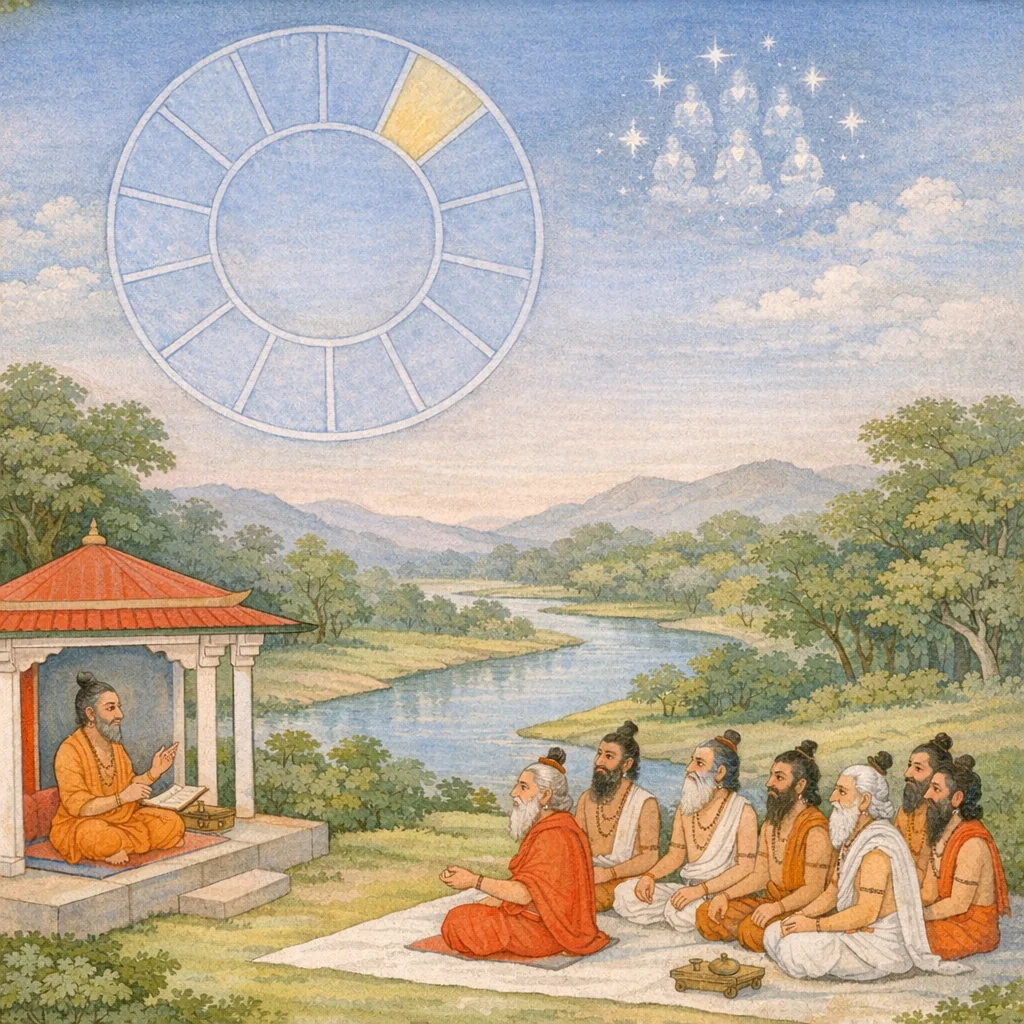
Manvantarāṇukīrtana (Enumeration of the Manvantaras and Manus)
Adhyāya 34 unfolds in the Purāṇic question–answer mode: Śaunaka asks for a full account of all manvantaras and the Manus who preside over them. Sūta replies by listing the Manus in succession, beginning with Svāyaṃbhuva and continuing through figures such as Vaivasvata (the present Manu) and later Sāvarṇi-type Manus. He then states the cosmological reckoning: within a single kalpa there are fourteen manvantaras spanning past, present, and future, aligned with the wider yuga-cycle framework. Having set down the list, Sūta indicates the next method of cataloging—he will describe, in order, the ṛṣis, sons, and devagaṇas connected with each era. As an early example he names the seven Brahmā-born sages—Marīci, Atri, Aṅgiras, Pulaha, Kratu, Pulastya, Vasiṣṭha—and the devagaṇa called Yāmā in the Svāyaṃbhuva manvantara, along with the directional placement of the Saptarṣis. In its deeper intent, the chapter serves less as mythic drama and more as an information architecture of sacred time, indexing revelation, ṛṣi authority, and divine governance to cosmic epochs for later theological and ritual reference.
Shlokas
Verse 1
शौनक उवाच । मन्वंतराणि सर्वाणि विस्तरेणानुकीर्तय । यावंतो मनवश्चैव श्रोतुमिच्छामि तानहम्
Śaunaka said: “Please recount in detail all the Manvantaras. I wish to hear of all the Manus—how many there are, and who they are.”
Verse 2
सूत उवाच । स्वायंभुवो मनुश्चैव ततस्स्त्वारोचिषस्तथा । उत्तमस्तामसश्चैव रैवतश्चाक्षुषस्तथा
Sūta said: “First there was Svāyambhuva Manu; then Ārociṣa; then Uttama and Tāmasa; and likewise Raivata and Cākṣuṣa.”
Verse 3
एते च मनवः षट् ते संप्रोक्ता मुनिपुंगव । वैवस्वतो मुनिश्रेष्ठ सांप्रतं मनुरुच्यते
Thus, O best of sages, these six Manus have been duly described to you. Now, O foremost among seers, the present Manu is said to be Vaivasvata.
Verse 4
सावर्णिश्च मनुश्चैव ततो रौच्यस्तथा परः । तथैव ब्रह्मसावर्णिश्चत्वारो मनवस्तथा
“Then come Sāvarṇi Manu, and Manu (Dakṣa-sāvarṇi) as well; after them is Rauchya, and then the next Manu. Likewise Brahma-sāvarṇi—thus these are the four Manus enumerated here.”
Verse 5
तथैव धर्मसावर्णी रुद्रसावर्णिरेव च । देवसावर्णिराख्यातं इंद्रसावर्णिरेव च
Likewise there are Dharmasāvarṇi, and indeed Rudrasāvarṇi; also one is known as Devasāvarṇi, and likewise Indrasāvarṇi as well.
Verse 6
अतीता वर्तमानाश्च तथैवानागताश्च ये । कीर्तिता मनवश्चापि मयैवैते यथा श्रुताः
The Manus who are past, those who are present, and likewise those yet to come—these too have I recounted, exactly as I have heard them in the sacred tradition.
Verse 7
मुने चतुर्दशैतानि त्रिकालानुगतानि ते । प्रोक्तानि निर्मितः कल्पो युगसाहस्रपर्य्ययः
O sage, these fourteen (divisions) that follow the threefold time have been declared to you. From them a kalpa is constituted—an aeon whose course consists of a thousand yugas.
Verse 8
ऋषींस्तेषां प्रवक्ष्यामि पुत्त्रान्देवगणांस्तथा । शृणु शौनक सुप्रीत्या क्रमशस्तान्यशस्विनः
I shall now recount their sages, their sons, and also their divine hosts. Listen with glad devotion, O Śaunaka, as I narrate, in due order, those illustrious ones.
Verse 9
मरीचिरत्रिर्भगवानङ्गिराः पुलहः क्रतुः । पुलस्त्यश्च वसिष्ठश्च सप्तैते ब्रह्मणस्सुताः
Marīci, Atri, the venerable Aṅgiras, Pulaha, Kratu, Pulastya, and Vasiṣṭha—these seven are the sons of Brahmā, renowned as the primordial seers.
Verse 10
उत्तरस्यां दिशि तथा मुने सप्तर्ष यस्तथा । यामा नाम तथा देवा आसन्स्वायंभुवेंतरे
O sage, in the northern quarter were the Seven Sages (Saptarṣis); and likewise the gods called the Yāmas were present in the Manvantara of Svāyambhuva Manu.
Verse 11
आग्नीध्रश्चाग्निबाहुश्च मेधा मेधातिथिर्वसुः । ज्योतिष्मान्धृतिमान्हव्यः सवनश्शुभ्र एव च
“(They were) Āgnīdhra and Agnibāhu; Medhā, Medhātithi, and Vasu; Jyotiṣmān, Dhṛtimān, Havya, Savana, and also Śubhra.”
Verse 12
स्वायंभुवस्य पुत्रास्ते मनोर्दश महात्मनः । कीर्तिता मुनिशार्दूल तत्रेन्द्रो यज्ञ उच्यते
O tiger among sages, those ten great-souled sons of Svāyambhuva Manu have been described. Among them, the one who is called Indra is known by the name Yajña.
Verse 13
प्रथमं कथितं तात दिव्यं मन्वतरं तथा । द्वितीयं ते प्रवक्ष्यामि तन्निबोध यथातथम्
O dear one, I have already described the first divine Manvantara. Now I shall explain to you the second—listen and understand it exactly as it truly is.
Verse 14
ऊर्जस्तंभः परस्तंभ ऋषभो वसुमां स्तथा । ज्योतिष्मान्द्युतिमांश्चैव रोचिष्मान्सप्तमस्तथा
He is the Pillar of vital power, the Supreme Support; Vṛṣabha, the Bull—the foremost among beings—and the Lord of riches. He shines with divine light, resplendent in splendor, and radiant with brilliant luster—thus is the seventh set of His names proclaimed.
Verse 15
एते महर्षयो ज्ञेयास्तत्रेन्द्रो रोचनस्तथा । देवाश्च तुषिता नाम स्मृताः स्वारोचिषेंऽतरे
Know these to be the great seers in that Manvantara. There, too, Indra is called Rocana, and the Devas are remembered by the name Tuṣitas in the Svārociṣa Manvantara.
Verse 16
हरिघ्नस्सुकृतिर्ज्योतिरयोमूर्तिरयस्मयः । प्रथितश्च मनस्युश्च नभस्सूर्यस्तथैव च
He is the slayer of sin and the fruit of holy merit; He is Light itself. He is the Iron-Form and the Iron-Substance, renowned and victorious in mind. He is the sky, and He is likewise the Sun.
Verse 17
स्वारोचिषस्य पुत्रास्ते मनोर्दशमहात्मनः । कीर्तिता मुनिशार्दूल महावीर्यपराक्रमाः
O tiger among sages, those ten great-souled sons of Svārociṣa Manu—mighty in valor and heroic prowess—have been recounted.
Verse 18
द्वितीयमेतत्कथितं मुने मन्वन्तरं मया । तृतीयं तव वक्ष्यामि तन्निबोध यथातथम्
O sage, I have thus narrated to you the second Manvantara. Now I shall tell you the third—listen to it attentively, just as it truly is.
Verse 19
वसिष्ठपुत्राः सप्तासन्वासिष्ठा इति विश्रुताः । हिरण्यगर्भस्य सुता ऊर्जा नाम महौजसः
There were seven sons of Vasiṣṭha, renowned in the world as the Vāsiṣṭhas. They were also the sons of Hiraṇyagarbha; among them was the mighty, radiant one named Ūrjā.
Verse 20
ऋषयोऽत्र समाख्याताः कीर्त्यमानान्निबोध मे । औत्तमेया ऋषिश्रेष्ठ दशपुत्रा मनोः स्मृताः
Know from me the sages who are being celebrated here and have been duly enumerated. O best of sages, they are remembered as the ten sons of Manu—descendants of Uttama.
Verse 21
इष ऊर्जित ऊर्जश्च मधुर्माधव एव च । शुचिश्शुक्रवहश्चैव नभसो नभ एव च
He is Īśa, the Lord; He is the Mighty and the very Power itself. He is Sweetness and also Mādhava (the beloved of spring). He is the Pure, the Bearer of radiance, and He is the Sky—indeed the very Ether itself.
Verse 22
ऋषभस्तत्र देवाश्च सत्यवेद श्रुतादयः । तत्रेन्द्रस्सत्यजिन्नाम त्रैलोक्याधिपतिर्मुने
O sage, there too were Ṛṣabha and the gods such as Satyaveda and Śruta. In that assembly Indra—named Satyajin—was present as the lord of the three worlds.
Verse 23
तृतीयमेतत्परमं मन्वतरमुदाहृतम् । मन्वतरं चतुर्थं ते कथयामि मुने शृणु
This has been declared as the supreme third Manvantara. Now, O sage, listen as I narrate to you the fourth Manvantara.
Verse 24
गार्ग्यः पृथुस्तथा वाग्मी जयो धाता कपीनकः । कपीवान्सप्तऋषयः सत्या देवगणास्तथा
Gārgya, Pṛthu, the eloquent Vāgmī, Jaya, Dhātā, Kapīnaka, and Kapīvān—along with the Seven Ṛṣis—likewise the Satyas and the hosts of devas were present as attendant divine groups.
Verse 25
तत्रेंद्रस्त्रिशिखो ज्ञेयो मनुपुत्रान्मुने शृणु । द्यूतिपोतस्सौतपस्यस्तमश्शूलश्च तापनः
There, O sage, know that Indra is Triśikha. Hear now of the sons of Manu: Dyūtipota, Sautapasya, Tamaḥśūla, and Tāpana.
Verse 26
तपोरतिरकल्माषो धन्वी खड्गी महानृषिः । तामसस्य स्मृता एते दश पुत्रा महाव्रताः
Taporati, Akalmāṣa, Dhanvī, Khaḍgī, and Mahānṛṣi—these are remembered among the ten sons of Tāmasa who uphold the great vow.
Verse 27
तामसस्यांतरं चैव मनो मे कथितं तव । चतुर्थं पञ्चमं तात शृणु मन्वंतरं परम्
Dear one, I have already told you of the Tāmasa Manvantara. Now, my child, listen in due order to the next supreme Manvantara—the fourth and the fifth.
Verse 28
देवबाहुर्जयश्चैव मुनिर्वेदशिरास्तथा । हिरण्यरोमा पर्जन्य ऊर्ध्वबाहुश्च सोमपाः
Devabāhu and Jaya; the sage named Vedaśirā; Hiraṇyaromā; Parjanya; and Ūrdhvabāhu—these are the Soma-drinkers, the consecrated ones who partake of the sacred Soma in the divine rite.
Verse 29
सत्यनेत्ररताश्चान्ये एते सप्तर्षयोऽपरे । देवाश्च भूतरजसस्तपःप्रकृतयस्तथा
Others, devoted to the vision of Truth, are these other great Seven Sages. Likewise there are gods whose nature is born of the guṇas of beings, and others whose very constitution is austerity (tapas).
Verse 30
तत्रेंद्रो विभुनामा च त्रैलोक्याधिपतिस्तथा । रैवताख्यो मनुस्तत्र ज्ञेयस्तामससोदरः
There, Indra is known by the name Vibhu and is also the lord of the three worlds. In that same period, the Manu is to be understood as Raivata, the brother of Tāmasa.
Verse 31
अर्जुनः पंक्तिविंध्यो वा दयायास्त नया मुने । महता तपसा युक्ता मेरुपृष्ठे वसंति हि
O sage, Arjuna and Paṅktivindhya—sons of Dayā—endowed with great austerities, indeed dwell upon the ridge of Mount Meru.
Verse 32
रुचेः प्रजापतिः पुत्रो रौच्यो नाम मनुः स्मृतः । भूत्या चोत्पादितो देव्यां भौत्यो नामाभवत्सुतः
From Prajāpati Ruci was born a son, remembered as the Manu named Raucya. And through the goddess Bhūti, he begot a son who came to be known as Bhautya.
Verse 33
अनागताश्च सप्तैते कल्पेऽस्मिन्मनवस्स्मृताः । अनागताश्च सप्तैव स्मृता दिवि महर्षयः
In this present kalpa, these seven Manus are remembered as those who are yet to come; likewise, seven great seers in heaven are also remembered as those who are yet to appear.
Verse 34
इति श्रीशिवमहापुराणे पञ्चम्यामुमासंहितायां सर्वमन्वतरानुर्कार्तनं नाम चतुस्त्रिंशोऽध्यायः
Thus, in the Śrī Śiva Mahāpurāṇa—within the Fifth Book, the Umāsaṃhitā—ends the thirty-fourth chapter entitled “The Recital of All the Manvantaras.”
Verse 35
गौतमस्यात्मजश्चैव शरद्वान् गौतमः कृपः । कौशिको गालवश्चैव रुरुः कश्यप एव च
And also the son of Gautama—Śaradvān (known as Kṛpa)—as well as Gautama, Kauśika, Gālava, Ruru, and likewise Kaśyapa.
Verse 36
एते सप्त महात्मानो भविष्या मुनिसत्तमाः । देवाश्चानागतास्तत्र त्रयः प्रोक्तास्स्वयंभुवा
“These seven great-souled ones will become the foremost of sages. And there, three gods yet to appear were also declared by Svayambhū (Brahmā).”
Verse 37
मरीचेश्चैव पुत्रास्ते कश्यपस्य महात्मनः । तेषां विरोचनसुतो बलिरिंद्रो भविष्यति
They are indeed the sons of Marīci—born of the great-souled Kaśyapa. Among them, Bali, the son of Virocana, shall become Indra, the lord of the gods.
Verse 38
विषांङ्गश्चावनीवांश्च सुमंतो धृतिमान्वसुः । सूरिः सुराख्यो विष्णुश्च राजा सुमतिरेव च
Viṣāṅga, Avanīvān, Sumanta, Dhṛtimān, Vasu, Sūri, Surākhya, Viṣṇu, Rājā, and indeed Sumati—these were also among them.
Verse 39
सावर्णेश्च मनोः पुत्रा भविष्या दश शौनक । इहाष्टमं हि कथितं नवमं चान्तरं शृणु
O Śaunaka, the sons of Sāvarṇi Manu will be ten in number. Here the eighth Manvantara has already been described; now listen to the ninth Manvantara as well.
Verse 40
प्रथमं दक्षसावर्णि प्रवक्ष्यामि मनुं शृणु । मेधातिथिश्च पौलस्त्यो वसुः कश्यप एव च
First I shall describe the Manu named Dakṣasāvarṇi—listen. In his lineage are Medhātithi, Paulastya, Vasu, and also Kaśyapa.
Verse 41
ज्योतिष्मान्भार्गवश्चैव धृतिमानंगिरास्तथा । सवनश्चैव वासिष्ठ आत्रेयो हव्य एव च
“(There were sages) Jyotiṣmān; Bhārgava (of Bhṛgu’s line); Dhṛtimān; and likewise Aṅgirā. Also Savana; Vāsiṣṭha (of Vasiṣṭha’s lineage); Ātreya (of Atri’s lineage); and Havya as well.”
Verse 42
पुलहस्सप्त इत्येते ऋषयो रौहितेंतरे । देवतानां गणास्तत्र त्रय एव महामुने
“Pulaha and the other seven—these are the sages in the Rohita-antara. There, O great sage, the hosts of the gods are only three in number.”
Verse 43
दीक्षापुत्रस्य पुत्रास्ते रोहितस्य प्रजापतेः । धृष्टकेतुर्दीप्तकेतुः पंचहस्तो निराकृतिः
These were the sons of Dīkṣā’s son—of Rohita, the Prajāpati: Dhṛṣṭaketu, Dīptaketu, Pañcahasta, and Nirākṛti.
Verse 44
पृथुश्रवा भूरिद्युम्नो ऋचीको बृहतो गयः । प्रथमस्य तु सावर्णेर्नव पुत्रा महौजस
Pṛthuśravā, Bhūridyumna, Ṛcīka, Bṛhata, and Gaya—these are named among the sons. Thus, of Sāvarṇi (Manu), the first set consists of nine sons, all endowed with great strength and vigor.
Verse 45
दशमे त्वथ पर्याये द्वितीयस्यांतरे मनोः । हविष्मान्पुलहश्चैव प्रकृतिश्चैव भार्गवः
Then, in the tenth cycle—within the interval of the second Manu—there appeared Haviṣmān, Pulaha, and also Prakṛti, as well as the Bhārgava sage.
Verse 46
आयो मुक्तिस्तथात्रेयो वसिष्ठश्चाव्ययस्स्मृतः । पौलस्त्यः प्रयतिश्चैव भामारश्चैव कश्यपः
Also remembered are Āya, Mukti, and Ātreya; Vasiṣṭha too is spoken of, along with Avyaya. And likewise are named Paulastya, Prayati, Bhāmāra, and Kaśyapa.
Verse 47
अङ्गिरानेनसस्सत्यः सप्तैते परमर्षयः । देवतानां गणाश्चापि द्विषिमंतश्च ते स्मृताः
Aṅgirā, Nena, Sassatya—these seven are remembered as the supreme seers; and they are also regarded as divine hosts, endowed with spiritual radiance and ardent, ascetic power.
Verse 48
तेषामिन्द्रस्स्मृतः शम्भुस्त्वयमेव महेश्वरः । अक्षत्वानुत्तमौजाश्च भूरिषेणश्च वीर्यवान्
Among them, the one remembered as Indra is Śambhu—indeed, You Yourself are that Mahādeva. And (there are) Akṣatva, Anuttamaujā, and Bhūriṣeṇa also—each renowned for mighty valor.
Verse 49
शतानीको निरामित्रो वृषसेनो जयद्रथः । भूरिद्युम्नः सुवर्चार्चिर्दश त्वेते मनोस्सुताः
Śatānīka, Nirāmitra, Vṛṣasena, Jayadratha, Bhūridyumna, and Suvarcārcis—these ten are declared to be the sons of Manu.
Verse 50
एकादशे तु पर्याये तृतीयस्यांतरे मनोः । तस्यापि सप्त ऋषयः कीर्त्यमानान्निबोध मे
Now, in the eleventh cycle—within the third Manvantara of Manu—listen from me as I recount the seven Ṛṣis belonging to that period.
Verse 51
हविष्मान्कश्यपश्चापि वपुष्मांश्चैव वारुणः । अत्रेयोऽथ वसिष्ठश्च ह्यनयस्त्वंगिरास्तथा
Haviṣmān, Kaśyapa, and also Vapuṣmān—the son of Varuṇa—together with Atreya and Vasiṣṭha; likewise Anaya and Aṅgiras as well (were present/are enumerated).
Verse 52
चारुधृष्यश्च पौलस्त्यो निःस्वरोऽग्निस्तु तैजसः । सप्तैते ऋषयः प्रोक्तास्त्रयो देवगणास्स्मृताः
Cārudhṛṣya, Paulastya, Niḥsvāra, and Agni of fiery splendor are thus named. Together they are declared to be the seven Ṛṣis, and are also remembered as three divine classes (devagaṇas).
Verse 53
ब्रह्मणस्तु सुतास्ते हि त इमे वैधृताः स्मृताः । सर्वगश्च सुशर्म्मा च देवानीकस्तु क्षेमकः
Indeed, these are the sons of Brahmā; they are remembered as the Vaidhṛtas—Sarvaga, Suśarmā, Devānīka, and Kṣemaka.
Verse 54
दृढेषुः खंडको दर्शः कुहुर्बाहुर्मनोः स्मृताः । सावर्णस्य तु पौत्रा वै तृतीयस्य नव स्मृताः
Dṛḍheṣu, Khaṇḍaka, Darśa, Kuhur, and Bāhu are remembered as descendants in the line of Manu. And indeed, nine are remembered as the grandsons of Sāvarṇa, the third in that lineage.
Verse 55
चतुर्थस्य तु सावर्णेरृषीन्सप्त निबोध मे । द्युतिर्वसिष्ठपुत्रश्च आत्रेयस्सुतपास्तथा
Now learn from me the seven seers (Saptarṣis) of the fourth Sāvarṇi Manu: Dyuti, the son of Vasiṣṭha, Ātreya, and Sutapā as well.
Verse 56
अंगिरास्तपसो मूर्तिस्तपस्वी कश्यपस्तथा । तपोधनश्च पौलस्त्यः पुलहश्च तपोरतिः
Aṅgiras is the very embodiment of tapas; Kaśyapa too is a great ascetic. Paulastya is rich in the treasure of tapas, and Pulaha is ever devoted to austerity.
Verse 57
भार्गवस्सप्तमस्तेषां विज्ञेय तपसो निधिः । पंच देवगणाः प्रोक्ता मानसा ब्रह्मणस्सुताः
Bhārgava is to be known as the seventh among them, a veritable treasury of tapas. These five groups of divine beings are declared to be mind-born sons of Brahmā.
Verse 58
ऋतधामा तदिन्द्रो हि त्रिलोकी राज्यकृत्सुखी । द्वादशे चैव पर्याये भाव्ये रौच्यांतरे मुने
O sage, in the coming twelfth cycle, in the Raucya Manvantara, Ṛtadhāmā will indeed become Indra—ruling the three worlds and enjoying the happiness born of sovereignty.
Verse 59
अंगिराश्चैव धृतिमान्पौलस्त्यो हव्यवांस्तु यः । पौलहस्तत्त्वदर्शी च भार्गवश्च निरुत्सवः
And there were Aṅgirā; the steadfast Dhṛtimān; Paulastya; and Havyavān. Paulaha was a seer of truth, and Bhārgava was free from outward festivity, remaining inwardly restrained.
Verse 60
निष्प्रपंचस्तथात्रेयो निर्देहः कश्यपस्तथा । सुतपाश्चैव वासिष्ठस्सप्तैवैते महर्षयः
Niṣprapañca, Atreya, Nirdeha, Kaśyapa, Sutapā, and Vāsiṣṭha—these indeed are the seven great sages, the Mahārṣis.
Verse 61
त्रय एव गणाः प्रोक्ता देवतानां स्वयंभुवा । दिवस्पतिस्तमिन्द्रो वै विचित्रश्चित्र एव च
The Self-born Lord (Brahmā) has declared that among the hosts (gaṇas) of the gods there are precisely three: Divaspati, Indra, and Vicitra—also called Citra.
Verse 62
नयो धर्मो धृतोंध्रश्च सुनेत्रः क्षत्रवृद्धकः । निर्भयस्सुतपा द्रोणो मनो रौच्यस्य ते सुताः
Naya, Dharma, Dhṛta-andhra, Sunetra, Kṣatra-vṛddhaka, Nirbhaya, Sutapā, Droṇa, and Mana—these were the sons of Raucyā (Manu).
Verse 63
चतुर्द्दशे तु पर्याये सत्यस्यैवांतरे मनोः । आग्नीध्रः काश्यपश्चैव पौलस्त्यो मागधश्च यः
In the fourteenth cycle—within the Manvantara of the Manu named Satya—there were (sages/lineages) such as Āgnīdhra, Kāśyapa, Paulastya, and also Māgadha.
Verse 64
भार्गवोऽप्यतिवाह्यश्च शुचिरांगिरसस्तथा । युक्तश्चैव तथात्रेयः पौत्रो वाशिष्ठ एव च
“Bhārgava too, and Ativāhya; Śuci, and Āṅgirasa; likewise Yukta, and also Ātreya; Pautra, and Vāśiṣṭha as well.”
Verse 65
अजितः पुलहश्चैव ह्यंत्यास्सप्तर्षयश्च ते । पवित्राश्चाक्षुषा देवाः शुचिरिन्द्रो भविष्यति
Ajita and Pulaha, together with the remaining sages who make up the seven seers, will appear then. The deities known as the Pāvitrās will be the gods of the Ākṣuṣa Manvantara, and Śuci will become Indra.
Verse 66
एतेषां कल्य उत्थाय कीर्तनात्सुखमेधते । अतीतानागतानां वै महर्षीणां नरैस्सदा
O auspicious one, by rising (in devotion) and singing their glories, happiness increases. Indeed, people should always celebrate the great sages of the past and those yet to come.
Verse 67
देवतानां गणाः प्रोक्ताश्शृणु पंच महामुने । तुरंगभीरुर्बुध्नश्च तनुग्रोऽनूग्र एव च
O great sage, listen: five groups among the deities are being declared—Turaṅgabhīru, Budhna, Tanugra, and Anūgra as well (as part of the fivefold listing).
Verse 68
अतिमानी प्रवीणश्च विष्णुस्संक्रंदनस्तथा । तेजस्वी सबलश्चैव सत्यस्त्वेते मनोस्सुता
“Atimānī, Pravīṇa, Viṣṇu, Saṃkrandana, Tejasvī, Sabala, and Satya—these indeed are the sons of Manu.”
Verse 69
भौमस्यैवाधिकारे वै पूर्वकल्पस्तु पूर्यते । इत्येतेऽनागताऽतीता मनवः कीर्तिता मया
Indeed, within the jurisdiction of Bhauma (the Earth), the account of the former kalpa is thus completed. In this way I have described the Manus—those who have passed and those yet to come.
Verse 70
उक्तास्सनत्कुमारेण व्यासायामिततेजसा । पूर्णे युगसहस्रांते परिपाल्यः स्वधर्मतः
These teachings were spoken by Sanatkumāra to Vyāsa of immeasurable splendor: “When a thousand yugas are completed, one should duly uphold (this tradition) according to one’s own dharma.”
Verse 71
प्रजाभिस्तपसा युक्ता ब्रह्मलोकं व्रजंति ते । युगानि सप्रतिस्त्वेकं साग्राण्यंतरमुच्यते
Those beings, endowed with austerity (tapas) for the sake of their progeny, attain Brahmaloka. A period consisting of yugas—together with the intervening junctions (sandhi)—amounting to one such cycle plus an additional measure is declared to be an ‘antara’ (interval).
Verse 72
चतुर्दशैते मनवः कीर्तिता कीर्तिवर्धनाः । मन्वंतरेषु सर्वेषु संहारांते पुनर्भवः
These fourteen Manus have been declared—enhancers of renown. In every Manvantara, at the end of dissolution (saṃhāra), they arise again in renewed manifestation.
Verse 73
न शक्यमन्तरं तेषां वक्तुं वर्षशतैरपि । पूर्णे शतसहस्रे तु कल्पो निःशेष उच्यते
Even over hundreds of years, one cannot fully describe the intervals between those cosmic divisions of time. But when a hundred thousand (years) are completed, that is proclaimed to be a kalpa in its entirety.
Verse 75
तत्र सर्वाणि भूतानि दग्धान्यादित्यरश्मिभिः । ब्रह्माणमग्रतः कृत्वा सदादित्यगणैर्मुने
There, all beings were scorched by the Sun’s rays. Then, O sage, the hosts of the Ādityas, placing Brahmā at their forefront, proceeded onward.
Verse 76
प्रविशंति सुरश्रेष्ठ हरिं नारायणं परम् । स्रष्टारं सर्व भूतानां कल्पांतेषु पुनःपुनः
O best of the gods, again and again at the end of each aeon, they enter into Hari—supreme Nārāyaṇa—who, in the next cycle, becomes the creator of all beings. From the Śaiva standpoint, this speaks of the periodic dissolution and re-emergence of cosmic functions, while the Supreme Lord Śiva remains the transcendent Pati beyond these changing roles.
Verse 77
भूयोपि भगवान् रुद्रस्संहर्ता काल एव हि । कल्पांते तत्प्रवक्ष्यामि मनोर्वैवस्वतस्य वै
Again, the Blessed Lord Rudra is indeed Kāla—Time itself, the great dissolver. At the end of the kalpa, I shall now describe that dissolution in relation to Vaivasvata Manu.
Verse 78
इति ते कथितं सर्वं मन्वंतरसमुद्भवम् । विसर्गं पुण्यमाख्यानं धन्यं कुलविवर्द्धनम्
Thus have I told you all that arose in the Manvantaras—the sacred account of Visarga (secondary creation), a meritorious tale that bestows blessedness and increases the prosperity and purity of one’s lineage.
Frequently Asked Questions
Rather than a single dramatic episode, the chapter presents a theological-architectural argument: sacred history is organized by fourteen manvantaras, each governed by a Manu. This enumeration (including the present Vaivasvata Manu) is used to explain how cosmic order and dharma are administered across time within a kalpa.
The ‘symbol’ here is the calendrical-cosmological grid itself: manvantara and Manu operate as indexing devices that encode continuity of revelation and governance. Listing ṛṣis, devagaṇas, and directional placement of Saptarṣis functions as a metadata system—linking authority, space, and time so later teachings and rituals can be situated within a coherent cosmic taxonomy.
No specific iconographic manifestation (svarūpa) of Śiva or Umā is foregrounded in the provided verses; the emphasis is cosmological administration (Manus, ṛṣis, devagaṇas). The Śaiva relevance is indirect: the chapter supplies the temporal framework within which Śaiva revelation, worship, and divine governance are understood to operate.