Svagati-varṇana (Description of the Supreme State / One’s True Attainment)
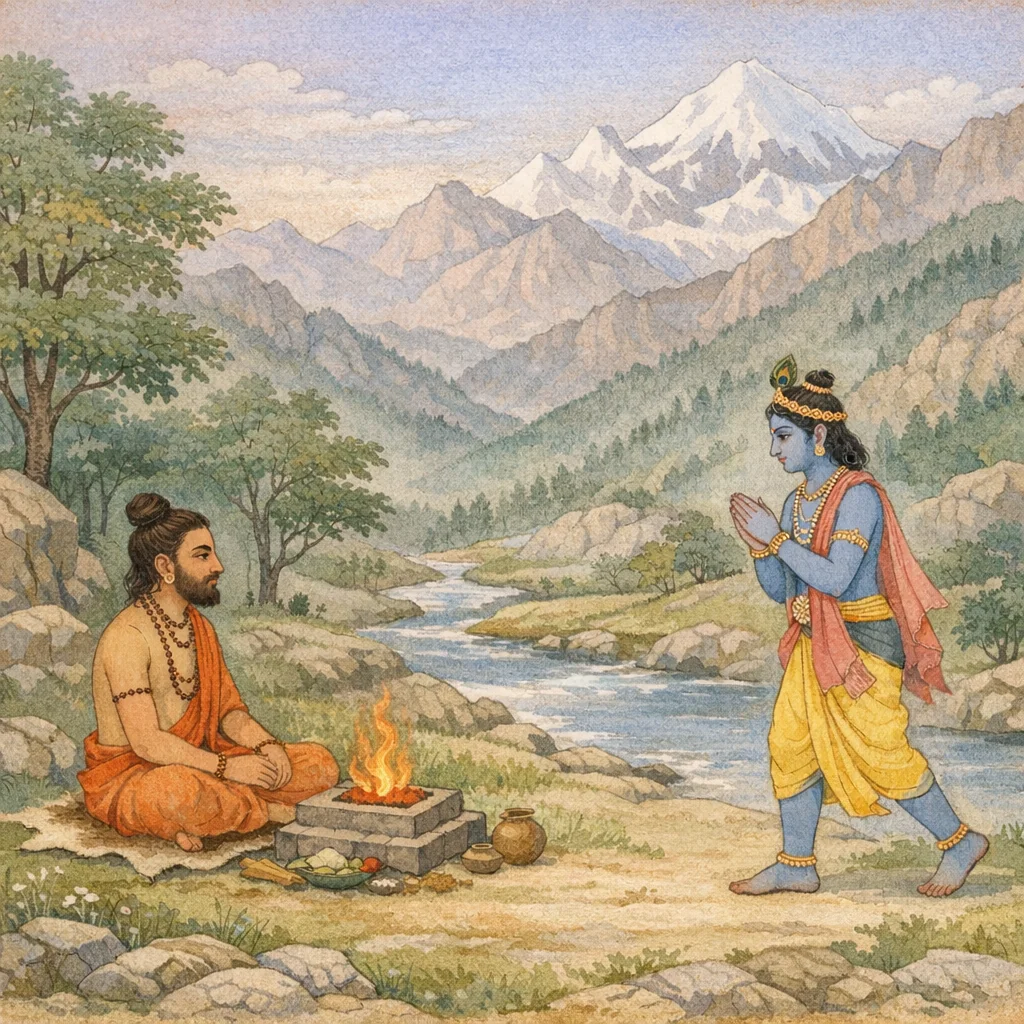
Adhyāya 1 opens the Umāsaṃhitā by affirming Śiva as the complete reality (pūrṇa): transcending the three guṇas yet presiding over the cosmos through their functions—creation aligned with rajas and dissolution aligned with tamas—while remaining beyond māyā. It then frames the teaching in a Purāṇic, layered dialogue: sages led by Śaunaka question Sūta, recall the earlier Koṭirudra-saṃhitā recitation, and request the multi-episode Umāsaṃhitā focused on Śaṃbhu’s deeds. Sūta cites the authoritative lineage—Vyāsa’s inquiry to Sanatkumāra—thereby validating what follows. Sanatkumāra begins the episode: Kṛṣṇa, seeking a son (putrārtha), goes to Kailāsa to perform tapas to Śiva, meets the great Śaiva ṛṣi Upamanyu engaged in austerity, and reverently asks him for guidance. Thus the chapter serves as an entry-gate: metaphysical framing of Śiva-tattva, authentication of transmission, and the start of a sādhaka-centered narrative where desire, discipline, and Śaiva instruction converge.
Shlokas
Verse 1
इति श्रीशिवमहापुराणे पंचम्यामुमासंहितायां कृष्णोपमन्युसंवादे स्वगतिवर्णनं नाम प्रथमोऽध्यायः
Thus, in the Śrī Śiva Mahāpurāṇa—within the Fifth Book, the Umāsaṃhitā—during the dialogue between Kṛṣṇa and Upamanyu, this is the First Chapter, called “Svagati-varṇana,” the description of one’s own spiritual state.
Verse 2
ऋषय ऊचुः । सूतसूत महाप्राज्ञ व्यासशिष्यन मोऽस्तु ते । चतुर्थी कोटिरुद्राख्या श्राविता संहिता त्वया
The sages said: “O Sūta, O greatly wise one, disciple of Vyāsa—salutations to you. You have recited to us the fourth Saṃhitā, known as the Koṭirudra.”
Verse 3
अथोमासंहितान्तःस्थ नानाख्यानसमन्वितम् । ब्रूहि शंभोश्चरित्रं वै साम्बस्य परमात्मनः
Now, please narrate to us the sacred account of Śambhu—Sāmba, the Supreme Self—rich with many episodes and preserved within the Umā-saṃhitā.
Verse 4
सूत उवाच । महर्षयश्शौनकाद्याः शृणुत प्रेमतः शुभम् । शांकरं चरितं दिव्यं भुक्तिमुक्तिप्रदं परम्
Sūta said: “O great sages beginning with Śaunaka, listen with loving attention to this auspicious account—the divine deeds of Śaṅkara (Lord Śiva), supreme in nature, which bestow both worldly well-being (bhukti) and liberation (mukti).”
Verse 5
इतीदृशं पुण्यप्रश्नं पृष्टवान्मुनिसत्तमः । व्यासस्सनत्कुमारं वै शैवं सच्चरितं जगौ
Having thus asked such a meritorious question, that best of sages—Vyāsa—then spoke to Sanatkumāra the true sacred account of Śiva.
Verse 6
सनत्कुमार उवाच । वासुदेवाय यत्प्रोक्तमुपमन्युमहर्षिणा । तदुच्यते मया व्यास चरितं हि महेशितुः
Sanatkumāra said: O Vyāsa, I shall now recount that sacred account of Maheśa which the great sage Upamanyu had earlier taught to Vāsudeva.
Verse 7
पुरा पुत्रार्थमगमत्कैलासं शंकरालयम् । वसुदेवसुतः कृष्णस्तपस्तप्तुं शिवस्य हि
In former times, desiring a son, Kṛṣṇa—the son of Vasudeva—went to Kailāsa, the abode of Śaṅkara, to perform austerities and seek the grace of Lord Śiva.
Verse 8
अत्रोपमन्युं संदृष्ट्वा तपंतं शृंग उत्तमे । प्रणम्य भक्त्या स मुनिं पर्यपृच्छत्कृताञ्जलिः
There, seeing the sage Upamanyu engaged in austerities upon the excellent mountain peak, he bowed to that muni with devotion; and with hands joined in reverence, he respectfully questioned him.
Verse 9
श्रीकृष्ण उवाच । उपमन्यो महाप्राज्ञ शैवप्रवर सन्मते । पुत्रार्थमगमं तप्तुं तपोऽत्र गिरिशस्य हि
Śrī Kṛṣṇa said: “Upamanyu—most wise, foremost among Śaivas, and of noble understanding—came here to perform austerities for the sake of obtaining a son, for this indeed is the sacred place of Girīśa (Lord Śiva).”
Verse 10
ब्रूहि शंकरमाहात्म्यं सदानन्दकरं मुने । यच्छ्रुत्वा भक्तितः कुर्य्यां तप ऐश्वरमुत्तमम्
O sage, please tell me the glory of Śaṅkara—the giver of everlasting bliss—hearing which, with devotion, I may undertake the supreme, Lord-centered austerity that leads to divine mastery and liberation.
Verse 11
सनत्कुमार उवाच । इति श्रुत्वा वचस्तस्य वासुदेवस्य धीमतः । प्रत्युवाच प्रसन्नात्मा ह्युपमन्युस्स्मरञ्छिवम्
Sanatkumāra said: Having thus heard the words of the wise Vāsudeva, Upamanyu—his mind serene—replied, remembering Śiva.
Verse 12
उपमन्युरुवाच । शृणु कृष्ण महाशैव महिमानं महेशितुः । यमद्राक्षमहं शंभोर्भक्तिवर्द्धनमुत्तमम्
Upamanyu said: “Listen, O Kṛṣṇa, great devotee of Śiva, to the glory of Maheśa, the Supreme Lord. I shall relate what I myself witnessed—an excellent episode that increases devotion to Śambhu.”
Verse 13
तपःस्थोऽहं समद्राक्षं शंकरं च तदायुधान् । परिवारं समस्तं च विष्ण्वादीनमरादिकान्
While I was established in austerity, I beheld Śaṅkara along with His divine weapons and His entire retinue—as well as Viṣṇu and the other gods and celestial beings.
Verse 14
त्रिभिरंशैश्शोभमानमजस्रसुखमव्ययम् । एकपादं महादंष्ट्रं सज्वालकवलैर्मुखैः
He beheld a wondrous form—radiant with threefold portions, ever-blissful and imperishable—single-footed, with mighty fangs, and with faces that seemed to swallow flaming masses.
Verse 15
द्विसहस्रमयूखानां ज्योतिषाऽतिविराजितम् । सर्वास्त्रप्रवराबाधमनेकाक्षं सहस्रपात्
He blazed forth with a radiance like that of two thousand rays, supremely resplendent. Unassailable even by the foremost of all weapons, He was many-eyed and thousand-footed—an all-pervading, all-protecting manifestation of the Lord.
Verse 16
यश्च कल्पान्तसमये विश्वं संहरति ध्रुवम् । नावध्यो यस्य च भवेत्त्रैलौक्ये सचराचरे
He who, at the dissolution at the end of an aeon, unfailingly withdraws the entire universe—throughout the three worlds, with all that moves and does not move, none can overpower or slay Him.
Verse 17
महेश्वरभुजोत्सृष्टं त्रैलोक्यं सचराचरम् । निर्ददाह द्रुतं कृत्स्नं निमेषार्द्धान्न संशयः
The entire threefold world—moving and unmoving—once released from Mahādeva’s arm, was swiftly burned up in its entirety, in but half a blink; of this there is no doubt.
Verse 18
तपःस्थो रुद्रपार्श्वस्थं दृष्टवानहमव्यम् । गुह्यमस्त्रं परं चास्य न तुल्यमधिकं क्वचित्
While absorbed in austerities, I beheld the imperishable One standing at Rudra’s side. I also perceived His supreme, secret divine power (astra); nowhere is there anything equal to it, much less anything greater.
Verse 19
यत्तच्छूलमिति ख्यातं सर्वलोकेषु शूलिनः । विजयाभिधमत्युग्रं सर्वशस्त्रास्त्रनाशकम्
That very weapon is renowned in all the worlds as the Trident of the Trident-bearer, Śiva. Named “Vijayā” (Victory), it is exceedingly fierce and has the power to destroy every weapon and missile.
Verse 20
दारयेद्यन्महीं कृत्स्नां शोषयेद्यन्महोदधिम् । पातयेदखिलं ज्योतिश्चक्रं यन्नात्र संशयः
That power can cleave the whole earth, dry up the great ocean, and make the entire wheel of the luminaries fall—of this there is no doubt.
Verse 21
यौवनाश्वो हतो येन मांधाता सबलः पुरा । चक्रवर्ती महातेजास्त्रैलोक्यविजयो नृपः
By him King Yauvanāśva was once slain; and by him Māndhātā—mighty with his forces—became a radiant universal monarch, famed as the conqueror of the three worlds.
Verse 22
दर्पाविष्टो हैहयश्च निः क्षिप्तो लवणासुरः । शत्रुघ्नं नृपतिं युद्धे समाहूय समंततः
Possessed by pride, the Haihaya warrior and the asura Lavaṇāsura were cast out; then, from every side, Lavaṇāsura challenged King Śatrughna to battle.
Verse 23
तस्मिन्दैत्ये विनष्टे तु रुद्रहस्ते गतं तु यत् । तच्छूलमिति तीक्ष्णाग्रं संत्रासजननं महत्
When that demon was destroyed, what came into Rudra’s hand became known as the Śūla (trident)—keen-pointed and greatly fear-producing.
Verse 24
त्रिशिखां भृकुटीं कृत्वा तर्जयंतमिव स्थितम् । विधूम्रानलसंकाशं बालसूर्यमिवोदितम्
With a three-pointed crest and knitted brow, he stood as though threatening; his radiance was like smokeless fire—like the youthful sun newly risen.
Verse 25
सूर्य्य हस्तमनिर्द्देश्यं पाशहस्तमिवांतकम् । परशुं तीक्ष्णधारं च सर्पाद्यैश्च विभूषितम्
His splendour was beyond description, as though the sun itself rested in His hand; and like Death holding the noose (pāśa) in his grasp. He also bore a sharp‑edged axe, and was adorned with sacred ornaments such as serpents and the like.
Verse 26
कल्पान्तदहनाकारं तथा पुरुषविग्रहम् । यत्तद्भार्गवरामस्य क्षत्रियान्तकरं रणे
That very power bears the blazing form of the fire at the end of an aeon, and yet can also assume a human embodiment. In battle it was seen as Bhārgava Rāma (Paraśurāma), the destroyer of the Kṣatriyas.
Verse 27
रामो यद्बलमाश्रित्य शिवदत्तश्च वै पुरा । त्रिःसप्तकृत्वो नक्षत्रं ददाह हृषितो मुनिः
In ancient times, relying upon that very power, Rāma and also Śivadatta—delighted at heart as a muni—burned the Nakṣatra constellation twenty‑one times.
Verse 28
सुदर्शनं तथा चक्रं सहस्रवदनं विभुम् । द्विसहस्रभुजं देवमद्राक्षं पुरुषाकृतिम्
I beheld that all‑pervading, mighty Deity—of human‑like form—radiant and beautiful, bearing the Sudarśana discus, with a thousand faces and two thousand arms.
Verse 29
द्विसहस्रेक्षणं दीप्तं सहस्रचरणाकुलम् । कोटिसूर्यप्रतीकाशं त्रैलोक्यदहनक्षमम्
Blazing with splendor, it had two thousand eyes and was thronged with a thousand feet. Radiant like ten million suns, it could consume the three worlds in fire.
Verse 30
वज्रं महोज्ज्वलं तीक्ष्णं शतपर्वप्रनुत्तमम् । महाधनुः पिनाकं च सतूणीरं महाद्युतिम्
He bore the vajra—exceedingly radiant and razor-sharp, the finest, praised as “hundred-jointed”; and he also held the great bow Pināka with its quiver, blazing with mighty splendor.
Verse 31
शक्तिं खङ्गं च पाशं च महादीप्तं समांकुशम् । गदां च महतीं दिव्यामन्यान्यस्त्राणि दृष्टवान्
He beheld the spear (śakti), the sword, the noose (pāśa), the blazing goad (aṅkuśa), and a great divine mace, and also many other celestial weapons.
Verse 32
तथा च लोकपालानामस्त्राण्येतानि यानि च । अद्राक्षं तानि सर्वाणि भगवद्रुद्रपार्श्वतः
Likewise, all the weapons belonging to the Lokapālas, the guardians of the worlds—I saw them all stationed at the side of Bhagavān Rudra.
Verse 33
सव्यदेशे तु देवस्य ब्रह्मा लोकपितामहः । विमानं दिव्यमास्थाय हंसयुक्तं मनोनुगम्
On the Lord’s left side, Brahmā—the grandsire of the worlds—took his seat, having mounted a divine aerial chariot yoked with swans, moving as swiftly as thought.
Verse 34
वामपार्श्वे तु तस्यैव शंखचक्रगदाधरः । वैनतेयं समास्थाय तथा नारायणः स्थितः
On his very left side stood Nārāyaṇa, bearing the conch, discus, and mace, seated upon Vainateya (Garuḍa).
Verse 35
स्वायंभुवाद्या मनवो भृग्वाद्या ऋषयस्तथा । शक्राद्या देवताश्चैव सर्व एव समं ययुः
The Manus beginning with Svāyambhuva, the sages beginning with Bhṛgu, and the gods beginning with Śakra (Indra)—all of them together proceeded in unison.
Verse 36
स्कंदश्शक्तिं समादाय मयूरस्थस्सघंटकः । देव्यास्समीपे संतस्थौ द्वितीय इव पावकः
Bearing his spear, Skanda—seated upon his peacock and adorned with tinkling bells—stood close by the Goddess, blazing there like a second fire.
Verse 37
नंदी शूलं समादाय भवाग्रे समवस्थितः । सर्वभूतगणाश्चैवं मातरो विविधाः स्थिताः
Nandī, taking up the trident, stood stationed in front of Bhava (Lord Śiva). In the same way, all the hosts of beings and the various Mothers (Divine Matṛkās) stood arrayed there.
Verse 38
तेऽभिवाद्य महेशानं परिवार्य्य समंततः । अस्तुवन्विविधैः स्तोत्रैर्महादेवं तदा सुराः
Then the gods, having bowed in reverence to Maheśāna and standing all around Him on every side, praised Mahādeva with many kinds of hymns.
Verse 39
यत्किंचित्तु जगत्यस्मिन्दृश्यते श्रूयतेऽथवा । तत्सर्वं भगवत्पार्श्वे निरीक्ष्याहं सुविस्मितः
Whatever in this world is seen, or even merely heard of—beholding it all as present beside the Blessed Lord, I was utterly astonished.
Verse 40
सुमहद्धैर्य्यमालंब्य प्रांजलिर्विविधैः स्तवैः । परमानन्दसंमग्नोऽभूवं कृष्णाहमद्ध्वरे
Mustering great steadiness, I stood with folded hands and praised the Lord with many hymns; and in that sacrificial rite I—Kṛṣṇa—became wholly immersed in supreme bliss.
Verse 41
संमुखे शंकरं दृष्ट्वा बाष्पगद्गदया गिरा । अपूजयं सुविधिवदहं श्रद्धासमन्वितः
Seeing Śaṅkara face to face, my voice choked with tears, I worshipped Him according to proper rite, endowed with steadfast faith.
Verse 42
भगवानथ सुप्रीतश्शंकरः परमेश्वरः । वाण्या मधुरया प्रीत्या मामाह प्रहसन्निव
Then the Blessed Lord—Śaṅkara, the Supreme Lord—being exceedingly pleased, spoke to me with loving delight, in a sweet voice, as though gently smiling.
Verse 43
न विचालयितुं शक्यो मया विप्र पुनः पुनः । परीक्षितोसि भद्रं ते भवान्भक्त्यान्वितो दृढः
“O Brāhmaṇa, again and again I have tried, yet I cannot shake you from your resolve. You have been tested—may auspiciousness be yours—for you are steadfast, endowed with firm devotion.”
Verse 44
तस्मात्ते परितुष्टोऽस्मि वरं वरय सुव्रत । दुर्लभं सर्वदेवेषु नादेयं विद्यते तव
“Therefore I am fully pleased with you, O steadfast one. Choose a boon. Even among all the gods, there is nothing rare that cannot be granted to you.”
Verse 45
स चाहं तद्वचः श्रुत्वा शंभोः सत्प्रेमसंयुतम् । देवं तं प्रांजलिर्भूत्वाऽब्रुवं भक्तानुकंपिनम्
Hearing those words of Śambhu, filled with pure and noble love, I too was moved. With folded hands in reverence, I spoke to that God—Śiva—who is compassionate to His devotees.
Verse 46
उपमन्युरुवाच । भगवन्यदि तुष्टोऽसि यदि भक्तिः स्थिरा मयि । तेन सत्येन मे ज्ञानं त्रिकालविषयं भवेत्
Upamanyu said: “O Lord, if You are pleased, and if devotion to You stands firm within me, then by the power of that truth may knowledge arise in me that comprehends the three times—past, present, and future.”
Verse 47
प्रयच्छ भक्तिं विपुलां त्वयि चाव्यभिचारिणीम् । सान्वयस्यापि नित्यं मे भूरि क्षीरौदनं भवेत्
Grant me abundant, unwavering devotion to You, never straying. And may there always be plentiful milk-rice for me, together with my family line.
Verse 48
ममास्तु तव सान्निध्यं नित्यं चैवाश्रमे विभो । तव भक्तेषु सख्यं स्यादन्योन्येषु सदा भवेत्
O Lord, may I ever dwell in Your holy presence, always, here in this hermitage. And among Your devotees, may friendship arise—may mutual goodwill and concord ever prevail among one another.
Verse 49
एवमुक्तो मया शंभुर्विहस्य परमेश्वरः । कृपादृष्ट्या निरीक्ष्याशु मां स प्राह यदूद्वह
Thus addressed by me, Śambhu—the Supreme Lord—smiled. Casting upon me a compassionate glance, he quickly spoke to me, O best of the Yadus.
Verse 50
श्रीशिव उवाच । उपमन्यो मुने तात वर्ज्जितस्त्वं भविष्यसि । जरामरणजैर्दोषैस्सर्वकामान्वितो भव
Śrī Śiva said: “O sage Upamanyu, dear child—may you become free from the faults that arise from old age and death, and may you be endowed with the fulfillment of all worthy desires.”
Verse 51
मुनीनां पूजनीयश्च यशोधनसमन्वितः । शीलरूपगुणैश्वर्यं मत्प्रसादात्पदेपदे
“You will be revered by sages and endowed with fame and prosperity. By my grace, at every step you will possess noble conduct, pleasing form, excellent virtues, and spiritual lordship.”
Verse 52
क्षीरोदसागरस्यैव सान्निध्यं पयसां निधेः । तत्र ते भविता नित्यं यत्रयत्रेच्छसे मुने
You shall ever enjoy the blessed nearness of the Ocean of Milk—the inexhaustible treasury of all milk. There, O sage, it shall be yours always, wherever you may wish to be.
Verse 53
अमृतात्मकं तु तत्क्षीरं यावत्संयाम्यते ततः । इमं वैवस्वतं कल्पं पश्यसे बन्धुभिस्सह
That milk, whose very nature is amṛta, is restrained only up to that point. Thereafter, together with your kinsmen, you shall behold this Vaivasvata Kalpa, the present aeon.
Verse 54
त्वद्गोत्रं चाक्षयं चास्तु मत्प्रसादात्सदैव हि । सान्निध्यमाश्रमे तेऽहं करिष्यामि महामुने
By my grace, O great sage, may your lineage remain imperishable forever. Indeed, I shall continually uphold my sacred presence within your hermitage.
Verse 55
मद्भक्तिस्तु स्थिरा चास्तु सदा दास्यामि दर्शनम् । स्मृतश्च भवता वत्स प्रियस्त्वं सर्वथा मम
May your devotion to me remain steadfast. I shall ever grant you my divine vision (darśana). And whenever you remember me, dear child, know that you are wholly beloved of me.
Verse 56
यथाकामसुखं तिष्ठ नोत्कण्ठां कर्तुमर्हसि । सर्वं प्रपूर्णतां यातु चिंतितं नात्र संशयः
Abide in comfort as you desire; you need not yield to anxious longing. All that you have contemplated shall surely attain complete fulfillment—of this there is no doubt.
Verse 57
उपमन्युरुवाच । एवमुक्त्वा स भगवान्सूर्य्यकोटिसमप्रभः । ममेशानो वरान्दत्त्वा तत्रैवान्तरधीयत
Upamanyu said: Having spoken thus, that Blessed Lord—radiant like ten million suns—my Lord Īśāna (Śiva) bestowed boons and, right there, vanished from sight.
Verse 58
एवं दृष्टो मया कृष्ण परिवारसमन्वितः । शंकरः परमेशानो भक्तिमुक्तिप्रदायकः
Thus, O Kṛṣṇa, I beheld Śaṅkara—the Supreme Lord—accompanied by His divine retinue, the bestower of devotion and the giver of liberation.
Verse 59
शंभुना परमेशेन यदुक्तं तेन धीमता । तदवाप्तं च मे सर्वं देवदेवसमाधिना
Whatever was spoken by Śambhu, the Supreme Lord—the wise One—has all been truly attained by me, through the God of gods, by His samādhi (grace-born absorption).
Verse 60
प्रत्यक्षं चैव तै जातान्गन्धर्वाप्सरसस्तथा । ऋषीन्विद्याधरांश्चैव पश्य सिद्धान्व्यवस्थितान्
“Behold—manifest before you—those Gandharvas and Apsarases who have come into being, and also the Ṛṣis and Vidyādharas; see too the Siddhas standing here in their ordained stations.”
Verse 61
पश्य वृक्षान्मनोरम्यान्स्निग्धपत्रान्सुगंधिनः । सर्वर्तुकुसुमैर्युक्तान्सदापुष्पफलन्वितान्
Behold these delightful trees—smooth-leaved and fragrant—adorned with blossoms of every season, ever furnished with flowers and fruits.
Verse 62
सर्वमेतन्महाबाहो शंकरस्य महात्मनः । प्रसादाद्देवदेवस्य विश्वं भावसमन्वितम
O mighty-armed one, all this exists by the gracious favor of the great-souled Śaṅkara, the God of gods; by His blessing the entire universe is pervaded and sustained by divine consciousness and sacred intention.
Verse 63
ममास्ति त्वखिलं ज्ञानं प्रसादाच्छूलपाणिनः । भूतं भव्यं भविष्यं च सर्वं जानामि तत्त्वतः
All knowledge is mine indeed, by the grace of the Trident-bearing Lord (Śiva). Past, present, and future—everything I know in its true reality.
Verse 64
तमहं दृष्टवान्देवमपि देवाः सुरेश्वराः । यं न पश्यंत्यनाराध्य कोऽन्यो धन्यतरो मया
I have beheld that Lord—whom even the gods, the lords of the devas, do not see unless they worship Him. Who could be more fortunate than I?
Verse 65
षड्विंशकमिति ख्यातं परं तत्त्वं सनातनम् । एवं ध्यायंति विद्वांसौ महत्परममक्षरम्
That supreme, eternal Principle is renowned as the “Twenty-sixth.” Thus do the wise meditate upon the Great, the Highest, the Imperishable—Śiva, the transcendent Lord beyond all evolutes.
Verse 66
सर्व तत्त्वविधानज्ञः सर्वतत्त्वार्थदर्शनः । स एव भगवान्देवः प्रधानपुरुषेश्वरः
He alone is the Knower of the ordering of all tattvas and the Seer of the true meaning of every tattva. That very Lord—Bhagavān, God Himself—is the Divine One, the Sovereign of Pradhāna and of the Puruṣa.
Verse 67
यो निजाद्दक्षिणात्पार्श्वाद्ब्रह्माणं लोककारणम् । वामादप्यसृजद्विष्णुं लोकरक्षार्थमीश्वरः
From His own right side, the Lord brought forth Brahmā, the instrumental cause for the world’s manifestation; and from His left side He also created Viṣṇu, for the protection of the worlds.
Verse 68
कल्पान्ते चैव संप्राप्तेऽसृजद्रुद्रं हृदः प्रभुः । ततस्समहरत्कृत्स्नं जगत्स्थावरजंगमम्
When the end of the aeon arrived, the Lord brought forth Rudra from His own heart; then Rudra drew the entire universe—both the immovable and the moving—into dissolution.
Verse 69
युगांते सर्वभूतानि संवर्तक इवानलः । कालो भूत्वा महादेवो ग्रसमानस्स तिष्ठति
At the end of the age, Mahādeva becomes Time itself; like the fire of cosmic dissolution, He stands there, consuming all beings.
Verse 70
सर्वज्ञस्सर्वभूतात्मा सवर्भूतभवोद्भवः । आस्ते सर्वगतो देवो दृश्यस्सर्वैश्च दैवतैः
He is omniscient; the inner Self of all beings; and the very source from which the becoming of all creatures arises. That all-pervading Lord abides everywhere, and is directly perceived by all the gods.
Verse 71
अतस्त्वं पुत्रलाभाय समाराधय शंकरम् । शीघ्रं प्रसन्नो भविता शिवस्ते भक्तवत्सलः
Therefore, for the attainment of a son, worship Śaṅkara with full devotion. Śiva—ever affectionate to His devotees—will quickly become pleased with you.
Frequently Asked Questions
The chapter inaugurates the Kṛṣṇa–Upamanyu frame: Kṛṣṇa goes to Kailāsa to perform tapas for putrārtha and approaches the Śaiva sage Upamanyu; the theological argument embedded in the opening invocation asserts Śiva’s supremacy as guṇa-transcendent while still regulating cosmic creation and dissolution.
The guṇa-mapping (creator/rajas, dissolver/tamas) functions as a symbolic theology: it explains how the Absolute can appear as functional divinity without being limited by function, while Kailāsa signifies the axis of ascent where disciplined tapas and correct devotion become a gateway from worldly aims to liberative insight.
Śiva is highlighted primarily as Śaṃbhu/Maheśa/Giriśa—the supreme Lord of Kailāsa and the pūrṇa, amala reality beyond māyā and the guṇas; Gaurī/Umā is not yet narratively foregrounded in these sample verses, but the Saṃhitā’s framing implies her interpretive centrality for subsequent chapters.