नारीसन्देहभञ्जक-शम्भ्ववतारकथा (The Account of Śambhu’s Incarnation that Dispels Doubts Concerning Women)
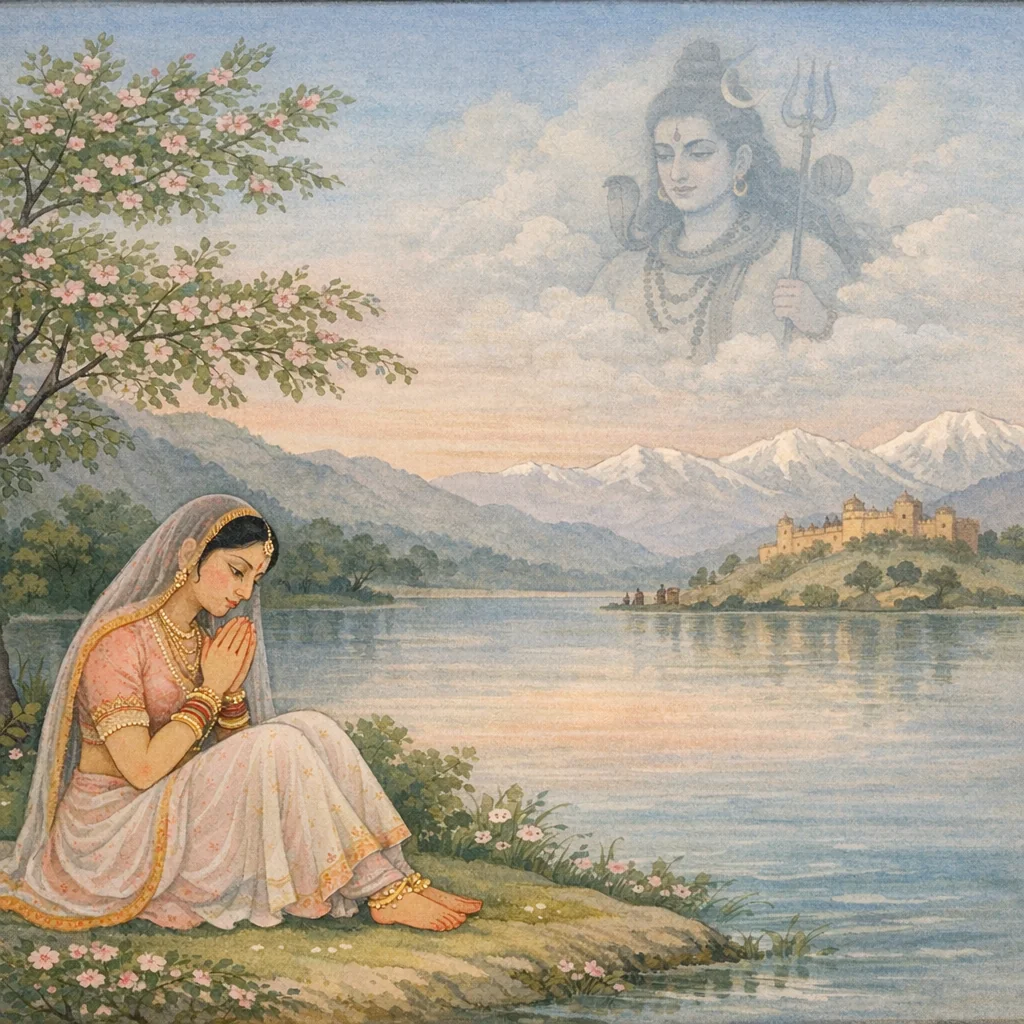
The chapter begins with Nandīśvara’s vow to recount an avatāra of Śambhu (Śiva) meant to dissolve nārī-sandeha—social and theological suspicion directed at women—by revealing Śiva’s compassionate solidarity with his devotees. It introduces King Satyaratha of Vidarbha as dharmic, truthful, and beloved of eminent Śaivas. A sudden war-disaster follows: conflict with the Śālvas ends in the king’s defeat and death, and the remaining troops and ministers scatter. The pregnant queen escapes the besieged city by night, grief-stricken yet sustained by remembrance of Śiva’s lotus-feet. By dawn she reaches a pure lake and shelters beneath a shady tree on its bank. Through this sequence the inner teaching is set: royal power and worldly order are contingent, while smaraṇa-bhakti—devotion through sacred remembrance—stands as the stable axis that draws Śiva’s protective intervention, preparing for a later Śaiva theological resolution that dispels doubt.
Shlokas
Verse 1
नन्दीश्वर उवाच । अथ वक्ष्ये मुनिश्रेष्ठ शम्भोः शृण्ववतारकम् । स्वभक्तदयया विप्र नारीसन्देहभंजकम्
Nandīśvara said: Now, O best of sages, I shall describe an avatāra of Śambhu—listen, O brāhmaṇa—assumed out of compassion for His own devotees, and it destroys the doubts of women.
Verse 2
आसीत्सत्यरथो नाम्ना विदर्भविषये नृपः । धर्म्मात्मा सत्यशीलश्च महाशैवजनप्रियः
In the land of Vidarbha there once ruled a king named Satyaratha—righteous in spirit, steadfast in truth, and dearly beloved by the great devotees of Śiva.
Verse 3
तस्य राज्ञस्सुधर्मेण महीं पालयतो मुने । महान्कालो व्यतीयाय सुखेन शिवधर्म्मतः
O sage, as that king protected the earth through righteous governance, a long span of time passed pleasantly for him, sustained by devotion to Śiva and by conduct rooted in Śiva-dharma.
Verse 4
कदाचित्तस्य राज्ञस्तु शाल्वैश्च पुररोधिभिः । महान्रणो बभूवाथ बहुसैन्यैर्बलोद्धतैः
Once, in the case of that king, a great battle arose with the Śālvas who were besieging the city—proud of their strength and backed by many armies.
Verse 5
स विदर्भनृपः कृत्वा सार्धं तैर्दारुणं रणम् । प्रनष्टोरुबलः शाल्वैर्निहतो दैवयोगतः
The king of Vidarbha fought a dreadful battle together with them; but, his great army being ruined, he was slain by the Śālvas—by the conjunction of fate (daiva).
Verse 6
तस्मिन्नृपे हते युद्धे शाल्वैस्तु भयविह्वलाः । सैनिका हतशेषाश्च मन्त्रिभिस्सह दुद्रुवुः
When that king was slain in battle by the Śālvas, the surviving soldiers—shaken with fear—fled away together with the ministers.
Verse 7
अथ तस्य महाराज्ञी रात्रौ स्वपुरतो मुने । संरुद्धा रिपुभिर्यत्नादन्तर्वत्नी बहिर्ययौ
Then, O sage, that king’s chief queen—pregnant within—was carefully kept under restraint by enemies. Yet, in the night, she went out beyond her own city with great effort.
Verse 8
निर्गता शोकसंतप्ता सा राजमहिषी शनैः । प्राचीं दिशं ययौ दूरं स्मरन्तीशपदाम्बुजम्
Afflicted by burning grief, the queen consort departed and, moving slowly, went far toward the eastern direction—her mind continually remembering the lotus-feet of Īśa (Lord Śiva).
Verse 9
अथ प्रभाते सा राज्ञी ददर्श विमलं सरः । अतीता दूरमध्वानं दयया शङ्करस्य हि
At daybreak, the queen beheld a spotless, pure lake. Having traversed a long distance—indeed by the compassionate grace of Śaṅkara, Lord Śiva—she arrived there.
Verse 10
तत्रागत्य प्रिया राज्ञस्संतप्ता सुकुमारिणी । निवासार्थं सरस्तीरे छायावृक्षमुपाश्रयत्
Having come there, the king’s beloved—tender and delicate, yet afflicted with grief—took refuge beneath a shady tree on the lake’s bank, seeking a place to dwell.
Verse 11
तत्र दैववशाद्राज्ञी मुहूर्त्ते सद्गुणान्विते । असूत तनयं दिव्यं सर्वलक्षणलक्षितम्
There, by the dispensation of providence, the queen—at an auspicious moment endowed with noble qualities—gave birth to a radiant son, marked with all auspicious signs.
Verse 12
अथ तज्जननी दैवात्तृषिताति नृपाङ्गना । सरोवतीर्णा पानार्थं ग्रस्ता ग्राहेण पाथसि
Then, by the turn of destiny, that king’s noble lady—his mother—became exceedingly thirsty. Having descended to the lake to drink, she was seized in the water by a crocodile.
Verse 13
स सुतो जातमात्रस्तु क्षुत्पिपासार्द्दितो भृशम् । रुरोद च सरस्तीरे विनष्ट पितृमातृकः
That son, just born, was severely afflicted by hunger and thirst. Bereft of both father and mother, he cried loudly on the bank of the lake.
Verse 14
तस्मिन्वने क्रन्दमाने जातमात्रे सुते मुने । कृपान्वितो महेशोऽभूदन्तर्यामी स रक्षक
O sage, when the newborn son was crying in that forest, Mahādeva—moved by compassion—became the indwelling Lord (Antaryāmin) and served as his protector.
Verse 15
प्रेरिता मनसा काचिदीशेन त्रासहारिणा । अकस्मादागता तत्र भ्रमन्ती भैक्ष्यजीविनी
Impelling her in mind, the Lord—who removes fear—caused a certain woman, living by alms and wandering about, to arrive there suddenly.
Verse 16
सा त्वेकहायनं बालं वहन्ती विधवा निजम् । अनाथमेकं क्रंदन्तं शिशुन्तत्र ददर्श ह
There she—a widow—was carrying her own one-year-old child; and there she saw another infant, helpless and without protection, crying all alone.
Verse 17
सा दृष्ट्वा तत्र तम्बालं वने निर्मनुजे मुने । विस्मिताति द्विजस्त्री सा चिचिन्तं हृदये बहु
O sage, seeing there a tambāla (a dwelling or structure) in a forest devoid of people, that Brahmin woman was utterly astonished and pondered many thoughts within her heart.
Verse 18
अहो सुमहदाश्चर्य्यमिदं दृष्टम्मयाधुना । असंभाव्यमकथ्यं च सर्वथा मनसा गिरा
Ah! An exceedingly great wonder has been seen by me just now. It is unimaginable and truly inexpressible—utterly beyond both the mind and speech.
Verse 19
अच्छिन्ननाभिनालोयं रसायां केवलं शिशुः । शेते मातृविहीनश्च क्रन्दंस्तेजस्विनां वरः
With his umbilical cord uncut, the infant lay alone upon the watery essence. Deprived of a mother, he cried—yet he was the foremost among the radiant ones.
Verse 20
अस्य पित्रादयः केऽपि न सन्तीह सहायिनः । कारणं किं बभूवाथ ह्यहो दैवबलं महत्
Here, none of his relatives—beginning with his father—are present as helpers. What, then, became the cause of this? Alas, how great indeed is the power of destiny (daiva)!
Verse 21
न जाने कस्य पुत्रोऽयमस्य ज्ञातात्र कोपि न । यतः पृच्छाम्यस्य जन्य जाता च करुणा मयि
I do not know whose son this is, nor is there anyone here who recognizes him. Therefore I ask about his parentage—and compassion has arisen within me for him.
Verse 22
इच्छाम्येनं पोषितुं हि बालमौरसपुत्रवत् । संप्रष्टुं नोत्सहेऽज्ञात्वा कुलजन्मादि चास्य वै
“Indeed I wish to nourish and raise this child as though he were my own son. Yet I do not dare to question him, for I have not ascertained his lineage, his birth, and the rest of his origins.”
Verse 23
नन्दीश्वर उवाच । इति संचिन्त्यमानायां तस्यां विप्रवरस्त्रियाम् । कृपां चकार महतीं शंकरो भक्तवत्सल
Nandīśvara said: As that noble brāhmaṇa lady thus pondered within herself, Śaṅkara—ever tender toward His devotees—bestowed great compassion upon her.
Verse 24
दध्रे भिक्षुस्वरूपं हि महालीलो महेश्वरः । सर्वथा भक्तसुखदो निरुपाधिः स्वयं सदा
Indeed, Mahādeva—Maheśvara of vast divine play—assumed the form of a mendicant. In every way He bestows happiness upon His devotees, for He is ever Self-existent and truly without limiting adjuncts.
Verse 25
तत्राजगाम सहसा स भिक्षुः परमेश्वरः । यत्रास्ति संदेहवती द्विजस्त्री ज्ञातुमिच्छती
At that very place, the Supreme Lord—appearing in the form of a mendicant—arrived at once, where a Brahmin woman, filled with doubt, longed to know the truth.
Verse 26
भिक्षुवर्य्यस्वरूपोऽसावविज्ञातगतिः प्रभुः । तामाह विप्रवनितां विहस्य करुणानिधिः
That Lord—whose ways are beyond ordinary knowing—had assumed the form of an exemplary mendicant. Smiling, that ocean of compassion spoke to the brahmin’s wife.
Verse 27
भिक्षुवर्य्य उवाच । सन्देहं कुरु नो चित्ते विप्रभामिनि मा खिद । रक्षैनम्बालकं प्रीत्या सुपवित्रं स्वपुत्रकम्
The excellent mendicant said: “Let no doubt arise in your mind, O Brahmin lady; do not grieve. Protect this child with affection—this most pure one—as though he were your own son.”
Verse 28
अनेन शिशुना श्रेयः प्राप्स्यसे न चिरात्परम् । पुष्णीहि सर्वथा ह्येनं महातेजस्विनं शिशुम्
Through this child you will soon attain the highest good. Therefore, in every way nurture and protect this infant, for he is a child of great divine splendour.
Verse 29
नन्दीश्वर उवाच । इत्युक्तवन्तं तं भिक्षुस्वरूपं करुणानिधिम् । सा विप्रवनिता शम्भुं प्रीत्या पप्रच्छ सादरम्
Nandīśvara said: When that treasure-house of compassion—Śambhu, who had assumed the form of a mendicant—had thus spoken, the brahmin lady, filled with love, respectfully questioned him.
Verse 30
विप्रवनितोवाच । त्वदाज्ञयैनं बालं हि रक्षिष्यामि स्वपुत्रवत् । पौक्ष्यामि नात्र सन्देहो मद्भाग्यात्त्वमिहागतः
The Brahmin woman said: “By your command, I shall indeed protect this child as my own son. I will nourish and raise him—of this there is no doubt. By my good fortune you have come here.”
Verse 31
तथापि ज्ञातुमिच्छामि विशेषेण तु तत्त्वतः । कोयं कस्य सुतश्चायं कस्त्वमत्र समागतः
Even so, I wish to know clearly, in accord with the true principle: who this person is, whose son he is, and who you are who have come here.
Verse 32
मुहुर्मम समायाति ज्ञानं भिक्षुवर प्रभो । त्वं शिवः करुणासिन्धुस्त्वद्भक्तोयं शिशुः पुरा
Again and again, O Lord, best of mendicants, true understanding arises within me. You are Śiva, an ocean of compassion; and this child here was once Your devotee.
Verse 33
केनचित्कर्मदोषेण सम्प्राप्तोयं दशामिमाम् । तद्भुक्त्वा परमं श्रेयः प्राप्स्यते त्वदनुग्रहात्
Through some fault born of past actions, this one has come to such a state. After experiencing and exhausting that karmic fruit, he will attain the highest good—by Your grace.
Verse 34
त्वन्माययैव साहं वै मार्गभ्रष्टा विमोहिता । आगता प्रेषिता त्वत्तो ह्यस्य रक्षणहेतुतः
By Your māyā alone I too was deluded and strayed from the true path. Yet I have come here, sent by You indeed, for the sake of protecting him.
Verse 35
नन्दीश्वर उवाच । इति तद्दर्शनप्राप्तविज्ञानां विप्रकामिनीम् । ज्ञातुकामां विशेषेण प्रोचे भिक्षुतनुश्शिवः
Nandīśvara said: Thus, to that Brahmin lady—whose understanding had arisen through the vision of Him—when she longed to know the truth more particularly, Śiva, who had assumed the form of a mendicant, spoke to her in detail.
Verse 36
भिक्षुवर्य्य उवाच । शृणु प्रीत्या विप्रपत्नि बालस्यास्य पुरेहितम् । सर्वमन्यस्य सुप्रीत्या वक्ष्यते तत्त्वतोऽनघे
The excellent mendicant said: “Listen with loving attention, O wife of the brāhmaṇa, to the former account of this child. Out of deep goodwill, I shall tell you everything—truthfully and in accordance with reality, O sinless one.”
Verse 37
सुतो विदर्भराजस्य शिवभक्तस्य धीमतः । अयं सत्यरथस्यैव स्वधर्मनिरतस्य हि
He is the son of Satyaratha, the king of Vidarbha—wise, devoted to Lord Śiva, and firmly engaged in his own righteous duty.
Verse 38
शृणु सत्यरथो राजा हतः शाल्वे रणे परैः । तत्पत्नी निशि सुव्यग्रा निर्ययौ स्वगृहाद्द्रुतम्
Listen: King Satyaratha was slain in battle at Śālva by his enemies. Thereupon his wife, greatly distressed in the night, quickly rushed out from her own house.
Verse 39
असूत तनयं चैनं समायाता प्रगेऽत्र हि । सरोवतीर्णा तृषया ग्रस्ता ग्राहेण दैवतः
She bore a son, and then returned here once more. Descending into the lake, tormented by thirst, she was—by divine dispensation—seized by a crocodile.
Verse 40
नन्दीश्वर उवाच । इति तस्य समुत्पत्तिं तत्पितुः संगरे मृतिम् । तन्मातृमरणं ग्राहात्सर्वं तस्य न्यवेदयत्
Nandīśvara said: “Thus I informed him of everything—how he came into being, how his father met death in battle, and how his mother died, seized by the crocodile.”
Verse 41
अथ सा ब्रह्माणी सा हि विस्मिताति मुनीश्वर । पुनः पप्रच्छ तं भिक्षुं ज्ञानिनं सिद्धरूपकम्
Then that Brahmāṇī, astonished, O lord among sages, again questioned that mendicant—the knower of truth—who bore the form of a perfected Siddha.
Verse 42
ब्राह्मण्युवाच । स राजोऽस्य पिता भिक्षो वरभोगान्तरेव हि । कस्माच्छाल्वैस्स्वरिपुभिस्स्वल्पेहैश्च विघातितः
The brāhmaṇa woman said: “O mendicant, his father was a king, enjoying the boons he had obtained. Why, then, was he struck down by the Śālvas—his own enemies—men of petty resolve?”
Verse 43
कस्मादस्य शिशोर्माता ग्राहेणाशु सुभक्षिता । यस्मादनाथोयं जातो विबन्धुश्चैव जन्मतः
“Why was the mother of this infant swiftly devoured by a crocodile? Because of this, the child has been born helpless—indeed, without kinsmen from the very moment of birth.”
Verse 44
कस्मात्सुतो ममापीह सुदरिद्रो हि भिक्षुकः । भवेत्कथं सुखं भिक्षो पुत्रयोरनयोर्वद
“Why is my son here a beggar, exceedingly poor? O mendicant, tell me: how can there be happiness for these two sons?”
Verse 45
नन्दीश्वर उवाच । इति तस्या वचः श्रुत्वा स भिक्षुः परमेश्वरः । विप्रपत्न्याः प्रसन्नात्मा प्रोवाच विहसंश्च ताम्
Nandīśvara said: Having heard her words thus, that mendicant—Parameśvara Himself—became gracious toward the brahmin’s wife and, smiling, spoke to her.
Verse 46
भिक्षुवर्य्य उवाच । विप्रपत्नि विशेषेण सर्वप्रश्नान्वदामि ते । शृणु त्वं सावधानेन चरित्रमिदमुत्तमम्
The foremost mendicant said: “O wife of a brāhmaṇa, I shall answer all your questions in detail. Listen attentively to this excellent sacred account.”
Verse 47
अमुष्य बालस्य पिता स विदर्भमहीपतिः । पूर्वजन्मनि पाण्ड्योऽसौ बभूव नृपसत्तमः
The father of that boy was the sovereign ruler of Vidarbha. In a former birth, that very one had been the king of the Pāṇḍya land—an excellent among kings.
Verse 48
स शैवनृपतिर्धर्मात्पालयन्निखिला महीम् । स्वप्रजां रंजयामास सर्वोपद्रवनाशनः
That Śaiva king, upholding dharma, protected the entire earth; and, as a destroyer of every calamity, he delighted and prospered his own subjects.
Verse 49
कदाचित्स हि सर्वेशं प्रदोषे पर्यपूजयत् । त्रयोदश्यां निराहारो दिवानक्तव्रती शिवम्
Once, on a Pradoṣa evening, he duly worshipped Lord Śiva, the Supreme Lord of all. On the thirteenth lunar day (trayodaśī), he fasted without food, observed the vow through day and night, and worshipped Śiva with disciplined devotion.
Verse 50
तस्य पूजयतः शम्भुं प्रदोषे गिरिशं रते । महाञ्छब्दो बभूवाथ विकटस्सर्वथा पुरे
As he worshipped Śambhu—Giriśa, Lord of the Mountain—at the sacred pradoṣa hour with joyful devotion, a mighty and dreadful uproar suddenly arose throughout the city on every side.
Verse 51
तमाकर्ण्य रवं सोऽथ राजा त्यक्तशिवार्चनः । रिप्वागमनशंकातो निर्ययौ भवनाद्बहिः
Hearing that clamorous sound, the king at once abandoned his worship of Śiva; fearing an enemy’s arrival, he hurried out from the palace to the outside.
Verse 52
एतस्मिन्नेव काले तु तस्यामात्यो महाबली । गृहीतशस्त्रसामन्तो राजान्तिकमुपाययौ
At that very time, his mighty minister—accompanied by feudatory chiefs who had taken up weapons—went into the king’s presence.
Verse 53
तन्दृष्ट्वा शत्रुसामन्तं महाक्रोधेन विह्वलः । अविचार्य वृषन्तस्य शिरश्छेदमकारयत्
Seeing that hostile vassal-lord, he was overwhelmed by fierce wrath; and, without deliberation, he caused Vṛṣanta’s head to be cut off.
Verse 54
असमाप्ये शपूजान्तामशुचिर्नष्टधीर्नृपः । रात्रौ चकार सुप्रीत्या भोजनन्नष्टमंगलः
With the worship not yet concluded, the king—impure and of bewildered mind—ate at night with complacent delight, and thus his auspicious fortune was destroyed.
Verse 56
तत्पुत्रो यः पूर्वभवे सोऽस्मिञ्जन्मनि तत्सुतः । अहमेव हतैश्वर्य्यः शिवपूजा व्यतिक्रमात्
He who was his son in a former life has become his son again in this birth. And I myself have been deprived of prosperity and lordly fortune, because I transgressed the worship owed to Lord Śiva.
Verse 57
अस्य माता पूर्वभवे सपत्नीं छद्मनाहरत् । भक्षिता तेन पापेन ग्राहेणाऽस्मिन्भवे हि सा
In a former birth, this man’s mother deceitfully abducted her co-wife. Therefore, as the fruit of that sin, in this birth she has indeed been devoured by a crocodile.
Verse 59
एष ते तनयः पूर्वजन्मनि ब्राह्मणोत्तमः । प्रतिग्रहैर्वयो निन्ये न यज्ञाद्यैस्सुकर्मभिः
“This son of yours was, in a former birth, an excellent brāhmaṇa. Yet he spent his life merely on receiving gifts as a livelihood, and not on meritorious deeds such as yajñas and other sacred observances.”
Verse 60
अतो दारिद्र्यमापन्नः पुत्रस्ते द्विजभामिनि । तद्दोषपरिहारार्थं शरणं शंकरं व्रज
Therefore, O radiant lady of a brāhmaṇa house, your son has fallen into poverty. To remove that fault and its consequence, take refuge in Śaṅkara (Lord Śiva).
Verse 61
एताभ्यां खलु बालाभ्यां शिवपूजाविधीयताम् । उपवीतानन्तरं हि शिवः श्रेयः करिष्यति
Indeed, let Śiva-worship be enjoined for these two boys; for after the investiture with the sacred thread (upavīta), Śiva will surely bring about their highest welfare and auspicious good.
Verse 62
नन्दीश्वर उवाच । इति तामुपदिश्याथ भिक्षुवर्ण्यतनुः शिवः । स्वरूपं दर्शयामास परमं भक्तवत्सलः
Nandīśvara said: Having thus instructed her, Śiva—whose body had assumed the appearance of a mendicant—then revealed His own supreme form, for He is utterly tender toward His devotees.
Verse 63
अथ सा विप्रवनिता ज्ञात्वा तं शंकरम्प्रभुम् । सुप्रणम्य हि तुष्टाव प्रेम्णा गद्गदया गिरा
Then that Brahmin woman, recognizing Him as Śaṅkara—the Supreme Lord—bowed down with deep reverence and, filled with love, praised Him in a voice trembling with devotion.
Verse 64
ततस्स भगवाञ्च्छम्भुर्धृतभिक्षुतनुर्द्रुतम् । पश्यन्त्या विप्रपन्त्यास्तु तत्रैवान्तरधीयत
Then Bhagavān Śambhu (Śiva), having assumed the form of a mendicant, swiftly vanished right there, even as the brāhmaṇa’s wife looked on.
Verse 65
अथ तस्मिन् गते भिक्षौ विश्रब्धा ब्राह्मणी च सा । तमर्भकं समादाय सस्वपुत्रा गृहं ययौ
When that mendicant had departed, the brāhmaṇa woman—now reassured—took up that little child and, along with her own son, went back to her home.
Verse 66
एकचक्राह्वये रम्ये ग्राम्ये कृत निकेतना । स्वपुत्रं राजपुत्रं च वरान्नैश्च व्यवर्द्धयत्
Making her home in the lovely village called Ekacakra, she carefully brought up both her own son and the king’s son, nourishing them with excellent food and provisions.
Verse 67
ब्राह्मणै कृतसंस्कारौ कृतोपनयनौ च तौ । ववृधाते स्वगेहे च शिवपूजनतत्परौ
Having had their purificatory rites performed by brāhmaṇas, and having duly undergone the upanayana initiation, the two of them grew up in their own home—ever devoted to the worship of Lord Śiva.
Verse 68
तौ शाण्डिल्यमुनेस्तात निदेशान्नियम स्थितौ । प्रदोषे चक्रतुः शम्भोः पूजां कृत्वा व्रतं शुभम्
O dear one, abiding by the injunction of the sage Śāṇḍilya and established in disciplined observances, the two performed—at the sacred pradoṣa time—the worship of Śambhu; and having worshipped Him, they undertook an auspicious vow.
Verse 69
कदाचिद्द्विजपुत्रेण विनाऽसौ राजनन्दनः । नद्यां स्नातुं गतः प्राप निधानकलशं वरम्
Once, that prince—without the brāhmin’s son accompanying him—went to bathe in the river, and there he obtained an excellent pot of hidden treasure.
Verse 70
एवं पूजयतोः शम्भुं राजद्विजकुमारयोः । सुखेनैव व्यतीयाय तयोर्मासचतुष्टयम्
Thus, as the prince and the young brahmin continued to worship Śambhu, four months passed for them with ease, peace, and contentment.
Verse 71
एवमर्चयतोः शम्भुं भूयोपि परया मुदा । सम्वत्सरो व्यतीयाय तस्मिन्नेव तयोर्गृहे
Thus, as the two of them worshipped Śambhu again and again with supreme joy, a full year passed in that very house of theirs.
Verse 72
सम्वत्सरे व्यतिक्रान्ते स राजतनयो मुने । गत्वा वनान्ते विप्रेण शिवस्यानुग्रहाद्विभोः
O sage, when a year had passed, that prince—by the grace of the all-pervading Lord Śiva—went with a brāhmaṇa into the interior of the forest.
Verse 73
अकस्मादागतां तत्र दत्तां तज्जनकेन ह । विवाह्य गन्धर्वसुतां चक्रे राज्यमकण्टकम्
There, a Gandharva maiden who had arrived unexpectedly was indeed given to him by her father. Having married that daughter of the Gandharvas, he made his kingdom “without thorns”—free from obstacles and affliction.
Verse 74
या विप्रवनिता पूर्वंतमपुष्णात्स्वपुत्रवत् । सैव माताभवत्तस्य स भ्राता द्विजनन्दनः
That brāhmaṇa lady who, in earlier times, had nurtured him as though he were her own son—she indeed became his mother; and the twice-born youth whom she had borne became his brother, O best of brāhmaṇas.
Verse 76
भिक्षुवर्य्यावतारस्ते वर्णितश्च मयाधुना । शिवस्य धर्मगुप्ताह्व नृपबालसुखप्रदः
I have now described to you that excellent incarnation of Śiva as the foremost mendicant, named Dharma-gupta, who bestows happiness upon the king’s child.
Verse 77
एतदाख्यानमनघं पवित्रं पावनं महत् । धर्मार्थकाममोक्षाणां साधनं सर्वकामदम्
This faultless sacred narrative is pure, greatly purifying, and exalted. It is a means to attain dharma, artha, kāma, and mokṣa, and it bestows the fulfillment of all rightful desires.
Verse 78
य एतच्छ्रृणुयान्नित्यं श्रावयेद्वा समाहितः । स भुक्त्वेहाखिलान्कामान्सोन्ते शिवपुरम्व्रजेत्
Whoever regularly listens to this sacred account, or, with a concentrated mind, causes it to be heard by others—having enjoyed here all desirable fulfillments, in the end goes to Śiva’s abode, Śivapura.
Verse 95
विदर्भे सोभवद्राजा जन्मनीह शिवव्रती । शिवार्चनान्तरायेण परैर्भोगांन्तरे हतः
In the land of Vidarbha he was born a king, steadfast in the vow of devotion to Śiva. Yet, as others obstructed his worship of Śiva, he was slain amid his worldly enjoyments.
Frequently Asked Questions
It begins the Śambhu-avatāra narrative explicitly described as ‘nārī-sandeha-bhañjaka’ (doubt-dispelling regarding women), using the historical crisis of Vidarbha—Satyaratha’s death in war and the pregnant queen’s flight—to set up a theological demonstration of Śiva’s protective grace toward devotees in conditions of social vulnerability.
Three symbols are foregrounded: (1) the queen’s pregnancy signifies continuity of dharma and lineage under threat, making protection a sacred obligation; (2) the ‘vimala’ lake functions as a tīrtha-like purity marker where worldly defilement is ritually and psychologically suspended; (3) remembrance of Śiva’s lotus-feet encodes smaraṇa as an inner ritual that stabilizes the devotee when external rites and institutions collapse.
The chapter highlights Śambhu (Śiva) primarily in the mode of compassionate protector (dayālu-anugrahakartṛ) whose avatāra is purposively narrated to correct social-theological suspicion; Gaurī is not explicit in the provided verses, while Śiva’s presence is mediated through devotion (pādāmbuja-smaraṇa) and the promised avatāra-kathā.