मेनावरलाभवर्णनम् — Description of Menā’s Attainment of Boons (and the worship leading to Umā’s advent)
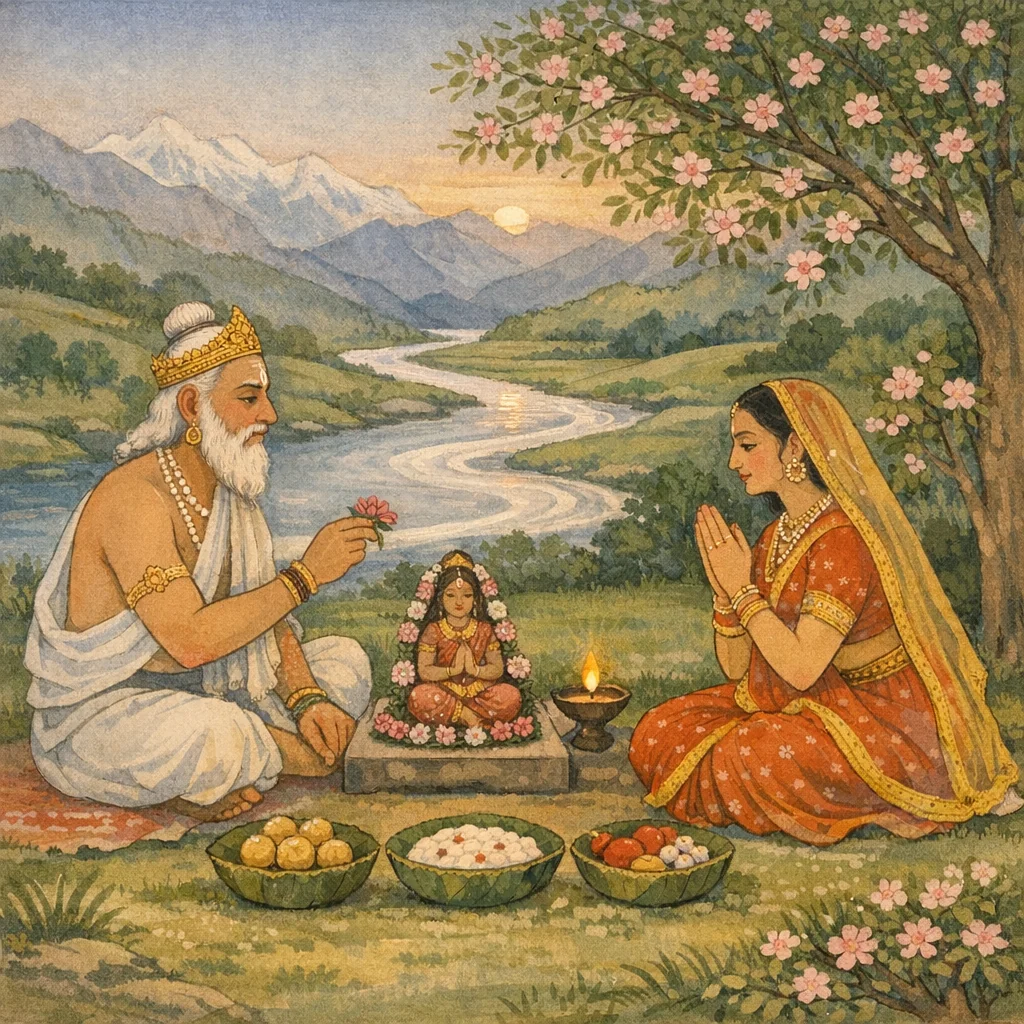
Adhyāya 5 is cast as a dialogue between Nārada and Brahmā. Nārada asks what happened after Devī Durgā withdrew from sight and the gods returned to their abodes, and how Himālaya and Menā performed tapas and worship to obtain a daughter. Brahmā, invoking Śaṅkara, recounts their disciplined bhakti: constant contemplation of Śiva and Śivā, steady pūjā, reverence to the Devī, and gifts to brāhmaṇas to please the Goddess. Menā’s long observance is marked by ritual time—beginning in Caitra and continuing for many years—with fasting on aṣṭamī and offerings on navamī. The chapter details specific upacāras such as modaka, bali/piṣṭa preparations, pāyasa, fragrances, and flowers, and describes making an earthen image of Umā near the Gaṅgā for pūjā with varied offerings. Thus it joins narrative causality (tapas → divine satisfaction → boon and progeny) with prescriptive ritual detail, presenting Menā’s vrata-like worship as a model of efficacious devotion.
Shlokas
Verse 1
नारद उवाच । अन्तर्हितायान्देव्यां तु दुर्गायां स्वगृहेषु च । गतेष्वमरवृन्देषु किमभूत्तदनन्तरम्
Nārada said: “When Goddess Durgā had vanished and returned to her own abode, and when the hosts of devas had departed to their respective dwellings, what happened immediately thereafter?”
Verse 2
कथं मेनागिरीशौ च तेपाते परमन्तपः । कथं सुताऽभवत्तस्य मेनायान्तात तद्वद
“O mighty one, tell me how Menā and the lord of mountains (Himālaya) performed the supreme austerities; and explain how a daughter was born to him—born from within Menā.”
Verse 3
ब्रह्मोवाच । विप्रवर्य सुतश्रेष्ठ शृणु तच्चरितं महत् । प्रणम्य शंकरं भक्त्या वच्मि भक्तिविवर्द्धनम्
Brahmā said: “O foremost of brāhmaṇas, O best among sons, listen to that great sacred account. Having bowed to Śaṅkara with devotion, I shall relate what increases bhakti.”
Verse 4
उपदिश्य गते तात सुरवृन्दे गिरीश्वरः । हर्यादौ मेनका चापि तेपाते परमन्तपः
O dear one, after instructing them and when the hosts of gods had departed, Girīśvara (Śiva), along with Hari and the others, and also Menakā, undertook intense austerities—by supreme tapas burning away all obstacles.
Verse 5
इति श्रीशिवमहापुराणे द्वितीयायां रु० सं० तृतीये पार्वतीखंडे मेनावरलाभवर्णनो नाम पंचमोऽध्यायः
Thus ends the Fifth Chapter, entitled “The Description of Obtaining Menā (as a boon),” in the Pārvatī-khaṇḍa of the third section of the Rudra-saṃhitā, within the second book of the Śrī Śiva Mahāpurāṇa.
Verse 6
गिरिप्रियातीव मुदानर्च देवीं शिवेन सा । दानन्ददौ द्विजेभ्यश्च सदा तत्तोषहेतवे
Greatly delighting Giripriyā (Pārvatī), the Goddess worshipped Śiva with joy; and, to please Him, she continually bestowed gifts upon the twice-born (brāhmaṇas).
Verse 7
चैत्रमासं समारभ्य सप्तविंशतिवत्सरान् । शिवां सम्पूजयामासापत्त्यार्थिन्यन्वहं रता
Beginning with the month of Caitra, she—seeking relief from her distress—worshipped Śivā, the Divine Consort of Śiva, every day with full devotion, and continued this worship for twenty-seven years.
Verse 8
अष्टम्यामुपवासन्तु कृत्वादान्नवमीतिथौ । मोदकैर्बलिपिष्टैश्च पायसैर्गन्धपुष्पकैः
Let them fast on the eighth lunar day; and on the ninth tithi, after making offerings, let them worship with sweet modakas, ritual portions of flour, pāyasa (milk-rice pudding), and fragrant flowers.
Verse 9
गङ्गायामौषधिप्रस्थे कृत्वा मूर्तिं महीमयीम् । उमायाः पूजयामास नानावस्तुसमर्पणैः
On the bank of the Gaṅgā, upon a spot rich with sacred herbs, he fashioned an earthen image and worshipped Umā by offering many kinds of ritual substances.
Verse 10
कदाचित्सा निराहारा कदाचित्सा धृतव्रता । कदाचित्पवनाहारा कदाचिज्जलभुघ्यभूत्
At times she remained without food; at times she steadfastly upheld her sacred vow. At times she lived on air alone, and at times she subsisted only on water—thus did she perform her austerities (tapas).
Verse 11
शिवाविन्यस्तचेतस्का सप्तविंशतिवत्सरान् । निनाय मेनका प्रीत्या परं सा मृष्टवर्चसा
With her mind firmly placed in Lord Śiva, Menakā lovingly nurtured (her daughter) for twenty-seven years; and she (Pārvatī) became supremely radiant, her splendor refined and purified by that steadfast devotion.
Verse 12
सप्तविंशतिवर्षान्ते जगन्माता जगन्मयी । सुप्रीताभवदत्यर्थमुमा शंकरकामिनी
At the end of twenty-seven years, Umā—Mother of the universe and pervader of the universe—became exceedingly pleased, for she longed for Śaṅkara (Śiva).
Verse 13
अनुग्रहाय मेनायाः पुरतः परमेश्वरी । आविर्बभूव सा देवी सन्तुष्टा तत्सुभक्तितः
To bestow grace upon Menā, the Supreme Goddess (Parameśvarī) manifested directly before her. That Devī appeared, pleased and satisfied by her noble devotion.
Verse 14
दिव्यावयवसंयुक्ता तेजोमण्डलमध्यगा । उवाच विहसन्ती सा मेनां प्रत्यक्षतां गता
Endowed with celestial limbs and abiding in the midst of a radiant circle of splendor, she—smiling—spoke to Menā, having revealed herself directly before her.
Verse 15
देव्युवाच वरं ब्रूहि महासाध्वि यत्ते मनसि वर्तते । सुप्रसन्ना च तपसा तवाहं गिरिकामिनि
The Goddess said: “O great and virtuous lady, speak the boon that abides in your mind. O beloved born of the mountain, I am exceedingly pleased with your austerity (tapas).”
Verse 16
यत्प्रार्थितं त्वया मेने तपोव्रतसमाधिना । दास्ये तेऽहं च तत्सर्वं वाञ्छितं यद्यदा भवेत्
“Whatever you have prayed for with the discipline of austerity, vow (vrata), and meditative absorption (samādhi), I accept. I shall grant you all of that—every desired boon—whenever it is to be fulfilled.”
Verse 17
ततस्सा मेनका देवीं प्रत्यक्षां कालिकान्तदा । दृष्ट्वा च प्रणनामाथ वचनं चेदमब्रवीत्
Then Menakā, beholding the Goddess manifest before her—radiant with a dark, Kālikā-like splendor—bowed down in reverence and spoke these words.
Verse 18
मेनोवाच । देवि प्रत्यक्षतो रूपन्दृष्टन्तव मयाऽधुना । त्वामहं स्तोतुमिच्छामि प्रसन्ना भव कालिके
Mena said: “O Goddess, I have now beheld Your form directly with my own eyes. I wish to praise You; be gracious and favorably disposed, O Kālikā.”
Verse 19
ब्रह्मोवाच । अथ सा मेनयेत्युक्ता कालिका सर्वमोहिनी । बाहुभ्यां सुप्रसन्नात्मा मेनकां परिषस्वजे
Brahmā said: Then that Kālikā—who bewilders all—being addressed as “O Menā,” became fully gracious in heart and embraced Menakā with both her arms.
Verse 20
ततः प्राप्तमहाज्ञाना मेनका कालिकां शिवम् । तुष्टाव वाग्भि रिष्टाभिर्भक्त्या प्रत्यक्षतां गताम्
Then Menakā, having attained great spiritual discernment, praised Kālikā—Śiva’s divine Śakti—who had become manifest before her, with cherished words and heartfelt devotion.
Verse 21
मेनोवाच । महामायां जगद्धात्रीं चण्डिकां लोकधारिणीम् । प्रणमामि महादेवीं सर्वकामार्थदायिनीम्
Mena said: I bow to the Mahādevī—She who is the Great Māyā, the Mother who bears the universe, the fierce Caṇḍikā who upholds the worlds—who bestows every desired aim and fulfillment.
Verse 22
नित्यानन्दकरीं मायां योगनिद्रां जगत्प्रसूम् । प्रणमामि सदासिद्धां शुभसारसमालिनीम्
I bow to that sacred Māyā—who bestows eternal bliss, who is Yoga-nidrā, the Mother who brings forth the worlds—ever-accomplished, and adorned with a garland made of the very essence of auspiciousness.
Verse 23
मातामहीं सदानन्दां भक्तशोकविनाशिनीम् । आकल्पं वनितानां च प्राणिनां बुद्धिरूपिणीम्
She is the great Mother of the earth, ever-blissful, the destroyer of devotees’ sorrow; enduring through all ages, she abides as the very form of intelligence within women and within all living beings.
Verse 24
सा त्वं बंधच्छेदहेतुर्यतीनां कस्ते गेयो मादृशीभिः प्रभावः । हिंसाया वाथर्ववेदस्य सा त्वं नित्यं कामं त्वं ममेष्टं विधेहि
You are the very cause by which ascetics cut the bonds of bondage; who among women like me could ever adequately sing of Your power? You are also that power connected with the Atharvaveda and with the restraint of violence. Therefore, O ever-present One, fulfil my constant longing; grant me what I desire.
Verse 25
नित्यानित्यैर्भावहीनैः परास्तैस्तत्तन्मात्रैर्योज्यते भूतवर्गः । तेषां शक्तिस्त्वं सदा नित्यरूपा काले योषा योगयुक्ता समर्था
By the subtle essences (tanmātras)—some held to be eternal and some non-eternal—devoid of independent being and subordinate in nature, the multitude of elements is brought into ordered combination. You are the Power (Śakti) of them all, ever of eternal form; as Time’s sovereign Lady, united with Yoga, you are fully capable of manifesting and governing the cosmos.
Verse 26
योनिर्धरित्री जगतां त्वमेव त्वमेव नित्या प्रकृतिः परस्तात् । यथा वशं क्रियते ब्रह्मरूपं सा त्वं नित्या मे प्रसीदाद्य मातः
You alone are the womb and the sustaining earth of all worlds; you alone are the eternal Prakṛti, transcendent beyond all. By you even the principle called Brahman is brought under governance and made manifest in form. O eternal Mother, be gracious to me today.
Verse 27
त्वं जातवेदोगतशक्तिरुग्रा त्वं दाहिका सूर्यकरस्य शक्तिः । आह्लादिका त्वं बहुचन्द्रिका या तान्त्वामहं स्तौमि नमामि चण्डीम्
You are the fierce power abiding in Jātavedas (Agni); you are the burning energy within the sun’s rays. You are also the cooling, delight-giving moonlight that shines in many ways. Therefore I praise you and bow to you, O Caṇḍī.
Verse 28
योषाणां सत्प्रिया च त्वं नित्या त्वं चोर्ध्वरेतसाम् । वांछा त्वं सर्वजगतां धाया च त्वं यथा हरेः
You are the true beloved of women; and you are the eternal one for the celibate ascetics of raised seed. You are the very longing within all worlds; and you are the sustaining support—just as Lakṣmī is for Hari (Viṣṇu).
Verse 29
या चेष्टरूपाणि विधाय देवी सृष्टिस्थितानाशमयी च कर्त्री । ब्रह्माच्युतस्थाणुशरीरहेतुस्सा त्वं प्रसीदाद्य पुनर्नमस्ते
O Goddess—You who fashion every mode of activity; You, the Doer whose very nature is creation, preservation, and dissolution; You who are the cause of the embodied manifestation of Brahmā, Acyuta (Viṣṇu), and Sthāṇu (Śiva)—be gracious today. Again and again, salutations to You.
Verse 30
ब्रह्मोवाच । तत इत्थं स्तुता दुर्गा कालिका पुनरेव हि । उवाच मेनकां देवीं वांछितं वरयेत्युत
Brahmā said: Thus praised in this manner, Durgā—Kālikā indeed—again spoke to the goddess Menakā: “Choose the boon you desire.”
Verse 31
उमोवाच । प्राणप्रिया मम त्वं हि हिमाचलविलासिनी । यदिच्छसि ध्रुवन्दास्ये नादेयं विद्यते मम
Umā said: “O beloved of my very life, O lady who delights in Himālaya’s abode—if you wish to remain steadfast in service, there is nothing that I cannot give you.”
Verse 32
इति श्रुत्वा महेशान्याः पीयूषसदृशं वचः । उवाच परितुष्टा सा मेनका गिरिकामिनी
Hearing these nectar-like words spoken by Maheśānī (Pārvatī), Menakā—the beloved of the mountain-king—became fully pleased and then spoke.
Verse 33
मेनोवाच । शिवे जयजय प्राज्ञे महेश्वरि भवाम्बिके । वरयोग्यास्महं चेत्ते वृणे भूयो वरं वरम्
Mena said: “Victory, victory to You, O Śivā—O wise One, O Maheśvarī, O Mother Bhavāmbikā. If I am indeed fit to receive a boon from You, then I ask again for yet another excellent boon.”
Verse 34
प्रथमं शतपुत्रा मे भवन्तु जगदम्बिके । बह्वायुषो वीर्यवन्त ऋद्धिसिद्धिसमन्विताः
“First, O Mother of the worlds, may I be blessed with a hundred sons—long-lived, full of vigor, and endowed with prosperity and spiritual attainments (siddhis).”
Verse 35
पश्चात्तथैका तनया स्वरूपगुणशालिनी । कुलद्वयानंदकरी भुवनत्रयपूजिता
Thereafter, a single daughter was born—endowed with beauty of form and excellence of virtues. She became the joy of both lineages and was revered throughout the three worlds.
Verse 36
सुता भव मम शिवे देवकार्यार्थमेव हि । रुद्रपत्नी भव तथा लीलां कुरु भवाम्बिके
“O Śivā, become My daughter—indeed, solely for fulfilling the gods’ purpose. And then become the consort of Rudra. O Bhavāmbikā, manifest this divine play (līlā).”
Verse 37
ब्रह्मोवाच । तच्छ्रुत्वा मेनकोक्तं हि प्राह देवी प्रसन्नधीः । स्मितपूर्वं वचस्तस्याः पूरयन्ती मनोरथम्
Brahmā said: Hearing what Menakā had spoken, the Goddess—her mind serene and pleased—replied with a gentle smile, granting and fulfilling her mother’s cherished wish.
Verse 38
देव्युवाच । शतपुत्रास्सं भवन्तु भवत्या वीर्यसंयुताः । तत्रैको बलवान्मुख्यः प्रधमं संभविष्यति
The Goddess said: “May a hundred sons, endowed with heroic potency, be born to you. Among them, one—strong and foremost—shall be born first.”
Verse 39
सुताहं संभविष्यामि सन्तुष्टा तव भक्तितः । देव कार्यं करिष्यामि सेविता निखिलैस्सुरैः
Pleased by your devotion, I shall indeed be born as your daughter. I will accomplish the work of the gods, and I shall be honoured and attended by all the devas.
Verse 40
ब्रह्मोवाच । एवमुक्त्वा जगद्धात्री कालिका परमेश्वरी । पश्यन्त्या मेनकायास्तु तत्रैवान्तर्दधे शिवा
Brahmā said: Having spoken thus, the Supreme Goddess Kālikā—she who upholds the worlds—vanished right there, even as Menakā looked on.
Verse 41
मेनकापि वरं लब्ध्वा महेशान्या अभी प्सितम् । मुदं प्रापामितां तात तपःक्लेशोप्यनश्यत
Having obtained the boon long desired by Maheśānī (Pārvatī), Menakā too was filled with joy; and, dear one, even the hardship born of austerity was thereby dispelled.
Verse 42
दिशि तस्यां नमस्कृत्य सुप्रहृष्टमनास्सती । जयशब्दं प्रोच्चरंती स्वस्थानम्प्रविवेश ह
Having bowed in that very direction, Satī—her mind filled with great joy—uttered cries of “Victory!” and then entered her own abode.
Verse 43
अथ तस्मै स्वपतये शशंस सुवरं च तम् । स्वचिह्नबुद्धमिव वै सुवाचा पुनरुक्तया
Then, to her own Lord and Husband, she proclaimed that excellent boon—reaffirming it again in sweet words, as though he already understood it by his own sign.
Verse 44
श्रुत्वा शैलपतिर्हृष्टोऽभवन्मेनावचो हि तत् । प्रशशंस प्रियां प्रीत्या शिवाभक्तिरतां च ताम्
Hearing Menā’s words, the lord of the mountain was filled with delight. With affectionate joy he praised his beloved wife, seeing her steadfast in bhakti to Lord Śiva.
Verse 45
कालक्रमेणाऽथ तयोः प्रवृत्ते सुरते मुने । गर्भो बभूव मेनाया ववृधे प्रत्यहं च सः
In the course of time, O sage, when their union took place, Menā conceived. That embryo then grew day by day.
Verse 46
असूत सा नागवधूपभोग्यं सुतमुत्तमम् । समुद्रबद्धसत्सख्यं मैनाकाभिधमद्भुतम्
She gave birth to an excellent and wondrous son named Maināka—fit to be the husband of a Nāga maiden—bound to the ocean and firmly allied in true friendship with the Sea.
Verse 47
वृत्रशत्रावपि क्रुद्धे वेदनाशं सपक्षकम् । पविक्षतानां देवर्षे पक्षच्छिदि वराङ्गकम्
O divine sage, even when Indra—the slayer of Vṛtra—was enraged, this power destroyed suffering together with its “wings”, the supporting causes. For those struck by the vajra, it became a noble means of severing the wings, cutting off the capacity for renewed harm.
Verse 48
प्रवरं शतपुत्राणां महाबलपराक्रमम् । स्वोद्भवानां महीध्राणां पर्वतेन्द्रैकधिष्ठितम्
He was the foremost among the hundred sons—endowed with immense strength and valor—born of the mountain-line itself, and uniquely established as the single sovereign among the lords of mountains.
Verse 49
आसीन्महोत्सवस्तत्र हिमाचलपुरेऽद्भुतः । दम्पत्योः प्रमुदाधिक्यं बभूव क्लेशसंक्षयः
In Himācala’s city, a wondrous great festival took place. For the divine couple, joy increased greatly, and their afflictions diminished.
Verse 50
दानन्ददौ द्विजातिभ्योऽन्येभ्यश्च प्रददौ धनम् । शिवाशिवपदद्वन्द्वे स्नेहोऽभूदधिकस्तयोः
He joyfully bestowed gifts upon the twice-born and also gave wealth to others. Between the pair—through auspicious and inauspicious states—their mutual affection grew all the more.
Frequently Asked Questions
Nāradā asks about the aftermath of Devī Durgā’s withdrawal (antarhita) and the gods’ departure, leading Brahmā to narrate Himālaya and Menā’s tapas and worship that culminate in the attainment of a daughter/boon connected with Umā/Pārvatī.
The chapter models bhakti as continuous remembrance of Śiva–Śivā paired with disciplined ritual action; tapas is portrayed as the stabilization of intention and purity that makes divine grace (anugraha) operative in worldly outcomes (such as auspicious progeny).
Devī appears in the chapter’s frame as Durgā (whose withdrawal prompts the inquiry) and as Umā (the focus of Menā’s image-making and pūjā), while Śiva is invoked as Śaṅkara/Śambhu as the theological ground of the narrative.