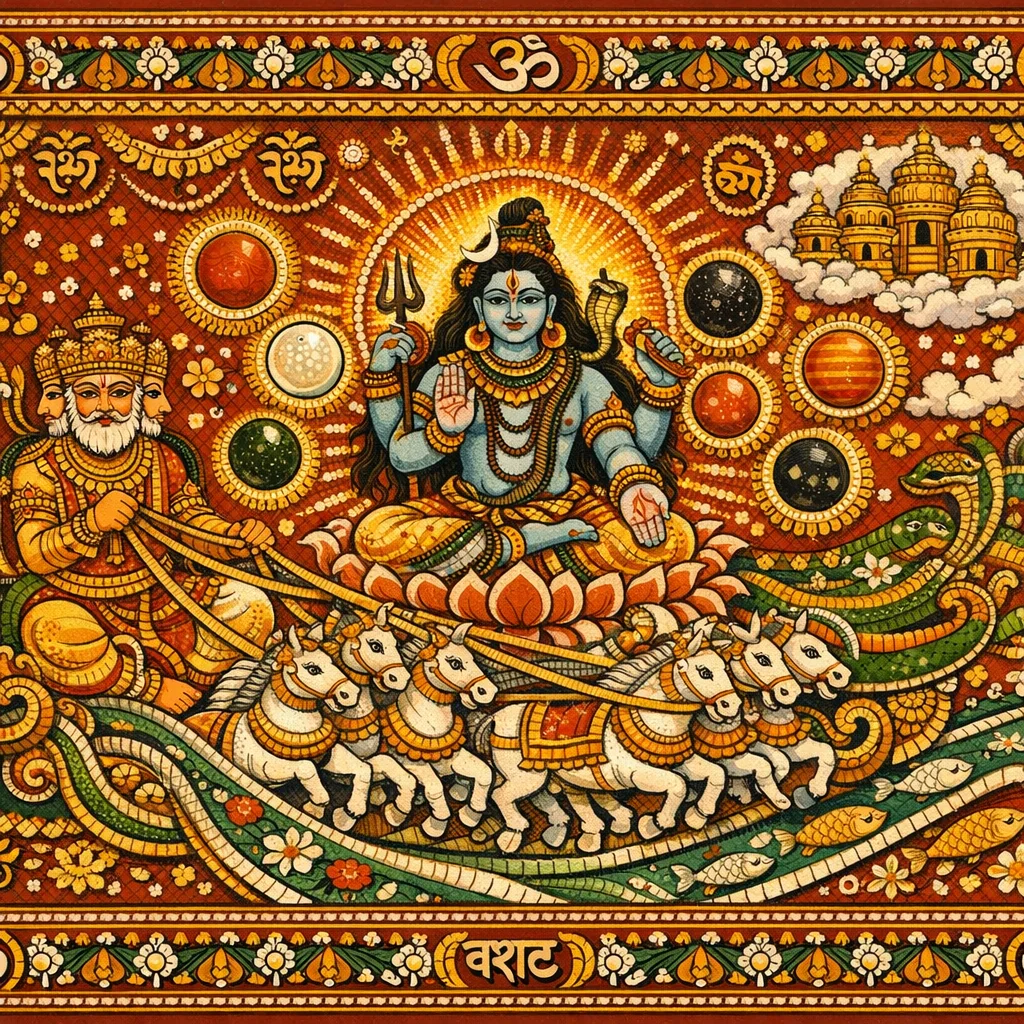
Adhyaya 133: The Gods Seek Śiva’s Refuge: The Cosmic Chariot Prepared for the Burning of Tripura
त्रिपुरदाहाय देवैर् रथनिर्माणवर्णनम्
Speaker: Sūta, Mahādeva (Śiva/Rudra), The Devas (with Brahmā and Indra)
Sūta recounts how the devas, tormented by the Dānavas dwelling in Māyā’s Tripura, seek refuge in Mahādeva Śiva. Śiva receives them graciously, promises their welfare, and declares he will burn Tripura, instructing them to construct a fitting chariot. The gods assemble a “world-chariot” through cosmic and ritual correspondences: mountains as the frame, luminaries and time-cycles as the mechanisms, planets and nāgas as bindings and guards, rivers as named structural members, the Vedas as horses, Oṃ as the goad, and the seasons and the year as the bow’s architecture. A tri-divine missile (Viṣṇu–Soma–Agni) is then constituted. At last Brahmā becomes the charioteer; Śiva mounts the chariot; and the retinue—Nandin, the Pramathas, Kumāra, the directional guardians, and the Maharṣis—advances toward Tripura amid thunderous acclamation.
Key Concepts
Shlokas in Adhyaya 133
Verse 1
*सूत उवाच ब्रह्माद्यैः स्तूयमानस्तु देवैर्देवो महेश्वरः प्रजापतिमुवाचेदं देवानां क्व भयं महत् //
Sūta said: While the gods—beginning with Brahmā—were praising him, the divine Mahādeva (Maheśvara) said this to Prajāpati: “Where, indeed, does this great fear of the gods come from?”
Verse 2
भो देवाः स्वागतं वो ऽस्तु ब्रूत यद्वो मनोगतम् तावदेव प्रयच्छामि नास्त्यदेयं मया हि वः //
O Devas, welcome to you. Speak what is in your minds. I shall grant it at once—indeed, for you there is nothing that cannot be given by me.
Verse 3
युष्माकं नितरां शं वै कर्ताहं विबुधर्षभाः चरामि महदत्युग्रं यच्चापि परमं तपः //
O best among the divine sages, I shall indeed bring you profound welfare; and I undertake that great, exceedingly fierce discipline which is also called the highest austerity.
Verse 4
विद्विष्टा वो मम द्विष्टाः कष्टाः कष्टपराक्रमाः तेषामभावः संपाद्यो युष्माकं भव एव च //
Those who hate you are also my enemies—cruel men of harsh and perilous might. Their removal must be brought about; and your own security and continued welfare must likewise be ensured.
Verse 5
एवमुक्तास्तु देवेन प्रेम्णा सब्रह्मकाः सुराः रुद्रमाहुर्महाभागं भागार्हाः सर्व एव ते //
Thus addressed with affection by the Lord, the gods—together with Brahmā—declared Rudra to be the greatly fortunate one; indeed, all of them were worthy of receiving their due shares in the sacrificial offerings.
Verse 6
भगवंस्तैस्तपस्तप्तं रौद्रं रौद्रपराक्रमैः असुरैर्वध्यमानाः स्म वयं त्वां शरणं गताः //
O Blessed Lord, those fierce Asuras—whose dreadful prowess has been hardened by austerities—are slaying us. Therefore we have come to You for refuge.
Verse 7
मयो नाम दितेः पुत्रस् त्रिनेत्र कलहप्रियः त्रिपुरं येन तद्दुर्गं कृतं पाण्डुरगोपुरम् //
There was one named Maya, a son of Diti, who delighted in quarrel with the Three‑eyed (Śiva). He it was who fashioned Tripura, that formidable fortress whose gateways were pale‑white and splendid.
Verse 8
तदाश्रित्य पुरं दुर्गं दानवा वरनिर्भयाः बाधन्ते ऽस्मान्महादेव प्रेष्यमस्वामिनं यथा //
Taking refuge in a fortified city, the Dānavas—made fearless by their boons—oppress us, O Mahādeva, treating us like servants who have no master.
Verse 9
उद्यानानि च भग्नानि नन्दनादीनि यानि च वराश्चाप्सरसः सर्वा रम्भाद्या दनुजैर्हृताः //
The pleasure-gardens too were shattered—those such as Nandana and the rest; and all the foremost Apsarases, beginning with Rambhā, were carried off by the Dānavas.
Verse 10
इन्द्रस्य वाह्याश्च गजाः कुमुदाञ्जनवामनाः ऐरावताद्या अपहृता देवतानां महेश्वर //
O Maheśvara, even Indra’s riding elephants—Kumuda, Añjana, Vāmana, and those beginning with Airāvata—have been carried off from the gods.
Verse 11
ये चेन्द्ररथमुख्याश् च हरयो ऽपहृतासुरैः जाताश्च दानवानां ते रथयोग्यास्तुरंगमाः //
And those excellent steeds that once drew Indra’s foremost chariot—having been seized by the Asuras and then born among the Dānavas—became horses fit for the yoking of chariots.
Verse 12
ये रथा ये गजाश्चैव याः स्त्रियो वसु यच्च नः तन्नो व्यपहृतं दैत्यैः संशयो जीविते पुनः //
Our chariots and elephants, our womenfolk, and whatever wealth we had—all of it has been carried off by the Daityas; and now even our survival has become uncertain.
Verse 13
त्रिनेत्र एवमुक्तस्तु देवैः शक्रपुरोगमैः उवाच देवान्देवेशो वरदो वृषवाहनः //
Thus addressed by the gods, led by Śakra (Indra), the Three-eyed Lord—God of gods, the bestower of boons, the Bull-bannered Rider—spoke to the assembled deities.
Verse 14
व्यपगच्छतु वो देवा महद्दानवजं भयम् तदहं त्रिपुरं धक्ष्ये क्रियतां यद्ब्रवीमि तत् //
O gods, let your great fear born of the Dānavas depart. I shall burn Tripura; therefore do exactly as I instruct.
Verse 15
यदीच्छत मया दग्धुं तत्पुरं सहमानवम् रथमौपयिकं मह्यं सज्जयध्वं किमास्यते //
If you wish me to burn that city together with its people, then prepare for me a suitable chariot—why this hesitation?
Verse 16
दिग्वाससा तथोक्तास्ते सपितामहकाः सुराः तथेत्युक्त्वा महादेवं चक्रुस्ते रथमुत्तमम् //
Thus instructed by Digvāsas, Lord of the quarters, those gods—together with Pitāmaha (Brahmā)—assented, saying “So be it,” and then fashioned for Mahādeva an excellent chariot.
Verse 17
धरां कूबरकौ द्वौ तु रुद्रपार्श्वचरावुभौ अधिष्ठानं शिरो मेरोर् अक्षो मन्दर एव च //
The two—Dharā and Kūbara—are attendants stationed at Rudra’s side. They constitute the base and the head of Mount Meru; and Mandara itself is the axis (pivot).
Verse 18
चक्रुश्चन्द्रं च सूर्यं च चक्रे काञ्चनराजते कृष्णपक्षं शुक्लपक्षं पक्षद्वयमपीश्वराः //
They fashioned the Moon and the Sun, and set in motion the shining golden wheel (of time); and the Lords also established the two fortnights—the dark fortnight (kṛṣṇa-pakṣa) and the bright fortnight (śukla-pakṣa).
Verse 19
रथनेमिद्वयं चक्रुर् देवा ब्रह्मपुरःसराः आदिद्वयं पक्षयन्त्रं यन्त्रमेताश्च देवताः //
The gods, led by Brahmā, fashioned a pair of chariot-rims; the two primordial principles became the wing-mechanism. This entire yantra, together with these presiding deities, was thus constituted.
Verse 20
कम्बलाश्वतराभ्यां च नागाभ्यां समवेष्टितम् भार्गवश्चाङ्गिराश्चैव बुधो ऽङ्गारक एव च //
It is encircled by the serpent-lords Kambala and Aśvatara; and (there are) Bhārgava (Śukra), Āṅgirasa (Bṛhaspati), Budha (Mercury), and indeed Aṅgāraka (Mars) as well.
Verse 21
शनैश्चरस्तथा चात्र सर्वे ते देवसत्तमाः वरूथं गगनं चक्रुश् चारुरूपं रथस्य ते //
Here, Śanaiścara (Saturn) as well—along with all those best of the gods—fashioned the chariot’s canopy as the very sky, giving the chariot a splendid and beautiful form.
Verse 22
कृतं द्विजिह्वनयनं त्रिवेणुं शातकौम्भिकम् मणिमुक्तेन्द्रनीलैश्च वृतं ह्यष्टमुखैः सुरैः //
It was fashioned with the “two-tongued” motif and eye-like markings, fitted with triple-braided bands, and wrought of fine gold; it was adorned with gems, pearls, and deep-blue sapphires, and encircled by divine figures of eight faces.
Verse 23
गङ्गा सिन्धुः शतद्रुश्च चन्द्रभागा इरावती वितस्ता च विपाशा च यमुना गण्डकी तथा //
The Gaṅgā; the Sindhu (Indus); the Śatadru (Sutlej); the Candrabhāgā (Chenab); the Irāvatī (Ravi); the Vitastā (Jhelum); the Vipāśā (Beas); the Yamunā; and likewise the Gaṇḍakī—these are the renowned sacred rivers.
Verse 24
सरस्वती देविका च तथा च सरयूरपि एताः सरिद्वराः सर्वा वेणुसंज्ञा कृता रथे //
Sarasvatī, Devikā, and also Sarayū—these excellent rivers are all designated by the technical name “Veṇu” in the (ritual/architectural) scheme called the ‘Ratha’.
Verse 25
धृतराष्ट्राश्च ये नागास् ते च वेश्यात्मकाः कृताः वासुकेः कुलजा ये च ये च रैवतवंशजाः //
Those Nāgas known as the Dhṛtarāṣṭras were appointed to the condition of the vaiśya order; likewise, those born in Vāsuki’s lineage, and those descended from the Raivata line.
Verse 26
ते सर्पा दर्पसम्पूर्णाश् चापतूणेष्व् अनूनगाः अवतस्थुः शरा भूत्वा नानाजातिशुभाननाः //
Those serpents—swollen with pride—were in no way lacking as they took their place in the quivers; becoming arrows, they stood ready, their auspicious faces of many different kinds.
Verse 27
सुरसा सरमा कद्रूर् विनता शुचिरेव च तृषा बुभुक्षा सर्वोग्रा मृत्युः सर्वशमस्तथा //
Surasā, Saramā, and Kadrū; Vinatā and likewise Śuci; Tṛṣā (Thirst), Bubhukṣā (Hunger), the all-fierce one, and Mṛtyu (Death) together with Sarvaśama (universal pacification/cessation) as well—these too are named.
Verse 28
ब्रह्मवध्या च गोवध्या बालवध्या प्रजाभयाः गदा भूत्वा शक्तयश्च तदा देवरथे ऽभ्ययुः //
Then Brahmin-slaying, cow-slaying, child-slaying, and the terrors that afflict the people—having assumed the forms of maces and spears—rushed upon Devaratha.
Verse 29
युगं कृतयुगं चात्र चातुर्होत्रप्रयोजकाः चतुर्वर्णाः सलीलाश्च बभूवुः स्वर्णकुण्डलाः //
In that age it was the Kṛta Yuga; there people were engaged in the performance of the fourfold Vedic rites (chāturhotra), the four social orders were present, all were sportive and joyful in disposition, and they wore golden earrings.
Verse 30
तद्युगं युगसंकाशं रथशीर्षे प्रतिष्ठितम् धृतराष्ट्रेण नागेन बद्धं बलवता महत् //
That immense yoke—vast as an age (yuga) in its seeming—was fixed upon the chariot’s front; and it was firmly bound there by the powerful serpent Dhṛtarāṣṭra.
Verse 31
ऋग्वेदः सामवेदश्च यजुर्वेदस्तथा परः वेदाश् चत्वार एवैते चत्वारस्तुरगाभवन् //
The Ṛgveda, the Sāmaveda, likewise the Yajurveda, and the other (Atharvaveda)—these are indeed the four Vedas; and these four became (symbolically) four horses.
Verse 32
अन्नदानपुरोगाणि यानि दानानि कानिचित् तान्यासन्वाजिनां तेषां भूषणानि सहस्रशः //
Whatever gifts are made with food-giving placed foremost—those very gifts become, for the donors, ornaments of merit in the thousands, that is, countless adornments.
Verse 33
पद्मद्वयं तक्षकश्च कर्कोटकधनंजयौ नागा बभूवुरेवैते हयानां वालबन्धनाः //
Padmadvaya, Takṣaka, Karkoṭaka, and Dhanaṃjaya—these indeed became Nāgas, appointed as the binders of horses’ tails.
Verse 34
ओंकारप्रभवास्ता वा मन्त्रयज्ञक्रतुक्रियाः उपद्रवाः प्रतीकाराः पशुबन्धेष्टयस्तथा //
All these rites indeed arise from the syllable Oṃ—namely, mantra-observances, sacrificial acts and śrauta ceremonies; also rites concerning afflictions and their counter-remedies, as well as animal offerings and iṣṭi-sacrifices.
Verse 35
यज्ञोपवाहान्येतानि तस्मिंल्लोकरथे शुभे मणिमुक्ताप्रवालैस्तु भूषितानि सहस्रशः //
These are the ceremonial conveyances used for sacrifice; and on that auspicious ‘world-chariot’ they were adorned in countless ways with gems, pearls, and coral.
Verse 36
प्रतोद ओंकार एवासीत् तदग्रं च वषट्कृतम् सिनीवाली कुहू राका तथा चानुमतिः शुभा योक्त्राण्यासंस्तुरंगाणाम् अपसर्पणविग्रहाः //
The goad was the syllable Oṃ, and its foremost tip was the sacred exclamation ‘vaṣaṭ’. Sinīvālī, Kuhū, Rākā, and the auspicious Anumati became the harness-straps for the horses—embodiments that drive away and repel obstructing forces.
Verse 37
कृष्णान्यथ च पीतानि श्वेतमाञ्जिष्ठकानि च अवदाताः पताकास्तु बभूवुः पवनेरिताः //
Then banners of many hues—black, yellow, white, and madder-red (mañjiṣṭhā)—appeared, bright and conspicuous, driven to flutter by the wind.
Verse 38
ऋतुभिश्च कृतः षड्भिर् धनुः संवत्सरो ऽभवत् अजरा ज्याभवच्चापि साम्बिका धनुषो दृढा //
Wrought of the six seasons, the bow is the year (saṃvatsara) itself; and the bowstring is the unaging Ambikā—Sāmbikā—firmly fastened upon the bow.
Verse 39
कालो हि भगवान्रुद्रस् तं च संवत्सरं विदुः तस्मादुमा कालरात्रिर् धनुषो ज्याजराभवत् //
Time (Kāla) indeed is the Blessed Lord Rudra; and the wise know that very Time as the year. Therefore Umā—also called Kālārātri—became the bow’s string, arising as its binding cord.
Verse 40
सगर्भं त्रिपुरं येन दग्धवान्स त्रिलोचनः स इषुर्विष्णुसोमाग्नित्रिदैवतमयो ऽभवत् //
That three-eyed Lord (Śiva), by whom the three cities of Tripura—together with all they contained—were burned, bore a missile constituted of the three divinities: Viṣṇu, Soma, and Agni.
Verse 41
आननं ह्यग्निरभवच् छल्यं सोमस्तमोनुदः तेजसः समवायो ऽथ चेषोस्तेजो रथाङ्गधृक् //
His face (ānana) arose from Fire (Agni); his stratagem (śalya) from Soma, dispeller of darkness. From radiance (tejas) came harmonious union; and from the brilliance of movement (ceṣṭā) arose the bearer of the discus (rathāṅga-dhṛk).
Verse 42
तस्मिंश्च वीर्यवृद्ध्यर्थं वासुकिर्नागपार्थिवः तेजःसंवसनार्थं वै मुमोचातिविषो विषम् //
In that undertaking, Vāsuki—the sovereign of the Nāgas—released a most virulent poison, intending thereby to increase potency and to serve as a fiery, radiant covering for the work at hand.
Verse 43
कृत्वा देवा रथं चापि दिव्यं दिव्यप्रभावतः लोकाधिपतिमभ्येत्य इदं वचनमब्रुवन् //
Then the gods, by their own divine power, fashioned a celestial chariot; and approaching the Lord of the worlds, they spoke these words.
Verse 44
संस्कृतो ऽयं रथो ऽस्माभिस् तव दानवशत्रुजित् इदमापत्परित्राणं देवान्सेन्द्रपुरोगमान् //
“O conqueror of the enemies of the gods (slayer of the Dānava-foes), we have prepared this chariot for you. With it, protect the gods—led by Indra—in this time of calamity.”
Verse 45
तं मेरुशिखराकारं त्रैलोक्यरथमुत्तमम् प्रशस्य देवान्साध्विति रथं पश्यति शंकरः //
Seeing that supreme chariot of the three worlds, shaped like the peak of Mount Meru, Śaṅkara (Śiva) praised it and, approvingly, commended the gods—then he beheld the chariot.
Verse 46
मुहुर्दृष्ट्वा रथं साधु साध्वित्युक्त्वा मुहुर्मुहुः उवाच सेन्द्रानमरान् अमराधिपतिः स्वयम् //
Again and again, having looked upon the chariot, he repeatedly exclaimed, “Excellent! Excellent!” Then the lord of the immortals himself addressed the gods, together with Indra.
Verse 47
यादृशो ऽयं रथः कॢप्तो युष्माभिर्मम सत्तमाः ईदृशो रथसम्पत्त्या यन्ता शीघ्रं विधीयताम् //
“O best among my worthy ones, just as you have prepared this chariot, so too—endowed with the same excellence of equipment—let a charioteer be appointed without delay.”
Verse 48
इत्युक्त्वा देवदेवेन देवा विद्धा इवेषुभिः अवापुर्महतीं चिन्तां कथं कार्यमिति ब्रुवन् //
After the Lord of gods had spoken thus, the gods—like men pierced by arrows—fell into great anxiety, saying, “What is to be done now?”
Verse 49
महादेवस्य देवो ऽन्यः को नाम सदृशो भवेत् मुक्त्वा चक्रायुधं देवं सो ऽप्यस्येषुं समाश्रितः //
What other god could ever be comparable to Mahādeva?—except the divine wielder of the discus; even he, in this matter, has resorted to Śiva’s arrow as his means.
Verse 50
धुरि युक्ता इवोक्षाणो घटन्त इव पर्वतैः निश्वसन्तः सुराः सर्वे कथमेतदिति ब्रुवन् //
All the gods, breathing hard, cried out, “How can this be?”—as though they were oxen yoked to a heavy load, as though mountains were colliding with mountains.
Verse 51
देवेष्वाह देवदेवो लोकनाथस्य धूर्गतान् अहं सारथिरित्युक्त्वा जग्राहाश्वांस्ततो ऽग्रजः //
Then, in the assembly of the gods, the God of gods addressed those who had come under the Lord of the worlds’ protection: “I shall be the charioteer.” Saying so, the elder brother thereupon took hold of the horses.
Verse 52
ततो देवैः सगन्धर्वैः सिंहनादो महान्कृतः प्रतोदहस्तं सम्प्रेक्ष्य ब्रह्माणं सूततां गतम् //
Then the gods, together with the Gandharvas, raised a mighty lion-roar of acclaim, on seeing Brahmā with a goad (pratoda) in his hand, having assumed the office of sūta, the charioteer.
Verse 53
भगवानपि विश्वेशो रथस्थे वै पितामहे सदृशः सूत इत्युक्त्वा चारुरोह रथं हरः //
Then the Blessed Lord, the Lord of the universe (Śiva), seeing Pitāmaha (Brahmā) seated upon the chariot, said, “Be the sūta, like Pitāmaha,” and Hari (Viṣṇu) gracefully mounted the chariot.
Verse 54
आरोहति रथं देवे ह्य् अश्वा हरभरातुराः जानुभिः पतिता भूमौ रजोग्रासश्च ग्रासितः //
When the divine one mounts the chariot, the horses—distressed by the weight and strain—sink down upon the earth on their knees, and are choked, as it were, by mouthfuls of dust.
Verse 55
देवो दृष्ट्वाथ वेदांस्तान् अभीरुग्रहयान् भयात् उज्जहार पितॄनार्तान् सुपुत्र इव दुःखितान् //
Then the Lord, seeing those Vedas carried off in fear by the bold seizer, rescued the distressed Pitṛs—like a good son who lifts his suffering parents from sorrow.
Verse 56
ततः सिंहरवो भूयो बभूव रथभैरवः जयशब्दश्च देवानां संबभूवार्णवोपमः //
Then once again there arose a lion-like roar, terrifying with the thunder of chariots; and the gods’ cry of “Victory!” swelled, vast and resounding like the ocean.
Verse 57
तदोंकारमयं गृह्य प्रतोदं वरदः प्रभुः स्वयम्भूः प्रययौ वाहान् अनुमन्त्र्य यथाजवम् //
Taking up the goad imbued with the sacred syllable Oṃ, the boon-giving Lord, the Self-born (Svayambhū), set out—after blessing and commissioning his mounts—swiftly, as befits his speed.
Verse 58
ग्रसमाना इवाकाशं मुष्णन्त इव मेदिनीम् मुखेभ्यः ससृजुः श्वासान् उच्छ्वसन्त इवोरगाः //
As though devouring the very sky, and as though stealing away the earth, they sent forth blasts of breath from their mouths—like serpents hissing as they exhale.
Verse 59
स्वयम्भुवा चोद्यमानाश् चोदितेन कपर्दिना व्रजन्ति ते ऽश्वा जवनाः क्षयकाल इवानिलाः //
Urged on by Svayambhū (Brahmā), and driven forward by Kapardin (Śiva), those swift horses surge ahead—like the winds that blow at the time of cosmic dissolution.
Verse 60
ध्वजोच्छ्रयविनिर्माणे ध्वजयष्टिमनुत्तमाम् आक्रम्य नन्दी वृषभस् तस्थौ तस्मिञ्छिवेच्छया //
During the construction and raising of the temple flagstaff, Nandin—the bull—stepped upon the excellent flagpole and stood there, by Śiva’s own will.
Verse 61
भार्गवाङ्गिरसौ देवौ दण्डहस्तौ रविप्रभौ रथचक्रे तु रक्षेते रुद्रस्य प्रियकाङ्क्षिणौ //
The two deities Bhārgava and Āṅgirasa—staff in hand and radiant like the sun—stand guard over the chariot-wheel, desirous of what is dear to Rudra (Śiva).
Verse 62
शेषश्च भगवान्नागो ऽनन्तो ऽनन्तकरो ऽरिणाम् शरहस्तो रथं पाति शयनं ब्रह्मणस्तदा //
And Śeṣa—the blessed Nāga, Ananta, who consigns foes to endlessness—holding arrows in his hand, then protected the chariot, and likewise the couch of Brahmā.
Verse 63
यमस्तूर्णं समास्थाय महिषं चातिदारुणम् द्रविणाधिपतिर्व्यालं सुराणामधिपो द्विपम् //
Yama should be depicted as swiftly mounted upon a most fearsome buffalo; the Lord of wealth, Kubera, upon a vyāla (a mythical beast); and the Lord of the gods, Indra, upon an elephant.
Verse 64
मयूरं शतचन्द्रं च कूजन्तं किंनरं यथा गुह आस्थाय वरदो युगोपमरथं पितुः //
Guha (Kārttikeya), the boon-giver, mounted a peacock—resplendent like a marvel of “a hundred moons”—and it cried out like a Kinnara; thus he set forth upon his father’s chariot, vast in majesty as a yuga.
Verse 65
नन्दीश्वरश्च भगवाञ् छूलमादाय दीप्तिमान् पृष्ठतश्चापि पार्श्वाभ्यां लोकस्य क्षयकृद्यथा //
And Nandīśvara, the revered lord, radiant as he bore a trident, stood behind and on both flanks—like a power that brings about the destruction of the worlds at the time of dissolution (pralaya).
Verse 66
प्रमथाश्चाग्निवर्णाभाः साग्निज्वाला इवाचलाः अनुजग्मू रथं शार्वं नक्रा इव महार्णवम् //
The Pramathas—radiant with the hue of fire, like mountains wreathed in tongues of flame—followed after Śarva’s chariot, as crocodiles follow in the great ocean.
Verse 67
भृगुर्भरद्वाजवसिष्ठगौतमाः क्रतुः पुलस्त्यः पुलहस्तपोधनाः मरीचिरत्रिर्भगवानथाङ्गिराः पराशरागस्त्यमुखा महर्षयः //
The Maharṣis are: Bhṛgu, Bharadvāja, Vasiṣṭha, and Gautama; Kratu, Pulastya, Pulaha, and the sage Stabdhāna; Marīci, Atri, the venerable Aṅgiras; and the great seers led by Parāśara and Agastya—these are the Maharṣis.
Verse 68
हरमजितमजं प्रतुष्टुवुर् वचनविशेषैर् विचित्रभूषणैः रथस्त्रिपुरे सकाञ्चनाचलो व्रजति सपक्ष इवाद्रिरम्बरे //
With choice and artfully ornamented words, they praised Hara—the Unconquered and the Unborn. Then the chariot set forth toward Tripura, bearing the golden mountain, moving through the sky like a winged peak.
Verse 69
करिगिरिरविमेघसंनिभाः सजलपयोदनिनादनादिनः / प्रमथगणाः परिवार्य देवगुप्तं रथमभितः प्रययुः स्वदर्पयुक्ताः //
The Pramatha hosts—vast and formidable like elephant-mountains and sun-darkening clouds, roaring like rain-laden thunderheads—surrounded Devagupta’s chariot on all sides and advanced, swollen with their own pride.
Verse 70
मकरतिमितिमिङ्गिलावृतः प्रलय इवातिसमुद्धतो ऽर्णवः व्रजति रथवरो ऽतिभास्वरो ह्य् अशनिनिपातपयोदनिःस्वनः //
Covered with makaras, timis, and mighty sea-monsters, the ocean—heaving up exceedingly like the very Pralaya—surges onward. And the supreme chariot speeds forth, blazing with brilliance, resounding like thunderbolts striking and like the roar of storm-clouds.
Frequently Asked Questions
The chapter teaches that divine victory is achieved through alignment with cosmic order: Śiva agrees to destroy Tripura, but the devas must first construct a properly constituted ratha whose parts are mapped to Vedas, time-cycles, mantras (Oṃ, Vaṣaṭ), planets, rivers, and nāgas. The instruction is that ritual precision, mantra-power, and cosmological harmony function like “engineering” that enables dharmic action.
Primarily cosmology and ritual-technology with Vastu/iconography overtones: the ratha is built through symbolic correspondences (yantra-like design), and there are depictive cues for deities and mounts (useful to temple-art/Vastu and iconography). Dharma appears as protection of the devas and removal of oppressive forces; genealogy appears indirectly via named lineages (e.g., Maya as Diti’s son; nāga lineages such as Vāsuki).
It explicitly makes Oṃ the goad (pratoda) of the chariot and Vaṣaṭ its tip, and states that mantra-observances, yajñas, śrauta rites, remedies for afflictions, animal offerings, and iṣṭis arise from Oṃ—presenting mantra as the generative source and activating principle of sacrificial efficacy.
Although narratively about Tripura-dahana, it provides a structured ‘component mapping’ (cosmic-to-material correspondences) and explicit depiction instructions (mounts, guardians, banner/flagstaff motif). Such mappings are commonly used by temple architects and iconographers to translate Purāṇic cosmology into design, layout, and visual programs.