Adhyaya 149
अलंबलवधः (Alaṃbala-vadhaḥ) / The Slaying of Alaṃbala and the Advance toward Karṇa
Upa-parva: Ghaṭotkaca–Alaṃbala–Jaṭāsuriputra Yuddha (Night Engagement Episode)
Saṃjaya reports that upon seeing Ghaṭotkaca surge toward Karṇa’s chariot to strike him in battle, Dhṛtarāṣṭra’s son (Duryodhana) instructs Duḥśāsana to quickly intercept the approaching rākṣasa and to protect Karṇa with a large supporting force. In the same interval, Jaṭāsura’s son petitions Duryodhana for permission to attack the Pāṇḍavas, framing his intent as recompense for his father’s death; Duryodhana, pleased and confident in Droṇa and Karṇa, directs him to confront Ghaṭotkaca. The engagement expands: Ghaṭotkaca disrupts Kuru forces, while Alaṃbala counters by attacking with volleys and driving back Pāṇḍava ranks; both armies scatter in the night amid confusion. Jaṭāsuriputra and Ghaṭotkaca exchange powerful blows; the rākṣasa is struck, then retaliates with crushing force. Ghaṭotkaca and Alaṃbala fight in a tumultuous, māyā-filled duel, shifting forms and weapon-types. Ultimately, Ghaṭotkaca overpowers Alaṃbala, kills him, severs his head, and displays it before Duryodhana as a battlefield signal of dominance. He then advances toward Karṇa, showering arrows, and a fearsome human–rākṣasa battle is set to unfold.
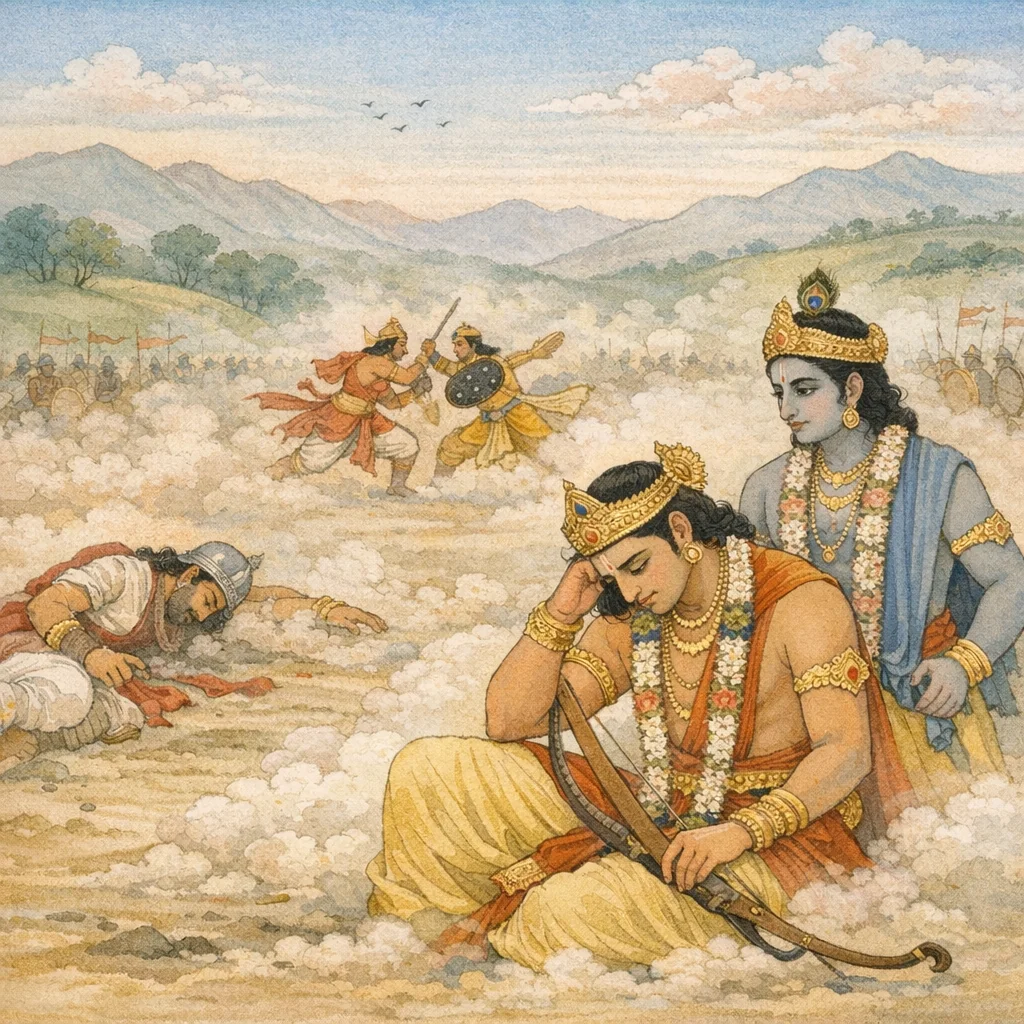
Chapter Arc: सैन्धव (जयद्रथ) के रण में अर्जुन-हस्त से निहत होते ही कौरव-पक्ष में शोक नहीं, ज्वाला उठती है—और उसी ज्वाला का पहला धधकता रूप कृप शारद्वत बनकर फाल्गुन पर टूट पड़ता है। → कृपाचार्य महाशरवर्षा से पाण्डव-सेना और विशेषतः अर्जुन को ढँक देते हैं; द्रोणपुत्र अश्वत्थामा भी रथ चढ़ाकर अर्जुन पर धावा बोलता है। अर्जुन प्रत्युत्तर देता है, पर जैसे ही उसके बाणों से कृप मूर्च्छित होते हैं, विजयी गर्जना के स्थान पर उसके भीतर ग्लानि उठती है—पूज्य गुरु पर प्रहार का दंश। इसी बीच रण का प्रवाह दूसरी ओर मुड़ता है: कर्ण और सात्यकि आमने-सामने आते हैं; सात्यकि के विरथ होने का संकट उभरता है और कौरव महारथी उसे घेरने लगते हैं। → अर्जुन का आत्म-धिक्कार—‘यह कर्म आज निश्चित ही नरक का कारण बनेगा’—और ‘धिग्’ कहकर वार्ष्णेय (कृष्ण) के सामने कृपाचार्य पर प्रहार करने की लज्जा; साथ ही समांतर शिखर पर कर्ण-सात्यकि का उग्र द्वंद्व, जहाँ दोनों सिंह-सम भिड़कर एक-दूसरे को क्षत-विक्षत करते हैं और सात्यकि के विनाश हेतु कर्णादि महारथियों का संयुक्त प्रयास चरम पर पहुँचता है। → अर्जुन अपने मन को धर्म-स्मृति से बाँधकर युद्ध-कर्तव्य में लौटता है—गुरु-पूजा और रण-धर्म के बीच संतुलन खोजता हुआ; उधर सात्यकि, विरथ/घिराव के बावजूद, अद्भुत वेग और कौशल से कर्ण तथा अन्य रथियों के प्रयत्नों को निष्फल कर बच निकलता है। पाञ्चाल्य युधामन्यु-उत्तमौजा और सात्यकि मिलकर कर्ण के अर्जुन-रथ की ओर बढ़ते दबाव को रोकते हैं। → कर्ण का लक्ष्य अभी भी अर्जुन-रथ की ओर है; सात्यकि को मारने में असफल कौरव महारथी फिर से घेरा कसने को तत्पर हैं—अगला क्षण निर्णायक टकराव का संकेत देता है।
Shlokas
Verse 1
/ ऑपन-- माल छा जि: सप्तचत्वारिशर्दाधिकशततमोब ध्याय: अर्जुनके बाणोंसे कृपाचार्यका मूर्च्छित होना, अर्जुनका खेद तथा कर्ण और सात्यकिका युद्ध एवं कर्णकी पराजय घतयाट्र उवाच तस्मिन् विनिहते वीरे सैन्धवे सव्यसाचिना । मामका यदकुर्वन्त तन््ममाचक्ष्व संजय,धृतराष्ट्रने पूछा--संजय! सव्यसाची अर्जुनके द्वारा वीर सिंधुराजके मारे जानेपर मेरे पुत्रोंने क्या किया? यह मुझे बताओ इस प्रकार श्रीमहाभारत द्रोणपर्वके अन्तर्गत जयद्रथवधपर्वमें कर्ण और सात्यकिका युद्धविषयक एक सौ सैतालीसवाँ अध्याय पूरा हुआ ॥/ १४७ ॥/ अपन का बा ] अतडणऑफा<ज अष्टचत्वारिशर्दाधिकशततमो< ध्याय: अर्जुनका कर्णको फटकारना 4 वधकी प्रतिज्ञा करना, श्रीकृष्णका अर्जुनको बधाई देकर उन्हें रणभूमिका भयानक दृश्य दिखाते हुए युधिष्ठिरके पास ले जाना ध्ृतराष्र उवाच तथा गतेषु शूरेषु तेषां मम च संजय । कि वै भीमस्तदाकार्षीत् तन््ममाचक्ष्व संजय
Dhṛtarāṣṭra said: “When that heroic king of Sindhu (Jayadratha) had been slain by Savyasācin Arjuna, what did my sons do then? Tell me that, Sañjaya.”
Verse 2
संजय उवाच सैन्धवं निहतं दृष्टवा रणे पार्थेन भारत । अमर्षवशमापन्न: कृप: शारद्वतस्तत:,संजयने कहा--भरतनन्दन! सिंधुराजको अर्जुनके द्वारा रणभूमिमें मारा गया देख शरद्वानके पुत्र कृपाचार्य अमर्षके वशीभूत हो बाणकी भारी वर्षा करके पाण्डुपुत्र अर्जुनको आच्छादित करने लगे। राजन! द्रोणपुत्र अश्वत्थामाने भी रथपर बैठकर अर्जुनपर धावा किया
Sañjaya said: “O Bhārata, seeing Saindhava slain in battle by Pārtha (Arjuna), Kṛpa, the son of Śaradvat, was then seized by indignation. Overcome by wrath, he poured a fierce shower of arrows and sought to cover Arjuna on the battlefield—an immediate surge of retaliatory violence born from grief and wounded honor.”
Verse 3
महता शरवर्षेण पाण्डवं समवाकिरत् । द्रौणिश्चवाभ्यद्रवद् राजन् रथमास्थाय फाल्गुनम्,संजयने कहा--भरतनन्दन! सिंधुराजको अर्जुनके द्वारा रणभूमिमें मारा गया देख शरद्वानके पुत्र कृपाचार्य अमर्षके वशीभूत हो बाणकी भारी वर्षा करके पाण्डुपुत्र अर्जुनको आच्छादित करने लगे। राजन! द्रोणपुत्र अश्वत्थामाने भी रथपर बैठकर अर्जुनपर धावा किया
Sañjaya said: O King, with a mighty shower of arrows he completely covered the Pāṇḍava (Arjuna). And, O ruler, Droṇa’s son (Aśvatthāmā) too, mounting his chariot, charged straight at Phālguna (Arjuna).
Verse 4
तावेतौ रथिनां श्रेष्ठी रथाभ्यां रथसत्तमौ | उभावुभयतस्ती ६णैर्विशिखैरभ्यवर्षताम्,रथियोंमें श्रेष्ठ वे दोनों महारथी दो दिशाओंसे आकर अर्जुनपर पैने बाणोंकी वर्षा करने लगे
Sañjaya said: Those two—foremost among chariot-warriors, the best of the best—came forward in their chariots and, attacking from both sides, showered Arjuna with sharp arrows.
Verse 5
स तथा शरवर्षाभ्यां सुमहद्भ्यां महाभुज: । पीड्यमान: परामार्तिमगमद् रथिनां वर:,इस प्रकार दो दिशाओंसे होनेवाली उस भारी बाणवर्षसे पीड़ित हो रथियोंमें श्रेष्ठ महाबाहु अर्जुन अत्यन्त व्यथित हो उठे
Sañjaya said: Thus, assailed by that mighty shower of arrows coming from two directions, the great-armed Arjuna—foremost among chariot-warriors—was pressed hard and fell into extreme distress.
Verse 6
सो<जिधघांसुर्गुरुं संख्ये गुरोस्तनयमेव च । चकाराचार्यकं तत्र कुन्तीपुत्रो धनंजय:,वे युद्धस्थलमें गुरु तथा गुरुपुत्रका वध करना नहीं चाहते थे। अतः कुन्तीपुत्र धनंजयने वहाँ अपने आचार्यका सम्मान किया
Sañjaya said: Arjuna, the son of Kuntī, did not wish to slay his teacher in the battle, nor the teacher’s son. Therefore, there on the battlefield he acted with the reverence due to an ācārya—upholding the bond of discipleship even amid war.
Verse 7
अस्त्रैरस्त्राणि संवार्य द्रौणे: शारद्वतस्य च । मन्दवेगानिषूंस्ताभ्यामजिघांसुरवासृजत्,उन्होंने अपने अस्त्रोंद्वारा अश्वत्थामा तथा कृपाचार्यके अस्त्रोंका निवारण करके उनका वध करनेकी इच्छा न रखते हुए उनके ऊपर मन्द वेगवाले बाण चलाये
Sañjaya said: Having countered the missiles of Aśvatthāmā (the son of Droṇa) and of Śāradvata Kṛpa with his own weapons, he—without wishing to kill them—released against the two arrows of restrained force, signaling deliberate self-control amid the fury of battle.
Verse 8
ते चापि भृशमभ्यघ्नन् विशिखा: पार्थचोदिता: । बहुत्वात् तु परामार्ति शराणां तावगच्छताम्,अर्जुनके चलाये हुए उन बाणोंकी संख्या अधिक होनेके कारण उनके द्वारा उन दोनोंको भारी चोट पहुँची। वे बड़ी वेदनाका अनुभव करने लगे
Sañjaya said: Those arrows, loosed at Arjuna’s urging, struck them again and again with great force. And because the shafts came in overwhelming numbers, the two were grievously wounded and fell into intense pain.
Verse 9
जयद्रथके कटे हुए मस्तकका उसके पिताकी गोदमें गिरना अथ शारद्वतो राजन् कौन्तेयशरपीडित: । अवासीददू रथोपस्थे मूर्च्छाीम भिजगाम ह,राजन! कृपाचार्य अर्जुनके बाणोंसे पीड़ित हो मूर्च्छित हो गये और रथके पिछले भागमें जा बैठे
Sañjaya said: “Then, O King, Śāradvata (Kṛpa), tormented by the arrows of the son of Kuntī (Arjuna), sank down upon the chariot-seat and fell into a swoon.”
Verse 10
विह्वलं तमभिज्ञाय भर्तारें शरपीडितम् । हतो<यमिति च ज्ञात्वा सारथिस्तमपावहत्,अपने स्वामीको बाणोंसे पीड़ित एवं विह्लल जानकर और उन्हें मरा हुआ समझकर सारथि रणभूमिसे दूर हटा ले गया
Sañjaya said: Realizing that his master was bewildered and grievously tormented by arrows, and taking him to be slain, the charioteer drove him away from the battlefield—an act born of fearful judgment and loyal concern amid the chaos of war.
Verse 11
तस्मिन् भग्ने महाराज कृपे शारद्वते युधि । अश्वत्थामाप्यपायासीत् पाण्डवेयाद् रथान्तरम्,महाराज! युद्धस्थलमें शरद्वानके पुत्र कृपाचार्यके अचेत होकर वहाँसे हट जानेपर अश्वत्थामा भी अर्जुनको छोड़कर दूसरे किसी रथीका सामना करनेके लिये चला गया
Sañjaya said: “O King, when Kṛpa, the son of Śaradvat, was routed in that battle and withdrew from the fight, Aśvatthāmā too turned away—leaving the Pāṇḍava warrior (Arjuna)—and went off to engage another chariot-fighter.
Verse 12
दृष्टवा शारद्वतं पार्थों मूर्च्छितं शरपीडितम् । रथ एव महेष्वास: सकृप॑ पर्यदेवयत्
Sañjaya said: Seeing Śāradvata (Kṛpa) lying senseless, tormented by the arrows, Pārtha (Arjuna)—that great archer—lamented for him from his chariot.
Verse 13
अश्रुपूर्णमुखो दीनो वचन चेदमब्रवीत् । कृपाचार्यको बाणोंसे पीड़ित एवं मूर्च्छिंत देखकर महाधनुर्धर कुन्तीकुमार अर्जुन दयावश रथपर बैठे-बैठे ही विलाप करने लगे। उनके मुखपर आँसुओंकी धारा बह रही थी। वे दीनभावसे इस प्रकार कहने लगे-- ।। पश्यन्निदं महाप्राज्ञ: क्षत्ता राजानमुक्तवान्
Sanjaya said: With his face flooded with tears and his spirit cast down, he spoke these words. Seeing what had happened, the highly wise chamberlain (kṣattā) addressed the king, speaking to him about the grievous scene unfolding in the war.
Verse 14
कुलान्तकरणे पापे जातमात्रे सुयोधने । नीयतां परलोकाय साध्वयं कुलपांसन:
Sañjaya said: “This sinful one, born to bring ruin upon the lineage—Suyodhana—should, even at birth, have been sent to the other world. Truly, he is the disgrace and dust of his family.”
Verse 15
अस्माद्धि कुरुमुख्यानां महदुत्पत्स्यते भसम् । “जिस समय कुलान्तकारी पापी दुर्योधनका जन्म हुआ था, उस समय महाज्ञानी विदुरजीने यही सब विनाशकारी परिणाम देखकर राजा धृतराष्ट्रसे कहा था कि “इस कुलांगार बालकको परलोक भेज दिया जाय, यही अच्छा होगा; क्योंकि इससे प्रधान- प्रधान कुरुवंशियोंको महान् भय उत्पन्न होगा” || १३-१४ ई || तदिदं समनुप्राप्तं वचनं सत्यवादिन:,'सत्यवादी विदुरजीका वह कथन आज सत्य हो रहा है। दुर्योधनके ही कारण आज मैं अपने गुरुको शर-शय्यापर पड़ा देखता हूँ। क्षत्रियके आचार, बल और पुरुषार्थको धिक्कार है! धिक्कार है
Sañjaya said: “From this man (Duryodhana) a great ruin—like ashes—will arise for the foremost of the Kurus.” The verse recalls Vidura’s earlier warning to Dhṛtarāṣṭra: that Duryodhana’s very birth foretold destruction for the Kuru elders and leaders. Now, as the war’s consequences unfold, that truthful counsel is seen to have become reality—an ethical lament on how adharma in one heir can consume an entire lineage.
Verse 16
तत्कृते हाद्य पश्यामि शरतल्पगतं गुरुम् । धिगस्तु क्षात्रमाचारं धिगस्तु बलपौरुषम्,'सत्यवादी विदुरजीका वह कथन आज सत्य हो रहा है। दुर्योधनके ही कारण आज मैं अपने गुरुको शर-शय्यापर पड़ा देखता हूँ। क्षत्रियके आचार, बल और पुरुषार्थको धिक्कार है! धिक्कार है
Sañjaya said: “Because of him, today I behold my revered teacher lying upon a bed of arrows. Shame upon the warrior’s code of conduct; shame upon strength and manly prowess!”
Verse 17
को हि ब्राह्मणमाचार्यमभिद्रुह्देत मादृश: । ऋषिपुत्रो ममाचार्यो द्रोणस्थ परम: सखा
Sañjaya said: “Who, being such as I am, would ever commit treachery against a Brahmin teacher? He is the son of a seer, my own preceptor—Droṇa—indeed my closest and highest friend.”
Verse 18
अकामयानेन मया विशिखैरर्दितो भूशम्
Sañjaya said: “Though I had no wish to fight, I was grievously tormented—pierced again and again by arrows.”
Verse 19
पुत्रशोकाभितप्तेन शरैरभ्यर्दितेन च
Sañjaya said: He was scorched by grief for his son, and further tormented by the arrows (of the enemy).
Verse 20
शोचयत्येष नियतं भूय: पुत्रवधाद्धि माम्
Sañjaya said: “This man keeps grieving me again and again—indeed, because of the slaying of his son.”
Verse 21
उपाकृत्य तु वै विद्यामाचार्ये भ्यो नरर्षभा:
Sañjaya said: “Having duly received (and mastered) their learning from their teachers, those bull-like men (noble heroes)…”
Verse 22
ये च विद्यामुपादाय गुरुभ्य: पुरुषाधमा:
Sañjaya said: “And those basest of men who, having received learning from their teachers…”
Verse 23
तदिदं नरकायाद्य कृतं॑ कर्म मया ध्रुवम्
Sañjaya said: “This deed that I have done today is surely one that leads to hell.”
Verse 24
यत् तत् पूर्वमुपाकुर्वन्नस्त्रं मामब्रवीत् कृप:
Sañjaya said: “That very weapon which Kṛpa, while preparing it earlier, spoke to me about.”
Verse 25
तदिदं वचन साधोराचार्यस्य महात्मन:
Sañjaya said: “This was the utterance of that noble, great-souled teacher—words befitting a righteous guide.”
Verse 26
नमस्तस्मै सुपूज्याय गौतमायापलायिने
Sañjaya said: “Reverent salutations to that most worthy and highly honored Gautama, who does not flee from duty or danger.”
Verse 27
धिगस्तु मम वार्ष्णेय यदस्मै प्रहराम्पहम् । 4ार्ष्णेय! युद्धमें कभी पीठ न दिखानेवाले उन परम पूजनीय गौतमवंशी कृपाचार्यको मेरा नमस्कार है। मैं जो उनपर प्रहार करता हूँ, इसके लिये मुझे धिक्कार है” ।। तथा विलपमाने तु सव्यसाचिनि तं प्रति
Sañjaya said: “Shame upon me, O Vārṣṇeya, that I strike at him! O Vārṣṇeya—my salutations to the supremely venerable Kṛpācārya of Gautama’s lineage, who never turns his back in battle. Since I am the one who attacks him, let me be condemned for it.” Thus, while Arjuna, the ambidextrous archer, lamented toward him in this way, the narrative continued.
Verse 28
तमापततन्तं राधेयमर्जुनस्य रथं प्रति
Sañjaya said: “Karna (Rādheya), rushing forward in attack, bore down toward Arjuna’s chariot.”
Verse 29
उपायान्तं तु राधेयं दृष्टवा पार्थो महारथ:
Sañjaya said: Seeing Rādheya (Karna) advancing toward him, Pārtha (Arjuna)—the great chariot-warrior—took note of his approach.
Verse 30
एष प्रयात्याधिरथि: सात्यके: स्यन्दनं प्रति
Sañjaya said: “Behold—this mighty chariot-warrior is advancing toward Sātyaki’s chariot.”
Verse 31
यत्र यात्येष तत्र त्वं चोदयाश्वान् जनार्दन
Sañjaya said: “Wherever he moves, there you must drive the horses, O Janārdana.”
Verse 32
एवमुक्तो महाबाहु: केशव: सव्यसाचिना
Sañjaya said: “Thus addressed by Arjuna, the mighty-armed Keśava (Kṛṣṇa) was called upon to respond.”
Verse 33
प्रत्युवाच महातेजा: कालयुक्तमिदं वच: । सव्यसाची अर्जुनके ऐसा कहनेपर महातेजस्वी महाबाहु केशवने उनसे यह समयोचित वचन कहा-- |। अलमेष महाबाहु: कणणयैकोडपि पाण्डव
Sañjaya said: “In response, the radiant one spoke words suited to the moment. When the ambidextrous Arjuna had spoken thus, the mighty-armed Keśava replied with timely counsel, declaring: ‘It is enough—even a single Pāṇḍava is sufficient to face Karṇa.’”
Verse 34
कि पुनद्रौपदेया भ्यां सहित: सात्वतर्षभ: । 'पाण्डुनन्दन! यह महाबाहु सात्वतशिरोमणि सात्यकि अकेला भी कर्णके लिये पर्याप्त है। फिर इस समय जब द्रुपदके दोनों पुत्र इसके साथ हैं, तब तो कहना ही क्या है ।। ३३३ || न च तावत् क्षम: पार्थ तव कर्णेन सजड्भर:
Sañjaya said: “O son of Pāṇḍu! Even alone, that mighty-armed Sātyaki—foremost among the Vṛṣṇis—is sufficient to meet Karṇa. What then need be said now, when the two sons of Draupada (the sons of Draupadī) stand together with him? And, O Pārtha, for the present it is not fitting for you to engage Karṇa in battle.”
Verse 35
त्वदर्थ पूज्यमानैषा रक्ष्यते परवीरहन्
Sañjaya said: “For your sake, this one—duly honoured—is being protected, O slayer of enemy-heroes.”
Verse 36
अहं ज्ञास्यामि कौन्तेय कालमस्य दुरात्मन: । यत्रैनं विशिखैस्ती3क्ष्ग: पातयिष्यसि भूतले,“कुन्तीकुमार! मैं उस दुरात्माका अन्तकाल जानता हूँ, जब कि तुम अपने तीखे बाणोंद्वारा उसे पृथ्वीपर मार गिराओगे”
Sañjaya said: “O son of Kuntī, I know the destined hour of this wicked man’s end—the moment when you will strike him down upon the earth with your sharp arrows.”
Verse 37
धृतराष्ट उवाच योडसौ कर्णेन वीरस्य वाष्णेयस्य समागम: । हते तु भूरिश्रवसि सैन्धवे च निपातिते,धृतराष्ट्रने पूछा--संजय! भूरिश्रवाके मारे जाने और सिंधुराजके धराशायी किये जानेपर कर्णके साथ वीरवर सात्यकिका जो संग्राम हुआ, वह कैसा था?
Dhṛtarāṣṭra said: “Sañjaya, after Bhūriśravas had been slain and the king of Sindhu had been struck down, what was that encounter in battle between Karṇa and the heroic Vāṣṇeya (Sātyaki) like? Describe it to me.”
Verse 38
सात्यकिश्वापि विरथ: क॑ समारूढवान् रथम् | चक्ररक्षौ च पाउ्चाल्यौ तन्ममाचक्ष्व संजय,संजय! सात्यकि भी तो रथहीन हो चुके थे। वे किस रथपर आरूढ़ हुए तथा चक्ररक्षक युधामन्यु और उत्तमौजा इन दोनों पांचाल वीरोंने किसके साथ युद्ध किया? यह सब मुझे बताओ
Dhṛtarāṣṭra said: “Sātyaki too had been left without a chariot—upon whose chariot did he then mount? And the two Pāñcāla heroes who served as wheel-guards, Yudhāmanyu and Uttamaujā—alongside whom did they fight? Tell me all this, Sañjaya.”
Verse 39
संजय उवाच हन्त ते वर्तयिष्यामि यथा वृत्तं महारणे | शुश्रूषस्व स्थिरो भूत्वा दुराचरितमात्मन:
Sañjaya said: “Come then—I shall recount to you exactly what happened in that great battle. Listen attentively, steady your mind, for it concerns the grievous misconduct of your own side.”
Verse 40
संजयने कहा--राजन! मैं बड़े खेदके साथ उस महासमरमें घटित हुई घटनाओंका आपके समक्ष वर्णन करूँगा। आप स्थिर होकर अपने दुराचारका परिणाम सुनें ।। पूर्वमेव हि कृष्णस्य मनोगतमिदं प्रभो । विजेतव्यो यथा वीर: सात्यकि: सौमदत्तिना,प्रभो! भगवान् श्रीकृष्णके मनमें पहले ही यह बात आ गयी थी कि आज वीर सात्यकिको सोमदत्तपुत्र भूरिश्रवा परास्त कर देगा
Sanjaya said: O King, with deep sorrow I shall recount to you what occurred in that great battle. Steady yourself and hear the consequence of your own wrongdoing. For earlier, O lord, this very thought had already arisen in Krishna’s mind—that on this day the hero Satyaki was destined to be overcome by Saumadatti (Bhūrishravas, the son of Somadatta).
Verse 41
अतीतानागते राजन् स हि वेत्ति जनार्दन: । ततः सूतं समाहूय दारुकं संदिदेश ह,मानवा वापि जेतार: कृष्णयो: सन्ति केचन । राजन! वे जनार्दन भूत और भविष्य दोनों कालोंको जानते हैं। इसीलिये उन्होंने अपने सारथि दारुकको बुलाकर पहले ही दिन यह आज्ञा दे दी थी कि कल सबेरेसे ही मेरा रथ जोतकर तैयार रखना। महाराज! श्रीकृष्णका बल महान् है। श्रीकृष्ण और अर्जुनको परास्त करनेवाले न तो कोई देवता हैं, न गन्धर्व हैं, न यक्ष, नाग तथा राक्षस हैं और न मनुष्य ही हैं
Sañjaya said: “O King, Janārdana (Kṛṣṇa) truly knows both what has passed and what is yet to come. Therefore, having summoned his charioteer Dāruka, he had already given him the instruction: ‘Have my chariot yoked and ready from early tomorrow morning.’ And, O King, are there any human beings at all who could conquer Kṛṣṇa and Arjuna? None—neither gods nor Gandharvas, nor Yakṣas, Nāgas, Rākṣasas, nor men—can overcome them.”
Verse 42
रथो मे युज्यतां कल्यमिति राजन् महाबल: । न हि देवा न गन्धर्वा न यक्षोरगराक्षसा:
Sañjaya said: “O King, ‘Let my chariot be yoked at once!’ Thus spoke the mighty one; for neither the gods, nor the Gandharvas, nor the Yakṣas, nor the Nāgas and Rākṣasas can stand as a sufficient counter to his resolve.”
Verse 43
पितामहपुरोगाश्च देवा: सिद्धाश्न त॑ं विदु:
Sañjaya said: Even the gods and the perfected sages—led by the Grandsire—did not truly comprehend him.
Verse 44
सात्यकिं विरथं दृष्टवा कर्ण चाभ्युद्यतं रणे
Sañjaya said: Seeing Sātyaki deprived of his chariot, and Karṇa standing ready with weapon raised for combat on the battlefield, the situation turned grave.
Verse 45
दारुको<वेत्य संदेशं श्रुत्वा शड्खस्य च स्वनम्
Sañjaya said: Understanding the message and hearing the blare of the conch, Dāruka grasped the urgency of the moment—an unmistakable signal amid the turmoil of war that duty now demanded immediate action.
Verse 46
स केशवस्यानुमते रथं दारुकसंयुतम्
Sañjaya said: With Keśava’s consent, he took up the chariot yoked with Dāruka—acting not by personal impulse but under rightful authorization, a reminder that even in war, action gains moral weight when aligned with legitimate counsel and disciplined command.
Verse 47
कामगै: शैब्यसुग्रीवमेघपुष्पबनलाहकै:,अभ्यद्रवत राधेयं प्रवपन् सायकान् बहून् | उसमें इच्छानुसार चलनेवाले महान् वेगशाली और सुवर्णमय अलंकारोंसे विभूषित शैब्य, सुग्रीव, मेघपुष्प और बलाहक नामवाले श्रेष्ठ अश्व जुते हुए थे। वह रथ विमानके समान जान पड़ता था। उसपर आरूढ़ होकर बहुत-से बाणोंकी वर्षा करते हुए सात्यकिने राधापुत्र कर्णपर धावा किया
Sañjaya said: With the swift, choice steeds named Śaibya, Sugrīva, Meghapuṣpa, and Balāhaka—horses that moved at the driver’s will and were adorned with golden trappings—Sātyaki surged forward like a chariot of the skies. Mounted upon that splendid car, he rained many arrows and charged straight at Rādheya (Karna). In the moral atmosphere of the war, the verse highlights disciplined martial resolve: a warrior’s focused intent and mastery of means directed toward a formidable opponent, within the relentless momentum of dharma-yuddha.
Verse 48
हयोगग्रैर्महावेगैहेंमभाण्डवि भूषितै: । युक्त समारुह्मु च तं विमानप्रतिमं रथम्
Sañjaya said: Harnessing swift, powerful horses, adorned with golden trappings, they mounted that chariot—splendid like a celestial aerial car—ready for the next surge of battle. The verse underscores how martial resolve is expressed not only through intent but through disciplined preparation and the dignified, almost ritualized, readiness for war.
Verse 49
चक्ररक्षावषि तदा युधामन्यूत्तमौजसौ
Sañjaya said: At that time, Yudhāmanyu and Uttamaujas took up the duty of guarding the wheel-formation, standing as vigilant protectors amid the ordered violence of battle—an act of disciplined loyalty within the harsh demands of war.
Verse 50
राधेयो5पि महाराज शरवर्ष समुत्सूजन्
Sañjaya said: “O great king, Rādheya too, unleashing a torrential shower of arrows, pressed the battle forward without pause.”
Verse 51
अभ्यद्रवत् सुसंक्रुद्धो रणे शैनेयमच्युतम् । महाराज! अत्यन्त क्रोधमें भरे हुए कर्णने भी उस युद्धस्थलमें अपनी मर्यादासे च्युत न होनेवाले सात्यकिपर बाणोंकी वर्षा करते हुए धावा किया || ५० $ ।। नैव दैवं न गान्धर्व नासुरं न च राक्षसम्
Sañjaya said: “In the thick of battle, Karna—burning with fierce anger—charged straight at Sātyaki, the son of Shini (Shaineya), who stood firm in discipline and did not stray from the warrior’s dharma. Showering him with arrows, Karna pressed the attack. The verse then begins a sweeping claim: ‘Neither divine, nor Gandharva, nor Asura, nor Rakshasa…’.”
Verse 52
उपारमत तत् सैन्यं सरथाश्चनरद्धिपम्
Sañjaya said: “Then that army ceased its advance and came to a halt—together with its chariots—before the lord of men.”
Verse 53
तयोर्दृष्टवा महाराज कर्म सम्मूढचेतस: । सर्वे च समपश्यन्त तद् युद्धमतिमानुषम्
Sañjaya said: “O great king, on seeing those two, all the warriors’ minds were thrown into confusion about what ought to be done. And everyone beheld that battle as something beyond ordinary human measure.”
Verse 54
तयोरनवरयो राजन् सारथ्यं दारुकस्य च । महाराज! उन दोनोंका वह संग्राम देखकर सबके चित्तमें मोह छा गया। राजन! सभी दर्शकके समान उन दोनों नरश्रेष्ठ वीरोंके उस अतिमानव युद्धको और दारुकके सारथ्य कर्मको देखने लगे। हाथी, घोड़े, रथ और मनुष्योंसे युक्त वह चतुरंगिणी सेना भी युद्धसे उपरत हो गयी थी ।। ५२-५३ $ || गतप्रत्यागतावृत्तैर्मण्डलै: संनिवर्तनै:,रथपर बैठे हुए कश्यपगोत्रीय सारथि दारुकके रथ-संचालनकी गमन, प्रत्यागमन, आवर्तन, मण्डल तथा संनिवर्तन आदि विविध रीतियोंसे आकाशमें खड़े हुए देवता, गन्धर्व और दानव भी चकित हो उठे तथा कर्ण और सात्यकिके युद्धको देखनेके लिये अत्यन्त सावधान हो गये। वे दोनों बलवान् वीर रणभूमिमें एक-दूसरेसे स्पर्धा रखते हुए अपने-अपने मित्रके लिये पराक्रम दिखा रहे थे
Sañjaya said: “O King, the unbroken exchange between those two—together with Daruka’s charioteering—cast a spell of bewilderment over every mind. Seeing that battle, O great king, all onlookers fixed their gaze as if transfixed upon the superhuman combat of those two best of men, and upon Daruka’s mastery at the reins. Even the fourfold host—elephants, horses, chariots, and infantry—fell silent and ceased fighting. By the varied patterns of the chariot’s advance and retreat, its wheeling turns, circling maneuvers, and sudden reversals, Daruka—standing on the chariot—astonished even the gods, Gandharvas, and Dānavas who watched from the sky. They became intensely attentive to witness the duel of Karṇa and Sātyaki. Those two mighty heroes, vying with each other on the battlefield, displayed their valor for the sake of their respective allies.”
Verse 55
सारथेस्तु रथस्थस्य काश्यपेयस्य विस्मिता: । नभस्तलगताश्षैव देवगन्धर्वदानवा:,रथपर बैठे हुए कश्यपगोत्रीय सारथि दारुकके रथ-संचालनकी गमन, प्रत्यागमन, आवर्तन, मण्डल तथा संनिवर्तन आदि विविध रीतियोंसे आकाशमें खड़े हुए देवता, गन्धर्व और दानव भी चकित हो उठे तथा कर्ण और सात्यकिके युद्धको देखनेके लिये अत्यन्त सावधान हो गये। वे दोनों बलवान् वीर रणभूमिमें एक-दूसरेसे स्पर्धा रखते हुए अपने-अपने मित्रके लिये पराक्रम दिखा रहे थे
Sañjaya said: Even the gods, Gandharvas, and Dānavas stationed in the sky were astonished at the charioteering of the Kaśyapa-line charioteer seated on the chariot—his advances and withdrawals, turns and circling maneuvers, and other tactical movements. With heightened attention they watched the duel of Karṇa and Sātyaki, as the two mighty warriors, vying with one another on the battlefield, displayed their prowess for the sake of their respective allies.
Verse 56
अतीवावलिता द्र॒ष्ट॑ कर्णशैनेययो रणम् । मित्रार्थे तौ पराक्रान्तौ शुष्मिणौ स्पर्धिनौ रणे,रथपर बैठे हुए कश्यपगोत्रीय सारथि दारुकके रथ-संचालनकी गमन, प्रत्यागमन, आवर्तन, मण्डल तथा संनिवर्तन आदि विविध रीतियोंसे आकाशमें खड़े हुए देवता, गन्धर्व और दानव भी चकित हो उठे तथा कर्ण और सात्यकिके युद्धको देखनेके लिये अत्यन्त सावधान हो गये। वे दोनों बलवान् वीर रणभूमिमें एक-दूसरेसे स्पर्धा रखते हुए अपने-अपने मित्रके लिये पराक्रम दिखा रहे थे
Sañjaya said: The gods, Gandharvas, and Dānavas who stood watching from the sky became utterly astonished, and they fixed their attention to behold the battle between Karṇa and Śaineya (Sātyaki). On that battlefield, those two powerful, high-spirited warriors—each striving against the other—displayed their valor for the sake of their respective friends, turning personal rivalry into a fierce contest of loyalty amid war.
Verse 57
कर्णश्वञामरसंकाशो युयुधानश्न सात्यकि: । अन्योन्यं तौ महाराज शरवर्षरवर्षताम्,महाराज! देवताओंके समान तेजस्वी कर्ण तथा सत्यकपुत्र युयुधान दोनों एक-दूसरेपर बाणोंकी बौछार करने लगे
Sañjaya said: O King, Karṇa—radiant like the gods—and Yuyudhāna Sātyaki faced one another and began to shower each other with volleys of arrows.
Verse 58
प्रममाथ शिने: पौत्रं कर्ण: सायकवृष्टिभि: । अमृष्यमाणो निधनं कौरव्यजलसंधयो:,कर्णने भूरिश्रवा और जलसंधके वधको सहन न करनेके कारण अपने बाणोंकी वर्षासे शिनिपौत्र सात्यकिको मथ डाला
Sañjaya said: Karṇa, unable to endure (the news of) the slaying of Bhūriśravas and of the Kaurava warrior Jalasaṃdha, struck down Sātyaki—the grandson of Śini—by a torrential shower of arrows.
Verse 59
कर्ण: शोकसमाविष्टो महोरग इव श्वसन् । स शैनेयं रणे क्रुद्ध: प्रदहन्निव चक्षुषा
Sañjaya said: Overwhelmed by grief, Karṇa breathed like a great serpent. Enraged in the midst of battle, he fixed upon Śaineya as though burning him with his very gaze.
Verse 60
तं॑ तु सक्रोधमालोक्य सात्यकि: प्रत्ययुध्यत
Sañjaya said: Seeing him inflamed with anger, Sātyaki met him in counter-combat, choosing not retreat but steadfast resistance on the battlefield.
Verse 61
तौ समेतौ नरव्याप्रौ व्याप्राविव तरस्विनौ
Sañjaya said: Those two mighty men met in close combat—like two powerful beasts, swift and forceful—each straining with all his vigor as the battle’s fury drove them into a direct clash.
Verse 62
तत:ः कर्ण शिने: पौत्र: सर्वपारसवै: शरै:,शत्रुओंका दमन करनेवाले महाराज! तदनन्तर शिनिपौत्र सात्यकिने सम्पूर्णत:ः लोहमय बाणोंद्वारा कर्णको उसके सारे अंगोंमें बारंबार चोट पहुँचायी और एक भल्लद्दवारा उसके सारथिको रथकी बैठकसे नीचे गिरा दिया
Sañjaya said: Then Sātyaki, the grandson of Śini—subduer of foes—assailed Karṇa with a full shower of iron-tipped arrows, striking him again and again in every limb. With a single broad-headed shaft (bhalla) he also felled Karṇa’s charioteer from the chariot-seat.
Verse 63
बिभेद सर्वगात्रेषु पुन: पुनररिंदम । सारथिं चास्य भल्लेन रथनीडादपातयत्,शत्रुओंका दमन करनेवाले महाराज! तदनन्तर शिनिपौत्र सात्यकिने सम्पूर्णत:ः लोहमय बाणोंद्वारा कर्णको उसके सारे अंगोंमें बारंबार चोट पहुँचायी और एक भल्लद्दवारा उसके सारथिको रथकी बैठकसे नीचे गिरा दिया
Sañjaya said: O subduer of foes, Sātyaki, the grandson of Śini, repeatedly pierced Karṇa in all his limbs with iron-shafted arrows; and with a sharp bhalla he struck down Karṇa’s charioteer from the chariot-seat.
Verse 64
अश्वांश्व चतुरः श्वेतान् निजघान शितै: शरै: । छित्त्वा ध्वजं रथं चैव शतधा पुरुषर्षभ
Sañjaya said: With keen arrows he struck down the four white horses; and, having cut the banner and even the chariot into a hundred pieces—O best of men—he pressed the attack with relentless precision.
Verse 65
चकार विरथं कर्ण तव पुत्रस्य पश्यत: । नरश्रेष्ठी इसके बाद सात्यकिने तीखे बाणोंद्वारा कर्णके चारों श्वेत घोड़ोंको मार डाला और उसके ध्वजको काटकर रथके सैकड़ों टुकड़े करके आपके पुत्रके देखते-देखते कर्णको रथहीन कर दिया ।। ६४ $ ।। ततो विमनसो राजंस्तावकास्ते महारथा:
Sātyaki made Karṇa chariotless before your son’s very eyes. Then that foremost of men, with keen arrows, slew Karṇa’s four white horses, cut down his banner, and shattered the chariot into hundreds of pieces—so that, as your son looked on, Karṇa was left without a car.
Verse 66
वृषसेन: कर्णसुत: शल्यो मद्राधिपस्तथा । द्रोणपुत्रश्न शैनेयं सर्वतः पर्यवारयन्
Sañjaya said: Vṛṣasena, Karṇa’s son, and Śalya, lord of Madra, together with Droṇa’s son (Aśvatthāman), surrounded Śaineya on every side.
Verse 67
राजन! इससे खिन्नचित्त होकर आपके महारथी वीर कर्णपुत्र वृषसेन, मद्रराज शल्य तथा द्रोणकुमार अश्वत्थामाने सात्यकिको सब ओरसे घेर लिया ।। ततः पर्याकुलं सर्व न प्राज्ञायत किंचन । तथा सात्यकिना वीरे विरथे सूतजे कृते,सात्यकिके द्वारा वीरवर सूतपुत्र कर्णके रथहीन कर दिये जानेपर सारा सैन्यदल सब ओरसे व्याकुल हो उठा। किसीको कुछ सूझ नहीं पड़ता था
Sañjaya said: “O King, distressed by this, your great chariot-warriors—Vṛṣasena, son of Karṇa, Śalya the king of Madra, and Droṇa’s son Aśvatthāmā—closed in on Sātyaki from every side. Then the whole host fell into confusion; no one could make out what to do. For when Sātyaki, in his prowess, had made the charioteer-born hero (Karṇa) bereft of his chariot, the army on all sides became agitated, and clarity deserted them.”
Verse 68
हाहाकारस्ततो राजन् सर्वसैन्येष्वभून्महान् । कर्णोडपि विरथो राजन् सात्वतेन कृत: शरै:
Sañjaya said: “Then, O King, a great cry of alarm arose throughout all the armies. Even Karṇa, O King, was made chariotless by the Sātvata (Kṛṣṇa’s kinsman) through his arrows.”
Verse 69
मानयंस्तव पुत्रस्य बाल्यात् प्रभति सौहृदम्
Sañjaya said: “Honouring the friendship with your son that had endured from childhood onward…”
Verse 70
तथा तु विरथं कर्ण पुत्रांश्ष॒ तव पार्थिव,राजन्! अपने मनको वशमें करनेवाले सात्यकिने रथहीन हुए कर्णको तथा दुःशासन आदि आपके वीर पुत्रोंको भी उस समय इसलिये नहीं मारा कि वे भीमसेन और अर्जुनकी पहलेसे की हुई प्रतिज्ञाकी रक्षा कर रहे थे
Sanjaya said: O king, when Karna had been left without a chariot, self-controlled Satyaki still did not kill him; nor did he then slay your valiant sons such as Duhshasana. He held back for this reason: at that moment they were upholding the earlier vows made by Bhimasena and Arjuna (Partha), and Satyaki would not cross the boundary of dharma set by those pledged claims.
Verse 71
दुःशासनमुखान् वीरान् नावधीत् सात्यकिर्वशी । रक्षन् प्रतिज्ञां भीमेन पार्थेन च पुराकृताम्,राजन्! अपने मनको वशमें करनेवाले सात्यकिने रथहीन हुए कर्णको तथा दुःशासन आदि आपके वीर पुत्रोंको भी उस समय इसलिये नहीं मारा कि वे भीमसेन और अर्जुनकी पहलेसे की हुई प्रतिज्ञाकी रक्षा कर रहे थे
Sanjaya said: Self-controlled Satyaki did not slay the heroes headed by Duhshasana. O king, he refrained in order to uphold and protect the prior vow made by Bhima and by Partha (Arjuna), leaving those pledged enemies for them to fulfill their own promise within the moral constraints of war.
Verse 72
विरथान् विह्नलांश्षक्रे न तु प्राणै््ययोजयत् । भीमसेनेन तु वध: पुत्राणां ते प्रतिश्रुतः
Sanjaya said: He rendered them chariotless and bewildered, yet he did not deprive them of their lives. But the slaying of your sons had already been vowed to Bhimasena.
Verse 73
वधे त्वकुर्वन् यत्नं ते तस्यथ कर्णमुखास्तदा
Sanjaya said: Then, intent on bringing about his death, they exerted themselves with all effort—Karna and the others taking the lead at that time.
Verse 74
द्रौणिश्व कृतवर्मा च तथैवान्ये महारथा:,अश्वत्थामा, कृतवर्मा, अन्यान्य महारथी तथा सैकड़ों क्षत्रियशिरोमणि सात्यकिद्धारा एकमात्र धनुषसे परास्त कर दिये गये। सात्यकि धर्मराजका प्रिय करना और परलोकपर विजय पाना चाहते थे
Sanjaya said: Droni (Ashvatthama) and Kritavarma, along with other great chariot-warriors, were driven back; indeed, many eminent Kshatriya champions were overcome by Satyaki with his single bow. Satyaki fought to please Dharmaraja (Yudhishthira) and to win victory in the next world as well—seeking merit through steadfast loyalty and righteous purpose amid the violence of war.
Verse 75
निर्जिता धनुषैकेन शतशः क्षत्रियर्षभा: | काडुक्षता परलोकं च धर्मराजस्य च प्रियम्,अश्वत्थामा, कृतवर्मा, अन्यान्य महारथी तथा सैकड़ों क्षत्रियशिरोमणि सात्यकिद्धारा एकमात्र धनुषसे परास्त कर दिये गये। सात्यकि धर्मराजका प्रिय करना और परलोकपर विजय पाना चाहते थे
With a single bow, Sātyaki vanquished by the hundreds the foremost bulls among the Kṣatriyas—Aśvatthāmā, Kṛtavarmā, and other great chariot-warriors—along with many a crown-jewel of the warrior race. Sātyaki sought to do what was dear to Dharmarāja, and to win victory even in the world beyond.
Verse 76
कृष्णयो: सदृशो वीर्ये सात्यकि: शत्रुतापन: । जितवान् सर्वसैन्यानि तावकानि हसन्निव,शत्रुओंको संताप देनेवाले सात्यकि श्रीकृष्ण और अर्जुनके समान पराक्रमी थे। उन्होंने आपकी सारी सेनाओंको हँसते हुए-से जीत लिया था
Sañjaya said: Sātyaki, a scorcher of foes, was equal in prowess to the two Kṛṣṇas—Kṛṣṇa and Arjuna. He overcame all your forces as though laughing.
Verse 77
कृष्णो वापि भवेल्लोके पार्थों वापि धनुर्धर: । शैनेयो वा नरव्याप्र चतुर्थस्तु न विद्यते,नरव्याप्र! संसारमें श्रीकृष्ण, कुन्तीकुमार अर्जुन और शिनिपौत्र सात्यकि--ये तीन ही वास्तवमें धनुर्धर हैं। इनके समान चौथा कोई नहीं है
Sañjaya said: “In this world, either Kṛṣṇa, or Pārtha (Arjuna) the wielder of the bow, or Śaineya (Sātyaki), O tiger among men—these alone are truly the great archers. A fourth equal to them does not exist.”
Verse 78
धृतराष्ट्र रवाच अजय्यं वासुदेवस्य रथमास्थाय सात्यकि: । विरथं कृतवान् कर्ण वासुदेवसमो युधि,धृतराष्ट्रने पूछा--संजय! सात्यकि युद्धमें भगवान् श्रीकृष्णके समान हैं। उन्होंने श्रीकृष्णके ही अजेय रथपर आरूढ़ होकर कर्णको रथहीन कर दिया। उस समय उनके साथ दारुक-जैसा सारथि था और उन्हें अपने बाहुबलका अभिमान तो था ही; परंतु शत्रुओंको संताप देनेवाले सात्यकि क्या किसी दूसरे रथपर भी आरूढ़ हुए थे?
Dhṛtarāṣṭra said: “Mounting Vāsudeva’s unconquerable chariot, Sātyaki—who is like Vāsudeva himself in battle—made Karṇa chariotless. Tell me, Sañjaya: did that tormentor of foes, proud of his own arm-strength, ever mount any other chariot as well?”
Verse 79
दारुकेण समायुक्त: स्वबाहुबलदर्पित: । कच्चिदन्यं समारूढ: सात्यकि: शत्रुतापन:,धृतराष्ट्रने पूछा--संजय! सात्यकि युद्धमें भगवान् श्रीकृष्णके समान हैं। उन्होंने श्रीकृष्णके ही अजेय रथपर आरूढ़ होकर कर्णको रथहीन कर दिया। उस समय उनके साथ दारुक-जैसा सारथि था और उन्हें अपने बाहुबलका अभिमान तो था ही; परंतु शत्रुओंको संताप देनेवाले सात्यकि क्या किसी दूसरे रथपर भी आरूढ़ हुए थे?
Sañjaya said: “Was Sātyaki—renowned as a tormentor of foes—yoked with Dāruka as his charioteer and proud of his own arm-strength, ever mounted upon any other chariot?”
Verse 80
एतदिच्छाम्यहं श्रीतुं कुशलो हासि भाषितुम् | असहां तमहं मन्ये तनन््ममाचक्ष्व संजय,मैं यह सुनना चाहता हूँ। तुम कथा कहनेमें बड़े कुशल हो। मैं तो सात्यकिको किसीके लिये भी असहा मानता हूँ, अतः संजय! तुम मुझसे सारी बातें स्पष्ट रूपसे बताओ
I wish to hear this. You are indeed skilled in narration. I consider him—Sātyaki—one who cannot be endured by anyone; therefore, Sañjaya, tell me the whole matter clearly.
Verse 81
संजय उवाच शृणु राजन् यथावृत्तं रथमन्यं महामति: । दारुकस्यानुजस्तूर्ण कल्पनाविधिकल्पितम्,संजयने कहा--राजन्! सारा वृत्तान्त यथार्थरूपसे सुनिये। दारुकका एक छोटा भाई था, जो बड़ा बुद्धिमान् था। वह तुरंत ही रथ सजानेकी विधिसे सुसज्जित किया हुआ एक दूसरा रथ ले आया
Sañjaya said: O king, hear the account exactly as it happened. Dāruka had a younger brother, a man of great intelligence; and he swiftly brought another chariot, fully prepared according to the proper rites and methods of chariot-fitting.
Verse 82
आयसै: काज्चनैश्वापि पट्टेः संनद्धकूबरम् । तारासहस्रखचितं सिंहध्वजपताकिनम्,लोहे और सोनेके पट्टोंसे उसका कूबर अच्छी तरह कसा हुआ था। उसमें सहसरों तारे जड़े गये थे। उसकी ध्वजा-पताकाओंमें सिंहका चिह्न बना हुआ था
The chariot’s yoke and fittings were firmly bound with bands of iron and also of gold. It was inlaid with a thousand star-like ornaments, and its flags and streamers bore the emblem of a lion.
Verse 83
अश्वैर्वातजवैर्युक्ते हेमभाण्डपरिच्छदै: । सैन्धवैरिन्दुसंकाशै: सर्वशब्दातिगैर्दढै:,उस रथमें सुवर्णमय आभूषणोंसे विभूषित, वायुके समान वेगशाली, सम्पूर्ण शब्दोंको लाँघ जानेवाले, सुदृढ़ तथा चन्द्रमाके समान श्वेतवर्ण सिन्धी घोड़े जुते हुए थे
That chariot was yoked with Sindhu-bred horses—moon-white in color—adorned with golden trappings, swift as the wind, so powerful that they seemed to outstrip every sound, and firm and unyielding.
Verse 84
चित्रकाज्चनसंनाहैवाजिमुख्यैर्विशाम्पते । घण्टाजालाकुलरवं शक्तितोमरविद्युतम्,प्रजानाथ! उन घोड़ोंको विचित्र स्वर्णमय कवचोंसे सुसज्जित किया गया था। वे सभी अश्व अच्छी श्रेणीके थे। उनसे जुते हुए उस रथमें क्षुद्र घंटिकाओंके समूहसे निकलती हुई मधुर ध्वनि व्याप्त हो रही थी। वहाँ रखे हुए शक्ति और तोमर आदि शस्त्र विद्युतूके समान प्रकाशित होते थे
O lord of the people, the foremost horses were outfitted with splendid harness and armor of variegated gold. The chariot they drew resounded with the sweet, pervasive sound of clustered small bells; and the weapons set there—spears and tomara-javelins—flashed like lightning.
Verse 85
युक्तं सांग्रामिकैद्रव्यैर्बहुशस्त्रपरिच्छदै: । रथं सम्पादयामास मेघगम्भीरनि:स्वनम्,उसमें बहुत-से अस्त्र-शस्त्र आदि युद्धोपयोगी आवश्यक सामान एवं द्रव्य यथास्थान रखे गये थे। उस रथके चलनेपर मेघोंकी गर्जनाके समान गम्भीर शब्द होता था। दारुकका छोटा भाई उस रथको सात्यकिके पास ले आया
Sañjaya said: He had a chariot made ready, fully equipped with the materials and supplies required for battle and furnished with many weapons. When it moved, it produced a deep roar like thunderclouds. Then Dāruka’s younger brother brought that chariot to Sātyaki.
Verse 86
तं॑ समारुहय शैनेयस्तव सैन्यमुपाद्रवत् । दारुको5पि यथाकामं प्रययौ केशवान्तिकम्,सात्यकिने उसीपर आरूढ़ होकर आपकी सेनापर आक्रमण किया। दारुक भी इच्छानुसार भगवान् श्रीकृष्णके निकट चला गया
Sañjaya said: Mounting that chariot, Śaineya (Sātyaki) charged against your army. Dāruka too, as he wished, went to Keśava (Kṛṣṇa). Thus, under the moral pressure of battle, the warrior hastens to the duty he has chosen on the field, while the charioteer goes to the rightful commander—each fulfilling role and allegiance.
Verse 87
कर्णस्यापि रथं राजन् शंखगोक्षीरपाण्डुरै: । चित्रकाञ्चनसंनाहै: सददश्लेवेगवत्तरै:,राजन! कर्णके लिये भी एक सुन्दर रथ लाया गया, जिसमें शंख और गोदुग्धके समान ब्ैतवर्णवाले, विचित्र सुवर्णमय कवचसे सुसज्जित और अत्यन्त वेगशाली श्रेष्ठ अश्व जुते हुए थे
Sañjaya said: “O King, for Karṇa too a splendid chariot was brought—yoked with excellent horses, white as a conch and as pale as fresh milk, adorned with variegated golden harness, and tightly bound and swift in their motion.”
Verse 88
हेमकक्ष्याध्वजोपेतं क्लृप्तयन्त्रपताकिनम् | अग्रयं रथं सुयन्तारं बहुशस्त्रपरिच्छदम्,उसमें सुवर्णमयी रज्जुसे आवेष्टित ध्वजा फहरा रही थी। वह रथ यन्त्र और पताकाओंसे सुशोभित था। उसके भीतर बहुत-से अस्त्र-शस्त्र आदि आवश्यक सामान रखे गये थे। उस श्रेष्ठ रथका सारथि भी सुयोग्य था
Sañjaya said: “It was a foremost chariot, furnished with a banner bound with golden straps, fitted with well-arranged mechanisms and adorned with pennants. It was well-equipped with many weapons and implements, and it had a highly competent charioteer.”
Verse 89
उपाजहुस्तमास्थाय कर्णो<प्यभ्यद्रवद् रिपून् | एतत् ते सर्वमाख्यातं यन्मां त्वं परिमूच्छसि,दुर्योधनके सेवक वह रथ लेकर आये और कर्णने उसके ऊपर आरूढ़ होकर शत्रुओंपर धावा किया। राजन! आप मुझसे जो कुछ पूछ रहे थे, वह सब मैंने आपको बता दिया
Sañjaya said: Duryodhana’s attendants brought the chariot; mounting it, Karṇa too charged straight at the enemies. O King, I have now told you everything you were asking me about—fully and in order.
Verse 90
भूयश्वापि निबोधेमं तवापनयजं क्षयम् | एकत्रिंशत् तव सुता भीमसेनेन पातिता:
Sañjaya said: Hear again of this further ruin that has befallen your line. Thirty-one of your sons have been struck down by Bhīmasena—an added measure of loss in the relentless course of war, where attachment and ambition culminate in grievous consequence.
Verse 91
शतशो निहता: शूरा: सात्वतेनार्जुनेन च,भारत! इसी प्रकार सात्यकि और अर्जुनने भी भीष्म और भगदत्त आदि सैकड़ों शूरवीरोंका संहार कर डाला है। राजन्! इस प्रकार आपकी कुमन्त्रणाके फलस्वरूप यह विनाश-कार्य सम्पन्न हुआ है
Sañjaya said: O Bharata, in the same manner hundreds of heroes have been slain by Sātyaki and by Arjuna. Thus Sātyaki and Arjuna have cut down hundreds of warriors such as Bhīṣma and Bhagadatta. O King, in this way the work of destruction has come to completion as the fruit of your misguided counsel.
Verse 92
भीष्म प्रमुखत: कृत्वा भगदत्तं च भारत । एवमेष क्षयो वृत्तों राजन् दुर्मन्त्रिते तव,भारत! इसी प्रकार सात्यकि और अर्जुनने भी भीष्म और भगदत्त आदि सैकड़ों शूरवीरोंका संहार कर डाला है। राजन्! इस प्रकार आपकी कुमन्त्रणाके फलस्वरूप यह विनाश-कार्य सम्पन्न हुआ है
O Bharata, with Bhīṣma foremost, and Bhagadatta as well—O King, such has this destruction come to pass, born of your ill counsel.
Verse 147
इति श्रीमहाभारते द्रोणपर्वणि जयद्रथवधपर्वणि कर्णसात्यकियुद्धि सप्तचत्वारिंशदधिकशततमो 5 ध्याय:
Thus, in the sacred Mahābhārata, within the Droṇa Parva—specifically in the section concerning the slaying of Jayadratha—ends the one-hundred-and-forty-seventh chapter, describing the battle between Karṇa and Sātyaki.
Verse 173
एष शेते रथोपस्थे कृपो मद्धघाणपीडित: । “मेरे-जैसा कौन पुरुष ब्राह्मण एवं आचार्यसे द्रोह करेगा? ये ऋषिकुमार, मेरे आचार्य तथा गुरुवर द्रोणाचार्यके परम सखा कृप मेरे बाणोंसे पीड़ित हो रथकी बैठकमें पड़े हैं
Sañjaya said: “There lies Kṛpa upon the seat of his chariot, tormented by the blows of my arrows.” The line underscores the moral tension of battle: even a warrior may feel the sting of wrongdoing when his weapons strike a revered Brahmin-teacher figure.
Verse 186
अवसीदन् रथोपस्थे प्राणान् पीडयतीव मे । “मैंने इच्छा न रहते हुए भी उन्हें बाणोंद्वारा अधिक चोट पहुँचायी है। वे रथकी बैठकमें पड़े-पड़े कष्ट पा रहे हैं और मुझे अत्यन्त पीड़ित-सा कर रहे हैं
Sañjaya said: “He sank down upon the seat of the chariot, as though crushing the very life-breaths within me. Though I did not wish it, I have wounded them all the more with my arrows; now they lie on the chariot-seat in torment, and their suffering seems to pierce me with intense anguish.”
Verse 193
अभ्यस्तो बहुभिर्बाणर्दशधर्मगतेन वै । “मैंने पुत्रशोकसे संतप्त, बाणोंद्वारा पीड़ित तथा भारी दुरवस्थाको प्राप्त होकर बहुसंख्यक बाणोंद्वारा उन्हें अनेक बार चोट पहुँचायी है
Sañjaya said: “He was repeatedly assailed by many arrows, and, having been driven into a grievous and perilous condition, he in turn struck him again and again with a multitude of shafts—his mind burning with the anguish of a son’s loss, and his conduct now shaped by the harsh compulsions of war rather than calm restraint.”
Verse 203
कृपणं स्वरथे सन्नं पश्य कृष्ण यथागतम् । “निश्चय ही ये कृपाचार्य आहत होकर मुझे पुत्रवधकी अपेक्षा भी अधिक शोकमें डाल रहे हैं। श्रीकृष्ण! देखिये, वे अपने रथपर कैसे सन्न और दीन होकर पड़े हैं
Sañjaya said: “O Kṛṣṇa, look at him—wretched and utterly dejected—slumped upon his own chariot, just as he has come to this state. The sight of the venerable teacher, struck down and reduced to helplessness, deepens the grief of those who witness it, revealing how war humiliates even the great and how compassion and duty collide on the battlefield.”
Verse 213
प्रयच्छन्तीह ये कामान् देवत्वमुपयान्ति ते । “आचार्योंसे विद्या ग्रहण करके जो श्रेष्ठ पुरुष उन्हें उनकी अभीष्ट वस्तुएँ देते हैं, वे देवत्वको प्राप्त होते हैं
Sañjaya said: “Those who, in this very world, grant desired boons and fulfill the wishes of worthy recipients—especially as a grateful return for learning received from one’s teacher—attain the state of the gods.”
Verse 223
घ्नन्ति तानेव दुर्वत्तास्ते वै निरयगामिन: । “गुरुसे विद्या ग्रहण करके जो नराधम उनपर ही चोट करते हैं, वे दुराचारी मानव निश्चय ही नरकगामी होते हैं
Sañjaya said: “Those of wicked conduct who, after receiving learning from a teacher, strike at those very persons are surely destined for hell.”
Verse 233
आचार्य शरवर्षेण रथे सादयता कृपम् | “मैंने आचार्य कृपको अपने बाणोंकी वर्षद्वारा रथपर सुला दिया है। निश्चय ही यह कर्म मैंने आज नरकमें जानेके लिये ही किया है
Sañjaya said: “With a shower of arrows, the teacher Kṛpa has been struck down upon his chariot. Surely, by doing this deed today, I have acted as one bound for hell.”
Verse 243
न कथंचन कौरव्य प्रहर्तव्यं गुराविति । 'पूर्वकालमें मुझे अस्त्रविद्याकी शिक्षा देकर कृपाचार्यने जो मुझसे यह कहा था कि “कुरुनन्दन! तुम्हें गुरुक ऊपर किसी प्रकार भी प्रहार नहीं करना चाहिये”
Sañjaya said: “O Kauravya, one must never strike one’s teacher in any circumstance.” This recalls the ethical restraint taught in the guru–disciple bond: even amid the violence of war, reverence for the preceptor is upheld as a binding rule of conduct.
Verse 256
नानुछितं तमेवाजी विशिखैरभिवर्षता । “जन श्रेष्ठ महात्मा आचार्यका यह वचन युद्धस्थलमें उन्हींपर बाणोंकी वर्षा करके मैंने नहीं माना है
Sañjaya said: “Even while showering him with arrows on the battlefield, I did not accept that act as proper.” The line conveys a moral hesitation within the violence of war: the speaker recognizes that certain targets or modes of attack can violate propriety (aucitya) even amid sanctioned combat.
Verse 273
सैन्धवं निहतं दृष्टवा राधेय: समुपाद्रवत् । सव्यसाची अर्जुन कृपाचार्यके लिये विलाप कर ही रहे थे कि सिंधुराजको मारा गया देख राधानन्दन कर्णने उनपर धावा कर दिया
Sañjaya said: Seeing the king of Sindhu (Jayadratha) slain, Rādheya (Karna), driven by wrath and the warrior’s code of retaliation, rushed forward to attack. The moment marks a sharp turn in the battle’s moral tension: grief and lamentation are instantly converted into renewed violence, as vengeance and loyalty to one’s side override restraint.
Verse 296
प्रहसन् देवकीपुत्रमिदं वचनमब्रवीत् । राधापुत्रको अपने समीप आते देख महारथी कुन्तीकुमार अर्जुनने देवकीनन्दन श्रीकृष्णसे हँसते हुए कहा--
Smiling, Arjuna—the great chariot-warrior, son of Kuntī—addressed Devakī’s son, Śrī Kṛṣṇa, with these words, as Rādhā’s son (Karna) was seen approaching nearby. The scene frames a tense moment in battle: Arjuna’s composed, even lightly smiling speech to Kṛṣṇa signals steadiness of mind and reliance on his charioteer-counsel amid the ethical strain of facing a formidable kinsman-enemy.
Verse 306
न मृष्यति हत॑ नूनं भूरिश्रवसमाहवे । “यह अधिरथपुत्र कर्ण सात्यकिके रथकी ओर जा रहा है। अवश्य ही युद्धस्थलमें भूरिश्रवाका मारा जाना इसके लिये असहयू हो उठा है
Sañjaya said: “Surely he cannot endure it—that Bhūriśravas has been slain on the battlefield.” The remark casts the moment as an emotional and moral shock amid the chaos of war, where the fall of a renowned warrior calls forth immediate reaction and renewed aggression.
Verse 313
न सौमदत्तिपदवीं गमयेत् सात्यकिं वृष: । “जनार्दन! यह जहाँ जाता है, वहीं आप भी अपने घोड़ोंको हाँकिये। कहीं ऐसा न हो कि कर्ण सात्यकिको भूरिश्रवाके पथपर पहुँचा दे”
Sañjaya said: “Let not the bull-like Sātyaki be driven onto the path of Saumadatti (Bhūriśravas). O Janārdana, wherever he goes, urge your horses there as well—lest Karṇa maneuver Sātyaki into Bhūriśravas’s line of attack.”
Verse 346
प्रज्वलन्ती महोल्केव तिष्ठत्यस्य हि वासवी । “कुन्तीकुमार! इस समय कर्णके साथ तुम्हारा युद्ध होना ठीक नहीं है; क्योंकि उसके पास बड़ी भारी उल्काके समान प्रज्वलित होनेवाली इन्द्रकी दी हुई शक्ति है
Sañjaya said: “With him there stands the Vāsavī—Indra’s divine missile—blazing like a great meteor. Therefore, O son of Kuntī, it is not right at this moment for you to engage Karṇa in battle, for he possesses that formidable, Indra-given power.”
Verse 353
अत: कर्ण: प्रयात्वत्र सात्वतस्य यथातथा । शत्रुवीरोंका संहार करनेवाले अर्जुन! तुम्हारे लिये कर्ण उसकी प्रतिदिन पूजा करते हुए उसे सदा सुरक्षित रखता है; अतः कर्ण सात्यकिके पास जैसे-तैसे जाय और युद्ध करे
Sañjaya said: “Therefore let Karṇa set out here against the Sātvata (Sātyaki) in whatever way he can. O Arjuna, destroyer of enemy heroes—Karṇa keeps that power/boon always secure for him, worshipping it day after day. Hence Karṇa should somehow reach Sātyaki and engage him in battle.”
Verse 423
मानवा वापि जेतार: कृष्णयो: सन्ति केचन । राजन! वे जनार्दन भूत और भविष्य दोनों कालोंको जानते हैं। इसीलिये उन्होंने अपने सारथि दारुकको बुलाकर पहले ही दिन यह आज्ञा दे दी थी कि कल सबेरेसे ही मेरा रथ जोतकर तैयार रखना। महाराज! श्रीकृष्णका बल महान् है। श्रीकृष्ण और अर्जुनको परास्त करनेवाले न तो कोई देवता हैं, न गन्धर्व हैं, न यक्ष, नाग तथा राक्षस हैं और न मनुष्य ही हैं
Sañjaya said: “O King, there may be some men who claim they can conquer Kṛṣṇa and Arjuna. But Janārdana knows both what has been and what is yet to come. Therefore, having summoned his charioteer Dāruka, he had already given this command the previous day: ‘At dawn tomorrow, yoke my chariot and keep it ready.’ O great king, Kṛṣṇa’s power is immense. None—neither gods, nor Gandharvas, nor Yakṣas, nor Nāgas, nor Rākṣasas, nor even men—are capable of defeating Śrī Kṛṣṇa and Arjuna.”
Verse 433
तयो: प्रभावमतुलं शृणु युद्ध तु तत् तथा । उन्हें ब्रह्मा आदि देवता और सिद्ध पुरुष ही यथार्थ रूपसे जान पाते हैं। उन दोनोंके प्रभावकी कहीं तुलना नहीं है। अच्छा, अब युद्धका वृत्तान्त सुनिये
Sanjaya said: Hear now of the incomparable might of those two; no true measure or comparison of their power exists. Even Brahmā and the primeval gods, and the perfected sages alone can know them as they really are. Now, listen to the account of the battle as it unfolded.
Verse 443
दध्मौ शड्खं महानादमार्षभेणाथ माधव: । सात्यकिको रथहीन और कर्णको युद्धके लिये उद्यत देख भगवान् श्रीकृष्णने बड़े जोरकी ध्वनि करनेवाले शंखको ऋषभस्वरसे बजाया
Sañjaya said: Then Mādhava (Śrī Kṛṣṇa) blew his conch, whose sound was mighty, in a deep, bull-like resonance. Seeing Sātyaki without his chariot and Karṇa poised for battle, Kṛṣṇa’s thunderous conch-call functions as a moral rally—steadfastness in adversity and the refusal to abandon one’s ally even when the situation turns dire.
Verse 456
रथमन्वानयत् तस्मै सुपर्णोच्छितकेतनम् । दारुकने उस शंखध्वनिको सुनकर भगवान्के संदेशको स्मरण करके तुरंत ही उनके लिये अपना रथ ला दिया, जिसपर गरुड़चिह्से युक्त ऊँची ध्वजा फहरा रही थी
Sañjaya said: Hearing the sound of the conch and recalling the Lord’s message, Dāruka immediately brought for him the chariot—marked by a lofty banner bearing the emblem of Garuḍa. The moment underscores disciplined service and alert devotion amid the pressures of war: duty is fulfilled promptly when one keeps the divine command in mind.
Verse 463
आरुरोह शिने: पौत्रो ज्वलनादित्यसंनिभम् | भगवान् श्रीकृष्णकी अनुमति पाकर शिनिपौत्र सात्यकि दारुकद्वारा जोते हुए अग्नि और सूर्यके समान तेजस्वी उस रथपर आरूढ़ हुए
Sañjaya said: With the permission of the Blessed Śrī Kṛṣṇa, Sātyaki—the grandson of Śini—mounted that chariot, yoked by Dāruka, which blazed with the splendor of fire and the sun. The moment underscores disciplined action in war: even a mighty warrior proceeds under rightful authorization and orderly command rather than mere impulse.
Verse 486
अभ्यद्रवत राधेयं प्रवपन् सायकान् बहून् | उसमें इच्छानुसार चलनेवाले महान् वेगशाली और सुवर्णमय अलंकारोंसे विभूषित शैब्य, सुग्रीव, मेघपुष्प और बलाहक नामवाले श्रेष्ठ अश्व जुते हुए थे। वह रथ विमानके समान जान पड़ता था। उसपर आरूढ़ होकर बहुत-से बाणोंकी वर्षा करते हुए सात्यकिने राधापुत्र कर्णपर धावा किया
Sanjaya said: Satyaki charged at Radheya (Karna), showering him with many arrows. His chariot was yoked to the finest horses—Śaibya, Sugrīva, Meghapuṣpa, and Balāhaka—swift, obedient to the driver’s will, and adorned with golden ornaments. The chariot looked like a celestial craft. Mounted upon it, Satyaki rushed straight at Karna, raining shafts in the fury of battle—an image of relentless martial resolve within the grim ethics of a war where duty is pursued through violence.
Verse 496
धनंजयरयथं हित्वा राधेयं प्रत्युदीयतुः । उस समय चक्ररक्षक युधामन्यु और उत्तमौजाने भी धनंजयका रथ छोड़कर कर्णपर ही आक्रमण किया
Sañjaya said: Leaving Dhanañjaya’s chariot, the two—Yudhāmanyu and Uttamaujas, appointed as the wheel-guards—turned back and charged straight at Rādheya (Karna). In the press of war, their duty of protection becomes an active moral choice: to risk themselves in order to shield their leader and confront a formidable adversary directly.
Verse 513
तादृशं भुवि नो युद्ध दिवि वा श्रुतमित्युत । राजन! मैंने इस पृथ्वीपर या स्वर्गमें देवताओं, गन्धर्वों, असुरों तथा राक्षसोंका भी वैसा युद्ध नहीं सुना था
Sañjaya said: “O King, never before have I heard of such a battle—neither on earth nor even in heaven. Indeed, I have not heard of a conflict like this even among the gods, Gandharvas, Asuras, or Rākṣasas.”
Verse 593
अभ्यधावत वेगेन पुन: पुनररिंदम । शत्रुदमन नरेश! कर्ण उन दोनोंकी मृत्युसे शोकमग्न हो फुफकारते हुए महान् सर्पकी भाँति लंबी साँसें खींच रहा था। वह युद्धमें क़रुद्ध हो अपने नेत्रोंसे सात्यकिकी ओर इस प्रकार देख रहा था, मानो वह उन्हें जलाकर भस्म कर देगा। उसने बारंबार वेगपूर्वक सात्यकिपर धावा किया
Sanjaya said: O king, subduer of foes, Karna—overwhelmed by grief at the death of those two—kept hissing and drawing long breaths like a great serpent. Enraged in battle, he fixed his gaze upon Satyaki as though he would burn him to ashes with his eyes. Again and again, with sudden speed, he charged at Satyaki.
Verse 606
महता शरवर्षेण गजं प्रति गजो यथा । कर्णको कुपित देख सात्यकि बाणोंकी बड़ी भारी वर्षा करते हुए उसका सामना करने लगे, मानो एक हाथी दूसरे हाथीसे लड़ रहा हो
Sañjaya said: With a mighty shower of arrows, Karṇa—enraged at the sight of Sātyaki—met him head-on, as one elephant confronts another.
Verse 613
अन्योन्यं संततक्षाते रणेडनुपमविक्रमौ । वेगशाली व्याप्रोंक समान परस्पर भिड़े हुए वे दोनों पुरुषसिंह युद्धमें अनुपम पराक्रम दिखाते हुए एक-दूसरेको क्षत-विक्षत कर रहे थे
Sanjaya said: In that battle, those two lion-like heroes—matched in strength and swift as tigers—closed upon one another and, displaying incomparable valor, kept wounding and tearing each other in relentless combat.
Verse 683
दुर्योधनरथं तूर्णमारुरोह विनि:श्वसन् । राजन्! उस समय सारी सेनाओंमें महान् हाहाकार होने लगा। महाराज! सात्यकिके बाणोंसे रथहीन किया गया कर्ण भी लंबी साँस खींचता हुआ तुरंत ही दुर्योधनके रथपर जा बैठा
Sañjaya said: Panting, he swiftly mounted Duryodhana’s chariot. O King, at that moment a great uproar rose throughout all the armies. O Maharaja, Karṇa too—stripped of his chariot by Sātyaki’s arrows—drawing a long breath, immediately took his seat upon Duryodhana’s chariot.
Verse 696
कृतां राज्यप्रदानेन प्रतिज्ञां परिपालयन् । बचपनसे लेकर सदा ही किये हुए आपके पुत्रके सौहार्दका वह समादर करता था और दुर्योधनको राज्य दिलानेकी जो उसने प्रतिज्ञा कर रखी थी, उसके पालनमें वह तत्पर था
Sañjaya said: Keeping faith with the vow he had made to secure the kingdom for Duryodhana, he remained intent on fulfilling it. From childhood onward, he had always honored the friendship shown by your son, and out of loyalty to that bond he strove to uphold his pledge of restoring Duryodhana to sovereignty.
Verse 726
अनुद्यूते च पार्थेन वध: कर्णस्य संश्रुतः । उन्होंने उन सबको रथहीन और अत्यन्त व्याकुल तो कर दिया, परंतु उनके प्राण नहीं लिये। जब दुबारा द्यूत हुआ था, उस समय भीमसेनने आपके पुत्रोंके वधकी प्रतिज्ञा की थी और अर्जुनने कर्णको मार डालनेकी घोषणा की थी
Sañjaya said: “And at the time of the later dice-game, Pārtha (Arjuna) had vowed the slaying of Karṇa.” They made them all chariotless and sorely distressed, yet did not take their lives. When the dice were cast again, Bhīmasena swore the death of your sons, and Arjuna proclaimed that he would kill Karṇa.
Verse 903
दुर्मुखं प्रमुखे कृत्वा सततं चित्रयोधिनम् । अब पुनः आपके ही अन्यायसे होनेवाले इस महान् जनसंहारका वृत्तान्त सुनिये। भीमसेनने अबतक सदा विचित्र युद्ध करनेवाले दुर्मुख आदि आपके इकतीस पुत्रोंको मार गिराया है
Sañjaya said: “Placing Durmukha at the forefront—he who was ever a fighter of varied and cunning tactics—hear again the account of this great slaughter that has arisen from your own injustice. Bhīmasena has now struck down Durmukha and, along with him, thirty-one of your sons.”
Verse 2836
पाज्चाल्यौ सात्यकिश्वैव सहसा समुपाद्रवन् । राधापुत्र कर्णको अर्जुनके रथकी ओर आते देख दोनों भाई पांचालराजकुमार (युधामन्यु और उत्तमौजा) तथा सात्वतवंशी सात्यकि सहसा उसकी और दौड़े
Sañjaya said: The two Pāñcāla princes and Sātyaki, seeing Karṇa—the son of Rādhā—driving toward Arjuna’s chariot, rushed at him at once.
Verse 7336
नाशवनुवंस्ततो हन्तुं सात्यकिं प्रवरा रथा: । कर्ण आदि श्रेष्ठ महारथियोंने सात्यकिके वधके लिये पूरा प्रयत्न किया; परंतु वे उन्हें मार न सके
Sañjaya said: Then the foremost chariot-warriors, led by Karṇa and other eminent mahārathas, exerted their utmost effort to slay Sātyaki. Yet, despite their concentrated assault and intent, they were unable to kill him—showing how prowess, when met by equal valor and steadfast resolve, does not always yield the desired end in war.
Frequently Asked Questions
The chapter frames a dharma-tension between strategic necessity (protecting Karṇa through mass intervention and night engagement) and the erosion of regulated combat norms, while also presenting vengeance for a slain father as a motivating rationale for new violence.
Power and ingenuity (including māyā) can secure tactical outcomes, but the narrative underscores how retaliatory motives and protective realpolitik accelerate escalation, increasing collective disorder and ethical ambiguity in conflict.
No explicit phalaśruti is stated in this chapter’s verses; its significance is structural—marking the transition from a screening action around Karṇa to a major human–rākṣasa confrontation that reshapes the night battle’s trajectory.