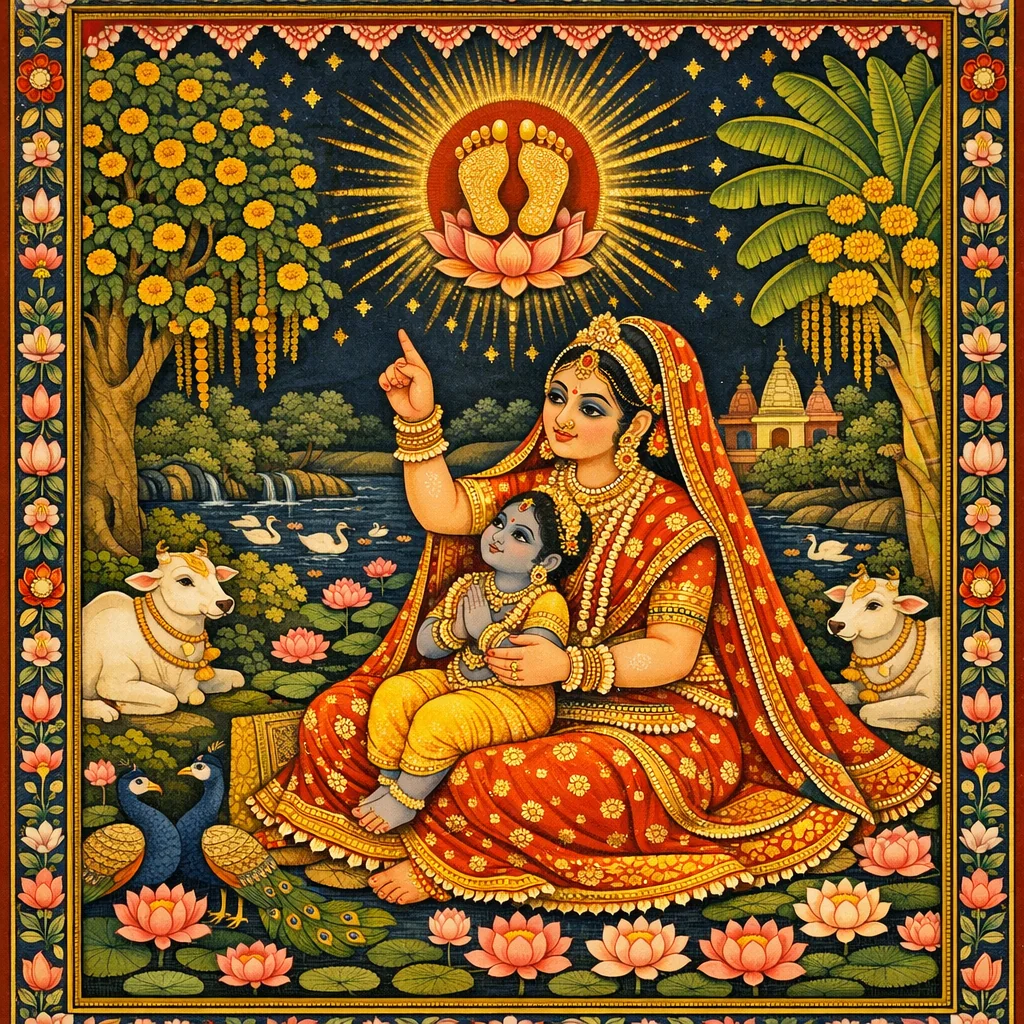
Adhyaya 8
Dhruva’s Humiliation, Sunīti’s Counsel, and Nārada’s Bhakti-Yoga Instruction
Maitreya first outlines the moral lineage of adharma: Irreligion and Falsity, personified, beget Bluffing, Cheating, Greed, Anger, Envy, Kali, Harsh Speech, Death, Fear, Pain, and Hell—showing how inner vices multiply into social ruin. He then turns to the descendants of Svāyambhuva Manu, focusing on King Uttānapāda, his queens Sunīti and Suruci, and their sons Dhruva and Uttama. When Dhruva tries to sit on his father’s lap, he is rejected; Suruci’s cutting words inflame the child’s kṣatriya pride, and the king’s silence deepens the wound. Sunīti redirects Dhruva from retaliation to refuge in Nārāyaṇa, teaching that even Brahmā and Manu attained success by worshiping the Lord’s lotus feet. Nārada tests Dhruva with counsel on tolerance and karma, but Dhruva admits his ambition and asks for a position higher than anyone’s. Nārada then gives precise sādhana: go to Madhuvana on the Yamunā, practice regulated yoga and meditate on Viṣṇu’s four-armed form, and chant the dvādaśākṣarī mantra “oṁ namo bhagavate vāsudevāya.” Dhruva departs for austerity; the remorseful king is consoled by Nārada. Dhruva’s intensifying tapas shakes the cosmos, the devas appeal to the Lord, and He promises to intervene—setting the stage for the next chapter’s divine response.
Shlokas
Verse 1
मैत्रेय उवाच सनकाद्या नारदश्च ऋभुर्हंसोऽरुणिर्यति: । नैते गृहान् ब्रह्मसुता ह्यावसन्नूर्ध्वरेतस: ॥ १ ॥
Maitreya said: The four Kumāras headed by Sanaka, as well as Nārada, Ṛbhu, Haṁsa, Aruṇi, and Yati—all sons of Brahmā—did not dwell at home, but became ūrdhva-retā, steadfast naiṣṭhika-brahmacārīs, pure celibates.
Verse 2
मृषाधर्मस्य भार्यासीद्दम्भं मायां च शत्रुहन् । असूत मिथुनं तत्तु निऋर्तिर्जगृहेऽप्रज: ॥ २ ॥
Another son of Brahmā was Mṛṣādharma (Irreligion), whose wife was Mṛṣā (Falsity). From their union were born two asuras, Dambha (Bluffing) and Māyā (Cheating). A childless asura named Nirṛti took them in.
Verse 3
तयो: समभवल्लोभो निकृतिश्च महामते । ताभ्यां क्रोधश्च हिंसा च यद्दुरुक्ति: स्वसा कलि: ॥ ३ ॥
O great soul, from Dambha and Māyā were born Lobha (Greed) and Nikṛti (Cunning). From them came Krodha (Anger) and Hiṁsā (Violence); and from Krodha and Hiṁsā were born Kali and his sister Durukti (Harsh Speech).
Verse 4
दुरुक्तौ कलिराधत्त भयं मृत्युं च सत्तम । तयोश्च मिथुनं जज्ञे यातना निरयस्तथा ॥ ४ ॥
O best of the virtuous, from the union of Kali and harsh speech were born Mṛtyu (Death) and Bhīti (Fear). From the union of Mṛtyu and Bhīti arose Yātanā (torment) and Niraya (hell).
Verse 5
सङ्ग्रहेण मयाख्यात: प्रतिसर्गस्तवानघ । त्रि: श्रुत्वैतत्पुमान् पुण्यं विधुनोत्यात्मनो मलम् ॥ ५ ॥
O sinless one, I have briefly described pratisaṛga, the causes of devastation. Whoever hears this account three times gains piety and washes away the sinful taint from the soul.
Verse 6
अथात: कीर्तये वंशं पुण्यकीर्ते: कुरूद्वह । स्वायम्भुवस्यापि मनोर्हरेरंशांशजन्मन: ॥ ६ ॥
Maitreya continued: O best of the Kurus, I shall now recount the lineage of Svāyambhuva Manu, whose fame is purifying, and who was born as a part of a part of the Lord Hari’s plenary expansion.
Verse 7
प्रियव्रतोत्तानपादौ शतरूपापते: सुतौ । वासुदेवस्य कलया रक्षायां जगत: स्थितौ ॥ ७ ॥
By Śatarūpā, Svāyambhuva Manu had two sons, Priyavrata and Uttānapāda. Being born from a portion (kalā) of Vāsudeva, they were fully competent to protect the universe and care for the citizens.
Verse 8
जाये उत्तानपादस्य सुनीति: सुरुचिस्तयो: । सुरुचि: प्रेयसी पत्युर्नेतरा यत्सुतो ध्रुव: ॥ ८ ॥
King Uttānapāda had two queens, Sunīti and Suruci. Suruci was far dearer to the king; Sunīti, though the mother of Dhruva, was not his favorite.
Verse 9
एकदा सुरुचे: पुत्रमङ्कमारोप्य लालयन् । उत्तमं नारुरुक्षन्तं ध्रुवं राजाभ्यनन्दत ॥ ९ ॥
Once upon a time, King Uttānapāda was patting the son of Suruci, Uttama, placing him on his lap. Dhruva Mahārāja was also trying to get on the King’s lap, but the King did not very much welcome him.
Verse 10
तथा चिकीर्षमाणं तं सपत्न्यास्तनयं ध्रुवम् । सुरुचि: शृण्वतो राज्ञ: सेर्ष्यमाहातिगर्विता ॥ १० ॥
While the child, Dhruva Mahārāja, was trying to get on the lap of his father, Suruci, his stepmother, became very envious of the child, and with great pride she began to speak so as to be heard by the King himself.
Verse 11
न वत्स नृपतेर्धिष्ण्यं भवानारोढुमर्हति । न गृहीतो मया यत्त्वं कुक्षावपि नृपात्मज: ॥ ११ ॥
Queen Suruci told Dhruva Mahārāja: My dear child, you do not deserve to sit on the throne or on the lap of the King. Surely you are also the son of the King, but because you did not take your birth from my womb, you are not qualified to sit on your father’s lap.
Verse 12
बालोऽसि बत नात्मानमन्यस्त्रीगर्भसम्भृतम् । नूनं वेद भवान् यस्य दुर्लभेऽर्थे मनोरथ: ॥ १२ ॥
My dear child, you are unaware that you were born not of my womb but of another woman. Therefore you should know that your attempt is doomed to failure. You are trying to fulfill a desire which is impossible to fulfill.
Verse 13
तपसाराध्य पुरुषं तस्यैवानुग्रहेण मे । गर्भे त्वं साधयात्मानं यदीच्छसि नृपासनम् ॥ १३ ॥
If you at all desire to rise to the throne of the King, then you have to undergo severe austerities. First of all you must satisfy the Supreme Personality of Godhead, Nārāyaṇa, and then, when you are favored by Him because of such worship, you shall have to take your next birth from my womb.
Verse 14
मैत्रेय उवाच मातु: सपत्न्या: स दुरुक्तिविद्ध: श्वसन् रुषा दण्डहतो यथाहि: । हित्वा मिषन्तं पितरं सन्नवाचं जगाम मातु: प्ररुदन् सकाशम् ॥ १४ ॥
Maitreya said: Struck by his stepmother’s harsh words, Dhruva, burning with anger, breathed heavily like a snake beaten with a stick. Seeing his father silent and offering no protest, he at once left the palace and went, weeping, to his mother.
Verse 15
तं नि:श्वसन्तं स्फुरिताधरोष्ठं सुनीतिरुत्सङ्ग उदूह्य बालम् । निशम्य तत्पौरमुखान्नितान्तं सा विव्यथे यद्गदितं सपत्न्या ॥ १५ ॥
When Dhruva came to his mother, breathing hard, his lips trembling with anger and weeping bitterly, Queen Suniti lifted the child onto her lap. Those in the palace who had heard Suruci’s harsh words recounted everything in detail, and Suniti became deeply distressed.
Verse 16
सोत्सृज्य धैर्यं विललाप शोक दावाग्निना दावलतेव बाला । वाक्यं सपत्न्या: स्मरती सरोज श्रिया दृशा बाष्पकलामुवाह ॥ १६ ॥
Unable to maintain her composure, Suniti lamented in grief, as if scorched by the forest fire of sorrow. Remembering her co-wife’s words, her radiant, lotuslike face filled with tears, and she spoke as follows.
Verse 17
दीर्घं श्वसन्ती वृजिनस्य पार- मपश्यती बालकमाह बाला । मामङ्गलं तात परेषु मंस्था भुङ्क्ते जनो यत्परदु:खदस्तत् ॥ १७ ॥
She too sighed deeply, seeing no remedy for this painful plight. Finding no way, she said to her son: My child, do not wish ill for others; whoever brings suffering to another must in the end taste the fruit of that very suffering.
Verse 18
सत्यं सुरुच्याभिहितं भवान्मे यद्दुर्भगाया उदरे गृहीत: । स्तन्येन वृद्धश्च विलज्जते यां भार्येति वा वोढुमिडस्पतिर्माम् ॥ १८ ॥
Suniti said: My dear boy, what Suruci spoke is indeed true. Your father, the king, does not regard me as his wife, not even as a maidservant; he feels ashamed to accept me. Therefore it is a fact that you were born from the womb of an unfortunate woman and have grown up nourished by her breast.
Verse 19
आतिष्ठ तत्तात विमत्सरस्त्वम् उक्तं समात्रापि यदव्यलीकम् । आराधयाधोक्षजपादपद्मं यदीच्छसेऽध्यासनमुत्तमो यथा ॥ १९ ॥
My child, abandon envy and stand steady. Though Suruci, your stepmother, spoke harshly, her words are true. If you desire a throne like Uttama’s, then without delay worship the lotus feet of the Supreme Lord, Adhokṣaja.
Verse 20
यस्याङ्घ्रि पद्मं परिचर्य विश्व विभावनायात्तगुणाभिपत्ते: । अजोऽध्यतिष्ठत्खलु पारमेष्ठ्यं पदं जितात्मश्वसनाभिवन्द्यम् ॥ २० ॥
The Supreme Lord is so great that by serving His lotus feet your great-grandfather Brahmā gained the qualifications to create the universe. Though unborn, he holds that exalted post by the Lord’s mercy—He whom even great yogīs worship by mastering mind and prāṇa.
Verse 21
तथा मनुर्वो भगवान् पितामहो यमेकमत्या पुरुदक्षिणैर्मखै: । इष्ट्वाभिपेदे दुरवापमन्यतो भौमं सुखं दिव्यमथापवर्ग्यम् ॥ २१ ॥
In the same way, your grandfather Svāyambhuva Manu performed great sacrifices and gave abundant charity, worshiping the Lord with unwavering faith. Thus he attained the highest worldly prosperity and afterward apavarga—liberation—which is difficult to gain by worship of the demigods.
Verse 22
तमेव वत्साश्रय भृत्यवत्सलं मुमुक्षुभिर्मृग्यपदाब्जपद्धतिम् । अनन्यभावे निजधर्मभाविते मनस्यवस्थाप्य भजस्व पूरुषम् ॥ २२ ॥
My dear boy, take shelter of that Supreme Lord who is affectionate to His devotees. Those who seek freedom from birth and death always cling to His lotus feet through bhakti. Purified by your rightful duty, place Him in your heart with exclusive devotion and serve Him without wavering.
Verse 23
नान्यं तत: पद्मपलाशलोचनाद् दु:खच्छिदं ते मृगयामि कञ्चन । यो मृग्यते हस्तगृहीतपद्मया श्रियेतरैरङ्ग विमृग्यमाणया ॥ २३ ॥
Dhruva, I see no one who can cut away your sorrow except the Lord whose eyes are like lotus petals. Demigods such as Brahmā seek the favor of Lakṣmī, yet Lakṣmī herself—lotus in hand—is ever ready to serve the Supreme Lord.
Verse 24
मैत्रेय उवाच एवं सञ्जल्पितं मातुराकर्ण्यार्थागमं वच: । सन्नियम्यात्मनात्मानं निश्चक्राम पितु: पुरात् ॥ २४ ॥
Maitreya said: Hearing his mother Sunīti’s instruction meant to fulfill his aim, Dhruva restrained himself and, with clear intelligence and firm resolve, departed from his father’s house.
Verse 25
नारदस्तदुपाकर्ण्य ज्ञात्वा तस्य चिकीर्षितम् । स्पृष्ट्वा मूर्धन्यघघ्नेन पाणिना प्राह विस्मित: ॥ २५ ॥
Nārada heard the news and understood Dhruva’s intention; he was amazed. Approaching, he touched the boy’s head with his sin-destroying, virtuous hand and spoke as follows.
Verse 26
अहो तेज: क्षत्रियाणां मानभङ्गममृष्यताम् । बालोऽप्ययं हृदा धत्ते यत्समातुरसद्वच: ॥ २६ ॥
How wondrous is the fire of the kṣatriyas! They cannot endure even a slight wound to honor. Behold—though only a child, this boy found his stepmother’s harsh words unbearable.
Verse 27
नारद उवाच नाधुनाप्यवमानं ते सम्मानं वापि पुत्रक । लक्षयाम: कुमारस्य सक्तस्य क्रीडनादिषु ॥ २७ ॥
Nārada said: My dear boy, I see neither dishonor nor honor for you at present. You are still a child attached to play and trifles—why are you so shaken by words that insult your prestige?
Verse 28
विकल्पे विद्यमानेऽपि न ह्यसन्तोषहेतव: । पुंसो मोहमृते भिन्ना यल्लोके निजकर्मभि: ॥ २८ ॥
Dhruva, even if there are alternatives, you have no cause for dissatisfaction. Such discontent is a feature of māyā; every being is governed by past karma, and thus the world displays varied conditions for enjoyment or suffering.
Verse 29
परितुष्येत्ततस्तात तावन्मात्रेण पूरुष: । दैवोपसादितं यावद्वीक्ष्येश्वरगतिं बुध: ॥ २९ ॥
My dear child, one should be content with what comes. The wise, beholding the Lord’s wondrous course, accept both favorable and unfavorable as His supreme will.
Verse 30
अथ मात्रोपदिष्टेन योगेनावरुरुत्ससि । यत्प्रसादं स वै पुंसां दुराराध्यो मतो मम ॥ ३० ॥
Now you have resolved to practice yogic meditation as your mother instructed, solely to gain the Lord’s mercy; yet in my view, to satisfy the Supreme Personality of Godhead is exceedingly difficult for an ordinary person.
Verse 31
मुनय: पदवीं यस्य नि:सङ्गेनोरुजन्मभि: । न विदुर्मृगयन्तोऽपि तीव्रयोगसमाधिना ॥ ३१ ॥
Nārada Muni continued: Though for many, many births they remained unattached, ever absorbed in intense yogic samādhi and performing many austerities, many mystic yogīs could not find the end of the path of God realization.
Verse 32
अतो निवर्ततामेष निर्बन्धस्तव निष्फल: । यतिष्यति भवान् काले श्रेयसां समुपस्थिते ॥ ३२ ॥
Therefore, my dear boy, do not persist in this; it will not succeed. Go home. When you are grown, by the Lord’s mercy you will gain the opportunity for such yogic practices; then you may perform them.
Verse 33
यस्य यद्दैवविहितं स तेन सुखदु:खयो: । आत्मानं तोषयन्देही तमस: पारमृच्छति ॥ ३३ ॥
Whatever the divine will has allotted to one, the embodied soul should accept as happiness or distress and keep the heart content. By such endurance one easily crosses beyond the darkness of ignorance.
Verse 34
गुणाधिकान्मुदं लिप्सेदनुक्रोशं गुणाधमात् । मैत्रीं समानादन्विच्छेन्न तापैरभिभूयते ॥ ३४ ॥
On meeting one more qualified, one should rejoice; toward one less qualified, show compassion; and with an equal, cultivate friendship. Thus one is not overcome by the threefold miseries of the material world.
Verse 35
ध्रुव उवाच सोऽयं शमो भगवता सुखदु:खहतात्मनाम् । दर्शित: कृपया पुंसां दुर्दर्शोऽस्मद्विधैस्तु य: ॥ ३५ ॥
Dhruva Mahārāja said: Dear Nāradajī, for one whose heart is disturbed by material happiness and distress, the means of peace you have mercifully taught is certainly excellent. But I am covered by ignorance, and such philosophy does not touch my heart.
Verse 36
अथापि मेऽविनीतस्य क्षात्त्रं घोरमुपेयुष: । सुरुच्या दुर्वचोबाणैर्न भिन्ने श्रयते हृदि ॥ ३६ ॥
Yet, my lord, I am ill-mannered for not accepting your instruction, but it is not wholly my fault. Born in a kṣatriya line, my nature is fierce. Suruci’s harsh words have pierced my heart like arrows; therefore your valuable counsel does not remain within it.
Verse 37
पदं त्रिभुवनोत्कृष्टं जिगीषो: साधु वर्त्म मे । ब्रूह्यस्मत्पितृभिर्ब्रह्मन्नन्यैरप्यनधिष्ठितम् ॥ ३७ ॥
O learned brāhmaṇa, I long to attain the most exalted position in the three worlds—one not yet held by anyone, even my father and forefathers. Please tell me a righteous path by which I may fulfill the goal of my life.
Verse 38
नूनं भवान्भगवतो योऽङ्गज: परमेष्ठिन: । वितुदन्नटते वीणां हिताय जगतोऽर्कवत् ॥ ३८ ॥
Surely you are a worthy son of Lord Brahmā, the Parameṣṭhī. You wander, plucking the vīṇā for the welfare of the whole universe, like the sun that moves for the good of all beings.
Verse 39
मैत्रेय उवाच इत्युदाहृतमाकर्ण्य भगवान्नारदस्तदा । प्रीत: प्रत्याह तं बालं सद्वाक्यमनुकम्पया ॥ ३९ ॥
Maitreya said: Hearing Dhruva Maharaja’s words, the venerable Narada Muni was moved with compassion and, to bestow his causeless mercy, spoke to the boy with wise and fitting counsel.
Verse 40
नारद उवाच जनन्याभिहित: पन्था: स वै नि:श्रेयसस्य ते । भगवान् वासुदेवस्तं भज तं प्रवणात्मना ॥ ४० ॥
Narada said: The path your mother Suniti has spoken is truly the way to your highest good. Therefore, with a humble and surrendered heart, worship Bhagavan Vasudeva in devotion.
Verse 41
धर्मार्थकाममोक्षाख्यं य इच्छेच्छ्रेय आत्मन: । एकं ह्येव हरेस्तत्र कारणं पादसेवनम् ॥ ४१ ॥
Whoever seeks the fruits of dharma, artha, kama, and finally moksha should engage in devotional service to Bhagavan Hari, for service to His lotus feet is the very cause of fulfilling them all.
Verse 42
तत्तात गच्छ भद्रं ते यमुनायास्तटं शुचि । पुण्यं मधुवनं यत्र सान्निध्यं नित्यदा हरे: ॥ ४२ ॥
Therefore, my dear boy, may auspiciousness be yours. Go to the pure bank of the Yamuna; there lies the holy forest called Madhuvana, where Bhagavan Hari is ever present.
Verse 43
स्नात्वानुसवनं तस्मिन् कालिन्द्या: सलिले शिवे । कृत्वोचितानि निवसन्नात्मन: कल्पितासन: ॥ ४३ ॥
In the auspicious, pure waters of the Yamuna, known as Kalindi, bathe three times daily. After bathing, perform the proper disciplines of aṣṭāṅga-yoga, and then sit peacefully upon the āsana you have prepared.
Verse 44
प्राणायामेन त्रिवृता प्राणेन्द्रियमनोमलम् । शनैर्व्युदस्याभिध्यायेन्मनसा गुरुणा गुरुम् ॥ ४४ ॥
Seated upon your seat, practice the threefold prāṇāyāma, and thus gradually bring the life-air, the mind, and the senses under control. Freed from all material taint, with great patience meditate within the heart upon Bhagavān, the Supreme Personality of Godhead.
Verse 45
प्रसादाभिमुखं शश्वत्प्रसन्नवदनेक्षणम् । सुनासं सुभ्रुवं चारुकपोलं सुरसुन्दरम् ॥ ४५ ॥
The Lord’s face is ever turned toward grace—always serene and pleasing. To His devotees He never appears displeased, for He is ever ready to bestow benedictions. His eyes, His beautifully arched brows, His raised nose, and His broad forehead are all exquisite, surpassing the beauty of the demigods.
Verse 46
तरुणं रमणीयाङ्गमरुणोष्ठेक्षणाधरम् । प्रणताश्रयणं नृम्णं शरण्यं करुणार्णवम् ॥ ४६ ॥
Nārada Muni continued: The Lord’s form is ever youthful; every limb is perfectly fashioned, free from fault. His eyes and lips are rosy like the rising sun. He is always ready to shelter the surrendered soul, and whoever beholds Him feels complete satisfaction. He is worthy to be the Master of the surrendered, for He is an ocean of mercy.
Verse 47
श्रीवत्साङ्कं घनश्यामं पुरुषं वनमालिनम् । शङ्खचक्रगदापद्मैरभिव्यक्तचतुर्भुजम् ॥ ४७ ॥
The Lord bears upon His chest the mark of Śrīvatsa, and His hue is deep bluish like a raincloud. He is the Supreme Person, adorned with a forest garland, and He eternally manifests four arms holding the conchshell, the disc, the club, and the lotus.
Verse 48
किरीटिनं कुण्डलिनं केयूरवलयान्वितम् । कौस्तुभाभरणग्रीवं पीतकौशेयवाससम् ॥ ४८ ॥
The entire body of the Supreme Personality of Godhead, Vāsudeva, is splendidly adorned. He wears a precious jewel-studded crown, earrings, necklaces, armlets, and bracelets; His neck is graced by the Kaustubha gem, and He is clothed in yellow silk.
Verse 49
काञ्चीकलापपर्यस्तं लसत्काञ्चननूपुरम् । दर्शनीयतमं शान्तं मनोनयनवर्धनम् ॥ ४९ ॥
The Lord is adorned with a waist-belt of tiny golden bells, and His lotus feet shine with golden anklets. Every feature of His form is supremely beautiful; ever peaceful and still, He delights both the eyes and the mind.
Verse 50
पद्भ्यां नखमणिश्रेण्या विलसद्भ्यां समर्चताम् । हृत्पद्मकर्णिकाधिष्ण्यमाक्रम्यात्मन्यवस्थितम् ॥ ५० ॥
True yogīs meditate upon the Lord’s transcendental form, standing upon the whorl of the lotus within the heart; the jewel-like nails of His lotus feet shine brilliantly.
Verse 51
स्मयमानमभिध्यायेत्सानुरागावलोकनम् । नियतेनैकभूतेन मनसा वरदर्षभम् ॥ ५१ ॥
One should meditate upon the Lord as ever-smiling, gazing upon His devotee with loving mercy. With a regulated, one-pointed mind, the meditator should behold the Supreme Personality of Godhead, the bestower of all benedictions.
Verse 52
एवं भगवतो रूपं सुभद्रं ध्यायतो मन: । निर्वृत्या परया तूर्णं सम्पन्नं न निवर्तते ॥ ५२ ॥
One who meditates in this manner, fixing the mind upon the Lord’s ever-auspicious form, is quickly freed from all material contamination and does not fall from meditation upon the Lord.
Verse 53
जपश्च परमो गुह्य: श्रूयतां मे नृपात्मज । यं सप्तरात्रं प्रपठन्पुमान् पश्यति खेचरान् ॥ ५३ ॥
O son of the King, hear from me this most confidential mantra for japa. One who carefully recites it for seven nights can behold the siddhas—perfect beings who move through the sky.
Verse 54
ॐ नमो भगवते वासुदेवाय । मन्त्रेणानेन देवस्य कुर्याद् द्रव्यमयीं बुध: । सपर्यां विविधैर्द्रव्यैर्देशकालविभागवित् ॥ ५४ ॥
“Oṁ namo bhagavate vāsudevāya” is the twelve-syllable mantra. Knowing the proper divisions of place and time, a wise devotee should establish the Lord’s worship in a physical form and, while chanting this mantra, offer flowers, fruits, and other foods according to authorized rules.
Verse 55
सलिलै: शुचिभिर्माल्यैर्वन्यैर्मूलफलादिभि: । शस्ताङ्कुरांशुकैश्चार्चेत्तुलस्या प्रियया प्रभुम् ॥ ५५ ॥
One should worship the Lord by offering pure water and clean garlands, forest roots and fruits, tender sprouts, buds, or even tree bark; and especially by offering tulasī leaves, so dear to Bhagavān.
Verse 56
लब्ध्वा द्रव्यमयीमर्चां क्षित्यम्ब्वादिषु वार्चयेत् । आभृतात्मा मुनि: शान्तो यतवाङ्मितवन्यभुक् ॥ ५६ ॥
One may worship a form of the Lord made from material elements such as earth, water, wood, or metal. In the forest, one can fashion a form with only earth and water and worship Him by the principles stated above. A self-controlled devotee should be sober and peaceful, restrained in speech, and satisfied with whatever fruits and vegetables are available in the forest.
Verse 57
स्वेच्छावतारचरितैरचिन्त्यनिजमायया । करिष्यत्युत्तमश्लोकस्तद् ध्यायेद्धृदयङ्गमम् ॥ ५७ ॥
My dear Dhruva, along with Deity worship and chanting the mantra three times daily, meditate within your heart on the enchanting, transcendental deeds of Uttamaśloka—the Supreme Personality of Godhead—as He reveals them in His various incarnations by His own will and inconceivable potencies.
Verse 58
परिचर्या भगवतो यावत्य: पूर्वसेविता: । ता मन्त्रहृदयेनैव प्रयुञ्ज्यान्मन्त्रमूर्तये ॥ ५८ ॥
One should follow the previous devotees in the methods of serving and worshiping Bhagavān with the prescribed paraphernalia. Or, by the “heart of the mantra,” one may worship within the heart alone—reciting the mantra to the Lord who is the mantra’s very form and nondifferent from it.
Verse 59
एवं कायेन मनसा वचसा च मनोगतम् । परिचर्यमाणो भगवान् भक्तिमत्परिचर्यया ॥ ५९ ॥ पुंसाममायिनां सम्यग्भजतां भाववर्धन: । श्रेयो दिशत्यभिमतं यद्धर्मादिषु देहिनाम् ॥ ६० ॥
One who, with body, mind, and speech, sincerely serves the Bhagavān through the prescribed practices of bhakti is blessed by the Lord with results according to his desire.
Verse 60
एवं कायेन मनसा वचसा च मनोगतम् । परिचर्यमाणो भगवान् भक्तिमत्परिचर्यया ॥ ५९ ॥ पुंसाममायिनां सम्यग्भजतां भाववर्धन: । श्रेयो दिशत्यभिमतं यद्धर्मादिषु देहिनाम् ॥ ६० ॥
To those who worship Him without deceit, the Bhagavān who nourishes their devotion grants embodied beings the desired good—dharma, artha, kāma, or mokṣa—according to their wish.
Verse 61
विरक्तश्चेन्द्रियरतौ भक्तियोगेन भूयसा । तं निरन्तरभावेन भजेताद्धा विमुक्तये ॥ ६१ ॥
If one is truly intent on liberation, one should be detached from sense enjoyment and, through powerful bhakti-yoga, worship the Lord with steady faith and unbroken devotional absorption, for certain freedom.
Verse 62
इत्युक्तस्तं परिक्रम्य प्रणम्य च नृपार्भक: । ययौ मधुवनं पुण्यं हरेश्चरणचर्चितम् ॥ ६२ ॥
Thus instructed by the sage Nārada, Prince Dhruva circumambulated his spiritual master, offered respectful obeisances, and set out for the sacred Madhuvana, blessed by the lotus footprints of Hari.
Verse 63
तपोवनं गते तस्मिन्प्रविष्टोऽन्त:पुरं मुनि: । अर्हितार्हणको राज्ञा सुखासीन उवाच तम् ॥ ६३ ॥
After Dhruva entered the forest of austerity, the sage Nārada went into the inner palace. The king received him with due honor and obeisance; seated comfortably, Nārada then began to speak to the king.
Verse 64
नारद उवाच राजन् किं ध्यायसे दीर्घं मुखेन परिशुष्यता । किं वा न रिष्यते कामो धर्मो वार्थेन संयुत: ॥ ६४ ॥
Nārada said: O King, why do you ponder so long? Your face seems to wither and grow dry. Has some obstacle arisen in your pursuit of dharma, artha, and kāma, or are dharma or kāma, joined with artha, being diminished?
Verse 65
राजोवाच सुतो मे बालको ब्रह्मन् स्त्रैणेनाकरुणात्मना । निर्वासित: पञ्चवर्ष: सह मात्रा महान्कवि: ॥ ६५ ॥
The King replied: O best of brāhmaṇas, enslaved by attachment to my wife I have fallen and become merciless at heart. I have banished my five-year-old son together with his mother, though he is a great soul and a great devotee.
Verse 66
अप्यनाथं वने ब्रह्मन्मा स्मादन्त्यर्भकं वृका: । श्रान्तं शयानं क्षुधितं परिम्लानमुखाम्बुजम् ॥ ६६ ॥
O brāhmaṇa, my son’s face was like a lotus. I think of his peril: unprotected in the forest, perhaps hungry and weary, lying somewhere; may the wolves not attack and devour him, that child with the fading lotus-face.
Verse 67
अहो मे बत दौरात्म्यं स्त्रीजितस्योपधारय । योऽङ्कं प्रेम्णारुरुक्षन्तं नाभ्यनन्दमसत्तम: ॥ ६७ ॥
Alas—consider my wickedness, conquered as I was by my wife! The boy, out of love, tried to climb upon my lap, yet I, most fallen, neither welcomed him nor even caressed him for a moment. How hard-hearted I am!
Verse 68
नारद उवाच मा मा शुच: स्वतनयं देवगुप्तं विशाम्पते । तत्प्रभावमविज्ञाय प्रावृङ्क्ते यद्यशो जगत् ॥ ६८ ॥
Nārada replied: O King, do not grieve for your son. He is protected by the Supreme Lord. Though you do not yet know his power, his fame has already spread throughout the world.
Verse 69
सुदुष्करं कर्म कृत्वा लोकपालैरपि प्रभु: । ऐष्यत्यचिरतो राजन् यशो विपुलयंस्तव ॥ ६९ ॥
O King, your son is most capable. He will accomplish deeds difficult even for the guardians of the worlds. Very soon he will complete his mission and return home, and he will spread your fame throughout the earth.
Verse 70
मैत्रेय उवाच इति देवर्षिणा प्रोक्तं विश्रुत्य जगतीपति: । राजलक्ष्मीमनादृत्य पुत्रमेवान्वचिन्तयत् ॥ ७० ॥
Maitreya said: Hearing the counsel spoken by the devarṣi Nārada, King Uttānapāda, lord of the earth, set aside concern for his royal opulence and fixed his mind only upon his son Dhruva.
Verse 71
तत्राभिषिक्त: प्रयतस्तामुपोष्य विभावरीम् । समाहित: पर्यचरदृष्यादेशेन पूरुषम् ॥ ७१ ॥
There in Madhuvana, Dhruva Mahārāja bathed and became purified, then carefully observed a fast throughout the night. Thereafter, as instructed by the great sage Nārada, with steady mind he engaged in worship of Bhagavān, the Supreme Purusha.
Verse 72
त्रिरात्रान्ते त्रिरात्रान्ते कपित्थबदराशन: । आत्मवृत्त्यनुसारेण मासं निन्येऽर्चयन्हरिम् ॥ ७२ ॥
During the first month, Dhruva Mahārāja ate only every third day, taking fruits such as kapittha and badarī merely to sustain the body. Thus he spent a month worshiping Hari.
Verse 73
द्वितीयं च तथा मासं षष्ठे षष्ठेऽर्भको दिने । तृणपर्णादिभि: शीर्णै: कृतान्नोऽभ्यर्चयन्विभुम् ॥ ७३ ॥
In the second month, the young Dhruva ate only every sixth day, taking as food dry grass and withered leaves. Thus he continued his worship of the all-powerful Lord, Vibhū.
Verse 74
तृतीयं चानयन्मासं नवमे नवमेऽहनि । अब्भक्ष उत्तमश्लोकमुपाधावत्समाधिना ॥ ७४ ॥
In the third month he drank only water, once every nine days. Thus, absorbed in samādhi, he worshiped Bhagavān Uttamaśloka, the Supreme Lord praised by chosen hymns.
Verse 75
चतुर्थमपि वै मासं द्वादशे द्वादशेऽहनि । वायुभक्षो जितश्वासो ध्यायन्देवमधारयत् ॥ ७५ ॥
In the fourth month he lived on air alone, inhaling only once every twelve days. Having conquered the breath, he became firmly fixed and worshiped the Supreme Lord in meditation.
Verse 76
पञ्चमे मास्यनुप्राप्ते जितश्वासो नृपात्मज: । ध्यायन् ब्रह्म पदैकेन तस्थौ स्थाणुरिवाचल: ॥ ७६ ॥
By the fifth month, Dhruva, the king’s son, had mastered his breath. Standing on one leg, motionless like a pillar, he fixed his mind wholly upon the Parabrahman.
Verse 77
सर्वतो मन आकृष्य हृदि भूतेन्द्रियाशयम् । ध्यायन्भगवतो रूपं नाद्राक्षीत्किञ्चनापरम् ॥ ७७ ॥
Drawing his mind back from all directions into the heart, the seat of the senses and their objects, he meditated on the Lord’s form and saw nothing else at all.
Verse 78
आधारं महदादीनां प्रधानपुरुषेश्वरम् । ब्रह्म धारयमाणस्य त्रयो लोकाश्चकम्पिरे ॥ ७८ ॥
When Dhruva Mahārāja thus held within his meditation the Supreme Lord—refuge of the mahat-tattva and all creation, master of pradhāna and of all living beings—the three worlds began to tremble.
Verse 79
यदैकपादेन स पार्थिवार्भक स्तस्थौ तदङ्गुष्ठनिपीडिता मही । ननाम तत्रार्धमिभेन्द्रधिष्ठिता तरीव सव्येतरत: पदे पदे ॥ ७९ ॥
As Dhruva Mahārāja, the king’s son, stood unwavering on one leg, the pressure of his big toe pressed the earth so that half of it bowed down—like an elephant on a boat rocking it left and right at every step.
Verse 80
तस्मिन्नभिध्यायति विश्वमात्मनो द्वारं निरुध्यासुमनन्यया धिया । लोका निरुच्छ्वासनिपीडिता भृशं सलोकपाला: शरणं ययुर्हरिम् ॥ ८० ॥
As Dhruva Mahārāja meditated with single-pointed mind on Viṣṇu, the Soul of the universe, and sealed all the openings of his body, the breathing of the worlds became severely choked; the demigods, along with the planetary rulers, felt suffocated and took shelter of Hari, the Supreme Personality of Godhead.
Verse 81
देवा ऊचु: नैवं विदामो भगवन् प्राणरोधं चराचरस्याखिलसत्त्वधाम्न: । विधेहि तन्नो वृजिनाद्विमोक्षं प्राप्ता वयं त्वां शरणं शरण्यम् ॥ ८१ ॥
The demigods said: O Lord, You are the refuge of all beings, moving and unmoving. We feel the breath of all creatures to be choked—never have we known such a thing. Therefore, O supreme Shelter, we have come to You for refuge; please deliver us from this danger.
Verse 82
श्रीभगवानुवाच मा भैष्ट बालं तपसो दुरत्यया- न्निवर्तयिष्ये प्रतियात स्वधाम । यतो हि व: प्राणनिरोध आसी- दौत्तानपादिर्मयि सङ्गतात्मा ॥ ८२ ॥
The Supreme Personality of Godhead said: Demigods, do not be disturbed. This obstruction of the universe’s breathing has arisen from the severe austerity and firm resolve of King Uttānapāda’s son, who is now fully absorbed in thought of Me. Return safely to your own abodes; I shall stop this boy from his arduous penance.
Frequently Asked Questions
Suruci’s statement is driven by pride and envy, using birth as a weapon to deny Dhruva legitimacy. In Purāṇic ethics, such speech exemplifies durukti (harsh speech) and the social misuse of status. The narrative contrasts this with Sunīti’s higher remedy: rather than fighting for validation within a corrupt social equation, Dhruva should approach Nārāyaṇa, who alone can grant true qualification and an enduring position beyond ordinary worldly hierarchy.
Sunīti acknowledges the painful reality of Dhruva’s situation yet forbids retaliation, teaching that harming others rebounds upon oneself. She then offers a bhakti-centered solution: worship the Supreme Lord’s lotus feet, the same refuge by which Brahmā and Manu attained their powers and success. This aligns with the Bhāgavatam’s method of converting duḥkha into sādhana—distress becomes fuel for surrender rather than a cause for further adharma.
Nārada’s initial discouragement tests Dhruva’s resolve and purifies motive by exposing the difficulty of God-realization and the need for inner steadiness. When Dhruva reveals unwavering determination—though mixed with ambition—Nārada channels that intensity into authorized bhakti-yoga rather than leaving it to devolve into revenge or mere political obsession. This demonstrates the guru’s role: not merely to negate desire, but to redirect it toward the Lord in a regulated, transformative way.
The dvādaśākṣarī mantra is presented as a direct worship-form of Vāsudeva, suitable for Deity worship and internal meditation. In Bhāgavata theology, nāma/mantra is non-different from the Lord when received and practiced properly. Here it functions as Dhruva’s central sādhana, integrating ritual offering, remembrance of the Lord’s form, and disciplined repetition—leading to rapid purification and concentrated devotion.
Dhruva’s one-pointed concentration and breath-control are depicted as so powerful that they disrupt the universal ‘breathing’—a poetic way of showing how individual tapas can influence cosmic balance. The devas, responsible for cosmic administration, feel suffocated and seek the ultimate refuge, Viṣṇu, because only the Supreme Lord can harmonize competing forces: the devotee’s intense vow and the universe’s functional stability. The Lord’s reply affirms both: Dhruva’s devotion is real, and divine intervention will restore equilibrium.