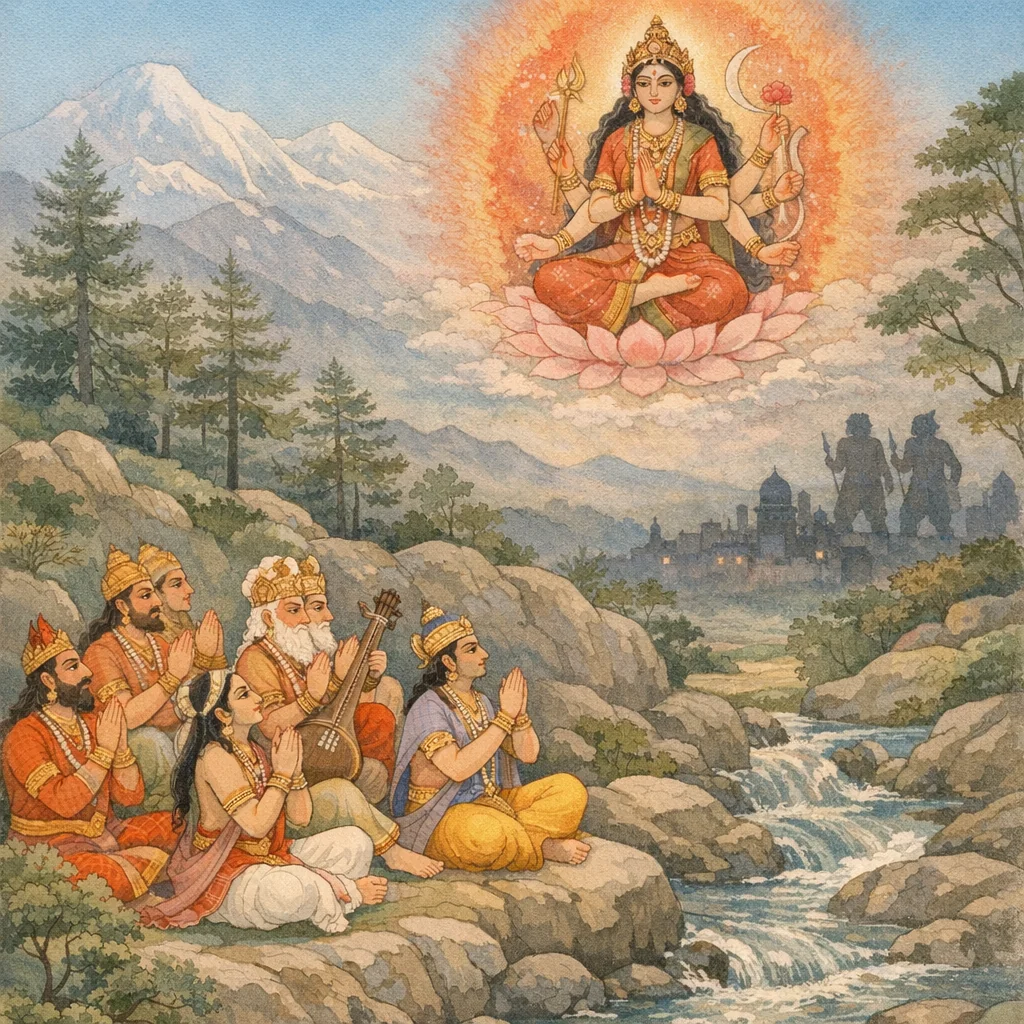
Śumbha–Niśumbha-pīḍā and Devastuti to Durgā/Śivā (Names and Forms of the Devī)
Adhyāya 47 begins with the ṛṣi describing the rise of the daitya brothers Śumbha and Niśumbha, whose might overwhelms the three worlds (trailokya), covering all moving and unmoving beings. Oppressed, the devas withdraw to Himavat and offer reverent praise to the universal Mother, acknowledging her as the benefactress of beings and the power behind cosmic origination, maintenance, and dissolution. The chapter’s heart is a structured stuti: the devas address the Goddess as Durgā and Maheśānī, then unfold a litany of names and iconographic forms—Kālikā, Chinnamastā, Śrīvidyā, Bhuvaneśī, Bhairavākṛti, Bagalāmukhī, Dhūmāvatī, Tripurasundarī, Mātaṅgī, Ajitā, Vijayā, Maṅgalā, Vilāsinī, Ghorā, Rudrāṇī—culminating in Vedāntic exaltation: she is knowable through Vedānta, the supreme Self, and sovereign over innumerable cosmic eggs (brahmāṇḍas). Esoterically, it teaches that the many forms are a single index to the one Śiva–Śakti reality, and that stuti itself is a ritual means of refuge and the restoration of dharmic order.
Shlokas
Verse 1
ऋषिरुवाच । आसीच्छुम्भासुरो दैत्यो निशुंभश्च प्रतापवान् । त्रैलोक्यमोजसा क्रान्तं भ्रातृभ्यां सचराचरम्
The sage said: “There was a Daitya named Śumbha, and his mighty brother Niśumbha. By the force of their power, the three worlds—together with all that moves and all that does not move—were overrun by those two brothers.”
Verse 2
ताभ्याम्प्रपीडिता देवा हिमवन्तं समाययुः । जननीं सर्वभूतानां कामदात्रीं ववन्दिरे
Oppressed by those two, the devas went to Himavān. They bowed to the Mother of all beings—the bestower of desired boons—and offered their reverent salutations.
Verse 3
देवा ऊचुः । जय दुर्गे महेशानि जयात्मीयजनप्रिये । त्रैलोक्यत्राणकारिण्यै शिवायै ते नमोनमः
The gods said: “Victory to you, O Durgā; victory, O Maheshānī; victory to you who are beloved of your own devotees. To you—Śivā, the protectress and savior of the three worlds—we bow again and again.”
Verse 4
नमो मुक्तिप्रदायिन्यै पराम्बायै नमोनमः । नमः समस्तसंसारोत्पत्तिस्थित्यन्तकारिके
Salutations again and again to the Supreme Mother, the bestower of liberation. Salutations to Her who brings about the arising, continuance, and dissolution of the entire world-process.
Verse 5
कालिकारूपसंपन्नो नमस्काराकृते नमः । छिन्नमस्तास्वरूपायै श्रीविद्यायै नमोस्तु ते
Salutations to You, endowed with the form of Kālikā; salutations to You, the very embodiment of reverent prostration. Salutations to You whose form is Chinnamastā; obeisance to You, O Śrīvidyā, the sacred wisdom‑power.
Verse 6
भुवनेशि नमस्तुभ्यं नमस्ते भैरवाकृते । नमोस्तु बगलामुख्यै धूमावत्यै नमोनमः
O Sovereign Lady of the worlds, Bhuvaneśī, I bow to You. Salutations to You who bear the Bhairava-form. Homage indeed to Bagalāmukhī; again and again, homage to Dhūmāvatī.
Verse 7
नमस्त्रिपुरसुन्दर्य्यै मातङ्गयै ते नमोनमः । अजितायै नमस्तुभ्यं विजयायै नमोनमः
Salutations again and again to You as Tripurasundarī; salutations to You as Mātaṅgī. Salutations to You, Ajitā, the Unconquered; salutations again and again to You as Vijayā, Victory.
Verse 8
जयायै मंगलायै ते विलासिन्यै नमोनमः । दोग्ध्रीरूपे नमस्तुभ्यं नमो घोराकृतेऽस्तु ते
Salutations again and again to You as Jayā (Victory), as Maṅgalā (Auspiciousness), and as the Lady of playful līlā. Salutations to You in the form of the Nourishing Mother who ‘milks’ forth grace; and salutations also to Your formidable, awe-inspiring form.
Verse 9
मनोऽपराजिताकारे नित्याकारे नमोनमः । शरणागतपालिन्यै रुद्राण्यै ते नमोनमः
Salutations again and again to You whose very form is unconquerable even to the mind, whose form is eternal. Salutations again and again to You, Rudrāṇī, protectress of those who take refuge in You.
Verse 10
नमो वेदान्तवेद्यायै नमस्ते परमात्मने । अनन्तकोटिब्रह्माण्डनायिकायै नमोनमः
Salutations to Her who is known through Vedānta; salutations to You, the Supreme Self (Paramātman). Again and again, salutations to the Sovereign Lady who presides over infinite crores of universes.
Verse 11
इति देवैः स्तुता गौरी प्रसन्ना वरदा शिवा । प्रोवाच त्रिदशान्सर्वान्युष्माभिः स्तूयतेऽत्र का
Thus praised by the gods, Gaurī—benign, gracious, and bestower of boons—became pleased. Then that auspicious Goddess spoke to all the thirty-three gods: “Who is it here that is being hymned by you?”
Verse 12
ततो गौरीतनोरेका प्रादुरासीत्कुमारिका । सोवाच मिषतां तेषां शिवशक्तिं परादरात्
Then, from Gaurī’s own body, a maiden suddenly manifested. While they all looked on in astonishment, she proclaimed—by the supreme ordinance—the power (Śakti) of Śiva.
Verse 13
स्तोत्रं मे क्रियते मातः समस्तैः स्वर्गवासिभिः । निशुंभशुंभदैत्याभ्यां प्रबलाभ्यां प्रपीडितैः
“O Mother, a hymn of praise is being offered to me by all the dwellers of heaven, who are grievously oppressed by the two mighty demons Niśumbha and Śumbha.”
Verse 14
शरीरकोशाद्यत्तस्या निर्गता तेन कौशिकी । नाम्ना सा गीयते साक्षाच्छुंभासुरनिबर्हिणी
Because she emerged from the sheath (kośa) of her own body, she is praised by the name Kauśikī—indeed, she is directly renowned as the slayer of the asura Śumbha.
Verse 15
चैवोग्रतारिका प्रोक्ता महोग्रतारिकापि च । प्रादुर्भूता यतः सा वै मातंगीत्युच्यते भुवि
She is also proclaimed as Ugratārikā, and likewise as Mahogratārikā. And since she manifested from that very source, she is indeed called “Mātaṅgī” in the world.
Verse 16
बभाषे निखिलान्देवान्यूयं तिष्ठत निर्भयाः । कार्यं वः साधयिष्यामि स्वतन्त्राहं विनाश्रयम्
He spoke to all the gods: “Remain fearless, all of you. I shall accomplish your task. I am independent, needing no support from anyone.”
Verse 17
इत्युक्त्वा सा तदा देवी तरसान्तर्हिताऽभवत् । चाण्डमुण्डौ तु तान्देवीमद्राष्टां सेवकौ तयोः
Having spoken thus, the Goddess swiftly vanished from sight. Yet Caṇḍa and Muṇḍa—those two attendants—beheld that Goddess.
Verse 18
दृष्ट्वा मनोहरं तस्या रूपं नेत्रसुखावहम् । पेततुस्तौ धरामध्ये नष्टसंज्ञौ विमोहितौ
Seeing her enchanting form, a delight to the eyes, those two fell upon the ground—bewildered, their awareness lost, overcome by delusion.
Verse 19
गत्वा व्याजह्रतुः सर्वं राज्ञे वृत्तान्तमादितः । दृष्टा काचिन्मया पूर्वा नारी राजन्मनोरमा
Having gone there, they reported to the king the entire account from the beginning: “O King, earlier I saw a certain woman—charming and captivating.”
Verse 20
हिमवच्छिखरे रम्ये संस्थिता सिंहवाहिनी । समन्ताद्देवकन्याभिः सेविता बद्धपाणिभिः
Upon a lovely peak of the Himālaya stood the Goddess, the Lion-rider, attended on all sides by celestial maidens who served her with palms joined in reverent devotion.
Verse 21
कुरुते पादसंवाहं काचित्संस्कुरुते कचान् । पाणिसंवाहनं काचित्काचिन्नेत्राञ्जनं न्यधात्
One attendant massaged her feet; another arranged and dressed her hair. One gently rubbed her hands, and another applied añjana (collyrium) to her eyes.
Verse 22
काचिद् गृहीत्वा हस्तेनादर्शं दर्शयते मुखम् । नागवल्लीं ददात्येका लवंगैलादिसंयुताम्
One woman, taking a mirror in her hand, shows him his face; another offers betel-leaves (nāgavalī) mixed with cloves, cardamom, and other fragrant ingredients.
Verse 23
पतद्ग्रहं करे कृत्वा स्थिता काचित्सखी पुरः । भूषयत्यखिलांगानि काचिद्भूषाम्बरादिभिः
One companion stood in front, holding a garment in her hand, while another adorned all her limbs with ornaments, fine clothing, and the like.
Verse 24
कदलीस्तंभजंघोरुः कीरनासाऽहिदौर्लता । रणन्मञ्जीरचरणा रम्यमेखलया युता
Her shanks and thighs were smooth like the plantain-stem; her nose was like a parrot’s beak; her arms were like graceful creepers. Her feet, adorned with softly tinkling anklets, resounded gently, and she was beautified by a charming girdle.
Verse 25
लसत्कस्तूरिकामोदमुक्ताहारचलस्तनी । ग्रैवेयकलसद्ग्रीवा ललन्तीदाममण्डिता
A pearl-garland, fragrant with shining musk, rested upon her bosom, and her breasts moved gently beneath it. Her neck gleamed with a splendid necklace, and she was adorned with a lovely garland draped upon her forehead.
Verse 26
अर्द्धचन्द्रधरा देवी मणिकुण्डलधारिणी । रम्यवेणिर्विंशालाक्षी लोचनत्रयभूषिता
The Goddess—bearing the crescent moon—wears jeweled earrings. With beautifully arranged tresses and wide, radiant eyes, she is adorned with three eyes, shining as the auspicious, manifest (saguṇa) power of Śiva.
Verse 27
साक्षरा मालिकोपेता पणिराजितकंकणा । स्वर्णोर्मिकांगुलिर्भ्राजत्पारिहार्य्यलसत्करा
Her hands shone with auspicious, lettered garlands; her wrists were adorned with radiant bracelets; and her fingers, bright with golden rings, gleamed with fitting ornaments.
Verse 28
शुभवस्त्रावृता गौरी पद्मासनविराजिता । काश्मीरबिन्दुतिलका चन्द्रालंकृतमस्तका
Gaurī was clad in auspicious garments and shone seated upon a lotus-seat. She bore a tilaka marked with dots of saffron, and her head was adorned with the moon—revealing the gracious, manifest (saguṇa) splendor by which the Mother is contemplated and worshipped.
Verse 29
तडिद्द्युतिर्महामूल्याम्बर चोलोन्नमत्कुचा । भुजैरष्टाभिरुत्तुंगैर्धारयन्ती वरायुधान्
She shone with the radiance of lightning; her costly garments and bodice exalted her lofty bosom. With eight uplifted arms she bore excellent weapons, revealing a formidable, protective divine form.
Verse 30
तादृशी नासुरी नागी न गन्धर्वी न दानवी । विद्यते त्रिषु लोकेषु यादृशी सा मनोरमा
Within the three worlds there is no Asurī, no Nāgī, no Gandharvī, and no Dānavī who is like that enchanting lady, Manoramā.
Verse 31
तस्मात्संभोगयोग्यत्वं तस्यास्त्वय्येव शोभते । नारीरत्नं यतः सा वै पुंरत्नं च भवान्प्रभो
Therefore, her fitness for sacred union truly shines only with you. For she is indeed a jewel among women, and you, O Lord, are a jewel among men.
Verse 32
इत्युक्तं चण्डमुण्डाभ्यां निशम्य स महासुरः । दूतं सुग्रीवनामानं प्रेषयामास तां प्रति
Hearing what was thus spoken by Caṇḍa and Muṇḍa, that great asura sent a messenger named Sugrīva to her.
Verse 33
गच्छ दूत तुषाराद्रौ तत्रास्ते कापि सुन्दरी । सा नेतव्या प्रयत्नेन कथयित्वा वचो मम
“Go, O messenger, to Mount Tuṣāra. There dwells a certain beautiful maiden. After conveying my words to her, bring her here with due effort.”
Verse 34
इति विज्ञापितस्तेन सुग्रीवो दानवोत्तमः । गत्वा हिमाचलं प्राह जगदम्बां महेश्वरीम्
Thus informed by him, Sugrīva—the foremost among the Dānavas—went to Himācala and reverently addressed Jagadambā, the great Goddess Maheśvarī.
Verse 35
दूत उवाच । देवि शुंभासुरो दैत्यो निशुंभस्तस्य चानुजः । विख्यातस्त्रिषु लोकेषु महा बलपराक्रमः
The messenger said: “O Goddess, the Daitya named Śumbhāsura—and Niśumbha, his younger brother—are renowned in the three worlds for their immense strength and valor.”
Verse 36
चारोहं प्रेषितस्तेन सन्निधिन्ते समागमम् । स यज्जगौ सुरेशानि तत्समाकर्णयाधुना
“I am the spy sent by him, and I have come into your presence. O lords of the gods, now hear from me what he spoke.”
Verse 37
इन्द्रादीन्समरे जित्वा तेषां रत्नान्यपाहरम् । देवभागं स्वयं भुञ्जे यागे दत्तं सुरादिभिः
Having conquered Indra and the other gods in battle, I seized their jewels. I myself partake of the gods’ share—the portion offered in sacrifice and bestowed by the Devas and the rest.
Verse 38
स्त्रीरत्नं त्वामहं मन्ये सर्वरत्नोपरि स्थितम् । सा त्वं ममानुजं मां वा भजतात्कामजै रसैः
I consider you a jewel among women, standing above all other treasures. Therefore, may you accept—according to your desire—either my younger brother or me, and take delight in the pleasures born of love.
Verse 39
इति दूतोक्तमाकर्ण्य वचनं शुंभभाषितम् । जगाद सा महामाया भूतेशप्राणवल्लभा
Hearing thus the messenger’s statement—the words spoken on Śumbha’s behalf—she, the Great Māyā, the beloved of Bhūteśa (Lord Śiva), replied.
Verse 40
देव्युवाच । सत्यं वदसि भो दूत नानृतं किंचिदुच्यते । परन्त्वेका कृता पूर्वं प्रतिज्ञा तान्निबोध मे
The Goddess said: “O messenger, you speak the truth; not even the slightest falsehood is uttered. Yet earlier I had made a single vow—now understand that from me.”
Verse 41
यो मे दर्पं विधुनुते यो मां जयति संगरे । उत्सहे तमहं कर्तुं पतिं नान्यमिति ध्रुवम्
“He who shakes off my pride, he who conquers me in battle—him alone I am willing to accept as my husband; none other, this is certain.”
Verse 42
स त्वं कथय शुंभाय निशुंभाय वचो मम । यथा युक्तं भवेदेवं विदधातु तथाऽत्र सः
So you, convey my words to Śumbha and Niśumbha. Let him arrange matters here in precisely that way which is proper and fitting.
Verse 43
इत्थं देवीवचः श्रुत्वा सुग्रीवो नाम दानवः । राज्ञे विज्ञापयामास गत्वा तत्र सविस्तरम्
Thus, having heard the Goddess’s words, a demon named Sugrīva went to the king and reported the matter there in full detail.
Verse 44
अथ दूतोक्तमाकर्ण्य शुंभो भैरवशासनः । धूम्राक्षं प्राह सक्रोधः सेनान्यं बलिनां वरम्
Then Śuṃbha—who ruled by the command of the Terrifying Bhairava—hearing the messenger’s report, angrily addressed Dhūmrākṣa, the army’s commander, foremost among the mighty.
Verse 45
हे धूम्राक्ष तुषाराद्रौ वर्तते कापि सुन्दरी । तामानय द्रुतं गत्वा यथा यास्यति सात्र वै
“O Dhūmrākṣa, on Mount Tuṣāra there dwells a certain beautiful maiden. Go there at once and quickly bring her here, so that she may indeed come to this place.”
Verse 46
तस्या आनयने भीतिर्न कार्य्याऽसुरसत्तम । युद्धं कार्यं प्रयत्नेन यदि सा योद्धुमिच्छति
O best among the Asuras, do not fear in bringing her here. If she desires to fight, then wage battle with full effort.
Verse 47
इति श्रीशिवमहापुराणे पञ्चम्यामुमासंहितायां धूम्रलोचन चण्डमुण्डरक्तबीजवधो नाम सप्तचत्वारिंशोऽध्यायः
Thus, in the Śrī Śiva Mahāpurāṇa, in the Fifth Book—the Umāsaṃhitā—ends the forty-seventh chapter entitled “The Slaying of Dhūmralocana, Caṇḍa-Muṇḍa, and Raktabīja.”
Verse 48
भर्तुर्ममान्तिकं गच्छ नोचेत्त्वां घातयाम्यहम् । पुष्ट्याऽसुराणां सहितः सहस्राणां नितंबिनि
“Go at once to my husband’s presence; otherwise I shall have you slain. O fair-hipped one, I am accompanied by Puṣṭi and by thousands of asuras.”
Verse 49
देव्युवाच । दैत्यराट्प्रेषितो वीर हंसि चेत्किं करोमि ते । परन्त्वसाध्यं गमनं मन्ये संग्राममन्तरा
The Goddess said: “O hero, if you have been sent by the king of the Daityas and you intend to slay me, then what can I do for you? Yet I consider that any departure from here is impossible without a battle.”
Verse 50
इत्युक्तस्तामन्वधावद्दानवो धूम्रलोचनः । हुंकारोच्चारणेनैव तन्ददाह महेश्वरी
Thus addressed, the Dānava Dhūmralocana rushed after her. But Maheshvarī, by the mere utterance of the syllable “Huṃ,” burned him to ashes.
Verse 51
ततः प्रभृति सा देवी धूमावत्युच्यते भुवि । आराधिता स्वभक्तानां शत्रुवर्गनिकर्तिनी
From that time onward, that Goddess is known on earth as Dhūmāvatī. When she is worshipped, she becomes the destroyer of the hosts of enemies of her own devotees.
Verse 52
धूम्राक्षे निहते देव्या वाहनेनातिकोपिना । चर्वितास्तद्गणास्सर्वेऽपलायन्तावशेषिताः
When Dhūmrākṣa had been slain by the Goddess, her mount—fiercely enraged—crushed and devoured all his attendant hosts; the few that remained fled away.
Verse 53
इत्थं देव्या हतं दैत्यं श्रुत्वा शुंभः प्रतापवान् । चकार बहुलं कोपं सन्दष्टोष्ठपुटद्वयः
Hearing that the demon had thus been slain by the Goddess, the mighty and valiant Śumbha was seized by fierce wrath, clenching his lips tightly together.
Verse 54
चण्डं मुंडं रक्तबीजं प्रैषयत्क्रमतोऽ सुरान् । तेपि चाज्ञापिता दैत्या ययुर्यत्राम्बिका स्थिता
One after another he dispatched the asuras—Caṇḍa, Muṇḍa, and Raktabīja; and those daityas, so commanded, went to the place where Ambikā was stationed.
Verse 55
सिंहारूढा भगवतीमणिमादिभिराश्रिताम् । भासयंती दिशो भासा दृष्ट्वोचुर्द्दानवर्षभाः
Seeing the Blessed Goddess mounted upon a lion—adorned with jewels and the like, and illumining the directions with her radiance—the foremost of the Dānavas spoke.
Verse 56
हे देवि तरसा मूलं याहि शुंभनिशुंभयोः । अन्यथा घातयिष्यामः सगणां त्वां सवाहनाम्
“O Goddess, go at once to the very source—Śumbha and Niśumbha. Otherwise, we shall slay you, together with your attendants and even your mount.”
Verse 57
वृणीष्व तं पतिं वामे लोकपालादिभिः स्तुतम् । प्रपत्स्यसे महानंदं देवानामपि दुर्लभम्
O gentle one, choose that Lord as your husband—He who is praised by the Lokapālas and the other gods. By taking refuge in Him, you will attain the great bliss that is difficult to obtain even for the devas.
Verse 58
इत्युक्तमाकलय्याम्बा स्मयित्वा परमेश्वरी । उदाजहार सा देवी सूनृतं रसवद्वचः
Having understood what was thus spoken, Mother Umā—the Supreme Goddess—smiled, and that Devī then uttered truthful, sweet, and delightful words.
Verse 59
देव्युवाच । अद्वितीयो महेशानः परब्रह्म सदाशिवः । यत्तत्त्वन्न विदुर्वेदा विष्ण्वादीनां च का कथा
The Goddess said: “Maheśāna, Sadāśiva, is without a second—the Supreme Brahman. Even the Vedas do not know His true tattva; what then can be said of Viṣṇu and the other gods?”
Verse 60
तस्याहं प्रकृतिः सक्ष्मा कथमन्यं पतिम्वृणे । सिंही कामातुरा नैव जम्बुकं वृणुते क्वचित्
“I am His subtle Prakṛti—His innate power and sacred consort. How could I choose any other husband? A lioness, even when inflamed with desire, never chooses a jackal.”
Verse 61
करेणुर्गर्दभं नैव द्वीपिनी शशकं न वा । मृषा वदत भो दैत्यो मृत्युव्यालनियंत्रिताः
A she-elephant never mates with a donkey, nor does a tigress with a hare. O Daitya, you speak falsely—your words are held in check by the serpent of death, and thus cannot stand as truth.
Verse 62
यूयं प्रयात पातालं युध्यध्वं शक्तिरस्ति चेत् । इति क्रोधकरं वाक्यं श्रुत्वोचुस्ते परस्परम्
“Then go to Pātāla and fight—if you truly have the strength!” Hearing these anger-stirring words, they spoke among themselves.
Verse 63
अबलां मनसि ज्ञात्वा न हन्मो भवतीं वयम् । अथो स्थिरैहि पञ्चास्ये युद्धेच्छा मानसेऽस्ति चेत्
Knowing in our minds that you are a woman (and thus not to be struck), we shall not slay you. Yet, O Five-Faced One, if the desire for battle truly remains within your heart, then stand firm.
Verse 64
तेषामेवं विवदतां कलहः समवर्द्धत । ववृषु समरे बाणा उभयोर्द्दलयोश्शिताः
As they argued in this manner, their quarrel steadily grew. Then, in the midst of battle, sharp arrows rained down from both opposing armies.
Verse 65
एवं तैः समरं कृत्वा लीलया परमेश्वरी । जघान चण्डमुण्डाभ्यां रक्तबीजं महासुरम्
Thus, having engaged them in battle, the Supreme Goddess—sporting as in divine līlā—had the great demon Raktabīja slain through Caṇḍa and Muṇḍa.
Verse 66
द्वेषबुद्धिं विधायापि त्रिदशस्थितयोऽप्यमी । अन्तेऽप्रापन्परं लोकं यंल्लोकं यान्ति तज्जनाः
Even though these beings, established among the gods, had cultivated a mind of hatred, in the end they attained the supreme realm—the very abode reached by those who are devoted to Him.
Frequently Asked Questions
Śumbha and Niśumbha subjugate the three worlds; the devas, afflicted, go to Himavat and invoke the Goddess through an extended hymn, initiating the narrative logic of divine intervention and restoration.
The multiplicity of names functions as a theological map: diverse iconographies are treated as convergent pointers to one supreme Śakti who is simultaneously cosmic function (creation–maintenance–dissolution) and ultimate reality (Vedānta-knowable Paramātman).
Durgā/Maheśānī/Śivā are foregrounded, with explicit invocation of Kālikā, Chinnamastā, Śrīvidyā, Bhuvaneśī, Bagalāmukhī, Dhūmāvatī, Tripurasundarī, Mātaṅgī, Ajitā, Vijayā, Maṅgalā, Ghorā, and Rudrāṇī.