Umā-caritra-prārthanā: Ṛṣayaḥ Sūtaṃ Pṛcchanti (Request for the Account of Umā)
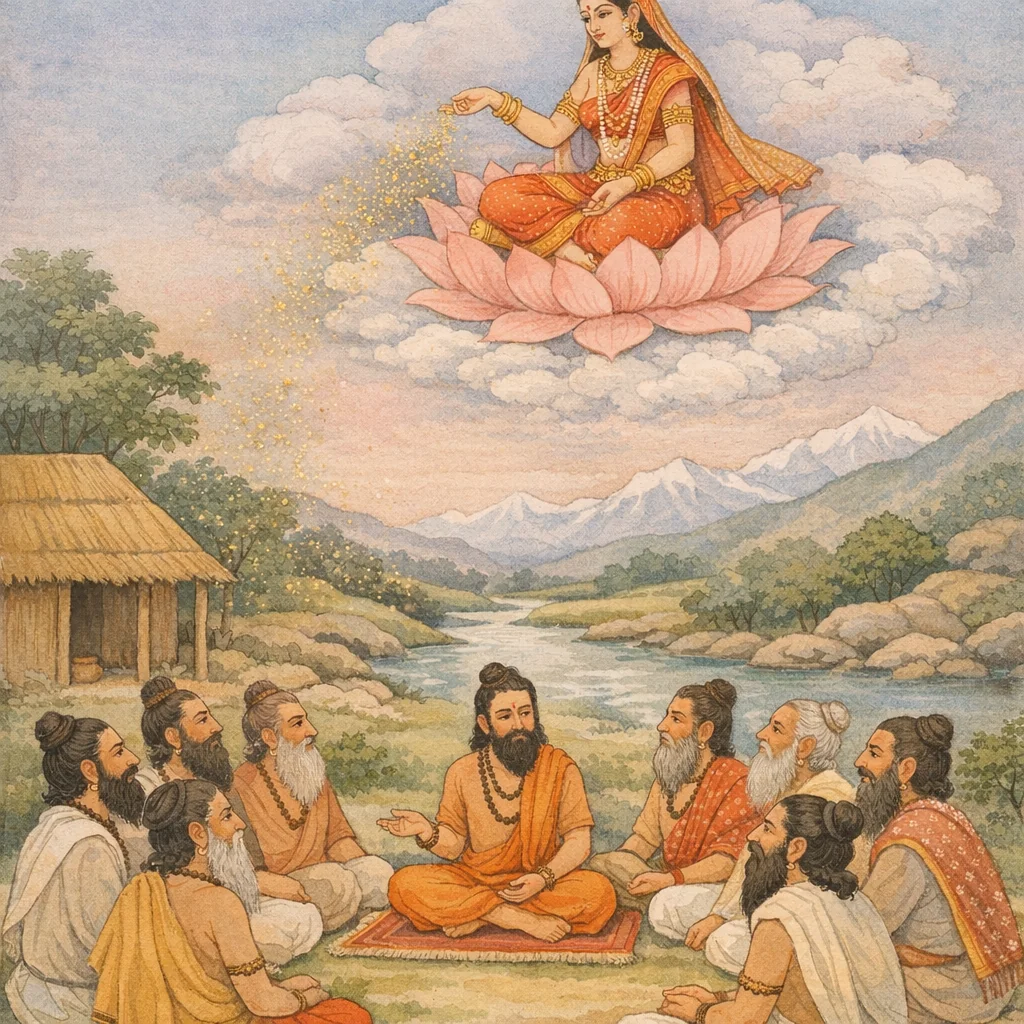
Adhyāya 45 begins with the munis, having heard many captivating kathās of Śaṃbhu (Śiva)—praised as bestowing both bhukti and mukti and filled with episodic and avatāra motifs—now asking Sūta for a focused account of Jagadambā’s delightful life-story. The chapter’s theological core declares Umā to be Maheśvara’s primordial and eternal Śakti (ādyā sanātanī), revered as the supreme Mother of the three worlds. The sages note that they already know the two chief descents (Satī and Hemavatī/Pārvatī) and request further avatāras and fuller exposition. Sūta extols the very act of inquiry: those who hear, ask, and teach this narrative are likened to tīrthas through contact with the “dust” of the Goddess’s lotus-feet (pādāmbuja-rajas). The discourse then draws a soteriological contrast—minds absorbed in the Devī’s higher consciousness (parā-saṃvid) are blessed across lineage and community, while those who neither praise nor worship the Devī, the cause of causes and an ocean of compassion, are deluded by māyā’s guṇas and fall into the “dark well” of saṃsāra. Thus the chapter serves as a doctrinal preface, grounding the coming narrative in Śakti theology and the ethics of devotion.
Shlokas
Verse 1
मुनय ऊचुः । श्रुत्वा शंभोः कथा रम्या नानाख्यानसमन्विता । नानावतार संयुक्ता भुक्तिमुक्तिप्रदा नृणाम्
The sages said: “Having heard the delightful account of Śambhu—filled with many narratives and joined with His many descents (avatāras)—we see that it grants human beings both bhukti (worldly enjoyment) and mukti (liberation).”
Verse 2
इदानीं श्रोतुमिच्छामस्त्वत्तो ब्रह्मविदां वर । चरित्रं जगदंबाया भगवत्या मनोहरम्
Now we wish to hear from you, O best among the knowers of Brahman, the enchanting sacred account of the Blessed Jagadambā—the Mother of the universe.
Verse 3
परब्रह्म महेशस्य शक्तिराद्या सनातनी । उमा या समभिख्याता त्रैलोक्यजननी परा
Umā—renowned by that very name—is the primordial, eternal Śakti of Maheśa, the Supreme Brahman; she is the transcendent Mother who brings forth the three worlds.
Verse 4
सती हेमवती तस्या अवतारद्वयं श्रुतम् । अपरानवतारांस्त्वं ब्रूहि सूत् महामते
We have heard of her two incarnations—Satī and Hemavatī. O Sūta, O great-minded one, please tell us of her other incarnations as well.
Verse 5
को विरज्येत मतिमान् गुणश्रवणकर्मणि । श्रीमातुर्ज्ञानिनो यानि न त्यजन्ति कदाचन
What discerning person could ever turn away from the discipline of hearing the Lord’s divine qualities? Even the wise—who know the glory of the Supreme Mother—never abandon these sacred observances at any time.
Verse 6
सूत उवाच । धन्या यूयं महात्मानः कृतकृत्याः स्थ सर्वदा । यत्पृच्छथ पराम्बाया उमायाश्चरितं महत्
Sūta said: “Blessed are you, O great-souled ones; you are ever fulfilled in purpose, for you inquire into the exalted and sacred deeds of the Supreme Mother, Umā.”
Verse 7
शृण्वतां पृच्छतां चैव तथा वाचयतां च तत् । पादाम्बुजरजांस्येव तीर्थानि मुनयो विदुः
The sages know that for those who listen, inquire, and also recite this teaching, it becomes truly a holy tīrtha—like the dust from the Lord’s lotus-feet.
Verse 8
ते धन्या कृतकृत्याः स्युर्धन्या तेषां प्रसूः कुलम् । येषां चित्तं भवेल्लीनं श्रीदेव्यां परसंविदि
Blessed indeed, and truly fulfilled, are those people; blessed are their mothers and their family line as well—whose mind becomes absorbed in Śrī Devī, in the supreme Consciousness.
Verse 9
ये न स्तुवन्ति देवेशीं सर्वकारणकारणाम् । मायागुणैर्मोहितास्स्युर्हतभाग्या न संशयः
Those who do not praise the Devī—Lady of the gods, the ultimate Cause behind all causes—become deluded by the qualities of Māyā; their fortune is ruined, of this there is no doubt.
Verse 10
न भजन्ति महादेवीं करुणारससागराम् । अन्धकूपे पतन्त्येते घोरे संसाररूपिणि
Those who do not worship Mahādevī—she who is an ocean of the nectar of compassion—fall into a blind well, into the dreadful saṁsāra that takes the form of bondage.
Verse 11
गंगां विहाय तृप्त्यर्थं मरुवारि यथा व्रजेत् । विहाय देवीं तद्भिन्नं तथा देवान्तरं व्रजेत्
Just as one who abandons the Gaṅgā and goes, seeking satisfaction, to the water of a desert—so too, abandoning the Goddess and turning to another deity who is separate from Her is equally misguided.
Verse 12
यस्याः स्मरणमात्रेण पुरुषार्थचतुष्टयम् । अनायासेन लभते कस्त्यजेत्तां नरोत्तमः
By merely remembering Devī Umā, one effortlessly attains the four aims of human life—dharma, artha, kāma, and mokṣa. What noble person, then, would ever abandon Her?
Verse 13
एतत्पृष्टः पुरा मेधास्सुरथेन महात्मना । यदुक्तं मेधसा पूर्वं तच्छृणुष्व वदामि ते
In former times, the sage Medhā was asked this very matter by the great-souled Suratha. Now listen as I tell you what Medhā had earlier spoken.
Verse 14
स्वारोचिषेन्तरे पूर्वं विरथो नाम पार्थिवः । सुरथस्तस्य पुत्रोऽभून्महाबलपराक्रमः
In the earlier period of the Svārociṣa Manvantara, there was a king named Viratha. His son was Suratha, endowed with great strength and heroic valor.
Verse 15
दानशौण्डः सत्यवादी स्वधर्म्म कुशलः कृती । देवीभक्तो दयासिन्धुः प्रजानां परिपालकः
He was foremost in charity, a speaker of truth, skilled in his own dharma and effective in action; devoted to the Goddess (Devī), an ocean of compassion, and a protector of the people.
Verse 16
पृथिवीं शासतस्तस्य पाकशासनतेजसः । बभूबुर्नव ये भूपाः पृथ्वीग्रहणतत्पराः
While that radiant lord—whose splendor rivaled Indra, the chastiser of Pāka—was governing the earth, there arose nine new kings, intent on seizing dominion over the world.
Verse 17
कोलानाम्नीं राजधानीं रुरुधुस्तस्य भूपतेः । तैस्समन्तुमुलं युद्धं समपद्यत दारुणम्
They laid siege to the king’s capital city named Kolā. From that, a dreadful and tumultuous war arose on every side.
Verse 18
युद्धे स निर्जितो भूपः प्रबलैस्तैर्द्विषद्गणैः । उज्जासितच्च कोलाया हृत्वा राज्यमशेषतः
In battle that king was defeated by those powerful hosts of enemies; and, having driven him out, they seized the entire kingdom without remainder.
Verse 19
स राजा स्वपुरीमेत्याकरोद्राज्यं स्वमंत्रिभिः । तत्रापि च महःपक्षैर्विपक्षैस्स पराजितः
That king returned to his own city and, with his ministers, set his realm in proper order. Yet even there he was overcome by powerful opposing factions and rival parties.
Verse 20
दैवाच्छत्रुत्वमापन्नै रमात्यप्रमुखैर्गणैः । कोशस्थितं च यद्वित्तं तत्सर्वं चात्मसात्कृतम्
By the force of destiny, those groups—led by the king’s ministers—had turned hostile; and whatever wealth lay stored in the treasury, all of that too was seized and appropriated for themselves.
Verse 21
ततस्स निर्गतो राजा नगरान्मृगया छलात् । असहायोऽश्वमारुह्य जगाम गहनं वनम्
Then the king, using the pretext of a hunting expedition, went out from the city; alone and without attendants, he mounted his horse and proceeded into a dense forest.
Verse 22
इतस्ततस्तत्र गच्छन्राजा मुनिवराश्रमम् । ददर्श कुसुमारामभ्राजितं सर्वतोदिशम्
Wandering here and there, the king came to the hermitage of the most excellent sage. There he beheld, in every direction, the place radiant with flower-gardens.
Verse 23
वेदध्वनिसमाकीर्णं शान्तजन्तुसमाश्रितम् । शिष्यैः प्रशिष्यैस्तच्छिष्यैस्समन्तात्परिवेष्टितम्
That place was filled with the resonant sound of Vedic recitation and was a refuge for peaceful beings. On every side it was encircled by disciples, grand-disciples, and their disciples, assembled in orderly attendance.
Verse 24
व्याघ्रादयो महावीर्या अल्पवीर्यान्महामते । तदाश्रमे न बाधन्ते द्विजवर्य्यप्रभावतः
O wise one, even mighty creatures such as tigers and the like do not trouble the weak within that hermitage, because of the sanctity and spiritual power of that foremost Brahmin.
Verse 25
उवास तत्र नृपतिर्महाकारुणिको बुधः । सत्कृतो मुनिनाथेन सुवचो भोजनासनैः
There the king—wise and greatly compassionate—stayed for some time. The lordly sage honored him well, with kind words and with offerings of food and a proper seat.
Verse 26
एकदा स महाराजश्चिंतामाप दुरत्ययाम् । अहो मे हीनभाग्यस्य दुर्बुद्धेर्हीनतेजसः
Once, that great king was seized by an overwhelming, hard-to-cross anxiety: “Alas! I am of scant fortune—of misguided understanding and diminished spiritual radiance.”
Verse 27
हृतं राज्यमशेषेण शत्रुवर्गैर्मदोद्धतैः । मत्पूर्वै रक्षितं राज्यं शत्रुभिर्भुज्यतेऽधुना
“My kingdom has been completely seized by bands of enemies, swollen with arrogance. The realm that was protected by my forefathers is now being enjoyed and ruled by those very foes.”
Verse 28
मादृशश्चैत्रवंशेस्मिन्न कोप्यासीन्महीपतिः । किं करोमि क्व गच्छामि कथं राज्यं लभेमहि
In this lineage of the Caitras, there has been no king like me. What shall I do? Where shall I go? And how can I regain the kingdom?
Verse 29
अमात्या मंत्रिणश्चैव मामका ये सनातनाः । न जाने कं च नृपतिं समासाद्याधुनासते
My long-standing ministers and counsellors—those who have been mine from of old—now sit in attendance, having approached some king or other; I do not even know which ruler they have taken refuge with.
Verse 30
विनाश्य राज्यमधुना न जाने कां गतिं गताः । रणभूमिमहोत्साहा अरिवर्गनिकर्तनाः
Now that the kingdom has been destroyed, I do not know to what end they have gone—those who, exultant on the battlefield, cut down the ranks of enemies.
Verse 31
मामका ये महाशूरा नृपमन्यं भजन्ति ते । पर्वताभा गजा अश्वा वातवद्वेगगामिनः
Those great heroes who are mine—if they choose to serve another king—then the elephants, mountain-like, and the horses, swift as the wind, go with them as well.
Verse 32
पूर्वपूर्वार्जितः कोशः पाल्यते तैर्नवाधुना । एवं मोहवशं यातो राजा परमधार्मिकः
“The treasury amassed by earlier generations is now being guarded and managed by those newcomers. Thus that supremely righteous king, overcome by delusion, fell under their sway.”
Verse 33
एतस्मिन्नंतरे तत्र वैश्यः कश्चित्समागतः । राजा पप्रच्छ कस्त्वं भोः किमर्थमिह चागतः
Meanwhile, a certain Vaiśya arrived there. The king asked him, “Who are you, sir, and for what purpose have you come here?”
Verse 34
दुर्मना लक्ष्यसे कस्मादेतन्मे ब्रूहि साम्प्रतम् । इत्याकर्ण्य वचो रम्यं नरपालेन भाषितम्
“Why do you appear so downcast? Tell me this right now.” Hearing these pleasing words spoken by the king, the other prepared to reply.
Verse 35
दृग्भ्यां विमुंचन्नश्रूणि समाधिर्वैश्यपुंगवः । प्रत्युवाच महीपालं प्रणयावनतो गिरम्
Letting tears stream from his eyes, Samādhi—the foremost among the Vaiśyas—bowed in affectionate humility and replied to the king in gentle words.
Verse 36
वैश्य उवाच । समाधिर्नाम वैश्योहं धनिवंशसमुद्भवः । पुत्रदारादिभिस्त्यक्तो धनलोभान्महीपते
The Vaiśya said: “I am a merchant named Samādhi, born in a wealthy lineage. O lord of the earth, driven by greed for money, my son, wife, and others have cast me out.”
Verse 37
स वनमभ्यागतो राजन्दुःखितः स्वेन कर्मणा । सोहं पुत्रप्रपौत्राणां कलत्राणां तथैव च
O King, having come to the forest, I became distressed because of my own deeds. And I—along with my sons, grandsons, and great-grandsons, and likewise with my wife—have fallen into this sorrow.
Verse 38
भ्रातॄणां भ्रातृपुत्राणां परेषां सुहृदां तथा । न वेद्मि कुशलं सम्यक्करुणासागर प्रभो
O Lord, ocean of compassion, I do not truly know the welfare of my brothers, my brothers’ sons, and also my other well-wishers.
Verse 39
राजोवाच । निष्कासितो यैः पुत्राद्यैर्दुर्वृत्तैर्धनगर्धिभिः । तेषु किं भवता प्रीतिः क्रियते मूर्खजन्तुवत्
The King said: “You have been driven out by those wicked sons and relatives, greedy for wealth. Why, then, do you still show affection toward them—like a foolish creature?”
Verse 40
वैश्य उवाच । सम्यगुक्तं त्वया राजन्वचः सारार्थबृंहितम् । तथापि स्नेहपाशेन मोह्यतेऽतीव मे मनः
The Vaiśya said: “O King, what you have spoken is indeed correct—words enriched with essential meaning. Yet even so, my mind is greatly deluded, bound fast by the noose of attachment.”
Verse 41
एवं मोहाकुलौ वैश्यपार्थिवौ मुनिसत्तम । जग्मतुर्मुनिवर्यस्य मेधसः सन्निधिन्तदा
Thus, O best of sages, the merchant and the king—both bewildered and shaken by delusion—then went to the presence of the eminent sage Medhas.
Verse 42
स वैश्यराजसहितो नरराजः प्रतापवान् । प्रणनाम महावीरः शिरसा योगिनां वरम्
That mighty and valorous king of men, accompanied by the king of the Vaiśyas, bowed down with his head to the foremost of yogins—acknowledging him as the higher spiritual authority.
Verse 43
बद्ध्वाञ्जलिमिमां वाचमुवाच नृपतिर्मुनिम् । भगवन्नावयोर्मोहं छेत्तुमर्हसि साम्प्रतम्
With palms joined in reverence, the king addressed the sage: “O Blessed One, please now deign to cut away the delusion that has arisen in us.”
Verse 44
अहं राजश्रिया त्यक्तो गहनं वनमाश्रितः । तथापि हृतराज्यस्य तोषो नैवाभिजायते
Cast off from royal fortune, I have taken refuge in a deep forest; yet even so, for one whose kingdom has been seized, true contentment does not arise at all.
Verse 45
इति श्रीशिवमहापुराणे पञ्चम्यामुमासंहितायां मधुकैटभवधे महाकालिकावतारवर्णनं नाम पंचचत्वारिंशोऽध्यायः
Thus, in the Śrī Śiva Mahāpurāṇa, in the Fifth Book—the Umāsaṃhitā—ends the forty-fifth chapter, entitled “The Slaying of Madhu and Kaiṭabha: the Description of the Descent (Avatāra) of Mahākālikā.”
Verse 46
किमत्र कारणं ब्रूहि ज्ञानिनोरपि नो मनः । मोहेन व्याकुलं जातं महत्येषां हि मूर्खता
Tell us the cause in this matter. Though we are learned, our minds have been shaken by delusion. Truly, this is a great folly on our part.
Verse 47
ऋषि उवाच । महामाया जगद्धात्री शक्तिरूपा सनातनी । सा मोहयति सर्वेषां समाकृष्य मनांसि वै
The sage said: “Mahāmāyā—the eternal Śakti, the sustainer of the world—indeed bewilders all beings, drawing their minds toward herself.”
Verse 48
ब्रह्मादयस्सुरास्सर्वे यन्मायामोहिताः प्रभो । न जानन्ति परन्तत्त्वं मनुष्याणां च का कथा
O Lord, even Brahmā and all the gods, deluded by Your Māyā, do not know the Supreme Reality. How then could ordinary human beings be expected to know it?
Verse 49
सा सृजत्यखिलं विश्वं सैव पालयतीति च । सैव संहरते काले त्रिगुणा परमेश्वरी
She alone brings forth this entire universe; she alone sustains it; and in due time she alone withdraws it. That Supreme Goddess—endowed with the three guṇas—presides over creation, preservation, and dissolution.
Verse 50
यस्योपरि प्रसन्ना सा वरदा कामरूपिणी । स एव मोहमत्येति नान्यथा नृपसत्तम
O best of kings, only that person upon whom She—the boon-giving Goddess who assumes whatever form she wills—becomes gracious truly crosses beyond delusion; it cannot be otherwise.
Verse 51
राजोवाच । का सा देवी महामाया या च मोहयतेऽखिलान् । कथं जाता च सा देवी कृपया वद मे मुने
The King said: “Who is that Goddess, the Great Māyā, who deludes all beings? And how was that Goddess born? O sage, out of compassion, please tell me.”
Verse 52
ऋषिरुवाच । जगत्येकार्णवे जाते शेषमास्तीर्य योगराट् । योगनिद्रामुपाश्रित्य यदा सुष्वाप केशवः
The sage said: “When the whole world had become a single ocean, Keśava—the lord of yogins—spread out Śeṣa as his couch and, resorting to yogic sleep, lay in deep repose.”
Verse 53
तदा द्वावसुरौ जातौ विष्णौ कर्णमलेन वै । मधुकैटभनामानौ विख्यातौ पृथिवीतले
Then indeed two asuras were born from the earwax of Viṣṇu; upon the earth they became renowned by the names Madhu and Kaiṭabha.
Verse 54
प्रलयार्कप्रभौ घोरौ महाकायौ महाहनू । दंष्द्राकरालवदनौ भक्षयन्तौ जगन्ति वा
Terrifying in appearance, blazing like the sun at dissolution, of colossal bodies and mighty jaws—those two, with mouths made dreadful by their fangs, seemed as though they could devour the very worlds.
Verse 55
तौ दृष्ट्वा भगवन्नाभिपङ्कजे कमलासनम् । हननायोद्यतावास्तां कस्त्वं भोरिति वादिनौ
On seeing the Lotus-seated Lord Brahmā upon the lotus arising from Bhagavān’s navel, the two of them became ready to strike; and they spoke, “Who are you, sir?”
Verse 56
समालोक्यं तु तौ दैत्यौ सुरज्येष्ठो जनार्दनम् । शयानं च पयोम्भोधौ तुष्टाव परमेश्वरीम्
Seeing those two demons, Janārdana—foremost among the gods—while reclining upon the Ocean of Milk, praised the Supreme Goddess (Parameśvarī), seeking her divine aid.
Verse 57
ब्रह्मोवाच । रक्षरक्ष महामाये शरणागतवत्सले । एताभ्यां घोररूपाभ्यां दैत्याभ्यां जगदम्बिके
Brahmā said: “Protect us, protect us, O Mahāmāyā—tender guardian of those who seek refuge. O Mother of the universe, save us from these two demons of dreadful form.”
Verse 58
प्रणमामि महामायां योगनिद्रामुमां सतीम् । कालरात्रिं महारात्रिं मोहरात्रिं परात्पराम्
I bow to Umā, the virtuous Satī—She who is Mahāmāyā, the cosmic power of manifestation, and Yogānidrā, the divine yogic sleep. I bow to Her as Kālarātri, as Mahārātri, as Moharātri—She who is supreme beyond the supreme.
Verse 59
त्रिदेवजननीं नित्यां भक्ताभीष्टफलप्रदाम् । पालिनीं सर्वदेवानां करुणावरुणालयम्
She is the eternal Mother of the Three Gods, bestowing upon devotees the cherished fruits they seek; the protectress of all the gods, and the abode of compassion—an ocean of grace.
Verse 60
त्वत्प्रभावादहं ब्रह्मा माधवो गिरिजापतिः । सृजत्यवति संसारं काले संहरतीति च
By Your power alone, I am Brahmā; Mādhava (Viṣṇu) sustains; and Girijā’s Lord (Śiva) too—creating, protecting, and, in due time, dissolving this cycle of saṃsāra.
Verse 61
त्वं स्वाहा त्वं स्वधा त्वं ह्रीस्त्वं बुद्धिर्विमला मता । तुष्टिः पुष्टिस्त्वमेवाम्ब शान्तिः क्षान्तिः क्षुधा दया
You are Svāhā, You are Svadhā, You are modesty; You are the stainless intelligence. O Mother, You alone are contentment and nourishment; You are peace, forbearance, hunger, and compassion.
Verse 62
विष्णु माया त्वमेवाम्ब त्वमेव चेतना मता । त्वं शक्तिः परमा प्रोक्ता लज्जा तृष्णा त्वमेव च
O Mother, You alone are the māyā that even Viṣṇu wields; You alone are regarded as pure consciousness. You are proclaimed the Supreme Power (Śakti), and You alone also appear as modesty and as desire.
Verse 63
भ्रान्तिस्त्वं स्मृतिरूपा त्वं मातृरूपेण संस्थिता । त्वं लक्ष्मीर्भवने पुंसां पुण्याक्षरप्रवर्तिनाम्
You are delusion, and You are also remembrance, established in the form of the Mother. You are Lakṣmī in the homes of those who set the sacred syllables in motion—those devoted to the auspicious recitation of mantras.
Verse 64
त्वं जातिस्त्वं मता वृत्तिर्व्याप्तिरूपा त्वमेव हि । त्वमेव चित्तिरूपेण व्याप्य कृत्स्नं प्रतिष्ठिता
You alone are the source of birth and embodiment; You alone are thought itself and the mind’s movement. Indeed, You are the very form of all-pervasion. And You, as Consciousness (Chiti), pervade everything and remain established as the support of the whole universe.
Verse 65
सा त्वमेतौ दुराधर्षावसुरौ मोहयाम्बिके । प्रबोधय जगद्योने नारायणमजं विभुम्
Therefore, O Ambikā, Divine Mother, you must bewilder these two invincible asuras; and then, O womb of the universe, awaken Nārāyaṇa—the unborn, all-pervading Lord—so that the divine purpose may be fulfilled.
Verse 66
ऋषिरुवाच । ब्रह्मणा प्रार्थिता सेयं मधुकैटभनाशने । महाविद्याजगद्धात्री सर्वविद्याधिदेवता
The sage said: “O slayer of Madhu and Kaiṭabha, this Goddess was invoked by Brahmā. She is Mahāvidyā, the sustainer of the worlds, and the presiding divinity over all forms of knowledge.”
Verse 67
द्वादश्यां फाल्गुनस्यैव शुक्लायां समभून्नृप । महाकालीति विख्याता शक्तिस्त्रैलोक्यमोहिनी
O King, on the twelfth lunar day of the bright fortnight in the month of Phālguna, there manifested that Power renowned as Mahākālī—whose divine Śakti can bewilder the three worlds.
Verse 68
ततोऽभवद्वियद्वाणी मा भैषीः कमलासन । कण्टकं नाशयाम्यद्य हत्वाजौ मधुकैटभौ
Then a voice resounded from the sky: “Do not fear, O lotus-seated Brahmā. Today I shall remove this thorn—having slain in battle Madhu and Kaiṭabha.”
Verse 69
इत्युक्त्वा सा महामाया नेत्रवक्त्रादितो हरेः । निर्गम्य दर्शने तस्थौ ब्रह्मणोऽव्यक्तजन्मनः
Having spoken thus, that Great Māyā emerged from Hari’s (Viṣṇu’s) eyes, mouth, and the rest. Then, manifest before him, she stood revealed to Brahmā, whose origin is unmanifest.
Verse 70
उत्तस्थौ च हृषीकेशो देवदेवो जनार्दनः । स ददर्श पुरो दैत्यो मधुकैटभसंज्ञकौ
Then Hṛṣīkeśa—Janārdana, the God of gods—rose up, and before Him He beheld the two daityas known as Madhu and Kaiṭabha.
Verse 71
ताभ्यां प्रववृत्ते युद्धं विष्णोरतुलतेजसः । पञ्चवर्षसहस्राणि बाहुयुद्धमभूत्तदा
Then a battle began between those two and Viṣṇu of incomparable splendor; at that time, a hand-to-hand combat ensued that lasted for five thousand years.
Verse 72
महामायाप्रभावेण मोहितो दानवोत्तमौ । जजल्पतू रमाकान्तं गृहाण वरमीप्सितम्
Overpowered and deluded by the force of Mahāmāyā, the two foremost among the Dānavas addressed Rāmākānta (Viṣṇu): “Accept the boon you desire.”
Verse 73
नारायण उवाच । मयि प्रसन्नौ यदि वां दीयतामेष मे वरः । मम वध्यावुभौ नान्यं युवाभ्यां प्रार्थये वरम्
Nārāyaṇa said: “If you two are pleased with me, then grant me this boon: let both of you be those whom I may slay. I ask no other boon from you.”
Verse 74
ऋथिरुवाच । एकार्णवां महीं दृष्ट्वा प्रोचतुः केशवं वचः । आवां जहि न यत्रासौ धरणी पयसाऽ ऽप्लुता
Ṛthi said: “Seeing the earth become a single ocean, they spoke these words to Keśava (Viṣṇu): ‘Take us to a place where this Earth is not submerged in the waters.’”
Verse 75
निर्विकारादि साकारा निराकारापि देव्युमा । देवानां तापनाशार्थं प्रादुरासीद्युगेयुगे
Devī Umā—beginningless and free from all change—though truly formless, assumes a manifest form. Age after age she appears to remove the afflictions of the devas.
Verse 76
एवन्ते कथितो राजन्कालिकायास्समुद्भवः । महालक्ष्म्यास्तथोत्पत्तिं निशामय महामते
Thus, O King, I have related to you the arising of Kālikā. Now, O great-minded one, listen as I describe the manifestation of Mahālakṣmī as well.
Verse 78
यदिच्छावैभवं सर्वं तस्या देहग्रहः स्मृतः । लीलया सापि भक्तानां गुणवर्णनहेतवे
All this is the splendor of Her will; therefore Her taking on a body is spoken of in this way. Even that embodiment, by Her divine līlā, is for the sake of devotees, so that Her qualities may be described and contemplated.
Frequently Asked Questions
The chapter argues that Umā is Maheśvara’s primordial, eternal śakti and the supreme mother of the three worlds; therefore, her narrative and praise are not merely devotional literature but a direct soteriological instrument leading toward bhukti and mukti.
Calling listeners/teachers ‘tīrthas’ sacralizes transmission itself: proximity to the Devi (pādāmbuja-rajas metaphor) purifies cognition and conduct. The andhakūpa (dark well) symbolizes māyā-guṇa–driven narrowing of awareness, where the absence of stuti/bhajana is treated as a symptom of spiritual misrecognition rather than simple ignorance.
The framing explicitly presupposes two major descents—Satī and Hemavatī (Pārvatī)—and requests further avatāra elaboration, while consistently naming the Goddess as Umā/Jagadambā/Mahādevī/Deveśī to emphasize her single identity across forms.