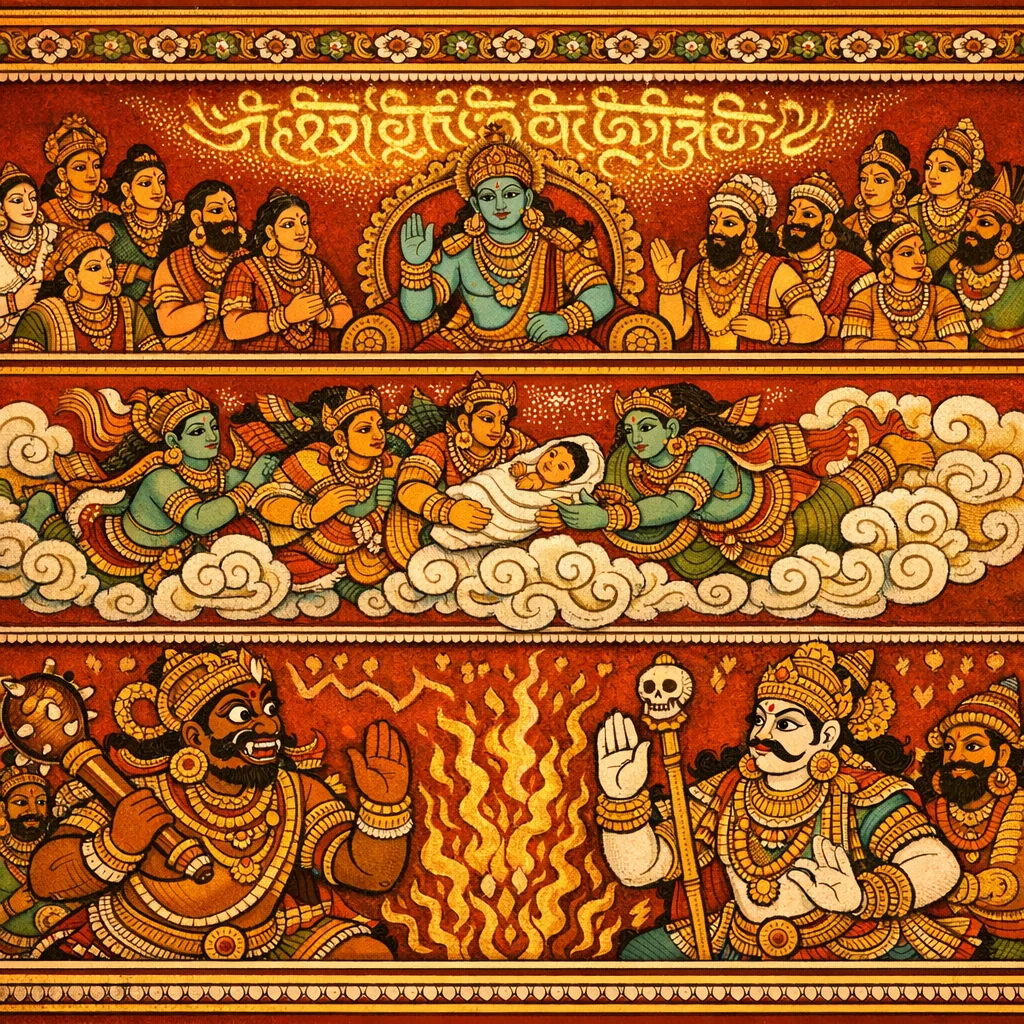
Adhyaya 49: Paurava Genealogy: Bharata, Bharadvāja (Vitatha), Hastināpura’s Founding, and the Ugrāyudha Episode
पौरववंशानुचरितम् (भरत-भरद्वाज-वितथ-हस्तिन वंशवर्णनम्)
Speaker: Sūta, Ṛṣis, Aśarīriṇī Vāk (bodiless voice), Bṛhaspati, Garbha (the speaking embryo), Mamatā, Janamejaya, Yama, Maruts
Sūta continues the dynastic account: from Puru’s descendants come Antināra, then Ilina and Duṣyanta; Bharata is born of Śakuntalā and becomes the namesake of the Bhāratas. A bodiless voice commands Duṣyanta to acknowledge his son, teaching that the putra (son) delivers one from Yama and thus establishing a doctrine of paternity. When Bharata’s sons perish through the wrath of the Mātṛkās, Sūta explains that, stirred by Bharata’s Marutsoma sacrifice, the Maruts bring Bharadvāja—linked with Aṅgiras and Bṛhaspati—to fulfill Bharata’s longing for an heir; Bharadvāja becomes Vitatha and carries on the royal line. The genealogy then extends through Bṛhatkṣatra and Hastin, founder of Gajasāhvaya/Hastināpura, and through Ajamīḍha’s branches, including Kaṇva and later the Nīpa lines. Finally, at the Ṛṣis’ inquiry, the Ugrāyudha episode is told: he slays the Nīpas in keeping with a pledge, curses them invoking Yama, battles Yama and prevails, receiving liberating knowledge; hearing and embracing this conduct is said to avert untimely death and grant imperishable happiness.
Key Concepts
Shlokas in Adhyaya 49
Verse 1
*सूत उवाच पूरोः पुत्रो महातेजा राजा स जनमेजयः प्राचीत्वतः सुतस्तस्य यः प्राचीमकरोद्दिशम् //
Sūta said: From Puru was born the mighty, radiant king Janamejaya. His son was Prācītvata, who made the eastern quarter renowned—expanding his rule toward the East.
Verse 2
प्राचीत्वतस्य तनयो मनस्युश्च तथाभवत् राजा पीतायुधो नाम मनस्योरभवत्सुतः //
Prācītvata had a son named Manasyu; and from Manasyu was born a son, the king named Pītāyudha.
Verse 3
दायादस्तस्य चाप्यासीद् धुन्धुर्नाम महीपतिः धुन्धोर्बहुविधः पुत्रः सम्पातिस्तस्य चात्मजः //
His heir, too, was a king named Dhundhu. Dhundhu had a son named Bahuvidha, and Bahuvidha’s son was Sampāti.
Verse 4
सम्पातेस्तु रंहवर्चा भद्राश्वस्तस्य चात्मजः भद्राश्वस्य धृतायां तु दशाप्सरसि सूनवः //
From Sampāti was born Raṃhavarcā, and Bhadrāśva was his son. And to Bhadrāśva, by Dhṛtā—one of the Apsarases—there were ten sons.
Verse 5
औचेयुश्च हृषेयुश्च कक्षेयुश्च सनेयुकः धृतेयुश्च विनेयुश्च स्थलेयुश्चैव सत्तमः //
And (there were) Auceyu, Hṛṣeyu, Kakṣeyu, and Saneyuka; also Dhṛteyu, Vineyu, and Sthaleyu—(all) foremost among the virtuous.
Verse 6
धर्मेयुः संनतेयुश्च पुण्येयुश्चेति ते दश औचेयोर्ज्वलना नाम भार्या वै तक्षकात्मजा //
Dharmeyu, Saṃnateyu, and Puṇyeyu—these (among them) are the ten (sons). Auceya’s wife was named Jvalanā, and she was the daughter of Takṣaka.
Verse 7
तस्यां स जनयामास अन्तिनारं महीपतिम् अन्तिनारो मनस्विन्यां पुत्राञ्जज्ञे पराञ्छुभान् //
In her, he begot Antināra, a king of the earth. And Antināra, in Manasvinī, fathered many excellent and auspicious sons.
Verse 8
अमूर्तरयसं वीरं त्रिवनं चैव धार्मिकम् गौरी कन्या तृतीया च मान्धातुर्जननी शुभा //
And (she gave birth to) the heroic Amūrtarayas, and also Trivana, a righteous man. Gaurī was the third daughter—an auspicious lady, the mother of Māndhātṛ.
Verse 9
इलिना तु यमस्यासीत् कन्या याजनयत्सुतान् ब्रह्मवादपराक्रान्ताञ् छुभदा त्व् इलिना ह्य् अभूत् //
Through Ilinā, Yama had a daughter; she bore sons who were vigorous in sacred learning and spiritual discourse. Indeed, that daughter was Ilinā’s own—named Śubhadā.
Verse 10
उपदानवी सुतांल्लेभे चतुरस्त्विलिनात्मजात् ऋष्यन्तमथ दुष्यन्तं प्रवीरम् अनधं तथा //
Upadānavī bore four sons to Ilina: Ṛṣyanta, Duṣyanta, Pravīra, and also Anadha.
Verse 11
चक्रवर्ती ततो यज्ञे दुष्यन्तात्समितिंजयः शकुन्तलायां भरतो यस्य नाम्ना च भारताः //
Then there arose the universal monarch (cakravartin). From Duṣyanta came Samitiṃjaya; and from Śakuntalā was born Bharata—after whose name the people are called Bhāratas.
Verse 12
दौष्यन्तीं प्रति राजानं वागूचे चाशरीरिणी माता भस्त्रा पितुः पुत्रो येन जातः स एव सः //
To King Duṣyanta, a bodiless voice then spoke: “The mother is like a bellows; the father is the true begetter—he from whom the son is born, he alone is (the real) father.”
Verse 13
भरस्व पुत्रं दुष्यन्त मावमंस्थाः शकुन्तलाम् रेतोधां नयते पुत्रः परेतं यमसादनात् त्वं चास्य धाता गर्भस्य सत्यमाह शकुन्तला //
O Duṣyanta, acknowledge and support your son; do not slight Śakuntalā. A son, as the bearer of one’s seed, leads a departed father up from the abode of Yama. And you are indeed the begetter of this child in the womb—Śakuntalā speaks the truth.
Verse 14
भरतस्य विनष्टेषु तनयेषु पुरा किल पुत्राणां मातृकात् कोपात् सुमहान्संक्षयः कृतः //
In ancient times, when Bharata’s sons had perished, a very great destruction was indeed brought about, arising from the wrath of the Mothers (Mātṛkās) against those sons.
Verse 15
ततो मरुद्भिरानीय पुत्रः स तु बृहस्पतेः संक्रामितो भरद्वाजो मरुद्भिर्भरतस्य तु //
Then the Maruts brought that son; and Bharadvāja was transferred to Bṛhaspati, and by the Maruts he was also connected with Bharata.
Verse 16
*ऋषय ऊचुः भरतस्य भरद्वाजः पुत्रार्थं मारुतैः कथम् संक्रामितो महातेजास् तन्नो ब्रूहि यथातथम् //
The sages said: “How was the mighty Bharadvāja, for the sake of obtaining a son for Bharata, transferred by the Maruts? Tell us that matter exactly as it happened.”
Verse 17
*सूत उवाच पत्न्यामापन्नसत्त्वायाम् उशिजः स स्थितो भुवि भ्रातुर्भार्यां स दृष्ट्वा तु बृहस्पतिरुवाच ह //
Sūta said: “When Uśij’s wife had conceived, he remained on the earth. Then Bṛhaspati, seeing his brother’s wife, spoke these words.”
Verse 18
उपतिष्ठ स्वलंकृत्य मैथुनाय च मां शुभे एवमुक्ताब्रवीदेनं स्वयमेव बृहस्पतिम् //
“Come near, adorning yourself, O auspicious one, and unite with me.” Having spoken thus, she herself addressed Bṛhaspati in this manner.
Verse 19
गर्भः परिणतश्चायं ब्रह्म व्याहरते गिरा अमोघरेतास्त्वं चापि धर्मं चैवं विगर्हितम् //
“This embryo has already matured, and with its speech it utters the sacred Brahman. You too are one whose seed is unfailing—yet such a course of ‘dharma’ as this is reprehensible.”
Verse 20
एवमुक्तो ऽब्रवीदेनां स्वयमेव बृहस्पतिः नोपदेष्टव्यो विनयस् त्वया मे वरवर्णिनि //
Thus addressed, Bṛhaspati himself replied to her: “O fair-complexioned lady, you should not instruct me in matters of proper conduct and discipline.”
Verse 21
धर्षमाणः प्रसह्यैनां मैथुनायोपचक्रमे ततो बृहस्पतिं गर्भो धर्षमाणमुवाच ह //
Forcibly assaulting her, he proceeded to force sexual union. Then the embryo (garbha) addressed Bṛhaspati, who was committing the assault.
Verse 22
संनिविष्टो ह्य् अहं पूर्वम् इह नाम बृहस्पते अमोघरेताश्च भवान् नावकाश इह द्वयोः //
“Indeed, O Bṛhaspati, I had already taken my place here earlier; and you too are of unfailing seed. Here there is no room for the two of us (together).”
Verse 23
एवमुक्तः स गर्भेण कुपितः प्रत्युवाच ह यस्मात्त्वमीदृशे काले सर्वभूतेप्सिते सति अभिषेधसि तस्मात्त्वं तमो दीर्घं प्रवेक्ष्यसि //
Thus addressed, he—angered from within the womb—replied: “Since, at such a time, when what is desired by all beings is at hand, you obstruct it, therefore you shall enter long darkness.”
Verse 24
ततः कामं संनिवर्त्य तस्यानन्दाद्बृहस्पतेः तद्रेतस्त्वपतद्भूमौ निवृत्तं शिशुको ऽभवत् //
Then, restraining desire, from Bṛhaspati’s surge of bliss his semen fell upon the earth; when it had come to rest, it became (manifest as) the child named Śiśuka.
Verse 25
सद्योजातं कुमारं तु दृष्ट्वा तं ममताब्रवीत् गमिष्यामि गृहं स्वं वै भरस्वैनं बृहस्पते //
Seeing the newly born boy, Mamatā said: “I shall go to my own home; O Bṛhaspati, do you rear this child.”
Verse 26
एवमुक्त्वा गता सा तु गतायां सो ऽपि तं त्यजत् मातापितृभ्यां त्यक्तं तु दृष्ट्वा तं मरुतः शिशुम् जगृहुस्तं भरद्वाजं मरुतः कृपया स्थिताः //
Having spoken thus, she departed; and once she had gone, he too abandoned the child. Seeing the infant forsaken by both mother and father, the Maruts took up that child—Bharadvāja—and, moved by compassion, remained to care for him.
Verse 27
तस्मिन्काले तु भरतो बहुभिर् ऋतुभिर्विभुः पुत्रनैमित्तिकैर्यज्ञैर् अयजत्पुत्रलिप्सया //
At that time, the mighty Bharata, longing for offspring, performed many seasonal sacrifices—rites undertaken for the sake of obtaining a son.
Verse 28
यदा स यजमानस्तु पुत्रं नासादयत्प्रभुः ततः क्रतुं मरुत्सोमं पुत्रार्थे समुपाहरत् //
When that eminent sacrificer did not obtain a son, he then undertook the Marutsoma kratu, performing it with the aim of begetting a putra (son).
Verse 29
तेन ते मरुतस्तस्य मरुत्सोमेन तुष्टुवुः उपनिन्युर्भरद्वाजं पुत्रार्थं भरताय वै //
Pleased by that Marutsoma sacrifice performed for him, the Maruts praised (the king), and for Bharata’s sake—so that he might obtain a son—they brought Bharadvāja to him.
Verse 30
दायादो ऽङ्गिरसः सूनोर् औरसस्तु बृहस्पतेः संक्रामितो भरद्वाजो मरुद्भिर्भरतं प्रति //
Bharadvāja was the heir of the son of Aṅgiras; yet he was the true-born (aurasa) son of Bṛhaspati. Transferred to another line, he was brought by the Maruts toward Bharata.
Verse 31
भरतस्तु भरद्वाजं पुत्रं प्राप्य विभुर् ब्रवीत् आदाव् आत्महिताय त्वं कृतार्थो ऽहं त्वया विभो //
But Bharata, having obtained Bharadvāja as his son, spoke thus: “From the very beginning you have acted for your own highest good; through you, O mighty one, I have been fulfilled and my purpose accomplished.”
Verse 32
पूर्वं तु वितथे तस्मिन् कृते वै पुत्रजन्मनि ततस्तु वितथो नाम भरद्वाजो नृपो ऽभवत् //
Earlier, when that birth of a son had indeed been brought about in relation to Vitatha, thereafter Bharadvāja became a king, bearing the name Vitatha.
Verse 33
तस्मादपि भरद्वाजाद् ब्राह्मणाः क्षत्रिया भुवि द्व्यामुष्यायणकौलीनाः स्मृतास्ते द्विविधेन च //
From Bharadvāja as well, there arose on earth Brahmins and Kshatriyas—those remembered as the Dvyāmuṣyāyana families of noble lineage; and they are reckoned in two distinct divisions.
Verse 34
ततो जाते हि वितथे भरतश्च दिवं ययौ भरद्वाजो दिवं यातो ह्य् अभिषिच्य सुतमृषिः //
Then, when Vitatha was born, Bharata departed to heaven. And the sage Bharadvāja too went to heaven, after having consecrated (installed) his son.
Verse 35
दायादो वितथस्यासीद् भुवमन्युर् महायशाः महाभूतोपमाः पुत्राश् चत्वारो भुवमन्यवः //
Vitatha’s heir was the illustrious Bhuvamanyu; and Bhuvamanyu had four sons, mighty as the great elements.
Verse 36
बृहत्क्षत्रो महावीर्यो नरो गर्गश्च वीर्यवान् नरस्य संकृतिः पुत्रस् तस्य पुत्रो महायशाः //
Bṛhatkṣatra was a great hero. Nara and Garga too were mighty in valor. From Nara was born Saṃkṛti, and his son was Mahāyaśā (of great renown).
Verse 37
गुरुधी रन्तिदेवश्च सत्कृत्यां ताव् उभौ स्मृतौ गर्गस्य चैव दायादः शिबिर्विद्वानजायत //
Gurudhī and Rantideva are remembered as two men renowned for true hospitality and honorable reception of guests. And from Garga’s line there was born the wise king Śibi, his rightful heir.
Verse 38
स्मृताः शैब्यास्ततो गर्गाः क्षत्रोपेता द्विजातयः आहार्यतनयश्चैव धीमानासीद् उरुक्षवः //
Thereafter the Śaibyās are remembered; then (came) the Gargas—twice-born men endowed with kṣatriya status. And Āhārya’s son too was the wise Urukṣava.
Verse 39
तस्य भार्या विशाला तु सुषुवे पुत्रकत्रयम् त्र्युषणं पुष्करिं चैव कविं चैव महायशाः //
His wife Viśālā, renowned and illustrious, gave birth to three sons—Tryuṣaṇa, Puṣkari, and Kavi, all of great renown.
Verse 40
उरुक्षवाः स्मृता ह्य् एते सर्वे ब्राह्मणतां गताः काव्यानां तु वरा ह्य् एते त्रयः प्रोक्ता महर्षयः //
These are remembered as the Urukṣavas; all of them attained the state of Brahminhood. Among the composers of kāvya (sacred poetry), these three are declared to be the foremost great seers (mahārṣis).
Verse 41
गर्गाः संकृतयः काव्याः क्षत्रोपेता द्विजातयः संभृताङ्गिरसो दक्षा बृहत्क्षत्रस्य च क्षितिः //
The Gargas, the Saṃkṛtis, and the Kāvyas—twice-born families endowed with kṣatriya power—together with the Sambhṛtas, the Āṅgirasas, and the Dakṣas; and also Kṣiti, the son of Bṛhatkṣatra—these are the named descendant branches.
Verse 42
बृहत्क्षत्रस्य दायादो हस्तिनामा बभूव ह तेनेदं निर्मितं पूर्वं पुरं तु गजसाह्वयम् //
From Bṛhatkṣatra there arose an heir named Hastin; it was he who, in ancient times, built this city, which came to be known as Gajasāhvaya (Hastināpura).
Verse 43
हस्तिनश्चैव दायादास् त्रयः परमकीर्तयः अजमीढो द्विमीढश्च पुरुमीढस्तथैव च //
And Hastin had three heirs, renowned above all: Ajamīḍha, Dvimīḍha, and likewise Purumīḍha.
Verse 44
अजमीढस्य पत्न्यस्तु तिस्रः कुरुकुलोद्वहाः नीलिनी धूमिनी चैव केशिनी चैव विश्रुता //
Ajamīḍha, the eminent scion of the Kuru dynasty, had three wives—renowned as Nīlinī, Dhūminī, and Keśinī.
Verse 45
स तासु जनयामास पुत्रान्वै देववर्चसः तपसो ऽन्ते महातेजा जाता वृद्धस्य धार्मिकाः //
He, endowed with divine radiance, begot sons upon those wives. At the culmination of his austerities, righteous children were born to the aged man of great splendor.
Verse 46
भारद्वाजप्रसादेन विस्तरं तेषु मे शृणु आजमीढस्य केशिन्यां कण्वः समभवत्किल //
By the grace of Bhāradvāja, hear from me the detailed account concerning them. From Ājamīḍha, in Keśinī, Kaṇva was indeed born, so it is said.
Verse 47
मेधातिथिः सुतस्तस्य तस्मात्काण्वायना द्विजाः अजमीढस्य भूमिन्यां जज्ञे बृहदनुर् नृपः //
Medhātithi was his son; from him arose the Kāṇvāyana brahmins. And from Bhūminī, the wife of King Ajamīḍha, was born the ruler Bṛhadanū.
Verse 48
बृहदनोर् बृहन्तो ऽथ बृहन्तस्य बृहन्मनाः बृहन्मनःसुतश्चापि बृहद्धनुरिति श्रुतः //
From Bṛhadanū came Bṛhanta; and from Bṛhanta was born Bṛhanmanas. The son of Bṛhanmanas, it is heard, was also named Bṛhaddhanu.
Verse 49
बृहद्धनोर् बृहदिषुः पुत्रस्तस्य जयद्रथः अश्वजित्तनयस्तस्य सेनजित् तस्य चात्मजः //
From Bṛhaddhanu was born Bṛhadiṣu; his son was Jayadratha. From Aśvajit was born Senajit, his son.
Verse 50
अथ सेनजितः पुत्राश् चत्वारो लोकविश्रुताः रुचिराश्वश्च काव्यश्च राजा दृढरथस्तथा //
Now, Senajit had four sons, renowned throughout the world—Rucirāśva, Kāvya, and also the king Dṛḍharatha (with a fourth son implied by the stated number).
Verse 51
वत्सश्चावर्तको राजा यस्यैते परिवत्सकाः रुचिराश्वस्य दायादः पृथुसेनो महायशाः //
And there was King Vatsa, also called Āvartaka; from him arose the descendants known as the Parivatsakas. From Rucirāśva’s line was born Pṛthusena, a prince of great renown.
Verse 52
पृथुसेनस्य पौरस्तु पौरान्नीपो ऽथ जज्ञिवान् नीपस्यैकशतं त्व् आसीत् पुत्राणाम् अमितौजसाम् //
From Pṛthusena, a son named Paura was born; and from Paura, Nīpa was then born. Nīpa, indeed, had a hundred sons, all of immeasurable prowess.
Verse 53
नीपा इति समाख्याता राजानः सर्व एव ते तेषां वंशकरः श्रीमान् नीपानां कीर्तिवर्धनः //
All those kings were known by the name “Nīpa.” Among them, the illustrious founder of their line, who increased the Nīpas’ fame, was Kīrtivardhana.
Verse 54
काव्याच्च समरो नाम सदेष्टसमरो ऽभवत् समरस्य पारसम्पारौ सदश्व इति ते त्रयः //
And from Kāvya was born a son named Samara, also known as Sadeṣṭa-samara. From Samara came three sons—Pāra, Sampāra, and Sadaśva.
Verse 55
पुत्राः सर्वगुणोपेता जाता वै विश्रुता भुवि पारपुत्रः पृथुर्जातः पृथोस्तु सुकृतो ऽभवत् //
Sons endowed with every virtue were born, and they became renowned upon the earth. From Pāra’s line Pṛthu was born; and for Pṛthu, Sukṛta arose as his son and issue.
Verse 56
जज्ञे सर्वगुणोपेतो विभ्राजस्तस्य चात्मजः विभ्राजस्य तु दायादस् त्व् अणुहो नाम वीर्यवान् //
His son was born as Vibhrāja, endowed with every noble quality. And Vibhrāja’s heir was the valiant one named Aṇuha.
Verse 57
बभूव शुकजामाता कृत्वीभर्ता महायशाः अणुहस्य तु दायादो ब्रह्मदत्तो महीपतिः //
The illustrious and greatly renowned Kṛtvībhartā became the son-in-law of Śuka; and Anuha’s heir was Brahmadatta, the king of the earth.
Verse 58
युगदत्तः सुतस्तस्य विष्वक्सेनो महायशाः विभ्राजः पुनर् आजातः सुकृतेनेह कर्मणा //
His son was Yugadatta. From him was born the greatly renowned Viṣvaksena; and Vibhrāja too was born again here in this world through the merit of his virtuous deeds.
Verse 59
विष्वक्सेनस्य पुत्रस्तु उदक्सेनो बभूव ह भल्लाटस्तस्य पुत्रस्तु तस्यासीज्जनमेजयः उग्रायुधेन तस्यार्थे सर्वे नीपाः प्रणाशिताः //
Viṣvaksena’s son, it is said, was Udaksena. His son was Bhallāṭa, and Bhallāṭa’s son was Janamejaya. For his sake—by the warrior Ugrāyudha—all the Nīpa kings were destroyed.
Verse 60
*ऋषय ऊचुः उग्रायुधः कस्य सुतः कस्य वंशे स कथ्यते किमर्थं तेन ते नीपाः सर्वे चैव प्रणाशिताः //
The sages said: “Ugrāyudha—whose son was he, and in which lineage is he spoken of? And for what reason were all those Nīpa kings destroyed by him?”
Verse 61
*सूत उवाच उग्रायुधः सूर्यवंश्यस् तपस्तेपे वराश्रमे स्थाणुभूतो ऽष्टसाहस्रं तं भेजे जनमेजयः //
Sūta said: Ugrāyudha, a king of the Solar dynasty, practiced austerities in the excellent hermitage; remaining motionless like a pillar for eight thousand years, he was then succeeded by Janamejaya.
Verse 62
तस्य राज्यं प्रतिश्रुत्य नीपान् आजघ्निवान् प्रभुः उवाच सान्त्वं विविधं जघ्नुस्ते वै ह्य् उभाव् अपि //
Having promised him the kingdom, the mighty lord then struck down the Nīpas. He also spoke many conciliatory words—yet in the end, indeed, both sides came to blows.
Verse 63
हन्यमानागतान् ऊचे यस्माद्धेतोर्न मे वचः शरणागतरक्षार्थं तस्मादेवं शपामि वः //
Addressing those who came while being struck down, he said: “Since, for whatever reason, my word has not been heeded, therefore—so as to uphold the protection owed to one who seeks refuge—I pronounce this curse upon you.”
Verse 64
यदि मे ऽस्ति तपस्तप्तं सर्वान्नयतु वो यमः ततस्तान् कृप्यमाणांस्तु यमेन पुरतः स तु //
“If I have truly performed austerity (tapas), then let Yama take you all away. And then, as those beings are being shown compassion, Yama indeed stands before them.”
Verse 65
कृपया परयाविष्टो जनमेजयम् ऊचिवान् गतानेतानिमान्वीरांस् त्वं मे रक्षितुमर्हसि //
Overwhelmed with profound compassion, he spoke to Janamejaya: “These heroes have departed—yet for my sake you should see fit to protect them.”
Verse 66
*जनमेजय उवाच अरे पापा दुराचारा भवितारो ऽस्य किंकराः तथेत्युक्तस्ततो राजा यमेन युयुधे चिरम् //
Janamejaya said: “O sinful men of wicked conduct—will you become his servants?” Thus addressed, the king then fought with Yama for a long time.
Verse 67
व्याधिभिर्नारकैर्घोरैर् यमेन सह तान्बलात् विजित्य मुनये प्रादात् तदद्भुतमिवाभवत् //
Overpowering them by force—together with Yama and the dreadful hellish afflictions that tormented them—he conquered them and handed them over to the sage; and that indeed seemed a marvel.
Verse 68
यमस्तुष्टस्ततस्तस्मै मुक्तिज्ञानं ददौ परम् सर्वे यथोचितं कृत्वा जग्मुस्ते कृष्णमव्ययम् //
Then Yama, being pleased, bestowed upon him the supreme knowledge that leads to liberation. And all of them, having duly performed what was proper, went to Krishna, the imperishable One.
Verse 69
येषां तु चरितं गृह्य हन्यते नापमृत्युभिः इह लोके परे चैव सुखमक्षय्यमश्नुते //
But those who truly take up and follow this sacred conduct and narrative are not struck down by untimely deaths; in this world and in the next as well, they attain imperishable happiness.
Verse 70
अजमीढस्य धूमिन्यां विद्वाञ्जज्ञे यवीनरः धृतिमांस्तस्य पुत्रस्तु तस्य सत्यधृतिः स्मृतः अथ सत्यधृतेः पुत्रो दृढनेमिः प्रतापवान् //
From Ajamīḍha, through Dhūminī, a learned son named Yavīnara was born. His son was Dhṛtimān, and Dhṛtimān’s son is remembered as Satyadhṛti. Then from Satyadhṛti was born the mighty and valorous Dṛḍhanemi.
Verse 71
दृढनेमिसुतश्चापि सुधर्मा नाम पार्थिवः आसीत्सुधर्मतनयः सार्वभौमः प्रतापवान् //
And Dṛḍhanemi’s son was born as well—a king named Sudharmā. Sudharmā’s son was Sārvabhauma, a universal sovereign, mighty in valor.
Verse 72
सार्वभौमेति विख्यातः पृथिव्याम् एकराड् बभौ तस्यान्ववाये महति महापौरवनन्दनः //
He became renowned on the earth as “Sārvabhauma,” the sole sovereign ruler; and in his great lineage there was born Mahāpaurava-nandana, a descendant of the Pauravas.
Verse 73
महापौरवपुत्रस्तु राजा रुक्मरथः स्मृतः अथ रुक्मरथस्यासीत् सुपार्श्वो नाम पार्थिवः //
Mahāpaurava’s son is remembered as the king named Rukmaratha. And Rukmaratha had a sovereign called Supārśva.
Verse 74
सुपार्श्वतनयश्चापि सुमतिर्नाम धार्मिकः सुमतेरपि धर्मात्मा राजा संनतिमानपि //
And Supārśva also had a son named Sumati, a righteous man. From Sumati too was born a dharma-souled king named Saṃnatimān.
Verse 75
तस्यासीत्संनतिमतः कृतो नाम सुतो महान् हिरण्यनाभिनः शिष्यः कौशल्यस्य महात्मनः //
From that humble-minded one was born a great son named Kṛta, who became a disciple of Hiraṇyanābhi—namely, the noble-souled Kauśalya.
Verse 76
चतुर्विंशतिधा येन प्रोक्ता वै सामसंहिताः स्मृतास्ते प्राच्यसामानः कार्ता नामेह सामगाः //
He it was who proclaimed the Sāma-saṃhitās in twenty-four divisions; these are remembered here as the Prācyasāmans, and their Sāma-chanters (Sāmaga-s) are known by the name Kārtas.
Verse 77
कार्तिरुग्रायुधो ऽसौ वै महापौरववर्धनः बभूव येन विक्रम्य पृथुकस्य पिता हतः //
That very Kartīru, fierce in arms, became a great enhancer of the Paurava line; for, advancing with valor, he slew the father of Pṛthuka.
Verse 78
नीलो नाम महाराजः पाञ्चालाधिपतिर्वशी उग्रायुधस्य दायादः क्षेमो नाम महायशाः //
There was a great king named Nīla, a powerful lord of the Pañcālas. From Ugrāyudha’s lineage was born Kṣema, renowned with great fame.
Verse 79
क्षेमात्सुनीथः संजज्ञे सुनीथस्य नृपंजयः नृपंजयाच्च विरथ इत्येते पौरवाः स्तुताः //
From Kṣema was born Sunītha; from Sunītha came Nṛpaṃjaya; and from Nṛpaṃjaya was born Viratha—these are the celebrated kings of the Paurava line.
Frequently Asked Questions
Alongside genealogy, the chapter teaches dharma around lineage and responsibility: a bodiless voice commands Duṣyanta to recognize and protect Bharata and not dishonor Śakuntalā, asserting that the true father is the begetter and that a son rescues the departed from Yama’s realm. It also upholds śaraṇāgata-rakṣā (protecting those who seek refuge) through the Ugrāyudha episode, and presents ritual discipline (Marutsoma) as effective for securing lawful succession.
Primarily Purāṇic Genealogy (Paurava–Kuru line), with Rajadharma themes such as legitimacy of heirs, protection of dependents/refuge-seekers, and the cakravartin ideal. Vastu/architecture appears indirectly as polity-memory through the statement that Hastin built the city Gajasāhvaya (Hastināpura), anchoring dynastic history to an urban foundation narrative.
Hastin, the heir of Bṛhatkṣatra, is said to have built the city known as Gajasāhvaya—identified with Hastināpura.
Bharata performs multiple progeny-motivated rites and then specifically undertakes the Marutsoma kratu. Pleased, the Maruts bring Bharadvāja to Bharata as a son (in a transfer/adoption-like succession motif), enabling continuation of the royal line via Vitatha.
Sūta states that Ugrāyudha (of the Solar line) promised a kingdom and then struck down the Nīpas when his word was not heeded and conflict escalated; he frames his action as tied to upholding his vow and the duty of protecting those seeking refuge, invoking a curse that calls Yama to take them.
Yes. It states that those who truly take up this sacred conduct and narrative are not struck by untimely deaths and attain imperishable happiness in this world and the next.