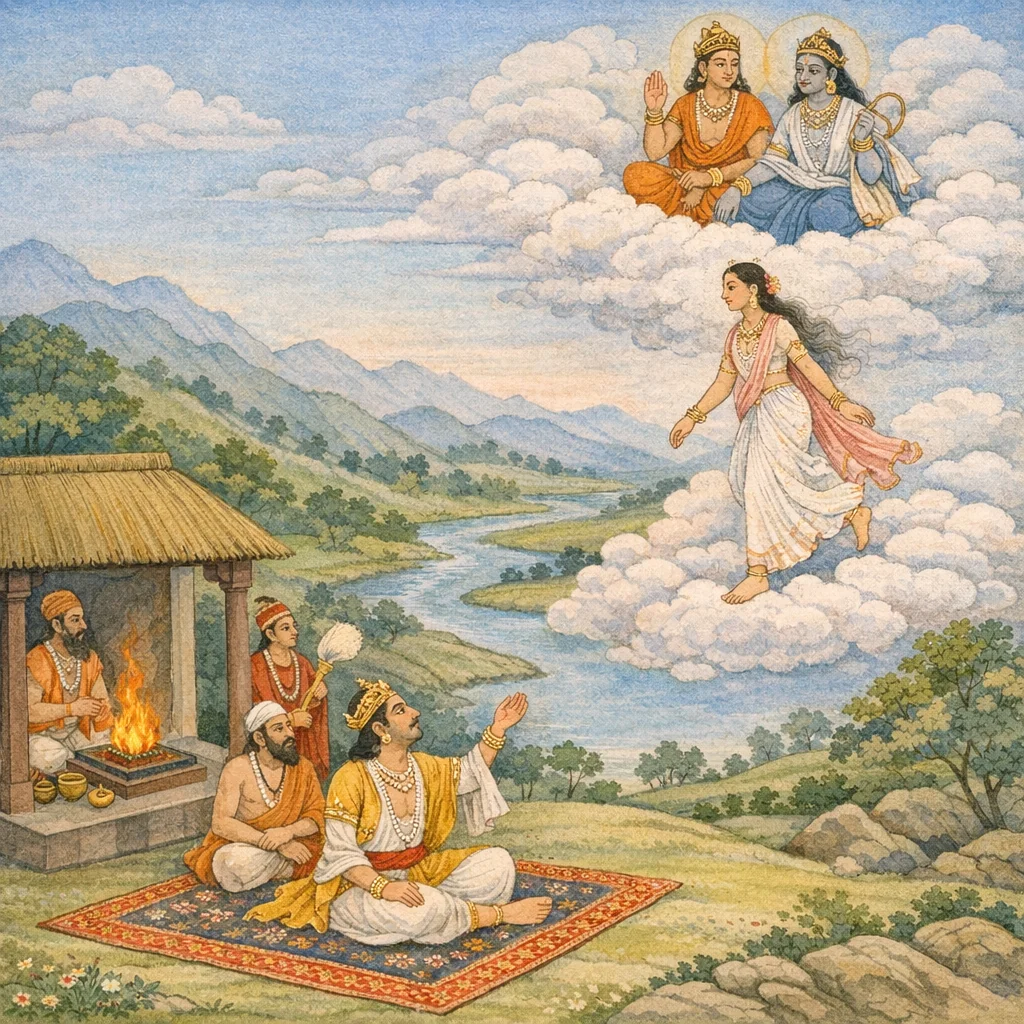
Manu’s Progeny and the Birth of Iḍā (Genealogy and Dharma-Choice)
Narrated by Sūta, this chapter turns to early royal genealogy and treats progeny as a matter of dharma and cosmic order. It first lists the nine sons of Vaivasvata Manu—figures tied to kṣātra-dharma and dynastic continuity, such as Ikṣvāku. It then describes Manu’s putrakāmeṣṭi, the progeny-seeking sacrifice, showing that offspring arise through the causality of yajña and the gods’ allotted shares. From that ritual setting Iḍā appears, endowed with divine qualities and a distinctive origin connected with the portions of Mitra and Varuṇa. A tension is set between Manu’s royal duty to secure lineage and succession and Iḍā’s declared inclination to return to Mitra–Varuṇa, implying a dharma-choice shaped by origin, affinity, and cosmic jurisdiction. The esoteric teaching is that lineage (vaṃśa) and social order are not merely biological facts, but outcomes of ritual intention, divine participation, and the subtle alignment (ruci) of a being’s nature with particular deities and duties—thus uniting genealogy with a theology of agency and cosmic law.
Shlokas
Verse 1
सूत उवाच । मनोर्वैवस्वतस्यासन्पुत्रा वै नव तत्समाः । पश्चान्महोन्नता धीराः क्षत्रधर्मपरायणाः
Sūta said: Vaivasvata Manu had nine sons, all equal in prowess. Thereafter, those steadfast and highly exalted ones devoted themselves to the duties of kṣatriya righteousness.
Verse 2
इक्ष्वाकुः शिबिनाभागौ धृष्टः शर्यातिरेव च । नरिष्यन्तोऽथ नाभागः करूषश्च प्रियव्रतः
Ikṣvāku, Śibi, Nābhāga, Dhṛṣṭa, Śaryāti, Nariṣyanta, and also Nābhāga; and Karūṣa and Priyavrata—these royal personages are recounted in due order.
Verse 3
अकरोत्पुत्त्रकामस्तु मनुरिष्टिं प्रजापति । अनुत्पन्नेषु पुत्रेषु तत्रेष्ट्यां मुनिपुंगवः
Desiring sons, the Prajāpati Manu performed the sacrificial rite called iṣṭi. When no sons had yet been born, that foremost of sages continued with that iṣṭi, seeking divine grace.
Verse 4
सा हि दिव्यांबरधरा दिव्याभरणभूषिता । दिव्यसंहनना चैवमिला जज्ञे हि विश्रुता
She wore celestial garments and was adorned with divine ornaments. Endowed with a radiant, heavenly form, the renowned lady named Milā was born.
Verse 5
तामिडेत्येव होवाच मनुर्दण्डधरस्तथा । अनुगच्छत्व मामेति तमिडा प्रत्युवाच ह
Then Manu, bearer of the staff of authority, said, “O Iḍā, come here; follow me.” Thereupon Iḍā replied to him.
Verse 6
इडोवाच । धर्मयुक्तमिदं वाक्यं पुत्रकामं प्रजापतिम् । मित्रावरुणयोरंशैर्जातास्मि वदतां वर
Iḍā said: “This utterance accords with dharma. O Prajāpati who longs for a son—know that I was born from the partial powers of Mitra and Varuṇa. Speak, O best of speakers.”
Verse 7
तयोस्सकाशं यास्यामि न मे धर्मे रुचिर्भवेत् । एवमुक्त्वा सती सा तु मित्रावरुणयोस्ततः
“I shall go into their presence, for my heart finds no delight in this dharma.” Having spoken thus, Satī departed from there and went toward Mitra and Varuṇa.
Verse 8
गत्वांतिकं वरारोहा प्रांजलिर्वाक्यमब्रवीत् । अंशैस्तु युवयोर्जाता मनुयज्ञे महामुनी
Approaching them, the noble maiden, with palms joined in reverence, spoke: “O great sage, in Manu’s sacrifice I was born as a partial manifestation of you both.”
Verse 9
आगता भवतोरंति ब्रूतं किं करवाणि वाम् । अन्यान्पुत्रान्सृज विभो तैर्वंशस्ते भविष्यति
“You both have come,” they said. “Tell us—what shall I do for you? O Lord, create other sons; through them your lineage will continue.”
Verse 10
सूत उवाच । तां तथावादिनीं साध्वीमिडां मन्वध्वरोद्भवाम् । मित्रावरुणानामानौ मुनी ऊचतुरादरात्
Sūta said: Beholding that virtuous Iḍā—who had spoken thus and had arisen from Manu’s sacrificial rite—the two sages, named Mitra and Varuṇa, addressed her with reverence.
Verse 11
मित्रावरुणावूचतुः । अनेन तव धर्मज्ञे प्रश्रयेण दमेन च । सत्येन चैव सुश्रोणि प्रीतौ द्वौ वरवर्णिनि
Mitra and Varuṇa said: “O knower of dharma, O fair-hipped one—by your humility, by self-restraint (dama), and by truthfulness, O most excellent among women, we two are well pleased.”
Verse 12
आवयोस्त्वं महाभागे ख्यातिं चैव गमिष्यसि । मनोर्वशकरः पुत्रस्त्वमेव च भविष्यसि
O greatly fortunate one, through us you will indeed attain renowned fame; and you yourself will become the son of Manu, named Vaśakara.
Verse 13
सुद्युम्न इति विख्यातस्त्रिषु लोकेषु विश्रुतः । जगत्प्रियो धर्मशीलौ मनुवंशविवर्द्धनः
He was renowned by the name Sudyumna, celebrated throughout the three worlds—beloved of all beings, steadfast in dharma, and a great enhancer of Manu’s royal lineage.
Verse 14
सूत उवाच । निवृत्ता सा तु तच्छ्रुत्वा गच्छंती पितुरंतिके । बुधेनांतरमासाद्य मैधुनायोपमंत्रिता
Sūta said: Hearing those words, she turned back; and while going toward her father’s presence, Budha, finding an opportunity, urged her toward conjugal union.
Verse 15
सोमपुत्रात्ततो जज्ञे तस्यां राजा पुरूरवाः । पुत्रोऽतिसुन्दरः प्राज्ञ उर्वशी पतिरुन्नतः
Then, from Soma’s daughter, there was born King Purūravas—an exalted lord, exceedingly handsome and wise, renowned as the husband of Urvaśī.
Verse 16
जनयित्वा च सा तत्र पुरूरवसमादरात् । पुत्रं शिवप्रसादात्तु पुनस्सुद्युम्नतां गतः
There, she lovingly bore Purūravas a son; and by Lord Śiva’s grace, he once again attained the state of being Sudyumna.
Verse 17
सुद्युम्नस्य तु दायादास्त्रयः परमधार्मिकाः । उत्कलश्च गयश्चापि विनताश्वश्च वीर्यवान्
Sudyumna had three heirs, supremely righteous in conduct—Utkala, Gaya, and the valiant Vinatāśva, endowed with great prowess.
Verse 18
उत्कलस्योत्कला विप्रा विनताश्वस्य पश्चिमाः । दिक्पूर्वा मुनि शार्दूल गयस्य तु गया स्मृताः
O best of sages, the learned declare Utkalā to be the eastern quarter of Utkala; the western quarter is known as Vinatāśva; and for the region of Gaya, the eastern quarter is remembered as Gayā.
Verse 19
प्रविष्टे तु मनौ तात दिवाकरतनुं तदा । दशधा तत्र तत्क्षेत्रमकरोत्पृथिवीं मनुः
O dear one, when Manu entered the solar-bodied form (the region of the Sun) then, he there divided that land into ten parts and duly organized the earth into those ten domains.
Verse 20
इक्ष्वाकुः श्रेष्ठदायादो मध्यदेशमवाप्तवान् । वसिष्ठवचनादासीत्प्रतिष्ठानं महात्मनः
Ikṣvāku, the foremost heir, attained the land of Madhyadeśa; and by the instruction of Vasiṣṭha, the great-souled one established his firm seat of rule (Pratiṣṭhāna).
Verse 21
प्रतिष्ठां धर्मराज्यस्य सुद्युम्नोथ ततो ददौ । तत्पुरूरवसे प्रादाद्राज्यं प्राप्य महायशाः
Then Sudyumna established the firm foundation of a kingdom ruled by dharma. Having attained sovereignty, that greatly renowned ruler bestowed royal authority upon Purūravas.
Verse 22
मानवो यो मुनिश्रेष्ठाः स्त्रीपुंसोर्लक्षणः प्रभुः । नरिष्यंताच्छकाः पुत्रा नभगस्य सुतो ऽभवत्
O best of sages, that lord Mānava, who bore the defining marks of both woman and man, was born as the son of Nabhaga; and from Nariṣyantā were born the sons known as the Śakas.
Verse 23
अंबरीषस्तु बाह्लेयो बाह्लकं क्षेत्रामाप्तवान् । शर्यातिर्मिथुनं त्वासीदानर्तो नाम विश्रुतः
Ambariṣa, the son of Bāhleyā, obtained the territory known as Bāhlaka. Śaryāti had twin offspring; one of them became renowned by the name Ānarta.
Verse 24
पुत्रस्सुकन्या कन्या च या पत्नी च्यवनस्य हि । आनर्तस्य हि दायादो रैभ्यो नाम स रैवतः
Sukanyā—who became the wife of the sage Cyavana—had a son. That son was the heir of Ānarta; he was named Raibhya, and he was also known as Raivata.
Verse 25
आनर्तविषये यस्य पुरी नाम कुशस्थली । महादिव्या सप्तपुरीमध्ये या सप्तमी मता
In the land of Ānarta there is a city called Kuśasthalī. Supremely divine, it is revered as the seventh among the seven sacred cities, the Saptapurī.
Verse 26
तस्य पुत्रशतं त्वासीत्ककुद्मी ज्येष्ठ उत्तमः । तेजस्वी सुबलः पारो धर्मिष्ठो ब्रह्मपालकः
He had a hundred sons. Among them, Kakudmī was the eldest and the most excellent—radiant with tejas, mighty in strength, steadfast, supremely righteous, and a protector of the Brahmanical order (dharma).
Verse 27
ककुद्मिनस्तु संजाता रेवती नाम कन्यका । महालावण्यसंयुक्ता दिव्यलक्ष्मीरिवापरा
To Kakudmin was born a maiden named Revatī—endowed with extraordinary beauty, like another celestial Lakṣmī herself.
Verse 28
प्रष्टुं कन्यावरं राजा ककुद्मी कन्यया सह । ब्रह्मलोके विधेस्सम्यक्सर्वाधीशो जगाम ह
To inquire about a worthy bridegroom for his daughter, King Kakudmī—lord of the earth—went with his daughter to Brahmaloka, to consult the Creator, Brahmā, in proper manner.
Verse 29
आवर्तमाने गांधर्वे स्थितो लब्धक्षणः क्षणम् । शुश्राव तत्र गांधर्वं नर्तने ब्रह्मणोंऽतिके
As the Gandharva music rose and swelled, he stood there, having found a brief opportunity. For a moment, near Brahmā—where the dancing was taking place—he heard that celestial Gandharva melody.
Verse 30
मुहूर्तभूतं तत्काले गतं बहुयुगं तदा । न किंचिद्बुबुधे राजा ककुद्मी मुनयस्स तु
O sages, in that realm what seemed to be only a single moment had, in truth, become the passage of many yugas. Yet King Kakudmī perceived none of it at all.
Verse 31
तदासौ विधिमा नम्य स्वाभिप्रायं कृतांजलिः । न्यवेदयद्विनीतात्मा ब्रह्मणे परमात्मने
Then he bowed to Brahmā, the Ordainer of sacred rule (vidhi), and with folded hands, in humble spirit, submitted his intention to Brahmā, the Supreme Self (Paramātman).
Verse 32
तदभिप्रायमाकर्ण्य स प्रहस्य प्रजापतिः । ककुद्मिनं महाराजं समाभाष्य समब्रवीत्
Hearing his intention, Prajāpati (Brahmā) smiled; then, addressing the great king Kakudmin, he spoke as follows.
Verse 33
ब्रह्मोवाच । शृणु राजन्रैभ्यसुत ककुद्मिन्पृथिवपिते । मद्वचः प्रीतितस्सत्यं प्रवक्ष्यामि विशेषतः
Brahmā said: O King Kakudmin, son of Raibhya—O lord and protector of the earth—listen. With goodwill I shall speak my words to you truthfully, and with particular clarity.
Verse 34
कालेन संहृतास्ते वै वरा ये ते कृता हृदि । न तद्गोत्रं हि तत्रास्ति कालस्सर्वस्य भक्षकः
Indeed, in time, those very boons that you had cherished in your heart are dissolved. There, no lineage or clan remains at all—Time devours everything.
Verse 35
त्वत्पुर्य्यपि हता पुण्यजनैस्सा राक्षसैर्नृप । अष्टाविंशद्द्वापरेऽद्य कृष्णेन निर्मिता पुनः
O King, even that city of yours was once destroyed by the Rākṣasas together with the hosts of Puṇyajanas; but now, in this twenty-eighth Dvāpara age, it has been built again by Kṛṣṇa.
Verse 36
इति श्रीशिवमहापुराणे पञ्चम्यामुमासंहितायां मनुनवपुत्रवंशवर्णनंनाम षट्त्रिंशो ऽध्यायः
Thus ends the thirty-sixth chapter, titled “The Description of the Lineage of Manu’s Nine Sons,” in the Umā-saṃhitā, the fifth section of the Śrī Śiva Mahāpurāṇa.
Verse 37
तद्गच्छ तत्र प्रीतात्मा वासुदेवाय कन्यकाम् । बलदेवाय देहि त्वमिमां स्वतनयां नृप
Therefore go there with a pleased and trusting heart, O king, and give this maiden—your own daughter—in marriage to Vāsudeva or to Baladeva.
Verse 38
सूत उवाच । इत्यादिष्टो नृपोऽयं तं नत्वा तां च पुरीं गतः । गतान्बहून्युगाञ्ज्ञात्वा विस्मितः कन्यया युतः
Sūta said: Thus instructed, this king bowed to him and then went to that city. Realizing that many ages (yugas) had passed, he was astonished—while still accompanied by the maiden.
Verse 39
ततस्तु युवतीं कन्यां तां च स्वां सुविधानतः । कृष्णभ्रात्रे बलायाशु प्रादात्तत्र स रेवतीम्
Then, in a fitting and proper manner, he promptly gave his own youthful maiden daughter Revatī there to Balarāma, the brother of Kṛṣṇa.
Verse 40
ततो जगाम शिखरं मेरोर्दिव्यं महाप्रभुः । शिवमाराधयामास स नृपस्तपसि स्थितः
Then that great and illustrious king went to the divine peak of Mount Meru. Established in austerity, he worshipped Lord Śiva with steadfast devotion.
Verse 41
ऋषय ऊचुः । तत्र स्थितो बहुयुगं ब्रह्मलोके स रेवतः । युवैवागान्मर्त्यलोकमेतन्नः संशयो महान्
The sages said: “Revata dwelt there in Brahmā’s world for many yugas; yet he returned to the mortal realm still as a youth. This indeed is our great doubt.”
Verse 42
सूत उवाच । न जरा क्षुत्पिपासा वा विकारास्तत्र संति वै । अपमृत्युर्न केषांचिन्मुनयो ब्रह्मणोंऽतिके
Sūta said: There, indeed, there is no old age, nor hunger and thirst, nor any bodily afflictions. And for some sages who abide in the presence of Brahmā, there is no untimely death.
Verse 43
अतो न राजा संप्राप जरां मृत्युं च सा सुता । स युवैवागतस्तत्र संमंत्र्य तनयावरम्
Therefore the king did not fall into old age or death, nor did his daughter. Remaining youthful, he came there and, after due deliberation, chose an excellent husband for his daughter.
Verse 44
गत्वा द्वारावतीं दिव्यां पुरीं कृष्णविनिर्मिताम् । विवाहं कारयामास कन्यायाः स बलेन हि
Going to the divine city of Dvāravatī, the splendid capital built by Kṛṣṇa, he had the maiden’s marriage solemnly performed there by the strength of his authority.
Verse 45
तस्य पुत्रशतं त्वासीद्धार्मिकस्य महाप्रभो । कृष्णस्यापि सुता जाता बहुस्त्रीभ्योऽमितास्ततः
O great lord, that righteous one had a hundred sons. And from Kṛṣṇa as well, thereafter countless children were born through many wives.
Verse 46
अन्ववायो महांस्तत्र द्वयोरपि महात्मनोः । क्षत्रिया दिक्षु सर्वासु गता हृष्टास्सुधार्मिकाः
There, a great lineage arose from those two noble souls. Those Kshatriyas—virtuous and firmly established in righteousness—went forth in all directions, rejoicing as they spread throughout the regions.
Verse 47
इति प्रोक्तो हि शर्यातेर्वंशोऽन्येषां वदाम्यहम् । मानवानां हि संक्षेपाच्छृणुतादरतो द्विजाः
Thus has the lineage of Śaryāti been narrated. Now I shall speak of the other lines of men as well—listen attentively, O twice-born sages, to this account in brief.
Verse 48
नाभागो दिष्टपुत्रोऽभूत्स तु ब्राह्मणतां गतः । स्वक्षत्रवंशं संस्थाप्य ब्रह्मकर्मभिरावृतः
Nabhāga was born as the son of Diṣṭa; yet he attained the state of a brāhmaṇa. Having established his own kṣatriya lineage, he became devoutly absorbed in the duties and disciplines of sacred Brahmanic conduct.
Verse 49
धृष्टाद्धार्ष्टमभूत्क्षत्रं ब्रह्मभूयं गतं क्षितौ । करूषस्य तु कारूषाः क्षत्रिया युद्धदुर्मदाः
From Dhṛṣṭa arose the kṣatriya line called Dhārṣṭa, and on earth it even attained the status of Brahminhood. And from Karūṣa came the Kārūṣas—kṣatriyas intoxicated with the pride of battle.
Verse 50
नृगो यो मनुपुत्रस्तु महादाता विशेषतः । नानावसूनां सुप्रीत्या विप्रेभ्यश्च गवां तथा
Nṛga, the son of Manu, was renowned above all as a great giver. With heartfelt devotion he gladly bestowed many kinds of riches upon the Brahmins, and likewise gifted cows as well.
Verse 51
गोदातव्यत्ययाद्यस्तु स्वकुबुद्ध्या स्वपापतः । कृकलासत्वमापन्नः श्रीकृष्णेन समुद्धृतः
But one who, through the perversion of what ought to be given—driven by his own foolish mind and his own sin—fell into the state of a lizard, was afterwards delivered and raised up by Śrī Kṛṣṇa.
Verse 52
तस्येकोभूत्सुतः श्रेष्ठः प्रयातिर्धर्मवित्तथा । इति श्रुतं मया व्यासात्तत्प्रोक्तं हि समासतः
He had a single son—excellent indeed—named Prayāti, who was also a knower of dharma. Thus have I heard it from Vyāsa; and that same account I have now stated in brief.
Verse 53
वृषघ्नस्तु मनोः पुत्रो गोपालो गुरुणा कृतः । पालयामास गा यत्तो रात्र्यां वीरासनव्रतः
Vṛṣaghna, the son of Manu, was appointed by his preceptor as a cowherd. With diligence he protected the cows; and at night he observed the vow of vīrāsana, seated in heroic posture, abiding in disciplined vigilance.
Verse 54
स एकदाऽऽगतं गोष्ठे व्याघ्रं गा हिंसितुं बली । श्रुत्वा गोकदनं बुद्धो हंतुं तं खड्गधृग्ययौ
Once, a powerful tiger came into the cow-pen to harm the cows. Hearing that the cows were being attacked, the wise man, sword in hand, went forth to slay that beast.
Verse 55
अजानन्नहनद्बभ्रोश्शिरश्शार्दूलशंकया । निश्चक्राम सभीर्व्याघ्रो दृष्ट्वा तं खड्गिनं प्रभुम्
Not recognizing him, he struck off the brown one’s head, mistaking it for a tiger. But when the tiger saw that Lord bearing a sword, it withdrew in fear.
Verse 56
मन्यमानो हतं व्याघ्रं स्वस्थानं स जगाम ह । रात्र्यां तस्यां भ्रमापन्नो वर्षवातविनष्टधीः
Thinking that the tiger had been slain, he returned to his own place. But that night, bewildered and with his judgment shattered by rain and wind, he wandered in confusion.
Verse 57
व्युष्टायां निशि चोत्थाय प्रगे तत्र गतो हि सः । अद्राक्षीत्स हतां बभ्रुं न व्याघ्रं दुःखितोऽभवत्
When the night had passed, he rose and went there at dawn. There he saw the tawny deer lying slain, but not the tiger; and he became sorrowful.
Verse 58
श्रुत्वा तद्वृत्तमाज्ञाय तं शशाप कृतागसम् । अकामतोविचार्य्येति शूद्रो भव न क्षत्रियः
Hearing of that occurrence and knowing what had transpired, he cursed the offender: “Since you acted without discernment and without due consideration, become a śūdra—no longer a kṣatriya.”
Verse 59
एवं शप्तस्तु गुरुणा कुलाचार्य्येण कोपतः । निस्सृतश्च पृषध्रस्तु जगाम विपिनं महत्
Thus, cursed in anger by his guru, the family preceptor, Pṛṣadhra was driven out and departed for the vast forest.
Verse 60
निर्विण्णः स तु कष्टेन विरक्तोऽभूत्स योगवान् । वनाग्नौ दग्धदेहश्च जगाम परमां गतिम्
Afflicted by hardship, he grew utterly disenchanted with worldly life and became steadfast in yoga. When his body was consumed by a forest fire, he attained the supreme state—liberation through the grace of the Lord, the supreme Pati (Śiva).
Verse 61
कविः पुत्रो मनोः प्राज्ञश्शिवानुग्रहतोऽभवत् । भुक्त्वा सुखं दिव्यं मुक्तिं प्राप सुदुर्लभाम्
Kavi, the wise son of Manu, attained excellence through the grace of Lord Śiva. Having enjoyed divine happiness, he obtained liberation—so very difficult to attain.
Frequently Asked Questions
It presents Manu’s putrakāmeṣṭi and the ensuing emergence of Iḍā, embedding dynastic genealogy in a theological argument: progeny and succession are produced through yajña-intent plus divine participation, not merely through human desire or politics.
The putrakāmeṣṭi functions as a symbol of intentional causality: sacrifice externalizes inner will (kāma) into a regulated dharmic act, while Iḍā’s return-impulse toward Mitra-Varuṇa symbolizes that beings gravitate to their originating cosmic principle—highlighting a Purāṇic theory of affinity and jurisdiction.
This chapter’s sampled verses do not foreground a distinct Śiva/Gaurī form; rather, it supports the Umāsaṃhitā’s broader Śaiva framework indirectly by grounding social order, lineage, and dharma—domains ultimately supervised by the Śaiva cosmic order—through a genealogical-ritual narrative.