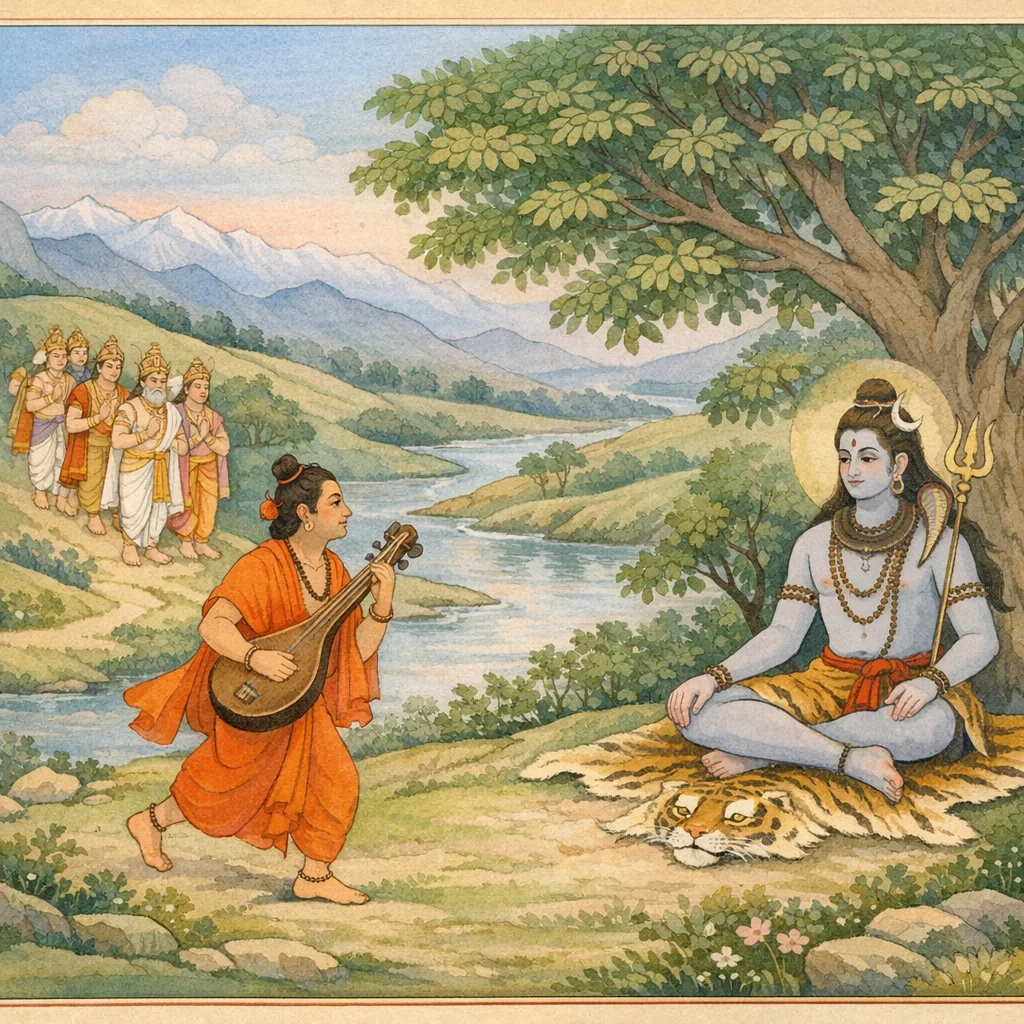
देवशरणागति-नारदप्रेषणम् | The Devas Take Refuge in Śiva; Nārada Is Sent
Adhyāya 18 begins with Sanatkumāra describing the devas’ anguish under the oppression of the great asura (linked with Jalandhara), by which they are displaced and unsettled. In their suffering, the devas together undertake śaraṇāgati to Śiva, praising Maheśvara as the giver of all boons and the protector of devotees. Śiva, sarvakāmada and bhaktavatsala, sets a divine remedy in motion by summoning and commissioning Nārada for devakārya, the gods’ cause. Nārada, the jñānī and Śiva-bhakta, proceeds by the Lord’s command to the relevant place; Indra and the other gods honorably receive him with a seat, salutations, and earnest attention. The devas then present their grievance: the daitya Jalandhara has forcibly driven them out and destabilized them, plunging them into sorrow and agitation. Thus the chapter establishes the causal sequence for what follows—oppression → refuge in Śiva → Śiva’s directive → Nārada’s mediation → the devas’ plea—preparing the next phase of divine intervention.
Shlokas
Verse 1
सनत्कुमार उवाच । एवं शासति धर्मेण महीं तस्मिन्महासुरे । बभूवुर्दुःखिनो देवा भ्रातृभावान्मुनीश्वर
Sanatkumāra said: When that mighty Asura ruled the earth in this manner, administering governance according to his own dharma, the Devas became sorrowful, O lord among sages, for he treated them with an attitude of “brotherhood,” reducing their rightful divine sovereignty to mere equality.
Verse 2
दुःखितास्ते सुरास्सर्वे शिवं शरणमाययुः । मनसा शंकरं देवदेवं सर्वप्रभुंप्रभुम्
Afflicted with sorrow, all those Devas sought refuge in Śiva. In their hearts they turned to Śaṅkara—the God of gods, the supreme Lord, the Master of all.
Verse 3
तुष्टुवुर्वाग्भिरिष्टाभिर्भगवंतं महेश्वरम् । निवृत्तये स्वदुःखस्य सर्वदं भक्तवत्सलम्
With cherished and fitting words, they praised Bhagavān Maheśvara—ever affectionate to His devotees and the giver of all boons—seeking the cessation of their own sorrow.
Verse 4
आहूय स महादेवो भक्तानां सर्वकामदः । नारदं प्रेरयामास देवकार्यचिकीर्षया
Mahādeva, who grants His devotees every worthy desire, summoned Nārada and commissioned him, intending to accomplish the work of the gods.
Verse 5
अथ देवमुनिर्ज्ञानी शंभुभक्तस्सतां गतिः । शिवाज्ञया ययौ दैत्यपुरे देवान्स नारदः
Then Nārada—the divine sage, wise, a devotee of Śambhu and a true refuge for the righteous—set out by Śiva’s command to the city of the Daityas, taking the gods along with him.
Verse 6
व्याकुलास्ते सुरास्सर्वे वासवाद्या द्रुतं मुनिम् । आगच्छंतं समालोक्य समुत्तस्थुर्हि नारदम्
All the gods—Indra and the rest—distressed and agitated, on seeing the sage Nārada swiftly approaching, immediately rose up to receive him.
Verse 7
ददुस्त आसनं नत्त्वा मुनये प्रीतिपूर्वकम् । नारदाय सुराश्शक्रमुखा उत्कंठिताननाः
With affection, the gods—led by Śakra (Indra)—bowed to the sage Nārada and respectfully offered him a seat, their faces eager with anticipation.
Verse 8
सुखासीनं मुनिवरमासने सुप्रणम्य तम् । पुनः प्रोचुस्सुरा दीना वासवाद्या मुनीश्वरम्
After bowing deeply to that foremost sage, seated at ease upon his seat, the devas—distressed, with Indra and the others at their head—once again addressed the lord among sages.
Verse 9
देवा ऊचुः । भोभो मुनिवरश्रेष्ठ दुःखं शृणु कृपाकर । श्रुत्वा तन्नाशय क्षिप्रं प्रभुस्त्वं शंकरप्रियः
The Devas said: “O! O best of sages, compassionate one—hear our sorrow. Having heard it, quickly remove it. You are capable, and you are dear to Śaṅkara.”
Verse 10
जलंधरेण दैत्येन सुरा विद्राविता भृशम् । स्वस्थानाद्भर्तृभावाच्च दुःखिता वयमाकुलाः
“By the demon Jalandhara, the gods have been violently driven away. Cast out from our own abodes and bereft of our rightful lordship, we are distressed and utterly shaken.”
Verse 11
स्वस्थानादुष्णरश्मिश्च चन्द्रो निस्सारितस्तथा । वह्निश्च धर्मराजश्च लोकपालास्तथेतरे
From their own abodes, the Sun, the Moon, Fire, Yama the Lord of Dharma, the Lokapālas (guardians of the quarters), and the other divine beings too were driven forth and cast out.
Verse 12
सुबलिष्ठेन वै तेन सर्वे देवाः प्रपीडिताः । दुःखं प्राप्ता वयं चातिशरणं त्वां समागताः
Indeed, by that exceedingly powerful one, all the gods have been grievously oppressed. Struck by distress, we have come to You alone as our supreme refuge.
Verse 13
संग्रामे स हृषीकेशं स्ववशं कृतवान् बली । जलंधरो महादैत्यः सर्वामरविमर्दकः
In the battle, that mighty Jalandhara—the great Daitya, crusher of all the gods—brought Hṛṣīkeśa (Viṣṇu) under his own control.
Verse 14
तस्य वश्यो वराधीनोऽवात्सीत्तत्सदने हरिः । सलक्ष्म्या सहितो विष्णुर्यो नस्सर्वार्थसाधकः
Hari—Viṣṇu—together with Lakṣmī, came to dwell in his abode, having become subject to him and dependent upon his boon; that same Viṣṇu is the accomplisher of all aims for us. (Yet in this narrative, even he is shown as moving under the higher ordinance that flows from Śiva’s supremacy.)
Verse 15
जलंधरविनाशाय यत्नं कुरु महामते । त्वं नो दैववशात्प्राप्तस्सदा सर्वार्थसाधकः
O great-minded one, strive earnestly for the destruction of Jalandhara. By the ordinance of destiny you have come to us—ever able to accomplish all that is needed for our righteous purpose.
Verse 16
सनत्कुमार उवाच । इत्याकर्ण्य वचस्तेषाममराणां स नारदः । आश्वास्य मुनिशार्दूलस्तानुवाच कृपाकरः
Sanatkumāra said: Hearing those words of the immortals (the Devas), Nārada—the tiger among sages, compassionate by nature—consoled them and then spoke to them.
Verse 17
नारद उवाच । जानेऽहं वै सुरा यूयं दैत्यराजपराजिताः । दुःख प्राप्ताः पीडिताश्च स्थानान्निस्सारिताः खलुः
Narada said: “Indeed, O Devas, I know that you have been defeated by the king of the Daityas. You have fallen into sorrow, have been grievously afflicted, and have truly been driven out from your own abodes.”
Verse 18
इति श्रीशिवमहापुराणे द्वितीयायां रुद्रसंहितायां पञ्चमे युद्धखण्डे जलंधरवधोपाख्याने देवर्षिजलंधरसंवादो नामाष्टदशोऽध्यायः
Thus, in the Śrī Śiva Mahāpurāṇa—within the Second Book, the Rudra-saṃhitā, in the Fifth, the Yuddha-khaṇḍa, in the episode concerning the slaying of Jalandhara—ends the eighteenth chapter entitled “The Dialogue between the Divine Sage and Jalandhara.”
Verse 19
सनत्कुमार उवाच । एवमुक्त्वा मुनिश्रेष्ठ द्रष्टुं दानववल्लभम् । आश्वास्य सकलान्देवाञ्जलंधरसभां ययौ
Sanatkumāra said: “Thus having spoken, O best of sages, and wishing to meet Jalandhara, the beloved of the Dānavas, he reassured all the gods and then proceeded to Jalandhara’s royal assembly.”
Verse 20
अथागतं मुनिश्रेष्ठं दृष्ट्वा देवो जलंधरः । उत्थाय परया भक्त्या ददौ श्रेष्ठासनं वरम्
Then, seeing the foremost of sages arrive, the lord Jalandhara rose up, and with supreme devotion offered him an excellent and honored seat.
Verse 21
स तं संपूज्य विधिवद्दानवेन्द्रोऽति विस्मितः । सुप्रहस्य तदा वाक्यं जगाद मुनिसत्तमम्
Having duly worshipped him according to proper rite, the lord of the Dānavas—greatly astonished—then spoke these words with a bright smile to that foremost of sages.
Verse 22
जलंधर उवाच । कुत आगम्यते ब्रह्मन्किं च दृष्टं त्वया क्वचित् । यदर्थमिह आयातस्तदाज्ञापय मां मुने
Jalandhara said: “O venerable Brahmin-sage, from where have you come, and what have you seen anywhere? For what purpose have you come here? Tell me, O muni.”
Verse 23
सनत्कुमार उवाच । इत्याकर्ण्य वचस्तस्य दैत्येन्द्रस्य महामुनिः । प्रत्युवाच प्रसन्नात्मा नारदो हि जलंधरम्
Sanatkumāra said: Having thus heard the words of that lord of the Dānavas, the great sage Nārada—serene in heart—then replied to Jalaṃdhara.
Verse 24
नारद उवाच । सर्वदानवदैत्येन्द्र जलंधर महामते । धन्यस्त्वं सर्वलोकेश रत्नभोक्ता त्वमेव हि
Narada said: “O Jalandhara, foremost among all Dānavas and Daityas, O great-minded one! You are indeed blessed; O lord of all the worlds—truly, you alone are the enjoyer of treasures.”
Verse 25
मदागमनहेतुं वै शृणु दैत्येन्द्रसत्तम । यदर्थमिह चायातस्त्वहं वक्ष्येखिलं हि तत्
“O foremost lord among the Daityas, listen to the true reason for my coming. As for the purpose for which you have come here, I shall explain all of it in full.”
Verse 26
गतः कैलासशिखरं दैत्येन्द्राहं यदृच्छया । योजनायुतविस्तीर्णं कल्पद्रुममहावनम्
“O lord of the Daityas, by chance I came to the summit of Kailāsa, to that vast great forest of kalpadruma wish-fulfilling trees, spread out over ten thousand yojanas.”
Verse 27
कामधेनुशताकीर्णं चिंतामणिसुदीपितम् । सर्वरुक्ममयं दिव्यं सर्वत्राद्भुतशोभितम्
It was filled with hundreds of wish-fulfilling cows (Kāmadhenu) and brilliantly illumined by wish-granting gems (Cintāmaṇi). Entirely fashioned of radiant gold, it was divine—everywhere adorned with wondrous splendor.
Verse 28
तत्रोमया सहासीनं दृष्टवानस्मि शंकरम् । सर्वाङ्गसुन्दरं गौरं त्रिनेत्रं चन्द्रशेखरम्
There I beheld Śaṅkara seated together with Umā—fair in hue, exquisitely beautiful in every limb, the Three‑eyed Lord, and the Moon‑crested One. In that auspicious vision, the compassionate Pati was revealed in His saguna form, gracious for the uplift of devotees.
Verse 29
तं दृष्ट्वा महदाश्चर्यं वितर्को मेऽभवत्तदा । क्वापीदृशी भवेद्वृद्धिस्त्रैलोक्ये वा न वेति च
Seeing that great marvel, a doubt arose in my mind at that time: “Can such an extraordinary growth be found anywhere at all in the three worlds—or is it found nowhere?”
Verse 30
तावत्तवापि दैत्येन्द्र समृद्धिस्संस्मृता मया । तद्विलोकनकामोऽहं त्वत्सांनिध्यमिहा गतः
O lord of the Daityas, I too recalled your prosperity and might. Longing to behold it with my own eyes, I have come here into your very presence.
Verse 31
सनत्कुमार उवाच । इति नारदतः श्रुत्वा स दैत्येन्द्रो जलंधरः । स्वसमृद्धिं समग्रां वै दर्शयामास सादरम्
Sanatkumāra said: Having heard these words from Nārada, Jalandhara, lord of the Dānavas, respectfully displayed to him the full measure of his own prosperity and power.
Verse 32
दृष्ट्वा स नारदो ज्ञानी देवकार्यसुसाधकः । प्रभुप्रेरणया प्राह दैत्येन्द्रं तं जलंधरम्
Seeing him, the wise sage Nārada—an able accomplisher of the gods’ purpose—spoke to that lord of the Dānavas, Jalandhara, moved by the prompting of the Supreme Lord (Śiva).
Verse 33
नारद् उवाच । तवास्ति सुसमृद्धिर्हि वरवीर खिलाधुना । त्रैलोक्यस्य पतिस्त्वं हि चित्रं किं चात्र संभवम्
Nārada said: “O excellent hero, you are now indeed fully endowed with prosperity and power. You are the lord of the three worlds—what, then, could be strange or impossible in this matter?”
Verse 34
मणयो रत्नपुंजाश्च गजाद्याश्च समृद्धयः । ते गृहेऽद्य विभांतीह यानि रत्नानि तान्यपि
“Jewels and heaps of precious gems, along with prosperities such as elephants and the like—indeed, all those treasures that exist—today they shine here in your house, those jewels as well.”
Verse 35
गजरत्नं त्वयानीतं शक्रस्यैरावतस्तथा । अश्वरत्नं महावीर सूर्यस्योच्चैःश्रवा हयः
“You have brought the jewel among elephants—Indra’s Airāvata. And (you have brought) the jewel among horses, O great hero—the steed Uccaiḥśravā, famed among the celestial steeds (as radiant as the Sun).”
Verse 36
कल्पवृक्षस्त्वयानीतो निधयो धनदस्य च । हंसयुक्तविमानं च त्वयानीतं हि वेधसः
“You have brought the wish-fulfilling Kalpa tree, and also the treasures belonging to Kubera, the lord of wealth. You have even brought the swan-yoked celestial chariot of Vedhas (Brahmā).”
Verse 37
इत्येवं वररत्नानि दिवि पृथ्व्यां रसातले । यानि दैत्येन्द्र ते भांति गृहे तानि समस्ततः
Thus, O lord of the Daityas, all those excellent jewels that shine in heaven, on earth, and in Rasātala (the netherworld) are, in their entirety, resplendent in your abode.
Verse 38
त्वत्समृद्धिमिमां पश्यन्सम्पूर्णां विविधामहम् । प्रसन्नोऽस्मि महावीर गजाश्वादिसुशोभिताम्
Beholding this prosperity of yours—complete, manifold, and splendid, adorned with elephants, horses, and the like—I am pleased, O great hero.
Verse 39
जायारत्नं महाश्रेष्ठं जलंधर न ते गृहे । तदानेतुं विशेषेण स्त्रीरत्नं वै त्वमर्हसि
O Jalandhara, the finest jewel of a wife is not in your house. Therefore, you are indeed worthy—especially—of bringing such a precious jewel of a woman as your bride.
Verse 40
यस्य गेहे सुरत्नानि सर्वाणि हि जलंधर । जायारत्नं न चेत्तानि न शोभंते वृथा ध्रुवम्
O Jalandhara, even if every precious jewel is present in a man’s house, if the jewel of a worthy wife is not there, those riches do not truly shine—indeed, they are surely in vain.
Verse 41
सनत्कुमार उवाच । इत्येवं वचनं श्रुत्वा नारदस्य महात्मनः । उवाच दैत्यराजो हि मदनाकुलमानसः
Sanatkumāra said: Having thus heard the words of the great-souled Nārada, the king of the Dānavas spoke—his mind thrown into turmoil by passion and infatuation.
Verse 42
जलंधर उवाच । भो भो नारद देवर्षे नमस्तेस्तु महाप्रभो । जायारत्नवरं कुत्र वर्तते तद्वदाधुना
Jalandhara said: “O revered Devarshi Narada, salutations to you, great lord. Where is that supreme jewel among wives now? Tell me at once.”
Verse 43
ब्रह्मांडे यत्र कुत्रापि तद्रत्नं यदि वर्त्तते । तदानेष्ये ततो ब्रह्मन्सत्यं सत्यं न संशयः
“O Brahman, if that jewel exists anywhere at all within this universe, then I shall surely bring it. This is truth—truth indeed—there is no doubt.”
Verse 44
नारद उवाच । कैलासे ह्यतिरम्ये च सर्वद्धिसुसमाकुले । योगिरूपधरश्शंभुरस्ति तत्र दिगम्बरः
Narada said: “On Kailāsa—exceedingly delightful and richly filled with every spiritual attainment—Śambhu abides there, assuming the form of a yogin, the sky-clad (digambara) Lord.”
Verse 45
तस्य भार्या सुरम्या हि सर्वलक्षणलक्षिता । सर्वांगसुन्दरी नाम्ना पार्वतीति मनोहरा
His wife was indeed exceedingly beautiful, endowed with every auspicious mark. She was charming and delightful, known by the name Sarvāṅgasundarī, and also as Pārvatī.
Verse 46
तदीदृशं रूपमनन्यसंगतं दृष्टं न कुत्रापि कुतूहलाढ्यम् । अत्यद्भुतं मोहनकृत्सुयोगिनां सुदर्शनीयं परमर्द्धिकारि
Such a form—matchless and without any equal—had never been seen anywhere before. It was filled with wonder, supremely astonishing, and enchantingly captivating even to accomplished yogins; it was most auspicious to behold and a bestower of the highest prosperity and spiritual attainment.
Verse 47
स्वचित्ते कल्पयाम्यद्य शिवादन्यस्समृद्धिवान् । जायारत्नान्विताद्वीर त्रिलोक्या न जलंधर
Today, within my own mind I conclude this: apart from Śiva there is none in the three worlds who is truly prosperous—O hero Jalandhara—whether in regard to a devoted wife or in the possession of precious treasures.
Verse 48
यस्या लावण्यजलधौ निमग्नश्चतुराननः । स्वधैर्य्यं मुमुचे पूर्वं तया कान्योपमीयते
She is likened to that maiden in whose ocean of beauty even the four-faced Brahmā, once immersed, formerly let go of his own steadfast composure.
Verse 49
गतरागोऽपि हि यया मदनारिस्स्वलीलया । निजतंत्रोऽपि यतस्स स्वात्म वशगः कृतः
By her—through the effortless play of the Enemy of Kāma, Lord Śiva—even one who had become free from passion is again brought under the sway of his own self; and even one who is independent and self-governed is, by that power, made subject to inner compulsion.
Verse 50
यथा स्त्रीरत्नसंभोक्तुस्समृद्धिस्तस्य साभवत् । तथा न तव दैत्येन्द्र सर्वरत्नाधिपस्य च
Just as prosperity came to that man who enjoyed the “jewel among women,” so it will not come to you, O lord of the Daityas—though you claim lordship over all jewels.
Verse 51
सनत्कुमार उवाच । इत्युक्त्वा स तु देवर्षिर्नारदो लोकविश्रुतः । ययौ विहायसा देवोपकारकरणोद्यतः
Sanatkumāra said: Having spoken thus, the divine sage Nārada—renowned throughout the worlds—departed through the sky, intent on accomplishing what would be beneficial to the gods.
Frequently Asked Questions
The devas, harassed and displaced by the daitya Jalandhara, take refuge in Śiva; Śiva responds by commissioning Nārada to advance the devas’ cause.
Their śaraṇāgati frames devotion as a functional spiritual technology: surrender and praise align the cosmic order with Śiva’s will, enabling corrective intervention.
Śiva is invoked as Śaṃkara, Maheśvara, Mahādeva, sarvaprabhu, and bhaktavatsala—titles that emphasize supreme lordship, beneficence, and the guarantee of protection for devotees.